• Skip to primary navigation
  • Skip to main content
  • Skip to primary sidebar
  • Home
  • About Us
    • Privacy Policy
    • Comment Policy
    • Disclosures & Disclaimers
  • Resources
    • Links, Essays & Articles
    • Fandomology!
    • CLAMP Directory
    • BlogRoll
  • Features & Columns
    • 3 Things Thursday
    • Adventures in the Key of Shoujo
    • Bit & Blips (game reviews)
    • BL BOOKRACK
    • Bookshelf Briefs
    • Bringing the Drama
    • Comic Conversion
    • Fanservice Friday
    • Going Digital
    • It Came From the Sinosphere
    • License This!
    • Magazine no Mori
    • My Week in Manga
    • OFF THE SHELF
    • Not By Manga Alone
    • PICK OF THE WEEK
    • Subtitles & Sensibility
    • Weekly Shonen Jump Recaps
  • Manga Moveable Feast
    • MMF Full Archive
    • Yun Kouga
    • CLAMP
    • Shojo Beat
    • Osamu Tezuka
    • Sailor Moon
    • Fruits Basket
    • Takehiko Inoue
    • Wild Adapter
    • One Piece
    • After School Nightmare
    • Karakuri Odette
    • Paradise Kiss
    • The Color Trilogy
    • To Terra…
    • Sexy Voice & Robo
  • Browse by Author
    • Sean Gaffney
    • Anna Neatrour
    • Michelle Smith
    • Katherine Dacey
    • MJ
    • Brigid Alverson
    • Travis Anderson
    • Phillip Anthony
    • Derek Bown
    • Jaci Dahlvang
    • Angela Eastman
    • Erica Friedman
    • Sara K.
    • Megan Purdy
    • Emily Snodgrass
    • Nancy Thistlethwaite
    • Eva Volin
    • David Welsh
  • MB Blogs
    • A Case Suitable For Treatment
    • Experiments in Manga
    • MangaBlog
    • The Manga Critic
    • Manga Report
    • Soliloquy in Blue
    • Manga Curmudgeon (archive)

Manga Bookshelf

Discussion, Resources, Roundtables, & Reviews

Reviews

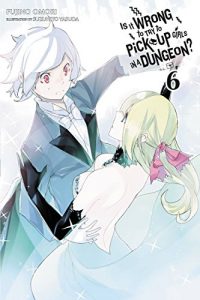
Is It Wrong To Try To Pick Up Girls In A Dungeon?, Vol. 6

September 13, 2016 by Sean Gaffney

By Fujino Omori and Suzuhito Yasuda. Released in Japan as “Dungeon ni Deai o Motomeru no wa Machigatte Iru Darou ka?” by Softbank Creative. Released in North America by Yen On. Translated by Andrew Gaippe.

I spent a lot of time in my last review complaining about Book 5’s use of Hestia as a character, so it feels especially good to see how well she fares here. In a volume where her entire life with Bell is destroyed and then offered up as sacrifice to an arrogant God, she shines, not in terms of being a badass but in terms of doing what she’s meant to do best – unite people who care about each other and get *them* to fight. After spending most of the last volume jealous of various women’s dealings with Bell, especially Lily, she doesn’t even think twice about rescuing her from Soma Familia’s clutches. And then there’s her confession to Bell, which sadly takes place during a deadly escape so she can’t press more. That said, once again, Bell just doesn’t see you that way, Hestia.
danmachi6

The girl he does have romantic chemistry with is of course Aiz, though it’s arguable whether that’s only on his end – I remain convinced that Aiz is not so much confused about her love for him as confused about her jealousy of him. Still, their dance at the Gods’ ball is a highlight of the book, and we get another round of training the only way Aiz knows how – beat Bell up till he learns. There’s also some new additions to Hestia Familia, taking it over the count of ‘two’ we’ve had for the first five books. No, not Aiz, but Lily, Welf, and Mikoto (remember her? From the last book?) all join up in order to help Bell and Hestia, though Welf and Mikoto may only be there temporarily. When they all combine, and with the aid of Lyr from the bar once again showing off how badass she is while trying not to reveal her true identity, they’re unstoppable.

They are perhaps a little too unstoppable, and yes, there’s elements of male power fantasy here. Speaking of which, the main villain this time around is Apollo, whose followers are all basically picked up by him because he wants to sleep with them, but are nevertheless very competent – and arrogant, as Bell finds in the first of the book’s four extended fights, which in page count take up nearly 3/4 of the book itself. I was a little irritated at the ‘depraved bisexual’ trope being played completely straight, especially when we’ve seen Freya’s desire for Bell played with a lot less creepiness in previous books. The other flaw in the book is during the battle for Lily at Soma Familia – Lily overcoming the power of the wine/drug to beg that she be able to help Bell is a powerful scene, but Soma is *such* a cipher that it’s not as big as it can be.

So now, at the end of Book Six, the cat is out of the bag as far as Bell Cranel being a badass. Everyone in the entire city watched him and the Familia stomp Apollo’s people, and Hestia’s secret isn’t anymore. I suspect that will affect the next book greatly. Before that, though, we have a spinoff coming in October, which will deal with Aiz and her adventures in the Loki Familia. Usually we get spinoff manga, not novels, so I’m looking forward to this. As for the main series, this volume is absolutely worth your time.

Filed Under: REVIEWS

The Devil Is A Part-Timer!, Vol. 5

September 11, 2016 by Sean Gaffney

By Satoshi Wagahara and 029. Released in Japan by ASCII Mediaworks. Released in North America by Yen Press. Translated by Kevin Gifford.

As the series has gone on, the astute reader may have realized that Enta Isla is not simply a place where fantasy devils and angels lived, but a place where an actual War in Heaven broke out and humans were caught in the middle. In other words, where I’d mentioned before that the series was a bit like A Certain Magical Index in the way that it used religious themes for its own ends, I apparently didn’t know the half of it. Here we see Angels descending to Japan to try to discipline one of their own, and Maou gets caught in the middle because a) it’s his series, and b) Chiho ends up hospitalized due to a series of unfortunate coincidences extending back to the start of the series.

devil5

Of course, the main people who get character building here are not Maou and Chiho, but rather Emi and Suzuno. Emi is forced to deal with the fact that her mother is in Japan, her father may be alive, and her very EXISTENCE is an affront to Heaven. And Suzuno, who had already had a bit of a crisis of faith in the second book, is now having to deal with the fact that the Angels who inhabit Heaven may not be all that angelic, and in fact may simply be equivalent to just another gang. Again, using Western religious imagery as the impetus for fantasy plotting is not unique to Japan, but it works particularly well here as we come to realize that there really aren’t good and bad guys here, just a bunch of people struggling for power and worship. That said, I do still want to find out one day why Maou was so horrible pre-series.

To be honest, though, the real joy of this book isn’t really the plot revelations or the depth of character. It’s not even the action sequences, or the sight of a busty teenage girl in pink pyjamas flying though the air and firing beams of energy. No, it’s the entire cast spending the first third of the book discussing digital TV and what makes really good udon. Devil Is a Part-Timer has good backstory, don’t get me wrong, but the best reason to read it is still the tiny minutiae of life in Japan as being lived by a bunch of fantasy heroes. Rika’s stunned reaction when none of her companions know who Toshiba is; Maou’s middle management skills saving the day once again and coming up even in the oddest situations and possibly best of all, Suzuno’s obsession with the delicious cheap udon they get at once shop. It’s simply fun to read.

I could say that about the series as a whole. Everyone’s likeable by now – Emi gets less tsundere by the book, though she’s still got a ways to go – and the prose is smooth and clear, one of the best of Yen On’s light novel efforts. It’s still in the top tier of light novels currently being released.

Filed Under: REVIEWS

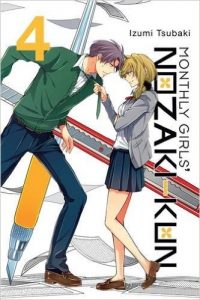
Monthly Girls’ Nozaki-kun, Vol. 4

September 8, 2016 by Sean Gaffney

By Izumi Tsubaki. Released in Japan as “Gekkan Shoujo Nozaki-kun” by Square Enix, serialization ongoing in the online magazine Gangan Online. Released in North America by Yen Press. Translated by Leighann Harvey.

For those who greatly enjoyed the Nozaki-kun anime, this volume in particular contains some of the most beloved parts of that anime. Here is where you can find Hori desperately trying to teach a lazy Nozaki about background, which leads to the wonderful “Lately everyone’s been really into boxes!”. We have Nozaki, Hori and Wakamatsu playing the otome game, and boggling at the “good-heartedness” of the lead girl, even when it turns out she can date Satan. And we have the festival, which doesn’t have the sweet ending the anime tacked on to make it more of a finale, but does have Wakamatsu thinking Kashima is a guy and Seo’s date, and the beloved candy apple eating. Basically, everything here is a gem.

nozaki4

(Also, we have that cover, which is absolutely wonderful. You don’t normally think of this title as being sexy, but trust Seo to upend that with one pull of a tie.)

We also meet the rest of Nozaki’s family, though his brother is the one who will actually show up on an occasional basis in future. Like many manga families, the children turn out to have similar personalities to the parents, though both Nozaki and Mayu both seem to be a bit more like their stoic mother. Mayu actually manages to top Nozaki in the “can’t be bothered” sweepstakes, which makes it even more amusing later in the book when he’s paired with the emotionally draining Mikoshiba. Indeed, circumstances have them both end up at the apartment of Tanuki manga author Miyako’s apartment, and Tsubaki shows us why much of the comedy that comes from Nozaki-kun can simply be taking people who’ve never interacted and throwing them together. Turns out their strip, who knew?

And of course there’s Nozaki’s manga, which continues to roll along, even if I imagine its core audience must read it for the eccentricities. Ken can’t possibly smooth them all out. Nozaki trying to “surprise” Sakura ends up failing miserably till he’s not trying anymore, at which point he wins her heart all over again. And speaking of non-romance, Wakamatsu still hates Seo but adores Lorelai, which frustrates Nozaki no end. Seo, of course, is quite happy to go along with this as long as it amuses her, but amusingly, when Wakamatsu ends up being too preoccupied with it to be irritated by her, SHE loses interest in singing! Personality-driven comedy needs to keep surprising, which can be especially difficult in titles like these that don’t really allow for character development, and seeing Tsubaki achieve it every volume is fun.

As always, caveats apply: This is a 4-koma book, which the punchline being a shouted “what the heck?” 90% of the time. But if you don’t mind that, this remains gloriously funny stuff, with a cast that’s extremely strange but fascinating nonetheless.

Very few tanukis this time round, though. Alas.

Filed Under: REVIEWS

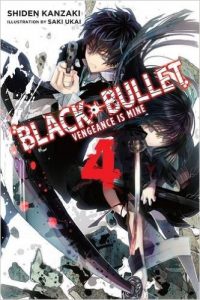
Black Bullet: Vengeance Is Mine

September 6, 2016 by Sean Gaffney

By Shiden Kanzaki and Saki Ukai. Released in Japan by ASCII Mediaworks. Released in North America by Yen On. Translated by Nita Lieu.

I’ve talked before about Black Bullet’s flaws – from its shoehorning of “lolicon’ style humor into the text to its simple unrelenting grimness – so let’s try to take this review to talk about what it does well. Because it does do some things very well. Black Bullet has a plan, and that plan is to let you know about the horrors of war. And over the course of this book’s 220-odd pages, you learn over and over again that the noble soldier fighting an unwinnable fight against an unkillable enemy is something that is going to result in hundreds, indeed thousands of casualties. Sometimes, I will admit, Black Bullet overdoes its message – there’s a scene with a cute 8-year-old getting her head cut off that was just so grand guignol it actually turned silly – but for the most part it’s just a sea of horror that hammers its point home nicely.

bb4

The other excellent thing in the book, though again it’s hard to enjoy, is Kisara. I had been ready to gripe about her being underused in the volume again, particularly as there were many times when we were told that she was the most dangerous and deadly of them all – including by the resident insane tykebomb – but we still don’t actually see her doing anything, given that for the most part Rentaro is the hero of this series and it follows his POV. And then we get the Epilogue, and boy howdy. Kisara discovers that one of her brothers is, in fact, responsible for the decay of the monument that led to the events of books 3 and 4 in the first place, and duels him. It’s interesting, because the brother is presented to the reader as being a Grade-A snake, horrible and loathsome, and you are totally not wrong to want to see her take him out.

No, the issue is that she takes joy in doing so, and, in her chosen method, drives a (semi) innocent bystander insane. Her glee and delight as she discusses her revenge being started reminds you what the subtitle of this volume was, and you realize that it was about her all along. Rentaro is, of course, shocked, as this is not the Kisara she normally shows to him. In fact, he realizes that one day he may in fact have to be the one to kill her if she keeps going on like this. I’m not sure when that will play out – final book in the series, I’m guessing – but certainly his utilitarian views are at odds with her “only evil can combat evil” revenge fantasy. It’s a stunning final 30 pages or so.

Of course, my own personal tastes remain an issue here too. This is well-written, the lolicon was at a minimum, and I enjoyed its themes and what it’s trying to say. I just hated reading it as a book for pleasure. It’s very good, bordering on excellent, but I felt the opposite of enjoyment. It was a slog. As such, Black Bullet remains a series that’s hard to recommend, though fans of the anime and of ‘grimdark’ style series will get a lot out of it.

Filed Under: REVIEWS

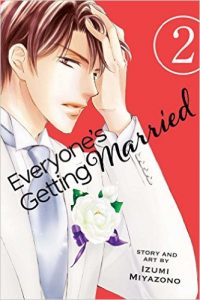
Everyone’s Getting Married, Vol. 2

September 5, 2016 by Anna N

Everyone’s Getting Married, Volume 2 by Izumi Miyazono

I’m always a happy camper when Viz is putting out a josei title, and with two volumes so far in the Everyone’s Getting Married series, I’m very much enjoying a periodic escape into adult romance trials and tribulations as a nice contrast from all the shoujo I usually read.

One of the things I liked very much about the first volume was that the main couple Asuka and Ryu are so clearly attracted to each other and yet their respective goals of becoming a housewife and never getting married are clearly going to come into conflict. Even when they might have attempted to avoid each other, they find themselves getting closer and closer and in a relationship that is going to have a sudden expiration date if neither of them are going to change.

While Asuka and Ryu are more emotionally connected than ever, they find that their hectic work schedules prevents them from seeing each other very often, causing a bit of tension. Ryu also finds himself enjoying some of the extra homemaker type things that Asuka does a little too much, as she’s able to whip up dinner at short notice and do some extra things to help him through an extra demanding time with his news anchor job.

They manage to navigate their first big fight and end up stronger than ever, but one of the things that I enjoy about this manga is that both characters are sympathetic, their points of view about life are intrinsically opposed, and I’m left rooting for a solution but I can’t picture how they’re going to pull it off. This ends up amping up my curiosity about what is going to happen in the story quite a bit, so I’m eager to see how everything progresses.

egm2

Filed Under: REVIEWS Tagged With: everyone's getting married, Josei, viz media

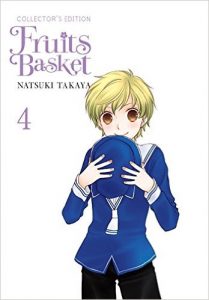
Fruits Basket Collector’s Edition, Vol. 4

September 4, 2016 by Sean Gaffney

By Natsuki Takaya. Released in Japan by Hakusensha, serialized in the magazine Hana to Yume. Released in North America by Yen Press. Translated by Sheldon Drzka.

As I’ve said a few times before, you can usually tell when a series has suddenly become a big hit by the writing. Fruits Basket has hit it big, to the point where the Hakusensha editors must have told Takaya she can stretch it out how she wants. And so we can get extended flashbacks devoted to Uotani, Tohru’s yanki friend, and how she went from a middle school delinquent to one of Tohru’s strongest protectors. We also get a brief one-chapter day in the life of Minagawa, the over the top president of the Yuki Fan Club, who like any other teenage girl is filled with doubts and insecurities of her own. And we see foreshadowing that I had forgotten happens this early, as the new Student Council members, whose faces are hidden from us, discuss their interest in Yuki… and Tohru. Are they SECRETLY EVIL? (Answer: no, but it’s a nice ominous cliffhanger that won’t be resolved for a while yet.)

furuba4

We are also introduced to two more Sohmas. I’ll start with Ritsu, as I’m less interested in him. He’s deliberately grating, in a way that irritates everyone not named Tohru, but it’s not without cause, and once again shows us how hard it is to be living with the Sohma curse, or living with someone who has it. Also, his meeting with Micchan is hilarious – they really are perfect for each other. More important to me is the introduction of Hiro, who I suspect will annoy the new reader even more than Ritsu does. Hiro’s a brat, there’s no mistaking it, and what’s worse, he’s smart and insightful but can’t deal with the emotions that go along with that. Throw in a crush on Kisa, and some veiled suggestion that telling Akito he was in love with her was the worst thing ever, and I find a lot to sympathize with. He also pegs Tohru perfectly, albeit rudely, and we start to see the first signs of the cracks showing in her all-loving facade here, as she admits that she focuses on others to the exclusion of her own needs mostly out of desperately not wanting to look hard at herself.

I’d mentioned foreshadowing before, and the other big introduction we see here will have to wait till next time, which is Rin. She’s in hospital, apparently put there by Akito, and judging by the fact that she’s recently broken up with Hatsuharu, seems to be trying to cut all ties – except to Shigure, who she’s convinced can help her. Rin looks scary, to be honest, and given how popular Haru is with fandom, it’s no surprise that she too gets off on the wrong foot in Furuba fandom, only she doesn’t have the benefit of being a cute guy in this female-driven fandom, so it seems worse. Oh yes, and we also get more of the Yuki backstory that was hinted at in the last omnibus, and I feel bad for saying that Akito smothered him – there was just as much abuse as everyone else has had to ensure. Being a Sohma is suffering.

This is about where the anime broke off, with its adapted ending that to this day doesn’t quite sit right with me. It’s also where Takaya hurt her hand, causing the manga to go on hiatus for a year. It stayed popular in Japan, and became huge over here, but I wonder if we may have gotten a second season otherwise. (Probably not – allegedly she had issues with the director, similar to Kare Kano.) In any case, the first few books in Furuba show us sad teens with emotional problems, but as we move forward, the depth of the writing shows that the sadness and the emotional problems have not begun to be plumbed. If you never read this the first time, you’re missing out.

Filed Under: REVIEWS

The Asterisk War: Encounter with a Fiery Princess

September 3, 2016 by Sean Gaffney

By Yuu Miyazaki and okiura. Released in Japan by Media Factory. Released in North America by Yen On. Translated by Melissa Tanaka.

There’s a moment about two-thirds of the way through this novel where the hero and heroine are viewing the city, and she asks to eat at a fast food place. He is somewhat startled by this, as he’s discovered that she’s the princess of a European nation and expected her to only want to go to high-class restaurants. Eventually we do get an explanation for why she prefers to eat there, but her initial response to him is simply that this is fine, right? And that’s sort of how I feel about The Asterisk War. It’s not original by any means. In fact, that’s an understatement. It is so unoriginal that it may actually leech cliches from the books on your shelves that surround it (Go reread them – are they filled with twists?). That said, sometimes you want a burger and fries. And The Asterisk War is very good fast food, which I’d be happy to eat if I’m in a rush.

asterisk1

I will try to describe the plot without just linking to various TV Tropes pages. Our hero is Ayato, a young man who’s just arrived at a prestigious magic academy, one of six schools in the shape of an asterisk that fight each other (hence the name of the series). Supposedly he’s a perfectly normal student with a bit of sword training. In reality, of course, his true power has been sealed by his sister, who is currently missing and whose footsteps he is trying to trace. He has an unfortunate first encounter (if you guessed “saw half-naked”, you get no points as it was too obvious) with our heroine, Julis, who seems like the standard angry tsundere (she wields massive fire powers, because of course she does) but in reality is just bad at dealing with people and somewhat lonely. As Ayato learns about the school, running into a) the buxom and teasing Student Council President who has big plans for him, and b) his childhood friend, a sleepy and emotionless young girl who nevertheless carries a somewhat obvious torch for him, Julis deals with the fact that someone is trying to kill, or at least disable, her before the Big Competition that no doubt will serve as the plot of future books.

Now, if you’ve been keeping score, try to add up the number of other manga, anime, and light novels that the above description sounded like or reminded you of. If you got under ten, you weren’t trying hard enough. (I’m honestly amazed there wasn’t incestual subtext – clearly the author didn’t try hard enough.) But for all my snark, I actually enjoyed this quite a bit. The hero is likeable and strong without being overpowerful, and reacts to half-naked women like a normal teenage boy and not a manga cliche. Julis starts off over the top, but it takes less than half a volume for us to realize that she’s not going to be another tsundere – well, except when the fanservice or comedy requires it, then of course she will be. I’m also very fond of Saya, less because of good writing and more because I simply like that type of character. Same with Claudia.

So there’s nothing here you haven’t seen before. But the fanservice is light compared to other series, the plot twists are predictable but not irritating, and most of the cast is quite likeable. It’s fast food, but it’s filled with stuff you always enjoyed growing up. I’m perfectly happy to take it in and see what happens next. (Also, Chivalry of a Failed Knight doesn’t have its book licensed yet, so schtum.)

Filed Under: REVIEWS

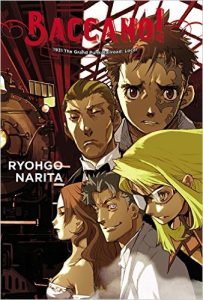
Baccano!: 1931 The Grand Punk Railroad: Local

September 1, 2016 by Sean Gaffney

By Ryohgo Narita and Katsumi Enami. Released in Japan by ASCII Mediaworks. Released in North America by Yen On. Translated by Taylor Engel.

I’ve mentioned before that some multi-volume arcs, particularly in light novels, can be seen as “the author just wrote a really long book and they had to cut it in half”. This book, the first of a two-part arc, is not that. We get the start of the story, but some characters are introduced and then forgotten as if they were meant to be minor characters, while others take center stage but then vanish 2/3 of the way through. But that’s OK, because this is one man’s journey to show some courage, defeat the bad guys because it’s the right thing to do, kiss his girlfriend for the first time ever, and also, yes, smuggle a huge amount of explosives into New York City in order to sell it off, as they are a gang as well – this is Baccano!, after all. Yes, this volume’s heroic journey is all about Jacuzzi Splot.

baccano2

If you find the name Jacuzzi Splot to be somewhat unusual, or even laughable, well, you aren’t alone. Many people in Baccano! have odd names, but Jacuzzi’s is pretty much the one that gets folks talking. More to the point, you may be wondering why this, the second book in a series, features almost none of the characters from the first book. Firo, Ennis, Maiza and the Gandors make brief cameos, but for the most part we meet a new huge cast, which luckily proceeds to get violently whittled down as the book goes on, though in general the named characters seem to do pretty well for themselves. It all takes place on a luxury train going from Chicago to New York City, which has the misfortune to be taken over by a) black-suited terrorists who profess they’re trying to get their leader, Huey Laforet, released; b) white-suited psychopaths, led by a mobster’s nephew, who are here to kill people because it’s fun, and c) the aforementioned delinquent gang, the closest we get to good guys here.

We also get Isaac and Miria, who are the thread that draws the two books together. They’re on the train as well, having decided to rob a mafia gang in order to buy Ennis an expensive present to cheer her up, because that’s the sort of people they are. As always, they’re hilarious, but as with the first book, the novel gives them occasional hidden depths, such as Isaac’s rather subdued reaction to a cabinful of corpses, as if he’s used to this. They’re at their best when inspiring others, though, particularly Jacuzzi, who is the sort to take crappy lines like “there’s a gun… in everyone’s heart!” and take them completely seriously. In general, the new characters hold up well and deserve your attention. Goose is an exception. As a villain, he’s very flat, and probably the weakest part of the book, mostly as he pales next to the evil flamboyance that is Ladd Russo, who is jaw-droppingly horrible in a riveting way. Also, due to the nature of the book, several characters seem to be very underdeveloped, namely the unfortunate child Czeslaw Meyer, and Ladd’s passive to the point of being disturbing girlfriend Lua.

So yes, like Jacuzzi at the end of this book, the reader still has questions. Why did Ladd suddenly disappear midway through the book? Why was a child cut to pieces and tied to the bottom of the train? Who is the Grey Magician and why was he cut from the anime completely? And if the woman in fatigues isn’t the Rail Tracer, who is? (The anime reader is at a disadvantage here, knowing the answers to all but one of those questions. The book reads better if you don’t know the true identity of several people.) We will find out in the third book, which tells the same events as the second but from several different perspectives. In the meantime, smile with Jacuzzi, laugh with Isaac and Miria, and wonder who the hell Claire Stanfield really is.

Filed Under: REVIEWS

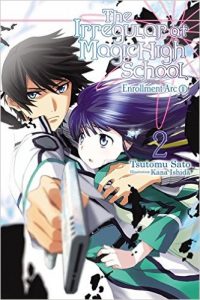
The Irregular at Magic High School: Enrollment Arc, Part 2

August 31, 2016 by Sean Gaffney

By Tsutomu Sato and Kana Ishida. Released in Japan as “Mahouka Koukou no Rettousei” by ASCII Mediaworks. Released in North America by Yen On. Translated by Andrew Prowse.

Multi-volume arcs in light novel series are nothing new, and quite popular. The usual thing to do is a two-volume arc, though they can balloon up to 5 (Baccano’s 1935 arc) or even 10 (SAO’s Alicization arc). It’s rare to see a series begin with a two-volume arc, and as you read the second volume of Mahouka (as the series is commonly abbreviated to), you guess why – this was originally one huge book that the publisher demanded be cut in half. The author admits this in the notes at the end. As such, it’s not something meant to be taken in on its own, and doesn’t try to be. It’s the second half of the first book, with a few more terrorist attacks and less school prejudice.

irregular2

There’s a lot of talk in these volumes, both in regards to how magic works in the world and in how the political landscape is affected by it. The narration is very much down on the side of those with magic, but at least tries to understand the viewpoint of one who does not have such magic skill, and has to look on in envy and frustration at those who do. In fact, I felt one of the biggest flaws of this book was towards the end, where it was revealed that the cute kendo girl who was working for the bad guys was doing so mostly due to simple mind control, rather than her own misguided beliefs. I suppose the author wants to keep her around rather than expel her, but still, you’d be surprised how often misguided beliefs are a good enough reason on their own and don’t need extra help.

I said this last time, and I will again: I have no idea how the anime handles Tatsuya’s thought process, which is constant throughout the book, but if it simply cuts it and goes with what he’s saying out loud, that’s a horrible mistake. There’s several times throughout this book where he’ll say something and then think to himself that he’s saying that just to go along with the flow, or put people off their guard, and that his feelings are almost the opposite. This even applies to the unfortunate incest subtext that’s still hanging around. It’s not all on Miyuki’s end, and we can see that she and Tatsuya both play it up to the hilt because they know if they exaggerate it that others will dismiss it – as Erika seems to here. Of course, this does not mean it isn’t there.

There’s also a lot of fighting towards the end, and it’s reasonably well done, though of course it does point out that Tatsuya is, shall we say, good at nearly everything. This is not going to change anytime soon, and he’s hardly the worst offender in light novels, but it can be frustrating to an audience that is seeking out a more flawed hero. It’s especially frustrating when combined with his stoic personality, though that can also be a blessing, as imagining Tatsuya as some shonen hothead but with the same abilities gives me a headache. In the end, this was a decent if flawed start to the series, and the next two volumes (this time seemingly intentionally written as an actual two-book series) look to show off an athletics festival between the various schools. Note this comes out in North America at the exact same time as A Certain Magical’s Index’s 2-book athletic festival series, which is an amusing coincidence. Fans of Index, SAO, or magic schools might find Mahouka worth getting.

Filed Under: REVIEWS

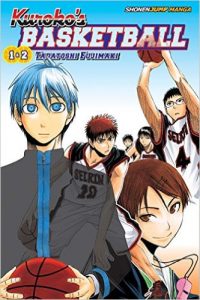
Kuroko’s Basketball, Vols. 1 and 2

August 30, 2016 by Anna N

Kuroko’s Basketball Volumes 1 and 2 by Tadatoshi Fujimaki

I enjoy a good sports manga, and this omnibus of the first couple volumes of Kuroko’s Basketball was entertaining, due to a unconventional protagonist.

kb1

The manga opens with a bit of a prologue discussing an unbeatable team at Teiko Middle School that was split up and scattered as the team members, known as “The Miracle Generation”, all went to different high schools. While five players were the superstars, there were rumors of a shadowy sixth man who was actually the key to the team’s success. Flash forward to the present day at Seirin High School, all the clubs are out in force trying to recruit new members. Taiga Kagami is an intense first-year student with a superior attitude because he played basketball in the United States who signs up for the club. Tetsuya Kuroko, an unassuming student who formerly attended Teiko signs up for basketball as well.

Taiga is drawn to look a bit like Hanamichi from Slam Dunk, and while both characters share a brash personality and an abundance of natural talent, Taiga isn’t as idiotic as Slam Dunk’s protagonist. The fact that the manga is called Kuroko’s Basketball is a signal that the stereotypical idea of who the hero is in sports manga is going to be subverted a little bit. It turns out that Kuroko has a unique talent of appearing invisible when he’s playing basketball, which turns into an incredible advantage for the Seirin team, as he’s constantly overlooked and underestimated, only to make key passes and plays for all the other players on his team.

Kuroko’s unassuming nature is often played for laughs, as he frequently seems to pop out of nowhere when he’s just overlooked. His talent doesn’t come without a lot of hard work, as when he’s actually playing a game he is paying such close attention to everyone around him and adjusting in response to opposing players, that he can’t log a significant amount of minutes devoted to basketball invisibility without becoming exhausted. The first couple volumes shows the Seinen team coming together under their bossy girl coach Riko. She begins to get a sense that with Kuroko and Taiga on the team, she may be able to build the Seirin team into something special.

I feel like after reading Slam Dunk, the art for any other basketball manga is going to suffer in comparison, especially because as Slam Dunk wrapped up the art was so glorious. But comparing other manga artists to Inoue is like comparing people to Kirby, just fundamentally unfair. So I suffered a few involuntary pangs of wanting some mindblowing basketball action paneling in Kuroko’s Basketball, but on the whole, it was easy to follow all the action in the basketball games, and Kuroko’s deadpan expression is used effectively to provoke a variety of reactions in his teammates.

As this omnibus volume was wrapping up, a tournament style struggle is set up, with the Seiran team placed in a position where they are going to have to face off against other high school teams, each with a standout player from the Miracle Generation. Kuroko is now playing only for the love of the game, he comments that he didn’t want to play with anyone from his former team because they were so focused on winning at all costs, they weren’t truly appreciating basketball. The dynamic that will be explored in future volumes is if Kuroko’s abilities combined with his new team will actually mean that the sixth man will emerge triumphant. I have to say I’m very happy that with Kuroko’s Basketball, Haikyuu!!, and Yowamushi Pedal (which I haven’t read yet), there is a bumper crop of sports manga coming out in English right now.

Filed Under: REVIEWS Tagged With: Kuroko's Basketball, Shonen, viz media

A Certain Magical Index, Vol. 8

August 30, 2016 by Sean Gaffney

By Kazumi Kamachi and Kiyotaka Haimura. Released in Japan as “To Aru Majutsu no Index” by ASCII Mediaworks. Released in North America by Yen On. Translated by Andrew Prowse.

For the most part, the Index series has Kamijou Touma as the viewpoint character, with most of the books being from his perspective. The exceptions we’ve seen are the 5th book, which has a substantial chunk from Accelerator’s POV, and this novel, which has Shirai Kuroko taking center stage, though honestly the way the book is framed also seems to imply that she really shouldn’t be doing this. Not that she isn’t badass and awesome – she does a number of amazing things throughout the book – but the book puts her through even more damage than Touma, and suggests that this is sort of the thing that happens to protagonists. In addition, she and Touma have the same general outlook as to why they’re getting involved, at least when Misaka is involved – protect her worldview. And if Misaka is an optimistic girl who thinks people are basically swell except a few bad apples, then by god it will be so. Which is fine, except Touma is much better equipped to take on said world, which has a lot more to it than Misaka’s clone experiment.

index8

Introduced in this volume: Uiharu Kazari, Kongou Mitsuko (For once I refuse to acknowledge Yen’s official spelling), Musujime Awaki. Technically we’d seen Awaki twice before, but we didn’t know it was her. Continuity-wise… eurgh. This is the volume where it’s very clear that this is being written before A Certain Scientific Railgun has really gotten off the ground – it comes out a full year before the Railgun manga debuts. As such, Uiharu’s characterization seems very odd with her obsession with being ladylike. The “teasing Kuroko” thing is still around, though, and Kuroko still does not react well. This is right around the time Kongou is introduced in the Railgun manga, which is why it sounds like she’s meeting Kuroko for the first time, and talking about Cliques. That said, in the anime, where she’s introduced much earlier, this makes no sense. This is why spinoffs give me a headache. Oh, and Accelerator and Last Order are still in hospital, being watched by Aiho, who it’s revealed here is friends with Yoshikawa Kikyou.

Whenever I’ve discussed Kuroko before, I’ve said I’ll save my beef with her till this review, and here we are. So let’s face it: Kuroko is a “Comedy Lesbian”, something much beloved among Japanese anime and manga authors. Kuroko is a bit more single-focused than many others, but exhibits the same symptoms – a constant desire to get into Misaka’s pants, even if that means sexually assaulting her without her consent. This is OK to the reader because it’s clearly meant as “comedy” scenes, not to be taken seriously, and Misaka always fends her off. It drives me nuts. It particularly drives me nuts as whenever she’s not in that mode, Kuroko is quite a nice character, devoted to keeping the peace as part of the student task force “Judgment”. At least I won’t get as much of it in the novels, where Kuroko is a minor character by dint of simply not being all that involved with Touma.

The storyline itself ties together many of the loose ends from Books 3 and 5, as Awaki helpfully notes, being very much in the “school of villains who love to hear themselves talk’. She is very clearly set up to be a dark counterpart to Kuroko, right down to similar hairstyles and similar powers – they’re both even Level 4! But Awaki’s villainy is based around selfishness and fear, and Kuroko’s heroism, comedy lesbian antics aside, around selflessness and pride. There is much discussion of the powers that Academy City is developing, and how students who are found to have that kind of power really feel about them. There is also a LOT of technobabble, and Kamachi’s flaws as an author sometimes become apparent in that he will get more excited about his worldbuilding than he will about what’s actually going on. That said, the fights in this are top notch, and Accelerator vs. Awaki at the end has a great quotable line.

So another good book for Index fans, and quite short too – I think it’s the shortest in the series to date. Next time won’t be that, though, as we get Index’s first two-book arc, devoted to the Citywide School Athletic Festival.

Filed Under: REVIEWS

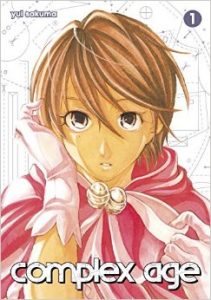
Complex Age, Vol. 1

August 29, 2016 by Michelle Smith

By Yui Sakuma | Published by Kodansha Comics

complex1

Twenty-six-year-old Nagisa Kataura is a perfectionist when it comes to cosplay. As a result, she has a tendency to critique the subpar efforts of others, but when she overhears a critical comment at an event that might be directed at her, she is suddenly plunged into self-doubt. Self-conscious of her height and age, she’s further troubled when she meets Aya, a younger and more petite cosplayer who is physically perfect to cosplay Ururu, the magical girl heroine Nagisa is most known for portraying.

Before reading Complex Age, it had never occurred to me that the world of cosplay could be so emotionally fraught. What I like best about it is how Sakuma is using this niche fan culture to explore universal themes like realizing you’re actually not the best at the thing that you love and struggling to accept that though you may not be perfect, you still have something unique and worthwhile to bring to the table. (I also enjoyed learning about things like how to make a custom wig.)

Another important plot thread is that Nagisa is hiding her hobby from most of the people in her life. She doesn’t want anyone’s negativity to defile her world, nor does she feel compelled to ask them to understand her. We glimpse her a few times at her temp job—and I have to wonder, are her work clothes a costume of their own?—where she doesn’t socialize with anyone except a snooty full-timer, only to end on a horrible cliffhanger as said full-timer spies her at a cosplay event.

I was pretty disheartened to find that, instead of the resolution to that encounter, we were getting the original one-shot instead. However, I was in for a pleasant surprise, because rather than an earlier iteration of the same story, the one-shot version of Complex Age is more of a companion piece, exploring similar themes as married thirty-four-year-old Sawako must decide whether it’s time to give up her Gothic Lolita fashions.

Ultimately, I enjoyed Complex Age a lot and look forward to volume two!

Complex Age is complete in six volumes. Kodansha will release volume two next month.

Filed Under: REVIEWS Tagged With: Yui Sakuma

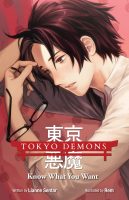
Tokyo Demons: Know What You Want

August 26, 2016 by Ash Brown

Tokyo Demons: Know What You WantAuthor: Lianne Sentar
Illustrator: Rem, Romy-chan, Tacto

Publisher: Chromatic Press
ISBN: 9780993861185
Released: February 2016

Ever since reading You’re Never Alone, the first novel in Lianne Sentar’s Tokyo Demons, I have been nearly consumed by everything even tangentially related to the trilogy. I find Tokyo Demons to be remarkably engaging and as the series has progressed I have become increasingly invested in both the story and its characters. Tokyo Demons has a small but very loyal fanbase, so perhaps it isn’t too surprising that it became one of the flagship titles not only for Chromatic Press and the Sparkler Monthly magazine but also for Cherry Bomb, an imprint that provides an opportunity for Sparkler Monthly creators to explore more mature, sexually-charged stories and themes. Know What You Want, released in 2016, is the first Cherry Bomb collection to be compiled. It brings together four Tokyo Demons Cherry Bomb stories–”Building Up,” “Coming Down,” “Never Again,” and “Save Me/Don’t Save Me”–originally published online between 2014 and 2015. The volume also includes illustrations by Rem and Romy-chan and collects “Once,” a related short story previously released in You’re Never Alone, and “Unsaid,” a comic illustrated by Tacto which was created specifically for Know What You Want.

Some of the stories collected in Know What You Want take place before the beginning of Tokyo Demons, effectively serving as prequels, while others actually take place during the events of the main series. Rather than being organized chronologically, the stories are arranged by character beginning with Ayase and Jo who are the two primary point-of-view protagonists of Tokyo Demons. “Building Up” shows Ayase consciously and subconsciously struggling to come to terms with her complicated and conflicted feelings for Kiyoshi while “Coming Down” delves into some of the more unfortunate parts of Jo’s past. The following three pieces–”Once,” “Never Again,” and “Save Me/Don’t Save Me”–form a triptych which turns to Sachi, a somewhat unexpected Tokyo Demons fan favorite, and more specifically to the shifting dynamics of his relationship with Kadoyuki. (Appropriately enough, Sachi is also the character featured on the collection’s front cover.) Know What You Want closes with “Unsaid” which examines Miki, another member of the series’ extended cast, and the painful ramifications of his devotion to Mitsuko.

"Coming Down"Know What You Want epitomizes what Cherry Bomb is all about. The content is mature but it has purpose and meaning behind it. While there is sex, the real focus is on the characters and their relationships with themselves and with one another. The stories collected in Know What You Want provide additional background details and greater insight into the characters and story of Tokyo Demons. The situations portrayed are alluded to within the novels, but reading Know What You Want isn’t at all necessary to understand the main series. Readers who aren’t interested in erotica can still enjoy Tokyo Demons without needing to delve into Know What You Want, but those who are will discover that the collection expands and deepens the already impressive characterization and worldbuilding present in the trilogy. To varying degrees, all of the stories in Know What You Want can stand on their own satisfactorily, but the collection is really intended for people who have read and who are familiar with Tokyo Demons–the stories lose some of their impact and underlying meaning if removed from the context of the series as a whole.

The Tokyo Demons Cherry Bomb stories have been affectionately termed miserotica by both their creators and fans and rightfully so. Know What You Want is an intentionally uncomfortable, heartwrenching, and heartbreaking collection. Many of the characters in Tokyo Demons are teenagers who come from broken or nearly nonexistent families and homes. They are young, awkward, and apt to make terrible but well-meaning decisions in their social and emotional immaturity. While they are strong in some ways they are fragile in others, understandably desperate for and terrified of intimacy and human connection. The characters of Tokyo Demons are all incredibly well-developed and relatable, but it’s Sachi with his heightened empathy who tends to be the character with whom I most personally resonate. Partly because of this, the fraught relationship between Sachi and Kadoyuki is one of my favorites in the series, so I’m happy to see it receive so much attention in Know What You Want. “Save Me/Don’t Save Me” is a particularly powerful and moving piece (I have honestly cried every time that I’ve read it), but the entire collection is a provocative exploration of the complexities of love, longing, and acceptance.

Filed Under: REVIEWS Tagged With: Cherry Bomb, Chromatic Press, Lianne Sentar, Rem, Romy-chan, Tacto, Tokyo Demons

Otherworld Barbara, Vol. 1

August 23, 2016 by Sean Gaffney

By Moto Hagio. Released in Japan as “Barbara Ikai” by Shogakukan, serialized in the magazine flowers. Released in North America by Fantagraphics. Translated by Matt Thorn.

For many readers, no review is necessary – just seeing the words “Moto Hagio” on the cover will make this a must-buy. But for those of you who have not yet been captivated by one of Japan’s premier artists, let me assure you that this first omnibus volume of Otherworld Barbara is absolutely worth the extra expense of a hefty hardcover. At times melancholy, amusing, heartbreaking and terrifying, it’s a trip through the senses, as with Hagio’s other work that’s recently come out over here (A Drunken Dream). This has the added benefit of being a complete story, and so you can see how she sets up various plot points and then allows them to sit percolating until they can be used again to devastating effect.

otherworld1

I was faked out at first, I admit. We’re introduced to an odd fantasy hybrid of a world, where a little girl who has difficulty flying like her friends do has happy fun adventures, but right away we see that Aoba is odd – eating the book gives it away if nothing else. It’s an odd hybrid of Peter Pan-style fantasy and reality, as there are several quasi-connections with the Tokyo we know. Then all of a sudden we’re away from that, and following the story of Dr. Watarai, a man whose job it is to enter other people’s dreams, and the troubled relationship he has with his teenage son Kiriya, who is a teenage boy in so many ways. I had assumed that the manga would now shift back and forth between the two “worlds”, but no, we don’t go back to the fantasy world till the second half of the book, where it becomes far more relevant – and creepy.

The fantasy stuff is excellent, but the book really shines when getting involved in the interpersonal relationships Dr. Watarai has with everyone from his bitter, slightly hysterical ex-wife to a somewhat overenthusiastic young protege. His fractured relationship with his son feels very real, especially as there are no good, easy fixes. Kiriya is also dealing with difficult times, as aside from his father he’s being courted – well, stalked to a degree – by a classmate, and also dreaming of Dr. Watarai’s latest patient, a woman who’s been in a coma for years ever since a devastating accident involving her parents. Where the two worlds collide is that this woman is named Aoba, and is clearly the same person as the young girl in the fantasy world.

There’s a lot more going on here, including age regression that almost turns into personality overlay, deadly psychic tornados, terrifying killer dolls, and a seeming suicide that makes you go back to the title page for the chapter and say “Really? You really went there?”. It’s definitely not a book for kids. But there’s so much going on here – in plot, which the reader figures out at the same time as the characters do, and in mood, which is always my go-to reason to read Hagio’s manga. things promise to get a lot more complex for the second and final book, as we also find out about a connection to Mars, and a sinister conspiracy led by a not-so-noble priest. If you enjoyed manga that rewards endless rereads with both its art and style, you can’t go wrong with Otherworld Barbara.

Filed Under: REVIEWS

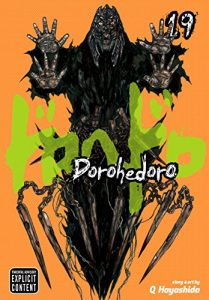
Dorohedoro, Vol. 19

August 21, 2016 by Sean Gaffney

By Q Hayashida. Released in Japan by Shogakukan, serialization ongoing in the magazine Hibana. Released in North America by Viz. Translated by AltJapan Co., Ltd. (Hiroko Yoda + Matt Alt).

I’ve missed Caiman. Yes, there’s a question as to who the real Caiman actually is, but I don’t care, I’ve missed THIS Caiman, the big goofy guy with the lizard head. Nikaido clearly has as well, even though she’s a lot more wary about his appearance than I am, even losing her perpetual happy face for a bit as she tries to work out what happened. Admittedly, what happened it not exactly clear to the reader either: it’s very fitting that when she explains to Caiman everything that’s happened to him for the past year, and asks if he understood, his response is an immediate “No”. I feel you, Caiman. We’ve all been there.

dorohedoro19

After the last volume, I was hoping for a bit less blood and guts, and to a certain extent that’s true, as we exchange it for a lot of scenes of people walking around trying to figure things out or avoid figuring other things out. In addition to Nikaido and Caiman, we have Dr. Kasukabe and Haru, who are trying to outthink our main devil leader and failing rather badly; the decapitated remains of En’s gang, who are having trouble doing much of anything at all, though ironically they may achieve more than the rest of the cast here; and Ebisu and her amnesiac slave, who are just trying to get En’s body back to the rest but are unfortunate enough to be the latest ones to run into Zombie Shin. Hope that goes better for them than it did the last group.

The big fight here is between Haru and Nikaido/Caiman, and it goes very badly very fast. So badly that Dr. Kasukabe is actually killed, and when I saw that I knew what was coming next. Sure enough, after Haru went berserk and annihilated Caiman (who must be getting tired of having his head killed in so many ways… melted this time), Nikaido breaks out her sorcerer’s magic and reverses time so she can stop the fight. This is always a dangerous narrative thing to do. Fans seem to have no issues with resurrecting people from a head in a jar, or a literal hell with devils, or all sorts of other kinds of magic, but time travel to rewrite the past still seems somewhat taboo. Still, we’ve seen Nikaido use it before, and I’m sure we will again, as she has two chances let.

This definitely now has the feel of a storyline that’s building to an ending, though it’s not quite over yet in Japan. I am hoping that the En half of Dorohedoro’s cast herd stops being a pile of body parts and gets to do something soon, and it would be nice to see Shin snap out of whatever zombie funk he’s in. And I’m not sure I want Nikaido being a devil either. With most stories you yearn for the characters to grow and change as the story comes to an end, but I have to admit, I just want my goofy gyoza lovers and violence-happy sorcerers back, please.

By the way, best joke of the volume has to be Caiman getting disgusted by a severed hand on the Store Knife, not realizing that it’s his OWN hand from the aborted future. A joke you can only pull off with Nikaido around.

Filed Under: dorohedoro, REVIEWS

  • « Go to Previous Page
  • Page 1
  • Interim pages omitted …
  • Page 214
  • Page 215
  • Page 216
  • Page 217
  • Page 218
  • Interim pages omitted …
  • Page 346
  • Go to Next Page »
 | Log in
Copyright © 2010 Manga Bookshelf | Powered by WordPress & the Genesis Framework