 Gorgeous Carat caught my eye because it seemed to be a frothy costume drama set in turn-of-the-century Paris, and I’m a sucker for historical fiction. There’s something delicious about seeing another time and place through a sympathetic character’s eyes, trying to imagine what it was like to live during the Napoleonic wars or the Tokugawa era. What’s not so delicious, however, is seeing a contemporary author unconsciously absorb the prejudices of another era and incorporate them into her story.
The premise is ridiculous, but the first volume has a certain flair that carries Carat past its credulity-straining aspects. Our hero, Florian Rochefort, belongs to a French family with a noble name and and not-so-noble debt load. Rather than fence the family jewels, Florian’s mother does what all self-respecting French aristocrats do in yaoi manga: she sells Florian into slavery, delivering him to Ray Balzac Courtland, a distant relative who also happens to be, natch, young and handsome. Florian may be too dense to recognize his growing attraction to Ray, but it doesn’t take long for Florian to realize that Ray is, in fact, “Noir,” a cat burglar who’s the talk of fin-de-siecle Paris. When Florian is kidnapped by a rival gang of thieves, Ray sails for Morocco to enlist an old friend in tracking down his prized possession relative.
…
 GENGHIS KHAN: TO THE ENDS OF THE EARTH AND SEA
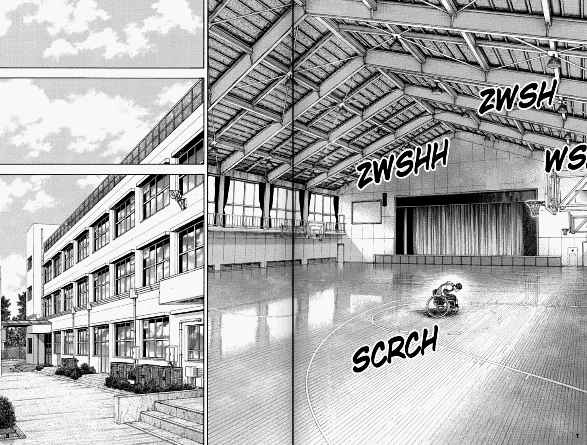
 Slam Dunk may have been the series that put Takehiko Inoue on the map and introduced legions of Japanese kids to basketball, but for me, a long-time hoops fan who grew up watching Larry Bird lead the Celtics to numerous NBA champtionships, Slam Dunk was a disappointment, a shonen sports comedy whose goofy hero desperately needed a summer at Robert Parrish Basketball Camp for schooling in the basics. Real, on the other hand, offered this armchair point guard something new: a window into the fiercely competitive world of wheelchair basketball. Watching Inoue’s characters run a man-to-man defense and shoot three-pointers from their chairs gave me a fresh appreciation for just how much strength, stamina, and smarts it takes to play the game, with or without the use of ones’ legs.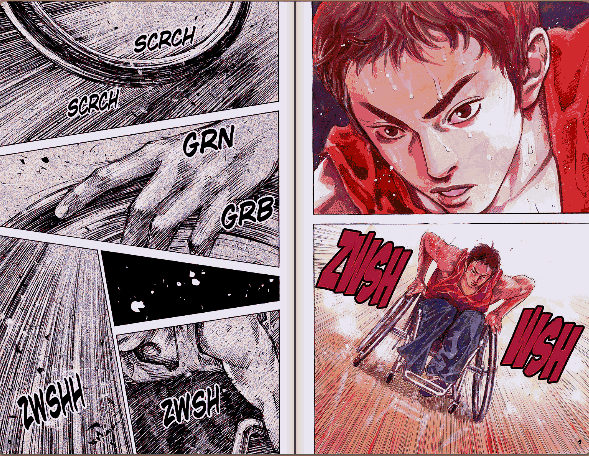
 Remake or retread? That’s the question facing critics whenever someone updates a classic novel or favorite film, be it Pride and Prejudice or The Taking of Pelham One Two Three. A remake brings new urgency or wit to the original story, new clarity to its structure, or new life to a premise that, by virtue of social or technological change, seems dated—think of Philip Kaufman’s The Invasion of the Body Snatchers, which infused a 1950s it-came-from-outer-space story with a healthy dose of seventies paranoia, or Alfred Hitchcock’s 1955 version of The Man Who Knew Too Much, which featured a leaner, meaner script than his 1934 original. Retreads, on the other hand, evoke the letter but not the spirit of the originals, embellishing their plots with fussy details, slangy dialogue, or new characters without adding anything of value—think of Ethan and Joel Coens’ deep-fried version of The Ladykillers, which was louder, cruder, and longer than the 1955 film, yet decidedly less funny.
 Mourning the cancellation of