• Skip to primary navigation
  • Skip to main content
  • Skip to primary sidebar
  • Home
  • About Us
    • Privacy Policy
    • Comment Policy
    • Disclosures & Disclaimers
  • Resources
    • Links, Essays & Articles
    • Fandomology!
    • CLAMP Directory
    • BlogRoll
  • Features & Columns
    • 3 Things Thursday
    • Adventures in the Key of Shoujo
    • Bit & Blips (game reviews)
    • BL BOOKRACK
    • Bookshelf Briefs
    • Bringing the Drama
    • Comic Conversion
    • Fanservice Friday
    • Going Digital
    • It Came From the Sinosphere
    • License This!
    • Magazine no Mori
    • My Week in Manga
    • OFF THE SHELF
    • Not By Manga Alone
    • PICK OF THE WEEK
    • Subtitles & Sensibility
    • Weekly Shonen Jump Recaps
  • Manga Moveable Feast
    • MMF Full Archive
    • Yun Kouga
    • CLAMP
    • Shojo Beat
    • Osamu Tezuka
    • Sailor Moon
    • Fruits Basket
    • Takehiko Inoue
    • Wild Adapter
    • One Piece
    • After School Nightmare
    • Karakuri Odette
    • Paradise Kiss
    • The Color Trilogy
    • To Terra…
    • Sexy Voice & Robo
  • Browse by Author
    • Sean Gaffney
    • Anna Neatrour
    • Michelle Smith
    • Katherine Dacey
    • MJ
    • Brigid Alverson
    • Travis Anderson
    • Phillip Anthony
    • Derek Bown
    • Jaci Dahlvang
    • Angela Eastman
    • Erica Friedman
    • Sara K.
    • Megan Purdy
    • Emily Snodgrass
    • Nancy Thistlethwaite
    • Eva Volin
    • David Welsh
  • MB Blogs
    • A Case Suitable For Treatment
    • Experiments in Manga
    • MangaBlog
    • The Manga Critic
    • Manga Report
    • Soliloquy in Blue
    • Manga Curmudgeon (archive)

Manga Bookshelf

Discussion, Resources, Roundtables, & Reviews

Reviews

Holmes of Kyoto, Vol. 5

June 2, 2021 by Sean Gaffney

By Mai Mochizuki and Shizu Yamauchi. Released in Japan by Futabasha. Released in North America by J-Novel Club. Translated by Minna Lin.

If nothing else, Holmes of Kyoto has let me know that I would be an absolutely terrible detective. Each of my last two reviews has had some equivalent of “well, I was wrong about _____, but I’m pretty sure I don’t have to worry about ________” for a while. And each time I’ve been wring. And I’m wrong again. Fortunately, that’s not the only mystery in this series, which holds an awful lot of genre balls in the air. It’s a travelogue, as we see Holmes and Aoi (and others) traveling to Amanohashidate and getting long scenes explaining why it’s so amazing. We get mysteries, as a Sherlock Holmes society is startled to find they have their own mystery to solve at one meeting. We have the ongoing not-quite-there-yet romance between Holmes and Aoi, and the book sometimes feels like a ticking clock counting down till her 18th birthday. And we get another appearance by Holmes’s Moriarty, Ensho, and their ongoing cat and mouse battle, which is far more deadly serious than previous books. The series gives you bang for your buck.

We get four stories here. In the first, Aoi and Kaori go on a hot springs trip they were invited to before, with Holmes and Akihito tagging along (and Holmes’ dad, so it doesn’t look skeezy) and meet up with Kaori’s sister, who’s now working at the same hot springs… and has a secret. In the second story, Holmes takes Aoi to a meeting of the Sherlock Holmes Society in the area, and there’s also a potentially valuable manuscript… which is promptly stolen. In the third story Holmes and Aoi go to a soccer exhibition match and try to resolve a burgeoning love affair between a player and his ex-teacher. And finally Holmes has to deal with Ensho, who is reduced to burgling the antique shop… as well as dealing with things he’s been putting off for some time.

I want to dance around actual spoilers, so let’s discuss some other stuff. I’ve said this before, but the series is very frank about knowing about what is and isn’t acceptable in terms of an age-gap relationship, and Aoi being seventeen still is mentioned quite a few times. The Sherlock Holmes Society was the funniest part, with lots and lots of Doyle and Holmes trivia (I am amused Holmes saw the manuscript was a fake because of the handwriting, rather than, judging by the summary, because it was mawkish crap). I was also highly amused at Holmes’ soccer fandom, as he talks about the excitement of the local team constantly being promoted and relegated… as if that’s a good thing. That said, the highlight of the book is absolutely the final story, which is 100% thriller. I also have to empathize with Ensho a bit here… Holmes’ “you can achieve anything in life, no matter how poor you are, if you work hard enough” is kind of ergh.

There’s still many, many volumes of this series to go in Japan, and I am curious to see where the series goes from here. If you enjoy mysteries, antiques, or deftly handled college boy/high school girl romance, this is a good read.

Filed Under: holmes of kyoto, REVIEWS

Romance of the Imperial Capital Kotogami: A Tale of Living Alongside Spirits

June 1, 2021 by Sean Gaffney

By Yamori Mitikusa and Tokihito Saiga. Released in Japan as “Teito Kotogami Romantan Kinrou Otome to Oshikake Juusha” by Kotonoha Bunko. Released in North America by Cross Infinite World. Translated by Evie Lund.

When I first saw that this title had been licensed, I thought that the synopsis sounded like one of Viz’s Shojo Beat supernatural titles. We’ve seen a lot of these “young human woman ends up caring for a number of yokai” series there – Kamisama Kiss, The Demon Prince of Momochi House, and Kakuriyo: Bed and Breakfast for Spirits. This one is not quite like that – the yokai are definitely serving her rather than the other way around – but it has a similar vibe. That said, it’s not a copycat, and this is certainly a wide genre to pull from. It also deals with survivor guilt, abandonment issues, and even good old fashioned murderous jealousy. Also, despite the ‘romance’ in the title, this is very much a book using the original definition of that word. Which is good, as for most of the volume the power dynamics between our heroine and any potential partner are too vast to be comfortable, and the heroine is definitely not ready for that anyway.

Our story takes place in not-quite-Japan around the Taisho period – the names have been changed to make it a fantasy, as this is a world where yokai are quite active. To help, the world also has Narrators, whose who can “read the story” of a yokai and control their nature, making them a kotogami. (If you think this sounds like Natsume’s Book of Friends, you’re not far off.) Our heroine Akari, however, despises all fiction and anything resembling a story. She works at a company that, among other things, makes grandfather clocks, lives in the company dorm, and avoids men telling her that she really should get married and settle down. Then one day her apartment burns to the ground thanks to a yokai on the loose. In the chaos, she runs into a police inspector and a kotogami who seem to know more than they’re saying, and ends up staying at a manor house filled with books, all with kotogami in them. Can she recover a normal life? Can she learn to enjoy fiction again? And how is this connected to her tragic past?

As with most of the best novels for women, the heroine is the main reason to read this. Akari is grumpy, practical, clearly hurting but also determined to live life the way she wants, and does not take shit from anybody. She’s also very good at her job (which is not always a good thing… there’s an underlying sexist society here, of which Akari and the author do not approve) and, as it turns out, VERY good at being a Narrator, whether she wants to be or not. Tomohito, the kotogami that she first meets, is seemingly goofy, silly, and a bit pathetic, but readers will be completely unsurprised to see this masks a very different sort of being. The “mystery” of the book is handled quite well, with revelations coming in at just the right time, along with one or two dramatic action scenes. And the supporting cast are also fun.

This is a one-shot, and I think ends on just the right note. I’d like to read more by this author (they apparently have another series out from Earth Star, this one more isekai fantasy), but am content with having read this.

Filed Under: REVIEWS, romance of the imperial capital kotogami

Daytime Shooting Star, Vols 11 and 12

May 31, 2021 by Anna N

Daytime Shooting Star Volumes 11 and 12 by Mika Yamamori

There are so many Shojo Beat series wrapping up! I’m trying to catch up on my reading and get myself psyched for new series. Daytime Shooting Star is by far the most anxiety-provoking Shojo Beat series for me, just due to the situation where Suzume falls in love with her teacher Mr. Shishio. From the first volume, the thing I was most dreading was a “10 years later” epilogue ending where Suzume is out of college, meets Shishio again and they live happily ever after. In this case my worry was unfounded and my expectations built on years of shoujo plot tropes might have made me worry needlessly. It is a testament to Yamamori’s storytelling abilities that this series was regularly on the top of my to-read pile and I was so invested in the story that I kept reading despite my worries.

Daytime Shoting Star 11

I’ve been on team Mamura all along, and it was great seeing Suzume and Mamura actually start tentatively dating. Of course Shishio has an incredibly immature reaction to Suzume moving along is to reel her back in with a confession of his feelings. One of the reasons why I’m so invested in the Mamura/Suzume relationship is that Mamura is unusually insightful, and willing call out Suzume a bit when she’s pretending that everything is ok when something is clearly bothering her. Mamura is putting her peace of mind in getting some sort of resolution over his own desire to move ahead with their relationship. There’s a great and touching scene where Suzume just leans her head into Mamura’s chest to calm herself, thinking “I feel like he’s putting my heart back where it belongs”. What follows is a sports day full of emotional confrontation and drama, as Mamura and Shishio compete in a relay race, Suzume gets injured in her dogged pursuit of bread, and she and Shishio have another emotionally charged talk.

Daytime Shooting Star 12

As the final volume opens, Suzume and Mamura go on a trip to Okinawa with friends, but he pushes her to resolve her feelings for Mr. Shishio. Shishio’s evolution from charming but slightly sketchy to selfish and incredibly immature over the twelve volumes has been something fascinating to see. Yamamori manages to make all her characters charming no matter what emotional issues they’re dealing with, and by the time I finished this volume I was convinced that all the teenage characters were exhibiting a maturity of character and psychological insight that far outpaced any of their adult counterparts in this manga. Suzume has been a charming and irrepressible heroine who has been plagued by self-doubt as she struggled to make sense of her emotions. By the end of this volume, she has clarity and is truly happy, which was wonderful to see. Daytime Shooting Star featured some great humor, stylish character design, and characters who grew and changed, becoming more secure in themselves as the series concluded. Daytime Shooting Star was an extremely satisfying series to read.

Filed Under: Manga Reviews, REVIEWS Tagged With: shojo beat, shoujo, viz media

The Reincarnated Prince and Felvolk’s Greatest Treasure

May 31, 2021 by Sean Gaffney

By Nobiru Kusunoki and Arico. Released in Japan as “Herscherik” by M Novels. Released in North America by J-Novel Club. Translated by afm.

After the end of the previous book, things are going pretty well for the Kingdom Formerly Known as In Woe. The King and his sons are running around trying to slowly fix everything that Barbosse broke, and also trying to track down the corrupt nobles who benefited from it (as opposed to those who were just threatened into obedience). Indeed, the previously unseen Sixth Prince has returned, as he was going all around to various countries trying to gain allies and also get enough evidence to get rid of the thorn in their side, only to find Hersch took care of everything first. Herscherik is buried under paperwork, because oh my god there’s SO MUCH potentially crooked stuff to review, but there’s still time to go out to his favorite outdoor market. While there, however, he runs into the grocer he likes, who asks him to talk to two clearly suspicious people – a young red-haired woman and a man disguising his huge wings. Disguising because being a beastman in Gracia is punishable by death.

Those who recall the events of the third book might be looking at the cover of the fifth book and saying “oh dear, I hope this isn’t a trend”, but no, I’d be a lot crankier in my review if it were. For the most part this book is very good, showing off how difficult it can be to take definitive action when you are running a kingdom and have to obey its laws… even when some of the laws have reasons that are lost to the mists of time. Both “Kurenai” and “Ao” (Hersch is still giving codenames to people, and is still terrible at the names) have suitably tragic backgrounds, are suitably broken and fatalistic, and are cheered immensely be Herscherik basically being himself. We also meet the sixth prince’s bodyguard, Tatsu, who comes from a land that sounds very much like ancient Japan… and he seems to know that Kuro is still hiding some secrets. But that’s future Herscherik’s problem. The current one has his hands full trying to stop another self-sacrifice that ends in death.

The book has several sequel hooks, and the afterword has the author hoping to see us again soon. Unfortunately, when series are licensed from Japanese publishers, we do not get guarantees that the series will go on until a proper ending, and rumor has it that the series has been cancelled by the publisher in Japan. This is a shame, as it has a lot of elements that I quite enjoyed, using just the right amount of “I have my memories as an office lady from Japan”, having Herscherik be ludicrously good at political intrigue but also ludicrously bad at physical and magical things, so he always needs allies to kick asses for him, and good guys you want to root for. Perhaps one day we can get more of this, but until then, I’m glad I read what I did. Plus, as the books have a bit of “and in later years” history text to them, at least we know the good guys won down the road.

Filed Under: reincarnated prince herscherik, REVIEWS

My Youth Romantic Comedy Is Wrong As I Expected, Vol. 11

May 30, 2021 by Sean Gaffney

By Wataru Watari and Ponkan 8. Released in Japan as “Yahari Ore no Seishun Rabukome wa Machigatte Iru” by Gagaga Bunko. Released in North America by Yen On. Translated by Jennifer Ward.

My Youth Romantic Comedy Is Wrong As I Expected may not be exactly the sort of harem manga Hachiman’s read in manga or novels, but it’s still a romantic comedy in the end. It has most of the major things that these series have – Hachiman may be far more cynical and bitter than the old-school potato harem lead, but he still has two main love interests and several others who easily could also slot into that place, such as Iroha and Saki. What’s more, Hachiman has changed, much to everyone else’s relief and Haruno’s disgust. It’s gotten to the point where, even if he can’t even narrate it out loud, he knows how Yukino and Yui feel about him. Yukino knows he knows. Yui knows he knows. All three know how this is likely going to end. And Yui desperately wants to put it off as long as possible, to keep their strong three-person club bond. But we know what happens to anime characters who say “I wish this time could last forever”.

It’s Valentine’s Day! And, naturally, the Service Club are roped into it. There are several people wanting to give chocolate to Hayama, but he refuses to accept any, so they ask our heroes to come up with a way they (Miura and Iroha, of course) can give him some. They end up sponsoring a “how to make your own homemade chocolate” event at the community center, with several boys, including Hayama, invited along as “taste testers”. This is a sensible plan that does not involve Hachiman throwing himself under a bus, so I approve. Unfortunately, someone invited Haruno, and she is absolutely the wrong person to be here, especially on a day like this. What’s worse, Yukino’s mom shows up again, and makes it pretty clear that hanging out with Hachiman and Yui is going to be coming to an end – very soon. Can Yui manage to hold things together, even to the point of taking Yukino and Hachiman out on a… date a trois?

It’s interesting seeing Haruno and Shizuka getting along fairly well in this book, as they’re both trying to drag Hachiman in different directions. Haruno is the sort of person you see talking to the former assassin/soldier talking about how they’ve gone soft and lost the edge that made them cool. Shizuka is urging Hachiman to try to actually say out loud – if only to himself – everything he’s been avoiding in his head. And, of course, Yui (and, passively, Yukino) doesn’t want to give up the wonderful bond she has with the two of them. The date at the end is achingly bittersweet, especially the ferris wheel ride. But sorry, Yui, you are not in a fantasy world where the kingdom has declared polygamy legal, and this isn’t going to end with Hachiman choosing two girls. That said, if this keeps up Yukino may lose by default – Haruno may not be as evil as she’s playing, but I bet mom is.

So yeah, another book that is happy most of the way through with a bitter end. Fortunately, there are no more .5 volumes before the climax, so we’ll be back next time to see how much more things can fall apart.

Filed Under: my youth romantic comedy is wrong as i expected, REVIEWS

Do You Love Your Mom and Her Two-Hit Multi-Target Attacks?, Vol. 9

May 29, 2021 by Sean Gaffney

By Dachima Inaka and Iida Pochi. Released in Japan as “Tsujo Kogeki ga Zentai Kogeki de Ni-kai Kogeki no Okasan wa Suki desu ka?” by Fujimi Fantasia Bunko. Released in North America by Yen On. Translated by Andrew Cunningham.

I can see what this volume was trying to do – well, aside from make an entire volume about Christmas and how it applies to moms and children. Because the main cast are all in their teens (even Porta), we haven’t really had much excuse to delve into the way that moms have to deal with infants and small children, and this volume gives us an excuse to do that. In addition, because Mamako is that sort of mother, we haven’t really gone into what it means to be spoiled or not spoiled in great detail since the (rather comedic) story of Mone and her mother, and combining Masato’s inherent issues, Mone’s unresolved plot and the ongoing travails of Hahako and the Kings is thematically sound. Unfortunately, the need for comedy and fanservice actually serves to turn me a bit against the book this time. I can appreciate the thought behind the plot, but didn’t enjoy reading it.

The main problem with Hahako and the Three Kings is that they’re NPCs literally written to be anti-mom, so changing their minds and accepting Hahako as their parent is well-nigh impossible. Towards that end, Shiraaase and Mamako come up with a Christmas-themed event that will hopefully help things along… especially since a mischievous Shiraaase has made it so Masato and the three Kings are infants. As the events go on, they become toddlers, then young kinds, but unfortunately there’s still a wall that can’t really be broken down between the Kings and Hahako. Unfortunately, the whole situation has to be put on hold when Mone, who’s been quiet and withdrawn through this whole event, suddenly gains a massive hole in her chest that sucks up half the cast. There’s gonna be a whole lotta spoiling going on unless Masato and company can stop it.

There are, I think, two big problems I had with this book. The first is that I’d honestly forgotten about Mone and her “spoil me” tendencies, and so having her as the mini-boss of this volume came somewhat out of left field. The other is that, for once, the parody and humor aspects of Do You Love Your Mom? work against it. There’s a few exceptions – mind-controlled Wise, Mehdi and Porta were amusing, I grant you, as was Shiraaase’s verbal disparaging of Porta’s mother throughout – but everything about Masato as a baby made me want to simply stop reading the series right there and fly to Japan to berate the writer. It’s a small part of the book, only a few pages, but I kept simmering about it through to the end. The books have nudged their way closer to a vaguely serious ending over the ppast few, and this felt like backsliding.

We have two volumes to go, and there’s a hint that the final volumes may be a two-parter, as a “demon lord” who is the final boss is mentioned. (I can guess who this is, but we’ll see.) Those who’ve been reading the series will still want to pick this up, but I was tired reading it.

Filed Under: do you love your mom?, REVIEWS

Accomplishments of the Duke’s Daughter, Vol. 1

May 28, 2021 by Sean Gaffney

By Reia and Haduki Futaba. Released in Japan as “Koushaku Reijou no Tashinami” by Kadokawa Books. Released in North America by Seven Seas. Translated by Alexander Keller-Nelson.

Seven Seas has been circling back a bit now that light novels actually sell and has picked up a few of the books they chose to only pick up the manga for earlier. The one that interested me most is this title, whose manga I had reviewed the first volume of in 2018. Since it’s come out, we’ve seen a boom in “villainess” works, mostly helped along by My Next Life As a Villainess but with a bit of help from this series as well. Unfortunately, the novel coming out now does sort of give the reader the feeling that they’ve read this all before, even though it was one of the first to pull off this plot. That said, the isekai aspect of it is barely touched on, and it’s clear that it’s more an excuse for the author to write political intrigue and worldbuilding. To be fair to the author, they are very good at that. As is Iris, though she’s helped along by a built-in support system.

An unnamed young woman, after being hit by a car in Japan, wakes up inside an otome game she enjoyed playing. Who she was is unimportant, because unlike other villainess books in this genre, Iris Armelia is still fully in charge here. Unfortunately, she’s about to get thrown out of school after bullying the “heroine”, and then exiled to a nunnery. Iris, whose influx of isekai memories has caused her jealous heart to come to its senses, is having none of that. She goes to negotiate with her father and, after proving that she’s no longer a lovestruck young lady, he puts her in charge of their local fiefdom. And it needs someone like her in charge – the economy is struggling, there’s a huge gap between rich and poor, and even basic needs such as medicine are hard to come by. Can a former villainess manage to turn things around? And introduce chocolate to the masses?

The biggest fault here is the same as I mentioned in my review of the manga – for a villainess, Iris certainly seems to have everyone on her side already. Her behavior towards Yuri is explained away by iris (and, indeed, the narrative) as basically a temporary lapse of reason, as for the most part she’s been a sensible and kind young noble, whose ENTIRE servant group comes from orphans she rescued from dying in the gutter. (Is this where all the other books get it from?) She has a capable butler, a doting and incredibly strong grandfather, and her savvy mother, who is such fun to read about you wish that she’d get a multi-volume prequel written about her past by the same author. (Good news on that front, though it’s not licensed here.) And of course there’s Dean, whose secret identity is not so secret to anybody but Iris, but that’s fine – he’s there to save her from literally working herself to death, and also setting himself up as the one non-problematic love interest in her life. Villainess? She’s loaded with allies, and did not even need to fall and whack her head to get them.

I definitely think this is a must for fans of the manga. That said, I suspect fans of “I’m in charge of a country and must reform the nobility” books, such as Realist Hero, might get more out of this than the standard Villainess reader. I’m definitely picking up more, though.

Filed Under: accomplishments of the duke's daughter, REVIEWS

The Demon Sword Master of Excalibur Academy, Vol. 3

May 27, 2021 by Sean Gaffney

By Yu Shimizu and Asagi Tosaka. Released in Japan as “Seiken Gakuin no Maken Tsukai” by MF Bunko J. Released in North America by Yen On. Translated by Roman Lampert.

It’s always the same, isn’t it? You get a thousand-year-old powerful being with a desire to take over the world resurrected, and all of a sudden the bus arrives with ten more. Still, it keeps you busy. this series continues to feel like someone wrote a Shonen Jump manga and, instead of getting it published in Jump, decided to novelize it. Well, OK, this would fit Shonen Magazine better than Jump, especially given the large number of kickass women who like to take baths with our hero. (It’s OK, he’s 10! Right? It is somewhat odd to see the “she looks 8 years old but she’s really 600” cliche used to justify underage fanservice seen in the opposite direction… again, also to help with fanservice.) Fortunately, aside from said bath scenes, this third volume is much like the first two. It will never be anyone’s favorite, but I’m probably going to be reading the next book in the series. And it is starting to show off its plot, though that relies on Leonis being dim.

We’re briefly back in actual classes at the start of the book, as Riselia and Leonis are doing team battles against a top-standing rival. This mostly serves to show the school that Riselia is not “that girl with no holy Sword” anymore, and she can kick ass and take names. She’s also a vampire queen, but that’s still pretty much a secret. The main plot, however, starts when the Third Assault Garden, Riselia’s birthplace and last seen being totally destroyed by monsters, has now floated back into vision… and there’s a distress signal. As such, our team is sent out to see what’s happened. Will Riselia be OK with digging up her past? Who’s behind the distress signal? Can we really work an elf AND an evil priest into the same book and not smack our foreheads? And gosh, who is Roselia reincarnated as, anyway? It’s a mystery…

Again, this is a good book. The girls are likeable and also take on a majority of the combat. The combat scenes are well done, and the villains are also good at being villains. There are some things I was annoyed by. After a second book where a confrontation I was waiting for didn’t happen, the same thing happens here, as Riselia is definitely set up to have a big showdown… that does not actually occur. Instead, she grabs an ancient book. Secondly, it’s gone from amusing to vexing to really really annoying that Leonis is unable to understand, as everyone else who sees her manages to do, including anyone who might see their two names side by side, that Riselia is Roselia’s reincarnation. One of the villains literally dies of happiness on seeing this, but Leonis remains clinically thick about it. As a running gag, it drives me nuts, especially as I expect it’s only going to be drawn out more. (It has been pointed out to be the two don’t look alike, and OK, I can kind of accept that.)

Still, as with previous volumes, this was good enough to warrant my reading more. If you want a great light novel, look elsewhere. If you want a book for an afternoon’s read on the beach, this would be fine.

Filed Under: demon sword master of excalibur academy, REVIEWS

Durarara!!SH, Vol. 1

May 26, 2021 by Sean Gaffney

By Ryohgo Narita and Suzuhito Yasuda. Released in Japan by Dengeki Bunko. Released in North America by Yen On. Translated by Stephen Paul.

It’s been a year and a half since the final volume of Durarara!! dropped in English, and coincidentally that’s also how much time has passed between that book and this sequel. That said, it does not really feel that all THAT much has changed. Some folks have left the city for various reasons, some others have graduated, and we have three new “main characters” to take the place of Mikado, Masaomi and Anri. Of course, “main character” in a Narita work is always a fluid title, and one could argue that this book stars Ikebukuro, in which case nothing has changed. That said, it’s definitely more story than can fit into this book, and the author apologizes for making this a multi-parter right off the bat. There’s a lot of stuff going on. A young man treated as a monster comes to the city to learn how to be human. Another young man is trying his best to be the next Izaya. And a young woman is searching for her missing sisters, both supposedly done away with … by the Headless Rider.

The first three books in the DRRR!! series proper each focused on one of the three high school students, and there’s a sign this sequel may do the same, as Yahiro is definitely the protagonist of this particular book. A young man from Akiba who has spent his life getting attacked and desperately fighting back, to the point where most people consider him to be a complete monster. He hears about Ikebukuro, a place which not only has the Headless Rider but also Shizuo (whose backstory is very similar to Yahiro’s, deliberately so) and decides to go to high school in Tokyo. But finding the Headless Rider is not recommended given the string of disappearances involved with everyone who looks for her. As for Shizuo, well, Yahiro has spent his entire life accidentally beating the crap out of people, so there may be no avoiding it. But who’s gonna win?

As noted, a lot of the “main cast” of the earlier series isn’t here or only shows up later. Shinra and Celty are on a long vacation, Izaya is still AWOL (though he does get a cameo, setting things in motion towards chaos as always), Kadota, Erika and Walker are only mentioned, etc. That said, the new characters blend seamlessly into the cast herd, and there’s so many minor characters in this series that it doesn’t feel like there’s a gaping hole missing. Yahiro is highly likeable in just the sort of way that Mikado never quite managed to be, and Kuon and Himeka also look to have promising, if twisted, stories in the future. It’s clear the city has been in stasis since Izaya left. We see Akane has grown older and is in middle school now, but Shizuo and Tom are still doing the same old thing, as is Simon, as are the Orihara twins and Aoba (he’s still not dating them, mostly as he’s just not into Mairu). Peace is good, but makes for dull storylines. In that sense, I’m grateful to Izaya for siccing Yahiro on the place.

This is a typical DRRR!! multi-parter, in that the cliffhanger ending is fairly mild, but also definitely makes you want to read more. Good news! There are three more books in the series to date. And the next one should be out soon. DRRR!! fans will definitely want to pick this up: it’s like welcoming an old friend back into your life (and then having them destroy your house again).

Filed Under: durarara!!, REVIEWS

The Magician Who Rose from Failure: Tales of War and Magic, Vol. 2

May 24, 2021 by Sean Gaffney

By Hitsuji Gamei and Fushimi Saika. Released in Japan as “Shikkaku Kara Hajimeru Nariagari Madō Shidō! ~ Jumon Kaihatsu Tokidoki Senki ~” by GC Novels. Released in North America by J-Novel Club. Translated by Alexandra Owen-Burns.

As with the first volume in the series, I would describe this book as “solid”. It keeps things interesting, has some fun new characters, balances political intrigue and character development (the first half) with an adventure against villains with lots of fighting (the second half). The protagonist is, of course, a prodigy who is praised by everyone else in the story – need I remind you what genre you are reading? – but he’s still probably the best reason to read this, being mostly sensible but with a core of ludicrousness that pops up whenever he tries to bring in ideas from his Japanese life. Oh yes, and this is still an isekai, but it’s used pretty sparingly, mostly to show why Arcus is a better thinker than the magicians in this world. All that said… as with the first book, solid is all I can give it, and it didn’t really knock my socks off. Magic in This Other World Is Too Far Behind fans are justified in being annoyed.

The book starts off with Arcus’ big invention being shown off to the leading magicians of the Kingdom. We’re briefly shown the group before the presentation, and they’re all stereotypical eccentrics who each have their own agendas and do not get along with others. But the thaumometer blows them all away, to the point where they’d all be fighting to see who gets it first if they didn’t all get one because this was a predictable outcome. After this we jump forward two years and see Arcus as a 12-year-old. The device is still a state secret, but the other kingdoms know something is up, and there are now spies trying to get it at any cost. Arcus joins forces with Orco from He-Man… erm, a mysterious elf, his (ex)-fiancee, his sister, and his “magical partner” to take out the enemy… though he may need help from a passing pirate.

The Arcus generation are all still in their tweens, so romance is not happening yet, but it’s clear that Charlotte likes him and would like to reignite their engagement, and that Sue (who we find out here is the daughter of a duke, though that’s hardly her only secret) is really possessive of him. It’s a love triangle I’d be more invested in if the King had not blithely said he could have two wives as a reward for the magical measuring stick. (Multiple wives getting a bit overdone? Yes.) As for Arcus, he has the fantastic spells, and can sometimes make them devastating (his magic machine gun boggles the mind), but he still lacks the mana to be a powerhouse like his sister (who still adores him). That my change in the future, as he gets a temporary power-up via his elf guide, which implies the same sort of thing could happen again.

In general, the series is better then it’s doing politics and character than battle scenes, which means both volumes so far fall down in the second half. Still, it’s one I’ll be reading more of. As I said, it’s solid.

Filed Under: magician who rose from failure, REVIEWS

Kuma Kuma Kuma Bear, Vol. 6

May 23, 2021 by Sean Gaffney

By Kumanano and 029. Released in Japan by PASH! Books. Released in North America by Seven Seas. Translated by Jan Cash & Vincent Castaneda. Adapted by M.B. Hare.

Towards the start of the Bakemonogatari series, when the protagonist, Koyomi Araragi, meets Tsubasa Hanekawa for the first time he talks about how he doesn’t have any friends as they would “lower my integrity as a human”. This is, of course, the sort of self-assuring bullshit that a lot of lonely teenagers go through, trying to reframe their social ineptness as cool reserve. Eventually, Araragi grows past this sort of attitude. That said, our bear girl Yuna may have a large number of acquaintances from all over the kingdom, but at heart she seems to think much the same thing about having friends, holding herself at a remove from everyone else and telling herself that she’s really a cool, somewhat selfish teenage girl who is not remotely a great hero. Mostly, I think, as she does not want to deal with potentially tragic consequences if she does end up getting closer to others. That said, I don’t think she can keep this up forever. Sometimes you just want to buy your best friend/protege a really cool knife.

As with a lot of books in this series, there are basically two main plotlines. The first has Yuna reluctantly agree to be a bodyguard for Shia and three of her classmates as they go into the woods as part of their classwork. Yuna is only to help them in a dire emergency. That said, once again we are reminded that, to folks who haven’t met her and seen her in action, Yuna is a small girl in a bear costume. (Later in the book, Yuna angrily reminds the other students that she’s the same age as they are – they thought she was much younger.) Needless to say, by the end Yuan wins over the other students AND defeats a hideous tiger monster. Then in the second half of the book Yuna helps Anz, the girl from the seaside city who wants to start her own restaurant, as well as the four young widows who Yuna rescued from the bandits who want to start over in a place with fewer memories.

I mentioned Yuna’s social ineptness above, and it’s never been quite as visible as it is towards the end of the book. The reader may recall that the four assistants Anz has were all raped by bandits and had their families brutally murdered a couple of months earlier. (Remember, cute bear girl series, really. It’s just like K-On!.) They’re there to help Anz with the restaurant, but Yuna decides to also have them help at her orphanage, which she feels is understaffed. One of the young women is CLEARLY distraught over being around children who are presumably the same age as her own children she saw murdered not long ago, but the story is still from Yuna’s POV, and the most we get out of her is a “huh, maybe I should not have done that”. Fortunately, it all works out well, but there is a reason why I keep highlighting the dark bits in this otherwise fluffy light novel series – they’re the most interesting, character-wise.

As the book ends, Yuna is off to battle a cave of endless golems, and we are briefly reminded that this is supposed to be based on a video game. I assume Yuna will win, but… the jagged edges that surround the big pluffy bear girl are why I really enjoy reading this series.

Filed Under: kuma kuma kuma bear, REVIEWS

I Swear I Won’t Bother You Again!, Vol. 1

May 22, 2021 by Sean Gaffney

By Reina Soratani and Haru Harukawa. Released in Japan as “Kondo wa Zettai ni Jama Shimasen!” by Gentosha Comics. Released in North America by Seven Seas. Translated by Kimberly Chan. Adapted by Jennifer Rawlinson.

One of the real joys of reading a large number of novels with the same sort of plot, characters, themes, and plot twists is that when something comes along that is surprising to me, I always enjoy it that much more. Let’s face it, we now have enough “villainess” novels out over here that it’s starting to become old hat. This book is not that, despite featuring many of the same beats you’ve seen before. Our heroine, Violette, is imprisoned after trying to murder her younger stepsister in a fit of rage. She’s filled with regrets and apologies, and swears that if she could only go back to when she and Maryjune were first introduced to each other, she’d do things differently, resolving to never bother her again. And then… she suddenly does return to that day. But she has no memories of a past life, this isn’t an otome game, and she can’t simply avoid conflict. As a result… she falls into depression.

Not to spoil too much about the book, but Violette is not your typical spoiled brat villainess we normally see, but a child of abuse, manipulated by her late mother, who forced her to live as a boy for several years, and then abandoned her when puberty made that impossible. Her father found a mistress he truly loved, and had a child with her, but as for Violette, he can’t stop seeing her mother in her, so is cool and unloving. As for Maryjune, she’s sweet and idealistic, but… she’s naive and VERY idealistic, and was raised as a commoner in a world where you can’t just say “nobility is wrong!” and expect to get away with it. All of this is filtered through Violette’s point of view, and frankly it’s not hard to see why Maryjune’s appearance made her snap. Here, on her second go-round, she just barely holds back, but this does not get rid of the rage, hurt, and loneliness that inhabits most of her being.

While not an “otome game” book per se, the plot certainly resembles that kind of genre, with Maryjune as the “protagonist” to Violette’s villainess. Violette has two allies; her childhood friend Yulan, who adores her but whom she sees as a younger brother type, and Marin, her maid (who was a dying orphan she found on the street as a child… I told you it hit all the standard plot beats), who is sometimes in tears as she sees just what Violette has to deal with every day. Violette tries to avoid the main things that led to her trying to kill Maryjune in her previous timeline, but she’s only gone back in time about a year, so it’s harder to prove that she’s changed. And, above everything else, she’s just so tired ALL the time. She’s resolved to become a nun after graduation, which I doubt will happen, but it does show that far from trying to find a happy life for herself, she’s almost given up from the start.

There’s a manga coming out next month, but I hear that this removes a majority of Violette’s inner monologue (as is common with adaptations), and thus she seems far less depressed and trying desperately to hold everything together. That said, I’m very happy we have this light novel, which shows why the Villainess genre has blown up lately – you can do a lot with it.

Filed Under: i swear i won't bother you again!, REVIEWS

Banished from the Hero’s Party, I Decided to Live a Quiet Life in the Countryside, Vol. 3

May 20, 2021 by Sean Gaffney

By Zappon and Yasumo. Released in Japan as “Shin no Nakama ja Nai to Yuusha no Party wo Oidasaretanode, Henkyou de Slow Life Surukoto ni Shimashita” by Kadokawa Sneaker Bunko. Released in North America by Yen On. Translated by Dale DeLucia.

As far as I can tell, this entire volume had one purpose: to make me feel guilty for calling Ruti terrifying over and over in my previous review. I mean, not to say that she still isn’t a bit much – waltzing past deathtraps that would have destroyed anyone else, taking the killer drug from the previous volume and having it only affect her slightly, and of course saving people when she runs across people who need saving… whether she wants to or not. Indeed, even her companion Tisse, who starts off the book sticking with Ruti seemingly because she’s being forced to, suspects that Ruti is going to turn on her beloved pet spider and kill it, which… isn’t actually true. (The spider’s name is Mister Crawly Wawly, which probably says a lot about Tisse, but let’s move past that.) But in the end, what this book is here to remind us is that behind her hero’s blessing, Ruti is a lonely young girl who HATES being the hero.

In fact, the majority of this volume, at least until the cliffhanger ending, is meant to undercut the previous two. After seeing Ruti as the stereotypical “yandere little sister” sort, she finally is told her brother and Rit are together, and… is not all that happy about it, but does not going on any killing sprees whatsoever. She arrives in town trying to get more of the drug that can kill her blessing, though it’s working pretty slowly so far. It *is* working, though – Ruti’s emotional range widens considerably throughout the book, which also helps to sell what she’s been forced to go through. After two volumes where a “slow life” start was followed by dark content and action scenes, this volume gives us slow life right to the end, with lots of Red and Rit being lovey dovey to each other, etc. Unfortunately, there is that ending… the rest of the hero’s party arrive in town.

I suspect the long term goal for Red and Rit might be figuring out a way to get rid of blessings entirely, though they may earn the ire of the church by doing so. They’re SUCH a liability in this world, with folks who are happy with them outnumber4ed in the narrative by folks who are not. Just as Ruti’s shy, introverted side is transformed by the hero blessing into an emotionless behemoth, so Tisse is an assassin because… well, if she doesn’t kill people, bad things will happen to her, so what choice does she have? (She levels up big time in this book as well, thanks mostly to her emotional support Mister Crawly Wawly.) Everyone is starting to question whether free will is an illusion or not, and this is a fantasy world where that questio9n is very much up in the air. That said, as long as Red is on the side of good they should be fine.

This volume was mostly all slow life, but I doubt the next book will be, as it looks like Ares is going to be having a huge fight with Red. Or Ruti. Or both. Till then,l this remains an excellent example of its genre.

Filed Under: banished from the hero's party, REVIEWS

Adachi and Shimamura, Vol. 5

May 14, 2021 by Sean Gaffney

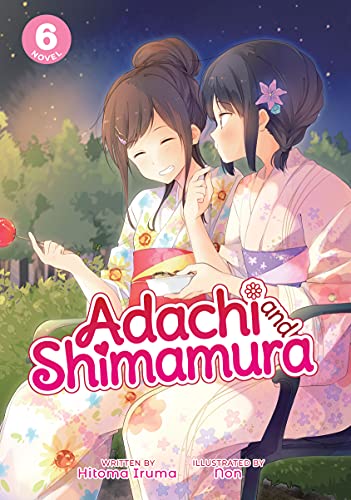
By Hitoma Iruma and Non. Released in Japan by Dengeki Bunko. Released in North America by Seven Seas. Translated by Molly Lee.

o/~ Come on baby now throw me a right to the chin
Just one sign that could show me that you give a shit
But you just smile politely
And I grow weaker… o/~

–Ben Folds Five, Selfless, Cold and Composed

For a little less than half of this volume of the series, it is a very typical Adachi and Shimamura. Adachi stresses out and worries about what Shimamura is doing/thinking and whether any of it involves her. Shimamura, in contrast, barely thinks of Adachi, instead living her normal life and occasionally attempting to have a real human emotion. Tarumi, her childhood friend with a crush that is obvious to everyone but Shimamura, asks to to a fireworks festival, which she agrees to, though of course her sister and Yashiro come along as well. Adachi is also at this festival, working at a booth for her restaurant, and spots Shimamura and some other girl she doesn’t know in the distance. Oh dear, the reader thinks. Now Adachi is going to stress and stress to herself and avoid Shimamura and do all the other little coping mechanisms that she’s perfected over the last four books. Well, reader, be relieved, that does not happen. Instead, we get what must be one of the most epic meltdowns in the history of light novels.

This happens when Adachi is on the phone with Shimamura, trying not-so-subtly to find out who was that lady Shimamura was with last night. When Shimamura is her usual oblivious self not really listening to anything she’s saying, Adachi proceeds to whine. For one paragraph that goes on for almost six pages. A massive block of text. Everything that she has kept suppressed from the start of the book comes out in one long rant, showing off exactly how obsessed with Shimamura she really is, and also how much she really does feel like a child. Every time you flip a page you think it is almost over, but no, Adachi keeps shouting over the phone, forever. Eventually she runs down into hysterically sobbing Shimamura’s name… and Shimamura’s response is our response as well. “So annoying.” (click).

So, as you can imagine, I was prepared for a second half of DRAMA. This is my own fault, as I forgot a) what series I was reading, and b) what Shimamura is like. Adachi, actually showing some gumption after realizing how much she has fucked up, asks Shimamura out, and Shimamura agrees readily, and seems to have completely forgotten about Adachi’s breakdown the previous day. Actually, this is MORE annoying to Adachi, who would like something a bit more than “indifference”, but well, she fell in love with Shimamura, so she has to take what that means. That said, Shimamura does get something out of this whole debacle: Adachi needs more friends that are not her, to broaden her social life. So she tries to rehabilitate Adachi, who goes along with it for a bit, and they invite Hino and Nagafuji for karaoke, but… meh. It’s not remotely fun for Adachi. Now what?

Adachi comes to a big realization at the end of this book, which she can now admit to herself out loud (at least while no one else she knows is around). Shimamura, on the other hand, while seemingly being the mature, responsible one (something brought up here multiple times by others) continues to make me want to scream until the universe finally ends and then keep screaming after that. I worry that even if Adachi does confess, Shimamura’s reaction will be “well, okay” or something like that. Basically, I suspect these two are going to be in a relationship soon, but neither of them should be. At all. What will Volume 6 bring? Dunno, but I’ll read it, if only to scream more.

Filed Under: adachi and shimamura, REVIEWS

Altina the Sword Princess, Vol. 8

May 13, 2021 by Sean Gaffney

By Yukiya Murasaki and himesuz. Released in Japan as “Haken no Kouki Altina” by Famitsu Bunko. Released in North America digitally by J-Novel Club. Translated by Roy Nukia.

Since this volume was released on the same day as the short story compilation, you end up with two Altina reviews in a row. Fortunately, there’s a lot of ground to cover here, as we pick up right where we left off – with Latrielle having just murdered his dissolute father and consort in a fit of disgust. Naturally, this particular part is covered up, but the fact that the King is dead is absolutely not – meaning not only that Latrielle is going to be the next King, but that Altina is no longer in the line of succession. Admittedly, he’s not quite crowned yet. What’s possibly worse is that the military and the crown are finally forcing Regis to return to the capital to get his promotion and title… and no, Altina has an army, she can’t just tag along. That’s right, we’re breaking the fellowship here, and I have a suspicion it may be for multiple books. That said, those who are fond of the low-flame romantic feels in this book might be pleased.

There are, of course, other things going on besides Altina and Regis liking each other and being unable to convey it properly. Regis’ impact is felt on multiple people, especially Clarisse, who may couch it in the form of teasing but clearly likes Regis a whole lot more than she’s ever going to let on. There’s also the matter of Gilbert, the mercenary that was captured last volume, and trying to negotiate so that he’ll join them rather than simply be executed as everyone expects. Unfortunately, the news of the King’s death makes negotiations fall apart a bit. Gilbert’s three sisters are still at large, although they’re a lot less dangerous on their own. And Bastian and Eliza are returning from Britannia after events in the short story collection, meaning there’s another royal to throw into this chaos. With all this going on, there is also personal defeat – Eric’s injury has injured their hand to the point of being unable to use a sword anymore, and Eric is devastated by this.

Despite all the bad news, there is quite a bit of comedy in this book, mostly stemming from Regis’ inhuman self-deprecation, which has actually become a genuine weakness – praise seems to cause him pain. Given that he’s generally considered by everyone not named Regis to be a brilliant strategist, you can imagine how he holds up when he’s escorted by a gorgeous young woman to return to the capital to get a promotion and a title – he’d rather be doing anything else. Altina is also her usual blockheaded, mildly tsundere self – please do not pull anyone into your boobs when you are wearing armor, kid. I get the feeling she’s gonna miss Regis more than he’s gonna miss her, at least in terms of the war. What’s more, given Latrielle assigning Regis as his aid for the immediate future, their separation may be longer than expected.

The author continues to write both this and How NOT to Summon a Demon Lord at the same time, which if nothing else shows off their ability to write in different styles. For those who like a fun, action-filled fantasy with much less fanservice than the other title, Altina remains a solid bet.

Filed Under: altina the sword princess, REVIEWS

  • « Go to Previous Page
  • Page 1
  • Interim pages omitted …
  • Page 95
  • Page 96
  • Page 97
  • Page 98
  • Page 99
  • Interim pages omitted …
  • Page 342
  • Go to Next Page »
 | Log in
Copyright © 2010 Manga Bookshelf | Powered by WordPress & the Genesis Framework