• Skip to primary navigation
  • Skip to main content
  • Skip to primary sidebar
  • Home
  • About Us
    • Privacy Policy
    • Comment Policy
    • Disclosures & Disclaimers
  • Resources
    • Links, Essays & Articles
    • Fandomology!
    • CLAMP Directory
    • BlogRoll
  • Features & Columns
    • 3 Things Thursday
    • Adventures in the Key of Shoujo
    • Bit & Blips (game reviews)
    • BL BOOKRACK
    • Bookshelf Briefs
    • Bringing the Drama
    • Comic Conversion
    • Fanservice Friday
    • Going Digital
    • It Came From the Sinosphere
    • License This!
    • Magazine no Mori
    • My Week in Manga
    • OFF THE SHELF
    • Not By Manga Alone
    • PICK OF THE WEEK
    • Subtitles & Sensibility
    • Weekly Shonen Jump Recaps
  • Manga Moveable Feast
    • MMF Full Archive
    • Yun Kouga
    • CLAMP
    • Shojo Beat
    • Osamu Tezuka
    • Sailor Moon
    • Fruits Basket
    • Takehiko Inoue
    • Wild Adapter
    • One Piece
    • After School Nightmare
    • Karakuri Odette
    • Paradise Kiss
    • The Color Trilogy
    • To Terra…
    • Sexy Voice & Robo
  • Browse by Author
    • Sean Gaffney
    • Anna Neatrour
    • Michelle Smith
    • Katherine Dacey
    • MJ
    • Brigid Alverson
    • Travis Anderson
    • Phillip Anthony
    • Derek Bown
    • Jaci Dahlvang
    • Angela Eastman
    • Erica Friedman
    • Sara K.
    • Megan Purdy
    • Emily Snodgrass
    • Nancy Thistlethwaite
    • Eva Volin
    • David Welsh
  • MB Blogs
    • A Case Suitable For Treatment
    • Experiments in Manga
    • MangaBlog
    • The Manga Critic
    • Manga Report
    • Soliloquy in Blue
    • Manga Curmudgeon (archive)

Manga Bookshelf

Discussion, Resources, Roundtables, & Reviews

Reviews

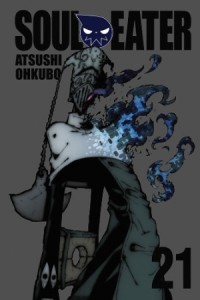
Soul Eater, Vol. 20

May 29, 2014 by Sean Gaffney

By Atsushi Ohkubo. Released in Japan by Square Enix, serialized in the magazine Shonen Gangan. Released in North America by Yen Press.

So much of what has gotten me addicted to Soul Eater comes to a climax in this volume. The discussion of madness and knowledge, and how the two sometimes interact. The artstyle, which lends an air of disturbing surrealism to any actual depiction of madness on the page, from Crona’s twisted grins of despair to a ball of black poisonous concentrated insanity. And of course we have the culmination of Medusa and Crona’s relationship, which has always been shown to be awful, abusive and toxic, but in the final chapter is given even more nightmarish proportions, to a point where there seems to be only one solution to the whole thing. Killing.

souleater20

Speaking of madness, though, I liked the battle between Justin and Tezca, particularly with Justin pounding on about faith in the Kishin, and Tezca wondering how strong a faith can be when it simply switches over to the next big powerful thing to fear/worship. There are a lot of terrifying things going on in the Soul Eater universe, so it’s understandable that one would want to ally oneself with the strongest even if it means sacrificing ideals. I’m not really sure Justin had any ideals to begin with, though – the confrontation loses something as it’s sort of obvious that Justin is never going to go back to the side of the heroes.

There is a scene with Sbhinigami and Kid where they argue about whether they should have gone into Baghdad to find the Kishin just because they knew there were anti-DWMA groups there, with Kid noting that they didn’t find anything, and Shinigami saying he was sure they’d find the Kishin there. I’ll just leave that here. Sometimes something is so blatant that even analyzing it would be overdone.

Maka and Soul get some nice stuff as well, with Soul managing to control the madness with in himself, but I want to talk more about Crona. Crona spends the first half of the book using black blood to destroy and drive insane anything that barrels into Crona’s path. Now in Russia, we see an entire city in the Ukraine where the populace are driven into madness and turn into a huge ball of madness. It’s especially chilling as it’s implied that those people can’t be brought back – that they are, essentially, dead. Like Justin, Crona’s last attempts at redemption seem to have come and gone. Unlike Justin, we still have some sympathy for Crona.

Let’s talk about the final chapter, ‘Just A Simple Story About Killing A Person’. It’s a two-hander between Crona and Medusa, who is at her most monstrous here. Crona’s backstory and childhood is every bit as bad as we feared, if not worse – from the stick-figure styled book about different ways to kill, to being starved to death unless Crona kills adorable baby bunnies, it’s all been designed to drive Crona to the very brink of madness, with Maka’s friendship being the only thing that ever held Crona back. And now Medusa needs to complete the descent, and does it in such a clever way, I almost have to admire her loathsome craftiness. She’s died in the series before, but I’m fairly certain that this time she’s died for good. But she got what she wanted – Crona is primed, ready to go, and completely insane.

As I said earlier, the art plays a major role in making this chapter as effective as it is – stick figures have never been so terrifying. And what’s more, it makes for a truly chilling cliffhanger. And next time, we start the final arc. An absolutely essential volume of Soul Eater. Even those who don’t read it should get it for the final chapter of the book.

Filed Under: REVIEWS

Phantom Thief Jeanne, Vol. 2

May 27, 2014 by Sean Gaffney

By Arina Tanemura. Released in Japan as “Kamikaze Kaitou Jeanne” by Shueisha, serialized in the magazine Ribon. Released in North America by Viz.

When I reviewed the first volume of this Tanemura magical girl title, I noted that her parents splitting up and suddenly moving out of the country looked ‘suspicious’. Well, it turned out to be more prosaic, as in this volume Maron gets notice from her mother that they are indeed getting a divorce, something that sends her running away from everything for a while. I will admit, despite one of those “didn’t you see that they built this amusement part because they love you’ moments, these are still two parents who are not going to be winning awards anytime soon. They’re lucky that Maron has survived with only minor ‘screwed up’ tendencies. The rest of the volume continues to show off Jeanne’s skills as a phantom thief, as well as the author’s skill for giving a touch of darkness to the standard magical girl genre.

jeanne2

Speaking of families, this volume seems to focus on them quite a bit. First Chiaki’s father is possessed by one of the paintings, causing him to kidnap young women and store them in glass cages in his basement (something that really gives maximum creep factor, particularly as his father is such a weirdo to begin with). Then Miyako comes to Jeanne for help, despite their rivalry, and asks her to steal a painting that has corrupted her scientist brother, who is now turning to mad science (complete with “they laughed at me at the academy” overtones). This is all done with maximum threats of peril and also allows Jeanne to show off her skills at being clever, particularly in the first part where she uses the realistic android-like ‘dolls’ to her advantage to pull a switch.

Miyako also gets a side chapter going further into her motivation for chasing Jeanne. I have to say that she’s probably my favorite character in the series, and most of the time she seems to understands how Maron thinks better than she does. There is the small matter of her being unable to connect Maron to Jeanne, but that’s a standard trope of this genre, so I’m inclined to let it slide. (Honestly, given how things are playing out, I would not be surprised if Miyako had figured it out at some point and is just going along with it by now. Particularly when Jeanne is being far too knowledgeable about her brother.)

There is a lot less of the heaven vs. hell aspect in this particular book, with the exception of the final chapter, where Jeanne finds herself in a deathtrap without her transformation abilities or her familiar and has to power up through sheer force of will. This is referred to as “Holy Power”, and seems to delight Finn (who we see far less of this time around, which pleases me as she’s annoying). There is one line that really struck me, however, and I suspect it will be followed up on in the next volume. She’s thanking Chiaki for helping her as Sinbad, and notes “I didn’t know followers of the demon lord used a cross as well.” As she toddles off, Chiaki stares and goes “what is she talking about?” To me this suggests that we’re not looking at a simple battle between heaven and hell. I can’t wait to see more with the next volume.

Filed Under: REVIEWS

Takasugi-san’s Obento, Vol. 2

May 25, 2014 by Sean Gaffney

By Nozomi Yanahara. Released in Japan by Media Factory, serialization ongoing in the magazine Comic Flapper. Released in North America by Digital Manga Publishing.

In general, one of the more disliked traits in manga among Western fandom is the oblivious harem hero who cannot see the obvious crushes that all the girls have on him, and wonders why it is he’s so unpopular. I agree 100% that this can be aggravating, but I have to admit that I am so very happy that Harumi, the start of Takasugi-san’s Obento, is exactly like this. Because the longer he keeps trying to act like a father and close family member to Kururi and doesn’t notice her blushes and googly eyes whenever he’s around, the happier I am. Mostly as despite the threat of this happening, this is a very good manga, with Vol. 2 having lots of great moments.

obento2

I’d mentioned in Vol. 1’s review that Natsuki, the snarky girl who was introduced to be the class bully but actually formed a close friendship with Kururi, reminded me strongly in both looks and attitude of Shinobu from Hakusensha shoujo series Teru Teru x Shonen. That opinion is reinforced by my favorite chapter in the book, where they start a new year only to find that Kururi and Mitsuru, the two that she’d bonded with, are in another class, leaving her alone with all of her former friends and cronies, who are very bitter about Natsuki changing her affections to the quiet weird girl. And so the bully becomes the bullied. That’s not what I liked about the chapter. What I liked was the way Natsuki handled it, being totally aware of what was going on, and then taking the earliest opportunity to gain the upper hand and reassert her position. We do see a teacher talk about stepping in, which is good, but I enjoyed seeing Natsuki being empowered again all by herself.

It also helped that she used a bento to do so. This still is not quite a foodie manga, but food certainly plays a major role in it, with Harumi and Kururi constantly trying new things and enjoying seasonal treats – even if their cooking skills don’t necessarily match up with their intentions. This is true of Harumi in general, who continues to be very awkward with most social interaction, and has a tendency to not think about what others around him might be feeling before he decides on a course of action. This is, of course, part of why he’s still an oblivious harem protagonist. The author’s notes said she has fun with him beign a passive, sad guy. Kururi, on the other hand, is a full-blown introvert, and this is also shown very deftly in several chapters.

Finally, let’s go back to Kururi’s crush. It’s still there, and everyone but Harumi seems to be aware of it. I was very grateful for the expansion of Mitsuru’s role, as he’s not only an age and family-appropriate rival, but his bluntness about liking Kururi and reminding her of it – a lot – is refreshing. That said, that sort of guy often ends up on the losing side in these sorts of mangas. His older brother, who’s in Harumi’s workplace, is more a fan of passive-aggressive poking – his queries at Kosaka are clearly meant to force her to admit that she has a crush on Harumi, and since she doesn’t admit it he wants to go for it as well, but is not as self-confident as his younger sibling. Normally all these harem antics would be annoying, but here they are giving a hint that maybe the manga won’t end like we fear.

Despite that fear, I still greatly enjoy Takasugi-san’s Obento, which hits a lot of my buttons, and reminds me of the old CMX shoujo days, despite being a DMP seinen title. Recommended for heartwarming comedy with lots of food.

Filed Under: REVIEWS

Whispered Words, Omnibus 1

May 23, 2014 by Ash Brown

Whispered Words, Omnibus 1Creator: Takashi Ikeda
U.S. publisher: One Peace Books
ISBN: 9781935548454
Released: May 2014
Original release: 2007-2008

Whispered Words is a nine-volume yuri manga series by Takashi Ikeda published in Japan between 2007 and 2011. It’s probably his most popular work, or a least his best-known work, and the early part of the manga was even adapted as a thirteen-episode anime series in 2009. Despite my interest in yuri manga and the series’ following, I actually didn’t know much about it until I discovered that One Peace Books had licensed the work for English release. Whispered Words, Omnibus 1, released in 2014, collects the first three volumes of the series originally published in Japan between 2007 and 2008. Considering that comparatively few yuri manga have been released in English, I was happy for the opportunity to read more in translation. Because of the excited murmuring from fans surrounding the licensing of the series, I was particularly glad for the chance to read Whispered Words. And, except for some poor editing and lettering by One Peace Books, generally I was not disappointed. Plus, it even has karate in addition to yuri!

Sumika “Violence” Murasame, a high-school first year, is in love with her classmate and best friend Ushio Kazama. Ushio likes girls, too, but the problem is that she only likes “cute” girls. Unfortunately, Sumika has come to the conclusion that she is decidedly un-cute. She’s taller than most people, athletically and academically gifted, and a genius at karate (which is what earned her her nickname). But Sumika would gladly give all of that up to become small, delicate, and cute in order to fit Ushio’s type. That’s not really a possibility, though. So instead of admitting her feelings to Ushio and potentially ruining their friendship, Sumika has chosen to keep them to herself. It’s difficult and can be painful at times, but more than anything else Sumika wants Ushio to be happy. Eventually, other classmates become aware of Sumika’s feelings for Ushio, so it seems that it’s only a matter of time before they become obvious to Ushio as well.

Although at its heart Whispered Words has a fairly serious story about friendship and unrequited love, there is also a very strong comedic element to the series. Personally, I found the silliness of the manga and the characters themselves all to be very charming. For the most part, the underlying story and relationships in Whispered Words are actually fairly realistic. However, Ikeda regularly throws in something completely outrageous, such as an impeccably timed exploding SUV or indulging in his penchant for finding any excuse to dress everyone up in maid costumes. Whispered Words can admittedly be a bit ridiculous at times, but it’s not necessarily a bad thing. Ikeda strikes an excellent balance between the series’ humor and its more serious aspects, making for a read that is both entertaining and heartfelt. Ikeda’s artwork also reflects this duality. He effectively captures the more emotional moments–the tears, the pining, and the heartbreak, as well as the happiness and joy–but he can just as easily slip into a more comedic mode with over-the-top reactions, dynamic expressions, and exuberant poses.

The characters in Whispered Words are what really make the series work for me–not only the two leads, but their friends, families, and classmates, too. I am particularly fond of Sumika and her development, though. She so desperately wants to be something the she’s not, but it’s when she allows herself to really be who she is that she shines. This growth and the evolution of her relationship with Ushio is explored in stages in Whispered Words, often through her relationships with other characters. Tomoe Hachisuka and Miyako Taema, with whom she becomes friends, are a couple that show a lesbian relationship is not something to be ashamed of. Akemiya Masaki and Azusa Aoi are classmates who prove that others already think that Sumika is cute and admire her. The petite Charlotte Munchausen is devoted to karate, follows Sumika’s guidance, and provides an example that strength and cuteness aren’t inherently mutually exclusive. Even when played for laughs, all of these relationships are incredibly important to Sumika and are what allow her to grow as a person and will hopefully allow her to grow even closer to Ushio.

Filed Under: REVIEWS Tagged With: manga, One Peace Books, Takashi Ikeda, Whispered Words, Year of Yuri

Strong in the Rain

May 21, 2014 by Ash Brown

Strong in the RainAuthor: Lucy Birmingham and David McNeill
Publisher: Palgrave Macmillan
ISBN: 9781137278944
Released: April 2014
Original release: 2012

Lucy Birmingham and David McNeill’s Strong in the Rain: Surviving Japan’s Earthquake, Tsunami, and Fukushima Nuclear Disaster was initially released as a hardcover volume by Palgrave Macmillan in 2012, a little more than a year and a half after the country’s threefold crisis that began on March 11, 2011. Both Birmingham and McNeill were established correspondents based in Tokyo who covered the March 2011 disaster–Birmingham writing for Time and McNeill writing for The Independent, Irish Times, and The Chronicle of Higher Education. Strong in the Rain, deriving its title from a poem by Kenji Miyazawa which became something of an anthem for the country and the disaster’s survivors, was later released as a trade paperback in 2014. It was this edition that I had the pleasure of receiving for review through LibraryThing’s Early Reviewers program. I had heard very good things about the original release of Strong in the Rain and so was looking forward to finally reading the work.

On March 11, 2011 an extraordinarily powerful earthquake occurred off of the northeast coast of Japan. Later estimated to have registered at at least a magnitude of 9.0, the earthquake was extremely violent. It moved the main island of Japan as much as eight feet in some areas and shifted the Earth’s axis. Aftershocks from the quake continued to be felt years later. However, the tsunami that was triggered by the earthquake accounts for much of the immediate damage associated with the March 2011 disaster. It wiped out entire communities along the coast and reached much further inland than anticipated. Japan has been subject to massive earthquakes and tsunami in the past, but what made the events of March 2011 particularly devastating was the resulting meltdown of the Fukushima Daiichi Nuclear Power Plant, culminating in one of the world’s worst nuclear crises. Japan’s recovery continues to this day; the country will have to deal with the impacts of the disaster for years to come.

Strong in the Rain is an excellent volume touching on many different parts of the March 2011 disaster. It’s written in an incredibly engaging manner but without sensationalizing the subject matter. Birmingham and McNeill incorporate their own personal experiences and have also conducted a great deal of research and investigative journalism. The narrative of what happened during and after the earthquake, tsunami, and nuclear disaster relies heavily on their interviews with six survivors: Katsunobu Sakurai, mayor of the coastal city of Minamisoma, who would become one of the most publicly recognized figures following the disaster; Kai Watanabe, a pseudonym of one of the maintenance workers at the Fukushima plant; Yoshio Ichida, a fisherman from Soma; David Chumreonlert, an American elementary school English teacher in Higashi-Matsushima; Setsuko Uwabe, a cook at a public nursery school; and Toru Saito, a recent high school graduate who was looking forward to attending Tohoku University that following April.

In addition to the personal accounts of the events surrounding Japan’s threefold disaster, Strong in the Rain also provides a scientific, historic, and cultural context for the catastrophe. The volume includes charts, maps, photographs, as well as a helpful index. Told in ten chapters (in addition to a prologue and epilogue), Strong in the Rain addresses many of the aspects and complexities of the March 2011 disaster: the quake, tsunami, and nuclear crisis themselves, but also the failure of the floodgates and other protective measures, the reaction of the imperial family, how news coverage was handled domestically and by the international media, the evacuation of foreign citizens, rescue and recovery efforts, how survivors dealt with the tragedy and death tolls, and the spirit and resilience of those living in the affected Tohoku region. Strong in the Rain forms a comprehensive overview of the March 2011 disaster and its ongoing effects. Even years after it was initially published, Strong in the Rain remains an approachable and informative work.

Thank you to Palgrave Macmillan for providing a copy of Strong in the Rain for review.

Filed Under: REVIEWS Tagged With: David McNeill, Lucy Birmingham, Nonfiction

Hetalia Axis Powers, Vol. 6

May 20, 2014 by Sean Gaffney

By Hidekaz Himaruya. Released in Japan by Gentosha, originally serialized as an online webcomic, then in Comic Birz. Released in North America by Tokyopop in association with Right Stuf, Inc.

I’ve generally enjoyed each volume of Hetalia I’ve read, and this new one is no exception. This is the first time, however, that I finished it with the feeling that the creator may have taken the concept as far as he can really go. After a brief resurgence last time, we already have less WWII than ever here, and while many would argue that’s a good thing it does sort of make the book feel a bit light. Discussion of tanks and battles has given way to discussions of customs and what the characters would look like as cats. It’s still fun, but something does seem missing here.

hetalia6

The Nordics are on the cover, and they also get most of the early and late pages in this volume. They’re not as well-defined as the other nations, however, with Denmark in particular finding it hard to separate himself from ‘Prussia’ clone every time I see him. I do think that focusing on Iceland’s self-consciousness was a good way to show off everyone at their best, though. A more interesting chapter is the one where Sealand tries to unite all the other micronations and make friends with them. This not only includes Wy, who we’d met before, but obscure places like Molossia and Hutt River.

We do get an African nation introduced as well, but oddly, we don’t know which country she is! Seychelles gets a visit from a fellow African nation, who seems to be landlocked, but that’s about all we can glean from her. I wonder if she’s meant to be a country like the Congo or Sudan, where Himaruya might want to err on the side of caution. (She can’t be Cameroon, we’ve seen him.)

As for the rest of the cast, most of the regulars get something to do, even if there’s little ongoing plot here, even from chapter to chapter. My favorite gags include Hungary trying to sing Prussia a lullaby (Gloomy Sunday, the famous depressing Hungarian song); Spain’s reaction on finding out he’s NOT getting the 2020 Olympics; Berlusconi being so appalling even Italy is ashamed to be talking about him (another ‘isn’t this supposed to be in World War II?’ moment); and of course seeing all the characters as cat personifications, which is not quite as adorable as it wants to be, but is still cute.

Still, at the end of the volume one wonders how much is really left in the tank. I know that we have more genderbending Hetalia coming our way soon, and the series still runs in Comic Birz, though it’s been far more irregular lately. But honestly, the original webcomic has the most obvious plotline to collect – the continuation of Buon San Valentino, and Germany possibly remembering his past – and has not adapted it at all beyond the first section. This could be partly as it’s more ‘obvious’ about its BL than we normally see in Hetalia, but it could just be that that story would lead to a natural ending, and I can’t see Hetalia ending anytime soon, given its cash-cow popularity. But where is it going from here?

Filed Under: REVIEWS

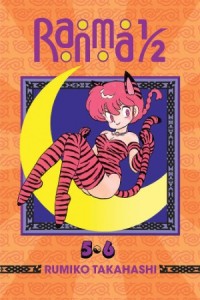
Ranma 1/2, Vols. 3 & 4

May 18, 2014 by Sean Gaffney

By Rumiko Takahashi. Released in Japan by Shogakukan, serialized in the magazine Shonen Sunday. Released in North America by Viz.

(Warning: This is Ranma 1/2 For Experts, basically – I do refer to future volumes a bit here, mostly the next one.)

As we get deeper into the Ranma 1/2 story, it’s starting to separate itself more and more from its predecessor, Urusei Yatsura. This despite adding two characters who are very much ‘based on’ similar UY characters in these two volumes. But while UY ran on escalation – take a situation, put people in it, and watch it expand till it explodes in comedic chaos – Ranma 1/2 almost seems driven by delusion. So many of the characters have a fixed idea of who someone is, what their goal is, or how people feel about them, and that fixed idea drives the comedy. So we have Kuno’s love for the ‘Pig-Tailed Girl’, Kodachi’s similar obsession with Ranma (and inability to tell that he and his girl side are the same person), Mikado’s ladykiller instincts, and even Ryouga’s delusion that all he has to do is defeat Ranma once and suddenly he’ll get Akane and be happy. Everyone in Ranma is deluded for the sake of comedy.

ranma3-4

We start off with Kodachi, who we already know likes to win her matches by disabling her opponent before they begin. Akane isn’t so easily dispatched (in fact, it’s her own misstep that forces her out of the match), so Kodachi resorts to her backup plan – cheating her way through the entire match. Throughout, she bears a strong resemblance to Ryouko Mendou from UY, something that is helped along when we find out that Tatewaki Kuno is in fact her older brother. (Yes, yes, mix and match the romanji. Leave me my bad habits.) Kodachi likewise has a flair for the overdramatic. She’ll stick around, but is probably the least important of the major Ranma harem girls – and the only one who never gets a ‘softer side’, even once we find out about her family situation (we’ve got a few more omnibuses to go there).

Martial Arts Gymnastics in the Kodachi story is followed by Martial Arts Ice Skating with Mikado and Azusa, and I advise the reader to get used to “Martial Arts _______” throughout the entire Ranma series. It’s a useful way to incorporate any silly situation Takahashi wants into the series, and it also serves as an obvious motivator for Ranma, who can’t resist a fight and whose ego says that he’ll always win in any martial arts situation – even if he can’t skate.

Mikado and Azusa are the first ‘arc villains’ we have who won’t be returning, though I think the anime adaptation brought them back a few times. They’re a lot of fun, but there’s not much you can really do with them, and neither of them have either the likeability or over the top madness that tends to bring back the best of Ranma’s recurring characters. I was quite pleased to see that, though they perform as a couple, they don’t actually seem to like each other at all. Azusa (who is Ran in UY with the anger replaced by more cute) also seems to get away with most of the antics she inspires here. Mikado, who sexually assaults Ranma by “stealing her lips”, is a Grade-A creep, however, and he gets the majority of the violence dealt out here.

Ryouga still features heavily here, and his anger remains, but we’re also starting to see his swirling pool of depression, something that will come to define his character for a long time to come. Ryouga is at his strongest when his mood is blackest, but this means that we rarely get to see him be happy. It’s probably not helped that, throughout both of these arcs, Ranma and Akane are still looking quite couple-y. Sure, they grump sat each other, but that seems almost friendly now, and Ranma is quick to whip out the ‘my fiancee’ card. It’s really quite cute.

…and then Shampoo hits the series, literally smashing through a wall and attempting to kill Ranma’s female half. My old memories of this point in the series made me think that it was Shampoo who was a catalyst for what Ranma and Akane will eventually become after this, but to be honest she doesn’t really play all that big a part. Akane’s hair-trigger temper and jealousy just seem to increase naturally, and we see Ranma having to restore her memories later by firing a volley of insults at her, as if all he’s been doing is calling her uncute for the past 3 1/2 volumes. Which isn’t true, as we’ve seen, but it’s another canon rewrite as we read. Ranma and Akane will have their moments from now on, certainly, but there’s a certain tension between them after this arc. Ranma turns to insults more swiftly and loses his ‘I will observe first, then act’ persona. And Akane will distrust Ranma unless proven otherwise… and sometimes even then.

Back to Shampoo, and I will bring up Urusei Yatsura again, sorry. She is clearly meant to be Lum, only here Ranma and Akane have had some time together to make the readers like them, and Shampoo gets a lot fewer ‘cute and likeable’ points. Many have seen this as Takahashi trying to ‘fix’ UY, where she originally wanted Ataru and Shinobu as the couple, but fans and editors made her change it to Lum. The thing is, fans and editors were correct, and I’m sure she realized that very fast. Ataru was the sort of person who worked much better with Lum. But as I’ve noted, Ataru and Ranma are NOT all that alike, and thus the Ranma/Shampoo pairing feels as out of place as Ataru/Shinobu did. He needs someone like Akane, who brings out who he really is – for good and ill.

I was going to discuss Shampoo’s accent, and how it’s dealt with both in the original Japanese and in the English release, but it may be better to save that till Cologne and Mousse show up.

Some random observations… Tofu has already become a one-gag character, and it’s an annoying gag. Kasumi and Nabiki barely appear, though notably when they do they’re trying to fix things up between Ranma and Akane – Nabiki still doesn’t quite have that aura of ‘only out for myself’ she’ll gain later. I quite liked Ranma trying to explain that the tribe’s ‘rule’ that Shampoo had to marry the man who defeated her was ‘from the Stone age’ – he’s absolutely correct, though it does also point out how steeped in ancient traditions Shampoo’s tribe is. And yes, Formula 911 was Formula 119 in the Japanese, but they basically are the same gag – it’s the phone # for emergencies.

By the way, for all that Shampoo is supposedly trying to kill Ranma, she never even gets close. And notably, when she gives the ‘kiss of death’ to Akane, who she’s clearly a superior fighter to, she just wipes Akane’s memories rather than, as Ranma fears, leaving her corpse on the outside of the school. In other words, she doesn’t really look like she’s able to go through with actually killing anyone. We see that again at the end, where Ranma leaves herself open and Shampoo can’t do it – she leaves in tears. It’s a rare serious moment in Ranma 1/2, and sad, because we know that this is the end, and we’ll never see Shampoo again – as she states, and the others imply.

Next time we’ll cover Volumes 5 and 6, where we see Shampoo again. We also get a few more introductions, two major – Cologne and Mousse from Shampoo’s Amazon village – and one minor, Gosunkugi, who is so sad the anime actually wrote him out for several seasons. In the meantime, this was a very enjoyable Ranma volume, and I look forward to gushing more words at you some July.

Filed Under: REVIEWS

Showa 1939-1944: A History of Japan

May 15, 2014 by Sean Gaffney

By Shigeru Mizuki. Released in Japan as “Comic Shouwashi” by Kodansha. Released in North America by Drawn & Quarterly.

As you may have gathered from the dates, this volume covers the majority of World War II – referred to by Mizuki as “The Pacific War”, as it is in Japan. While we don’t neglect the average Japanese civilian back home, there is definitely more of an emphasis on battles, troop movements, and the machinations of war here, with so many Japanese general names flying past you will be grateful there are endnotes explaining who they all are. Interwoven into this is Mizuki’s own storyline, as he continues to fail at most everything he tries until the day he is drafted into the army… and manages to fail there as well, leading to a horrifying cliffhanger.

showa1939

The narration of events continues to be done mostly by Nezumi Otoko, Mizuki’s filthy coward character from Gegege no Kitaro. He’s a bit less noticeable here, as the narration has to move so quickly it doesn’t allow time for anyone to make yokai jokes. Still, only Nezumi Otoko would stand behind Hitler, Mussolini and Tojo and wrap his arms around them in a ‘we’re buddies’ hug. This isn’t to say his narration is biased, though – Nezumi Otoko is quick to point out the lies and deceit that Japan uses to advance its own thirst for power. In addition, the fact that he is sort of ‘out of time’ means that he can have the occasional chat with Mizuki the artist, appearing as himself in a slightly less exaggerated version of the Mizuki we see living though his late teenage years.

General Yamamoto is mentioned early in the book, right around Pearl Harbor, that if he can turn the tide in 6-12 months, everything will go Japan’s way, but if it takes longer, America will end up winning. Most of the focus of this book is that extended narrative, as we see battle after battle where Japan marches in and takes over… and then the tide begins to turn, more men are lost, less land is gained, and the Japanese government decides to start lying to its people about what’s going on – the Battle of Midway’s true casualties weren’t known publicly till well after the war.

And then there’s Mizuki himself. As I said in my first review, I suspect that he is exaggerating his past self for comic relief, but there’s still a sense that this is a young man who cannot stop aimlessly drifting through his life, and is easily influenced by those around him. He’s also beaten, a lot – those who recall Onward Towards Our Noble Deaths will see a number of similar scenes here. The reward for the beatings seems to be rising in rank so that you can beat others in turn, but Mizuki never even gets that far. The most tragic part of the entire book for me when when, assigned to the bugle corps, he finds the job boring and demands a transfer. His superiors try to talk him out of this THREE TIMES, but to no avail. And so he’s sent to the front, and ends up fighting for his life as we get yet another amazing cliffhanger ending.

A whole lot of this book continues to be a history textbook of sorts. But then again, this is a manga written for Japanese people, telling them things that, at the time of its publication (and indeed to an extent today) the government was not comfortable with admitting. As a result, it can be a bit didactic. Mizuki is not entirely condemning Japan – he discusses the Bataan death march, and notes what little choice the Japanese military had there given the climate. But certainly this is more critical than we’re used to seeing, and the facts are so riveting that you’ll find you can’t stop turning the page. Add to this the art style, which continues to shift between photorealism and goofy sketches, and you’ve got a second volume that’s just as essential as the first.

Filed Under: REVIEWS

Whispered Words, Vol. 1

May 13, 2014 by Sean Gaffney

By Takashi Ikeda. Released in Japan in three separate volumes as “Sasameki Koto” by Media Factory, serialized in the magazine Comic Alive. Released in North America by One Peace Books.

This was one of those licenses I’d been waiting for for quite some time. Along with Aoi Hana, Sasameki Koto (released here as Whispered Words) was one of the big yuri manga of the last few years or so. It will seem quite familiar to those who read the genre. The tall, strong, dark-haired girl who does karate and her smaller, more feminine and gorgeous friend. Unrequited love out the wazoo. A cast of eccentric side characters there to help the main couple grow and change. And piles and piles of angst. Does it read well as an omnibus?

whispered1

Actually, I’d argue that the omnibus format was the best way for this series to succeed, as there are a lot of issues with it as it starts off. It’s clearly meant to be more comedic, with Sumika’s crush being portrayed as genuine but subordinate to getting her into awkward situations. More to the point, Ushio can be very hard to like in the first part of this series. And then there’s Akemiya, who’s nice enough, but whose plotline feels like it belongs in another manga, and whose sister is easily the most aggravating character in the series. Were this not an omnibus, I can see a lot of folks giving up after Vol. 2 (which is also where the anime ended, as it didn’t want to overtake the manga).

About halfway through the third section, though, you sense the manga starting to take a more serious and character driven turn. I suspect the writer might have ended things with the folk dance, but was told the series was popular enough to continue, and so started to think about how to take things in a deeper, more fulfilling direction. This starts off oddly, with the addition of Lotte, a tiny German foreign exchange student who idolizes Sumika. But it really points out Sumika’s issues with who she is, and how Ushio has been unthinkingly making those issues harder and harder to overcome. The emotional high point to this volume is really high – Ushio getting upset at Sumika for allowing Lotte to push herself too hard in karate training, and Sumika just losing it and screaming how Lotte likes her for being big and strong – unlike Ushio, the subtext says.

And Ushio gets this, to be fair. A lot of the setup of Whispered Words is of a somewhat shallow, ditzy girl who gloms onto anything cute. A flashback at the end shows that this is pretty much a mask, and Ushio, caring for Sumika after running outside in the rain makes her get a cold (never let it be said this manga doesn’t use manga cliches 100%), starts to wonder what her feelings for her best friend are really like. Is this going to be the moment when the two of them finally get together?

Highly unlikely, we’ve got 6 more volumes (2 more omnibuses) to go. In the meantime, this is a decently translated volume with good reproduction. Sadly, the publisher is tiny, and apparently their budget could not stretch to a copy editor, as there are some bad, BAD typos. They will make you cringe. But I hope that doesn’t stop you from getting this series. The tone is changing to a more serious work by the end of this first omnibus, and I hope that it continues along those lines and we continue to see Sumika and Ushio suffer for their love (in a good way, of course.)

Also, this manga has Kyori, who is perfect. That is all.

Filed Under: REVIEWS

Devils and Realist, Vol 1

May 11, 2014 by Anna N

Devils and Realist Vol 1 by Madoka Takadono and Utako Yukihiro

Devils and Realist is an amusing fish out of water supernatural tale about a young scientific aristocrat and the devils who torment him. The realist of the title is William Twining, an elite member of the English aristocracy who prides himself on his elite status and his logical mind. He makes an uncomfortable discovery when he goes home for a school holiday. His uncle, who was in charge of his fortune has rendered him penniless. William discovers that his house is almost entirely empty and he only has one lone servant left in Kevin Cecil, who is staying on without being paid and learning how to garden for vegetables in the absence of any other food.

William is determined to come up with the money to pay for his tuition, because it would never do for someone of his standing to apply for a scholarship. As he and Kevin scour the house trying to find something valuable, they happen across a hidden room, with a door that is unlocked by William’s blood when he suffers an accident trying to break it down. A mystical spell is invoked and the demon Dantalion appears in grand fashion, only to tell William that he’s now a central figure in the electoral politics of Hell, because William possesses “the Blood of Solomon”. William isn’t ready to believe that he has a mystical connection with a bunch of demons, and invents a series of comically rational explanations for all the supernatural phenomena he’s starting to encounter. Dantalion is joined by other demons, all of who want to win William to their side. William remains stubbornly focused on finishing up his schooling in the human world, leading to additional wacky complications.

There are some parallel themes here with Black Butler, but I found that series to be a bit mean spirited and creepy.
Devils and Realist is more of a gently comedic take on the genre, with William’s stubbornness manifesting in various ways. There are hints that William’s ancestors might not be all that innocent and Dantalion has some hidden motivations that might serve to illuminate his character in later volumes. The art for Devils and Realist is attractive, with particular attention paid to the character designs of the parade of demons which makes it much easier to distinguish them. I enjoyed this volume, and I’ll try volume 2 before deciding to go all in on following this series. I could see William’s realism being used for jokes getting a bit tiring after multiple volumes when he’s surrounded by an army of demons, so I’m interested to see if the author comes up with some other plot devices to keep things fresh.

Filed Under: REVIEWS

The Battle Royale Slam Book: Essays on the Cult Classic by Koushun Takami

May 11, 2014 by Ash Brown

The Battle Royale Slam BookEditor: Nick Mamatas and Masumi Washington
Publisher: Viz Media
ISBN: 9781421565996
Released: April 2014

Battle Royale has recently seen something of a revival in North America in recent years. Koushun Takami’s controversial novel was originally published in Japan in 1999. Both the novel and its manga adaptation illustrated by Masayuki Taguchi first appeared in English in 2003. The novel was released again with a slightly revised translation and additional supplementary material in 2009 by Viz Media’s speculative fiction imprint Haikasoru. (This tenth anniversary release was my introduction to Battle Royale.) However, it wasn’t until 2012 that the film version of Battle Royale and its sequel Battle Royale II: Requiem received an official release in the United States. And now, in 2014, we’re seeing the releases of a new English translation of Takami’s novel by Haikasoru, the recent Battle Royale: Angels’ Border manga illustrated by Mioko Ohnishi and Youhei Oguma, and The Battle Royale Slam Book: Essays on the Cult Classic by Koushun Takami, which is also notable for being Haikasoru’s first foray into nonfiction. Takami’s original novel left a huge impression on me, so I was very excited to read all of these new Battle Royale releases.

The Battle Royale Slam Book, edited by Nick Mamatas and Masumi Washington, collects sixteen essays (seventeen including the introduction by Mamatas) which examine various aspects of the entire Battle Royale franchise. The core of that franchise is of course Takami’s original novel, but The Battle Royale Slam Book also explores many of its manga and film adaptations as well. The contributors to the volume include award-winning writers, academics, fans, and many others from around the world–the United States, Canada, United Kingdom, and even Japan itself are particularly well-represented. I was specifically excited to see an essay by Toh EnJoe included in the volume, but the rest of the lineup is great, too: Nadia Bulkin, Carrie Cuinn, Raechel Dumas, Isamu Fukui, Sam Hamm, Masao Higashi, Brian Keen, Gregory Lamberson, Kathleen Miller, Konstantine Paradias, Jason S. Ridler, Adam Roberts, John Skipp, Steven R. Stewart, and Douglas F. Warrick. All of their essays were written specifically for inclusion in The Battle Royale Slam Book.

The Battle Royale Slam Book includes several types of essays ranging from academic ruminations to literary and film criticisms to the authors’ more personal experiences with Battle Royale in all of its iterations. The topics of the individual contributions are also varied, though some recurring themes do emerge. Many of the essays focus on some of Battle Royale‘s most controversial aspects, such as extreme violence and the deaths of school-aged youth, gender portrayals and sexism, and so on. Other essays position Battle Royale within a greater context, exploring its place within and relationship to not only Japanese popular culture but Western popular culture as well. School literature, professional wrestling, teen films, and other similar subjects are all addressed. The volume also examines the historical context of Battle Royale and its themes. The Battle Royale Slam Book shows how the Battle Royale phenomena has been influenced by, uses, and challenges literary and genre conventions in addition to showing its impact and continuing influence on individual people.

Several assumptions are made with The Battle Royale Slam Book, primarily that the readers are adults already familiar with Battle Royale, have a basic understanding of the novel’s premise, or have been exposed to at least one of its adaptations. It’s also helpful but not absolutely necessary to have some grounding in literature and film, and especially with speculative fiction and horror. The Battle Royale Slam Book will probably appeal most to those who are already interested in or who have already experienced Battle Royale in some form. Though the contributors don’t hesitate to point out the flaws and challenges presented by the Battle Royale novel, manga, and films, it is very clear that they are all either fans or are fascinated by the material and the responses to it. There is criticism to be found, but in general the volume tends to take a positive approach. The Battle Royale Slam Book was written for people like me who want to learn more about Battle Royale, its influences, and impacts. I found The Battle Royale Slam Book to be utterly fascinating and would highly recommend the volume to similarly minded individuals.

Filed Under: REVIEWS Tagged With: Battle Royale, Haikasoru, Koushun Takami, Masumi Washington, Nick Mamatas, Nonfiction, viz media

No. 6, Vol. 6

May 9, 2014 by Ash Brown

No. 6, Volume 6Creator: Hinoki Kino
Original story: Atsuko Asano

U.S. publisher: Kodansha
ISBN: 9781612623603
Released: April 2014
Original release: 2013

I was rather pleased when Kodansha Comics licensed Hinoki Kino’s manga adaptation of Atsuko Asano’s No. 6. The original No. 6 was a nine-volume series of science fiction novels written between by 2003 and 2011. (Sadly, they haven’t officially been translated into English.) Also in 2011, two adaptations of No. 6 began–Kino’s manga series, which also ended up being nine volumes long, and an eleven-episode anime series directed by Kenji Nagasaki. The anime was actually my introduction to No. 6. Parts of the anime’s original ending frustrated me a great deal, but I was so taken with the characters and setting that I wanted to explore another interpretation of the story. No. 6, Volume 6 was originally published in Japan in 2013 while the English-language edition of the volume was released in 2014. The series has now passed its halfway point and is approaching its climax. The fifth volume ended in the middle of a critical scene, so I was particularly anxious to read the sixth.

The Security Bureau of the city of No. 6 has arrested Shion’s close childhood friend Safu and is currently holding her within the Correctional Facility. Shion is willing to do almost anything he can to rescue her, but he won’t be able to do it on his own no matter how hard he tries. Instead, he must rely on those he has met in West Block, a large population of refugees living outside the city walls. Rat has devised a daring plan to infiltrate the Correctional Facility. Shion and Rat allow themselves to be rounded up during the Manhunt–an effort by No. 6 to forcibly control and instill fear into those living in West Block–and are thereby able to gain access to the least secured area of the facility. If they hope to proceed any further they will have to depend on outside help and bribery; nothing is free in West Block, especially when those who give their aid may very well lose their lives for doing so. Everyone involved in the rescue have their own motives and agendas against the holy city of No. 6 so, at least for the time being, they are comrades.

No. 6, Volume 6 is a particularly important volume in the series for several reason: more of No. 6’s dark secrets are uncovered, a part of Rat’s past and the reason behind his hatred for the city is revealed, and the characters, specifically Shion but also Rat, have reached a crucial turning point in their development. All three of these things are interrelated and tied closely together. Shion grew up living an extremely privileged life in the supposedly perfect and pristine No. 6. However, the Manhunt and his experiences in West Block have shown him the terrible things that the city is capable of. Shion’s innocence is shattered further when he discovers that even the foundation of No. 6 was based on the blood of others. This history and Rat’s connection to it is something that up until this point in the series Rat has kept hidden from Shion, partly because he tends to distrust and close himself off from other people, but also because he was trying to protect the other young man. However, these are terrible truths that Shion must now face and come to terms with.

Seeing Shion begin to really change in the previous volume was heartbreaking, but here in No. 6, Volume 6 the difference between who Shion is now and who he was before is terrifying. The violence he is willing to commit with such eerie calm is chilling. His mother, still inside the city, is understandably worried about her son and his survival. However Rat, who is with him, is less concerned with Shion’s physical safety and more concerned about the potential loss of Shion’s personality and his very self. It’s almost as if the two of them have changed roles. Never before has Rat appeared so vulnerable or exhibited such kindness. He fears for Shion and is afraid of who Shion is becoming. At one point in the sixth volume the question is asked “Who do you want so much that it kills you?” In many ways, that question is the crux of No. 6. Rat is changing. Shion is changing. For the better and for the worse. For themselves and for each other. As a result the dynamics of their relationship is also evolving. They may or may not survive their confrontation with No. 6; tragically, even if they do, it is likely that they will be so different that little of their past lives and selves will remain intact.

Filed Under: REVIEWS Tagged With: Atsuko Asano, Hinoki Kino, kodansha, Kodansha Comics, manga, no. 6

Umineko: When They Cry, Vol. 6

May 6, 2014 by Sean Gaffney

Story by Ryukishi07; Art by Kei Natsumi. Released in Japan in two and 1/2 separate volumes as “Umineko no Naku Koro ni: Banquet of the Golden Witch” by Square Enix, serialized in the magazine Gangan Joker. Released in North America by Yen Press.

In general, I find that the Umineko manga does a bang-up job of adapting the original source. It can’t possibly have all the verbiage that the visual novels have, but it usually manages to include all the important points (something the anime adaptation was very good at avoiding), and it plays fair with the reader in regards to the mystery (something the anime didn’t even bother to try). Where the manga can truly stand up is when it dramatizes those moments in the VN where you really wish you could see more than just sprites on a screen, where you want some action and heartbreak.

umineko6

Say what you will about Kei Natsumi’s love of exaggerated faces twisted to the extreme (Beatrice and Virgilia in the Golden Land comes to mind), she’s very good at laying out a page. There are lots of two-page spreads here designed to rivet the reader and keep them on the edge of their seats, the best of which is the moment when the fourth wall shatters. The last few Umineko ‘worlds’ have involved a meta world where Battler and Beatrice debate how things are being carried out while, on the island, the murders actually occur. The same thing is going on here, only Eva-Beatrice has ‘hijacked’ Beatrice’s game and is going around merrily torturing everyone.

Beatrice, at a low ebb after being yelled at by Battler for being uncaring and cruel, has been doing her best to stop the worst of these excesses, and when that fails she just straight up helps George and Jessica get a final moment with their loved ones, even at the cost of her life. It’s quite a character building moment for the Endless Witch, and Battler knows it. (Most of the shipping that exists in fandom started with this arc.) So, in the meta world, Beatrice asks if she’s redeemed herself enough to be Battler’s opponent. He notes she has, but that he’s not her opponent in this case… then reaches out, smashes into the island world, and grabs Eva-Beatrice by the scruff of her neck and drags her to him. It is *the* most badass moment in this volume, and beautifully handled.

(By the way, for those who enjoy being spoiled, Page 516 makes it clear that Kei Natsumi knows what’s really going on.)

Meanwhile, it becomes clear through most of this volume that Eva-Beatrice = Eva Ushiromiya, using the ‘witch’ identity to help commit murder. Why? DID YOU SEE ALL THAT GOLD? Some fans have trouble with ‘all that money’ as a motivating factor, to them, I recommend Higurashi, which is a lot more idealistic than this series. That said, some of the murders clearly are NOT the work of Eva, as her witch self points out to Battler – Eva couldn’t have killed Nanjo. In fact, none of them could have. So who did? Beatrice? Well, if Eva-Beatrice was Eva, then who is our Beatrice?

In the end, Battler (though he has improved greatly in his analysis) can’t get past this, and Beatrice sacrifices herself in order to stop Eva-Beatrice from winning the game. Thus they both end up in the Golden Land, which is essentially heaven. And it really points out all the difficulties with an idealized heaven that many people have if they look at it closely. In particular, Natsuhi and Eva hugging each other while despairing over their offspring marrying the servants is so horribly WRONG in every way you almost recoil at the change in their personalities. And sure enough, the Golden Land *is* false, a trap designed to make Battler accept witches. (How much Beatrice actually wants to go through with this trap is perhaps apparent in her faces right before she starts to cackle, which show someone desperately sad.)

Luckily, we have Ange coming to the rescue. Ignored in other arcs because she stayed home with a cold, almost forgotten by readers, Ange is older now and ready to kick Battler’s ass. And Beatrice’s as well, but most of this seems driven by a sense of jealousy and being left behind, which makes perfect sense. We do see the Ange of 1998 interacting with a dying Eva (who survived!), and she is at a point where she is the perfect pawn for Bernkastel to bring in to stop Beatrice. Of course, one wonders how much Bern is on anyone’s side…

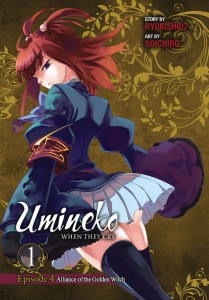
By the end of this volume, I think even the most unspoiled should have a pretty good idea about the concept of Beatrice, if not the actual identity. And, just as Higurashi abandoned Keiichi in its 4th arc to focus on a new protagonist, so Umineko does the same, with Ange driving much of the next arc. Of course, that arc brings us full circle. At the start of this review, I raved about what a great manga adaptation can add to the source. With Alliance of the Golden Witch, we’ll find out what happens when a manga adaptation adds things you REALLY don’t want added to the source.

Filed Under: REVIEWS

Gangsta Vols 1 and 2

May 4, 2014 by Anna N

Gangsta Volumes 1 and 2 by Kohske

I was pretty intrigued by Gangsta when I first heard that Viz was going to be translating this title. I always am interested in series that get the deluxe treatment of the Viz Signature line. The art looked very stylish, and I generally enjoy the few examples of seinen written by women authors that we get translated over here, so I was already intrigued for a few months before finally getting my hands on a couple volumes.

First of all, to totally judge a manga by its cover, I was immediately captivated by the cover designs! The front and back covers of both volumes show the same scene from different perspectives, showcasing the personalities of the main characters Nic and Worick. The first volume shows Nic glaring out at the reader, with Worick turned away. On the back Worick has his finger raised over his lips to prevent someone from telling a secret. Worick and Nic are handymen, mercenaries, couriers, and assassins taking on jobs no one else will. Their day opens in a way that conveys the gritty and corrupt nature of the city of Ergastulum, as a hooker gets beat up and the police chief asks the handymen to deal with recent gang activity, promising them “all their goods” as payment.

As the day unfolds, more gets revealed about Nic and Worick. Nic is a “Tag” or “Twilight,” who appears to be an ex-soldier who was the subject of some sort of enhancement experiments that have turned him into a deadly warrior. Nic is deaf, and Kohske has come up with some clever ways of portraying this, by representing his sign language with a different style of word balloons and carefully drawing them as emanating from his hands as he gestures. Nic is incredibly deadly, but he is viewed as subhuman by almost everybody but Worick. The duo quickly becomes a platonic (so far) threesome, as the handymen decide to liberate Ally, the hooker who was being beat up by her john before. When the police chief objects, Nic yells that the handymen will take whatever they want.

What follows is a mix between slice of life communal living issues, drug deals, and over the top action scenes as Ally putters around the handymen’s apartment, reading sign language dictionaries and answering their phone. She gradually learns a little more about Worick and Nic, including the fact that Worick occasionally hires himself out as a gigalo and that his past might be very far from the circles where he runs in now.

There are a few elements of Gangsta that reminded me of other series, but not in a bad way. The intense friendship of Nic and Worick set against a gritty background with mysterious drugs enhancing human abilities gave me some slight Wild Adapter flashbacks, although Gangsta isn’t very shonen-ai (yet). I’m sure there’s some Gangsta doujinshi out there that is though! Worick’s mysterious and privileged past made me remember Antique Bakery a bit. And the 3 rules for Twilight behavior are basically Asimov’s 3 Laws of Robotics. But Kohske hints at so many different plots to be explored in future volumes, I’m wanting to see the shared past of the handymen explored, wondering if Ally is better off with them than without them, and curious to see how Nic manages to deal with the latest in a procession of super human enemies.

Kohske’s art is gritty and stylish, showcasing the dynamic nature of the fights the handymen find themselves embroiled in as well as the run down area of the city where they live. The illustrations in this book are for sure not style over substance, as there are nuanced and varying character designs for all the members of the expanding cast. Nic’s growling antagonism and Worick’s intelligently constructed careless facade are both nimbly portrayed, as are the wordless exchanges and day to day moments that say volumes about the friendship they share. After enjoying the first two volumes, I’m certainly going to see about reading the rest of this series.

Filed Under: REVIEWS Tagged With: Gangsta, viz media

Dorohedoro, Vol. 12

May 4, 2014 by Sean Gaffney

By Q Hayashida. Released in Japan by Shogakukan, serialization ongoing in the magazine Ikki. Released in North America by Viz.

This volume of Dorohedoro is particularly good at showing off all the myriad reasons why it’s become one of the more addicting seinen manga out there. There are some amazingly violent fight scenes, some hysterical humor, a dose of complete insane weirdness, and some truly visceral horror – and not body horror this time around. I had wondered at first how long the series could keep its premise up, now I worry that with the series ending in Japan soon it won’t have time to tell me everything that I need to know.

dorohedoro12

Let’s start with the violence, which spirals out after En’s death. And En definitely appears to be dead this time, though there’s a suggestion they can reverse it if they find Judas’ Ear, who is missing. En’s people are somewhat gutted by this – even Noi, who notes that she hated En for forcing her into all of this, but still feels at a loss. As for Fujita, he’s absolutely devastated, having flashbacks and trauma from finding the body. Luckily, Shin knows that everything will be solved by finding the parties responsible and killing them. Finding the cross-eyes is the next step, and killing them mostly goes well, at least until the climax. Hayashida knows just how to choreograph fights, and also that her audience does not mind seeing splattered limbs.

Her audience also wants a healthy does of humor and weirdness, both of which dovetail nicely with the creation of a living En doll to try to lead them to the location of the real En, assuming he is alive. This involves baking a giant pizza, out of which the doll En them rises. If you can’t quite understand what I’m talking about, that’s because it makes no sense unless you see it. Any time Turkey appears things are odd, but this one takes the biscuit. We then get a very amusing chase scene, as the Doll En has a mind of its own and is not interested in letting Shin and Noi keep up with it. If you combine this with the ongoing humiliation of Natsuki (involving nudity this time, natch), we’ve got a lot of laughs in here.

But what I suspect folks will take away from this volume is the flashback that explains Nikaido’s past, who she’s so reluctant to do magic, and the horrors of time travel. Some lessons, particularly when you’re a child, need to be learned firsthand, and this is a particularly horrifying and bitter one for Nikaido, whose friend is lost forever thanks to her own folly about time magic. It contrasts with the cover art with Asu and a child Nikaido, with a blue sky and blooming flowers belie the serious contents within.

And so, in the end, we have something for everyone, a little bit of plot advancement, a lot of weird humor, and some terrifying existential terror. In other words, all the reasons to read Dorohedoro, encapsulated in one book. At least until the next volume, when I assume we’ll find more. We even see the gyoza fairy again!

Filed Under: REVIEWS

  • « Go to Previous Page
  • Page 1
  • Interim pages omitted …
  • Page 250
  • Page 251
  • Page 252
  • Page 253
  • Page 254
  • Interim pages omitted …
  • Page 342
  • Go to Next Page »
 | Log in
Copyright © 2010 Manga Bookshelf | Powered by WordPress & the Genesis Framework