• Skip to primary navigation
  • Skip to main content
  • Skip to primary sidebar
  • Home
  • About Us
    • Privacy Policy
    • Comment Policy
    • Disclosures & Disclaimers
  • Resources
    • Links, Essays & Articles
    • Fandomology!
    • CLAMP Directory
    • BlogRoll
  • Features & Columns
    • 3 Things Thursday
    • Adventures in the Key of Shoujo
    • Bit & Blips (game reviews)
    • BL BOOKRACK
    • Bookshelf Briefs
    • Bringing the Drama
    • Comic Conversion
    • Fanservice Friday
    • Going Digital
    • It Came From the Sinosphere
    • License This!
    • Magazine no Mori
    • My Week in Manga
    • OFF THE SHELF
    • Not By Manga Alone
    • PICK OF THE WEEK
    • Subtitles & Sensibility
    • Weekly Shonen Jump Recaps
  • Manga Moveable Feast
    • MMF Full Archive
    • Yun Kouga
    • CLAMP
    • Shojo Beat
    • Osamu Tezuka
    • Sailor Moon
    • Fruits Basket
    • Takehiko Inoue
    • Wild Adapter
    • One Piece
    • After School Nightmare
    • Karakuri Odette
    • Paradise Kiss
    • The Color Trilogy
    • To Terra…
    • Sexy Voice & Robo
  • Browse by Author
    • Sean Gaffney
    • Anna Neatrour
    • Michelle Smith
    • Katherine Dacey
    • MJ
    • Brigid Alverson
    • Travis Anderson
    • Phillip Anthony
    • Derek Bown
    • Jaci Dahlvang
    • Angela Eastman
    • Erica Friedman
    • Sara K.
    • Megan Purdy
    • Emily Snodgrass
    • Nancy Thistlethwaite
    • Eva Volin
    • David Welsh
  • MB Blogs
    • A Case Suitable For Treatment
    • Experiments in Manga
    • MangaBlog
    • The Manga Critic
    • Manga Report
    • Soliloquy in Blue
    • Manga Curmudgeon (archive)

Manga Bookshelf

Discussion, Resources, Roundtables, & Reviews

Reviews

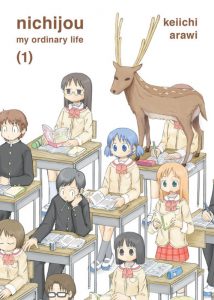
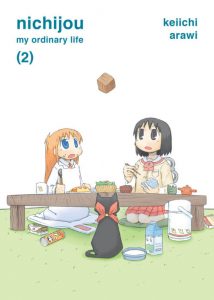
Nichijou, Vol. 1

April 3, 2016 by Sean Gaffney

By Keiichi Arawi. Released in Japan by Kadokawa Shoten, serialized in the magazine Shonen Ace. Released in North America by Vertical Comics.

I have a weakness for gag manga, as some of you may have noticed, and also a weakness for high school slice-of-life starring a bunch of quirky high school girls. It should be no surprise, therefore, to learn that I have been awaiting the release of Nichijou for some time. It was initially licensed by Bandai Entertainment about 5 years ago, but they folded their US manga division before it could even get a volume out. That said, the anime did appear over here, and was quite popular – in fact, arguably far more popular than it ended up being in Japan. And so Vertical, which has been dipping its toes into the surreal gag world with titles like My Neighbor Seki, now introduces us to a very unordinary manga.

nichijou1

Nichijou has quite a large ensemble cast, but for the most part is the adventures of five girls. Three of them, Yuuko, Mio, and Mai, are classmates at the local high school. Yuuko is peppy, somewhat dense, and very fond of attempting to make jokes that no one finds funny but her. Mio is the “normal” girl in the csat, but that’s only a matter of degrees, as we discover when she realizes her secret yaoi manga doodle is about to be discovered and becomes Superwoman. Mai is my personal favorite, a quite and shy girl who loves to bait and get reactions from Yuuko, I suspect as it’s the only way she can really show her feelings. There are apparently fans of Nichijou who dislike Mai for her gadfly nature, but these people are objectively wrong, so there’s no need to worry about them.

The other two main cast members are Nano, a robot girl who also attends class and her child genius inventor Professor, who’s a genius at making robots but an immature child in almost every other sense. Those familiar with the anime might be taken aback by Nano appearing in class right away – the anime decided to move all the stories with her in class to the second half of the series, the better to separate the ‘school’ and ‘Professor’s house’ segments of the show. We also meet a few other amusing minor characters here, like the farmer’s son who acts like a stereotypical rich boy, and the parody of tsunderes who can be seen literally blowing people’s brains out (though they’re fine a panel later – this is essentially a cartoon, in the Western Looney Tunes sense).

There’s not a lot to review in Nichijou beyond the gags, which I don’t want to spoil if you haven’t seen them. As with most manga of this sort, the humor can be found in facial reactions, and Arawi is very, very good at these – check out Chapter 9 for the best example. The girls are cute as well, but there is a blissful lack of fanservice that I also greatly appreciate, and there don’t seem to be any obvious romances besides the one-sided crushes Mio and the tsundere parody have. Nichijou is content to make jokes and be strange, and if it has to choose between being funny or being strange, it will pick the latter. If you like laughing, or if you like tilting your head and going “wuh?”, either way you’ll enjoy this.

Filed Under: REVIEWS

The Autobiography of Yukichi Fukuzawa

April 1, 2016 by Ash Brown

The Autobiography of Yukichi FukuzawaAuthor: Yukichi Fukuzawa
Translator: Eiichi Kiyooka
U.S. publisher: Columbia University Press
ISBN: 9780231139878
Released: January 2007
Original release: 1897

Yukichi Fukuzawa—scholar, translator, author, and educator, among many other things—is one of Japan’s most influential historical figures of the modern era, helping to shape the country as it is known today. As the founder of Keio University whose writings continue to be taught and whose likeness appears on the 10,000 yen banknote, there are very few Japanese to whom Fukuzawa is entirely unknown. Fukuzawa’s life was recently brought to my attention while reading Minae Mizumura’s The Fall of Language in the Age of English which discussed some of his influence and included excerpts of his autobiography. Intrigued by this, I decided to read the work in its entirety. The Autobiography of Yukichi Fukuzawa was originally dictated by Fukuzawa in 1897. The first English translation by Eiichi Kiyooka, Fukuzawa’s grandson, appeared in 1934 and was later revised in 1960. Many editions of The Autobiography of Yukichi Fukuzawa have been released in English, but the most recent was published in 2007 by Columbia University Press.

The Autobiography of Yukichi Fukuzawa originated from a request by a foreigner interested in Fukuzawa’s account of the time period leading up to and surrounding the Meiji Restoration in 1868. Fukuzawa narrated the story of his life fairly informally in 1897 and soon after edited, annotated, and published the transcribed manuscript. He intended to write a more formal and comprehensive companion volume, but he died in 1901 before it was completed. The Autobiography of Yukichi Fukuzawa begins with Fukuzawa’s childhood and follows his life into his old age. Fukuzawa was born in 1835 in Osaka into a samurai family originally from Nakatsu, where he grew up. From an early age, Fukuzawa showed interest in Western learning, first studying Dutch (at the time the only foreign influence permitted within Japan) and the eventually English. He was very passionate about language as a tool to access new knowledge and understanding, and he served on multiple missions to America and Europe as an interpreter and translator. But his interest in the West also put him in danger during a time when anti-foreign sentiment was rampant in Japan.

The various editions of The Autobiography of Yukichi Fukuzawa available in English are primarily distinguished by the accompanying materials included to supplement Fukuzawa’s main text. The most recent release from Columbia University Press offers several useful additions, some of which were available in previous editions or which were published elsewhere. Albert Craig, an academic and historian whose work focuses on Japan, provides the volume’s foreword as well as its lengthy afterword “Fukuzawa Yukichi: The Philosophical Foundations of Meiji Nationalism.” Originally published in 1968 in the the volume Political Development in Modern Japan, the afterword places Fukuzawa and his ideals into greater historical and political context. Also included in Columbia’s recent edition of The Autobiography of Yukichi Fukuzawa are two appendices—a chronological table outlining the events in Fukuzawa’s life and in world history and a translation of Fukuzawa’s influential essay “Encouragement of Learning”—as well as copious notes and an index.

The Autobiography of Yukichi Fukuzawa is a surprisingly engaging, entertaining, and even humorous work. In his autobiography, Fukuzawa comes across as very amicable, down-to-earth, and forward-thinking. I particularly enjoyed Fukuzawa’s invigorating account of his experiences as a young man who was devoted to his studies, but who would also willingly participate in the revelry, antics, and pranks of his fellow students. Speaking of how drunken “nudeness brings many adventures” and such other things greatly humanizes a person primarily known for his impressive accomplishments. As Fukuzawa matured, he played a pivotal role in the development of the Japanese education system. While he introduced many Western concept and ideas in his pursuit of knowledge, at heart Fukuzawa was a nationalist who abhorred the violent methods of many of his contemporaries. The Autobiography of Yukichi Fukuzawa provides not only a fascinating look into the life of Fukuzawa, it provides a glimpse into a particularly tumultuous and transformative period of time in Japan’s history.

Filed Under: REVIEWS Tagged With: Nonfiction, Yukichi Fukuzawa

Log Horizon: Game’s End, Part 2

March 31, 2016 by Sean Gaffney

By Mamare Touno and Kazuhiro Hara. Released in Japan by Enterbrain. Released in North America by Yen On.

As I’ve said many times before, Log Horizon has a bit of a fandom war with a similar series, Sword Art Online. It’s something of a one-sided war, given that SAO has about 10 times the number of fans LH does, but being #2, Log Horizon fans try harder. And one thing that comes up in complaining about SAO is how Kirito is the sort of self-insert perfect hero type who always gets all the attention and the girls. This contrasts with Shiroe in Log Horizon… somewhat. Shiroe’s not a front-line combatant, being more of a general and tactician. And there are many girls in the series who seem totally uninterested in him. This is perhaps balanced by the events at the end of this book, in which he reveals that with a properly written contract, he appears to have the power to resurrect the dead and create life. Which is something Kirito could never do. (Isn’t it sad, Sachi?)

lh4

Of course, Shiroe’s role in this book is not as big as it has been, mostly as the cast continues to be fleshed out and expanded. On the cover we have Crusty and Reinesia, two similar characters who are able to project a veneer of serenity and competence even though they’d rather be doing something else. And, as we find in this book, both are able to supporess their lazy impulses when the need arises. Reinesia impressed me the most in this entire book, showing off impressive political acumen in cutting through all the red tape and ego tripping of the Council arguments and realizing what had to be done. And then she goes and does it, despite being forced to dress in a revealing Valkyrie costume “for morale reasons” and getting exposed to horrific battles (and, even more terrifying, Crusty loving those battles). I really hope to see more of her soon.

Meanwhile, we discover the terrible secret of Rundelhaus, though admittedly we don’t get the extensive background story I was expecting. He’s an NPC who desperately wants to be a hero, and has tried even harder than the others, despite the fact that the game itself won’t let him level up as much. So, naturally, he’s killed in combat, which leads to Shiroe doing what I said he did in the first paragraph. I had sort of hoped that this would lead to Isuzu finally treating him like a man instead of a big dog, but to no avail. Actually, shippers will be happy-yet-left-wanting with the ending, in which no less than four ships get teases but that’s about it. Also, I am amused that it became so obvious Akatsuki had done next to nothing since the first book that she actually whines about it here.

Log Horizon continues to do a very good job of building a world logically based on “what if we were trapped in a game” mechanics, with the plot of these two books being particularly clever, as it relies on the adventurers not doing something due to the crisis, and the consequences being horrible. I do wonder if we’ll ever see the original core trio battling together again, though. Perhaps next time.

Filed Under: REVIEWS

Princess Jellyfish, Vol. 1

March 29, 2016 by Sean Gaffney

By Akiko Higashimura. Released in Japan in two separate volumes as “Kuragehime” by Kodansha, serialization ongoing in the magazine Kiss. Released in North America by Kodansha Comics.

This is another one of those titles where I haven’t seen the anime that was based on it, but sheer word of mouth has made me incredibly excited for its release. First of all, it’s very rare to see Kodansha Comics taking a chance n josei over here at all – lately they’ve been licensing some Dessert, but that’s still shoujo for older teens. Kiss is for young women, and it shows – this title features adults, even if much of the cast are jobless and living off their parents. Its humor and energy are absolutely worth a read, though I found more flaws in it than I was expecting.

pj1

Our heroine is, as you may have guessed, the girl in the braids in the foreground, not the pink-haired pretty thing behind her. Tsukimi is a shy introvert with an obsession for jellyfish, who has to force herself to go outside her apartment – an apartment she shares with similar-minded women, all of whom are obsessed with something (kimonos, trains, older men, and Romance of the Three Kingdoms). Then one day, while trying to work up the nerve to tell a fish store employee that the ways he’s put the jellyfish into the tank will kill one of them, she runs into Kuranosuke, who she assumes is a gorgeous, extroverted young woman who helps her out and ends up back at her apartment. Then it turns out that Kuranosuke is a man.

The main reason to read this title, and it’s absolutely worth it, is the humor. Tsukimi may be a massive introvert, but her reactions are nicely over the top and horrified much of the time, especially trying to deal with this new free spirit in her life. Of the rest of the female cast, Mayaya is the one that stands out the most, something she brings on herself with all of her posing and dramatic declarations. Kuranosuke’s own frustrations at his family, his new friends, and his growing realization that he actually likes Tsukihi is also highly amusing. The art is also excellent, helping to show off the humor and being distinct but not overly busy.

That said, I do have a few issues. This is a little progressive, but not overly so – Kuranosuke emphasizes he’s not gay a couple of times, and there’s some slangy ‘homo’ refs sprinkled throughout, which the endnotes helpfully tell us isn’t as caustic as it sounds here, but is still very defensive. The main villain of the piece, meanwhile, is almost a cliche, and it doesn’t help that she uses sex as a weapon to get what she wants – this is likely meant to contrast with the ‘pure’ Tsukimi, and I was happy to see one or two times when she didn’t act like a cartoon character, but it was only once or twice. Lastly, Kuranosuke’s attempts to drag these women out of their shells and have them ‘don armor’ to deal with the real world is both inspiring and frustrating – I sense he’s of the school that feels that introverts just aren’t trying hard enough to be extroverted.

All that said, this is still a definite title for your collection. Tsukimi is sweet and a bit over the top, and I look forward to seeing her Cinderella-type story, while hoping that she still retains the parts of her that are why we fell for her in the first place. Want to see more of this.

Filed Under: REVIEWS

Accel World: Shrine Maiden of the Sacred Fire

March 27, 2016 by Sean Gaffney

By Reki Kawahara and Hima. Released in Japan by ASCII Mediaworks. Released in North America by Yen On.

One of Accel World’s strongest points is its ability to built on plot and themes from prior books without overwhelming the reader too much. The last book showed us that the Disaster Armor had not entirely left Silver Crow, and much of this volume is about the fallout from that. We worry about what such a thing would do to the game itself, and then later on find that crude copies of it may be racing out of control via other people, making the question moot. Or it would be moot if this wasn’t in may ways a desire for the others to punish Kuroyukihime through Haruyuki, as by now everyone can see their bond. We’re also asked to see one of the core tents of her past in a different light, as it’s hinted that there’s more to her killing off the Red King than just wanting to get to Level 10.

aw6

As for Haruyuki’s self-loathing, it’s gotten slightly better. We get a minimum of school here, and I was a bit faked out when we were introduced to two fellow classmates who I thought Haru would either bond with or get bullied by, but who ended up being mostly irrelevant, another way of showing that Haruyuki is not like the normal “cool” kids, who skive off their club work the first time we see them. Of course, this determination to get better and discover new things is what makes him such a success in the game world, as is pointed out by Chiyuri. One reason that Kuroyukihime, Fuko, and even Ash Roller like him to much is that he’s always seeking ways to get better, ways to play the game that are more than just “get strong and then stop”.

We also get a new character, the titular shrine maiden of the title. She’s around 9 years old, and half of the somewhat tossed off fanservice in the volume is dedicated to accidentally getting her wet with a garden hose (the other half being Kuroyukihime changing in front of Haru – and the cover, if we’re going to be honest). For once, though, it looks like the lolicon is not meant to be the primary driving force. Utai is interesting, from her game persona’s Sailor Mars-style powers, to the Incarnate she unleashed somehow being related to Noh Theater, or simply because she can’t speak – something prevents her from getting the words out, so she types all her dialogue in ways that would be very difficult if people in this universe didn’t already have neurolinkers. And, of course, by definition of the fact that she’s playing Brain burst, her home life is somewhat broken, though we get few details.

And, of course, there’s still the best reason to read Accel World: Kawahara writes excellent battle scenes. They’re understandable, easily visualized, and emotionally raw. They may also make you scream at the ending, as yes, this is a cliffhanger that will hopefully get resolved in the next book. It’s not as popular as Sword Art Online, but Kawahara’s other series quietly goes about telling its story well, and if you can get past Haru’s beating himself up narrations, well worth your time.

Filed Under: REVIEWS

Durarara!!, Vol. 3

March 25, 2016 by Sean Gaffney

By Ryohgo Narita and Suzuhito Yasuda. Released in Japan by ASCII Mediaworks. Released in North America by Yen On.

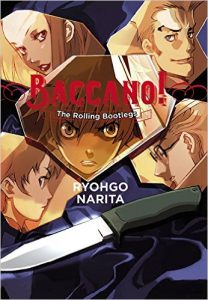
Anyone who reads any of Narita’s two main series, Baccano! and Durarara!!, knows how much he likes his gangs and gangsters. Be it yakuza, mafia, camorra, or just kids wearing colors and yelling about territory, it’s a huge theme in his books. And with the teenage gangs he does a very good job showing off how much the desire for control and power is motivated by simple fear, and how easy it can be to let situations spiral out of control. We learned at the end of the last volume about who Masaomi Kida really is, but this third volume shows us that, of the three teens who have been our protagonists so far, he may be the weakest… which of course makes his comeback and true strength just that much more satisfying.

drrr3

I think Narita’s habit of creating a bunch of divergent situations and then arranging them so that they all crash into each other at the end is something that might work better in a novel than in an anime – a lot of people have complained about the episodes of DRRR!! where nothing happens, but of course it’s all just required setup. the book doesn’t really have this problem, and so you enjoy seeing more and more information get revealed as time goes on. Both to the reader AND to the characters – the reader has been aware of the true identities of Mikado, Anri and Masaomi for some time, but it’s not till the climactic battle that each of them sees the truth.

We also meet Saki, Masaomi’s not-quite-girlfriend and the target of much hatred among the fan pairing community, mostly for existing. I like her, while acknowledging that we aren’t supposed to at first. She’s almost Izaya’s thrall, and as with everything Izaya touches, we’re automatically leery of her. Her constant smile is also not helping. It’s only towards the end of the book that we see the other side of her, the one that genuinely did fall in love with Masaomi, and see her crying and showing emotions. Honestly, it’s easier to blame Izaya here, who loves emotionally manipulating people just to see what happens and because it amuses him. He remains the most punchable person in the entire cast, and given this cast also has Namie, Seiji and Mika that’s saying something. Except wait, there’s someone more punchable.

Yes, this is the volume where we meet Shingen, Shinra’s even-more-eccentric-than-the-son father, who immediately establishes himself as an impulsive freak designed to give Celty migraines (except, of course, she does not have a head, but I suspect Shingen gives them to her anyway). As with Shinra, it’s never really clear when he’s decided to turn serious or not – or how much of his goofing was done to deliberately throw Celty off her game. In any case, a word to the wise, he can be teeth-grindingly annoying, and I know a few people who skip past him in the anime.

This is the longest book in the series to date, and the extra words work well. We get someone of the other minor characters fleshed out a bit, such as Kadota, Erika and Walker. The translation is smooth, only faltering a bit when it has to deal with the Japanese prose habit of never identifying who is speaking, so you have to make more contextual judgments than is strictly necessary. And the art is finally starting to mature a bit and be less flat-faced, with a bold, striking cover. If you enjoy DRRR!!, and can put up with Shingen, then this is definitely an excellent purchase.

Filed Under: REVIEWS

Of the Red, the Light, and the Ayakashi, Vol. 1

March 24, 2016 by Ash Brown

Of the Red, the Light, and the Ayakashi, Volume 1Creator: Nanao
Original story: HaccaWorks*

U.S. publisher: Yen Press
ISBN: 9780316351966
Released: December 2015
Original release: 2012

Of the Red, the Light, and the Ayakashi was originally a visual novel developed and created by the doujin group HaccaWorks* that was released in 2011. The manga adaptation by another doujin creator, Nanao, began serialization in Japan in 2012. The first volume of the manga was also collected and released later that year. In English, the Of the Red, the Light, and the Ayakashi manga is being released by Yen Press and debuted in late 2015. I haven’t actually played the original Of the Red, the Light, and the Ayakashi, though I’m fairly certain it would be something that I would enjoy. In fact, I didn’t even known that the manga was based on a game when I first picked it up. Nor was I previously familiar with any of the creators involved which probably isn’t too surprising—I believe that Of the Red, the Light, and the Ayakashi may very well be Nanao’s first professional work as a mangaka. But, due to the evocative and vaguely ominous cover art and title as well as the promise of the involvement of yokai, the series still caught my attention.

For as long as he can remember, Yue has lived at the mountain shrine associated with the town of Utsuwa where he has been taken care of by the local fox spirits and their attendants. Despite being told not to leave the mountain, Yue and Kurogitsune, one of his fox companions, sneak out of the shrine to attend the town’s festival. The new experience, although exciting, is somewhat overwhelming for Yue. But while at the festival, he encounters two young men who stand out to him more than anyone else—whereas most people appear as shadowy, indistinguishable figures to Yue, Tsubaki and Akiyoshi are distinctive and unique presences. Upon his return to the shrine Yue is duly scolded for breaking the rules but when the master learns about Akiyoshi and Tsubaki she encourages him to meet them again. The fate of all three boys are now intertwined. Because Yue finds himself so irresistibly drawn to Tsubaki and Akiyoshi, he is told that he will one day have to choose one of them to become his “meal,” necessary for sustaining his very existence.

Of the Red, the Light, and the Ayakashi, Volume 1, page 39I was pleasantly surprised by how much I enjoyed the first volume of Of the Red, the Light, and the Ayakashi. The manga combines elements of folklore, horror, and mystery in a very satisfying way. Granted, after the first volume, readers are left with more questions than answers. Much about the series’ story, setting, and characters remain unclear at this point, but what is possibly implied is tantalizing. At times Of the Red, the Light, and the Ayakashi can be unnecessarily cryptic—entire conversations are held in which the characters obviously know what they are talking about but readers aren’t given enough information or context to really understand or follow—which is more frustrating than mysterious, but this still sparks curiosity. I am genuinely intrigued by the series; I want to know more about the ominous events and strange disappearances occurring in Utsuwa, a place inhabited by both humans and spirits which seems to be some sort of threshold between worlds.

Utsuwa isn’t the only thing peculiar that’s peculiar in Of the Red, the Light, and the Ayakashi. The characters, too, are all a bit odd. Yue goes through life in an almost dreamlike, innocent state, his real identity not only obscured to readers but to himself as well. Akiyoshi, with his eccentric behavior and flair for the dramatic, comes across as conspiracy theorist except that he actually has evidence and legitimate reasons to be concerned. Tsubaki would initially appear to be a fairly normal if somewhat moody young man if it wasn’t for the fact that humans and spirits alike frequently find themselves obsessed or enamored with him. The three form an curious bond as they begin to investigate the unusual happenings in Utsuwa. They’re not exactly friends but are far more than mere acquaintances. Supported by Nanao’s attractive (if occasionally cluttered) artwork, intriguing characters, and an effective sense of mystery and impending misfortune, Of the Red, the Light, and the Ayakashi has a dark, otherworldly atmosphere which I’m really enjoying.

Filed Under: REVIEWS Tagged With: HaccaWorks, manga, Nanao, Of the Red the Light and the Ayakashi, yen press

Danganronpa: The Animation, Vol. 1

March 22, 2016 by Sean Gaffney

By Spike Chunsoft and Takashi Tsukimi. Released in Japan by Kadokawa Shoten, serialized in the magazine Shonen Ace. Released in North America by Dark Horse.

I have made my opinions on the glut of ‘survival game’ manga well known by now, I hope. In general, if you’re writing a survival game manga, you need a lot to keep me interested, as teens locked in a school and killed off one by one has zoomed WAY past vampires and sadistic shoujo boyfriends in the things I avoid sweepstakes. And yet sometimes I do hear so much about a title that I feel the need to check it out anyway. Such a title is Danganronpa, which was originally a game and then got adapted to an anime. The manga wears on its sleeve that it’s adapting the anime and not the game, which is likely why it’s only 4 volumes instead of the 9-10 I’d expect otherwise. That said, what makes Danganronpa stand out?

dangan1

Well, for starters it’s far more overdramatic than the usual glumness I’ve seen from survival game manga before. Monokuma, the bear lurking in the background on the cover, seems to be both the manga’s mascot and its villain. He’s a ludicrously cruel and over the top figure, making bear puns as he gleefully executes people. He’s just a lot of fun, and stands out in particular because the rest of the cast of students are stereotypes, many deliberately so. Our hero is the average “player character” type, we get the jock, the idol, the fashion plate, the overweight otaku, etc. With a cast like this, that sort of shorthand is necessary as you’ll know at a glance what they’re like and how they’ll react. Plus, of course, the cast starts getting killed off fairly quickly, so you don’t have to remember all of them.

The other interesting aspect of this title is the trial sequence. Basically the kids are told they can escape the school if they kill someone – but they have to get away with it. There’s a trial, and if the killer isn’t found, the rest of the cast will get punished. Of course, the killer is found, as our hero is very good at deductions, and is helped out by a stoic girl who seems to be a detective, and I suspect may be a love interest except this is one of those series where everyone tends to die, so I won’t commit to that just yet. And the kids aren’t complete sociopaths either, mostly killing out of terror and fear of blackmail. I was also amused at how easy it was to solve the first murder’s ‘written in blood’ clue, and the manga must have agreed with me, as the cast also figures it out immediately.

This is a title that’s pretty much marketed to fans of the gmae or anime, and they should find it quite enjoyable. If you haven’t seen either, it’s still pretty good, keeping in mind the usual irritations of the genre. The comedy and dramatics help make that less of a poison pill this time around, though.

Filed Under: REVIEWS

Shuriken and Pleats Vol. 1

March 21, 2016 by Anna N

Shuriken and Pleats Volume 1 by Matsuri Hino

Matsuri Hino is one of those shoujo authors who I like, but I haven’t been pulled into the time of deep admiration that I feel towards an Arina Tanemura or a Chika Shiomi. One of the main reasons for this is that I never really connected with Hino’s major series Vampire Knight. I have some volumes stockpiled and I intend to give that series another chance one day. I do enjoy Hino’s delicate art. I was curious about a non-vampire series from Hino.

Shuriken and Pleats is a short two-volume series about a ninja girl in the modern age, with all of the angst one might expect from a Matsuri Hino title with the added bonus of some fish out of water humor. The tragedy is introduced in the first chapter, as Mikage Kirio is assigned to protect an idealistic man whose wife and daughter have passed away, possibly as the result of some of his research into a way to end world hunger. Mikage’s master James goes out of the way to exhibit a personal interest in the young ninja, wanting her to have a normal life. When James dies, his will sets Mikage up with an option for an independent life for the first time, and he requests that she take the time to go to school like a regular girl. Mikage moves back to Japan and makes an attempt to fit in as a schoolgirl, while being haunted by her past. She also finds a final person to protect along the way.

“Girl who doesn’t understand her feelings” is almost as much of a shoujo cliche as the inexplicably alluring klutzy heroine, but Mikage is a more interesting than usual example of this particular type of heroine. Being part of a secret ninja clan in the modern world is a legitimate reason to have a closed-off personality, and while she fails sometimes she does have some serious ninja skills. One thing that does make Shuriken and Pleats stand out are some fine points of character development that manage to be both humorous and tragic at the same time, like Mikage’s shrine of cute erasers that her former master gave her. Mikage’s reaction to having papers passed to her at school from behind her back is a dramatic flip and the stern command for her classmate to “State your intention.”

Mikage’s ninja nature is signaled by the flowing black scarf she wears at all times, even when in her school uniform. Hino’s art has her trademark extremely pretty character designs mixed with dynamic ninja action scenes. I found myself intrigued by Mikage’s journey as she gradually loosens up on her ninja training and starts dealing with her emotions for the first time. I was less interested in some of the aspects of the plot, like the conspiracy at work that Mikage has to unravel. There’s a great deal of plot development packed into just one volume, which perhaps speaks to the benefit of planned short manga series as opposed to short series that are the result of an abrupt cancellation. I enjoyed this manga, and I’ll look forward to the concluding volume. Shuriken and Pleats seems like it will be an entertaining diversion if someone is looking for a short series to enjoy.

sp1

Filed Under: REVIEWS Tagged With: shojo beat, shoujo, Shuriken and Pleats, viz media

Paradise Residence, Vol. 1

March 20, 2016 by Sean Gaffney

By Kosuke Fujishima. Released in Japan by Kodansha, serialized in the magazine Afternoon. Released in North America by Kodansha Comics.

For all that Fujishima’s Oh My Goddess! was a series with angels, devils, and everything in between (that is when it wasn’t just about vehicles and those who love them), there was an awful lot of what is generally termed ‘slice-of-life’ in the series. And before that we had You’re Under Arrest, which also took a basic premise (female cop buddy movie) and used it as a springboard for everyday amusing situations. As a result, it should not come as a surprise that his new series details the rather everyday, slice-of-life adventures of a girls’ dormitory way up a hill, and the eccentric characters therein. Of course, the problem with this is that the series needs to rise and fall on said eccentric characters, and so far we don’t really get a good handle on any except one or two.

parares1

Our two heroines are on the front cover posing for us, and they are very much of the Miyuki and Natsumi school of personalities. Takanashi is brash, sleeps late, loves to eat, is not very good at school but makes up for it with energy and heart. Misawa is her best friend, the straight man of the group who exists mostly to react to Takanashi’s antics and sometimes sigh. The dorm they’re in is old and tends to fall apart easily, but its residents all love it, particularly when defending it against their all-girls’ school’s other dorm, which is modern and state of the art. We get the overly sadistic sempai, the elementary schoolgirl who acts as a dorm mother (she’s the daughter of the REAL, almost never seen, dorm mother), the overseas student, the otaku, the eccentric artist, etcetera.

The volume begins pretty much in media res, showing off the group’s everyday school and dorm life. We see how Takanashi deals with dogs, heat, and typhoons, as well as what appears to be a rivalry with a stuck-up girl from the otehr dorm. After this volume, we get as an extra “Volume 0”, a collection of the initial chapters that ran as one-offs in the spinoff good!Afternoon while Fujishima was still working on Oh My Goddess!. I can see why it was put later, as the characters are not quite in character yet, but it does give a better introduction to everyone than the initial first volume does. There’s also a short story featuring Takanashi’s parents, about the springtime of youth, etc.

This is light and fluffy fun. If there’s a flaw it’s that that’s all it is. There’s not as big a hook to draw people in as there is with Oh My Goddess!, and I doubt we’ll get serious plotlines here. The pacing can be slow, as you’d expect with this genre. And sometimes there’s a gag thrown in that just doesn’t work, such as one girl comedically falling into another girl’s breasts during a blackout, as if Fujishima is reminded that fanservice has moved on since 1985 and tried to imitate it. But if you like Fujishima, and his art is very nice here, this should appeal to you. It’s also over in Japan, so should wrap up pretty soon.

Filed Under: REVIEWS

Mushishi, Vol. 8, 9, and 10

March 18, 2016 by Ash Brown

Mushishi, Volumes 8-10Creator: Yuki Urushibara
U.S. publisher: Del Rey
ISBN: 9780345505606
Released: July 2010
Original release: 2007-2008
Awards: Japan Media Arts Award, Kodansha Manga Award

Every once in a while I come across a work that stays with me long after I first finish reading it and that I find myself revisiting time and again. Yuki Urushibara’s ten-volume debut manga series Mushishi is one such work. Heavily influenced by traditional Japanese folklore but retaining modern sensibilities, Mushishi is a nuanced and layered manga which can either be simply enjoyed as a collection of atmospheric and subtly unsettling stories or more deeply appreciated for its complex underlying themes and philosophies. Mushishi quickly became and remains one of my favorite manga. The series has been received positively by fans and critics alike, earning Urushibara several awards and recognitions including a Japan Media Arts Award and a Kodansha Manga Award. Mushishi has also been the basis for multiple anime among other media adaptations. In English, the series was first published in print by Del Rey Manga and was later released digitally by Kodansha Comics.

The final volume of the English-langauge edition of Mushishi, first printed in 2010 and released digitally in 2014, is equivalent to the eighth, ninth, and tenth volumes of the series’ original Japanese release published between 2007 and 2008. Keeping with the episodic nature of Mushishi, the volume collects fourteen stories that for the most part aren’t directly tied to one another or to earlier chapters, but which share similar ideas and themes with the rest of the series. Family relationships are very important in Mushishi as a whole, but stories like “The Milk of the Valley,” “The Hidden Channel,” “Aquamarine,” and “The Thread of Life” in particular explore the deep bonds between mothers, including surrogate mothers, and their children. Other stories, like “The Final Bit of Crimson,” “Stars in the Jar of the Sky,” and “The Scented Darkness,” are about other realities and worlds, or at least about aspects of the natural world that aren’t fully understood by humankind. On the other hand, “Sunshowers,” “The Mud Weeds,” “The Whirlwind,” and “The Eternal Tree” are stories which show that when dealing with possession by or control of mushi, greater understanding can be both a curse and a blessing.

Mushishi, Volume 10, page 155The remaining three stories collected in the volume, including the series’ two-part finale, specifically involve Ginko (the manga’s protagonist and linking character), his personal relationship to mushi (primordial creatures that are closest to the original form of life), and what are known as “masters” in the world of Mushishi. Each master is associated with a specific geographic area and are responsible for maintaining the connection and balance between the natural world and all of the beings found within it. They are described as the living embodiment of the promise and rule of life. Although each of the three stories are technically found in different volumes of the series, taken together they form a particularly interesting narrative and are very illuminating when it comes to Ginko’s character. “The Bed of Grass” returns to Ginko’s past, firmly establishing why he is who he is and revealing the origin of his deep connection to and somewhat unusual attitude towards mushi. That connection is extremely critical to and further developed in “The Bottom of Winter” and in the series’ conclusion “Drops of Bells.”

Ginko’s devotion to life, whether it be human, mushi, or some other form, is perhaps the most prominent narrative driving force behind the entirety of Mushishi. At the same time, Ginko is also very aware that sometimes life cannot and should not always be preserved and that coexistence isn’t always an option. The intent is to find an appropriate balance, but what that balance should be is often debatable and mistakes are made. Ginko frequently acts in a role akin to that of a master and on several occasions throughout the series even considers taking the responsibilities of master upon himself. The decisions that he makes as he considers all of this in the final volumes of Mushishi are especially poignant. Mushishi is a manga series about many things, but at its very heart it’s an exploration of relationships, not only between humans and the natural world of which they are only one, inextricable part, but between people as individuals and as members of larger social groups. Mushi provide a seemingly supernatural element to the series, but ultimately the focus of Mushishi is on the very real, varied, and changing struggles of individuals living in an evolving world that they cannot completely control or understand.

Filed Under: REVIEWS Tagged With: del rey, Japan Media Arts Award, Kodansha Manga Award, manga, mushishi, Yuki Urushibara

Ranma 1/2, Vols. 25-26

March 18, 2016 by Sean Gaffney

By Rumiko Takahashi. Released in Japan by Shogakukan, serialized in the magazine Shonen Sunday. Released in North America by Viz.

It’s not an ironclad rule, but in general, the longer the story arc in Ranma the better it ends up being. And this is good news for this volume, which wraps up the Herb arc from the previous omnibus, introduces a new character who brings a lot of silliness to the table, and has what may be the strongest arc in the entire series, where Takahashi learns that even though her series desperately need to be static and unchanging, sometimes you have to have the occasional character development. (Admittedly, we haven’t seen her learn that lesson with Rin-Ne just yet, but hey.) The Shinnosuke arc also manages to be strong simply by reversing the usual plotline of many a Ranma story, as this time it’s Akane who meets the stranger with a mysterious connection to her past.

ranma25-26

Indeed, Akane is comparatively calm and peaceful compared to previous situations, possibly as, instead of dealing with a supposed errant fiancee for Ranma, she now has her own love troubles to deal with. Shinnosuke saved her when she was a child, at great cost to his own self, and has grown up to be a handsome young man who looks a bit like Ryouga. (Too much, IMO – especially when the actual Ryouga shows up, it can be difficult to tell them apart.) The trouble is that Akane loves Ranma, and even though she’ll never say it or think it she knows it as well. Thus on her end she feels an obligation to stay and help because of a life debt. Ranma, who is playing the Akane role this time around, can only see her getting cozy with this new guy. He goes through various stages of jealousy, and as ever with Ranma, the worst argument, where you know things are really bad, comes from when Ranma and Akane STOP hitting each other.

There is another half to this volume, of course. We wrap up Herb in a quick but satisfying way, and Ranma once again proves unable to sacrifice even one of his worst villains. We also meet Hinako, who is another character who transforms from one form to another, though for once it’s not due to a cursed spring but rather due to a failed attempt at a good deed by Happosai, of all people. The Hinako storyline is not going to give you the depth and romance that you see in the Shinnosuke arc. Instead we get pure comedy, as Ranma, in order to defeat the teacher, has to essentially grope her pressure points – which are exactly where you’d think they are. Oh yes, and Hinako’s transformation from bratty immature kid to statuesque stunner makes no sense except as comedy. But that’s Ranma for ya.

In short, Ranma has now turned the corner and is entering its twilight years, but can still turn out some classics, and this volume is overall excellent, provided you don’t mind some fanservice. There’s even actual romantic progress at the very end, which I won’t spoil except to again say that the real tsundere in this series is Ranma, not Akane.

Filed Under: REVIEWS

A Girl on the Shore

March 16, 2016 by Ash Brown

A Girl on the ShoreCreator: Inio Asano
U.S. publisher: Vertical
ISBN: 9781941220856
Released: January 2016
Original release: 2011-2013

Several of Inio Asano’s manga have been released in English in the past—Solanin, What A Wonderful World!, and Nijigahara Holograph—and I’ve read every one. While they all left a significant impression on me and can be difficult works, Nijigahara Holograph in particular floored me, further convincing me to seek out more of Asano’s manga. Vertical Comics published one of Asano’s more recent manga series A Girl on the Shore in early 2016. While the English-language edition of A Girl on the Shore is complete in a single omnibus, in Japan the series was originally released in two volumes which were published in 2011 and 2013. I didn’t actually know much about A Girl on the Shore before picking it up beyond the fact it was by Asano, but I rightfully anticipated that it would be a fairly challenging read in addition to being beautifully drawn.

Junior high can be a trying time for anyone as students become more aware of themselves and each other while hormones and the intense desire to belong complicate relationships and they make decisions that will greatly influence their futures. Koume has a crush on her upperclassman Misaki, but he turns out to be something of a playboy, taking advantage of her interest by receiving sexual favors with no intention of returning her feelings. In order to cope, Koume turns around and does the same thing to her classmate Keisuke who she had previously rejected after he confessed that he liked her. Keisuke and Koume both know that they’re manipulating and using each other, but that doesn’t stop their increasingly intimate relationship from evolving and their feelings from changing. Both of them are searching for some deeper connection and meaning in their lives. For a time, having sex together seems to satisfy that need, but in the end the physical relationship only obscures their underlying emotional crises.

A Girl on the Shore, page 147A Girl on the Shore contains numerous and frank depictions of teenage sex. However, the sexual content of the volume is integral to the story that Asano is telling and carries meaning beyond titillation. In fact, A Girl on the Shore provides a deliberately uncomfortable and voyeuristic reading experience, often showing events and personal encounters unfolding directly from the characters’ perspectives. Sex isn’t romanticized or idealized in the manga and carries with it significant repercussions. Koume and Keisuke’s relationship has consequences not only for them both, but for the others around them as well. Physically the two are intimate and daring, but there continues to be a separation between them and they remain emotionally distant. Their relationship is an incredibly important one and their feelings and needs become progressively intertwined, but they are never quite able to completely and truly connect with each other.

Asano’s works tend to be emotionally intense and A Girl on the Shore is no exception. The manga is filled with discontent and sadness that occasionally erupts in physical or psychological violence. A Girl on the Shore is coming-of-age story that can be brutally unsettling and hard-hitting. Koume finds herself drawn more and more towards Keisuke and the complicated power dynamics of their intimacy, seemingly oblivious of the toll that the relationship is taking on them both. Independent of that, Keisuke is also dealing with some heavy family matters and emotional issues of his own. Ultimately, one of the most prominent themes of A Girl on the Shore is loneliness and isolation even in the midst of a relationship. This is beautifully emphasized by Asano’s artwork in which detailed backgrounds, dramatic perspectives, layout and use of space form settings in which people seem set apart not only from others but the world around them as well. At times A Girl on the Shore can tend to be overwhelmingly bleak and tragic, but there is a deliberate narrative purpose and intent behind the pain and pessimism.

Filed Under: REVIEWS Tagged With: Inio Asano, manga, vertical, Vertical Comics

Skip Beat! Vol. 36

March 15, 2016 by Anna N

Skip Beat Volume 36 by Yoshiki Nakamura

I feel like most reviews of Skip Beat could just be summed up as, “Skip Beat, long-running shoujo series, continues to be relentlessly excellent,” but as I was reading the latest volume there were several specific things that struck me about it. I absolutely loved the Heel siblings plot, and while the manga has to move on from Ren and Kyoko being forced to be in close proximity to each other as they pretend to be gothic semi-incestual siblings in order to further Ren’s acting career as he acts in a drama while pretending to be an entirely different actor than “Ren” which is itself a totally different persona from his genuine personality, I’m glad that this volume eases out of the story line gently, with Kyoko getting one last big scene as Setsu.

Early in this volume I was reminded at how good Nakamura is at drawing Kyoko in freak-out mode, as she suffers agony in telling Ren that she kissed her long-lost fairy prince Corn (who is also Ren). Ren is pushing Kyoko a bit to get an emotional reaction from her, but he also is genuinely grateful for her help as they part and she heads back to Japan to resume her own acting career. Kyoko has matured so much as an actress and a person, and while she’s handling a crisis on her new show, things get complicated fast when Sho visits her home.

A settled and stable shoujo heroine doesn’t make for much drama, and now in addition to Sho’s reappearance, Kyoko is confronted with the specter of her long-absent horrible mother. Just when she starts to get a bit of emotional equilibrium, something happens to throw things off!

Lettering Skip Beat! must be a fun and challenging job, as there are different fonts used for Kyoko when she’s beset by the angry demon side of her personality, when she’s yelling at Sho, and when she’s calmly giving advice to a fellow actress. All in all, this was a very entertaining volume helping Skip Beat! transition away from one story line into a new direction, and I’m looking forward to seeing what happens next.

sb36

Filed Under: REVIEWS Tagged With: shojo, shoujo, Skip Beat!, viz media

No Game No Life, Vol. 4

March 15, 2016 by Sean Gaffney

By Yuu Kamiya. Released in Japan by Media Factory. Released in North America by Yen On.

It’s always dangerous when a title that you enjoy despite its many glaring flaws has a subpar volume. Suddenly there isn’t enough to enjoy to justify wading through everything. It doesn’t help that this volume was delayed two months for unknown reasons (possibly as the translator got burnt out – it did have a 3-month schedule before this). And it’s unfortunate that this is the first volume that wasn’t adapted into an anime, so will presumably have a lot of new readers trying to see what happens next. But yes, there’s no getting around this – this is just not a great volume of No Game No Life.

ngnl4

Everything seems to be just that little bit tired, starting with Sora and Shiro, who in the first volume were hideously broken people who just happened to be crazy otaku, but here the otaku part is in full swing and were it not for a few casual mentions in the text, you’d never even remember how codependent they are on each other’s presence. This is the first of a two-parter again, so it’s possible the next volume will up the ante, but it also has to be said that nothing really seems to threaten our heroes. Sure, they initially refuse to play the datesim simply because it’s just like that anathema, real-life romance, but once they’re in it, merely avoiding any love points seems to be fine with them. Sora and Shiro have been shown to be invincible, and that’s ALL they are here.

The other characters don’t fare much better. There are the usual NGNL levels of perversion, this time around involving the fantasy vampires and mermaids we see here. The fact that the dhampirs can suck bodily fluids other than blood is (pardon me) milked for all it’s worth, and the Sirens are succubuses whose lack of foresight and intelligence had better be undercut when we reach Volume 5 or I’m going to be pissed off. You don’t right an entire race of bimbos anymore just because it’s fun. And then there’s Ino, the old Werebeast grandpa, whose response in regards to winning the datesim was… memorable, but I’m not sure I get the manly part, and he was also used as a sexual gag regarding all the women he’d bedded over the years.

There is one bright spot in this volume, and that was the first scene with Steph, who has been left behind to deal with the kingdom while Sora and Shiro are negotiating with the Shrine Maiden. Having been forced to play against the two for thousands of games, and losing every single time, Steph has actually become scarily good at games, particularly the card games we saw her failing at in the very first volume. Of course, she’s not aware of this – she’s constantly trying to compare herself to Sora and Shiro, rather than, say, the average citizen. We are also reminded why Sora and Shiro left her there in the firt place – she’s really good at running a country, something they would be terrible at. Sadly, she then goes back to being a figure of mockery for most of the book, but that one brief shining moment was excellent.

It’s possible the next volume will turn this around. As I said, it is a two-parter of sorts. But I must admit that after reading this volume of NGNL I just felt tired.

Filed Under: REVIEWS

  • « Go to Previous Page
  • Page 1
  • Interim pages omitted …
  • Page 217
  • Page 218
  • Page 219
  • Page 220
  • Page 221
  • Interim pages omitted …
  • Page 342
  • Go to Next Page »
 | Log in
Copyright © 2010 Manga Bookshelf | Powered by WordPress & the Genesis Framework