• Skip to primary navigation
  • Skip to main content
  • Skip to primary sidebar
  • Home
  • About Us
    • Privacy Policy
    • Comment Policy
    • Disclosures & Disclaimers
  • Resources
    • Links, Essays & Articles
    • Fandomology!
    • CLAMP Directory
    • BlogRoll
  • Features & Columns
    • 3 Things Thursday
    • Adventures in the Key of Shoujo
    • Bit & Blips (game reviews)
    • BL BOOKRACK
    • Bookshelf Briefs
    • Bringing the Drama
    • Comic Conversion
    • Fanservice Friday
    • Going Digital
    • It Came From the Sinosphere
    • License This!
    • Magazine no Mori
    • My Week in Manga
    • OFF THE SHELF
    • Not By Manga Alone
    • PICK OF THE WEEK
    • Subtitles & Sensibility
    • Weekly Shonen Jump Recaps
  • Manga Moveable Feast
    • MMF Full Archive
    • Yun Kouga
    • CLAMP
    • Shojo Beat
    • Osamu Tezuka
    • Sailor Moon
    • Fruits Basket
    • Takehiko Inoue
    • Wild Adapter
    • One Piece
    • After School Nightmare
    • Karakuri Odette
    • Paradise Kiss
    • The Color Trilogy
    • To Terra…
    • Sexy Voice & Robo
  • Browse by Author
    • Sean Gaffney
    • Anna Neatrour
    • Michelle Smith
    • Katherine Dacey
    • MJ
    • Brigid Alverson
    • Travis Anderson
    • Phillip Anthony
    • Derek Bown
    • Jaci Dahlvang
    • Angela Eastman
    • Erica Friedman
    • Sara K.
    • Megan Purdy
    • Emily Snodgrass
    • Nancy Thistlethwaite
    • Eva Volin
    • David Welsh
  • MB Blogs
    • A Case Suitable For Treatment
    • Experiments in Manga
    • MangaBlog
    • The Manga Critic
    • Manga Report
    • Soliloquy in Blue
    • Manga Curmudgeon (archive)

Manga Bookshelf

Discussion, Resources, Roundtables, & Reviews

Reviews

Hayate the Combat Butler, Vol. 28

September 24, 2016 by Sean Gaffney

By Kenjiro Hata. Released in Japan as “Hayate no Gotoku!” by Shogakukan, serialization ongoing in the magazine Shonen Sunday. Released in North America by Viz. Translated by John Werry.

It is not uncommon for long-running harem comedy series to introduce a new girl who quickly captures the hearts and minds of fans who have grown weary of the natural staticness of a typical harem plot. Indeed, it’s not uncommon for Hayate the Combat Butler iteslf, as Athena grew quite popular when she was introduced, but she was part of Hayate’s tragic backstory, and also heralded a certain amount of drama. With Ruka Suirenji, a pop idol who apparently likes to sell doujinshi on the side, we get something more akin to the typical Hayate heroine, and much of the first half of this volume is about showing off how cute she is and how much chemistry she has with Hayate. Who she thinks is a girl, something that I’m sure will go bad for him later on.

hayate28

Of course, this doesn’t mean that the old favorites are getting ignored. To no one’s surprise, Athena has returned, though only for a brief cameo before we get introduced to Alice, a cute young girl who looks just like Athena did when she and Hayate were kids – a fact not lost on him, and clearly there’s some magic age-regression going on here. This ends up leading to some ship tease with Hinagiku after Alice (Athena’s child form) decides that Hayate and Hina are her mama and papa. (Best joke of the volume has Hayate wondering if it was that time when–and getting cut off by Hina with a sword to the head, as jokes about her chastity are a bit much even for her.) And even Maria, who’s been so absent from the manga lately that she’s slipped to 5th in the popularity poll (Athena is second, for the curious) gets a sweet ‘let’s go to the public baths’ scene with Hayate, who for once does not get accused of peeping.

This volume sees Hata starting to balance out his ongoing storylines and his desire to write gag comedy a little better than he has before. Aika appearing as Alice’s minder ensures there will always be a snarky comment handy, and even though she regresses a bit, Nagi is still able to see what a really dedicated writer of bizarre incomprehensible doujinshi can do. And there’s still room for one-shots, such as a typical day in the apartments implying that Hayate survives on one hour of sleep a night, or a drunken Yukiji winning the attention of manga artist Ashibashi (who we now see is actually named Koji as if it wasn’t obvious enough who Hata based him on). Rest assured that things are still funny, even as the plot grows more complex.

By now I highly doubt that Hayate is winning new readers, and its die-hards likely support the manga while also reading the scans online, which are about five years ahead of Viz’s release. But it is worth supporting This is a funny title that also has doses of sentiment and even a bit of action. It remains an underrated treat.

Filed Under: REVIEWS

Human Acts

September 22, 2016 by Ash Brown

Human ActsAuthor: Han Kang
Translator: Deborah Smith
U.S. Publisher: Hogarth Press
ISBN: 9781101906729
Released: January 2017
Original release: 2014
Awards: Manhae Literary Prize

Over the last few years South Korean novelist Han Kang has gained a fair amount of international attention. Of particular recent note, her second novel to be translated into English, The Vegetarian (which I’ve been meaning to read for quite some time now), was awarded the Man Booker International Prize in 2016 after being met with great acclaim. Kang isn’t a stranger to awards–her work, while at times controversial, is well-regarded and has earned her many honors and accolades both in South Korea and abroad. Human Acts is Kang’s third novel to receive an English translation. The book was originally published in Korea in 2014 (under a title that more closely translates as The Boy Is Coming) and won Kang the Manhae Literary Prize. Deborah Smith’s English translation of and accompanying introduction to Human Acts was first published in Great Britain in 2016 and is scheduled to be released in the United States in early 2017.

After the assassination of South Korean president Park Chung-hee in 1979, the political climate of the country became increasingly perilous. The student demonstrations calling for democracy and the protests against the government which began during Park’s rule when he implemented authoritarian policies and martial law continued even after his death. In 1980, in the southern city of Gwanju, one such demonstration was engulfed in violence when a group of citizens supporting the students’ efforts was attacked and killed by government forces. The protest in Gwanju quickly escalated into an uprising involving thousands. The incident only lasted a few days–ultimately the civil militias were defeated by the government troops–but the uprising and accompanying massacre would deeply impact South Korea and its people for decades to come, leaving a wound that has yet to completely heal.

Human Acts focuses on the aftermath of the Gwanju Uprising and the personal costs, pain, and suffering of the people involved. The novel unfolds in seven parts told from seven different perspectives. It begins in the midst of the uprising itself in 1980 and ends in 2013 with its lingering influence. Human Acts opens with the story Dong-ho, a middle school student working in a gymnasium which had been hastily converted into a temporary morgue in order to accommodate the tremendous number of casualties. There he helps to care for and identify the bodies. After he himself is killed during the uprising, Dong-ho becomes the touchstone which ties the disparate parts of the novel together. In addition to Dong-ho, Human Acts contains the accounts of the soul of his friend who also lost his life, two of the women who worked in the morgue with him, a protestor who witnessed his death and who was later arrested, imprisoned, and tortured, his mother, and the writer who retells their stories.

Human Acts is a beautifully written novel, the translation is elegant and at times even poetic, but the subject matter is horrific and tragic and Kang doesn’t shy away from that fact. The story, based on truth, is filled with death, brutality, and violence. Human Acts is extraordinary though it certainly isn’t light reading; it can be a very difficult, affecting, and haunting read. The text slips in and out of a second-person narrative which draws the reader directly into the story. The technique is surprisingly effective and disconcerting, helping to turn the novel into something that’s akin to both a eulogy and a denunciation. While Human Acts focuses on a specific historical event, its themes are universal, exploring the lasting changes that the past has on the present and how people as individuals cope with the trauma that has been experienced. Human Acts is an intensely personal, political, powerful, and devastating work and is honestly one of best novels that I have read in a long while.

Thank you to Hogarth Press for providing a copy of Human Acts for review.

Filed Under: REVIEWS Tagged With: Han Kang, Novels

Lord Marksman and Vanadis, Vol. 1

September 22, 2016 by Sean Gaffney

By Tsukasa Kawaguchi and Nobuhiko Yanai. Released in Japan by Media Factory, serialization ongoing in the magazine Comic Flapper. Released in North America by Seven Seas. Translated by Elina Ishikawa. Adapted by Rebecca Schneider.

I’ve mentioned before that Media Factory publishes both my nemesis and my weakness. They put out two magazines for young men, basically sister publications. Comic Alive and Comic Flapper. Comic Alive tends to produce series, usually based on a popular franchise, that I can’t abide, with the worst otaku pandering, fanservice-laden drivel. Comic Flapper also, of course, publishes series based on popular franchises, but it tends to skew a bit weirder and less mainstream than Alive. And as a result, despite some problematic things, I usually find myself enjoying a Flapper series. Lord Marksman and Vanadis is a fantasy series based on a light novel with a cool hero and a bunch of girls, so I admit I was a bit wary. But sure enough, Flapper wins again. This was a good start, and I want to see more of it.

vanadis1

Now don’t get me wrong, there is service here. We get not one but two ‘walk in on someone bathing’ scenes, a ‘we are fighting and I accidentally grope your boob’ scene, and another nude scene when the childhood friend of the hero cleanses herself to go to the temple and pray for him. But the series, at heart, is grounded in its plot and worldbuilding, which is always the way to win me over and get me to read your harem series starring your really cool guy. Tigre is a young Count called on to fight in a territorial war for his lord against a rival kingdom who have a Vanadis with them – who are apparently young women who can fight with amazing weapons. We find out how amazing when Tigre’s group is almost completely wiped out (honestly, I thought it was a complete massacre bar him, but a couple of the named characters show up later). He’s subsequently captured and brought to the Vanadis, who wants to test his skills, given his archery actually caused her to make an effort in the battle.

Our heroes are types that you will see in most fantasy manga and light novels, but they hew towards the ‘sensible’ end of the spectrum. (The exception is the bodyguard, Lim, who is allowed to be the tsundere hair-triggered temper girl that Elen herself cannot be because she is the Vanadis. Also, we need SOME comedy in here.) Tigre’s capture, as well as the death of his lord in the battle, leads to real consequences as various territories vie to see who can gain the most power, and decide that Tigre’s village is the perfect one to raze off the map to do so. I knew he was going to have to escape to deal with that, and also knew that he would be stopped. I’m impressed that he actually asked his captors to help him defend his village, though – it’s the sort of ballsy decision that makes you see why Elen likes him so much.

So there’s not much original here, but it’s well told, and avoids most of the wretched cliches of such genres while skating past the ones it can’t quite avoid. Our hero is cool and amazing in archery, but is shown to be useless in most other forms of combat. As for Elen, well, it’s only the first book, I’m sure we’ll find out her weaknesses later. If you enjoy this genre, it’s a very good start.

Filed Under: REVIEWS

Yona of the Dawn, Vols. 1-2

September 21, 2016 by Michelle Smith

By Mizuho Kusanagi | Published by VIZ Media

yona1In the kingdom of Kohka, kindly King Il adores his only child, Princess Yona, and throws a celebration for her sixteenth birthday. Red-haired Yona is primarily preoccupied with getting her cousin, Su-Won, to see her as a woman. After the festivities, she decides to go tell her father that she simply must be allowed to marry Su-Won, only to walk in on her beloved running her father through with a sword. The palace guards are in on the treachery, and ready to comply with Su-Won’s order to dispatch the witness, but Yona is saved by her trusty personal guard, Hak, and the two of them manage to escape.

I’m really glad I ended up reviewing the first two volumes together, because Yona is too stunned by what she’s witnessed to show much personal determination in the first volume. Hak chooses their destination—the homeland of the wind tribe, of which he is chief—and she trails along in a daze, not eating much. By the second volume, though, she’s realized that Su-Won’s actions are taking a toll on innocent people and is appropriately horrified. He cannot be crowned king without the support of all five tribes, but Hak’s grandfather, the elder chief of the wind tribe, is a holdout. Pressure tactics ensue, and eventually Hak and Yona are on the run again in an attempt to spare the wind tribe further hardship.

At first, the tone of the series worried me. It seemed a little too cutesy, a little too comedic. By the end of the second volume, though, I was fully on board. I will always love a resolutely determined shoujo heroine, and Yona shows real potential in that regard. She manages to save Hak’s life a couple of times, but somehow my favorite visual is when a foe grabs her by her hair and she whirls around, steals his sword, and hacks off her own hair to get free. It’s a very nice way to show that her personal appearance is no longer remotely on her list of concerns.

yona2I’m interested in a couple of the villainous characters, too! Kang Tae-jun of the fire tribe has desired Yona for a long time, so his remorse at her apparent death is genuine, even if he’s an entitled jerk. He reminds me of Skip Beat!’s Sho, a little bit, and I have a strong desire to see him switch sides someday and become a better person. And then there’s Su-Won, who ends the volume believing that Yona’s dead and being crowned king even as he admits that he crushed his dearest friends underfoot to achieve it. That’s much more interesting than him being utterly evil, and I wonder if he was manipulated into believing King Il had murdered his father or if that’s actually true. Unfortunately, both of these guys are more interesting to me right now than Hak is. Hopefully that will change.

I did find that Yona of the Dawn reminded me a lot of other shoujo fantasy epics like Dawn of the Arcana, From Far Away, Basara… That’s not necessarily a criticism, but an observation, and it’s my dearest hope that it will become a series worthy of being mentioned alongside them.

Yona of the Dawn is ongoing in Japan and is up to 21 volumes so far. Volume one is available in English now and the second will be released on October 4th.

Review copies provided by the publisher.

Filed Under: REVIEWS Tagged With: Mizuho Kusanagi

Emma, Vol. 5

September 20, 2016 by Sean Gaffney

By Kaoru Mori. Released in Japan in two separate volumes by Enterbrain, serialized in the magazine Comic Beam. Released in North America by Yen Press. Translated by Sheldon Drzka.

The final omnibus of Emma picks up where the last one left off, and is mostly a collection of side-stories, some of which are only vaguely related to the actual Emma series. Mori tries to explain why she did various stories in the afterwords, but it’s not hard to see that she’s simply getting bored, and using the excuse of a popular series as a way of testing her abilities and letting herself draw whatever she wants. Sometimes this is excellent. The scene with the Molders in their bed, and the flashbacks to how they met, is amazingly sexy, as the author herself tells us, and you really see how much the two adore each other, even if Wilhelm remains as stoic as ever. On the flip side, Teo’s Amazing Adventures in the Wild is a nice excuse to draw a wordless animal story plot, but the resolution hangs disbelief by the neck till it’s dead.

emma5

This volume is at its best when it’s dealing with the murky world of Victorian emotions – or, as the series ends, Edwardian emotions, as we move into a new century for Emma’s wedding. The three-part story of a troupe of opera singers and a love triangle is well-done if melancholy, and as ever benefits from multiple minor plot points flittering throughout the main one. Eleanor meets her college student again, and this time it’s more romantic than the last volume – indeed, Mori seems to revel this time around in seeing how many people she can try to hook up, and even the kids seem to have chemistry with each other. There’s even a series of Emma 4-komas in one chapter, mostly following the other characters, as we learn Grace is cute when she’s embarrassed, Hans has no weaknesses (except when he does), and that the butler is just a big softie.

Of course, it all eventually DOES come back to Emma, as her marriage to William is the last quarter of the book. It’s mostly a very good time, but there are reminders that this is still a bit of a status thing – Grace is still upset with William for breaking up with Eleanor, and even though she realizes it’s not Emma’s fault she’s still awkward around her and has to excuse herself. And the Campbells are, of course, not there. But for the most part it’s a glorious event and a party, and there’s a wonderful heartwarming moment where Emma has to write her name and is almost forced to admit she doesn’t have a last name, till William tells her to use Mrs. Stowner’s. Wedding, saved, everyone dances, bride gets completely smashed (in a genteel, repressed way – this is still Emma).

Despite dragging things out a bit with the side stories, Emma is still a wonderful series, and I’m very happy that Yen gave it this deluxe hardcover re-release. It may have some historical inaccuracies and unbelievability, but it’s so emotionally moving that you don’t really care. It’s also a series with a huge cast where, by the end, I was almost able to name everyone without resorting to the internet, which is am impressive feat. Very happy to have read this.

Filed Under: REVIEWS

Skip Beat!, Vol 37

September 18, 2016 by Anna N

Skip Beat! Volume 37, by Yoshiki Nakamura

I always do a mental happy dance whenever a new volume of Skip Beat! comes out, because it is just so consistently good. This volume brings the pain, as Kyoko has to deal with her mother. Kyoko’s family has always been consistently absent from this series, and now the reader knows why. There was a bit of a reference to family difficulties when Kyoko had to get her mother’s permission to sign with a talent agency, but she hasn’t appeared in person in the manga before. Kyoko’s mom appears to be a cold-hearted lawyer who doesn’t want to be inconvenienced by her own daughter.

Coming off of the Heel Siblings arc, Kyoko is back in Japan, working as a Love Me section member again while the first few episodes of her new drama are airing. She runs into her mother by an elevator, but she only displays a few hostile micro-expressions before walking by her daughter, utterly ignoring her. Later, it turns out that Saena Mogami is filling in for another lawyer on a variety show and when responding to questions about her cold demeanor, she replies that she’s never had children. Both Ren and Sho witness this moment, and they think about Kyoko’s feelings, rushing to be by her side.

Sho arrives first, right after Kyoko sees her mother deny her existence. Kyoko’s response to this event is to utterly shut down her emotions. Nakamura does such a great job with Kyoko’s facial expressions in this scene. Kyoko is usually so animated, swinging from one emotional extreme to another that to see her be both beyond sad and blank at the same time is shocking. Kyoko’s eyes are shadowed in grey, and the aftermath of her mother’s interview settles on Kyoko like a physical weight. Sho being Sho, his response is to try to provoke some sort of emotion out of her, and he fails miserably.

Skip Beat! has that rare combination of gripping plots and lovely art, even though the characters might have the leg proportions of giraffes. There are always several pages in each volume where I stop to appreciate the art, like the panels that show Kyoko’s devastation, a photo shoot with Ren that shows the charisma he has that has made him a star, and the moment where Kyoko finally finds some comfort.

Kyoko goes on the run and finds Ren, but she thinks he’s Corn! Oh the tangled web we weave, etc! Still, no mater what side of himself Ren may be portraying, he’s the refuge that Kyoko needs at the time. I can see this storyline spinning out over several volumes, and as usual when Skip Beat! embarks on new direction I can’t wait to see what happens next.

skipbeat37

Filed Under: REVIEWS Tagged With: shojo, shoujo, Skip Beat!, viz media

Ranma 1/2, Vols. 31-32

September 18, 2016 by Sean Gaffney

By Rumiko Takahashi. Released in Japan by Shogakukan, serialized in the magazine Shonen Sunday. Released in North America by Viz. Translated by Kaori Inoue, Adapted by Gerard Jones.

The mid to late 1990s was a very strange time for anime fandom on the internet. Information was scarce and fleeting, and most fans relied on hearsay and textual spoilers. We’re a long ways before the era of scanlations and raws being available on all good pirate sites. As a result, Ranma fans who wanted more information (since the anime wasn’t adapting the final volumes, clearly) had synopses and that’s about it. this did not, of course, stop them from using said characters in fanfics, particularly if they helped pair up someone who didn’t really pair up easily before.

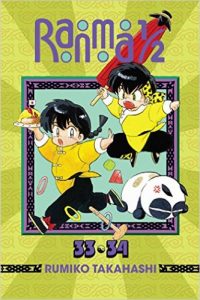
ranma-31-32

For example, we meet Rouge here, a Chinese girl (you can tell she’s Chinese as Takahashi names her after a beauty product, even though she’s not from Shampoo’s village) who ends up in a cursed spring thanks to Pantyhose Taro, and is now determined to have her revenge – most of which involves destroying the Tendo home. It’s an amusing story, relying on her falling in the spring of drowned ASURA, which is drawn with as much ridiculousness as it is possible to have. The denoument, where we see what she’s been fighting to retrieve all this time, is also funny in that Takahashi “so it was all completely pointless” way. Now, Rouge never shows up in the manga again, but several fanfic writers decided she made a good pair with Pantyhose (why they didn’t not write Pantyhose is beyond me, but hey) and thus she had a larger effect on the fandom than she did on the manga itself.

The same goes for Asuka the White Lily, who if she’d appeared ten years later would absolutely have been shipped with Kodachi – even leaving aside the Lily nickname, she’s a ojousama from a private school with a hate on for her childhood friend. But this is 1996, not 2006, and thus the battle between them over who has the best boyfriend (the joke being that because they’re both so horrible neither one has ever found a boyfriend) is taken by fandom somewhat at face value. Don’t worry, Asuka, someone will write a tortured yuri scene with you and Kodachi one day. Oh yes, and Akari shows up again, the only one of these girls who is making repeat appearances, as she visits Ryouga’s home (where, for once, he actually is) and gets caught up in a drawing room farce so broad I was expecting a plate of sardines.

For those who want ship tease with the regulars, well, there’s the hilarious Umbrella of Love story, which features the only known Kuno and Nabiki tease in the entire manga (even under the power of a mind-controlling umbrella, she’s still taking his money), but this is all about Ranma and Akane. As if knowing the end of the series is near, we get a truly incredible amount of moments between them. The umbrella is mostly played for laughs, but shows their feelings for what they are. The story with the Cursed Doll is almost horror, as Akane tries desperately to regain her body before Ranma is either dead or seduced. And most of all we have the arc where Akane gains a possessed armor with a mind of its own, one that makes her stronger than Ranma, and can only be removed if the wearer loses their heart to another. This should be the cue for more hijinks, but it’s played more seriously than I expected, with Ranma realizing how beautiful Akane really is, and trying to defend his true feelings even as she thinks he’s being like this to deceive her (as, to be fair, he has done over and over again).

Ranma never ends with any canon ships, though some are so close that you’d have to be a 1990s Ranma fan in order to deny them. Putting that aside, though, this is a particularly strong volume, one where even the Happosai story made me smile (not because I sympathized with him, it was simply ridiculous). Classic manga comedy at its finest.

Filed Under: REVIEWS

Sword Art Online, Vol. 8: Early And Late

September 15, 2016 by Sean Gaffney

By Reki Kawahara and abec. Released in Japan by ASCII Mediaworks. Released in North America by Yen On. Translated by Stephen Paul.

This is the second of two short-story collections in the SAO series, though two of the three stories aren’t so short. The Safe Haven Incident was written early enough to actually be used in the first season of the anime, though they sadly cut the funniest scene. Calibur (as in Excalibur) is more recent, and was adapted into the 2nd season. The final story here, The Day of Beginnings, was written specially for this book, and is also the darkest story in the book, showing off a scared, desperate Kirito and why he’s so insistent on being a solo player. All of the works are good, fleshing out this world further and giving fans a bit of a treat before we jump headlong into the next arc, which is ten whole volumes long.

sao8

The Safe Haven Incident is a murder mystery, though the murder and its investigation are probably the least interesting part of it. What is good is seeing Kirito and Asuna bond with each other immediately, almost despite themselves, and showing off the two of them seamlessly working together before they became a couple. (Kawahara apologizes to the reader for the continuity not matching the first two books precisely. Given that SAO: Progressive has kicked continuity in the groin and stolen its stuff, I think that’s the least he has to worry about.) We also see Laughing Coffin here, including some retroactive setup for the Phantom Bullet arc that we get as readers even if Kirito doesn’t. As always, a group of players who kill for fun are chilling. The best part of the story, though, bar none, is Kirito and Asuna’s talk with Heathcliff in a ramen restaurant. From Heathcliff’s deadpan hatred of the ramen (his asking “why is this restaurant even here?” is twice as funny after you know his secrets) to Asuna saying the ramen “felt lonely” and determined to figure out how to make soy sauce in Aincrad, it’s pure comedy gold, and it’s a crime the anime had to cut it.

Calibur is more lighthearted, even with a sort of apocalyptic deadline forced on the story. It takes place in Aflheim, so there’s no danger of actual player death, but there is a very real chance the game might ruin itself by starting Ragnarok. But mostly it’s an excuse to see the full cast all reunited one last time and working towards a common goal as a unit. Even Klein gets in on the action, and in fact it’s his samurai desire to help a lady in distress that accidentally ends up winning the day, though of course Klein does not get the girl. Oh, and more comedy cold, as Kirito’s immature pulling of Sinon’s tail (Kawahara tries not to state outright that the tail pull’s effect on its characters is arousing, but it’s somewhat obvious) results in her getting epic revenge later by taking advantage of the fact that every girl in the group is in love with Kirito.

The new story is last, but in terms of continuity it’s first, as it shows what Kirito did immediately after leaving Klein when the game first began. For all the times we’ve seen players complain about “beaters”, here we see they had a point – Kirito absolutely it trying to level up as fast as possible using knowledge only the beta players have, and that will adversely affect the area for other players. We also meet another player, Kopel, who contrasts with Kirito by trying to kill him to save his own skin, though Kirito is not as far from Kopel as he might like. As I said, this is a dark and sad story showing us how a somewhat antisocial young man becomes even more so in a game of death.

This isn’t a book to get if you haven’t read any of SAO before – there’s too much continuity, broken or otherwise, going on – but it’s a nice little addition to the series, and a bit of a breather after the drama of Mother’s Rosary. In the meantime, there’s another Progressive in October, and then in December SAO begins its epic arc: Alicization. Be afraid.

Filed Under: REVIEWS

Is It Wrong To Try To Pick Up Girls In A Dungeon?, Vol. 6

September 13, 2016 by Sean Gaffney

By Fujino Omori and Suzuhito Yasuda. Released in Japan as “Dungeon ni Deai o Motomeru no wa Machigatte Iru Darou ka?” by Softbank Creative. Released in North America by Yen On. Translated by Andrew Gaippe.

I spent a lot of time in my last review complaining about Book 5’s use of Hestia as a character, so it feels especially good to see how well she fares here. In a volume where her entire life with Bell is destroyed and then offered up as sacrifice to an arrogant God, she shines, not in terms of being a badass but in terms of doing what she’s meant to do best – unite people who care about each other and get *them* to fight. After spending most of the last volume jealous of various women’s dealings with Bell, especially Lily, she doesn’t even think twice about rescuing her from Soma Familia’s clutches. And then there’s her confession to Bell, which sadly takes place during a deadly escape so she can’t press more. That said, once again, Bell just doesn’t see you that way, Hestia.

danmachi6

The girl he does have romantic chemistry with is of course Aiz, though it’s arguable whether that’s only on his end – I remain convinced that Aiz is not so much confused about her love for him as confused about her jealousy of him. Still, their dance at the Gods’ ball is a highlight of the book, and we get another round of training the only way Aiz knows how – beat Bell up till he learns. There’s also some new additions to Hestia Familia, taking it over the count of ‘two’ we’ve had for the first five books. No, not Aiz, but Lily, Welf, and Mikoto (remember her? From the last book?) all join up in order to help Bell and Hestia, though Welf and Mikoto may only be there temporarily. When they all combine, and with the aid of Lyr from the bar once again showing off how badass she is while trying not to reveal her true identity, they’re unstoppable.

They are perhaps a little too unstoppable, and yes, there’s elements of male power fantasy here. Speaking of which, the main villain this time around is Apollo, whose followers are all basically picked up by him because he wants to sleep with them, but are nevertheless very competent – and arrogant, as Bell finds in the first of the book’s four extended fights, which in page count take up nearly 3/4 of the book itself. I was a little irritated at the ‘depraved bisexual’ trope being played completely straight, especially when we’ve seen Freya’s desire for Bell played with a lot less creepiness in previous books. The other flaw in the book is during the battle for Lily at Soma Familia – Lily overcoming the power of the wine/drug to beg that she be able to help Bell is a powerful scene, but Soma is *such* a cipher that it’s not as big as it can be.

So now, at the end of Book Six, the cat is out of the bag as far as Bell Cranel being a badass. Everyone in the entire city watched him and the Familia stomp Apollo’s people, and Hestia’s secret isn’t anymore. I suspect that will affect the next book greatly. Before that, though, we have a spinoff coming in October, which will deal with Aiz and her adventures in the Loki Familia. Usually we get spinoff manga, not novels, so I’m looking forward to this. As for the main series, this volume is absolutely worth your time.

Filed Under: REVIEWS

The Devil Is A Part-Timer!, Vol. 5

September 11, 2016 by Sean Gaffney

By Satoshi Wagahara and 029. Released in Japan by ASCII Mediaworks. Released in North America by Yen Press. Translated by Kevin Gifford.

As the series has gone on, the astute reader may have realized that Enta Isla is not simply a place where fantasy devils and angels lived, but a place where an actual War in Heaven broke out and humans were caught in the middle. In other words, where I’d mentioned before that the series was a bit like A Certain Magical Index in the way that it used religious themes for its own ends, I apparently didn’t know the half of it. Here we see Angels descending to Japan to try to discipline one of their own, and Maou gets caught in the middle because a) it’s his series, and b) Chiho ends up hospitalized due to a series of unfortunate coincidences extending back to the start of the series.

devil5

Of course, the main people who get character building here are not Maou and Chiho, but rather Emi and Suzuno. Emi is forced to deal with the fact that her mother is in Japan, her father may be alive, and her very EXISTENCE is an affront to Heaven. And Suzuno, who had already had a bit of a crisis of faith in the second book, is now having to deal with the fact that the Angels who inhabit Heaven may not be all that angelic, and in fact may simply be equivalent to just another gang. Again, using Western religious imagery as the impetus for fantasy plotting is not unique to Japan, but it works particularly well here as we come to realize that there really aren’t good and bad guys here, just a bunch of people struggling for power and worship. That said, I do still want to find out one day why Maou was so horrible pre-series.

To be honest, though, the real joy of this book isn’t really the plot revelations or the depth of character. It’s not even the action sequences, or the sight of a busty teenage girl in pink pyjamas flying though the air and firing beams of energy. No, it’s the entire cast spending the first third of the book discussing digital TV and what makes really good udon. Devil Is a Part-Timer has good backstory, don’t get me wrong, but the best reason to read it is still the tiny minutiae of life in Japan as being lived by a bunch of fantasy heroes. Rika’s stunned reaction when none of her companions know who Toshiba is; Maou’s middle management skills saving the day once again and coming up even in the oddest situations and possibly best of all, Suzuno’s obsession with the delicious cheap udon they get at once shop. It’s simply fun to read.

I could say that about the series as a whole. Everyone’s likeable by now – Emi gets less tsundere by the book, though she’s still got a ways to go – and the prose is smooth and clear, one of the best of Yen On’s light novel efforts. It’s still in the top tier of light novels currently being released.

Filed Under: REVIEWS

Monthly Girls’ Nozaki-kun, Vol. 4

September 8, 2016 by Sean Gaffney

By Izumi Tsubaki. Released in Japan as “Gekkan Shoujo Nozaki-kun” by Square Enix, serialization ongoing in the online magazine Gangan Online. Released in North America by Yen Press. Translated by Leighann Harvey.

For those who greatly enjoyed the Nozaki-kun anime, this volume in particular contains some of the most beloved parts of that anime. Here is where you can find Hori desperately trying to teach a lazy Nozaki about background, which leads to the wonderful “Lately everyone’s been really into boxes!”. We have Nozaki, Hori and Wakamatsu playing the otome game, and boggling at the “good-heartedness” of the lead girl, even when it turns out she can date Satan. And we have the festival, which doesn’t have the sweet ending the anime tacked on to make it more of a finale, but does have Wakamatsu thinking Kashima is a guy and Seo’s date, and the beloved candy apple eating. Basically, everything here is a gem.

nozaki4

(Also, we have that cover, which is absolutely wonderful. You don’t normally think of this title as being sexy, but trust Seo to upend that with one pull of a tie.)

We also meet the rest of Nozaki’s family, though his brother is the one who will actually show up on an occasional basis in future. Like many manga families, the children turn out to have similar personalities to the parents, though both Nozaki and Mayu both seem to be a bit more like their stoic mother. Mayu actually manages to top Nozaki in the “can’t be bothered” sweepstakes, which makes it even more amusing later in the book when he’s paired with the emotionally draining Mikoshiba. Indeed, circumstances have them both end up at the apartment of Tanuki manga author Miyako’s apartment, and Tsubaki shows us why much of the comedy that comes from Nozaki-kun can simply be taking people who’ve never interacted and throwing them together. Turns out their strip, who knew?

And of course there’s Nozaki’s manga, which continues to roll along, even if I imagine its core audience must read it for the eccentricities. Ken can’t possibly smooth them all out. Nozaki trying to “surprise” Sakura ends up failing miserably till he’s not trying anymore, at which point he wins her heart all over again. And speaking of non-romance, Wakamatsu still hates Seo but adores Lorelai, which frustrates Nozaki no end. Seo, of course, is quite happy to go along with this as long as it amuses her, but amusingly, when Wakamatsu ends up being too preoccupied with it to be irritated by her, SHE loses interest in singing! Personality-driven comedy needs to keep surprising, which can be especially difficult in titles like these that don’t really allow for character development, and seeing Tsubaki achieve it every volume is fun.

As always, caveats apply: This is a 4-koma book, which the punchline being a shouted “what the heck?” 90% of the time. But if you don’t mind that, this remains gloriously funny stuff, with a cast that’s extremely strange but fascinating nonetheless.

Very few tanukis this time round, though. Alas.

Filed Under: REVIEWS

Black Bullet: Vengeance Is Mine

September 6, 2016 by Sean Gaffney

By Shiden Kanzaki and Saki Ukai. Released in Japan by ASCII Mediaworks. Released in North America by Yen On. Translated by Nita Lieu.

I’ve talked before about Black Bullet’s flaws – from its shoehorning of “lolicon’ style humor into the text to its simple unrelenting grimness – so let’s try to take this review to talk about what it does well. Because it does do some things very well. Black Bullet has a plan, and that plan is to let you know about the horrors of war. And over the course of this book’s 220-odd pages, you learn over and over again that the noble soldier fighting an unwinnable fight against an unkillable enemy is something that is going to result in hundreds, indeed thousands of casualties. Sometimes, I will admit, Black Bullet overdoes its message – there’s a scene with a cute 8-year-old getting her head cut off that was just so grand guignol it actually turned silly – but for the most part it’s just a sea of horror that hammers its point home nicely.

bb4

The other excellent thing in the book, though again it’s hard to enjoy, is Kisara. I had been ready to gripe about her being underused in the volume again, particularly as there were many times when we were told that she was the most dangerous and deadly of them all – including by the resident insane tykebomb – but we still don’t actually see her doing anything, given that for the most part Rentaro is the hero of this series and it follows his POV. And then we get the Epilogue, and boy howdy. Kisara discovers that one of her brothers is, in fact, responsible for the decay of the monument that led to the events of books 3 and 4 in the first place, and duels him. It’s interesting, because the brother is presented to the reader as being a Grade-A snake, horrible and loathsome, and you are totally not wrong to want to see her take him out.

No, the issue is that she takes joy in doing so, and, in her chosen method, drives a (semi) innocent bystander insane. Her glee and delight as she discusses her revenge being started reminds you what the subtitle of this volume was, and you realize that it was about her all along. Rentaro is, of course, shocked, as this is not the Kisara she normally shows to him. In fact, he realizes that one day he may in fact have to be the one to kill her if she keeps going on like this. I’m not sure when that will play out – final book in the series, I’m guessing – but certainly his utilitarian views are at odds with her “only evil can combat evil” revenge fantasy. It’s a stunning final 30 pages or so.

Of course, my own personal tastes remain an issue here too. This is well-written, the lolicon was at a minimum, and I enjoyed its themes and what it’s trying to say. I just hated reading it as a book for pleasure. It’s very good, bordering on excellent, but I felt the opposite of enjoyment. It was a slog. As such, Black Bullet remains a series that’s hard to recommend, though fans of the anime and of ‘grimdark’ style series will get a lot out of it.

Filed Under: REVIEWS

Everyone’s Getting Married, Vol. 2

September 5, 2016 by Anna N

Everyone’s Getting Married, Volume 2 by Izumi Miyazono

I’m always a happy camper when Viz is putting out a josei title, and with two volumes so far in the Everyone’s Getting Married series, I’m very much enjoying a periodic escape into adult romance trials and tribulations as a nice contrast from all the shoujo I usually read.

One of the things I liked very much about the first volume was that the main couple Asuka and Ryu are so clearly attracted to each other and yet their respective goals of becoming a housewife and never getting married are clearly going to come into conflict. Even when they might have attempted to avoid each other, they find themselves getting closer and closer and in a relationship that is going to have a sudden expiration date if neither of them are going to change.

While Asuka and Ryu are more emotionally connected than ever, they find that their hectic work schedules prevents them from seeing each other very often, causing a bit of tension. Ryu also finds himself enjoying some of the extra homemaker type things that Asuka does a little too much, as she’s able to whip up dinner at short notice and do some extra things to help him through an extra demanding time with his news anchor job.

They manage to navigate their first big fight and end up stronger than ever, but one of the things that I enjoy about this manga is that both characters are sympathetic, their points of view about life are intrinsically opposed, and I’m left rooting for a solution but I can’t picture how they’re going to pull it off. This ends up amping up my curiosity about what is going to happen in the story quite a bit, so I’m eager to see how everything progresses.

egm2

Filed Under: REVIEWS Tagged With: everyone's getting married, Josei, viz media

Fruits Basket Collector’s Edition, Vol. 4

September 4, 2016 by Sean Gaffney

By Natsuki Takaya. Released in Japan by Hakusensha, serialized in the magazine Hana to Yume. Released in North America by Yen Press. Translated by Sheldon Drzka.

As I’ve said a few times before, you can usually tell when a series has suddenly become a big hit by the writing. Fruits Basket has hit it big, to the point where the Hakusensha editors must have told Takaya she can stretch it out how she wants. And so we can get extended flashbacks devoted to Uotani, Tohru’s yanki friend, and how she went from a middle school delinquent to one of Tohru’s strongest protectors. We also get a brief one-chapter day in the life of Minagawa, the over the top president of the Yuki Fan Club, who like any other teenage girl is filled with doubts and insecurities of her own. And we see foreshadowing that I had forgotten happens this early, as the new Student Council members, whose faces are hidden from us, discuss their interest in Yuki… and Tohru. Are they SECRETLY EVIL? (Answer: no, but it’s a nice ominous cliffhanger that won’t be resolved for a while yet.)

furuba4

We are also introduced to two more Sohmas. I’ll start with Ritsu, as I’m less interested in him. He’s deliberately grating, in a way that irritates everyone not named Tohru, but it’s not without cause, and once again shows us how hard it is to be living with the Sohma curse, or living with someone who has it. Also, his meeting with Micchan is hilarious – they really are perfect for each other. More important to me is the introduction of Hiro, who I suspect will annoy the new reader even more than Ritsu does. Hiro’s a brat, there’s no mistaking it, and what’s worse, he’s smart and insightful but can’t deal with the emotions that go along with that. Throw in a crush on Kisa, and some veiled suggestion that telling Akito he was in love with her was the worst thing ever, and I find a lot to sympathize with. He also pegs Tohru perfectly, albeit rudely, and we start to see the first signs of the cracks showing in her all-loving facade here, as she admits that she focuses on others to the exclusion of her own needs mostly out of desperately not wanting to look hard at herself.

I’d mentioned foreshadowing before, and the other big introduction we see here will have to wait till next time, which is Rin. She’s in hospital, apparently put there by Akito, and judging by the fact that she’s recently broken up with Hatsuharu, seems to be trying to cut all ties – except to Shigure, who she’s convinced can help her. Rin looks scary, to be honest, and given how popular Haru is with fandom, it’s no surprise that she too gets off on the wrong foot in Furuba fandom, only she doesn’t have the benefit of being a cute guy in this female-driven fandom, so it seems worse. Oh yes, and we also get more of the Yuki backstory that was hinted at in the last omnibus, and I feel bad for saying that Akito smothered him – there was just as much abuse as everyone else has had to ensure. Being a Sohma is suffering.

This is about where the anime broke off, with its adapted ending that to this day doesn’t quite sit right with me. It’s also where Takaya hurt her hand, causing the manga to go on hiatus for a year. It stayed popular in Japan, and became huge over here, but I wonder if we may have gotten a second season otherwise. (Probably not – allegedly she had issues with the director, similar to Kare Kano.) In any case, the first few books in Furuba show us sad teens with emotional problems, but as we move forward, the depth of the writing shows that the sadness and the emotional problems have not begun to be plumbed. If you never read this the first time, you’re missing out.

Filed Under: REVIEWS

The Asterisk War: Encounter with a Fiery Princess

September 3, 2016 by Sean Gaffney

By Yuu Miyazaki and okiura. Released in Japan by Media Factory. Released in North America by Yen On. Translated by Melissa Tanaka.

There’s a moment about two-thirds of the way through this novel where the hero and heroine are viewing the city, and she asks to eat at a fast food place. He is somewhat startled by this, as he’s discovered that she’s the princess of a European nation and expected her to only want to go to high-class restaurants. Eventually we do get an explanation for why she prefers to eat there, but her initial response to him is simply that this is fine, right? And that’s sort of how I feel about The Asterisk War. It’s not original by any means. In fact, that’s an understatement. It is so unoriginal that it may actually leech cliches from the books on your shelves that surround it (Go reread them – are they filled with twists?). That said, sometimes you want a burger and fries. And The Asterisk War is very good fast food, which I’d be happy to eat if I’m in a rush.

asterisk1

I will try to describe the plot without just linking to various TV Tropes pages. Our hero is Ayato, a young man who’s just arrived at a prestigious magic academy, one of six schools in the shape of an asterisk that fight each other (hence the name of the series). Supposedly he’s a perfectly normal student with a bit of sword training. In reality, of course, his true power has been sealed by his sister, who is currently missing and whose footsteps he is trying to trace. He has an unfortunate first encounter (if you guessed “saw half-naked”, you get no points as it was too obvious) with our heroine, Julis, who seems like the standard angry tsundere (she wields massive fire powers, because of course she does) but in reality is just bad at dealing with people and somewhat lonely. As Ayato learns about the school, running into a) the buxom and teasing Student Council President who has big plans for him, and b) his childhood friend, a sleepy and emotionless young girl who nevertheless carries a somewhat obvious torch for him, Julis deals with the fact that someone is trying to kill, or at least disable, her before the Big Competition that no doubt will serve as the plot of future books.

Now, if you’ve been keeping score, try to add up the number of other manga, anime, and light novels that the above description sounded like or reminded you of. If you got under ten, you weren’t trying hard enough. (I’m honestly amazed there wasn’t incestual subtext – clearly the author didn’t try hard enough.) But for all my snark, I actually enjoyed this quite a bit. The hero is likeable and strong without being overpowerful, and reacts to half-naked women like a normal teenage boy and not a manga cliche. Julis starts off over the top, but it takes less than half a volume for us to realize that she’s not going to be another tsundere – well, except when the fanservice or comedy requires it, then of course she will be. I’m also very fond of Saya, less because of good writing and more because I simply like that type of character. Same with Claudia.

So there’s nothing here you haven’t seen before. But the fanservice is light compared to other series, the plot twists are predictable but not irritating, and most of the cast is quite likeable. It’s fast food, but it’s filled with stuff you always enjoyed growing up. I’m perfectly happy to take it in and see what happens next. (Also, Chivalry of a Failed Knight doesn’t have its book licensed yet, so schtum.)

Filed Under: REVIEWS

  • « Go to Previous Page
  • Page 1
  • Interim pages omitted …
  • Page 210
  • Page 211
  • Page 212
  • Page 213
  • Page 214
  • Interim pages omitted …
  • Page 342
  • Go to Next Page »
 | Log in
Copyright © 2010 Manga Bookshelf | Powered by WordPress & the Genesis Framework