• Skip to primary navigation
  • Skip to main content
  • Skip to primary sidebar
  • Home
  • About Us
    • Privacy Policy
    • Comment Policy
    • Disclosures & Disclaimers
  • Resources
    • Links, Essays & Articles
    • Fandomology!
    • CLAMP Directory
    • BlogRoll
  • Features & Columns
    • 3 Things Thursday
    • Adventures in the Key of Shoujo
    • Bit & Blips (game reviews)
    • BL BOOKRACK
    • Bookshelf Briefs
    • Bringing the Drama
    • Comic Conversion
    • Fanservice Friday
    • Going Digital
    • It Came From the Sinosphere
    • License This!
    • Magazine no Mori
    • My Week in Manga
    • OFF THE SHELF
    • Not By Manga Alone
    • PICK OF THE WEEK
    • Subtitles & Sensibility
    • Weekly Shonen Jump Recaps
  • Manga Moveable Feast
    • MMF Full Archive
    • Yun Kouga
    • CLAMP
    • Shojo Beat
    • Osamu Tezuka
    • Sailor Moon
    • Fruits Basket
    • Takehiko Inoue
    • Wild Adapter
    • One Piece
    • After School Nightmare
    • Karakuri Odette
    • Paradise Kiss
    • The Color Trilogy
    • To Terra…
    • Sexy Voice & Robo
  • Browse by Author
    • Sean Gaffney
    • Anna Neatrour
    • Michelle Smith
    • Katherine Dacey
    • MJ
    • Brigid Alverson
    • Travis Anderson
    • Phillip Anthony
    • Derek Bown
    • Jaci Dahlvang
    • Angela Eastman
    • Erica Friedman
    • Sara K.
    • Megan Purdy
    • Emily Snodgrass
    • Nancy Thistlethwaite
    • Eva Volin
    • David Welsh
  • MB Blogs
    • A Case Suitable For Treatment
    • Experiments in Manga
    • MangaBlog
    • The Manga Critic
    • Manga Report
    • Soliloquy in Blue
    • Manga Curmudgeon (archive)

Manga Bookshelf

Discussion, Resources, Roundtables, & Reviews

Reviews

An Invitation from a Crab

January 11, 2019 by Sean Gaffney

By panpanya. Released in Japan as “Kani ni Sasowarete” by Hakusensha, serialized in the magazine Rakuen Le Paradis. Released in North America by Denpa Books. Translated by Ko Ransom.

Iev always been a fan of those sketchy, semi-slice of life (except they’re too weird) manga that you see towards the back of a lot of seinen and josei manga magazines. It used to be that the chances of such works getting licensed over here was nil, but Denpa has quite a few eclectic titles coming out now, and An Invitation from a Crab is one of the first. It’s more of a collection of interconnected short stories, along with the occasional essay discussing the importance of paying attention to things. Our unnamed heroine is theoretically a high school student, and occasionally we do see her in class. But the world she’s in is not quite the same as ours, featuring normal humans but also animal-headed people, as well as the bizarre lemon with an eye that seems to be a ‘boss’ sort of type. Essentially, An Invitation from a Crab is a “what kind of stories will the author spin next?’ sort of book. And they’re good stories.

The stories here range from a few pages long to larger chunky narratives. The title comes from the first story, where our heroine follows a crab that is lying in the road and seems to know where it’s going. That said, the “punchline”, as it were, amounts to not much, and that’s also the case with most of the rest of these stories. You’re reading this for mood, not for jokes or characterization, and so frequently the stories feel like “shaggy dog” stories, where the ending does not justify the effort expended. Which is absolutely fine given much of this is about enjoying the journey. We see our heroine wearing a Chinese communist outfit in a factory breaking coconuts so they can be used to create electricity. That is a sentence I can’t believe I just typed, and it’s probably the weirdest of the stories in here, but there’s other dreamlike sequences as well, including one that literally is a dream, where our heroine’s spirit gets off a train but her body doesn’t.

There is quite a bit of humor here, despite my saying earlier that there weren’t punchlines per se. Sometimes simply seeing the situation makes me laugh, such as our heroine and her dog/roommate/whatever searching to try to find anyone who knows where pineapples come from, or the heroine gleefully preparing for her Sunday day off by doing piles of things (this reminded me of the Zetsubou-sensei chapter where the class had a “preview” of their field trip). And sometimes the mood can be disturbing – there’s a lot of dark shadows in this world, and while the coconut and lost body stories are not dark in any way, they’re unsettling and have a sense of unreality to them. Even some of the shorter stories in the volume, such as when our heroine is sold a giant salamander and tries to return him to the Amazon (a plot that lifts directly from an old Bugs Bunny cartoon), has an ominous feel to its humorous ending.

If you’re interested in a skewed look at life in a world that’s not quite this one, or wonder what it would be like if you did follow that crab into the side alley, you should definitely pick this up.

Filed Under: an invitation from a crab, REVIEWS

Accel World: Snow White’s Slumber

January 10, 2019 by Sean Gaffney

By Reki Kawahara and Hima. Released in Japan by ASCII Mediaworks. Released in North America by Yen On. Translated by Jocelyne Allen.

I was a little grumpy with the last volume of Accel World. After feeling that the Armor of Catastrophe arc went on far too long (a fact the author also agreed with me on), seeing it return as a Mark II made me slap my hand to my forehead. Fortunately, we were near the end of this arc when it appeared, and so it’s taken care of in one volume, though not without considerable sacrifice. More importantly, there’s a lot of really interesting discussion about the nature of Accel World in general, as well as its forbears. Striving for a meaning and purpose in life is something we see a lot of in the real world, but in the Accel World, the meaning and purpose of life may actually be a tangible thing, given that it was created. What’s more, the nature of Metatron reminds me very much of the nature of Kizmel in Sword Art Online; a sense of “these supposed NPCs have gone way beyond what everyone thought they would do’.

A lot of this volume, given that Haruyuki is separated from Kuroyukihime, focuses on the relationship between him and Metatron, who would likely have risen up fairly high on the list of ‘harem candidates’ were it not for the events later in the book, and even so the epilogue shows there may be hope. I admit I could have done without the “I speak like a tsundere princess” thing, but I really did like the discussion they had, which also shows how clever Haruyuki is, piecing together stuff that’s been bubbling around inside his head for the last 15 volumes or so. She also gives him the strength to finish off the bad guys before they get even more powerful, and (hopefully) get ris of the ISS kits making everyone lose it in the real world as well, though that last part remains to be seen. Everyone else got a lot of good stuff to do as well, and there was some nice development of Nico, who gets her armor back… mostly. There’s even a heartwarming festival to end things!

Except that what most everyone will be talking about is the arrival of White Cosmos, the White King who we’d never seen before, the power behind the Accelerated Research Society, and Kuroyukihime’s real-life sister. Given this is a Kawahara villain, it’s no real surprise that her goal appears to be to drive everyone in the game to total despair. Subtlety is not why you read this author. I suspect that she’s mostly going to be used to drive character development for Kuroyukihime, who wisely (and with Haruyuki’s help) chooses not to fight her just now. And of course to contrast the ‘girl shrouded in black who’s really kind vs. girl who looks white and kind but is secretly manipulative and awful’. Again, subtlety is not on display here. But it makes for a nice, dramatic scene, and would look pretty cool animated.

Given that we’ve wrapped up a long arc here, I would not be surprised if the next volume is lighter in tone. In the meantime, fans of the series shold enjoy this new volume, especially the talk between Haruyuki and Metatron.

Filed Under: accel world, REVIEWS

Kakuriyo: Bed & Breakfast for Spirits, Vol. 1

January 9, 2019 by Katherine Dacey

One occupational hazard of reviewing manga is the powerful sense of déjà vu that a middle-of-the-road series can induce. I experienced just such a flash while reading Kakuriyo: Bed & Breakfast for Spirits, a pleasant, decently executed shojo series that hit so many familiar beats I was tempted to pull out a bingo card and tick off the stock characters and situations as I plowed through volume one.

As in other supernatural romances — think InuYasha and The Water Dragon’s Bride — the plot is set in motion by the heroine’s abduction to the kakuriyo, or spirit realm. There, Aoi learns that her late grandfather was capable of traveling between the kakuriyo and utsushiyo (human world), a skill that gramps exploited to run up a tab at a supernatural B&B. Gramps pledged Aoi as collateral, promising her hand in marriage to Odanna, the inn’s proprietor. Odanna is — wait for it — a handsome jerk with an attitude so condescending that Aoi can barely stand to be in the same room with him. He’s also an ogre. (A real ogre, not a metaphorical one.)

Indignant at the prospect of marrying a monster, Aoi instead vows to settle her grandfather’s accounts by working at the inn, a vow made more complicated by the other demons’ refusal to hire human staff for even the most menial tasks. The creators have used Aoi’s predicament as an opportunity to graft elements of a cooking manga onto the main plot by furnishing Aoi with culinary skills so impressive that even denizens of the kakuriyo are wowed by her omelet rice and chicken stew. The inclusion of these scenes feels perfunctory, however, as they add little to our understanding of who Aoi is; if anything, these interludes serve mostly to foreshadow the inevitable moment in volume two or five when Aoi finally persuades the inn’s chef to update his menu with Japanese comfort food.

The real pleasure in reading Kakuriyo: Bed & Breakfast for Spirits is the parade of ayakashi (spirits). The supporting cast seem to have stepped out of a Hyakki Yagyō scroll: there are kappas and tengus and oni, no-faced women and nine-tailed foxes, all drawn in a style that explicitly references the work of Utagawa Yoshiiku and Kawanabe Kyosai. When interacting with Aoi, these spirits morph into preternaturally elegant humans swathed in Edo-era couture. It’s an effective gambit, allowing illustrator Waco Ioka to emphasize her strengths — fabrics, textures, masks — while offering a plausible explanation for the demons’ uncanny appearance. (Looking through one of gramps’ photo albums, Aoi notes that the ayakashi‘s “faces look fake, like they’re pasted on.”)

Yet for all the joys of seeing the Night Parade of 100 Demons come to life in such a stylish fashion, I was so aware of the plot mechanics that I could never fully embrace Kakuriyo as a story. Someone less steeped in the conventions and cliches of shojo manga, however, might well find Kakuriyo a charming introduction to one of the medium’s most ubiquitous and appealing genres: the supernatural romance.

The verdict: Librarians working with middle school readers might find Kakuriyo a good addition to their graphic novel collection, as it’s largely free of provocative content (e.g. strong language, sexuality) but will feel more “adult” to readers in grades 6-8 than other T-rated romances.

A review copy was supplied by VIZ Media.

KAKURIYO: BED & BREAKFAST FOR SPIRITS, VOL. 1 • ART BY WACO IOKA, ORIGINAL STORY BY MIDORI YUMA, CHARACTER DESIGN BY LARUHA • TRANSLATED BY TOMO KIMURA • RATED T, FOR TEENS (FANTASY VIOLENCE) • 196 pp.

Filed Under: Manga, Manga Critic, REVIEWS Tagged With: Ayakashi, shojo, shojo beat, Supernatural Romance, VIZ, Waco Ioka

After the Rain, Vol. 2

January 9, 2019 by Sean Gaffney

By Jun Mayuzuki. Released in Japan as “Koi wa Ameagari no You ni” in two separate volumes by Shogakukan, serialized in the magazine Big Comic Spirits. Released in North America by Vertical Comics. Translated by Jocelyne Allen.

As you might imagine given the title of the series is After the Rain, it rains an awful lot in this manga. This not only creates an appropriate atmosphere, but allows both of its protagonists to come down with bad colds. This causes both Akira and Kondo to lose control of their emotions a bit, allowing suppressed feelings to boil over – nothing going beyond hugging, mind you. No one is quite ready for this relationship to advance that far yet. (Well, Akira may want it to – her fantasies when she’s in bed with a cold verge close to a masturbatory scene.) Plus both Akira and Kondo have things in their life they need to work out first. Akira is still trying to untie herself from her previous track team life, despite her friend Haruka insisting they can still be friends. And Kondo has a hidden side – he writes. But doesn’t want anyone to find out about it.

It’s no coincidence that both of these plotlines resemble each other – our leads are very much alike despite the age difference. Akira is determined to move on from her injury, but feels like the only way she can do that is by completely cutting out that part of her life. This naturally upsets Haruka, who is reduced to tears hearing Akira essentially deny everything they had. As for Kondo, seeing Akira recommend a book by his college friend Chihiro brings up old memories, and causes him to reunite with said friend and discuss their old literature club, which also apparently had his ex-wife in it. The reunion allows him to give advice to Akira on her fight, which is, essentially, “even if you do never speak again, this will not change the precious moments you once had with each other”. Which is good, if non-confrontational, advice – I’m sort of rooting for Haruka here.

We also meet Akira’s father in this volume (complete with a great “stop telling people I’m dead!” joke), which is good, because it shows us that her dad really isn’t much like Kondo at all. (So he’s not a replacement father figure, which I was fearing.) She’s also a lot more outgoing with her dad, sort of like the flashbacks of her and Haruka that we see before the accident. Like most high school kids, she’s ready to grow up and be taken seriously as an adult, and is frustrated by people who still want to treat her as a kid – not realizing that the reason they’re doing it so much is they know they don’t have much time left to pamper her. She’s almost an adult, but you want to stop time just so that you can still have her need you in the same way. It amounted to my favorite chapter in the book.

This story continues to be a sweet, slow burn, and my misgivings about the May-December romance have faded a bit. More to the point, I just like the writing of the characters. Even if the romance doesn’t happen, I want to see what happens next in their life anyway.

Filed Under: after the rain, REVIEWS

Reborn as a Vending Machine, I Now Wander the Dungeon, Vol. 3

January 8, 2019 by Sean Gaffney

By Hirukuma and Ituwa Kato. Released in Japan as “Jidou Hanbaiki ni Umare Kawatta Ore wa Meikyuu wo Samayou” by Kadokawa Shoten. Released in North America by Yen On. Translated by Andrew Prowse.

This third volume of Reborn as a Vending Machine tries to expand the world that we’re in and give our hero a bit more insight into goals for the future. As we’ve seen, a lot of his “what should I do next” thoughts involve collecting points to level up, get new products, etc. Here, after a very amusing eating contest, Shui from the mercenary group wins the right to have Boxxo for the entire day, and takes him to the first floor of the dungeon, home to (try to contain your surprise) a group of poor yet plucky orphan children. The dungeon, it turns out, needs to have someone reach a certain level in order to get to the second floor. So for the unwanted kids, or whose whose parents have died, they have this. It reminds Boxxo to, if you’ll pardon me, think outside the box and realize this is a real life world he’s now in, not just a game RPG.

There’s also his relationship with Lammis, which continues to be chaste (he’s a vending machine) but still have that “I am a harem manga protagonist” feel to it. Lammis is clearly deeply in love with Boxxo, and as such will try to overcome her limits in order to stay by his side (she’s terrified of the supernatural, and the last half of the book involves nothing but that) and also gets easily embarrassed around him (she tries to hide her heavy period, which doesn’t work but does allow Boxxo to show off that he can also dispense sanitary pads). As for Boxxo, his emotions are still a bit flat, but it’s pretty clear he likes Lammis quite a bit. I’m not entirely sure where the series’ endgame is here, but am content with it simply being cute and chaste – it really does get pretty adorable.

Less adorable is the climax to the third book, where our heroes defeat a skeleton lord and then discover the demon behind the skeleton lord, who is vastly more powerful. For a moment I wondered if the book was actually going to kill off a few regulars – the villain actually stops Hulemy and Shui’s hearts, and you briefly think the book might be going in a dark direction. But no, it’s just an excuse for Boxxo to recall that AED stations can also be part of a vending machine, and that he can use that to save their lives. Also, he has telekinesis now, though we don’t get too much of a sense of how he’ll use that. Honestly, you don’t want this series getting too dark – it’s about a guy reincarnated as a vending machine – so I’m fine with his breaking out vaguely deus ex vending machina powers so that everyone is fine again.

While the series has a number of volumes after this in its webnovel version, Kadokawa hasn’t published a new volume in about two years, so this may be all the vending machine we see. (The author has been writing KonoSuba side story volumes, which may explain it.) Which is a shame, as despite its truly ridiculous premise I found myself drawn into each book, trying to see what would be happening next. I’ll miss you, Boxxo.

Filed Under: reborn as a vending machine, REVIEWS

I Saved Too Many Girls and Caused the Apocalypse, Vol. 11

January 6, 2019 by Sean Gaffney

By Namekojirushi and Nao Watanuki. Released in Japan as “Ore ga Heroine o Tasukesugite Sekai ga Little Mokushiroku!?” by Hobby Japan. Released in North America digitally by J-Novel Club. Translated by Mana Z.

By the end of this volume, we have five left to go before the series ends. It’s started to make me wonder what the endgame is actually going to be. Oh, I’m still convinced it will end with him not choosing anyone. But it has to be said, if he is going to choose one of the girls, it has to be someone the reader has a strong attachment to as well. And, well, First Girl Wins is not just a trope for nothing. Satsuki has an advantage that the other girls do not. She’s a childhood friend, she has magical wikipedia powers and is therefore involved in Rekka’s life rather than being kept in the dark. And she gets a big focus in this volume as well, as she and Rekka are accidentally sent to a deserted island for a while, where they can wax nostalgic, almost get eaten by a leopard, and come close (but not close enough) to a confession.

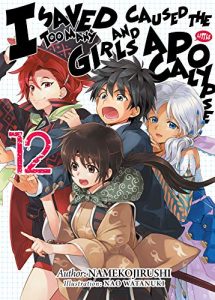
Satsuki is not on the cover, of course. The interesting thing, though, is that both girls on the cover, while heroines that Rekka “solves”, are not romantic heroines that we can see. Yulia is a nun who, like many Japanese nuns in fiction, is also an exorcist and a bit of a fanatic. Given she’s ended up in Rekka’s hometown, which is teeming with otherworldly inhabitants, particularly the vampire Rosalind, you can see why Yulia is flipping out a bit. In fact, dialing back her fanaticism is the point – she’s mistaking the Church’s vendetta for her own, and Rekka has an actual Angel to tell her “no, God says the Church is wrong”. (A very common thing in light novels lately.) As for Poppy the fairy, “staying hidden” and avoiding a group of kids trying to capture her is the sole goal she has. Compared to prior volumes, the stakes are very low key here.

Back to Satsuki, a surprise in this volume was that we not only see her parents, but get art showing what they look like. (In fact, the author wondered if there were enough interesting scenes for the artist, which may be why we see her parents as well as the kids harassing the fairy.) The other plot-heavy part of the book involves L, who has been abandoned by her villain friends and is on her own in the past, and essentially homeless till she gets picked up and adopted, for the moment, by Satsuki’s family. She’s still trying to kill Rekka technically, but it is interesting that whereas R is going for “hammer Rekka with as many heroines as possible to create a crisis point”, L is more “I am in one heroine’s corner”. And that heroine is Satsuki.

Will she win? Likely we won’t know till Book 16. Will R ever be seen? And of course the one question that absolutely has to wait for the last book: will Rekka get a clue that everyone is in love with him and do something about it other than change the subject? We do apparently get a girl in a top hat, though, so that’s nice. If you’ve been reading this, keep reading it. It’s fun froth.

Filed Under: i saved too many girls and caused the apocalypse, REVIEWS

Silver Spoon, Vol. 6

January 5, 2019 by Sean Gaffney

By Hiromu Arakawa. Released in Japan as “Gin no Saji” by Shogakukan, serialization ongoing in the magazine Weekly Shonen Sunday. Released in North America by Yen Press. Translated by Amanda Haley.

It’s going to be very hard to discuss this volume without talking about the final chapter that overshadows the rest of it, but I will do my best to save that for later. In the meantime, there is still festival prep, and horse races! The racing is a highlight of the book, mostly as, despite getting distracted by family, studies, and Mikage, Hachiken is finally learning how to ride. This is despite the fact that he almost falls off Chestnut 3/4 of the way through, creating a dramatic moment when everyone panics he’s going to fall and get trampled. But he survives, and ends up in fourth place! Which is interesting, because it’s really good for a newbie, but it still irritates him. He wants more. He’s getting competitive spirit. This is especially good news given that he’s fallen for Mikage, who gets third in her own race and actually agrees to go on a date with him during the festival (though she may not have realized that’s what it was).

It would be remiss of me not to mention Ayame, who is introduced in this volume and is FABULOUS, in all senses of the word. Trying her hardest to have wandered in from a Rose of Versailles manga, and consumed with an intense rivalry with Mikage (who merely sees her as a good childhood friend), Ayame is pure hilarity the moment she steps onto the page. She’s basically the “ohohohohohoho” laugh given human form. She rides slowly and perfectly through her race, not understanding or even really caring that she’d doing it wrong. And when Hachiken manages to get fourth in a race (and thus finish ahead of her), Ayame admits that she’s rivals with him as well. For all that I praise Silver Spoon for its depiction of agriculture and compelling characters, there’s also no doubt that Arakawa can make things incredibly funny.

…and then Hachiken collapses and is taken to hospital, right before the festival begins. Frankly, the astute reader should have guessed this was going to happen. He hasn’t been brought up on a farm, and he got goaded into taking charge of eighty different things. He was ridiculously exhausted, and now he’s paying. That doesn’t make this any less depressing, though. His look as he wakes up in the hospital is almost heartbreaking. And that cliffhanger, showing the arrival of his dad, promises that the next volume is not going to be starting with laughs either. Still, I like that we are shown the start of the festival anyway – the manga is not just Hachiken, and I’ll lay you even money that his incredibly detailed and easy to understand festival plan is going to be noticed by someone at some point (there’s even a shot of the notebook sitting there like Chekhov’s gun.)

So the festival looks to be a success, but will Hachiken get to see any of it? And will his dad demand he pull out of the school? Can his dad, in fact, find it in him to not be a complete dick this time? I cannot wait to find out, because Silver Spoon is still amazingly addicting.

Filed Under: REVIEWS, silver spoon

The Asterisk War: Idol Showdown

January 4, 2019 by Sean Gaffney

By Yuu Miyazaki and okiura. Released in Japan by Media Factory. Released in North America by Yen On. Translated by Haydn Trowell.

I must admit, of all the minor characters introduced in the last book when Ayato toured the festivals, I was not expecting the comic relief idol band to be the most important. Yet here we are, with said band trying to shame Ayato for being a clueless harem protagonist, getting into fights with other, more delinquent contestants, discovering secret underground battle rings, and taking on our heroes in the final part of the book. Actually, possibly the most interesting part of their story is the fact that their weapon is so powerful, even divided into five bits, that it literally makes them more eccentric and difficult. They have weaponized being cloud cuckoolanders! They also put up a damn good fight, forcing Claudia to use a lot more of her precognitive powers than I think she wanted, which will no doubt come to haunt her in the end. That said, this is really Saya’s book. So I will save her for later.

But first, let’s stay with Claudia, who stuns everyone by announcing her goal in front of the press. This certainly unnerves many people in power, especially her mother, who it turns out if in charge of most everything. As you can imagine, Claudia and her mother do not get along, and yet their confrontation is a highlight of the book. It also seems to tie into what Sylvie is searching for – as does the aforementioned underground battle ring, which is shut down for now but I’ll bet you even money will be started up again in a few books so that Ayato and Julis can fight forbidden illegal battles. Much of the rest of the book is the start of this tournament, with various groups fighting and showing off their dangerous points. This includes Claudia’s team as well, usually with her as the ‘team captain’, though that changes for the final match of the book.

Which brings us to Saya, who gets a lot of focus here. She’s both the childhood friend love interest and the ‘stoic’ one, so brings a lot of popular cards to the table. Her stoicness masks a lot of emotion, though, both in her desire to be able to bring everything she can to the battles with her weapons (which works out wonderfully in the last battle with her homing bazooka thing), and in her desire to be closer to Ayato. She spends a lot of the middle of the book convincing the idol group girls that Ayato is not, in fact, a playboy (well, not deliberately) and explaining all the times he’s been there for her. Which seems to lead her to the big cliffhanger, where she confesses to him. Now, I have a feeling that Saya is aware of the cliches of harem novels like this, and knows that by both being a childhood friend *and* confessing first, she’s out of luck. Still, it’s super impressive, and I hope that Ayato is able to give her a response that’s not just hemming and hawing.

Asterisk War is still very light and fluffy, but this was a particularly strong volume of the series. If you only watched the anime to make fun of it, you might be surprised by this book.

Filed Under: asterisk war, REVIEWS

Kimagure Orange Road, Vol. 1

January 3, 2019 by Sean Gaffney

By Izumi Matsumoto. Released in Japan in three separate volumes by Shueisha, serialized in the magazine Weekly Shonen Jump. Released in North America by Digital Manga Publishing. Translated by Steven LeCroy.

It’s been an awfully long journey from “the anime is a big hit, the manga is sure to be licensed” to “why didn’t Viz license this back in the day?” to “yay, DMP is Kickstartering the entire series!” to “will this be released before DMP dies?”. But here we are at last, and all six omnibuses of the legendary Kimagure Orange Road are now in my hot little hands. They look nice – good paper stock, solid covers. You can tell the KS money went into printing them. The question is who the audience is. Chances are that anyone who ponied up the considerable cash to get six print omnibuses of the entire series is already going to be a KOR fan. You aren’t getting casual readers. If a casual reader did get the series (there are PDF copies of the omnibuses on sale at emanga), they might be startled by how ordinary it all seems. But that’s typical with manga that sets the trend and then is quickly surpassed by those who come after it.

For those unfamiliar (and given that the heyday of North American fandom was around twenty-five years ago, I think that’s most of you), the premise of Kimagure Orange Road has a family moving to a new neighborhood. The father is fairly normal. But his children, Kyosuke, Manami, and Kurumi… are psychics! Just like their late mother. (Yes, sorry, Hard-KOR fans, esper is not used here.) They move a lot because the kids, being young and impetuous, abuse their powers and are caught. Kyosuke is really trying to not do that and fit in at his new school. Then he sees two girls smoking behind the school… cool, aloof Madoka and outgoing, impetuous Hikaru. He’s met Madoka before, running up a stairway with either 99 or 100 steps, depending on who you agree with. But she seems totally different now, and doesn’t want to give him the time of day! Kyosuke promptly falls for her… and Hikaru falls for him. But what of Madoka, this whimsical girl?

“Kimagure” can be translated as “whimsical”, and it certainly applies to Madoka, who runs hot or cold depending on the situation. She clearly likes Kyosuke immediately but she also sees Hikaru likes him too, and that he’s not doing a good job of telling Hikaru he’s not interested. Plus he tends to be a jerk some of the time, saying things like “if you smoke, you won’t have healthy babies”. (Note the two reactions: Madoka blushes at the thought of doing things that make you have babies, Hikaru gets mad and says “I’ll show you! Imma have ALL the babies!”) The series plays out like a classic shonen romantic comedy – in fact, it is *the* classic shonen romantic comedy. That said, it’s also steeped in what was big in 80s manga, as Kyosuke does use his powers quite a bit – if you’re wondering what specific powers, well, it tends to vary depending on the need of the plot, but includes teleportation, telekenesis and mind reading. You can see why their dad is worried about his kids.

I mentioned that North America had a big KOR fandom back in the day, but that’s not quite true. The fandom was for Madoka. The rest of the anime and cast was secondary. Most modern manga tries to keep the love triangle at least a little balanced, but Matsumoto is not really interested in that. We *know* Kyosuke and Madoka are the couple, the question is how long it will take. The answer is there’s five more of these 600-page omnibuses to go. As for Hikaru, fans these days are more sympathetic to her than they were back in the 1990s, where she was the very first “bashed” anime character – even before Akane in Ranma 1/2! Given that, in the manga at least (the anime is another story) she is unaware of Kyosuke and Madoka’s feelings for each other, her forwardness is a lot more understandable. Still, looking back on the series now, I must admit: things would be solved a lot faster if Kyosuke mustered a backbone.

If you want to see shonen romance as your parents read it, you really can’t get a more perfect choice than KOR, which is pure 1980s Japan, even down to the discos – and the amusement park called Cougar Town. Recommended.

Filed Under: kimagure orange road, REVIEWS

Beasts of Abigaile Vol. 4

January 2, 2019 by Anna N

Beasts of Abigaile Volume 4 by Spica Aoki

I hadn’t realized that Beasts of Abigaile was only 4 volumes long, and I’m guessing that the mangaka wasn’t planning on the series wrapping up so quickly either, based on the sheer amount of backstory and exposition crammed into one volume. Still, the story does end on a satisfying note, although I would have been fine to see the series get stretched out to 5 or 6 volumes in order to be able to spend more time with the supporting cast.

Nina’s been captured and her secret of being a human at the werewolf academy on the island of Abigaile is threatened with exposure! She encounters a chained-up Giles, who fills in some of the details about the manipulation of Angelica the student body president who is nursing a special hatred for Nina. Nina is determined to be a force for good at the academy after hearing more about how its potential has been subverted by the school administrators. Roy is on his way to rescue Nina when she flies in with a high kick and they take off and hide in rose bushes to escape. One of the things that I like about this series is that for all of Roy’s alpha male blustering, Nina often manages to rescue herself through sheer determination.

On the way to the resolution of the series, the reader learns about Nina’s secret past, Roy and Giles’ secret past, and Nina comes to realize exactly what her own feelings are. There are some spectacular revelations and many panels of people staring intensely through jail bars. While this volume suffered a bit from too much story being crammed into a few short chapters, overall Beasts of Abigaile was a fun to read breezy paranormal shoujo series that I enjoyed. I hope it did well enough for Seven Seas that they continue to publish the occasional shoujo manga, as I like to see shoujo coming here from a variety of Japanese publishers.

Filed Under: Manga Reviews, REVIEWS Tagged With: beasts of abigaile, Seven Seas, shoujo

The Devil Is a Part-Timer!, Vol. 12

January 2, 2019 by Sean Gaffney

By Satoshi Wagahara and 029. Released in Japan by ASCII Mediaworks. Released in North America by Yen Press. Translated by Kevin Gifford.

This is a stronger volume of Devil Is a Part-Timer! than the previous one, probably because the previous one got all the exposition out of its system in one gulp. Actually, the theme of this new volume could be avoiding exposition, as both Emilia and Maou do their absolute best to not talk to Laila and avoiding knowing why it is they’re the only ones who can save the world this time. In practice, this means this is a “downtime’ volume, though there is an exciting battle in a subway tunnel in the middle of the book. For the most part, though, Emi is still shattered by the last book, to the point where she runs away to a minor character’s home for college advice. Maou is just trying to get the new delivery program at MgRonald’s in gear. And Chiho should be pleased that Emi and Maou are finally acting closer, but this is offset by her realizing that she’s in a shonen love triangle where she’s the sweet girl who doesn’t get the guy but finds new confidence so that’s OK. Which does not sit well with her.

That’s Laila on the cover, but I get the feeling it’s meant to be what Emi and Maou think she’s doing in this book, rather than her real personality. Laila is genuinely trying to save the world, but seems to be making a lot of incorrect assumptions as well, not least of which is “this is for a good cause so my daughter who I have been manipulating her entire life and the boy I helped before he was a demon king will totally be into it”. But sometimes world-saving is goddamn exhausting, and after getting kidnapped/rescued and learning some nasty truths about heaven and Enta Isla, neither Emi or Maou really wants to deal with it right now. Probably the best scene in the book (and the author knows it, as the other characters praise him for it as well) is Maou talking about assuming that the strongest person will always be there to protect and save. If you have something made of steel, does that mean it’s OK to beat the crap out of it?

There’s also the romantic dynamics here. This series has been pretty good at keeping the romance there but on a low boil. Chiho has confessed to Maou (though he’s pretty much ignored that) and everyone can see how she feels. Suzuno is starting to realize that she may have feelings for Maou, though is very reluctant to admit it. And Emi, while not quite admitting that she’s in love with Maou yet, is willing to admit that she sometimes wants to be protected, and is OK if the person doing it is him. She even hugs him! (He does not hug her back. Maou still seems to be baffled by the concept of loving and being attracted to someone.) Unfortunately, both this and the main plot collide at the end, as due to a deal made between Maou and Laila, Emi is now refusing to leave his side, much to everyone’s horror.

That said, she can’t keep running from her problems forever. I suspect the next volume will have more details on how we’re going to save the world next. But for now, enjoy Maou reminding folks that heroes and villains need downtime too.

Filed Under: devil is a part-timer!, REVIEWS

The Quintessential Quintuplets, Vol. 1

January 1, 2019 by Sean Gaffney

By Negi Haruba. Released in Japan by Kodansha, serialization ongoing in the magazine Weekly Shonen Magazine. Released in North America by Kodansha Comics. Translated by Steven LeCroy.

Deserved or not, it has to be said that sometimes Kodansha in Japan has a certain reputation for making series that are very similar to series published by other publishers. The most obvious example is Fairy Tail, which is “Kodansha’s One Piece”, but there are a few others. So when Shueisha started releasing a series in Weekly Shonen Jump about a poor high school student who is blackmailed into tutoring a bunch of eccentric, mistrusting but gorgeous young women (We Never Learn), I raised an eyebrow when I saw that Shonen Magazine, precisely six months later, has debuted this title, in which a poor high school student who is blackmailed into tutoring a bunch of eccentric, mistrusting but gorgeous young women. (It’s also not hard to think of Araragi from the Monogatari series when looking at Futaro, and I think the author was on the short list of manga artists considered for that adaptation.) That said, unoriginal does not equal bad, and I found the first volume of this series enjoyable enough, though these girls are VERY mistrusting.

Futaro is our hero, a somewhat misanthropic young man who gets excellent grades but has a “loner” personality. His family is in debt, which may explain why he’s so gloomy, though his bubbly younger sister seems fine with it. He’s told that he can get his family out of debt by tutoring some girls, all of whom with grade issues, from his school. Imagine his surprise when he finds that one of them is the new transfer student he met the previous day. In fact, all these girls seem familiar… that’s right, they’re quintuplets, all in the same school, having left their previous school for low grades. And they are all pretty low. How he has to figure out a way to teach them so they retain it, while also dealing with the fact that they’re either unmotivated, airheaded, stubborn, or just plain malicious. Is there any way he can do this?

Well, we know the answer to that one right away – the manga debuts with a flashforward to the wedding of Futaro and…. one of the quintuplets. They look very alike, and sometimes try to “switch” to another sibling to fool Futaro, so there’s no guarantee that it’s Itsuki he’s marrying simply because she’s the first one that he meets. (That said, this is a shonen romantic comedy, where “first girl wins” holds quite a lot of weight.) Actually, the bulk of the character development in this first book goes to Miku, the middle sister, who’s the “quiet one” of the siblings and also has an obsession with the Warring States period. This allows Futaro to figure out a way to tutor her, and they bond a bit. Others may prove harder. Futaro getting literally drugged into unconsciousness by Nino, the angriest of the five sisters, was going a bit too far for me.

If you like reading shonen romantic comedies and arguing about who is “best girl”, well, we have five siblings who look a lot alike but have differing personalities, so you should have a lot of fun here. That said, this seems like the sort of series that gets better in future volumes. This was an okay start, but only okay. It has several more volumes out digitally, though, and is getting an anime soon.

Filed Under: quintessential quintuplets, REVIEWS

Didn’t I Say to Make My Abilities Average in the Next Life?!, Vol. 5

December 31, 2018 by Sean Gaffney

By FUNA and Itsuki Akata. Released in Japan as “Watashi, Nouryoku wa Heikinchi de tte Itta yo ne!” by Earth Star Entertainment. Released in North America by Seven Seas. Translated by Diana Taylor. Adapted by Maggie Cooper.

There is something going on with this series that I absolutely love, that’s gotten stronger with each volume. We see Mile and the rest of the Crimson Vow, who have awesome strength and abilities and are a fantastic party. And throughout the book, we see everyone trying to find ways to use that to further their own agenda. And every time – Every Single Time – they are frustrated and anguished as our heroines shut everyone down and continue doing what they want to do. It’s fantastic, especially since so many of these folks eyeing the Crimson Vow are young guys thinking “ehehehe, cute young girls of marriageable age”. We even get it contrasted with a plotline about an inn being run by three young (very young – more on that later) girls who end up with husbands (mostly). The Crimson Vow, minus Mile, are all able to understand the romantic subtext, but just are not looking for that in their life right now. Mile, meanwhile, is Mile.

The start of the book features a moment we’ve been waiting for, as Mile’s main friends go back to her old kingdom and meet her emergency backup friends, which is to say Marcela and company. The main chapters give a fun and emotional reunion. An extra side story turns everything very ridiculous, as Reina and company have to battle against Marcela and company to see who gets custody of Mile. Once Mile realizes that’s what this is about she gets really angry, but till then it’s really quite funny, showing off the old cast vs. the new cast in very amusing ways. There’s two other big stories that take up the rest of the book. The first has the group hired to try to find spices for a gourmet restaurant, and Mile deciding to simply make her own capsaicin. PURE capsaicin. The other involves two warring inns…. well, one inn in trouble and another that wants to help but can’t because of stubbornness.

It is mentioned several times that the age of “I am an adult” is far younger here, i.e. it’s ten years old. Which makes sense in a fantasy sort of way, but I do mention it as we are seeing a lot of 15-16 year old girls discussing marriage, and some here who are about eight talking about getting engaged. In fact, time does seem to be passing and things actually happening here. In addition to trying to track down those excavating the past (which provides us with the cliffhanger), Mile finds out that her old kingdom has executed or exiled those responsible for her original fate, and they are in fact actually trying to find her… again, so that she can be elevated to a title and married off. Responsibilities for young women are never far away from everyone’s thoughts. But Mile, Reina, Mavis and Pauline want to carve out their own path before settling down, and that path does not involve marrying a lord and stopping. This is a series that moves.

I didn’t mention the humor this time, but there are tons of funny moments, mostly involving Pauline, who gets humiliated a lot but also seems to be a few steps away from becoming a supervillain, so it balances out. Anyone who likes seeing young women kick ass and gales of laughter should be seeking this series out.

Filed Under: Didn't I Say to Make My Abilities Average in the Next Life?!, REVIEWS

I’ve Been Killing Slimes for 300 Years and Maxed Out My Level, Vol. 3

December 29, 2018 by Sean Gaffney

By Kisetsu Morita and Benio. Released in Japan as “Slime Taoshite 300 Nen, Shiranai Uchi ni Level MAX ni Nattemashita” by Softbank Creative. Released in North America by Yen On. Translated by Taylor Engel

For all that the premise of this book is about a girl who likes to take things easy and relax, they sure do a hell of a lot. But that’s where the humor comes into play, of course. The only thing relaxed about Azusa’s life is her general attitude and desire to simply live in her cottage. What actually happens? Well, OK, the cookie baking battle seems to fit in nicely. But then one of her daughters is stuck as a slime, leading to a big adventure to try to fix things, which includes a martial arts tournament. Then a fake witch is abusing the name of the Witch of the Highlands, forcing Azusa to track her down and find out why it’s happening. Even a barbeque party, which you’d think would be as peaceful as the cookie baking, involves killing off masses of dangerous boar animals – and teaching dragon girls that nudity is not OK. There’s a lot going on here.

There is more of what I enjoy about the series in this volume (some great humor, “found family” affection) and less of what I don’t like (Halkara’s clumsiness and jokes about her chest – well, OK, there’s some of those). There’s also still a large amount of yuri subtext, though it’s not going anywhere as Azusa really isn’t interested. It’s heavily implied most everyone who lives in the house – and even some who don’t – love her romantically, but she seems to be a) straight, and b) mostly indifferent anyway. Actually, that may be by design – when we meet another long-lived witch, and discuss the loneliness that happens when you outlive everyone around you, Azusa strongly implies that she’s deliberately suppressing all her emotions in order to not be affected by this. It helps that she’s made several long-lived girls part of her family (or ghosts, as the case may be), but I do wonder if it will come up again in the future.

Frankly, though, I’m happy with Azusa being relatively subdued and snarky – except in her head, when the tsukkomi comes across much louder. We get a lot more memories of her previous life on Earth, both from her wageslave days and her school life (she brags about her ping ping club skill… which proves to be a mistake against two dragons she describes as being “classic high school jocks”. There’s a bit more development of the others, particularly the dragons and Beelzebub the Demon Lord, who isn’t living with Azusa but might as well be for how often she pops up. There’s also some examination of modern Japanese foibles, as we get a fantasy undead who’s also a NEET, and the “fake witch” trying to get people to praise her by a method so oblique that it feels a little ridiculous.

If “my pace” heroines drive you nuts, steer clear. But however much Azusa may not want it to, things are happening in this series. Just… very slowly and leisurely.

Filed Under: i've been killing slimes for 300 years, REVIEWS

Yona of the Dawn, Vol. 15

December 28, 2018 by Anna N

Yona of the Dawn, Volume 15 by Mizuho Kusanagi

This story arc of Yona of the Dawn examines issues of geopolitics and addiction, along with Yona’s growth into someone who inspires others to do their their best. Yona gets injured defending her new friend Riri. Sinha appears just in time to rescue her, and as she recuperates Hak is constantly by her side. Yona being Yona, as soon as she is slightly mobile she decides to continue her mission to track down the source of the drug trade that is decimating the Water Tribe. Seeing Yona’s determination, Riri challenges herself to do what she can as well, stealing her father’s seal of authority and traveling to the coastal city of Sensui. Riri’s overtures of friendship to Yona as they part ways are adorably awkward, as she shoves a box of sweets at Yona and attempts to help her with her sash.

Yona of the Dawn 15

One of the reasons why I like Yona of the Dawn so much is the way Kusanagi builds in short character development moments into a larger, more complex story. Seeing Riri on her own standing up for what she believes in shows the depth of Yona’s influence. Jaeha has a few quiet moments with Yona that show how much of his breezy womanizing persona is actually an act. The larger conflict between Yona and Su-Won appears again, as their paths continue to intersect as Yona’s actions on behalf of the people intersect with his travels through his kingdom. Kusanagi is building up to a dramatic confrontation, and while I have no doubt that Yona and her companions will eventually leave the country of the Water Tribe in better shape than it was when they arrived, seeing the pathway to fixing the problems of the people is what makes this series so consistently interesting.

Filed Under: Manga Reviews, REVIEWS Tagged With: shojo beat, shoujo, viz media, yona of the dawn

  • « Go to Previous Page
  • Page 1
  • Interim pages omitted …
  • Page 151
  • Page 152
  • Page 153
  • Page 154
  • Page 155
  • Interim pages omitted …
  • Page 342
  • Go to Next Page »
 | Log in
Copyright © 2010 Manga Bookshelf | Powered by WordPress & the Genesis Framework