• Skip to primary navigation
  • Skip to main content
  • Skip to primary sidebar
  • Home
  • About Us
    • Privacy Policy
    • Comment Policy
    • Disclosures & Disclaimers
  • Resources
    • Links, Essays & Articles
    • Fandomology!
    • CLAMP Directory
    • BlogRoll
  • Features & Columns
    • 3 Things Thursday
    • Adventures in the Key of Shoujo
    • Bit & Blips (game reviews)
    • BL BOOKRACK
    • Bookshelf Briefs
    • Bringing the Drama
    • Comic Conversion
    • Fanservice Friday
    • Going Digital
    • It Came From the Sinosphere
    • License This!
    • Magazine no Mori
    • My Week in Manga
    • OFF THE SHELF
    • Not By Manga Alone
    • PICK OF THE WEEK
    • Subtitles & Sensibility
    • Weekly Shonen Jump Recaps
  • Manga Moveable Feast
    • MMF Full Archive
    • Yun Kouga
    • CLAMP
    • Shojo Beat
    • Osamu Tezuka
    • Sailor Moon
    • Fruits Basket
    • Takehiko Inoue
    • Wild Adapter
    • One Piece
    • After School Nightmare
    • Karakuri Odette
    • Paradise Kiss
    • The Color Trilogy
    • To Terra…
    • Sexy Voice & Robo
  • Browse by Author
    • Sean Gaffney
    • Anna Neatrour
    • Michelle Smith
    • Katherine Dacey
    • MJ
    • Brigid Alverson
    • Travis Anderson
    • Phillip Anthony
    • Derek Bown
    • Jaci Dahlvang
    • Angela Eastman
    • Erica Friedman
    • Sara K.
    • Megan Purdy
    • Emily Snodgrass
    • Nancy Thistlethwaite
    • Eva Volin
    • David Welsh
  • MB Blogs
    • A Case Suitable For Treatment
    • Experiments in Manga
    • MangaBlog
    • The Manga Critic
    • Manga Report
    • Soliloquy in Blue
    • Manga Curmudgeon (archive)

Manga Bookshelf

Discussion, Resources, Roundtables, & Reviews

Features & Reviews

Housekeeping Mage from Another World: Making Your Adventures Feel Like Home!, Vol. 3

November 2, 2022 by Sean Gaffney

By You Fuguruma and Nama. Released in Japan as “Kasei Madoushi no Isekai Seikatsu: Boukenchuu no Kasei Fugyou Uketamawarimasu!” by Ichijinsha Bunko Iris NEO. Released in North America by J-Novel Heart. Translated by Hengtee Lim.

The good news is that this is definitely far less heavy than the first two books, with only occasional panic attacks and memories of past trauma. Alec and Shiori are a couple, and while they still have not talked to each other about their secret backstories, that’s mostly because they haven’t had the time. That said, we do get a brief glimpse at Japan, where Shiori’s disappearance ended up being quite a big thing. We still don’t know WHY she was isekai’d, but we do see what effect her vanishing had on her immediate family, and it’s not really that great, though shared dreams end up offering a modicum of hope. The book has made it very clear this was a one-way journey, and I’m pretty sure we won’t be coming back to Japan again, so it’s a reminder that all isekais leave someone behind, and sometimes that can be devastating.

Alec and Shiori, along with Clemens and Nadia, get a new mission. An artistic noble wants to go visit a scenic tower, which is normally not a problem… but it’s in the dead of winter, which is. Her aide found out that Shiori is a housekeeping mage, which would be ideal for the trip, so arranged things. Unfortunately, her aide then discovered Shiori is “an Eastern woman”, and due to his tragic backstory he has an innate prejudice against Eastern women. Fortunately, he’s self-aware enough to realize this is his problem, so things don’t go too badly. The journey itself goes fairly smoothly, aside from the occasional attacks from snow jellyfish and monstrous bears. But why is Annelie so determined to make this journey? And what about the other party of adventurers they stumble upon, who frankly are far too sketchy?

Given that Alec and Shiori are now a couple, and Clemens is obviously still getting over it so there’s nothing we can do with him, it’s not a surprise that we’re getting a new romance written into the series. Annelie is an “artist” sort of noble, which means she’s far more relaxed about things than the other nobles we’ve met in this series. Unfortunately, her aide Dennis is well aware of what other nobles are like, and this has led to him attempting to keep Annelie at arm’s length, despite the fact that it becomes clear very fast that he’s 100% in love with her. He’s also the one with the prejudice, by the way, so he does the bulk of the growing and changing this volume. I feel bad for the other aide, Walt, who gets very little to do beyond being “the other aide”. As for Alec and Shiori, they’re in the sugary sweet part of their relationship, which still has not moved beyond kissing. It’s almost cloying. Which, after the first two books in this series, is fine.

The arc is not done in this volume, so we’ll have to wait till next time to see if dumbass noble and his two beleaguered servants cause problems for our heroes. Signs point to yes. Till then, I am relieved that this has risen from the darkness and allowed its couple to be adorable.

Filed Under: housekeeping mage from another world, REVIEWS

Unnamed Memory, Vol. 6

November 1, 2022 by Sean Gaffney

By Kuji Furumiya and chibi. Released in Japan by Dengeki Bunko. Released in North America by Yen On. Translated by Sarah Tangney.

I do get into the ending of the series in this review, be warned, spoiler lovers.

Readers of the third volume of this series, where we had a happy ending for our hero and heroine yeeted away fro us at the last minute, may be a bit wary of this 6th volume of Unnamed memory. And they are absolutely right to be wary. This series has had the feeling, throughout all six books, of “what will get in the way of them getting married next?”, to the point where it’s almost felt like a short story collection as Oscar and Tinasha go around dealing with crisis after crisis. At first she was the wary one and he was the one wanting to get married. Now, in books 4-6, it’s the reverse. But it’s essentially the same vibe. And for those who enjoyed Tinasha the Witch, good news, you definitely get to see her again. That said, those who enjoyed Tinasha the Queen may be saying “uh oh” right now. This is the trouble with time travel and repeating lives.

The first half of the book, as noted above, is basically “what can get in the way of the upcoming wedding?”. This even includes plots from previous books/timelines, as the “curse song” from earlier gets dealt with a lot more swiftly and neatly. The main snag is when the king of a neighboring country ends up in a coma, and the culprit seems to be The Witch of the Forbidden Forest… who has been noticeably absent from the second arc of this series. Is she really the one trying to destroy Tinasha’s country? That said, the main antagonist here is Valt, who has been trying to find a way to save the girl he loves and not have her take on his own burden, and is coming up empty. Towards that end, he is now 100% behind “destroy everything, start over”, even if he has to get Oscar and Tinasha to do it for him.

The second half is the best part, as usual with these books. The first half isn’t really filler, but can feel like it. (A queen of one nation stabs the queen of another nation, while in her right mind, and we never hear from her again except that her son is now king. Was she executed?) Valt’s backstory hits a lot harder than I was expecting, and I enjoyed the scenes with him and Tinasha. That said, I imagine the ending can be frustrating – again. We don’t quite get the first timeline back at the expense of the second timeline – this is an all-new timeline – but there is a sense that the Tinasha who we’ve been following for the last three books, the human Queen of Tuldarr, “died”. That said, the framing of the finale is “the two of them still live on in legend”, which fits the theme of the books as well, and ties into the author’s (unlicensed) other series. I also liked the short story at the end, which was basically another Tinasha-as-witch what-if.

There is an “after story” volume out in Japan, but I’m not sure if Yen will pick it up – they’re sort of 50-50 on those kinds of books. In the meantime, while I may have found some of the plotting frustrating, Unnamed Memory is a very rewarding read, filled with luxurious prose and great characters.

Filed Under: REVIEWS, unnamed memory

The Girl I Saved on the Train Turned Out to Be My Childhood Friend, Vol. 3

October 30, 2022 by Sean Gaffney

By Kennoji and Fly. Released in Japan as “Chikan Saresou ni Natteiru S-kyuu Bishoujo wo Tasuketara Tonari no Seki no Osananajimi datta” by GA Bunko. Released in North America by Yen On. Translated by Sergio Avila.

There is a very famous meme in regards to the visual novel/anime franchise Fate/Stay Night regarding Shirou’s obliviousness towards any and all romantic affection from other girls, which has Rin showing him diagrams of sex ending with “Jam it in”, to which Shirou’s response is “..you lost me.” Of course, the real reason beyond Shirou’s lack of emotional sensitivity stems from his traumatic past. Ryou’s past is not quite as traumatic as Shirou’s… despite the cliffhanger to this book… but he is another character whose obliviousness has more depth to it than the standard anime harem lead. That said… it’s been three books, and the solution to all of this seems to have been “add more girl” each time. I’m hoping that Ai Himejima may be the final straw, mostly as she brings something to the table that the other non-Hina girls don’t have: she is also a childhood friend. And, apparently, was also in love with Ryou.

The book starts almost the same way the first one did, with Ryou rescuing a girl from a groper on the train, and almost getting in trouble for it himself. Said girl turns out to be Ai (aka Himeji), who is transferring to their school… in June, an odd time to transfer schools. It is, however, just in time to be part of the annual school trip, which involves lots of shrine visits and cultural education. Himeji is eager to reconnect with Ryou, and also reconnects with Hina, though she’s less thrilled about this. (Ryou finds himself thinking “they must be very good friends” in response to their constant arguing over him… again, this book requires a lot of patience.) Is Himeji going to steal Ryou away from Hina? Why did she transfer in the first place? And can Ryou please stop hating himself?

The main reason that Himeji is interesting is what she brings to the table: she was in elementary school with Ryou and Hina as well, and (as the cliffhanger points out) may have been far more involved with Ryou than he remembers. This series relies heavily on the transient quality of childhood memories, especially when you have a lot of upheaval in your life in between, and I wonder (but doubt, frankly) if this will cause Ryou to actually push back a bit. We also get a sense that Ryou and Hina need each other, if only as without him around she might end up in a lot of trouble. The scene where she tries to give directions to a “lost tourist” and is almost taken off to a dark alley somewhere is chilling, and fits oddly in the midst of this relatively fluffy book. Oh yes, and we get Ryou’s sister giving him condoms – again. She knows someone needs a constant ass-kicking if he’s going to get anywhere.

This is not really an essential high school romcom, but I’m curious as to how things will shake out. It’s not in the genre of “sugary sweet and conflictless” – the love quadrangle won’t let it be – but it’s the next level down.

Filed Under: girl i saved on the train, REVIEWS

Manga the Week of 11/2/22

October 29, 2022 by Sean Gaffney, Michelle Smith, Ash Brown, Anna N and MJ Leave a Comment

SEAN: Is it Halloween yet? Oh my God, it’s already past! You fools! You absolute fools!

ASH: The time! How it flies!

SEAN: We start with Airship’s print releases, as they’ve got Modern Villainess: It’s Not Easy Building a Corporate Empire Before the Crash 2, Reborn as a Space Mercenary: I Woke Up Piloting the Strongest Starship! 5, and Though I Am an Inept Villainess: Tale of the Butterfly-Rat Body Swap in the Maiden Court 2.

And we get an early digital release for Failure Frame: I Became the Strongest and Annihilated Everything With Low-Level Spells 6.

Cross Infinite World has a new light novel, The Strongest Knight is Actually a Cross-Dressing Noblewoman?! (Hyōgetsu no Kishi wa Dansō Reijō: Naze ka Dekiai Sarete Imasu). A young woman has to disguise herself as a man in order to become a knight… and possibly lead the way to an order of female knights!

ASH: Okay, that could be good.

ANNA: I enjoy cross dressing female knights!

SEAN: Dark Horse has the 41st volume of Berserk, the last one drawn by Kentaro Miura before his tragic death.

ASH: This series is a touchstone for me; Miura is missed by so many.

SEAN: Ghost Ship debuts Ayakashi Triangle, the series that broke the online manga apps. From the creator of To-Love-Ru, it is a “gender-bending romance”, but let’s face it, you know this author, it’s T&A and more T&A.

Also from Ghost Ship: I’m Not Meat 2, It’s Just Not My Night! – Tale of a Fallen Vampire Queen 2, and Yuuna and the Haunted Hot Springs 21.

Some print from J-Novel Club. We get Ascendance of a Bookworm 15 and An Archdemon’s Dilemma: How to Love Your Elf Bride 13.

ASH: Obligatory, “Yay, Bookworm!”

SEAN: Digitally we see the debut of the Rebuild World manga. J-Novel Club already put out the light novel version. This runs in Dengeki Maoh.

And we also get Doll-Kara 3, Full Clearing Another World under a Goddess with Zero Believers 5, Invaders of the Rokujouma!? 40, and Now I’m a Demon Lord! Happily Ever After with Monster Girls in My Dungeon 2.

Kaiten Books has a new digital release: The Bottom-Tier Baron’s Accidental Rise to the Top (Teihen Ryoushu no Kanchigai Eiyuutan). This Comic Gardo series honestly sounds like The Genius Prince’s Guide to Raising a Nation Out of Debt on hard mode.

Kodansha is offering the Complete Edition of No Longer Human that Usamaru Furuya did a while back. Definitely more for Furuya fans than Osamu Dazai fans, I’d say.

ASH: That’s a fair assessment. I’m really glad to see this coming back into print, though.

SEAN: And we also get a complete edition of The Ghost in the Shell. Minus that one page, y’know.

Also in print: Attack on Titan The Final Season Part 2 Box Set, which comes with a new ending that isn’t godawful (OK, I lie, it doesn’t), Don’t Toy with Me, Miss Nagatoro 13, A Galaxy Next Door 3, The Iceblade Sorcerer Shall Rule the World 2, and Orient 10.

I don’t know what’s coming out digitally due to the way Kodansha updates its site after its end-of-month announcements. Sorry!

Another pile of Seven Seas debuts. Ex-Yakuza and Stray Kitten (Hiroware Koneko to Moto Yakuza) is from Mag Garden’s MAGxiv, and means we get another week in a row of adorable cat manga.

ASH: So many ex-yakuza and cat manga these days! It was only a matter of time before we’d get this particular combo.

SEAN: I’m a Terminal Cancer Patient, but I’m Fine (Mikkigan demo Genki desu 38-sai) is a biographical manga about, well, the artist’s life with colon cancer. It ran in Flex Comic’s Comic Polaris.

ASH: I do like that Seven Seas continues to release biographical manga.

SEAN: Let’s Buy the Land and Cultivate It in a Different World (Isekai de Tochi wo Katte Noujou wo Tsukurou) runs in Gentosha’s Comic Boost. Do you like Farming Life in Another World and wish there was a version with more mermaids? This is it.

Also from Seven Seas: The 4th and final volume of The Scum Villain’s Self-Saving System: Ren Zha Fanpai Zijiu Xitong, which has short stories set around the main action and after it. This also has a special edition and a Barnes and Noble special edition.

ASH: Oh!

SEAN: And there is The Demon Girl Next Door 6 and The Savior’s Book Café Story in Another World 4.

Viz Media debuts a new Shonen Jump manga, Blue Box (Ao no Hako). A guy on the boy’s badminton team falls for a girl on the girl’s basketball team. Can their love survive being a non-BL-tinged sports manga in Shonen Jump? Seriously, though, I’ve heard this is excellent.

MICHELLE: I am here for it.

ASH: Same!

ANNA: One of my kids really likes this.

MJ: I may miss the BL fanservice, but girl’s basketball more than makes up for it.

SEAN: We also see The Elusive Samurai 3, The King’s Beast 8, Kubo Won’t Let Me Be Invisible 4, Natsume’s Book of Friends 27, One-Punch Man 24, and Skip Beat! 47.

MICHELLE: Insert Skip Beat! squee here. I also look forward to getting caught up on Natsume.

ASH: Excellent series, both.

ANNA: Extra Yay! for Skip Beat!.

SEAN: Lastly, Yen Press has Thermae Romae: The Complete Omnibus (it apparently weighs almost 7 pounds) and The Detective Is Already Dead 3.

ASH: Thermae Romae provided me with such delight when it was first released; so glad to see it available again.

SEAN: Since you didn’t get any candy, what manga are you getting?

Filed Under: FEATURES, manga the week of

The Manga Review, 10/28/22

October 28, 2022 by Katherine Dacey Leave a Comment

Over the last year, The Comics Journal has been translating essays by prolific manga critic Natsume Fusanosuke. The topics have run the gamut from Taiyo Matsumoto’s distinctive visual style to the enduring appeal of Sazae-san and Rumiko Takahashi’s role in bringing romance to shonen manga. The latest installment focuses on Miyaya Kazuhiko, a key figure in the gekiga movement who’s not particularly well known to Western readers. In their helpful introduction, translators John Holt and Teppei Fukuda compare Natsume’s essay to Tatsumi Yoshihiro’s A Drifting Life, arguing that both Yoshihiro and Natsume write their “autobiograph[ies] as a history of gekiga. For Natsume, Miyaya’s gekiga form the pivotal ‘chapters’ in his own life as a ‘manga youth’ (manga seinen), coming of age in Japan in the 1960s and 1970s.” That’s a helpful way of understanding the essay’s mixture of self-reflection and analysis; Natsume uses his personal experiences to show the reader what Miyaya’s work meant to Japanese readers during a period of immense social, cultural, and technological change.

NEWS AND VIEWS

Seven Seas announced that it will be publishing LUPIN III (Lupin the Third): Thick as Thieves – Classic Manga Collection, “a curated collection of some of Monkey Punch’s best stories and chapters of Lupin III from throughout the classic manga’s history.” The book will be available in digital and hardcover editions next summer. [Seven Seas]

If you missed the first issue of Glaeolia, fear not: Glacier Bay Books is currently raising money for a reprint. (N.B. The crowdfundr page is not yet accepting pledges; the site should go live this weekend.) [Glacier Bay Books]

Jocelyne Allen sings the praises of Japanese SF Comics, a collection of sci-fi stories by Keiko Takamiya, Osamu Tezuka, and Junko Sasaki. Someone license this, please! [Brain vs. Book]

Found on Twitter: Kiuchi Niboro’s manga memoir about his time in a Soviet POW camp. It’s a fascinating look at a forgotten chapter of World War II history. [tara_chara]

What does Space Brothers have in common with M*A*S*H? The Mangasplainers are big fans of both, and divide their latest episode between a discussion of Chuya Koyama’s sci-fi drama and a discussion of the beloved seventies sitcom. [Mangasplaining… er, M*A*S*Hsplaining]

Tom and Joe, a.k.a. the Anime Sickos, sit down with one of Twitter’s most popular manga influencers, Minovsky Article. [Anime Sickos]

The Manga Machinations crew dedicate their latest podcast to Franken Fran, Wonderland, and Muhyo & Roji’s Bureau of Supernatural Investigation. [Manga Machinations]

Scholar Kathryn Hemmann explores the relationship between dojinshi and Western zine culture, drawing on their own experiences “both as an indie zine maker and as someone who has participated in big anthology fanzines.” [WWAC]

REVIEWS

In keeping with the spirit of Halloween, this week’s featured review analyzes Junji Ito’s Black Paradox, just out from VIZ. Christoper Farris argues that the book isn’t “especially ‘scary’ in a traditional sense, noting that “[t]here aren’t a lot of page-turn jump-scares included, and even the idea of gnawing, anxious dread is tied more to a character’s interior development rather than tangibly imparted to the reader. Black Paradox instead mostly thrives on general conceptual weirdness, letting Ito cut loose with body horror in time with the broadening of the plot.”

Also worth a look is Megan D.’s review of Happiness, a vampire manga by Shuzo Oshimi (Blood on the Tracks, Flowers of Evil). “Happiness is at its best when it tries to visualize the terror and confusion of a vampiric transformation against one’s will,” she observes, “but it’s hard to shake the feeling that from this point onward Oshimi was starting to rely on a story formula that was starting to get a little repetitious and questionable in its gender politics.”

  • Beauty and the Feast, Vol. 4 (Krystallina, The OASG)
  • CANIS Dear Hatter, Vol. 1 (Sarah, Anime UK News)
  • Dai Dark, Vol. 2 (Sara Smith, The Graphic Library)
  • Dandadan, Vol. 1 (Caitlin Moore, Anime News Network)
  • Frieren: Beyond Journey’s End, Vol. 6 (Josh Piedra, The Outerhaven)
  • Hi, I’m a Witch and My Crush Wants Me to Make a Love Potion, Vol. 1 (Krystallina, The OASG)
  • How Do We Relationship?, Vols. 6-7 (King Baby Duck, Boston Bastard Brigade)
  • Ikigami: The Ultimate Limit, Vol. 10 (SKJAM, SKJAM! Reviews)
  • Magical Explorer: Reborn as a Side Character in a Fantasy Dating Sim, Vol. 1 (Brett Michael Orr, Honey’s Anime)
  • Moriarty the Patriot, Vols. 8-9 (King Baby Duck, Boston Bastard Brigade)
  • No Longer Heroine, Vol. 1 (Renee Scott, Good Comics for Kids)
  • Parasyte, Vol. 4 (Sara Smith, The Graphic Library)
  • A Returner’s Magic Should Be Special, Vol. 1 (Brett Michael Orr, Honey’s Anime)
  • Moriarty the Patriot, Vols. 8-9 (King Baby Duck, Boston Bastard Brigade)
  • Spy x Family, Vol. 8 (Sara Smith, The Graphic Library)
  • Toilet-Bound Hanako, Vol. 6 (Sara Smith, The Graphic Library)
  • Undead Unluck, Vols. 8-9 (King Baby Duck, Boston Bastard Brigade)
  • Villains Are Destined to Die, Vol. 1 (Josh Piedra, The Outerhaven)

Filed Under: FEATURES Tagged With: Doujinshi, Glacier Bay Books, Horror/Supernatural, Junji Ito, Kazuhiko Miyaya, Lupin III, Seven Seas, Shuzo Oshimi

I Swear I Won’t Bother You Again!, Vol. 2

October 28, 2022 by Sean Gaffney

By Reina Soratani and Haru Harukawa. Released in Japan as “Kondo wa Zettai ni Jama Shimasen!” by Gentosha Comics. Released in North America by Seven Seas. Translated by Kimberly Chan. Adapted by T. Anne.

It’s been about a year and a half since the first volume of this came out (there were apparently behind-the-scenes difficulties), and I was worried, given that I’ve read 578 Villainess books in the interim, that I would have lost whatever made me really, really love the first volume. Having now read the second volume, I can state my worries were entirely unfounded. This is not a fun book to read. It may take you a while to crawl through it. But it’s an intensely powerful book. Most of the Villainess books either have the main character entirely unaware of how much everyone loves her, or they resolve the “bad end” part straight away and move on to happier, fluffier things. Not here. At the end of this second volume, I can’t think of a single thing that Violette can do to make this a happier, more joyous series. And that’s even including the epiphany she has at the end of the volume!

Most of this volume deals with exams. In her previous go around, Violette did all right, but maryjune got first place for her year, meaning her father yelled at her endlessly. She knows she can’t avoid that, but she wants to at least do well, but lacks any core friends that will help her study beyond Yulan. Fortunately, Yulan would do anything for her, and takes care of this. Then the exams come out, and she does quite well… but she accidentally triggers something new, and now has even more new, terrifying ways to worry about what Maryjune is going to do. On the bright side, she does gain a new friend in Rosette, a princess from a neighboring country who also tends to hide her real self. On the not-so-bright side… the entire rest of the book.

I worry I may be talking this book down by saying how goddamn depressing it is, and I want to reassure readers: this is really good. The author knows how to convey abuse and depression, the day to day grinding down that can happen to anyone forced to live with a family that belittles and hates them. At one point Violette has a panic attack, and it too is perfectly portrayed. The end of the book has her realize just how she feels about Yulan, and we also get several POV chapters showing how he feels about her. That said… I’m not a fan of them getting together. I think it would be bad for both of them. Yulan is not in love so much as obsessed, and that can easily turn out badly, especially with someone like Violette, who already has to deal with Daddy Dearest (you’ll really wish him dead by the end of this book). At least she has her maid Marin, who does not slaughter the entire family in a rage at the way they treat Violette, but certainly imagines doing it.

I’d wait till you’re in the right mood to experience this book. It’s heavy, and downbeat, and somewhat hopeless. But man, it is NOT the same old Villainess story we normally get. Can’t wait to suffer more.

Filed Under: i swear i won't bother you again!, REVIEWS

Bofuri: I Don’t Want to Get Hurt, So I’ll Max Out My Defense, Vol. 7

October 27, 2022 by Sean Gaffney

By Yuumikan and KOIN. Released in Japan as “Itai no wa Iya nano de Bōgyoryoku ni Kyokufuri Shitai to Omoimasu” by Kadokawa Books. Released in North America by Yen On. Translated by Andrew Cunningham.

Having taken the last book off due to her One Weakness, Sally is back in action here, and this entire volume, with the exception of a few scenes, is a Maple/Sally two-hander. It’s also the closest the novels have become to literally reading a Let’s Play website. The entire book is the two of them trying to clear level after level of the special event. Sometimes they do really cool things. Sometimes Maple whips out her bizarre logic. Sometimes they even have a terribly hard time achieving anything, which is refreshing – the mods are finally succeeding in finding things that are tough for Maple to Maple her way past. But yeah, while this is a fun book to read, it’s a hard one to review. There’s no plot development or character development in Bofuri. It’s just Cute Girls Do OP Things. It also really makes you long for the upcoming second season, which will hopefully take this and make it even better.

So yes, there’s a 10-level special event, and Maple and Sally have decided to try to do it just as a 2-person team, something that all the other groups think is nuts, though that does not stop Pain and Mii’s groups doing it as a 4-person team after hearing about Maple and Sally. The rest of Maple Tree is also participating, and we get brief scenes of those other three groups struggling with the fairly difficult levels and bosses. As for Maple and Sally, well, there’s ice levels, jungle levels, Rainbow Road levels, and even ghost levels, much to Sally’s horror. Fortunately, except for that last one, the two of them are more than up to the task. That said, their goal was not only to go through all ten levels as a 2-party group without once dying, but also without taking any damage. That proves far, far harder.

There is always one moment in every Bofuri book that is jaw-droppingly hilarious, and I won’t spoil this one, which involves how to get Sally past the ghost level. Other than that, however, this book is very matter-of-fact, as always. It doesn’t have the boffo laughs that the anime has, opting instead for a more laissez-faire style, as Maple and Sally simply trundle through everything they come across. That said, as I noted above, it’s considerably harder for them than any book to date, and a lot of the designs appear to be pure Maple-killers, such as the spikes at the bottom of the cliff that Maple would obviously thing to jump down from. There’s also the relationship between Maple and Sally, which is always wonderful. Fans may enjoy shipping them, but the books really don’t – however, it’s great at showing they’re best friends. Given Bofuri almost never returns to the real world, it’s even more impressive we see this.

The next volume promises that the entire maple Tree gang will be playing it together, and also promises… monster taming? Should be fun. In the meantime, this is The Maple and Sally Show.

Filed Under: bofuri, REVIEWS

Kuma Kuma Kuma Bear, Vol. 12

October 26, 2022 by Sean Gaffney

By Kumanano and 029. Released in Japan by PASH! Books. Released in North America by Seven Seas. Translated by Jan Cash & Vincent Castaneda.

As you can probably tell by the cover art, the entire first half of the book sees Yuna outside of the bear suit, dressed in a school uniform so as not to attract the attention she did as a bear last time. (She still has the bear paws and feet, just in case.) And what ends up happening is one of the more fascinating psychological examinations of a character I’ve seen in some time. Yuna, throughout the series, has complained about having to wear the bear outfit all the time, as well as the fact that people can’t recognize her if she’s not dressed like that. In fact, that’s a running gag here. But as she walks around the festival looking like a cute and pretty 15-year-old girl, and more and more people stare at her, the reader starts to realize how much the bear suit is a shield she uses to avoid attention. Yes, she’s the most conspicuous thing ever, but she’s conspicuous as a bear. Yuna as a real girl is still “one step away from a NEET”.

Yuna and her group are ready for the second day of the festival, this time walking around it with Princess Teilia, who has been shooed away from her class’s booth for attracting TOO much attention. She realizes that Yuna has the same problem, so forces her to remove her bear suit and attend the festival that day as a regular girl. They watch plays, concerts, and sword dances. And they also watch a sexist knight captain trying to destroy the women attempting to be knights, which requires Yuna, bear suit or no, to fight back and teach him a lesson. After the festival ends and they all go back home, Yuna is asked by the King to take the mana crystal she got from slaying the Kraken to a desert oasis that desperately needs it, and so she moves south, fighting hornets and running into old friends along the way.

I joked on Twitter that you should take a shot every time Yuna deflects or denies when anyone calls her cute, or pretty, or is obviously staring at her in astonishment. The series rarely looks back at Yuna’s past in Japan, and I don’ really expect this to ever be anything but a character tic of sorts for her, but it really shows off how little socialization she has before meeting Fina. We’ve seen her being blase about her astonishing OP skills and deeds before, and calling acts of kindness and heroism “common sense”, but here we see how viscerally uncomfortable she is with being the center of attention, or having the idea that anyone could be attracted to her. Even when we get the “comedy” scene where she has to have her measurements taken for a swimsuit, which is filled with “lol I have small breasts and hate it” patter, there’s a sense that Yuna’s bear suit is a mask that she can use to hide from everything when she wears it. (I don’t think it’s quite at the level of “Yuna hates herself” per se. But Yuna doesn’t like herself all that much either.

Again, for the most part this series is “cute girls doing cute things”, and fans of that will be quite happy. But I do admire the jagged undercurrents in these waters, and though I don’t expect any emotional payoff, it serves to make me more interested than I might otherwise be.

Filed Under: kuma kuma kuma bear, REVIEWS

My Youth Romantic Comedy Is Wrong As I Expected, Vol. 14.5

October 25, 2022 by Sean Gaffney

By Wataru Watari and Ponkan 8. Released in Japan as “Yahari Ore no Seishun Rabukome wa Machigatte Iru” by Gagaga Bunko. Released in North America by Yen On. Translated by Jennifer Ward.

Generally speaking, you can’t rely on the cover art of a light novel series to tell you who’s important in that particular volume. This especially goes for romcoms, where it tends to alternate between the heroines regardless of whether they have a presence in the book. This volume of Oregairu, though, is an exception. If you’re here for Yui, expect disappointment. If you’re here for Yukino, you’ll get one really nice scene and that’s about it. No, most of this book, as the cover indicates, is about the next generation of the series. Our heroes are in their third year, talking about preparatory schools and discussing which colleges to apply to. Their mentor has moved to a new school and isn’t even mentioned in the post-ending story. This it’s up to the new generation to decide what the service club is going to be in the future: Komachi (who is a member) and Iroha (who isn’t, but might as well be). Unfortunately, they don’t seem to care.

The book consists of five stories, but only the final one is new to Japanese readers. The first two were Blu-Ray extras, and feature Komachi trying to decide who will be the best “big sister” for her – i.e., who will Hachiman end up paired up with? This takes place before the end of the series, so as you can imagine the answers are mostly comedic. We then get an adaptation of a CD drama, as Hachiman and his sister go to a music festival and run into Iroha, Yukino, Yui, and Tobe (their gofer and bodyguard). This has the most “Hachiman” narration of the book. A fourth story (written for a collaborative project) involves Iroha’s birthday, and her odd but comfortable relationship with Hachiman. Finally, we get a story set after the events of the final book, which is mostly about Hachiman worrying over his sister’s future at school.

I’ve talked a lot before about how I think the relationship between Hachiman and Komachi is one of the best written brother-sister relationships in light novels, and that continues to be true. He has to reluctantly accept that his sister is a lot more socially adept than he is, and thus her classroom life is fine. But they all have to deal with the elephant in the room, which is that Komachi joined the service club to be with her brother, Yukino, and Yui, and they’re going to have to leave it by the summer to gear up for college exams. The one bit of Hachiman/Yukino romance we get is set in a cafe near a college he’s visiting, and is (for this series) syrupy sweet, as Yukino has learned to take Hachiman’s realistic asides and roll with them, and they both have learned to accept actual affection. Just. As for Yui, she plans to go to prep school with Hachiman, but honestly, she gets the short end of the stick here. In other words, just like the series overall.

And so this series has now come to a close. I can confidently say there was not a single time in this volume I wanted Hachiman to shut the hell up, which shows how much he’s grown as a person. Fans of the series should enjoy this slight but heartwarming epilogue.

Filed Under: my youth romantic comedy is wrong as i expected, REVIEWS

My Quiet Blacksmith Life in Another World, Vol. 4

October 24, 2022 by Sean Gaffney

By Tamamaru and Kinta. Released in Japan as “Kajiya de Hajimeru Isekai Slow Life” by Kadokawa Books. Released in North America by J-Novel Club. Translated by Linda Liu.

Apologies for being a broken record in the reviews of this series, but My Quiet Blacksmith Life in Another World has a “boring” problem. Yes, I know, “Quiet Life”, it’s that sort of series. I get it. And I’m used to a great deal of the book being detailed descriptions of Eizo making swords or spears or what have you. But usually the second half of the book has things pick up and gives us actual plot. That technically happens here, but… look, let me sum up what happens: they go on a rescue mission. They find the person. They escape. No one ever confronts them, and there are no fights. There’s Quiet Life and then there’s Dreary Life, y’know? What’s more, Eizo once again points out that he has no plans to have sex with anyone or get romantically involved with anyone, as he doesn’t want his line to carry on, so even though we get another addition to the household this time around, harem fans are also annoyed.

The first half of the book is essentially the Quiet Blacksmith Life part. Eizo and his family meet a beastman friend of Samya’s, fight another huge bear (this time far more successfully), and make lots of swords. They even discover a new restaurant in town… though it doesn’t seem to be doing too well. Then there’s a more troublesome problem: there’s an Empire next door, and they’re about to have a revolution of the common people. The actual problem is that they somehow got Helen captured, and Eizo has been asked to help go and save her. Can they infiltrate the Empire, find Helen, rescue her, and escape without anything horrible happening? Yes. See above paragraph.

There are other things that annoyed me here as well. The author straight up states that Helen was captured so easily and acted like a stereotypical helpless kidnapping victim so that she could “show off a more feminine side”, which made my eyes roll so far back in my head I think I broke them. Given that she’s one of the strongest women in the series, and was deliberately shown to be a badass over and over again, that’s annoying, especially as the book ends with her moving in and becoming one of Eizo’s wives… OK, they’re not romantically involved, but they want to be. I’d say this is a plot point, but it’s also not going anywhere, as he has no desires and they’re not rocking any boats. The author also introduced Jolanda and Athena as “novel only” characters, separate from the webnovel, and insists they’re there to add women to Eizo’s life that aren’t living with him. I give it 2-3 books.

Basically, I think I’ve decided to step off the bus here. This is a pleasant, nice series with a number of cute young women and a male lead who is “nice”. It’s basically the standard isekai harem fantasy, only written for 40 year olds rather than 20 year olds. If you want that, great. I’ll read something else.

Filed Under: my quiet blacksmith life in another world, REVIEWS

Yuri Tama: From Third Wheel to Trifecta, Vol. 1

October 23, 2022 by Sean Gaffney

By Toshizou and Kuro Shina. Released in Japan as “Yuri no Ma ni Hasamareta Watashi ga, Ikioi de Futamata Shite Shimatta” by Overlap Bunko. Released in North America by J-Novel Club. Translated by Tristan K. Hill.

One of the strong points of Japanese light novels is that most of them are written in first person singular from the point of view of the protagonist. This is especially true of high school romcoms – when reading Rascal Does Not Dream of Bunny Girl Sempai, it is immediately striking that the narration ISN’T like this. Unfortunately, this can be a double-edged sword. If your protagonist is someone whose thoughts we find ourselves entertained by, or who provides an adept running commentary, it can be quite fun. See Kyon, for example, or Koyomi Araragi. Unfortunately, when your protagonist is annoying, spending time in their head can be unrelentingly exhausting. That’s the main issue we have with Yuri Tama. Yotsuba, the main character, is a pathetic drip who hates herself, something she reminds us about every single page. Which, y’know, whatever. Except that almost every other girl in the series is in love with her. You’ll want to cry out, “WHY?”.

As noted above, our heroine is Yotsuba. The oldest of three daughters, she’s at a very prestigious high school… which she got into entirely by chance, as she used a pencil marked with A, B, C, and D to randomly choose her answers on the entrance exam. Now that she’s a second year, she’s last place in academics, and last place in athletics. However, she does have one thing that makes her stand out. She’s friends with the school’s “Sacrosanct Duo”, Rinka and Yuna. The appearances differ, but you can think “Haruka and Michiru” and you won’t be far off. They’ve also got a fan club!… one that resents Yotsuba for being near them at all. That said, Yotsuba is relatively happy with her friends… till one of them confesses to her. And then she confesses to the other one. And, brilliant girl that she is, her solution is to try to date them both and keep it a secret.

The author previously wrote “The Sidekick Never Gets the Girl, Let Alone the Protag’s Sister!”, another series where I thought it had an interesting premise but the writing choices annoyed me. I can now assume that the author and I just don’t get along. If you’re worried about the “cheating” part of the book, I would not. First of all, I figured out how this was going to resolve about two minutes after Yotsuba hooked up with her friends – it’s really very obvious if you listen to what she’s said about Yuna and Rinka. Secondly, though, this book is broad comedy, with Yotsuba’s comedy reactions to everything being the point. That’s also likely why she is how she is – the fact that everyone loves her (including her two younger sisters, something I should also probably warn readers about) because she’s so pathetic and makes you want to protect her is the comedic gag. For what it’s worth, it does land a few times. I also liked the rare moments when Yotsuba actually was good – the story of how and why she’s friends with the Sacrosanct Duo is the best part of the book.

The yuri in this book is definitely there rather than merely suggested – there’s makeout sessions, and “no, I mean I love you in a romantic way”. And, thankfully, the childhood friends are not interested in each other, so this is more of a triangle relationship rather than an OT3. That said, your enjoyment of it will depend entirely on how much you can tolerate its wet rag of a protagonist and the fact that she reminds you she’s a wet rag constantly.

Filed Under: REVIEWS, yuri tama

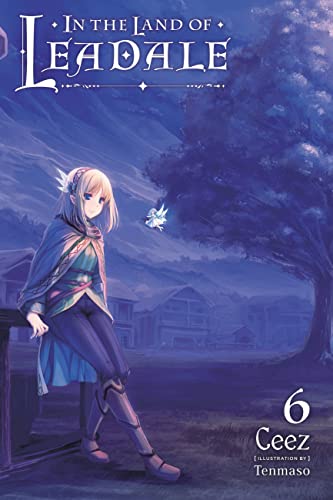
In the Land of Leadale, Vol. 6

October 22, 2022 by Sean Gaffney

By Ceez and Tenmaso. Released in Japan as “Leadale no Daichi nite” by Famitsu Bunko. Released in North America by Yen On. Translated by Jessica Lange.

Last time I wondered whether Opus’ introduction would lead to him explaining the plot a bit more, or just to him being a dick. As it turns out, it’s both. Indeed, the explanations come fast and furious, which is a bit of a surprise. We’ve occasionally thought back to Keina lying in her hospital bed, and how Leadale was created essentially for her. But this volume shows that goes MUCH deeper than we’d expected , and that Cayna is tied to Leadale in a far more significant way than I think she’d really like to be. I don’t want to get too much into spoilers, but suffice to say that Opus’ real-life identity was the least surprising part of it. That said, the real world is not an option for Cayna anymore, so best make the most of it and do what she does best – be a terrifyingly powerful mage who you never, ever want to see get angry. Sadlty, in this volume, Opus is at her side most of the time, so no luck there.

After recovering from her MP-draining rage attack on Opus from the last volume, Opus actually deigns to answers a lot of her questions about the true nature of this world. From there, she goes back to the village she’s now calling home, trailed by Opus and his Maid/Bodyguard/Tsukkomi Siren, who has definite opinions on what servants should be like but also is well aware of how much of an asshole her boss is. She then returns to the capital, where her granddaughter asks her to deal with a loose end… the player/bandit leader she put a punishment collar on several books ago, who has basically learned his lesson. As for Opus, he’s just starting to walk around and get back into the swing of things, but he certainly enjoys putting the fear of God into anyone he interacts with. This won’t change.

There’s a prologue where we see Keina at the hospital, interacting with her family and the programmer who’s there to tell her about Leadale, and it helps to hammer home how mentally exhausted she was in there, and also how truly immature she still is. I’d mentioned the reaction against her violence last time, and I think that’s because we’re told (as everyone else thinks) to see her as a 200-year-old all-powerful grandma rather than a teenage girl who get really, really excited simply by the fact that she can run around. As for her and Opus, leaving aside the various reveals, I am pleased to see that they have exactly zero romantic chemistry together… though admittedly that’s not what the rest of the cast thinks. It’s OK, sometimes you can just have a relationship be two antagonistic friends who have the power to destroy a continent. Cayna yells, Opus smugs, punches ensue, rinse and repeat. It’s fun.

Leadale is not for everyone, and if you didn’t like the anime I don’t think this adds enough value to recommend, but for those already invested, there’s a lot of payoff here you weren’t expecting.

Filed Under: in the land of leadale, REVIEWS

The Manga Review, 10/21/22

October 21, 2022 by Katherine Dacey Leave a Comment

“Manga won”–that was Heidi MacDonald’s pithy assessment of New York Comic Con 2022, as she noted how much the show was tilting towards Asian comics. “We all know that anime and manga soared during the pandemic but the exhibit halls of NYCC ‘22 were the in your face proof of that,” she opined, pointing to VIZ’s giant Luffy float as an example of how manga was crowding out tights and capes. “If the NYCC show floor was a diagram of nerdworld, comics publishers were the equivalent of an abandoned storefront,” she continued. “Against these massive displays for anime and collectibles, comics publishers were often just a pipe and drape table with some people signing.” For additional perspective on NYCC ’22, check out Heidi’s more in-depth report for Publisher’s Weekly.

NEWS AND VIEWS

If you missed the Best and Worst Manga panel at New York Comic-Con, fear not: MangaInLibraries has posted the panelists’ picks and pans. [Anime Planet]

Have you filled out the October Seven Seas Reader Survey yet? [Seven Seas]

Brigid Alverson has the deets on three new Seven Seas titles, all of which are slated for release next year. [ICv2]

Good news for Hunter x Hunter fans: the series returns from a four-year hiatus in November. [Anime News Network]

REVIEWS

This week’s must-read review comes to us from Renee Scott, who praises Josee, The Tiger and The Fish for “handl[ing] ableism in a realistic way” while offering readers “a beautiful love story that shows that nothing is beyond your reach if your passion is stronger than your doubt.” Looking for a good shojo title? Laura Grace posts a new installment in the ABCs of Shojo Manga, this time focusing on titles that begin with E.

New and Noteworthy

  • Be My Love, My Lord (Sarah, Anime UK News)
  • Black & White: Tough Love at the Office, Vol. 1 (Erica Friedman, Okazu)
  • Blood Alone (Megan D., The Manga Test Drive)
  • Dinosaur Sanctuary, Vol. 1 (Danica Davidson)
  • Drip Drip (MrAJCosplay, Anime News Network)
  • Formerly, The Fallen Daughter of the Duke, Vol. 1 (Rebecca Silverman, Anime News Network)
  • Kubo Won’t Let Me Be Invisible, Vol. 1 (Justin, The OASG)
  • The Men Who Created Gundam (Kate, Reverse Thieves)
  • The Tunnel to Summer. the Exit of Goodbyes, Vol. 1 (Harry, Honey’s Anime)
  • Usotoki Rhetoric, Vol. 1 (John, Anime Nation)
  • Usotoki Rhetoric, Vol. 1 (King Baby Duck, Boston Bastard Brigade)

Ongoing and Complete Series

  • Blood Alone (Megan D., The Manga Test Drive)
  • Chainsaw Man, Vol. 12 (Tony Yao, Drop-In to Manga)
  • Cross-Dressing Villainess Cecelia Sylvia, Vol. 2 (Krystallina, The OASG)
  • Formerly, The Fallen Daughter of the Duke, Vol. 1 (Rebecca Silverman, Anime News Network)
  • Love of Kill, Vols. 8-9 (Krystallina, The OASG)
  • Orient, Vol. 7 (Onosume, Anime UK News)
  • Orochi: Perfect Edition, Vol. 2 (SKJAM, SKJAM! Reviews)
  • Sensei’s Pious Lie, Vol. 2 (Tony Yao, Drop-In to Manga)
  • Zom 100: Bucket List of the Dead, Vol. 7 (King Baby Duck, Boston Bastard Brigade)

Filed Under: FEATURES

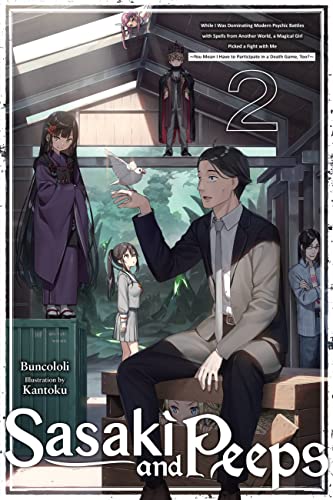
Sasaki and Peeps: While I Was Dominating Modern Psychic Battles with Spells from Another World, a Magical Girl Picked a Fight with Me: ~You Mean I Have to Participate in a Death Game, Too?~

October 21, 2022 by Sean Gaffney

By Buncololi and Kantoku. Released in Japan as “Sasaki to Pi-chan” by Media Factory. Released in North America by Yen On. Translated by Alice Prowse.

Content warning before we start: near the end of this volume there is an attempted rape scene of a middle schooler, and it is 100% played completely seriously. It helps to show off the strengths and weaknesses of this series in general. The author clearly wants to take several distinct genres and slam them all against each other. We’ve got isekai fantasy, esper battles, magical girls (and, because it’s the 2020s, they’re dark killer magical girls), and now we’re adding a battle between angels and demons using humans as proxy. This works pretty well when things are ridiculous, with our stoic salaryman Sasaki, his relatively stoic bird, and the amusing Futarishizuka. But it’s also trying to tell the story of an abused, suicidal middle school girl who is also deeply twisted, and it’s telling it with all the gravity it requires. Which… y’know, better than the alternative, but it GRATES against everything else.

As with the first volume of this series, things are slightly more interesting on the Japan side of the equation. This is not to say that the fantasy world doesn’t have a lot of danger, but it’s fantasy isekai danger, which means you have a lot of domineering nobles and sneering merchants. All Sasaki is trying to do is sell off all the modern things he’s bringing from Japan, but now he’s involved in a proxy war between two counts, two princes, and two companies. That said… he’s an experienced Japanese salaryman. This is what he’s GOOD at. He fares far less well when being tasked with his high school girl co-worker to try to recruit a new psychic who has fire powers. This goes disastrously wrong in ways I 100% was not expecting. That said, the most interesting part of the book was when the little princess from the fantasy world stows away when Sasaki returns to Japan… not the last time these two worlds intersect, I hope.

As for “the neighbor”, whose name, we find, is Kurosu, we get a little peek into her horrible, horrible daily life. She has to steal food from school to not starve to death, and it’s middle school, so she also has to avoid the class hottie helping her lest she be in trouble with the other girls. Her mother is sleeping with a guy who tries to rape her. Oh yes, and then there’s the corpse that drops in front of her as she’s walking home. Kurosu’s story has still not really intersected with the main one yet, but I expect that to change in the next book – the “death game” mentioned in the ludicrous subtitle of the volume is hers, not Sasaki’s. We also get a bit more about the magical girl… and it’s not really great news. She’s already killer her comedy animal mascot, she alleges that Sasaki’s employers killed her entire family and friends, and she now doesn’t know whether to trust him or not. So, y’know, just another day at the office.

If you enjoy A Certain Magical Index you might get a big kick out of this, because the chaos is the point. That said, unlike Index, there’s sometimes a realistic and very dark undertone to this series. I’ll read more, but YMMV.

Filed Under: REVIEWS, sasaki and peeps

Bookshelf Briefs 10/20/22

October 20, 2022 by Sean Gaffney, Anna N, Michelle Smith and Ash Brown Leave a Comment

Anti-Romance, Vol. 1 | By Shoko Hidaka | Seven Seas – I was a big fan of Shoko Hidaka’s series Blue Morning. She excels at depicting complicated relationships where obstacles and conflict come not from external sources but from within the people involved. Happily, the same skillful characterization is on display in Anti-Romance. Ryou Kakitani and Hiroki Suou were childhood friends and classmates and now they’ve been roommates for six years. Nothing has happened between them, though Ryou has, on a couple of occasions, made it obvious that his feelings for Suou go beyond mere friendship. Suou prefers to run away from this knowledge so that things can remain comfortably as they are. Urged on by a meddling coworker, Ryou finally issues an ultimatum: “Do we face each other and move forward? Or do I go ahead and move out?” This is the sort of BL where some chaste smoochies are really big progress, and I’m so here for it. – Michelle Smith

Dinosaur Sanctuary, Vol. 1 | By Itaru Kinoshita | Seven Seas – The premise of this series is a bit high-concept: once upon a time, there were popular zoos for dinosaurs, just like Jurassic Park. But now a few years later, and a few disasters onward, our heroes are at a run-down, ramshackle zoo trying to get people interested in their dinos. Fortunately, they have a plucky young new girl, whose dad is said to have ties to this whole project, as well as a grumpy young man who clearly loves the dinosaurs more than any humans he comes across (he’s clearly her love interest, but this really isn’t a manga that will ever put that front and center). What this mostly is is a love letter to dinosaurs behaving cutely, and if you’re a fan of the species this is worth a read. – Sean Gaffney

Laid-Back Camp, Vol. 12 | By Afro | Yen Press – This volume shows us what the other three members of the club were doing while Rin and Nadeshiko are having their suspension-bridge camping adventures. That said, what it really is is an excuse for the author to simply go bananas, as the “flashback” to what actually happened is immediately filled with lies, additions, and a constantly commenting Nadeshiko, who leans in and out of a panel box meant to indicate the non-flashback portion of the narrative. Things get so surreal that the entire narrative breaks down and turns anarchic, much to the horror of Chiaki, who is trying to keep this volume vaguely sane. The closest they get there is a discussion of the best ways to chop firewood. A bizarre side step, but hilarious. – Sean Gaffney

My Love Mix-Up!, Vol. 5 | By Aruko and Wataru Hinekure | VIZ Media – In this volume, Aoki starts cram school and ends up teaching his instructor a valuable lesson about prejudice. Then it’s Valentine’s Day and Hashimoto makes cupcakes for Akkun and there’s a big misunderstanding with an eventual sweet resolution. Then Aoki gets a part-time job and Ida feels left out. Meanwhile, Aoki’s tsundere coworker seems to fancy him. Yes, My Love Mix-Up! has become somewhat more typical shoujo as it has gone along, but I still really enjoy the main characters and their interactions. I’m most impressed by how much Akkun has developed as a character—initially I couldn’t fathom at all why Hashimoto might fancy him, but he’s turned out to be pretty interesting. There are only four more volumes of this, which feels about right. – Michelle Smith

Snow White with the Red Hair, Vol. 21 | By Sorata Akiduki | Viz Media – I get the sense that the author is aware that no one really wanted what happened in the last three volumes, but she is stubbornly sticking to it and shoving it in our faces some more, as Kiki and Hisame get engaged. There’s a distinct lack of love on her part, and this is very much a political marriage. That said, hopefully we can finally put it on the back burner. More to the point, Snow White with the Red Hair is going on the road, as the King quietly (very quietly) orders Shirayuki and Obi to travel from town to town trying to sell people on the cure they’ve come up with which is unusual and will require some explanation. I think that, rather than angsty romance, is the foreseeable future. Still good. – Sean Gaffney

Tales of Wedding Rings, Vol. 11 | By Maybe | Yen Press – Last time I said “more battles, less sex.” There is slightly less sex here, I admit, mostly as it’s very difficult to get your rocks off when your other ring-bearing fiancees are within listening distance. They do all get a very nice “yes, I really am in love with you, and can’t wait till I get my turn” scene. As for battles, it’s mostly just walking slowly towards the battlefield here, with a slight diversion by Amber in order to get a bit more of her backstory. This volume does not really do anything wrong, but I get the sense that the author was told to shoot for a certain volume number, and ended up short of material, because it’s astonishing how little happens here. Perhaps more battles NEXT time? – Sean Gaffney

Tsubaki-chou Lonely Planet, Vol. 1 | By Mika Yamamori | Yen Press – This manga has many familiar ingredients. Fumi is a plucky high school student forced to take a job as a housekeeper for a mysterious novelist. Kibikino is the mysterious novelist who ends up being young and having a tendency to collapse close to Fumi. Add in a new cranky student at Fumi’s school who bears a grudge for her beating him at a tiny tikes race ten years ago and you have a ready-made love triangle. Yamamori’s art is winsome, and Fumi’s earnest dedication to couponing is hilarious, but I wish there had been something a little more unexpected about this first volume. I’ll likely hang in there or another volume or so to see if I end up being pleasantly surprised. – Anna N.

Usotoki Rhetoric, Vol. 1 | By Ritsu Miyako | One Peace Books – Urabe Kanoko has the ability to detect lies by the sound of a person’s voice. A useful skill, it would seem, but a talent that has left her and her family ostracized in their hometown. And so she leaves, determined to hide her ability and start life anew. But things aren’t easy for a young woman on her own at the dawn of the Shōwa era. Fortunately, Urabe eventually meets Iwai Soma, a remarkably perceptive private detective who is convinced her talent can be used for good. The first volume of Usotoki Rhetoric is a strong start to a delightful series. There has already been some great character development and the leads are charming. Urabe and Iwai’s respective talents support and complement one another in entertaining and satisfying ways—while Urabe’s lie-detecting ability is helpful, Iwai’s understanding of people is just as important. I’m really looking forward to reading more. – Ash Brown

Filed Under: Bookshelf Briefs

  • « Go to Previous Page
  • Page 1
  • Interim pages omitted …
  • Page 90
  • Page 91
  • Page 92
  • Page 93
  • Page 94
  • Interim pages omitted …
  • Page 541
  • Go to Next Page »
 | Log in
Copyright © 2010 Manga Bookshelf | Powered by WordPress & the Genesis Framework