• Skip to primary navigation
  • Skip to main content
  • Skip to primary sidebar
  • Home
  • About Us
    • Privacy Policy
    • Comment Policy
    • Disclosures & Disclaimers
  • Resources
    • Links, Essays & Articles
    • Fandomology!
    • CLAMP Directory
    • BlogRoll
  • Features & Columns
    • 3 Things Thursday
    • Adventures in the Key of Shoujo
    • Bit & Blips (game reviews)
    • BL BOOKRACK
    • Bookshelf Briefs
    • Bringing the Drama
    • Comic Conversion
    • Fanservice Friday
    • Going Digital
    • It Came From the Sinosphere
    • License This!
    • Magazine no Mori
    • My Week in Manga
    • OFF THE SHELF
    • Not By Manga Alone
    • PICK OF THE WEEK
    • Subtitles & Sensibility
    • Weekly Shonen Jump Recaps
  • Manga Moveable Feast
    • MMF Full Archive
    • Yun Kouga
    • CLAMP
    • Shojo Beat
    • Osamu Tezuka
    • Sailor Moon
    • Fruits Basket
    • Takehiko Inoue
    • Wild Adapter
    • One Piece
    • After School Nightmare
    • Karakuri Odette
    • Paradise Kiss
    • The Color Trilogy
    • To Terra…
    • Sexy Voice & Robo
  • Browse by Author
    • Sean Gaffney
    • Anna Neatrour
    • Michelle Smith
    • Katherine Dacey
    • MJ
    • Brigid Alverson
    • Travis Anderson
    • Phillip Anthony
    • Derek Bown
    • Jaci Dahlvang
    • Angela Eastman
    • Erica Friedman
    • Sara K.
    • Megan Purdy
    • Emily Snodgrass
    • Nancy Thistlethwaite
    • Eva Volin
    • David Welsh
  • MB Blogs
    • A Case Suitable For Treatment
    • Experiments in Manga
    • MangaBlog
    • The Manga Critic
    • Manga Report
    • Soliloquy in Blue
    • Manga Curmudgeon (archive)

Manga Bookshelf

Discussion, Resources, Roundtables, & Reviews

Features & Reviews

La Corda d’Oro, Vol. 10

May 16, 2009 by MJ Leave a Comment

By Yuki Kure
Viz, 200 pp.
Rating: Teen

As Kohoko and the other contestants head into the final selection of Seisou Academy’s music competition, there is a last-minute shake-up when the decision is made to change the order of their performances to reflect their scores up to that point in order to show off the strongest musicians for Mr. Kira, a young man whose family runs Seisou Academy and who believes the music competition is, in his words, “a bit silly.” The change is a shock for all of the contestants, though prickly violinist Len surprises everyone by protesting that it undermines their performances to make them suddenly aware of their standing in a competition that is supposedly about promoting the enjoyment of music. Finally, however, the performance goes on with each of them demonstrating the impressive growth they’ve experienced during the competition, especially Kahoko who is performing for the first time without magical assistance.

There is a lot of reflection in this volume, especially on the part of Kahoko, who spends much time pondering her first meetings with the other contestants and how her relationships with them have progressed to this point. It’s quite an emotional volume, too, with some very moving moments, particularly Kahoko’s encounter with Len just before she goes on (in which he offers to help her replace her E string with the one formerly magical string remaining, saying, “It means something to you, right?”), her performance itself, and her tearful goodbye with Lili who made it possible for her to learn that she loves music.

With at least two more volumes to go, it’s hard to see where the story will find the momentum to move forward now that the competition’s final selection is complete. There is the question of Kahoko’s love life and perhaps some drama to come regarding the flippant Mr. Kira, but it will be interesting to see where this goes now that it has passed what would seem to have been a comfortable stopping point. La Corda d’Oro may not be a masterpiece, but it is sweet, heartwarming, and oddly addictive with its cast of attractive characters so sincere in their musical pursuits.

Review copy provided by the publisher. Review originally published at PopCultureShock.

Filed Under: MANGA REVIEWS Tagged With: la corda d'oro

Otomen 2 by Aya Kanno: B

May 16, 2009 by Michelle Smith

otomen2-125This volume presents three episodic tales, two of which focus on Asuka’s challenge to be true to himself despite the expectations of others. In the first of these stories, he acquires an apprentice who wants to use him as a reference on how to be cool and masculine, requiring Asuka to suppress his girly tendencies, and in the other, his mother attempts to set him up in an arranged marriage and manipulates him by warning that her health will suffer if he should thwart her or betray any sort of preference for feminine things. This last story is insanely kooky, but it gives Ryo the opportunity to ride in on a white horse and rescue the about-to-be-wed Asuka, so I can’t fault it too much.

Kanno’s art is very attractive in general, but I was especially impressed by it in this volume because she was able to adopt a completely different style—one reminiscent of ’70s shoujo—to depict the parents of Asuka’s fiancée. What’s more, there are scenes where they are sitting at a table with Asuka’s mom, and seeing the two very different artistic techniques juxtaposed in the same panel is pretty awesome.

The other story in the volume is more of a romantic one. Asuka finds out that Ryo has never celebrated Christmas before, and so plans the perfect Christmas party for her. It’s a nice chapter overall, but the best part is Asuka’s inexplicable fixation upon a yule log as the essential ingredient for the event. I often find straightforward comedies unfunny, but the absurdity of Otomen gets me every time.

Review copy provided by the publisher. Review originally published at Manga Recon.

Filed Under: REVIEWS Tagged With: Aya Kanno, shojo beat, VIZ

Nabari No Ou, Volume 1

May 15, 2009 by MJ 9 Comments

Nabari No Ou, Vol. 1
By Yuhki Kamatani
Published by Yen Press

nabarinoou
Buy This Book

Middle school student Miharu, a quiet loner whose life’s plans extend to the inevitable inheritance of his parents’ okonomiyaki shop, carefully avoids becoming involved in anything that would require him to care about anyone (or anything), or worse, require anyone to care about him. Unfortunately, his dreams of perfect apathy are shattered when he discovers that he holds The Secret Art (shinra banshu)–the power to control everything in creation–inside his own body. …

Read More

Filed Under: MANGA REVIEWS Tagged With: manga, nabari no ou

Comic, Volume 6

May 14, 2009 by MJ 5 Comments

Comic, Vol. 6
By Ha Sihyun
Published by Yen Press

comic6
Buy This Book

Volume five ended with turmoil for both protagonist and aspiring manhwa-ga Alice Song and her love interest, established manhwa-ga Patrick Kang. Having not quite escaped the clutches of manipulative queen bee Daria, Patrick lied to Alice about it, only to be shocked by a furious slap in the face from Alice who (unbeknownst to him) spotted them together in the physics classroom at the very worst time possible. Volume six opens with the reintroduction of the infamous piano room “pervert” whom Alice caught dancing half-naked back in volume four. …

Read More

Filed Under: REVIEWS Tagged With: comic, manga, manhwa

Nodame Cantabile, Volume 2

May 13, 2009 by MJ 7 Comments

Nodame Cantabile, Vol. 2
By Tomoko Ninomiya
Published by Del Rey

nodame2
Nodame Cantabile 2

This volume opens with the introduction of new character Masumi Okuyama, a timpani player with massive crush on Chiaki who sees Nodame as his rival. His initial attack against her consists of various childish pranks, like sending her an ominous chain letter and taping a sign that reads “IDIOT” on her back. Eventually, the two of them become engaged in a competition to see who can procure a Christmas Eve date with Chiaki–a challenge they both lose (or both win, depending on how you look at it). Also introduced in this volume is a new professor of conducting, Maestro Franz von Stresemann–a notorious skirt-chaser who takes photographs of the female students’ underwear, and who creepily pursues Nodame from the first moment he appears. He later forms his own personal orchestra made up mainly of colorful characters and pretty girls chosen without regard to their actual musical talent.

…

Read More

Filed Under: MANGA REVIEWS Tagged With: manga, nodame cantabile

Gorgeous Carat, Vols. 1-4

May 11, 2009 by Katherine Dacey

Gorgeous Carat caught my eye because it looked like a frothy costume drama. I’m a total sucker for that kind of thing, especially if it involves beautiful people fighting and falling in love in fancy surroundings. Alas, what I’d hoped would be a pleasant bit of escapism turned out to be so problematic in its presentation of gender, sexuality, and race that I never got swept up in its embrace.

The premise is ridiculous, but the first volume has a certain flair that carries Carat past its credulity-straining aspects. Our hero, Florian Rochefort, belongs to a French family with a noble name and and not-so-noble debt load. Rather than fence the family jewels, Florian’s mother does what all self-respecting French aristocrats do in yaoi manga: she sells Florian into slavery, delivering him to Ray Balzac Courtland, a distant relative who also happens to be, natch, young and handsome. Florian may be too dense to recognize his growing attraction to Ray, but it doesn’t take long for Florian to realize that Ray is, in fact, “Noir,” a cat burglar who’s the talk of fin-de-siecle Paris. When Florian is kidnapped by a rival gang of thieves, Ray sails for Morocco to enlist an old friend in tracking down his prized possession relative.

Elegant men in elegant costumes hopscotching across Europe and North Africa in pursuit of treasure: sounds good, no? Alas, You Higuri’s beautiful artwork can’t disguise the fact that her vision of North Africa is steeped in the same colonialist attitudes as Salammbo — not exactly an unimpeachable source of information about the Middle East. Take, for example, Laila, one of the key supporting characters in the Carat cast. Laila is Ray’s gal Friday, helping him track down information, cooking him meals, and keeping his car’s engine running whenever he sets out on a mission that might require a quick getaway. She might be a harmless character if it weren’t for Higuri’s decision to make Laila a dark-skinned Moroccan wearing a midriff baring costume.

Though we’re meant to see Laila as plucky, she has an ugly, Pygmalion-esque backstory (Courland rescued her from the streets when she was a girl and taught her to read) and is depicted as all-too-eager to do her master’s bidding. More disturbing is the way in which she competes with the fair-skinned Florian for her master’s attention. She throws temper tantrums, rages at Florian, tries seducing Ray, and, when none of that works, concedes that Florian has the superior claim on Ray’s heart. In fairness to Higuri, I think Laila is intended to be a surrogate for Carat’s female readers—a kind of wink-wink to readers wishing that Ray or Florian harbored romantic feelings for women. Instead, Laila comes across a tempestuous child-servant—a Steppin’ Fetchit for the Britney Spears era.

Equally troubling is the kidnapped-by-a-sexy-sheik subplot in the second volume. Florian becomes a pawn in an ugly contest between Ray and Azura, a mysterious Moroccan who—naturally—is impossibly and exotically beautiful himself. I got the same queasy feeling reading these pages as I did watching the implied rape scene in Lawrence of Arabia. Much is made of Florian’s fair, virginal beauty, just as Jose Ferrer fawns over Peter O’Toole’s blue eyes, pale skin, and sexual innocence. But while David Lean shows us the terrible ramifications of this encounter, Higuri includes these scenes in Carat for pure titillation. Yes, she hints that Azura may have “ruined” Florian, but given the series’ Harlequin romance plotting, it’s a safe bet that the lasting impact of Florian’s imprisonment will be bringing him closer to Ray, not sending him into, say, an irreversible tail spin of drug addiction and prostitution. (Though, of course, Higuri does inflict amnesia and temporary insanity on Florian for most of volume three.)

In Higuri’s defense, I doubt she knew much, if anything, about the imperialist discourse that shaped European attitudes towards the “Orient.” Yet she rehearses many of the stereotypes prevalent in nineteenth-century European art, literature, and scholarship about the Middle East, portraying Laila and Azura as irrational, childlike, and dangerously sensual — just as Flaubert portrays his Carthaginian princess. About the best I can say for Higuri is that she’s so committed to her story and characters that Gorgeous Carat almost works as a parody of Delacroix, Flaubert, and Massenet. Good thing Edward Said never picked up a copy.

GORGEOUS CARAT, VOLS. 1-4 • BY YOU HIGURI • BLU MANGA • RATING: MATURE (18+)

Filed Under: Manga, Manga Critic, REVIEWS Tagged With: Action/Adventure, BLU Manga, LGBTQ, Romance/Romantic Comedy, You Higuri

The Private Patient by P. D. James: B

May 11, 2009 by Michelle Smith

Book description:
In James’s stellar fourteenth Adam Dalgliesh mystery, the charismatic police commander knows the case of Rhoda Gradwyn, a 47-year-old journalist murdered soon after undergoing the removal of an old disfiguring scar at a private plastic surgery clinic in Dorset, may be his last. Dalgliesh probes the convoluted tangle of motives and hidden desires that swirl around the clinic, Cheverell Manor, and its grimly fascinating suspects in the death of Gradwyn, herself a stalker of minds driven by her lifelong passion for rooting out the truth people would prefer left unknown and then selling it for money.

Review:
The Private Patient isn’t bad—I think it’d be impossible for P. D. James to write a bad novel—but it isn’t very gripping. It’s written in her usual style, very descriptive of setting, even down to the retirement home accomodations of an obscure family solicitor, and spending a lot of time with the victim and her environs before the crime actually takes place. Like most of James’ novels, this one involves a small institution of some kind with a precarious financial future, and a limited cast of subjects connected with it.

Perhaps I’m a bit jaded, but I’d expected a few more twists and turns out of this. There’s one point, quite near the end, but not near enough that it seemed a culprit should really be revealed, when all evidence seemed to point to one person. “Ah,” I reasoned, “this person is the red herring. We will now get the twist ending when it will turn out to have been Y instead of X!” Except all that happens is that X commits a completely unnecessary additional act of violence and gets found out, leaving me going, “Oh. It was X. Huh.”

Much like the previous book, The Lighthouse, this could possibly be the last in the Dalgleish series. The whole reason Dalgleish’s squad is on the case in the first place is because a wealthy client of the clinic got her politically connected hubby to pull some strings. This rankles with Dalgleish quite a lot, as one might imagine, and the increasing politicization of his squad, along with the possibility that it will be eliminated in forthcoming budget cuts, makes him ponder retirement. The door’s still open, however, as the novel ends without Dalgleish making a firm decision in either way.

If this is the last novel, I’ll be slightly disappointed in the ending, which doesn’t focus on him at all. Instead, we get an epilogue about those still at the clinic as well as an attendee’s view of Dalgleish’s wedding. Then again, perhaps this slipping out of the limelight and into quiet, happy domesticity exactly parallels Dalgleish’s fate. That’d be nice.

Filed Under: Books Tagged With: P. D. James

One Thousand and One Nights, Volume 7

May 11, 2009 by MJ 3 Comments

I have a mini review out at PCS today for volume seven of manhwa series One Thousand and One Nights. This is such a beautiful and well-crafted series, and I could easily have written a full-length review of this volume so I will add some things here that I did not have room to say in my mini. Bonus: I get to say them here with wholly unprofessional abandon. :)

First of all, let me address the new political turn the series has taken, because that’s probably the thing that most sets this volume apart from the others. Though politically and theologically I’m sure it would be easy to poke at some of the author’s statements made through the characters (Sehara, mainly), but to do that would be missing the point. Fiction is all about expressing ideas, which is what the author does here–and very effectively at that. His notes at the back of the book are incredibly revealing, too. “There are always greedy people who have profited from war. They create a reason for war, and the rest of us go along with it. Young and innocent lives are uselessly sacrificed,” he says, mentioning too that at the time of his writing, Korea had the third highest number of soldiers in Iraq (after the US and England). …

Read More

Filed Under: MANGA REVIEWS Tagged With: manga, manhwa, one thousand and one nights

Walkin’ Butterfly, Volume 2

May 9, 2009 by MJ 7 Comments

Walkin’ Butterfly, Vol. 2
By Chihiro Tamaki
Published by Deux Press

wb2
Buy This Book

Despite Michiko’s new resolve, her path to a career as a model is not progressing easily. She is raw and untrained, and her impatience and unwillingness to try things she doesn’t understand are huge obstacles for her. Fortunately, her desire to impress childhood friend Nishikino provides some fresh motivation and she digs in once again, but though she finally begins to grasp some of what it means to do the job she’s pursuing so relentlessly, it isn’t enough to win over prickly designer Mihara. Meanwhile, Mihara is facing big decisions of his own as he’s offered an opportunity to join a fashion house in Paris, and Michiko’s agent, Tago, fights what could be the end of her career if she’s unable to make something of Michiko.

…

Read More

Filed Under: MANGA REVIEWS Tagged With: manga, walkin' butterfly

Do Whatever You Want, Volume 1

May 7, 2009 by MJ 9 Comments

Following up on my post, Let’s Talk About Manhwa, I’ve been slowly seeking out early volumes of series recommended in comments by readers. This first volume I was lucky enough to pick up at Mangatude and now I’m itching for more!

Do Whatever You Want, Vol. 1
By Yeri Na
Published by NETCOMICS
dweyw1
Buy This Book

Jiwon and Hosoo are best friends dreaming of musical stardom which they’ve sworn to pursue together to the exclusion of all else, including girls. Their friendship is so close that rumors persist that they are involved with each other romantically, but though Hosoo appears to appears to view Jiwon in much the same way as he does a pretty girl (and Jiwon has examined his own feelings for Hosoo with some concern as well), both of them are too focused on family problems and career goals to dwell too much on questioning the nature of their relationship. …

Read More

Filed Under: REVIEWS Tagged With: do whatever you want, manga, manhwa

We Were There, Volume 2

May 6, 2009 by MJ 23 Comments

It’s my fortieth birthday today, and as I was pondering what I’d like to post, I decided that there is nothing closer to my heart on a day like this than my distant past, which brings me to a series that feels more authentic to my teenage heart than anything I’ve read in a long time.

We Were There, Vol. 2
By Yuki Obata
Published by Viz Media

wwt2
Buy This Book

“Beloved. For the first time I understood what that word truly meant in the winter of my 15th year.”

…

Read More

Filed Under: MANGA REVIEWS Tagged With: manga, we were there

Click 4 by Youngran Lee: B-

May 4, 2009 by Michelle Smith

From the back cover:
Carefree player and rich kid Taehyun knows that he feels something for Joonha whether he’s a boy or a girl. But he hasn’t reckoned on the arrival of music star Jinhoo, Joonha’s friend from childhood, who’s back in Seoul to stay. That’s because Joonha seems ready to pick up right where he and his old pal left off. But can a close friendship remain just friendship when one of the boys is now a girl?

Good-natured and oblivious, Jinhoo seems to take it all in stride—that is, until Heewon, the trash-talking crazy girl, confronts him with a devastating revelation…

Review:
There’s not much I can say about this series that I haven’t already. I’m not terribly fond of any of the characters, and yet I find it pretty engrossing. I think it helps that the art is so clean and easy on the eyes and the layouts so simple—it makes it easy to just focus on the emotions and dialogue and zip right on through.

Most of the action in this volume is pretty boring. Taehyun is in love with Joonha, even though he’s unsure of her gender, and she admits to him that she lived for a guy as sixteen years. Taehyun’s minion is inexplicably in love with the violent Heewoon, and does her bidding a few times. Joonha bickers with Jinhoo’s girlfriend. The good stuff is in the interactions between Joonha and Jinhoo, especially a moment they share toward the end where Jinhoo confesses he’s still nervous that Joonha will spontaneously disappear again.

Also, despite the faults of this series, it seriously delivers come cliffhanger time. I think practically every volume has ended with a new step toward Jinhoo’s eventual discovery of Joonha’s secret. This time, I don’t know how can possibly avoid realizing that his old friend is now a girl, but we shall see.

Filed Under: REVIEWS Tagged With: netcomics, Youngran Lee

Live for Love

May 4, 2009 by MJ Leave a Comment

By Itsuki Sato
Digital Manga Publishing, 200 pp.
Rating: M (18+)

Seven years ago, just as his life was falling apart, Yoshiyuki Nomura was approached out of the blue by a small-time private detective, Yasuie, who offered him employment and, more importantly, escape. Yoshiyuki agreed and the two have been working together ever since, though they have more work shampooing cats than anything else. Their relationship with each other is easy and playful and Yoshiyuki has never thought much about Yasuie’s touchy-feely nature and frequent sexual teasing, but when Yoshiyuki’s estranged adoptive parents seek him out to schedule a marriage interview, Yasuie freaks out and rapes Yoshiyuki, claiming afterwards that he’s always loved him and begging him to stay with the agency. Being raped, of course, only makes it easier for Yoshiyuki to leave and he returns to his family, ready to go through with the marriage interview.

It’s really difficult not to become weary of the overabundance of rape in yaoi manga and in this case it really is a shame, because Live for Love is otherwise an extremely charming story. The relationship between Yoshiyuki and Yasuie is frankly adorable and unusually well developed for a yaoi one-shot, filled with playful banter and obvious affection. The humor, too, really hits the mark, as the men resign themselves to the fact that their business has devolved into a cheap cat-grooming salon. Even the art is charming, with attractive character designs and an ease of expression that matches the story’s off-the-cuff feel. What’s saddest is that the rape serves no real purpose other than to hasten Yoshiyuki’s departure from the detective agency, which could have easily been achieved by other means that might have also made his eventual return to Yasuie much easier to believe.

For those who can stomach the nonconsensual sex, Live for Love is smart, engaging, and fun, with good humor and endearing characters who deserve better treatment than they get.

Review copy provided by the publisher. Review originally published at PopCultureShock.

Filed Under: BL BOOKRACK Tagged With: yaoi/boys' love

Real, Vols. 1-4

May 3, 2009 by Katherine Dacey

Slam Dunk may have been the series that put Takehiko Inoue on the map and introduced legions of Japanese kids to basketball, but for me, a long-time hoops fan who grew up watching Larry Bird lead the Celtics to numerous NBA champtionships, Slam Dunk was a disappointment, a shonen sports comedy whose goofy hero desperately needed a summer at Robert Parrish Basketball Camp for schooling in the basics. Real, on the other hand, offered this armchair point guard something new: a window into the fiercely competitive world of wheelchair basketball. Watching Inoue’s characters run a man-to-man defense and shoot three-pointers from their chairs gave me a fresh appreciation for just how much strength, stamina, and smarts it takes to play the game, with or without the use of ones’ legs.

Much of the series’ appeal lies with Inoue’s superb draftsmanship. As he does in both Slam Dunk and Vagabond, he immerses us in the action, making us feel as if we’re on the court with his characters, bumping rims and talking trash. No detail is squandered; even a close-up of a character’s eyes or hands helps us picture where his teammates are on the court, and imagine how the play might unfold.

The other thing that Real does incredibly well is give us a window into its characters’ emotional lives, something that the antic, frantic Slam Dunk never pauses to do. (In Inoue’s defense, I don’t expect a shonen comedy to shed much light on its hero’s interior life, especially one as dense and single-minded as the flame-haired Hanamichi Sakuragi.) Its three principle characters—Togawa Kiyoharu, a track-and-field standout whose promising career was snuffed by bone cancer, Nomiya Tomomi, a high school dropout responsible for paralyzing a girl in a motorcycle accident, and Takahashi Hisanobu, a high school basketball star sidelined by a spinal cord injury—are complex individuals whose foul tempers and bouts of self-loathing make them seem like ordinary people coping with extraordinary circumstances, rather than cardboard saints.

Consider Takahashi. Until the day he was hit by a truck, Takahashi embodied the big-man-on-campus stereotype, leading the basketball team, dating several girls at once, acing his exams, and enforcing the school’s social pecking order by ruthlessly hazing weaker students. The accident robs him not only of his mobility, but also his identity; Takahashi predicated his entire sense of self on what others thought of him. Once confined to a bed, however, he lashes out at anyone who shows him kindness: how dare these C- and D-list folk offer him pity? (In one of the series’ only running jokes, Takahashi evaluates everyone on a five-point scale, including the tough, homely nurse assigned to his ward. She rises in his estimation after ticking off a long list of American boyfriends.) As he begins the grueling process of rehabilitation, Takahashi’s sense of self is further undermined by the realization that learning to move again will require discipline, something he lacks. (In fact, Takahashi held his more disciplined teammates in contempt, viewing their work ethic as a sign of weakness.) His fear and anger begin curdling into self-pity, leaving him physically and emotionally paralyzed.

Degraded as the character may seem, however, Inoue never invites us to pity Takahashi. We feel his sense of loss and futility, yet it’s clear from Takahashi’s repellent behavior that he still has a strong will to live, giving us hope that his journey will end in redemption. What isn’t so obvious is how Takahashi will get his groove back, as Inoue doesn’t draw neat draw parallels between his story and Kiyoharu’s. (Nomiya, the dropout, emerged from his accident unscathed, and faces a somewhat different battle than the wheelchair-bound Takahashi and Kiyoharu.) Though it’s frustrating to wait and see what will happen to Takahashi, the slow and almost haphazard way in which his story unfolds gives the narrative a true-to-life rhythm that mitigates against a pat, uplifting resolution to the drama.

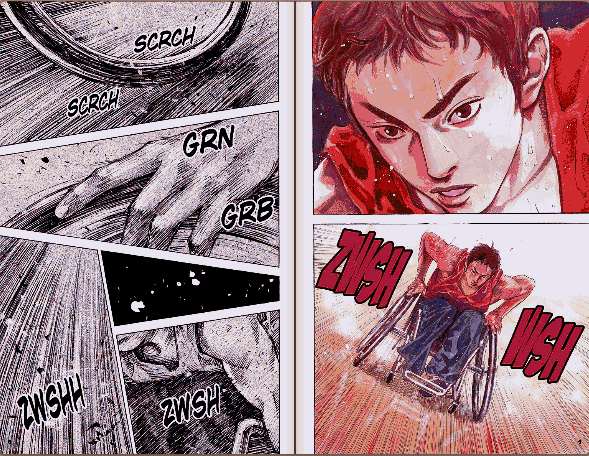
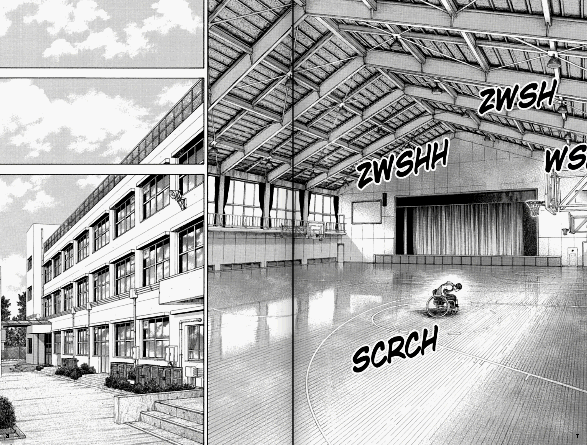
Inoue may take his time developing each character’s backstory, but he’s surprisingly efficient at establishing their personalities in just a few panels. The opening two pages of volume one, for example, speak volumes about Kiyoharu:

realpage1

realpage2

Through a combination of facial gestures and body language, those first five panels capture Kiyoharu’s fierce determination and incredible physical strength — he’s a consummate athlete pushing his body to its limits. Inoue then pulls back from Kiyoharu’s hands and face to reveal a lone figure dwarfed by an empty gymnasium. Kiyoharu’s discipline may make him a first-class basketball player, but as this image suggests, that discipline isolates him from other people — a theme that Inoue develops in volumes three and four, when Kiyoharu estranges his teammates with a grueling practice schedule and tough talk about winning.

Viz has done a terrific job of packaging Real, wrapping each issue in a beautifully designed cover and printing the artwork on creamy, high-quality paper that makes both the grayscale and full-color images pop. (I’m not really sold on the French flaps’ utility, though they certainly look cool.) John Werry’s fluid translation gives a distinct voice to each of the three principles — no mean feat, given how belligerent all three of them can be. Each volume includes a helpful set of cultural notes, as well as sidebars explaining the rules of wheelchair basketball; if anything, the American edition might have benefited from a more extensive appendix at the end of each volume.

I’m hoping that the deluxe presentation will encourage folks to give Real a try, regardless of their interest in basketball. It’s a sports story for those of us who care more about good writing and good artwork than the inner workings of a zone defense. But if you like to wax poetic about the Celtics/Lakers rivalry of yore, Real is your kind of series, too, as it will remind you just how beautiful the game can be when played with passion.

Review copies provided by VIZ Media, LLC.

REAL, VOLS. 1 – 4 • BY TAKEHIKO INOUE • VIZ • RATING: OLDER TEEN (16+)


Filed Under: Manga, Manga Critic, REVIEWS Tagged With: Basketball, Sports Manga, Takehiko Inoue, VIZ, VIZ Signature

Off*Beat, Volumes 1 & 2

May 3, 2009 by MJ 19 Comments

Off*Beat, Vols. 1 & 2 | By Jen Lee Quick | Published by Tokyopop

offbeat
Buy This Book

Christopher “Tory” Blake is a genius teenager in Queens, unchallenged in school, damaged by his absent father’s failures, and living with his well-meaning mom who worries that she gives her son too much freedom for his own good. After his parents’ break-up, Tory began keeping meticulous diaries of every detail in his life, minute-to-minute, including everyone and everything around him, which he keeps in file boxes in his closet. …

Read More

Filed Under: MANGA REVIEWS Tagged With: manga, off*beat

  • « Go to Previous Page
  • Page 1
  • Interim pages omitted …
  • Page 506
  • Page 507
  • Page 508
  • Page 509
  • Page 510
  • Interim pages omitted …
  • Page 541
  • Go to Next Page »
 | Log in
Copyright © 2010 Manga Bookshelf | Powered by WordPress & the Genesis Framework