• Skip to primary navigation
  • Skip to main content
  • Skip to primary sidebar
  • Home
  • About Us
    • Privacy Policy
    • Comment Policy
    • Disclosures & Disclaimers
  • Resources
    • Links, Essays & Articles
    • Fandomology!
    • CLAMP Directory
    • BlogRoll
  • Features & Columns
    • 3 Things Thursday
    • Adventures in the Key of Shoujo
    • Bit & Blips (game reviews)
    • BL BOOKRACK
    • Bookshelf Briefs
    • Bringing the Drama
    • Comic Conversion
    • Fanservice Friday
    • Going Digital
    • It Came From the Sinosphere
    • License This!
    • Magazine no Mori
    • My Week in Manga
    • OFF THE SHELF
    • Not By Manga Alone
    • PICK OF THE WEEK
    • Subtitles & Sensibility
    • Weekly Shonen Jump Recaps
  • Manga Moveable Feast
    • MMF Full Archive
    • Yun Kouga
    • CLAMP
    • Shojo Beat
    • Osamu Tezuka
    • Sailor Moon
    • Fruits Basket
    • Takehiko Inoue
    • Wild Adapter
    • One Piece
    • After School Nightmare
    • Karakuri Odette
    • Paradise Kiss
    • The Color Trilogy
    • To Terra…
    • Sexy Voice & Robo
  • Browse by Author
    • Sean Gaffney
    • Anna Neatrour
    • Michelle Smith
    • Katherine Dacey
    • MJ
    • Brigid Alverson
    • Travis Anderson
    • Phillip Anthony
    • Derek Bown
    • Jaci Dahlvang
    • Angela Eastman
    • Erica Friedman
    • Sara K.
    • Megan Purdy
    • Emily Snodgrass
    • Nancy Thistlethwaite
    • Eva Volin
    • David Welsh
  • MB Blogs
    • A Case Suitable For Treatment
    • Experiments in Manga
    • MangaBlog
    • The Manga Critic
    • Manga Report
    • Soliloquy in Blue
    • Manga Curmudgeon (archive)

Manga Bookshelf

Discussion, Resources, Roundtables, & Reviews

Features & Reviews

The Favorites Alphabet: I

November 11, 2011 by David Welsh

Welcome to another installment of The Favorites Alphabet, where the Manga Bookshelf battle robot pick a favorite title from each letter of the alphabet. We’re trying to stick with books that have been licensed and published in English, but we recognize that the alphabet is long, so we’re keeping a little wiggle room in reserve.

“I” is for…

Ichigenme… The First Class is Civil Law | By Fumi Yoshinaga | 801 Media – There are some pretty terrific manga that begin with the letter “I,” but as a devoted fan of Fumi Yoshinaga, it’s impossible to pass up an opportunity to talk about Ichigenme, which has the distinction of being not only my favorite of Yoshinaga’s BL works, but one of my very favorite BL series of all time. In terms of my personal taste in the genre, Ichigenme has everything going for it. It’s a character-driven romance between smart, idiosyncratic adults, set in a competitive, career-minded environment that includes smart, idiosyncratic women and gay men who are actually gay. It also features quite a number of genuinely erotic, emotionally affecting sex scenes that actually move the story forward rather than getting in its way. I could go on and on about this two-volume series (and have), but instead I’ll just urge people to read it, especially those who think they don’t like BL. This is what good adult romance should look like. – MJ

I Hate You More Than Anyone! | Banri Hidaka | CMX – Yes, once again I’m picking a series that never finished in North America due to the company closing down.  But I can’t help it.  Intellectually I know this series is flawed – the early volumes have very sketchy art, the plot meanders, the emphasis on cartoon violence has disturbed some – but in the end, it doesn’t matter.  The characters in IHYMTA are hilarious, likeable, and magnificently talkative.  The series is filled with more dialogue than any other shoujo series I’ve seen, as everyone needs to give Kazuha Akiyoshi advice, or listen to her freak out about the latest crisis.  The title, of course, ceases to be true fairly quickly – it’s no spoiler that the series ends with a wedding – but that’s OK too.  This series for me is a tribute to the best and worst of Hakusensha’s Hana to Yume magazine – its high-spirited, tomboy-ish heroines, its silly love stories, and its fly-by-night plot resolution.  And Japan clearly agrees with me – the Akiyoshi family appeared in V.B. Rose as well, and Hidaka-san’s new series running today deals with their offspring.  Clearly folks cannot get enough of this family and their adventures.  (I just wish the companies would stop folding before they finish!) – Sean Gaffney

Imadoki! Nowadays |Yuu Watase | Viz – All Yuu Watase manga are not created equal, but when I like one, I tend to really, really like it. That’s the case with this super-charming series about a country girl who enrolls at a snooty school in the big city. If you’re experiencing uncomfortable flashbacks to Tammy and the Bachelor, you aren’t far off. Like the titular hick played by Debbie Reynolds in that film, homespun Tanpopo upsets the elitist apple cart and falls in love with the cutest, snootiest boy in town. The difference is that Imadoki! is genuinely funny and surprising. Tanpopo is utterly sincere and completely indefatigable in her effort to make friends, and she does it on her own terms. The romance is sweet, the supporting cast is uniformly great, and there’s even an adorable pet fox to raise the cuteness level just that much higher. This book offers a fine blend of warm fuzzies and snarky chuckles. – David Welsh

InuYasha | By Rumiko Takahashi | Viz – Few manga have gone through as many English-language editions as InuYasha, which began its life as a floppy in 1997 and is now enjoying new life as a digital download. Easy as it may be to dismiss InuYasha as second-rate Takahashi, the series’ longevity is no fluke: InuYasha is Rumiko Takahashi’s most accessible story, a rollicking shônen adventure that incorporates elements of folklore, fantasy, and flat-out horror, as well as generous helpings of humor and romance. InuYasha also boasts some of Takahashi’s most appealing characters, from Sango, the tenacious demon-slayer, to Sesshomaru, whose chilling indifference to others makes him a more terrifying figure than the malicious Naraku. Great artwork and imaginatively staged combat help bring the story to life, and carry it through its more repetitive moments. – Katherine Dacey

Itazura Na Kiss | By Kaoru Tada | DMP – Because I can rest assured that my other “I” favorite, InuYasha, is in Kate’s capable hands, I can devote my pick to the shoujo classic Itazura Na Kiss, being released in deliciously chunky two-in-one volumes by Digital Manga Publishing. Some of its plot points might seem cliché—a ditzy heroine in love with a brilliant and aloof guy, circumstances that force them to live together, etc.—but then you realize that it’s Itazura that most of those other series are copying! Lamentably unfinished due to the mangaka’s untimely accidental death, the series is sheer pleasure to read, with a storytelling style and large cast of eccentrics that reminds me more of the seinen Maison Ikkoku than anything you’d find in the Shojo Beat lineup, for example. Goofy, addictive, and satisfying, I love this series and am extremely grateful to DMP for licensing it. – Michelle Smith

What starts with “I” in your favorites alphabet?


Filed Under: FEATURES

Tokyo Mew Mew Omnibus, Vol. 1

November 11, 2011 by Sean Gaffney

By Reiko Yoshida and Mia Ikumi. Released in Japan by Kodansha, serialized in the magazine Nakayoshi. Released in North America by Kodansha Comics.

I have to admit that I was looking forward to this one. When Kodansha announced the Love Hina omnibus, they mentioned this as well. I hadn’t read it the first time around, but I recall fans talking about it quite a bit. Cute heroines, magical girl battles, etc. They also seemed to get annoyed when folks compared it to Sailor Moon. So I wanted to see what it was like.

Well, it was all a bit underwhelming, wasn’t it? I admit that my brain is somewhat influenced by the many magical girl series that are already out there, but I didn’t really see much in Mew Mew that made it stand out above the pack. The heroine is cheerfully cute but clumsy, in love with a cute normal guy, and can turn into a catgirl superhero after a magical experiment gone awry. She is met by the two cute bishie guys responsible for this accident (including one who teases her constantly, and whom I suspect may be a love interest or rival later), and she must find her four other teammates, because groups of 5 magical girls as a team is nothing like Sailor Moon at all. (Or indeed every other sentai series, as Sailor Moon is, to a degree, the magical girl as sentai motif.)

As for the team itself, we find the rich girl/snooty one, the shy and meek one, the airheaded athletic one (who seems to be on the lookout for ways to make money, which makes sense as she is Chinese and Japan does love its stereotypes just as North America does), and the cool aloof loner who will no doubt be breaking down in tears before the end of the series. And they too transform into magical girls that are based around endangered species. Together, they are told, they must battle aliens who are bent on destroying our world by polluting its natural resources.

The environmental angle, I admit, is somewhat interesting. It’s a bit overly earnest, but then, we’re reading a Nakayoshi title, not Evening. The alien plot is not entirely clear now beyond the fact that they have a snarky and rude underling, but I did find it amusing that one of the alien’s first targets is a cherry blossom park. Heathens! They cannot dare to ruin the majesty of the cherry blossom festival! The authors know how to push the right emotional buttons.

There’s also Aoyama, the guy Ichigo is in love with, who actually manages (so far) to be fairly nice and not overly rude to our heroine. (One of Ichigo’s allies fulfills that role, though he’s more on the teasing end of the spectrum. It helps that other characters get to be clumsier than she is.) Yes, you get the sense that he’s hiding something important, but hey, welcome to magical girl manga. I’m not sure if he’ll end up with Ichigo, but I am pretty sure he’ll tie into the plot somehow.

Overall, though, while the manga didn’t do much that was annoying or irritating, this ended up being a standard magical girl zap the monsters and save the world plot. Most series like this are slow burners, and I’ve no doubt it will pick up, but there’s only 7 volumes, so I was hoping for a bit more oomph here. Pleasant, but not exceptional.

Filed Under: REVIEWS

Manga Bestsellers: 2011, Week Ending 30 October

November 10, 2011 by Matt Blind 2 Comments

Manga Bestsellers: 2011, Week Ending 30 October
Comparative Rankings Based on Consolidated Online Sales

last week’s charts
about the charts

##

Manga Bestsellers

1. ↔0 (1) : Sailor Moon 1 – Kodansha Comics, Sep 2011 [465.3] ::
2. ↑2 (4) : Sailor Moon 2 – Kodansha Comics, Nov 2011 [453.0] ::
3. ↑4 (7) : Yotsuba&! 10 – Yen Press, Oct 2011 [439.5] ::
4. ↓-1 (3) : Vampire Knight 13 – Viz Shojo Beat, Oct 2011 [418.3] ::
5. ↑3 (8) : Black Butler 7 – Yen Press, Oct 2011 [412.6] ::
6. ↑12 (18) : Sailor Moon Codename: Sailor V 2 – Kodansha Comics, Nov 2011 [376.5] ::
7. ↓-2 (5) : Naruto 52 – Viz Shonen Jump, Jul 2011 [375.8] ::
8. ↓-2 (6) : Rosario+Vampire Season II 6 – Viz Shonen Jump Advanced, Oct 2011 [361.4] ::
9. ↓-7 (2) : Sailor Moon Codename: Sailor V 1 – Kodansha Comics, Sep 2011 [354.5] ::
10. ↑1 (11) : Pandora Hearts 7 – Yen Press, Oct 2011 [352.4] ::

[more]

Top Imprints
Number of volumes ranking in the Top 500:

Viz Shojo Beat 79
Viz Shonen Jump 79
Yen Press 71
Kodansha Comics 40
Viz Shonen Jump Advanced 40
Vizkids 31
HC/Tokyopop 22
Tokyopop 18
DMP Juné 17
Viz 14

[more]

Series/Property

1. ↔0 (1) : Sailor Moon – Kodansha Comics [1,088.1] ::
2. ↑1 (3) : Black Butler – Yen Press [772.7] ::
3. ↓-1 (2) : Vampire Knight – Viz Shojo Beat [727.1] ::
4. ↔0 (4) : Naruto – Viz Shonen Jump [709.1] ::
5. ↔0 (5) : Maximum Ride – Yen Press [690.8] ::
6. ↑13 (19) : Black Bird – Viz Shojo Beat [555.9] ::
7. ↓-1 (6) : Negima! – Del Rey/Kodansha Comics [531.3] ::
8. ↑5 (13) : Yotsuba&! – ADV [481.1] ::
9. ↑2 (11) : Pandora Hearts – Yen Press [459.7] ::
10. ↓-2 (8) : Highschool of the Dead – Yen Press [458.7] ::

[more]

New Releases
(Titles releasing/released This Month & Last)

1. ↔0 (1) : Sailor Moon 1 – Kodansha Comics, Sep 2011 [465.3] ::
3. ↑4 (7) : Yotsuba&! 10 – Yen Press, Oct 2011 [439.5] ::
4. ↓-1 (3) : Vampire Knight 13 – Viz Shojo Beat, Oct 2011 [418.3] ::
5. ↑3 (8) : Black Butler 7 – Yen Press, Oct 2011 [412.6] ::
8. ↓-2 (6) : Rosario+Vampire Season II 6 – Viz Shonen Jump Advanced, Oct 2011 [361.4] ::
9. ↓-7 (2) : Sailor Moon Codename: Sailor V 1 – Kodansha Comics, Sep 2011 [354.5] ::
10. ↑1 (11) : Pandora Hearts 7 – Yen Press, Oct 2011 [352.4] ::
12. ↑2 (14) : Negima! 31 – Kodansha Comics, Sep 2011 [306.2] ::
14. ↑1 (15) : Highschool of the Dead 4 – Yen Press, Oct 2011 [301.0] ::
16. ↓-7 (9) : Blue Exorcist 4 – Viz Shonen Jump Advanced, Oct 2011 [291.7] ::

[more]

Preorders

2. ↑2 (4) : Sailor Moon 2 – Kodansha Comics, Nov 2011 [453.0] ::
6. ↑12 (18) : Sailor Moon Codename: Sailor V 2 – Kodansha Comics, Nov 2011 [376.5] ::
15. ↑82 (97) : Black Bird 11 – Viz Shojo Beat, Nov 2011 [298.5] ::
17. ↑4 (21) : Sailor Moon 3 – Kodansha Comics, Jan 2012 [286.3] ::
18. ↑1 (19) : Sailor Moon 5 – Kodansha Comics, Apr 2012 [272.8] ::
24. ↔0 (24) : Sailor Moon 4 – Kodansha Comics, Mar 2012 [251.8] ::
26. ↑102 (128) : D. Gray-Man 21 – Viz Shonen Jump Advanced, Nov 2011 [247.0] ::
37. ↑93 (130) : Dengeki Daisy 7 – Viz Shojo Beat, Nov 2011 [201.9] ::
50. ↑87 (137) : Claymore 19 – Viz Shonen Jump Advanced, Nov 2011 [161.0] ::
54. ↑6 (60) : Negima! 32 – Kodansha Comics, Nov 2011 [157.3] ::

[more]

Manhwa

134. ↓-13 (121) : March Story 3 – Viz Signature, Oct 2011 [86.4] ::
169. ↑345 (514) : Bride of the Water God 9 – Dark Horse, Oct 2011 [63.7] ::
187. ↑1140 (1327) : Raiders 7 – Yen Press, Sep 2011 [58.1] ::
290. ↑52 (342) : Black God 14 – Yen Press, Oct 2011 [37.7] ::
427. ↑104 (531) : March Story 2 – Viz Signature, Apr 2011 [24.7] ::
631. ↑374 (1005) : Black God 8 – Yen Press, Feb 2010 [13.6] ::
652. ↑329 (981) : JTF-3 Counter Ops (ebook) – RealinterfaceStudios.com, Mar 2011 [12.8] ::
680. ↑452 (1132) : March Story 1 – Viz Signature, Oct 2010 [11.7] ::
766. ↑ (last ranked 9 Oct 11) : Goong 8 – Yen Press, Feb 2010 [9.5] ::
791. ↓-246 (545) : Antique Gift Shop 9 – Yen Press, Nov 2009 [9.0] ::

[more]

BL/Yaoi

51. ↓-17 (34) : Finder Series 4 Prisoner in the View Finder – DMP Juné, Aug 2011 [160.7] ::
94. ↓-4 (90) : Maelstrom (ebook) 1 – Yaoi Press, Jun 2011 [108.9] ::
116. ↓-6 (110) : Finder Series 5 Truth in the View Finder – DMP Juné, Dec 2011 [94.9] ::
122. ↑1 (123) : Black Sun 2 – 801 Media, Dec 2011 [92.8] ::
133. ↓-1 (132) : About Love – DMP Juné, Nov 2011 [86.6] ::
150. ↓-1 (149) : Private Teacher 2 – DMP Juné, Jan 2012 [74.3] ::
156. ↑11 (167) : Aphrodisiac Kiss (ebook) – Animate/Libre, Sep 2011 [71.9] ::
157. ↓-1 (156) : Secrecy of the Shivering Night – DMP Juné, Dec 2011 [70.5] ::
161. ↑4 (165) : Mr. Convenience – DMP Juné, Nov 2011 [68.5] ::
168. ↓-61 (107) : Seven Days Friday-Sunday – DMP Juné, Sep 2011 [64.0] ::

[more]

Ebooks

94. ↓-4 (90) : Maelstrom (ebook) 1 – Yaoi Press, Jun 2011 [108.9] ::
156. ↑11 (167) : Aphrodisiac Kiss (ebook) – Animate/Libre, Sep 2011 [71.9] ::
168. ↓-61 (107) : Seven Days Friday-Sunday – DMP Juné, Sep 2011 [64.0] ::
171. ↑16 (187) : Attacked on a Tiger’s Whim (ebook) – DMP Digital Manga Guild, Oct 2011 [62.7] ::
219. ↓-20 (199) : Manga Cookbook – Japanime’s Manga University, Aug 2007 [50.8] ::
226. ↓-19 (207) : Manga Moods – Japanime’s Manga University, Mar 2006 [48.9] ::
252. ↑533 (785) : Seven Days Monday-Thursday – DMP Juné, Aug 2010 [42.9] ::
281. ↑149 (430) : The Outcast 1 – Seven Seas, Sep 2007 [38.8] ::
291. ↓-65 (226) : The Rule of Standing on Tiptoe (ebook) – DMP Digital Manga Guild, Oct 2011 [37.6] ::
360. ↓-143 (217) : Vampire Cheerleaders 1 – Seven Seas, Mar 2011 [30.0] ::

[more]

Filed Under: Manga Bestsellers Tagged With: Manga Bestsellers

Princess Knight, Vol. 1

November 10, 2011 by David Welsh

The thing that frequently strikes me about Osamu Tezuka’s comics is how fresh they feel, no matter when they were created. I suspect this is because, while he was as solid and conscientious an entertainer as has probably ever worked in the medium, he was also always pushing to bring new ideas to manga and to infuse new levels of ambition into comics. This isn’t always true, and there are some Tezuka works that feel locked in the time of their birth (Swallowing the Earth, Ayako), but it happens with a frequency that just about any creator of any kind of entertainment would envy.

Princess Knight (Vertical) exhibits that lively timelessness that I associate with Tezuka at his best. I have no idea if he sat down one day and decided that he wanted to take comics for girls in an entirely new direction or if it just happened because he wanted to take all comics in entirely new directions, but the comic exudes that feeling of opportunity and transformation.

It’s hard not to think of the princesses of Walt Disney’s motion pictures, mostly because Tezuka references them so often. Disney was an influence and inspiration to Tezuka, but Tezuka didn’t seem content to merely mimic Disney. Princess Knight seems like the best example of that. While Disney’s princesses were titular, they were never the heroine of their own story, at least with Disney at the rudder. Tezuka’s Sapphire may be pulling plot points out of a Disney grab bag, but she’s nothing like her American sisters.

Before Sapphire is born, a mischievous angel named Tink gives her the heart of a boy shortly before she receives her assigned girl’s heart. Beyond the supernatural complications, her earthly parents are hoping for a son, or rule of the kingdom will pass to a craven moron. The king and queen love their daughter, but archaic tradition forces them to raise her as a boy. Sapphire’s extra heart makes this easier than it might have been otherwise.

She’s great with a sword, and she stands up for what’s right. She’s smart, tough, and good-hearted, though she keenly feels the call of her feminine side. She falls for the prince of a neighboring kingdom, but she can never act on those feelings. And she’s constantly wary of her unscrupulous, ambitious uncle, who would love to expose her and open up the throne for his idiot son.

Things go from difficult to impossible when her charade is exposed. Loss piles upon loss and peril upon peril, and she’s imprisoned and exiled. Fortunately, adversity brings out the best in her, and she takes steps to reclaim her kingdom, not because of any air of entitlement but because it’s right and the best thing for her people. She’s not passive and she doesn’t want a prince to save her; you can’t come close to saying that about any of her Disney princess contemporaries.

That’s not to say her adventures don’t draw on familiar princess tropes. Like Cinderella, she gets to don glamorous disguise to connect with her handsome prince. Like Snow White, she’s targeted by an evil and ambitious witch. Like Ariel, she loses her ability to communicate. Beyond that, there are pirates and assassins, scheming courtiers and incompetent angels, magic and monsters. Sapphire faces more difficulties than the entire coterie of Disney princesses combined, which makes for an insanely lively narrative flow.

Of course, another fascinating aspect of Tezuka’s work was the way his well-intentioned thinking regarding women’s roles was betrayed by execution that wasn’t quite as involved. Sapphire’s agency is entirely connected to her boy’s heart. In moments when she loses that heart, she becomes as passive a victim as Snow White and Sleeping Beauty ever were. And it’s not entirely clear what Tezuka is trying to say in those moments. Is it just another form of peril to keep things moving, or did Tezuka wholeheartedly own those gender roles, even if he regretted them? It also makes me wonder about likely outcomes in the next volume – will a happy ending for Sapphire constitute a satisfying conclusion for me as a reader?

Jarring as those considerations are, they do give the reader an extra layer to ponder. You don’t really need to think about Princess Knight in the context of its time too often, since Tezuka the entertainer is in such fine form here. But the chance to consider Tezuka the figure of his era, no matter how progressive he may have been in relative terms, is always intriguing to me. It’s kind of like how you can ride along with the madly entertaining antics in Dororo (Vertical) only to be occasionally slapped with how genuinely bleak Tezuka’s world view must have been.

Speaking of aspects that could date the work, I have to take issue with the packaging here. Vertical has an admirable history of crafting vibrant covers for classic titles, so why does Princess Knight look like a paperback textbook from the 1970s? The washed-out palette and the minimalist cover design aren’t up to Vertical’s usual standard, and the design does nothing to communicate the excitement contained within. Vintage manga is always a tough sell, so why make the book look so blah? It wouldn’t look out of place in a book stack at a suburban garage sale.

That sounds harsh, but I’ve got a protective bent for this book. I’ve wanted someone to republish it in English for ages, and I think I imagined it being perfect. And it is almost perfect – wonderful characters, a terrific story, and Tezuka’s wonderful illustrative style, packed with action and humor and feeling. Vertical has done a marvelous job making a range of Tezuka’s work available in English, though it generally falls in his seinen vein. That’s great and entirely welcome, but I feel like it’s equally important to showcase Tezuka’s work as an entertainer for a wider, younger audience. Because even those pieces feel fresh and ambitious, just like Princess Knight.


Filed Under: REVIEWS

Manga the Week of 11/16

November 9, 2011 by Sean Gaffney

You get two images in this post, mostly because every time I post a horizontal image it breaks the Bookshelf site. So let’s start with the actual manga, then get to the things I’m actually super hyper excited about.

Digital Manga Publishing has a few more releases. Lovephobia is a new BL-ish title from Enterbrain’s B’s Log spinoff magazine Kyun!, and features vampires. The author, I know, has written a lot of Gintama yaoi doujinshi. Rabbit Man, Tiger Man hits Vol. 2, and is still not a Tiger and Bunny spinoff. And there is the third volume of A Strange And Mystifying Story, which apparently has demons. Never let it be said that DMP does not have its finger on the pulse of the modern manga buyer.

Kodansha and Diamond seem to have settled nicely into “one week later than bookstores” at this point. So we don’t get Sailor Moon 2. But we do get Fairy Tail 16, which I think wraps up the arc with Laxus, and Arisa 5, which no doubt continues to be thrilling. (It ran very long for a modern-day Nakayoshi series, so much have good chops.) Sorry, folks, you should see Ami and Minako next week.

Yes, just in time for the Manga Movable Feast, it’s a short story collection called Tesoro, which I suspect will be filled with middle-aged men and sweet quiet interludes. If just one volume is not enough for you, meanwhile, why not buy the Fullmetal Alchemist 1-27 box set? You can a) read the final volume early, and b) it makes a nifty blunt instrument! Kurozakuro reaches its final volume, and we get a new Saturn Apartments. Lastly, we’ve apparently caught up with Real enough that we get a new volume of that as well, so Real 10 gives you all the drama you could possibly want.

And Yen press, as always, seems to own Week 3 of our monthly schedule. New Haruhi, new Haruhi-chan. The Giant Hardcover Omnibus of Death for High School of the Dead (I saw that thing at Comic Con. If you can’t afford FMA as your weapon, this will serve.) New Nabari no Ou, Omamori Himari, and Sumomomo Momomo will surely sate your thirst for inscrutable Japanese titles that tell you little about the content. And there are new adaptations of Avi Arad’s the Innocent, and a Gossip Girl tie-in, for those who like things outside the manga box.

Though if you really want to go outside the box next week…

I literally cannot recall a time in my life when I was not reading Pogo. One of the first books I ever read so hard it fell apart in my hands was the Pogo Collection Bats and the Belles Free – and that’s not even one of the best ones! Fantagraphics announced this collection aeons ago, and it apparently has been a long, hard struggle. But trust me, if you buy this, you will see why they put in the effort. Even in these early, first two years of the strip, Pogo has a magic all its own. Anyone who loves reading dialect or the written language will find a treasure trove in Pogo, and anyone who likes biting satire will take it right to their heart. I cannot possibly recommend it enough.

(And yes, there is also the new Donald Duck collection, the first in their Carl Barks reissue project, which is also awesome, but I think Walt Kelly needs to be pushed by the online comics community more than Carl Barks, honestly.)

So what are you getting besides Pogo?

Filed Under: FEATURES

Previews review November 2011

November 9, 2011 by David Welsh

It’s kind of an odd month in the Previews catalog from Diamond. There’s a lot of great stuff, but there’s very little immediately exciting debut material. (There is a fair amount of on-the-fence content, and I could certainly use your feedback on that front.) Let’s start with a few new editions of previously published material:

Dororo Complete Edition, written and illustrated by Osamu Tezuka, Vertical, NOV11 1117: If you haven’t read this brilliant, Eisner Award winning piece of supernatural shônen, this will provide an excellent opportunity to pick up all three volumes in one shot. While it makes me sad that Tezuka ended this series early, the material he did finish is just magnificent: scary, sad, funny, bleak, gruesome… the whole package. This is one Tezuka title that I can recommend without any reservation or qualification.

Girl Genius Omnibus Vol. 1: Agatha Awakens, by Phil and Kaja Foglio, Tor Books, NOV11 1104: This web-to-print success story has been around for a while, and I’m glad to see it get some hardcover, prestige treatment. It’s about a mad scientist who learns that she’s even madder and more inventive than she suspected. Spunky, scrappy Agatha finds herself in a million different kinds of steampunk peril, and it’s great-looking, fast-paced fun.

Now, onto some less chunky but still worthy items:

A Treasury of 20th Century Murder: The Lives of Sacco and Vanzetti, written and illustrated by Rick Geary, NBM, NOV11 1052: I love these crime histories for their smart writing and great, detailed art, but I tend to wait for them to be available in paperback. It means I have to wait a bit to enjoy Geary’s take on highly controversial cases like this one, but I can be patient.

The Kurosagi Corpse Delivery Service Vol. 12, written by Eiji Otsuka and illustrated by Housui Yamazaki, Dark Horse, NOV11 0055: On the other hand, I can’t be any more patient with this title than the publication schedule demands, and damnation, does that schedule demand a lot of patience. Still, this is one of my very favorite Japanese comics ever, and I always get giddy at the prospect of enjoying more misadventures of a group of supernatural investigators.

We’ll wrap up with one on-the-fence item that I didn’t feel like wedging into this month’s poll:

Gentlemen’s Agreement Between a Rabbit and a Wolf, written and illustrated by Shinano Oumi, Digital Manga, NOV11 0962: As you know, I always like to investigate unknown boys’-love quantities before investing in them, so I’d appreciate any feedback either on this title or on Oumi’s work in general. This one sounds promising – a workplace romantic comedy about two guys who work for an advertising agency. The whole predator-prey framing is a little on the nose for me, but I’m certainly open to anything about grown-ups with jobs.


Filed Under: FEATURES

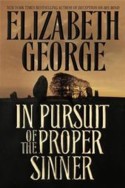
In Pursuit of the Proper Sinner by Elizabeth George

November 8, 2011 by Michelle Smith

Book description:
Calder Moor is a wild and deadly place: many have been trapped in the myriad limestone caves, lost in collapsed copper mines, injured on perilous ridges. But when two bodies are discovered in the shadow of the ancient circle of stones known as Nine Sisters Henge, it is clearly not a case for Mountain Rescue.

The corpses are those of a young man and woman. Each met death in a different fashion. Each died violently. To Detective Inspector Thomas Lynley, this grisly crime promises to be one of the toughest of his career. For the unfortunate Nicola Maiden was the daughter of a former officer in an elite undercover unit, a man Lynley once regarded as a mentor.

Now, as Lynley struggles to find out if Nicola’s killer was an enemy of her father’s or one she earned herself, Barbara Havers, his longtime partner, crisscrosses London seeking information on the second victim. Yet the more dark secrets Lynley and Havers uncover, the more they learn that neither the victims nor the suspects are who they appear to be… that human relationships are often murderous… and that the blood that binds can also kill.

Review:
Once again, Elizabeth George has created an intriguing mystery—perhaps her most complicated yet easy-to-follow case to date—while ensuring that the interactions between the lead detectives remain the most compelling part of the story.

The two victims in this case—Nicola Maiden and Terry Cole—are found on a moor in Derbyshire, and Lynley is specifically requested to work the case by the Nicola’s father, a former special operations officer for whom he worked briefly earlier in his career. Heading up the local investigation is DI Peter Hanken, a chain-smoking family man whose manner of speech frequently put me in mind of Gene Hunt. Hanken’s convinced that Nicola’s father is responsible, and while Lynley can’t buy that, he is still convinced that Nicola was the target, especially as more details of her not-so-wholesome lifestyle emerge.

Enter Havers. After the events of Deception on His Mind, in which she not only disobeyed a director order but fired a gun at a superior officer, Barbara has spent the last three months on suspension pending the results of an inquiry. She is ultimately demoted to Detective Constable and at first attributes the fact that she still remains with CID at all to Lynley’s advocacy, but it turns out that he is quite critical of her actions. He assigns her various menial tasks connected to the Derbyshire case but, headstrong as ever, Havers follows her hunch that the key to the murders lies with Terry Cole, not Nicola Maiden.

She works that end of things in London, enlisting the more-charming-the-more-we-see-of-him DC Winston Nkata to help her. (Seriously, Nkata is fun. When are we going to get something from his perpsective?) Lynley gets increasingly fed up with her defiance and I swear… the tension between them kept me on the edge of my seat much more than the murder investigation itself. It was like watching two friends keep doing things to irritate and alienate the other while being completely unable to help. How could I not sympathize with Barbara as she doggedly works to get at the truth? But at the same time, how could I not cringe when her actions drive her further and further out of Lynley’s good graces? The resolution to all this comes about a little too conveniently, but I’m too relieved to be too critical.

The case itself is particularly multi-layered, and I marvel that George is able to keep all of these balls in the air while never losing the reader. There’s not too much with Lynley’s personal life in this volume—aside from Lady Helen’s involvement in patching things up with Barbara—but Barbara’s makes some progress. Her neighbor, Taymullah Azhar, has been trying to get the details of what happened in Essex and ultimately learns that Barbara wound up demoted because she wouldn’t let his daughter, Hadiyyah, be left to drown. So now he feels tremendous gratitude to her and it almost looks at one point like he’s confessing more romantic feelings but now I am unsure again. The thought of awkward, sloppy Barbara trying to navigate a romantic relationship fills me with utter squee, though, so I will continue to hope that matters develop in that direction.

If you’re looking for a well-written mystery series with a serious claim to the label “literature,” then the Inspector Lynley series might be for you. I’ll be diving into the next book as soon as I post this review!

Filed Under: Books Tagged With: Elizabeth George

Cage of Eden, Vol. 2

November 8, 2011 by Sean Gaffney

By Yoshinobu Yamada. Released in Japan as “Eden no Ori” by Kodansha, serialization ongoing in the magazine Weekly Shonen Magazine. Released in North America by Kodansha Comics.

As we head into the second volume of our survival story, we’re starting to see a few more familiar trappings. The airplane homebase is rendered uninhabitable, they try making a raft, and we get a lot more survivors, some of whom are likeable and some of whom aren’t. We also get to see our hero Akira develop increasing leadership qualities, and Kanako start to prove she is more than just a walking fanservice poster. Things aren’t getting more original, but they’re staying interesting.

As you would expect when you get a bunch of emotional Japanese teenagers and toss them into the middle of an island with prehistoric monsters on it, not everyone is handling it the same way. Akira and company are trying to band together and be a team. One guy with a Jason mask names himself Hades and seems to go off the deep end at the earliest opportunity. Akira’s friend Arita is seemingly doing the same thing, but is in reality barely holding it together because of guilt over a previous impulsive action. And then there’s Yarai, who seems to be leading a third group simply by virtue of being so badass people instinctively want to follow him.

The action here is well-done and exciting. The animals are suitably dangerous, while remaining just realistic enough that our heroes managing to defeat them only feels a little ludicrous. The power politics also feels realistic, though I could do without everyone lampshading how Akira is becoming a great leader. We already see it, no need to hammer it home. Likewise, while the deaths of two classmates was done well, and was suitably gruesome, I think a true test of the series will be to see what happens when likeable people start getting killed.

And then there’s the fanservice. Look, I can take a lot of fanservice with no qualms. I read Negima, after all. But I honestly would not blame anyone who wants to drop the series here, because man, the sheer obsession with panty shots and breasts is over the top even for a Shonen Magazine manga. I realize that this is a magazine for young teens, and they are pubertylicious. Still, after a while I was flicking through them faster, trying to get past it. “Yes, the two girls fall on top of each other. Yes, squoosh. OK, let’s watch them climb down a ladder from the bottom. I GET IT, they’re sexy!” It can be very taxing.

I will admit that the cliffhanger makes me quite eager to see what happens next. I’m fairly certain that Akira and Yarai will disagree, but seeing the groups lock horns should be fun. And we still really have no idea why this island is filled with long-dead creatures. Is it a plot point, or is this just an excuse for carnage? Oh, and no doubt we will meet more female characters, and their breasts as well. Cage of Eden remains good candy, even if you sometimes feel a bit sick after eating too much of it.

Filed Under: REVIEWS

Manga Artifacts: GeGeGe no Kitaro

November 7, 2011 by Katherine Dacey

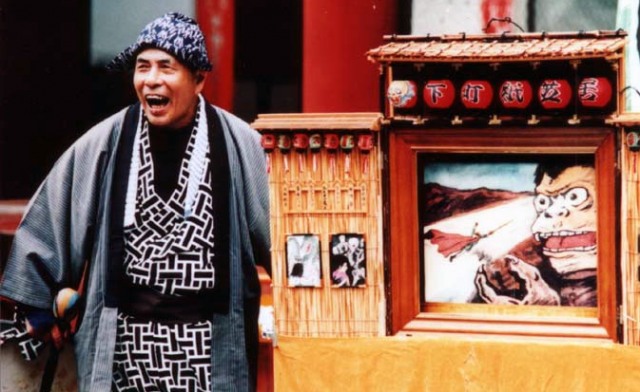
From the early 1920s through the late 1950s, before television became a fixture in Japanese homes, audiences flocked to kamishibai performances on street corners and parks around the country. A kamishibaiya (storyteller) would pedal from village to village with a butai (small wooden stage) perched on the back of his bicycle. When he arrived in a new community, he would click two sticks together to announce his presence, selling candy to the growing assembly of children. He would then show the audience a series of colorfully painted panels that told a story in much the same fashion as a comic book, narrating as he removed them one at a time from the butai.

At the height of its popularity in the 1930s, nearly five million people attended kamishibai performances every day. There were kamishibai for every demographic: sentimental tales about kittens and orphans for girls, adventure stories about masked heroes and mountaineers for boys, and pulpy mysteries and historical dramas for adults. A small army of artists and writers cranked out new installments of popular stories such as Golden Bat, Tiger Boy, Prince Gamma, and Cry of the Andes, providing an important training ground for such postwar manga-ka as Kazuo Koike, Sanpei Shirato, and Shigeru Mizuki.

A contemporary kamishibaiya performs in front of a butai.

Mizuki’s best-known comic, GeGeGe no Kitaro, traces its roots to the 1930s, when kamishibaiya around Japan performed Hakaba no Kitaro, a supernatural tale about a yokai boy who lived in a graveyard. Though Mizuki didn’t create Kitaro, he was responsible for adapting Hakaba no Kitaro into manga form, publishing his first Kitaro stories for the akabon (rental comics) market in 1959. Kitaro eventually found a home at Weekly Shonen Magazine in 1966, where the editors renamed it GeGeGe no Kitaro. Kitaro proved immensely popular, spawning animated television shows, feature-length movies, and video games, not to mention numerous manga sequels in Shonen Sunday, Shonen Action, and Shukan Jitsuwa.

Despite its immense popularity in Japan, none of the GeGeGe no Kitaro manga have been licensed for the North American market. In 2002, Kodansha International hired Ralph McCarthy to translate a handful of the Weekly Shonen Magazine stories, collecting them in three bilingual editions. Those volumes are scarce — at least on this side of the Pacific — although I was able to snag the first on eBay for less than $20. (Caveat emptor: Some Amazon retailers are asking as much as $345.00 for a single volume of the Kodansha Bilingual Comics edition.)

Looking through the pages of volume one, the story’s roots in kamishibai are apparent. The first chapter, “Ghost Train,” is a classic example of comeuppance theater: after two Tokyo businessmen abuse Kitaro and his sidekick Ratman, the men find themselves aboard a mysterious train whose final destination is Tama-reien (Tama Cemetery). The pacing suggests a story told at a campfire, allowing the audience to savor the word play (all the stops on the Tama-reien line have eerie names), the description of the passengers, and the two businessmen’s growing sense of terror. Though the pictures carry the weight of the storytelling, Mizuki uses an omniscient narrator to heighten the reader’s awareness of sound. “The skeleton-thin attendant blew his flute, and a tram came screeching into the station like a rickety hearse,” the narrator informs us. “The door rattled open like the door to a crematorium.”

The narrator serves another important purpose as well, filling in the gap between images, just as a kamishibayai would have done in the 1930s. Towards the end of the story, for example, the two men decide to leap from the train, rather than ride it to its final destination. Mizuki draws their awkward jump, then cuts to an image of the ghost train speeding along a dark track, barely distinguishable from the night sky and grassy wasteland it traverses. “Their heads cracked against something hard — rocks, perhaps,” the narrator explains. “A wail of agony splits the air, then all was silence once again.” This statement proves essential to setting up the story’s punchline, bringing the men’s ordeal to a dramatically suggestive end that is deftly clarified in the last four panels.

The second chapter, “The Leviathing,” owes a debt to such kamishibai mainstays as Golden Bat and Prince Gamma, serial adventures that freely mixed elements of science fiction, mystery, and fantasy. In “Leviathing,” Kitaro joins a scientific expedition to New Guinea, where an unscrupulous scientist injects Kitaro with a prehistoric animal’s blood, transforming Kitaro into a hairy, seven-story beast with the head of a whale and the body of a yeti.

As in “Ghost Train,” an omniscent narrator plays an important role in advancing the story, describing the changes in setting, and revealing the limitations of Kitaro’s new form. “Kitaro tried to yell, ‘Father!’, but all that came out was the Leviathing’s roar,” the narrator intones. “He put down his frightened father and walked away.”

Vital as the narration may be, it’s the artwork that underscores the poignancy of Kitaro’s situation. Mizuki draws the Leviathing in a dramatically different fashion when viewed from below than when viewed close-up: from the perspective of a human bystander, the Leviathing is monstrous, with an enormous, gaping mouth and short, grasping arms. Up close, however, he’s a gentle creature, capable of frowning, sighing, and shedding tears. These close-ups help remind us that it’s Kitaro trapped inside this destructive body, unable to communicate with humans or yokai; there’s simply no place for a giant prehistoric creature in such a thoroughly urbanized landscape, a point underscored by the military’s brutal efforts to eradicate Kitaro by driving him out to sea.

Although “The Leviathing” may strike readers as a sci-fi romp and not a ghost story, it illustrates one of the series’ most important themes: displacement. In many of the Kitaro stories, he struggles to find a place for himself — and his yokai friends — in an increasingly modernized world. As Jonathan Clements observes,

Mizuki was one of the first manga creators to deal with the rush of modernity, depicting Japanese ghosts largely as peaceful, gentle creatures forced into action by the encroachment of human civilisation on their remote, secluded places of haunting. In particular, he cited electric light as the main nemesis of spirits from the otherworld, giving his stories an elegiac quality that celebrates Japanese folktale traditions, even as he laments their passing.

Readers familiar with GeGeGe no Kitaro from its numerous film and television adaptations may find the bilingual edition a frustrating introduction to the manga, as many of the series’ colorful supporting players — Daddy Eyeball, Catchick, and The Sand Witch — play minor-to-nonexistent roles in the first volume. Readers interested in manga’s history, however, will find the first volume of the bilingual edition a fascinating window into the pre-war Japanese entertainment industry, offering English-speakers a hint of the stories and storytelling practices that once enchanted Japanese audiences on street corners around the country. Below, you’ll find a short bibliography of articles and books about Kitaro and kamishibai, should you wish to learn more about this famous character’s roots.

For Further Reading

Clements, Jonathan. “Spooky Ooky.” Schoolgirl Milky Crisis. 13 September 2010. <http://schoolgirlmilkycrisis.com/blog/?p=1710>. Accessed 11/6/11.

Kobayashi, Kenji and Kelly Yamamoto. “Kamishibai Theater.” Japanese American National Museum. <http://www.janm.org/janmkids/kamishibai.php>. Accessed 11/7/11.

Kyogoku, Natsuhiko. “Afterword.” GeGeGe no Kitaro, Vol. 1. Trans. Ralph F. McCarthy. New York: Kodansha International, 2002. 123-25.

McCarthy, Helen. “Spooky Kitaro’s Sixth Generation.” Suite 101. 6 May 2008. <http://helen-mccarthy.suite101.com/spooky-kitaros-sixth-generation-a52997>. Accessed 11/6/11.

Nash, Eric. Manga Kamishibai: The Art of Japanese Paper Theater. New York: Harry N. Abrams, 2009.

Filed Under: Manga Critic, REVIEWS Tagged With: GeGeGe no Kitaro, Shigeru Mizuki, Shonen, Yokai

Bookshelf Briefs, 11/7/11

November 7, 2011 by Katherine Dacey, David Welsh, Sean Gaffney and Michelle Smith 4 Comments

This week, Kate, David, Sean, & Michelle look at recent releases from Yen Press, Kodansha Comics, and Viz Media.


Black Bird, Vol. 11 | By Kanoko Sakurakoji | VIZ Media – Reading the newest installment of Black Bird, I can see why the series has been a perennial bestseller: the cast is comprised of achingly beautiful young men in yukatas, all of whom are captivated by the heroine. The story, too, has crack potential, as it involves demon clan warfare, fragile political alliances, age-old prophecies, and sex. What’s missing is a compelling heroine. Eleven volumes into Black Bird, Misao remains as helpless as she did in the very first chapters, enduring Kyo’s grouchy, possessive behavior, an enemy’s memory-erasing spells, and other demons’ violent attempts to drink her blood. Adding insult to injury is the author’s insistence that Kyo is really a good, soulful person underneath his brusque exterior, a side of his personality that only Misao can see. As someone who’s old enough to have dated a few jerks, I find that kind of relationship as tedious on paper as it is in real life, even if the lead character is a handsome male tengu. – Katherine Dacey

A Bride’s Story, Vol. 2 | By Kaoru Mori | Yen Press – I had argued that I found the first volume of A Bride’s Story very well-done, but a bit cold, like looking at a piece of art in a museum. I’m pleased to say that Volume 2 draws me in a lot more. Amir still tends to be a cipher at times, but the author compensates for that by pairing her with more emotional characters – the hotheaded and perpetually frustrated Pariya, or her youthful husband Karluk, with whom she gets probably the best two scenes in the book. But there’s more action here as well, as Amir’s family come to take her back so they can forge a better relationship with less savory neighbors. Seeing the townspeople riding up to protect her is awesome – indeed, Amir has trouble taking it all in. Even Dr. Smith, who seemed to be the comedy Westerner in Volume 1, gets some excellent depth here, and I do wonder if we’ll be seeing more of him in future volumes. Indeed, the author’s notes hint we might see the focus change to other brides? I hope not – Amir’s story still needs closure.– Sean Gaffney

Fairy Tail, Vol. 15 | By Hiro Mashima | Kodansha Comics – As with many shonen mangas of its type, this volume of Fairy Tail is taken up with a lot of battles, as the Laxus fights come to their natural conclusion. This gives Erza another chance to be awesome, of course, and shows that Fairy Tail’s camaraderie and willingness to work together will always trump a quest for sheer power like Laxus has gone through. But I expect, despite the fact that the fights are of decent quality and the characterization decent, everyone will be discussing the Ass Pull of a character return we get with Mystogan’s real identity. If it were deconstructed, such as with Cross Game, it might be decent, but we get the reveal and then the character simply walks away – the whole scene reads like a ratings grabber for sweeps time, and sucks the soul out of much of the book. Oh well, the rest of it is fairly solid. I hope the arc wraps up in the next volume, though. – Sean Gaffney

Grand Guignol Orchestra, Vol. 5 | By Kaori Yuki | VIZ Media – The fifth and final volume of Grand Guignol Orchestra is a gorgeous mess. Though Kaori Yuki’s artwork remains as attractive as ever, she still hasn’t mastered the art of bringing her stories to a satisfying conclusion. The series’ penultimate scene is a long, confusing sequence of double-crosses, overwrought speeches, and bolt-from-the-blue revelations that make little sense even within the parameters of the Grand Guignol universe. A more sedate epilogue ties up the loose ends, hinting of what Yuki is capable of doing when she dials down the histrionics. The volume is rounded out with a lengthy story, “Camelot Garden,” which quotes liberally from Tennyson’s “The Lady of Shallot,” to diminishing returns. – Katherine Dacey

Natsume’s Book of Friends, Vol. 10 | By Yuki Midorikawa | VIZ Media – The latest volume of Natsume’s Book of Friends features two longer stories. In the first, “False Friend,” a bully from Natsume’s past returns when he suspects that he’s had an encounter with the supernatural, while in the second, “The Harvest Festival,” Natsume must rescue a guardian spirit who’s been sealed inside a rock. Both stories are well-executed, with crack pacing, memorable demons, and just enough ambiguity to keep the reading guessing at the outcome, even though Natsume’s fundamental decency is never in doubt. As an added bonus, Yuki Midorikawa’s artwork is improving steadily with each volume, yielding some simple but astonishing images. Recommended. – Katherine Dacey

Pandora Hearts, Vol. 7 | By Jun Mochizuki | Yen Press – After a seemingly random detour to Lutwidge Academy (the school attended by Oz’s sister) provides information about “the tragedy of Sablier,” Pandora Hearts resumes its original mission, with Oz determined to learn the truth about why he was sent to the Abyss and his companion, Alice, renewing her search for her missing memories, even though they may be too traumatic to bear. Sometimes this series is hard to follow—this volume certainly contains a few abrupt segues—but it continues to deliver on character arcs. Sure, Oz’s desire to grow stronger pretty generic, but I quite like the plight of his childhood friend, Gilbert, who faces a future where his aid is less useful to Oz, and newish character Elliot has some intriguing potential as well. Add in a bit of background for enigmatic and eccentric Break, and this is quite a satisfying volume! – Michelle Smith

Soul Eater, Vol. 7 | By Atsushi Ohkubo | Yen Press – This volume is less exciting than the previous ones, mostly as the last arc has ended and the author is taking his time setting up the new one. This is not to say there is nothing of interest, though. Soul Eater continues to appeal to me for its artistic design, which manages to combine funny and creepy better than anyone else – even Franken Fran should take lessons from Ohkubo. After Medusa, Arachnae seems underwhelming so far, but she’s only just established herself. Not to mention that Medusa – or at least hallucinations of her – isn’t far away, and I wonder what Stein will do. The biggest surprise of the series to date, though, is seeing Crona join the side of the good guys – despite remaining a twitching mess, and still having that double personality of a weapon inside him/her. It’s a testament to Maka’s friendship building skills that Crona’s trying at all. And it wouldn’t be Soul Eater without at least one drop-dead funny scene – Marie’s introduction, and her decision to marry a toilet, immediately tells us that she is a Christmas Cake of the finest kind, and I hope she gets more to do later. Great fun, even if this volume is ‘shifting gears’ more than ‘constant thrills’. – Sean Gaffney

The Story of Saiunkoku, Vol. 5 | By Kairi Yura and Sai Yukino | VIZ Media – Much as I love this series, this volume is kind of a mess in terms of storytelling. It starts with a pleasant-enough but forgettable sequence with its heroine, Shurei, suffering from a cold and her devoted circle of men trying to make her feel better while dealing with their own rivalries. It’s cute, but it feels like a side story in a series where volumes usually launch strongly. The main story introduces a heap of plot elements too quickly, from the impending civil service exam to the nation’s criminal underworld to an admittedly awesome courtesan of Shurei’s acquaintance. The characters still shine through all of the clutter, but I missed the focused clarity of previous story arcs. It felt less like a complete reading experience than previous volumes. On the bright side, Yura does maintain the admirable level of prettiness she’s always brought to her illustrations. – David Welsh

Yotsuba&!, Vol. 10 | By Kiyohiko Azuma | Yen Press – The tag line of this series, “Enjoy everything,” pretty much says it all. Readers get the opportunity to follow an energetic, quirky kid through the average moments of her life. She hangs out with friends, family, and neighbors. She invents games, makes pancakes, goes shopping, and occasionally misbehaves. Azuma’s grasp of kid logic elevates the material from being simply identifiable to hitting some wonderful comic highs. When she gets a picture book with animal stickers in it, her delight manifests itself very specifically: “Ohhh… this is a lifesaver.” That’s funny, because it isn’t something you’d expect a kid to say, but it’s extra funny, because you can absolutely see a kid saying it. That’s Azuma’s specialty: a grounded approach that finds the little bits of weirdness in everyday life, going easy on the outright sentiment while still investing everything with a heartfelt quality. It’s kind of magical. – David Welsh

Yotsuba&!, Vol. 10 | By Kiyohiko Azuma | Yen Press – It’s hard to know how to review a volume of Yotsuba&!. I mean, it’s just sweet, y’know? There’s just lots of moments in this volume that are simply worth reading. Jumbo’s reaction to seeing photos of Asagi and Koiwai at the balloon fair; Asagi’s casual cruelty towards Fuuka when she lends Yotsuba the medicine ball; Fuuka showing that she may actually be the most eccentric one in the cast, rather than Yotsuba; Yotsuba’s frustration over not making perfect pancakes, and Miura’s frustration later on knowing that she may have to play Danbo FOREVER. The best chapter, though, is the one where Yotsuba panicked after breaking some dishes, lies about how it happened. What follows is pure beauty, with Yotsuba digging herself deeper and deeper and her father managing to brilliantly resolve things without yelling at her – in fact, his passive terrifying may be the best deterrent there is. Heck, even Yanda is tolerable here (though he’s still a jerk). Great series.– Sean Gaffney

Yotsuba&!, Vol. 10 | By Kiyohiko Azuma | Yen Press – It’s been nearly a year since I last read a volume of Yotsuba&!, and that was definitely way too long. I dove into this volume with relish and happily found that the first chapter, “Yotsuba & Playtime,” is quintessential Yotsuba&!, showing the title character at her most imaginative and her father at his most patient, even when her behavior borders on obnoxious. And, indeed, the fact that Yotsuba is capable of sulking and lying actually makes her adventures all the more wonderful because, in addition to ringing true, these moments give her father a chance to shine as he makes sure she learns the right lessons. He’s an intriguing guy and a terrific dad and I hope that whenever this series comes to an end we’ll get a glimpse of the kind of grown-up Yotsuba turned out to be thanks to his loving guidance. – Michelle Smith

Filed Under: Bookshelf Briefs

The Drops of God, Vol. 1

November 7, 2011 by David Welsh

I promise to use only one wine metaphor in this review of the first volume of The Drops of God (Vertical): it gets better after it has a chance to breathe. The first few chapters of Tadashi Agi and Shu Okimoto’s tale of wine aficionados are kind of a slog.

There’s a behavior known as “mansplaining,” and I certainly think there’s a variation of it, “fansplaining.” You’ve all been engaged in conversation with someone who’s passionate about a particular entertainment who proceeds to bury you under unsolicited detail delivered with an unsettling degree of authority. (I’ve been both victim and perpetrator; I have no illusions about that.)

And Drops of God is absolutely fansplaining manga as only a certain type of seinen can be. Even though its protagonist is a novice to the world of wine, he’s surrounded by people who aren’t, and he’s thrust into a situation where he has to join their informed ranks. And the audience must gauge their tolerance for the level of detail they can endure regarding varietals, vineyards, rankings, price, and so on. There’s a lot of that, and the world of wine is often viewed as kind of byzantine and elitist and twee to begin with.

Personally, I can deal with a lot of fictional fansplaining if the characters are engaging. That’s why the first couple of chapters of this volume worried me. The leads came off as fairly flat, cookie-cutter versions of types you can see in literally a hundred different licensed manga: the brash, ignorant hero who happens to be enough of a savant to unsettle his highly trained, elitist rival, especially with the help of a book-smart rookie. Agi and Okimoto almost literally drown them in exposition in the early going, and I was kind of anxious that this eagerly anticipated title would turn into a charmless, didactic experience.

Then, a few chapters in, the creators start to relax a bit. The hero, Shizuku, reveals himself to be kind of an endearing dork. Yes, he’s suspiciously astute in terms of his ability to evaluate wine by taste, even though he tastes it for the first time in this comic, but he’s a pretty funny guy. Trainee sommelier Shinohara doesn’t quite transcend the thanklessness of her role as “girl who knows things but has no real personal stakes,” but I like her well enough.

The ostensible plot is a contest between Shizuku and a snooty wine critic to see who’s worthy of inheriting the legendary wine collection of Shizuku’s late father, a snooty wine critic in his own right. But the series really seems to be more about teaching readers about wine by showing the ways it can influence people’s character. Agi and Okimoto prove themselves to be pretty deft with that sort of thing, and, lectures aside, it’s the sort of thing I really enjoy in a manga.

It’s about hooch, it’s got amiable stars, and you can learn stuff about a subject that may be new to you while occasionally enjoying the comfortable structure of competition manga. I’m in for the duration.


Filed Under: REVIEWS

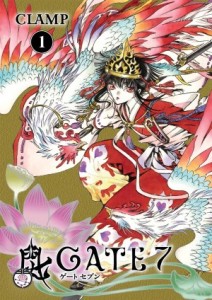
Gate 7, Vol. 1

November 7, 2011 by Sean Gaffney

By CLAMP. Released in Japan by Shueisha, serialization ongoing in the magazine Jump Square. Released in North America by Dark Horse.

It’s been a busy fall for CLAMP here in North America. xxxHOLIC is finishing out its run at Del Rey, The re-release of X is out this week from Viz, and their new series, Gate 7, has come out from Dark Horse. This one runs in Shueisha’s Jump Square, which is still shonen but is well known for experimentation. And, like its parent magazine Weekly Shonen Jump, also has a large female readership. Which plays right into what CLAMP does best.

The trouble with giving the audience what they want, of course, is that they do not particularly want originality, or experimentation, or new things. What an audience typically wants is the same story told over and over, only with the names changed so we can pretend that they’re different characters. Heck, sometimes CLAMP even bypasses that, relying on using tried and tested characters in new situations (Tsubasa, X…). Of course, the problem with this is that reading the first volume of a new work of theirs can feel a bit like making ticks on a list.

Let’s see, straight man hero who seems to exist to be exasperated, befuddled, and ask questions: check. With a supernatural secret: check. Meets up with two complementary hot, long-legged and tall guys who may or may not be lovers but the fandom will have decided they are from panel one: check. And a mysterious person of ambiguous gender to hook up with the hero, again giving a frisson of BL while still having an out if the creators do decide they need them female for some reason: check. And the entire plot, about a war between two sides to see who can gain the powers of demons.

So I think we’ve established that this is The Pick Of The Best Of Some Recently Repeated CLAMP Hits Again, Vol. 2. That said, CLAMP would have to work much harder than they are to tell a boring story, and the whole thing ends up being interesting and a page-turner almost despite itself. Working in the Edo period history is not only a good way to ground everything, but quite timely given how many Edo period manga are coming out here these days. The lead is nice enough, even if his “history buff” trait screams of a plot device. I wish he’d have more personality, but I suspect if he got upset he’d be a complete Watanuki clone, instead of just half of one. Hana is Hina from Suki with added powers: still having that same sense of childlike naivete that everyone wants to protect. Tachibana and Sakura are any number of types, but in this volume I was most reminded of Kurogane and Fai.

See how I try to talk about how I still found the manga enjoyable, but ended up drifting off into how everything reminded me of something else again? Yeah, I think I’ll have to go with that. CLAMP are now marketing nostalgia for CLAMP. And this title is for everyone who liked X and Tokyo Babylon and RG Veda and Tsubasa and wants to set their empty glass down on CLAMP’s bar and say “Another, please!” And y’know, it’s still pretty tasty, even if you know exactly what you’re getting.

Filed Under: REVIEWS

Oresama Teacher, Vol. 5

November 6, 2011 by Sean Gaffney

By Izumi Tsubaki. Released in Japan by Hakusensha, serialization ongoing in the magazine Hana to Yume. Released in North America by Viz.

In the last volume of Oresama Techer, it was non-stop wall-to-wall delinquency. Here we get a change of pace, and we see a few chapters of Mafuyu managing to deal with life as herself. Although, being who she is, delinquency is never all that far away…

The cliffhanger kiss from last volume is rightly tossed away quickly. Despite a bit of tease, this is not particularly a romance manga. Instead, we start off with our two leads showing us once again that they completely fail at anything resembling normal in their life. Mafuyu’s idea of beach couple fun is straight out of shoujo manga (old-school shoujo, not the modern HtY-style), and Takaomi is far more interested in working off steam and starting fights. He’s always been menacing in a comedic way in the prior volumes, now we get another glimpse of the sort of beast lurking within – Mafuyu is awestruck, and she should be.

Takaomi actually gets a bit of backstory here, though its presentation is fairly elliptical. Given the author’s style, both here and in The Magic Touch, her previous series, I’d say it’s 50-50 whether the subtlety is deliberate or accidental. Tsubaki-san is fantastic at basic gag comedy – even more here than in her prior series – and her pacing has improved monumentally. But plotting is still a weakness, and it’s noticeable even in this volume, which is a collection of ‘breather’ anecdotes. No one is reading this series to discover Takaomi’s past, or to see which guy Mafuyu will hook up with. (Contrast this with The Wallflower, another gag manga, where people *are* reading it for the romance – and thus are far more annoyed.)

Still, you can get away with this as long as the book is funny. And it’s funny. I read this while I was depressed over having no power this week, and it managed to buoy me right up. There’s facial expression comedy – the entire sequence with the ninja boy, and the contrast between his stolid expression and his actions, capped by Mafuyu and Takaomi’s stares. There’s character-based comedy – the entire sequence with the rich girl and her butler, typing in with Takaomi’s past and featuring him being both brutal (he carries the heiress around like a sack, as he’s used to doing with Mafuyu) and touching (his yelling at the butler to step up and not be satisfied with what little he has). And there’s the purely random “what the hell” style Osaka comedy (the entire sequence with the flower arranging club, or Sakurada imagining Mafuyu revealing that she’s really an alpaca wearing a human skin).

This volume was not as strong as previous ones – the extended 4-koma series at the end reeked of filler – but it’s still great fun. And now that Hayasaka has managed to tick off another villain with his sheer denseness, I expect things to get even worse for the public morals committee. Perhaps we may even need to see the return in Volume 6 of… SUPER BUN!

Filed Under: REVIEWS

Cross Game, Vol. 5

November 5, 2011 by Sean Gaffney

By Mitsuru Adachi. Released in Japan in 2 separate volumes by Shogakukan, serialized in the magazine Shonen Sunday. Released in North America by Viz.

At last, we can now talk about the big secret that comes halfway through Cross Game. Well, after we finish up the big game, of course. It’s an 8-volume series, and we’ve still got four to go. Will our team manage to defeat their rivals and go to the Koshien in their second year, and first with Ko and Azuma?

Hi, spoiler on the cover, thanks for ruining everything as always. In any case, no, of course they don’t. Sports manga have to follow a certain pattern, after all. Ko and Azuma and company have no had to experience the harsh realities of competition nearly enough. And Ryuou is a very good team. We really know that they’re going to win when we’re introduced to the likeable players they have behind the two supposed “superstars” – calm and patient Mishima to contrast with overhyped slugger Shimano, and cocky yet analytical phenom Oikawa replacing the cool – perhaps too cool ace pitcher Matsushima. It’s no coincidence that both replacements mirror Seishu’s own Ko and Azuma.

So yes, Ryuou wins and goes to the Koshien, and Ko and Azuma get a reminder that they’re not perfect yet – but also that they have another year to go. There’s lots of the usual Adachi touches here. Ko’s apology to the third years who will be graduating, and their hug. Ko’s fatigue and injuries, and his pitching through them. Aoba, once again, asking what Wakaba would be like were she there. (Her sister’s reply is both accurate and eerie foreshadowing.) Half the enjoyment of this manga is re-reading it and picking out little subtle bits you missed the first time around.

As for what Wakaba would be like were she around, well, one merely needs to look at the cover, which clearly shows Aoba standing next to a teenage Wakaba… oh, wait, no it isn’t. Instead, it’s Adachi using one of the hoarier cliches in fiction – the lookalike of the dead romantic interest. There’s a new soba shop in town, and their daughter, Akane (come on, he HAS to be trolling Takahashi here, even if it is a common Japanese name) is a dead ringer for a 17-year-old Wakaba… well, at least that’s what everyone isn’t saying. There’s a lot of stunned gazes, a few muttered asides, and some discussion of “ghosts growing older”, but mostly what we see here is Ko and Aoba trying to deal with her mere presence. They both, typically, share the same reaction – they’ve no idea if she looks like Wakaba as a teen or not, as Wakaba is still 12 in their heads.

As with the previous section, the second half of the volume is rife with fantastic character moments. Azuma’s quiet happiness at seeing his brother being cheerful, and his needling of Ko about fulfilling Wakaba’s dream – and Aoba’s, since she can’t participate. Mizuki doing his best to be nice and helpful to Aoba, but never quite getting the hang of it, mostly as he tries hard to do what Ko does naturally by being a brat towards her. Aoba’s detailed research on Akane, and Ko’s annoyance that everyone seems to assume that he’ll end up with her the moment she arrives. (Clearly they read the same big book of cliches Adachi did). And of course Akane herself, mostly still a nice, polite cipher, but her increasing puzzlement at everyone staring at her as if she’d grown a third head is apparent.

I remain ecstatically happy that Viz picked this series up. I do hope they do more Adachi in the future (digital?), but for now I will enjoy this, a release once again appropriate for the season – baseball is wrapping up, time to move on.

Filed Under: REVIEWS

Halloween Briefs

November 5, 2011 by Sean Gaffney

So, due to power outage, these aren’t on the regular Manga bookshelf site with last week’s briefs, and the MMF is actually long over. So just pretend this is still relevant.

The Manga Movable Feast dealt with horror, but most of the titles I’m about to talk about fall more under the realm of ‘supernatural’. They’re shonen and shoujo titles that deal with friendship, romance, etc., but happen to feature monsters, demons, or yokai in some way. This is, of course, not to say that they don’t all have the ability to scare in some way.

The one with the least horrific content here is likely Kamisama Kiss 5, which continues to be about a young girl who finds herself the god of a local shrine, and her vaguely romantic relationship with her familiar, sexy fox creature Tomoe. This particular volume in fact, is about removing the terror – no one goes to the shrine due to its reputation, so Nanami decides to hold a festival to entice people to notice the shrine is no longer run-down and creepy. There is a mysterious chapter where Nanami thinks that Tomoe has abandoned her and the shrine (which looks like a pit again), but it turns out to be a trick, and the majority of the volume is devoted to showing Nanami as plucky and never-say-die, and Tomoe as being aloof yet caring. The supernatural mostly is a spice here.

Much more scary, or at least with a vague tinge of unease hanging around it, is Natsume’s Book of Friends 9. The series is about a young man with the ability to see and control yokai thanks to his grandmother, and his attempts to balance out a normal school and family life with his desire to help free (and to a certain degree befriend) the yokai in his book. The stories tend to be drenched in yokai lore, and sometimes need a footnote or two, but generally dealing with monsters tends to be universal. We all know when a monster demands something or else she will do harm, and then gets what she wants, harm is going to happen anyway. There’s less school antics here and more of Natsume working with his own familiar, Nyanko-sensei. Who, thank goodness, is not a sexy fox creature. Things can get scary here, but this series gives more of a feeling of melancholy than terror.

Nura also deals with yokai, and is a Shonen Jump manga, so is not concerned so much with cute romance or finding friends as it is with awesome fights. Rikuo is still having issues with his leadership skills, and a lot of this volume continues to deal with the takeover of the town by a rival gang of yakuza… um, yokai. This volume in particular is very good at contrasting Rikuo’s caring and accepting nature, even of those who can’t stand him, with that of Tamazuki, who callously destroys his closest allies with a cruel word and a wave of his hand. It’s the difference between ruling by loyalty and ruling by fear, and this being a Jump manga, we know what will eventually win out. There are several good scary moments here, but I’d read it more for the Friendship, Training, and Victory myself. (Also, the Rikuo/Tsurara shiptease is really getting hammered on here.)

Lastly, there’s Vampire Knight 13, which despite the presence of vampires and demon hunters, is not so much horror in this volume as the political intrigue that it’s excelled in ever since Yuki came into her heritage. I’ll be honest, I think I preferred Yuki in the earlier volumes – despite trying to balance being prudent with becoming her own person, she still comes off as awfully passive here. There are a few scattered bits of action, and a scene or two of blood and gore (tastefully and sexily done, of course – this is LaLa Magazine, after all), but this is horror in the same way that Wilkie Collins was horror – romantic suspense horror with twists and turns and fitting into society turning out to be far more important than the number of people you kill. Normally I enjoy it, but I admit I found this volume a bit boring.

So, to sum up, it’s November 5th. Happy Halloween! Dress as Guy Fawkes!

Filed Under: REVIEWS

  • « Go to Previous Page
  • Page 1
  • Interim pages omitted …
  • Page 431
  • Page 432
  • Page 433
  • Page 434
  • Page 435
  • Interim pages omitted …
  • Page 541
  • Go to Next Page »
 | Log in
Copyright © 2010 Manga Bookshelf | Powered by WordPress & the Genesis Framework