• Skip to primary navigation
  • Skip to main content
  • Skip to primary sidebar
  • Home
  • About Us
    • Privacy Policy
    • Comment Policy
    • Disclosures & Disclaimers
  • Resources
    • Links, Essays & Articles
    • Fandomology!
    • CLAMP Directory
    • BlogRoll
  • Features & Columns
    • 3 Things Thursday
    • Adventures in the Key of Shoujo
    • Bit & Blips (game reviews)
    • BL BOOKRACK
    • Bookshelf Briefs
    • Bringing the Drama
    • Comic Conversion
    • Fanservice Friday
    • Going Digital
    • It Came From the Sinosphere
    • License This!
    • Magazine no Mori
    • My Week in Manga
    • OFF THE SHELF
    • Not By Manga Alone
    • PICK OF THE WEEK
    • Subtitles & Sensibility
    • Weekly Shonen Jump Recaps
  • Manga Moveable Feast
    • MMF Full Archive
    • Yun Kouga
    • CLAMP
    • Shojo Beat
    • Osamu Tezuka
    • Sailor Moon
    • Fruits Basket
    • Takehiko Inoue
    • Wild Adapter
    • One Piece
    • After School Nightmare
    • Karakuri Odette
    • Paradise Kiss
    • The Color Trilogy
    • To Terra…
    • Sexy Voice & Robo
  • Browse by Author
    • Sean Gaffney
    • Anna Neatrour
    • Michelle Smith
    • Katherine Dacey
    • MJ
    • Brigid Alverson
    • Travis Anderson
    • Phillip Anthony
    • Derek Bown
    • Jaci Dahlvang
    • Angela Eastman
    • Erica Friedman
    • Sara K.
    • Megan Purdy
    • Emily Snodgrass
    • Nancy Thistlethwaite
    • Eva Volin
    • David Welsh
  • MB Blogs
    • A Case Suitable For Treatment
    • Experiments in Manga
    • MangaBlog
    • The Manga Critic
    • Manga Report
    • Soliloquy in Blue
    • Manga Curmudgeon (archive)

Manga Bookshelf

Discussion, Resources, Roundtables, & Reviews

Features & Reviews

In Another World with My Smartphone, Vol. 9

July 14, 2018 by Sean Gaffney

By Patora Fuyuhara and Eiji Usatsuka. Released in Japan as “Isekai wa Smartphone to Tomo ni” by Hobby Japan. Released in North America digitally by J-Novel Club. Translated by Andrew Hodgson.

I’ve frequently described In Another World with My Smartphone as being “entertaining but not good”, and that applies just as much to this volume as it does to the others before it. There’s no real plot beyond “watch what Touya does next”, the characterization can vary depending on what needs to happen, and the author’s tendency (and he’s hardly alone in this regard) in writing all his human villains as ugly, whining petty and completely 100% evil is wearing a bit thin. On the other hand, there was some brief attempt at backstory and depth for the Phrase, of all things, which made me very interested in what was going to happen next with them. (not much, at least not in this book.) And honestly, seeing Elze gleefully punching things with her giant robot would put a smile on anyone’s face. Smartphone is dumb fun. Emphasis on the dumb, yes, but also emphasizing the fun.

We start off with another Phrase invasion, which gives us an opportunity to talk some more with Ende, who is clearly connected with them in some way (as we see in the backstory I mentioned above), but who otherwise continues to be Kaworu-lite. There’s another kingdom with a waffling, non-assertive leader, whose scientific advisor (the eeeeeeeevil villain of the book I mentioned above, though he’s also super pathetic) shows off his wood glems as being just as good if not better than Touya’s powered suits. Spoiler: they aren’t. We also go back to Eashen, which is dealing with more internecine wars, and would probably be far more entertaining if I was up on the actual history. And we also meet the leader of a magic-heavy kingdom… who’s actually far more like the other kings we’ve met, as it was his now dead brother who had all the magic powers. He’s just a big powerful guy. He’s also in love with Lu’s sister, which gives Touya another boisterous in-law, to his chagrin.

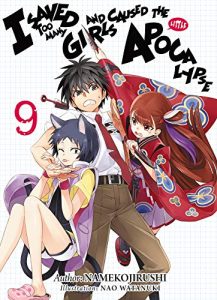
If it sounds like nothing happens in this book, you’re not wrong. There are lots of events, and several things occur which look like setup for a larger plot down the road. In addition to the Phrase stuff, there’s also Sakura, who still has amnesia and still isn’t a wife (damn you, anime spoilers). She finds a dark elf with a tragic past… which we don’t find out about, but she gets to join the Royal bodyguards anyway. And Touya keeps meaning to tell the other girls that he’s from another world, but still hasn’t gotten around to doing so, despite hints from his “sisters” (who also grace the cover, along with Sakura) that he needs to do thins sooner rather than later. Taken individually, these scenes are mildly irritating at worst and a lot of fun at best. But they’re the opposite of someone like Ryohgo Narita in Durarara!!, who sets up dozens of plot guns over a few books, then fires them all off. This is the adventures of Touya wandering around and seeing what happens next, and occasionally using his godlike powers.

I mean, I’m still reading it. It’s still entertaining. But it’s also still not very good.

Filed Under: in another world with my smartphone, REVIEWS

My Hero Academia: Vigilantes, Vol. 1

July 13, 2018 by Sean Gaffney

By Hideyuki Furuhashi and Betten Court, based on the story by Kohei Horikoshi. Released in Japan as “Vigilante: Boku no Hero Academia Illegals” by Shueisha, serialization ongoing in the magazine Weekly Shonen Jump +. Released in North America by Viz.

My Hero Academia, the main series, is very explicitly based on the American concept of superheroes. And, despite the occasional foray into “yes, heroes really do die” and an examination of loss, for the most part it remains a very idealistic series that wears its heart on its sleeve. Therefore, there was absolutely room for a “grim and gritty” take on the Academia universe, though it won’t be featuring any of the main students. If Horikoshi read a lot of Superman, then (as he explicitly states in the author’s notes) Furuhashi is modeling this spinoff after Batman. And, given the design of the “let’s punch everything” vigilante Knuckleduster, it’s pretty clear we’re talking the Frank Miller Batman. That said, this is still My Hero Academia, so I don’t expect things to get completely hopeless. Mostly as, if the “mentor” figure is Batman, the “hero” is… well, Deku. Something the authors also explicitly admit.

Our hero is Koichi, who is in college and trying to hold down a part-time job. Unlike Izuku at the start of MHA, he DOES have a quirk – he can glide along the ground. Slowly. Most people think he resembles a cockroach. He spends his off time doing nice things like picking up litter, to the point where the neighborhood gives him the hero name “Nice Guy”. He also has run ins with a group of bullies… wait, he’s out of high school, so they get to be thugs – as well as a self-styled wannabe pop idol. And, thanks to a variety of circumstances, he also ends up trying to stop an underground drug trade, which makes people’s powers go out of control, turning them into villains, also also seems, very disturbingly, to be controlled by bees. But it’s OK. He can glide. The wannabe idol can jump really high, and then there’s Knuckleduster, who has no quirk, but is GOOD AT PUNCHING.

As I said, we’re dealing here with mostly original characters. Eraser Head shows up at one point to help compare and contrast the difference between licensed heroes and vigilantes, but the core of the series is our three “illegal” heroes. Of the three, Pop Step is the most problematic. My Hero Academia has been criticized a bit for having the female characters get less focus than the guys, and their costumes overly sexualizing them, and that’s not wrong. But over the course of the first volume, Pop Step is captured multiple times, threatened with rape, and the sadly very popular “covered from head to toe in gloop which probably reminds the reader of something”. Knuckle Duster fares better – he’s in the Frank Miller style, but it’s taking the good bits of Miller and leaving out all the claptrap. As for Koichi, he’s a nice kid, but so far is defined personality-wise as “Deku, only less shiny because this is a “grim and gritty” spinoff. He needs more oomph.

On the good side, the action sequences are very well handled here, and there are some nice creepy horror images with the bees. Vigilantes is a decent enough start for a MHA spinoff, and I hope it gives better development to its leads in future volumes. And stops having Pop Step get captured all the time.

Filed Under: my hero academia, REVIEWS

Manga the Week of 7/18/18

July 12, 2018 by Sean Gaffney, Michelle Smith, Anna N and Ash Brown 1 Comment

SEAN: Mid-July. It’s hot. But there is manga for you.

ASH: Yay, manga!

SEAN: Bookwalker has a 4th light novel of The Ryuo’s Work Is Never Done.

Dark Horse gives us a 6th Blade of the Immortal omnibus and the 6th Fate/Zero.

J-Novel Club has new volumes for Demon King Daimaou (6), The Magic in This Other World Is Too Far Behind! (4) and The Unwanted Undead Adventurer (2).

Kodansha has a digital debut, as we see Kakafukaka, the 2nd debut from josei magazine Kiss in two weeks. It’s about a girl who just had a break-up moving in with an old school boyfriend, but he has his own issue – erectile dysfunction. I am intrigued.

MICHELLE: Somehow I totally missed the ED angle on this one! But hooray for josei!

ANNA: Huh. OK!

SEAN: Kodansha also has a pile of ongoing digital. All Out!! 6, Fuuka 19, Love’s Reach 10, Perfect World 4, and The Wizard and His Fairy 2.

MICHELLE: Man, I’m falling so far behind on these.

SEAN: On the print side, we have new volumes as well. There’s a 2nd Golosseum, a 6th Kiss Me at the Stroke of Midnight, a 6th Land of the Lustrous, and a 5th. Wake Up, Sleeping Beauty.

MICHELLE: The last volume of Wake Up, Sleeping Beauty ended on quite a dramatic note, so I’m keen to see what happens next.

ASH: I’ve been enjoying Wake Up, Sleeping Beauty as well, but Land of the Lustrous is what really catches my eye out of that bunch.

SEAN: Seven Seas has a debut in The Bride & the Exorcist Knight (Hanayome to Futsuma no Kishi). This is a relatively short (4 volumes) series from Hakusensha’s LaLa by the author of The Heiress and the Chauffeur. Warning: one of the male leads falls below the comfort line in terms of age.

MICHELLE: Hm. I think I’ll wait to see some reviews of this one.

ANNA: Yeah, I don’t know. Heiress and the Chauffeur was pretty cute, but not sure about this.

SEAN: Seven Seas also has a digital-only light novel with the 4th Boogiepop book, Boogiepop in the Mirror. This is the first one that is new to North America, I believe.

ASH: It is! I’ll be waiting for next year’s omnibus print edition, but I’m very glad for Boogiepop‘s return.

SEAN: There’s also a 2nd volume of Himouto! Umaru-chan.

Tokyopop debuts Hanger, a Gentosha title (bet you guessed that) from their BL magazine Rutile. A cop teams up with a criminal to catch people using performance-enhancing drugs. The author also did Innocent Bird back in the day.

Vertical has a 2nd volume of My Boy, which I found less uncomfortable than I expected.

Viz gives us Children of the Whales (5), Dead Dead Demon’s DededeDe Destruction (2), and Fire Punch (3). Dededede is my pick from this.

ASH: Same! I need to catch up with Children of the Whales, too.

SEAN: And most of Yen’s stuff got pushed back a week or two, but we still have two light novels, with the 10th Durarara!! and the 4th Magical Girl Raising Project. More dead magical girls, or Izaya? It’s a tough choice…

Manga? Or air conditioning? You decide.

Filed Under: FEATURES, manga the week of

Accel World: Archangel of Savage Light

July 12, 2018 by Sean Gaffney

By Reki Kawahara and Hima. Released in Japan by ASCII Mediaworks. Released in North America by Yen On. Translated by Jocelyne Allen.

The author jokes in the afterword about how once again he said that an arc would wrap up in the next volume… and once again it did not, with this volume ending on yet another cliffhanger. It could be a sign that the author has difficulty bringing things together, but honestly with Accel World you don’t really mind. The main plot is interwoven into the individual arcs, so we know that solving the ISS Kits and rescuing Ash Roller is not going to stop the Acceleration Research Society anytime soon, just as we know that eventually Haruyuki is going to have to meet Kuroyukihime’s sister, even though we still haven’t seen her either. For now we have this volume, which is mostly in two chunks. The first involves rescuing Aqua Current by taking on another of the Four Gods guarding the Accel World equivalent of the Imperial Palace. The other involves taking on Metatron, who has the laser that Haruyuki thinks he can now repel. Sadly, before that they have to take on Magenta Scissor – again.

The cover features Blood Leopard and Aqua Current, who turn out to have a closer relationship than previously expected. The role of ‘parent’ and ‘child’ is an interesting one in the AW universe, as all it involves is getting another person into the same game you’re playing. That said, in the AW universe there’s good parents and bad parents, and we get an example here with Avocado Avoider. He was invited into the game, then the other players saw his power wasn’t really “useful” and proceeded to essentially kill him right there. You’re never allowed to forget that Accel World is actually a game, and that means that it invites the worst of gamer mentalities. Haruyuki’s playing for the fun of it, the curiosity of winning and the bonds he forms is contrasted with the agenda of Magenta Scissor, who wants everyone to be equal in abilities, point, and everything else – it’s fair, but is it really any fun? That said, her behavior at the end of the volume here suggests she may not be as hardcore about it as she sounds.

The other big revelation here involves the “villain” of the piece, Metatron. We see our heroes going after her laser and coming up with a very clever plan… which then goes to hell when Metatron decides to come down to the ground to attack them right there. It’s always wise to not assume what your enemy plans to do. That said, Metatron appears to be fighting a battle herself, and with Haruyuki’s help is able to get past it… only to reveal that she seems to be EVEN MORE POWERFUL now. I’m interested in seeing where she goes from here, especially as she’s now apparently providing Haruyuki with power in order to rescue Niko (oh dear, please tell me she’s not going to be part of the harem). The cliffhanger was rather abrupt, but plausible – you knew these goons were not just going to let Nega Nebulus waltz in and destroy them. And the harem antics were there but minimal.

Kawahara, with this series, has succeeded in making it one where you want to get the next book immediately after reading the last one. Sadly, we have to wait for September now. Will he finish the arc this time? Mmmmmmmaybe?

Filed Under: accel world, REVIEWS

Tokyo Alice, Vol. 1

July 11, 2018 by Sean Gaffney

By Toriko Chiya. Released in Japan by Kodansha, serialized in the magazine Kiss. Released in North America by Kodansha Comics. Production by amimaru.

(Note: Tokyo Alice has no translator credit, but also has a “production” credit I rarely see, so I’m considering them equivalent for now.)

The number of times I’ve started a review by saying “I’ve never seen _______” is starting to number in the hundreds, but it has to be said. No, not the Tokyo Alice live-action drama that went out last year. Something a bit more relevant: I’ve never seen Sex and the City. As such, I’m not entirely sure how similar this series, about a group of four friends who live in the big city, whose lives we occasionally follow, and who are (mostly) living together by the end of the first boo9k should remind me of said series, except it does by sheer cultural osmosis. The sex so far is on the light side (one of the lead women has a different guy in her bed every night, and says she’s never had an orgasm, but we don’t see this beyond guys coming and going), but the bond between the four friends is strong, and if the series can keep it up I’ll be pleased to follow along.

Of course, some heroines are more equal than others. The lead here is clearly Fu, a 26-year-old woman who works for a design company and loves shopping. Somewhat surprisingly, at least at the start, men don’t really apply to her, something that bothers her when she dwells on it. She is otherwise the classic ‘ditzy’ shoujo lead, only this is josei so she’s all grown up. I imagine the reader may find her a bit frustrating, which is something of the point. Her friends include Mizuho, a shoujo manga artist with a loser boyfriend who finds that she has trouble drawing real love; Rio, a stylish doctor who has lots of suitors but rejects them as she’s got a crush on… well, the answer surprised me; and Sayuri, who I mentioned above, who will one day have to marry who her parents want her to but in the meantime plans to fool around and have fun.

When I mentioned Fu loves shopping, it’s possible that I wasn’t emphatic enough. shopping consumes Fu, and much of the first volume deals with her buying things and then living to regret it when she sees her bank balance. (I wonder how long she’ll last living with her friends before she’s thrown out for missing rent.) This feels very much like a josei manga catering to its readers, who are also likely twenty-somethings living in a big city and wondering what to do next. We get the occasional flashback to the friends when they were in junior high, talking about the type of guy they want to end up marrying. Reality has ensued for most of them (and Fu is rather startled to realized the sweetest, most idealistic one of them became the somewhat hedonistic Sayuri), and Fu in particular needs to be more aware of the situations (and men) around her. But if you don’t mind that, then Tokyo Alice is a good start.

Filed Under: REVIEWS, tokyo alice

The Water Dragon’s Bride, Vol. 6

July 10, 2018 by Anna N

The Water Dragon’s Bride Volume 6 by Rei Toma

One would not normally expect a fantasy series about a girl from modern day Japan falling through worlds to end up in a quasi-medieval land where the lives of humans revolve around appeasing gods to contain a dense philosophical exploration of what it means to be human, with a side meditation on man’s inhumanity to man, but that’s exactly what the reader gets in The Water Dragon’s Bride. Toma’s masterful storytelling is on full display in the 6th volume, where there’s a dramatic emotional breakthrough with Asahi and her Water Dragon God.

All along the Water Dragon God has been transformed bit by bit due to his close exposure to humans. He doesn’t exactly understand humanity yet, but he’s a great deal more sensitive and caring than the person he was in the first volume who just sat back and let a young Asahi starve to death because the concept of providing food did not occur to him. When the Water Dragon God continues to see that the other humans are going to still persist in trying to control Asahi due to her standing as priestess, he decides that she can’t remain in the human world, and she needs to exist by his side with no more pain. The solution the Water Dragon God hits on is to trap Asagi in a bubble in his world, where she experiences a day of her being a normal high school girl with Subaru over and over again until she begins to sense that something is wrong with her fake new existence. I’m always in awe at what Toma can do with her minimalist yet highly effective approach to illustration. Seeing Asagi trapped in her bubble in the world of the Gods while they discuss her is visually arresting, as the formless world is intercut with scenes of the dream in modern Japan that Asagi slowly realizes is not real.

The power dynamic between Asagi and the Water Dragon God is so unequal, but she manages to break his spell, raising a question about how much power she actually has over him. So much of this volume is expressed through the internal thoughts of the characters, with brief dialog that evokes all of the unsaid emotions as seen Asagi and the Water Dragon God share a “Good Morning” greeting after she breaks out of her water bubble. He decides after his attempt to trap Asagi in a dream that he will set things back on their original path, but can Asagi really go home again after everything she’s experienced? I’m genuinely not sure what to expect from this series next, which makes it such a pleasure to read.

Filed Under: Manga Reviews, REVIEWS Tagged With: shojo beat, shoujo, viz media, water dragon's bride

Re: ZERO ~Starting Life in Another World~, Vol. 7

July 10, 2018 by Sean Gaffney

By Tappei Nagatsuki and Shinichirou Otsuka. Released iJapan by Media Factory. Released in North America by Yen On. Translated by Jeremiah Borque.

There is apparently something of an argument among Re: Zero fans about whether the overall story is meant to be a deconstruction of the typical “light novel” hero. I can see why people would come to this conclusion. Subaru frequently acts like he can glide through every situation based on guts and gumption, and the series is very quick to put him in his place over and over again. It shows what might actually happen in a situation like that. And, much as I get very, very frustrated with Subaru, this is an excellent way to handle his character. That said, I think it’s a great character idea, but I don’t think the book is a deconstruction in general. And the reason for that is books like this, where Subaru takes everything he’s learned from previous books where he was a giant dumbass and uses it to save the day, becoming the light novel hero whether he wants it or not. If you think it’s a deconstruction, you’re likely annoyed. As for me, I’m saying ABOUT DAMN TIME.

Subaru, knowing he needs help from everyone and also knowing that “let’s rescue Emilia!” is not going to get him jack, works with what he already knows from prior loops of failure: he knows when and where the White Whale will show up. This is big news, especially for Wilhelm, whose backstory we finally get here for those who didn’t already read it in the 2nd EX novel which came out earlier in North America. He lost his beloved wife to the Whale years ago, and is bent on revenge. And Crusch is there to help him, having mobilized tons of resources (something Subaru had been quietly noticing before) in an effort to try to best it. Subaru’s “here is the exact time it will be here” is, therefore, a blue-chip piece of info. What follows, for the rest of the volume, is that battle against the whale, who proves to be amazingly difficult to do anything about, as you’d expect.

Throughout this battle, we see Subaru doing exactly what he can/ As a combatist, he’s worse than useless. But he can exude the Witch’s scent to lure the whale to him, he can come up with a final plajn that takes it out once and for all, mostly as he has no qualms about destroying a centuries old legend, and most importantly his “never give up, give it GUTS and GUMPTION!” is finally appropriate for the situation. We see it when he gives the order to Rem to start the battle while Crusch is still boggling at the whale’s full glory, and we see it after many casualties (who, the whale’s attack being what it is, are now forgotten) when he rallies everyone to not give up and never say die. He’s finally learning when it’s best to be a light novel hero and when it isn’t. And yes, this means he finally finds it in him to apologize to Julius as well.

We’re still in the middle of the arc – after all, the Whale may be taken care of but the Witch Cult lives on. But if Subaru keeps this up, I may actually grow to respect him has a character. He’s learning to be a real hero, rather than just thinking good things wwill happen because of who he is. Well done.

Filed Under: re: zero, REVIEWS

Invaders of the Rokujouma!?, Vol. 14

July 8, 2018 by Sean Gaffney

By Takehaya and Poco. Released in Japan as “Rokujouma no Shinryakusha!?” by Hobby Japan. Released in North America digitally by J-Novel Club. Translated by Warnis.

I have found that a series like Rokujouma is at its best when the cast it set up against a strong enemy. Be it Theia’s home planet’s military or the dark magical girls, this allows Koutarou and the girls to be able to use their strong bonds to maximum effect. It also makes it heartwarming whenever they go on and on about said strong bonds. Unfortunately, that does lead to an annoying side effect, which is that when you have a book where there ISN’T a strong conflict, the series can sometimes turn a bit smug. When Koutarou was asked to grade all the girls he liked on a scale of 1-100 (100 being “would marry her in a flash), and even Yurika, considered the “weakest” of the lot, still gets over 300… the tendency to roll the eyes can be very strong. We know where the author is going with this, but sadly Koutarou’s nature means that we’re a ways away from him knowing it, I expect.

This book essentially consists of three short stories. The second is the one I was telling you about above, which involves Koutarou realizing how important all the girls are to him, Ruth suggesting that he start a cadre of Knights he can command (with her as second in command, natch), and Yurika getting comedically tortured, because honestly that’s still pretty funny. It’s a pretty slight story, though, and the other two do better. The longest involves Shizuka, whose past we finally hear about. I’m going to be honest here, the moment I heart of the fate of her parents I knew where the climax of this story was going to end up, and it sure did. But I like her as a character, and she now no longer has to be kept in the dark, and can officially be added to the “harem”. Basically, it’s the Shizuka depth we’d been waiting for.

The last story follows up on Vol. 13, where it was made clear that Koutarou and Clan had met Theia’s mother before in their apparently endless time travel. Here we see that meeting happen. It’s fun if a bit predictable – Ellie is a strong princess who nevertheless falls hard for Koutarou like everyone else, and since she’s not going to be part of the harem, Koutarou is allowed to realize that. And we see that even back twenty years prior, the military was a bit out of control – essentially, the planet’s history has reached the crisis point that Koutarou’s presence can solve once more. I wish a bit more had been done with the fact that Koutarou was still in love with Alaia at this point, but it’s given short shrift in favor of time travel “do I have the right?” stuff.

So this is not the strongest book in the series, and might seem self-satisfied to a casual reader. But I’m sure that more conflict will come along soon, and it’s good to see Shizuka officially be part of the main group at last.

Filed Under: invaders of the rokujouma!?, REVIEWS

Is It Wrong To Try To Pick Up Girls In A Dungeon? On The Side: Sword Oratoria, Vol. 6

July 6, 2018 by Sean Gaffney

By Fujino Omori and Suzuhito Yasuda. Released in Japan as “Dungeon ni Deai o Motomeru no wa Machigatte Iru Darou ka? Gaiden – Sword Oratoria” by Softbank Creative. Released in North America by Yen On. Translated by Liv Sommerlot.

I am frequently amused when I find that my own thinking as I read a book has mirrored the author’s. As I read this new Sword Oratoria volume, which focuses on Tione and Tiona, the twin Amazons from Loki Familia, I remember thinking that I didn’t really think much of them beyond “loves Finn” and “kind of an idiot”. And sure enough, in the afterword the author states that they had the same thought, and writing the book involved finding their character to an extent. Fortunately, it works out great: this is one of the strongest books in the Sword Oratoria series, with not only the usual excellent fights and seeing Loki be clever, but also some terrific backstory for the twins, whose live growing up was horrific and has left its mark on… both of them, though it’s not surprising that Tione thinks at first that it’s just her.

Here we meet a new goddess, Kali, as well as her followers, who the twins split off from years ago. As you may have guessed, Kali is bloodthirsty and desires endless war, so her children participate in a battle royale event from the moment they can walk, fighting each other to see who is strongest. (There is a chilling age reveal at one point that was handled fantastically.) Of course, it’s not just the new people – the series continues to also mirror what’s going on in the main one, and we’re nearing Book 7 on the timeline, so Ishtar Familia proves to be very active behind the scenes as well. This is unfortunate for Aiz, as the frog-faced battle warrior of the family, Phrynne, has a hate-on for Aiz for being… well, powerful and beautiful. And there’s another God involved as well, which surprised me, especially after reading the Lyu spinoff.

That said, Tione and Tiona are the stars here. We’ve seen Tione angry before, but here she spends almost the entire book in an incandescent, uncontrollable rage. I’ve never been a big fan of her goofy crush on Finn, but it works here because it’s actually weaponized, and also serves to remind Tione of what she’s gained since leaving the Amazons. As for Tiona, she absolutely knocked it out of the park for me, taking “smiling idiot” and showing how it can be one of the most powerful, heartwarming things ever – as well as showing that the idiot is not as true as it seemed. Tiona’s very clever here, in many respects.

This book lacks Bell Cranel for the most part, which works in its favor. As for Lefiya, well, she’s peril monkey here, sadly, but at least is shown to be more upset about her ongoing magic advancement and less about her crush on Aiz. The book is on the larger scale, so you’ll need to set aside from time for it, but if you like DanMachi, and particularly Loki Familia, you’ll love this.

Filed Under: is it wrong to try to pick up girls in a dungeon?, REVIEWS

Hanamonogatari: Flower Tale

July 5, 2018 by Sean Gaffney

By NISIOISIN and VOFAN. Released in Japan by Kodansha. Released in North America by Vertical, Inc. Translated by Daniel Joseph.

First off, I can’t help but notice that I haven’t been crediting VOFAN in my reviews of the Monogatari series. This may not be surprising – Monogatari is not a “light” novel per se, and there are no interstitial illustrations – we get cover art and one large piece at the start of the story. But the art is not only gorgeous but can also be a signpost as to what type of story we’re getting. Kanbaru here – be it in the original cover or the one VOFAN did for the North American release – is looking very serious, not at all like the suggestive and leering girl we’ve seen in previous books narrated by Araragi. And sure enough, as we get a book written with her narration, we see that she is at heart an overly serious and earnest young woman, and that most of her banter with Araragi is a facade. “Playing the fool” is something she’s actively called out about. Even worse, this book takes place in her third year, so she can’t even count on her (now graduated) friends.

That’s right, we’re jumping forward in this book, as Hanamonogatari takes place sometime after the events of all the other books in the series. Araragi, Senjogahara and Hanekawa have graduated and moved on – though Araragi does play a small role here, mostly to give Kanbaru emotional support. Which she desperately needs. Her friend Higasa knows nothing of aberrations. Kaiki Deishu shows up, oddly enough, claiming to know her mother, and is actually quite helpful, but given his behavior regarding Senjogahara, Kanbaru wants nothing to do with him. And then there’s Ogi (and believe me, that romanization pains me as much as it does you). I hadn’t mentioned Ogi in my review of Kabukimonogatari – she showed up at the start to harangue Araragi about stoplights, and seems to hold him in contempt. Now Ogi is a male student – this is lampshaded a few times in case we don’t get the gender switch – and haranguing Kanbaru, though there seems to be less venom in his tone this time around. Ogi is clearly a puzzle that we’ll have to solve in future books, but for now let’s just go with ‘annoying underclassman’.

As for the main plotline, you won’t be surprised to hear it has to do with Kanbaru’s main issues – her “devil’s hand” and basketball. An old middle-school rival, Roka Numachi, has shown up, and like Kanbaru she’s injured and doesn’t play anymore. Also like Kanbaru she seems to be somewhat fluid in her sexuality, though this book indicates that most of Kanbaru’s happy “I’m a lesbian!” to Araragi was part of her front – her experience is near zero, though there’s definitely sexual tension with Roka. As with a lot of the Monogatari series, the plot itself seems to be laid out in a couple of long expository monologues – if you get bored easily, this is not the series for you. The resolution works well, though, and seems to point to Kanbaru maturing and moving forward, made explicit by her cutting her hair short again at the end (it has been growing longer as the series has gone on, as anime fans no doubt noticed.)

Anime fans, speaking of which, may be surprised to see this book coming so soon – this was the original Japanese release order, but the anime delayed its production till after the next three books were adapted. If you like Kanbaru it’s essential, and even if you don’t it’s still a good volume of the series, mostly as it lacks the “filter” of Araragi’s narration. Next time we’ll move back a few months and see why Sengoku Nadeko is this series’ most polarizing character.

Filed Under: monogatari series, REVIEWS

Takane & Hana, Vol 3

July 4, 2018 by Anna N

Takane & Hana Volume 3 by Yuki Shiwasu

Takane & Hana continues to be a bit of a guilty pleasure read for me. It might not be all that deep, but the humor and Shiwasu’s ability to draw hilarious facial expressions make it a great light summer read, even as it steps through some fairly typical plot points for shoujo manga.

The volume starts off with Hana brokering peace between Takane and his friend Nicola, who promises to be a semi-regular presence in future stories with his womanizing ways and ability to tease Takane. One of the things that has be rooting for this relationship between a CEO and a high schooler against all logic is the way each half of the couple springs into action whenever their partner needs support. In this case, Hana’s grades take a nosedive, and she’s irritated at the presumption people make that it is because she has a new boyfriend. She tells Takane that she needs a break to study and can’t see him for awhile, but of course he takes this as an excuse to turn himself into the perfect tutor, and they spend the time before her big exams studying together. Hana then returns the favor when Takane gets sick. There are possible hints of a potential love triangle ahead, as Hana’s friend Okamon monitors Takane closely when they go on a beach summer vacation trip. Overall this was a fun volume as always, enlivened by Takane’s overwrought reactions to normal life events.

Filed Under: Manga Reviews, REVIEWS Tagged With: shojo beat, shoujo, takane & hana, viz media

Manga the Week of 7/11/18

July 4, 2018 by Sean Gaffney, Michelle Smith, Ash Brown, Anna N and MJ 2 Comments

SEAN: Manga, manga, manga! Last chance sale! Everything must go!

Dark Horse gives us a 39th volume of Berserk, a series that without hiatuses might have 139 volumes.

ASH: Ha! That may be true. I still greatly anticipate this one, though!

SEAN: J-Novel Club has the 9th volume of guilty pleasure In Another World With My Smartphone.

Kodansha did it again, releasing their new digital manga press release just after I posted Manga the Week of. So, already released, we have I’m Standing on a Million Lives (100-man no Inochi no Ue ni Ore wa Tatte Iru), an isekai fantasy that runs in Bessatsu Shonen Magazine. The artist may be familiar for Psycho Busters.

Meanwhile, next week’s debut is Tokyo Alice, a long-runing josei series from Kiss magazine that recently got a live-action series. The heroine is looking for love and looking to shop, possibly not in that order.

MICHELLE: I’m not especially into shopping, but who can resist long-running josei?

ANNA: Did someone say long-running josei!?

SEAN: Also digitally we have Kamikamikaeshi 2 and Starving Anonymous 5.

Print-wise, we have another digital debut that’s now getting a print release. Grand Blue Dreaming is a romantic comedy from the creator of Bakas, Tests and Summoned Beasts. It runs in good! Afternoon.

ASH: I’m curious about this one! What could possibly go wrong when mixing drinking and diving? (Plus, I’m always happy when one of Kodansha’s digital titles makes its way into print.)

SEAN: Amazon also tells me that there is an Attack on Titan Character Encyclopedia coming out next week, though I don’t see that on Kodansha’s site. Learn more about your favorite characters who are now dead. NOT THAT I’M BITTER.

Kiss Him, Not Me! comes to an end with its 14th volume. The series had its ups and downs, but overall I enjoyed it.

And there is a 7th Waiting for Spring.

MICHELLE: I always enjoy this series.

SEAN: Seven Seas debuts Little Devils (Maou Kyoudai), the latest in a long line of slice-of-monster-girl life. Or monster kids, in this case, as a hero has to raise demon children to become model citizens. It runs in Tokuma Shoten’s Comic Ryu, and looks more cutesy than pervey.

ASH: It does look really cute. I plan on giving it a try.

MJ: This sounds pretty cute.

SEAN: There’s also a 7th print novel for Grimgar of Fantasy and Ash, a 2nd Sorry for My Familiar, and a 4th Spirit Circle. I’ll definitely be getting the last of those.

ASH: Same!

SEAN: Vertical gives us a 7th volume of the Mobile Suit Gundam Wing manga.

Lastly, there is Viz, which has a 67th Case Closed (still not over in Japan), and a 27th Rin-Ne (which has ended, but we have a long way to go to catch up.)

MICHELLE: I had no idea RIN-NE had ended! It makes me wonder if there was some actual plot there at the end.

MJ: *snort*

SEAN: Not too bad, right? Which of these MANGA BARGAINS are you getting?

Filed Under: FEATURES, manga the week of

The Irregular at Magic High School: Reminiscence Arc

July 4, 2018 by Sean Gaffney

By Tsutomu Sato and Kana Ishida. Released in Japan as “Mahouka Koukou no Rettousei” by ASCII Mediaworks. Released in North America by Yen On. Translated by Andrew Prowse.

Last time I was feeling a bit grumpy about the all-consuming black hole that Tatsuya was, removing moments of characterization from others in order to betetr serve the dramatic battle scenes. That’s not an issue with this volume, which flashes back three years to show us Tatsuya and Miyuki in middle school. Sure, there are battles, and endless numbers of dead magician mooks, but the thrust of this book is to show us how Miyuki’s feelings for Tatsuya changed into what they are at present, and also show us their relationship with their mother (who is dead in the present series, I believe) and their aunt (who is very much not dead). It does a good job at the latter, but unfortunately the former doesn’t quite work as well. I get that we’re supposed to see how Miyuki notices what Tatsuya is suffering through every day, and what he’s doing for her sake, but it reads more like “I finally saw him really fight, and he’s so cool!”.

The book is interspersed with moments from just after the last book, with Tatsuya reporting to Maya and being asked to leave school and Miyuki. (He refuses – no surprise there.) The bulk of the book follows Miyuki’s viewpoint, though, as a typical pampered 12-year-old who is mostly pissed off at her brother because she doesn’t understand him. We see Tatsuya fight off a bunch of military brats, hear about him getting injured fighting someone while Miyuki was sleeping, and then see him really break out the whoopass once Miyuki is almost killed. Miyuki is also informed by her mother about the essential lobotomisation that was done to Tatsuya when he was young, and the fact that he has no strong emotions other than “loves Miyuki like a little sister” as a result. Miyuki is understandably horrified, and this is what has led us to our current situation of Tatsuya and Miyuki trying to push back against the Yotsubas as much as they can.

The most interesting part of the book is probably the last short story at the end, which goes back still further to show us Miya and Maya as 12-year-old girls. Sadly, it’s not a happy time when they’re playing cutely together. Maya was kidnapped by (please hold your surprise in) an evil Asian organization, raped, and experimented on for three days. (We thankfully do not see this ourselves, just hear about it.) Maya is broken by this, and the family ask Miya to fix it using her own powers. What follows is what led to the rift between the two sisters, as well as, to a degree, the main plot of the series – my guess is that a lot of the machinations we’ve been seeing are related to Maya’s trauma and her attempts to deal with it. It explains a lot, and makes compelling reading, but, much like the battle Tatsuya gets into as a middle schooler, it’s not particularly fun to read.

Like Tatsuya, I felt a bit emotionally dead after reading this volume. It’s well-written, and I want to see what happens next. The fights are nice provided you don’t mind knowing there’s no way they’re ending in anything but Tatsuya winning handily. But the reason that we stay with the high school and the students within it is to have their emotional center, which Tatsuya lacks – and Miyuki to, to a large degree. Thankfully, the next three books are a big arc that takes place at the school. Till then we have this, which basically says that brother-sister incest is the least of this family’s troubles.

Filed Under: irregular at magic high school, REVIEWS

Bookshelf Briefs 7/3/18

July 3, 2018 by Michelle Smith, Sean Gaffney and Ash Brown Leave a Comment

Ace of the Diamond, Vol. 12 | By Yuji Terajima | Kodansha Comics (digital only) –Seido had been sure their opponent for the quarter-finals of the East Tokyo qualifying tournament would be Ichidai, but when that team is taken out by Yakushi in a surprise upset, Seido is suddenly facing a team full of fearless batters. In this tense volume, Yakushi fields their fiercest batter first, and I was bracing for Furuya to crumble under the pressure, but instead he has a lot of fun, having faith in his reliable upperclassmen and demonstrating some growth in his fielding capabilities. In an effort to keep Yakushi from becoming accustomed to one pitcher’s style, Sawamura is switched in but before he can do too much, the volume’s over. This is really a series that benefits from being marathoned, for though it’s great fun the way that it is, it’s probably going to be immensely satisfying to binge 40+ volumes back-to-back. – Michelle Smith

After Hours, Vol. 2 | By Yuhta Nishio | Viz Media – This second volume does a nice job alternating between Emi and Kei trying to put on a live event and Emi trying to decide what to do about her relationship, if that’s what it is, with Kei. I was pleased that the manga chose to negotiate a fairly melodramatic path without going overboard—the emotions feel fairly realistic given what Emi is going through, and Kei is not ignored either. There’s also some great scenes of Emi meeting more members of the dance club crew, and making friends and bonding with them. Usually with yuri manga you’re following it for the romance and that’s about it. But this is a more mature yuri title, and that doesn’t just mean sex, it means career motivations and such. A keeper. – Sean Gaffney

Anonymous Noise, Vol. 9 | By Ryoko Fukuyama | VIZ Media –Anonymous Noise, Vol. 9 | By Ryoko Fukuyama | VIZ Media – It took me a long time to get to this point, but I think I’m finally ready to declare Anonymous Noise a keeper. In No Hurry has embarked on their first national tour, which is interesting in and of itself, but it also feels like Fukuyama has achieved a good balance between her characters’ professional growth—Nino’s gotten more experience, Momo has decided that he wants to release music that’s true to who he is—and their personal angst. Yes, the main love triangle is still going, and though Yuzu attempts a few times and Momo declares his intentions, neither boy has made clear their feelings to Nino. But now I at least care a little more about that, while predominantly being excited for what might happen for them career-wise. I’m glad I grew to truly enjoy this series. – Michelle Smith

As Miss Beelzebub Likes, Vol. 2 | By Matoba | Yen Press – It can be difficult when you’re rooting for a cute couple to get together in a series and that series is, at heart, a goofy comedy. It’s a shame, because when the series is focusing on the cute Beelzebub and her secretary Mullin, it’s pretty adorable. But that’s not what the author is here for, really. As such, we get some new characters in this volume, including a shotacon (bleah) and a shota for the shotacon to obsess over (meh). Belphegor’s crush on Azazel is more promising, mostly as there’s a bit less about how nervousness makes her want to pee and more actual affection. This is a cute series, but at heart it’s a comedy, and the comedy is hit-or-miss. It should try to be more of a romance. – Sean Gaffney

Claudine | By Riyoko Ikeda | Seven Seas – For a variety of reasons, one of my most anticipated manga releases of 2018 was Claudine. First of all, it’s by Riyoko Ikeda, one of the Magnificent Forty-Niners, a group of women who were extraordinarily influential to the development of shoujo manga in the 1970s and many of whom continue to create exceptional work. I was also particularly interested in Claudine due to its sympathetic, albeit tragic, portrayal of a transgender man, a rarity in comics of any country or era. First published in 1978, the manga follows the titular Claudine, a young man growing up in France who struggles with the perceptions others hold of him in regards to his gender and sexuality. Claudine repeatedly finds and loses love over the course of the short manga, acceptance and betrayal often following one after the other. Claudine is gorgeously illustrated and heartwrenchingly melodramatic, a beautiful and at times troubling work. – Ash Brown

The Elder Sister-Like One, Vol. 2 | By Iida Pochi | Yen Press – Strangely, given this is still based on a porn doujinshi, the author and editors have done a very good job at making it mainstream while keeping a goodly amount of fanservice. The core relationship between Yuu and his demon sister is familial here, despite the occasional suggestiveness, and the best scenes in the book show off the family connection that he desperately needs. There’s also hints of something darker, and the clever reader will realize this is not a lifestyle that is going to be sustainable for much longer. Something is bound to go wrong. Till then, I’m happy with Yuu’s heart slowly being healed, as long as the creators remember to avoid getting too salacious. – Sean Gaffney

Giant Spider & Me: A Post-Apocalyptic Tale, Vol. 2 | By Kikori Morino | Seven Seas – Despite the attempt of various dramatic events to make us think otherwise, at heart this is a cooking manga, and the core of each chapter shows off the various recipes. We get an addition to the cast of Belle, who is the grumpy snarker that sets off Nagi’s perky optimist nicely, and the two become fast friends. There’s also a stroll into town, which surprised me, and the town reacts to a giant mutant spider about the way you’d expect it to. Fortunately, the giant spider is a sweetie pie, and indeed might be a baby giant spider, which helps to explain why Nagi’s TLC is helping. Of course, there’s another cliffhanger with Nagi being kidnapped, but given how the last cliffhanger resolved, I’m not TOO worried. – Sean Gaffney

Monster Tamer Girls, Vol. 2 | By Mujirushi Shimazaki | Yen Press – As with a lot of series that end after only two or three volumes, there’s a sense of “please wrap this up as quickly as possible” to the ending of the book, but it’s still rather cute and romantic, with Koto and Tsukiko’s relationship getting as close to canonical as a series like this is going to get. I also liked the backstory for Sora, as we see that she was rescued by a monster as a child, and then we see that same monster needing to be “rescued” in a different sense. At heart a series more about building and continuing relationships than about monsters, two volumes was probably about the right length for it. Still a good read if you like cute girls and monsters. – Sean Gaffney

My Monster Secret, Vol. 11 | By Eiji Masuda | Seven Seas – Yes, Asahi and Youko are together, but this series isn’t even half over yet, so don’t expect a lot of dating and holding hands here. Instead it’s more comedy, which is good as My Monster Secret does comedy very well. Even the melodramatic drama is comedy, as Nagisa’s tearful return to her home planet is undercut by a) a running gag of her worried about public spankings, and b) the punchline. There’s also a return of Youko’s hyperprotective father, which leads to an endless string of amusing gags. About the only time that My Monster Secret misses is when the gags it relies on are too tired, such as Akari’s age. This still has the capacity to make me laugh a good deal. – Sean Gaffney

The Troublemakers | By Baron Yoshimoto | Retrofit Comics – Only a few manga have been released by Retrofit Comics, the most recent of which is The Troublemakers, a collection of Baron Yoshimoto’s short manga curated and translated by comics historian Ryan Holmberg. Along with an accompanying essay by Holmberg placing Yoshimoto and his work into historical context, The Troublemakers collects six stories originally published between 1966 and 1974. The volume isn’t necessarily intended to be a “best of” collection. Instead, the manga included are meant to be a representative sample of not only Yoshimoto’s creative output but also of the types of gekiga and seinen manga being published for men in Japan around the 1970s. The stories are engaging and provocative, sex and violence featuring prominently as part of intense and dramatic narratives with protagonists who are frequently society’s outsiders. Based on the manga collected in The Troublemakers, I’m intrigued and certainly interested in reading more work by Yoshimoto. – Ash Brown

Filed Under: Bookshelf Briefs

Sweet Blue Flowers, Omnibus 4

July 3, 2018 by Sean Gaffney

By Takako Shimura. Released in Japan as “Aoi Hana” by Ohta Shuppan, serialized in the magazine Manga Erotics F. Released in North America by Viz. Translated by John Werry.

The final volume of Sweet Blue Flowers shows off all the strengths and weaknesses of this particular series. Akira and Fumi make very good leads, and there are some deft story touches in this book, particularly in how their breakup is conveyed wordlessly – we’re not actually seeing it straight on, but obliquely. And yes, there’s a breakup, but don’t panic, yuri fans. Just as the reader was meant to be very wary when Akira suggested dating while she sorts out her feelings, so the reader somehow knows that the breakup isn’t going to be permanent. It is interesting, given how negative and toxic the feeling is in so many other manga out there, that it’s Akira feeling jealousy of Fumi possibly seeing other girls that makes her realize “oh, I *do* love her like that.” She also looks so much better with her hair cut it’s not even funny. Their story was the main reason to read the series, and it’s worth the read.

This does leave the rest of the book and the rest of the cast, and I was sort of up and down about that. I still say that, even if the cast list is somewhat helpful, a lot of Shimura’s characters look and act too similarly, especially the giant pile of younger students. More than that, though, at times when the narrative was focused elsewhere I felt like I was drifting through the book like at a party, catching fragments of conversation about events that should be important but don’t have time to grab me before we’ve moved on. Now, to a degree this can be refreshing. It’s clear that every girl in the cast has things going on besides what we see on the page, and I like characters with full, rich lives. But I sometimes wish the manga had more focus – its desire to flit from cast member to cast member made me feel like I was reading though a gauzy haze.

Overall, though, I’m very pleased we finally got to see this series come out in North America. It’s girls in school falling in love, yes, but the diffuseness I mentioned above also helps to separate it from the series that followed in its wake, many of which we saw here first. I also enjoyed the odd serious moments of melancholy, such as the backstory with Kyoko and her mother, which was sad and depressing without making the reader feel angry. And the teacher was a highlight of the entire series, and we saw that her own attempts to come out more publicly had both its ups and downs – I’m not sure if she’s in trouble at school, like so many plotlines in this series it gets carefully examined and then we move on – but it was great to see her imagining a double bride wedding. I do think this series ended at just the right length – it would have been exhausting to carry on for 3-4 more volumes. In the end, Sweet Blue Flowers had its bittersweet moments, but the end showed that sweetness can win out.

Filed Under: REVIEWS, sweet blue flowers

  • « Go to Previous Page
  • Page 1
  • Interim pages omitted …
  • Page 210
  • Page 211
  • Page 212
  • Page 213
  • Page 214
  • Interim pages omitted …
  • Page 538
  • Go to Next Page »
 | Log in
Copyright © 2010 Manga Bookshelf | Powered by WordPress & the Genesis Framework