• Skip to primary navigation
  • Skip to main content
  • Skip to primary sidebar
  • Home
  • About Us
    • Privacy Policy
    • Comment Policy
    • Disclosures & Disclaimers
  • Resources
    • Links, Essays & Articles
    • Fandomology!
    • CLAMP Directory
    • BlogRoll
  • Features & Columns
    • 3 Things Thursday
    • Adventures in the Key of Shoujo
    • Bit & Blips (game reviews)
    • BL BOOKRACK
    • Bookshelf Briefs
    • Bringing the Drama
    • Comic Conversion
    • Fanservice Friday
    • Going Digital
    • It Came From the Sinosphere
    • License This!
    • Magazine no Mori
    • My Week in Manga
    • OFF THE SHELF
    • Not By Manga Alone
    • PICK OF THE WEEK
    • Subtitles & Sensibility
    • Weekly Shonen Jump Recaps
  • Manga Moveable Feast
    • MMF Full Archive
    • Yun Kouga
    • CLAMP
    • Shojo Beat
    • Osamu Tezuka
    • Sailor Moon
    • Fruits Basket
    • Takehiko Inoue
    • Wild Adapter
    • One Piece
    • After School Nightmare
    • Karakuri Odette
    • Paradise Kiss
    • The Color Trilogy
    • To Terra…
    • Sexy Voice & Robo
  • Browse by Author
    • Sean Gaffney
    • Anna Neatrour
    • Michelle Smith
    • Katherine Dacey
    • MJ
    • Brigid Alverson
    • Travis Anderson
    • Phillip Anthony
    • Derek Bown
    • Jaci Dahlvang
    • Angela Eastman
    • Erica Friedman
    • Sara K.
    • Megan Purdy
    • Emily Snodgrass
    • Nancy Thistlethwaite
    • Eva Volin
    • David Welsh
  • MB Blogs
    • A Case Suitable For Treatment
    • Experiments in Manga
    • MangaBlog
    • The Manga Critic
    • Manga Report
    • Soliloquy in Blue
    • Manga Curmudgeon (archive)

Manga Bookshelf

Discussion, Resources, Roundtables, & Reviews

Features

Re-flipped: Kazuo Umezu

October 24, 2011 by David Welsh

For this week’s blood-soaked Manga Moveable Feast, I thought I’d revisit some old Flipped columns that have a horrific bent.

With so many aspects of the manga industry apparently in question, there is one thing I can say without too much fear of contradiction:  it’s a good time to be a fan of horror comics from Japan.

CMX is offering the creepy-cute moralizing of Kanako Inuki’s Presents.  Dark Horse is serving fans of Shaun of the Dead-style self-aware chills with The Kurosagi Corpse Delivery Service, written by Eiji Otsuka and drawn by Housui Yamazaki.  Old-school angst and energetically rendered savagery take center stage in Hitoshi Iwaaki’s Parasyte from Del Rey.  In spite of some moments of uncertainty along the way, Tokyopop did a great public service by finishing the apocalyptic ten-volume run of Mochizuki Minetaro’s Dragon Head. Viz Media released new editions of Junji Ito’s Uzumaki and Gyo in its Signature imprint.

What really makes this a mini-golden age for horror devotees, and the Signature line a relative horn of plenty for such readers, is the quantity of Kazuo Umezu manga on offer.   Umezu’s tykes-in-trouble classic, The Drifting Classroom, recently wrapped up an 11-volume run, and Viz just released Cat Eyed Boy in two fat, prestige volumes.

The Drifting Classroom begins with an elementary school blowing sky high.  The community is devastated by the apparent deaths of hundreds of students and their teachers, not realizing that the victims should have been so lucky.  Instead of a quick and relatively merciful end, the school has been cast into a hellish, post-apocalyptic landscape filled with mysterious perils.  The grown-ups are less than useful, giving in to panic and madness.  Umezu dispatches them with ruthless efficiency, placing the focus on the kids and their attempts to survive external and internal threats.

I’ve rarely seen a comic with as much insanity per page.  Umezu’s pace is relentless as he tosses the dwindling student body from frying pan to fire and back again.  It’s like a child’s worst nightmares woven into one and infused with adrenaline.  Grown-ups are useless, and peers are even more pernicious than they suspected.

The brutality never becomes wearying, because Umezu has seemingly boundless imagination in finding new ways to render horrible things happening to children.  Some moments have slowly mounting terror, like a panicked stampede of kids charging at a handful of out-of-their-depth faculty.  Others pop out of nowhere with the kind of jarring effect that slasher film-makers only wish they could muster.

It’s incidental, but the series provides additional pleasure when you remind yourself that The Drifting Classroom was originally created for children, originally serialized in Shogakukan’s Shônen Sunday.  One shudders to think what Fredric Wertham would have made of manga.

After the hyperactive terror of The Drifting Classroom, Umezu’s Cat Eyed Boy seems almost serene.  Like a lot of horror manga, it’s episodic in its construction, following a half-demon protagonist as he’s drawn to scenes of horrible things happening to terrible people.

Actually, “protagonist” might be the wrong term.  Cat Eyed Boy has no vested interest in the misfortunes he witnesses.  Sometimes, he’s just an observer.  He can demonstrate a penchant for taunting humans, playing on their superstitions.  If he sometimes finds himself opposed to malevolent forces, it’s generally a matter of self-preservation.  He’s not admirable by any means, but he’s understandable.  If Cat Eyed Boy’s odd existence has taught him anything, it’s that people generally suck.

This is most clearly demonstrated in what might be described as his origin story, “The Tsunami Summoners.”  Rejected by both the human and demon sides of his family, Cat Eyed Boy is taken in by a lonely spinster in a seaside village.  The community doesn’t share his foster mother’s benevolence, and his childhood is characterized by alienation and hostility.  The Cat Eyed Boy becomes the scapegoat for the town’s misfortunes, blinding them to more insidious threats on the horizon.

“The Tsunami Summoners” is a wonderfully twisted morality play, easily my favorite entry in the first volume.  It delivers Umezu’s visual imagination, inventive plotting, and ambiguous morality.  The title character could easily be one of those prolific and slightly sickening types – hideous on the outside, but with a pure and childlike heart.  Umezu’s approach is much more interesting; the Cat Eyed Boy owns both his human and demonic heritage.  He can be hurt by human cruelty and fear, but the impish part of his nature earns at least a portion of it.

His foster mother, Mimi, is equally ambiguous to me.  She’s driven by loneliness as opposed to any specific affection for the Cat Eyed Boy; Mimi wants a child, any child.  Even the villagers aren’t entirely unreasonable in their fears; they come out on the wrong end of the moral equation, obviously, but the sliver of sympathy you feel for their fears adds extra spice to the story’s outcome.

If the Cat Eyed Boy is a bit on the adorable side, like a plush toy, Umezu doesn’t stint on disturbing character design.  “The Band of One Hundred Monsters” is a parade of the grotesque.  And ultimately, it’s the internal deformities, that are most disturbing – anger, jealousy, sadism, greed.  Umezu’s mastery comes from his ability to render both.


Filed Under: FEATURES

BL Bookrack: October 2011

October 20, 2011 by MJ 6 Comments

Welcome to the October installment of BL Bookrack! This month, MJand Michelle take a look at three offerings from Digital Manga Publishing’s Juné imprint, Yakuza Café, Sky Link, and volume three of A Strange and Mystifying Story.


Sky Link | By Shiro Yamada | Digital Manga Publishing/Juné | Rated YA (16+) – Ritsuki Ban is a troubled young man just starting university. On his first day, he collides with a man who praises him for being his type, and who (of course) turns out to be one of his professors. The professor, Takagi, pursues Ritsuki vigilantly, despite his surface apathy. How does Ritsuki really feel?

Truthfully, there’s a lot more going on in this story than what I’ve just described, but I sort of wish there wasn’t. This story, more than any other I’ve read recently, really suffers from the limitations of being a one-shot, which means that all of its best character development amounts to nothing more than false promises in the end.

Things start out pretty well. Ritsuki is a sullen guy with a mysterious past, written just subtly enough to be more intriguing than cliché. Takagi is aggressive and over-confident, but with enough sensitivity to dodge that cliché as well. Their relationship develops slowly (and reluctantly) in the beginning, with just enough real sexual tension to allow us to root for it. Then, perhaps pressed for time, the mangaka suddenly rushes them to being “in love,” eliminating all their troubles and sending them off on a world adventure. None of the volume’s early tension is meaningful by the end, and even the characters’ title-inspiring bond over their love for the sky deteriorates into sentimentality of the most cloying kind.

Believable romance is incredibly difficult to write in a single volume, and many BL mangaka don’t even try. But while I might criticize those stories as being simply “not for me,” Sky Link actually would be, if only it succeeded, and that’s what I find so heartbreaking about it. I love a happy ending as much as the next romance-addict, but I prefer ambiguity (or even sadness) over unearned happiness any day. Ultimately, Sky Link is attractive but disappointing. – Review by MJ

A Strange and Mystifying Story, Vol. 3 | By Tsuta Suzuki | Digital Manga Publishing/Juné | Rated Mature (18+) – The first two volumes of this series are the story of a sickly fellow named Akio who is cured of his illness thanks to the sexual healing provided by his family’s guardian beast, Setsu. These volumes are pretty good, but volume three beats them by a mile.

That’s because mangaka Tsuta Suzuki is wise enough to know when a story is played out and brave enough to risk angering her fans by taking things in an entirely new direction. Akio and Setsu appear but briefly, therefore, as Suzuki devotes the first half of this volume to the absolutely adorable love story between two of Akio’s coworkers and the second half to a teenager named Tsumugi who has just encountered a guardian beast of his own.

We’ve met Akio’s coworkers—cheerful middle-aged boss Keiichiro Minamiura and stoic twenty-something Tetsushi Hatoki—before, and there have been hints that something might be going on between them. The first chapter devoted to the pair reveals their history before Akio was hired, with Tetsushi being drawn in by Keiichiro’s personality (“Surely it’s a gift, such hearty, carefree laughter”) but unable to make a move because he is convinced he will be rejected, since others have pursued Keiichiro with no success. The second chapter seems to take place in the present. I loved both unstintingly and without restraint. Tetsushi may seem impassive, but he’s really straightforward with his emotions, and Suzuki adeptly captures the qualities that make Keiichiro simultaneously warm and enigmatic. I could seriously read about these guys forever.

The second half of the book pales in comparison somewhat, but is better than expected. Tsumugi Shirota—who, as it turns out, is Keiichiro’s former step-son—is one of those manga guys who excel at all manner of domestic tasks, especially cooking. On his 16th birthday, he finds out that he’s been assigned these chores as a means of training to become the “bride” for the family’s guardian fox-beast, Kurayori. Kurayori is displeased to find that his bride-to-be is male, but Tsumugi’s diligence wins him over and he decides to continue protecting the family until such time as Tsumugi is grown and can provide for them. It’s a little weird how accepting Tsumugi is of this arrangement (though I suppose that’s better than inflicting a lot of spastic flailing on readers), but I am overall intrigued and glad that this setup did not immediately lead to sexytimes.

As a final note, the volume’s mature rating is likely due to content in earlier volumes, because this one is markedly chaste. Suzuki writes in her afterward, “On a personal note, I am quite disappointed that I was not able to portray for you the panting of a middle-aged man.” Hee! – Review by Michelle Smith

Yakuza Café | By Shinano Oumi | Digital Manga Publishing/Juné | Rated M (18+) – When Shinri Irie receives an invitation from his father, absent from his life for many years, to come live with him, he decides to accept. As it turns out, his dad (Daigo) is the former head of the Fujisaki clan, a yakuza group he disbanded in order to devote himself to being a better father. Many of his former devotees have been cast out, but a select crew remains to help the boss in his new venture: running a café.

The café’s décor is rather abysmal and their tea is even worse, so Shinri works together with the business manager, Zaouji, to whip the place into shape. Everything’s going smoothly on opening night until the disgruntled former clan members return with mayhem on their minds until they are quelled by the sight of Daigo’s phoenix tattoo. Really.

The romance angle comes in the form of Shinri’s relationship with Mikado, the leader of the henchman. He has reportedly loved Shinri for years and is dedicated to protecting him, but he has a weird quirk: whenever anyone touches the dragon tattoo on his back, he goes into savage mode—seriously, he has a line of dialogue translated as “rawr”—and, on one occasion, this leads to a nonconsensual encounter with Shinri. Not only is Shinri forgiving about this, he actually gets kind of wistful about it. “Even though it hurt and I was scared…. I didn’t hate it, either.”

The comedic element of a group of yakuza attempting to run a café is kind of fun, and I did like the scene where Shinri and Zaouji are dazzling some coeds with their looks and tea-making skills. But the business with the tattoos is just ridiculous, and Shinri’s acceptance of Mikado’s violent assault grates on my nerves. Worst of all, though, is the characters themselves. Mikado has almost zero personality. And if I told you to think of the most generic uke in the history of ukes, you’d probably come up with someone just like Shinri. I don’t believe in their relationship at all, but it’s not just them: a side story about Zaouji and his lover’s death has no impact at all because the characters are so flat.

If you want to read about yakuza and tea, I recommend Crimson Snow or I Give to You. There’s no need to read something this tepid. – Review by Michelle Smith


Review copies provided by the publisher.

Disclosure: MJ is currently under contract with Digital Manga Publishing’s Digital Manga Guild, as necessitated for her ongoing report Inside the DMG. Any compensation earned by MJin her role as an editor with the DMG will be donated to the Comic Book Legal Defense Fund.

Filed Under: BL BOOKRACK Tagged With: yaoi/boys' love

The Favorites Alphabet: H

October 20, 2011 by David Welsh

Welcome to the Favorites Alphabet, where the Manga Bookshelf battle robot gaze upon our respective manga collections to pick a favorite title from each letter of the alphabet. We’re trying to stick with books that have been licensed and published in English, but we recognize that the alphabet is long, so we’re keeping a little wiggle room in reserve.

“H” is for…

Here Is Greenwood | Yukie Nasu | Viz Media – Again, I could pick any number of ‘H’ titles – Hayate the Combat Butler, High School Girls, Higurashi – but I have a soft spot in my heart for Greenwood, which was first seen in North America in the mid-1990s as an anime. Viz brought over the 9 volume manga in 2004, and to be honest it did not sell well. This is a shame, as it’s part of that classic genre of shôjo manga – BL tease. There are many people (including myself) who may read Greenwood for Hasukawa, and seeing him struggle with his temper and with the hijinks that surround him at the Greenwood dorms. Seeing him eventually win the heart of the girl he’s trying to win is a highlight of the entire run. But if I were honest, I’d admit that 98% of all Greenwood fans read it to see Mitsuru and Shinobu not be lovers at each other. The two best friends complement each other perfectly, and even the Japanese audience demanded, at the end, that Nasu show the two of them kissing. (She did not comply.) This may not have sold well here, but those female fans who had the anime be one of their gateways into BL fandom should try the manga – it’s better, and gives them even more ammo. – Sean Gaffney

High School Debut | Kazune Kawahara | VIZ Media – On the surface, this is just another shôjo high school romance. There’s the earnest heroine, Haruna, who’s got a tremendous heart and athletic ability, and the more stoic boy, Yoh, whom she taps to be her dating coach. What’s different is that they fall in love within the first few volumes and spend the rest of the time working out what it means to be a couple. I love that Yoh admires Haruna for all of her terrific qualities, and I love that Haruna trusts Yoh and truly wants what’s best for him. Although the story itself may not be new, I adore the characters so much that when the final volume came around, I was tempted to write a review consisting entirely of hearts and sniffles. I’ve loaned this series out a couple of times already and know that I will be rereading it often. – Michelle Smith

Hikaru no Go | By Yumi Hotta and Takeshi Obata | Viz Media – Oh, what to say about Hikaru no Go that I haven’t already said? Hikaru no Go was my first exposure to manga, and managed in one two-day whirlwind read to win me over to a medium (comics) I had previously sworn I could never, ever love. In a very real way, Manga Bookshelf exists because of Hikaru no Go. It is an epic, deeply compelling, emotionally resonant sort-of-sports manga, with some of my favorite artwork in in the medium overall. And though I later realized that the sense of non-ironic optimism that (in part) drew me to the series originally is a trait common to the genre, there is something unique about this quality as it inhabits Hikaru no Go.  It is elegant in its innocence, and in its sadness too. And though I’ve read many more moving and complex manga since, nothing can ever replace Hikago in my heart. It is that special. – MJ

Hotel Harbour View | By Jiro Taniguchi | Viz Media – This slim volume explores terrain familiar to anyone who’s watched Double Indemnity, The Big Sleep, or Stray Dog: it’s a world of gangsters, molls, and taciturn killers. Though the stories unfold in present-day Shanghai and Paris (or what was the present day when Taniguchi wrote it), the mood is decidedly retro: the characters speak in a highly self-conscious, stylized language borrowed from the silver screen; they wear hats, waist-cinching dresses, and formidable shoulder pads; and they die dramatic deaths. If the prevailing sensibility is mid-century noir, the artwork owes a debt to John Woo and the Hong Kong action films of the late 1980s and early 1990s, with balletic gun fights and artfully composed kill shots. Much as I love titles like Zoo in Winter and A Distant Neighborhood, Hotel Harbour View may be my favorite Taniguchi title. – Katherine Dacey

House of Five Leaves | By Natsume Ono | Viz Media – It frankly seems wrong that we’ve gone this far in The Favorites Alphabet without me having a chance to mention Ono’s work, but it’s nice that I can start with what I think is her very best licensed series. This tale of an out-of-work samurai who falls in with a motley gang of generally benevolent kidnappers falls right in my tonal sweet spot – casual, character driven, but packed with surprising and potent emotional highlights that seem to creep up on the reader. The look of the series is essential to its success, and it’s easily Ono’s most stylish, gorgeous work. There’s a wonderfully concise quality to her illustrations here. She manages to convey a great deal with the tiniest modulations in facial expression, framed as they are by her languid, graceful staging. House of Five Leaves represents everything I like about Ono’s work, and it features those qualities at their very best. – David Welsh

What starts with “H” in your favorites alphabet?

Filed Under: FEATURES

Manga the Week of 10/26

October 19, 2011 by Sean Gaffney

As is traditional with the last week of the month, we have a nice, reasonable, quiet week. Oh, if only they were all like this.

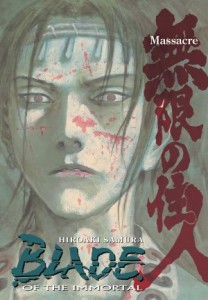
It is rather scary that Blade of the Immortal 1 came out in 1997, and here we are 14 years later getting Volume 24. But hey, that’s what happens when you are the very last manga series in the West to cease coming out in monthly floppies. This particular volume is entitled Massacre, and I’ve no doubt it will deliver on that. Speaking of old-school Dark Horse titles, they are almost caught up with their Oh My Goddess re-release unflipped. Volume 19 is out next week, and wraps up the Phantom Racer story, as well as giving us another plot with Skuld’s ‘robot girl’.

Kodansha put out 3 books this week, and this is Diamond Comics, so that must mean we have three books coming out next week. Hey, they’re getting closer! The second volume of Animal Land is out, which Dallas Middaugh praised highly at NYCC. There’s also a second volume of cyberpunk mystery Mardock Scramble. And for those who have been despairing, fear not! Sayonara Zetsubou-sensei has hit Volume 11. Now with 100% more body doubles.

So does anything please you? Or will you spend the week getting everything you put aside as it all came out the first week in October?

Filed Under: FEATURES

The Favorites Alphabet: G

October 13, 2011 by David Welsh

Welcome to the Favorites Alphabet, where the Manga Bookshelf battle robot gaze upon our respective manga collections to pick a favorite title (or “titles,” if we really can’t pick just one) from each letter of the alphabet. We’re trying to stick with books that have been licensed and published in English, but we recognize that the alphabet is long, so we’re keeping a little wiggle room in reserve.

“G” is for…

GALS! | Mihona Fujii | CMX – At first glance, this tale of the loves of three “ko-gals” in the streets of downtown Shibuya may seem like nothing but a frothy yet shallow examination of clothes, guys and the longest legs you’ve seen this side of Revolutionary Girl Utena. But if you look deeper, you find a fantastic look at the head of a teenage girl determined to have as much fun as she can in her high school years without making sacrifices to her reputation or cutting corners. Ran Kotobuki is the child of a long line of police officers, and even though she insists she won’t follow in their footsteps, her sense of justice drives her to ensure that Shibuya is a safe haven. Ran’s enthusiasm is infectious, even if it’s often over the top, and the series is a fantastic one for young girls who want to live life to the fullest while still searching for a purpose in that life. (No surprises, Ran ends the series deciding to be a police officer.) – Sean Gaffney

Gatcha Gacha | Yutaka Tachibana | TOKYOPOP – I fell in love with this title from the moment it came out, mostly thanks to the interplay between its four leads. Supposedly a simple shôjo story of a girl who always tends to fall for bad boys and her unlikely friendship with a strong yet damaged classmate, Gatcha Gacha ends up being anything but simple, as you struggle to figure out which lies Motoko is telling are pure fiction and which are merely the truth; who’s still in love with whom; and of course whose attempted relationship will be the most twisted and horrible. Those hoping for typical shôjo romance will likely find this wanting, but for addictive crack with a kudzu plot, kickass heroines, and some great, snappy dialogue, it can’t be beat. – Sean Gaffney

Genshiken | By Kio Shimoku |  Del Rey – The beauty of Genshiken is that the protagonists – a group of college-aged otaku who are members of possibly the least active club in all of manga – are neither repulsive nor saintly. It isn’t about the triumph of the underdog, and it isn’t about the ridicule of the socially maladroit. It’s about people finding their niche and living their lives on a very believable scale. It’s still funny, because Shimoku is honest enough to recognize that his cast’s individual obsessions can reach ridiculous levels. But that’s what otaku are about, and Shimoku doesn’t need to push anything to the point of being grotesque. He gives the reader permission to both like his characters and snicker at their weirder extremes, but the sum effect is fondness. The series also has one of the most restrained renderings of perverse, unlikely, perhaps partially requited love between two people who are simply not meant to be together that I’ve ever seen. And I have no resistance to that. – David Welsh

GoGo Monster | Taiyo Matsumoto | VIZ Media – Every elementary school has a kid like Yuki, a smart, odd student who says things that unsettle classmates and teachers alike. In Yuki’s case, it’s the matter-of-fact way he reports seeing monsters that leads to his social isolation. Newcomer Makoto doesn’t share Yuki’s vision, but he admires Yuki’s nonchalant attitude, and struggles mightily to understand what makes his friend tick. It’s to Taiyo Matsumoto’s credit that we’re never entirely sure what aspects of the story are intended to be real, and which ones might be unfolding in the characters’ heads; Yuki’s monsters remain largely unseen, though their presence is felt throughout the story. Matsumoto’s stark, primitive style suits the material perfectly, inoculating Gogo Monster against the sentimentality that imaginary friends and childhood fears inspire in so many authors. – Katherine Dacey

Gon | Masashi Tanaka | CMX, Kodansha – Ken Haley, my former PopCultureShock colleague, once likened Gon to Dennis the Menace, and I think the comparison is apt. Look past Gon’s teeth and claws, and you’ll see a pint-sized terror who, like Hank Ketcham’s famous creation, loves disrupting the natural order. Of course, Gon’s mischief is of a very different sort than Dennis’, as it involves swimming with sharks, stealing honey from a hive, and eating psychedelic mushrooms (to name just a few of Gon’s wordless exploits). No matter: the results are just as predictable, ruffling feathers (literally) and causing destruction. Masashi Tanaka’s intricate pen-and-ink illustrations make this far-fetched conceit work, infusing the stories with humor and pathos in equal measure. – Katherine Dacey

Goong: The Royal Palace | By Park SoHee | Yen Press – Though there are many fine manga beginning with the letter “G,” here my heart belongs completely to the Korean manhwa, Goong. Set in an alternate version of modern-day Korea with a monarchy still in place, Goong is a teen soap opera to die for, filled with compelling characters, emotionally-charged banter, royal politics, and pretty, pretty costumes. More than all of this, however, and despite a boatload of political machinations and misunderstandings, it features a romantic couple that is truly hindered by nothing more than themselves, and this is my very favorite kind of romance. It’s deliciously complicated, surprisingly funny, and really, truly addictive. I absolutely adore Goong. – MJ

Goong: The Royal Palace | By Park SoHee | Yen Press – It’s something of a common theme in sunjeong manhwa to depict a romance between a spunky, common girl and an aloof, rich jerk. The jerk will, of course, be surprised that the girl dares to criticize him, but eventually come to realize that she understands him better than anyone else.  I’ve read that story in various permutations several times now, but it’s at its most compelling in the pages of Goong, in which a regular girl named Chae-Kyung learns that she is engaged to the crown prince of Korea thanks to a pact made between their grandfathers. Neither is happy about the situation at first, and there is lots of bickering, but there are also moments of true connection between them that show their promise as a couple. Throw in some rivals, some political intrigue, and some truly unfortunate comic relief in the form of a pervy eunuch, and you’ve got the ingredients for major soapy goodness!  Bonus points to Yen Press for switching to a two-in-one omnibus format for the series. – Michelle Smith

What starts with “G” in your favorites alphabet?


Filed Under: FEATURES

Manga the Week of 10/19

October 12, 2011 by Sean Gaffney

After a smaller Week 2, Week 3 is fairly hefty!

Dark Horse brings us Volume 19 of Gantz, another title that seems designed purely for the comic book store fan. But hey, it seems to sell well enough, so good design! And they’ve also got the debut of CLAMP’s new title, Gate 7! Like most CLAMP titles, I expect the beginning to be fantastic. The ending, I make no promises.

Kodansha brings us Volume 2 of Gon, the highly underrated seinen manga that kids can also love about a small dinosaur with a big attitude! (Hey, who said I can’t write copy?)

Vertical gives us the penultimate volume of Black Jack. Ed Chavez has hinted they will announce a new Tezuka title at NYCC. If it’s to take the place of Black Jack, it’ll have its work cut out for it; Tezuka’s medical series is top notch.

Viz has two new IKKI titles, the 4th volume of cloned famous people high school thriller Afterschool Charisma and relaxing manga-loving slice of life Kingyo Used Books. And they have the 3rd omnibus edition of Tenjo Tenge, which will have fighting and fanservice as always. But the fanservice is DEEP and MEANINGFUL, honest.

And Yen has a pile of stuff. New Black Butler! It may not last quite as long on the bestseller lists as it once did, but it still hangs out there all the time. The 2nd Bride’s Story hardcover, which I’m hoping will be a bit warmer and more engaging than Vol. 1 (though just as well-written and drawn as 1 was). New volumes for Cirque Du Freak (aka Darren Shan), Pandora Hearts, Soul Eater, and Spice & Wolf. Higurashi When They Cry begins a new arc, this one finally focusing on its ‘poster child’ Rena. And a new volume of Yotsuba&!, which will no doubt make the internet explode in cute glee once more.

My shop is only getting in a few of the Yen titles (Bride’s Story and Soul Eater aren’t on my shop’s list for some reason), but there’s still plenty for everyone. Enjoy!

I’m off to New York Comic Con and Anime Fest for the next few days. Expect daily news updates, and no reviews in the interim.

Filed Under: FEATURES

Going Digital: October 2011

October 9, 2011 by MJ 4 Comments

Welcome to Going Digital, Manga Bookshelf’s monthly feature focusing on manga available for digital viewing or download. On the first weekend of each month, the Manga Bookshelf bloggers review comics we’ve read on our computers, phones, or tablet devices, to give readers a taste of what’s out there, old and new, and how well it works in digital form.

This month, we take a look at manga published for viewing on an iOS device and in your web browser. Device, OS, and browser information is included with each review as appropriate, to let you know exactly how we accessed what we read.

iOS

Cross Game, Omnibus Vol. 1 (Japanese vols. 1-3) | By Mitsuru Adachi | Viz Manga app | iPad 2, iOS 4.3 – For quite some time now, I’ve stood by quietly as my esteemed colleagues raved about Mitsuru Adachi’s Cross Game. I meant to catch up, truly I did, but as more time (and more volumes) passed me by, the idea of catching up at $15-$20 a pop seemed more than a bit daunting. Fortunately, the Viz iPad app has changed all that, offering me the opportunity to buy these volumes for half their print price, and on a terrific platform to boot!

It’s difficult to know what to say about Cross Game that hasn’t already been said (and better) by my cohorts, two of whom selected it as their favorite “C” manga. Probably the best I can do is to just say, “they’re right.” This is sports manga as it should always be done—moving, character (and relationship)-driven, and as deeply rooted in the lives of its characters as it is in the sport that brings them together. And while it doesn’t require a background or interest in baseball to enjoy Cross Game, Adachi doesn’t trivialize the sport either. The series is dazzling thanks to spectacular emotional resonance rather than super-human displays of athleticism.

This triple-length volume, spanning the first three Japanese volumes, was both sadder and funnier than I expected. Adachi broke my heart completely within the first third of the volume, while consistently making me smile with his warm humor and occasional breaks in the fourth wall. It’s exactly my kind of manga, blessed with strong female characters and lots of emotional messiness, while pleasantly lacking in melodrama. Three volumes is a terrific amount to start with, too, and certainly helped me to fall in love with the series.

Cross Game looks beautiful on the iPad 2, so crisp and detailed, there’s no need to zoom in, panel-to-panel. I mainly read in vertical single-page mode, which offers the biggest image, but this series reads well in the horizontal two page-spread as well. Reading manga on the iPad is really a joy, and definitely a habit I could get into, as long as the pricing remains reasonable. I’ll certainly be picking up more of Cross Game. (also available at vizmanga.com) – MJ

Veronica Presents: Kevin Keller, Issue 2 | By Dan Parent | Archie Comics App | iPad 2, iOS 4.3 – Comic creators who work in a shared universe face specific, conjoined responsibilities when adding a new character to that universe: they have to simultaneously generate interest in the addition while reassuring the existing audience that they aren’t going to go too far off of the ranch. The situation poses some interesting challenges, and success stories aren’t exactly numerous. One noteworthy example is the addition of a gay teen, Kevin Keller, to the wholesome solar system that is Archie Comics.

Like the rest of the teens in Riverdale, Kevin is basically a nice kid with his own set of hobbies and interests. Unlike the rest of the teens in Riverdale, Kevin is romantically interested in members of the same sex. That’s not the core way that Kevin is different, though. What really makes him stand out is that he has a specific goal in mind for his future: he wants to serve in the military, just like his beloved father, and his family and friends recognize that this might be more complicated for an openly gay person than it would be for, say, Archie or Betty. (The military would love to have Betty; she’s frugal, hard-working, cooperative, and can repair automobiles.)

It’s an interesting choice that the ostensible problem with Kevin’s sexuality isn’t interpersonal. Nobody in his family or circle of friends gives his gayness a second thought, and why would they? Aside from Betty, he’s probably the nicest, most thoughtful student at Riverdale High. Of course, that’s the problem with Kevin in the narrative sense; Riverdale teens don’t age and haven’t since their introduction, so career-anxiety-related storylines will always be somewhat of a dead end. With the future not really in play, the publisher needs to give the character some individual spark that can generate the kind of in-the-moment stories that the rest of his classmates enjoy.

It’s great that Archie has thoughtfully and successfully made their student body more diverse. Now they just need to make Kevin a fun, funny, functional member of the cast rather than just a Nice Young Man Who Happens to Crush on Other Nice Young Men. – David Welsh


Web Browser

Girlfriends, Vol. 1 | By Miruku Morinaga | Futabasha, via the JManga website | Windows XP, Firefox 7.0 – It’s not just salaryman manga about ninjas and bento lovers at Futabasha, they also have a close eye on the typical “otaku” reader as well. The magazine Comic High! began in 2006, and basically advertised itself as shoujo stories for young men. Titles that already fit this genre, such as Towa Oshima’s High School Girls, were brought over from other magazines, and several new titles were commissioned from up and coming talents who knew how to draw cute girls being cute.

One of the more famous names, at least to yuri fans, was “Morinaga Milk”, a mangaka who had a short yuri series running in Ichijinsha’s Comic Yuri Hime, a magazine devoted to “Girls’ Love” manga, usually of the Story A variety (I like this girl, hey she likes me back, look we like each other) as mentioned several times by Erica Friedman on her Okazu site. Many of these stories tended to feature a meek, dark-haired girl and her more outgoing, lighter-haired girlfriend; indeed, that describes Kisses, Sighs, and Cherry-Blossom Pink, her Yuri Hime series as well.

Now that Morinaga has moved to Comic High and is given a broader canvas, she is able to develop things in a slower and more realistic way. And that’s what we get for the first volume of her series Girlfriends, which in this volume might better be written “Girl Friends”, as despite the occasional “what is this strange feeling in my chest” moment, and the cliffhanger ending, there’s very little yuri here, the story being content with developing its two leads and their group of friends. Mariko is a quiet, studious girl who doesn’t have many friends, at least not until she is dragged into a social life by vivacious Akiko, and the first volume is mostly taken up with Mariko’s wonder at the things that everyday girls do – they actually go out after school! And shop!

This volume starts slow, as I noted. If you’re here to see girls confessing to each other and becoming a couple, be warned it doesn’t happen here. But it’s cute. Indeed, Girlfriends Vol. 1 pretty much fulfills the mission statement of many of Comic High‘s titles – cute girls behaving cutely. If you’re a fan of that, this title should appeal to you. – Sean Gaffney

Gokudou Meshi, Vol. 1 | By Shigeru Tsuchiyama | Futabashi/JManga | Windows 7, SeaMonkey 2.4.1 – When Shunsuke (or possibly Junsuke—the translation is inconsistent) Aida is sentenced to three years of hard labor for assault and kidnapping charges related to his host club empire, he finds that his eight fellow cellmates at Naniwa South Prison have an interesting tradition: every Christmas Eve, they have a storytelling contest about the best meal they ever ate. The winner gets to take one item from everyone else’s special osechi meal that the prisoners receive as a New Year’s treat.

Aida’s not so much the main character, though, as simply our entry point into the competition. While he listens to the others’ stories—focusing on dishes like soba, sushi, okonomiyaki, and “tear-inducing gyoza”—he works on his own strategy, learning which sorts of stories and foods work best, and hearing about some of the failures from last year (“stewed achilles heel of a deer…!?”). Primarily, however, this manga is all about the food, which is lovingly depicted in all its regional varieties. One learns a little about the characters through their stories, but nothing about prison life. Mostly, the guys just sit around the table and attempt to entrance each other with their culinary tales. Since I happen to really like food manga, I enjoyed Gokudou Meshi quite a bit, but I can see how it wouldn’t be everyone’s cup of sake. (Haha. I kill me.)

JManga’s manga reader is very easy to use and navigate, and I primarily read using the full-screen option. Occasionally, I’d have to zoom in to catch some of the smaller sound effects (lots of munching and even some “nom”s), but otherwise the images and text were clear. Despite the confusion over Aida’s first name, the translation was actually somewhat smoother than the previous JManga title I read (Ekiben Hitoritabi), with one typo and one instance where “it’s” was used instead of “its.”

Gokudou Meshi is up to eight volumes in Japan, so readers may be in for several years’ worth of competitions with very little action in between. Hopefully volume two will be available soon so I can confirm that suspicion! – Michelle Smith

So I Married an Anti-Fan, Vol. 1 | By Wann | NETCOMICS | iPad, iOS 4.3, Safari – MJand Michelle’s recent Off the Shelf column prompted me to visit the NETCOMICS site, something I haven’t done in well over a year. I’m pleased to report that not much has changed since my last visit. The basic distribution model remains the same, with readers paying 25 cents per chapter to rent a title for forty-eight hours. The catalog has been updated, however, with new chapters of fan-favorites as well as brand new titles.

Among those new arrivals is So I Married an Anti-Fan, a romance in the Full House mode. Like Full House, Anti-Fan features a feisty, down-on-her-luck young woman who becomes financially and romantically entangled with a handsome celebrity. The heroine of Anti-Fan is Geunyoung Lee, an aspiring writer stuck in a dead-end newspaper job covering celebrity gossip. When she snaps a pic of popular actor Joon Hoo in a less-than-flattering light, Geunyoung loses her job, sending her into a tailspin of destructive behavior: she builds a website declaring herself to be Joon Hoo’s number one “anti-fan,” sends him a blackmail letter, and protests outside his apartment building. Eager to quell rumors about Geunyoung’s motivation for hating him, Joon Hoo extends an olive branch: if she agrees to play his manager on a reality television show, he’ll make sure she’s compensated for lost wages.

Though the premise is credulity straining, the execution is surprisingly nimble. Geunyoung initially seems like a stereotypical manhwa heroine, all bluster and impulse, but Wann digs deeper below the surface to explain the source of Geunyoung’s rage. She’s a believable mixture of bravado and self-doubt, mustering the courage to publicly reject Joon Hoo’s offer of a handout while privately castigating herself for her reckless spending and foolish behavior. By the end of volume one, Joon Hoo, too, seems more like a flesh-and-blood person than a standard-issue sadist who delights in seeing Geunyoung suffer. He’s nasty — there wouldn’t be a plot if he were nice from the get-go — but, like Geunyoung, his anger is rooted in real pain, making it a little easier to imagine how these two characters might eventually fall for each other.

If I had any criticism of the series, it’s that the artwork is very uneven. The lead characters are expertly rendered, but many of the bit players seem to have been assembled from scraps: eyes from here, noses from there, plaids from leftover sheets of screentone. The backgrounds are flat-out lazy, relying heavily on Photoshop and simple, geometric renderings of buildings and furniture to convey a sense of place. Still, the plainness of the artwork isn’t a major obstacle to enjoying this opposites-attract story, as the script and the lead characters make a lasting impression. – Katherine Dacey


Some reviews based on digital copies provided by the publisher.

Filed Under: FEATURES, Going Digital

Inside the DMG: BoysLoveBangBang

October 8, 2011 by BoysLoveBangBang 8 Comments

Editor’s note: While my own DMG experience has been stalled due to the disintegration of my localizing group (soon to be restarted, more on this soon!), the active group BoysLoveBangBang has agreed to share with us their Guild experience! Thanks, BLBangBang! – MJ


BoysLoveBangBang: Our Digital Manga Guild Experience

When I’m excited, my thoughts bubble up, suddenly exploding en masse. The result? Reader confusion. Today, not only am I excited about Digital Manga Publishing’s (DMP) unprecedented business model, the Digital Manga Guild (DMG), but I also want to share my personal experience so far with my localizing team, BoysLoveBangBang, and DMG. So, I’m gonna strap on the leather restraints and divide this journey into four categories: group formation; DMG interaction; the working process; and group interaction and beliefs.

Group Formation

BoysLoveBangBang, or the shortened version BLBangBang, was not without its set up discouragements, both from DMG itself and from within our group.

After announcing their—somewhat vague—comic guild idea, DMG needed time to define both their potential and procedures before attempting to clear the air for everyone interested in joining the guild. Understandable, but incredibly frustrating! Here was a brave and exciting promise: one that demonstrated awareness and appreciation of fan motivation and wanted to work with the long proven power of active enthusiasts!

Our original group members were all part of the experimental first wave of people applying to DMG. After submitting our qualifying tests, we had a considerable wait. I reread my grammar and style books and went through three shelves of my favourite manga before our individual approvals were completed and our members were linked. Finally, we were sent our contracts; BLBangBang put on its serious hat for contract discussions and group planning.

Next queue: DMG requires each member to send in their contract as a hard copy. Combined, our contracts flew over waving whitecaps, trucked down dusty roads, and weaved through rocky escarpment forests. DMG staff had to reunite all these lonely contracts into the BLBangBang family before any project assignments. Yup. Tick tock. We were ready for any genre, any mangaka–we just wanted to help with quality English manga availability.

We had trouble firming up our group roles. For a spell, we even had no translator. (Sounds kinda dismal so far, no?) We were saddened, but in comparison to setting up even the most conventional of new businesses, BLBangBang’s formation and partnership with DMG was bliss–full of eager people from both parties and reasonably smooth transitions. Oh yes, and a bit of luck…

This autumn, Apricotsushi, our translator, landed in our laps with a deliciously alluring squeal, and we gelled into who we are today: a fun-spirited, supportive, working team of: Alexandra Gunawan (Al), our group leader and letterer from the United States; Kimberly Lammens (Dutchie), our editor from Canada; and Anne Whittingham (Apricotsushi), our translator from Australia.

During our period sans translator, Al didn’t bow to Lady Luck; rather, she kept vigilant herself. When DMG offered a special project–a single title, already translated–she swiftly thrust herself up, and, over the sound of her chair clattering to the floor, she screeched happily: “PICK US! PICK US!” This project was Healing Music by Kaiya Tatsumi; it proved positively perfect for us. Not only did it breath fire back into our dampened spirits, but it also allowed us to learn the pitch and tone for our unique BLBangBang procedure.

Healing Music gave us clarity toward: our roles as editor and letterer; our needs regarding our new translator; and finally, our expectations of DMG. With the arrival of our first full package of three titles–Tweeting Love Birds volumes one and two by Yamamoto Kotetsuko and Want to Depend on You by Kinoshita Keiko–we’re now go-go-go, like a wild seme on an unsuspecting uke. Rawr! We’re approaching our three new titles with confidence, but we’re open to strengthening our fresh procedure with the addition of Apricotsushi!

DMG Interaction

Interaction with DMG holds two components: direct emails between BLBangBang and DMG; and the bimonthly teleconferences between DMG and the localizing group collective.

Direct Interaction

Al, our go-between for DMG and BLBangBang, gathers any questions or concerns, such as security issues, or technical and procedural problems, and sends them off pronto. At first, DMG’s responses, although still professional and friendly, retained a “slow and vague” modus operandi. Thankfully, that was short-lived. DMG administrators are now excellent, in both efficiency and clarity; they respond with reasonable promptness and satisfactory, respectful answers.

Al says: Group leaders must stay proactive in communication and follow up with DMG. If an email is sent that requires DMG response, I make sure I get it. It’s easy to get lost in DMG’s shuffle, so finding ways to politely assert and reassert our team’s agenda has been paramount. As group leader, it’s also been important to anticipate the paperwork DMG sends us. For example, the bundle of Schedule As we expected to receive following Healing Music was lost in a computer glitch on DMG’s end. If I hadn’t followed up immediately with our DMG contact when that email went astray, BLBangBang would have looked rather negligent!

Teleconferences

When DMG decided to maintain a regular time allotment for a live exchange with their localizers, I was pleased. We took turns listening in, working around our personal needs. At the conclusion of each meeting, the minutes would be shared with the rest of the group. Teleconferences were a useful channel at the beginning—it was a forum for DMG to share business information and status updates, and for localizers to raise concerns and questions. Perhaps because we started with DMG from the beginning, the teleconferences dwindled from useful to irritating repetition.

Encouragingly, DMG recently announced that they are holding themed teleconferences now. What a relief! With this focusing agenda and DMG’s growing activity, we’re returning to the live meetings with renewed interest.

The Working Process

The general procedures provided by DMG, although comprehensive, are somewhat tedious and disorganized from my perspective. “Wah!” I thought, rubbing my bleeding eyes and saying, “Calm down; type up your own version. You can own this monster!” And voila–a checklist that includes all of DMG’s fairly exacting requirements but now reshaped into my eye-friendly standards!

Onward to the project itself!

Roles

Apricotsushi is transforming Tweeting Love Birds from Japanese to English as I type! I’m willing myself to patience. I don’t want to be that child who whines: “Are we there yet?” Well done translations are not rushed translations–please ignore this brat, Apricotsushi!

I whip the script into shape and then fine tune it some more: a semi colon added here, a conversion to active tense there, and… would an em-dash clarify this dialogue, make it more expressive…? Add insightful team discussions on image-word flow choices and various translations we wish to grasp better in order to deliver smoother, and we finally arrive at the polished version of the script.

Al has enormous image and font files to juggle and manipulate. She does marvelously, with nary a complaint (that isn’t slathered in funny). Each project is going to be different: she informed me with a happy tinkle in her voice that the Japanese files for Healing Music were wonderfully sharp and mostly clean, but then she harrumphed, stating that the files for Tweeting Love Birds must be coaxed into submission with a lot of patience. I feel technical skills are not the only part of her lettering work; she’s also handles many aesthetic judgments.

After several quality checks for each chapter, the whole team is happy with the comic’s English flow and look.

Technology

Each localizing group has varying technological resources—hardware, operating systems, software–and varying ways they utilize their resources. For me, an agonizing death would await me without my two monitor set up: I read the translated script while looking at the Japanese images, making sure nothing is missing and all the image-word choices jive effectively; later, I view the cleaned and edited images at the same time as I type up quality control comments. As for my hardware, at first, my computer blew up when I tried to shove too much at it (those beautiful but beleaguering image files!). I may be old, but I can recognize the sound of a computer’s processor weeping: “Please stop. It hurts.” Being an anger management graduate, I stopped. My operation is now well-oiled: I only open one or two programs with one or two files displayed at a time.

Al: Uploads of updated files are done!
Dutchie: And they’ve begun their race to download into my computer! (“Race” may be the wrong word.” -_-)

Downloads and uploads on DMG’s FTP server are often s-l-o-w, but with our “rolling” procedure, all of us are constantly productive.

Finding Our Look

More than half way through Healing Music, we realized–after taking a look at how the manga files displayed on a variety of portable devices–that the font we were using was too small. We wisely talked it over, keeping our sailor curses to a minimum. With what I imagine was a charmingly profane gesture, Al finally huffed, “No problem—I’m fixing the files NAO.” (She later clarified: “It was less profane gestures and more irritated mouse smashing.”) I did my quality checks once again, and there you have it! Trés dramatic improvement! Trouble to worth ratio? Immeasurable!

Before we sent the final project in, we both read it from beginning to end once more. I tweaked style and grammar flow and made sure nothing was amiss. Al decided to stun me at the last minute: she took some of the artful Japanese sound effects and made her English subtitles into striking mimics!

As soon as the last page of Healing Music transferred into DMG’s final submissions folder, nervousness assailed me. My focus has long been researching and writing about the comic form and comic history–I’ve never actually helped a comic come to life! We had made quite a few independent choices and, although I firmly believed in the quality of our final work, I also hoped that our seniors in the comic industry would look on it with approval. We didn’t wait long for a response: production sent us a couple critiques to consider for next time; and both DMP and DMG representatives sent us encouraging words on the professionalism of our work and our ability to meet DMG’s high standards. After this fantastic feedback, I’m inspired and reinvigorated for our next project!

Less than two weeks after we finished our English version of Kaiya Tatsumi’s Healing Music, it’s a wonderful feeling to see it flashed about on DMP’s websites, and especially on emanga.com itself. (Kindle and Nook versions will be available mid to late November.)

Group Beliefs and Interaction

Al: . . . idk we could use “pervert” –is that less powerful of a word to you than “slut”?
Dutchie: . . . I dunno, but it’s just so RANDOM in the scene. No lead up and BLAM! Especially shocking word choice for this cute set of innocent lovers…
Dutchie: Uke’s eyes would be more like @_@ or T_T
Al: >_< yeah. It's pretty bad.
Dutchie: I’m sure the smexy times would be flat lined. LOL
Al: LOL poor limp dick

The above conversation regarding an extra story at the end of Healing Music may seem like an inessential, crass conversation, but it’s not. For all titles, as we absorb the characters, wishing to reflect the mangaka’s intent, we figure out what sort of flow is required. From the smallest “haa” to the biggest “smash,” we try to consider the impact of all the available choices. (I’ll let you know how that particular conversation turned out!)

Beliefs

All three of us have careers and/or are pursuing academic studies in addition to our DMG activities. We also have families that include long term partners. My partner, although not fully initiated in the esoteric world of self lubricating… erm… manga, is supportive of my passion and also technologically savvy, so that’s a boon for me! Al’s partner is… wondering how the hell she spent over $3,000 on manga so far this year. (Just wait until Yaoi Con…) Apricotsushi’s partner has her back, too!

We’re treating BoysLoveBangBang as if we’ve formed a small business together—as indeed we have from one perspective. It’s hard to find the right terms to use with DMG’s new business model. It’s a liminal place, for sure, but out of scary change often comes enrichment.

Everything we do we take seriously: from maintaining the comic’s artistic integrity, accuracy, tone and aesthetics to respecting one another. Each of us feels we are part of a whole; although we have individual roles to perform, we don’t “own” any one part of the process. This results in a solid piece! From the book blurb to the emotional impact of the polished final pages, we’re in it together.

Interaction

Groups operate best with tight communication between members, including awareness of each member’s personal life commitments. What else is involved in communicating? A heck of a lot of fortifying affirmation, constructive criticism, honesty, and humour.

Because we are not within a tangible distance of one another, and operate entirely over the internet, we’ve shared our personal contact information and set up a back-up emergency procedure. We use regular emails, Twitters, and scheduled Skype meetings (sometimes even with an agenda!) to connect.

Al has tackled the social networking and promotion for BLBangBang like a football star, utilizing both Twitter and Tumblr to add pretty colour and important information to our lives on a daily basis. Apricotsushi efficiently set BLBangBang up with a new Facebook page. What does Dutchie do? Blabs. Excessively and explosively.

We want to know what you’re thinking and talking about too! After all, this is a community effort, so why not chat with us! We can support one another, either as fellow localizers or simply as comic appreciators. In celebration of our first DMG release, we just had a manga giveaway. We’re planning more giveaways and other fun events! Please follow us at any of these sites!

And here’s the condensed conclusion to our completely practical, somewhat sensational, dirty talk discussion:

Al: “Dirty slut” may brain the readers. . . basically the Japanese literally says “[uke name] really erotic” and then “[seme name] is more erotic.”
Dutchie: So, they’re playfully arguing about who is more “ero.” “Dirty slut” replacement: “No, you’re the erotic/passionate/sensual one.”
Al: Preference?
Dutchie: Hmm. The seme is like an eager puppy… Passionate? Wait. Let me just go check the dictionary…
Dutchie: Passionate: “easily aroused or ruled by intense emotions.” We done step right, boy.
Al: ha ha –with a brofist!

Later…

Al: We’re done! Now I can start cleaning up the next one,Tweeting Love Birds! It’s been deadly! lol kiss kiss

Now, lifting my glass of sake, I make two toasts: first, to all localizers and DMG — may we continue striving for accomplished titles and effective guild dynamics, never forgetting our enjoyment that puts sparkle into everything; and second, to my fellow comic enthusiasts – may you all find comics that connect with your hearts and minds, regardless if you read them via traditional formats or this new, exciting electronic format!

Filed Under: FEATURES Tagged With: digital manga guild, dmg, Inside the DMG

The Favorites Alphabet: F

October 6, 2011 by David Welsh

Welcome to the Favorites Alphabet, where the Manga Bookshelf battle robot gaze upon our respective manga collections to pick a favorite title from each letter of the alphabet, whenever possible and ever fearful of the mournful bitterness of the runners up. We’re trying to stick with books that have been licensed and published in English, but we recognize that the alphabet is long, so we’re keeping a little wiggle room in reserve.

“F” is for…

Firefighter! Daigo of Company M | By Masahito Soda | Viz – On one level, Firefighter! is meat-and-potatoes shônen: it’s got a young, brash lead who wants to be the best at what he does; a rival who excels at pushing the hero’s buttons; and a sexy big sister character whom the hero adores. On another level, however, Firefighter! is a classic procedural, showing us how firemen practice their trade, interact at the house, and respond to conditions at every fire. The series definitely cants more towards shonen tournament manga than procedural; as Jason Thompson observed in Manga: The Complete Guide, Daigo’s company fights more dangerous fires in a week than most firemen will see in an entire career. Still, the series’ brisk pacing and sense of dramatic urgency make it one of the most entertaining titles in VIZ’s vast shônen library, even when the story strains credulity. -Katherine Dacey

Flower of Life | By Fumi Yoshinaga | Digital Manga Publishing – Although it works perfectly well as the amusing story of a forthright (perhaps overly so) teen named Harutaro who has just returned to school after a bout with leukemia, Flower of Life also offers many subtle meditations and musings on the nature of friendship. Seamlessly woven into stories in which a memorable cast of characters enlivens even the most tired manga clichés (school cultural festival, anyone?), these themes imbue the work with insight and depth, just as one would expect from Fumi Yoshinaga. On top of all this goodness, you’ve got Harutaro’s personal journey, where he discovers both an abiding love for manga and the ability to lie. This extraordinary series is not one to be missed. – Michelle Smith

Fruits Basket | By Natsuki Takaya | Tokyopop – This was a tough letter, especially with Fullmetal Alchemist just sitting there, but once again I went with the obvious pick.  Fruits Basket was something I discussed with my friends constantly while it was still coming out, and remains a beloved favorite.  Tohru’s struggles – first to try to bond with the Sohmas, then to try to break their curse, then to resolve her feelings towards Kyo, all wrapped up in a surprisingly deep cover of guilt and self-hatred – are fascinating to watch, and it helps that the side characters are just as fascinating if not more so.  And so much of Fruits Basket is about forgiveness – something the readers sometimes had a lot more trouble with than the characters, especially when it came to Akito.  But in the end, as a manly male who will also happily read First President of Japan and other manly titles, Fruits Basket is my pick as it’s made me cry more than any other manga. – Sean Gaffney

Fullmetal Alchemist | By Hiromu Arakawa | VIZ – Though I’ve often credited Hikaru no Go with getting me into manga, it was Fullmetal Alchemist that guaranteed I’d stay.  With its deeply relatable characters, impressively tight plot, and clean, well-paced storytelling, Fullmetal Alchemist proved to me that my new love for the medium was much more than a fling. Alternately heartbreaking and jubilant without ever feeling strained, Fullmetal Alchemist is a deceptively smooth read, even in its most emotionally and visually-packed moments. I often feel like a broken record when I sing this series’ praises. But the truth is, I just never stop being wowed by Arakawa’s discipline and skill. She makes epic look easy. – MJ

Future Lovers | By Saika Kunieda | Deux Press – All of the letters in this alphabet have posed a certain degree of difficulty, but “F” is a positive bloodbath. After serious consideration, I’ve decided to go with the fact that this two-volume series offers something very unique: it’s the gayest yaoi I’ve ever read. In a lot of comics in this category, you’re as likely to encounter issues of sexual orientation as you are concepts of particle physics, so some recognizable context is always welcome. In the case of Future Lovers, that context is layered over a wonderful, messy, evolving romance between two very likable, believable characters. Beyond the tricky issue of their feelings for each other, stalwart Kento and cynical Akira deal with the way their relationship will fall out at work (they teach at the same school) and with their families (particularly Kento’s traditional – but very funny – grandparents). It’s real-world romance, and it just plain works on every level. – David Welsh

What starts with “F” in your Favorites Alphabet?

Filed Under: FEATURES

Manga the week of 10/12

October 5, 2011 by Sean Gaffney

Hallelujah, hallelujah. Midtown Comcis has finally taken the first step, admitted they had a Kodansha problem, and is getting in 3-4 months worth of titles next week. I won’t list them here as I’ve been listing them here in previous weeks while whining. No more whining! Hooray!

As for non-Kodansha things, there’s a new Vampire Hunter D novel out. It’s the 17th, showing that the difficulty selling Japanese novels here in North America does not particularly extend to novels with Vampire in their names.

And Viz has their typical 2nd week, aka ‘non-Jump or Beat stuff’. We get the 15th Battle Angel Alita: Last Order, which may be the final one depending how the author’s contract reads. He moved from Shueisha to Kodansha, acrimoniously, and is continuing the series there in the magazine Evening. What this means here… we don’t know yet.

Cross Game Vol. 5 gives us Vols. 10 & 11 of the original Japanese release, and introduces a character who’s guaranteed to shake things up… though this being Adachi, that generally means their eyes widen somewhat.

We also have the 40th (!) Volume of Case Closed, The 6th Hyde & Closer, the 28th Kekkaishi, and the 7th Maoh Juvenile Remix (this volume remixed by Frankie Knuckles) from our friends at Shonen Sunday, an imprint which NEEDS MORE LOVE AND SALES. But is, admittedly, probably not getting either anytime soon. Sigh. I don’t get North American readers.

Lastly, we have the new March Story, a manga by a Korean artist that runs in Sunday Gene-X; the 17th volume of Urasawa’s 20th Century Boys (hasn’t Bolan had his car crash by now?), and Yen is putting out the 2nd Twilight graphic novel, hopefully to get more money from readers so they can license other things.

What are you buying so you can read it on your way to Comic-Con next week?

Filed Under: FEATURES

Let’s Get Visual: Celebrating the Pretty

October 2, 2011 by Michelle Smith

MICHELLE: The long-awaited return of Sailor Moon has inspired us to devote this month’s column to classic shoujo art, focusing on a celebration of its sheer prettiness. Normally, we try to be astute in these columns—their whole purpose is to provide experience in seriously considering the artistic merits of manga—but it’s possible that this time we’ll be reduced to just sighing happily.

MJ: Yes, it’s quite possible indeed. But honestly, I think that’s valuable in its own way, and maybe we’ll end up learning a little something about why these things make us sigh happily.

MICHELLE: Perhaps so!

So, for my contribution I’ve chosen two memorable moments from the first volume of Naoko Takeuchi’s Pretty Guardian Sailor Moon. The first one comes from a chapter in which the protagonist, Usagi Tsukino, has infiltrated a masquerade ball in an effort to determine whether the Legendary Silver Crystal might be found there. Possible foe/possible ally Tuxedo Mask is also on the crystal’s trail, but pauses to give Usagi a twirl on the dance floor.

Pretty Guardian Sailor Moon, Volume 1, Chapter 4, Pages 142-143 (Kodansha Comics)

Takeuchi’s art perfectly captures the sheer dreaminess of this encounter for Usagi. In the top panel, the lacy screentone mimics the flare of her skirts, and the way that the smaller panels are framed focuses attention on facial expressions and reinforces the feeling that no one and nothing is capable of intruding upon this perfect moment for them.

And, of course, her dress is purty.

MJ: This sequence truly is dreamy. What particularly pulls me in here is the screentone. Its texture brings a 3D quality into this 2D world, as though the moment was preserved and wrapped up in an elaborate scrapbook that I could reach out and touch—as though it was someone’s real memories of the moment. Even just looking at something that has such a familiar texture stimulates my sense of touch, bringing me more fully into the scene. I think this kind of tangible decoration not only lends a fairy-tale dreaminess to the scene, but also makes it feel more personal for the reader.

MICHELLE: Ooh, you’re right, it does feel like a page from a scrapbook! In that sense, the screentone almost seems like it represents a snippet of the actual material of Usagi’s dress.

In addition, Usagi has used her transformation gadget for this chapter and is supposed to appear a little older than usual. I think her expression on the lower left page captures that subtle distinction nicely.

MJ: I’ll note too, that while this particular brand of big-eyed shoujo tends to get a lot of flack outside shoujo fandom, that it’s Usagi’s big, shining eyes that really let us know how she feels here, and just how dreamy this moment really is for her (and subsequently for us).

MICHELLE: You know, I think I’ve become inured to the big-eyed thing, except with extreme cases, because I don’t even notice it anymore. It just seems like such an obvious way to convey youth and wonder.

My second “memorable moment” is an example of a Sailor Moon action sequence.

Pretty Guardian Sailor Moon, Volume 1, Chapter 5, Pages 188-189 (Kodansha Comics)

In its way, this selection is just as pretty as the other one. Luna tosses Makoto her transformation pen, which glows in an appealingly magical girl fashion, transforming the girl—who is somewhat insecure about her physique—into Sailor Jupiter, someone both beautiful and powerful. Meanwhile, the enemy lurks on a nearby rooftop, and I’m impressed how this single panel so effectively establishes setting and atmosphere when one doesn’t have the preceding pages to furnish that information. Makoto’s first attack is simultaneously feminine and effective, giving her the opportunity to vanquish the enemy with her thunder bolt on the next page.

Looking back at some of the adjectives used in the paragraph above, I find that they aptly convey what it is I like about this moment: beauty and power, femininity and effectiveness. Sailor Moon shows that these things need not be mutually exclusive.

MJ: Those are great adjectives, Michelle, and actually this brings up a point I’ve been wanting to make since I listened to the podcast you participated in about Sailor Moon.

When male manga fans are trying to explain why something written for girls might be appealing to them as well, they will often attribute this to what they perceive as male or “shounen” elements in the story, like team-building or action sequences. And while I appreciate their enthusiasm for the work, I’m a bit perplexed as to why these would be considered exclusively “shounen” to begin with. Sure, certain genres of shoujo manga might share these things in common with certain genres of shounen manga, but I honestly don’t see what’s not inherently shoujo about them. Girls enjoy things like action, adventure, teamwork, and battling evil just as much as anyone, and there’s nothing odd or incongruous about these elements standing alongside things like beauty and femininity. These things naturally coexist in the minds of many girls, and when they’re all put together, they are not only exciting and inspiring, but really freaking pretty.

MICHELLE: You’re right, and though I agreed with them that there were some “shounen” elements to Sailor Moon, I didn’t mean to imply that they’re not just as easily shoujo elements, but simply story aspects that are more common to shounen manga. If that makes sense.

MJ: I guess what I’m saying is, though maybe there are more shounen action series than there are shoujo action series, it’s not as if it’s uncommon in shoujo. The entire magical girl genre pretty much exists in that realm, and those series share as much or more in common with fantasy, adventure, or sci-fi shoujo like Basara, X/1999, or They Were Eleven as they do with shounen manga—all of it very shoujo and very pretty.

I don’t mean to derail this discussion with my shoujo manifesto, though, so please forgive me. I’m just happily overwhelmed by the sparkly loveliness of this action sequence.

MICHELLE: No worries; I agree with you. But perhaps we should move on. What pretty shoujo have you chosen?

MJ: Well, it may seem like an odd choice, given the vast pool of classic pretty to choose from, but I’ve chosen an 8-page scene from volume three of Reiko Shimizu’s Moon Child, and there are a number of reasons why.

Moon Child, Volume 3, Pages 146-153 (CMX)

First, of course, there is quite a bit of objectively lovely imagery in the later panels of the scene, including rippling water, a flowing seascape, and a billowy-haired mermaid, all rendered with a perfect balance of simplicity and detail. I’m particularly fond of Shimizu’s style of character design as well, which is very much in step with most of the ’80s and early ’90s manga I’ve read. For whatever reason, this is probably my very favorite period for shoujo character design.

Most of all, though, there is an eerie, vaguely melancholy tone throughout the entire scene, particularly the first two pages, which I will admit are my favorite. I even consider them the prettiest of the whole sequence, though they have none of the flowing seascape that decorates the rest of the scene. They are, however, beautifully strange, and a perfect example of what I personally find prettiest in shoujo manga. This may seem like an odd thing to say, but I find the strangeness—this particular brand of strangeness—to be really, really beautiful. When I look at the first two pages of this sequence, I can feel the smooth surface of the water as the character brings his face near, touching the ends of his hair and the tips of his nose and chin. That smooth pool of water and the way he just falls slowly into it—it’s difficult for me to articulate exactly why I find it beautiful, but I really do.

Yes, I love these character designs, and the pretty page layouts, but sometimes what I find most beautiful about older shoujo manga is its strangeness. It brings to mind a dreamworld, I guess—one that looks like our world but somehow just isn’t in a way that engages the most obscure, most beloved corners of my imagination. These stories make themselves part of my private world, and I find them beautiful for it. If that makes any sense at all.

MICHELLE: It absolutely makes sense. And for what it’s worth, I studied the pages before I read your commentary and also felt that the exquisitely slow descent into the fountain was the loveliest part. I like, too, how Teruto slips into the fountain with such grace and barely a ripple and how this is contrasted off-panel by the little girl who has observed what happened. The inability of an everyday person to access the same magic only reinforces its strangeness.

MJ: Yes, exactly! It seems so clear that he exists in a different state of being from the regular people around him, which is part of what makes it feel so dreamlike, I think. There is a lot of that kind of thing in this series, which is really, exquisitely strange. I think the dreamlike tone makes it easier to suspend disbelief as well.

MICHELLE: From the examples we’ve both chosen, it seems that, to some extent, it’s the dreaminess of pretty scenes that is at least partly responsible for the happy sighing. Of course, we realize that real life is seldom so lovely, but it’s nice to abandon oneself for a while in a reality where that sort of thing really can happen.

MJ: I think where I often find solace in shoujo manga, is that it offers exactly what you describe—a reality that contains the stuff of dreams—but held together by real human feeling, such that even the wildest tale can often shine much-needed light on our real-life emotional turmoil. At the heart of all this strange, sparkly fantasy, there is a solid base of real emotional truth, which is sometimes easier to face when it’s presented in a pretty, dreamlike package.

MICHELLE: Well put! I think that’s one of the major strengths of genre fiction in general, actually, no matter the media.

MJ: Agreed! Of course, nothing does “pretty” quite like classic shoujo.

MICHELLE: Indeed not. That’s just icing on the cake!

Filed Under: FEATURES, Let's Get Visual Tagged With: cmx, Kodansha Comics, Naoko Takeuchi

The Edge of Darkness, Comic @Bunch

September 29, 2011 by Erica Friedman Leave a Comment

If you’ve read anything I’ve written about manga magazines, you know I love the obscure and unique. Not AX unique, “look at me, I’m so experimental! Penises!” unique. I like unique when it comes by it honestly. Authentic oddballity, if you will.  Fortuitous circumstance lead me, therefore, to Monthly Comic @Bunch.

Monthly Comic @Bunch is a relative newcomer to the comic scene. Replacing Weekly Comic Bunch, along with Monthly Comic Zenon, Monthly Comic @Bunch began publication in January 2011. There are no circulation numbers available yet, and Weekly Comic Bunch last posted data in 2008, with a monthly circulation of 182,672. At 650 yen ( $8.50 at time of writing) for about 670 pages, you’re getting a page per yen of action, adventure and a fair measure of screaming, for one reason or another.

Compared with other Seinen magazines, Monthly Comic @Bunch  feels very much as if the editorial staff’s main requirement is that the artists draw something they want to draw, as opposed to something that will sell. As a result, there’s no one cohesive thread in Bunch’s choices.  Explosion- and violence-filled “BTOOOM!” by Inoue Junya sits side by side with Mizu Asato’s children-and-animals story “Meina no Fukurou.”

What will probably strike a Western audience first is that few, if any, of the creators or stories’ names are known here. With the exception of some of the “Hokuto no Ken” (Fist of the North Star) stories, and Usamaru Furuya’s manga adaptation of Dazai Osamu’s No Longer Human, both of which ran in Weekly Comic Bunch,  Monthly Comic @Bunch is filled with talented artists and skilled storytelling that we’ll probably never see here in English.

Monthly Comic @Bunch does have a website, Web@Bunch, with samples of manga, both running currently, and website-only. The site includes messages from the creators, a blog, links to published collected volumes and the usual sort of functions on magazine websites.

The standout Monthly Comic @Bunch series for me are Nakajima Michitsune’s fantasy war story, “Gunka no Baltzar” set in a Napoleonic War-style setting, about a young man moving up through the ranks; police action/adventure story “Ouroboros” by Kanzaki Hiroya, and the story that dragged me here in the first place, “Avare Senki” by Nakamura Ching. Let me talk a little bit about this story, because in a world where Bakuman is being talked about so often, there needs to be an “Avare Senki.”

Bakuman is a fictionalized story about two young men trying to make it in the manga world, written and drawn by two men who have made it in the manga world. “Avare Senki” (which translates to something like “Stingy Wars” or maybe the “Battle of Cheeseparing,” or “Miserly Combat,”) is a story about the bone-crushing poverty and exhaustion endured by a manga artist and her assistants when she’s working steadily, but has not “made” it. Wrapped in a plot of working on a fantasy series called Avare Senki, Nakamura-sensei draws a sobering, but not entirely depressing, tale of deadlines, ramen, smoking and recycling materials. For people who want to really see behind the curtain of a manga artist’s life, forget Bakuman, and turn to “Avare Senki.” It will open your eyes, I assure you.

When compared with many Seinen magazines, there’s a refreshing lack of creepy fanservice here. The magazine feels quite manly overall, and there is a sense of edginess to it that pervades most of the pages, even if it eschews the most banal tropes of fanservice. This isn’t to say there is none – but when compared with many of the top Shounen magazines, this magazine is significantly more mature.

For fans of the obscure, the authentically edgy, Monthly Comic @Bunch, is a don’t-miss magazine.

Monthly Comic @Bunch from Shinchosha Publishing: http://www.comicbunch.com/

Filed Under: Magazine no Mori Tagged With: Manga Magazine, Seinen, Shinchosha

The Favorites Alphabet: E

September 29, 2011 by David Welsh

Welcome to another installment of the Favorites Alphabet, where the Manga Bookshelf battle robot cast our loving gaze upon the titles in our respective collections to pick the manga title (or… ahem… titles) from each letter of the alphabet that stands (or… ahem… stand) above the rest, whenever possible. We’re trying to stick with books that have been licensed and published in English, but we recognize that the alphabet is long, so we’re keeping a little wiggle room in reserve.

“E” is for…

Eagle: The Making of an Asian-American President | By Kaiji Kawaguchi | VIZ – As we prepare for another presidential election cycle, I find myself wishing, once again, that fictional New York Senator Kenneth Yamaoka would finally run for office. Yamaoka is, of course, the hero of Kaiji Kawaguchi’s Eagle: The Making of an Asian-American President, and, unlike most American politicians, Yamaoka is unapologetically liberal, thoroughly persuasive on controversial issues, and seemingly atheist. It’s a swell fantasy for older readers like me, who feel a twinge of nostalgia for the days when a presidential candidate could actually use the “L” word (that’s “liberal,” kids, for those of you who’ve only heard it used in a pejorative fashion) without embarrassment. At the same time, however, it’s a great, pulpy manly-man manga in which an ambitious character uses wit and integrity to defeat his rivals. Eagle is long out of print, but well worth the time and effort to track down. – Katherine Dacey

Emma | By Kaoru Mori | Published by CMX – Okay, okay, I sometimes pick titles that are out of print, but come on. How can I not include Mori’s beautifully subdued tale of a maid who falls in love well out of her class? For those who are just discovering her work through A Bride’s Story (Yen Press), this is the series where many English-language readers discovered Mori’s ability to turn tiny, mundane moments into arias of subtle emotion. To be honest, the plot here is secondary to the meticulous slices of period life that Mori serves up. Of course, those slices would probably have less impact without the acute observations about social constraints, not just between domestics and their employers but between old money and new and country and city and British and everyone else. And, as if that wasn’t enough, Mori does the hands-down funniest, most witheringly self-deprecating autobiographical strips I’ve ever seen in the back of a Japanese comic. – David Welsh

ES: Eternal Sabbath | By Fuyumi Soryo | Published by Del Rey – I have a particular fondness for creators who defy categorical constraints, so when I learned that shôjo manga-ka Fuyumi Soryo had done a sci-fi series for Kodansha’s Morning and that Del Rey was publishing it, I had to read it. I find that this partiality to fence hoppers is almost always rewarding, and that’s certainly the case with ES. It’s about a hot clone with amazing psychic powers who casts off the shackles of his scientist overlords to go see what life is like in the real world. His primary prism in that effort is a brilliant but emotionally remote scientist who senses something unusual in her new acquaintance but can’t quite figure out what it is. At least she can’t until a second, much less benevolent clone surfaces and starts exacting horrible and violent revenge on humanity. ES offers a great combination of thoughtful romance, scientific philosophy, and creepy horror. What more could you want? – David Welsh

Even a Monkey Can Draw Manga | By Koji Aihara and Kentaro Takekuma | VIZ – Profane, raunchy, and thoroughly on the mark, this blistering satire pokes fun at every conceivable niche of mangadom, from ladies’ comics to salaryman manga. Koji Aihara and Kentaro Takekuma gleefully skewer narrative cliches and overused tropes, all while offering solid (if sarcastically delivered) advice on how to produce a commercially successful manga. The highpoint (lowpoint?) of volume one is a table comparing sex scenes in different genres, with helpful suggestions for choosing appropriate sound effects. Yes, it’s rude, but it’s also a virtuoso display of artistic skill; Aihara and Takekuma are equally adept at drawing for mature female audiences and hormonal teenage boys. – Katherine Dacey

Excel Saga | By Rikdo Koshi | VIZ – Oh come on, you can’t pretend to be surprised that this is my pick. My pet series for the last 8 years, ever since Viz started to publish it in North America, Excel Saga has had a rough ride ever since folks realized that the anime it was based off of was telling the truth – Rikdo was giving permission for the anime to do whatever it wanted, while he made the manga into his own thing. After readers realized it wasn’t simply the anime on the page, sales dropped sharply – this is why Volumes 7 and 8 are so hard to find today. But the hardcore fans who stayed with it were rewarded with a satire of sentai shows and the collapse of the economic bubble, and characters who were no less insane than their anime counterparts. They get a deeper backstory, though, and there are touching and dramatic moments sprinkled through this comedic story. Carl Horn’s translation is also a classic example of a loose adaptation that’s handled correctly – it’s not word for word from the Japanese, but conveys the same spirit. And his end notes are the best in the business, bar none. There are only 5 volumes to go till its conclusion now, so maybe Viz can speed it up a bit from its one-per-year schedule – but if not, it makes a rare but delightful treat. – Sean Gaffney

Eyeshield 21 | By Riichiro Inagaki and Yusuke Murata| VIZ Media – As mentioned back on letter C, I love sports manga, even when it’s kind of juvenile like Eyeshield 21. But even though the overuse of bathroom humor makes me sigh heavily, there are still many reasons to recommend Eyeshield 21. For one, it’s delightfully over-the-top, with the (possibly literally) demonic Hiruma, captain of the Deimon Devil Bats football team, doing everything possible to ensure the success of his team, including and not limited to blackmail. Secondly, it’s got some wonderful characters. My personal favorite is Komusubi, a small but fierce defensive lineman who looks like a muppet, but I also have a soft spot for “the Hah?! Brothers,” who started off as juvenile delinquents but have begun to experience what it’s like to actually be good at something and receive positive feedback for it. Growth like that will get me every time. – Michelle Smith

What starts with “E” in your favorites alphabet?


Filed Under: FEATURES

Manga the Week of 10/5

September 28, 2011 by Sean Gaffney

First week of the month, and you know that means it’s time to be punched in the face with the enormity of Viz’s releases. But first, more ‘Midtown doesn’t list Kodansha anymore’ stuff. This means I have to guesstimate when stuff hits comic shops based on my own store’s list. And so sometimes I miss things. Like xxxHOLIC! Did you know it shipped this week? Surprise!

Kodansha should see the rest of September’s releases hit comic shops the first week of October. This includes Vol. 15 of Fairy Tail (just in time for Hiro Mashima at NYCC!), Vol. 26 of The Wallflower, Vol. 7 of Ninja Girls, and the 2nd Negima omnibus, containing Vols. 4-6. This will cover the ‘Kyoto’ arc, which is where most hardcore Negima fans say the story starts to improve.

The Penguin Group is also listing Gandhi: A Manga Biography. The artist is indeed Japanese, but I have to say the advance reviews have not exactly had me panting to pick up a copy.

And thus we come to Viz. The big debut this week is Psyren, the new Shonen Jump series that only SEEMS like it was licensed 8 years ago. It should be a lot of fun. There’s also new Bakuman! New Bleach omnibus of Vols. 7-9! The final Eyeshield 21, which had quite a long run for a sports manga in North America! New Nura: Rise of the Yokai Clan! New Slam Dunk! (Well, it’s about 20 years old, but new to us!). And for you Jump Square fans, there are the wildly popular Blue Exorcist and Rosario + Vampire II!

In less exclamatory terms, there’s plenty of shoujo as well. Kamisama Kiss 5 comes out at the same time as Natsume’s Book of Friends 9 and Nura 5 just to overdose EVERYONE with yokai. (And yet, still no Gegege no Kitaro license. Le sigh…) New Sakura Hime from the ever popular Arina Tanemura. The final volume of highly underrated Betsucomi series Seiho Boys High School. Skip Beat has hit 25 volumes! And Vampire Knight 13, with all your broody vampire needs.

Lastly, in non-manga news, Hark! A Vagrant! hits comic shops next week as well, and you should all get copies. And there’s also 2 new Archie HCs (no, no, it only SEEMS like they’re out every week now), with Archie Americana: the 50s, and Best of Harry Lucey.

Anything excite you?

Filed Under: FEATURES

BL Bookrack: September 2011

September 22, 2011 by MJ 7 Comments

Welcome to the September installment of BL Bookrack! This month, MJand Michelle take a look at three offerings from Digital Manga Publishing’s Juné imprint, An Even More Beautiful Lie, Only Serious About You, and Private Teacher.


An Even More Beautiful Lie | By Kei Kanai | Digital Manga Publishing/Juné | Rated YA (16+) – It was an impulsive decision on Kurosu Keiichiro’s part to attend Teio Art University, but he believes that meeting genius painter Yukari Yohito proves that it was the right choice. Kurosu is in awe of Yukari’s works, and when he spots the other boy sleeping on the train and about to miss his station, he wakes him up and makes sure he doesn’t forget his umbrella, at the cost of forgetting his own and getting left behind by the train.

This leads to an offer from enigmatic Yukari to spend the night at his place, after which Kurosu comes around more often, making sure Yukari remembers to eat and bathe. Yukari is so completely obsessed with painting that he doesn’t “have any time to think about today, tomorrow, how to live.” Gradually they grow closer, even though Yukari insists that he’d never be able to care for someone more than he does painting. When his home and studio is randomly invaded by thieves, however, and Kurosu gets seriously hurt while single-handedly subduing the culprits, Yukari is unable to paint at all until his friend is fully recovered and discharged. Once he assures himself that Kurosu is fine and will stay by his side, he is finally able to start creating again. Theirs is a quirky love story, and an interesting one.

On the negative side, the narrative occasionally feels disjointed and self-consciously “artsy,” thanks to some obtuse dialogue (“Excessive bias makes me stop thinking about the essential nature of things”) and abrupt flashbacks which, while they provide useful information about characters’ motivations, also require flipping back a few pages to figure out where and when they’re supposed to occur. This issue pales in comparison to the true head-scratcher of the volume, however—the scene in which one of Yukari’s attackers engages in a brief daydream about raping his victim. It’s tonally dissonant, completely gratuitous, and takes one out of the story. I’d still recommend An Even More Beautiful Lie, but it’s too bad the mangaka (assuming it wasn’t an editorial mandate) found it necessary to include that scene.

– Review by Michelle Smith

onlyseriousOnly Serious About You | By Kai Asou | Digital Manga Publishing/Juné | Rated YA (16+)- Nao Oosawa is a busy guy. Juggling a demanding restaurant job and life as a single dad, he’s barely keeping his head above water. So when his daughter comes down with a fever, Oosawa can’t possibly turn down help, even when the offer comes from an overly-familiar customer, Yoshioka, who never stops flirting. Having observed Yoshioka’s endless stream of boyfriends, Oosawa’s got him pegged as a pretty careless guy, but as Yoshioka becomes more a part of Oosawa’s life, things start to look a bit different.

There’s a lot about this manga that looks like the same-old, same-old—the “straight,” serious uke, the playboy with a heart of gold, the double helping of hurt/comfort—not the worst of the genre’s overused tropes, perhaps, but gratingly familiar (much like Yoshioka). Fortunately, these bits of cliché are fleshed out with a level of warmth and thoughtfulness generally associated with the very best romance.

Both Oosawa and Yoshioka’s characters have been crafted with real care, and from authentic human stuff. They’ve both got baggage, which is neither easy to let go of or the sum of who they are. Oosawa’s holding his little family together, running between home, work, and daycare (fans of Yumi Unita’s Bunny Drop will sigh adoringly), completely devoted to his daughter even as he worries that she might be happier without him. And Yoshioka’s a mess, but the kind of mess that manages to prop up everyone around him when it looks like they might fall.

Asou’s got it right on the romantic front too, even with the straight guy and the somewhat contrived means of throwing the characters together. She builds the relationship slowly on a surprisingly solid foundation, and even by the end of this first volume, all she’s really shown us is the evolution of a friendship. Sure, we’ve yet to see how she handles Oosawa’s realization that he’s fallen for a man, but given the series’ maturity so far, I’ll give her the benefit of the doubt.

Artwork is the least exciting element of this series, but in some ways that may be for the best. It’s always refreshing to read a BL manga where character design feels unimportant, and that’s certainly the case here. The designs are serviceable and the visual storytelling is competent, but Asou gets the most mileage out of dialogue and a handful of very expressive visual moments.

Overall, Only Serious About You is exactly the kind of BL I hope to see much more of. Now how to get by until the release of volume two?

– Review by MJ

Private Teacher, Vol. 1 | By Yuu Moegi | Digital Manga Publishing/Juné | Rated M (18+) – Rintaro is a high school student being tutored by a college student named Kaede.

That’s the shortest summary I’ve ever written for a manga review, but Private Teacher may have the least interest in its own plot of any manga I’ve ever read. There’s some banter back-and-forth about Rintaro’s test scores and so on, but the entire thing is a stunningly transparent excuse for younger boy/older boy porn, and nothing else is even remotely on the table.

Now, I have no objection to pure pornography, but I’ll admit that it’s not what I was hoping for from this manga (there’s seriously another volume of this?). More importantly, however, it is simply Not For Me. Not only is this manga obsessed with its age gap (this is even more pronounced in the book’s second story, where the characters are younger), but also with obsessive love, which is not at all my cup of tea, at least not when it’s presented with such uncomplicated romanticism.

In each of the three stories in Private Teacher (seriously, the main story only lasts three chapters, and there is still a second volume?) the driving force behind the relationships is jealous obsession. “I get jealous when you laugh and talk with anyone but me.” That’s a frequently expressed sentiment in this manga, and it’s always received with love and gratitude. The message being delivered is loud and clear. Isn’t it wonderful to have someone feel so possessive of you? Aren’t you happy that someone wants to own you?

As I said, this manga is really Not For Me. Your mileage may vary.

– Review by MJ


Review copies provided by the publisher.

Disclosure: MJ is currently under contract with Digital Manga Publishing’s Digital Manga Guild, as necessitated for her ongoing report Inside the DMG. Any compensation earned by MJin her role as an editor with the DMG will be donated to the Comic Book Legal Defense Fund.

Filed Under: BL BOOKRACK, FEATURES

  • « Go to Previous Page
  • Page 1
  • Interim pages omitted …
  • Page 90
  • Page 91
  • Page 92
  • Page 93
  • Page 94
  • Interim pages omitted …
  • Page 114
  • Go to Next Page »
 | Log in
Copyright © 2010 Manga Bookshelf | Powered by WordPress & the Genesis Framework