• Skip to primary navigation
  • Skip to main content
  • Skip to primary sidebar
  • Home
  • About Us
    • Privacy Policy
    • Comment Policy
    • Disclosures & Disclaimers
  • Resources
    • Links, Essays & Articles
    • Fandomology!
    • CLAMP Directory
    • BlogRoll
  • Features & Columns
    • 3 Things Thursday
    • Adventures in the Key of Shoujo
    • Bit & Blips (game reviews)
    • BL BOOKRACK
    • Bookshelf Briefs
    • Bringing the Drama
    • Comic Conversion
    • Fanservice Friday
    • Going Digital
    • It Came From the Sinosphere
    • License This!
    • Magazine no Mori
    • My Week in Manga
    • OFF THE SHELF
    • Not By Manga Alone
    • PICK OF THE WEEK
    • Subtitles & Sensibility
    • Weekly Shonen Jump Recaps
  • Manga Moveable Feast
    • MMF Full Archive
    • Yun Kouga
    • CLAMP
    • Shojo Beat
    • Osamu Tezuka
    • Sailor Moon
    • Fruits Basket
    • Takehiko Inoue
    • Wild Adapter
    • One Piece
    • After School Nightmare
    • Karakuri Odette
    • Paradise Kiss
    • The Color Trilogy
    • To Terra…
    • Sexy Voice & Robo
  • Browse by Author
    • Sean Gaffney
    • Anna Neatrour
    • Michelle Smith
    • Katherine Dacey
    • MJ
    • Brigid Alverson
    • Travis Anderson
    • Phillip Anthony
    • Derek Bown
    • Jaci Dahlvang
    • Angela Eastman
    • Erica Friedman
    • Sara K.
    • Megan Purdy
    • Emily Snodgrass
    • Nancy Thistlethwaite
    • Eva Volin
    • David Welsh
  • MB Blogs
    • A Case Suitable For Treatment
    • Experiments in Manga
    • MangaBlog
    • The Manga Critic
    • Manga Report
    • Soliloquy in Blue
    • Manga Curmudgeon (archive)

Manga Bookshelf

Discussion, Resources, Roundtables, & Reviews

Reviews

Magus of the Library, Vol. 1

July 31, 2019 by Sean Gaffney

By Mitsu Izumi, “based on Kafna of the Wind by Sophie Schwimm”. Released in Japan as “Toshokan no Daimajutsushi” by Kodansha, serialization ongoing in the magazine good! Afternoon. Released in North America by Kodansha Comics. Translated by Stephen Kohler.

This one surprised me. The premise was promising, but the artist has previously done 7th Garden, which was OK but didn’t wow me. To my surprise, this ended up being one of the most gorgeous manga I’ve read all year – the fact that Kodansha released both this and Witch Hat Atelier within a few months of each other shows we are in a golden age of pretty manga. The characters looks cute, the ‘dream sequences are fun, and best of all, there’s attention paid to the books. Which is good, as this is a manga for book lovers first and foremost. Despite the fact that the first volume serves as a prologue to the series proper (we get a “Several years later” timeskip0 at the end), this is a great introduction to the adventures of Theo, a young boy who loves to read more than anything, and can often be found hiding out in the local library. Which I’m sure a lot of this manga’s readers will find very familiar – certainly I did that as a kid.

Despite what the cover may imply, Theo has not had the best life so far. He’s poor (which means the head librarian doesn’t let him read books there), and his pointed ears mean that he’s bullied by the other kids. His older sister works four jobs to get enough money to send him to school, and he has one friend – ironically, the daughter of the librarian. His one pleasure is sneaking into the library to read books, which cam take him places he’s never even dreamed of. But his life is upended when a group of librarians come to town looking for a book. This being a manga, these are BADASS librarians, and they impress Theo with their love and knowledge of books. Unfortunately, all the books may soon be in danger, as the librarian accidentally lets loose a book with a fire spirit in it. Can the books be saved? Can Theo turn his life around?

As I noted, the librarians in this volume are very cool. There’s their leader Anzu, who is the “outwardly serene and sweet but terrifying when angry’ sort I always love. Blunt Nanako is there to tell the librarians how they’re doing their jobs wrong, and how to properly preserve books. Pipiri is a fairy who also seems to be the ‘cheerleader’ of the group, and also the oldest, though she looks young. And then there is Sedona, who just loves books, and bonds quickly with Theo. Sedona also notices that Theo has a few odd things about him – in addition to the pointed ears (which his sister does not have), he can apparently tame savage wolves. An intriguing young boy.

An intriguing series, too. We see Theo at the end of the volume, now a teenager, leaving his town behind and trying to become a librarian. Like the best series, I want to read what comes next.

Filed Under: magus of the library, REVIEWS

Seriously Seeking Sister! Ultimate Vampire Princess Just Wants Little Sister; Plenty of Service Will Be Provided!

July 30, 2019 by Sean Gaffney

By Hiironoame and Siso. Released in Japan as “Tonikaku Imouto ga Hoshii Saikyou no Kyuuketsuki wa Mujikaku Gohoushichuu” by TO Books. Released in North America digitally by J-Novel Club. Translated by David Evelyn.

I’ve talked before about how publishers can sometimes choose a title for a series that makes me want to run away rather than look forward to it when I reviewed Is It Wrong to Try to Pick Up Girls in a Dungeon?, a series that I think has lost a few readers who think it’s just a dumb harem series. (It *is* a harem series, but…) Similarly, when I saw the title of this book, I described it as ‘dire’. I owe it an apology; it has a few issues, but it’s actually pretty fun, and is not what I thought it would be, which was “vampire girl constantly glomps and feels up other girls”. In fact, consent is rather important in the one sorta relationship that exists in this book. (The amount of yuri you perceive in the book may depend on how you feel about “sucking blood = sex” motifs in vampire fiction.) No, what this is is another in the genre of “ludicrously OP girl boggles everyone’s minds”.

Ristia is a young vampire girl who is tired of being treated like a cute little sister by her powerful vampire family. She wants her own little sister to dote over! Sadly, vampires don’t procreate very often, so she decides to seal herself in stasis in a cave and wait for her little sister to wake her up. A millennium passes, and she’s women by Nanami, member of an adventuring party that’s run afoul of a dragon. Ristia can slay the dragon. Ristia can also get rid of morally bankrupt men, pull entire luxury houses out of her Item, Box, and create magical amulets that will literally regrow arms. But, she reassures Nanami, she’s just a normal girl. She ends up working for, and then taking over, an evil orphanage after purging it of its villains, and rebuilds it. To a ludicrous extent. And then starts a maid cafe. She can do anything… so why will no one see her as a little sister?!?!

A word of warning here, one of the girls in this book is a rape survivor, and it’s a function of her character and plotline. It actually felt rather odd to have a character like Maria is a story like this, which otherwise really enjoys leaning on the “silly” side of the fence. It should also be noted that Ristia looks like an older teen girl but that’s as a human; in vampire terms she starts the book pre-pubescent, and it’s her hitting puberty that also triggers part of the plot. My other major issue with the book is that it reads like it needed a better edit. The author comments on how they kept losing story contests for “bad structure”, and it’s still not that great; in particular, it reads like we get a little sister only to abandon her midway for a more interesting one. Don’t replace your cast halfway through a book.

That said, if you don’t mind OP characters, and can tolerate the word “normal girl” repeated so much it will make you sick (Nami from Zetsubou-sensei must be livid), this is a cute and fun read, and yes, has a little bit of fanservice and yuri, though not nearly as much of either as the title implies. So far this is the only volume, but there’s more of the original webnovel. I wouldn’t mind seeing more of Ristia.

Filed Under: REVIEWS, seriously seeking sister

Do You Love Your Mom and Her Two-Hit Multi-Target Attacks?, Vol. 3

July 29, 2019 by Sean Gaffney

By Dachima Inaka and Iida Pochi. Released in Japan as “Tsujo Kogeki ga Zentai Kogeki de Ni-kai Kogeki no Okasan wa Suki desu ka?” by Fujimi Shobo. Released in North America digitally by Yen On. Translated by Andrew Cunningham.

Since the last volume of this series came out in North America, the anime has started, and as such the series is even more well-known than it was before. Unlike some other Summer 2019 debuts I could mention (coughArifuretacough), the anime of Do You Love Your Mom? does not seem to have annoyed anyone who’s not already annoyed with the premise in the first place. I have been seeing a lot more criticism of Masato, though, and this isn’t a surprise. Indeed, it’s called out by the villain in this book. Shouldn’t he be the hero? Shouldn’t he get to do a cool thing once in a while? Shouldn’t Wise and Medhi be falling for him/competing for him? The answer, of course, is no, becausde the whole point of the series is that it isn’t that. This is a series where the mom takes over. That’s the PLOT. Masato’s journey, if anything, is to get on with him mom.

It’s a journey that may take a while – the entire series, in fact. Now, compared to everyone else in the series, Masato and his mother have a warm, loving relationship. But it’s clear that “my mom is embarrassing” is combining with “my mom is stealing my spotlight” to make for a very frustrated young man. In this book, he and his party reach a 100-floor tower with lots of monsters. A standard dungeon crawl. But there’s not much of that. Instead they take over an inn and fix it up, try to stop a bunch of thugs from blowing up the town, and (of course) deal with a whole bunch of NPC moms and their overly mom traits. The author in the afterword has to spell out that while these are stereotypical moms in every way, they’re not meant to be MEAN characterizations. The book is on Team Mom. Which is why the villain, a clumsy and rather airheaded women who wants to abolish all mothers, is as lame as she is. Well, that plus it’s funny.

As for the core cast, they’re much the same. Wise and Medhi sniping at each other can be funny, and I’m somewhat relieved that the sniping is not as one-sided as I feared it would be. As for Porta… yeah, there’s that implication towards the end. Porta being a sleeper agent for the bad guys is pretty much my number one theory right now, and the villain in this book does nothing to dissuade it. After all, we still know absolutely nothing about her own situation (is she even a PC?), and it would not surprise me if she winds up evil. That said, you know Mamako will just hug the evil out of her. Suspense is not the name of the game here, nor is adventuring and fantasy. The name of the game is watching Mom smother her boy with love while being ludicrously over the top – be it in killing monsters or in washing clothes.

I suspect the anime will end with this volume, and it’s a decent ending place given each book is mostly self-contained. Fans of Mamako will enjoy her being more Mamako than ever, and there’s lots of silly fun to be had here.

Filed Under: do you love your mom?, REVIEWS

How a Realist Hero Rebuilt the Kingdom, Vol. 9

July 28, 2019 by Sean Gaffney

By Dojyomaru and Fuyuyuki. Released in Japan by Overlap, Inc. Released in North America digitally by J-Novel Club. Translated by Sean McCann.

While Souma is the focus of these books, he’s not the only ruler in town. We’ve seen some of them taken into his orbit, like Kuu. Some are allied with him but for their own reasons are separate, such as the Empress Maria (who I still say may eventually get into the Souma wife battalion eventually but not just yet). Some, like the Chima leader we meet in this book, are there to make deals using their popular and talented children as bargaining chips and marriage pawns. And then there’s Fuuga Haan, the leader of Malmkhitan, who by his sheer presence, inspirational qualities, and sheer power is the most terrifying of all. He’s compared to Oda Nobunaga and Napoleon in terms of the sort of leader who sets out to conquer. Which is not good news for Souma, who is not that sort of leader at all. Fortunately, Fuuga is on Souma’s side. For now. Fortunately, we also have Ichiha, the youngest child of the Chima ruler, who has a talent that no one recognizes. We know Souma loves those types.

That’s Fuuga Haan on the cover, by the way. No, he’s there in the background, lurking like a Kirito in a Kirito-less book. In the foreground is his little sister Yuriga, who is introduced to us when Tomoe, who has come a long way from her shy little sister days of the early books, goes exploring in the Chima castle. There she runs into Ichiha, who she discovers is not only an excellent artist for his age but is also classifying the monsters into types and seeing what they have in common. Needless to say, Souma LOVES this. No, he’s not taking Ichiha as a spouse, Ichiha being a 10-year-old boy, but he was already going to be sending Tomoe to school, so Ichiha (otherwise useless to the Chima dynasty) gets to come along. But wait, you ask, what does the little sister to Fuuga Haan do? She’s there to be a tsundere. That’s… really it. But she’s also going to the school, and given how obsessed the author is with pairings, I would not be surprised to see her, Ichiha and Tomoe hooking up when they’re of age.

Yuriga is not the only little sister we get in this volume. The main plot of the book takes up about 2/3 of it, the rest being short stories set away from Chima. We get to meet Maria and Jeanne’s younger sister Trill, who should be romanized as Drill, I expect, except it would be one cutesy name too many. Trill is a mad scientist who’s obsessed with inventing new things and blowing holes in the castle by accident, not in that order. Naturally, she too gets packed off to Souma’s kingdom of babysitters, where she can be apprenticed to Genia, their own resident mad scientist, and do mad science together. Which in this case involves building a drill. Which means they need Kuu’s not-quite-girlfriend for the steel. Realist Hero is very good at interconnecting the huge cast it has, which is good as it makes it slightly easier to remember them.

Oh yes, and I forgot to mention: Souma and Liscia’s twins are born, a boy and a girl. Also, motherhood as converted Saber Red into Saber Lily. Now that the mother and children are healthy, there’s nothing stopping the wedding, which I suspect will happen next volume. It should be fun, as this volume was.

Filed Under: how a realist hero rebuilt the kingdom, REVIEWS

Secretly, I’ve Been Suffering About Being Sexless

July 27, 2019 by Sean Gaffney

By Togame. Released in Japan as “Jitsu wa Watashi Sexless de Nayandemashita” by Media Factory, serialized in the magazine Comic Flapper. Released in North America by Yen Press. Translated by Alexandra McCullough-Garcia.

I will admit, this wasn’t quite what I expected when I heard about the license and saw the title. It is certainly a biographical manga about the author and her struggles, but I was thinking it would be more like My Lesbian Experience with Loneliness, a lot more directly at the reader and deeply serious. But of course, this ran in Comic Flapper, not on Pixiv or another online site. As a result, it feels far less autobiographical, and honestly aside from a couple of references to Togame drawing manga within the book, and of course using her own name for the heroine, you’d never really know this was about her. It’s the story of a young newly married couple, and the fact that she wants to do it but he doesn’t. Of course, the common “plotline”, both in Western and Japanese works, is that the opposite is the case. Everyone knows that men are always horny and women get “headaches”. But is that really the case?

As I said earlier, this is a lot more comedic than I was expecting. Togame’s reactions are frequently over the top and overdramatic, and she also tends to fantasize about imaginary situations where either her husband or someone else satisfies her desires. (Indeed, it can be very hard to tell when the reality ends and her fantasy begins, and I felt sometimes that she was finally succeeding only to be shown a panel where she admits it was in her head.) She thinks when desperate about cheating, and goes out to drink with another guy at some point, but in the end does not have an affair and clearly loves her husband. She’s just… really frustrated. Things are not helped by the fact that she’s apparently “tiny and fairy-like”, and that said husband thinks of her more as cute than sexy, though she does have a generous bosom that she tries to break out to entice him as well. What, in the end, is the problem?

To no one’s surprise, it’s poor communication that’s the issue here. Despite her laying out her feelings and what she wants, he’s not really taking her seriously, and it takes her leaving the apartment for a bit to make him realize what’s going on. Similarly, she just assumes his lack of desire is just that, and never tries to ask him why he doesn’t really feel in the mood. Of course, this is merely the case of Togame and her husband. In an epilogue, which I quite liked, we see various other women and their own relationship, and get other types of explanations, such as a woman with “no libido”, or another woman who loved her husband as a person but didn’t find him sexually attractive at all. Communication is not ALWAYS the answer. But, in the main story, it seems to have done the trick, and we end with Togame and her husband now having sex and trying to have a child.

Like Togame herself, I feel this is more “cute” than “sexy” as a manga. But it was a sweet read, and reminds the average reader that the cliche of “the guy wants it, the girl doesn’t” is not always the case.

Filed Under: REVIEWS, secretly i've been suffering about being sexless

I Shall Survive Using Potions!, Vol. 3

July 25, 2019 by Sean Gaffney

By FUNA and Sukima. Released in Japan by Kodansha. Released in North America by J-Novel Club. Translated by Hiroya Watanabe.

I’m at a loss for words to an extent. It can’t be that the author read my reviews – they’re in Japan, and this volume was out before the series started here. I double checked, and it didn’t change companies or anything like that. Perhaps someone told the author that an anime might be a possibility? But yes, it’s very clear that between the second and third book – actually, more like “after the timeskip” now that I think about it – the author acceded to the requests to dial Kaoru back a lot. She’s still very snarky, and won’t hesitate to mock and belittle obviously arrogant noble guys, but she’s (mostly) found an emotional center and is actually doing what I thought she would do when the book began – running a small potion store in a large city. I guess the answer to “how to solve a problem like Kaoru” is “keep her away from war”. Not that this has suddenly turned into a Slow Life title or anything. Trouble continues to follow Kaoru around. But she’s now a standard OP FUNA heroine, and not “will she turn evil?”.

As noted, Kaoru and her newly adopted daughter are starting a potion shop. But no overpowered healing potions this time around, just normal minor illness stuff like “soldier’s disease” (athlete’s foot). She makes the potions good enough to be palliative, but not curative forever, so they have to come back to buy new ones. But things aren’t easy. Soldier’s Disease is far more of an issue in this military town than she suspected. She’s being asked to join an association and give up her secrets. There’s a deadly disease killing people in a village a few days away. The “distortion” that the goddess had warned her about actually appears. No one will buy her shampoo/makeup products. No one prefers her “standard” box lunches. And worst of all, she’s still not attracting husband material. Can she put down roots in this town, or is it time to move on?

Now, don’t panic. Kaoru is still easily the meanest of the FUNA heroines. But she’s not getting revenge that may literally get people executed this time around. She’s also doing great things for the military, finding lost treasures for poor nobles, giving money to orphans and street urchins, and of course, preventing the world from being ravaged by disease. She’s become a heroine, rather than an anti-heroine. It’s fun to see, but it does make this a bit less of a must read as there’s no longer any sense that she’s going to completely lose it the way there was during the war last volume. The rest of the running gags are present and correct, including the rest of her group being so devoted to her safety that they all fall over each other to protect her from enemies, and don’t go on dates because that would take away from protecting Kaoru time. And of course there is Kaoru’s lack of self-awareness, as she, like Mile, occasionally talks about being a normal girl, to everyone’s amusement.

In the end, dialing Kaoru back is good for the future of the series. And it’s still a light, breezy read. But I miss my jaw dropping, I will admit.

Filed Under: i shall survive using potions!, REVIEWS

Koyomimonogatari: Calendar Tale, Part 01

July 24, 2019 by Sean Gaffney

By NISIOISIN and VOFAN. Released in Japan by Kodansha. Released in North America by Vertical, Inc. Translated by Daniel Joseph.

This originally came out in Japan as one giant volume, but I totally understand why Vertical has decided to break it in half. The Monogatari books feel long and wordy enough as it is with their 280-300 pages per volume, but this one would be around 500, and that’s just too exhausting. That said, it does present a bit of a dilemma in that I feel the book is meant to be appreciated as a whole. Without spoiling the second volume, there is a very definite cliffhanger to this book, and it puts everything we read before into stark relief. But we don’t have that, so it has to be said: this feels meandering even for a Monogatari volume. Being a short story volume, even less is “happening” per se, so you’re entirely dependent on the conversations. Which is fine, as honestly dialogue is why we’re reading NISIOISIN in the first place. If you like snark, these stories will give it to you in spades. There’s also some nice foreshadowing here, as most of them take place at or near the start of the series.

“Koyomi” is not only Araragi’s first name, but also the word for “calendar”. The conceit of this volume is that we get twelve short stories, one for each month of the year. They start in April, immediately after the events in Kizumonogatari but before Nekomonogatari Black, and move forward in the timeline from there. Each story has Araragi conversing with one of the female leads, in the order he met them (not counting Shinobu/Kissshot). They serve as an examination of each heroine’s story (particularly in Sengoku’s case), but are also about the fact that, despite what you may think, not everything that Araragi happens across happens to be related to the supernatural. There are several puzzling things in this book that turn out to have ordinary, prosaic meanings – as is normally the case. Usually it’s NOT the immortal vampire.

Naturally, each story ends up sounding like its heroine, to a degree. Senjogahara’s is filled with caustic banter between two kids who agreed to date the other day but have no idea how to actually be a couple. Kanbaru’s has another cleanup of her messy room, is filled with innuendo, and has probably the best ending of the book, if only as it sounds perfectly in character. Sengoku’s has an ominous tone to some of it, taking place after her first arc but before her second, and hinting at events to come. The weakest stories in the book are probably the first and the last ones – Hanekawa before all her character development just comes across as Ms. Exposition, and Karen is simply not nearly as interesting as her brother and younger sister. Oh yes, one minor translation quibble – why is everyone cursing in this book? Normally I gloss over that sort of thing, but there sure are a lot of shits and fucks in here. When it’s Araragi it doesn’t jar as much, but Hanekawa saying “bullshit” does jar quite a bit, especially pre-Nekomonogatari Hanekawa.

This is a decent slice of Monogatari life, and will make the reader happy, but honestly if you can I would advise putting it off and reading it with its second part.

Filed Under: monogatari series, REVIEWS

Takane & Hana, Vols. 8 and 9

July 23, 2019 by Anna N

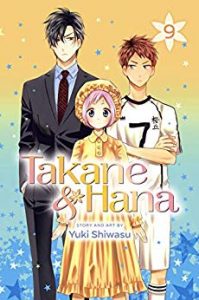
Takane and Hana, Volumes 8 and 9 by Yuki Shiwasu

At 9 volumes in Takane and Hana continues to have story arcs centered on wacky shenanigans, but since those shenanigans seem to be prodding along the romance between Takane and Hana at a glacial pace, I tend to just sit back and enjoy the story.

Most of this volume is taken up with Hana’s realization that she actually cares for Takane, and stumbling through events like Valentine’s Day and dinner with her family while she’s burdened with newfound awareness of her own feelings. There are still plenty of moments of culture shock as Takane isn’t sure what to do the first time he encounters insufficiently marbled beef. There could only be so long that Takane could survived in forced poverty in the position of a mediocre salaryman, mostly because while he is an emotional idiot, he’s actually exceedingly good at business. His current company ends up creating more of a manager role for him, and he’s clearly moving up.

Takane & Hana 9

Takane’s grandfather is pleased with the success of his machinations to force his grandson to grow through vicariously experiencing poverty, but now he’s worried that there will be no time for Takane’s romance to progress. Since exercising familial authority through housing worked so well the last time, he decides to provide Hana’s family with an elaborate mansion to live in as part of a made-up “testing program.” They all move in, only to find out later that they are also required to live with Takane. Takane and Hana end up setting some rigid boundaries around their new living situation, but they aren’t rigid enough for Okamon. Okamon has been lurking on the margins with his carefully deadpan expression, but he hasn’t weighed in on Takane and Hana’s relationship before. I was delighted that volume 9 finally featured Okamon being more direct and also presented a chapter from his point of view. While Okamon may firmly be fulfilling the role of “second lead guy” so familiar in Korean dramas, and I don’t think that he represents a serious threat to an eventual resolution for Takane and Hana, it was a nice change of pace to get to spend more time with him in this volume. I’m expecting that Takane and Hana cohabiting in a mansion will provide plenty of antics for at least 2 volumes.

Filed Under: Manga Reviews, REVIEWS Tagged With: shojo beat, shoujo, takane & hana, viz media

The Irregular at Magic High School: Double Seven Arc

July 22, 2019 by Sean Gaffney

By Tsutomu Sato and Kana Ishida. Released in Japan as “Mahouka Koukou no Rettousei” by ASCII Mediaworks. Released in North America by Yen On. Translated by Andrew Prowse.

The author states in the afterword that this was written to be serialized in Dengeki Bunko’s magazine, rather than as a stand-alone novel, and apologizes for its sloppiness. It’s certainly sloppy – its saving grace is that for once it wasn’t split into two for length, because as a two-volume set this would have been unbearable. On the downside, this means that this is an incredibly long volume where almost nothing happens. There are rumblings of a plot in the background involving the media attacking magicians, and there is foreshadowing of future events. For the most part, though, this book functions to start second year for Tatsuya and Miyuki, and to introduce the new freshman who will be semi-regulars going forward. Chief among whom are the twins on the cover, Mayumi’s little sisters Kasumi and Izumi. The title of the arc comes from them – “Saegusa” has ‘seven’ in its family name, and they are twins, hence ‘Double Seven’.

The twins are not the only new regulars introduced. We also meet Takuma Shippou, who is essentially Shinji from Fate/Stay Night without a sister to abuse. He’s meant to be unlikeable, and he certainly is – reading scenes with him was like eating glass. It will be interesting to see if he actually matures or if he stays an antagonist – Mahouka tends to fall into “you’re either with Tatsuya or against him” character dynamics, and I suspect any maturity might take a long while. There’s also Minami Sakurai, who has moved into the Shiba home to be Miyuki’s protector. Given that’s basically Tatsuya’s job, there’s more going on here, and I suspect it will play out in future books. Sadly, she’s a nonentity here, though I do give her credit for being against the Tatsuya/Miyuki ship – she’d be very happy if Tatsuya hooked up with Mayumi. (As would Mayumi, come to think of it.) Oh yes, and we also meet Kent Smith… erm, sorry, Kento Sumisu (his mother, Jennifer Smith, is a teacher at the school, so I can only assume he’s romanized this way as Tatsuya hasn’t made the connection), who seems to be Saika Totsuka from Oregairu transported to this universe.

The school has invented a new Magical Engineering course so that Tatsuya doesn’t have to put up with the “first/second” prejudice for another year. (Note that the first and second classes are still around, but sine the new freshman don’t involve Tatsuya, we don’t get to see if any of them are bullied.) It also has a couple of magical duels to attempt to solve arguments – one between Shippou and the twins, the other between Shippou and his upperclassman. This allows the author to do what he loves best, which is lovingly describe the magic system he’s invented in terms that make it sound like cook science instead of cool magic. To be fair, he is pretty good at this, and I imagine this would be a treat animated. Oh yes, and we get the highlight of the book – and possibly the entire series – when Tatsuya dresses as Batman for one of his espionage missions. No, really, there’s a picture.

It feels like I’m reading this series out of habit now. You know things are bad when I get excited at the prospect of a tournament arc, as the next volume seems to be. Till then, enjoy the new cast members being introduced over the course of a lot of pages but not making nearly as much of an impression as our stoic Batman.

Filed Under: irregular at magic high school, REVIEWS

Legend of the Galactic Heroes: Upheaval

July 21, 2019 by Sean Gaffney

By Yoshiki Tanaka. Released in Japan as “Ginga Eiyū Densetsu” by Tokuma Shoten. Released in North America by Haikasoru. Translated by Matt Treyvaud.

Yang Wen-Li may be dead but Legend of the Galactic Heroes goes on, even if Yang’s ghostly presence hangs over much of this volume. Julian is trying to do things the way he thinks Yang would have wanted to, even to the point of hearing Yang’s dialogue in his head. He’s still got revenge on his mind, but it has to take a backseat. Much to his frustration, the fight against the Empire also has to take a back seat – he has in mind now trying to get the Empire to become more of a parliamentary democracy, but that’s a long-term plan, and also unlikely to happen with Reinhard in power. So Iserlohn is placed in a bit of stasis this volume, with its most dramatic decision being that of letting the Empire’s fleet pass by unmolested so that it can attack von Reuentahl’s fleet, as the long-foreshadowed rebellion is finally upon us. Oh well, at least it looks like he might be getting a tsundere girlfriend soon.

The “rebellion” is interesting, as it’s a setup, von Reuentahl knows it’s a setup, and yet he goes along with it anyway, partly as he’s fairly sure he wouldn’t be believed if he denied it but partly because, without Yang there to be the noble enemy, there’s nothing really stopping von Reuentahl from attacking the next best military genius – Reinhard. Of course, the joke is on him, as for once Reinhard allows himself to take a back seat and let Mittermeier handle things. They go about as well as you could expect, which is to say very badly for von Reuentahl, who can’t even bleed to death quietly in his office without being presented with his newborn child, the product of yet another love affair. This leads to one of the most bittersweet moments in the series, as a dying von Reuentahl asks the child be raised by childless Mittermeier and his wife. I wish it hadn’t gone this far, but at least there’s some good coming from it. Oh yes, and Trunicht was finally killed. That was great, he deserved it.

The book is not all doom and gloom, though it is mostly serious as always. After being verbally attacked for the massacre that happened about 7 books ago, Reinhard is in a mood and feeling depressed, and asks Hilda to stay the night with him. We don’t see the love scene that follows (though it’s made clear that they’re both dorky ignorant virgins, so it can’t have been that breathtaking), but we do get the aftermath, with Hilda fleeing back home saying “WTF have I done?” and Reinhard immediately showing up to propose. This whole section is actually very funny, and it’s nice to see Reinhard as a lover is about 1/100th as successful as Reinhard the military genius. That said, Hilda is “lucky” enough to get pregnant after this one-night stand, so after taking care of his little rebellion Reinhard proposes again, and this time Hilda accepts. Like most LOGH romances, this has been both obvious and incredibly slow burning, so is very satisfying to finally see.

The main story ends with the 10th and final volume next time. (There are more books with additional stories, but it’s not clear if those will be licensed.) With its huge cast getting smaller and smaller, what fresh new deaths await? Or can we finally achieve peace?

Filed Under: legend of the galactic heroes, REVIEWS

Teasing Master Takagi-san, Vol. 5

July 20, 2019 by Sean Gaffney

By Soichiro Yamamoto. Released in Japan as “Karakai Jouzu no Takagi-san” by Shogakukan, serialization ongoing in the magazine Monthly Shonen Sunday. Released in North America by Yen Press. Translated by Taylor Engel.

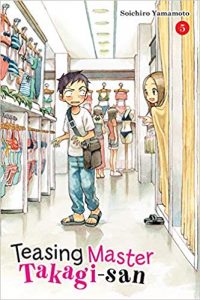
After reviewing the first volume of this charming series as a full review, I did Bookshelf Briefs for the 2nd to 4th volumes. I’m still loving it, but there’s usually not a lot to break down over the course of 500-plus words. Takagi teases Nishikata, he tries to overcome it/turn it back on her, he fails, next chapter. It’s a formula, much the same way that My Neighbor Seki follows a similar type of formula. And we do get several chapters here that show off that formula. Nishikata’s desire to beat Takagi in a school run is foiled by his ignorance of the fact that girls have to run shorter distances he’s tricked into helping Takagi pick out a swimsuit (this is a two-parter); and Takagi sees him pretending to be a wizard during a typhoon and mocks him for it, which may be the funniest chapter. But the first and last chapters are why I wanted to give this a review.

I’ll start with the last chapter of the volume, ‘Critical Hit’. This starts off pretty normally, with Nishikata thinking this is his day to finally win against Takagi because his horoscope and blood type fortune were both super lucky. Takagi knows his star sign AND blood type, of course, so shuts this down right away. But he tries anyway, as his horoscope says he’d get a “critical hit” today. So when his friends want him to go buy a game he wants with them, he rejects them and, not wanting to say the real reason, tells Takagi that he wanted to walk home with her. He DID it! He ALMOST won! Technically, he did win… but he’s too embarrassed at the implication, can’t look her in the eye, and backs off. And we see what he didn’t – Takagi is blushing. An important chapter as it shows Takagi is vulnerable and not perfect, and that Nishikata could win if he had more confidence and less second-guessing.

Then there’s the first chapter, Memories, which takes place well over ten years after the main storyline, and shows us Takagi as an adult with her daughter, Chi. The series is about Takagi being someone who likes to tease, but it doesn’t HAVE to be Nishikata. Here, she teases the reader, reminiscing about her middle school yearbook and implying that Nishikata is either a) dead or b) she didn’t end up with him. Any reader who looks at Chi and sees her daddy’s eyes is not going to be fooled, but, like most of Takagi’s “teasing”, this isn’t meant to be hard. She’s just having fun, and sure enough, at the end of the chapter, we see who she’s married to. This chapter is important as it shows us that things are not going to be static forever – sure, the manga may not end with a confession or anything like that, but we see that eventually there is a happy ending. This also helps make the teasing more fun.

Chapters like these are worth ten of Takagi teasing Nishikata about drinking coffee to be more “adult”, and are a big reason I still adore this cute series. Also, it’s now out digitally as well!

Filed Under: REVIEWS, teasing master takagi-san

My Next Life As a Villainess! All Routes Lead to Doom!, Vol. 4

July 19, 2019 by Sean Gaffney

By Satoru Yamaguchi and Nami Hidaka. Released in Japan by Ichijinsha. Released in North America by J-Novel Club. Translated by Shirley Yeung.

This is a stronger volume than the previous one. The reader gets the sense that the author has decided on a forward path after previously ending the series with two volumes and then extending it out. Now, arguably there might be some frustration with Katarina getting confessed to at the end of the last book – and the end of THIS book – and being able to forget about it merely by being mildly distracted. It borders on disbelieving. But this is the sort of series we are reading, and we all know that the moment Katarina realizes everyone loves her and she has to do something about that, the basis of the series would stop. So on that front, things are much the same. Fortunately, we don’t add another person who falls madly for Katarina’s dense yet forthright personality this time around. We do get what seems to be an ongoing villain, though, and we also see that Katarina might be able to do more than just be really nice at people until they give in.

The premise for this book is that Keith is kidnapped by forces unknown, who leave behind a note saying he is running away from home. No one really believes he would do this, except of course Katarina, who is already getting hammered by her mother and servants for being too… well, too much like herself. So she resolves to go find him, and a crack team heads out composed of herself, Jeord (who is still trying to get her to react to his declaration of love), Maria (whose light magic is super useful here), Larna (who remains entertained by Katarina, but also wants to see what’s really going on) and Sora (the villain from last time, he’s now there basically to get in Jeord’s way so everything remains status quo). Oh yes, and Alexander the Ugly Bear, a magical device/familiar that really does not like Katarina, and the feeling is mutual. Can they find and rescue Keith/ And is there more dark magic at the cause of this?

As I noted above, the book feels more confident in its characters. Katarina can still be a blockhead much of the time, but there is a sense that she is maturing, just not in the field of romance. She has minimal talent in Earth Magic, but one scene towards the end suggests that, with the help of certain artifacts she happens to buy at a flea market, she can do a lot more to fight the forces of evil. This is important going forward, because clearly she’s going to join the Ministry, and “because she makes me laugh” was not really a good enough reason. There needs to be more to Katarina’s life besides “who will she end up with?”, and this is a very good start. I also liked the brief look we got at the series’ new villain, Sarah, who feels incredibly creepy and broken and who I suspect might be a tough nut for Katarina to crack.

Not quite as deeply silly as it has been, I still greatly enjoyed this volume of Bakarina. Will everyone finally graduate in the next volume? I want to find out.

Filed Under: my next life as a villainess, REVIEWS

Didn’t I Say to Make My Abilities Average in the Next Life?!, Vol. 7

July 17, 2019 by Sean Gaffney

By FUNA and Itsuki Akata. Released in Japan as “Watashi, Nouryoku wa Heikinchi de tte Itta yo ne!” by Earth Star Entertainment. Released in North America by Seven Seas. Translated by Diana Taylor. Adapted by Maggie Cooper.

I have a bit of a shameful confession to make. I don’t really care that much about the plot of Make My Abilities Average. Well, that’s not true. The girls’ ongoing adventures interest me, and I definitely want to read the 8th book to see Mile going home to where Adele came from. But all the stuff with Gods and millennia-old ancestors and the like kind of put me to sleep. It’s nice that the author wants to show there’s a genuine reason behind Mile getting reincarnated this way, but I feel it’s a bit unnecessary. It doesn’t matter what the religious cultists who kidnap Mile’s favorite catgirl are after, what matters is that they do it and Mile now has to stop them. It also doesn’t help that Mile goes to interrogate the cultists – and thus find out bits of the aforementioned plot – while wearing a school swimsuit, something so mind-bogglingly stupid even the rest of the Crimson Vow ignore it out of pity and just go back to bed.

The book is still funny, though most of the humor can be divided into two parts. The first is funny characters and situati0ons, as you want and expect. The second are scenes that all end with someone saying or doing something overpowered and the rest of the cast saying the equivalent of “Nandeyanen?!”. Boke and tsukkomi humor is clearly very important to the author, and it helps that any of the Vow, not just Mile, can be the boke at times. It does feel a little tiring after a while, though. Mile is also filling her observations with otaku humor as always, including references to Thunderbirds and The Rocky Horror Picture Show that I suspect may have been adapted away from some really, really obscure Japanese thing. We’ve also gotten so used to the cast that some of the funniest moments come when they don’t act as you’d expect, such as Reina becoming all soppy.

It’s not hard to see why Reina does this, though. Hot-tempered and stubborn as she is, she’s also the most “normal” of the Crimson Vow, and it’s wonderful seeing her boggle at the teamwork of the Servants of the Goddess, who are also all women and the same rank as the Vow but get through battles using their meager skills and perfect teamwork, as opposed to our four overpowered idiots just smashing through any obstacle. It’s exactly the kind of hunting party Reina dreamed of before she met Mile, and thus it’s no surprise that she starts to see the leader of the other party as a big sister figure (well, no surprise to us, it certainly surprises the rest of the Vow). The Vow also helps to fend off a very dangerous enemy: Mavis’ family, who want to marry her off. This problem is solved through the simple but hilarious plan of talking up Mile, who is even MORE awesome than Mavis and has even MORE of a noble background. Mavis isn’t too happy about that, though…

The humor might not be as top-tier as it once was, but this is still a lot of fun, and I definitely want to see what comes next.

Filed Under: Didn't I Say to Make My Abilities Average in the Next Life?!, REVIEWS

Full Metal Panic!: Rampaging One Night Stand

July 16, 2019 by Sean Gaffney

By Shouji Gatou and Shikidouji. Released in Japan by Fujimi Shobo. Released in North America by J-Novel Club. Translated by Elizabeth Ellis.

The FMP! novels mostly seem to have the same conceit for their titles: a Japanese word, followed by an English phrase. (OK, I think “Fighting Boy Meets Girl” was all English.) This is translated for the benefit of the English-speaking reader, and can, of course, lead to thwarted expectations. There are no one night stands as the word is commonly used in this book. The title refers to the fact that the main action in the book takes place over the course of one evening. And there certainly is a lot of rampaging, as the premise involves a huge, skyscraper-sized AS called the “Behemoth”, which is awkward but unstoppable, especially when piloted by Takuma, a troubled young man who is also somewhat mentally unbalanced. Things aren’t helped by the fact that, due to various attacks by Takuma’s terrorist friends, Sousuke’s commanding officer, Tessa, is forced to hide out in his apartment. And much as the action is interesting, it was Tessa meeting Kaname that provided the best part of this book.

Last time I mentioned that Kaname is a rare “angry girl heroine” who fans actually love, and Tessa is along the same lines, the “nice girl” rival character who, while not disliked by fans, has almost no one shipping her and Sousuke instead of Kaname. This book helps to show why, as I had forgotten how much it contrasts Tessa’s excellent command skills (and her abilities as a Whispered, something only hinted at in this book) and Tessa’s mediocre-to-poor skills as a girl falling in love. Indeed, the “nice girl” part of her is absent a lot of the time, as her pretending not to be Sousuke’s commanding officer in order to piss Kaname off is rather mean (and she has to apologize for it later), and she and Kaname have far more of an antagonist stance with each other than I’d remembered from when I first experienced this years ago. Heck, Tessa even declares her rivalry to Kaname at the end. Add to this her feelings about her brother Leonard, and she’s a fascinatingly complex character.

As for Kaname, use of her Whispered abilities are kept to a minimum here, meaning she spends most of the time as the bright, refreshing normal girl. As with the first book, she’s alternating between being attracted to Sousuke and finding him the most aggravating person in the world. This is not helped by his attempting to apologize to her by offering her heroin, so she can sell it for money. Yes, this is an actual thing that he does, and I’m pretty positive the anime cut that. Sousuke, while still doing things like this, has at least developed a finely-honed “Kaname is about to get really angry” sense, though most of the time – like when Tessa comes out of his shower while Kaname is there – there is nothing whatsoever he can do about it. That said, the “which of the two ladies do you like better?” choice offered by the villains doesn’t even register with him, as he makes the choice based solely on combat reasons.

Unlike a lot of action series with a romantic sideplot, most people read or watch FMP! for the romance. They won’t be disappointed with this one, a solid second volume that establishes a love triangle but also makes it clear who the winner will be.

Filed Under: full metal panic!, REVIEWS

Daytime Shooting Star, Vol 1

July 14, 2019 by Anna N

Daytime Shooting Star Volume 1 by Mika Yamamori

We haven’t had a ton of student-teacher shoujo romances being translated here recently, but perhaps series like Dengeki Daisy and Takane and Hana have paved the way. Suzume has a comfortable, slow-paced life in the country. Her classmates are all as familiar to her as siblings, and she feels free to randomly ditch class and go up on the roof of her school building to stare at the sky. Unfortunately her routines are about to be disrupted, as her parents announce that they have to go abroad for her father’s work, and they are sending her to Tokyo to live with her uncle. Suzume ends up getting lost on her way to her uncle’s house and an eccentric young man wearing a goofy hat helps her out. It turns out that Shishio is a friend of her uncle’s and her teacher! This amazing coincidence isn’t terribly surprising. The contrast between Shishio’s mannerisms when he’s off-duty and when he’s at school is amusing.

Suzume initially has a hard time fitting in with her new school, but she makes a quasi-friend in Mamura, the boy she ends up sitting next to in class. He has a almost pathological reaction of terror in response to any contact from girls. She also makes a frenemy in the form of Nekota, a girl at school who sets up a fairly weak way of deliberately excluding Suzume from a weekend outing with her classmates. When Suzume realizes what is going on, she decides to charge in and confront the issue. Shishio keeps showing up at odd moments when Suzume is feeling down, and while she’s clearly developing a hidden crush, she has plenty of other things on her mind as she attempts to deal with adjusting to life in Tokyo.

Yamamori’s art is attractive and stylish, and I enjoy the varied way Suzume is portrayed, as she swings from being timid in a new environment, to cool and confident on the volleyball court, to desperately trying to cover up evidence of a girlfight. Suzume is an engaging heroine, and I’m looking forward to see what happens next as the relationships between the characters develop more.

Filed Under: Manga Reviews, REVIEWS Tagged With: daytime shooting star, shojo beat, shoujo, viz media

  • « Go to Previous Page
  • Page 1
  • Interim pages omitted …
  • Page 145
  • Page 146
  • Page 147
  • Page 148
  • Page 149
  • Interim pages omitted …
  • Page 349
  • Go to Next Page »
 | Log in
Copyright © 2010 Manga Bookshelf | Powered by WordPress & the Genesis Framework