• Skip to primary navigation
  • Skip to main content
  • Skip to primary sidebar
  • Home
  • About Us
    • Privacy Policy
    • Comment Policy
    • Disclosures & Disclaimers
  • Resources
    • Links, Essays & Articles
    • Fandomology!
    • CLAMP Directory
    • BlogRoll
  • Features & Columns
    • 3 Things Thursday
    • Adventures in the Key of Shoujo
    • Bit & Blips (game reviews)
    • BL BOOKRACK
    • Bookshelf Briefs
    • Bringing the Drama
    • Comic Conversion
    • Fanservice Friday
    • Going Digital
    • It Came From the Sinosphere
    • License This!
    • Magazine no Mori
    • My Week in Manga
    • OFF THE SHELF
    • Not By Manga Alone
    • PICK OF THE WEEK
    • Subtitles & Sensibility
    • Weekly Shonen Jump Recaps
  • Manga Moveable Feast
    • MMF Full Archive
    • Yun Kouga
    • CLAMP
    • Shojo Beat
    • Osamu Tezuka
    • Sailor Moon
    • Fruits Basket
    • Takehiko Inoue
    • Wild Adapter
    • One Piece
    • After School Nightmare
    • Karakuri Odette
    • Paradise Kiss
    • The Color Trilogy
    • To Terra…
    • Sexy Voice & Robo
  • Browse by Author
    • Sean Gaffney
    • Anna Neatrour
    • Michelle Smith
    • Katherine Dacey
    • MJ
    • Brigid Alverson
    • Travis Anderson
    • Phillip Anthony
    • Derek Bown
    • Jaci Dahlvang
    • Angela Eastman
    • Erica Friedman
    • Sara K.
    • Megan Purdy
    • Emily Snodgrass
    • Nancy Thistlethwaite
    • Eva Volin
    • David Welsh
  • MB Blogs
    • A Case Suitable For Treatment
    • Experiments in Manga
    • MangaBlog
    • The Manga Critic
    • Manga Report
    • Soliloquy in Blue
    • Manga Curmudgeon (archive)

Manga Bookshelf

Discussion, Resources, Roundtables, & Reviews

Blog

PotW: Twin Spica, Young Avengers, Toradora!

March 14, 2011 by MJ, David Welsh and Katherine Dacey 10 Comments

Slim pickin’s at Midtown Comics means a bit of cheating this week. Thankfully, the Manga Bookshelf bloggers find ways to spend money under any conditions.


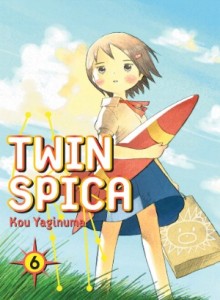
From MJ: I’m at a bit of a loss looking at this week’s list from Midtown, so I think I’ll cheat and pull from last week’s ComicList as quoted by David in his Upcoming post, especially since Midtown missed this book’s actual release! That would be volume six of Twin Spica, one of my picks for best new manga of 2010, and an ongoing favorite as well. I’m a few volumes behind (I’ve just bought volume four) but this is a great time to finally catch up. From my review of volume three, “Everyone in this series has suffered loss of some kind, but what is rare in a story with a teenaged protagonist is that the pain and loss of the story’s adult characters is given the same weight as the pain of its teens … By the end of this volume, I had tears running down my face, and I challenge any reader to avoid the same fate, adult or teen.”

From David: Choices are thin on the ground, aren’t they? Since you went with Twin Spica, I’m forced to cheat even harder and go with a comic from Marvel: Avengers: Children’s Crusade: Young Avengers. (That’s a lot of punctuation for a comic, isn’t it?) I’ll try and describe this succinctly: the Avengers are one of Marvel’s long-running teams of super-heroes, which means horrible things have happened to them, both in narrative and creative terms. During a period when they’d disbanded, possibly out of shame over their last crossover, a young group of heroes tried to fill the gap. These interesting teens starred in a few very enjoyable comics, but they had to mark a lot of time while the writer, Allan Heinberg, did other stuff. Now they have a mini-series where one of their members, an adorable gay super-teen named Wiccan, is looking for his amnesiac mother, and this comic is apparently related to that somehow. It’s drawn by Alan Davis, who is one of my favorite super-hero artists, and it features adorable gay super-heroes. (Wiccan has a boyfriend named Hulkling. Ignore the names and focus on the adorableness.)

From Kate: I’m going to order off the menu this week and go with volume one of Toradora! Imagine a shonen version of Kimi ni Todoke, and you have a good idea of what this romantic comedy is all about: its hero, Ryuchi, is a high school student whose scary face has doomed him to social obscurity. When he crosses paths with the class firecracker, however, his life is turned upside down, as his classmates wrongly assume he’s dating Taiga. (Do I even need to say, “Wacky hijinks ensue”?) Toradora! isn’t perfect by any means — the female characters are either relentlessly perky or relentlessly bossy — but a smart script and appealing hero make it enjoyable nonetheless.


Readers, what are your Picks this week?

Filed Under: PICK OF THE WEEK

From the stack: The Zabîme Sisters

March 14, 2011 by David Welsh

I’m working my way through the top ten books on the 2011 Great Graphic Novels for Teens, one of which is the late Aristophane’s The Zabîme Sisters (First Second). It follows three girls from Guadeloupe through their first day of summer vacation, and it does so with a degree of clarity, honesty, and restraint that’s quite surprising and very refreshing.

Bossy M’Rose wants to watch a fight between the school bully and one of his targets. Attention-hungry Célina wants to hang out with some girlfriends. Timid Ella just seems to want as pleasant and peaceful a day as she can manage. They cross paths with classmates who have their own agendas and concerns. Manuel is trying to figure out what to do about his father’s broken pipe. Euzhan has smuggled some rum out of the house to share with her girlfriends. Some things go well, some go badly, and some just go.

Aristophane’s approach to slice of life is meticulously subdued. His narrative never overpromises, maintaining a steady pace of event but never inflating those moments into more than just moments. It’s a day, not an epic, and there’s comfort and familiarity in the string of anticlimaxes. The pleasure of The Zabîme Sisters is in its simplicity and candor.

Part of that candor comes in the form of sharp little bits of exposition that Aristophane sprinkled throughout the narrative. When Célina joins her family for breakfast, Aristophane offered this narration:

“Célina got up after making them beg her. She took particular pleasure in being pleaded with and in feeling indispensible. When she got this attention first thing in the morning, she felt especially content.”

These bits of omniscience are frank and illuminating, but they’re never intrusive. They add wonderful layers to the events, and they rarely flatter their subjects. Aristophane isn’t mocking his characters, per se, but his assessments are unsparing. But they reveal the emotional complexity of the characters, too, and they add weight and clarity to their actions. It’s a terrifically successful technique, and it lifts the book to a higher level.

The art has the same kind of chunky, inky beauty that I find so appealing in the work of Iou (Sexy Voice and Robo) Kuroda. Just about every panel is absorbing in its own way, with shifting perspectives and an eye-catching haziness. There’s a blend of precision and abstraction that adds interest; you’re always sure of what you’re seeing, but the rendering has enough oddity and expressionism to keep refreshing the way you see it. (Publishers Weekly ran several preview pages from the book.)

I’m actually kind of embarrassed that this book largely escaped my attention before making it onto the top ten list. It’s the kind of thoughtfully inventive work that always excites me, and its unique elements and techniques cohere in really admirable ways.

Other reviews in this intermittent series:

  • Set to Sea, written and illustrated by Drew Weing, Fantagraphics

You can nominate titles for the next Great Graphic Novel for Teen List, and you can take a look at the current batch of contenders.


Filed Under: REVIEWS

Follow Friday – a little late

March 12, 2011 by MJ 1 Comment

Yesterday was Follow Friday, according to my feature schedule, but I admit I had a hard time mustering the will for such a frivolous post in the aftermath of the earthquake in Japan.

Today, though, I’ve got some recommendations to share that many may find helpful. Here are a few Twitter accounts I’ve found valuable for keeping up on news from Japan.

@YokosoNews, usually devoted to lifestyle and entertainment news, has focused its efforts on relaying news about the catastrophe from the Japanese media to English-speaking readers. Check out their USTREAM for ongoing translation of news broadcasts from the NHK.

@MariKurisato, a regular favorite on my follow list, has been tweeting available news from all the reliable sources she can find pretty continuously over the couple of days

@tokyograph is another source for current news (thanks to Kimberly Saunders @ShroudedDancer for the link).

I’ve also been following tweets from @mangauniversity, @tokyoreporter, and @globalvoices.

So far, I’ve been grateful to hear that all those I personally know in Japan are all safe. I hope the same for all of you.

Filed Under: Follow Friday, UNSHELVED

License request day: Glass Mask

March 11, 2011 by David Welsh

Looking back on my most recent license requests, I notice an unfortunate trend: none of them run to the outlandish end of the spectrum. It’s all well and good to ask for things that you may actually receive, but it’s also important to pull out the stops from time to time… to ask for something massive, something commercially suspect, something old… something like Suzue Miuchi’s Glass Mask.

This is the sprawling tale of an ambitious, would-be stage actress named Maya Kitajima who responds to her mother’s dismissal and criticism with a burning desire for fame. (As Roxie Hart sagely noted in Chicago, “And that’s because none of us got enough love in our childhood. And that’s showbiz, folks.” Okay, Renée Zellweger’s Roxie may not have said that, but Gwen Verdon’s did, and Verdon’s is the one that matters.) Maya apparently endorses the Method, throwing herself into rehearsals and performances with reckless disregard for her own health.

And she has a rival, Ayumi Himekawa, who takes a more learned approach to acting and thinks she’d be much better in Maya’s dream role, the lead in The Crimson Goddess. And she has a mentor, Chigusa Tsukikage, whose own very promising acting career was prematurely ended by a disfiguring accident. And she has at least one love interest, entertainment entrepreneur Masumi Hayami, who can only reveal his feelings for Maya through gestures as an anonymous fan.

It sounds like the acting version of Kyoko Ariyoshi’s Swan (CMX), and there’s absolutely nothing wrong with that. Both series launched in 1976, with Swan in Shueisha’s Margaret and Glass Mask in Hakusensha’s twice-monthly Hana to Yume. Swan concluded in 1981 with its 21st volume. Glass Mask is still running, though it did move to Hakusensha’s monthly Bessatsu Hana to Yume. The 46th volume of Glass Mask came out in October of 2010. The series has enjoyed to anime adaptations, one of which has been released in North America.

Dauntingly long? Check! (Miuchi indicated in 2009 that the end of the series was near, though.) Vintage, difficult-to-market shôjo style? Double check! (Hakusensha is somewhat skimpy with preview pages, but if you click on the red button with the open-book icon on the third entry down in the right-hand column, you can see a bit of Glass Mask and gape.) Do I want to read it like Maya wants to play the lead in The Crimson Goddess? Triple check!

What ridiculously long, commercially questionable series would you like to see licensed? Or do you just want the chance to read the rest of Swan, From Eroica with Love, and Oishinbo?


Filed Under: LICENSE REQUESTS

Wandering Son 1 by Shimura Takako: A

March 10, 2011 by Michelle Smith

Book description:
The fifth grade. The threshold to puberty, and the beginning of the end of childhood innocence. Shuichi Nitori and his new friend Yoshino Takatsuki have happy homes, loving families, and are well-liked by their classmates. But they share a secret that further complicates a time of life that is awkward for anyone: Shuichi is a boy who wants to be a girl, and Yoshino is a girl who wants to be a boy. Written and drawn by one of today’s most critically acclaimed creators of manga, Shimura portrays Shuishi and Yoshino’s very private journey with affection, sensitivity, gentle humor, and unmistakable flair and grace. Volume one introduces our two protagonists and the friends and family whose lives intersect with their own. Yoshino is rudely reminded of her sex by immature boys whose budding interest in girls takes clumsily cruel forms. Shuichi’s secret is discovered by Saori, a perceptive and eccentric classmate. And it is Saori who suggests that the fifth graders put on a production of The Rose of Versailles for the farewell ceremony for the sixth graders—with boys playing the roles of women, and girls playing the roles of men.

Wandering Son is a sophisticated work of literary manga translated with rare skill and sensitivity by veteran translator and comics scholar Matt Thorn.

Review:
The main thing I kept thinking about while reading Wandering Son—beyond the continuous undercurrent of general squee—is how things that seem insignificant to one person can be secretly, intensely significant to someone else.

Wandering Son begins simply. Nitori Shuichi (the translation retains Japanese name order) is an extremely shy fifth-grade boy, and as the volume opens, he and his sixth-grade sister, Maho, are preparing for their first day at a new school. Upon arrival, Shuichi is instructed to sit next to Takatsuki Yoshino, a girl so tall and handsome that she’s called Takatsuki-kun by her classmates. They become friends.

One day, when Shuichi goes to Takatsuki’s house to work on some homework, he spies a frilly dress hanging in her room. Perhaps Takatsuki didn’t mean much of anything when she suggested that Shuichi should wear it, but it’s an idea that refuses to leave his head, despite his protests that he isn’t interested. He ends up taking the dress home and giving it to Maho, but its presence in their shared bedroom taunts him.

At this point, Shuichi isn’t thinking about things like gender identity. He’s ten! Instead, he’s dealing with processing the new idea that he could wear a dress and that he might even want to. Slowly, and bolstered by interactions with another encouraging classmate, he begins experimenting. First, he buys a headband. Then he tries dressing as a girl while no one else is home. Finally, when Takatsuki reveals her own treasured possession—her elder brother’s cast-off junior high uniform—he tries going out as a girl in public, with Takatsuki (as a boy) at his side.

One wonders what would’ve happened to Shuichi without Takatsuki to set the example. Would he have become aware of these feelings within himself eventually or been somehow unfulfilled forever? Her comments and her acceptance mean more to him than she knows, as he has a habit of internalizing things that are said to him. After an adorable turn in a female role in a drag version of The Rose of Versailles at school, for example, Maho conversationally notes, “You should have been born a girl.” Again, this is a concept that’s new to Shuichi, but one he gradually comes to believe is true. When his grandmother promises to buy him a present, he visualizes his female form and realizes it’s what he most wants. “Even grandma can’t buy me this.”

I had no problem seeing Takatsuki as a boy throughout, because of her inner certainty and obviously boyish appearance, but Shuichi was more problematic. The moment he confronts the mental vision of what he feels he should be, however, and realizes that he truly wants to be a girl, he starts to become one for the reader. By contrast, it’s shocking when the onset of her first period reminds readers that Takatsuki is biologically female. Though she mostly projects a confident air, her anguish at the undeniable truth that she is not really a boy is intense.

The story is subtle, simple, poignant, and innocent. The tone is matched by Shimura’s uncluttered artwork, which features big panels, little screentone, and extremely minimal backgrounds. These factors combine to make the volume go by quickly, and all too soon it’s over. While waiting for volume two, in which Shuichi and Takatsuki will progress to the sixth grade, I suspect I will have to console myself with the anime adaptation, currently available on Crunchyroll.

The first volume of Wandering Son—published in English by Fantagraphics—will be available in June 2011. The series is still ongoing in Japan, where it is currently up to eleven volumes.

Review copy provided by the publisher.

Filed Under: REVIEWS Tagged With: fantagraphics, Takako Shimura

3 Things Thursday: Down the Aisle

March 10, 2011 by MJ 22 Comments

Today is my tenth wedding anniversary, so I’ve got marriage on the brain. And I was surprised to realize, when I thought about it, just how seldom I encounter weddings or even marriage in the manga I read, despite my heavy leanings towards romance.

Then again, I think it’s only a rare kind of story that wants to delve beyond the early rush of romance and into what happens next. I remember as a child, getting to Laura Ingalls’ wedding in the Little House series, and feeling just as bewildered as she seemed to be, suddenly separated from the place and people she’d lived with all her life until then. The heart-pounding romance that had brought us both to this point had taken a too-realistic turn that neither she nor I was even remotely prepared for. I had a similar feeling when Betsy finally married Joe near the end of Maud Hart Lovelace’s Betsy-Tacy series. As much as Betsy struggled with the reality of domestic life, I struggled with the loss of her romantic adventure.

Still, there are a few manga weddings that spring to mind as I ponder, though not all of them are marriages I personally endorse!

3 manga weddings for MJ’s anniversary:

1. The Moon and the Sandals | Fumi Yoshinaga | Hashizume & Ida

Probably the favorite of my manga marriages is not actually a legal one, at least not in Japan. But when Hashizume turns up with the adoption forms, showing Ida that he really does love him, and has wanted to marry him for long time, I honestly got teary. Oh, Fumi. *snif* You really are the best of all.

2. Fruits Basket | Natsuki Takaya | Tohru & Kyo

Okay, so they don’t actually show Tohru’s marriage to Kyo, but after 23 volumes of pounding in the message that a girl’s most important dream is marriage, Takaya at least provides us with proof that it happened after all. It’s a pretty sweet little moment too, even if it gets her out of having to deal with any of the hard stuff.

3. NANA | Ai Yazawa | Hachi & Takumi

Though Hachi and Takumi’s wedding is possibly the least romantic thing to ever hit the page as far as I’m concerned, its business-like manner reminds us all that marriage is really just a contract, for good or for ill, and that it can’t create or replace love and emotional partnership. Will we ever find out how this marriage really turns out? I dearly hope so.

A list of manga weddings was difficult for me to muster, I have to admit. Readers, can you do better?

Filed Under: 3 Things Thursday

iPad Manga Review: Claymore Volume 1

March 10, 2011 by Anna N

Claymore Volume 1 by Norihiro Yagi

Claymore is one of those series that’s been on my radar for awhile because I remember reading several online reviews that pointed out it was a shonen manga series with some potentially interesting gender dynamics. So I was happy to spend .99 cents on the iPad version of Claymore volume one. This manga seems like a fairly standard fantasy action story, made much more interesting by the fact that the ultimate bad ass warriors in Yagi’s world are all women. Demons called yoma prey on hapless pseudo medieval villagers, and their only recourse is to hire claymores, women who have become part-demon themselves in order to be able to fight the yoma. The world of Claymore is introduced through the standard shonen set piece of having a young boy discover how claymores protect the world. Raki is orphaned, and he meets the claymore Clare when she is hired to protect his village. Clare is everything you might expect from a shonen action hero. She’s terse, business-like, and doesn’t hesitate to dismember a yoma by hacking off limbs before splitting it in half with her giant sword. Clare doesn’t even deal with the mercenary details of payment for her services. When the head of the town offers to give her money before she heads out on her killing mission, she tells him to wait and pay after she’s done with her job, “If I get killed…there’ll be no reason to pay.” Clare is followed from job to job by Rubel, a mysterious man who collects the money for her services.

Raki ends up following Clare and she agrees that he can tag along as her cook, telling him that he can stay with her until he finds another town he would like to live in. Clare isn’t one to sit around and talk about her feelings, but it is heavily implied that she’s taking on Raki as a sidekick because his companionship might be a way to help her regain some of her humanity. When the claymores transform themselves into human/yoma hybrids, they’ve started a process where they will eventually lose their human qualities and become yoma. A claymore who senses that she’s about to transform sends a black card to the next member of the organization requesting that she be killed.

Overall, I found this manga very intriguing. It is unusual to find a shonen manga that features a female main character that doesn’t feel exploitative. There were a couple scenes of Clare changing clothes taking a bath to wash the blood off of her self after battle, but these didn’t feel very gratuitous to me. Clare’s characterization is strong and forceful, and I’m curious to see what happens in the rest of her journey. I really liked the bleak tone of Claymore as well. It has been some time since I’ve read a grim fighting manga, so I actually found it a bit refreshing. Yagi’s art falls into the category of serviceable but not spectacular. I can see how it will probably improve over time, but Claymore doesn’t display the insane composition of something like Bleach that would prompt me to pick up several volumes for the action scenes alone. I’m very interested to see what’s going to happen with Claymore’s group of hybrid women/demon yoma hunters.

One of the things I like about reading manga on the iPad is that when reading it in the portrait or single page orientation, the art is automatically blown up to omnibus edition size. Also, being able to magnify individual panels is fun. The only thing that is making me a little hesitant about picking up this series is that it is so long! I will try to at least check out the second volume to see if I’m still interested. Can anyone whose read more Claymore let me know what they think about it? Does it get stronger as it goes along?

Filed Under: UNSHELVED

Brains win

March 10, 2011 by David Welsh

It should come as no surprise to anyone following the voting in this month’s Previews poll that the young ladies of A Certain Scientific Railgun (Seven Seas), written by Kazuma Kamachi and illustrated by Motoi Fuyukawa, used their psychic powers to manipulate you all into voting for them, thus crushing the competition. On the whole, I think you were pretty generous to give this one a landslide, as it sounds perfectly tolerable. I’m still not looking forward to reading the word “esper” over and over again, so I hope that’s confined to the expository bits at the beginning.

Branching outwards, Kate (The Manga Critic) Dacey offers a bushel of links to items that are worth your reading time. The only one I’d add to that roster is this piece by Shaenon K. Garrity at comiXology, which looks at the sidebars that are often included in various shôjo manga:

Read enough of these notes, however, and you get the impression that shojo manga artists are both incredibly boring and completely insane.

She speaks the truth.


Filed Under: DAILY CHATTER, Link Blogging

Playing for the Ashes by Elizabeth George: A-

March 10, 2011 by Michelle Smith

Book description:
When country milkman Martin Snell makes his usual delivery to fifteenth-century Celandine Cottage one fine spring morning in Kent, he expects to be greeted by the cottage’s seductive tenant, Gabriella Patten, not the ugly remains of a fire pointing to murder.

As all of England, as well as the magnetic world of national cricket, discovers itself reeling from the shock of this particular crime, Lynley and Havers find themselves working on the most frustrating case of their careers: the perfect crime. When in an act of desperation Lynley breaks department rules to flush out the killer, he risks being pulled from the case and jeopardizes his career with New Scotland Yard.

In Playing for the Ashes, a deft study of human nature and a crime with too much evidence result in a powerful work of fiction that pulls the reader into a fully created world to explore the dark side of passion and self-delusion.

Review:
I would normally never dream of naming the culprit in a review of a mystery novel. But your average mystery novel usually doesn’t have themes, which this one does, and exploring those requires me to divulge some essential details. Major spoilers ahead.

When Kenneth Fleming, a renowned batsman for England’s cricket team, is found dead in his lover’s rented cottage in Kent, a media frenzy ensues. Scotland Yard is called in to assist in the investigation, and Inspector Lynley and Sergeant Havers must get the truth out of various recalcitrant witnesses before their lack of results sees them ousted from the case. The principal cast includes Jean Cooper, Fleming’s soon-to-be ex-wife; Jimmy Cooper, his grungy and rebellious teenage son; Miriam Whitelaw, Fleming’s former teacher and current roommate and patron; Olivia Whitelaw, Miriam’s estranged daughter and frequent narrator; and Chris Farraday, animal activist and Olivia’s bargemate.

I mentioned above that this work has themes, and the central one seems to be: choices. Everyone in the story is either faced with a choice or dealing with the repercussions of a choice they made in the past. While teenagers, Fleming and Jean chose to have unprotected sex, then chose to marry and keep the baby, putting an end to his scholastic ambitions, much to Miriam Whitelaw’s dismay. Olivia Whitelaw chose to break free of her privileged life and pursue a path of debauchery and drugs.

In the present, Lynley has still not received a response to his marriage proposal to Lady Helen, and he finally insists that she decide one way or the other. Fleming chooses not to reveal that he has decided to cancel a fishing trip with his son to go to Kent and end his relationship with a promiscuous girlfriend, an omission which leads to his death, as Miriam chooses that moment to get rid of the problem girlfriend on his behalf. Jimmy chooses to follow his dad and to later confess to the crime, believing that the person he saw at the cottage that night was his mother.

Despite the objections of his superiors, Lynley chooses to bring media scrutiny down upon Jimmy to exert pressure on Olivia, who must choose whether to reveal admissions of guilt made by her mother, just when the two had achieved some measure of reconciliation brought on by Olivia’s request for help in dealing with her illness, ALS. This choice affects Farraday’s life, as well, since Olivia being in her mother’s care will allow him to spend more time with the woman he loves. Heck, even Havers faces a choice regarding whether to befriend an eight-year-old neighbor!

Another prominent theme is the comparison of platonic love and physical love. Both Olivia and her mother are living with men they love who, though they care for the Whitelaw women, don’t return their feelings in the same degree. Actually loving a man is painful for Olivia, for whom sex has always been a casual thing, since the one person she really wants to be with in that respect sees her only as a friend. Physical relationships are portrayed as fleeting and lust-driven, and George goes a bit overboard in depicting some of these, especially an awful scene occurring between a hostile young Olivia and her father. In fact, much of Olivia’s early narration is frustrating, because she is so insolent as to be borderline intolerable, but by the end of the novel she does become a sympathetic character.

On the whole, despite some unpleasant and unnecessary bits, I liked Playing for the Ashes a lot. I thought it was cleverly constructed and well written, and was impressed that it managed to convey just how much the victim would be missed by those he left behind, something many mysteries fail to do. It made me care about the characters more than the solution, and I actually got sniffly when Lady Helen (who has the best line of the novel in “I’m very nearly frivolity personified”) finally made her decision. Happily, I still have ten more books in this series to go!

Filed Under: Books Tagged With: Elizabeth George

From the stack: House of Five Leaves vol. 2

March 10, 2011 by David Welsh

Of all of the series in Viz’s SigIKKI initiative, I think Natsume Ono’s House of Five Leaves is probably my favorite. It’s intriguing in a very delicate, oblique way, and it’s rare to be able to say that about… well… just about any kind of entertainment.

It’s about an out-of-work samurai called Masa who falls in with a gang of kidnappers. Masa isn’t a bad person, but he lacks confidence, and he doesn’t inspire it. He looks physically frail, and whatever good intentions he may have are outweighed by the harsh realities of his jobless existence.

Beyond necessity, the gang, the Five Leaves, have a kind of lazy allure. They aren’t violent, and they plan carefully to make sure they profit from their illegal activities. There’s Matsukichi, the spy who prefers to keep his own counsel. In the rest of his life, Ume owns a bar and looks after his daughter who’s just entering adulthood. Sexy, mature Otake views life with a wry curiosity. And Yaichi, their ringleader, has a shady glamour and a strange kind of affection for, or at least profound interest in, Masa.

They’re appealing individually and as a quintet. Ono has assembled the kind of cast I could happily read about if they just sat around and drank and gossiped (which they do a lot). But she finds surprising depths in all of them, and she shifts their relationships around in measured but heartfelt ways.

The second volume digs into Umezo’s criminal past as it encroaches on his present. Masa is recuperating with Ume’s former boss, Goinkyo. Two of Goinkyo’s former underlings are stirring up trouble, one reluctantly and one maliciously. There’s blackmail involved, and violence, but they’re secondary to the dynamics that fuel them. Fatherly Goinkyo seems to have a sense for people who aren’t cut out for a life of crime, and his observations resonate through the events and revelations of the volume. And, of course, there’s Yaichi, guarding his secrets and managing the state of his colleagues at the same time, while wanting to not seem like he’s trying very hard.

In that, he’s representative of the series itself. It kind of glides along, casting sideways glances at its characters that mask the sharpness of its observations. It’s sly, but it’s also very sincere. With an apparent absence of effort, Ono has crafted a cast and a set of circumstances that are deeply involving, even at a very low volume. Ono leaves you wanting to know everything there is to know about these intensely private people, even as you understand she probably won’t spill everything. As low-key as House of Five Leaves is, it’s also cumulatively stunning. I can’t get enough of its hidden depths.


Filed Under: REVIEWS

  • « Go to Previous Page
  • Page 1
  • Interim pages omitted …
  • Page 871
  • Page 872
  • Page 873
  • Page 874
  • Page 875
  • Interim pages omitted …
  • Page 1047
  • Go to Next Page »
 | Log in
Copyright © 2010 Manga Bookshelf | Powered by WordPress & the Genesis Framework