• Skip to primary navigation
  • Skip to main content
  • Skip to primary sidebar
  • Home
  • About Us
    • Privacy Policy
    • Comment Policy
    • Disclosures & Disclaimers
  • Resources
    • Links, Essays & Articles
    • Fandomology!
    • CLAMP Directory
    • BlogRoll
  • Features & Columns
    • 3 Things Thursday
    • Adventures in the Key of Shoujo
    • Bit & Blips (game reviews)
    • BL BOOKRACK
    • Bookshelf Briefs
    • Bringing the Drama
    • Comic Conversion
    • Fanservice Friday
    • Going Digital
    • It Came From the Sinosphere
    • License This!
    • Magazine no Mori
    • My Week in Manga
    • OFF THE SHELF
    • Not By Manga Alone
    • PICK OF THE WEEK
    • Subtitles & Sensibility
    • Weekly Shonen Jump Recaps
  • Manga Moveable Feast
    • MMF Full Archive
    • Yun Kouga
    • CLAMP
    • Shojo Beat
    • Osamu Tezuka
    • Sailor Moon
    • Fruits Basket
    • Takehiko Inoue
    • Wild Adapter
    • One Piece
    • After School Nightmare
    • Karakuri Odette
    • Paradise Kiss
    • The Color Trilogy
    • To Terra…
    • Sexy Voice & Robo
  • Browse by Author
    • Sean Gaffney
    • Anna Neatrour
    • Michelle Smith
    • Katherine Dacey
    • MJ
    • Brigid Alverson
    • Travis Anderson
    • Phillip Anthony
    • Derek Bown
    • Jaci Dahlvang
    • Angela Eastman
    • Erica Friedman
    • Sara K.
    • Megan Purdy
    • Emily Snodgrass
    • Nancy Thistlethwaite
    • Eva Volin
    • David Welsh
  • MB Blogs
    • A Case Suitable For Treatment
    • Experiments in Manga
    • MangaBlog
    • The Manga Critic
    • Manga Report
    • Soliloquy in Blue
    • Manga Curmudgeon (archive)

Manga Bookshelf

Discussion, Resources, Roundtables, & Reviews

Blog

The Drops of God, Vol. 3

April 4, 2012 by Sean Gaffney

By Tadashi Agi and Shu Okimoto. Released in Japan as “Kami no Shizuku” by Kodansha, serialization ongoing in the magazine Weekly Morning. Released in North America by Vertical.

The third omnibus of Drops of God sees the first major plot advancement in the series. After spending so long trying to guess which wine was described in the will, one of our heroes finally gets it right. Of course, that does leave eleven more. And there’s still a few other problems to solve along the way…

(Incidentally, my cover for V. 3 is different from the one above. Last minute change? Or multiple designs?)

Once again, we have a plotline about how wine is far more than just an alcoholic beverage. We left off at the end of the last volume with an amnesiac woman who only had a description of wine to link her to her forgotten past. The trouble is, she’s now married – and both she and her husband are worried that if she recovers her memories, she’ll remember she was in love with someone else. Even though it relied on a contrived coincidence (two car accidents in the past leading to tragedy?), I really enjoy the way the authors used this, showing that it doesn’t necessarily take amnesia to avoid the past. And indeed, that the future can also shape the past – when Kaori recovers her memories and discovers her old love, we see that she and her husband are not the only ones whose lives are shaped by the tragedy. Throughout this plot, wine comes into play, acting almost as a mnemonic in order to be a gateway to prior events.

We then get the battle for the first apostle, which comes down to a very interesting point: these are not ‘the 12 best wines’ that Shizuku’s father has been describing, but 12 wines that he wanted to describe. This means that the first apostle revealed here depends on it not being an outstanding wine, but rather a wine that you have to work at to enjoy. Not only can I empathize with this, but of course it opens the playing field of wine even more to the cast. As with previous volumes, we get lovingly detailed depictions of the scene they’re imagining (and that his father described), which allow you to see the similarities and differences between the two wines picked, which differ only in the year made. It’s a good scene.

Characterization of the regulars continues to be the weak part of the series, but to be fair this is a manga about wine, not about Shizuku and Miyabi. We do get a little more development of her character here, showing her first love from high school returning and shocking her by being a cold businessman, but honestly I thought the best part of the manga for her was her superdeformed jealousy of Shizuku having lunch with Sara. Any love story that happens in this series will take even longer than Oishinbo’s did (and that took 47 volumes!), mostly as when it comes to love Shizuku seems to be thick as a brick. Something lampshaded by the other cast members. Speaking of the rest of the cast, the Italian wine snob, Chosuke, gets a rather sweet little backstory showing why he dislikes French wine so much.

The volume ends with the first half of the story I mentioned above with Miyabi’s old love. It involves trying to show that brand name doesn’t always mean quality, but to do that they have to note that in terms of wine, it frequently does. Lafite and Rothschild aren’t the top names in wine just due to marketing and publicity. They’re the cream of the crop, and I liked the scenes where Shizuku and Miyabi realize what a big hurdle they have to overcome. In the meantime, they’re also searching for the second apostle. Given this is a manga series, I have a sneaking suspicion Shizuku is going to fail hard at finding it, but we shall see.

This continues to be a good solid foodie manga. The broad points (p;lot, characters) are cliched, but the writing is what makes them stand out, and shows the work of two long-standing professionals. Definitely one for your shelves… though maybe the drinks cabinet instead?
Filed Under: REVIEWS

50 Shades of Morally Unambiguous, Part 4 (The Final Post I Swear!)

April 4, 2012 by Aja Romano 3 Comments

Hello, MB! This is the last post in a series of posts rebutting last week’s Dear Author series on fanfiction. (That is, I think it’s the next-to-last. Either way, I just really like saying ‘penultimate.’) It’s also the 4th and final of a sub-set of posts responding to one DA post in particular: “Fanfiction: A Tale of Fandom and Morality.”

(I know, right? you thought it was never going to end and I was never going to move on from rebutting that post. WHAT KIND OF COLUMN IS THIS, you wondered. That makes two of us, guys, that makes two of us. WELL. THIS IS THE LAST ONE, I PROMISE.)

Before I dive in here, let me just issue, once again, the disclaimer that everything I write here is based on my own experiences and encounters with many different elements and aspects of many different kinds of fandoms. I have what I believe is a pretty broad perspective on fandom in general, but none of my thoughts on fandom should be taken as declarations of universal truth. If anyone wants my full and complete fandom bibliography I’ll happily provide it, but you really don’t want it because it’s long and boring and also includes this really awkward year where I was in the Kevin Spacey fandom. Trust me, let’s just not go there.


J/K, Boy-o, it’s cool.


In the previous three posts, I talked about the ways in which trying to police how influence works itself out in fiction is nearly impossible, and ultimately bad for the works on either side of the equation. I also talked about how it’d be a bit hypocritical for us to do that in the case of 50 Shades of Grey, our current controversial work of fanfic-turned-pro, given that one of the things publishers want writers to do is to appeal to the audience who shelled out for Twilight. In my last post I also discussed the potential for remix culture to change the way we think about creativity and the origins and ownership of creative ideas.

Now. There are a couple of potential negative aspects to this admittedly warm-fuzzy and optimistic scenario of industry free love. One of them Has mentions in her original post, and others I’ve had conversations with fans about throughout the past couple of weeks. They seem to boil down to the following arguments:

  • pro-fic can threaten fandom by damaging the implicit “no profiting off fanwork” code between fans and creators, thereby causing authors to be, as Has puts it, “more proactive in protecting their books from fanfiction.”
  • pro-fic can damage the quality and kind of fannish output, because instead of writing in order to critique specific canons, writers will come to fandom purely to exploit it and gain fanbases for their original works. We have already seen a bit of this in the Twilight fandom, according to Twilight fans themselves.
  • pro-fic can alter the nature of fandom by jeopardizing the free-exchange and alternative profit structure that fandom has going for itself.

I think these are all really good points, and there’s precedent for each of them. However, the construction of each argument removes autonomy from fans–millions of fans–who have been operating within their own spaces long enough to know exactly what they’re doing and why they’re doing it. Take, for instance, the case of Fanlib, which was an infamous site begun in 2007 which attempted to exploit fan creativity in order to make money for corporate creations. The backlash from my corner of fandom against the whole idea of Fanlib was so strong that it partially fuelled a movement within fandom to create multiple platforms, blogging communities, archives, and even the non-profit organization for fan advocacy that would become the Organization for Transformative Works. All because many of us realized that if we didn’t create our own spaces that people outside of fandom would be all-too happy to exploit it. Former Fanlib user aurimyonys has a great post about realizing what was problematic about the site she loved:

In the end, what is niggling at me here is the idea of corporate invasion into fan fiction – making the things we write fit their molds rather than ours (there was indeed a brochure from the Fanlib company referring to the fan scripts and contests they ran, separate from the Fanlib website, that said fans’ creations were made “to fit in the lines, as in a coloring book”). That basically destroys fan culture. Fan culture allows fans to play with worlds in unique ways. If what we are permitted to do suddenly is assigned a strict formula, that kills fandom. Really and truly.

And that, my friends, scares the hell out of me.

Fandom has a proven track record of withstanding attempts by outsiders or TPTB to take it over, shut it down, or dictate to it. But is professionally written fanfic a kind of corporate invasion? I don’t think so, and the main reason I don’t is because the overlap between pros and fans, as I’ve previously discussed, has always been there. Policing the interplay between them is literally impossible whether the policing is coming from fandom or from copyright holders. The other main reason is that just like with every other creative field, one or two breakout successes don’t suddenly create an entire overwhelming trend of for-profit fics. The reason 50 Shades is getting this much attention is because its success is so unprecedented; there have been plenty of other bestsellers based on fanworks, absolutely, but always tacitly so. Fanfiction that was openly converted into original work which then became a bestseller? This has never happened before. To me, the far more amazing and phenomenal fact about all of this is that members of Twilight fandom actually built and created their own publishing houses in order to truly bypass the gatekeepers of publishing; but that aspect of 50 Shades’ success isn’t really being talked about in the media to any degree. And even when you look at the dozens of dozens of Twilight fics that have been converted into original works, they’re absolutely nothing against the millions of Twilight fanfics that are happily co-existing for free alongside them. Literally, millions. I haven’t actually counted the number of Twilight fanfics over on FF.net, but it’s probably at least 3 million or so. Probably much more. One bestselling fanfic-turned-original work, balanced against all of the others that are still being produced within the culture of free exchange that the majority of fandom is happy to uphold? That’s just simply not a threat to fandom, any more than it is to Stephenie Meyer.

This is also the part where I point out that nearly half a million people on Tumblr alone know what “OTP” stands for. Fan culture is evolving and changing all the time, but it’s converging with mainstream culture in ways that actually strengthen it, not weaken it. Tumblr fascinates me because the whole site is so synonymous with fandom at this point that you really can’t extricate fans who identify themselves as being part of “fandom” from all of the other fans who simply reblog, like, and participate in fandom jargon and culture without realizing that’s what they’re doing. And when you consider that all of this fandom activity is directly supporting the creators, it becomes clear that outsiders don’t need to exploit fandom, because fandom is already a juggernaut of profit-making for any creator with sense. If it wanted to, fandom could prove a formidable enemy to copyright, but it clearly doesn’t want. Its own internal resistance to the idea of for-profit converted fic makes that abundantly clear. (I am telling you, thank goodness Sherlock Holmes is public domain, because if he wanted to, Benedict Cumberbatch could probably summon his own mini-army of fans to overtake copyright and leave it squirming on the floor begging for mercy. )


(Twice.)


What’s more, fandom’s respect for its canons actively works to protect creators from those who actually would infringe upon their copyright. Anyone remember Kaavya Viswanathan? When fans of Megan McCafferty got their hands on copies of the book, they instantly twigged that there was plagiarism afoot, and they helped document passage similarities while the story was still breaking. The irony here, of course, is that Viswanathan herself was a huge fan of McCafferty; and not to apologize for her plagiarism, but if we take her statements–that she unconsciously internalized McCafferty’s novels and reused her language accidentally– as being true, then I can’t help but feel that if she’d been a part of a fandom where there was a community around McCafferty’s language and story concepts, then she would have been more self-aware when writing her own works, less likely to plagiarize whole chunks of language and scenes from McCafferty, because that impulse would have been channelled into the creative transformation that fanwork affords.

There’s one final thing that I’ve not yet touched on in each of these posts, and that is the basic question: is for-profit fanfiction ethically wrong?

I say no, and here’s why. I have written numerous articles and blogged many times about how the publishing industry does all of the following things to books because they think it will make them more marketable:

  • whitewashes book covers
  • tries to erase queer and genderqueer characters from narratives, and often succeeds
  • queerwashes book covers to make butch, trans, or androgynous characters appear more binary gendered
  • thinwashes narratives and book covers
  • puts most of its financial and marketing support behind primarily white narratives
  • perpetuates the idea that minorities and women will read stories about white men, but white men won’t read stories about minorities and women, which turns into an awful catch-22 of a self-fulfilling prophecy that has nothing to back up a compelling contrary prevailing belief, because none of those other stories get told.
  • contributes, generally, to the danger of a single story

I believe that all of these extremely common occurrences within the publishing industry are immoral. I also believe that reclaiming heteronormative narratives, making them our own, and diversifying them, offering up alternatives to them, is far more ethical than supporting a hoary traditionalist system that wants to erase me, my friends, and other cultures besides my own. Which is why I believe that taking narratives out of the hands of the gatekeepers of traditional publishing–agents, editors, publicists, book-buyers–and putting them directly into the hands of people who want to read them can only ever be a good thing.

It doesn’t matter that most people wouldn’t find a book of BDSM erotica like 50 Shades of Grey particularly progressive or groundbreaking. To me, its function as a response to a literary phenomenon, its creation entirely within a fandom community, and its being placed directly into the hands of people who wanted to read it are all hugely progressive events. I believe every 50 Shades that a fandom produces actually paves the way for us to have more voices telling more stories, doing more things with narrative and modern technology, and telling more stories to more and more people. I believe that all of these things work to diversify our existing pools of literature, whether we’re writing the next Wide Sargasso Sea or the sixth millionth iteration of a SasuNaru fic where one of them gets turned into a bunny.


Source: Pixiv.Net


Plenty of people within fandom disagree with me, incidentally: there are many people who feel that trying to prove that all fanfic is transformative or empowering is a snooty and constricting activity, and I think that’s a valuable viewpoint too. To me, fanfic that is just produced for purposes of escapist entertainment is still transformative, because it’s still free work that’s being published for love and joy, and that still is a kind of response to established traditional means of producing literature. What gets me really excited is the idea that the millions of fanworks that exist can be all of these things at once: dialogic, monologic, pure porn, escapist, profound, literary, shallow, something in-between, or none of the above. And it’s still, all of it, working to increase the number of perspectives that get heard, the number of voices that get to speak. Fanfic that gets converted and published is still helping to do all of these things.

And what could be more “moral” than that?

Filed Under: FANBATTE Tagged With: dear author, fandom, fanfiction

The Condor Trilogy in Manhua: Tony Wong’s The Eagle Shooting Heroes

April 3, 2012 by Sara K. 7 Comments

Cover illustration of Tony Wong's The Eagle Shooting Heroes, Volume 13

This is part three in a seven part series about the Condor Trilogy and its manhua adaptations.

Example Scene (be sure to click on the pictures for a bigger size!)

The theme of this round of the contest Huang Yaoshi is hosting between Ouyang Ke and Guo Jing is music, and – oh, who cares? I didn’t pick this scene because of the plot. I picked this scene because it’s pretty.

Huang Yaoshi plays the flute

I really like the presence of swirling things in this manhua. The music coming from Huang Yaoshi’s flute is no exception.

Guo Jing listens to the music

This manhua is occasionally punctuated with a page which is meant to pop. The “pop” pages usually are done in pastel, and consist of a single panel. However, even though the left page is the “pop” page, my favorite panel here Guo Jing on the right, as he stops worrying about the fact that he knows squat about music and just listens. It helps that there is yellow fog/music/something swirling around him in that panel.

The action continues in the Guo Jing vs. Ouyang Ke competition

One of the things that helps keep the action clear is the alternation of panels showing close-ups of the characters faces and panels showing the action.

The musical competition gets flooded by a metaphorical sea.

Yes! I love the copious use of visual metaphors to represent the action! Here, the sea represents the music. And notice how the orange sound waves contrast with the blue sea waves. The blue-orange color theme continues for the rest of the scene.

Guo Jing actually gets the music, to the surprise of everybody

Look at the bottom-left panel. Not only has the sea metaphor been expanded to include a whale, fish, and dragons, but the way Huang Rong’s face pops in close up and at an angle makes this panel perfect. Her face connects the turbulence of the sea and Guo Jing’s tranquility.

Cool ocean metaphors, included merpeople, continue.

Notice how in the top-right panel, the sharp-pointed, orange, concave diamond Guo Jing is inside contrasts with the blue sea swirling around it. Guo Jing’s extended arms reinforce the pointy nature of the diamond, while the mer-people’s curved tails reinforce the wavy nature of the sea. It’s the multiple layers of visual contrast which makes that panel so dynamic—of course, it’s also pretty.

Huang Yaoshi really wants Guo Jing to lose, but Guo Jing is winning

There are many things I can say of the page where Huang Yaoshi is dancing and playing the flute around the seated Guo Jing, but I’ll stick to the colors. Notice that Guo Jing is blue, which is the opposite color of the orange swirls around him—maximum contrast. Huang Yaoshi, of course, is green, which does not constrast quite so much with either blue or orange, so, colorwise, he forms a soft border. And to reinforce the theme of the blue/orange contrast, in the background there is a blue/orange yin-yang.

Guo Jing wins the second round

By now, you should appreciate how wonderful the swirls, color contrasts, and visual metaphors are. And yes, Guo Jing wins this round.

About Tony Wong and his adaptation of Shè Diāo Yīngxióng Zhuàn

Tony Wong is called “the godfather of Hong Kong comics.” He has been publishing manhua since the age of 13, and has since become an institution of Hong Kong culture. More Jin Yong novels have been adapted by him than any other manhua artist.

This manhua, first published in 2007, is a relatively recent Tony Wong work, and he definitely had an army of assistants help him make this. That doesn’t matter. What matters is how good is it to read.

The Art:

Once in the while, I have the pleasure of reading a comic where the art is so good that, after finishing a volume, I am compelled to immediately go back through the pages so that my eyes can rest some more upon the pictures. This manhua is one of those pleasures.

This picture how detailed the art in Twesh is

I am impressed by the way that the art manages to be detailed and complex without looking too busy. I am not completely sure how Tony Wong pulls it off, but I do have some ideas. First of all, this comic is in color. Tony Wong uses colors to increase the contrast between different things, which increases the level of detail each panel can sustain without losing the reader. Look at this page (and click on the picture to see it in full size!).

This image shows young Mei Chao-feng and Huang Yaoshi on Peach Blossom Island

In this page, the main color theme is green against red-orange, two colors with a high contrast. This helps my eyes figure out quickly where one object begins and another one ends. While I didn’t notice it while casually reading the comic, looking through the pages again, I see than most scenes have 2-3 key colors which form a theme, which not only helps distinguish things inside a given scene, but also helps set that scene apart from the scenes with different color themes.

Guo Jing fights Mei Chaofeng

Especially impressive are the fight scenes, which in spite of being long and complicated, are lively, varied, and easy to follow. Looking at the extras sections, it becomes apparent that a lot of planning had to go into the battle scenes to get this result – there are illustrations of all Guo Jing performing all 18 of the “Eighteen Dragon Subduing Palms,” as well as Huang Rong performing all of “Dog Staff Technique” moves. Taking the time to distinguish every individual move helps a lot to keep the fights interesting and readable.

In addtion, the high level of detail supports many wonderful flourishes in the linework. Swirls and circles are in abundance, like frosting on the cake.

I also love the constant use of visual metaphor. There are little visual metaphors throughout the comic, like pretty little flower petals casually left in the wake of a pacing young lover saying “He loves me… he loves me not…” For example, this:

Hong Qigong hurls some buckets of water at Ouyang Feng, turning the water into dragons.

I love that Hong Qigong can turn buckets of water into dragons!

Of course, the big, bold visual metaphors come out when it’s time to fight! It helps the reader keep track of what’s going on, and even better, it’s exciting.

The artwork alternates between regular coloring and pastel work. At first, this jolted me a little, but I got used to it quickly. The pastels generally come out to emphasize the expression of a certain character or to highlight a key moment in a battle. Usually there is only one pastel panel every few pages or so, or a full single or double page spread done in pastel. When the pastels are used differently, it feels even more special.

Yang Kang and Mu Nianci get romantic with each other

Seeing so many panels in pastel together really drives home that this is as special scene. And pastels are also warm, soft, and fluffy, like the characters’ feelings for each other.

Yang Kang wants sex.  Mu Nianci does not.  They are both kung fu fighters, and act accordingly.

Wait a minute, the pastels are stopping. Uh oh…

Mu Nianci points a sword at her throat and says that she will kill herself if Yang Kang tries to touch her.

Yep, something is definitely wrong – in the story, I mean. There is nothing aesthetically wrong with the way Mu Nianci has poised a sword at her own throat.

While Tony Wong is not a master of showing subtle feelings or complex personalities through drawings, the characters all feel quite lively with a little spring in their step, keeping the energy level high.

And overall, the art evokes a greater-than-life grandeur. The frequent use of slanted angles makes the artwork more exciting, the costumes are often lovingly rendered, and palaces, islands, cliffs, and all sorts of grand sights make the world seem bigger than life.

The Adaptation

This is the whirlwind edition of Shè Diāo Yīngxióng Zhuàn. The story has been greatly streamlined. Many details, and even some story arcs, have been removed, pretty much leaving just the essence of the plot intact. This allows the story to move—and move it does. Sometimes things happened so quickly that I felt like I got whiplash. However, the fast pace keeps the energy high, and makes the comic all the more sweeping.

There is also a strong emphasis on the battles. Many battles run 20+ pages. This allows Tony Wong room to fully flesh out the battles with sophisticated yet easy to understand moves. The battles are a lot of fun to read.

However, because the story has been so stripped down and the battles are given so much room, the characters and the pathos are greatly dimished. While the characters do not ring false, with so many details removed, they feel much less rich than in the original novel. And while the characters are given many pages to punch each other, the scenes which are meant to punch the readers in the heart often only run 4-10 pages. This is not really enough pages to let the impact sink in, especially when the reader is quickly swept to the next event. I do not think this adaptation of Shè Diāo Yīngxióng Zhuàn will make anybody weep.

One exception is the backstory of Yi Deng, Yin Gu, and Wan Botong. This manhua actually goes into their history in greater detail than the original novel, and gives sufficient room for the reader to feel the tragedy. That said, this manhua still did not make my eyes wet with this story arc, whereas the original novel did.

In short, this adaptation fails to bring out the melancholy, tragedy, and passion of the original story … and succeeds at bringing out the fun and excitement with flying colors.

Guo Jing, Huang Rong, and Hong Qinggong are running out of a giant snakes mouth - with lots of snakes chasing them.

Whee! Doesn't that look fun?

Availability

This manhua, to the best of my knowledge, is totally unavailable in English, or any language other than Chinese. That is not a big deal. If one already knows the story of Shè Diāo Yīngxióng Zhuàn, understanding the dialogue is unnecessary.

Conclusion

I knew these characters really well before I read this manhua. Therefore, even though many of the details that fleshed them out are missing, I still know those details, and filled them in as I read this manhua.

I only recommend this manhua for fans of Shè Diāo Yīngxióng Zhuàn. Much of the story has been gutted—I think it would be very hard to get involved in characters’ struggles if this was a reader’s first contact with the story.

For me, this manhua truly was a pleasure to read. It made Jianghu look more lovely, spectacular, and wonderful than it ever looked inside my own head. It was like watching a friend coming to the ball looking like the most fabulous person in the world. Thank you, Tony Wong, for expanding my imagination.

Which brings me to the discussion question:

Which adaptations have you seen or read which, while clearly inferior to the original work, expanded your imagination or showed new sides of the story?


Sara K. has previously written for Manga Bookshelf: Why You Should Read Evyione Part 1 & Part 2, Mary Stayed Out All Night, and The Geeky Heart of Taipei. Her personal blog is The Notes Which Do Not Fit, though there is not much about comics or East Asian pop culture over there. She is a vegan, atheist, Linux user, ace, loudmouth, and the person in the back of the classroom who is always clicking her pen.

Filed Under: FEATURES Tagged With: condor trilogy

New Digital licenses, Lupin train, inside the DMG

April 3, 2012 by Brigid Alverson

Lissa Pattillo has the scoop on two new licenses from Digital, See Me After Class and President Momoi-kun.

MJ discusses her experiences with the Digital Manga Guild at Manga Bookshelf.

The Manga Bookshelf team discusses their Pick of the Week.

News from Japan: The end of the Cyborg 009 story will be made into a manga series, Cyborg 009 Kanketsu-Hen conclusion God’s War, which will run on the Club Sunday website. Translator Tomo Kimura shows off the alternate cover for the Japanese edition of vol. 17 of Pandora Hearts. And Hokkaido launches a Lupin-themed train—autographed by creator Monkey Punch—to boost tourism in the area.

Reviews: The Manga Bookshelf bloggers keep it short and sweet in their latest set of Bookshelf Briefs. Ash Brown discusses a week’s worth of manga reading at Experiments in Manga.

Matthew Warner on vol. 2 of @Full Moon (The Fandom Post)
Leroy Douresseaux on vol. 7 of Blue Exorcist (The Comic Book Bin)
Alex Hoffman on The Book of Human Insects (Manga Widget)
Justin on Breathe Deeply (Organization Anti-Social Geniuses)
Johanna Draper Carlson on vol. 5 of Bunny Drop (Comics Worth Reading)
Anna on vol. 2 of A Devil and Her Love Song (Manga Report)
Rob McMonigal on issue 1 of Gen Manga (Panel Patter)
Sean Gaffney on vol. 1 of Is This a Zombie? (A Case Suitable for Treatment)
Sakura Eries on vol. 9 of Maoh: Juvenile Remix (The Fandom Post)
Johanna Draper Carlson on Mastering Manga with Mark Crilley (Comics Worth Reading)
Matthew Warner on vol. 8 of Rin-ne (The Fandom Post)
Kate O’Neil on vol. 8 of Soul Eater (The Fandom Post)
Lesley Aeschliman on vol. 1 of Twin Spica (Blogcritics)

Filed Under: MANGABLOG

Inside the DMG: Getting to work!

April 2, 2012 by MJ 10 Comments

It’s been quite a while since my last installment of this feature, largely due to the fact that my DMG work itself has required a great deal of my time. Now that I’ve completed a number of my current assignments, I’d like to take the next few weeks to break down my experience, and also to look into how the Digital Manga Guild is being received so far by the online community, both members and fans.

Readers may recall that Guild members finally received contracts back in June of last year. Then in late July, after great deal of angst and discussion, the group I’d joined finally fell apart, due to the others’ reluctance to sign their DMG contracts.

Though I’m not able to get into the details of my former group’s dissolution, I can tell you that the other members’ decisions were less driven by issues with the contract itself (though these certainly were a factor) and more by an ongoing dispute with DMG management about some of the group’s qualification tests, about which they’d been given conflicting information from the start. Overall, lack of effective and accurate communication between DMG’s caretakers and its members is what killed my original group, something which continues to be an issue for the Guild (I’ll talk about that more later).

In September, I put my name back into the pool of editors without a group, though I wasn’t especially hopeful about snagging one.

Given the overwhelming number of groupless editors in the mix, I thought it likely that my own reporting was pretty much done, and with that in mind, asked the active group BLBangBang if they’d be willing to write up a report on their own experiences, since I had failed to get far enough to actually begin work. They submitted their report in early October, just a few days after I was contacted by Morgan, leader of the group Purple Prose Killers, who thankfully invited me to join her team.

Though I’d finally found a group (again), it would be a while before I’d have real work—at least that’s how things originally stood. The PPK had already received their first batch of assignments, and the work had been distributed and signed off on with the DMG. I’d get my own stuff to work on the next time around, Morgan said, and in the meantime, I offered myself up for final proofreading or anything else the group might need.

A few weeks later, it became clear that the group’s existing editor was going to have difficulty making deadlines for all three of her titles, due to some unexpected personal conflicts. I agreed to take over two of these titles (Keiko Kinoshita’s Yuri Sensei is in a Good Mood Today as Well and A Lovely Day with Yuri Sensei) to help out, though we were told by DMG that I wouldn’t be able to receive credit (or payment) for them, as the paperwork had already been signed. Since I wasn’t accepting payment anyway, I did not see this as a problem. My priority was getting some real working experience so that I could continue my report. (Also, as a big fan of Kinoshita, I’ll admit I was pretty psyched.) In the meantime, DMG assigned us an additional title “for MJto work on,” so I’d have something official to show for myself.

By the end of November, the group’s original editor was entirely MIA. In early December, she was formally removed from the group, at which point DMG agreed to redo the original paperwork so that I would officially be named as editor on all three titles.

Though I’d been working on the two titles I’d taken over, suddenly I had four books on my docket, and the first deadline (for the title I hadn’t been working on) was approaching fast! I was officially named editor on Syuko Nishimura’s Career Gate on December 6th, with a final submission deadline of January 15th. Though the original editor had completed the first chapter, I decided it would be more consistent for me to start from scratch.

Much panic ensued.

Check in next week for the next article in this series, “Process, process, process”!

Filed Under: UNSHELVED Tagged With: digital manga guild, dmg, Inside the DMG

How manga is made, and why it matters

April 2, 2012 by Brigid Alverson

Lissa Pattillo picks up on two new Digital Manga licenses that were announced via Facebook and Twitter: Wild Honey and Tender Hearts. And speaking of Lissa, Justin interviewed her at Organization Anti-Social Geniuses.

A member of the Digital Manga Guild group Cynical Pink tries to clarify the situation with regard to the DMG groups, noting that they are all independent and are freelancing for Digital Manga Inc., so dissatisfaction with one should not transfer over to all the others. And here’s some excellent advice:

Readers have commented that the quality of DMG titles can be hit or miss, and with the huge selection of titles available now, it’s difficult to separate the wheat from the chaff. To that, I say – PLEASE REVIEW. If one out of every 10 people who read a DMG title left a review on Amazon or B&N or even just on their own blog site (which would then show up in a Google search), then deciding what to read would be that much easier. The localizing group is listed on the credit page of each book. If you find a book you like, look for more by the same group, and vice versa if you unfortunately didn’t like it.

On a more technical note, Erica Friedman explains how manga is produced and how the process differs from other books. The bottom line: Fewer eyes during the editing and production phases results in more typos and clunkier translations in the finished product.

On the latest Manga Out Loud podcast, Ed Sizemore and Johanna Draper Carlson discuss the Jiro Taniguchi MMF, the possible surge of manga sales in comics stores, and the news that Vertical will allow Twin Spica to go out of print.

MJ and Michelle Smith discuss the rather odd vintage manga Moon Child in their latest Off the Shelf column at Manga Bookshelf.

Khursten Santos turns the spotlight on BL/josei manga-ka Tomoko Yamashita at Otaku Champloo.

Elisabeth Watson talks to Kurt Hassler about scanlation and its effect on overseas licenses at Publishing Trends:

Hassler argues that rather than “pushing” manga publishing into the digital age, the genre’s robust digital piracy-base has retarded its progress. As if the challenges of image-rich content weren’t enough, Japanese publishers have feared that licensing digital editions internationally is as good as hanging out a “pirates welcome” Jolly Rodger. Consequently, digital rights have been all but impossible for US and other international publishers to negotiate.

At Manga Xanadu, Lori Henderson reviews the April issue of Shonen Jump, which is the final print issue, and she has some thoughts on how Viz handled the digital transition.

Anna is giving away vol. 1 of Toradora at Manga Report; click the link to see how to enter.

News from Japan: Here’s exciting news for those of you who read Japanese (and even those who don’t): A free online version of Hana to Yume. According to the French site Manganews, the site will update every Friday and right now, only series by the younger creators are available online but more are on the way. AstroNerdBoy calls attention to a proposed Japanese copyright law that has some rather alarming provisions—including forcing creators to share copyright with publishers and allowing publishers to shut down doujinshi—and suggests that may be the reason Ken Akamatsu wound up Negima so quickly.

Reviews: Lissa Pattillo links to some short reviews by her and Shannon Fay in their local paper, The Coast.

Page McKee on vol. 6 of Blue Exorcist (Sequential Tart)
Sheena McNeil on vols. 1 and 2 of A Devil and Her Love Song (Sequential Tart)
Kate Dacey on vol. 2 of A Devil and Her Love Song, vol. 3 of Drops of God, and vol. 2 of GTO: 14 Days in Shonan (The Manga Critic)
Johanna Draper Carlson on vol. 3 of Drops of God (Comics Worth Reading)
Lesley Aeschliman on vol. 1 of Gate 7 (Blogcritics)
Margaret O’Connell on In the Bed of My Dear King (Sequential Tart)
Rob McMonigal on vol. 8 of Jormungand (Panel Patter)
Sheena McNeil on vols. 7 and 8 of Nura: Rise of the Yokai Clan (Sequential Tart)
Sheena McNeil on vol. 7 of Rosario + Vampire: Season II (Sequential Tart)
Leroy Douresseaux on vol. 8 of Rosario + Vampire: Season II (The Comic Book Bin)
Sean Gaffney on vol. 4 of Sailor Moon (A Case Suitable for Treatment)
Leroy Douresseaux on vol. 7 of Sakura Hime (The Comic Book Bin)
Johanna Draper Carlson on vol. 1 of Soulless (Comics Worth Reading)
Wolfen Moondaughter on vol. 7 of Stepping on Roses (Sequential Tart)

Filed Under: MANGABLOG

Pick of the Week: Drops, Devil, & more

April 2, 2012 by MJ, Katherine Dacey, Michelle Smith and Sean Gaffney 3 Comments

The selection of new manga is wide at Midtown Comics this week. See the Battle Robot’s picks below!


KATE: My liver and I agree: this week’s must-read manga is volume three of The Drops of God. The genius of Drops is that it reads like a shonen tournament manga but has the soul of a Food Network show. Each volume manages to impart information about the world’s finest and rarest wines while delivering plenty of drama and adventure; it’s as if someone crossed Naruto with Oishinbo, and the results are totally, utterly entertaining, even if the characters spend a lot of time waxing rhapsodic about terroir and vintage. Really, what’s not to like about a series that dares to compare a 2001 Chateau Mont-Perac with Freddie Mercury’s singing?

SEAN: My pick this time is the 2nd volume of A Devil And Her Love Song, Viz’s new shoujo series for those of us who like our heroines with bite. However, leaving Maria aside, I’m also enjoying the way that the manga is giving us the traditional shoujo cliche of the happy blond guy and his more serious brunet friend. Maria manages to deconstruct the two of them almost right out of the box, and I look forward to seeing whether they plan to develop beyond the cliche. (I do expect the cliche to stay the same in one, way – serious guy is going to win the girl.) And, as ever with series where the girl is hated by her female classmates but surrounded by hot guy friends, there’s a hope for other sympathetic females.

MICHELLE: Oh man, this is a difficult week! I am definitely eager to read both Drops of God volume three and A Devil and Her Love Song volume two, but Kate and Sean advocated for them so eloquently that I’ve nothing left to add! I think, therefore, that I’ll go for volume two of GTO: 14 Days in Shonan. I knew nothing about the series going in, yet found it easy to follow and though it does have a little too much gross-out humor for my taste, it’s also got a lot of heart. It’s nice reading about a generally goofy protagonist who is also legitimately good at something. Recommended.

MJ: I’m anxious to read both the second volume of A Devil And Her Love Song and The Drops of God (I’m behind on GTO), but since these have already been mentioned, I’ll give my nod to the third volume of Rei Toma’s Dawn of the Arcana. Though at its core, it is a pretty typical shoujo love triangle, volume three finally manages to make the heroine’s supernatural ability interesting and introduces a new, fairly intriguing character as well. Even the political angles of the story are finally taking on some real heft. Though my enthusiasm for this series is still in-progress, this is beginning to look like a series I’ll enjoy following to completion. If you haven’t already, I’d say now is the right time to pick it up!


Readers, what looks good to you this week?

Filed Under: PICK OF THE WEEK

Bookshelf Briefs 4/2/12

April 2, 2012 by MJ, Sean Gaffney and Michelle Smith 3 Comments

This week, Sean, MJ, and Michelle look at recent releases from Viz Media, Yen Press, Kodansha Comics, and SuBLime Manga.


Bamboo Blade, Vol. 12 | By Masahiro Totsuka and Aguri Igarashi | Yen Press – There’s a lot of silly fun in this volume, and most of it requires you to be familiar with the sentai genre. North American fans would best think of Power Rangers. Given that, there’s some hysterical mocking of it here, as well as some great poses. Most of the volume, though, serves two purposes: giving Usra a reason to return to kendo (which is not the “oh, wait, I love kendo all along” reason everyone thought it would be), and giving Tamaki a genuine challenge. We’ve seen TV savant Erina set up to be good at anything she does, so the cliffhanger shouldn’t be surprising, but we were all expecting Tamaki vs. Ura, so it is anyway. Everything is set up for the big finale, but will it be the finale we were expecting? Recommended to fans of sports manga and fun comedy.-Sean Gaffney

Cage of Eden, Vol. 4 | By Yoshinobu Yamada | Kodansha Comics – We have slightly less fanservice in this volume – which still means more fanservice than almost any other manga on the market, mind you – but that’s probably because things take a darker turn here, and the body count starts to pile up. There’s murder, attempted murder, rape, attempted rape, and more murder in these pages, which have more of a Lord of the Flies feeling than ever. Unlike Lord of the Flies, though, the adults on the island can be just as mercenary and villainous as the teenagers. In the end, though, it comes down to Akira – shonen hero extraordinaire, thinking on his feet and protecting the others – vs. Kohei, who panicked under pressure and is now sliding further and further into darkness in order to cover that up. It’s violent and servicey, but still a riveting thriller.-Sean Gaffney

Dawn of the Arcana, Vol. 3 | By Rei Toma | Viz Media – Visitors from a neighboring kingdom bring Princess Nakaba some new inter-palace strife, but they’re also responsible for the introduction of an enigmatic new character who so far provides more genuine intrigue than either of Nakaba’s current love interests. Furthermore, both Nakaba’s heritage and her supernatural ability are finally gaining some real dramatic traction, and even the story’s royal politics have begun to be interesting. Though the series’ romantic trajectory still remains pretty much standard, its plot and characterization have now taken the lead—never a problem for this reader. I described volume two as “tentatively recommended,” but I’m happy to report that this recommendation has now become more solid. – MJ

A Devil and Her Love Song, Vol. 2 | By Miyoshi Tomori | Viz Media – Following up on a strong first volume, A Devil and Her Love Song catapults from “good” to “great” here, as “Devil” Maria struggles with both a desire to reach out to her evolving circle of friends and her inability to gauge the impact of her own words on the brave few willing to stand with her. It’s refreshing to read a modern shoujo manga in which everyone is truly, deeply flawed, and no amount of “doing their best” can fix it. Even better, mangaka Miyoshi Tomori manages to do this while deftly avoiding both the syrup and cynicism that alternately pervade stories about high school “mean girls.” Happily, too, Tomori’s supporting characters continue to be just as interesting as her lead, including passive classmate Tomoyo, whose emerging backbone offers the promise of some awesome female friendship—one of my very favorite elements in shoujo manga. Definitely recommended. – MJ

Devil’s Honey | By Isaku Natsume | Published by SuBLime – Tasked by his superiors with reigning in a gang of punks at the school where he teaches, Toshimitsu Sugaya is surprised to learn that their leader, Yoshino, has not only been unfairly judged, but is also willing to obey his instructions without any argument. Turns out that a few years before, Sugaya inspired a runaway Yoshino to return home and stay out of trouble, and Yoshino has regarded him as a hero ever since. This being BL, these feelings become love soon enough, and after some token resistance due to the teacher-student taboo, the two get together. Honestly, there’s not a whole lot here that’s out of the ordinary, but that doesn’t stop it from being a pleasant read. It also seems to be one of the tamer offerings from VIZ’s new SuBLime imprint, if that’s more your speed. – Michelle Smith

Fairy Tail, Vol. 18 | By Hiro Mashima | Kodansha Comics – I wasn’t as enamored with Fairy Tail 17 as I have been of the series in the past, and while 18 suffers from some of the same problems – Mashima’s battles just don’t excite me as much as they should – this is still a definite improvement, mostly due to the concentration on character relationships. Natsu and Lucy get some excellent scenes together (and some ship tease too, even lampshaded), the villains get a bit more development, and even Leo and Aries get to be cute yet angsty. Best of all, though, is Erza, dealing with Jellal back before her eyes and amnesiac to boot. Her angry exhortation that it is better to live with the pain and guilt than taking the easy way out via death. Which, of course, she knows from personal experience. Still not sure where this is going, but it’s picked up again. –Sean Gaffney

The Melancholy of Suzumiya Haruhi-chan, Vol. 5 | By Puyo and Nagaru Tanigawa | Yen Press – One of the best reasons for Haruhi fans to read these gag comics is that the character suffer great humiliation in ways that really only Mikuru seems to in the original. Seeing Haruhi so flummoxed by cats and crows, to the point of tears, is fantastic. Even better is the bodyswap episode, which gives us an opportunity to see Yuki acting like Haruhi. But best of all is the sheer lunacy of seeing Koizumi, off on an enforced vacation, being replaced by Arakawa-san and getting away with it. From the start, as he quickly turns the entire SOS Brigade into his disciples, to the ending parodying uber-serious 70s anime, it’s things like this that make me come back to this series over and over. Still better than the manga adaptation it’s parodying.-Sean Gaffney

Phoenix Wright: Ace Attorney, Vol. 4 | By Kenji Kuroda and Kazuo Maekawa | Kodansha Comics – Despite being comedic, the original Phoenix Wright games all revolved around murder, and could get quite dark and depressing at times. So here we have a story of a daughter accused of killing her father, and she’s shown to have endured a life of abuse – we see her father hitting her in the head with a kendo sword, and it’s shown that she wears a head bandage constantly. That being said, there’s some real mood dissonance here, also very common in the original series – the actual way that the father was murdered is so silly it almost undercuts the entire story. The second case, which we only get half of here, has fewer high points but also fewer moral ambiguities. Fun fluff for fans of the games, but not recommended otherwise.-Sean Gaffney

Pretty Guardian Sailor Moon, Vol. 4 | By Naoko Takeuchi | Published by Kodansha Comics – You know, I think this might just be the best volume of Sailor Moon yet. Not only do we meet a new guardian in the form of Sailor Pluto, we also learn a little bit more about Sailor Jupiter’s daily life and watch as Sailor Venus gets frustrated trying to figure out the enemy and starts actively seeking answers. Various secrets and enemy motives are revealed, and though the majority are familiar to a long-time fan like me, there were some surprises, too, as I had completely forgotten that, in the manga, Tuxedo Mask has, like, actual powers! Even some awkward dialogue and a sigh-inducing “it’s” instead of “its” could not mar my enjoyment. At least they fixed “Sparkling Wide Pressure!” – Michelle Smith

Psyren, Vol. 3 | By Toshiaki Iwashiro| Viz Media – This series is probably never going to be in anyone’s list of top Jump properties, mostly due to it relying on hitting the basic shonen points. At the same time, those basic shonen points are the equivalent of eating beef stew – it’s not glamorous, but it fills you up. So we get a villain who is actually someone that Hiryu knew from before, now supposedly betraying them. We also get a volume filled with battle, as we’re back in the Psyren world for virtually the entire volume. People’s psychic powers are awakening, because that happens. And our hero and heroine get a chance to be badass and capable, which is always enjoyable. Honestly, there’s nothing here that will convince me this is great, but it’s not mediocre enough that I want to stop reading it. It’s good at what it does.-Sean Gaffney

Filed Under: Bookshelf Briefs

Is This A Zombie?, Vol. 1

April 2, 2012 by Sean Gaffney

By Sacchi and Shinichi Kimura. Released in Japan as “Kore wa Zombie desu ka?” by Kadokawa Shoten, serialization ongoing in the magazine Dragon Age. Released in North America by Yen Press.

Now, let’s be fair. I knew I wouldn’t like this title when I ordered it. As I’ve noted before, I sometimes get things I hate in order to bring more ‘balance’ to my blog – see my review of Qwaser of Stigmata as an example. And honestly, any title that ran in Dragon Age is guaranteed to get me looking at it warily, similar to Champion Red. Sadly, though, Is This A Zombie? is merely bad, and not laughably bad.

This is essentially one of those manga where the premise is ‘guy living with lots of cute girls of various tyes’, but the author can’t really be bothered to give us much backstory on them. character development for Haruna and Sera in particular is minimal, with the two of them fulfilling the usual moe fetish tropes – Haruna is the loli tsundere, and Sera is the violent kuudere. Amazingly, by the way, this is not actually the worst of the adaptations – there’s an ‘alternate universe’ manga running in Comp Ace called ‘Yes, She’s Your Bride’ that is basically this only with less monster fighting and more naked harem antics. The mind boggles.

There is meant to be a certain amount of self-parody here, I suspect, but it’s the kind that’s done by people who think putting ‘ironic’ in quotes is ironic. The sleazy fanservice winks at you, but wants to have it both ways so the wink doesn’t fulfill its function. There’s also our hero’s magical girl outfit – excuse me, ‘magikewl’ girl (Yen explains why they translated it that way, and I agree it works, but I still hate it) – which of course is designed for laughs. Even the layout of the manga itself screams ‘self-aware comedy!’. It’s just not very good at that.

This is actually a shame, as there are a few moments in the manga where it briefly gets serious, and they show a definite leap in quality. These tend to revolve around the third girl, Eu, who is the quiet Rei Ayanami-esque character. She’s the one who resurrected Ayumu and turned him into a zombie in the first place, and like many other emotionless girls in anime/manga, her emotionless state is actually a plot point. Ayumu’s advice to her, and his decision to take whatever fate throws at him in order to make her life easier, is about the only time in the entire volume I liked him (he is otherwise a sarcastic pervert, one of the new breed of harem leads who are a reaction against the nebbish “Tenchi” type, but seeing a perverse guy not sleeping with all the women chasing after him is even more irritating than seeing a ‘pure-hearted’ type not do so).

Yen’s translation is fine for this type of series – it’s very colloquial, and at times read like a dub, but the original was no doubt just as colloquial. There’s lots of sentai and giant robot references, all explained in Yen’s copious endnotes. Sadly, absent from the endnotes is an explanation of why they licensed this at all. Admittedly, it *has* an audience here, unlike Sasameke. This title will appeal very much to the harem-anime-downloading, body-pillow-buying, waifu-proclaiming males out there. For everybody else, read pages 130-145, realize that the rest of the manga is nothing like that, and find something else.

Filed Under: REVIEWS

Off the Shelf: Moon Child

March 31, 2012 by MJ and Michelle Smith 21 Comments


MJ: “There is this fish.”

That’s the sentence that first comes to mind when trying to describe Reiko Shimzu’s Moon Child, the subject of this week’s Off the Shelf. I hear it in my head, a la the Boy from Jones & Schmidt’s The Fantasticks. “There is this fish.”

Let me see if I can do a little better. I first became acquainted with Moon Child by way of Shaenon Garrity’s Overlooked Manga Festival, which she begins with the sentence, “How insane does a manga have to be in order to be the insanest manga I’ve ever read?” She goes on to describe Moon Child, and I don’t know whether it was simply due to her delightful writing style or the truly bizarre train of thought behind Moon Child itself, but it was an article that seared itself into my brain forever. I’ve probably shared that link with more people since the first time I read it than anything else I’ve found on the internet, and that’s saying quite a lot.

Eventually, curiosity got the best of me, and I started collecting the series—if only to confirm that what Shaenon had presented to me could really, honestly exist. Result? It does, exactly as she describes it, and though it’s probably one of the most problematic manga I’ve ever read (on quite a number of levels), it’s also one of the most beautiful and one of the most intriguing.

MICHELLE: I am not exactly sure how I started collecting Moon Child. It was probably something along the lines of, “Ooh, look, here’s some more shoujo from CMX. Shoujo from CMX can’t be bad!” I bought the volumes religiously and have actually owned the whole series for a while without ever reading it… until this past week. And yes, indeed, it is quite insane!

MJ: So in the interest of helping our readers better understand all these cries of “Insanity! Insanity!” let me see if I can describe the basics of Moon Child‘s plot.

There is this fish.

No, sorry, I promised better. Okay. So. Art Gile is a former ballet prodigy whose career was abruptly stalled in his youth, thanks mainly to his inability to deal with the success of his partner, Holly, whom he’d helped along on the road to stardom. Now Art is a failed Broadway dancer with anger management issues and a tendency towards domestic violence. Driving back to his apartment after a bad audition, Art strikes a young boy with his car, sending both of them to the hospital. Though the boy appears physically uninjured, he seems to have lost his memory. Feeling responsible for the boy’s condition, Art unofficially adopts him, naming him “Jimmy.”

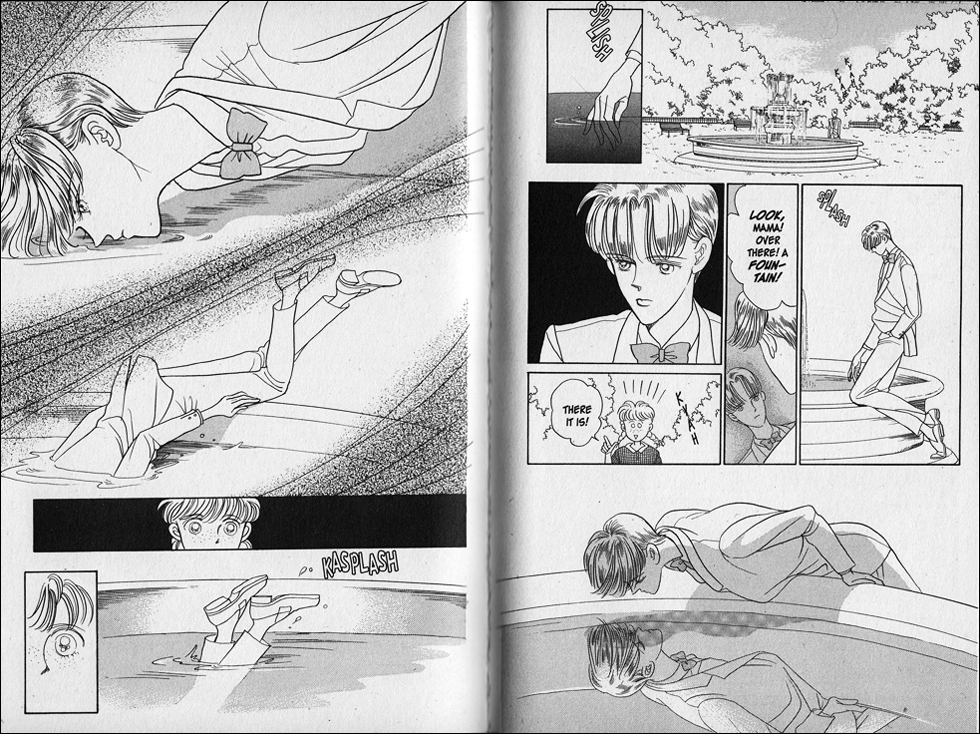
(read right-to-left | click images to enlarge)

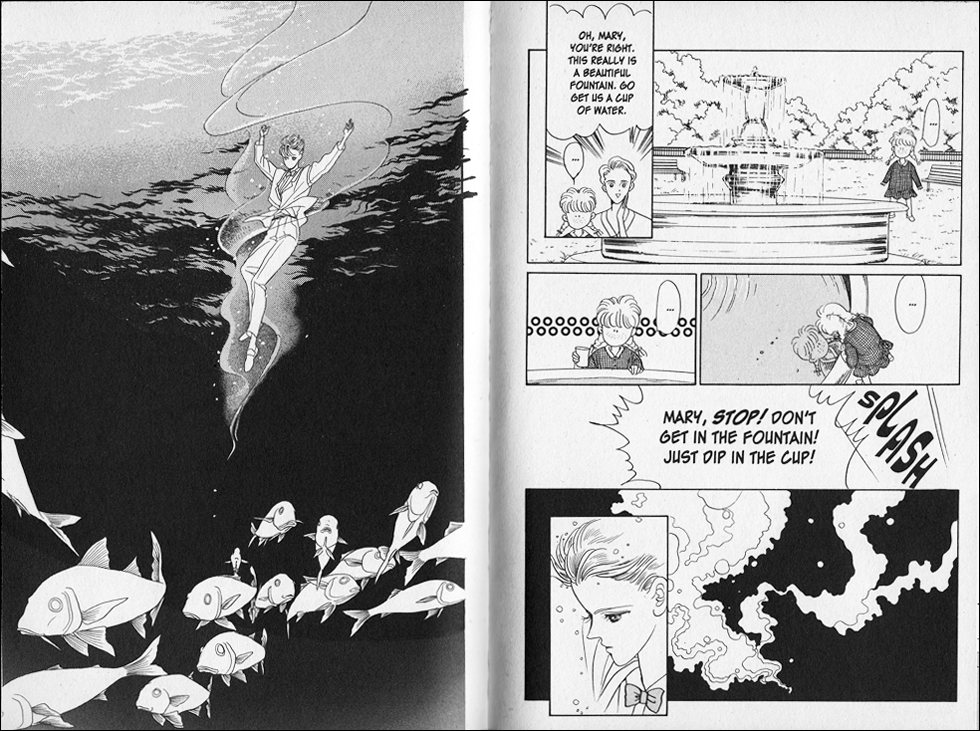
As it turns out, “Jimmy” is actually an alien mermaid named Benjamin, still in a sort of genderless larval form. Though, by day, he looks like a pre-adolescent boy in a suit and bow tie, moonlight transforms him into a beautiful (female) mermaid with long, flowing hair and soulful eyes and the inability to speak when it counts. We soon learn that these mermaids, scattered all across the universe, return to earth every six hundred years or so to spawn a new generation. We also learn that Jimmy/Benjamin is a descendant of the actual “Little Mermaid,” and that her entire clan is dedicated to making sure that Benjamin, unlike her mother, will appropriately mate with a merman instead of falling for a human, thereby thwarting a prophesied environmental catastrophe certain to wipe out their entire population.

(read right-to-left | click images to enlarge)

Complicating matters further, Benjamin is left to the care of her two siblings, Teruto and Seth, who have long been instructed that their purpose in life is to see that Benjamin matures into an egg-bearing female and mates properly, at which point they will merely dissolve into foam.

Seeing that Benjamin may potentially defy her duty by falling for the human, Art, her siblings battle (not quite successfully) the desire to remove her from the picture so that one of them can properly take her place.

MICHELLE: But the siblings are unable to actually do anything to Benjamin themselves, so Teruto, the more active of the pair, strikes a deal with the same witch who brokered his mother’s bargain to become human, and ends up possessing Gil Owen, the heir to an influential investment group, which results in the story being all about Chernobyl and Gil’s exceedingly convoluted plans (I am not even sure about this) to get Art to come to Kiev and then drive him so insane with the belief that Benjamin will destroy the world that he kills her. From a story that starts off about mermaids it really is entirely, as Shaenen Garrity wrote, all about water pollution.

MJ: Though there are numerous details we’ve declined to mention so far, as you can see, the series’ plot is fairly… esoteric. Furthermore, as I mentioned in the beginning, the series is problematic on a number of levels, including the visual age gap between “Jimmy”‘s usual form and that of his romantic prospects (Art, of course, and a merman named Shonach who is captivated by Benjamin’s beauty), his cheerful acceptance of Art’s physical abuse, and the highly unfortunate depiction of the mer-people’s prophet, Grandma, as a cross between a minstrel show caricature and a woman from the Burmese Kayan Lahwi tribe. (Click if you really want to know.)

But amidst all the crazy plotting, questionable characterization, and possible racism, there is a poignance and a unique beauty to this manga that is difficult to fully convey, though we’ll certainly do our best. And I hate to jump right to the ending, but I’ll admit that the series’ final volume—which provides two different possible endings, without making it fully clear which one is real—pretty much redeemed all its faults for me in one go. How often does that happen?

MICHELLE: The ending is very interesting, indeed! I will say, though, that leading up to it is a lot of stuff that doesn’t make a lot of sense, and for me, once you’ve reached the critical mass for “wtf” it spills over into “whatever,” so there were certain aspects of the conclusion that didn’t affect me as much as they might’ve, though there were a few subplots I liked very much.

MJ: I have a feeling there will end up being a bit of a divide here between us at some points—not because I think things necessarily made sense, but because that doesn’t matter nearly as much to me as it does to you. But I expect the conversation will be lively! So, why don’t we start off with some of the things we most liked, and then move on to the rest later? Where would you like to begin?

MICHELLE: With the twins. Really, I thought they were the most interesting aspect of the story, much more so than crybaby Benjamin who beguiles men purely on the basis of being lovely. I sympathized a lot with Teruto, who was bitter at having sullied his soul to provide for his gentler siblings and was to be rewarded for all that he had done with dissolving into foam. I also really enjoyed Seth’s journey, as after Teruto embarks on his plot for revenge he is given a chance to spread his wings and become more independent. I rooted for his relationship with Shonach from the start and enjoyed just about everything involving them up until the final volume. I didn’t care about Jimmy/Benjamin and her love for Art nearly as much.

MJ: I think I’m sort of half with you and half not. I absolutely agree with you about how fascinating the twins are, and I love the fact that though Teruto is, ultimately, the villain of the story, he’s also one of the most relatable characters by far. It’s pretty much impossible not to understand his resentment over his fate, which seems tragically unjust, and his devotion to Seth is quite moving. Seth’s journey, as you say, is also one of the most interesting aspects of the series, and he ends up being the character we care most about in the end.

On the other hand, I’m not quite with you on either the Seth/Shonach relationship or your feelings about Benjamin/Jimmy. I have to admit that I kind of hate Shonach. Probably he doesn’t deserve it—I realize that—but it really bothers me that his obsession with Benjamin’s beauty (her beauty only—he doesn’t care about her as a person at all, really) keeps him from being able to appreciate the best parts of Seth, to the point that even at the end, when Seth has matured into a female, he can only see her as Benjamin. That the only expression of true affection Seth ever really gets from Shonach is when he believes she is Benjamin really breaks my heart.

(read right-to-left | click images to enlarge)

Also, I admit I really do care about Jimmy/Benjamin, and I see her as being wronged pretty much throughout the story. She’s not responsible for her pre-destined role as this super-important mermaid who holds the fate of her race in her hands any more than Teruto or Seth are responsible for their pre-determined futures as bubbles of foam. Benjamin doesn’t want to mesmerize men with her beauty. If anything, she wants to be able to live indefinitely as Jimmy, so that she can preserve the relationship she (inexplicably) treasures with Art. But with everyone tugging at her fate from every side, what she’s got is a lot of unwanted attention from Shonach (for all the wrong reasons), a deteriorating relationship with Art (who is incapable of accepting her as an adult woman), and everyone and their mom out to kill or ruin her in one way or another. If I were Benjamin, I’d cry too!

MICHELLE: You know, it never occurred to me that Shonach was to blame for his fixation on Benjamin, but you’re absolutely right in terms of the limits of his feelings and how that blinded him to Seth most of the time. And yeah, I know that Benjamin doesn’t mean to mesmerize men, but… maybe Teruto’s plight just resonated with me extra strongly for various personal reasons, and so I came to regard her much like he does. I certainly didn’t feel this way about her in the beginning!

Also, I think I could’ve liked Benjamin more if I had really seen what she saw in Art, but because I couldn’t it affected the way I perceived her feelings for him. Of course, one can have genuine feelings for shitty people, but I got so irked at various times that my capacity for being thoughtful was impacted. It didn’t help that she—incapable, as Teruto pointed out, of doing anything for herself—eventually seemed to be trying to ruin Art so that he would kill her.

MJ: I can definitely agree that it’s really difficult to understand what Benjamin sees in Art. For my own various personal reasons (heh) I can understand her desire to help him rise up out of his professional slump so that he can regain his self-esteem, and he also proves his devotion to her in many ways throughout the course of the series, and I can see why she’d desire that, especially from someone outside the mer-world where she’s valued only as a sort of angel/demon icon. But it’s so difficult for me to swallow his abusive tendencies, that my view of him is ultimately pretty negative.

On a different note, one of the characters I ended up liking most by the end was Holly, who I’d hated early on for her manipulation of Art and her cruelty towards Jimmy. I was actually pretty surprised that I could end up liking her as much as I did, given where we started. But by the end, she was one of the few likable characters left.

MICHELLE: Speaking of Art’s profession, I did wonder whether the parts where we actually see him performing were among your favorites!

I never entirely warmed to Holly, but it did seem that concern over her brother’s fate—he’s in Colombia when an earthquake strikes—tempered her bitchy tendencies in a major way, and she was actually pretty horrified by what Gil was attempting to do, and much more attuned to there being something really wrong than Art, who was basically like, “I’m responsible for my sponsor’s injury so I will do whatever he says, especially if that happens to be touring a nuclear facility.”

Another unexpectedly fun character is Gil’s personal secretary, Rita. I admit, she’s quite a favorite for me. Tall, large, and unlovely, Rita harbors a crush on Gil even before Teruto takes possession of his (secretly terminally ill) body. When Teruto realizes her psychic gifts can amplify his own powers, he makes her his right-hand woman, and quells her questions with sex. I was disappointed that she turned out to be crazy, but her bizarre actions did help ratchet up the tension.

MJ: I loved Rita! I hate that she’s easily manipulated by her interest in Gil, but I can understand it, and really it only made me feel more indignant on her behalf. I suppose I, too, was disappointed that she turned out to be crazy in the end, but she wasn’t any crazier than Teruto/Gil by that point, so I was still rooting for her on some level. I kept sort of hoping she would ultimately prevail, but I’m not even sure what that would have meant. I am sad that she never got to see how her crush on the real Gil might have played out. I suppose she would have had little chance (even if he wasn’t dying) but I really hated the way she was treated by Gil’s overprotective sister, and I would have loved for the sister to have been proven wrong for real. You know. Not just because her brother’s body got taken over by the soul of a vengeful alien mermaid.

And to answer your earlier question, yes I really did love the parts where we saw Art actually performing! I loved all the ballet stuff, actually, including the bits with Artem Zaikov, the Russian dancer who (for his own personal reasons—I guess we shouldn’t spoil everything) has it in for Art, but who ultimately won my heart by way of his charming family.

MICHELLE: Characters who look like Rita are so rare in manga that I think it’s utterly natural to root for them and hope they will prevail. Which… I suppose in a way she did, but not in a way that made her feel any better about herself.

And I was just going to ask you about Artem! When Gil was first introduced, I thought, “Wait, who is this guy?” It soon became clear what his story was, however. Shimizu duplicates this feat near the end, with Artem’s introduction providing another “Wait, who is this guy?” moment that eventually proves pivotal to the climax of the series. I really liked him, and was especially impressed by the way his dancing was drawn—I swear, Shimizu was able to perfectly capture the ways in which his style differs from Art’s.

(read right-to-left | click images to enlarge)

MJ: Yes, she really does! I feel pretty strongly that Shimizu must be a real ballet fan. Okay, I’m going to end up spoiling things after all, here, but it seems likely to me that she based Art and Artem’s mutual father, “Rimsky” on the legendary Russian dancer Vaslav Nijinsky (despite entirely glossing over his sexuality), right down to the mental illness that ultimately ended his career, and she passed down some of his defining characteristics to Artem.

Among other things, Nijinsky was known for his sensuality and androgynous appearance onstage, which is exactly how she characterizes Artem. There’s a little Nureyev in there, too (which is more appropriate to the time period), but I feel like her real interest is Nijinsky. And despite Artem’s claim that it’s Art who is “the reincarnation of Rimsky,” it’s Artem who most resembles what we know of Nijinsky, body type notwithstanding (Nijinsky was kinda stocky).

Vaslav Nijinsky in Le Spectre de la Rose E. O. Hoppé, 1911

MICHELLE: Check out MJwith the ballet knowledge!

I think Shimizu likes the idea of parental characteristics being split between siblings. Rimsky’s look and style are passed down to Artem, but his must-kill-love-interest-she-is-dangerous traits are passed to Art. Meanwhile, Seira’s love for the human prince is inherited by Benjamin, while her love for her original mer-person fiancé is embodied in Seth.

MJ: Oh, what a smart observation, Michelle! I hadn’t thought of that, but you’re absolutely right. With that in mind, it becomes even easier to understand Teruto’s tragedy. He’s the only one of Seira’s offspring to receive basically nothing from her. I think one of the most poignant moments in the series is the flashback in which Teruto overhears one of their caretakers talking about the fact that it’s really only Benjamin and Seth who are priorities, because Teruto is (essentially) barren. And since these mermaids seem to be valued only for their ability to bear eggs, they might as well be saying that Teruto has no soul. It’s that devastating.

MICHELLE: You can’t see me, but I am nodding emphatically. Teruto’s entire purpose is to protect the other two; he’s not destined to have any future of his own. Really, though, none of the mer-people are, as we learn late in the series (and I can’t tell if this was planned all along or what) that they will all die shortly after spawning. I feel like Shimizu could’ve emphasized the biological imperative a bit more—early on, there are many comparisons to fish, along with visuals of the spacefishies returning to Earth, but at the time we didn’t know that this would also be their final journey. Though, I guess if I were really up on my ichthyology, I might’ve expected it.

MJ: Mostly, I feel that revealing this late in the story was really effective. I thought it was kind of a brilliant way to suddenly change the reader’s perspective and it’s interesting, too, because it simultaneously makes things seem both more and less urgent, in terms of the relationship issues we’ve been following the entire way through. But since we’ve managed to stumble on one of the areas where you feel Shimizu fell down a little, let’s steer our way in that direction. I’m sure you’ve been bursting all along with the need to scream, “BUT IT DOESN’T MAKE SENSE!” Am I right?

MICHELLE: Not exactly bursting, and (perhaps surprisingly) not at all over the general concept itself. Once something crosses that surreal threshold, it becomes easier to accept whatever kooky setup the creator wishes to explore. But certain particulars of the plot did bug me, like “Why do these guys love Benjamin?” or, most significantly, “How does Teruto/Gil doing all this stuff accomplish his goal of having Seth turn into a female and bear eggs?”

MJ: Well, I think the first question we pretty much have to chalk up to Benjamin’s physical allure, which is made out to be pretty spectacular in a very specific, fantasy-driven way. Benjamin is drawn as a classic fairy-tale princess, all wide eyes and golden, billowing hair—a stark contrast to all the sleek, modern women in the series, like Holly. I think we’re supposed to pretty much take it as a given that all men are helpless in the face of that kind of beauty.

The only reaction that is a bit more complicated is Art’s, since he’s more attached to the (in his mind) sexually null Jimmy. By the way, am I the only one who noticed that Jimmy seems to get younger and younger as the series goes on? At first it really bothered me, but after a while I started to think that Benjamin might be achieving that by pure strength of will, in her ongoing effort to try as hard as possible to be what Art most wanted her to be— almost like some kind of automatic defense mechanism. Like a chameleon.

Regarding Teruto/Gil… well, I think it becomes pretty clear after a while that Teruto is much more driven by his need to destroy Benjamin than he is by his desire to put Seth in her place. I mean, the idea is supposed to be that if Benjamin dies, Seth will be the next in line to mature into a female. But it certainly seems like this could have been accomplished much more easily by other means. Somehow.

MICHELLE: Yeah, I don’t think Chernobyl needed to blow up in order for Benjamin to die. A suggestion to Rita would’ve done the trick, I’m sure.

I’m glad you mentioned that about Jimmy, because I definitely noticed it, too! There’s one scene in volume three (pages 86-87) where her size is extremely variable. Sometimes he looks more five than twelve! I wondered if it was intentional on Jimmy’s part, but Art doesn’t react at all, so I suspect it’s a Shimizu issue.

(click image to enlarge)

MJ: And when we first see Jimmy, she looks pretty much exactly the same as Teruto and Seth do later on, which is to say maybe mid-to-late teens. Originally, I thought maybe Shimizu changed her mind about Jimmy’s visual age to avoid dealing with any issues regarding Jimmy’s sexuality except when she appears as Benjamin, and maybe to avoid Art having to be confronted by that as well. But I was never really sure.

MICHELLE: Yeah, me neither. Probably “never really sure” is just a state of mind one has to become accustomed to with Shimizu’s works.

Alas, no others have been licensed in English and aren’t likely to be now that CMX has disappeared. (Please bow your heads for a moment of silence.) I have thirteen volumes of Princesse Kaguya in French waiting to be read, though, and her josei series Top Secret is also coming out en Français.

MJ: I really would like the opportunity to read more of her work. As weird as Moon Child is, it feels really… I don’t know… organic. And I think Shimizu’s omake sections are actually really telling, here. I don’t always read these, but I poked through a few of hers, and my immediate impression was, “Oooooh, this is what it’s like in her mind all the time.”

MICHELLE: Yeah, those are really kooky! The two robot characters who feature in the omake, Jack and Elena, star in a string of stories by Shimizu, beginning with Milky Way, so they’d be familiar to her regular readers. It makes me wonder if, in some subsequent series, there might be similar omake starring the cast of Moon Child!

MJ: So, before we wrap up, I just want to gush a little bit about Shimizu’s artwork. You know I’m a huge fan of shoujo from this era, and really, there could be no better example of why that is. I chose a scene from this series back on our Let’s Get Visual column Celebrating the Pretty, and seriously that is still one of my favorite sequences of all time.

(read right-to-left | click images to enlarge)

Yet, I’m leafing through the books now, and page after page, I’m seeing visuals that just pretty much blow me away with their haunting beauty, like the dream tidal wave in volume seven, or the creepy, creepy fish inquisition in volume eight. In many ways, it’s the series’ weirdness that makes it work so well for me, visually, because it’s so well-suited to Shimizu’s artistic mind.


MICHELLE: That wave! Here’s what I wrote about it in my notes: “A… very trippy sequence with a wave ensues.” There are many strange and lovely sequences in the book.. I was disappointed that we saw less and less of the fishy manifestations as the series went on, but I believe that’s tied in to Benjamin’s form stabilizing as she matured. I also really liked the exquisitely detailed line drawings that frequently appear in between chapters.


Another thing that impressed me was Seth’s female form, who was so very beautiful—more than Benjamin, even—and entirely feminine, and yet everything about her mannerisms still made it clear that she is Seth. She actually appears on the cover before she appears in the manga, and I blinked for a second in puzzlement and then got geekbumps when I figured out who it was.

MJ: Oh, you’re absolutely right! Honestly, I felt chills through the entire scene in which Seth finally transforms. Not only is she so completely, utterly Seth, but the way Shimizu reveals the transformation, in rapid, chaotic spurts, just as Seth must be experiencing it, is absolutely stunning.


MICHELLE: I just got geekbumps again thinking about it. Although I admit, I have to squash the logical part of my brain that’s demanding to know how she and Shonach did the deed when she was in her neither male nor female state.

MJ: I feel that adolescent mermaid sex is one of those things we’re just better off not really thinking about.

MICHELLE: I cannot help but concur.

MJ: You don’t know this yet, but I’ve been going pretty much crazy here with scanning in artwork. There’s just so much I want to share with our readers. I know that Moon Child is in many ways a great big mess, but honestly this is the kind of series I most long to see more of in English. It’s just so beautiful and so unique. There are a lot of current shoujo series that I love very much, but it’s this stuff that I really hunger for as a reader. It’s something I can’t get in any other medium. Not like this.

MICHELLE: I wish I could be hopeful that we’ll see more manga like this in the future, but taking chances in this business doesn’t seem to pay. Every series has its faults, and Moon Child is not an exception, but that doesn’t mean I’m not infinitely grateful to CMX for making it possible for us to read it.

MJ: I most certainly am. And yes, I know that historically these series have not been strong sellers. I guess all we can really do is to continue to write columns like this, in hopes of getting more readers interested in the kind of manga we wish we could see more of.


More full-series discussions with MJ & Michelle:

Fullmetal Alchemist | Paradise Kiss | The “Color of…” Trilogy | One Thousand and One Nights| Please Save My Earth
Princess Knight | Fruits Basket | Wild Adapter (with guest David Welsh)

Full-series multi-guest roundtables: Hikaru no Go | Banana Fish | Gerard & Jacques | Flower of Life

Filed Under: OFF THE SHELF Tagged With: moon child

  • « Go to Previous Page
  • Page 1
  • Interim pages omitted …
  • Page 768
  • Page 769
  • Page 770
  • Page 771
  • Page 772
  • Interim pages omitted …
  • Page 1053
  • Go to Next Page »
 | Log in
Copyright © 2010 Manga Bookshelf | Powered by WordPress & the Genesis Framework