• Skip to primary navigation
  • Skip to main content
  • Skip to primary sidebar
  • Home
  • About Us
    • Privacy Policy
    • Comment Policy
    • Disclosures & Disclaimers
  • Resources
    • Links, Essays & Articles
    • Fandomology!
    • CLAMP Directory
    • BlogRoll
  • Features & Columns
    • 3 Things Thursday
    • Adventures in the Key of Shoujo
    • Bit & Blips (game reviews)
    • BL BOOKRACK
    • Bookshelf Briefs
    • Bringing the Drama
    • Comic Conversion
    • Fanservice Friday
    • Going Digital
    • It Came From the Sinosphere
    • License This!
    • Magazine no Mori
    • My Week in Manga
    • OFF THE SHELF
    • Not By Manga Alone
    • PICK OF THE WEEK
    • Subtitles & Sensibility
    • Weekly Shonen Jump Recaps
  • Manga Moveable Feast
    • MMF Full Archive
    • Yun Kouga
    • CLAMP
    • Shojo Beat
    • Osamu Tezuka
    • Sailor Moon
    • Fruits Basket
    • Takehiko Inoue
    • Wild Adapter
    • One Piece
    • After School Nightmare
    • Karakuri Odette
    • Paradise Kiss
    • The Color Trilogy
    • To Terra…
    • Sexy Voice & Robo
  • Browse by Author
    • Sean Gaffney
    • Anna Neatrour
    • Michelle Smith
    • Katherine Dacey
    • MJ
    • Brigid Alverson
    • Travis Anderson
    • Phillip Anthony
    • Derek Bown
    • Jaci Dahlvang
    • Angela Eastman
    • Erica Friedman
    • Sara K.
    • Megan Purdy
    • Emily Snodgrass
    • Nancy Thistlethwaite
    • Eva Volin
    • David Welsh
  • MB Blogs
    • A Case Suitable For Treatment
    • Experiments in Manga
    • MangaBlog
    • The Manga Critic
    • Manga Report
    • Soliloquy in Blue
    • Manga Curmudgeon (archive)

Manga Bookshelf

Discussion, Resources, Roundtables, & Reviews

Blog

Pretty Guardian Sailor Moon, Vol. 6

July 23, 2012 by Sean Gaffney

By Naoko Takeuchi. Released in Japan as “Bishoujo Senshi Sailor Moon” by Kodansha, serialized in the magazine Nakayoshi. Released in North America by Kodansha Comics.

Having defeated Death Phantom and the Black Moon Clan, and briefly saying hi to their 20th century selves, Usagi and friends have returned to the present, ready to prepare for their final year of middle school, with all the test-taking that involves for typical Japanese students. But this is Sailor Moon. More importantly, it’s the Sailor Moon manga, where filler is hard to find. There’s barely any time to breathe before a new enemy has made its presence known. But… who *is* the new enemy, anyway?

It has to be said, the senshi are getting better at finding and stopping threats. There is no flailing around the way we sometimes saw in previous volumes. The trouble is that while they can find beings of power, they aren’t quite sure if they’re bad guys or not. Sometimes it gets obvious right away. Possessed schoolgirl has huge lumpy monster leap off her back? That’s a bad guy. (Well, the lump anyway, try not to kill the girl.) But there’s also a couple at the newly formed Private School For The Awesome, Mugen Academy. He’s a cocky smart-aleck who seems taken with Usagi, but also gives off a different kind of aura. She’s a cool and self-possessed gorgeous teen who seems to like Mamoru. And together… well, they have their own agenda.

Of course, I am talking about Haruka and Michiru, who (along with Hotaru) make their debut here. It’s interesting in hindsight to see how much time Takeuchi-san devoted to making the main cast doubt the two new cast members, mostly as, of course, from our perspective, we know they’re good guys, if ones with ambiguous ethics. They’re helped out by a deliberate stylistic art choice. Haruka, when she’s being her normal Academy student self, is not only drawn in the male uniform but is drawn as a male. The judo practice in particular shows this. Whereas when she’s Sailor Uranus, there are far more curves. As I said, though, this is mostly stylistic (Naoko admitted as much in an interview), and Haruka does not appear to be a sex-changer like Ranma or anything. The anime didn’t even bother to deal with this at all, and just made Haruka obviously female for all but her very first episode.

There’s a lot of gender identity stuff here. When Makoto gets hurled to the ground in the judo match, the other senshi yell at Haruka, but she replies that gender shouldn’t matter if you have something you want to protect. Likewise, later on Usagi asks Haruka (who she suspects of being Sailor Uranus) point blank if she’s a woman or a man, and Haruka asks “Does it matter?”. Being a woman and the strength that it provides are a core theme of the series, of course, but Haruka’s dual identity adds a dual thrill to the whole thing. As for the agenda of Sailors Uranus and Neptune, it seems to be partly ‘this is our fight, not yours’ and partly ‘we are better at this and know better’. Though thankfully not quite as obnoxious about it as they would be in the anime.

And there’s also Hotaru, one of my favorite characters, who at this point seems to be shaping up to be a tool of the big bad more than anything else. As opposed to the other senshi (including Uranus and Neptune), Hotaru’s true identity actually *does* remain a surprise in the manga proper, though this is slightly spoiled by the start of the volume having a giant color picture of all ten senshi. Hotaru here mostly gets ill and bonds with Chibi-Usa (who is quite cute here, and also very much like her mother). There is an interesting scene where she is clearly unhappy with Kaolinite, her father’s new assistant, accusing her of breaking up their family. Unfortunately, I think she is going to be disappointed on that front. Despite her initial standoffishness, though (much like the other Outers), there is a core of empathy to Hotaru that makes us sympathize with her.

I do still have a few issues with the manga proper. The anime, particularly this arc, spoiled me for real villains. Yes, the Witches 5 are present and accounted for, but they’re one-offs who do their schtick and get killed off. We don’t even get Eudial driving her car! Likewise, I’m afraid that the main villain behind the scenes, Pharaoh 90, is another nebulous black miasma of evil. Not to be confused with the previous two nebulous black miasmas of evil. (I think Takeuchi eventually realized what she was doing and ‘fixed’ this, if I recall the Stars plotline correctly.)

Still, overall a fantastic volume of Sailor Moon. And hey, who’s that we see at the cliffhanger? Gosh, she looks very familiar…

Filed Under: REVIEWS

Wonder!, Vol. 2

July 21, 2012 by Sean Gaffney

By Akira Kawa. Released in Japan by Futabasha, serialized in the magazine Women’s Comic Jour. Released in the United States by Futabasha on the JManga website.

The second volume of Wonder! (which has just ended in Japan, by the way, and is 17 volumes total) continues the types of stories we saw in the first. It’s a story about what it means to be a family, in all the myriad ways: husbands and wives, parents and children, and the multi-generational aspect of everything. It also touches on childcare quite a deal, and might actually strike some as being a bit heavy-handed at times. I think the writing and characterization is so strong, though, that it overcomes any issues it might have.

The protagonist role continues to switch back and forth between forthright and emotional Kaori and her reserved and quiet adopted son, Kota. Having jumped forward about 9 years in the first volume, this one settles down into his final years of high school, as the manga seems to have been picked up as a series fully by now. Kota’s future is not so certain, though. He doesn’t really want to go to college, and is content to simply start working full time at the snack bar he’s been with. Everyone seems to wonder if this is really the right choice for him, though… especially as he seems to brim with unfulfilled potential. As the volume goes on, a new possibility makes itself known: Kota is really fantastic with kids, and it’s brought up that he may want to look into being a caregiver of some sort. Whether he takes this up or not is another matter. Kota is not quite as hard to read as his father, Taiyo, but it’s clear he’s at that age where he doesn’t want to burden his family but also doesn’t ant to leave.

As for Kaori, if she seems angrier than usual here, it’s mostly because her mother has moved in with them temporarily, after getting divorced from what appears to be her fifth husband. It’s lampshaded right away that Kaori and her mother are far too similar for their own good, though Kaori certainly comes off better when we compare; her mother is written as deliberately antagonistic most of the time, and picks fights constantly. Just as much as this series is about family, it also seems to be about communication, and how hard it is to really get anything across even when you *do* mean well. Kaori has always been upset with her mother for ruining her second marriage (the first, which led to Kaori, ended with her father’s death from illness). And after a long series of arguments, her mother finally reveals the real reason that marriage fell apart. Kaori is stunned, and rightly so, but… you also feel sympathy for her mother, as really, how do you begin to bring that up with a child?

It can be argued that Kori and Taiyo’s family is a bit too perfect, especially compared to the other family we get to know in this volume, which involves both spousal and parental abuse. There’s an interesting discussion of disciplining a child – Kaori is adamant about hot hitting her child, partly due to the real reasons that it’s not a good thing to do, but also because of her own memories of being hit as a kid. When the abused young child of a different family comes to live with them for a short period, Kaori is frustrated that he’s acting up and lashing out – the child even attacks Wonder, the titular dog! Kaori is stunned to realize that at one point she wanted to strike the boy, and her mother cynically notes, “Did you think that you were perfect?” Well, she may have – her own child, Miya, is adorable, well-mannered and behaves, she and her husband have resolved the whole ‘open marriage’ thing from last volume and seem to have bonded. It’s easy to be judgmental towards someone whose problems you’ve never dealt with.

As with Volume 1, this volume ends with a one-shot story about an unrelated couple. This one has a bit of a fantasy aspect – a young wife who’s feeling stressed out and uncertain about her marriage, especially as her husband is ten years older than she is, finds that an older couple have moved in next door to him – and not only are they eerily similar, but there even seem to be future echoes of the fights that she and her husband have. The revelation here was more obvious than I’d have liked – anyone who’s read speculative fiction will get it right away – but I still enjoyed it, especially as it examinees the fact that choosing to live with someone the rest of your life can be a scary and terrifying thing to do… but is ultimately really sweet.

In case you’re wondering, Wonder does appear throughout, and still appears to have that ’empathy’ superpower and ability to always find a person in trouble that he had previously. In fact, Kota may share the same ability – the parallels between Kota and Wonder are numerous. As for Volume 3, I’m definitely awaiting more, despite a cliffhanger ending (was it a cliffhanger?) to Chapter 9 that made my jaw drop – let’s just say that the most serious part of the manga was dragged uncomfortably back and given a light, almost offhand touch. I’m not certain how morally dissonant it was meant to be, honestly, and to say more would be to spoil. But for anyone wanting a josei manga about family and raising children, Wonder! is a fantastic choice.

Filed Under: REVIEWS

Polterguys, Vol. 1

July 20, 2012 by Katherine Dacey 9 Comments

If you’ve ever watched Iron Chef, you know that some competitors prevail by transforming the day’s theme ingredient into dishes of astonishing originality and complexity, while others win by making everyday dishes—say, mac and cheese or fish sticks—with such consummate skill that they elevate comfort food into cuisine. I don’t know what kind of cook Laurianne Uy is, but if I had to hazard a guess based on her writing, I’d say she fell into the second category of culinary magicians. Polterguys, her print debut, isn’t astonishing for its novelty, but for its masterful presentation of a familiar story.

That story goes something like this: nerdy high school girl Bree seeks a fresh start in college. Bree soon discovers, however, that college isn’t the haven she imagined it would be. Her roommate is loud and messy, and her classmates are more interested in partying than studying. When presented with the opportunity to live on her own, off-campus, Bree jumps at the chance. The house she rents, however, is already occupied… by five male ghosts. And cute ones, at that.

What prevents Polterguys from reading like a supernatural retread of Ouran High School Host Club is Uy’s ability to adapt the reverse-harem concept to an American setting. The college town in which the story takes place bears a strong resemblance to Berkeley, CA (or perhaps Palo Alto), and the characters who inhabit the town look and sound like American college students. Her ghosts are pleasingly diverse, running the gamut from all-American jock to dread-locked scientist. Best of all, Uy’s protagonist has a depth and complexity that many shojo heroines lack; Bree is smart and capable, but her prickly behavior, fierce work ethic, and inability to relate to her peers make her seem like a real person, rather than a wallflower who’s just waiting for a hot guy to fall in love with her. (She’s also appealingly quirky, hanging a picture of Dr. Sanjay Gupta on her dorm wall for hunkspiration.)

Polterguys also benefits from a tightly scripted story. Uy handles the exposition crisply, using an emotionally charged scene to frame the action: we meet Bree, watch her move into her college dorm, then see her collapsed, sobbing, in the rain several weeks later. The story then jumps back to the beginning of her first semester, showing us the sequence of events that led to that tearful moment. Though Uy covers considerable territory in her first volume, completing one character’s story arc and establishing another (presumably to be addressed in the second volume), the narrative never feels rushed; Uy steadily increases the dramatic tension, building to third-act climax that’s both sad and satisfying.

Art-wise, Polterguys may remind readers of Dramacon and Nightschool — not because Uy’s style resembles Svetlana Chmakova’s, but because Uy, like Chmakova, employs an artistic vocabulary that’s a distillation of shojo manga conventions, rather than a slavish imitation. Uy’s character designs are a great example: though they’re heavily stylized and simplified, they owe as much a debt to Archie as they do to Ouran; the only obvious nod to shojo manga is embodied in a pair of twins who have a bad case of Manga Hair. (Both sport spiky, skunk-striped fetlocks.) In another departure from standard shojo operating procedure, Uy draws Bree as a slightly awkward, geeky figure — bespectacled and freckled, favoring Carhart pants over cute outfits — rather than a blandly pretty teen.

The Polterguys with Bree (front right). Image copyright Laurianne Uy.

Perhaps the best compliment I can pay Polterguys is that it’s an old story told well. Uy’s witty script and appealing characters leave a fresh impression, even when the plot itself does not; Polterguys is one of the most unabashedly fun new comics I’ve read this summer. Recommended.

Where to Read and Buy: Readers curious about Polterguys can read the entire first volume at Laurianne Uy’s website. Thanks to a successful Kickstarter campaign and a 2012 Xeric Grant, readers who would like to own a copy can purchase PDF and paper copies through her website. Polterguys is also available through Amazon, Barnes & Noble, and the Apple Bookstore.

Review copy provided by the artist.

Filed Under: Manga Critic Tagged With: Laurianne Uy, OEL/Global Manga, Reverse Harem, Supernatural Romance

Negima! Magister Negi Magi, Vol. 35

July 20, 2012 by Sean Gaffney

By Ken Akamatsu. Released in Japan as “Mahou Sensei Negima!” by Kodansha, serialized in the magazine Weekly Shonen Magazine. Released in North America by Kodansha Comics.

Sometimes when you’re reviewing Volume 35 of a series, it can be a bit difficult to know what to say. Especially when so much of the volume is people punching other people, sometimes with lightning. But as we head breathlessly towards the climax, we are reminded that Akamatsu always manages to make things interesting, even when we don’t expect it.

Note that Negi is not on the cover for the 2nd volume in a row. Instead we get Ayaka in costume, surrounded by the five girls who probably ended up getting the least attention in the series. I mean, even Zazie gets to be an actual demon. The twins and the cheerleader girls, though, ended up suffering from Akamatsu trying his best to write a plot that would feature 31 different girls and not quite making it. We get another brief reminder of Sakurako’s insane luck skills, but other than that, their main function is to be the ‘reassuringly normal ones’ when Haruna returns to Mahora Academy (even if, as Madoka intuits, that’s an insult by now).

As for the fighting, it’s rather interesting that even after all this time, Negi still wants to try to resolve things through discussion. It tends to separate out Negima from other shonen fighting titles – yes, there’s a love of physical combat, but every time we confront a villain and prepare for battle, there’s an offer to try to mediate. This doesn’t just extend to Negi, as even his followers do the same – Nodoka’s overture of friendship to Fate may get her socked in the jaw, but that doesn’t make it less sincere. (I would like to take the time to note, since I suspect I won’t get the opportunity again, how much I love Nodoka’s character arc in this entire series. She’s come a long way from ‘that one who’s like Shinobu from Love Hina.) But of course, for all the attempts at peacemaking, in the end it comes down to a lot of fights – which, luckily, Negi is also very good at.

One of the surprises in this volume is the fact that the connections between Magical World and the ‘real’ world of Mahora Academy have become so broken down that the fight is now literally coming to the school. This, of course, allows a lot of the cast who were left behind to appear again, as I noted above. It also allows Evangeline to finally give up and embrace her not-villain status. For a supposed morally bankrupt vampire, she’s really been one of the more noble characters in the series, and Negi’s influence has done her a world of good. As Zazie notes. Speaking of which, Zazie’s sudden penchant for conversation, and lampshading of Eva’s sudden affection for her classmates, is easily the funniest part of the book.

And yes, there’s people being stripped, and discussion on which of the girls Negi likes best, because this is still Akamatsu, after all. In the end, though, we’re left with another killer cliffhanger, as we find out what’s actually beneath that world tree. Oh yes, and Kodansha remembered to keep the extras this time!

Filed Under: REVIEWS

Manga the Week of 7/25

July 18, 2012 by Sean Gaffney

The last week of the month has always been the quietest since Tokyopop left us, and this month is no exception. Let’s see what we’ve got.

Kodansha has two titles hitting Diamond. Arisa reaches volume 8, and finds that her love may be a building which is on fire. Meanwhile, Phoenix Wright: Ace Attorney wraps up with Vol. 5, saddening all the fans of the game who aren’t aware that the Edgeworth manga is apparently due out later this month. (Despite having no cover art online yet.)

And, because it’s such a small week, I’ll note that Udon has a new volume of its Apple artbook, featuring more pinups from the best Korea has to offer.

Aaaaaand that’s it. So? Any titles for you?

Filed Under: FEATURES, manga the week of

Quick Wednesday manga links

July 18, 2012 by Katherine Dacey

Pour yourself a cup of coffee and grab a Danish — Ryan Holmberg has posted another in-depth article about the early manga industry, this time examining the influence of American cartoonists on Osamu Tezuka’s early artistic development.

Derek Bown dedicates his latest Combat Commentary column to Naruto.

Sequential Tart interviews Gina Biggs, creator of the OEL manga Red String.

And the Eisner goes to… Shigeru Mizuki’s autobiographical comic Onwards Towards Our Noble Deaths, which won the award for Best U.S. Edition of International Material — Asia. Katsuhiro Otomo also got a nod from the judges, earning himself a spot in the Eisner Hall of Fame.

Shiftylook, a webcomic initiative of Namco/Bandai, has hired manga-ka Hitoshi Ariga (The Big O, Megaman Megamix) to draw a new webcomic based on popular game Klonoa; Canadian artist and writer Jim Zub will pen the script.

Reviews: Over at Anime News Network, Carlo Santos dedicates his latest Right Turn Only!! column to such new releases as 5 Centimeters Per Second and Jiu Jiu. Closer to home, the Manga Bookshelf gang posts an assortment of brief reviews.

Patti Martinson on vol. 20 of Claymore (Sequential Tart)
Connie on vol. 2 of Dawn of the Arcana (Slightly Biased Manga)
Johanna Draper Carlson on Genshinken: Second Season Book One (Manga Worth Reading)
Erica Friedman on Jigoku NEET (Okazu)
Connie on vol. 14 of Kimi ni Todoke: From Me to You (Slightly Biased Manga)
Sean Gaffney on vol. 63 of One Piece (A Case Suitable for Treatment)
Lissa Patillo on vol. 18 of Ouran High School Host Club (Kuriousity)
Connie on vol. 2 of Princess Knight (Slightly Biased Manga)
Lori Henderson on vols. 8-9 of Rin-ne (Manga Xanadu)
Connie on vol. 2 of Wandering Son (Slightly Biased Manga)

Filed Under: MANGABLOG

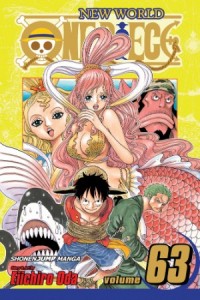
One Piece, Vol. 63

July 18, 2012 by Sean Gaffney

By Eiichiro Oda. Released in Japan by Shueisha, serialization ongoing in the magazine Weekly Shonen Jump. Released in North America by Viz.

There’s always a risk that Oda runs because he puts everything into his manga. This is not a title like Bleach, where a 5-minute fight can take three months of real time. There’s always at least ten different things going on. The difficulty is in trying to keep all that happening and not confuse or alienate the audience with too much information all at once. And in this volume, I’m afraid a lot of the time Oda doesn’t quite manage it. He’s simply trying to do too much too fast here, using too many characters that we haven’t grown to care about yet.

This is basically a volume in two halves. The first continues the melee battle on Fishman Island, as the Straw Hats get in between a civil war/coup started by Hody Jones and his brand of outlaw scum. Of course, they’re powerful outlaw scum, so King Neptune and his good guys are getting pounded. Meanwhile, Luffy has succeeded in getting Princess Shiratori outside, but this quickly leads to even more chaos. And then there’s Jimbei, who is down by the grave of the princess’ mother, feeling guilt and sadness. There are some nifty fights (Zoro is, as usual, badass) and the odd goofy comedic moment (Sanji seems to finally get better here, after briefly turning to stone (which I’m sure isn’t meant to be metaphorical at ALL.) But mostly the chaos is what’s driving everything, and this does make things incoherent at times.

Some things to note: Nami’s subplot is actually quite interesting. She’s recognized, sort of, as being an ex-member of Arlong’s crew, and certainly Jimbei’s guilt is directed quite a bit in her direction. But we don’t really see her reacting much beyond faraway looks and the occasional sweatdrop. I like to think that it’s Oda showing that Nami is finally starting to move on from her past (we get a nice page-long flashback from Nami for those readers who may have forgotten it), but also we see that she can also see things from the other side now, and is more aware of the prejudice and persecution that fish-people have suffered. Not that she’s forgiving Arlong anytime soon.

Which leads us into the big flashback. This is an unusual flashback in that it doesn’t seemingly stem from a crewmember’s past and end with them joining Luffy – unless that’s meant to be Jimbei. Instead, we meet Fisher Tiger and Queen Otohime, two characters whose dreams and ideals for their people are contrasted against each other. Fisher Tiger knows what’s right and tries to follow that, but the constant abuse of humanity against his people has ground him down. As for Queen Otohime, her naivete is contrasted with her nobility and pure stubbornness, and we learn that even if fishmen and humanity can try to move closer together, it only seems to take one person with different ideas to screw everything up. As you might guess, prejudice is not an easy fix, especially when it involves slavery.

The aftermath of the queen’s death will have to wait for the next volume, as she dies on the last page (Oda even notes there’s no room for extras this time). But it’s not going to be pretty. Oda is showing us that the world is a complex, contrasting, and sometimes horrible place. Even if he’s trying to jam it into a narrative already overstuffed with political battles and revolutions. Next volume should have a lot of fights, which will actually come as a relief after all this buildup, I think.

(Also, Oda’s response to the reader asking who the father of Makino’s child is is classic Odatroll. He clearly knows all about the Shanks/Makino shippers, and is baiting them mercilessly.)

Filed Under: REVIEWS

Last week at Manga Bookshelf, July 8th-14th

July 17, 2012 by MJ Leave a Comment

With so much going on here these days, it seemed time to establish a weekly roundup. Here’s what you may have missed at Manga Bookshelf last week, July 8th-14th!

From the main blog:

The Battle Robot each chose a Pick of the Week and filed a new installment of Bookshelf Briefs.

Megan checked out The Comic Book History of Comics and Chicks Dig Comics, while Sean continued his Kliban excavation in Not By Manga Alone: Supreme and other drawings.

Sara K. continued her exploration of Chinese-language pop culture with a look at the Taiwanese feature film Cheerful Wind in last week’s installment of It Came From the Sinosphere.

Matt Blind caught up on two more manga bestseller lists, covering the weeks ending May 27th and June 3rd.

Finally, Michelle and I discussed three supernatural shoujo series—Natsume’s Book of Friends, La Corda d’Oro, and Jiu Jiu in last week’s Off the Shelf: Communicable Crankiness.

From The Manga Critic:

Kate reviewed two Vertical titles this week—volume two of The Flowers of Evil and the single volume josei manga Sakuran. She also shared details on VIZ’s new android app.

From A Case Suitable for Treatment:

Sean checked out volume three of Hetalia Axis Powers from the semi-revived Tokyopop and Olympos from Yen Press, and shared his thoughts on this week’s upcoming manga.

From MangaBlog:

Brigid shared some links, including news about the upcoming Sailor Moon anime, before heading off to San Diego. Kate tends the store in Brigid’s absence.

Offsite:

Brigid talked about manga with a reporter at The Boston Globe, and Sara K. shared some insights on learning to read Chinese (recommendation: comics!) at Hacking Chinese.

Filed Under: Last week at Manga Bookshelf

It Came From the Sinosphere: Creative Comics Collection

July 17, 2012 by Sara K. 8 Comments

A collage of illustrations from Issue 7 of Creative Comics Collection, depicting various myths and legends

Pretty, isn’t it? Before you learn more about it, here’s some history for you to read!

A Brief Demographic History of Taiwan

Tens of thousands of years ago, Taiwan was not an island, and stone age people walked from Fujian to Taiwan. Then, when sea levels rose, Taiwan became an island. Thousands of years ago, Austronesian people showed up in Taiwan. It is unknown what relationship they had with the people already living in Taiwan, but the most likely scenario is that they married each other and had kids.

In the 17th century, Europeans (primarily the Dutch and Spanish) colonized Taiwan. They never arrived in sufficient numbers to have much direct impact on Taiwan’s demographics. But the era of European colonization was the first time Han Chinese (mainly from Fujian and Guangdong) arrived in Taiwan in large numbers. And since the vast majority of the Han Chinese migrants were male (at least during the early waves of migration), if they wanted to marry or have babies, pairing up with the women who already lived there was often their only option. The same applied to the few Europeans who showed up in Taiwan, of course—at all points in Taiwanese history there have been far more white males than white females present on the island (including today).

The next time a different outsider group showed up in Taiwan was when Japan took over Taiwan in 1895. Strangely, unlike all previous migrations, the Japanese did not have lots of babies with the people already living in Taiwan, though they did of course have a few babies, which is why some Taiwanese people claim Japanese ancestry. After WWII, almost all of the Japanese people living in Taiwan left.

Then after WWII many people fled from China to Taiwan, and unlike previous waves of Han Chinese migration, these immigrants were not primarily from Fujian or Guangdong. They brought a new language, Mandarin, to Taiwan (previous Han Chinese migrants spoke Minnan or Hakka). Like most immigrants to Taiwan, they married the local people and had babies.

The most recent wave of migration to Taiwan has been coming from Southeast Asia—Phillipines, Vietnam, Indonesia, Thailand, and Cambodia. And I recall reading somewhere that 20% of all marriages in Taiwan today are between a Taiwanese person and a Southeast Asian immigrant. It seems the Southeast Asians are carrying on the old Taiwanese tradition of immigrants having babies with locals.

It should be apparent by now that Taiwan is really different from Korea and Japan. Korea and Japan can point to centuries of unified, independent rule, whereas Taiwan has never been an independent and unified nation, not even today (at least not officially). If you ask a Korean or Japanese person what ethnicity they are, they will answer “Korean, obviously” or “Japanese, obviously.” If you ask a Taiwanese person what ethnicity they are, the answers can get really complicated.

And this raises the question … what is Taiwanese culture? Is there something unique about Taiwanese culture which cannot be found in any other culture, or is Taiwanese culture just an extension of some other culture?

I cannot tell you what Taiwanese culture is, and I have heard Taiwanese people answer this question in many different ways. But I see a lot of parallels between Taiwan today and the United States in the 18th and 19th centuries. Much of the work of artists in the United States from that era was to hash out what exactly the culture of the United States was. And today, many Taiwanese artists are hashing out the question of what Taiwanese culture is. Which finally, finally brings me to the main topic.

Creative Comic Collection

Creative Comics Collection is Taiwan’s best-selling manhua magazine-anthology. By “best-selling” I mean “it sells a lot more copies than the Taiwanese edition of Shonen Jump.” I am not sure there are any American comic book magazine-anthologies which out-sell the American edition of Shonen Jump (please correct me if I’m wrong). While I don’t have sales numbers, I heard that Creative Comic Collection even out-sells the collected volumes of some of Shonen Jump‘s flagship titles, such as Bleach (though I must note this not mean there are more Taiwanese people reading Creative Comics Collection than Bleach—the vast majority of Taiwanese manga-readers would rent, not buy, Bleach, whereas Creative Comics Collection is generally not available for rent).

And, I will say this for Creative Comics Collection—it is unlike any other comic book magazine-anthology I know about. Star Girls, which I discussed in a previous post, is clearly modeled on Japanese shojo magazine-anthologies. However, Creative Comics Collection is not modelled on anything I know of. It is an entirely different beast than the entire universe of Japanese magazine-anthologies (at least based on reading Magazine no Mori—I suppose there might be Creative-Comics-Collection–esque magazines in Japan which Erica simply has not discussed).

So what is this model? It’s very simple—presearchers at the Academy Sinica team up with young artists and illustrations, and make illustrations and manhua together.

How an Issue is Set Up

Each issue of Creative Comics Collection (which from now on I’m just calling CCC) has a theme—for example, Myths and Legends, Labor, Seasonal Festivities, and so forth. Most or all of the content of that issue uses that them.

Some animals talking about marine biology in a color-comic

The first section of an issue of Creative Comics Collection is dedicated to color illustrations and various articles about the theme. Often, there is a color manhua or illustrated story followed by a collection of illustrations from different artists around a theme. This is actually my favorite part of the magazine because of the color, the variety of styles, and the various ways they express the themes. For example, there was one color feature where the artists had to depict various historic sites in Taiwan as comic book characters.

This is Fort San Domingo in Danshui as a comic book character:

Fort San Domingo in Danshui is depicted as a michevious European boy playing with puppets

Fort San Domingo was used by the Spanish, Dutch, and British … in other words, it has European colonization written all over it (in fact, the two puppets the character is holding represent Holland and Spain fighting each other).

This is a residence built for the Japanese imperial family in Taichung:

A residence built for the Japanese Imperial Family in Taichung depicted as two twins on the water

The writing and the diagrams explain the drawing and which aspects of the drawing represent which aspects of of the original building.

After the comics comes the bulk of the issue—black and white comics accompanied by articles from the Academic Sinica.

This is an example of one of the articles put throughout CCC.

The academics present some research to the artist, and then the artist bases a short manhua story on the research. The academic writes a short article to follow the short manhua. The manhua stories generally run about 30-40 pages long, and the articles run about 2 pages long. They explore various aspects of Taiwan—ecology, Austronesian heritage, Chinese heritage, Japanese heritage, and so forth. Each issue has about 8 manhua/articles.

Artwork

It is rather difficult to discuss the artwork, because even though there are some regular contributors, each issue has a different set of artists. However, there is a heavy Japanese influence everywhere. This is not surprising. Since Taiwan’s earlier manhua tradition was suffocated to death by censorship (ah, martial law), today’s manhua artists only have Japanese artists, not their Taiwanese predecessors, as their role models. Unlike the manhua found in Star Girls, which tends to track Japanese art styles so closely that I can date a Star Girls manhua by looking at the same things I would use to date a Japanese manga, the artists in CCC do not seem to be bound to following Japanese styles. Instead, they are exploring their own style.

Looking through the issues, I do notice a trend.

These are all from the first issue:

A CCC page showing a baseball game

A CCC page showing life in the military

A page from a ghost story

Some kids running around on an adventure

Notice that there are a variety of styles, with an experimental vibe running beneath most of them.

These are all from the most recent issue:

A fish has a close encounter with a car

Another CCC page

another ccc page

Not as much variety in style as in the first issue, and certainly not as much of an avant-garde atmosphere. It might be inevitable that as a magazine-anthologies matures, the art style settles down.

Overall, I prefer the art of the early issues because of the greater variety and the freshness, but I also appreciate that the magazine is building a stable of maturing artists—some of whom I like a lot—while still keeping room for more artists to come on board.

Stories

And …here is CCC‘s weak point. The stories are not terrible. They are generally just not, well, very memorable. The typical CCC story is ordinary person finds unusual thing, learns more about unusual thing, and then has an ephiphany (the unusual thing, of course, is the subject of the academic’s article). Even though I don’t particularly like Kokai’s drawing style (Kokai is one of CCC‘s regular contributors) I generally like her storytelling more than the other artists because she at least puts a little pizazz into the plot. But generally, I prefer the manhua where they throw the story to hell and just focus on drawing up Taiwanese esoterica in imaginative ways.

That said, the stories (being short) go by quite quickly and balance out the academic articles nicely. Light manhua – academic article – light manhua – academic article, and so forth, makes for a better reading experience than pure light manhua or pure academic articles.

Still, my favorite section is the still the color illustrations in the beginning because they often don’t bother with storytelling in that section, instead focusing on CCC‘s strengths—a variety of art and … Taiwanana? What am I supposed to call the Taiwanese equivalent of Americana?

Availability

Availability in English … ha ha ha.

Well, a few of the manhua stories don’t have dialogue, so I suppose somebody literate in English can read them just as well as someone literate in Chinese. Some manhua stories are “available” online at the CCC website, but the resolution is so bad that I can’t read them, so if you want to look, it does not matter what language you’re literate in (or not).

CCC is quite easy to acquire in Taiwan. I’m sure it’s harder to acquire elsewhere.

Conclusion

Yet another illustration from the color section

Like I said, this is a strange beast, so I am not going to say it should be licensed, at least not in the traditional sense. Nonetheless, I think it would be nice if they translated some of the manhua and features into English and put them online on the offical CCC website so that people outside of Taiwan could get a taste of what it’s like.

It is no secret that Japanese manga dominates the Taiwanese comic book scene, and most Taiwanese people are hardly aware of local manhua (this is partially because the most commercial Taiwanese manhua packages itself just like Japanese manga, so the casual reader may not notice the difference). However one thing Japanese manga cannot do for Taiwanese readers is reflect Taiwanese culture. While I think Star Girls manhua sometimes reflects Taiwanese culture in interesting ways, it’s generally subtle and would not satisfy somebody who really, really wants to see Taiwan embodied in comic book form.

And that is the craving that CCC fills. It is Taiwanese in your face. Taiwan practically drips from its pages.

An avant-garde depiction of a Formosa magpie in a sailor suit

Like this page, which depicts a badass Formosa magpie (the Formosa magpie is often used as a symbol of Taiwan).

It might be difficult for relatively privileged people to understand this. However, if you have had trouble finding stories which reflect people like you and the culture you live in, the craving for such stories can be quite powerful.

So, I have a question for you:

Would you like to discuss specific artists from CCC in future columns?

Next time: Autumn’s Concerto, AKA Next Stop, Happiness (idol drama)

One of the reasons Sara K. enjoys living in Taiwan is that it is the crossroads of East Asia. Japan, Korea, China, Phillipines, Vietnam, Indonesia, Thailand … it all comes together in Taiwan. She thinks it is not a coincidence that Taiwan is both the crossroads of such different cultures … and is the most queer-tolerant and least-sexist place in Asia (that has more to do with Asia generally being homophobic and sexist rather than Taiwan being wonderful in that regard … but Sara K. does not know of any other place in Asia where the head of state publicly attended a gay pride parade).

Filed Under: It Came From the Sinosphere Tagged With: manhua, taiwan

Combat Commentary: Naruto (The Entire Series)

July 17, 2012 by Derek Bown 5 Comments

You know what the most disappointing thing is about Naruto?

It’s not the story that’s stagnated to the point of resembling a soap opera that’s passed its prime. Neither is it the considerably large female cast that gets absolutely no focus. Nor is it the fact that Kishimoto insists on focusing on the one character more mind-numbingly awful than the actual protagonist.

No, it’s that Naruto used to be good.

That isn’t to say that Naruto can’t be enjoyed by a very particular breed of person, but when considering the first three volumes of the manga I can’t help but wonder: What the heck happened?

As far as shounen fighters go, Naruto was something of a godsend in its early days. Rather than focus on two muscley men punching each other to death, Naruto had the audacity to focus on preteen children punching each other to death. With magic! And as anyone who has spent an extended amount of time around children can attest, this is an incredibly cathartic experience.

Rather than the admittedly much simpler, “Guy A punches Guy B very hard” repeated ad nauseum, Naruto instead had fights that were more about strategy and trickery. This led to a variety of intelligent ways in which Guy A could halt Guy B’s vital functions. Even with the addition of magic powers (Kishimoto can call it “chakra” and “chi” or whatever he wants, one’s inner energy does not give one the ability to shoot fireballs with one’s eyes!) Naruto remained intelligent and fast moving—a battle manga for the intellectual. Sort of.

(click images to enlarge)

But somewhere along the line Naruto lost its way. Focus was placed on the magic, rather than the clever ninja fighting techniques. Fights became longer and more repetitive. The biggest problem was the grave misuse of the sharingan powers. Rather than be satisfied with just two powers, Kishimoto decided at some point the sharingan needed to be so powerful that it made every other technique obsolete.

It’s a problem of escalation really. Dragon Ball experienced the same problem. After you introduce a villain that can destroy a planet, where do you go from there? By introducing a villain that can destroy planets—only he does it harder! The problem is found in most battle manga, and is a curse of the way in which manga is published. If a manga is clever and engaging then the readers will connect with it. And when they connect with it they want more. And when the readers want more the publishers squeeze the creator for everything he or she has, even if the creator’s best ideas dried out a long time ago.

It would be easy to dismiss Naruto as one of those comics that outstayed its welcome. The problem is that not only has Kishimoto never shown any signs of being close to done, but he’s single handedly responsibly for the downgrade in quality. Just like he decided Sasuke was the most engaging character anyone would want to read about, so he decided that magic eyeballs were the way of the future.

One of Kishimoto’s signature stylistic choices was having diagrams describing what happened in the action scene, as a kind of recap or to explain new techniques. I was never a fan of this, as it broke the flow of the story in favor of presenting information with more tedium than my entire undergrad program. For a while Kishimoto abandoned this—one of the only good decisions he’s made in the past few years I’d say. But as those who have been reading Weekly Shonen Jump Alpha know, Kishimoto recently brought that particular feature back—to describe yet another inane sharingan power. It’s as if Kishimoto realizes he doesn’t have that spark anymore, and so he’s reaching back to the early days of his manga. A note to the wise, perhaps try bringing back the engaging parts of your manga, not the one lousy thing that should have stayed buried.

As easy as it is to complain but not provide a solution to the problem, I’m afraid it’s too late for Naruto. The escalation has gone too far. Characters are capable of leveling mountains now—going back to throwing shuriken just won’t work. Which begs the question, why do they still bother carrying the things?

While I’m sure there are still those who read and enjoy the series, I for one have long since abandoned it to that depressing part of my mind where good manga go to stagnate. It seems that’s been happening far too often with current ongoing shounen manga. Bakuman had the right idea and got out while the getting was good.

My current negative opinion of the series isn’t going to stop me from reviewing later fights in, for some, excruciating detail. Please stay tuned, unless you like Naruto—might be a good idea to avoid those future reviews.

Filed Under: Combat Commentary, FEATURES Tagged With: naruto

  • « Go to Previous Page
  • Page 1
  • Interim pages omitted …
  • Page 745
  • Page 746
  • Page 747
  • Page 748
  • Page 749
  • Interim pages omitted …
  • Page 1053
  • Go to Next Page »
 | Log in
Copyright © 2010 Manga Bookshelf | Powered by WordPress & the Genesis Framework