• Skip to primary navigation
  • Skip to main content
  • Skip to primary sidebar
  • Home
  • About Us
    • Privacy Policy
    • Comment Policy
    • Disclosures & Disclaimers
  • Resources
    • Links, Essays & Articles
    • Fandomology!
    • CLAMP Directory
    • BlogRoll
  • Features & Columns
    • 3 Things Thursday
    • Adventures in the Key of Shoujo
    • Bit & Blips (game reviews)
    • BL BOOKRACK
    • Bookshelf Briefs
    • Bringing the Drama
    • Comic Conversion
    • Fanservice Friday
    • Going Digital
    • It Came From the Sinosphere
    • License This!
    • Magazine no Mori
    • My Week in Manga
    • OFF THE SHELF
    • Not By Manga Alone
    • PICK OF THE WEEK
    • Subtitles & Sensibility
    • Weekly Shonen Jump Recaps
  • Manga Moveable Feast
    • MMF Full Archive
    • Yun Kouga
    • CLAMP
    • Shojo Beat
    • Osamu Tezuka
    • Sailor Moon
    • Fruits Basket
    • Takehiko Inoue
    • Wild Adapter
    • One Piece
    • After School Nightmare
    • Karakuri Odette
    • Paradise Kiss
    • The Color Trilogy
    • To Terra…
    • Sexy Voice & Robo
  • Browse by Author
    • Sean Gaffney
    • Anna Neatrour
    • Michelle Smith
    • Katherine Dacey
    • MJ
    • Brigid Alverson
    • Travis Anderson
    • Phillip Anthony
    • Derek Bown
    • Jaci Dahlvang
    • Angela Eastman
    • Erica Friedman
    • Sara K.
    • Megan Purdy
    • Emily Snodgrass
    • Nancy Thistlethwaite
    • Eva Volin
    • David Welsh
  • MB Blogs
    • A Case Suitable For Treatment
    • Experiments in Manga
    • MangaBlog
    • The Manga Critic
    • Manga Report
    • Soliloquy in Blue
    • Manga Curmudgeon (archive)

Manga Bookshelf

Discussion, Resources, Roundtables, & Reviews

Blog

Pick of the Week: Potpourri

June 13, 2016 by Sean Gaffney, Ash Brown, Michelle Smith and Anna N Leave a Comment

eva14-15SEAN: Tempted as I am to go with Magi, which is a wonderful default, I will throw my Pick of the Week over to the last omnibus of Neon Genesis Evangelion. A series that seemed for years like it would never end finally has, and as readers of the individual volumes know, this is an excellent conclusion. Go buy it, there’s color pages!

ASH: Though there are plenty of manga being released this week that I’m interested in, I’m actually going to go off list for my pick. Breakdown Press, a small comics publisher in the UK, recently published Red Red Rock and Other Stories, a collection of over a dozen short manga spanning the career of alternative manga creator Seiichi Hayashi. I just got my hands on a copy of the volume and am looking forward to reading it a great deal.

MICHELLE: I, too, am giving Magi a break this time and going with something else. I really enjoyed the first few volumes of Tokyo ESP, and now we’re starting up a new phase of the story. I’m interested to see what happens!

ANNA: If everyone else is giving Magi a break, I feel compelled to pick it, even though I am a gazillion volume behind in this series.

Filed Under: PICK OF THE WEEK

My Week in Manga: June 6-June 12, 2016

June 13, 2016 by Ash Brown

My News and Reviews

Last week at Experiments in Manga I posted May’s Bookshelf Overload. Largely in part due to my trip to TCAF and the generosity of Kodansha Comics, I ended up with a lot of comics and manga to add to my shelves in May. I was actually out of the state traveling for work for most of the week, but while I was gone I did manage to post an in-depth review of Yui Sakuma’s Complex Age, Volume 1 which is scheduled to be released later this month. I was completely taken by surprise by how strongly the manga resonated with me.

As for some of the interesting reading that I came across online last week: Kodansha Comics’ most recent creator spotlight, which includes links to interviews, videos, and more, focuses on Yoshitoki Oima. ICv2 interviewed Stu Levy about Tokyopop’s return to print publishing. At The OASG, Jenny McKeon shared part of her story about becoming a manga translator in comic form. Also, the most recent installment of The Sparkling World of 1970s Shojo Manga highlights Keiko Takemiya and her work.

Quick Takes

Kiss Him, Not Me!, Volume 3Kiss Him, Not Me!, Volumes 3-4 by Junko. I can’t help it. I do have some reservations about the occasional emphasis placed on Serinuma’s weight (although it does reflect more poorly on the other characters than it does on Serinuma herself), but Kiss Him, Not Me! honestly makes me grin. The story is ridiculous and over-the-top, as are Junko’s illustrations. The characters’ facial expressions and extreme reactions can be pretty spectacular. But there’s also some legitimate character development in the series to go along with the comedy. At times it can even be quite touching. One of the things that makes Kiss Him, Not Me! particularly refreshing is that although Serinuma is basically dealing with a reverse-harem situation, she doesn’t really have any sort of romantic interest in any of the other characters. Like the title suggests, she’d much rather her fujoshi fantasies be indulged. But at this point she does care a great deal about them all as friends, and she makes a great friend even if her suitors would like something more. The four boys and now also the one girl (who is a fantastic addition to the series) are slowly changing for the better and are becoming better people simply by knowing her.

Orange, Omnibus 2Orange, Omnibus 2 by Ichigo Takano. The first manga to really floor me this year was the debut of Orange. I was a little worried how the second half of the series would turn out, but Takano handles the story very well, finding a good balance between hopefulness and bittersweetness. Orange is a series that deals very frankly, realistically, and powerfully with heavy subject matter like depression and suicide. Takano captures extraordinarily well what it can be like to have depression and how extremely difficult it can be not only for that person but for their loved ones as well. Orange recognizes that issues surrounding mental health are complicated and simple fixes don’t really exist. The manga is not always an easy read—honestly, it can be devastating and I’ll admit to reading through tears on multiple occasions—but it most definitely is a worthwhile series. The second omnibus is filled out by one of Takano’s earlier manga Haruiro Astronaut, a romantic comedy which plays around with shoujo tropes. After the hard-hitting emotional drama of Orange, Haruiro Astronaut comes across as a little frivolous, but it’s enjoyable and in the end I rather liked it’s goofiness.

Paradise Residence, Volume 2Paradise Residence, Volume 2 by Kosuke Fujishima. I’m a little surprised by how much I’m enjoying Paradise Residence. Perhaps it’s because the series reminds me of some of the better parts of living in a dormitory and leaves me feeling a bit nostalgic for my college days. (Paradise Residence is about an all-girls high school, though, so the experience isn’t quite the same.) I was particularly fond of the chapter in the second volume in which everyone shows off their culinary skills and creations using low-budget ingredients and super-simple cooking techniques. (Actual recipes are included in the volume as well, which is a nice touch.) Paradise Residence is a fairly low-key comedy that relies more on the charming nature of its cast rather than on over-the-top humor, although sometimes the manga can be pretty ridiculous. The characters are generally likeable and their interactions are entertaining, providing much of the series’ appeal. However, their characterization does come across as somewhat shallow; some of the girls seem to be little more than a “type” or are stuck with a single gag instead being allowed to be fully-realized characters.

Filed Under: FEATURES, My Week in Manga Tagged With: Ichigo Takano, Junko, Kiss Him Not Me, Kosuke Fujishima, manga, Orange, Paradise Residence

Anne Happy, Vol. 1

June 12, 2016 by Sean Gaffney

By Cotoji. Released in Japan by Houbunsha, serialization ongoing in the magazine Manga Time Kirara Forward. Released in North America by Yen Press.

There is a sort of subgenre of school life manga that flits across all genres, be it shonen, seinen or shoujo. This is the ‘separate class filled with special students’ genre. They can be special in the bad way, as with Assassination Classroom’s 3-E class of low-graders, special in a superpowered way, with both Medaka Box’s Class 13 and Class -13, or special in the doomed way, as with many a survival game manga where the class finds itself in a situation where they all die one by one (Battle Royale, Dangan Ronpa, etc.). And now we have Anne Happy, a mostly lighthearted comedy about a group of girls who are all ‘unlucky’ in some way, be it poor health, misdirection, or what have you. The title character (though not, oddly, the protagonist so far) is Anne, a girl whose bad luck is SO bad that it almost comes out the other side.

annehappy1

Our heroine is Ruri, who at first seems out of place in this class, till we realize that she has a fetish for the construction sign of a cartoon worker who directs you to move out of the area. I hesitated to reveal this, as honestly it’s the best joke of the volume, and it’s really the only thing keeping her in the class at all, as otherwise she’s a fairly normal, if dour, young girl. Anne is just like you’d expect from a series like this: overly upbeat and peppy to an unreasonable degree, whether she’s being picked as 49th most lucky in a class with only 40 people in it or accidentally falling into a river and almost getting mauled by a bear. There’s also Botan, who is the ‘calm airhead’ sort (apologies if I call her Mugi by accident) whose body is so fragile that a mild handshake can break all her fingers.

Everyone in this class has been put there supposedly to change their bad luck and find happiness, which mostly seems to involve a series of endurance tests given by their semi-sadistic teacher (who seems to have a split personality). There’s a sense that Anne is worse than the others – she is the title character, after all – and at one point she loses her hair clip and her luck turns to negative fifty zillion. Honestly, though, the plot is mostly an excuse for a series of school gags based around goofy, unlucky girls. We also meet Hibiki, a tsundere sort who seems to be in love with her Takarazuka-esque classmate Ren. I assume that everyone will get to know each other better in the 2nd volume.

This isn’t really a must-read, even for fans of comedies like this one. But it’s pleasant enough, and there weren’t many points where I was irritated or wanted to stop reading. And, aside from a few jokes about Botan’s chest, there’s less fanservice than you’d normally expect in a title like this, possible as Kirara Forward lacks that sort of thing in general. Anne Happy falls into the category of ‘Not bad, will try another volume’ for now.

Filed Under: REVIEWS

Complex Age, Vol. 1

June 10, 2016 by Ash Brown

Complex Age, Volume 1Creator: Yui Sakuma
U.S. publisher: Kodansha Comics
ISBN: 9781632362483
Released: June 2016
Original release: 2014
Awards: Tetsuya Chiba Award

I almost passed over the English-language debut of Yui Sakuma’s Complex Age, but I’m very glad that I took the opportunity I had to read it. Complex Age, Volume 1 was first released in Japan in 2014 while the English-language edition of the volume was released in 2016 by Kodansha Comics. I believe that Complex Age is currently the first and only professional work by Sakuma to have been released. The manga began in 2013 as a one-shot which won the Tetsuya Chiba Award. (That one-shot is also included in the first volume of Complex Age.) Then, in 2014, Complex Age was relaunched as a series. While the original one-shot and the longer series don’t appear to be directly related when it comes to characters and plot, they do share a similar basic premise—an adult woman who is growing older and coming to terms with what that means for her hobbies and interests. I actually didn’t know that was what Complex Age was really about before reading the first volume. I thought it was simply about cosplay and since cosplay—the passion of the series’ main character—isn’t a particular interest of mine, I wasn’t anticipating that the manga would be story that I would end up so closely identifying with.

Nagisa Kataura is twenty-six years old, lives with her parents, and works as a temp worker for a tutoring agency, but in her spare time she is an accomplished and admired cosplayer. Her favorite character to cosplay is Ururu from the anime Magical Riding Hood Ururu who represents everything she wants to be as a person. Nagisa pours herself into her creations and is known for her attention to detail and high-quality work. She does all that she can to achieve perfection and to completely embody a character. However, despite cosplay being such a huge part of her life, she keeps her hobby a secret from her family and coworkers. Now that she’s an adult it’s become even more difficult for Nagisa to share her passion with people who aren’t already accepting of cosplay; it’s considered by many to be a frivolous hobby more suited for much younger fans. As she ages, Nagisa becomes more and more self-conscious about her cosplaying and the criticism that she receives becomes harder and harder for her to take. And yet Nagisa still loves what she does and cosplay is a very important part of who she is.

Complex Age, Volume 1, page 32At first, I wasn’t sure that I really liked Nagisa. The opening chapter begins with her preparing for an event at which she will be cosplaying Ururu, putting an incredible amount of effort into making sure that everything is just right. But while she is at the event she is exceptionally rude and judgemental of the other people there, her behavior culminating in an outburst in which she harshly and publicly criticizes another cosplayer for not respecting the hobby and for not taking it seriously enough. However, as Complex Age progresses, Nagisa becomes a much more sympathetic, or at least understandable, character. The reason she is so sensitive is that her confidence, self-worth, and personal identity are almost irrevocably intertwined with her cosplaying. And so what Nagisa perceives as an insult to the hobby becomes an insult to her personally; when someone else is more talented or more physically suited to portray her favorite characters, she can only see her own faults and limitations being emphasized in comparison. She’s genuinely afraid that she is getting too old for cosplay and that voluntarily giving it up or being rejected by others because of her looks or age would result in her losing a large part of herself.

Before reading Complex Age I didn’t know much at all about the behind-the-scenes work that goes into cosplay, but the manga generally  incorporates those sorts of interesting details quite nicely into the story. I’m still not particularly interested in or personally invested in cosplay myself, but Complex Age still resonated with me a great deal. Like Nagisa, I’m an adult interested in media and hobbies that many people look down upon or generally associate with a younger age group (in my case, manga and comics among other things). I also know quite well and understand the dangers of allowing a passion to define one’s self or to impact one’s self-esteem. I have dealt with and, if I’m completely honest, continue to deal with many of the same uncertainties, insecurities, and struggles that Nagisa faces in Complex Age. While so far I do like the series, I think that the Complex Age one-shot about Sawako, a thirty-four-year-old woman letting go of her passion for dressing in Gothic Lolita fashion, made an even greater impression on me. (Also, Sawako’s husband is pretty great.) I’m very curious to see if Sakuma will take Nagisa’s story in a similar direction or if ultimately the Complex Age series will be a little less bittersweet than its predecessor.

Thank you to Kodansha Comics for providing a copy of Complex Age, Volume 1 for review.

Filed Under: REVIEWS Tagged With: Complex Age, kodansha, Kodansha Comics, manga, Tetsuya Chiba Award, Yui Sakuma

Manga the Week of 6/15

June 9, 2016 by Sean Gaffney, Michelle Smith, Ash Brown, MJ and Anna N Leave a Comment

SEAN: Ah, the 2nd week of the month, the most common week for the Manga Bookshelf team to look over the releases and think “Wow, am I picking Magi as Pick of the Week again?”

MICHELLE: Heh.

SEAN: Dark Horse has a 2nd volume of Fate/Zero, sure to give us many more heartwarming moments so that it can crush them to bits in later volumes.

Kodansha Comics is likely counting down the days till Air Gear finishes, and they’re close with Vol. 35, but not yet.

And there’s a 5th volume of L♥DK, and I’m sure all is sweetness and light.

ASH: I know people who like the series, but personally I find it infuriating.

MICHELLE: I never went back after volume one.

SEAN: Paradise Residence has a 2nd volume, which is NOT an omnibus, so don’t be surprised at its slim size. There’s also a souped-up car, because Fujishima.

ASH: I’m enjoying Paradise Residence much more than I thought I would!

SEAN: And Kodansha also has a 2nd volume of their Persona Q spinoff, this one on the P4 side.

masamune

Seven Seas has a new debut, which seems to be a romantic comedy of sorts? Masamune-kun’s Revenge runs in Comic Ryu, and the premise sounds like it could be a disaster (guy becomes handsome to get revenge on ice queen who rejected him). I guess we will see how much it subverts its premise.

ASH: Hmmm.

SEAN: There’s also a 6th volume of Servamp, which has vamp… yeah, OK, the running gag is old. I will stop.

SubLime gives us a 2nd 2-in-1 omnibus of Don’t Be Cruel. But are their hearts true?

ASH: I haven’t heard much about Don’t Be Cruel, but enough to be curious about the manga.

MJ: I’m a bit curious as well.

MICHELLE: The blackmail plot doesn’t thrill me, but I can’t help but be amused by the fact that the volume numbers appear on tighty whities.

SEAN: And His Favorite has reached Volume 9, and the cover art is still amazing.

ASH: Uh oh! I’m apparently a couple volumes behind.

SEAN: Vertical gives us a 5th omnibus of Tokyo ESP.

MICHELLE: Yay! I believe this is launching a new arc.

SEAN: And yay, it’s a new volume of Magi! 18 volumes from Viz, and we’re still not tired of it.

MICHELLE: Nope!

ANNA: YAY MORE MAGI!!!!!!

SEAN: Viz also has a 2nd volume of Monster Hunter: Flash Hunter. Would a Flash hunter be against every one of us? (Wow, that was obscure.)

MICHELLE: I admit I didn’t get it, but my brain did think the sequel could perhaps be ‘QuickTime Hunter.’

SEAN: Lastly, the re-release of the Evangelion manga comes to an end with the 5th omnibus, containing the last two volumes. I actually quite liked this ending. It’s worth picking up.

Does something this week cry out to you?

Filed Under: FEATURES, manga the week of

orange: The Complete Collection, Vol. 2

June 9, 2016 by Sean Gaffney

By Ichigo Takano. Released in Japan by Shueisha and then Futabasha, serialized in the magazines Bessatsu Margaret and Manga Action. Released in North America by Seven Seas.

I’d mentioned while reviewing the first omnibus of orange that it wasn’t a slam dunk that Kakeru was going to be saved. Fortunately, the author agreed with me, and most of this 2nd omnibus shows us that trying to change the future is hard, especially when you’re dealing with someone who killed themselves – it’s not always something you can fix just by being really nice. Naho and the others don’t really screw much up here, and they try their hardest, but there’s a lot going on in Kakeru’s head, and even Future Vision can’t solve his own inner demons. This leads to a devastating chapter that is easily the best of the book, as we see from Kakeru’s POV the thoughts and actions that led to his suicide in the original world.

orange2

And there is, of course, the romance between Naho and Kakeru as well. I’m pleased that the future flashforwards we see here show that Naho and Suwa’s marriage isn’t an unhappy one – they’re two people who’ve led a good life, and even have a kid, but they’re both still devastated by the boy they couldn’t save. Perhaps this is why, despite all the suggestions and hints, the romance is mostly left on the back burner, and we don’t get a definitive “and they married and lived happily ever after” here. Much like A Silent Voice, this is a series that’s trying to be about friendship and overcoming difficulties. Because in the end, after everything they changed, and every way they tried to make Kakeru feel loved and welcome, he *still* tries to kill himself.

But they did make a difference – he pulls back at the last minute, realizing he doesn’t want to die. (Admittedly, Hagita breaking his bike helped – Hagita is mostly used as comic relief throughout, being the “friend nobody likes” sort, but he’s also quite clever and absolutely one of the gang here.) I was rather surprised that, in their tearful talk after his attempt, they all confess they got letters from the future, and show them to him. The science of how this happened is very vague, and I don’t think we’re meant to dwell too hard on it. In the end, appropriately, the six friends bury the time capsule we’ve seen before, only now dedicated to a new future.

There wasn’t quite enough orange to fill a 2nd omnibus, so we get a short multi-part romance from the same author, Haruiro Astronaut. It’s not as good as the main story, but isn’t too bad, and has some good twists – the romantic setup is theoretically between the cool guy and the sweet guy, but ends up taking a third option, and there’s some talk about actually trying to care about what girls think rather than just trampling all over them. It’s good, but the main draw of this collection is orange itself. It’s excellent, and both omnibuses are absolutely worth your money.

Filed Under: REVIEWS

Everyone’s Getting Married, Vol. 1

June 8, 2016 by Anna N

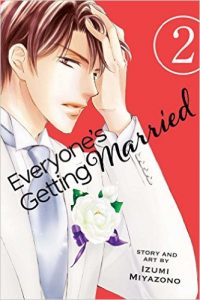
Everyone’s Getting Married Volume 1 by Izumi Miyazono

As far as I’m concerned, Shojo Beat’s recent practice of releasing the occasional josei title is one of the best things ever. Manga featuring non-highschoolers is still not so easy to find, so I was looking forward to Everyone’s Getting Married. At the same time, just based on the title I was a bit concerned that this would be a josei version of The Rules or something that would involve trapping a man into marriage. I was really happy to discover that I enjoyed the personalities and relationship dynamic between the main couple in this manga.

Asuka Takahashi is a successful real estate agent, but her main ambition in life is to get married and become a homemaker. Asuka takes the idea of being a housewife very seriously, mainly due to the fact that she has strong childhood memories of the type of home her mother provided for her as a child. She’s thwarted in her goal in the first chapter when her long term boyfriend breaks up with her. Asuka has a brief encounter with Ryu Nanami when she’s attending a wedding. He’s a newscaster who is determined to never settle down. Asuka and Ryu have an unusually frank exchange about their incompatible goals in life and then part, fully expecting to never see each other again. He tells her “You seem like a great woman, but it would never work out between us,” and she thinks “This man…is not at all what I am looking for.”

Of course, they get thrown together over and over again, because Ryu is the roommate of Asuka’s co-worker Ono. Ryu and Asuka start getting to know each other better, unconstrained by the possibility of a romantic relationship since they’ve mutually ruled each other out. Asuka sees that Ryu is much more of an ordinary person than he appears to be based on his TV persona. He sees that she’s genuinely kind, and he respects the work that goes into keeping a household running even though he has no desire for a wife. They both begin to fall a little in love with each other, but their goals in life for a family and future remain absolutely different. Miyazono’s art is pretty to look at and easy to follow, even though her style isn’t particularly unique.

egm1

Asuka and Ryu end up both being sympathetic and quirky enough to make me wonder which way this story is going to go, even though I’m totally expecting a happy ending. They’re also balanced out a bit by secondary couple Ono and Rio, who have the opposite relationship dynamic where Ono wants to settle down and Rio is determined to keep dating. Overall, this first volume seems like a great addition to the under the radar josei titles coming out under the Shojo Beat line.

Filed Under: REVIEWS Tagged With: everyone's getting married, Josei, shojo beat, viz media

Bookshelf Overload: May 2016

June 8, 2016 by Ash Brown

I will be the first to admit that  the amount of manga, comics, and other delights I acquired in May was kind of ridiculous, especially when compared to recent months in which I’ve deliberately tried to curb my spending. However, I expected and planned for a bump in May, mainly because the month includes my annual trip to TCAF. I picked up so many independent comics and zines while in Canada! And it made me very happy. I was also pleasantly surprised to receive an enormous box of review copies from Kodansha Comics at my new address. I really wasn’t expecting to see one so soon after the last box that arrived. (But thank you!) All that combined with a few preorders and other bargains meant that May was a big month for me.

As for some of the highlights from May: Kazuo Umezu’s manga series The Drifting Classroom appears as though it may be going out of print. Volume 11 is becoming particularly difficult (and expensive) to find, but I was able to nab a stray Canadian copy. After a several-year delay, Masahiko Matsumoto’s Cigarette Girl was finally released by Top Shelf last month. Likewise, it’s been a few years since Drawn & Quarterly published its initial collection of Shigeru Mizuki’s Kitaro, but now there’s The Birth of Kitaro which I loved. There are several other May release which I’m excited about and hope to review in the future, too, including Lianne Sentar and dee Juusan’s short comic Shut In Shut Out from Chromatic Press/Sparkler Monthly, Requiem of the Rose King, Volume 4 by Aya Kanno from Viz Media, and Another: Episode S/0 from Yen On which contains both Yukito Ayatsuji’s novel and Hiro Kiyohara’s manga. My in-depth review of Yui Sakuma’s Complex Age, Volume 1 should be posted later this week as well; I didn’t anticipate that it would resonate with me as much as it did. Oh, and the Dororo anime is now available, too!

Manga!
As Many As There Are Stars by Miecohouse Matsumoto
Attack on Titan, Volume 16 by Hajime Isayama
Bakuman, Volumes 3-5 written by Tsugumi Ohba, illustrated by Takeshi Obata
Bleach, Volume 1 by Tite Kubo
Cigarette Girl by Masahiko Matsumoto
Complex Age, Volume 1 by Yui Sakuma
The Drifting Classroom, Volume 11 by Kazuo Umezu
Fairy Tail, Omnibus 2 by Hiro Mashima
Fairy Tail, Volumes 52-54 by Hiro Mashima
Forget Me Not, Volume 2 written by Mag Hsu, illustrated by Nao Emoto
Genshiken: Second Season, Volume 8 by Himoku Kio
Inuyashiki, Volume 3 by Hiroya Oku
JoJo’s Bizarre Adventure, Part 2: Battle Tendency, Volume 3 by Hirohiko Araki
Kiss Him, Not Me, Volumes 3-4 by Junko
Kitaro, Volume 1: The Birth of Kitaro by Shigeru Mizuki
My Little Monster, Volume 13 by Robico
Noragami: Stray God, Volumes 10-14 by Adachitoka
Ouran High School Host Club, Volumes 4-16 by Bisco Hatori
Paradise Residence, Volume 2 by Kosuke Fujishima
Persona Q: Shadow of the Labyrinth, Side: P3, Volume 2 by So Tobita
Persona Q: Shadow of the Labyrinth, Side: P4, Volumes 1-2 by Mizunomoto
Planetes, Omnibus 2 by Makoto Yukimura
Real Account, Volume 2 written by Okushou, illustrated by Shizumu Watanabe
Requiem of the Rose King, Volume 4 by Aya Kanno
Say I Love You, Volumes 12-13 by Kanae Hazuki
The Seven Deadly Sins, Volumes 12-14 by Nakaba Suzuki
A Silent Voice, Volume 7 by Yoshitoki Oima
Tract by Shintaro Kago
UQ Holder, Volume 7 by Ken Akamatsu
What Did You Eat Yesterday?, Volume 10 by Fumi Yoshinaga
Yamada-kun and the Seven Witches, Volumes 7-8 by Miki Yoshikawa
Your Lie in April, Volumes 6-7 by Naoshi Arakawa
Ze, Volume 11 by Yuki Shimizu

Comics!
Always Raining Here, Volume 1 by Hazel and Bell
Avialae, Chapter 1 by Lucid
Bad Company, Part 2 by Guilt | Pleasure
Before the Snows Come by Kat Verhoeven
Cautionary Fables and Fairy Tales: Asia Edition edited by Kel McDonald and Kate Ashwin
Foundations of Chinese Civilization: The Yellow Emperor to the Han Dynasty by Jing Liu
Foxfire by Carolyn Gan
GQutie, Issue 1 by Ronnie Ritchie
Human Plantation by Various
If There Be Magic by Kez
Is This a Fetish?: A Weird Aesthetic Zine by Sfé R. Monster
Leveret written by Andrew Wheeler and illustrated by Tory Woollcott
Life on the Hill 5 by Love Love Hill
Magical Beatdown, Volume 2 by Jenn Woodall
Muddlers Beat, Volume 1: Literally Everything Is Outside My Comfort Zone by Tony Breed
Nameless & the Scientist, Volumes 1-2 by Amei Zhao
Portals, Chapter 1: Twenty Minutes by Kori Michele Handwerker
The Prince and the Swan, Volumes 1-2 by April Pierce and Gareth Cj. Wee
Pupa: A Bug Anthology edited by Lawn and Saicoink
Romeo X Julien, Act 1: The Family by Marina
Shitty Horoscopes: The Anthology by Amrit Brar
Shut In Shut Out written by Lianne Sentar, illustrated by dee Juusan
This Will Be Worth It by Sfé R. Monster
Those Spaces Between by Kez
Up Until Now by Akimiya Jun
Valley of the Silk Sky, Part 1: The Long Run by Dylan Edwards
Wayward, Volume 3: Out From the Shadows created by Jim Zub and Steve Cummings

Artbooks!
Samurai 2.0: A Tribute to Men by Various
Take My Revolution!: A Revolutionary Girl Utena Fanzine by Various
Yuko Shimizu
by Yuko Shimizu

Novels!
Another: Episode S/0 by Yukito Ayatsuji
Horses, Horses, in the End the Light Remains Pure by Hideo Furukawa
The Secret Biwa Music That Caused the Yurei to Lament by Isseki Sanjin

Anime!
Dororo directed by Gisaburō Sugii

Filed Under: Bookshelf Overload, UNSHELVED

Bookshelf Briefs 6/7/16

June 7, 2016 by Sean Gaffney and Michelle Smith Leave a Comment

inuboku11Inu x Boku SS, Vol. 11 | By Cocoa Fujiwara | Yen Press – The finale of this series gets a few more extra pages to be able to show the final battle and all of the villainous tragic backstory that precipitates it. It ends up tying in with the time-traveling tree we’ve seen in prior volumes, but honestly, I wasn’t as interested in the villains as I was in seeing our heroes be cool. All the appropriate couples end up together (though surprise, the supposed lesbian isn’t so much in the end), and we even get some closure from the future-that-wasn’t cast as well. I enjoyed this series a great deal, with several of the plot twists taking me totally by surprise (though sometimes, as with the fate of Kagerou, there is utter non-surprise). I’ll miss it. – Sean Gaffney

kamisama21Kamisama Kiss, Vol. 21 | By Julietta Suzuki | VIZ Media – I have consistently enjoyed Kamisama Kiss, but now that we’re moving into the endgame, it’s gotten even better. Tomoe has decided to become human, but his first attempt has left him in fox form instead. Nanami is supposed to stay behind while Mikage seeks treatment, but of course she doesn’t, and her shortcut leads to a run-in with one of Kirihito’s minions who reveals that her life force has been so diminished by what happened between her and his master in Okinawa that she’s got at most six months to live. I am absolutely sure a shoujo manga won’t allow its heroin to die—though I can think of one notable exception—so the parts that I actually found most interesting involved Kirihito’s schemes coming nearer to fruition along with inter-minion power plays. I love the darker atmosphere Suzuki evokes in their scenes; I hope there are many more of them to come! – Michelle Smith

nonbiyori4Non Non Biyori, Vol. 4 | By Atto | Seven Seas – I was a bit irritated with the last volume of this slice-of-country-life series, but luckily things are a bit better this time around. Natsumi’s irritating qualities are kept to a minimum, and we get more of Renge, possibly due to reader demand as she is the young, cute (and very strange) one. Of course, you could argue the entire cast is strange in its own way, and the series is at its best when it’s at its silliest, such as the Koshigaya Sisters playing around with persimmons, or a flashback to the day baby Renge was brought to school and caused total havoc. There are some sweet moments as well, of course, such as the trek to see the New Year’s sunrise, but for the most part you read this for good, if mild, laughter. – Sean Gaffney

orange2orange: The Complete Collection, Vol. 2 | By Ichigo Takano | Seven Seas – Given how deeply I loved the first volume of orange, it would’ve been hard for the second to surpass it, so the fact that I liked it a little less shouldn’t be construed as disappointment. I merely thought the ending was a bit rushed, with Suwa giving up on his feelings for Naho seemingly without much angst and an argument between Naho and Kakeru that felt somewhat forced. (Surely Naho is intelligent enough to see where her future self went wrong before essentially repeating the mistake!) There are many intensely lovely scenes between the group of friends, however, including a memorable sports festival, and I’m very fond of all the characters. To top it all off, I actually really liked the bonus story, too. This is a manga I will be rereading and foisting on friends for sure. – Michelle Smith

silentvoice7A Silent Voice, Vol. 7 | By Yoshitoki Oima | Kodansha Comics – Those who were wondering if the two tormented leads would ever get together at the end of this may be a bit disappointed by the ending to A Silent Voice, where the closest we get to romantic resolution is Naoka showing off a ring a tall, hot model gave her—which turns out to be from Miyoko. (OK, that’s not romantic resolution, it’s yuri tease.) What is resolved is the film everyone was making, which doesn’t get any awards but ends up being personally satisfying, and Shoko and Shoya, who are both able to come to terms with their past and move on. After a series that dealt repeatedly with abuse and suicidal thoughts, this comes as something of a relief, and I am delighted with the finish. – Sean Gaffney

yamada8Yamada-kun and the Seven Witches, Vol. 8 | By Miki Yoshikawa | Kodansha Comics – The first half of this is pure setup, as they learn what the power of the seventh witch is (the cliffhanger from last volume being totally wrong), realize what will happen if they figure out who said witch is, and have contingency plans to deal with said fallout. And then, naturally, everything goes horribly wrong. The second half of this volume can be very painful to read, especially for anyone who’s always secretly wondered if maybe their friends all have more fun whenever they aren’t there. Yamada-kun puts a brave face on things, which leads to hilarious scenes of him trying to clean his way to happiness, but an emotional breakdown isn’t far off, and I suspect things will get worse in the next volume. – Sean Gaffney

yotsuba13Yotsuba&!, Vol. 13 | By Kiyohiko Azuma | Yen Press – It’s been a long time since the last volume of Yotsuba&! came out, but after reading a few pages it feels like we’ve never really been away. We get Asagi being bemused at Yotsuba’s childlike logic, Fuuka suffering from the same, and Yanda getting just plain abuse. But the majority of this book is about Yotsuba’s grandmother, who comes to stay with her son for a few days. She’s new to the reader but not to Yotsuba or Koiwai, which leads to many familiar yet unfamiliar situations. She’s also naturally got a dour face, even if her mood is not matching, so we get amusing contrasts between dialogue and expression. But, most importantly, we discuss Yotsuba sleeping on her own for the first time! Will time actually move forward? – Sean Gaffney

Filed Under: Bookshelf Briefs

Franken Fran, Vols. 3-4

June 7, 2016 by Sean Gaffney

By Katsuhisa Kigitsu. Released in Japan by Akita Shoten, serialized in the magazine Champion Red. Released in North America by Seven Seas.

Franken Fran has many grotesque, nasty images throughout. There’s blood, gore, other bodily fluids, and truly disgusting things being done to the human body. And yet the most terrifying thing in the entire series is easily Fran herself, who is quite simply impossible to understand or empathize with, and whose concept of what life is does not remotely cross over with the majority of humanity. Fran is simply a force of nature, and this omnibus shows us several times when your jaw drops at what she carries out. Oddly enough, it’s Veronica, her sister the assassin who was introduced at the end of the last book, who ends up being the voice of sanity in the series (as well as the straight man).

frankenfran3-4

This is not to say that Veronica is a good guy, of course. In one of the more touching chapters in this book, Veronica and walking organ bank Adorea go to a high school undercover to, theoretically, give Veronica “social skills”. (The fact that Fran is the one who says she doesn’t have these is one of the best jokes in the book.) Of course, veronica is a small, sullen, scarred girl, so naturally she proceeds to get bullies to hell and back, with only one other girl nice enough to be friends with her. And then, of course, everything goes even MORE horribly wrong, as we discover a slavery ring and Veronica has to clean house and chop up a few bad guys. If this were a normal, non-funny thriller series, Veronica might be the anti-hero.

And of course there are the plots of the chapters themselves. Franken Fran is to a large degree an anthology horror series, with Fran and her occasional cast dealing with tragic young love, evil matriarchs seeking immortality, and of course at least two chapters dealing with bugs, which are absolutely not for the squeamish. There’s even a cameo by a certain cult religious deity. The two best chapters in the book are two of the most touching (note that I’m defining touching in the venue of Franken Fran, not beyond it) – in one, a suicidal young man who changes his mind is given new life as a children’s mascot, and crosses paths with a young girl who’s being abused by her father. In the other, a young girl’s dog is killed by a truck, and it’s Fran to the rescue, though her new dog is, shall we say, not what you’d expect. The series even mocks itself by having a Hollywood movie made out of the latter chapter, with dire consequences. (“The bestiality was a nice touch.”)

In the end, Franken Fran is about the stories. They won’t make you feel good, they may gross you out, and one or two of them may give you nightmares. But they’re all stories that stay in your head. And Fran, being a protagonist (I refuse to call her a heroine) who is our guide through this twisted world, is just as memorable.

Filed Under: REVIEWS

  • « Go to Previous Page
  • Page 1
  • Interim pages omitted …
  • Page 497
  • Page 498
  • Page 499
  • Page 500
  • Page 501
  • Interim pages omitted …
  • Page 1061
  • Go to Next Page »
 | Log in
Copyright © 2010 Manga Bookshelf | Powered by WordPress & the Genesis Framework