• Skip to primary navigation
  • Skip to main content
  • Skip to primary sidebar
  • Home
  • About Us
    • Privacy Policy
    • Comment Policy
    • Disclosures & Disclaimers
  • Resources
    • Links, Essays & Articles
    • Fandomology!
    • CLAMP Directory
    • BlogRoll
  • Features & Columns
    • 3 Things Thursday
    • Adventures in the Key of Shoujo
    • Bit & Blips (game reviews)
    • BL BOOKRACK
    • Bookshelf Briefs
    • Bringing the Drama
    • Comic Conversion
    • Fanservice Friday
    • Going Digital
    • It Came From the Sinosphere
    • License This!
    • Magazine no Mori
    • My Week in Manga
    • OFF THE SHELF
    • Not By Manga Alone
    • PICK OF THE WEEK
    • Subtitles & Sensibility
    • Weekly Shonen Jump Recaps
  • Manga Moveable Feast
    • MMF Full Archive
    • Yun Kouga
    • CLAMP
    • Shojo Beat
    • Osamu Tezuka
    • Sailor Moon
    • Fruits Basket
    • Takehiko Inoue
    • Wild Adapter
    • One Piece
    • After School Nightmare
    • Karakuri Odette
    • Paradise Kiss
    • The Color Trilogy
    • To Terra…
    • Sexy Voice & Robo
  • Browse by Author
    • Sean Gaffney
    • Anna Neatrour
    • Michelle Smith
    • Katherine Dacey
    • MJ
    • Brigid Alverson
    • Travis Anderson
    • Phillip Anthony
    • Derek Bown
    • Jaci Dahlvang
    • Angela Eastman
    • Erica Friedman
    • Sara K.
    • Megan Purdy
    • Emily Snodgrass
    • Nancy Thistlethwaite
    • Eva Volin
    • David Welsh
  • MB Blogs
    • A Case Suitable For Treatment
    • Experiments in Manga
    • MangaBlog
    • The Manga Critic
    • Manga Report
    • Soliloquy in Blue
    • Manga Curmudgeon (archive)

Manga Bookshelf

Discussion, Resources, Roundtables, & Reviews

Blog

Kagerou Daze IV: The Missing Children

July 24, 2016 by Sean Gaffney

By Jin (Shinzen no Teki-P) and Sidu. Released in Japan by Enterbrain. Released in North America by Yen On.

As we reach the end of this book, our heroes are getting a lot closer to figuring out why they have these strange eye powers and what the powers actually are. In fact, they get a lot closer than the reader, as we’re shown parts of a diary that Marie’s grandmother kept, but they get to read the whole thing. Admittedly, we can connect some dots, but I am reminded once more that this is a light novel series based off of a series of songs, and that the intended audience is meant to be familiar with those songs. In particular, Shinigami (Reaper) Record, which introduces us to Azami’s story that is fleshed out here.
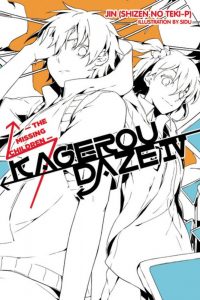
kagerou4

Azami is a mysterious supernatural creature – called a Reaper, she seems to also have many traits of a medusa, something which she’s apparently passed along to her granddaughter. Speaking of Marie, the bigger revelation in this book may be just how old she actually is – it’s somewhat startling, particularly given her fairly childlike personality. But of course, when you live alone in a cabin in the woods, there’s not as much chance to evolve or learn. And there’s also Konoha, whose real identity we’ve been able to guess with information from the previous two books, but who looks to be just as different from his other self as Ene is from Takane. Actually, the biggest disappointment here may be Shintaro, who still has a tendency to get dragged along and whine much of the time – indeed, the trip to and from the cabin is an endless stream of irritation from him.

If there’s a larger issue with these books, it’s the length – they’re much, much shorter than the average Japanese light novel, and you barely get into the book before it’s already finished, padding out its page count with lots of character design art and advertisements for the manga. Each of the last three volumes has featured a segment of the main plot and a more serious side story that gives us backstory and hints, but the backstory really is not connecting fast enough for my taste, and some of the things I was most interested in last time (Kano confronting Shintaro in Ayano’s body) is glossed over here, as Kido reassures Shintaro in a way that makes it seem like just a bad nightmare.

This volume was delayed two months, so the next one will come sooner than expected, and I’m hoping that less lag time will allow me to get into it a bit more. It would seem to involve Kano in a big way, so maybe I’ll finally get the answers to my questions. Kagerou Daze is enjoyable, particularly to fans of the multimedia franchise, but I still wish it wasn’t so fragmented. And short – even this review is underlength when I try to discuss it.

Filed Under: REVIEWS

Manga the Week of 7/27

July 21, 2016 by Sean Gaffney, Michelle Smith, Anna N and Ash Brown Leave a Comment

SEAN: You know the drill. Last week of the month, piles and piles of titles, let’s get right to it.

Dark Horse gives us a 2nd volume of Dangan Ronpa: The Animation, whose awkward subtitle lets you know it’s based on that rather than the game.

And they also have a 4th Oh My Goddess omnibus, which is warring with Dragon Ball for most re-releases.

emeraldas1

This is my featured manga this week, and I guarantee it’s my pick of the week as well. The first omnibus volume of Queen Emeraldas is coming from Kodansha Comics, and I’ve heard it looks gorgeous. Matsumoto’s manga is always amazing, and don’t let the age of the material stop you – this is top tier.

MICHELLE: So excite!

ANNA: I am also very, very excited!

ASH: Definitely picking this one up!

SEAN: Also from Kodansha, we have a 3rd volume of Real Account.

ASH: As far as manga with games of life and death go, this series actually manages to be pretty interesting.

SEAN: The other Kodansha debut is Sweetness and Lightning, which runs in good! Afternoon, and apparently lives up to the sweet part of its name. It was a Crunchyroll title that Kodansha then decided to take to print. The author is much better known for BL titles, which this isn’t.

MICHELLE: I’m looking forward to this, as well!

ASH: A food manga featuring a single dad and his adorable kid? I’m in.

SEAN: And there is a 9th volume of Yamada-kun and the Seven Witches, currently in the middle of a very dramatic arc.

ASH: That it is! I just recently caught up with the series, and I’m curious to see where it goes.

SEAN: Seven Seas has a 4th volume of college romance and drama Golden Time.

We also have the 4th and final volume of Haven’t You Heard? I’m Sakamoto, which is ending at just about the right time, I think.

ASH: I’m glad Seven Seas took a chance on this series.

SEAN: Vertical has the 2nd volume of vampire thriller Devils’ Line.

hounds1

They also debut Immortal Hounds, a violent supernatural thriller that runs in Enterbrain’s Harta magazine. If you liked Ajin and the like, you should enjoy this.

And now for Yen. Only one digital-only title this month, the 5th volume of Crimson Prince.

For print, we have a 7th volume of capital-letter loving (or just English loan-word loving) Akame Ga KILL!.

A manga debut based off a light novel that comes out next month, The Asterisk War is a fantasy series with magic and swords, much like every other series licensed in the past 3 years or so. Its manga runs in… groan… Comic Alive.

Speaking of manga that make me groan, BTOOOM! is somehow at 14 volumes, and more are coming.

MICHELLE: Ugh.

SEAN: A Certain Magical Index has its 6th manga volume. It’s adapting Accelerator and Last Order, should be good.

And The Devil Is A Part-Timer! also has its 6th manga, which is only up to the 3rd book, because it’s not jettisoning some novels the way Index did.

The final volume of Final Fantasy Type-0 Side Story, Volume 5, means I can stop making lame soccer-based jokes.

Fruits Basket gets a 3rd Collectors’ Edition, which will collect the 5th and 6th volumes. It will feature a very awkward but true discussion of how school bullying really works in Japan.

MICHELLE: And Shigure looks fetching on the cover.

ANNA: More Fruits Basket is always a good thing!

SEAN: Horimiya has a 4th volume of romantic sweetness – will things finally get taken further?

ASH: I really need to catch up on this series! The first volume was delightful.

SEAN: How to Raise a Boring Girlfriend reaches Vol. 3, and the boring girlfriend is still the major issue with this.

Kagerou Daze has a 6th manga volume, and I’ve honestly lost track of which LN volume it’s adapting.

And a 5th omnibus of Karneval comes next week as well.

liselotte1

The debut I’d be most excited about were it not for Queen Emeraldas is Liselotte & Witch’s Forest, the current series (though I think it’s on hiatus for health reasons) by Natsuki Takaya, creator of Fruits Basket. It runs, when active, in Hana to Yume.

MICHELLE: And a third debut I’m eagerly anticipating. All of these fab new series almost salve the pain of what we lost when various companies folded in recent years. I’ll never stop pining for Silver Diamond, though.

ANNA: Ah, I’m looking forward to this, although series on hiatus always make me nervous. Also, if Michelle is going to shout out Silver Diamond, I am going to take a moment of silence for Demon Sacred.

MICHELLE: I still haven’t given up hope!

SEAN: Log Horizon’s harem-influenced spinoff The West Wind Brigade has a 3rd volume.

And there’s a 4th omnibus of hard-to-read but fascinating Prison School.

ASH: Yup.

SEAN: And for those who wished Jeanne D’Arc’s life was just as tragic but had more magical girls, there’s the 3rd Puella Magi Tart Magica manga.

Re: Zero had its novel debut last week, so look to that post for a description. Here’s Vol. 1 of the manga, which runs in Big Gangan.

Lastly, there is a 3rd Taboo Tattoo, one of manga recent series that have an anime running at the same time.

Exhausted yet? That’s a whole lotta spicy manga. You’ll need alka-seltzer.

Filed Under: FEATURES, manga the week of

Durarara!!, Vol. 4

July 21, 2016 by Sean Gaffney

By Ryohgo Narita and Suzuhito Yasuda. Released in Japan by ASCII Mediaworks. Released in North America by Yen On.

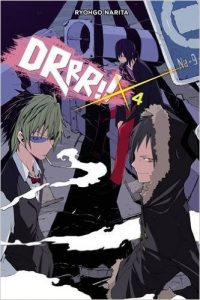
Narita’s books, be it Baccano!, DRRR!!, or what have you, all enjoy being endlessly re-readable. Not only do you get the single-volume habit of various disparate and seemingly unconnected plots all crashing together at the end, which certainly happens here, but you also see this as part of a series whole, as he also teases out future major plot and characters that don’t pay off here but will several books down the line. I’ve called DRRR!! a nerd series, and it’s not just because Erika and Walker talk a lot about anime and manga types (their discussion of whether Celty is a tsundere or not is one of the highlights of the book). It’s because his series cry out for Tumblr analysis and bullet points explaining what’s going on and how it affects things down the road.

drrr4

As an example, this volume is very good about taking the metatext and making it textual. In addition to the analysis of Celty’s character and how it applies to a seemingly ‘real life’ person, we meet Izaya’s twin younger sisters, Mairu and Kururi, who are not as loathsome as him but do seem to be just as difficult to stop. They’re polar opposite twins, as per the TV Tropes article, but Izaya helpfully tells us they deliberately engineer this in order to balance each other out, the better to be one person in two bodies (which is what they think they are). This isn’t the sort of exposition you expect to be casually laid out in the book itself. Things get even weirder when, at the end of the volume, Izaya has to meet with an even higher level of manipulator to find out about events he wasn’t around for (most of them, in fact). We don’t learn all that much about him, but what we do get seems to imply that Izaya is literally meeting the book’s omniscient narrator.

This is not to say the book does not function as a normal book as well. There’s a lot going on, as always, but if you pay enough attention it’s easy to follow and have fun (indeed, the narrative helpfully spells out the difficult bits, like the fact that all the money Celty lost ends up returning to her by the end of the volume). There’s car chases and fights, Shizuo throws people across the city and hits them so hard they need reconstructive surgery. We meet Aoba Kuronuma, who is a new high school student who is clearly there to manipulate Mikado for evil ends, but at the same time he himself is thrown off by the higher-levels weirdness of the Orihara Twins. (Speaking of the Twins, those who disliked Namie’s creepy incest subtext in previous books won’t be happy to see Mairu and Kururi making out here – again, they deliberately invoke tropes, even distasteful ones.) My favorite subplot was probably that of Shizuo’s brother, who runs into the cutest serial killer you’ll ever see, and helps her redefine what it means to be a monster.

Speaking of said killer, I mentioned how DRRR’s novels tie into each other and reward re-reading, and the same can be said for “The Naritaverse” as a whole. Nebula, the evil corporation we’ll see in Baccano!, is still the evil corporation 70 years later in DRRR!!. We hear about a couple of thieves who liked to dress in costumes, clearly Isaac and Miria. And while Ruri’s ‘monstrous’ nature is kept deliberately vague, anyone who reads Narita’s unlicensed series Vamp! will have figured it out already. DRRR!! is a nerd series that rewards overanalysis, and also a lot of fun and action packed. It ends with everyone in the cast having food with friends and loved ones, except Izaya, who is alone and unloved. Needless to say, this pisses him off and he will no doubt be far more active in future books. Can’t wait.

Filed Under: REVIEWS

Bookshelf Briefs 7/18/16

July 18, 2016 by Sean Gaffney and Michelle Smith Leave a Comment

demonprince5The Demon Prince of Momochi House, Vol. 5 | By Aya Shouoto | VIZ Media – It’s been quite interesting to see how Shouoto-sensei has improved as a mangaka. Kiss of the Rose Princess was fairly mediocre, He’s My Only Vampire is better, but in these past two volumes, The Demon Prince of Momochi House has surged forward in a big way. While volume five isn’t quite as great as volume four was, it’s still very good, revealing Yukari’s sad backstory and leaving fans with yet another cliffhanger ending: Aoi looking happy at Himari’s confession and then turning her down. Is this the usual mortal/immortal love angst, or did he somehow mess up their fate when he asked Kasha for help breaking a curse? Combine this with a mysterious new foe and I’m really looking forward to the next volume! – Michelle Smith

mls9My Love Story!!, Vol. 9 | By Kazune Kawahara and Aruko | VIZ Media – My Love Story!! continues to be as cute as ever. In this volume, Takeo struggles with feelings of insecurity after one of Yamato’s coworkers at the cake shop—a talented pastry chef named Ichinose—declares that he’d be a better match for her and that she has become his muse. Alas, the love rivalry plotline isn’t especially unique, but I did really enjoy spending more time with Yamato on her own, being passionate about something, and the way Takeo never wavers in his encouragement just proves what a great guy he is. This volume also includes a sweet bonus story that emphasizes how much Takeo means to Sunakawa. I will always love how their friendship is depicted. I’ll probably always love this series, too. – Michelle Smith

monster3My Monster Secret, Vol. 3 | By Eiji Masuda | Seven Seas – There is some more cast expansion in this volume as well, mostly showing us Nagisa’s trolling brother (it was a nice fake-out, actually), but much of this volume is dedicated to expanding on Asahi’s growing harem. Youko is the main girl, of course, and if you think the final girl will be anyone but her, you’re fooling yourself. The scenes of honest cute romance with the two of them are the best part of the book, and apparently they’re recreating something that Youko’s parents also went through. We can’t count the others out yet, though— after all, it’s only volume three. I was admittedly not expecting forced love confessions to be brought about by a pair of possessed glasses, but then, this is a comedy first and foremost. Fun. – Sean Gaffney

nisekoi16Nisekoi: False Love, Vol. 16 | By Naoshi Komi | Viz Media – The main arc in this particular volume involves a foreign princess who’s a dead ringer for Chitoge, which is honestly just an excuse for Raku and “Chitoge” to go on real dates without the author needing to worry about keeping her in character. One can only tsun so far, after all. As ever, the remainder of the volume are short one-chapter vignettes, mostly comedic, involving the rest of the class. We hear Yui’s horrible singing, deal with Marika’s fear of animals, continue to set up Shu and Ruri as a beta couple, though clearly this will require more giving in on Ruri’s part, and allows Onodera lovers to have more ‘will they or won’t they?’ tease. As with the last volume, I’m still enjoying Nisekoi, but it’s spinning its wheels. – Sean Gaffney

roseguns1-4Rose Gun Days Season One, Vol. 4 | By Ryukishi07 and Soichiro | Yen Press – Knowing that season two is coming makes the finale to this volume a bit more acceptable. Oh, things wrap up pretty nicely, but there’s a lot of ambiguity going on here, the sort that is only going to be answered by seeing what comes next. Has Leo really left the cast for good? And are he and Rose a couple or not? (The omakes play it for laughs…) Did Rose really kill Caleb? I’m inclined to doubt it, even though the entire plot of this volume is about making us think that Rose is ready to get her hands dirty. In the end, I think Rose is just too shiny for that. And, most importantly, was that omake gag with Stella at the end really as filthy as it sounded? Ryukishi07 fans will enjoy this. – Sean Gaffney

Filed Under: Bookshelf Briefs

Pick of the Week: Heroes, Zeroes, and Gangstas

July 18, 2016 by Michelle Smith, Sean Gaffney, Ash Brown and Anna N Leave a Comment

gangsta7MICHELLE: It isn’t manga, but my pick this week is definitely the second volume of Legend of the Galactic Heroes. In fact, I just used my shiny new Audible credit to pre-order it!

SEAN: I’m definitely ready for more LOGH as well, but my pick of this week is the first volume of Re: ZERO. Not since Sword Art Online have I seen a light novel debut with this much buzz, thanks no doubt to the anime’s current showing. I want to see what the fuss is about.

ASH: Likewise, I’ll certainly be making room on my shelf for the next volume of Legend of the Galactic Heroes, but my pick of the week is for something else entirely. In my particular case, I’m greatly anticipating the continuation of the dark, gritty, violent, and frequently tragic Gangsta.

ANNA: I have to agree, Gangsta is a special series and the wait for a new volume has been killing me!

Filed Under: PICK OF THE WEEK

My Week in Manga: July 11-July 17, 2016

July 18, 2016 by Ash Brown

My News and Reviews

I finally did it! I actually managed to finish a longer, in-depth feature. The first since I announced the need to scale back on my blogging. It’s been about a month, the last in-depth post being my review of Yui Sakuma’s Complex Age, Volume 1. (Which I suppose thematically may have been oddly appropriate.) Anyway! Last week I posted a new Adaptation Adventures feature, this time focusing on the Mushishi manga, anime adaptations, and live-action film. I actually really enjoy writing these longer non-review features, so it made me very happy to be able to post a new one! The Mushishi Adaptation Adventures post is part of my (at one point monthly) horror manga review project. There’s only one more review to go, the final volume in Setona Mizushiro’s After School Nightmare, and then I’ll be able to bring the project to a close, so I’ll likely be focusing on that for my next in-depth post.

Elsewhere online, last week I came across a few interesting interviews: Oprainfall has a brief interview with Naoshi Arakawa, the creator of Your Lie in April, from Anime Expo. Crunchyroll posted an interview with Reo Kurosu, the producer of the newest Berserk anime adaptation, also from Anime Expo. And over at Okazu, Takarazuka Week begins with an interview with Ako Dachs, a former troupe member. Also, though not an interview, there is a free online course from Keio University that looks incredibly interesting: Japanese Culture through Rare Books. The class just started today, so there’s still time to register!

Quick Takes

Franken Fran, Omnibus 2Franken Fran, Omnibus 2 (equivalent to Volumes 3-4) by Katsuhisa Kigitsu. While I wasn’t quite as taken with the second omnibus as I was with the first, I am still enjoying Franken Fran a great deal and definitely plan on reading more of the series. It’s not nearly as fanservice-y a series as the covers might indicate, although there is still some amount of nudity and sexually charged imagery and themes. Sadly, I do know of some people who would likely enjoy the manga who are hesitant to try it simply because of the salacious nature of the cover artwork. For the most part though, Franken Fran is just good, wholesome(ish), gruesome fun. The series remains episodic, so knowing the basic premise is all that’s necessary to jump into most chapters. There’s not much character development at this point either. What Franken Fran does have is a fantastic and frequently dark sense of humor, oddly quirky yet likeable characters, and a bizarre charm. (I mean, even the Flying Spaghetti Monster makes a legitimate appearance in the second omnibus.) Franken Fran is a horror manga that’s fun and funny as well as gross and grotesque. The stories tend to be incredibly weird, but that’s also probably part of why the series is so engaging and entertaining.

Real Account, Volume 2Real Account, Volume 2 written by Okushou and illustrated by Shizumu Watanabe. I was a little surprised by how much I enjoyed the first volume of Real Account, but I found that I appreciated its mix of life-or-death entertainment, psychological drama, and social commentary; I was very curious to see how the manga might develop. Real Account continues to be thought-provoking, encouraging readers to really consider the impact that social media has on individuals and society. The series isn’t especially subtle about it, though, and can be a little over-the-top and melodramatic. Online transgressions in the series can lead to someone’s literal death in Real Account, generally in a rather spectacular fashion. The series already has a huge body count and it doesn’t appear as though the rate of casualties will be slowing down any time soon. At this point the motivations and identities of the people behind it all have yet to be revealed, but the games that people are being forced to play are only becoming deadlier. The manga’s creators do go out of their way to ensure that the lead hasn’t yet killed anyone himself, but he most definitely benefits from others killing on his behalf.

Yamada-kun and the Seven Witches, Volume 5Yamada-kun and the Seven Witches, Volumes 5-8 by Miki Yohsikawa. Although I have been thoroughly enjoying Yamada-kun and the Seven Witches, it’s been a while since I’ve actually read any of the series. These few volumes are generally playful, upbeat, and fun with plenty of kissing happening between all genders. I really like how Yamada’s circle of friends and acquaintances continues to grow without it exactly becoming a harem situation. Granted, the series’ basic premise does mean that sexual harassment occurs on a fairly regular basis. Thankfully, Yamada-kun and the Seven Witches is most definitely fiction, and a comedy at that. However, if taken seriously, the occasionally forced and reluctant kisses, usually necessary for the story and played for humor, may very well be off-putting for some readers. But there’s all sorts of other silliness in Yamada-kun and the Seven Witches, and the plot is progressing quite nicely, too. By the end of the eighth volume, the identities of all seven witches have been discovered. The fallout of this is unexpected and is accompanied by several plot twists and revelations. It feels as though the series’ first story arc is beginning to draw to a close; it should be interesting to see where things go from here.

Filed Under: FEATURES, My Week in Manga Tagged With: Franken Fran, Katsuhisa Kigitsu, manga, Miki Yoshikawa, Okushou, Real Account, Shizumu Watanabe, Yamada-kun and the Seven Witches

7th Garden, Vol. 1

July 17, 2016 by Sean Gaffney

By Mitsu Izumi. Released in Japan by Shueisha, serialization ongoing in the magazine Jump Square. Released in North America by Viz.

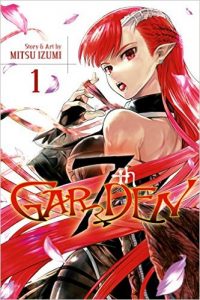
For a nation that mostly seems to revolve around Shintoism and Buddhism, Japanese manga authors seem very taken with Christianity. Not necessarily for the actual religious thought behind it, but I think they see the Bible as sort of a Lord of the Rings-type book, filled with epic battles between angels and demons, lots of divine punishment, and a few bouts of sinning for good measure. There have been quite a few stories talking about a battle between heaven and hell with Earth as its grounds, most famously Neon Genesis Evangelion, but Angel Sanctuary is also up there. 7th Garden is firmly along those lines, as a young man with a tortured past finds himself allying with a demon with a tortured past in order to protect his young mistress, who may in fact have a tortured past as well. All of this revolves around the symbols and imagery of Christianity, slightly distorted,

7thgarden1

This actually ended up being a lot more wholesome than the descriptions I saw led me to believe – I probably should have guessed that give that the busty demon on the cover actually has her back turned to the reader, rather than facing them chest first. Said demon is Vyrde, who is accidentally freed by our hero from a thousand year sleep, and proceeds to be the best thing about this series once she wakes up. She’s playful, seductive, and amoral in just the right amount, and even the ‘sneak into the hero’s bed at night’ feels for once as if it didn’t come out of the pages of ‘Love Comedy For Beginners’. Probably because there’s not much love here – yes, there’s a suggestion that Awyn (the hero) and Marie (his mistress) sort of kind of like each other, but make no mistake about it: this is a battle manga, with ridiculous swordfights and lots of corpses.

I mentioned Christianity above, but given that in this series the demons are the good guys and the angels the bad guys (very common in manga), it’s unsurprising that this fantasy world calls it ‘anti-Quoristiantity’, enforced by ‘anti-Knights, who as you might imagine with a name like that tend to mete out anti-Justice. To be fair, we’re told that the mooks we see killing innocents here are not Knights but Apostles – those who were not good enough to be Knights so do the Church’s dirty work. This does allow our hero to be somewhat more cavalier about life and death than you’d expect from a Jump manga – then again, this is Jump Square, and Blue Exorcist can also have very ambiguous morality. The most interesting part of the manga may have been told the end, as we’re fed little droplets of backstory hints that might pay off. Who is Ashriel, really, and what does she know? (With a name like that, the foreshadowing isn’t subtle.) What do they mean by the village not existing? And is there any significance that our demon’s real name is so close to Awyn’s innocent mistress? (That last may be a no. I suspect it’s the Western name equivalent of Isumi and Izumi being nothing alike.)

There’s a lot of tease here but not much beyond promise, and the fighting is good but can get confusing (on a level of 1 to Trigun Maximum, it’s about a 4). But it does show promise, and I am interested enough to pick up a second volume. Recommended for those who like fantasy and don’t mind religion being used as a heavy spice.

Filed Under: REVIEWS

Manga the Week of 7/20

July 14, 2016 by Sean Gaffney, Ash Brown, Anna N and Michelle Smith Leave a Comment

SEAN: Sometimes I like to shake things up and do my list in reverse order, usually when a feature image would be right at the bottom of the list. This is one of those times.

rezero1

So let’s start with Yen On, which has four books out, one a debut, Re: ZERO ~Starting Life in Another World~ sounds like a mouthful, and it is yet another in a series of “normal guy gets summoned to fantasy world” books, but I have heard from those who have seen the anime that this is top tier stuff. We shall see, but I am provisionally excited.

ASH: One of the light novel competitions has actually stopped accepting those types of stories they’ve become so prevalent.

SEAN: Log Horizon has a 5th volume, subtitled A Sunday in Akiba. Will Shiro and company be able to avoid politics and monster killing and have a light fluffy volume of no consequence? I highly doubt it.

After a bit of a delay, we see the 4th Kagerou Daze novel. The main point of interest in the last novel was seeing that one of the Mekakushi group seems to have a grudge against Shintaro, and also knows about his tragic relationship with Ayano. I’d like to see more about that.

The 4th Durarara!! novel, on the other hand, is a bit of a placeholder before the next major arc begins, but as with most Narita novels, the placeholding is possibly more interesting to fans.

ASH: I’ve sadly fallen behind in most of my light novel reading.

SEAN: And now back to manga, so the rest of the MB team can wake up. We have a 13th volume of Terra Formars from Viz, which honestly has gone a lot further than I expected.

I believe that the 9th volume of Monster (Perfect Edition) is the last, which means it’s a perfect time for readers who got behind to catch up.

ASH: I’m really glad Monster is available in its entirety again! And in a great looking edition, too.

SEAN: And hey, it’s been a while – over a year, in fact – but here’s the 7th volume of Gangsta.

ASH: I’ve been looking forward to the continuation of the series as well as the spinoff that Viz recently licensed.

ANNA: I didn’t realize that there was a spinoff coming out too! I enjoy this series and it has been far too long since a new volume came out.

SEAN: The Complete Chi’s Sweet Home has a 3rd omnibus of amazingly cute kitties!

MICHELLE: Yay!

SEAN: Seven Seas has a bevy of titles out. My Monster Secret’s 3rd volume continues to show us that monsters and broad comedy mix really well.

linhdl

If you enjoyed Love in Hell when it came out a while back, we’re now getting a sequel series, Love in Hell: Death Life. As for me, I’d prefer an anime of Matt Groening’s Life in Hell.

And there’s a 4th volume of yuri thriller Akuma no Riddle, which is beginning to run out of antagonists.

MICHELLE: I haven’t gone back since volume two. Not sure if I am sufficiently compelled.

SEAN: One Peace has a 4th volume of the manga adaptation of Rise of the Shield Hero (which runs in Comic Flapper, for those of you fond of that magazine).

Kodansha has an 8th volume of UQ Holder, which has gone from weekly to monthly recently in Japan, so may start slowing down soon.

And with Noragami 16, we are finally caught up with Japan, so the monthly releases end here.

ASH: I recently caught up with Noragami myself and it’s getting really good. Like, really good.

SEAN: Lastly, we end as we began, with a novel. This one can’t really be called light, though, as it’s the 2nd Legend of the Galactic Heroes book from Haikasoru. Space opera! Intrigue! A whole lot of death! All are within these pages.

MICHELLE: Woot! I confess I still haven’t read the first one, but I am totally getting this via Audible, as I did the first volume.

ASH: Definitely picking this up!

ANNA: I need to confess that I haven’t read the first, but I really want to! Maybe I will schedule a reading binge for a long weekend soon.

SEAN: Which of these books will help you beat the heat?

Filed Under: FEATURES, manga the week of

Haikyu!!, Vol. 1

July 14, 2016 by Michelle Smith

By Haruichi Furudate | Published by VIZ Media

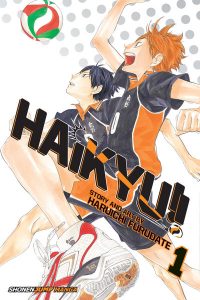
haikyu1

It’s been a good year so far for sports manga! Competitive cycling is represented in Yen’s Yowamushi Pedal, August brings the first two-in-one omnibus edition of Kuroko’s Basketball, and volleyball-centric Haikyu!! is on shelves now. I am just about in heaven! (If someone would just license Mitsuru Adachi’s Rough, that would seal the deal.)

At first glance, Haikyu!! looks a little bit like Slam Dunk. Tobio Kageyama is the dark-haired character with talent and experience, and Shoyo Hinata is the enthusiastic redhead with a lot of potential but who lacks many basic skills. They join their high school’s volleyball team in their first year and clash instantly, fueled by a previous encounter where Kageyama’s team trounced Hinata’s in a middle-school tournament, but must put this aside and learn to function as teammates. What’s different is that Kageyama has more obviously negative qualities than Slam Dunk’s Rukawa had, including a perpetual snarl and dismissive attitude, while Hinata has more positive qualities than Sakuragi possessed, like discipline and team spirit.

I really liked watching their relationship develop, as it eventually becomes apparent (as they practice for then participate in a match against a couple other new members) that each is what the other has been waiting for. Kageyama’s previous team turned their backs on his demanding leadership and wound up losing the aforementioned tournament. None of them could keep up with the pace he was attempting to set. Hinata can, though, and he’s so grateful to finally have teammates and someone to “set” the ball for him, that he is positively eager to get in position to execute the plays that Kageyama’s old team grumbled about.

Their rivalry is far from over, but as the first volume draws to a close, it’s clear they’ve begun to appreciate the other more and are warming to the idea that, if they used to be the greatest enemies, then now they could be the greatest teammates. Inevitably, their journey will take them to Nationals, for that’s the goal of seemingly all sports manga series. I’ll be looking forward to it!

Haikyu!! is ongoing in Japan, where the 22nd volume has just been released. VIZ will be releasing a new volume each month through at least January 2017, which is as far as their Amazon listings presently go.

Review copy provided by the publisher.

Filed Under: REVIEWS Tagged With: Haruichi Furudate

Adaptation Adventures: Mushishi

July 14, 2016 by Ash Brown

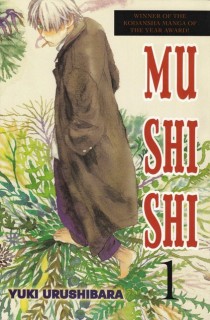
Mushishi, Volume 1After revisiting and reviewing each volume of Yuki Urushibara’s Mushishi for my horror manga review project, by now it’s probably readily clear that I greatly enjoy the series. I love the influence of traditional Japanese folklore on the stories. I love the manga’s subtle creepinesss. I love the exploration of the relationship between humans and the rest of nature. I love how the series delves into the connections that exist between people. I love the importance placed on the search for knowledge. The storytelling in Mushishi is atmospheric, beautiful, and frequently unsettling as individuals struggle with themselves and with the unknown. There is darkness and tragedy in Mushishi but there is also hope—one of the major themes in the manga is that for better or for worse, life will ultimately persevere.

Mushishi is a largely episodic series following Ginko, a mushishi, who travels the Japanese countryside studying mushi and trying to help people who have fallen under their influence. Mushi are described as creatures which are very close to the original form of life. Their presence is fundamental and necessary to the living world, but depending on the circumstances they may either be beneficial to or negatively impact humans. Mushi are frequently at the heart of unusual natural phenomenon or may cause otherwise unexplainable illnesses. Within the context of the series mushi can be taken literally, but they can also be read as metaphors for many conditions experienced in reality.

MushishiAnime1Urushibara’s ten-volume Mushishi, originally serialized in Japan between 1999 and 2008, was first released in print in English by Del Rey Manga between 2007 and 2010. Soon after, Del Rey’s manga imprint was closed and Mushishi subsequently went out of print. Unsurprisingly, the print edition of Mushishi has become increasingly difficult to find over time, but in 2014 Kodansha Comics released the entire series digitally. In addition to earning multiple awards and honors over the course of its publication, Mushishi was also the basis for multiple anime adaptations and a live-action film (most of which are available digitally if not physically in North America), as well as a variety of other media.

The first Mushishi anime series, directed by Hiroshi Nagahama, aired in Japan in 2005 and 2006. At twenty-six episodes, it only adapted a portion of the original manga. (Granted, the manga hadn’t yet been completed at that point.) Since I love the Mushishi manga, it probably doesn’t come as much of a surprise that I love the anime as well. Although the first Mushishi anime adaptation isn’t necessarily my favorite series, or even the anime that means the most to me personally, it is the series that I’ve seen the most number of times; I return to it frequently. Eventually, nearly a decade after the first Mushishi anime series, an animated television special was released which was followed a few months later by a second anime series. This twenty-episode series, also directed Nagahama, aired in Japan between 2014 and 2015 and adapted most of the remaining stories found in the manga. (A second animated television special was released during this time as well.) Despite the number of years that passed between the first and the second anime series, they are both very similar in tone and style. Nagahama also directed the Mushishi animated film released in 2015 which adapted the manga’s final story arc. Since I loved both the original manga and the first anime series, I was very happy to see so much more Mushishi anime produced.

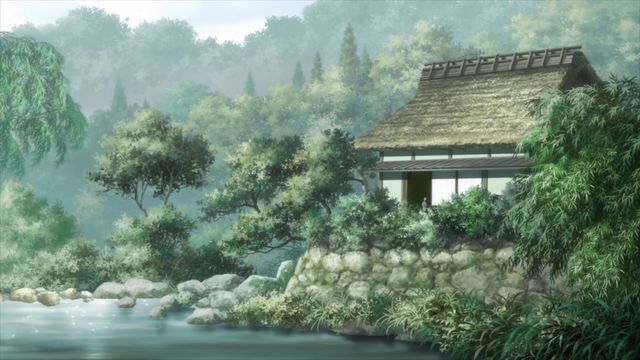
MushishiAnime2-17The various Mushishi anime are very faithful adaptations of the manga. Frequently the scenes in the anime follow the scenes in the manga frame by frame and panel by panel, though occasionally the order that events appear in the narrative is slightly altered. Where the anime distinguish themselves is in their color and sound, especially in the establishment of the backgrounds and settings. Urushibara’s color artwork is lovely, but except for the covers of the individual manga volumes, very few examples of it officially appeared in North America. (I imported Urushibara’s 2015 Mushishi artbook which is filled with color illustrations and I adore it.) The anime bring the world of Mushishi to life. While the actual animation can at times be fairly simple and limited, the environments are always absolutely gorgeous and beautiful in their detail. The sound design in the anime adaptations is great, too, adding spectacularly to the overall atmosphere. The music by Toshio Masuda (which I’m constantly listening to) makes extensive use of bells, chimes, and other percussion along with unobtrusive synthesized and acoustic instruments, creating a beautiful soundtrack that is in turns ethereal and dramatic. Much like the original, the Mushishi anime creates an experience that can be calming and soothing as well as unsettling and disturbing.

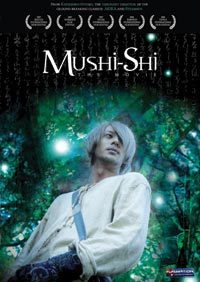
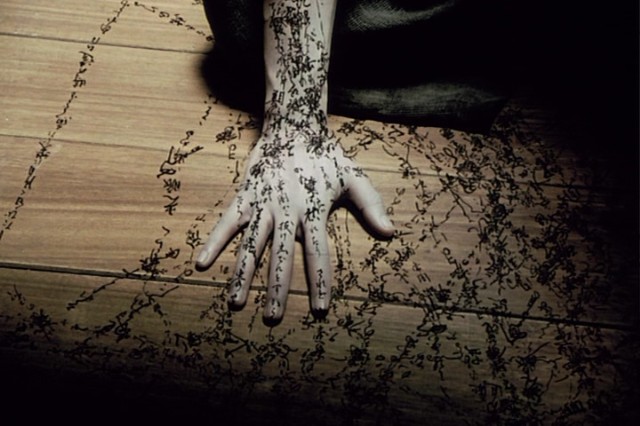
MushishiMovieUrushibara’s manga series was also the inspiration for Katsuhiro Otomo’s award-winning 2006 live-action film Mushishi. For the most part the film was received very well both inside and outside of Japan. Though overall it’s palette tends to be darker and more subdued than the anime adaptations, the visuals can be quite stunning; the special effects hold up surprisingly well even a decade after it was first released. I actually only very recently watched Otomo’s Mushishi for the first time. From the standpoint of someone who is very familiar with the original manga and its anime adaptations, the live-action movie is somewhat disorienting and perhaps even shocking. Though it begins much as one would expect, it ultimately deviates a fair amount from its source material even to the point of changing some of the underpinning mythologies and characterizations of the original. It’s clear that Urushibara’s manga provides the basis for the movie, but many details have been reimagined or remixed in some way. The narrative is still interesting, though. Otomo successfully weaves together several stories from the manga series and makes references to many others before taking the film in an entirely new and different direction. While the original Mushishi tends to be episodic, Otomo’s film is self-contained and provides a single cohesive story. In part this is accomplished placing a significant focus on Ginko’s past and what it means for his present and future, providing a framework for the film as a whole. Instead of simply wandering the countryside helping other people, Ginko has the additional motivation of trying to solve the mystery of who he really is and to reclaim his missing memories.

MushishiLiveActionWhile I would consider the Mushishi manga and anime to be horror, albeit fairly subtle and subdued horror, the film is much more obviously so. Many of the underlying elements are the same, but the film focuses more directly on the aspects of traditional, supernatural horror. However, this does mean some of the more nuanced themes found in the manga and anime are missing. Otomo’s film is a much darker incarnation of Mushishi. The movie, especially towards its end, is incredibly creepy and extraordinarily disconcerting in both imagery and story. It’s so different in tone and narrative that it might actually be better described as a portrayal of an alternate universe of Mushishi rather than being a strict adaptation. It certainly won’t be to everyone’s taste, especially if viewers are expecting something more akin to the gentler (though still disquieting) anime adaptations, but I actually quite liked the movie. For me though, it’s really more of a horror film before it’s a Mushishi film. Still, I feel that the live-action film, the anime adaptations, and the original manga are all well worth checking out and are all fascinating in their own rights. And of course, although unlikely, I’d love to see more Mushishi media and merchandise released in North America.

Save

Filed Under: FEATURES Tagged With: anime, film, Hiroshi Nagahama, Katsuhiro Otomo, manga, mushishi, Yuki Urushibara

  • « Go to Previous Page
  • Page 1
  • Interim pages omitted …
  • Page 480
  • Page 481
  • Page 482
  • Page 483
  • Page 484
  • Interim pages omitted …
  • Page 1049
  • Go to Next Page »
 | Log in
Copyright © 2010 Manga Bookshelf | Powered by WordPress & the Genesis Framework