• Skip to primary navigation
  • Skip to main content
  • Skip to primary sidebar
  • Home
  • About Us
    • Privacy Policy
    • Comment Policy
    • Disclosures & Disclaimers
  • Resources
    • Links, Essays & Articles
    • Fandomology!
    • CLAMP Directory
    • BlogRoll
  • Features & Columns
    • 3 Things Thursday
    • Adventures in the Key of Shoujo
    • Bit & Blips (game reviews)
    • BL BOOKRACK
    • Bookshelf Briefs
    • Bringing the Drama
    • Comic Conversion
    • Fanservice Friday
    • Going Digital
    • It Came From the Sinosphere
    • License This!
    • Magazine no Mori
    • My Week in Manga
    • OFF THE SHELF
    • Not By Manga Alone
    • PICK OF THE WEEK
    • Subtitles & Sensibility
    • Weekly Shonen Jump Recaps
  • Manga Moveable Feast
    • MMF Full Archive
    • Yun Kouga
    • CLAMP
    • Shojo Beat
    • Osamu Tezuka
    • Sailor Moon
    • Fruits Basket
    • Takehiko Inoue
    • Wild Adapter
    • One Piece
    • After School Nightmare
    • Karakuri Odette
    • Paradise Kiss
    • The Color Trilogy
    • To Terra…
    • Sexy Voice & Robo
  • Browse by Author
    • Sean Gaffney
    • Anna Neatrour
    • Michelle Smith
    • Katherine Dacey
    • MJ
    • Brigid Alverson
    • Travis Anderson
    • Phillip Anthony
    • Derek Bown
    • Jaci Dahlvang
    • Angela Eastman
    • Erica Friedman
    • Sara K.
    • Megan Purdy
    • Emily Snodgrass
    • Nancy Thistlethwaite
    • Eva Volin
    • David Welsh
  • MB Blogs
    • A Case Suitable For Treatment
    • Experiments in Manga
    • MangaBlog
    • The Manga Critic
    • Manga Report
    • Soliloquy in Blue
    • Manga Curmudgeon (archive)

Manga Bookshelf

Discussion, Resources, Roundtables, & Reviews

Blog

The Asterisk War: Awakening of Silver Beauty

December 24, 2016 by Sean Gaffney

By Yuu Miyazaki and okiura. Released in Japan by Media Factory. Released in North America by Yen On. Translated by Melissa Tanaka.

In general, I try to give light novels full reviews on my site, as I’m sure regular readers have noticed. In fact, it’s almost become a light novel review site with manga interruptions. Most of the time this is very easy, as the average light novel has about 3-4 manga volumes worth of content, and so it’s easy to find things to say. Sometimes, though, you need to reach. Not because a title is poor – believe me, I have things to say about titles I don’t like. But sometimes there’s just not a lot of “there” there, if you know what I mean. I enjoyed the second volume of Asterisk War just as much as the first. It’s an easy read with likeable characters and cool action. And it is setting up future plotlines and investing in depth of backstory. Despite all this, however, the series FEELS very slight.

There’s a new cast member as well, and she gets the cover. She is, of course, a very obvious “harem manga” type, as are all the girls in this so far. This is the shy, polite girl who’s to repressed and reserved to really stand on her own but is finally able to do so with the help of our hero. And it also helps that Kirin is absolutely deadly with a sword – in fact, she’s so good she doesn’t even use a lightsaber… erm, excuse me, Orga Lux… but instead uses a katana. And she still manages to mop the floor with everyone, including our hero. Unfortunately, she’s also from an abusive family AND has a tragic past. Needless to say, she fits right in here. Oh yes, and in case you were worried, he manages to beat her by the end of the book. No fears, the guy is still the best in the series.

We also meet several other characters who are introduced in order to use as antagonists in future volumes. We get the childlike yet manipulative mad scientist girl and her more stoic partner. We also see the class presidents of almost all the other schools (one is out touring her new album and can’t join them), which helps to show off how each of the schools differ from each other, and also to emphasize why, if you’re interesting in following a standard light novel protagonist, Claudia’s school is clearly the one to choose. Claudia continues to be one of the best parts of the book – I always enjoy manipulative ojou-types who don’t bother to hide they’re doing it, and I’m sure if this series ever crossed over with Irregular at Magic High School that she and Mayumi would be polite at each other in the best way.

So it’s a good series. You’ll enjoy reading it. It just lacks that certain oomph that puts it over the top that other light novel series have. But I’d certainly recommend it as a read – probably on a beach for vacation, it’s about that type of a series.

Filed Under: REVIEWS

Manga the Week of 12/28

December 22, 2016 by Sean Gaffney, Michelle Smith, Ash Brown, Anna N and MJ 1 Comment

SEAN: I remember only 4-5 years ago when the Christmas week releases numbered zero, or at most one. Those days are gone forever, though this is a light week compared to the previous ones.

Dark Horse has a 6th omnibus of the Astro Boy manga.

Kodansha has the 20th volume of Attack on Titan, and if you like there’s also the Special Edition which comes with an actual Titan that will eat you… OK, it’s just a DVD. But I bet they’d do it if they could.

Cells at Work! gives is a 2nd volume of anthropomorphic medical action.

MICHELLE: I’m reading the first volume now and it’s pretty entertaining. I’m interested to see how (and if) the story develops.

ASH: The first volume was a great deal of fun! I’m interested in reading more.

SEAN: And a second (and final?) volume of The Black Museum: The Ghost and the Lady. No word if the other series in this collection has been picked up.

ASH: I really liked the first half of this story. If the rest of the series is anywhere near as good, I hope it’s licensed, too.

SEAN: Potboilers continue to do well, as we get an 8th L♥DK.

Lastly, rejoice! An 8th Vinland Saga omnibus is here in all its glorious carnage.

ASH: I am beyond thrilled for Vinland Saga’s return.

ANNA: I did not realize that this was coming out, but I’m very excited!

SEAN: Seven Seas has D-Frag! hit double digits. My guess: there will be boke and tsukkomi humor within… like the nine previous volumes.

And a 4th survival game-ish Not Lives.

My #1 guilty pleasure, and believe me the guilt outweighs the pleasure by a metric ton, Seven Seas also has a 6th Pandora in the Crimson Shell: Ghost Urn, where two amazing talents prove they can reinforce each other’s worst habits.

The debut next week is the first volume of Seven Princes of the Thousand Year Labyrinth. It’s one of the most Ichijinsha things you’ve ever met, despite also being a survival game. I reviewed it here.

ASH: I plan on giving the first volume a look at least.

SEAN: Lastly, Vertical gives us a 4th omnibus of Mysterious Girlfriend X. Get yourself some drool for the holidays.

MICHELLE: Ew.

MJ: Nothing really calls out to me from this week’s list, but I did want to say “Happy Holidays!” to all our readers, and to you all, too!

SEAN: So what are you getting with those Christmas gift cards?

Filed Under: FEATURES, manga the week of

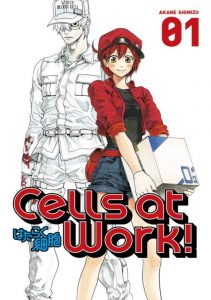
Cells at Work!, Vol. 1

December 22, 2016 by Michelle Smith

By Akane Shimizu | Published by Kodansha Comics

cells1

Cells at Work! has a quirky premise, one that’s fun to describe to people in one’s life whom one may wish to bewilder.

Essentially, the setting is the interior of the human body and the characters are anthropomorphized versions of blood cells, lymphocytes, and other types of cells that work together to keep things running smoothly. None of the characters has an actual name—the pair of protagonists refers to each other as Red Blood Cell and White Blood Cell—and there’s not much of a plot.

Instead, the first volume is composed of episodic chapters showing how the body defends itself against various threats, including bacteria, viruses, and allergens. Along the way, information is relayed to the reader and almost immediately one starts learning things. For example, before I read this I didn’t even know the terms neutrophil and macrophage, but now I could easily talk about their functions, and that’s because I’ve got a vivid visual reminder. Also, Shimizu comes up with some clever ways to depict bodily functions. I was particularly fond of the concept of a sneeze as a missile onto which pesky germs are loaded for expulsion.

Cells at Work! runs in a shounen magazine, and I imagine its intent is to amuse and educate young readers. That said, it did take me a bit of time to accept that there weren’t going to be any story or character developments. That might change, but for now it just doesn’t seem to be that sort of manga, and that’s okay, too. It’s fun enough that I’ll keep reading!

Cells at Work! is ongoing in Japan, where it is up to four volumes. Kodansha Comics will release the second volume in English next week.

Filed Under: REVIEWS

Baccano!: 1931 The Grand Punk Railroad: Express

December 22, 2016 by Sean Gaffney

By Ryohgo Narita and Katsumi Enami. Released in Japan by ASCII Mediaworks. Released in North America by Yen On. Translated by Taylor Engel.

This is, as the prologue suggests, not so much the second part of a 2-arc set as it is “what was going on behind the scenes” for Book One. Various questions we had are answered, various characters who seemed to arrive and vanish for no reason now get a fully fleshed-out backstory. And we discover the true identity of the Rail Tracer, whose presence alone makes this book much, much more brutal and gore-filled than the previous two. Last time we had some horrible violence, but a lot of it was “come across the bloody remains of corpses”, and in this book we see why they came to be that way. And whereas in The Rolling Bootlegs Ennis was the one with the hero’s journey, and in the first Grand Punk Railroad it was Jacuzzi, this book’s most fascinating character is one who doesn’t really make any journey at all, because he’s already ten times better than everyone else. Yes, let’s talk about Claire.

It’s a shame that the cover art for this volume is so bad, but it makes Claire look almost like a cardboard cutout of a human, and after following him though half the book, that’s not really an unapt description. He’s the dark mirror to Ladd – and given that Ladd is a psychopath who murders for fun, that’s really saying something. Claire talks a lot towards the end of the book about solipsism, the idea that he is the most important thing in the world, and that since he can’t imagine what it would be like to either die or lose a battle, he never will. And he doesn’t. He’s not a hero – make no mistake about it, Claire is a nasty piece of work, and makes his living as a killer for hire – but at the same time he’s saving the day here, taking out the black suits and the white suits, falling in love with one girl while cheerfully admitting if she rejects him he’ll go after the other girl he also sort of fell for, and generally making your jaw drop as you go “cooool!”. Oh, except perhaps when he’s torturing Czeslaw.

Of all the characters introduced in this volume, Czes is probably the most tragic. The idea that in among all the people in 1711 who gained immortality was a young boy is chilling enough on his own, but then to spend years being roundly physically, emotionally and mentally abused by one of his fellow immortals is the icing on the cake, and Narita really does milk it for all it’s worth. He’s not subtle, either – when Czes is trying to make a deal with Ladd to have the other passengers on the train killed off, it explicitly mentions that he’s channeling the very man who abused him. The scenes with Czeslaw and Claire are there, I think, to remind you not to see Claire as too awesome or wonderful – they’re utterly dreadful. Still, the whole thing does lead to Czes managing to find hope in trusting other people, even if it means he has to put his life in their hands. First Isaac and Miria, who are of course all-loving and think nothing of falling off a train just to protect Czes – and then Maiza, who is the reason he’s there today, and possibly the most dangerous immortal of all, but around whom Czes can finally be the child that even after 200 years he still is to a large degree.

It is, of course, not all about guys murdering other guys, though you so get a lot of that. There are some amazing female characters here who get a chance to shine. We met Chané in Book 2, but here we see what’s driving her – a love for her father, who may be a terrorist but still shows her more love than any of the other black suits. We also finally confirm that she’s mute, which also allows her character to be more visually expressive than a ‘type’ like her would otherwise be. And of course we get Claire falling for her – it’s not clear if they’ll ever meet up (as Claire says, “meet me in Manhattan” is horribly vague), but it would be nice. As for Rachel, she’s the seemingly “normal” character here, even though she can nimbly crawl across the bottom of trains and save the day by rescuing everyone from the terrorists. She’s normal as she has the most normal reaction to everything going on within the train – sheer terror. Even Isaac and Miria, when presented with a pile of corpses last time, felt like they’d seen this sort of thing before. Rachel, on the other hand, is us, and her heartfelt plea to Claire towards the end of the book to sacrifice herself to stop all the other killing is wonderful, and it’s the one thing the anime cut that is deeply missed. Lastly, there’s Lua Klein, who is… still something of a cipher, but given a bit of internal monologue and a chat with the Grey Magician (also cut from the anime, mostly as he does very little other than stitch people up and give advice), we can empathize with her life choices and why she and Ladd really are deeply in love with each other.

I’ve gone on more than usual, but that’s because there’s simply so much to talk about. This is a short book – possibly the shortest in the series – and yet it’s rich in its development. Those who are fans of the series will enjoy picking out little bits and pieces that we’ve seen before, or setups for the next book. And it also has Isaac and Miria deciding the best present to cheer up Ennis is a young boy to be her little brother. Baccano! is as chaotic as ever, but also richly rewarding. Just… be prepared for a lot of blood. A *lot* of blood.

Filed Under: REVIEWS

Bookshelf Briefs 12/19/16

December 19, 2016 by MJ, Michelle Smith and Sean Gaffney Leave a Comment

Black Clover, Vol. 4 | By Yuki Tabata | Viz Media – So the arrogant heroes we met last time haven’t really learned humility, but at least they’re not regarding Asta and company as total chumps anymore. Instead, it’s our heroes who either get to learn a lesson, kick ass, or both. Noelle learns not to dwell on weakness or mistakes during a battle; Yuno shows that he still has a big complex when it comes to Asta supposedly being “weaker”; and Asta himself gets to beat people up for most of the volume, but also learn how to actually analyze a battle and know his limitations. The result is a volume filled with fights that not only manages to entertain throughout, but didn’t immediately make me think “this reminds me of this other title.” Getting better. – Sean Gaffney

Blue Exorcist, Vol. 16 | By Kazue Kato | Viz Media – This is very much a marking time volume, setting things up for the next big arc and taking a breather from the last one. There’s comedy, particularly with Renzo trying to feel his way back with his group of friends (Suguro keeps calling him “spy”) and a gratuitous bathing scene; there’s possible romantic advancement as Rin finally confesses to Shiemi, albeit under circumstances that don’t really allow a response; and there’s the new instructor, Lewin, who wears a big fishing hat, has hair over his eyes, and is easygoing, so you know he’s super-powerful. And above all else there is Yukio, whose desire to find out whether the power within him is evil or not has become so great it’s making him try to kill himself. Chilling. – Sean Gaffney

The Case Study of Vanitas, Vol. 1 | By Jun Mochizuki | Yen Press – As one of the manga blogosphere’s most vocal fans of Jun Mochizuki’s Pandora Hearts, it should come as no surprise that I anticipated this series’ debut with great interest. Its first signs are promising. The volume’s opening pages introduce us to Noé, a Mochizuki protagonist if there ever was one, stoic and quietly dashing, complete with top hat and temperamental pet cat, surrounded by a steampunk universe full of ornate zeppelins and the glorious clothing that has traditionally accompanied the artist’s horror-tinged worlds. Unfortunately, that’s where the wonder ends. The rest of the volume trudges along, mired in confusing exposition and fights so dull, even a beautifully elaborate mechanical arm can’t save it. Also, there are vampires. Still, though this series is not as immediately engaging as Pandora Hearts, it warrants patience. We’ll hold out for volume two. MJcannot live on sleeves alone. – MJ

Everyone’s Getting Married, Vol. 3 | By Izumi Miyazono | VIZ Media – Marriage-obsessed Asuka is beginning to get on my nerves. She knew full well that her boyfriend, popular newscaster Ryu Nanami, did not want to get married. He made it abundantly clear. But when she finally decides to try to figure out why he is opposed, and learns that his past experience with a miserably married lover means that he doesn’t share her idealistic view of marriage, she has the temerity to feel as if she’s been deceived. Uh-huh. By yourself, lady. To her credit, she does soon realize that she’s been pushing this idea on Ryu without it being about the two of them so much as this fantasy of hers, so perhaps she’ll be able to table her fixation for a while. We shall see! – Michelle Smith

Haikyu!!, Vol. 6 | By Haruichi Furudate | VIZ Media – I always like it when the supporting players in a sports manga get their moment to shine. In the first half of this volume, there’s a lot of Azumane and Nishinoya, as they were the two most affected by Karasuno’s previous defeat at the hands of Date Tech. Moments of faith and triumph ensue. Next up, the team faces off against Aoba Johsai, and unfortunately Kageyama starts to fall back on his own habits by attempting to rectify a score deficit by himself. While this makes for a somewhat stressful read, it does give the team’s other setter, Sugawara, a chance to finally see some tournament play. In volume seven. Hmph! Lastly, it’s gratifying that spectactors are starting to appreciate just how much Hinata contributes to the team. More, please! – Michelle Smith

Kuroko’s Basketball, Vol. 5-6 | By Tadatoshi Fujimaki | Viz Media – This omnibus introduces us to Aomine, a player so talented that he defeats everyone handily and thus has begun to find the game tedious. Naturally, Kagami says that he’ll show that jerk a lesson. Unfortunately, Kagami, you’re only up to volume six. As such, he’s the one who learns the lesson, as he and Kuroko get their asses handed to them—a defeat so bad it has a knock on effect on the rest of the tournament. And so all hopes and dreams are left in ashes. Luckily, these kids are just freshman, and we’re nowhere near done yet. There are other tournaments. But learning from bitter defeat is tried and true sports manga, and Kuroko’s Basketball handled it quite well. – Sean Gaffney

Lord Marksman and Vanadis, Vol. 2 | By Tsukasa Kawaguchi and Nobuhiko Yanai| Seven Seas – When this series is having a giant melee battle, it really shows off how good it is. The hero is talented but not omnipotent; the heroine is talented and yeah, sort of omnipotent, but we knew that from the start; and even the childhood friend gets to look cool before unfortunately having her clothes ripped off and being threatened with assault, because this series also has lots of fanservice, which is much less good. Still, the good outweighs the bad here, and the two leads have excellent chemistry (sorry, childhood friend, you’ve already lost). It looks as if the cast is going to expand next time, so we’ll see if this manages to avoid becoming a harem manga. I hope so. – Sean Gaffney

Reindeer Boy | By Cassandra Jean | Yen Press – Quincy is an ordinary high school student with an unusual recurring dream. Each Christmas Eve, she dreams of a young boy with antlers placing a gift beneath her Christmas tree, and each Christmas she awakens to find a stray gift waiting for her, wrapped in tinfoil. When a gorgeous, antlered transfer student named Cupid arrives at her school, it takes her a surprising amount of time to realize that he is, in fact, the boy from her dream. Meanwhile, a slew of other new students begin turning up, also with antlers, similarly bearing the names of Santa’s reindeer (at which, somehow, nobody at school bats an eye). Not since Sweet Rein have we been asked to accept so silly a Christmas-themed premise. Yet, despite all of that, there is an adorableness to this comic that can’t be denied. Jean’s artwork is attractive and her storytelling effective, ultimately achieving some kind of real success. Though the volume has no number, the story seems to beg for more. Here’s hoping? – MJ

Yona of the Dawn, Vol. 3 | By Mizuho Kusanagi | VIZ Media – I am starting to get legitimately immersed in the shoujo fantasy epic that Yona of the Dawn is shaping up to be. After receiving counsel from a priest, Yona and Hak travel to a remote village in search of the White Dragon, one of four warriors who can help Yona with her quest, whereupon it becomes clear that Yona is the “Crimson Dragon King” returned. The quest for allies and the female protagonist as foretold leader evoke both Fushigi Yuugi and Basara feels without being derivative of either. True, neither Hak nor Yun, another new companion, is particularly interesting yet, but Gija (the White Dragon) does seem to have some potential. At the very least, he’s a convenient GPS for the other warriors. Can’t wait for volume four! – Michelle Smith

Filed Under: Bookshelf Briefs

Pick of the Week: Holiday Reads

December 19, 2016 by Michelle Smith, Sean Gaffney, Ash Brown, MJ and Anna N Leave a Comment

MICHELLE: There are several things coming out from Yen this week that I’m pretty excited about, but the one that I most look forward to—even more than Fruits Basket, since I’ve read that a time or two already—is the fourth omnibus of Yowamushi Pedal.

SEAN: I’m basically reading half this list (whimper), but there’s no doubt my pick of the week is Bakemonogatari. I’ve loved Nisioisin’s writing for some time now, and this is both his most popular as well as his most mainstream series. The fanservice can be appalling, but I’m ready for it.

ASH: I’m right there with you, Sean! There are so many things being released this week that I’m looking forward to reading. Yowamushi Pedal, Tomie, Goodnight Punpun, and Gangsta: Cursed are all definitely high on that list, but I think the manga I’m most curious about this week (and which therefore gets my pick) is the debut of Bungo Stray Dogs.

MJ: So, I feel a little guilty, because if I hadn’t already read it and been somewhat disappointed (look to this week’s Briefs for my elaboration on this point) my obvious choice would have been Jun Mochizuki’s The Case Study of Vanitas, given my long-standing devotion to her previous series, Pandora Hearts. But as it stands, I’m going to have to go with Bungo Stray Dogs, which has the advantage of not having had the opportunity to disappoint me yet. Is that fair? Maybe not, but there you have it.

ANNA: I absolutely adore Gangsta, so the prequel series is what I’m most interested in this week. I hope Gangsta: Cursed doesn’t disappoint me!

Filed Under: PICK OF THE WEEK

My Week in Manga: December 12-December 18, 2016

December 19, 2016 by Ash Brown

My News and Reviews

After a slight delay, November’s Bookshelf Overload was posted last week at Experiments in Manga. Last week I also came to the sad conclusion that my feature on Ichigo Takano’s Orange simply isn’t going to happen despite the progress that I’ve made on it and all of my best efforts. I’d like to extend an apology to everyone who was looking forward to that post, myself included. Orange deeply resonated with me and my own experiences and I wanted to share that with others. Specifically, I wanted to write an essay exploring its sensitive, honest, and compassionate portrayal of the very personal challenges surrounding issues of guilt, depression, and suicide. Ironically, it’s partly due to my own mess of anxieties, et al. that I’m having so much trouble lately. Even when I have the inspiration and desire, I’m still having a terribly difficult time actually writing. So, I’m not sure when my long-form features will return–even though I miss writing and sharing them, I’m trying to be kind to myself by giving myself a bit of a break–but I hope that it is sooner rather than later. However, I can at least still commit to regularly posting My Week in Manga, Giveaways, and Bookshelf Overload features! It’s not much compared to my past output, but at least it is something. Oh, and I’ll definitely be posting my list of notable 2016 releases at the end of the month!

Quick Takes

The Boy Who Cried WolfThe Boy Who Cried Wolf by Mentaiko Itto. Bruno Gmünder’s Gay Manga line began in 2013 and the publisher has been slowly but steadily releasing gay erotic manga in English translation ever since. The Boy Who Cried Wolf is the second collection of Mentaiko Itto’s erotic doujinshi to be published by Bruno Gmünder. The volume collects three of Itto’s short manga: “Hamu and the Boy Who Cried Wolf,” “Holy Night,” and “As Swift as Lightning.” As I’ve come to expect from Itto’s work, in addition to uninhibited sex scenes there is also a fair amount of humor to be found in The Boy Who Cried Wolf as well as a great deal of heart. Unlike Priapus, Itto’s previous collection in translation, The Boy Who Cried Wolf is generally more realistic and less fantastic in nature. Granted, as a historical comedy of sorts, “As Swift as the Lightning” deliberately includes its fair share of anachronisms. But Itto actually incorporates some autobiographical elements in “Hamu and the Boy Who Cried Wolf,” a manga about a young man who is initially so deeply closeted that he unintentionally hurts the person he cares most about. However, because this is Itto, the story isn’t nearly as gloomy as that description sounds. The Boy Who Cried Wolf is a great collection of highly entertaining erotic manga. I truly hope that more of Itto’s work will be translated in the future.

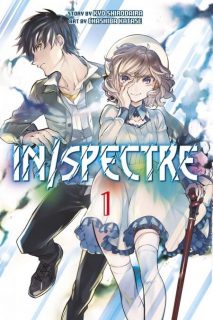
In/Spectre, Volume 1In/Spectre, Volume 1 by Chasiba Katase. Although In/Spectre is based on the novel Invented Inference: Steel Lady Nanase by Kyo Shirodaira, Katase seems to have been given plenty of freedom in adapting the story as a manga series. If the note from the original author is to be believed, the currently ongoing In/Spectre manga is actually the more popular of the two renditions. Unsurprisingly, I was primarily drawn to the manga because yokai play a prominent role in the series. Considering the title I thought it might also be a mystery manga which, as it turns out, in some ways it is and in some ways it isn’t. I didn’t find the first volume of In/Spectre to be as engaging as I hoped it would be–at times the pacing can be agonizingly slow–but I am still greatly intrigued by the series. Now that the setting has been established and the rather peculiar characters have been introduced, I’m hoping that future volumes have more energy to them because I really do like the basic premise of the series. In/Spectre largely follows a young woman named Kotoko Iwanaga who has become a god of wisdom to Japan’s yokai. This has its benefits, but it also cost her an eye and a leg. She is responsible for helping to mediate disputes between yokai, but also for keeping the more unruly ones in check when humans are in danger.

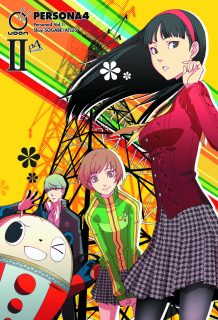
Persona 4, Volume 2Persona 4, Volumes 2-5 by Shuji Sogabe. Though I suspect that I would enjoy it, I still haven’t actually played the original Persona 4 video game, so it’s difficult for me to directly compare Sogabe’s manga adaptation. However, I can say that for the most part the manga can stand alone as its own work. However occasionally it does feel as though the characters are being railroaded and the story has only one possible path to take, probably a remnant from the manga’s RPG origins. While overall the artwork is attractive and stylish, the action-oriented scenes and fight sequences can be somewhat lacking in their execution. But I love the themes that Persona 4 deals with, especially those of personal identity and self-acceptance. As the series progresses, concepts of gender and sexuality come into greater play as well which (as always) I find particularly interesting. In general like all of the characters, too. Yosuke can unfortunately be a homophobic ass from time to time, but I absolutely adore Kanji, a tough guy with a good heart who has traditionally feminine interests and hobbies. Much of the character and story development in Persona 4 is ambiguous enough that multiple and sometimes opposing readings and interpretations are possible, some of which are frankly unflattering. Personally, I prefer and am more comfortable with the more positive interpretations.

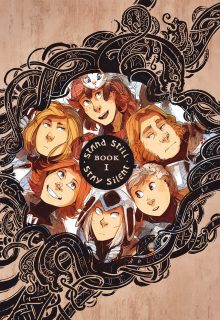
Stand Still, Stay Silent, Volume 1Stand Still, Stay Silent, Book 1 by Minna Sundberg. The first book of Sundberg’s ongoing Stand Still, Stay Silent collects the award-winning webcomic’s prologue, first five chapters, and additional bonus content. It’s available in both digital and physical editions, but the hardcover print volume is absolutely gorgeous. Much like Sundberg’s earlier epic A Redtail’s Dream, Nordic influences are a major part of Stand Still, Stay Silent. The comic is stunningly illustrated with beautiful, full-color artwork. Stand Still, Stay Silent is a post-apocalyptic tale of adventure and exploration with an ominous touch of horror and the unknown. At the same time, the comic manages to be lighthearted and humorous. The prologue establishes the comic’s fascinating setting–a seemingly harmless disease which turns out to be fatal quickly spreads across the globe. Ninety years later, Iceland, which was able to completely close itself off from the rest of the world, has become the center of known civilization, but a team has been assembled to see what can be found beyond the relative safety of the Nordic countries. Despite scenes of intense terror and action, the plot of Stand Still, Stay Silent is actually on the slower side; the focus is almost entirely on the characters and their interpersonal dynamics. The character writing, worldbuilding, and humor in Stand Still, Stay Silent is simply fantastic.

Filed Under: FEATURES, My Week in Manga Tagged With: Chasiba Katase, comics, In/Spectre, manga, Mentaiko Itto, Minna Sundberg, Persona, Shin Megami Tensei, Shuji Sogabe, Stand Still Stay Silent

Magi, Vol. 21

December 19, 2016 by Sean Gaffney

By Shinobu Ohtaka. Released in Japan by Shogakukan, serialization ongoing in the magazine Shonen Sunday. Released in North America by Viz.

I haven’t actually given Magi a full review since its first volume; I love it to bits, but for the most part I could articulate those bits into a 150-word brief pretty well. This volume of Magi, which wraps up one arc and sets the stage for the rest of the series, though, requires more verbiage. For one thing, it solidifies more than anything else who the real hero of this story is. The first volume had Aladdin on the cover, and for the most part the mangaka made a good effort to keep Aladdin, Alibaba and Morgiana as a power trio lead. But in the end, Alibaba’s journey is the most profound and important, and this volume features both his highs and lows as he discovers what’s happened to Balbadd.

There’s also some romantic hints, and they may actually stick. For the most part, the first few volumes of the series didn’t really bother with romance beyond Aladdin loving the ladies in his own amusing way, and Alibaba occasionally being an idiot. The idiot part is highlighted again here, as he brags about having a girlfriend that he doesn’t have in order to make himself look impressive. Leaving aside the romance for a moment, this is exactly what makes the tension of Alibaba’s character so great. He spends much of the volume wondering why people like and respect him, thinking that he really hasn’t achieved anything, and even, yes, having people hook up in front of him, reminding him that he’s still basically a clueless virgin. Luckily, he has an even more clueless virgin with a crush on him, though Morgiana admits that she’s so not in touch with any of her emotions that she can’t really deal with it right now. This has the potential to be cute.

Less cute is Alibaba’s return to Balbadd, as we see exactly what a conquered country looks like. His visit to his former Fog Troop friends, who are getting by but suffering nonetheless, is chilling, and reminds you again of the dangers of right-wing totalitarian tactics (I wish this weren’t so relevant today). His visit to Koen and Komei Ren, who inform him that “agreements” have nothing upon power and brute force, is topped only by the fact that they want him to join them – again, it’s difficult at times to register how important Alibaba is because we always see things filtered through his poor self-image. People knows what’s up. As for what his response will be, I can guess, but that’s what the cliffhanger brings.

Of course, Aladdin is not totally forgotten here, and this brings up what may be the other major plot point to come, which is Sinbad. Sinbad so far has been portrayed as the “good guy” side of the power is everything coin, as opposed to the Koen kingdoms. That said, Aladdin has chosen Alibaba, not Sinbad. And we’re informed by Yunan that both Sinbad *and* Alibaba are classic examples of King’s Vessels – they draw people to them and history changes as a result. (In real life, this is called the “Great Man” theory, and thankfully does not have magic to back it up.) As for Sinbad, he’s the best at drawing people to him and getting what he wants – but is that really a good thing? What’s separating Sinbad from being a tyrant other than his good disposition?

There’s so much going on here, and like the best shonen series you want to read the next volume immediately. Thankfully, Magi is still bimonthly, so we only have to wait a little bit to see what happens next. Brilliant stuff.

Filed Under: REVIEWS

Grimgar of Fantasy and Ash, Vol. 1

December 18, 2016 by Sean Gaffney

By Ao Jyumonji and Eiri Shirai. Released in Japan by Overlap, Inc. Released in North America digitally by J-Novel Club. Translated by Sean McCann.

These days, if you have a genre that’s popular enough you’re going to get deconstructions of it. And the Japanese genre of ‘people sent to another world where they fight in RPG-like circumstances’ is hugely popular in Japan. We’ve seen the odd attempt at doing something different with this genre before (Re: Zero comes to mind), but Grimgar in particular seems to follow another very popular way of thinking: the “grim and gritty” school. I don’t know if the name was deliberately chosen to mirror the mood of the book (likely it’s coincidence), but this first volume is a lengthy look at a group of people who are forced to fight monsters together and find, that with a lot of training and sacrifice… they can still be pretty terrible at it.

We meet a group of 12 people who find themselves in a castle in fantasy world X. They appear to be modern Japanese people, but have lost their memories, knowing only their names and the basic “I have plot amnesia” things. They’re taken to a man (who is unfortunately written in “scary gay man” mode) who tells them to survive, they need to become volunteer soliders. For the moment, they’re trainees. One group immediately forms of what seems to be the top people in the group. This is not their story, though we see them later on and find they are indeed the top people in the group. Our group consists of our narrator, who is “generic protagonist” with an occasional line in snark and a tendency to have no self esteem; a cheerful happy girl who has a complex about her small breasts; a painfully shy girl (with large breasts); the leader, a smiling sensible type who screams “I won’t last the book” and indeed does not; a big awkward guy; and Ranta.

I signal Ranta out by name for a reason. Grimgar is a well-written book, with good fight scenes and a dark but compelling plotline. Its weakness is the characters, who are a bit more generic types than I’d really wanted. Ranta is a type as well, the irritating hot-headed loudmouth. The difficulty is that this is turned up to 11 – he’s easily the most irritating part of the entire book, and it’s more grating because you know he’s written this way on purpose. He makes the whole party dislike him, and it takes the arrival of another stock type, the cold beauty with a tragic past (she replaces the doomed guy I mentioned above), to make everyone accept him because well, they’re a team and teams have to get along no matter what.

The awkwardness of this cast is, of course, the selling point. You won’t find a Kirito here; this team is mocked for going out to smash up low-ranked goblins all day every day, and they’re not terribly good at doing that either. None of them arrive with any game-breaking powers. They do gain some powers by joining guilds (again, this is very RPG), but leveling up is tough and slow. It’s a “what would this sort of story be like in reality?” type of tale, and as such it does its job quite well. Of course, this makes it a bit of a slog at times as well. I am hoping that fortunes turn upward for this group in future books, but won’t get my hopes up – that would defeat the purpose a bit.

Filed Under: REVIEWS

Spice & Wolf, Vol. 1

December 17, 2016 by Sean Gaffney

By Isuna Hasekura and Jyuu Ayakura. Released in Japan by ASCII Mediaworks. Released in North America by Yen On. Translated by Paul Starr.

All right, so I’m just a little bit late to the party here. In fact, the party has long since had everyone leave and shut the lights off, and Carol Burnett is walking around me mopping up. But when this series began here in North America, it was in the pre-Yen On days, and I wasn’t as into light novels as I am now, so I never got around to it. Then when I did show interest (particularly after seeing the author at New York Comic Con) it was more a case of “I don’t have the room for 17 volumes on my shelf”. But glory be, the whole series is due to be released digitally over the next few months, and there’s a new book coming out in May as well, so I thought “Why not?” And it’s a good thing I did, as this proved to be a very good first volume.

I knew a bit about the series before I began to read it through internet osmosis – I seem to recall the general talk about it was “come for the nekkid loli wolf girl, stay for the economic theory’. Thankfully, at least in the first volume, the nekkid loli is kept to a minimum, as after her introduction Holo finds clothes and for the most part stays in them. She is indeed a wolf girl, or to be more accurate wolf goddess of the harvest, and her ears and tail and the hiding thereof take up a bit more of the narrative’s time. The majority of the book, though, is about two things: 1) the travails of Holo and Lawrence, the merchant who picked her up at the start, trying to stop a vast economic conspiracy and also make a bit of cash doing so, and b) the banter back and forth between them as they do this. And honestly, economics is fine, but I’d say the dialogue and banter is the real win here.

The series takes place is sort of “generic middle ages X”, but thankfully is more of a genuine fantasy novel rather than all of the RPG-styled worlds we’ve seen in more recent books. I mentioned Lawrence earlier, and he’s our narrator and viewpoint character. He is seemingly rather pleasant and mild-mannered, but there is a deep awkwardness to him as well, with the odd hint of a tragic past. It’s rather cruel that the one man he looks forward to meeting at the start of the book turns out to be one of the main villains towards the end. You get the sense that Lawrence and Holo are made for each other, and there certainly seems to be a bit of ‘will they or won’t they?’ through the book. Despite being called a loli, Holo acts and speaks like you’d expect someone hundreds of years old to, and honestly looks to be about 15-16 on the cover, which for anime and manga is pretty much ‘go for it’ age.

Basically, “come for the economics, stay for the playful sarcastic banter” is my tag for this series. I look forward to catching up.

Filed Under: REVIEWS

  • « Go to Previous Page
  • Page 1
  • Interim pages omitted …
  • Page 458
  • Page 459
  • Page 460
  • Page 461
  • Page 462
  • Interim pages omitted …
  • Page 1048
  • Go to Next Page »
 | Log in
Copyright © 2010 Manga Bookshelf | Powered by WordPress & the Genesis Framework