• Skip to primary navigation
  • Skip to main content
  • Skip to primary sidebar
  • Home
  • About Us
    • Privacy Policy
    • Comment Policy
    • Disclosures & Disclaimers
  • Resources
    • Links, Essays & Articles
    • Fandomology!
    • CLAMP Directory
    • BlogRoll
  • Features & Columns
    • 3 Things Thursday
    • Adventures in the Key of Shoujo
    • Bit & Blips (game reviews)
    • BL BOOKRACK
    • Bookshelf Briefs
    • Bringing the Drama
    • Comic Conversion
    • Fanservice Friday
    • Going Digital
    • It Came From the Sinosphere
    • License This!
    • Magazine no Mori
    • My Week in Manga
    • OFF THE SHELF
    • Not By Manga Alone
    • PICK OF THE WEEK
    • Subtitles & Sensibility
    • Weekly Shonen Jump Recaps
  • Manga Moveable Feast
    • MMF Full Archive
    • Yun Kouga
    • CLAMP
    • Shojo Beat
    • Osamu Tezuka
    • Sailor Moon
    • Fruits Basket
    • Takehiko Inoue
    • Wild Adapter
    • One Piece
    • After School Nightmare
    • Karakuri Odette
    • Paradise Kiss
    • The Color Trilogy
    • To Terra…
    • Sexy Voice & Robo
  • Browse by Author
    • Sean Gaffney
    • Anna Neatrour
    • Michelle Smith
    • Katherine Dacey
    • MJ
    • Brigid Alverson
    • Travis Anderson
    • Phillip Anthony
    • Derek Bown
    • Jaci Dahlvang
    • Angela Eastman
    • Erica Friedman
    • Sara K.
    • Megan Purdy
    • Emily Snodgrass
    • Nancy Thistlethwaite
    • Eva Volin
    • David Welsh
  • MB Blogs
    • A Case Suitable For Treatment
    • Experiments in Manga
    • MangaBlog
    • The Manga Critic
    • Manga Report
    • Soliloquy in Blue
    • Manga Curmudgeon (archive)

Manga Bookshelf

Discussion, Resources, Roundtables, & Reviews

Sean Gaffney

Secret of the Princess

February 12, 2017 by Sean Gaffney

By Milk Morinaga. Released in Japan as “Ohime-sama no Himitsu” by Shinshokan, serialized in the magazine Hirari. Released in North America by Seven Seas. Translated by Jennifer McKeon, Adapted by Shannon Fay.

Morinaga Milk’s books are simply nice. They’re sweet. They put a smile on your face. They are not the most original books in the world – in fact, they sometimes have so many cliches that they rack up a Yuri Trope Bingo before they’re halfway done – but they’re smooth reads, and you don’t have to worry about serious tragedy befalling anyone. There is angst in this volume, don’t get me wrong, but it’s the sort of book where one of the heroines threatening to kill herself by jumping off a roof is treated as a loving confession rather than an actual suicide attempt. If you try to attack too much reality to this, it begins to come apart, but that’s the point. It’s yuri fantasy.
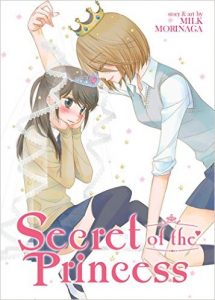
Stop me if you’ve heard this one before. At an all-girls school, Fujiwara is the tall, athletic, cool, one-quarter Western beauty who all the girls admire. She’s also just accidentally destroyed the principal’s expensive vase. This is witnessed by Miu, a girly young first year whose mother has drilled into her that the secrets to catching a good husband. Of course, at an all-girls school, men are thin on the ground, so Miu has no idea how actual dating works. So, in exchange for her silence, she asks Fujiwara to pretend to date her so she can discover how this all works. Of course, she doesn’t consider the jealousy of her fellow students, or Fujiwara’s own loneliness and need for the social interactions that she gains with Miu, or, of course, her own growing and conflicting feelings.

Miu can be a weak part of this book – she’s a bit hard to take and frustrating, though she improves as the volume goes on. This is complete in one book, and a short book at that, so there’s not really much time to slowly develop anything. Fujiwara fares better, having a home life that seems to be mostly filled with maids (of course she lives in a rich mansion, have you read this genre before?) and her friend Hirosawa, who is also a short-haired beauty with a fan club but is second to Fujiwara. (The shoujo dynamic of the blond taking second place to the brunet lead seems to be reversed for Yuri titles.) Other than that, there’s not much to talk about – they date cute, break up when they start feeling guilty about the “falseness” of things, get back together dramatically, and end up in bed (though fleetingly – for the most part, this is pretty squeaky-clean.)

So it’s not mind-boggling, but it’s nice to see some sweet titles coming out here after a year of Citrus and Netsuzou Trap. And we have more from this author coming up next month as well. I suspect it will be sweet, fluffy, somewhat insubstantial, and yuri. Much as this is.

Filed Under: REVIEWS, secret of the princess

Strike the Blood, Vol. 5

February 11, 2017 by Sean Gaffney

By Gakuto Mikumo and Manyako. Released in Japan by ASCII Mediaworks. Released in North America by Yen On. Translated by Jeremiah Bourque.

As always, Strike the Blood does what it wants competently and efficiently, with good pacing and a nice balance between the hero and his various female leads. And yet it continues to be one of the most frustrating light novel series that I follow, because it is content to be simply that. There’s potential for a lot more here, and at times the series looks as if it’s going to show you that potential… and then it backs off, content to give us a comedic perverted parent, or a bath scene with a giant nosebleed, or Yukina saying her catchphrase again with all the well-crafted timing of a Swiss watch. Strike the Blood is what it is, and thus I will never get to experience what I have with most other cliched light novel series, which is the joy of seeing the books get better as they go along.

This is the second half of a two-part arc, and as such we hit the ground running, with less development and more fights. Sadly, this also means less development for Yuuma, who is injured enough to be shunted to the side for the majority of the book, until the climax where she shows up to use her clone status against her mother. There is talk of the idea of her being a disposable tool being wrong, which would probably read a lot better of the author weren’t treating her like a disposable tool, using her to help resolve things at the climax and then cheerfully writing her out to go serve time as an accessory. We also finally meet Kojou’s mother, who is unaware (possibly) that he is a vampire now, and is an absurdly youthful genius doctor mom who has a tendency to feel up girls for fun. I called this “TV Tropes: The Novel” last time, and that hasn’t changed. His mother is there to provide gropes and exposition, and stop Yuuma from dying.

As for the plot itself, as the villain cheerfully admits, half of it is an excuse for a giant runaround using minibosses to build up tension but never actually do much beyond sort of threaten the hero and heroines and then get dealt with. I was happy to see Asagi get something more substantial to do – she remains my favorite of the three main heroines, and her solution to the first miniboss battle showed off her smarts (with the help of her AI that controls the entire island). Sadly, the main villain herself is less interesting, which is especially irritating as she didn’t have to be. There’s suggestion of a deeper story between her and Natsuki, and we even see a brief flashback, but it’s just spice to show why she hasn’t merely killed everyone before this. If we’d gotten an entire chapter devoted to Natsuki and Aya’s school days and what led to her descent into mad villainy, I might have praised it. But we don’t.

I keep hoping this will get bad enough for me to drop, but it’s far too efficient for that. It has dropped a new novel in our laps, and we will read it, vaguely enjoy it, be disappointed at what could have been, adn then forget about entirely until the next book. Sigh.

Filed Under: REVIEWS, strike the blood

Yona of the Dawn, Vol. 4

February 10, 2017 by Sean Gaffney

By Mizuho Kusanagi. Released in Japan as “Akatsuki no Yona” by Hakusensha, serialization ongoing in the magazine Hana to Yume. Released in North America by Viz. Translated by JN Productions, Adapted by Ysabet Reinhardt MacFarlane.

Yona of the Dawn started off pretty serious, given the nature of its plot. It always had some humor, but in the midst of regicide and fleeing from a murderous former trusted friend, you can understand why things were a bit edgy for a while. But now Yona is collecting allies, and learning to shoot a bow, and things are looking up even if she is occasionally still attacked by bandits or led into deathtraps by terrified villagers. This allows the author to bring in a lot more humor – the third volume already had a lot of this, but this one finds almost the perfect balance between action fantasy, tragic backstory, and hilarious shenanigans.

the hilarity tends to come from three different places. First we have Yun, the resident tsukkomi of the group, who keeps them from dying in the middle of the woods and tries to provide actual common sense among a group that sorely needs it. His line in snark is good, but it’s his offhand introduction of himself as “genius pretty boy” that made me giggle most. (And he’s not wrong – this is a very attractive cast in general.) Hak and Gija, meanwhile, are both attracted to Yona, though they either won’t admit it or aren’t aware of it, so this naturally puts them at each other’s throats. Luckily it’s in a comedic way, and I was reminded a couple of times of the dynamic between Legolas and Ginli – particularly with counting the number of dead bandits. And there’s also Yona, whose humor comes when she steps away from her princess and savior mode in order to, say, beat her would-be lovers across the head, or insult a squirrel’s name. This is a very amusing book.

This does not take away from its other qualities, though. We meet another Dragon Warrior here, and his past is tragic and filled with violence, and I suspect meeting Yona will be the best thing that ever happens to him – though you may need to convince him a little more first. It’s easy to be terrified of someone who’s different from you, especially if they have a mysterious power that can seemingly kill people. Luckily, nameless Blue Dragon (he was too unloved to be given a name!) is found by Yona and company. There are also lots of fights interspersed through the volume, which Yona does not take part in, though she is getting better with a bow. I like the scene where Hak admits he hates the idea of her learning to fight but loves the idea of her learning to be stronger – it strikes a nice balance between the patriarchal “women shouldn’t be doing this” and his growing respect for Yona as a young woman.

I’m not sure how long it will take to convince the Blue Dragon to come with them – not long, I expect, it’s not like he has much tying him down – but I eagerly await things being resolved in the next book. Must-read shoujo fantasy.

Filed Under: REVIEWS, yona of the dawn

Manga the Week of 2/15/17

February 9, 2017 by Sean Gaffney, Ash Brown, Anna N, MJ and Michelle Smith 1 Comment

SEAN: OK, I know why we’re all here, but god forbid I not do this in alphabetical order by publisher, so…

MICHELLE: *sits on hands*

ANNA: *taps fingers impatiently*

SEAN: Dark Horse gives us a 4th volume of Fate/Zero, which has been getting darker and darker by the volume.

J-Novel Club has gotten to the point where we’re getting 2nd volumes. My Big Sister Lives in a Fantasy World may be very light novelish, but I found it a lot more fun than expected. Look forward to Vol. 2.

Their debut is Paying to Win in a VRMMO, which for once seems to feature a total immersion VR world that DOESN’T trap the players inside it.

OK, what you’ve been waiting for. Kodansha announced a few digital-only titles, and one was a long-coveted “this will never be licensed because it’s too Japanese” series, Chihayafuru. The story of a girl and her Hyakunin Isshu Karuta growth… what’s too Japanese about that? A josei series from Be Love magazine, everyone will buy this or I will personally come to your house and stare balefully at you.

MICHELLE: I’ll bring the cricket bat.

ANNA: I am SO excited, this is one of those titles I thought would never come out here.

MJ: This, this-y, this this. This this.

SEAN: We’re also getting the digital debut of Springtime with Ninjas, a shoujo title from Nakayoshi that I feel bad for, first because it pales next to Chihayafuru and Tokyo Tarareba Girls, but mostly because I won’t be able to read it without adding “And Germany!”.

MICHELLE: And now I won’t, either! :)

ANNA: I enjoy shoujo ninjas!

SEAN: As hinted, we also see Tokyo Tarareba Girls debut. Also a josei title, this one from Kiss magazine, it’s by the creator of Princess Jellyfish, and is award-nominated and fantastic.

MICHELLE: This is one I didn’t know I needed, and now I’m so eager. I will give Springtime with Ninjas a chance, too. Mostly to show my appreciation to Kodansha for the josei, though, I admit.

ANNA: I did not know about this either but josei titles are a must buy for me.

MJ: Well, huh. yes.

SEAN: Those are all digital-only, though if they sell well I hope that will change. In print we have the third volume of vampire manga Happiness.

ASH: I’m definitely someone who prefers reading in print, but I’m thrilled that these manga are being translated at all! Also, even though I’m a little weary of vampire manga, I am liking Happiness so far.

SEAN: There’s also a 6th Heroic Legend of Arslan, which I need to catch up with one of these days. I feel bad that I clamor for Silver Spoon while ignoring this.

ASH: It’s a pretty solid historical fantasy series, though I do join you in clamoring for Silver Spoon.

SEAN: And a 2nd volume of the odd yet compelling Nekogahara: Stray Cat Samurai.

Speaking of odd (but not always that compelling), One Peace has a 3rd Kuma Miko.

Seven Seas has four volumes out next week, including a 4th Hour of the Zombie.

Re: Monster is one of the weirder male power fantasies I’ve ever read, so I may give Vol. 2 a try, though I’m wary.

Seven Seas has been doing a LOT of yuri the last few weeks. The one-shot volume next week is Secret of the Princess, from popular author Morinaga Milk. It ran in Shinshokan’s Hirari.

MICHELLE: Hmm… Maybe on this one.

ASH: I have enjoyed many of the creator’s other manga, so I should probably give this one a look, too.

SEAN: And a 4th Shomin Sample, which no doubt will have a girl showing us her panties on the cover.

SuBLime’s 3rd volume of Ten Count is still not about boxing.

MICHELLE: Definitely not.

ASH: Nope.

ANNA: Indeed, no.

MJ: I am skeptical. Though not regarding its lack of boxing.

SEAN: Vertical’s To The Abandoned Sacred Beasts’s 4th volume does feature beasts, though, I believe.

Viz time. Hayate the Combat Butler makes me happy to see it even though it comes out so infrequently. Bring on Vol. 29!

Magi does not have the ‘only twice a year’ issue Hayate does, which is why we’re seeing Vol. 22.

Lastly, there is a 6th Monster Hunter: Flash Hunter.

Well, this was more exciting than I’d expected a few days ago! What are you getting next week?

MICHELLE: A plethora, apparently!

Filed Under: FEATURES, manga the week of

Mixed Bathing in Another Dimension: The Hero of the Unlimited Bath

February 9, 2017 by Sean Gaffney

By Nagaharu Hibihana and Masakage Hagiya. Released in Japan as “Isekai Konyoku Monogatari” by Overlap. Released in North America digitally by J-Novel Club. Translated by Dan Luffey.

One of the benefits of rock-bottom expectations is the numerous ways you can be pleasantly surprised. Light novels in general, particularly those licensed in North America, tend to cater to the older teen/younger adult male reader. “Isekai” books, where our hero is transported to another world, are already a hoary cliche. And let’s face it, this was advertised as a harem novel which features the hero bathing with any number of girls. It had the potential to be bad on a monumental scale. Luckily, it isn’t. Now, don’t get me wrong. The plot is still as traditional as heck, it applies that weird harem logic whereupon our hero is deeply in love with a girl till she vanishes from his sight and the next one comes along, and there is endless talk of butts, boobs, and naked flesh. That said, let me tell you why I actually enjoyed this.

First of all, there is the twist in the premise. Yes, this is a standard “Japanese kids brought over to fantasy world to save the kingdom from invasion by demons” plot. Each of the five summoned (though we only really deal with two, our hero and first heroine) get a power that is supposed to help then become a hero and destroy evil. The snag is that Touya’s power is the ability to open a door to a standard Japanese bathroom wherever he is, with unlimited supplies of water, shampoo, etc. The fun here is seeing not only how he uses this in the ways you’d expect (he’s in medieval fantasy land, so the idea of shampoo is amazing to them), but also in ways that would never occur to you (the final boss battle in the book, which is so hilarious I don’t want to spoil it). Touya is a clever kid, and I like how he keeps thinking of both the strengths and weaknesses on his useless power. (Note this isn’t a hot spring or public bath – it’s a bath you’d find in a home, and seats two if they’re very friendly.)

The other, even more surprising thing is how the main characters actually communicate with each other. This is a harem adventure, after all. You expect tsunderes left and right, the hero tripping and falling into boobs, lots of lecherous grins, etc. But no, Touya is a normal teenage boy. Which means that yes, he thinks of sex all the time. But it’s not taken to any pervy extremes. More importantly, he actually communicates with the women he meets! Consent is super important throughout this book, and I can’t tell you how happy it makes me to type that. Over and over again Touya tells the girls the nature of his magic bath, the fact that he has to be *in* it to have it work, and that yes, nudity will probably be involved. He asks if they’re OK with this at every single step. And they are, of course, though they’re nice girls too. In fact, Touya and Haruno falling for each other, although swifter than you’d like, is really cute and sweet. They even kiss! Halfway through Vol. 1! What kind of harem adventure is this?

A few more minuses – in addition to the basics I mentioned in the first paragraph, there’s that odd Japanese idea that thinking about sex AT ALL makes a person a ‘pervert’, which I’ve come across in more works than this. And once again we get a hero who has to emphasize over and over that he’s not gay, just in case the presence of other men in the narrative – even if they’re giant lizardmen – might cause the reader to question their sexuality. But overall, this was a lot better than I expected, especially on the romantic end. I’d still only recommend it to male readers, but if you’re wary of the ‘traditional’ harem story, you should give this one a try.

Filed Under: mixed bathing in another dimension, REVIEWS

Kindred Spirits on the Roof: The Complete Collection

February 8, 2017 by Sean Gaffney

By Hachi Ito, Aya Fumio and Toitentsu, based on the visual novel by Liar-Soft. Released in Japan in two separate volumes as “Okujou no Yurirei-san” by Shinshokan, serialized in the magazine Hirari. Released in North America by Seven Seas. Translated by Amy Osteraas; Adapted by David Liederman.

The success of Kindred Spirits on the Roof as a visual novel was one of the big events of 2016 – indeed, I even reviewed the game here – so it shouldn’t be a surprise that Seven Seas would pick up a manga adaptation of it. What is a surprise is that this isn’t just the usual manga adaptation of the visual novel itself; instead, you get two long stories that take place the year after the game happened, featuring new characters but with many cameos and supporting appearances from our heroines we know and love. This, of course, also allows the authors to hook up new couples, something that wasn’t likely to happen if they focused on the already resolved game pairings.

This was released in Japan as two separate volumes, “Side A” and “Side B”, by two different artist teams. As with many series that follow this path, the A side is better. Shiori is a shy student with a talent for art who is trying to recover from her best friend confessing to her the previous year. They haven’t spoken since, though it doesn’t appear to be because Shiori isn’t interested (certainly not in THIS series, at least), but because she has no idea what to say or how to react, and also she’s a giant introvert. Luckily, she’s in a class with Hina and Seina, two of the visual novel’s heroines, and they can help give her perspective and also talk about their own experiences. As this year’s cultural festival comes up, Shiori finds the courage to tell Maki how she really feels. The festival also gives us an opportunity to have everyone else cameo, even the girls who had graduated (and the ghosts, though they’re reduced to sort of smiling down on the new lesbians from heaven, as one does).

The second half isn’t quite as gripping, though it isn’t actually bad or anything. Chiharu is also a new first-year, and she’s a fan of yuri pairs (boy, did she come to the right school). When she sees two upperclassmen try to get members for the quiz club, she’s enthralled… not by quizzes, but at the thought of what a cute couple they’d make. Joining the club, she finds a kindred spirit (see what I did there?) in Tokino, who is taller and more reserved but also a yuri fan. If this manga weren’t so light and fluffy, this would be a recipe for disaster. But it is light and fluffy, and so Chiharu and Tokino turn out to be correct, and resolve to help push their two sempais together… and possibly learn something more about their own relationship. There are fewer cameos here, so things lean more heavily on the new girls.

Both stories are cute and fluffy and not too deep, and filled with cute fluffy high school yuri. I do think that anyone who wants to read them should play the game first; it adds to the experience of knowing who all these people are. If you have played the game, you’ll definitely want to buy this.

Filed Under: kindred spirits on the roof, REVIEWS

The Faraway Paladin: The Boy in the City of the Dead

February 7, 2017 by Sean Gaffney

By Kanata Yanagino and Kususaga Rin. Released in Japan as “Saihate no Paladin” by Overlap. Released in North America digitally by J-Novel Club. Translated by James Rushton.

So far J-Novel Club has about five or six titles going, and most of them are light novels that have one thing in common: they have that ‘light novel’ feel to them. There’s the obvious ones, like titles that are far too long, and Big Sisters and Little Sisters galore, but even the odder choices like Grimgar or Occultic;Nine still feel like a Japanese anime/manga franchise. The Faraway Paladin is an exception to this rule. It is technically a light novel, in that it was published in Japan and has intermittent illustrations, but there the similarities end. Instead, what The Faraway Paladin does is give you a dark fantasy, a coming-of-age story, an epic battle to save the souls of your adopted family, and easily the best book they’ve released to date.

I take that back, there is one other common Japanese light novel trope: our hero, Will, is actually a reincarnation of a Japanese boy, a loser shut-in who seemingly never tried to achieve anything, never mourned the death of his parents, and died alone and unfulfilled. Now he’s reincarnated as a baby… but with his old memories. That said, except for one point towards the end of the book, this is pretty irrelevant. It’s there to allow him to narrate the story from infancy without worrying about tone, and to show off why he has such heroic resolve to grow and learn as fast as possible: he regrets his old life, and wants to do better. Helping him are the three who are raising him: a skeleton, a mummy and a ghost. They teach him magic, teach him fighting, teach him basic daily life skills, and turn him into a strapping young lad ready to set out into the world. Then their past catches up…

I’ll be honest, I was expecting ‘raise the boy to be a warrior’ to take up maybe the first quarter of this book, but no, the entire first volume is devoted to his upbringing. This is a good thing, as it lets the plot breathe, and gives you time to get to know each of these characters. The cast is deliberately small, and each person gets a good amount of development, angst, and overcoming said angst. In the second half, things get a lot more action packed, as well as darker in tone, and the pace picks up in an appropriate way. The resolution is somewhat telegraphed, but not in a way that makes it predictable, more in an “ah, I knew it!” sort of way. Most of all, the book is simply well-written, and everyone is likeable and fun to read about. Even the ghost, who can be a grumpy old cuss. (Terrific translation, as well – probably the best of the company’s to date.)

Basically, this is a good novel to give to people who don’t like all the tropes associated with light novels – they’re absent here. And it’s simply a good fantasy in general. (You can tell I really like it as I’m holding myself back from giving everything away in the review.) Highly recommended, and I look forward to seeing the direction the series takes.

Filed Under: faraway paladin, REVIEWS

Bookshelf Briefs 2/6/17

February 6, 2017 by Michelle Smith and Sean Gaffney Leave a Comment

Food Wars!: Shokugeki no Soma, Vol. 16 | By Yuto Tsukuda and Shun Saeki | VIZ Media – The Moon Festival continues, as does Yukihira’s attempt to outsell Terunori Kuga, a member of the Council of Ten with a popular Chinese food booth. There are a few chapters about Yukihira’s latest concoction being amazing, and at least one day where he comes out ahead, thanks to help from half a dozen friends, and then… the whole idea just kind of fizzles. Instead, we’re introduced to Erina’s uber-controlling dad who has managed to convince six members of the Council to appoint him the new dean of the school. He’s the one who taught Erina to have such a refined palette, but his techniques were akin to brainwashing, so the now-former dean enlists Yukihira’s help to save his granddaughter. It’s not that this isn’t interesting, but it was a really awkward segue. Didn’t he have something major on the line with that challenge? – Michelle Smith

FukuFuku: Kitten Tales, Vol. 2 | By Konami Kanata | Vertical Comics – In these turbulent times, it’s nice to take a mental break and just read about a kitten doing kittenish things. In this volume, FukuFuku opens doors with her face, gets brushed, tries to avoid getting wet, goes outside on a windy day, chases bugs, drinks from a drippy faucet, jumps on the counter, and gets irritated at her owner on a regular basis, particularly when she’s thwarted from attacking things that, frankly, the owner should’ve known better than to wave in her face. In fact, that’s the one frustrating thing about this series—owner, if you have a cat, why on earth do you expected the sliced fish you leave on your kotatsu to still be there after you leave the room?! But FukuFuku’s expressive reactions are definitely amusing enough to compensate, and an unexpected event at the end of the volume is welcome, too. I’m on board for volume three! – Michelle Smith

Haikyu!!, Vol. 8 | By Haruichi Furudate | VIZ Media – The third set of the match against Aoba Johsai continues, and it’s a real nail-biter. Perennial bench-warmer Tadashi Yamaguchi finally gets a chance to step in as a pinch-hitter, but regrettably botches his chance. Still, Karasuno manages to tie up the game at 24 points each, and then tense and exhausting back-and-forth scoring ensues until, finally, Aoba Johsai takes the win. I’m reminded of Kuroko’s Basketball, which just did something similar, but this is the way to ensure growth in our heroes, and they’re all determined to work hard, even the third years, who have decided to stay on the team with the goal of participating in the spring tournament together. Individually, Kageyama has changed, too, throwing off his kingly mantle seemingly for good, and I’m pretty excited to see where the team goes from here. – Michelle Smith

My Love Story!!, Vol. 11 | By Kazune Kawahara and Aruko | VIZ Media – We begin with Takeo and Yamato each on their school trip to Hokkaido, and the anticipation of finally getting to spend some free time together. When they do see each other, Takeo thinks he’s able to hide his lustful impulses from Yamato, but she not only knows all along, but purposefully gets close to him because she enjoys making him feel the same way she does. They finally communicate about their feelings and… share a single, chaste smooch in an unoccupied train station. Which I suppose is progress for them. As the volume ends, Sunakawa has evidently made a new friend, which makes Takeo a bit lonely, though the guy seems to be a creep and one wonders why Sunakawa is hanging out with him, when in the past he’d diss girls who insulted his large, good-hearted friend. Only two volumes left! Sad face! – Michelle Smith

My Pathetic Vampire Life, Vol. 2 | By Ishikawa Rose | Seven Seas – I was a bit underwhelmed with the first volume, and that feeling has not changed. To be fair, this may be another case of “I am disappointed as this was not what I expected,” but I still feel that there could be a lot more done with this sort of plot. Instead, it’s a relaxed, slice-of-life comedy manga with a few vampires in it. The odd joke manages to land, and there’s some good backstory for Koide as he talks about visiting his sister, which excites his classmates till they realize he means her grave. I also liked his analysis of cultural festivals and how they work, especially as it’s almost immediately subverted. Still, in this end, this title is merely OK. Fans of comedy supernatural manga may want to read it. – Sean Gaffney

Filed Under: Bookshelf Briefs

Pick of the Week: So Many Choices

February 6, 2017 by Sean Gaffney, Ash Brown, Anna N, Katherine Dacey, MJ and Michelle Smith Leave a Comment

SEAN: There’s a ton to choose from, most of it from Viz. So many of my favorites are getting new volumes it’s hard to narrow it down, but I’ll make it the new volume of My Love Story!!, which never fails to warm the cockles of my little heart.

KATE: My pick goes to Fuku Fuku Kitten Tales. Although it’s not quite in the same league as Chi’s Sweet Home, Fuku Fuku will appeal to cat fanciers. I particularly like the way Kanata Konami draws cats when they’re irritated; no one draws feline side-eye with quite such authority. Those feline reaction shots add a tart little zing to the Fuku Fuku stories that prevents them from becoming too cloying.

MICHELLE: Oh, man. Such a tough choice. Both Sean’s and Kate’s picks are on the top of my stack, but ultimately the title I’m most eager for is Haikyu!! because I’m addicted to its sports manga goodness.

ASH: It really is a tough pick this week, especially since there are so many Viz series that I’m following with new volumes being released. Sean has already mentioned My Love Story!! and Michelle has already mentioned Haikyu!!, so I’ll take this opportunity to mention Yona of the Dawn. It may not be as typographically emphatic, but it’s still a great series and I’m looking forward to reading more of the shoujo fantasy epic.

ANNA: If there’s a shoujo fantasy series out, you can be sure that I’m going to pick it. I’m going to join with Ash in picking Yona of the Dawn. It is firmly in the “get the team together” phase of the story, but I’m thoroughly enjoying it. I would love it if there were 2 or 3 series like it licensed at once!

MJ: I feel a little out of sync this week, with such a big haul and so little of it for me. But I will join Kate in appreciation of Fuku-Fuku Kitten Tales. More kitties is always something I can get behind, especially when they are drawn by this artist.

Filed Under: PICK OF THE WEEK

Umineko: When They Cry, Vol. 15

February 6, 2017 by Sean Gaffney

Story by Ryukishi07; Art by Hinase Momoyama. Released in Japan in two separate volumes as “Umineko no Naku Koro ni: Dawn of the Golden Witch” by Square Enix, serialized in the magazine GFantasy. Released in North America by Yen Press. Translated by Stephen Paul.

Warning: this reviews mentions the biggest spoiler in Umineko, which I have been dancing around until now. I won’t mention it in this first paragraph, but it’s hard not to review this final omnibus of the arc and discuss it, as it ends up being a major part of the climax. Before we get to that, though: I’ve talked before about how Ryukishi07 loves a good old fashioned shonen battle at heart, and a great deal of this book is just that. Various characters try to attack Beatrice and get blown away by various other characters, as you realize how ridiculously huge the cast has become by now. Erika finally loses, and judging by the “roll call” at the end of the book, seemingly abandoned to a watery grave by Bernkastel. And Ryukishi still can’t resist connecting Umineko and Higurashi, even though Featherine and Hanyuu are as alike as two very unalike things.

(I am very irritated with that front cover image, by the way. I know it’s not Yen’s fault, and that the Japanese licensor chose which cover to use and which to hide. But it makes me sad that the best cover in the series is relegated to the color page inside.)

For those trying to figure out what’s going on in Umineko, the manga has been a bit more obvious in its hints than the visual novel, even back in earlier arcs. For this particular arc, we’ve spent a long time debating why it is that Shannon, Kanon, and Beatrice need magic in order to have their love fulfilled, and this volume explicitly says it’s because they are not a whole person. Meanwhile, as predicted in the last volume, Battler is trapped in a logic error of his own making, trapped inside the guest room till he can figure out how to get out without disturbing the chain lock, duct tape seals, or anything else. The answer ends up being that Kanon, being dead (Shannon won the big duel), can now come free Battler and take his place. And then “erase himself” by magic. There’s only one way for this all to work, and that’s by realizing that we’re talking about IDENTITIES when we discuss people on the island, not BODIES. Shannon and Kanon cannot both love without magic help as they’re the same person. And both are also a third person – Beatrice.

This works a lot better than you’d imagine if you think about what is “real” in the books and what takes place in an imaginary fantasy world. We’ve gone on and on about “magic” being a conceit, and that’s in full force here. It’s also what allows Fledgling Beato to take up the place of her old self and become the “real”, haughty Beatrice – though that mask slips much of the time, and there’s still some creepy incestual vibes between her and Battler that is the big downside of this arc and I kind of hate. In any case, we may have figured out the gimmick behind one of the biggest mysteries of Umineko, but we’re still completely in the dark as to the motive? What led to this? Was it Battler’s sin (remember that)? Was it because everyone needed a lot of money right now? What drove Beatrice, whoever she may identify as, to the events of 1986?

We will hopefully find out soon (though Yen hasn’t scheduled it yet) with the 7th arc of Umineko: Requiem of the Golden Witch. I’m sure it will be happy and filled with good times – after all, Bernkastel will be in charge of this arc. What could possibly go wrong?

Filed Under: REVIEWS, umineko

Death March to the Parallel World Rhapsody, Vol. 1

February 5, 2017 by Sean Gaffney

By Hiro Ainana and shri. Released in Japan by Fujimi Shobo. Released in North America by Yen On. Translated by Jenny McKeon.

For all that we talk about the cliche of the “transported to another world” genre (‘isekai’ in Japan), we haven’t actually seen too many pure examples of the genre itself in the light novels we’ve had translated. There have been slight variations – DanMachi essentially works on the same principles, only Bell is not from another world. SAO and Log Horizon have people trapped in literal game worlds. We’ve seen deconstructions, like Re: Zero and Grimgar of Fantasy and Ash. And next month we’ll see an outright parody with KonoSuba. Even this series I’m reviewing today, which comes closest to the original form, has a variation in that the hero is a late-20s salaryman in his old teenage body, and thus his thoughts are more of an adult’s. And honestly, there’s a reason we haven’t seen too many of the ‘standard’ types of isekai novels: they’re standard male wish-fulfillment.

Our hero is Satou, a game designer who falls asleep after a rough coding session and wakes up in a desert-like area where he’s about to be killed by lizard people. He thinks he’s dreaming and imagining he’s in a game, mostly as he can see his stats on a screen in front of him. So he tries the stupidly overpowered move that he and his boss were discussing earlier, which causes a giant meteor shower to take out the enemy. And then a bigger one to take out a dragon god. Doing this levels Satou up to absolutely ridiculous levels, and since he also has a Bag of Infinite Holding and a giant pile of money… even most self-insert fanfics don’t go this far. He goes to the nearest city, which is battling wyverns and demons and such, and slowly learns about the world he’s now in. Very, very slowly.

The difficulty with these male power fantasy books is that the hero is meant to be one that the reader can just swap out and substitute with themselves, and as a result can’t have too many signifying traits that might differ from said reader. This means that the novel’s big weakness is Satou, who is a giant yawning void where a protagonist should be. Since he’s got a teenage body but his mind is that of his old 29-year-old game developer self, he’s rather calm and stoic about things like love. And since he WAS a game designer, he can handle most of the cliches that come his way to try to kill him, especially as he’s got his God Stats, his Unlimited Items, and his Unlimited Money. Stoic emotionless heroes can work in the right context – Overlord and The Irregular at Magic High School have similar types. But there needs to be something behind them, something other than “well, here’s a monster, splat, OK, next?”. Also, he needs to stop telling everyone he’s not a lolicon every other line, or folks are going to get suspicious.

As for the rest of the book, well, it was all right. I never thought I’d say this about any work ever, but: this book is crying out for a tsundere to get angry with the hero. The female knight Satou saves falls for him immediately, and the three slaves he takes on (Satou is against slavery, but circumstances are such that he can’t do much about it) are all fairly meek and willing to do anything he says. If there is one bright light in this book, it is the stat updates that accompany Satou whenever he does anything, which range from the practical to the hilarious, and are easily the best part of the book. If you want to see what a garden variety isekai work is, you may want to give Death March a try. Everyone else is better off sticking with the subversions, deconstructions and parodies, though.

Filed Under: death march to the parallel world rhapsody, REVIEWS

Fruits Basket Collector’s Edition, Vol. 9

February 4, 2017 by Sean Gaffney

By Natsuki Takaya. Released in Japan by Hakusensha, serialized in the magazine Hana to Yume. Released in North America by Yen Press. Translated by Sheldon Drzka.

This review contains spoilers that everyone knows. If you don’t know them, you can stop reading here.

At the time that Fruits Basket was first coming out, both in Japan and North America, it had a sizeable BL fandom. In fact, one might very well argue the BL fandom was far larger than the het fandom for this particular title. Not really a surprise – the series is filled with pretty boys, and some of them even play up to this stereotype (Shigure, Ayame, I’m looking at you). And BL fandom at the time (and to a certain extent today, though maybe not as much?) tended to demonize and bash any female character that got in the way of their pairings (not Tohru so much, but Rin got hit REALLY hard with this) as well as praise the “bad boy”. Which of course in Fruits Basket was Akito. Akito was a hot guy, so could be forgiven a little abuse here and there, right?

So with the revelation that Akito was actually a girl, raised as a boy (her gender is a secret to most of the cast as well as the reader), the fandom sort of exploded into bits. Half of it reacted much like Tohru did in this book, dropping to her knees and breaking down until Hanajima comes to her rescue (one of my favorite scenes in the entire manga, particularly Hana providing her own fanfare). The other half reacted with rage that Takaya-san would do this to their beloved Akito, who… was no longer as beloved as a girl. In fact, the fandom started to turn on her a bit. Reading it now almost ten years later, I am similarly torn, though admittedly not for the BL. Akito is clearly also part of this giant family of abuse, and we see a lot more of her mother Ren here – indeed, Ren kickstarts the plot that occupies much of the latter half of the book. On the other hand, Akito is still a spoiled, entitled brat, and lashes out in panic whenever anyone shows the slightest sign they’re going to leave her. It’s hard to read, but worth it.

Then there’s Rin and Haru, who’s plots get mostly resolved here. Rin suffers somewhat from being a dark mirror to Tohru, and so her quest to break the curse was always doomed to end in failure. Also, don’t trust the obviously untrustworthy woman, Rin. But Akito’s reaction to finding her opening “the forbidden box”, and her subsequent punishment, is nightmarish – you sense that if Kureno hadn’t found her, she would literally have died there. (Kureno has to talk a terrified maid into helping him, and judging by the head maid’s disparaging words after the fact, I suspect that said maid may have gotten fired after all.) Speaking of dark mirrors, the light side is Haru, who realizes he wanted to possess Rin more than he wanted to protect her. The dark side is Shigure, who wants Akito all for himself and is happy to shatter her preconceptions to do so – in fact, he has to do so due to the nature of the curse.

I admit these two volumes, as well as the first half of the next edition, are where I realized Shigure would always be my favorite. His possessive monologue about wanting to “crush Akito to a pulp”, as well as his dull-eyed stare as he thinks it, is some of Takaya’s finest work in he entire manga. And as if that wasn’t horrifying enough, his conversation with Rin right at the end implies he may have known about her fate and done nothing about it. Shigure can be both fascinating and completely awful, and I could analyze him all day. But I will instead say that this volume of Fruits Basket and the one after are, in my mind, the high points of the entire series. Even if they did crack the internet in half at the time.

Filed Under: fruits basket, REVIEWS

Manga the Week of 2/8/17

February 2, 2017 by Sean Gaffney, Anna N, Ash Brown, MJ and Michelle Smith Leave a Comment

SEAN: Sooooo much Viz. So much. Almost every single Viz title I follow has a volume out this week. Oddly, though, absolutely no new title debuts.

Before Viz, though, Kodansha gives us a 2nd volume of Fire Force, which seems to be Soul Eater’s attempt to do Fairy Tail.

Say “I Love You” is ending soon, but I’m not sure if 17 is the final volume or not. We shall see.

MICHELLE: Yeah, I don’t know either.

ASH: This series has been consistently great. I’m glad that Kodansha brought it over.

ANNA: I’m so far behind on this series, I’ve almost given up on getting caught up, but I’m also glad Kodansha brought it over.

SEAN: Seven Seas gives us a 2nd volume of My Pathetic Vampire Life, which I did not enjoy as much as I expected.

And a 2nd Please Tell Me, Galko-chan!, which I enjoyed more than I expected.

ASH: I really enjoyed the first volume, too! It was surprisingly bright and cheery.

SEAN: Titan Comics has been releasing the manga version of Sherlock in pamphlet form over the last year, and now we finally get the first volume collected as A Study in Pink. Assuming there are Sherlock fans left after that last season.

MICHELLE: I liked the middle one!

ANNA: Ah, maybe it will be pleasantly nostalgic?

SEAN: Kitty! A 2nd volume of Fuku Fuku: Kitten Tales from Vertical Comics.

MJ: More kitties are always welcome!

MICHELLE: Yay!

SEAN: And now. Viz. So much Viz. A 14th volume of Assassination Classroom, which is not quite at THAT spoiler yet. Next time.

Black Clover has improved slightly with each volume, to the point that I am prepared to call the 5th volume “pretty good”.

Bleach has an 18th 3-in-1, which I assume is in the middle of some long arc.

Hungry? Good. Food Wars! 16 will make you want to eat (or go to a school festival).

Don’t eat volleyballs, though. But the 8th volume of Haikyu!! should be excellent.

MICHELLE: Very excited about more Food Wars! and Haikyu!!.

ASH: I’m also looking forward to more of both series.

ANNA: Haikyu!! is consistently good.

SEAN: The 3rd arc of JoJo’s Bizarre Adventure did not grip me as immediately as the first two. I’m hoping that changes with the 2nd Stardust Crusaders hardcover.

ASH: It’s such a weird series. It almost becomes a travelogue at some points. Granted, a very bloody one with lots of punching and mind games.

SEAN: Kamisama Kiss continues its final arc with its 23rd volume.

ANNA: I’ve got 4 volumes to read to get caught up, but in a way that’s fine because the series is so enjoyable.

SEAN: How will Kuroko’s Basketball’s 4th omnibus deal with the CRUSHING DEFEAT from last time? My guess? Friendship and Training.

MICHELLE: A solid bet.

SEAN: Maid-sama! has Vol. 13-14, which means it’s actually nearly over. I assume Misaki will protest quite a bit throughout.

MICHELLE: It’s kind of hard to believe that we’re actually going to see the conclusion of this one.

SEAN: And a 7th volume of superhero school manga My Hero Academia.

ASH: I’ve really been meaning to read this series; I’ve heard great things about it.

SEAN: Yay! My Love Story!! 11 is here! Please always be adorable.

MICHELLE: Here’s one that’s almost over, too. (Volume thirteen is the end.)

ASH: I continue to love My Love Story!!(!)

ANNA: How could it not be adorable?

SEAN: One Piece’s 81st volume makes me very happy, if only as I don’t have to say Dressrosa anymore. What’s up with Sanji, though?

MICHELLE: Man, you weren’t kidding about nearly everything getting a new volume!

SEAN: So Cute It Hurts!! gets an 11th volume, though the exclamation mark joke’s time has passed.

Toriko is in its final arc with the 37th volume, but I think it’s still got a ways to go.

MICHELLE: Finally, I’m about to embark on reading Toriko!

SEAN: Yona of the Dawn has a 4th volume, and cannot come out fast enough for me.

MICHELLE: I am excite.

ASH: I’m more than ready for my next dose of shoujo epic fantasy!

ANNA: Me too!

SEAN: Lastly, there’s a 9th Yu-Gi-Oh! 3-in-1, because Yu-Gi-Oh will never die.

MJ: Wow, when I see a list like this, it makes me feel like I’m not reading anything at all. I swear I am!

SEAN: What’s keeping you happy in this cold and gloomy February?

Filed Under: FEATURES, manga the week of

Kagerou Daze VI: Over the Dimension

February 2, 2017 by Sean Gaffney

By Jin (Shinzen no Teki-P) and Sidu. Released in Japan by Enterbrain. Released in North America by Yen On. Translated by Kevin Gifford.

For all that I’ve joked about the Kagerou Daze light novels being short – and they really are, they’re easily the shortest books that Yen is putting out right now – that’s not a complaint about their quality, which has steadily improved with each volume. Kagerou Daze does not really give the reader a lot of information directly, so one can get very easily confused reading the first three books. As we move on, though, and discover backstories and connections between characters, everything starts to come together as we realize that there is an overarching plot here, we have a main villain, and we almost know what the villain is doing, though not why. It can also help flesh out previous books, and no volume does that more than this new one, which is a mirror to the second book, A Headphone Actor.

In that book we had the POV of Takane, the eternally angry high school girl who likes her tall, airheaded classmate Haruka but can’t do anything but take shots at him, because hiding embarrassment, etc. A tsundere with very little dere. This new book gives us Haruka’s perspective of the same events, and we can see that he does actually sort of like Takane, but unfortunately due to her actions he doesn’t think that she likes him much at all. If you’re going to haev a stereotypical angry anime girl, it’s always nice to show off how it can work against them in the long run. As for Haruka himself, he’s a bit shy, straightforward, nice… and dying, something that he’s known about for some time but hasn’t really told anyone about. The knowledge that he’ll be dead in a year informs many of his actions, especially as he begins to open up to both Takane and his new friends Ayano and Shintaro.

Shintaro is a bit of a revelation here, as from Takane’s perspective in Volume 2, he was quite different back in school from the emotional hot mess we know and love. Here we see Shintaro slowly open to to Haruka’s aggressive overtures of friendship, and we can see that the emotional turmoil is not all that far from the surface. There’s lots of bits in this book that work because we know the cast and their pasts from previous books – when Ayano walks in on Haruka and begins to act in a completely non-characteristic way, it’s easy to see that it’s really Kano. We also see the start of Momo’s idol career, and the fact that literally everyone but Shintaro can see how gaga Ayano is over him. Of course, Ayano is dead in the future, which also makes this a bit tragic as well.

In fact, the book ends darkly, as not only do we see Haruka and Takane getting turned into Konoha and Ene from his perspective, but we also see that Konoha seems to be somewhat possessed by evil, and also that Shintaro is possibly dead as well. Given that we’ve seen time loops in this series before, I highly doubt this is meant to be permanent, but our heroes still have a long way to go to fix things. Definitely worth a read, even if you’re not a fan of the songs.

Filed Under: kagerou daze, REVIEWS

Murciélago, Vol. 1

January 31, 2017 by Sean Gaffney

By Yoshimurakana. Released in Japan by Square Enix, serialization ongoing in the magazine Young Gangan. Released in North America by Yen Press. Translated by Christine Dashiell.

Before I get to the actual review, please be advised that when you see the Parental Advisory warning on the cover, it’s not kidding. This series is explicit in both its sex and violence, and in particular those who don’t like gore would do well to avoid it. It’s also another one of those “everyone in the cast is a sociopathic monster” series, where empathy is really hard to come by and you simply have to shrug your shoulders and read it as if it was a Woody Woodpecker cartoon. Once you do that, you’ll realize just how much fun Murciélago is, particularly its mass murdering protegonist, Kuroko. Though I also have to warn you that if you also read One-Punch Man, Kuroko will remind you much of the time of a busty female Saitama.

The premise is that Kuroko is on death row for, well, murdering so many people, but is offered a job by the government as a killer-for-hire to take out the really difficult to capture psychos. Since this will allow her to do whatever the hell she wants legally, she agrees to it straight away. She’s partnered with Hinako, a high school girl (though her normal personality reads more like a ten year old) with an insane ability to drive her car anywhere, including across cityscape roofs. Together the two of them take on an ex-wrestler whose drug habit has led him to a murderous hallucination-driven rage, and some really unfortunate robbers who try to hold up the restaurant they’re eating in. Along the way we also meet Miyuki, a seemingly innocent young girl who somehow ends up roped into Kuroko’s world. Seemingly probably being the right word, though we don’t have much beyond one evil grin yet.

One other thing that bears mentioning is that Kuroko is a lesbian, something we see very explicitly throughout. We meet Kuroko scissoring her lover, the book ends with an online date that turns to sex pretty quickly, and she’s all over every single woman we meet in the book, though Hinako thankfully doesn’t seem to really react to it much. It’s rather refreshing to see a lesbian in mainstream manga portrayed as this blatantly sexual, and I’m sure the only reason it can get away with it is that Kuroko is the “antihero” sort of hero, and is therefore allowed to be as outrageous as possible. That said, honestly the best part of this manga may be the way Kuroko moves and reacts. She seems to be made entirely of limbs at times, does what has been dubbed the “SHAFT head tilt”, and her facial expressions are worth the price of the book alone.

Basically, if you enjoy over the top violence and action with a strong female lead, and don’t mind that everyone in this world except for one rookie cop is completely looney tunes, Murciélago is right up your alley. Fans of Black Lagoon should also enjoy it, though Black Lagoon attempts to have a moral center that Murciélago never bothers with. Great gore-filled fun.

Filed Under: murciélago, REVIEWS

  • « Go to Previous Page
  • Page 1
  • Interim pages omitted …
  • Page 264
  • Page 265
  • Page 266
  • Page 267
  • Page 268
  • Interim pages omitted …
  • Page 382
  • Go to Next Page »
 | Log in
Copyright © 2010 Manga Bookshelf | Powered by WordPress & the Genesis Framework