• Skip to primary navigation
  • Skip to main content
  • Skip to primary sidebar
  • Home
  • About Us
    • Privacy Policy
    • Comment Policy
    • Disclosures & Disclaimers
  • Resources
    • Links, Essays & Articles
    • Fandomology!
    • CLAMP Directory
    • BlogRoll
  • Features & Columns
    • 3 Things Thursday
    • Adventures in the Key of Shoujo
    • Bit & Blips (game reviews)
    • BL BOOKRACK
    • Bookshelf Briefs
    • Bringing the Drama
    • Comic Conversion
    • Fanservice Friday
    • Going Digital
    • It Came From the Sinosphere
    • License This!
    • Magazine no Mori
    • My Week in Manga
    • OFF THE SHELF
    • Not By Manga Alone
    • PICK OF THE WEEK
    • Subtitles & Sensibility
    • Weekly Shonen Jump Recaps
  • Manga Moveable Feast
    • MMF Full Archive
    • Yun Kouga
    • CLAMP
    • Shojo Beat
    • Osamu Tezuka
    • Sailor Moon
    • Fruits Basket
    • Takehiko Inoue
    • Wild Adapter
    • One Piece
    • After School Nightmare
    • Karakuri Odette
    • Paradise Kiss
    • The Color Trilogy
    • To Terra…
    • Sexy Voice & Robo
  • Browse by Author
    • Sean Gaffney
    • Anna Neatrour
    • Michelle Smith
    • Katherine Dacey
    • MJ
    • Brigid Alverson
    • Travis Anderson
    • Phillip Anthony
    • Derek Bown
    • Jaci Dahlvang
    • Angela Eastman
    • Erica Friedman
    • Sara K.
    • Megan Purdy
    • Emily Snodgrass
    • Nancy Thistlethwaite
    • Eva Volin
    • David Welsh
  • MB Blogs
    • A Case Suitable For Treatment
    • Experiments in Manga
    • MangaBlog
    • The Manga Critic
    • Manga Report
    • Soliloquy in Blue
    • Manga Curmudgeon (archive)

Manga Bookshelf

Discussion, Resources, Roundtables, & Reviews

Sean Gaffney

Konosuba: God’s Blessing on This Wonderful World!: You Good-for-Nothing Quartet!

December 27, 2017 by Sean Gaffney

By Natsume Akatsuki and Kurone Mishima. Released in Japan as “Kono Subarashii Sekai ni Shukufuku o!: Chūnibyō demo Majo ga Shitai!” by Kadokawa Sneaker Bunko. Released in North America by Yen On. Translated by Kevin Steinbach.

KonoSuba returns with its fourth light novel, though unusually there’s plenty of manga in this volume, which adds an extended ‘what you will see in this book’ manga chapter (none of it is seen), as well as a two-page spread in the middle. This is perhaps not surprising given that our heroes spend much of their time at a town devoted to hot springs. The subtitle this time around is a parody of the manga Yozakura Quartet, started by Del Rey and finished by Kodansha Comics digitally in North America, from the artist behind DRRR!!. You would think, given Wiz’s presence on the front cover, that she is the fourth member of the group to merit the title, but no, Wiz is sensible (and quite powerful) throughout, except for her horrible shopkeeping skills. No, Kazuma is just as bad as the rest of his crew, and this volume is happy to emphasize that.

We’re on a vacation this time around, ending up, as I indicated, at a city renowned for their hot springs. Sadly, Aqua keeps turning their springs into plain old hot water whenever she uses them, so things aren’t going well. You’d think she’d be happy, given that the town is filled with Axis Church followers – i.e. HER followers – but she’s as whiny and put upon as ever. Darkness, meanwhile, is having a ball – as a follower of Eris, she’s treated like absolute dirt, which makes her incredibly happy (and by happy I mean aroused). She’s a bit less happy with the fact that the group is now perfectly willing to use her family name to get their way, something she’s really rather avoid. As for Megumin, aside from a few stray moments, she’s the sensible one this time around. Kazuma may seem a better candidate, but not only does he die AGAIN, but he also gets everyone in trouble by not realizing that this ISN’T a transported-to-a-game world and that some “easy-level” monsters are in fact not so easy.

No one really reads KonoSuba for the plot, which is good as there isn’t much. Our villain is seen meeting with a busty woman who is never seen again, so I imagine she’ll pop up as an antagonist in future books. No, KonoSuba is read for the humor, and there are many, many wonderful jokes here – the dog food and “Legendary Sword Excalibur” being two of my favorites. (Let’s take a moment to realize that Kazuma, who is on the verge of being allowed to reincarnate into a nice life on Earth, is literally annoyed into returning to the KonoSuba world.) The cast are all terrible, with the exception of Wiz, and possibly Yunyun, who shows up at the end to deliver the ridiculous cliffhanger. We’re now caught up with the anime, meaning Book 5 should be new to most readers. (I’m going to take a wild guess and say the anime did NOT end with Yunyun’s request.) If you like tremendously silly light novels, KonoSuba is exactly what you’re looking for.

Filed Under: konosuba, REVIEWS

Bookshelf Briefs 12/26/17

December 26, 2017 by Michelle Smith and Sean Gaffney Leave a Comment

Absolute Duo, Vol. 2 | By Shinichirou Nariie, Takumi Hiragiboshi, and You Asaba | Seven Seas – I gave this one more volume, but last time I said that if you didn’t realize there was another released you’d barely care, and if anything I was understating it. Most of the volume consists of the class fighting against each other, showing off their various cool moves. Of course, it all ends up with the characters we’re familiar with facing each other, and the introverted busty girl turns out to have a sword as large as her chest. The trouble is that there are so many other series coming out with magical schools, including many with only one major male character, and this does not have anything that lets it stand out above the pack. The definition of ‘meh.’ – Sean Gaffney

Arpeggio of Blue Steel, Vol. 12 | By Ark Performance | Seven Seas – Most of this volume is dedicated to trying to take out Kongou, the arrogant blonde warship on the cover who sees herself as invincible and whose fate is therefore almost pre-determined. Again, we see the value in not only treating the mental models as real beings with values and feelings, but also trusting others—Iona wins as she trusts the humans on her crew to do things for her so that she can concentrate on this. Even the two chibis who were captured last time, whose names I still can’t really remember, are able to see this and compare it to their own side. That said, Iona does make them wear tracksuits as punishment, so it’s clear that the good guys torture too. An excellent mecha series. – Sean Gaffney

Flying Witch, Vol. 4 | By Chihiro Ishizuka | Vertical Comics – Um… cute! Fluffy! More cute! Seriously, some series I don’t have enough to say about for full reviews, but Flying Witch may be the first series that I genuinely enjoy but don’t even have enough to say for a Bookshelf Brief. Sometimes the focus is magical, as when Makoto meets up with her bike-riding senpai for a status report, or befriends a pokemon-like creature on the beach. And sometimes it’s pure high school slice-of-life, as when they all make lunch in home ec class… and forget to cook the rice. My favorite chapter may have been the apple-picking, which was filled with amusing sight gags and lots of cuteness. There is no plot and no character development, but Flying Witch remains light fun. Very light. – Sean Gaffney

Golden Kamuy, Vol. 3| By Satoru Noda | Viz Media – Everything I said about the second volume applies here. There’s quite a bit of nasty gore, including intestines being used in ways they probably shouldn’t be, much killing of animals, a whole lot of urine and feces, etc. There is also a large amount of what amounts to early 20th century Ainu recipes, as we learn the finer arts of how to kill and eat various animals in the wild. Fortunately, there is also some light relief this time around, coming from some very eccentric side characters, as well as our heroes getting drunk on sake, with all that that entails. I’m still not sure where Golden Kamuy is going with its treasure map, but as long as it has fun characters and delicious (if sometimes gross) food, I’ll keep reading. – Sean Gaffney

Magi: The Labyrinth of Magic, Vol. 27 | By Shinobu Ohtaka | Viz Media – So for about two-thirds of the volume, I wondered if Ohtaka was really going to pretend that she had killed off Alibaba after all, as well as sent Judar! Into! Spaaaaaaaace! But not quite, as we now have the separate adventures of Judar and a sort of… Alibaba toy… fighting aliens on another planet. Which is probably for the best, as it puts them away from the war that begins in this volume. The best part of the book is the growth, painful though it is, of Aladdin, who has to come to terms with the fact that Hakuryu is likely correct. “I may be unhappy… but I don’t want YOU to decide how I live.” The fact that it’s done sympathetically makes it even worse, and Aladdin has a lot to think about. Next time: war! – Sean Gaffney

Magi: The Labyrinth of Magic, Vol. 27 | By Shinobu Ohtaka | VIZ Media – Despite appearances from last volume’s cliffhanger, Hakuryu actually won his duel with Alibaba, as the latter has had his soul banished to another dimension by Hakuryu’s new djinn. That’s certainly dramatic enough, but Aladdin’s victory over Judar is even more chilling—he casts a permanent spell on him that causes him to continue moving in the same direction forever, “no matter what objects he strikes or what damage he takes.” Cool! Part of me sincerely wishes both of these deeds were allowed to stick, but oh well. I can’t say I am sad to see Alibaba’s spirit and Judar reunited on an alien world. Meanwhile, war is brewing and it’s looking mighty intense. I am already looking forward to one day undertaking a marathon reread of Magi. I suspect it’ll be even more potent when consumed without interruption. – Michelle Smith

Re:Monster, Vol. 3 | By Kogitsune Kanekiru and Haruyoshi Kobayakawa| Seven Seas – I suspect that the readers of Re: Monster fall into two categories: young teenage boys who want masturbation fodder, and older boys (at least at heart) who want to laugh out loud at the pure ridiculousness of this power fantasy. Everything in this volume is the same as the last two, only MORE. Mi becomes a hot dhampir (complete with spectacles, to make her even more of a Rider ripoff), Kichi and E hook up in the most muscley romance ever, the redheaded swordsman eats monster meat and thus also starts gaining weird abilities (and oral skills), and this remains the most hilariously NOT T-for-Teen series Seven Seas has ever released. Recommended if you’re shameless or a young teenage boy. – Sean Gaffney

Say “I Love You,” Vol. 18 | By Kanae Hazuki | Kodansha Comics – Sometimes shoujo series end by simply connecting all the dots, and that’s what happens in this final volume. The hooked up couples get married or have kids (or both), Megumi finally returns to Japan and gets decent work again (and a boyfriend, possibly, though that’s going to take a lot longer than just a pat ending can deliver), and everyone is happy and content. I’ll admit it, it seemed a bit too pat for me at times, but after eighteen volumes of a whole lot of angst, I am willing to see everyone here smiling and married off. This was one of the first Dessert series to be licensed, along with My Little Monster, and we now have a flood of titles from that magazine, so it was a trailbalazer. I’ll miss it. – Sean Gaffney

Yowamushi Pedal, Vol. 7 | By Wataru Watanabe | Yen Press – The end of day one of the Inter-High is in sight! With only two kilometers to go, Imaizumi must help propel Kinjou to the finish line, and struggles mightily to stay even with his counterpart from Hakone. But just as the two aces make their break, who should appear (in a very effective two-page spread) but super-creepy Midousuji, who has saved his energy for this moment! What ensues is a three-way battle for first place, in which you get sequential panels with dialogue like, “Haauuughh!!,” “Rarrrrgh!!,” and “Haaargh!!” All of the racing stuff is exciting, of course, but my favorite moments were Hakone’s Toudou being really complimentary to Onoda, Makishima worrying about his teammates, and Onoda’s insistence on day two that he is not going to leave a struggling Tadokoro behind. I’m sad I have to wait until April for more! – Michelle Smith

Filed Under: Bookshelf Briefs

Cardcaptor Sakura: Clear Card, Vol. 1

December 26, 2017 by Sean Gaffney

By CLAMP. Released in Japan by Kodansha, serialization ongoing in the magazine Nakayoshi. Released in North America by Kodansha Comics. Translated by Devon Corwin.

I won’t lie, it can be a bit disappointing to see CLAMP return to the well of old hits. Tsubasa Reservoir Chronicle was a menage of most of their series with a few new characters, xxxHOLIC ended only to return as an ongoing sequel, and now we have that old standby, Cardcaptor Sakura, getting a sequel with the characters in middle school. Now admittedly writing brand new material is not a guarantee of success – Gate 7 is an excellent example of that, and is still on hiatus. As a result, I can’t blame the creators for returning to a guaranteed draw. That said, there’s not really much here that’s new or innovative – instead, it’s the same old favorites back again. Sakura’s here, her family, Tomoyo, and yes, Syaoran has returned as well, and can now go to school with his “we’re too young to be dating” girlfriend once more. Except… the cards are changed.

Sakura’s having prophetic dreams of mysterious hooded enemies, and they’ve essentially blanked all her cards. But she gets a powerup as well, so now (you knew this was coming, admit it) she will have to go around collecting cards again, though they seem to be the Cool Millennial version – they’re transparent and fancy, and the sweet, mild ‘Windy’ has now apparently become ‘Gale’, and there’s a ‘trapped in a room’ card that becomes ‘Siege’. The cards sound more mature. Tomoyo is mostly delighted, as this means she gets to film Sakura in new costumes – though she misses her catching the first card, which seemingly devastates her. (As with the first series, Tomoyo’s motivations tend to be deeper than they outwardly seem. Also as with the first series, Tomoyo is the main reason I’m reading this.) As for Eriol, he still seems to be keeping things from Sakura, no doubt “for her own good”, but sigh. Didn’t we learn this lesson before?

I mentioned the gang’s all here, but that’s not entirely accurate – while most of Sakura’s muggle friends have returned to her school, Rika has gone to a different school and will presumably not be appearing. Given that her relationship with her adult teacher, complete with a pseudo wedding ring, was easily the creepiest aspect of the original series, it’s no surprise that CLAMP decided to quietly push her out the door rather than give it more attention. (Kaho is still with Eriol, but that’s far vaguer, and in any case Eriol is one of those “I’m really decades older than I look” sorts.) Everyone else gets a “greatest hits” appearance – Sakura’s father is still kind and widower-ey, and mentions he hasn’t seen Nadeshiko’s spirit lately. Touya and Yukito are still very vaguely gay, and while Yukito seems a bit more savvy as to his true nature, it’s still Yue in the driver’s seat when that nature is needed. And Yamazaki is still making up amusing and obvious lies for Syaoran to fall for.

If you enjoyed Cardcaptor Sakura, there’s no reason not to read this – it’s cute and fun. I do hope that it at least tries to go to some new places, however.

Filed Under: cardcaptor sakura, REVIEWS

Pick of the Week: Week And Year

December 25, 2017 by Ash Brown, Michelle Smith, Sean Gaffney, Katherine Dacey and Anna N Leave a Comment

ASH: It doesn’t seem like there are any truly quiet weeks when it comes to manga releases anymore, but the last week of year does tend to be smaller than others. Still, it’s not hard for me to find something to read. My pick for the week is the most recent volume of Land of the Lustrous, a series I appreciate for its philosophical musings and striking artwork even if its plot can be a little haphazard.

Looking back over everything published in 2017 there have been some tremendous releases; it’s been a great year for manga. The debut series that left the greatest impression on me was Nagabe’s beautiful and haunting The Girl from the Other Side: Siúil, a Rún. The manga is both charming and unsettling, with Nagabe’s exceptional storytelling and atmospheric artwork making it one of the most stand out releases of the year.

MICHELLE: I absolutely agree with Ash for my pick of the year, though honorable mention goes to Chihayafuru.

For this week, I’m most looking forward to the fourth volume of The Night Beyond the Tricornered Window. This complicated, suspenseful story is BL at its best.

SEAN: The week itself does not impress me that much, so I will pick the new volume of The Full-Time Wife Escapist.

And though it seems a bit premature to make a Pick of the Year for something that only debuted in December, I’m still so blown away by The Promised Neverland that I’m going with that one. It may get too bleak for me in future, but for now I can’t look away.

KATE: I liked the first volume of That Time I Got Reincarnated as a Slime. Aside from some totally gratuitous fan service, it was snappy, funny, and heart warming in an unexpected way. The release of volume three seems like a fine excuse to get caught up with Rimuru’s adventures.

As for my pick of the year, it’s Furari, one of the late, great Jiro Taniguchi’s final works. The manga reads like a mash-up of The Times of Botchan and The Walking Man, focusing on Tadataka Ino, a real cartographer who lived in Edo. As with Walking Man, not much happens story-wise, but the book offers a vibrant portrait of eighteenth-century urban life — think Richard Scarry’s Busy Town, Busy People for grown-ups.

ANNA: Although I’m shamefully behind on the series, the most interesting thing coming out this week to me is The Full-Time Wife Escapist. I’m glad others have selected The Girl from the Other Side: Siúil, a Rún, it is absolutely a standout title.

When I was thinking about my pick of the year, the first thing that came to my mind was The Water Dragon’s Bride. Well executed fantasy shoujo should be celebrated! I also agree that Chihayafuru deserves a shout-out as well.

Filed Under: PICK OF THE WEEK

The Saga of Tanya the Evil: Deus lo Vult

December 25, 2017 by Sean Gaffney

By Carlo Zen and Shinobu Shinotsuki. Released in Japan by Enterbrain. Released in North America by Yen On. Translated by Emily Balistrieri and Kevin Steinbach.

The first thing I noticed when I saw the first volume of Tanya the Evil on my phone is that it is long. Really very long indeed. You could fit four volumes of Kagerou Daze into one volume of Tanya the Evil. I noticed that this volume has two translators, and I wonder if the main reason for it is that each volume is so long. (I double checked – the second volume is actually longer.) The second thing that I noticed about Tanya the Evil is that it is, at heart, a military novel with a dash of magic and “reincarnated into another world” as its gimmick. If you’re reading it for the reincarnation or the magic, you may be disappointed – if you’re reading it for the military maneuvers, you’re in luck, this is absolutely the book for you. This is the story of not-Germany, its new war hero who has the appearance of a small girl but the mind of a cynical, calculating HR director, and the evil God who sets things in motion.

OK, “evil God” may be stretching the point, as it’s more petulant hissy fit God, but once again we have a book I’d ask the hardcore religious to stay away from. Our hero is a ruthless HR director who is pushed in front of a train after laying off someone with a grudge. He meets God, who is upset at the lack of faith in him these days, which our hero can’t help but snark back at him for. In response, God reincarnates him in a world that is on the brink of war, as a young orphan girl. He keeps all his memories, though, and apparently in addition to being an HR director he was a bit of a military nut. As now we have Tanya von Degurechaff, a 9-year-old child prodigy sent to the front line to battle as a mage because, well, the Empire is mostly OK with this. The problem is that Tanya is just a bit too brilliant, and also somewhat disturbing…

One of the more interesting aspects of this book is also one of its most aggravating: the narration, which is mostly first person from Tanya’s perspective with a few exceptions, alternates between “I” and “Tanya” constantly, as the HR director still tends to think of himself as being slightly separate from the little girl’s body he now inhabits. This really shows off the disconnect that should normally be there for most people who go through the standard reincarnation schtick, but it’s also very disorienting, and by the end of the volume I was wishing the author had chosen a different way to achieve this. The gimmick that works much better in the book is Tanya constantly doing things as a way to ither a) stay alive or b) get herself assigned away from combat, and having her actions misinterpreted as insane gung-ho soldiering by the generals and powers that be. It doesn’t help that her main weapon that makes her even more powerful literally runs on the power of prayer, much to her bitter chagrin.

The author says at the end of the book that those who like happy endings should stay away from this series, and indeed I’m not sure I can read this on a regular basis. For this one volume, though, it was fascinating, even with all the military jargon. Yes, we have yet another Japanese author fascinated with World War I/II Europe, and our heroes are yet again essentially Germany with the fascism toned down (you’ll likely think of Legend of Galactic Heroes as you read it). But I just liked the back and forth between Tanya and the rest of the cast, and also liked the occasional glimpses we saw of her judging humans as something other than meat shields. Well, OK, one human. Pretty much just Visha. But you have to start somewhere. The Saga of Tanya the Evil is a rich and rewarding read, provided you spend the time to plough through it, and don’t mind Tanya’s constant first/third person perspective switches.

Filed Under: REVIEWS, saga of tanya the evil

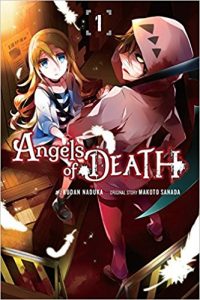
Angels of Death, Vol. 1

December 25, 2017 by Sean Gaffney

By Makoto Sanada and Kudan Naduka. Released in Japan as “Satsuriku no Tenshi” by Media Factory, serialization ongoing in the magazine Comic Gene. Released in North America by Yen Press. Translated by Ko Ransom.

I’ve mentioned before that I will sometimes dip back into a genre that I’m not fond of to see if a new series might catch my eye. With horror, this has been something of a mixed back. When it works, it works seriously well – see Higurashi or Kurosagi Corpse Delivery Service. But for each one of those there are five or six “let’s gather a cast of people together and winnow them down one by one” that leaves me cold. Angels of Death is my latest look in to the horror/survival game genre. It’s based on a game which I believe you can actually get on Steam, and has an amnesiac heroine waking up in an abandoned building, where she’s informed she has to go from floor to floor and avoid being killed. What makes Angels of Death more interesting than most others of this sort is that the cast is kept to a bare minimum, which allows us to skip piles of introduction and get right to business. And also Rachel looks a bit more interesting than most faceless game protagonists.

The moment we see an adorable wounded bird get brutally slaughtered in a giant two-page spread, we know the emphasis here is not going to be on friendship, training or victory. She first runs into Zack, who is an absolute cliche of a serial killer and the sort of character you’d expect to get killed off pretty quickly in this sort of series, but somehow she manages to escape him. She then ends up on a different floor with Dr. Irie… sorry, Dr. Danny, who is very much like what Dr. Irie from Higurashi would be if he was deeply sociopathic and awful. To the manga’s credit, it doesn’t bother to try to convince us that he’s really another good guy – we already know there’s a killer on each floor, and he’s already so shady that it barely raises an eyebrow when he starts going on about eyes. Eventually Zack ends up chasing Rachel once more, but Zack is now put off by her personality so allies with her to try to get out.

As I said, the odd moments when Rachel shows off how broken she is are the best in the book. They manage to combine hidden tragedy and loss with a truly scary feeling, particularly when dealing with the bird. The artist, in fact, is very good at showing off the strengths of this genre – scary scenes, over the top faces, and a lot of bloody action. On the downside, unlike, say, Higurashi or Kurosagi Corpse Delivery Service, I doubt the final goal here is to show how a team can become true friends and band together to defeat the bad guy. The goal here is to frighten and shock. This first volume does a decent job of that, and therefore if you like survival horror, I’d definitely recommend it, though I likely won’t be reading further.

Filed Under: angels of death, REVIEWS

Accel World: The Red Crest

December 23, 2017 by Sean Gaffney

By Reki Kawahara and Hima. Released in Japan by ASCII Mediaworks. Released in North America by Yen On. Translated by Jocelyne Allen.

Why do we play fighting games? That’s the question being asked many times over the course of Accel World, and the idea of winning and losing seems to linger in some people more than others. Certainly in the case of Wolfram Cerberus, it’s a matter of life and death, especially as, for some odd reason, his Accelerated form seems to have multiple personalities, a la the legendary dog it’s named after. For others, it’s a way to bond with friends, such as the new character we meet here, Chocolat Puppeteer. Sadly, her friends have been infected with ISS kits, which leads to a chilling new revelation: you can now be infected against your will. Fortunately, Haruyuki and Chiyuri (and it’s nice to see the two of them team up without an overdose of sexual tension) manage to help her and temporarily save the day. Unfortunately, that just means that the enemy changes their focus, and the reader realizes that yes, this is another 4-5 book arc.

As for Kuroyukihime, we finally get the answers we’ve been waiting for since the first book – why did she kill Red Rider, and what drove her to leave her family? The answer turns out to be the same thing, unsurprisingly. Kuroyukihime may be strong and a guiding light to Haruyuki, but she’s also horrible at anything regarding subterfuge, much less outright lying, so it’s no surprise that she’s played like a sucker by White Cosmos. It’s nice to see Haruyuki has matured enough to take this calmly and offer support, even when she’s sobbing on his shoulder – a few volumes ago he would have been a total wreck. (It’s possible the author saved all the total wreck parts for the short story at the end of the book, which features 200% more Fuko teasing than normal, but also goes into the circumstances of her birth and dealing with being born without legs in the real world.)

It’s looking as if things might come to a head at the school’s culture festival, which may turn out to be a disaster as they’re all supposed to be keeping their real-life identities secret. As is usually the case with Accel World, the battles are well-written and concise, and I rarely find myself getting lost in technobabble. (It’s very clear that he wrote a lot of this after he had more experience, whereas Sword Art Online sometimes shows off his immaturity.) I’m not entirely sure if this will wrap up in the 13th book or not – at least, this particular arc, I’ve no doubt that White Cosmos is the Big Bad and will be part of whatever final End Kawahara has in mind – if he has one, the series is well over 20 volumes in Japan. That said, I’m perfectly content to let him slowly spin his tale – the fanservice may occasionally grate on me, but for the most part Accel World has developed into one of the most solid, dependable light novel series being put out by Yen.

Filed Under: accel world, REVIEWS

Sweet Blue Flowers, Omnibus 2

December 22, 2017 by Sean Gaffney

By Takako Shimura. Released in Japan as “Aoi Hana” by Ohta Shuppan, serialized in the magazine Manga Erotics F. Released in North America by Viz. Translated by John Werry.

Shameful confession to make: while I always enjoy Shimura’s series when I read them, I will note that it’s sometimes hard for it to stay in my memory, particularly when so much other yuri is already coming out. Not helping the matter is the fact that, while I do love her art, I sometimes have trouble telling her characters apart, particularly secondary characters. And thirdly, this particular omnibus seems to have backloaded the more interesting material. (There is a very helpful “Let’s meet the cast” list at the start of the second half/4th volume, which I realize is meant to be something of a parody but which I could honestly have used at the beginning.) Add all these things together and I’m left with a volume that I did not enjoy as much as the first. I suspect Sweet Blue Flowers may be a series that rewards marathoning the entire series in one gulp.

The first half, Volume 3, has the cast invited to Kyoko’s summer home for a vacation, which has horseback riding, and scary stories, and one of the secondary girls falling for Akira’s brother, which I’m honestly happy about because he gets so much abuse from his sister that he could use some nice things happening to him. Akira, meanwhile, is stricken with a cold, as is Fumi. This means that Akira is there to overhear some of Kyoko’s family drama and also with Fumi finally admitting that Akira was her first love, with all the awkwardness that comes with it. And we write Yasuko out of the story, at least for now, as she comes to terms with the fact that her crush is marrying the girl he loves (which isn’t her), and tries to apologize to Fumi for what happened between them (which doesn’t go well), then flies off to England. And so the fourth volume introduces new first-years, new potential relationships, and more and more of Fumi being a bit of a wreck.

This is not an easy yuri series, one that goes down smoothly and leaves a smile on your face. And it’s also not a series that seems to magically have no men in it whatsoever. Men are here, and they get into relationships with some of the cast. Girls have crushes on other girls, and then get over them. But we also have their teacher Yamashina-sensei, who gets a chapter devoted to her which seems to be about the bitter, unrequited love of youth – followed by the bitter, unrequited love of a student with a crush on her – but ends in a sweet way that shows us that it’s not ALL going to be angst and drama. I think Shimura may have realized that she was laying it on a bit thick – in the second half we get Haruka and Ryoko, two students who seem so far to be a bit less burdened with baggage than others. But we still have Fumi, and her attempts to try to be a bit more outgoing – which doesn’t work well – are very true-to-life but also painful.

Sweet Blue Flowers is a good series. That said, it’s exhausting as well, and I suspect that it’s best enjoyed either in one gulp – waiting till the other two omnibuses are out – or in smaller quantities, such as reading only half and then coming back. There is such a thing as too much Fumi. (And too be fair, too much Akira, though that’s slightly less pressure-heated.)

Filed Under: REVIEWS, sweet blue flowers

Manga the Week of 12/27/17

December 22, 2017 by Sean Gaffney, Michelle Smith, Ash Brown and Anna N 1 Comment

SEAN: Well, it would be a quiet final week of 2017… were it not for Kodansha, who are determined to break us.

First off, yes, they did it again. Out already is Living Room Matsunaga-san, a title that was announced after Manga the Week of went to press. It looks like a typical shoujo title from Dessert.

MICHELLE: So far, I feel kindly disposed enough toward Dessert titles to give this one a look.

ANNA: Me too!

SEAN: Dark Horse has a 5th Drifters, whose volumes come out so infrequently I tend to forget what’s going on beyond “crazy faces”. Which, honestly, is probably for the best.

ASH: The fifth volume already?! After years between the releases of the third and fourth volume, a few months between the releases of the fourth and the fifth seems like no time at all.

SEAN: And there’s a 2nd Legend of the Piko Piko Middle School Students, a wacky Evangelion parody/comedy thing.

J-Novel ends two of their ongoing light novel series next week. Bluesteel Blasphemer wraps up with its 4th volume. And, while it’s not an official “ending”, My Big Sister Lives in a Fantasy World has no current plans for new volumes after Vol. 7.

Kodansha. Wow. They have print! We get new volumes of Attack on Titan: Before the Fall (12), Land of the Lustrous (whose anime has really exploded in Western fandom) (4), Love & Lies (3), and That Time I Got Reincarnated As a Slime (whose novel came out last week from Yen) (3).

ASH: Despite not always completely understanding what’s going on in Land of the Lustrous, I am enjoying the series and its striking artwork.

SEAN: We have digital debuts! Yes, and I actually know about them in advance. My Boyfriend in Orange is, yes, another Dessert title (Dessert is the new Betsufure). This time the boyfriend seems to be a firefighter. Pitch-Black Ten runs in Shonen Magazine R, and seems to be a supernatural series.

MICHELLE: I could cut and paste my line from above here, too. It’s not that I really crave a romance series with a fireman in it, but eh. Okay. Why not?

ANNA: Sure, why not?

SEAN: We have ongoing digital series! Piles of them. I think I got them all. DAYS 7, Domestic Girlfriend 13, Drowning Love 7, The Full-Time Wife Escapist 8, Giant Killing 9, House of the Sun 13, I Want to Hold Aono-kun So Badly I Could Die 2, Kounodori: Dr. Stork 7, Love’s Reach 6, and Peach Heaven 12. As always, I’m all about Wife Escapist, but I believe Michelle will be looking at the soccer.

MICHELLE: I will be looking at the soccer *and* the spouses! (But probably, yes, I do love Giant Killing the best.)

ANNA: So far behind on Wife Escapist. I will not give up though!

SEAN: There are publishers other than Kodansha with titles next week, oddly enough. Seven Seas’s debut is Unmagical Girl, a comedy series about a fictional magical girl who’s somehow brought into reality, and now has to cope with everyday life. I’m just happy to have a magical girl series that it’s “let’s kill the magical girls”. It apparently ran in a Pony Canyon magazine, but I think the license may have gone through Ichijinsha.

Seven Seas also has a 2nd Absolute Duo, a 4th Magical Girl Site (which is absolutely about killing magical girls), and a 4th Species Domain (which is actually pretty cute).

SuBLime has a 4th volume of The Night Beyond the Tricolored Window, which looks dramatic as hell.

MICHELLE: I love this series so much and have been eagerly anticipating volume four for a year!

ASH: I want this series in print so much!

MICHELLE: So do I! Even though I don’t mind reading digitally, I crave that extra security you feel when you own a tangible copy of something.

SEAN: Vertical has hit double digits with Witchcraft Works.

Lastly, Yen Digital has a 4th IM: The Great Priest Imhotep, who is still invisible, I believe. (I will never stop making that joke, sorry.)

Are you getting anything from this? Or still catching up with this week’s avalanche?

Filed Under: FEATURES, manga the week of

Baccano!: 1933 The Slash -Cloudy to Rainy-

December 21, 2017 by Sean Gaffney

By Ryohgo Narita and Katsumi Enami. Released in Japan by ASCII Mediaworks. Released in North America by Yen On. Translated by Taylor Engel.

After a brief foray into the 21st century, Baccano! returns to its main plot, which takes place in the 1930s. Many of the main characters are featured in some way or another here, and in a way it feels like the author is writing enjoyable set pieces, as if he’s finally gotten a grip on writing everyone. Isaac and Miria are fun, loud, and seemingly completely random; Luck is seemingly cool but in reality rather frustrated with everything happening around him; Jacuzzi cries a lot but buckles down when he needs to, etc. That said, the book also features two minor characters from earlier books who get the spotlight here, and I suspect enjoyment of it depends on how much you enjoy those characters. It’s also, as you may have guessed by the title, the first of a two-parter, and unlike Grand Punk Railroad, this is definitely incomplete.

Tick Jefferson is in the top third of the cover art. We saw him before as the Gandor family’s torture expert, and he seemed like another of Narita’s ‘smiling insane guys’. Which he may be, to a lesser degree – he still really loves cutting people apart. But we get a bit of his family background, as well as a surprising amount of his philosophy, and see that when he’s not torturing people he’s surprisingly level-headed. His partner in the book (middle third of the cover) is Maria Barcelito, one of the assassins that we saw Claire completely destroy in the 4th novel, who joined the Gandors because she was so impressed by Keith stopping Claire. On the bright side, the Gandors gained a powerful assassins, probably their most powerful fighter. On the down side, Maria is annoying as hell, immature, can’t stop trying to cut anyone and anything with her swords, and is desperately in need of some humbling. Fortunately, she gets it in spades at the end of the book.

The bottom third of the cover art is Chane Laforet, the “girl in the black dress” from the Railroad books. The cliffhanger to those books had her being picked up by Jacuzzi’s gang, and she’s now living with them in Eve Genoard’s mansion in upper Manhattan (the explanation for why a gang is living in the Genoard mansion made me roll my eyes a bit, but I can see Eve just agreeing and then forgetting about it, especially given her obsession with finding Dallas). Chane doesn’t interact with Jacuzzi’s gang as much as I’d have liked, but she clearly values them highly as friends. She’s also clearly hooked up with Claire, something also implied at the end of the railroad arc, and I suspect Claire will have more to do in the next volume.

As for the villains, well, technically I suppose it’s Huey, though his daughter is unaware of what he’s doing. He has a group of people trying to offer Jacuzzi’s gang the power of immortality (please God no, I love the fact that Jacuzzi and Nice’s gang are just normal scrappy kids), though this goes south when their demo – Dallas Genoard, freshly retrieved from a sunken river and just as much of a giant dumbass – ends up getting too obnoxious and gets slashed. A lot. Immortality sounds great till you see that you can still feel horrible pain. We really only meet two of the villainous gang here. Tim is the leader and also shares a secret past with Tick Jefferson, and seems to be there to watch what was supposed to be a smooth situation spiral out of control. Adele is seemingly shy and meek… but in reality seems to really love fighting more than anyone. And we haven’t even met the mysterious Christopher yet…

This is a decent book, and I recommend it for those reading the series, obviously. That said, it really needs its second half, and feels slight as a result. It does have some rewards for the careful reader (watch Isaac and Miria’s reaction to the Genoard mansion), and Tick and Maria can be a lot of fun provided you don’t pay too much attention to how aggravating Maria is most of the time. You may want to wait till April and read this with its conclusion.

Filed Under: baccano!, REVIEWS

Umineko: When They Cry, Vol. 16

December 19, 2017 by Sean Gaffney

Story by Ryukishi07; Art by Eita Mizuno. Released in Japan in three separate volumes as “Umineko no Naku Koro ni: Requiem of the Golden Witch” by Square Enix, serialized in the magazine Shonen Gangan. Released in North America by Yen Press. Translated by Stephen Paul.

It’s been nearly a year since we last checked in on Rokkenjima. We have two arcs left, and they’re both packed to the gills – each is nine volumes total. And they’re sometimes big volumes. That means this first omnibus of three by Yen is 826 pages long, but fortunately it doesn’t feel like you’re reading a lot. By now we’re familiar with everyone in the story, and since Requiem is, for the most part, devoted to explaining the mysteries from the previous six arcs, everything glides along very smoothly. Well, we’re familiar with almost everyone in the story. This volume is noticeably short on Battler, who only shows up at the very start. Instead we get Willard D. Wright, who is to S. S. Van Dine what Dlanor is to Ronald Knox. Battler was a teenager who liked mysteries, Willard is an actual detective. And he’s here to get answers, along with his Watson, the heir to the Ushiromiya family, Lion.

That’s Lion on the front cover there, and you might be forgiven for a certain lack of recognition. And also wonder, as Will does, what Lion’s gender is. Ryukishi07 has deliberately hidden this from us, and explicitly told the manga artist (best known for Spiral: Bonds of Reasoning) to do the same, so I will try not to use gender pronouns. That said, if you understand Kinzo’s monstrous sexism from previous arcs, you can easily hazard a guess as to what gender his beloved grandchild and heir is. Lion is a lot of fun (and yes, the name completes the horrible Eva – Ange – Lion pun), pinching Will’s ass whenever he acts callous, which is a lot of the time. Will is retired, and doesn’t want to be here, but Bernkastel is basically forcing him to solve everything for her master. So we see him ask Rosa about what happened that day in 1967, talk to Jessica about her own experiences with being rude to Beatrice (or more accurately, Maria), and find out how Kinzo really got all that gold and who Beatrice was originally. (Admittedly, Kinzo’s story seems very romantic and idealized – you’re left wondering if that’s really all that happened.)

The ugliest part of this volume is, hands down, the section where everyone talks about the fact that Kinzo raped his own daughter, and all the servants basically say “well, yeah, that happened, but he really loved her mother, see?”. It’s infuriating, and at least Genji had the good sense to hide the next generation down until he was sure it wouldn’t happen AGAIN. Speaking of which, as rapidly becomes clear, Lion’s existence here ties into the 5th arc, where Natsuhi shoved the baby she’d been given by Kinzo to raise as her own off a cliff. Lion is what happens when she DOESN’T do that, something that Bern says is an incredibly rare thing. It’s to Lion’s credit that the first thing that comes to mind is defending Natsuhi, who really is a loving mother here. Honestly, Lion holds up pretty well with everything that’s going on, especially when we find out that in all the worlds where Natsuhi shoved the baby off the cliff, we get Beatrice, not Lion.

Towards the end of this omnibus, Will reveals the culprit to Lion and Bernkastel – but not to us, as we’re still supposed to make guesses. That said, many of the hints are laid out in front of us this volume as well. The fact that Shannon and Kanon are the only ones besides Will to not know who Lion is. The fact that when Will asks Shannon to go get Kanon so he can talk to them together, Shannon has possibly the scariest mental breakdown in the entire series. And the fact that when we get the “culprit” POV at the end, we see her, in 1976, working with a Shannon who looks exactly the same age as she does in 1986. Speaking of the word culprit, if you weren’t already horrified by the Evangelion pun, the fact that the nickname for the culprit is “Yasu” will surely have you rolling your eyes and grinding your teeth – that is, if you know Japanese mystery games.

This is, incest apologia aside, one of my favorite arcs, and the manga artist does a great job bringing it to life. Next time around we’ll get more flashbacks, as “Yasu” grows up, falls in love, and becomes a witch. If you’ve been reading Umineko all along, this is an essential volume.

Filed Under: REVIEWS, umineko

Bookshelf Briefs 12/18/17

December 18, 2017 by Michelle Smith and Sean Gaffney Leave a Comment

Assassination Classroom, Vol. 19 | By Yusei Matsui | Viz Media – The first half of this book shows us that our heroes are still high school students, and thus powerless to a degree—they’re captured with astonishing ease. Of course, once we get them out of holding and back on the mountain (kudos to Irina, who shows off a few things I’m surprised Jump let her get away with—not least of which wanting to do Karasuma ten times a day) they’re in their element, and even the hardened trained assassins find that environment plays a key role. As for Koro-sensei, well, he’s trapped, and time is running out. The book makes it very clear that saving Koro-sensei is not going to fly with the general public. So what happens next? Can’t wait to find out. – Sean Gaffney

Captive Hearts of Oz, Vol. 3 | By Ryo Maruya and Mamenosuke Fujimaru | Seven Seas – As with its spiritual predecessor, Alice in the Country of Hearts, the goal of this series is to find out what the world is actually supposed to be. After reading this volume, it may be even less clear. I am grateful that, because this isn’t based on an otome game, there’s no real romance being played out here. (Romance could be some of the shadiest elements of the Alice series.) However, I’d like things to be just a little bit clearer, to be honest. I probably should have reread the first two books, as it’s been a while. That said, the general TONE of the book is fine, and it pushes all the right buttons that fans of this sort of series will want pushed. It’s just… HUH? – Sean Gaffney

Chihayafuru, Vol. 7 | By Yuki Suetsugu | Kodansha Comics (digital only) – Chihaya should be studying for exams, but she ditches a session with Desk-kun to see how Taichi’s doing in a tournament. It’s there she learns that Arata has resumed competing, and I so love Taichi’s reaction to this news. It’s obvious that he’s jealous, but seeing Chihaya so happy causes him to admit to himself that part of him is happy, too. Then, after some nice chapters in which the more lowly members of the Mizusawa karuta club offer sage advice to Taichi and Chihaya, we progress to the East Japan qualification tournament to decide challengers for the ranks of master and queen. Chihaya’s mastery of the game has improved, and it’s great to see her take on formidable opponents without making mistakes. It’s probably too early in the series for her to actually beat Shinobu, but I am in no rush. Every volume is a joy. – Michelle Smith

Everyone’s Getting Married, Vol. 7 | By Izumi Miyazono | Viz Media – Oh, long-distance relationships. Everyone goes into them filled with good intentions, but it never quite works out the way you want. Asuka and Ryo are certainly finding that out. She’s being strong and totally OK with him doing this, which makes sense for him, but… you can tell that she hates it, and that’s not being communicated. As such, even though everything is being done properly, it’s hard to not get that sense of impending doom, especially as everyone else is telling Asuka this as well. We also meet Ryu’s brother, who is the classic “I look totally scary but am really just overprotective” sort. We still have a couple of volumes to go… how is this going to sort itself out? – Sean Gaffney

Kuroko’s Basketball, Vols. 17-18 | By Tadatoshi Fujimaki | VIZ Media – Seirin has made it to the quarterfinals of the Winter Cup where they must face Yosen, a team that not only includes Kagami’s childhood friend/rival but also Murasakibara, an (enormous) member of the Miracle Generation. Kuroko debuts his new shooting skills (essentially, he adapts his passing technique instead of using proper form) and the various members of Seirin get their moment in the sun, especially Hyuga and Kiyoshi. And, of course, there’s a lesson, as Murasakibara’s approach has been that big people are always going to win at basketball, so there’s no use in anyone else trying. I must note that this series has just about reached The Prince of Tennis levels of implausibility involving some characters’ abilities, including a peanut gallery that calls out the names of moves, but I am still enjoying it immensely. – Michelle Smith

Of the Red, the Light, and the Ayakashi, Vol. 9 | By nanao and HaccaWorks* | Yen Press – So I will admit that throughout this series I’ve found the plot difficult to follow at the best of times, but for all that I appreciated this volume trying to lay things out for us. We get even more clarification about what ‘taking a meal’ entails, and also why Akane did what she did. Yue’s decision feels very much in character, and I suppose it could have been worse—the characters who were “eaten” don’t come back, but most of the Ayakashi are at least seen as around. As for Tougo, he is very unhappy with part of Yue’s decision, and takes it upon himself to try to fix it—also in character for him. Main series is over, time for extras! Will there be an epilogue? – Sean Gaffney

Princess Jellyfish, Vol. 7 | By Akiko Higashimura | Kodansha Comics – At one point while reading this, I had to step back a moment to just appreciate what an unexpected turn this story has taken. It’s not about saving the Amamizukan from destruction anymore. It’s about Tsukimi getting on a plane for the first time and flying to Singapore, Kuranosuke’s determination to get her back, Shu’s apparent willingness to let her go, and Hanamori’s promises to make enough money gambling to buy the Amars’ residence back from Kai, the fashion mogul who has whisked Tsukimi away on a new life. But, y’know, I’m not sure Tsukimi really wants to go back, and that’s what makes this series great. I think we could get a happy ending that preserves the status quo for most of the Amars while allowing Tsukimi to become something she never imagined. I am so eager to experience the final volumes! – Michelle Smith

Welcome to the Ballroom, Vol. 8 | By Tomo Takeuchi | Kodansha Comics – Well, I was wrong in my review of the last volume, where I said we would have an amazing breakthrough this time. Instead, we get more pain, angst, and torment from our lead couple, and everyone around Tatara yelling at him to figure things out or else stop this. They’re not going to tell him what the issue is, mostly as it can’t be conveyed well with words. And you get the sense by the end of the volume that he might be getting it. But I said that last time, and I’m not really sure that it’s worth crawling through broken glass every volume just to get to a bit of catharsis. Is this trip really necessary? – Sean Gaffney

Filed Under: Bookshelf Briefs

Pick of the Week: A Bounty of Manga

December 18, 2017 by Sean Gaffney, Katherine Dacey, Michelle Smith, Ash Brown, Anna N and MJ Leave a Comment

SEAN: Honestly, there’s just too much stuff. I feel like I’m drowning in choices. And so (because I suspect the rest of the group will go with CLAMP) I will go with an old favorite and pick the new Umineko When They Cry omnibus volume, Requiem of the Golden Witch. Fans love this arc, and the manga adaptation of it is supposed to be quite good. And at 826 pages, it can also be used as a blunt object.

KATE: I’m torn between the latest volumes of Golden Kamuy and Happiness, two of my favorite ongoing series. Since choosing between them seems like deciding whether you like your daughter better than your son, I’m going with Junji Ito’s Shiver, which has been getting great advanced buzz.

MICHELLE: I am actually not going to go with CLAMP, despite my intense love of Kero-chan, because this is the last time I can choose Say I Love You. I’ve enjoyed this series a lot, and have been anticipating this final volume for a long time. It’s definitely a must-buy for me this week.

ASH: So much manga! And so many new volumes in series that I’m following! Although I will certainly be giving the new Cardcaptor Sakura a try, I will continue to thwart Sean’s prediction by choosing another debut. Kate already has Shiver covered, which I’ll definitely be reading, but I’m also incredibly curious about Graineliers, so that’s my pick!

ANNA: I feel like one of us should not thwart Sean’s prediction! Thus, Cardcaptor Sakura is my pick! Let’s hope it is more like early CLAMP and less like late CLAMP!

MJ: Wow, I’m really torn here. I have a deep, deep love for Cardcapter Sakura so it’s really hard for me to let that go. But I don’t necessarily trust CLAMP to recreate that magic for me at this point, and I’m really a sucker for a new GFantasy title, so I’m with Ash on Graineliers! Thanks, Anna, for making Sean’s prediction at least a little true!

SEAN: I’m not sure I trust all this love for Grenaliers. I think the love for it may have been… planted. (puts on sunglasses, Roger Daltrey scream)

MJ: Wow.

Filed Under: PICK OF THE WEEK

Rokka: Braves of the Six Flowers, Vol. 3

December 18, 2017 by Sean Gaffney

By Ishio Yamagata and Miyagi. Released in Japan by Shueisha. Released in North America by Yen Press. Translated by Jennifer Ward.

I have to say that I was groaning when the beginning of this third volume dealt once again with “which one of us is the traitor”. Fortunately, like Book 2, the question quickly gets set aside as we deal with an ever-growing threat. We also deal with the return of Nashetania, who’s still trying to pursue her goal even if she has to kill a bunch of people. Her loopy amorality was a highlight of the first book, so I was looking forward to this. Sadly, we don’t get nearly as much Nashetania in the book as I’d like. Chamo is also sidelined, and Mora reduced to support. The first half mostly focuses on Adlet, Fremy and Rolonia getting into various fights and trying to figure out how to stop Nashetania – or at least find her. The other half of the book focuses on Goldof, as you might have guessed from the cover, and we get his backstory and see why he is so devoted to his princess.

The main problem with this is that Goldof is fairly stoic, with his quirk being a berserker rage and urge to destroy that only turns off around Nashetania. His past is tragic, but his churlish acceptance of it (and violence against women and children) make it harder to sympathize. Nashetania is the most interesting part of the flashback, and we also learn a bit about how she got to be the way she is (pretty much brainwashed since birth into being a cultist, which… well, fits her pretty well). In the present, Goldof’s narration shows him trying to figure out what the fiends are doing, who’s lying, and how he can be both a Brave and save Nashetania. I found it rather frustrating that Goldof kept thinking of himself as not as smart as Adlet, particularly as Adlet has never been all that smart in this series. He’s not all that smart here either, basically just running around till he arrives at the climax.

The best part of Rokka continues to be the mysteries of each book, which are pretty hard to figure out – the revelation about how one trick is done is sort of impressive and also rather disgusting. Even if the solutions aren’t as satisfying as the author thinks, it did keep me constantly trying to figure things out, the goal of any mystery. Sadly, the main issue with Rokka continues to be that I just don’t find the characters all that compelling. I enjoyed Mora when she was the focus in Book 2, but without her backstory she’s basically dull. Adlet is nowhere near as main character-ish as he should be, and as I said before, Goldof is supposed to be dumb muscle, but can come across easily as unlikable dumb muscle, especially when give the standard “save the world or save the woman you love” choice.

We’re now halfway through the series, and I’m not ready to give up on it just yet, but I really would like the real traitor to be found so that the book can move forward, and I’ll be honest: this series cries out for a manga spinoff that’s a high school AU. Mildly recommended, with reservations.

Filed Under: REVIEWS, rokka: braves of the six flowers

Children of the Whales, Vol. 1

December 17, 2017 by Sean Gaffney

By Abi Umeda. Released in Japan as “Kujira no Kora wa Sajou ni Utau” by Akita Shoten, serialization ongoing in the magazine Mystery Bonita. Released in North America by Viz. Translated by JN Productions.

In general, I try to review something fairly soon after I read it, if only to ensure the volume sticks in my head. But sometimes the queue gets really long and things slide to the back. This can be unfortunate. When I read Children of the Whales back in November, I thought it was pretty creepy but intriguing, if a bit too depressing for my taste, and firmly in the genre of “we discover that our world is not what it seems and must fight for survival”. All of which is true. Then I read The Promised Neverland, one of Viz’s new Jump titles, which is not the same premise, but has enough similarities that I couldn’t help but compare the two. And, two be honest, Children of the Whales is not as good. The desire to immediately see more and figure out how the cast will succeed that I got with The Promised Neverland is, with Children of the Whales, replaced with “I wonder if the author is finished killing off interesting characters yet?”.

Our hero is Chakuro, who lives on a “mud whale” (hence the title), an island that seemingly moves through the desert in some post-apocalyptic land. Chakuro is an archivist, meaning he records births, deaths, etc. He’s also a bit of a weirdo. The mud whale has its own culture, with a mayor and everything, and its own taboos – such as grieving for those who have died, something that comes naturally to Chakuro, and thus gets him into trouble. He’s also got a cute childhood friend who clearly likes him. Then one day they run across another mud whale, and while exploring it find a seemingly emotionless girl, Lykos, who seems to be the last survivor. Unfortunately, though she doesn’t bring it herself, once she returns with them to their sand whale, terrible things begin to happen, as we find the world is not as abandoned as they had thought.

I think my main issue with Children of the Whales so far is that it seems to bleak. One of the characters killed off near the end was, in my mind, going to be used to set up a couple of different plots involving Chakuro and Lykos that would carry over into future volumes, but no, they’re brutally killed off to show us that Nothing Is The Same Anymore. And where The Promised Neverland shows us heroes who plan to fight back using pluck and grit, the cliffhanger to this book shows more of having to fight due to simple “otherwise I will be dead” despair. I just can’t really get involved with anyone here. It’s a shame, as the art is great, and the best reason to read this – the cover alone is fantastic. It conveys both the wonder of this world we’re discovering as well as its vicious, bloody destruction.

I know I shouldn’t be comparing two titles that are for different audiences in different magazines. But I find it very telling that after reading Children of the Whales, it drifted to the bottom of my review stack, whereas after reading The Promised Neverland I had to review it the very next day. Still, fans, of creepy fantasy/mystery series will likely enjoy this more than I did.

Filed Under: children of the whales, REVIEWS

  • « Go to Previous Page
  • Page 1
  • Interim pages omitted …
  • Page 239
  • Page 240
  • Page 241
  • Page 242
  • Page 243
  • Interim pages omitted …
  • Page 382
  • Go to Next Page »
 | Log in
Copyright © 2010 Manga Bookshelf | Powered by WordPress & the Genesis Framework