• Skip to primary navigation
  • Skip to main content
  • Skip to primary sidebar
  • Home
  • About Us
    • Privacy Policy
    • Comment Policy
    • Disclosures & Disclaimers
  • Resources
    • Links, Essays & Articles
    • Fandomology!
    • CLAMP Directory
    • BlogRoll
  • Features & Columns
    • 3 Things Thursday
    • Adventures in the Key of Shoujo
    • Bit & Blips (game reviews)
    • BL BOOKRACK
    • Bookshelf Briefs
    • Bringing the Drama
    • Comic Conversion
    • Fanservice Friday
    • Going Digital
    • It Came From the Sinosphere
    • License This!
    • Magazine no Mori
    • My Week in Manga
    • OFF THE SHELF
    • Not By Manga Alone
    • PICK OF THE WEEK
    • Subtitles & Sensibility
    • Weekly Shonen Jump Recaps
  • Manga Moveable Feast
    • MMF Full Archive
    • Yun Kouga
    • CLAMP
    • Shojo Beat
    • Osamu Tezuka
    • Sailor Moon
    • Fruits Basket
    • Takehiko Inoue
    • Wild Adapter
    • One Piece
    • After School Nightmare
    • Karakuri Odette
    • Paradise Kiss
    • The Color Trilogy
    • To Terra…
    • Sexy Voice & Robo
  • Browse by Author
    • Sean Gaffney
    • Anna Neatrour
    • Michelle Smith
    • Katherine Dacey
    • MJ
    • Brigid Alverson
    • Travis Anderson
    • Phillip Anthony
    • Derek Bown
    • Jaci Dahlvang
    • Angela Eastman
    • Erica Friedman
    • Sara K.
    • Megan Purdy
    • Emily Snodgrass
    • Nancy Thistlethwaite
    • Eva Volin
    • David Welsh
  • MB Blogs
    • A Case Suitable For Treatment
    • Experiments in Manga
    • MangaBlog
    • The Manga Critic
    • Manga Report
    • Soliloquy in Blue
    • Manga Curmudgeon (archive)

Manga Bookshelf

Discussion, Resources, Roundtables, & Reviews

Sean Gaffney

Bookshelf Briefs 9/17/18

September 17, 2018 by Ash Brown, Sean Gaffney and Michelle Smith Leave a Comment

The Ancient Magus’ Bride, Vol. 9 | By Kore Yamazaki | Seven Seas – I read the first eight volumes of The Ancient Magus’ Bride back-to-back, so it was a little weird reading this one on its own. We pick up with Chise having made a deal with Josef that ultimately involves each getting to see the other’s painful past. She eventually must agree that he’s suffered even more than she has, though this doesn’t give him an excuse for hurting people. I’m not sure if her message of understanding really got through to him, but it was pretty neat that, although Elias was prepared to do something terrible to save her, Chise essentially saved herself. Perhaps a bit too neatly, everything more or less resets in time for the next phase of the story—the “college arc”—which begins next volume. I’m looking forward to it! – Michelle Smith

A Centaur’s Life, Vol. 15 | By Kei Murayama | Seven Seas – Last time we had a lot of war and very little of the main cast; this time the main cast are more heavily involved, but only because the war comes to them. Honestly, if anything, the series gets even more bizarre, something I thought impossible, mostly thanks to the snake people and their “world in a bubble” reality generator, which makes me wonder how much of what we’ve seen has been in one of those. As for Hime, though the cover may make this look like a final volume, it isn’t—but she is almost killed by terrorists, who go after the little triplet girls as well. A Centaur’s Life has found the line between cute (and sometimes perverse) monster girls and anti-war otakudom, and is proud to step back and over over that line. – Sean Gaffney

Hatsu*Haru, Vol. 2 | By Shizuki Fujisawa | Yen Press -The concept of the playboy high school guy who ends up knowing nothing about what real love feels like is not a new plot in the slightest, but the author does a very good job of keeping us interested despite that. Kai’s attempts to force a kiss on Riko get him in deep trouble for almost half the volume, and justifiably so. But Kai is genuinely trying to understand Hiro, and understand why she continues to be in love with another man even though she knows he is with someone else and can’t reciprocate it. The series gets a bit more cliche when it moves to the other main characters—honestly, the Buddhist guy/Shinto girl pair made me groan at how cliched it was. Do we need to pair the spares already? Still, overall good. – Sean Gaffney

Is It Wrong to Try to Pick Up Girls in a Dungeon Four-Panel Comic: Odd Days of Goddess | By Masaya Takamura and Fujino Omori | Yen Press – The second volume of this 4-koma parody series is not as good as the first. Honestly, it has to be said: seeing Hestia and Lilly getting jealous over Bell is not really why fans over here read the series, and since it’s exaggerated in a parody, that makes it more annoying. This second volume came out around when Sword Oratoria was taking off, so the second half focuses far more on Lefiya and company, but the humorous tone is still the same. Oddly, the best parts of the volume are when it briefly turns serious, or at least sweet, showing off Bell and Hestia’s pure and innocent kind-of love. If you like the series, this may make you smile. – Sean Gaffney

Kaguya-sama: Love Is War, Vol. 4 | By Aka Akasaka | Viz Media – I suspect I may love this a bit more than other manga bloggers do, but oh well. I love it. Shirogane’s sister is on the cover, and she does come to visit the student council room, though she’s on her best behavior. And there are a few classic Chika moments. But for the most part this volume is dominated by Kaguya and Shirogane and their desperate attempts to get the other to confess first so they can just GO OUT ALREADY. This includes pretending to be cold, which goes disastrously on both sides, and Kaguya then CATCHING a cold, which leads to an actual crisis when Shirogane can’t control his teenage hormones and Kaguya thinks he went too far… or not far enough. I can’t stop laughing when I read this. – Sean Gaffney

The Night Beyond the Tricornered Window, Vol. 5 | By Tomoko Yamashita | SuBLime Manga (digital only) – I wasn’t exactly lulled into a false sense of security by the episodic first half of this volume, given the pervasive ominous feeling that always lingers on the fringes of this series, but I was still taken by surprise when some pivotal things suddenly happen in the back half, including Hanzawa having a run-in with Erika and readers suddenly learning some very major and disturbing truths about Rihito’s past that both render him more sympathetic as a character and provide further evidence that he’s likely a very dangerous person for Mikado to be hanging around with. I love this series so much, from the spare yet expressive art to the creepy cases to the leads and their complicated relationship. What it reminds me of the most is Tokyo Babylon, so if that’s your jam, please read this series! – Michelle Smith

Queen’s Quality, Vol. 5 | By Kyousuke Motomi | Viz Media – This volume of Queen’s Quality felt more like a shonen series, filled with dramatic battles, swords, and flashbacks of dead childhood friends in the best One Piece tradition. Fumi is getting closer to becoming a true queen, and succeeds in at least moving from the Black Queen to the Dark Grey Queen this time around (would she sing the Seven Seas of Rhye?), but she has to figure out a way to work with white as well, and it’s implied that she has to recover all her memories to do so. Meanwhile, Kyutaro is having trouble dealing with how much he’s in love with her, and even her very presence can relax and heal him. This new arc involving a spring break training trip will have trouble topping the excitement of the arc that ended here. – Sean Gaffney

Skip Beat!, Vol. 41 | By Yoshiki Nakamura | VIZ Media- Kyoko’s audition for a ninja role in a samurai drama continues, and the majority of this volume can be summed up as, “She proceeds to be very badass.” Some of what happens to make her stand out was a calculated move on Yashiro’s part, but the fact is that she has prepared more than any of the other candidates, and even the fact that she’s a “talento” with LME instead of an official actress doesn’t seem like it’ll hurt her much. I love the way Nakamura-sensei depicts Kyoko when she’s in character, and her ninja persona is very cool indeed. I’d be super happy to see some serious stardom start to come her way, especially with Yashiro as her manager. The final couple of pages hint for some movement on the romance front, too. I still love this series very, very much! – Michelle Smith

Slum Wolf | By Tadao Tsuge | New York Review Comics – Although it’s the first volume by a Japanese creator to be published by New York Review Comics, Slum Wolf is the second major collection of Tadao Tsuge’s work to have been translated into English. (Trash Market was released a few years ago by Drawn & Quarterly.) Slum Wolf brings together nine of Tsuge’s short manga originally published between 1969 an 1978, most of which first appeared in the influential alternative manga magazine Garo. In addition to an autobiographical article by Tsuge, an essay by the volume’s editor and translator Ryan Holmberg which provides additional historical context for the manga is also included. The stories themselves have autobiographical influences as well. Filled with vagrants, punks, hoodlums, and other tough guys living in the shadow of the Second World War and the American occupation that followed, the short vignettes in Slum Wolf share a similar atmosphere and mood, themes, and even a few recurring characters. – Ash Brown

Filed Under: Bookshelf Briefs

Pick of the Week: Easy Pickings

September 17, 2018 by Sean Gaffney, Michelle Smith, Katherine Dacey, Ash Brown, Anna N and MJ Leave a Comment

SEAN: My Brother’s Husband 2. Wow, that was easy.

MICHELLE: Yep.

KATE: In the interest of making this a polysyllabic Pick of the Week, I’ll agree with Sean and Michelle’s choice while adding two of my own: volume six of Golden Kamuy, everyone’s favorite manly cooking manga, and volume one of 20th Century Boys, back again as a series of handsome two-in-one omnibus volumes. If you missed Naoki Urasawa’s twisty thriller the first time around, now’s your chance to discover what all the fuss is about.

ASH: The final volume of My Brother’s Husband is definitely my pick this week although, like Kate, I have my eye on a few other things as well, including Golden Kamuy, the debut of Otherworldly Izakaya Nobu, and the last bit of Erased.

ANNA: There’s a lot of great manga coming out this week, but I’m going to take the opportunity to celebrate the new edition of Twentieth Century Boys. A great opportunity for people who missed it the first time around.

MJ: I will use more than one syllable, but there’s only one choice for me this week. My Brother’s Husband. The end.

Filed Under: PICK OF THE WEEK

Dragon Goes House-Hunting, Vol. 1

September 17, 2018 by Sean Gaffney

By Kawo Tanuki and Choco Aya. Released in Japan as “Dragon, Ie wo Kau” by Mag Garden, serialization ongoing in the magazine Comic Blade. Released in North America by Seven Seas. Translated by Nan Rymer. Adapted by T Campbell.

It can sometimes be hard for a book to live up to its premise. Some series just have such a good starting point that the imagination takes off before you even read it, and this can lead to expecting too much. Fortunately, there are a lot of funny moments in Dragon Goes House-Hunting, a book that mostly relies on the titular dragon reacting in a ridiculous manner to the various houses that he’s being shown. Because make no bones about it, the premise of the title is absolutely what happens. Every chapter the demon lord who is also the dragon’s realtor has a fresh new house to show off, and every chapter we see the ludicrously off-putti9ng reasons no one up till now has bought it. If I’m being honest, there’s only one big flaw in this series: I found Letty, the dragon himself, to be rather irritating and wussy. But that is pretty much the point.

Letty is a pampered NEET of a dragon who has been thrown out of his parents’ house for accidentally letting the dragon eggs he was watching get stolen. Letty seems to live IN a video game world, as he points out the eggs will just respawn when the next adventurer party cones along, but gets thrown out anyway. He is a young, naive dragon with lots of people who want him dead, and so, after many harrowing situations, ends up in the hands of Dearia, who is a respected architect and real estate broker… as well as a demon lord, a fact that is third on his list. Dearia is pretty mild-mannered, and seems quite happy to find Letty a house. The trouble is, this is a fantasy RPG-land. And Letty is a massive wuss. Combining these leads to things like the house with all the built-in traps, or the house that’s haunted, or the house with the portrait that reveals your deepest secrets if you don’t give the right password.

Despite Letty irritating me a lot of the time, he’s basically good at heart, and the best part of the book was the growing friendship between him and Dearia. Towards the end Dearia simply decides to build him a house to order, and while this works out fine at first, it does highlight the problem that Letty is not like other dragons, and would much rather just curl up and stay away from the hustle and bustle of the universe. Dearia seems to have been friends with another dragon in the years before he met Letty, and it’s not hard to see that the endgame here may simply be Letty staying with Dearia and going on journeys with him. But if that happens, we wouldn’t see more ridiculous houses and Letty’s reaction to them, i.e. the primary reason to read this series. It may not quite match up to the premise in my head, but it’s pretty fun.

Filed Under: dragon goes house-hunting, REVIEWS

Seirei Gensouki: Spirit Chronicles, Vol. 1

September 16, 2018 by Sean Gaffney

By Yuri Kitayama and Riv. Released in Japan by Hobby Japan. Released in North America by J-Novel Club. Translated by Mana Z.

Ooof. Despite the fact that this combines the hot new trends of the last few years – reincarnation into a fantasy world AND going to a magical academy – the first volume of this series felt older than its 3 or so years, like something that came out in the dregs of the late 00s. Sadly, I use the word ‘dregs’ deliberately, as I did not really enjoy this book very much. It has almost no humor, which doesn’t help. In fact, the author seems to have decided that since they’re going to be writing a hero who is overpowered and also has the ladies falling for him, the way to balance this out is to make his entire life as miserable as possible. The reincarnated hero finds out that his childhood sweetheart he promised to marry seems to have forgotten about it.. and then she disappears anyway. He’s then killed in a bus crash. And put in the body of a 7-year-old orphan working for a group of thugs. Who are then all murdered. It’s that kind of life.

The cover features the disappeared girl prominently, which is surprising as she never appears in this new world as I expected her to. It’s possible she’s in the memories of one of the other girls we see in this book, but if so she’s hiding it well. Our hero ends up in the body of Rio, and his own memories and Rio’s merge together to create one of the more staid, boring heroes I’ve ever seen in a light novel – and I’ve read Black Bullet, for God’s sake! The new merged Rio sees that his life is a constant parade of crap, and the cynicism and knowledge he gets from his Japanese part allows him to stoically endure everything. He ends up rescuing one of the princesses… only to be tortured because they think he was in on it. When cleared, he’s sent to the magic academy… filled with nobles, so everyone hates him. He works hard and doesn’t make waves… which really doesn’t help, because the first time a scapegoat is needed when a noble screws up, guess who gets blamed? It’s wearying.

So what does Rio have going for him? Well, the heritage of his parents, who were from the fantasy equivalent of Japan before being murdered (we’re in fantasy Europe, no doubt) allows him a different type of magic from the others, and it lets him enhance his body physically. His older self did kendo and the like before getting killed, so Rio is also an excellent swordsman. Everyone praises him for being mature, because, well, he has the knowledge of a whole other person in his head, and he also doesn’t get mad. Or happy. Or anything in between. Oh yes, and his teacher Celia, who’s five years older than him, has fallen in love with him in a sort of cliched anime way. As has the princess he rescued. We’re also introduced to the older princess and the class president, who haven’t fallen yet, but it’s only a matter of time. Usually there’s at least one guy introduced to be a token friend (see: Demon King Daimaou). Not here. He’s Valentino, men fear and hate him, women adore him. Or will once he grows up, he’s still only 12. But such a mature 12!

The book ends with him leaving the school (as he’s been scapegoated – again) and setting off to his parents’ homeland. An assassin is being sent after him, but she’s cute and female, so I’m not holding out high hopes. This has quite a few volumes in Japan, and there was the occasional time I was almost interested – mostly when around the teacher, Celia. Sadly, the hero is such a dull, depressing blank I can’t really recommend going any further.

Filed Under: REVIEWS, seirei gensouki

Sunshine Sketch, Vol. 9

September 15, 2018 by Sean Gaffney

By Ume Aoki. Released in Japan as “Hidamari Sketch” by Houbunsha, serialization ongoing in the magazine Manga Time Kirara Carat. Released in North America by Yen Press. Translated by Sheldon Drzka.

Bless me, Father, for I have sinned. It’s been thirty-three months since my last Sunshine Sketch review. This is mostly as it’s been that long since the last volume – the series is coming out at a far slower pace now, so it’s taken a while to get the new volume to these shores. That said, it really doesn’t feel like we’ve been away. There’s not quite as much art class here, though we do see several of the student doubting their art progression. The majority of the volume is devoted either to the class trip that Yuno and Miyake and company take to Kansai, as well as visiting Hiro’s college and starting to think about where they want to go to school after graduation. Yuno shares the cover with Matsuri, the new girl introduced last time, and she seems to be nice, sort of like Miyako without the weirdness. It does beg the question, though: the series survived Sae and Hiro graduating, can it survive Yuno and Miyako too?

Of course, Sae and Hiro are at their nearby colleges, so they do manage to show up here as well, when Yun o and Miyako visit for an open campus tour. This allows us to get in several “lol, Hiro is pudgy” jokes, which aren’t very funny, as well as Hiro tossing Miyako like a caber in revenge, which is. As for the school trip, the characters of Nakayama and Mami, Yuno and Miyako’s classmates, are greatly expanded on here so that we can have the standard “we are in a group of four” field trip fun. Nakayama seems to be terrified of anything “naughty”, which leads to a few amusing gags, but Mami is more “generic friend”. The group visits temples, has pillow fights, etc., and we occasionally cut back to Nazuna and Nori, who are back at the apartments missing them.

Despite Sae and Hiro’s appearance, there’s little yuri tease there. Instead it comes from Natsume, who is also at college with Hiro and whose tsundere love for Sae does not really seem to have diminished, and Miyako, who does her best “Sae-san” impression a couple of times on Yuno, and we see that the subtext may not be quite as broad as it was before but it’s still there. At one point, it’s lampshaded that no one at the school is boy crazy at all. Funny, that. It’s almost like Ume Aoki knows what would make her lose a large portion of her audience. That said, for the most part this series is still meant for those who like 4-koma slice of life stuff, and runs on the charm of its main cast. Yuna and Miyako are still the best things in it. I’m hoping it won’t be another thirty-three months before the next volume.

Filed Under: REVIEWS, sunshine sketch

Reborn as a Vending Machine, I Now Wander the Dungeon, Vol. 2

September 14, 2018 by Sean Gaffney

By Hirukuma and Ituwa Kato. Released in Japan as “Jidou Hanbaiki ni Umare Kawatta Ore wa Meikyuu wo Samayou” by Kadokawa Shoten. Released in North America by Yen On. Translated by Andrew Prowse.

It’s time for the vending machine isekai to try that difficult second album, and as you’d expect, it’s not quite as good as the first. Don’t get me wrong, Boxxo tries his hardest, but the limitations of the premise are starting to make themselves felt. The first half of the book is essentially a series of short stories revolving around everyday life in the town Boxxo and Lammis life in, as Boxxo does things like compete in a magical item competition, battle against a chain restaurant trying to infiltrate the village, and add another girl to his growing, if strange, harem – Hulemy, Lammis’ mad scientist friend from the last volume, is a major character in this book, and is intrigued by Boxxo. The second half of the book is a more standard fantasy dungeon crawl, as Boxxo accidentally ends up on the floor below and has to bide his time till he can be rescued.

Last time I noted that the harem aspects of the book were OK, mostly as Boxxo had no libido as he’s a vending machine. This does, however, cause issues when he’s placed in mortal peril or experiencing heartwarming events and has the same sort of similar “oh, that’s a thing” reaction. Boxxo is emotionally flat, and we need to rely on the other characters to be emotional for him. (Lammis excels in this regard, as her love for Boxxo has grown a bit terrifying – when he goes missing, she turns into a berserker.) He also levels up here, allowing the reader to see that Japanese vending machine varieties are truly ridiculous – he can also be an air hose and car wash, and pump out dry ice, and turn himself into a balloon vending machine or a cardboard vending machine. (Boxxo/Danbo OTP.) It’s a bit sad when your protagonist is a vending machine who can’t move on his own or talk properly and he’s still overpowered.

That said, there’s still a lot to enjoy here. Hulemy is an excellent addition to the book, as she’s smart enough to figure out what’s really going on with Boxxo – that he’s a human soul trapped in a vending machine. The consequences of this are then examined, as it turns out (in one of the few emotional funks that Boxxo allows himself to get into) that he’s somewhat wary of beeing turned back by whatever fantasy “reward” this world can give him. In Japan, he was a typical nebbish Japanese guy with a vending machine obsession but little else. Here he’s the heart and soul of the village, and one of the adventurers outright suspects that he’s a “Hero”, which is played up as a cliche in-universe. If Boxxo changes back to an unuseful guy, what will happen to his bond with everyone else? It’s a very well-explored side plot. Oh yes, and major props for Boxxo for delivering what young ladies adventuring in a swampy area in the middle of nowhere really need – a portable toilet.

I note that this series has only three volumes, and the last was about 18 months ago. I suspect this may be other of those “does not so much end as stop” light novel series – after all, if Boxxo is turned back into a human, the series has to end. Still, I’m impressed enough with the characters and worldbuilding to move on to the third book. Still better than you’d expect.

Filed Under: reborn as a vending machine, REVIEWS

Manga the Week of 9/19/18

September 13, 2018 by Sean Gaffney, Ash Brown, Anna N, Michelle Smith and MJ 1 Comment

SEAN: Wake me when September ends?

Dark Horse starts us off with the official Berserk Guidebook. This is a guide to the world of Berserk, and not a guide to why it’s on hiatus so often, FYI.

ASH: Hahaha! Either way, I’m still picking it up.

SEAN: There’s also a 7th volume of dark as pitch Fate/Zero.

Ghost Ship has a 6th volume of To-Love-Ru Darkness.

J-Novel Club has two one-shot novels, both very much off the beaten track from the typical light novel. JK Haru Is a Sex Worker in Another World *sounds* like it should be dire, but apparently it’s really well-written and the translator has been pushing it as hard as she can.

And Last and First Idol won oodles of awards, including the prized Seiun Award (the Japanese equivalent of the Hugos), and this collection includes that story and a couple of others.

ASH: I’ve certainly enjoyed the other Seiun Award titles that I’ve read.

SEAN: In more typical J-Novel Club fare, we also have How a Realist Hero Rebuilt the Kingdom 7 and In Another World with My Smartphone 10.

Kodansha debuts The Walls Between Us, which is a shoujo title from Dessert starring a girl who is confessed to by her childhood friend. The trouble is, his personality is awful.

ANNA: Ok, this does sound potentially amusing.

MICHELLE: I typically like Dessert offerings.

MJ: Sounds like this could be fun.

SEAN: And they have Back Street Girls 4, Kamikamikaeshi 4, Karate Heat 3, Living-Room Matsunaga-san 4, and Perfect World 6.

In Kodansha print, we have Interviews with Monster Girls 6.

One Peace debuts Hinamatsuri, which seems to be “yakuza meets supernatural girl”. I don’t know much about it, except it runs in Harta, so is awesome by default.

ASH: Count me curious!

ANNA: I do enjoy the fact that One Peace comes up with some out of left field titles now and then.

MJ: I plan to take a look at this!

SEAN: They also have a 2nd manga volume of Mikagura School Suite.

Pantheon has the 2nd and final omnibus of My Brother’s Husband. Can’t wait to read this.

ASH: Yes, this! I am still absolutely thrilled and delighted that this series was translated.

ANNA: Going to try to order it for my library!

MICHELLE: I’m also really looking forward to this one.

MJ: Oh, wonderful! I’m so excited!

SEAN: Seven Seas has a light load, with only Getter Robo Devolution 2 and High-Rise Invasion 3-4.

Udon debuts a manga that does not have the word “Persona” in its title! Otherworldly Izakaya Nobu is a Young Ace title that features an izakaya whose food can literally transport you elsewhere.

ASH: Hooray for more fantasy food manga! (Or is it food fantasy manga?)

ANNA: Food manga is always a genre to be treasured.

MICHELLE: Huh! Sounds interesting!

SEAN: Vertical has a 3rd volume of CITY.

Viz debuts the perfect edition of 20th Century Boys. If you haven’t read this title before, this is a great way to get it. If you have, you may want to get it anyway. It has bells and whistles.

ANNA: Yay!

MICHELLE: I will never not love the opening pages in which T. Rex’s “20th Century Boy” is played over a school intercom.

SEAN: There is also Children of the Whales 6 (meh) and Golden Kamuy 6 (yay!).

ASH: I’ve fallen very far behind on Children of the Whales but Golden Kamuy is always a reading priority for me.

SEAN: Yen has no light novel debuts, but they do have a number of ongoing titles. Accel World 15, Death March to the Parallel World Rhapsody 6, Goblin Slayer 5, The Irregular at Magic High School 9, Overlord 8, A Sister’s All You Need 2, Strike the Blood 10, and the 2nd Sword Art Online Alternative: Gun Gale Online.

Yen also, oddly, has no manga debuts in September either. It’s all ongoing series! As Miss Beelzebub Likes 3, Bungo Stray Dogs 8, Erased 5, the 2nd DanMachi 4-koma, Odd Days of Goddess, Kiniro Mosaic 7, One Week Friends 4, Puella Magi Oriko Magica Sadness Prayer 4, the 5th volume of the 2nd Re: Zero arc, The Royal Tutor 9, Sunshine Sketch 9, A Terrified Teacher at Ghoul School 4, Though You May Burn to Ash 3, and the 11th Ubell Blatt omnibus, Ubel Blatt 10. (NEVER FORGET UBEL BLATT NUMBERING.) Of that list, I’m most interested in the Sae-and-Hiroless Sunshine Sketch.

ASH: I’m looking forward to reading the last bit of Erased, myself.

MICHELLE: Someday, I’ll manage to read Erased.

MJ: I’m ready for more Erased.

SEAN: So, to sum up: September’s not over. What are you getting?

Filed Under: FEATURES, manga the week of

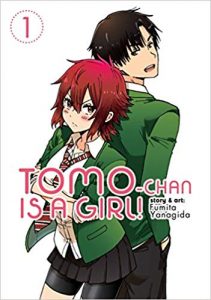
Tomo-chan Is a Girl!, Vol. 1

September 13, 2018 by Sean Gaffney

By Fumita Yanagida. Released in Japan as “Tomo-chan wa Onnanoko!” by Star Seas Company, serialization ongoing on the online site Twi 4. Released in North America by Seven Seas. Translated by Jennifer O’Donnell. Adapted by T Campbell.

When you’re doing a 4-koma series based around a very simple premise, it takes a lot of care to make sure that the audience comes back on a daily basis to see what happens next. The characters have to be interesting but not annoying, and the premise has to amuse but not bore. Tomo-chan Is a Girl! does a pretty good job of this. In Japan it’s helped by being released daily on a website, one comic at a time, much like a Western comic strip. Here, however, we read it in volumes, so the bar to clear is a bit higher. Especially when three of the four main characters are, for lack of a better word, dense in some degree or another. If you’re reading the series and thinking “man, I hope that they figure things out and get together soon”, I would drop it right now if I were you. Payoff will eventually come, but the whole point of series like these is a long, slow burn based around comedy and frustration.

Tomo is the titular heroine. She grew up as a tomboy, learning karate at her father’s dojo and hanging out with her best friend Jun. Now they’re in high school, and Tomo has grown tall and busty, but is still very much the rough tomboy sort. This is a problem, as she’s in love with Jun, but he just sees her as one of the guys! Can she make it clear that she likes him the way a girl likes a boy? And if she ever did this, would she even notice, as it rapidly becomes clear that she’s just as bad at noticing the obvious when it comes to matters of love. Indeed, Jun’s obliviousness may be played up to hide his real embarrassment over the whole thing. Added to this mix are Misuzu, Tomo’s best friend who is there to offer jibes and support, in that order, and Carol, an exchange student who may be flightier than the rest of the cast, and is definitely bustier. Will anyone end up making their feelings clear?

Not so far, but I’m enjoying the journey. The first few chapters are rougher and a bit less fun, and it’s very clear that Jun is not playing things up, something that rapidly changes as the book goes on and the author realizes he can’t keep that going forever. Tomo is a likeable yet very fallible girl, who longs for reciprocated affection but wouldn’t know what to do with it if she had it. And I know, you’re shocked) Misuzu is my favorite character, as her dry retorts and “war” with Jun over who’s closest to Tomo ground the series a bit and also adds a new vein of humor. This is 7+ volumes in Japan, so I’m not sure it can quite keep up the pace, for reasons I mentioned above. But for now I’m amused by Tomo-chan Is a Girl!, and want to see how far the series can go with its (seemingly) dense leads.

Filed Under: REVIEWS, tomo-chan is a girl!

Bookshelf Briefs 9/12/18

September 12, 2018 by Ash Brown, Sean Gaffney and Michelle Smith Leave a Comment

Again!!, Vol. 4 | By Mitsurou Kubo | Kodansha Comics – Just as the ouendan members are beginning to communicate and share ideas for how to set their cheering apart, Imamura falls down the flight of stairs again and finds himself back where he started, temporally speaking. What follows is a neat split timeline, with Imamura in 2014 trying to figure out whether what he experienced was real or a dream, and Fujieda in 2011 watching everyone gradually forget Imamura and his influence in their lives. It’s still not 100% conclusive that it is real, or whether Imamura’s actions will in any way affect the present, but he’s still determined to try. Armed with knowledge of how Usami ends up causing a disaster and dropping out of school, an accidental plummet from a window sends him back again. This was an exciting volume, and a big improvement over the previous one. – Michelle Smith

Arakawa Under the Bridge, Vol. 4 | By Hikaru Nakamura | Vertical Comics – As always, I’m grasping at straws to avoid having every review be simply “this series is really weird but pretty funny,” and this time around it’s noticing that despite living under the bridge mostly involving Rec playing the straight man, it’s actually pretty much been a good thing for him, both in terms of his physical and mental health. Rec was the sort of person who was headed for an early nervous breakdown, and while one can argue that he has about ten of these in this omnibus alone, he’s also maturing in a weird way by being immature. He’s also a good fit with Nino, who gets a rival in a huge Amazon this time around but is otherwise power-faced. Best read in bits, but still great fun. – Sean Gaffney

Chio’s School Road, Vol. 1 | By Tadataka Kawasaki | Yen Press – Although Chio is a high school student who would rather not draw too much attention to herself, somehow the complete opposite always seems to happen. She can’t even make it to school on time without something astonishingly absurd happening first–thus the title and premise of the series. Chio’s School Road can be incredibly funny. The titular heroine repeatedly finds herself in over-the-top situations which she unintentionally makes even more outrageous due to a potent mix of exceptionally creative problem solving, a nearly complete lack of common sense, and an obsessive love of video games. While not as overly-sexualized or fanservice-laden as it could be, Kawasaki’s background as a hentai artist is readily apparent in Chio’s School Road, mostly in how characters’ facial expressions are portrayed during times of intense physical exertion. Some of the humor is a bit lewd or risqué as well, but some elements are more innocent. – Ash Brown

D-Frag!, Vol. 12 | By Tomoya Haruno | Seven Seas – It’s been almost a year and a half since the last volume of D-Frag!, and I’ve honestly forgotten half the cast. But that’s fine, as the reader will quickly get back into the spirit of things, as the premise remains the same—gags happen, and they are funny. Much of the volume involves the main cast going to a festival held at the Girls’ Private Academy they’ve occasionally battled, and no prizes for guessing that they have to play games there. And there’s also many, many jokes about Takao’s breasts, which remain nearly invincible (in fact, the fact that they can come to harm is a gag all to itself.) D-Frag! is never going to have a serious plotline or any character development, but it’s dumb fun. – Sean Gaffney

My Monster Secret, Vol. 12 | By Eiji Masuda | Seven Seas – First off, I get the feeling that the manga really is going to go for the teacher/student relationship with Akari and Sakurada, and I’m not sure how I feel about it, though it would at least stop the old maid jokes. The best part of this volume, though, is Youko and Asahi’s first date, which is absolutely adorable despite a bit of ominous foreshadowing near the end, which seems to imply that Youko’s vampire tendencies may actually be tied to her lust for her boyfriend. We also start a new year, and thus have new freshman, including Asahi’s sister, who I’d forgotten existed, and Momochi, an over-the-top ninja who seems to fall in love at the drop of a hat. Dragging on a bit, but still good. – Sean Gaffney

Yowamushi Pedal, Vol. 9 | By Wataru Watanabe | Yen Press – Day two of the inter-high continues! The teams from Hakone and Sohoku make their triumphant return to the head of the pack, much to the consternation of a hothead on the Kyoto-Fushimi team. Midousuji insists all is within the scope of his simulations, however, and employs various tactics to ensure his victory. It’s initially satisfying watching Midousuji be thrown off by just how strong Fukutomi and Kinjou really are—I was particularly amused when he called them “sewer gnats!!”—but once he gets a tragic backstory, I felt a little less gleeful about it. Fukutomi and Kinjou have a very healthy rivalry born of mutual respect that leads to greater heights, whereas Midousuji has nothing like that. Watanabe-sensei, I can’t believe you made me feel bad for Midousuji. Well done! – Michelle Smith

Filed Under: Bookshelf Briefs

Sorcerous Stabber Orphen: The Wayward Journey, Vol. 1

September 12, 2018 by Sean Gaffney

By Yoshinobu Akita and Yuuya Kusaka. Released in Japan by TO Books. Released in North America by J-Novel Club. Translated by Andrew Hodgson.

Most of the time, when reviewing books this old (Fujimi Fantasia Bunko put out the first volume in May 1994), I have to remind myself not to think of things that may have been newer or fresher as hopelessly cliched. I had less of an issue here, though, possibly as Orphen is such an old-school fantasy it actually feels slightly fresher these days. The tropes are taken mostly from a) fantasy BOOKS, and b) your typical comedic anime cast. This means that the usual RPG nattering is entirely absent, and no one mentions hit points at all. It’s a very direct and straightforward book. Unfortunately, there is one thing the creator does that does still resonate here in 2018: the book starts to grate when it’s being “funny”. There is overly plucky girl, put-upon nerd, and above all, obnoxious, angry and “lovable coward” guy, all of whom made my teeth grate a bit as I read the book, though the first two not nearly as much as the third. But setting that aside, this was a good, solid debut volume.

As you may imagine, Orphen is our hero, though it’s a name he took on when leaving the fancy school of magic in protest, saying he’s an orphan now. (Magic is his specialty, but spelling is apparently not.) Five years earlier, he watched in horror as his mentor turned into a horrible monster, and the magic users vowed to destroy her rather than try to return her to normal. Now he roams the land looking for her. Unfortunately, currently he’s dealing with two dwarf brothers who owe him money and are very bad about finding “schemes” to pay it back, which include things like “pretend to be a merchant and marry the local rich lady’s daughter”. This ends up being fortuitous, though, as the rich family is also the home to endless ancient artifacts, one of which is desired by both the sorcerers who are still hunting the “monster” down, and the monster herself, still presumably looking for a cure.

I’m going to get this out of the way right off the bat: Volkan, one of the two dwarfs, almost caused me to stop reading this book entirely. He is very loud, very annoying, abuses his brother in what is supposed to be a funny way, is not particularly bright, and is also a coward. Now, this is deliberate. He’s meant to be annoying, and well done! But he’s meant to be annoying in a “look at this funny annoying guy!” way, and that did not happen for me. I want him to fall in a pit. Dortin, who has comedy “manga nerd” glasses and spends most of the book whining about his brother’s abuse but not saying it out loud for fear of provoking more abuse, and Claiomh, the younger sister in the rich family and (I suspect) future love interest of Orphen, who is bright and impulsive and very much a “bratty younger sister” sort, are far more tolerable. But the reason to read the book is the main plot, which deals with Orphen’s tormented relationship with Azalie, his mentor and crush, which is both admirable and frustrating, and causes him to make some teeth-grinding decisions that turn out to pay off in a well-written ending.

I’m not sure I’m going to continue with this – Volkan was THAT annoying, my friends – but for those looking for a nice old-school fantasy light novel, Orphen would be a very nice choice.

Filed Under: REVIEWS, sorcerous stabber orphen

Pick of the Week: Lots and Lots of Stuff

September 10, 2018 by Sean Gaffney, Ash Brown, Michelle Smith, Katherine Dacey, Anna N and MJ Leave a Comment

ASH: So many interesting manga are being released this week, it’s difficult to pick just one! A couple in particular have especially caught my attention, though. There’s Dementia 21 which should be… memorable, and then there’s Dragon Goes House Hunting which has a premise that delights me utterly.

MICHELLE: I am also really, really delighted by Dragon Goes House Hunting, but I know that I will love the latest volume of The Ancient Magus’ Bride, so that’s my official pick this week.

KATE: I can’t limit myself to a single pick, especially since there are so many intriguing debuts! Topping my list would be Dragon Goes House Hunting followed by The Delinquent Housewife! and Tomo-chan Is a Girl!, though I’m also curious about Radiant. I’m also curious about — and wary of — Dementia 21, which looks like the stuff nightmares are made of.

SEAN: As others have noted, there’s an embarrassment of riches this week. I think I will throw my lot in with The Delinquent Housewife!, whose cover art and description combine to make it look like it was written just for me.

ANNA: I agree, The Delinquent Housewife! looks hilarious just judging from the cover! That’s my pick as well.

MJ: I feel a bit iffy on this week’s releases as a whole, but I think I’ll throw in my vote for Radiant. Wizards are generally a win for me, so I’m going to bet that I’ll like it!

Filed Under: PICK OF THE WEEK

Kokoro Connect: Hito Random

September 10, 2018 by Sean Gaffney

By Sadanatsu Anda and Shiromizakana. Released in Japan by Enterbrain. Released in North America by J-Novel Club. Translated by Molly Lee.

I had enjoyed the manga version of Kokoro Connect when it came out a few years back, so was delighted to hear that I’d get a chance to read the novel version that spawned it. And for the most part it does not disappoint me. Ostensibly a book about an alien being who toys with a high school club by causing them to swap bodies at random (each book, in fact, will have the title _______ Random), in reality it’s a good example of the turbulence that is life as a hormonal teenager with issues, some of which are larger than others, but all of which are the most important thing in the world for that person. It also has a very likeable cast, including a fascinatingly flawed hero (Taichi is our 3rd-person viewpoint character, so I’ll call him a hero even though the series is about the five kids as a unit) whose selflessness is called out as nothing of the sort.

The club is one of those sorts that was created mostly because everyone HAS to be in a club, and it functions more as a hangout for the main cast than anything else. Iori is happy, joking, and energetic; Inaba is serious, foul-mouthed, and seems to exist in a perpetual state of near-fury; Yui, who is a pint-sized powerhouse whose knowledge of karate can’t quite make up for a terror of men; Aoba, the big goofy guy who loves Yui but is mostly there to be “the friend everyone picks on”, and Taichi, who I’d mentioned above, another serious guy whose function so far is to be “the male lead”, something I suspect we aren’t quite done with even as the cast does call out his “martyr complex” over the course of this book.

But of course the point of the book is that each of these kids are more complex than you’d expect. I love series where the protagonist is boggled by the fact that their friend may have more than one side to them, and we get that here – in fact, Iori’s main concern is that she’s spent so long showing other sides to people that she can’t remember who she’s supposed to be. Her monologue about loss of identity is one of the highlights of the book, along with the climax of the book where the characters all have to decide, literally, who lives and who dies, and Iori shuts them right down. Meanwhile, the most interesting thing about Inaba (who is my favorite, sorry to be predictable), whose panic about her own personal issues, which are not related to a “traumatic past” like Iori and Yui, is that everyone will hate and pull away from her, is that it really IS overblown. This is quite a funny book when it tries to be, but the funniest line may be Iori’s blithe “So basically… you have anxiety?”.

I also want to give props to the translator. These kids sound like high school kids, and their dialogue does not read like it’s written by someone who grew up in a different time. It’s also not afraid to get coarse for realism – Inaba is meant to curse like a sailor to a degree, and she does. That said, the main reason to pick up Kokoro Connect is the characters, who make you root for them and want to see how they handle whatever’s coming next. I’m very happy this is being released.

Filed Under: kokoro connect, REVIEWS

Legend of the Galactic Heroes: Tempest

September 8, 2018 by Sean Gaffney

By Yoshiki Tanaka. Released in Japan as “Ginga Eiyū Densetsu” by Tokuma Shoten. Released in North America by Haikasoru. Translated by Daniel Huddleston.

This volume seems to be the best at balancing out the political; intrigue and the cool space fighting, as both really get a good chance to capture the attention of the reader. On the political side, we see the final decline and fall of the Free Planets Alliance, and much snarking about the negatives of democracy. But Yang is also there to remind us that even with all those negatives it’s still worth fighting for, and the author does a much better job of reminding the reader that the only reason the dictatorship is looking like the better option in this series is that Reinhard is not evil – that’s pretty much it. We see a few scenes where he reminds everyone who’s trying to do dictator-ey things that this is what leads to rebellion and unrest. That said, Reinhard may not be evil but he’s still having trouble with the whole “what’s next?” thing. Luckily, Yang may help him there, as the end of the book seems to tell us we’re headed for one final confrontation.

Last time Yang got more to do than Reinhard, so it’s appropriate that we get the reverse here. It’s interesting seeing all of his aides worry about his seeming passivity, and we see that it’s not just Reinhard worrying about what to do once he’s conquered everything – none of the Empire wishes to follow a bored leader. That said, behind the scenes machinations may be taking care of that soon. Someone is out to get von Reuentahl, and they’re being helped along by the man himself, who seems to have no interest whatsoever in self-preservation. He’s safe for the moment because of Reinhard, but there are seeds being sown here, and I’m wondering if he’s going to end up an antagonist sooner rather than later. Poor Mittermeier, who tragically has to be the one persona in the Empire with a happy, satisfying personal life.

Meanwhile, on the other side, we see Bucock make one final awesome stand against the Empire. It’s a futile one, but he does absolutely everything right, and the admirals on the other side are filled with praise for him. It must have looked fantastic animated, especially Bucock’s final “screw you” before his death. Unfortunately, his death briefly sends Yang into a tailspin. Yang is trying somehow to avoid the role that fate keeps spelling out for him. He does not want to be a leader of anything, and yet here he is. Fortunately we also see a bit of the Admiral Yang of old, as his retaking of the fortress is both impressive and a bit hilarious. And he’s also reunited with Julian, meaning the family is together again.

So it looks like we’re headed for one big Reinhard vs. Yang battle – again. We’ve got three more books left in the main series, can it really be strung out that long? Probably not. Something else is bound to happen to upset the apple cart. What that is, we’ll have to see. Till then, enjoy another excellent (if dryly written, as always – we get a lot of history textbook stuff this time around) book in this space opera series.

Filed Under: legend of the galactic heroes, REVIEWS

The Devil Is a Part-Timer!, Vol. 11

September 7, 2018 by Sean Gaffney

By Satoshi Wagahara and 029. Released in Japan by ASCII Mediaworks. Released in North America by Yen Press. Translated by Kevin Gifford.

This book can mostly be divided into two parts, and while I won’t say that they’re good and bad, I will say that they’re good and less good. The less good involves three large scenes that serve as giant infodumps, telling us a lot about the backstory of some of the characters and revealing most of the worldbuilding and machinations that have been going on. It’s framed all right (at least the first two – the third is just the landlord blatantly spelling things out for them), but it can read awkwardly at times, as it amounts to a lot of listening to other people talking, and, unlike Emi and Suzuno, I am not particularly lovestruck by how Emi’s mom and dad fell in love. I’m not entirely sure that writing Alas Ramus and company out of the series is a thing that’s going to be happening, but certainly it’s the next big crisis, and will no doubt carry us through the next book or two. Hopefully along with some McRonald’s antics, as that’s where this volume shines.

Honestly, Emilia working at McRonald’s is such an obvious plot complication that I’m amazed that it hadn’t come up before now. She’s not living at the apartment complex yet (the explanation apparently involved her swank apartment being haunted or something, so the rent is cheap – I think the author just likes keeping them separated), but having her work with Maou and Chiho will certainly add to the fun of this series, and help keep us from, well, long infodumps. This is all kicked off by Maou possibly being the stupidest he has ever been, misunderstanding Emilia’s pride and acting (seemingly) like such an ass that Chiho tears him up one side and down the other. Of course, his goal and Emilia’s are the same, but she’s absolutely right in that she needs to get the job and commit to it on her OWN terms, not his. Maou spends much of this book getting yelled at and humiliated, and it’s actually pretty fun.

There is also some attention paid to the love comedy in this title, which honestly takes a backseat a lot of the time. The question is whether Maou actually has romantic feelings for anyone. With Emi he’s having enough trouble simply acknowledging her as a friend, so we have a long way to go there. With Chiho it’s far more practical – he doesn’t want to get a normal human involved with everything that being the lover of Satan of Enta Isla, and there’s also the fact that he and the other demons are very long-lived, and Chiho as a human isn’t. Honestly, though, all this boils down to “I am keeping her at a distance”, and I get the feeling Chiho is somewhat aware of this. Despite the snarking of the other male McRonald’s employees, the harem does not appear likely to be resolved anytime soon.

The cliffhanger ending (of a sort) promises even more backstory revelations in the next volume, but I hope that it finds time for fast food wars as well. Devil Is a Part-Timer! is at its best when it’s thinking small, and not dealing with demons vs. angels and where Enta Isla actually is in relation to Earth.

Filed Under: devil is a part-timer!, REVIEWS

Manga the Week of 9/12/18

September 5, 2018 by Sean Gaffney, Michelle Smith, Ash Brown, Anna N and MJ Leave a Comment

SEAN: There is, it has to be said, a bit of manga out next week. Just a wee bit. A dram.

MICHELLE: A smidge.

ASH: A skosh, perhaps.

SEAN: And also some light novels, starting with Cross Infinite World, who have The Champions of Justice and the Supreme Ruler of Evil, which seems to be on the humorous side. It’s also got some steamy scenes, be warned!

Fantagraphics gives us the one-volume Dementia 21 by famous (infamous) manga artist Shintaro Kago. Best described as ‘surreal horror’, I’ve wanted to see Kago’s works over here for some time. This volume is a great start.

ASH: I’m always glad to see more manga released by Fantagraphics! Kago’s work can be pretty intense.

ANNA: Me too! I feel that they target manga no other publisher would take on.

SEAN: J-Novel Club have two debuts. The first is Amagi Brilliant Park, from the creator of Full Metal Panic. It’s about an amusement park and also involves magic, I think?

The other new title is Der Werewolf: The Annals of Veight. Seems to be another reincarnation isekai. But werewolves!

And there’s also Infinite Dendrogram 7 and The Magic in This Other World Is Too Far Behind! 6.

Kodansha’s debut is actually a new edition of a title that’s now been debuted 3 times. Sailor Moon: Eternal Edition. Larger trim! Different translation! More bells and whistles! Buy it again for the first time.

ANNA: Sailor Moon!!

MICHELLE: Oh, I didn’t know there was a different translation! Maybe I do need to buy it again.

MJ: Well, damn.

SEAN: There’s also Golosseum 3, Nekogahara: Stray Cat Samurai 4, and Waiting for Spring 8.

Digitally there’s no new debuts, but we do get Peach Girl 9-18, as well as Tokyo Alice 3.

Seven Seas has a lot of interesting stuff. We get Dragon Goes House Hunting (Dragon, Ie wo Kau), whose title alone makes me want to read it. It’s from Mag Garden’s Comic Blade.

MICHELLE: I’ve been eagerly anticipating this one!

ASH: I’m looking forward to it, too!

SEAN: Tomo-chan is a Girl! (Tomo-chan wa Onnanoko!) is the other manga debut next week. About a tomboy girl who can’t convince her childhood friend she likes him romantically, it’s a 4-koma from what I believe is an online site, but Kodansha collects the volumes.

ASH: Oh, I didn’t realize it was a four-panel manga! I’ve heard good things about it, though.

SEAN: There’s also the debut of J-Novel Club’s biggest breakout hit in print, How a Realist Hero Rebuilt the Kingdom.

But there’s also a 9th volume of The Ancient Magus’ Bride, a 12th D-Frag! (the first in 17 months), Didn’t I Say to Make My Abilities Average! Novel 3 (in print) and 4 (digitally), The Testament of Sister New Devil STORM! 4, and Toradora! manga 8 (the first since June 2015).

MICHELLE: Yay for The Ancient Magus’ Bride!

ASH: Yes, indeed!

SEAN: SuBLime debuts Escape Journey, a BL series from Libre Shuppan’s Be x Boy filled with dubious consent and drama.

MJ: Why always dubious consent, whyyyyy?

SEAN: And a 7th Don’t Be Cruel is out next week too.

Tokyopop has the 2nd Konohana Kitan.

And Udon has a 7th volume of the Persona 4 manga.

Vertical debuts The Delinquent Housewife (Futsutsuka na Yome Desu ga!), a slapstick comedy from Shogakukan’s Big Comic Spirits about a man who discovers his new sister-in-law is, shall we say, not the perfect Japanese wife.

Viz has Radiant. It’s actually a French manga, but Akaneshinsha releases it in Japan. It’s got wizards, monsters, and the Inquisition. Sounds pretty manga to me.

ANNA: OK!

MJ: Interesting!

ASH: It really is!

SEAN: There’s also a 32nd Hayate the Combat Butler, a 4th Legend of Zelda: Twilight Princess, and a 4th Splatoon.

See? Barely anything. A doddle. What are you getting?

Filed Under: FEATURES, manga the week of

  • « Go to Previous Page
  • Page 1
  • Interim pages omitted …
  • Page 217
  • Page 218
  • Page 219
  • Page 220
  • Page 221
  • Interim pages omitted …
  • Page 382
  • Go to Next Page »
 | Log in
Copyright © 2010 Manga Bookshelf | Powered by WordPress & the Genesis Framework