• Skip to primary navigation
  • Skip to main content
  • Skip to primary sidebar
  • Home
  • About Us
    • Privacy Policy
    • Comment Policy
    • Disclosures & Disclaimers
  • Resources
    • Links, Essays & Articles
    • Fandomology!
    • CLAMP Directory
    • BlogRoll
  • Features & Columns
    • 3 Things Thursday
    • Adventures in the Key of Shoujo
    • Bit & Blips (game reviews)
    • BL BOOKRACK
    • Bookshelf Briefs
    • Bringing the Drama
    • Comic Conversion
    • Fanservice Friday
    • Going Digital
    • It Came From the Sinosphere
    • License This!
    • Magazine no Mori
    • My Week in Manga
    • OFF THE SHELF
    • Not By Manga Alone
    • PICK OF THE WEEK
    • Subtitles & Sensibility
    • Weekly Shonen Jump Recaps
  • Manga Moveable Feast
    • MMF Full Archive
    • Yun Kouga
    • CLAMP
    • Shojo Beat
    • Osamu Tezuka
    • Sailor Moon
    • Fruits Basket
    • Takehiko Inoue
    • Wild Adapter
    • One Piece
    • After School Nightmare
    • Karakuri Odette
    • Paradise Kiss
    • The Color Trilogy
    • To Terra…
    • Sexy Voice & Robo
  • Browse by Author
    • Sean Gaffney
    • Anna Neatrour
    • Michelle Smith
    • Katherine Dacey
    • MJ
    • Brigid Alverson
    • Travis Anderson
    • Phillip Anthony
    • Derek Bown
    • Jaci Dahlvang
    • Angela Eastman
    • Erica Friedman
    • Sara K.
    • Megan Purdy
    • Emily Snodgrass
    • Nancy Thistlethwaite
    • Eva Volin
    • David Welsh
  • MB Blogs
    • A Case Suitable For Treatment
    • Experiments in Manga
    • MangaBlog
    • The Manga Critic
    • Manga Report
    • Soliloquy in Blue
    • Manga Curmudgeon (archive)

Manga Bookshelf

Discussion, Resources, Roundtables, & Reviews

Sean Gaffney

Cocoon Entwined, Vol. 1

August 8, 2019 by Sean Gaffney

By Yuriko Hara. Released in Japan as “Mayu, Matou” by Enterbrain, serialization ongoing in the magazine Comic Beam. Released in North America by Yen Press. Translated by Amanda Haley.

Hair.
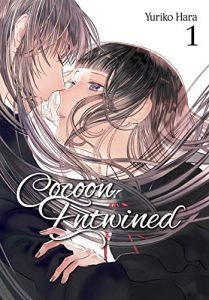
I suppose I should go into a LITTLE more detail, but honestly, after reading the first volume of this new series, “hair” is going to be what everyone takes away from it. It is hair-drenched and hair-permeated, a story about a private Japanese Girls’ Academy whose very uniforms are created using the hair of their seniors, but even there you get the sense that the story is somewhat irrelevant, an excuse to simply draw hair in every possible way. Even the cover art gets into it – the front cover may look relatively sedate, but turn the book over and you can see the hair of the two leads tangling into each other, trying to be the best metaphor that hair can be. Which is good, as hair gets to be a metaphor for a lot here. In addition to hair, the story focuses on three students at the school, two of whom are what you’d expect, and one of whom seems to have wandered in from some other manga.

Saeki is the girl who crosses over into both storylines, the “prince” of the school because the school needs one, rather than due to any desire of her own, though she plays the part even as it exhausts her. She gets closer to Yokozawa, who is our “normal girl” viewpoint character, though Yokozawa’s tongue is a lot more acid than this sort of character usually is. They like each other. The third cast member is Hoshimiya, the granddaughter of the headmistress, who spends her days locked in her room and seems to have a far more casual attitude towards hair than the rest of the school (seriously, you can be expelled for your hair being too short). Hoshimiya seems to be ethereal to the point of ridiculousness, and even when she and Saeki escape the school and go all the way to the local docks, there’s no real escape.

This is, of course, meant to be a yuri manga. Yokozawa clearly likes Saeki, and the book ends with a kiss, albeit the usual “they’re sleeping but I can’t resist” sort. Saeki and Hoshimiya also clearly have doomed chemistry in that Sei-and-Shiori sort of way. That said, you could also argue that the story is horror. Aside from a few exceptions like Saeki, most of the cast is the traditional long black haired heroine, which fits the private school setting but is also a trope in Japanese horror stories. The gimmick of the student’s shorn hair being used to make the uniforms of the incoming students is milked for all its worth, with the uniforms seeming alive and described as breathing, and it is meant to be dream-like and erotic but also a bit creepy. Hoshimiya herself also makes me think of horror, and it’s worth noting that we never clearly see her face. Don’t be surprised if she ends up being a ghost or a Zashiki-warashi of some sort.

This was a riveting if somewhat baffling read. I’m definitely getting the second volume, but I’m not sure if we’ll stick with this cast or see it expand to other couples. That said, you don’t read this for the couples, you read this for the hair. Hair will definitely star in the second book.

Filed Under: cocoon entwined, REVIEWS

The Dirty Way to Destroy the Goddess’s Heroes: Damn You, Heroes! Why Won’t You Die?

August 7, 2019 by Sean Gaffney

By Sakuma Sasaki and Asagi Tosaka. Released in Japan by Famitsu Bunko. Released in North America by Yen On. Translated by Jordan Taylor.

I didn’t have high hopes for this title going in. Despite assurances from the publisher that it wasn’t THAT kind of dirty, the title still didn’t inspire confidence. It was also the most traditional “isekai” of this month’s debuts. But as frequently happens with things I read, as I got further into the book I found myself warming up to it. This is mostly thanks to the main hero, Arian, who is bright and shiny and yet also lonely and needs a friend. Had the book gone with the original set of heroes we meet, who are rather quickly dispatched, it might have been unbearable, just watching a Japanese guy with nothing to stop him become a sadist because it’s fun. (Indeed, we’re seen other light novels like this, though mercifully few have been licensed.) But Arian’s inner goodness causes Shinichi, the protagonist, to reach down and find his inner ethical sense, and so the last third of the book is actually pretty good, despite the appearance of yet another lecherous and corrupt bishop from a questionable religion.

Our hero is Shinichi, a standard young Japanese protagonist whose backstory is merely hinted at, but who seems to relish the opportunity to let loose in the situation he’s now in. He’s been summoned by the demon king to a) eliminate the heroes who keep attacking, and b) find delicious food for his cute daughter, as all the demon world food tastes awful. With the help of a sharp-tongued maid who rains abuse on him at every opportunity, he’s soon able to dispatch the first group of heroes through his prior knowledge of old-school RPGs and also by being a complete and utter bastard. However, the remaining hero that’s left to attack is not only far more talented than the previous heroes, but she’s also cute and a kind, good-hearted person! Can he find it in himself to trick her and save the demons?

There are, of course, still a few big flaws in the book. Despite a last-minute attempt to give him some inner monologue, the bad guy of this volume is (apologies for spoiling, but it’s obvious the moment he appears on the page) your standard corrupt and evil priest, in this case a bishop. Celes, the dark elf maid who accompanies Shinichi on his tasks, is so much like Ram from Re: Zero that I was almost calling the hero Barusu. Possibly as, while he shows signs of depth that may be explored in future books, Shinichi really doesn’t do much to stand out until, as I said, the last third or so of the book, where he uses his sadistic cleverness for good rather than evil. Well, OK, for the good of the demons, but they’re more interested in better food than attacking humans. On the bright side, I liked the relationship between Arian and Shinichi, though I’m sure it will be walked back a bit in the next book. Her immediate infatuation feels in character.

This isn’t the greatest light novel out there, but it gets better as it goes along, and there’s hints of some depth down the road. Recommended for isekai fans.

Filed Under: dirty way to destroy the goddess's heroes, REVIEWS

Bookshelf Briefs 8/6/19

August 6, 2019 by Ash Brown, Sean Gaffney and Michelle Smith

Dr. STONE, Vol. 6 | By Riichiro Inagaki and Boichi | Viz Media – So it turns out that the current non-turned-to-stone population are all descended from Senku’s dad and the rest of the crew of the space shuttle, which is honestly more about Byakuya’s faith in his son to eventually save the day even if it takes hundreds of years. Back in the present, Tsukasa and the followers that he’s amassed are planning to invade the village and destroy what Senku has accomplished, but little do they know that Senku has the power of RIDICULOUS SHONEN SCIENCE on his side. The best thing about this volume is that we’re starting to see the non-Senku cast actually come up with inventions—the water wheel revelation was great, and Senku knows it. Dumb fun, masquerading as smart fun. – Sean Gaffney

Farewell, My Dear Cramer, Vol. 1 | By Naoshi Arakawa | Kodansha Comics (digital only) – Midori Soshizaki and Sumire Suo played girls’ soccer for different teams in middle school, but Soshizaki is so taken with Suo’s play that she volunteers to go to whichever high school Suo chooses. Suo, accustomed to being the only one really trying on her team, feels kinship with another girl on a lousy team, and so she and Soshizaki both end up at Warabi Seinan, whereupon a couple of other talented players show up along with a new coach, since the current one sees no future in girls’ soccer and isn’t interested in doing his job. This was a pleasant start to a series, but the soccer action isn’t as easy to follow as in other titles I’ve read, and it quickly veers away from the two leads to focus on another teammate. I’ll definitely keep reading, though! – Michelle Smith

Love in Focus, Vol. 3 | By Yoko Nogiri | Kodansha Comics – I had forgotten that this was a series that ended in three volumes, but I would have remembered anyway given the rapidity with which Kei and Mako get together and just as quickly break up. “Let’s date first and fall in love later” rarely works in shoujo manga, especially when you’re the blond, who almost always loses out to the brunet. That happens here as well, as dating Kei does help Mako realize her feelings—for Mitsuru. That said, though the plot beats were very predictable, I thought Mako and Mitsuru’s dialogue was sweet and pure in a shoujo sort of way, and I also liked how the “stalker” plot was resolved. As with the author’s previous series, this was decent but not good enough for long-term. – Sean Gaffney

My Hero Academia, Vol. 20 | By Kohei Horikoshi | VIZ Media – I’m sorry to say that I just can’t muster up much interest for Gentle Criminal and La Brava, the villain and his acolyte who get in Midoriya’s way when he’s trying to get back to campus in time for class 1A’s performance at the school festival. Once their fight is finally over, though, it’s time for the feels. The focus on Jiro here is pretty brief, but oh so welcome, and that two-page spread of her smiling so radiantly while performing is incredible. And then, just a few pages later, there’s Mirio who is suddenly moved to tears because Eri, the girl he sacrificed so much to save, is having the time of her life. I love Mirio and Eri together, and I also love Aizawa rushing to be with Todoroki when his dad, now the number-one hero, is injured on live TV. Plus, there’s Hawks! This volume has much goodness. – Michelle Smith

My Hero Academia: Smash!!, Vol. 1 | By Kohei Horikoshi and Hirofumi Neda | VIZ Media – I’m not really a gag manga sort of person, so I didn’t expect much from My Hero Academia: Smash!!. But despite the warning from creator (and Horikoshi assistant) Hirofumi Neda that it was going to be crude, I actually thought it was quite fun! It follows along with the early events of the main story, up until the first attack by the League of Villains. Often, familiar scenes are subverted in some way, like All Might’s “you can be a hero” moment turning into a sales pitch for vitamins, but sometimes they’re expounded upon in genuinely intriguing ways, like showing how Yaoyorozu used her quirk in the fitness tests Aizawa devised. (I also liked that her classmates now prefer Yaoyorozu brand erasers.) Also, I think one panel features a tiny puking Jesus. To my surprise, I’m looking forward to volume two! – Michelle Smith

My Hero Academia: Vigilantes, Vol. 5 | By Hideyuki Furuhashi and Betten Court | Viz Media – This volume definitely felt like the fifth book in a four-book series, a constant danger when something gets really popular. Knuckleduster’s plot is resolved, and so he very pointedly, with one or two exceptions, withdraws from the series. Instead we see Pop Step and the Crawler trying to be vigilantes on their own and rapidly coming to a realization, which is underscored by licensed heroes yelling at them—they’re not powerful enough to do much more than get in the way. That said, I did enjoy seeing Midnight in her “casual” clothes, and the kid singers were very cute. A series that has turned a corner but not yet hit the next long straightaway. – Sean Gaffney

My Next Life As a Villainess: All Routes Lead to Doom!, Vol. 1 | By Satoru Yamaguchi and Nami Hidaka | Seven Seas – The manga adaptation of one of my favorite recent light novels didn’t have to go very far to impress me, just adapt the novel as well as it could. There’s obviously stuff that’s cut to fit (Katarina’s parents’ relationship gets a one-panel explanation), but it handles introducing the main cast well, and cuts the “alternate POV” parts which would have made the manga repetitive. Best of all is the prose short story at the end, seeing Katarina having a nightmare about the villainess her otome game self is supposed to be, and the bad choices that she makes which our Katarina can’t stop her from despite yelling inside her head. Definitely get this if you like the novels. – Sean Gaffney

The Quintessential Quintuplets, Vol. 4 | By Negi Haruba | Kodansha Comics – This is moving at a galloping pace for a romantic comedy, especially one with quintuplet heroines. There’s the bad—Ichika pursuing her dream would mean leaving school, which would mean Futaro losing tutoring money—and there’s the worse—various people getting bad, bad colds due to the weather and circumstance, which leads to a mass search for Itsuki and a bedside vigil for Futaro, whose cold of course turns out to be the worst of all. We also get another flash forward reminding us that he does eventually marry one of them, but continuing to not tell us who. Don’t expect that to be resolved till the final page of the series. For fans of harem comedy/dramas. – Sean Gaffney

Sacrificial Princess and the King of Beasts, Vol. 6 | By Yu Tomofuji | Yen Press – Anubis has finally given in and allowed a trial period for Sariphi to be Queen Consort. Unfortunately, we then see the problems that this causes, which is that the majority of the populace still isn’t ready for a human girl as the Queen. Fortunately, Sariphi is made of pretty stern stuff, and even when she’s down there are folks who can cheer her up. This allows her to resolve the fractured relationship between a mother and daughter, as well as give Amit the courage to give a token to her beloved Jor, even though as a soldier he may not be able to return that love. Honestly, this does continue to remind me a lot of Fruits Basket, but that’s not especially a bad thing. – Sean Gaffney

Skull-face Bookseller Honda-san, Vol. 1 | By Honda | Yen Press – My first exposure to Skull-face Bookseller Honda-san was through its anime adaptation. I’ve not actually watched the show, but I’ve seen enough screencaps of the titular skeleton dramatically reacting to a wide range of customer service exchanges to reasonably expect that I would love the original series. And, after reading the first volume of the manga, I can definitively say that I absolutely do. To a large extent the manga is autobiographical, based on Honda’s experiences as a clerk in the manga department of a large Tokyo bookstore. It provides entertaining insights into the life of a bookseller, showing the challenges presented by customers, publishing schedules, corporate management, and just trying to keep the shelves appropriately stocked. This could be rather dry as a subject, but in Honda’s hands the portrayal of bookselling is delightfully humorous, intense, and over-the-top in a way that is both engaging and still incredibly honest. – Ash Brown

Skull-face Bookseller Honda-san, Vol. 1 | By Honda | Yen Press – I’ve seen the first few episodes of the Skull-face Bookseller Honda-san anime and this is going to be one of those rare occasions where I have to admit that I kind of like the anime more than the manga. Certainly, Honda-sensei depicts the bookstore (specifically its manga department) as a place way more hectic than I ever anticipated, but that frenetic energy (and the kookiness of his often-foreign customers) just translates better to the animated medium, I think. That said, this volume has a lot to recommend it, particularly if you want a glimpse of what Japanese booksellers think of the global readership manga has obtained. Read it, but maybe watch it, too. – Michelle Smith

Waiting for Spring, Vol. 11 | By Anashin | Kodansha Comics – I’d long been wanting more basketball in Waiting for Spring, and I finally got my wish in this volume. The latest tournament has begun, and if the Seiryo boys want to repeal the no-dating rule, they have to win. They make it to the finals league, where they’re up against Aya’s team, Hojo, and though Seiryo ends up losing, there’s still hope due to the structure of the tournament. Aya realizes his kind of love expected Mitsuki to never grow or change whereas her love for Asakura inspires her to try new things and set goals for herself, so he seemingly steps aside though he does talk about returning (he’s apparently moving back to America) once she’s grown up. Anyway, this is a cute series that I like a lot and though I don’t expect many surprises from its final two volumes, I nonetheless look forward to reading them. – Michelle Smith

Filed Under: Bookshelf Briefs

Pick of the Week: Crime and Superheroes

August 5, 2019 by Sean Gaffney, Michelle Smith, Katherine Dacey, Anna N and Ash Brown Leave a Comment

SEAN: My Hero Academia’s 19th and 20th volumes have what may be my favorite “light” arc of the series. As such, the 20th volume, like the 19th, is my pick. If only for those two faces. You know the ones I mean.

MICHELLE: Courtesy of the awesome Shonen Jump vault, I’m all caught up on My Hero Academia now, so volume 20 is actually a reread for me, but it’s a testament to the greatness of this series that I’m still looking forward to it. The light arc concludes, and is definitely great, but I also really enjoyed finally getting to meet a mysterious hero who’s been hinted at and finally makes his debut in this volume.

KATE: After being publicly shamed for my tendency to plug the same manga over and over — notice I resisted the temptation to type “again” — I had to bring my Recommendation A-Game this week. My pick is Ryuko, Titan Comic’s first foray into serialized manga. It looks like the sleazy, brutal, fast-paced stuff that Kazuo Koike used to pump out by the truckload, and I can’t wait to read it. The cover alone is swoon-worthy!

ANNA: There’s so much great shoujo coming out this week, it is hard for me to single out just one title. But I have to admit when looking over everything coming out that I’m always most enthusiastic about Yona of the Dawn, so volume 19 of that series is my pick!

ASH: So many series that I’m following have new volumes this week, making it very difficult to choose where to start. So, thanks for the reminder about Ryuko, Kate! I’ve been very curious about that series, enough to make it my pick, too.

Filed Under: PICK OF THE WEEK

The Saga of Tanya the Evil: Nil Admirari

August 5, 2019 by Sean Gaffney

By Carlo Zen and Shinobu Shinotsuki. Released in Japan by Enterbrain. Released in North America by Yen On. Translated by Emily Balistrieri.

Sometimes war can be filled with pitched battles, back and forth action and excitement, and sometimes war can be filled with not a heck of a lot happening except people talking about tactics. The same holds true for Tanya the Evil, especially in this sixth volume, where action scenes are kept to an absolute minimum in favor of dialogue, inner monologue, and a lot of grumbling about the futility of war. Which, it has to be said, makes for a book that’s a bit of a struggle to get through at times. Most of the time Carlo Zen balances his dry military tactics prose with other scenes that pick up the pace, but we don’t have that here, so some of this book is simply boring. But not all of it. There is, once again, the threat of peace on the horizon, and Tanya is all for it, though she’s not the one in charge, and you get the sense that von Zettour is not simply going to agree to anything that isn’t “we win, and then discuss terms”. Winning, of course, is not happening right now.

The title is Latin once more, and means “Nothing Will Surprise Me”. That’s put to the test in this book, which sees the nation of Ildoa getting involved – seemingly to be a neutral broker for peace, but in reality looking to get the best deal for themselves by playing both sides. As the Empire is not-Germany, Ildoa is not-Italy, though their political leader seems to be nothing like Mussolini so far – Carlo Zen is avoiding the main Axis villains in this series. The Empire is understandably rather wary of Ildoa, who put on a show of strength that actually shows off that they don’t have much strength to back it up. Still, an overture for peace is a start. Certainly it’s what Tanya wants, to the surprise of everyone – possibly the funniest scene in the book is when she talks with Visha, Weiss and the others in her unit and realizes how they’re all warmongers, not realizing who trained this into them.

On the other side, we have the Commonwealth and the Federation still making very awkward allies, as they come to the realization that the Empire is far stronger than they had expected. (The Empire, of course, is coming to the same realization about their enemy.) Colonel Drake appears to be the Lergen of the Allied side, and he has his own Tanya analogue in Lieutenant Mary Sue, still bright and idealistic and shiny and driven by sweet, sweet revenge. “The Saga of Tanya the Evil” is a Western title, albeit one approved by the author, I believe – the Japanese title, Youjo Senki, translates as “The Military Chronicles of a Little Girl”. Tanya is evil in the sense that she’s working for the Empire, and she can be morally reprehensible at times, but she knows about war and why things happen. Mary Sue, though, can’t believe everyone doesn’t think the way that she does, and she’s a headache to everyone around her. I really want to see her and Tanya fight again – perhaps I should watch the movie.

So there’s a lot of talking but little forward movement in a book which sees Tanya’s unit going from the Federation to the Empire Homeland and then up towards the Entente Alliance in an effort to win the war. Which Tanya knows isn’t happening, but she can’t convince anyone else. A necessary read for fans of the series, but it’s really dry and dull at times, I admit.

Filed Under: REVIEWS, saga of tanya the evil

Our Dreams at Dusk: Shimanami Tasogare, Vol. 2

August 4, 2019 by Sean Gaffney

By Yuhki Kamatani. Released in Japan by Shogakukan, serialization ongoing in the magazine Hibana. Released in North America by Seven Seas. Translated by Jocelyne Allen. Adapted by Ysabet MacFarlane.

It was always a possibility, of course. We’ve seen that sort of thing in countless other titles. The new character comes along to an already existing group and is able to magically help all of them with their problems. And indeed, we saw Tasuku last time introduced to the drop-in center, and the bulk of this second volume revolves around Misora, the kid from last time who was rude and dismissive of Tasuku, and is on the cusp of puberty and also having gender identity issues. It would make perfect sense to see Tasuku help drag Misora out of their shell and help them come to firm realizations. Indeed, we start to see something like that. But life is just not that simple, and Misora’s issues are deep-rooted and not easily solved. And so we end with more lashing out, and more slurs used to hurt, and more art as metaphor with Tasuku’s world literally collapsing around him.

Both people on the cover are Misora, who dresses as a girl at the drop-in center but would never do anything like that at home. Their relationship with Tasuku is extremely bitter and confrontational, and Misora takes delight at times in not only correcting Tasuku’s misconceptions but also hammering on Tasuku’s wounds. At the same time, of course, Misora is also guardedly opening up to Tasuku and feeling him out, ready to lash out in pain and fury at the slightest sign of pity or confusion. But at least Tasuku has defined himself, even if he can’t admit it to the man he loves. Misora is not sure at all what they are – a boy, a girl, or what have you. And they also know that puberty is soon going to make this much, much harder. Meanwhile, Tasuku’s story is hardly over, as he’s spotted at the drop-in center, and outed to his crush… who may already have an inkling about things anyway.

The plot of this volume is very good, but it’s the journey that’s even better. There are no wasted pages, and the frustration burns off the pages as Misora spews more and more slurs at Tasuku – there’s lots of them in this book, all meant to push Tasuku away and also other him to a degree. There’s also more terrific art – I’d mentioned the collapsing building metaphor earlier that serves as the climax, but there’s also little moments like Tasuku taking a wave that Tsubaki gives to him and consuming it at stars, or Misora shown in the water of a glass that Tasuku drops, about to shatter to the floor. Little moments like these help to move the reader along, and the character moments – which can be agonizing – help to slow things down. (I also want to know more about Tchaikovsky guy, and hope we see him next time.)

If you’d been on the fence about reading this series (and I can’t imagine too many who were), pick it up. It’s a painful journey, but also amazing to read.

Filed Under: our dreams at dusk, REVIEWS

Last Round Arthurs, Vol. 1: Scum Arthur & Heretic Merlin

August 3, 2019 by Sean Gaffney

By Taro Hitsuji and Kiyotaka Haimura. Released in Japan by Fujimi Shobo. Released in North America by Yen On. Translated by Jan Cash.

Even the author knew what people were going to be thinking. In the afterword, he describes getting the premise from his editor and thinking that it had been done to death. The words “Fate/Stay Night” did not get mentioned explicitly, but the implication was certainly there. Actually, it appears the editor and publisher were really stepping up to the plate for this one. The author is known for Akashic Records of Bastard Magic Instructor, a very popular LN series with a manga out over here. They also brought in Haimura as the illustrator, who’s already busy drawing Index and DanMachi Sword Oratoria. All that and a series about a bunch of King Arthur wannabes fighting each other in a battle to the death to see who can be the Last Round Arthur (see what they did there?). The obvious flaw in this series is that it reeks at times, especially in the first half, of being written to be a franchise rather than a story. Fortunately, it gets better, especially in the last third.

The premise is essentially Mallory’s Arthur legends meets Fate/Stay Night meets Haruhi Suzumiya. Rintarou is a young man who is perfect at everything he’s ever done since he was born, which makes everyone think that he’s a monster – including his parents. He hears about a competition between those with the blood of King Arthur, a battle involving Kings and their “Jacks”, essentially a summoned Servant a la Fate. The winner takes over the world… which isn’t all good, as there’s also a reality incursion they’ll have to deal with. Rintarou wants in on this competition, and finds the weakest candidate – Luna Artur, a seemingly arrogant young woman who’s taken over the local Camelot High School and made it her plaything – and sold her Excalibur for cash. Despite thinking Luna is annoying and possibly bonkers, he becomes her vassal, mostly so that he can stop being bored with life. Of course, things aren’t going to be easy, as Luna’s childhood friend is fighting for the prize as well. And Rintarou also has a secret… which the title of the work may in fact give away.

Luna starts off as a weird mix of Haruhi and Gilgamesh from Fate, and it can make her hard to like until her true self shines through. In reality, she wants to see everyone happy and wants the power to achieve it. This does not mesh very well with Rintarou, who tends to be the pragmatic “let’s sacrifice their lives and sneak up behind the enemy” sort, but they eventually do get along quite well. I was less enamored with Sir Kay, Artur’s beleaguered Jack, but that’s the fault of the author, really – Kay is nice enough, but she’s Mikuru Asahina with a sword, and unfortunately I have no confidence she’ll rise above “comedy relief” in future books. The fights were well described and tense, which is good, as I think they may be the main reason people will read this. There’s also a few surprise revelations that AREN’T in the title, some amusing jokes, and some setup for the future.

When that future is I’m not sure – unlike the other July Yen debuts, Last Round Arthurs doesn’t have another book scheduled yet. It’s not fantastic, but it’s worth a read if you like modernization of Arthurian legend or just want a Fate book with the serial numbers filed off.

Filed Under: last round arthurs, REVIEWS

Skull-Face Bookseller Honda-san, Vol. 1

August 2, 2019 by Sean Gaffney

By Honda. Released in Japan as “Gaikotsu Shotenin Honda-san” by Media Factory, serialized in the magazine Gene Pixiv. Released in North America by Yen Press. Translated by Amanda Haley.

I had (shocking, I know) not actually seen the anime that is based off of this manga and took the internet by storm a while back. As such, I was a bit surprised to find that the skull face is actually irrelevant. No, this is not about a walking skeleton who works in a bookstore. The protagonist is the author, and the skull face is a mask that hides their identity – all the employees of the bookstore have different types of masks, for exactly the same reason. When you’re basing things on a true story, but don’t want to actually upset any of your colleagues, this is a good way to go about it. Moreover, it focuses the reader’s attention on the faces of the customers, which are gloriously well-done and expressive. No, instead of walking skeletons we just have life at a large bookstore in Japan, and insight into what’s going on behind the scenes. That does not mean this title is not fascinating, because it is.

Actually, the large bookstore also surprised me. I’ve seen manga about sleepy bookstores where a customer walks in once in a while, and the huge chain bookstore is usually the villain in those titles, trying to crush the mom and pop store and its individuality. But no, this manga is about a LARGE bookstore and its MANY employees – in fact, just the employees of the manga department of the store. It’s not made clear where it is, but given the large number of Westerners who wander through it, it has to be somewhere in Tokyo. Most of the time we see Honda-san at the front counter, helping customers find the manga they’re looking for, no matter how embarrassing, confusing, or impossible the request is. It doesn’t help that, as I mentioned earlier, many of the customers are foreigners with little concept of Japanese, and Honda-san’s English is also iffy. Still, service is the important thing, and we can’t leave a customer unhappy – though they may change their objective a bit.

Among the ‘types’ noted on the cover of the manga are ‘801 girls’, and a large chunk of the start of the book is devoted to BL manga and those searching for it. Sometimes they’re at sea, such as a dad whose daughter has asked for Gintama BL doujinshi, something Honda-san has to tell him isn’t sold at this bookstore. Sometimes you get a feeling of being “the Ugly American” in a sense, such as Honda-san watching the very loud American BL fans gushing about the types they like in the middle of the store. (That said, there’s no judgment given, and Honda-san seems to admire their forthrightness.) We do also meet several other employees, who tend to run the gamut from busy and harried to harried and busy, but the emphasis here, apart from Honda-san, is on the customers. (One exception is the class Honda-san has to take on customer service, where he meets a gorgeous young woman from another store who has trouble smiling for work – it’s amusing.)

I’ll be honest, this almost reads like a travel documentary about the Book Buyers of Shinjuku or something. It can be a bit exhausting (Honda-san reminds you time and again how painfully busy and overworked they are), but the stories and faces of the people involved are worth it. Even if they come in looking for shoujo manga and end up buying Berserk.

Filed Under: REVIEWS, skull-face bookseller honda-san

Manga the Week of 8/7/19

August 1, 2019 by Sean Gaffney Leave a Comment

SEAN: The dog days of August are here, but no worries. There’’s stuff here for you. A lot of stuff.

Cross Infinite World has The Werewolf Count and the Trickster Tailor, another romance novel from Japan. These are usually fun.

Ghost Ship gives us To-Love-Ru 15-16 and Yokai Girls 8.

J-Novel Club has a pile of print releases next week. How NOT to Summon a Demon Lord 5, If It’s for My Daughter, I’d Even Defeat a Demon Lord 4, In Another World with My Smartphone 5, and The Magic in This Other World Is Too Far Behind! 4.

They also have digital light novels, as we get Campfire Cooking in Another World 2, Crest of the Stars 2, Demon King Daimaou 12, and Invaders of the Rokujouma!? 22.

Kodansha has some print releases that Manga Bookshelf loves. We get 10 Dance 4, Again!! 10, and the 8th volume of Tokyo Tarareba Girls.

ANNA: So far behind on Again!!….

MICHELLE: All of which are worth reading!

ASH: They really are! I’m closely following all of these series.

SEAN: Kodansha Digital debuts Goodbye! I’m Being Reincarnated, a shonen series that started in Shonen Magazine R but has moved up to the weekly big leagues recently. A guy is visited by a princess who needs a hero from another world! The trouble is that he can’t be transported to the other world… he has to be reincarnated. Which means she has to kill him.

MICHELLE: Huh.

ASH: Well now, that could be an interesting twist.

SEAN: We also get My Sweet Girl 5, The Tale of Genji: Dreams at Dawn 6, and You Got Me Sempai! 6.

Seven Seas debuts the print version of Reincarnated As a Sword, which is apparently better than my attempt to read it made it seem. There’s also My Monster Secret 17, Saint Seiya: Saintia Sho 7, Shomin Sample 10, and the 3rd digital novel for Skeleton Knight in Another World.

Vertical has a 13th Devils’ Line.

It’s the start of the month, so there’s a pile of Viz. The debut is another My Hero Academia spinoff, My Hero Academia SMASH! As you might guess from the title, it’s a gag comic. Should be silly and fun.

MICHELLE: I hope there is, like, zero Mineta.

SEAN: We also get, in shonen titles, Black Torch 5, Food Wars! 31, Hunter x Hunter 36, JoJo’s Bizarre Adventure Arc 4 Book 2, My Hero Academia 20, One Piece 91, One-Punch Man 17, The Promised Neverland 11, and We Never Learn 5.

ASH: JooooooJoooooo!

SEAN: Shoujo is just as filled with must-haves. Ao Haru Ride 6, the 7th and final volume of Behind the Scenes!!, Idol Dreams 6, Shortcake Cake 5, Takane & Hana 10, and Yona of the Dawn 19.

ANNA: AIEEE, so many favorites coming out this week.

MICHELLE: Dang. So many awesome titles for both demographics!

ASH: It’s true!

SEAN: Lastly, Yen has some stuff left over from July that’s coming out in August. Cocoon Entwined (Mayu, Matou) debuts; it’s a yuri story set at an all-girls school, but it’s from Comic Beam, so I have hope.

ASH: At the very least, the cover art is lovely.

SEAN: Killing Me! is also out; it’s also yuri, though the fact that it’s from Media Factory’s Comic Cune makes me think it’s definitely “yuri for guys”. Vampire and vampire hunter in school.

And we have High School Prodigies Have It Easy Even in Another World 4, DanMachi: Sword Oratoria 8 (manga version), Murcielago 11, So I’m a Spider, So What? 6 (manga version), and Umineko When They Cry: Twilight of the Golden Witch omnibus 2.

While Kate ponders how to choose between Again!! and The Promised Neverland for Pick of the Week, what are you getting?

Filed Under: FEATURES, manga the week of

Bottom-Tier Character Tomozaki, Vol. 1

August 1, 2019 by Sean Gaffney

By Yuki Yaku and Fly. Released in Japan as “Jaku Chara Tomozaki-kun” by Shogakukan. Released in North America by Yen On. Translated by Winifred Bird.

These days, whenever a light novel is licensed that does not in some way shape or form ground itself in fantasy, I take notice. This is the “isekai boom”, and even the titles released that aren’t isekai seem to involve fantasy worlds, adventuring, and demon lords. We have seen a few normal “romantic comedy” LNs – Toradora!, My Youth Romantic Comedy Etc. – but they’re in a tiny minority, and were licensed well after the anime became popular. So Tomozaki, a high school kids title with no fantasy and no anime (at least not yet) was a surprise. I wondered what attracted Yen to it, especially as the publisher rarely deals with North America on their light novel end. I ended up being very happy with it. The novel starts slow, but as both it and its main character gradually find their feet it gets more and more interesting till a final quarter that was fantastic. This is especially interesting because of the odd little genre the book turns out to be: it’s a self-help guide.

Tomozaki is our title character, a quiet and sullen young man who is fantastic at gaming – particularly ‘Atafami’, the current hot new game – but not so good at everyday social interactions. His narrative voice will remind a few people of Hachiman, though he’s not as clever or misanthropic. (In fact, let’s get that out of the way – this is going to get compared to OreGairu, and some of that is by design. Even the cover art styles look similar. There’s even a reference saying that Saitama (where the books take place) can beat Chiba easily (OreGairu’s territory) that made me think the author is well aware of what he’s doing.) In any case, Tomozaki ends up playing a really good player online, and they arrange to meet up. To his shock – and hers – she’s his classmate Hinami, the cute and popular girl. Meanwhile, she’s incredibly disappointed in him, as she assumed he’d be as cool in real life as he was in the game. When he goes off about how life is much harder than a game, she decides to tutor him in how to life.

The first half of the book, as I said, feels like someone wanted to write a self-help manual for the introverted Japanese high schooler but make it interesting. To my surprise, the gaming talk did not bore me at all – it’s made relevant to the conversations throughout, and even when we’re watching characters play Atafami, it doesn’t drown us in stats unless that’s the point. Hinami explains how to make Tomozaki’s real-life character better, starting with learning to smile, then posture, then a new outfit, etc. And conversation. He has to get better at that as well. As the book goes on, it turns out that he and Hinami have a lot more in common than you’d think, and that she’s not explaining this from a superior position – she continues to do every day just what she’s telling him to do. Constant practice, just like in a game.

The book gets better when we start to see the results of her tutelage. Tomozaki doesn’t get perfect immediately, of course, and he’s still socially awkward much of the time. But once he starts treating these tasks – “have two conversations with a girl in class every day”, etc. – like a game that he needs to beat, he shows that he can be very good about it. He’s also observant and speaks his mind, like most LN narrators. And so he can spot that the over-the-top genki girl is putting on something of an act, or that the overly serious girl never starts conversations herself. Towards the end of the book he starts teaching another girl to play Atafami (so she can impress a guy) and he’s now the one giving the excellent advice – and also applying it to life, telling her that it’s never too late to change your character if you don’t like it. His growth is both astonishing and not surprising at all, given his gaming skills.

The book was clearly written as a stand-alone, but there’s more to come. I want to read it. The cast is all likeable (in fact, it’s a safe bet that Hinami, the female lead, is likely the least popular, as always happens in “harem” stories like this) and Tomozaki is relatable without being overbearing or irritating (well, he’s irritating to start with). It’s been called a “kinder, gentler OreGairu” and that’s simplistic but not a bad starting point. I had a ball reading it.

Filed Under: bottom-tier character tomozaki, REVIEWS

Magus of the Library, Vol. 1

July 31, 2019 by Sean Gaffney

By Mitsu Izumi, “based on Kafna of the Wind by Sophie Schwimm”. Released in Japan as “Toshokan no Daimajutsushi” by Kodansha, serialization ongoing in the magazine good! Afternoon. Released in North America by Kodansha Comics. Translated by Stephen Kohler.

This one surprised me. The premise was promising, but the artist has previously done 7th Garden, which was OK but didn’t wow me. To my surprise, this ended up being one of the most gorgeous manga I’ve read all year – the fact that Kodansha released both this and Witch Hat Atelier within a few months of each other shows we are in a golden age of pretty manga. The characters looks cute, the ‘dream sequences are fun, and best of all, there’s attention paid to the books. Which is good, as this is a manga for book lovers first and foremost. Despite the fact that the first volume serves as a prologue to the series proper (we get a “Several years later” timeskip0 at the end), this is a great introduction to the adventures of Theo, a young boy who loves to read more than anything, and can often be found hiding out in the local library. Which I’m sure a lot of this manga’s readers will find very familiar – certainly I did that as a kid.

Despite what the cover may imply, Theo has not had the best life so far. He’s poor (which means the head librarian doesn’t let him read books there), and his pointed ears mean that he’s bullied by the other kids. His older sister works four jobs to get enough money to send him to school, and he has one friend – ironically, the daughter of the librarian. His one pleasure is sneaking into the library to read books, which cam take him places he’s never even dreamed of. But his life is upended when a group of librarians come to town looking for a book. This being a manga, these are BADASS librarians, and they impress Theo with their love and knowledge of books. Unfortunately, all the books may soon be in danger, as the librarian accidentally lets loose a book with a fire spirit in it. Can the books be saved? Can Theo turn his life around?

As I noted, the librarians in this volume are very cool. There’s their leader Anzu, who is the “outwardly serene and sweet but terrifying when angry’ sort I always love. Blunt Nanako is there to tell the librarians how they’re doing their jobs wrong, and how to properly preserve books. Pipiri is a fairy who also seems to be the ‘cheerleader’ of the group, and also the oldest, though she looks young. And then there is Sedona, who just loves books, and bonds quickly with Theo. Sedona also notices that Theo has a few odd things about him – in addition to the pointed ears (which his sister does not have), he can apparently tame savage wolves. An intriguing young boy.

An intriguing series, too. We see Theo at the end of the volume, now a teenager, leaving his town behind and trying to become a librarian. Like the best series, I want to read what comes next.

Filed Under: magus of the library, REVIEWS

Bookshelf Briefs 7/30/19

July 30, 2019 by Ash Brown, Sean Gaffney and Michelle Smith 2 Comments

Black Clover, Vol. 16 | By Yuki Tabata | VIZ Media – It’s usually about this time in a long-running Jump manga that one of the cast is killed off for drama, usually an authority figure. And there’s no bigger authority figure in Black Clover than Julius, who is forced to fight against the leader of the Eye of the Midnight Sun and pays the ultimate price. That said, our heroes are also storming the villains’ base, which should allow for lots of cool fights. Unfortunately, we may also have some friends fighting friends, as magic beams have come down and converted some of our heroes—Luck in particular—into Midnight Sun cultists. That said, it’s the death of the Wizard King that looms over this volume, and while that opens up the position for Asta, this isn’t how he wanted it. – Sean Gaffney

Flying Witch, Vol. 7 | Chihiro Ishizuka | Vertical Comics – If it seems like it’s been forever since the last volume of this series, you’re right—it’s been about a year. That said, it’s easy to get back into the swing of this series that has always reminded me of Yotsuba&! only with the supernatural. The most amusing part of the manga was seeing our girls being given super soft candy that’s actually softened diamonds, and the reactions to this. We also ALMOST see Inukai cured, but family trumps that, in a sort of bittersweet but heartwarming way. And the mandrakes are back, only they’re adorable, and also running all over the house. Nothing ever really happens in this series (which is good as it may be a year till volume eight), but you’re always be smiling while reading it. – Sean Gaffney

New Game!, Vol. 6 | By Shotaro Tokuno | Seven Seas – We’re back to the regular serialized 4-koma here, though there’s a big change a-coming, as Kou decides to take advantage of an opportunity to go study in France, leaving a big hole to fill at Eagle Vision. Fortunately, there are new hires who are here to move into a kohai role, Sunshine Sketch-style. (Speaking of Sunshine Sketch, Kou and Rin have always seemed like Sae and Hiro, and that doesn’t change at all after reading this.) As for the new characters, Tsubame and Momiji, they both know each other—in fact they live together—and will no doubt add to the kinda-yuri pileup this series has. That said, they’re competitive. Will Aoba get to be the sempai she dreams of being, or will she lose out again? Cute stuff. – Sean Gaffney

Oresama Teacher, Vol. 26 | By Izumi Tsubaki | VIZ Media – Mafuyu has been abducted by her new teacher Seiichiro Maki and soon discovers that he’s actually a servant of the Hanabusa family. Despite her circumstances, the plot continues to be “Find out about Maki’s past,” and Mafuyu ends up getting the story from Toko Hanabusa, who visits her in captivity because she finds her stupidity amusing. It turns out that Maki has a history of helping lost little girls, having once rescued a young Mafuyu, and in this way ended up meeting Toko and filling the role of her big brother (since her family kept her apart from Miyabi) and shedding his delinquent past. I really wish I could care about any of this, but I do not. Not even a little. It might be time for me to stop reading this series. – Michelle Smith

Snow White with the Red Hair, Vol. 2 | By Sorata Akiduki | Viz Media – As a whole, I tend to thoroughly enjoy shoujo fantasy manga, so I’m always happy when a new title is licensed. What makes Snow White with the Red Hair stand out from other recently released series is that, so far, there are no magical or supernatural elements involved. Unless, of course, one considers the practice of medicine to be a form of magic. While she still has plenty to learn, Shirayuki has now successfully become a court herbalist in the kingdom of Clarines. This has earned her a rightful place in Wistal Palace, but there are still those who would question her motivations. Even in the face of this increased scrutiny, Shirayuki has consistently demonstrateda remarkable strength of character and sense of justice. Snow White with the Red Hair is a lovely tale of fantasy with endearing characters and just the right touch of court intrigue and romance. – Ash Brown

Witch Hat Atelier, Vol. 2 | By Kamome Shirahama | Kodansha Comics – I hate these sorts of series. Not the actual manga itself, which is gorgeous and fantastic and makes you get heart eyes, but the fact that it’s hard to figure out what to say about it. I don’t really want to talk about what happens as that will ruin the sense of wonder that I think we’re meant to get from every volume. Several parts of the book I went back and read bits of over and over again just to enjoy the flow, and I also really liked the cliffhanger, which amps up the danger about one thousand percent. And Coco is simply fantastic, being the sort of YA fantasy protagonist everyone wants. Basically, aaaaah, flail flail flail, go buy this. You won’t regret it. – Sean Gaffney

World’s End and Apricot Jam, Vol. 6 | By Rila Kirishima | Kodansha Comics (digital only) – Hina and Anzu’s love story reached a natural conclusion at the end of volume five but apparently someone really wanted to see them do it, so we get these three “encore” chapters that take place 1.5 years in the future. “It feels like you turned 19 in the blink of an eye,” Anzu tells Hina on the first page, so everyone knows she’s of legal age when they finally have their love scene. Two short stories round out the volume, one of which is a pretty bad early effort and the second of which is about Hina’s friend, Nakatsu. I actually like that, rather than a love story for Nakatsu, this about him setting his girlfriend free when she falls for someone else. This series had some sweet moments and some silly, melodramatic moments, but in the end I enjoyed it. – Michelle Smith

Filed Under: Bookshelf Briefs

Seriously Seeking Sister! Ultimate Vampire Princess Just Wants Little Sister; Plenty of Service Will Be Provided!

July 30, 2019 by Sean Gaffney

By Hiironoame and Siso. Released in Japan as “Tonikaku Imouto ga Hoshii Saikyou no Kyuuketsuki wa Mujikaku Gohoushichuu” by TO Books. Released in North America digitally by J-Novel Club. Translated by David Evelyn.

I’ve talked before about how publishers can sometimes choose a title for a series that makes me want to run away rather than look forward to it when I reviewed Is It Wrong to Try to Pick Up Girls in a Dungeon?, a series that I think has lost a few readers who think it’s just a dumb harem series. (It *is* a harem series, but…) Similarly, when I saw the title of this book, I described it as ‘dire’. I owe it an apology; it has a few issues, but it’s actually pretty fun, and is not what I thought it would be, which was “vampire girl constantly glomps and feels up other girls”. In fact, consent is rather important in the one sorta relationship that exists in this book. (The amount of yuri you perceive in the book may depend on how you feel about “sucking blood = sex” motifs in vampire fiction.) No, what this is is another in the genre of “ludicrously OP girl boggles everyone’s minds”.

Ristia is a young vampire girl who is tired of being treated like a cute little sister by her powerful vampire family. She wants her own little sister to dote over! Sadly, vampires don’t procreate very often, so she decides to seal herself in stasis in a cave and wait for her little sister to wake her up. A millennium passes, and she’s women by Nanami, member of an adventuring party that’s run afoul of a dragon. Ristia can slay the dragon. Ristia can also get rid of morally bankrupt men, pull entire luxury houses out of her Item, Box, and create magical amulets that will literally regrow arms. But, she reassures Nanami, she’s just a normal girl. She ends up working for, and then taking over, an evil orphanage after purging it of its villains, and rebuilds it. To a ludicrous extent. And then starts a maid cafe. She can do anything… so why will no one see her as a little sister?!?!

A word of warning here, one of the girls in this book is a rape survivor, and it’s a function of her character and plotline. It actually felt rather odd to have a character like Maria is a story like this, which otherwise really enjoys leaning on the “silly” side of the fence. It should also be noted that Ristia looks like an older teen girl but that’s as a human; in vampire terms she starts the book pre-pubescent, and it’s her hitting puberty that also triggers part of the plot. My other major issue with the book is that it reads like it needed a better edit. The author comments on how they kept losing story contests for “bad structure”, and it’s still not that great; in particular, it reads like we get a little sister only to abandon her midway for a more interesting one. Don’t replace your cast halfway through a book.

That said, if you don’t mind OP characters, and can tolerate the word “normal girl” repeated so much it will make you sick (Nami from Zetsubou-sensei must be livid), this is a cute and fun read, and yes, has a little bit of fanservice and yuri, though not nearly as much of either as the title implies. So far this is the only volume, but there’s more of the original webnovel. I wouldn’t mind seeing more of Ristia.

Filed Under: REVIEWS, seriously seeking sister

Pick of the Week: We Love Honda-san

July 29, 2019 by Ash Brown, Sean Gaffney, Anna N, Michelle Smith, Katherine Dacey and MJ Leave a Comment

ASH: Along with the usual variety of releases, this week also seems to have a fair number of series making their English-language debut. This includes the first volume of one of my most anticipated manga of the year, Skull-Faced Bookseller Honda-san. The series has already gained some recognition from its anime adaptation, but I’m thrilled to have a chance to read the original.

SEAN: Honda-san is definitely my manga of the week, but my pick this week is the first volume of new light novel Bottom-Tier Character Tomozaki. In a marketplace where it seems the only things that can be licensed are those with some sort of supernatural/fantasy content, I want to champion the rare series that has none of those things. (It does talk about gaming a lot, though.)

ANNA: Skull-Faced Bookseller Honda-san is my pick, no question. It looks delightfully quirky.

MICHELLE: Yep, it’s bony booksellers for me, as well!

KATE: C’mon, guys, no love for The Alchemist Who Survived Now Dreams of a Quiet City Life or Precarious Woman Executive Miss Black General? You’re breaking my heart! I jest, I jest… I’m on team Skull-Faced Book Seller Honda-san 100% this week.

MJ: Okay, the truth is, I’m headed into production week of my teen opera today, so if Handel didn’t write it, it’s not really in my universe this week. But if I was in the same universe as my colleagues and any of this manga right now, I’d be Skull-Faced Book Seller Honda-san all the way. Do with that what you will.

Filed Under: PICK OF THE WEEK

Do You Love Your Mom and Her Two-Hit Multi-Target Attacks?, Vol. 3

July 29, 2019 by Sean Gaffney

By Dachima Inaka and Iida Pochi. Released in Japan as “Tsujo Kogeki ga Zentai Kogeki de Ni-kai Kogeki no Okasan wa Suki desu ka?” by Fujimi Shobo. Released in North America digitally by Yen On. Translated by Andrew Cunningham.

Since the last volume of this series came out in North America, the anime has started, and as such the series is even more well-known than it was before. Unlike some other Summer 2019 debuts I could mention (coughArifuretacough), the anime of Do You Love Your Mom? does not seem to have annoyed anyone who’s not already annoyed with the premise in the first place. I have been seeing a lot more criticism of Masato, though, and this isn’t a surprise. Indeed, it’s called out by the villain in this book. Shouldn’t he be the hero? Shouldn’t he get to do a cool thing once in a while? Shouldn’t Wise and Medhi be falling for him/competing for him? The answer, of course, is no, becausde the whole point of the series is that it isn’t that. This is a series where the mom takes over. That’s the PLOT. Masato’s journey, if anything, is to get on with him mom.

It’s a journey that may take a while – the entire series, in fact. Now, compared to everyone else in the series, Masato and his mother have a warm, loving relationship. But it’s clear that “my mom is embarrassing” is combining with “my mom is stealing my spotlight” to make for a very frustrated young man. In this book, he and his party reach a 100-floor tower with lots of monsters. A standard dungeon crawl. But there’s not much of that. Instead they take over an inn and fix it up, try to stop a bunch of thugs from blowing up the town, and (of course) deal with a whole bunch of NPC moms and their overly mom traits. The author in the afterword has to spell out that while these are stereotypical moms in every way, they’re not meant to be MEAN characterizations. The book is on Team Mom. Which is why the villain, a clumsy and rather airheaded women who wants to abolish all mothers, is as lame as she is. Well, that plus it’s funny.

As for the core cast, they’re much the same. Wise and Medhi sniping at each other can be funny, and I’m somewhat relieved that the sniping is not as one-sided as I feared it would be. As for Porta… yeah, there’s that implication towards the end. Porta being a sleeper agent for the bad guys is pretty much my number one theory right now, and the villain in this book does nothing to dissuade it. After all, we still know absolutely nothing about her own situation (is she even a PC?), and it would not surprise me if she winds up evil. That said, you know Mamako will just hug the evil out of her. Suspense is not the name of the game here, nor is adventuring and fantasy. The name of the game is watching Mom smother her boy with love while being ludicrously over the top – be it in killing monsters or in washing clothes.

I suspect the anime will end with this volume, and it’s a decent ending place given each book is mostly self-contained. Fans of Mamako will enjoy her being more Mamako than ever, and there’s lots of silly fun to be had here.

Filed Under: do you love your mom?, REVIEWS

  • « Go to Previous Page
  • Page 1
  • Interim pages omitted …
  • Page 189
  • Page 190
  • Page 191
  • Page 192
  • Page 193
  • Interim pages omitted …
  • Page 382
  • Go to Next Page »
 | Log in
Copyright © 2010 Manga Bookshelf | Powered by WordPress & the Genesis Framework