By Tadatoshi Fujimaki | Published by VIZ Media
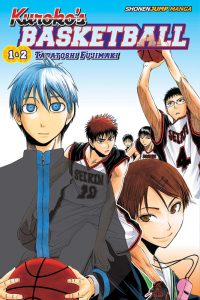
Tetsuya Kuroko is a plain and unremarkable guy with a talent for going unnoticed. On the basketball court, this means that despite his unimpressive physique and lackluster shooting ability, he is extremely valuable because he can get the ball to the right person without giving the opposing team the chance to react. In middle school, he was part of a legendary team that included the five members of the “Miracle Generation,” stellar players who all happened to be born in the same year. Although each of them has now gone on to different elite schools, Kuroko disliked the sole emphasis on winning and so chose to attend newly established Seirin, where he could experience teamwork with people who simply loved basketball. He forms a partnership with his fellow talented first-year, Taiga Kagami, to defeat the Miracle Generation players and make Kagami the best in Japan.
I’ve been reading a lot of sports manga lately, which is great, but also gives me a variety of titles to compare Kuroko’s Basketball to. The emphasis on someone who’s very skilled at helping others score is reminiscent of Haikyu!! and the character of Kageyama, and in both cases I appreciate a potentially unheralded position/skill getting its due. And, of course, how many sports manga are there that feature a pair of special first years? Quite a few, I’d reckon, though Kuroko and Kagami avoid the rivals-butting-heads trope. And how many launch quickly into inter-high qualifying matches? Quite a few.
Still, there are things each series does differently, and in Kuroko, at least so far, I mostly see what has been omitted. Instead of starting off with some practice sessions to introduce the team and familiarize readers with their personalities and specialties, we dive right into a practice game against a team containing one of the Miracle Generation. It’s not until the second volume that the other players on the team even get names. And then, once the qualifiers begin—from which only three teams of 300 will continue on to represent Tokyo at Nationals—three of Seirin’s first four matches are skipped and merely summarized in a panel or two. It’s kind of disappointing.
We do see some evolution of skills, particularly in how Kuroko and Kagami are able to work together, but when they receive a special training regimen in preparation for the inter-high, we only get a brief glimpse of what Kagami learned and nothing at all about what Kuroko was doing. Perhaps that’ll come into play in a future volume.
What appeals to me most so far is the attitude of the players, particularly Kagami, who loves the sport and loves a good challenge, and isn’t afraid to go up against someone even if he might lose. Too, I love the seed of doubt planted in Kuroko’s mind by an opponent—what happens when Kagami achieves his full potential and realizes how great he really is? Will he drift away from his teammates?
Ultimately, I did enjoy this introduction to the series and look forward to the next volume.
Kuroko’s Basketball is complete in 30 volumes. The next 2-in-1 edition from VIZ contains volumes three and four and will be released on October 4th, with further installments proceeding on a bimonthly release schedule.
Review copy provided by the publisher.


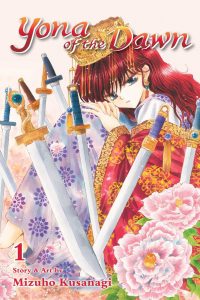 In the kingdom of Kohka, kindly King Il adores his only child, Princess Yona, and throws a celebration for her sixteenth birthday. Red-haired Yona is primarily preoccupied with getting her cousin, Su-Won, to see her as a woman. After the festivities, she decides to go tell her father that she simply must be allowed to marry Su-Won, only to walk in on her beloved running her father through with a sword. The palace guards are in on the treachery, and ready to comply with Su-Won’s order to dispatch the witness, but Yona is saved by her trusty personal guard, Hak, and the two of them manage to escape.
 I’m interested in a couple of the villainous characters, too! Kang Tae-jun of the fire tribe has desired Yona for a long time, so his remorse at her apparent death is genuine, even if he’s an entitled jerk. He reminds me of Skip Beat!’s Sho, a little bit, and I have a strong desire to see him switch sides someday and become a better person. And then there’s Su-Won, who ends the volume believing that Yona’s dead and being crowned king even as he admits that he crushed his dearest friends underfoot to achieve it. That’s much more interesting than him being utterly evil, and I wonder if he was manipulated into believing King Il had murdered his father or if that’s actually true. Unfortunately, both of these guys are more interesting to me right now than Hak is. Hopefully that will change.


 MICHELLE: What a dilemma! A new volume of Fruits Basket versus a new volume of Yowamushi Pedal! I love both series, but I think the advantage here has to go to the content that hasn’t been released here before, in which case it’s Yowamushi Pedal by a handlebar!