I was invited to participate in the “Anniversary of Hate” going on at The Hooded Utilitarian this month. My contribution, “Hating on Season Eight,” is now up, if you’d like to read some fangirl ranting about Buffy comics.
Pick of the Week: Toradora! & more
SEAN: As always after a week where 30+ titles ship all at once, this 2nd week of the month feels like a bit of a letdown. That said, there are a few interesting items. My pick of the week goes to the 5th volume of Toradora!, Seven Seas’ romantic comedy about a tiny girl with a hot temper and her not-boyfriend, a sensitive guy with the face of a gangster. Generally speaking, ‘tsundere girl who looks 8 years old but is 16 and will beat up the guy she likes’ is a overdone theme in Japanese anime and manga, but Taiga has managed to be less irritating than, say, Louise or Shana, and the cast of characters is also more appealing to me. Especially Minori, Taiga’s best friend, who needs to cross over with Bleach so that she and Orihime can be weird together.
KATE: Them’s some meager offerings! Click over to the graphic novel list, however, and you’ll find a worthy pick of the week: Madeline Rosca’s Clockwork Sky. If Rosca’s name sounds familiar, that’s because she was one of the first people to win the International Manga Award for Hollow Fields, a story set at an academy for mad scientists. Like Hollow Fields, Clockwork Sky has a heavy element of steampunk: the story unfolds in a technologically advanced version of Victorian England, complete with automated factories and robot detectives. The description promises an abundance of plotlines, from class warfare to rogue robots, so I’m optimistic that Clockwork Sky will be a fun read.
MJ: I admit I’m finding this week’s offerings at Midtown less than enticing. Fortunately, there are other places to turn for new manga these days, and by “other” I mean “digital”! Right now, I’m racing over to JManga to pick up the third volume of Setona Mizushiro’s Dousei Ai. As a big fan of Mizushiro’s After School Nightmare I’d long waited for some of her BL work to finally be translated into English, and this series’ first two volumes did not disappoint. If you’re looking for epic, complex BL, Dousei Ai is a must-read. I only wish it was available in print!
MICHELLE: Meager, indeed! According to Amazon, though, the seventh volume of Sailor Moon (my personal pick) is due on Tuesday, so you will likely be able to find it at your local comic store, provided that store isn’t Midtown!
Readers, what looks good to you this week?
Bookshelf Briefs 9/10/12
This week, Sean, Kate, and Michelle look at recent releases from Seven Seas, Yen Press, VIZ Media, and Vertical, Inc.
Alice in the Country of Clover: Cheshire Cat Waltz, Vol. 2 | By QuinRose and Mamenosuke Fujimaru | Seven Seas – Ace, the cheery yet sociopathic character who’s quickly become my favorite in this series, tells Alice he finds her most attractive when she’s upset and stressed, as the conflict makes her pretty. That’s sort of how I feel about this series as a whole. When it’s talking about whether Alice and Boris will get over their fight and become closer and maybe even move in together, it’s just another generic reverse harem title. When it’s analyzing the mechanics of the world, putting Alice on a high wire act and pitting her friends against each other, and showing why leaving Wonderland and going back continues to possibly be horrible, it’s fascinating. Hence my favorite part of the book – Boris shooting at Alice’s vial and failing to even crack it, to his annoyance. -Sean Gaffney
Bamboo Blade, Vol. 14 | By Masahiro Totsuka and Aguri Igarashi | Yen Press – I was underwhelmed by the initial volumes of Bamboo Blade: I found the one-note characters and slapstick humor too familiar to be compelling. As the series unfolded, however, the artist’s ability to draw kendo matches improved steadily, yielding fight scenes that were fun to read and advanced the plot in a meaningful fashion. The final volume resolves the individual characters’ conflicts first, then features a lengthy, 100+ page epilogue in which we see the girls strut their stuff at a Burnish Academy tournament. It’s not brilliant by any means, but the matches are expertly staged, and the final pages of the story suggest that even Toraji is capable of growing up. -Katherine Dacey
The Flowers of Evil, Vol. 2 | By Shuzo Oshimi | Vertical, Inc. – Quite often I agree with MJ on matters of manga, but this series is one where our opinions differ wildly. She liked it and found the leads sympathetic; I pretty much hated it and found no one to sympathize with except Saeki, the innocent (though idealized) girl who has agreed to date Kasuga, a middle-schooler who’s being manipulated by a female classmate (Nakamura) into acknowledging his inner perversion. I know I probably should applaud the depiction of teenage sexuality and pretention, but this series is just so not my cup of tea that I can’t find anything good to say about it. It’s very disturbing to me that what Saeki believes is a sweet, if awkward, first date with Kasuga is in reality tainted by the fact that he’s been forced to wear her stolen gym clothes beneath his own. She’s being duped. To his credit, Kasuga hates himself for the ruse and the final moments of the volume find him on the verge of telling the truth in a horrible, messy way, but ugh, I just can’t see myself picking up volume three to see what happens next. – Michelle Smith
Is This a Zombie?, Vol. 2 | Comic by Sacchi, Character Design by Kobuichi • Muririn, Original Concept by Shinichi Kimura | Yen Press> – Is This a Zombie? has the dubious distinction of being the worst comic I’ve read this year. The artwork is lousy, the jokes unfunny, the fanservice unrelenting, and the plot so nonsensical it often seems as if the characters themselves are confused by the rapid turn of events. In volume two, for example, there’s an extraordinarily silly fight scene in which we learn the identity of Ayumu’s killer. There are so many reversals and reveals packed into that chapter, however, that it reads more like something a six-year-old brainstormed than the work of a professional script writer. Add an unnecessary episode in which the characters go to the beach and participate in a food-eating contest, and presto! you have a recipe for a Manga Hall of Shame nomination. – Katherine Dacey
Library Wars: Love & War, Vol. 8 | By Kiiro Yumi and Hiro Arikawa | VIZ Media – And now, at last, after eight volumes, we get some resolution, as Tezuka’s horribly smug brother jogs Iku’s memory and forces her to realize who her prince is. And so now she’s freaking out, which is fun and yet also a bit predictable. Hopefully they’ll talk about it next volume after dealing with a molester who haunts libraries. What really impressed me, though, is Shibazaki’s plot thread. There’s lots of revelations here, some of which I found rather unpleasaant – but then that was the point – and you hope that someone (coughTezukacough) is able to take a hold of her and get her out of this ‘no one can ever really love me for who I am’ spiral she seems to be in. In comparison, Iku has it easier, but then Iku is a less complex person – as Shibazaki knows and envies. Good shoujo fluff. – Sean Gaffney
Oresama Teacher, Vol. 10 | By Izumi Tsubaki | VIZ Media – Longtime readers should now by now how much I love the humor in this title, and how I think it’s at its best when everyone is being as thick as planks. That said, I was surprised that my favorite moments in this volume were the more emotional ones. Hojo, the new Student Council member introduced here (another female character? How did that happen?) is comparatively ‘normal’, and thus we empathize even more with her obsession/frustration with Yui, who continues to vacillate between being cool and intelligent and being the dumbest, most clueless guy ever. As for our heroine, Mafuyu’s reaction to Takaomi reaching around to tie up her hair shows that, despite Western fandom’s dislike of student/teacher relationships, she’s still got it bad for him. All this, plus the return of SUPER BUN! – Sean Gaffney
Pick of the Week: September Bounty
KATE: After several lean weeks, the Midtown Comics list is bursting at the seams with great titles. I have no doubt that at least one of my fellow Battle Robot members will bang the drum for Osamu Tezuka’s Message to Adolf, which Vertical is re-issuing in a splendid, two-volume hardcover edition, so I’ll plug another Vertical title: volume nine of Chi’s Sweet Home. I adored Chi before I became a cat owner last November — c’mon, what’s not to like about cute kitten antics? — but I’ve developed an even deeper appreciation for the series after living with Francesca. Kanata Konami does a great job of showing the pet-owning experience from both the pet and the person’s point of view, never avoiding those moments that test an owner’s patience: barf, shredded toilet paper, pilfered food, accidents. In the last few volumes, Konami’s done a nice job of expanding Chi’s horizons beyond the confines of her apartment, preventing the story from becoming too cutely claustrophobic or repetitive. Best of all, Chi is one of those rare manga that I could hand to just about anyone — a six-year-old, my mom, a grumpy subway commuter — and know that they’d enjoy it.
SEAN: Tempted as I am to go with one of my many light, fluffy comfort manga which will no doubt make me smile more, I have to admit that the pick of the week is going to be Message to Adolf, the new Tezuka release from Vertical. I never did read the first release of this when Viz put it out back in the day, so am looking forward to seeing what late-period, mature Tezuka can be like. The premise alone sounds good – examining the life of three people named Adolf, one of whom you probably know – but the artwork is also more advanced and detailed, and the book’s design is gorgeous. At about 1200 pages total between the two volumes, this tome is a big investment, but I sense that it’s going to be worth it.
MICHELLE: I am completely on board with both Chi’s Sweet Home and Message to Adolf—I was fortunate enough to be able to read the old VIZ editions via inter-library loan a couple years ago—but I would be remiss if I did not voice my squee at a new volume of Yuu Watase’s Fushigi Yûgi: Genbu Kaiden appearing on this list! It’s been nearly three years since we’ve had a new installment in this series, which finds Watase revisiting the world of Fushigi Yûgi as a more experienced storyteller. I can’t wait to get caught up, and it makes me even happier that volume eleven isn’t too far behind!
MJ: After all that, I hardly know what to choose! I’ll be anxiously digging in to all three of my colleagues’ picks as soon as I can get my grubby little hands on them, but with such a bounty shipping in this week, I feel I should take the opportunity to spotlight another title. So in the end, I’ll give my nod to volume eight of Natsume Ono’s House of Five Leaves. I’ve made it a habit to champion this title whenever I have the chance, so why stop now? This series really shows off all of Ono’s greatest strengths—subtle relationships, nuanced characterization, complicated morality, and her lovely, distinctive artwork. Even in the midst of a very hectic week, when I sit down with a new volume of House of Five Leaves, I simply have to savor it, page by page. It’s an enduring favorite.
Readers, what looks good to you this week?
Off the Shelf: Sakuran
MICHELLE: Hey, MJ! What’s red and bad for your teeth?
MJ: Um. I got nothin’.
MICHELLE: A brick!
MJ: Well. Huh. Um. So, hi!
MICHELLE: Howdy! So, once again, we’re devoting our column to a single series. This time it’s Sakuran: Blossoms Wild by Moyoco Anno, published by Vertical. Although I own a couple of other complete series by Anno, this was my first time actually reading one of her works. I definitely enjoyed it, but found myself somewhat stuck between enjoying it for what it was and wishing it was somehow more uplifting.
But maybe I’m getting ahead of myself and we should offer readers a synopsis.
MJ: Okay!
Sakuran tells the story of Kiyoha, a young woman in Edo-era Japan who was sold to a brothel in Yoshiwara as a child. Over the course of the story, she endures the path towards becoming an oiran (the highest-ranking courtesan), very little of which is particularly graceful or glamorous, and after suffering through some unexpected heartbreak finally seems to accept the brothel as her home.
It’s a rather cynical tale that does not attempt to gloss over the fact that Kiyoha will most likely live her entire life in servitude (either to the brothel, or to some future man who might buy her freedom), and manages somehow to make the brothel feel like the better fate in the end.
MICHELLE: Yeah, it may be a difficult life, but at least Kiyoha seems to have made peace with it by the end.
Which is, really, not exactly the end, as Sakuran follows a similar structure to Ooku, in that the first chapter is “current day” in the life of its protagonist, followed by detail on how exactly Kiyoha came to be in that situation. Kiyoha’s not an easy person to like at first—one of the first things she does is clobber and pee on another courtesan—but I did grow to sympathize with her by the end, especially when her love proves false. “Cry, and you lose. Love, and you lose. Win, and you lose.”
MJ: I admit that I sympathized with her practically from the start, but especially as soon as Anno began to tell Kiyoha’s story from the beginning. Her intense desire to escape the pleasure quarter felt so real and relatable, I couldn’t help but side with her from then on.
One of the things I was immediately struck by was what a different kind of story this was from Blade of the Courtesans, a prose novel Vertical released a few years ago. Though the novel had some stirring moments, one of the comments I made in my review was this:
The story constantly describes the power of women in the Yoshiwara society, yet in the midst of an impassioned explanation of how the women are able to come to Yoshiwara to “rinse away their origins” and escape from the persecution of their clan, it is revealed that they are indentured to the various houses in the pleasure quarter (all owned by men) until their 28th birthday, at which time they may choose to get married or to remain courtesans for the rest of their lives. That these women, shackled to a system that values them only for their skills in lovemaking, are held up as the pinnacle of female beauty and sovereignty is inexpressibly sad.
If there is one thing Sakuran does not do, it’s try to romanticize or glorify the life of an indentured courtesan. For that, I am very grateful.
MICHELLE: It definitely does not do that.
It was an interesting experience reading this at about the same time as I was getting caught up on Ooku, because both of them deal with women forced to take many sexual partners but for vastly different reasons. It’s the courtesan’s job to do so, but so too the female shogun (who supposedly has all this power) must take lover after lover in the desperate attempt to produce a child hearty enough to become her heir. In reality, are they really so different, the shogun and the courtesan? In both cases, their fates are bleak as they submit to (or compel) their parade of lovers, very rarely finding true love.
MJ: That’s a great point, Michelle. Despite the power having supposedly been transferred to women out of necessity in Ooku, it’s ultimately still a story about women trapped in a society that values them really only for their sexual organs, one way or another.
Heh, you know, with all this in mind, I have to admit that I was pretty surprised to hear at the beginning that you had any hope or expectation of Sakuran being “uplifting.” Given the circumstances, it’s hard for me to imagine how it could be!
MICHELLE: Well, I don’t know, I thought she might actually escape or something! But, of course, her options really wouldn’t have been any better outside Yoshiwara (without a husband, at least), which Anno makes clear. So it would’ve completely been a fallacious fantasy to read a story about a courtesan getting out and living happily ever after. Not challenging for a reader, but kind of… satisfying.
MJ: I can understand the impulse to wish for a more unambiguously happy ending. Yet the ending as it is isn’t exactly bleak, even if it seems like it should be. That’s actually one of the book’s greatest strengths, really. It manages not to be just grim, which is kind of amazing.
MICHELLE: Definitely. I want to add here that if we’d actually been given a happier ending, I probably would’ve hated it and chastised Anno for not being brave and taking a darker route. I guess I’m just conditioned now to expect creators to go for uplifting instead of ambiguous, since it has happened so many times before.
MJ: Probably one of the reasons we’re able to get a more ambiguous ending here is the fact that, aside from something like Sugar Sugar Rune, Moyoco Anno mainly writes for adults–and most often about adult women. But since manga about teen girls is sort of the default for female-centric manga imported to the US, that’s really what we’ve become accustomed to.
MICHELLE: Yes, you’re definitely correct. And when we do encounter a story aimed at teen girls that takes a more painful route—We Were There, 13th Boy, to some extent…—we tend to love it to pieces.
MJ: We do! Now, I’m not sure if I’m prepared to say that I love Sakuran to pieces. I enjoyed it very much, and I think it’s very well-crafted, but it’s not the kind of story that resonates really strongly with me on a personal level the way some others do.
That said, as a critic there is so much here to enjoy. One aspect we haven’t really touched on yet is the artwork, which is really quite stunning, especially with Vertical’s particular touches. The paper choice, color pages, and beautiful foil cover let you know right away that Sakuran will be a visual treat.
MICHELLE: Well, no, I didn’t love Sakuran either, but I really admire it, if that makes sense.
Going in, I wasn’t sure how I’d feel about the artwork, since Anno has such a distinctive style, but I ultimately enjoyed it and thought she did a terrific job capturing the atmosphere of the tea house. I did have some problems with telling a few of the courtesans apart, though.
MJ: That makes perfect sense. I think that’s where I was at with it, too, though I did really feel strongly for the main character, which is always a big plus. And one of my favorite aspects of the artwork has to do with her as well. I was really impressed by Anno’s ability to visually portray both Kiyoha’s spite and her vulnerability, which is not a combination that always translates well to the page.
MICHELLE: I hadn’t thought about that specifically, but it’s true that even nearly two weeks after I read Sakuran, I can still easily conjure some of Kiyoha’s expressions falling into both of those categories. Actually, I can still vividly remember quite a few scenes, including specifics of panel layouts. And that’s not something I could say about quite a lot of other manga.
MJ: One thing Anno has accomplished, perhaps specifically by writing Sakuran as a collection of story snapshots rather than a long narrative, is that the moments she’s chosen to highlight are genuinely memorable, and that goes for individual images as well.
MICHELLE: Yes, that is true, though I still wish it could’ve been longer. Carlo Santos at ANN put it well: “This volume offers a glimpse into a fascinating world, but closes up before we ever get a chance to peek around the corners.”
MJ: I certainly would have read much, much more of it!
BL Bookrack: August 2012
Welcome to the August installment of BL Bookrack! This month, Michelle takes a look at Flutter from Juné Manga and the debut volume of Punch Up! from SuBLime, while MJchecks out the first two volumes of Setona Mizushiro’s Dousei Ai at JManga. In Brief: Awkward Silence (SuBLime), Honeydew Syndrome, Vol. 2 (New Shoe), My Boyfriend the Mad Dog (DMG), and Starting With a Kiss, Vol. 1 (SuBLime).
Dousei Ai, Vols. 1-2 | By Setona Mizushiro | Published by Libre Publishing Co., Ltd./JManga | Rated Mature – When innocent middle-schooler Tsubaki tells his classmate Kaoru that he loves him, he is completely unprepared for the consequences of his words. Devastated by Kaoru’s violent rejection, Tsubaki begins to withdraw from his other friends and, as he reaches high school, enters into a sexual relationship with a male teacher in order to ease his growing sense of isolation. As graduation approaches, Tsubaki becomes anxious to get out of the increasingly one-sided relationship with his teacher. But when he tries to break up, the teacher reacts by dramatically outing him to his family—sending Tsubaki running to Tokyo to escape his parents’ visible pain and disapproval.
If the entire series was Tsubaki’s alone, his poignant tale would be more than enough to keep me hooked. But its second chapter makes it immediately clear that Mizushiro has much bigger plans, as she introduces the series’ second protagonist, Koutarou.
Having mainly been raised by his kind, domestically-inclined older brother, Koutarou is a fairly manipulative, smart-ass kid who privately prides himself on being able to “beat” his brother at anything. When his brother brings home a girlfriend for the first time, it seems he’s finally bested Koutarou at something, but the girl sneaks into Koutarou’s bed during the night, providing Koutarou with both the loss of his virginity and proof that he’s still on top (so to speak). Things take a downward turn, however, when Koutarou’s brother announces that he’ll be marrying the girlfriend, who is pregnant with a child he believes must be his. Wracked with guilt and self-loathing, Koutarou falls into a pattern of loveless one-night-stands with any women (and later, men—which eventually establishes itself as his preference) who express interest, all the while keeping up appearances as the guy who’s got it all together.
That was probably more summary than I’ve ever included in a single review in my entire career as a manga critic, but in those two paragraphs you will find evidence of both the best (and worst) things about Dousei Ai. In the category of “best,” well… wow. This is no casual one-shot or simplistic BL romance. Setona Mizushiro has carefully crafted a complex emotional drama with some of the best-written characterization I’ve ever seen in this genre and a long game that is pretty obviously going to offer up significant payoff for the reader. I mean, going into this it’s clear that we’re in for a killer of a ride, along the lines of something like Sooyeon Won’s manhwa epic Let Dai, only better—much, much better. Both Tsubaki and Koutarou are rich, genuinely fascinating characters, who somehow manage to remain sympathetic even as they fall into their individual patterns of using others in order to get by with their own pain. And as the second volume wraps up it becomes clear that the main cast will continue to grow as the series goes on. I can’t wait. Seriously, I can’t.
On the downside—and perhaps at least partially due to the era in which this was originally released—Mizushiro puts a lot of work into making sure we know just how broken her protagonists are, which wouldn’t be a problem if she didn’t also hint at their personal trauma being at least partly responsible for their sexuality. I’m giving her a pass on this so far, since it hasn’t been stated outright from an authorial point of view, but it is the one small bruise on this otherwise deliciously epic treat. And while I’ve heard the series’ old-school ’90s artwork (it began serialization in 1996) described as “ugly,” it satisfies my admittedly-retro tastes with near-perfection.
If you’ve got a hankering for lighthearted comedy or sweet romance, this series is emphatically not the ticket. But for my part, Dousei Ai may be the BL epic I’ve long been waiting for. Highly recommended.
– Review by MJ
Flutter | By Momoko Tenzen | Juné | Rated Mature – Sometimes I’m tempted to write a review that simply says, “This is really good. Go read it.” Flutter is just such a case, but I suppose I ought to present at least some evidence in its favor.
Masahiro Asada works in the sales division of a company. Although straight, he’s transfixed every morning by the sight of a beautiful male coworker, Ryosuke Mizuki, who is so impeccably dressed and put together that he almost doesn’t seem human. When a project brings them together, Asada gets to know Mizuki—and his all-too-human flaws, sorrows, and weaknesses—and finds himself even more attracted.
There are so many things to recommend this manga. The atmosphere is sort of… elegant and languid, which suits mysterious Mizuki well and makes an earnest everydude like Asada stand out all the more. The growing friendship between the men is believable—and they’re both completely professional adults, I might add—as is Mizuki’s wary reaction when Asada confesses his feelings. Mizuki’s been hurt before, and is concerned he might be tempted to just use Asada to make his ex jealous.
It’s lovely and complicated, and when the guys do finally get together physically it’s wonderfully awkward. I’m always a little embarrassed when BL lets us get to know the guys well before they start getting intimate, because then it feels like we’re spying on something we shouldn’t be seeing. Thankfully, the love scene fades to black before this becomes an issue.
Ultimately, Flutter is the best BL oneshot I’ve read in a long time. This is really good. Go read it.
– Review by Michelle Smith
Punch Up!, Vol. 1 | By Shiuko Kano | Published by SuBLime Manga | Rated Mature – Shiuko Kano has had a lot of manga published in America, but somehow, despite owning several volumes, I’ve never managed to read any of her work until this first volume of Punch Up!, which is itself a spinoff of Play Boy Blues.
The concept is pretty simple: Maki Motoharu is a gay architect with a lively appreciation for attractive men. When he learns that his lost cat has been found and cared for by Ohki Kouta, a construction worker helping to build his latest project, and that Kouta has quarreled with his landlord because of that, he offers the younger man a place to stay. Kouta soon realizes that Motoharu’s fancy digs (and cat) are woefully neglected, and ends up bonding with the cat (Nyanta) far more than her owner ever had.
Pretty soon Kouta’s concern for Nyanta translates to concern for Motoharu, and they hook up. What’s interesting about their relationship is that it’s not sweet at all. This isn’t some dreamy romance manga. Motoharu is pretty much a crappy person, but not in an over-the-top villainous kind of way. Kouta realizes this, bemoaning his own lousy taste in men, and has no expectations that their relationship is going to last. And somehow… this seems to give the story a lot of potential to go in various soapy directions while seeming at least a little more realistic than the thoughtful/adorable BL to which I typically gravitate.
Though a lot more explicit than I usually prefer, and tonally different as well, Punch Up! has at least intrigued me enough to check out the next volume, though I don’t see it becoming a permanent fixture in my collection.
– Review by Michelle Smith
In Brief:
Awkward Silence, Vol. 1 | By Hinako Takanaga | Published by SuBLime Manga | Rated Mature – With his impassive face, Satoru Tono has always had trouble expressing his feelings. He can’t even visibly convey his happy surprise when Keigo Tamiya, a popular athlete and object of Satoru’s long-time crush, asks him out. Various obstacles and misunderstandings ensue—drama over a lost cell phone charm, jealousy over a flirtatious female transfer student, and a persistent sempai with an eye for Satoru— but the boys reaffirm their affections as needed and engage in end-of-chapter “romping” with predictable regularity. If you’re thinking, “Gee, that sounds pretty generic,” you’re absolutely right. It’s not actively bad, so I might have read a second volume if the series had ended there, but it looks like it’s up to four volumes in Japan and still ongoing! I am, quite frankly, astounded that Takanaga was able to extract that much material from this tired premise. – Michelle Smith
Honeydew Syndrome, Vol. 2 | By New Shoe | Rated Teen – With Metis and Josh’s relationship well in hand, volume two of this charming BL comic turns the camera on quiet, easygoing Jay and his growing interest in Metis’ caustic friend Charles, as well as a few other members of Metis’ idiosyncratic social sphere. Though this can feel a bit choppy as a volume, the individual stories are just as engaging as the first half of the series, and perhaps more so in places—evidence of this team’s growth over the course of the series. The print version of this webcomic also includes a a terrific prose story about Jay and Charles that offers up some essential character notes on both of them and is not to be missed. Still recommended. – MJ
My Boyfriend, The Mad Dog | By Sanae Rokuya | Digital Manga Guild – Akae is an eccentric mangaka who expects his assistants to, er, “assist” with more than just artwork. Honma is a highly sought-after freelancer with ample talent for the job. If this sounds like the introduction to a little mindless porn, you’d only be partly right. Though their story is far from deep, there is some fairly nuanced characterization here, especially in Honma, who refuses to be cast as simply the blushing uke. Unfortunately, the volume’s second couple—an aspiring artist who hasn’t learned the word “no,” and his (apparently) desperate editor—is pretty cringe-worthy throughout. If you don’t enjoy persistent non-con, proceed with caution.– MJ
Starting with a Kiss, Vol. 1 | By Youka Nitta | SuBLime Manga | Rated Mature – As a fan of multi-volume BL, I’m usually pretty anxious to try out anything with a volume number in its title, though results are frequently negative or mixed at best. Starting with a Kiss falls squarely into the latter category, with its mix of confusing narrative and comically rushed romance alongside some genuinely interesting characterization. Though Youka Nitta’s yakuza are intriguing, her jumps between past and present read as awkward rather than illuminating. Furthermore, her plentiful sex scenes are hampered by unbelievable relationships that seem to form in the blink of an eye. Fortunately, with multi-volume series, there’s always hope for next time. Not yet recommended. – MJ
Review copies of most titles provided by the publishers.
Disclosure: MJ is currently under contract with Digital Manga Publishing’s Digital Manga Guild, as necessitated for her ongoing report Inside the DMG. Any compensation earned by MJin her role as an editor with the DMG will be donated to the Comic Book Legal Defense Fund.
Pick of the Week: Ikigami, Gate 7, Itazura, Dorohedoro
KATE: This week’s shipping list is heavy on Dark Horse and DMP titles, and light on just about everything else. I still have no idea what’s happening in Gate 7, and I lost patience with Itazura na Kiss several volumes ago, so my pick goes to one of Wednesday’s few VIZ releases: volume eight of Ikigami: The Ultimate Limit. I have a hot-and-cold relationship with Ikigami: the artwork is terrific and expressive, and the premise is chilling in a good, thought-provoking way. At the same time, however, the stories are unrelentingly grim, and the tone so pessimistic that I can only read a few chapters at a time before needing a stiff drink. The other problem with Ikigami is that the overarching story — in which a “reaper” slowly begins to question his job — unfolds at what might be charitably described as a snail’s pace. Still, recent volumes have shown incremental progress in bringing Fujimoto’s crisis of conscience to the fore, giving me hope that the series is moving in a new and more dramatically satisfying direction.
MJ: It’s kind of an odd week for me, which is to say that there is a decent amount of new manga shipping in, with little of it to my taste. So I’ll make a rather optimistic choice this week and pick volume three of CLAMP’s Gate 7. While I joyfully declared volume one of this series to be “my kind of CLAMP,” its second volume’s onslaught of exposition and historical information left me a bit cold. However, having now discovered this tumblr full of guidance on Gate 7‘s historical matters, I’m ready to jump back in again for another try. If nothing else, Gate 7 offers me CLAMP’s latest take on their Watanuki-model character, which is pretty much bullet-proof for me, so that may get me through on its own. So, Gate 7 it is!
MICHELLE: Although I do intend to check out the latest volume of Ikigami and haven’t completely given up on Gate 7, I don’t feel enthusiastic enough about either to appoint one my pick of the week. I’m largely unfamiliar with most of the rest of the offerings on the list, though I confess to being slightly amused that I’ve Seen It All evidently involves love in a urology clinic. So, basically this is my exceedingly long-winded way of saying, yet again, that Itazura Na Kiss gets my vote.
SEAN: I have to know what happens! Will Caiman reunite with Nikaido? What about the new relationship between her and En, now that we know more about En’s past? I want to see more goofy humor between Noi and Shin as they casually kill people. I want more casual killing and gore from this cast of anti-heroes (or lovable villains). I want to be able to spot tiny little things in the background. I want more world-building and locations we haven’t seen before! I want to find out more about the head in Caiman’s mouth, who I think we finally have figured out. And I want more gyoza! Delicious gyoza! So yes, for all that and more, and to no one’s surprise, Dorohedoro is my pick this week.
Readers, what looks good to you this week?
Bookshelf Briefs 8/20/12
This week, Sean, MJ, Kate, & Michelle look at recent releases from Yen Press, VIZ Media, and Kodansha Comics.
Ai Ore!, Vol. 6 | By Mayu Shinjo | VIZ Media – It really is astonishing what changing magazines/publishers has done for this title. It still has its issues, but the way that it handles them is more acceptable and more mature. This is not to say that the premise is completely different, however. Akira is still trying to prove that he’s a manly man for Mizuki, Mizuki is still getting embarrassed and misunderstanding everything, and Ran and Rui trade off between being comedic creepers and serious creepers. At one point, Rui tries to seduce Misaki, to the point almost of sexual assault. But Misaki doesn’t buy it, and neither do we – unlike Vol. 1 of this series, the danger doesn’t feel genuine. You can argue this makes the series fluffier and less electrically charged, but it also makes Akira and Mizuki’s relationship far sweeter and more tolerable. –Sean Gaffney
Bunny Drop, Vol. 6 | By Yumi Unita | Yen Press – As the series continues with its new switch to Rin as its primary POV character, the story begins to revolve around Rin’s increasingly awkward relationship with her childhood friend Kouki, whose (supposedly) ex-girlfriend deliberately alienates Rin. Fortunately, this plotline is more nuanced than it sounds, deftly avoiding most of the “evil rival” territory common in manga for female readers. Unfortunately, Unita seems less comfortable writing Rin’s voice than she was writing Daikichi’s—or maybe Daikichi is just infinitely more comfortable than Rin herself—which means that there is often a noticeable distance between the reader and the series’ protagonist. On the upside, Rin’s evolving balance between dependence and independence creates unexpected difficulties in Daikichi’s own personal life, allowing us back (however briefly) into his somewhat more forthcoming mind. Though the series’ new direction seems to still be settling in, there’s enough solid ground left for nearly any fan to stand on. Still recommended. – MJ
Cage of Eden, Vol. 6 | By Yoshinobu Yamada | Kodansha Comics – This really is the perfect series for 12-year-old boys, though I would not recommend it to parents of those boys. There’s far too much casual nudity, casual violence, and general skeevy fanservice. But it also has bears vs. wolves, in which our hero teams up with the wolf because of their similar roles in their groups. It’s almost pure shonen at its finest. We meet two more regulars here. I suspect Rei is there entirely to be a large-breasted woman (you know, in case there weren’t enough of those), but Maya seems to be more of an action girl, and backs it up. She seems a bit *too* eager for battle, though, and I wonder if she’ll last long. Then again, the only people in this series who seem to be killed are the irredeemable ones, such as manipulative Kotomi or stalker Ryoichi.-Sean Gaffney
The Melancholy of Haruhi Suzumiya, Vol. 13 | By Gaku Tsugano and Nagaru Tanigawa | Yen Press – I haven’t reviewed this series for a while, but since it’s moved on to stories that aren’t animated, it has managed to improve – finally, it can be 2nd best, rather than 3rd! It has a difficult job here, as Editor in Chief, the short story adapted for this volume, does not lend itself well to the visual. Still, it manages pretty well, and also throws in an original short story chapter, featuring Miyoko, the girl from Kyon’s story, arriving to ask the SOS-Dan to help her investigate a haunted house. It shakes things up by having Taniguchi and Kunikida there rather than Yuki and Mikuru, and also has an ending that undercuts the tension but still is nicely sentimental. The art is still only fair, and I’d rather read the novels, but this is now an acceptable alternative. –Sean Gaffney
Ooku: The Inner Chambers, Vol. 7 | By Fumi Yoshinaga | VIZ Media – Ever since the end of volume one, the latest Tokugawa Shogun, Yoshimune, has been reading Chronicle of a Dying Day, which tells the story of how women came to rule Japan. Readers have followed along, and here in volume seven we finally return to the “present,” but not before realizing just how much scheming Yoshimune—or perhaps simply her ever-faithful attendant, Hisamichi—has engaged in to become the next Shogun. It’s just another lesson that nearly everyone in this tale, no matter how likeable, has sinned in pursuit of power, sometimes inflicting misfortune upon the innocent. Maybe it’s because of this that Ooku, despite being interesting and boasting some impressive art, doesn’t stand a chance of becoming my favorite Yoshinaga manga. Oh, I’ll keep following it, but Antique Bakery‘s place in my heart is secure. – Michelle Smith
Puella Magi Madoka Magica, Vol. 2 | Story by Magica Quartet, Art by Hanokage | Yen Press – If your chief aversion to magical-girl manga is its earnest, perky wholesomeness, then Puella Magi Madoka Magica is for you. The series is dark and violent, using the magical-girl concept as a metaphor for adolescence in all its ugliness. In volume two, for example, we see the corrosive influence of jealousy, as Sayaka begins to regret wishing for her friend Kamijou’s full recovery. Sayaka’s rapid descent into anger and self-pity is one of the most astonishing developments in the volume — and that’s saying something, given the healthy sprinkling of fight scenes, dramatic confrontations, and plot twists. As terrific as some of these scenes are, Puella often feels rushed. Most of the fight sequences are too brief and too busy to make much sense; one gets the sense that the writers were trying too hard to cover all the major plot points of the anime, rather than tailoring the story to a different medium. That said, Puella has consistently surprised me with its ability to both faithfully observe and thoroughly subvert magical-girl tropes, and continues to grow on me with each volume. -Katherine Dacey
A Place of Hiding by Elizabeth George
From the back cover:
A shocking murder calls forensic scientist Simon St. James and his wife, Deborah, to an isolated island in the English Channel. An old friend of Deborah’s, China River, stands accused of killing the island’s wealthiest benefactor, Guy Brouard. There is little evidence pointing to China—and Deborah and Simon are certain that their friend didn’t murder the inveterate womanizer. But if China didn’t kill Brouard, who did?
As family and friends gather for the reading of the will, Deborah and Simon find that seemingly everyone on the history-haunted island has something to hide. And behind all the lies and alibis, a killer is lurking.
Review:
Every once in a while, a strange thing happens to me: I get an incredibly strong craving to read a mystery by Elizabeth George. This isn’t a bad thing, but I’ve only got five left now ’til I’m current, and I wonder what’ll happen then. Anyway, in the case of A Place of Hiding this craving was strong enough to trump the off-putting fact that this novel prominently features Deborah St. James, a character whom I dislike most intensely.
Before I get into the ways in which Deborah caused me to contemplate violence upon her fictional person, I should probably talk about the actual mystery, such as it is. Guy Brouard, wealthy war orphan and inveterate womanizer, has been killed on the island of Guernsey the morning following a party announcing his plans for a war museum. Among the attendees was China River, an American and old friend of Deborah’s, who has now been arrested for the crime. China’s brother, Cherokee, comes to London to enlist the aid of Deborah and her forensic scientist husband, Simon, in proving his sister’s innocence.
Simon’s credentials convince the local force to allow him to poke around, and he, as one might assume, soon discovers additional suspects with various motives. He also entrusts Deborah with an important piece of evidence, and when she fails to do with it what he requested, he gets chewed out about it by the local DCI, which obviously leaves him feeling rightfully irritated with her. Deborah fails to see how this is her fault, and indulges in repeated hissy fits about how Simon views his rational approach to the investigation (and life in general) as superior to her own “passionate, unpredictable” one.
This eventually culminates in Deborah idiotically interrupting a stakeout and, once again, making Simon look unprofessional in front of the local police. Elizabeth George tries so hard to make us sympathize with Deborah that she introduces characteristics in Simon that I had never before noticed, like a patronizing form of sexism. So now, not only do I hate Deborah, she’s making me start to dislike Simon, too! Great.
Some of the secondary characters are fairly odious, too, but honestly I am ready to put them (and this book) behind me. I will say, however, that this is the first Elizabeth George novel to ever make me cry happy tears (the last scene involving Paul Fielder), so it’s obviously not all bad.
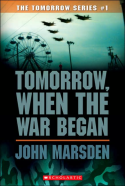
Tomorrow, When the War Began by John Marsden
Book description:
When Ellie and her friends go camping, they have no idea they’re leaving their old lives behind forever. Despite a less-than-tragic food shortage and a secret crush or two, everything goes as planned. But a week later, they return home to find their houses empty and their pets starving. Something has gone wrong—horribly wrong. Before long, they realize the country has been invaded, and the entire town has been captured—including their families and all their friends.
Ellie and the other survivors face an impossible decision: they can flee for the mountains or surrender. Or they can fight.
Review:
It’s been several weeks now since I finished Tomorrow, When the War Began. Normally, I write a book’s review as soon as I finish reading it, but I feel like I’m still processing this one to some extent, trying to figure out exactly how I feel about it.
This is due in part to the fact that I have greatly enjoyed the other books by John Marsden that I have read, and so built this series up in my mind as something that was going to be jaw-droppingly amazing. And when it turned out not to be so, even though it’s still quite good in general and genuinely riveting in parts, I was kind of disappointed.
This is the story of seven Australian teenagers (later eight) living in the rural town of Wirrawee who go camping while their parents and most of the people in town are attending a fair. The kids return to find that a mysterious military force has invaded Australia and has imprisoned most of the townspeople at the fairgrounds, including their families. They must decide what, if anything, they’re going to do to help. Ellie Linton has been tasked with chronicling their story.
Large portions of the tale are pretty fascinating. The teens are resourceful and rise to the occasion, especially Ellie’s clown/daredevil childhood friend, Homer, who emerges as the group’s leader, and Fiona, a ladylike rich girl who proves to have unexpected reserves of courage. While Homer is the tactician of the group, Ellie seems to find herself trusted with the most dangerous missions, which require some quick, inventive thinking on her part in difficult situations involving things like exploding lawn mowers, demolition derby bulldozers, and exploding gas tankers.
I even liked the parts of the story where the characters talk about what they’re going to do—are we going to hide out here in our camping spot, or are we going to try to engage the enemy somehow?—and the various supplies they’re going to need from town, whether to keep chickens, etc. Where the story really bogs down, however, is with the introduction of romance.
Ellie has never considered Homer in a romantic way before, but begins to see him in a new light given his metamorphosis. Meanwhile, she’s also intrigued by Lee, the inscrutable Asian musician, and Homer has fallen for Fiona. Ellie dwells a lot on her confusion before ultimately deciding upon Lee, and then telling readers about all the making out they’re doing and how she has learned the things that make him groan, etc. I kept thinking how embarrassing all of this will be for Lee whenever he/anyone reads this official chronicle!
Anyway, it’s not that I am anti-romance or anything, but it’s just that these scenes really slow down the pace of the story. And maybe that is the point. Even if something as dramatic as an invasion has occurred, there will still be a lot of downtime if you’re hiding out in the woods, and a lot of time for more mundane things to be going on.
I guess what it boils down to is that my perception of the book has been hampered by my expectations. I am certainly going to read the rest of the series, and hopefully I will like it better now that I’ve reconciled myself to what it actually is rather than what I thought it was.
Additional reviews of Tomorrow, When the War Began can be found at Triple Take.
Pick of the Week: Ninja, Samurai, Hoops, & Blades
MICHELLE: There’s a lot of good stuff on Midtown’s list this week, including new volumes of a few favorites like Slam Dunk and Dawn of the Arcana, but I must avail myself of the once-yearly chance to award my pick to Kaze Hikaru, now in its 20th volume. While I’m sad that this series doesn’t come out more frequently, I’m exceedingly grateful that it hasn’t been outright cancelled, because it’s quite an affecting read. The cross-dressing element of the story—a young woman has disguised herself as a warrior in order to fight alongside the Shinsengumi—doesn’t do much for me, but I love that very sad and complicated things can and do happen, which makes me keen to see just how closely mangaka Taeko Watanabe will follow history. Highly recommended.
SEAN: Lotsa good stuff this time around, but my obvious pick is for a series I’ll see for the last time. I’ve loved Bamboo Blade since it began, a sports manga that shows jaded girls, flaky girls, ambitious girls, and quite frankly dangerously insane girls, all of whom can throw off all that baggage and become awesome with the power of kendo in order to reach the top. For most of the series the top has been our heroine, Tamaki. And now she’s finally discovering that she still has something to reach for, and that kendo is not just about making her more sociable. I can’t wait to see the end, and will miss the series dearly when I do get to it.
KATE: Long-time readers of my blog know I’m a shameless promoter of Kaze Hikaru. And InuYasha. And Kekkaishi. So I’m going to deviate from my well-established pattern of promoting my favorite titles and recommend volume twenty-three of Slam Dunk. One of the things I like best about this series is the way Takehiko Inoue balances intense game play with slapstick humor. Hard-core sports fans will appreciate the skill with which Inoue renders the pick-and-roll and free throw, while ordinary otaku can can appreciate the goofy, anything-for-a-laugh moments that punctuate the practices, scrimmages, and games.
MJ: There really is a lot to choose from this week, but the title that most catches my eye is one I haven’t thought about in a while. I became an immediate fan when I read the first volume of Nabari no Ou back in 2009, but I let it fall off my radar a bit after the first few volumes. Then last week, I read this review of volume ten by Kate O’Neil at the Fandom Post, and it became suddenly clear that I needed to catch up. So this week’s must-buy for me is volume eleven of Nabari no Ou. I really look forward to digging in to this series again, especially now that I have a few volumes ready to marathon all at once. I’ll be sure to report back!
Readers, what looks good to you this week?
Bookshelf Briefs 8/13/12
This week, Michelle, MJ, and Sean look at recent releases from Seven Seas, VIZ Media, Yen Press, Kodansha Comics, and Dark Horse Manga.
Alice in the Country of Clover: Cheshire Cat Waltz, Vol. 1 | By QuinRose & Mamenosuke Fujimaru | Published by Seven Seas – I am pleased to report that, so far, Cheshire Cat Waltz is much better than the prior “country of Clover” installment, Bloody Twins! Some of the elements that made Alice in the Country of Hearts so surprisingly good are back, like ominous hints about a particular character and Alice experiencing culture clash with the various attitudes and mysteries of Wonderland. However, because this is much more obviously a romance—here, Alice is paired up with Boris, the Cheshire Cat—the story’s more intriguing aspects must occasionally take a backseat to Alice being confused about her motives for remaining in Wonderland, Alice being pounced upon, Alice getting smooched, and lovers’ quarrels born of jealousy. Although I am sure I’m being duped again and that nothing significant of Wonderland will be revealed, I remain interested enough that I’ll probably come back for volume two. – Michelle Smith
Bakuman, Vol. 13 | By Tsugumi Ohba & Takeshi Obata | VIZ Media – Bakuman‘s heroes, Mashiro and Takagi, are always the most interesting when they are at odds, and this volume is a perfect example of exactly why that is. As all the young Jump mangaka throw themselves into a rather unusual competition (writing romantic one-shots), it isn’t Nizuma’s sudden display of inexperience or even Hiramaru’s over-the-top romantic hero act that make the volume work, hilarious though they may be. What really steals the volume are a few scattered scenes between Mashiro and Takagi’s wife, Kaya, as they try to make sense of their shared partner. These moments are uncharacteristically honest and sincere for an Ohba/Obata manga, and it’s a real pleasure to discover them amidst all the slick shounen meta. On a personal note, Kaya has long been my favorite of Bakuman‘s characters, and I’ll admit that a scene in which she receives a basket of flowers from Shueisha as thanks for her work on her husband’s series was surprisingly gratifying. Still recommended. – MJ
A Devil and Her Love Song, Vol. 4 | By Miyoshi Tomori | VIZ Media – As “Devil” Maria’s class finally prepares for their choral performance, everything falls (rather predictably) apart, but fortunately this is shoujo manga, and even in a story with a heroine as prickly and jaded as Maria, a little romance can save the day. Any feelings of frustration one might have as the choral competition story drags interminably on are blown away completely by the impact of a wholly surprising confession by the character from whom you least expect it. Despite this series’ cynical bent, its romantic thread reads as genuinely sincere and even sweet—a mashup of contrasting tones that apparently works very well. Even as the series appears to be gearing up for a typical romantic triangle, it seems clear that Miyoshi Tomori’s gift for injecting raw emotional truth into standard shoujo tropes will continue to keep things interesting. – MJ
Drifters, Vol. 2 | By Kohta Hirano | Dark Horse Comics – Volume Two of this series continues to do what the series does best – give us a lot of people trying to kill other people in nasty ways. It’s great fun for those who don’t mind that sort of thing – Hirano draws battles that are easy to follow, and the ‘nasty’ aspect of the combat is not remotely glossed over here – Nobunaga’s treated arrows are as disgusting as possible, and the rape of the elven women is not played for laughs. As for our hero, Shimazu, well, he does seem to be strategizing a little more, almost despite himself, and is also forming a deep bond with Nobunaga that involves a lot of yelling and punching. Meanwhile, for those wondering when this ‘warlords in a fantasy world’ would reach Hitler, it didn’t take long at all. Still good fun, even if it plays mostly to the 12-year-old in all of us. –Sean Gaffney
Durarara!!, Vol. 3 | By Ryohgo Narita, Suzuhito Yasuda & Akiyo Satorigi | Yen Press – There’s a lot of big reveals in this volume, which would be churlish of me to talk about, so I will merely note that one of the weaker of our heroes turns out to have far more strength than we had imagined. Elsewhere, Shizuo shows once more how incredibly tough he is, Izaya is one of the most obnoxious S.O.B.s in all of the universe, and Celty is cute, if frantic. But then, she has reason to be frantic. There’s also a fantastic parody of Doraemon about 1/3 through, when the art style shifts to that in order to demonstrate Mikado’s disbelief at the latest plot twist. And of course there’s Namie and Seiji, whose creepy desires are something completely amped up in this manga, to the point where even the novel’s author was impressed. A solid adaptation. –Sean Gaffney
Kamisama Kiss, Vol. 10 | By Julietta Suzuki | VIZ Media – I have to say, Nanami is starting to remind me a bit of Tohru in Fruits Basket, who sometimes felt as if she existed to interact with the screwed-up Sohmas and heal them with her magical power of niceness. Tohru turned out to be just as screwed-up, though, whereas Nanami is shiny all around. Her interaction with Jiro (who irritates Tomoe as he reminds him of himself) is fairly predictable, though that doesn’t necessarily mean bad – there’s a wonderful bit towards the end where she notes Tomoe’s strength as something that might not be a positive. In the end, though, this arc wrapped up a lot easier than I’d anticipated, and I’m left with a feeling that things are simply going too well for our protagonists right now. Of course, I’m sure that will change – the manga is not ending anytime soon… –Sean Gaffney
Miles Edgeworth: Ace Attorney Investigations, Vol. 1 | By Kenji Kuroda & Kazuo Maekawa | Kodansha Comics – I try not to review Volume Ones in the Briefs category, but with something like this title there’s little choice, as there’s so little *to* it. Heck, we don’t even get to see Kay Faraday, which I was expecting given the title – the only regulars are Miles and Detective Gumshoe. The cases are both pretty good, though the first is extremely short, and the writing is much the same as it was in the Phoenix Wright books. The trouble is that Miles is not Phoenix – he doesn’t make screwups or say dumb things on occasion. He’s simply too smart to make this anything but a foregone conclusion. Indeed, in the first case he solves things so quickly that everyone around him just stares. Let’s hope future books find more of a challenge – and maybe more faces we know? –Sean Gaffney
Nura: Rise of the Yokai Clan, Vol. 10 | By Hiroshi Shiibashi | VIZ Media – The cliffhanger from last volume is resolved incredibly quickly, leaving us with two major plotlines for this volume consisting mostly of fighting sequences. First we see the conflict between Yura and her siblings, which shows us how even the purest of heart can be ruined by just a tiny sliver of pride and jealousy. Meanwhile, Rikuo and company are taking their airship to Kyoto (still being destroyed bit by bit), but infighting may destroy them before the enemy can. Here we see just how much trust Rikuo has gained over these ten volumes – and how much more he has yet to earn, though the greater control of his power here helps. Unfortunately, this conflict doesn’t look nearly like it’s reaching the end, so expect Volume 11 to me more fight, fight, fight.-Sean Gaffney
Toriko, Vol. 11 | By Mitsutoshi Shimabukuro | VIZ Media – Thankfully, the fighting briefly pauses here in this volume of Toriko, which is especially a relief as it means we don’t have to see more of the repulsive Tommyrod. Instead, our heroes leave the Ice Hell for their own separate quests – Toriko to somehow regrow the arm that he lost in the last book, and Komatsu to try to recreate the Century Soup from the brief sip that he got. Komatsu continues to be my favorite part of Toriko – he’s smart enough to know he has to make his own soup and can’t simply duplicate another, and stubborn enough to keep at it even knowing it might take years. Of course, in his own way Komatsu is as badass as Toriko, so we know it won’t take that long. In the meantime, there’s more weird food and weird creatures, which is the main reason to read this fun manga. –Sean Gaffney
Pick of the Week: Flowers of Evil, GTO, Lizzie Newton
MJ: Though Midtown Comics’ selection is pretty limited this week, I still find myself a bit torn. I’ve been a big fan of Tohru Fujisawa’s GTO: 14 Days in Shonan—much bigger than I’d ever expected, in fact—so that’s certainly a major draw for me. But I think my real vote goes to the second volume of another Vertical title—Shuzo Oshimi’s The Flowers of Evil. The series’ first volume offered up a thoughtful take on some of the awkward realities of teenage sexuality, portrayed with a level of honesty (especially regarding its young, male protagonist) that I really hadn’t anticipated. I was surprised by my own reaction to this series, and I am really looking forward to more.
SEAN: Tempted as I am to ignore Midtown’s list and pick one of the pile of Viz coming out everywhere else this week, I will refrain. Instead, let’s go with Vol. 13 of GTO The Early Years, which doesn’t get as much critical praise as its sequels, but is just as much fun. The first half is an epic high school battle involving what a man has to do. After that we get to see exactly what it’s like to be Onizuka’s mother (answer: not all that fun), and find out what the dangers are of claiming to your gang that you’re so badass you can defeat anyone and anything. And the last two chapters are filthy and hilarious. It may seem retro, but just like GTO, its heart is in the right place.
KATE: I second both of MJ’s recommendations—GTO: 14 Days in Shonan for being much funnier than it has any right to be, and The Flowers of Evil for being more complex and real than Sundome, the manga it most closely resembles. If I had to choose one of the two, Flowers nudges out GTO simply because it’s weirder and less formulaic than 14 Days in Shonan. The ending of volume two is amazing—it gives new meaning to the term “blow-out”—and pushes the plot in a new and unexpected direction.
MICHELLE: I too recommend GTO: 14 Days in Shonan, but since that’s already been touted by my compatriots I will instead mention a title that’s due on August 7th according to Amazon, but which is absent from Midtown’s list, and that’s the debut volume of Lizzie Newton: Victorian Mysteries, a new manhwa coming from Seven Seas. I suppose its plot isn’t too original—headstrong lady is more interested in solving crime than in marrying advantageously—but it still sounds pretty fun to me!
Readers, what looks good to you this week?
Bookshelf Briefs 7/30/12
This week, Kate, Sean, and Michelle look at recent releases from Vertical, Inc., Viz Media, and Kodansha Comics.
5 Centimeters Per Second | By Makoto Shinkai and Yukiko Senkei | Vertical, Inc. – In this skillful adaptation of Makoto Shinkai’s film, middle schooler Tohno Takaki falls in love with classmate Akari Shinohara. First love is a common manga subject, but Shinkai and collaborator Yukiko Senkei resist the temptation to idealize Tohno’s formative romantic experiences; rather, Shinkai and Senkei show us how that relationship’s gradual disintegration soured Tohno on love, making him loathe to form similar attachments to anyone else — even in adulthood. Tohno’s quest to achieve closure on this first love is carefully and beautifully observed, making 5 Centimeters Per Second a compelling read. – Katherine Dacey
GTO: 14 Days in Shonan, Vol. 3 | By Tohru Fujisawa | Vertical, Inc. – Reading a new installment of GTO: 14 Days in Shonan is a lot like listening to a comedian perform “The Aristocrats”: the humor lies less with the punchline than with the telling of the joke. In the third volume of Shonan, for example, Onizuka has his share of lady troubles. Though anyone familiar with Onizuka’s track record can anticipate the outcome of his encounters with the White Swan’s female staffers, watching Onizuka strike out with both women is excruciatingly funny. As in previous volumes, some of the jokes cross the line from raunchy but funny to just plain rude; I could have done without the cameo from Eikichi, canine sidekick to Onizuka’s supervisor at Holy Forest Academy. Still, the gags yield laughs more often than not, and the sprinkling of heart-warming dramatic moments prevent the story from becoming too silly. Still recommended. – Katherine Dacey
Oresama Teacher, Vol. 9 | By Izumi Tsubaki | VIZ Media – After a couple of not-so-great volumes, the ninth volume of Oresama Teacher represents a (likely temporary) turn for the better. It’s the first school festival in three years (a riot at the last one ruined the school’s reputation), so Mafuyu dons her (male) Natsuo guise to make sure it goes off without a hitch. I can’t claim that the plot here is really very good—the reveal about why students keep disappearing at 5 o’clock is particularly groan-inducing—but I like Natsuo, and I like Okegawa, the reluctant bancho of the school’s gang. Somehow, the stories about Mafuyu’s former gangmates bore me to tears, but Okegawa’s gang dynamics are more interesting. It probably helps that none of them are one-note masochists. Anyway, I will probably keep reading Oresama Teacher, but I think it’s gotten to the point where I’ll be checking it out from the local library rather than making it a permanent part of my collection. – Michelle Smith
Phoenix Wright: Ace Attorney, Vol. 5 | By Kenji Kuroda and Kazuo Maekawa | Kodansha Comics – I’ve noted before that the only people who should be reading this series are hardcore fans of the games. That said, the manga does actually do a good job at keeping the feel of those games. Both the cases in this final volume of PW:AA feel like events that could, if drawn out a bit more, have appeared somewhere in the third game or so. Indeed, it even features a Franziska Von Karma who helps out our heroes, although it’s subtle and she denies it when asked. But the humor, the mysteries, the stunned poses of overdramatic guilt from everyone: this is exactly what a media tie-in should be like. Given that the manga will never ‘fill in the blanks’ between Phoenix and Apollo, that is. It’s not groundbreaking, but it’s fun. – Sean Gaffney
Psyren, Vol. 5 | By Toshiaki Iwashiro | VIZ Media – Ah, another one of those ‘fighting’ volumes we see so often in Jump manga. It was nice to see Kabuto actually gain a useful power, though it seems to be something designed more around his cowardly personality than anything else. The opening of the volume was rather startling, showing us the gruesome deaths of the Elmore Wood kids trying to defend the Earth. Clearly we’re going to be looking at changing that future. But mostly this volume is lots of villains bragging about how resistance is useless against them, and then heroes kicking their asses. Generally, I think volumes like this should be saved and read with one of the more ‘plot’ oriented books – which Volume 6 should be, given the pattern of ‘plot – fight – plot’ the manga has established. Not bad, but clearly second-tier Jump. – Sean Gaffney
Vampire Knight, Vol. 14 | By Matsuri Hino | VIZ Media – I’ve given up on following the plot in this series. It comes out too infrequently now that it’s caught up with Japan, and so I find it impossible to keep track of anything even with the guide at the front and back. Yuki, meanwhile, has recovered from Kaname’s induced flashback, and feels closer to him in that vaguely romantic, vaguely familial way we’ve grown used to. Sara continues to be the real genuine villain here, contrasting with Kaname’s tortured ‘I do what I must’ personality. Her little yuri harem of thralls is disturbing in the extreme. But despite her rule-breaking, the real shocker in the volume is the fate of Aido’s father, which results in Yuki being arrested – no doubt to meet up with Zero again. So pretty, but so utterly confusing. – Sean Gaffney
Pick of the Week: Sakuran & X
SEAN: It’s another tiny, tiny week at Midtown Comics, with only four titles to choose from. Given that, I will go with Sakuran from Vertical, Inc., despite it also appearing on this list two weeks ago. Comic readers who enjoy Love & Rockets type fare should give this book a try, though. It’s complete in one volume, contains some fantastic art, and has a strong plotline showing us someone who could easily use her looks and intelligence to rise to the top, and does—in spite of all her best efforts. It’s fascinating and raw, and probably the best Moyoco Anno title I’ve read to date.
MJ: I’m with Sean. I’ve been eagerly anticipating Sakuran‘s release since Vertical announced it last fall, and it’s my must-read manga this week. I can hardly wait to pick this up.
MICHELLE: See above re; Sakuran!
KATE: Since I’ve already plugged Sakuran both here and at my own site, I’ll make a pitch for the third volume of CLAMP’s X. One of the things I like best about the new VIZ 3-in-1 edition is the trim size. CLAMP’s gorgeous, swirling linework and epic battles finally have enough room to breathe, allowing readers to appreciate just how detailed (and gory!) it really is. I’m also enjoying the omnibus format; with an enormous cast and a profusion of subplots, X is the kind of story that’s best read in large installments. (I can’t keep track of the Seals and Dragons otherwise!) It’s frustrating to know that this series still doesn’t have a proper conclusion, but when the page-by-page journey is so engrossing, I almost don’t care.
Readers, what looks good to you this week?