My News and Reviews
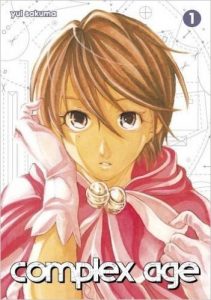
Last week was the end of one month and the beginning of another, which means it’s time for yet another manga giveaway at Experiments in Manga. There are still a couple of days left to enter for a chance to win Complex Age, Volume 1 by Yui Sakuma. As can probably be gleaned from my relatively recent review of the first volume, so far I’m really liking the series.
In other news, it sounds like Akimaro Mori’s award-winning collection of short mysteries The Black Cat Takes a Stroll will finally be released by Bento Books this year, perhaps even within the next few months. Fans of Vampire Hunter D will likely be interested in a recently launched a Kickstarter campaign to produce Vampire Hunter D: Message from Mars, a comic based on Hideyuki Kikuchi’s unpublished short story Message from Cecile. (Anime News Network posted an interview with part of the creative team which has more information.) But the Kickstarter project I’m personally most excited about at the moment is the campaign to support the fourth year of Sparkler Monthly Magazine. I’m not shy about my love of Chromatic Press and Sparkler Monthly (Chromatic Press even has its own tag here at Experiments in Manga) so I really want to see the campaign succeed.
Anime Expo began last week and there were plenty of licensing announcements to come out of the event. Dark Horse has licensed Hatsune Miku: Rin-Chan Now!, Neon Genesis Evangelion: Legend of the Piko-Piko Middle School Students, and H.P. Lovecraft’s The Hound and Other Stories by Gou Tanabe which should be great. The announcements from Kodansha Comics included an interactive Attack on Titan novel, and four manga for print release: Fire Force, Clockwork Planet, Toppu GP and the one I’m probably most interested in, Ichi F, about a nuclear power plant worker in Fukushima. Seven Seas has picked up Magical Girl Site, Species Domain, Plum Crazy! Tales of A Tiger-Striped Cat, and Dreamin’ Sun which is by Ichigo Takano, so I definitely plan on checking it out. Vertical will be translating the Nisemonogatari light novels. Viz Media will be releasing Dragon Ball Super, The Water Dragon’s Bride, and Mobile Suit Gundam Thunderbolt and will be rereleasing Yu-Gi-Oh! Arc-V, Rurouni Kenshin, and Revolutionary Girl Utena. Yen Press has added one light novel (Rokka: Braves of the Six Flowers), five manga (Rokka: Braves of the Six Flowers, The Isolator, Big Order, Smokin’ Parade, Murciélago) as well as an original graphic novel by Cassandra Jean, Reindeer Boy, which I’m especially looking forward to.
Quick Takes
 My Little Monster, Volumes 11-13 by Robico. While the middle part of the series felt like it dragged a bit, overall I would say My Little Monster was a manga that for the most part I enjoyed. I particularly liked the characters and their quirkiness. The story itself was at times tedious to read due to the fact that the narrative often backtracked after any forward progress was made in regards to the plot and so the same ground had to be covered multiple times. The seriousness of some parts of the story (like Haru’s background and family situation) didn’t always seem to mesh well as a whole with the series’ comedy. Robico tended to handle the humor better, and I like My Little Monster best when it’s being ridiculous (I can’t begin to tell you how pleased I was to see Nagoya the chicken at the wedding), but there were still some very touching moments. I also really enjoy Robico’s after-chapter four-panel manga. The series proper actually ends with the twelfth volume while the thirteenth volume collects various side stories and epilogue chapters that focus on the series’ supporting cast. Because the English-language release of series has been so well supported, Kodansha Comics also includes an extra sixty pages of comics and character profiles which were a great deal of fun.
 Persona Q: Shadow of the Labyrinth, Side: P4, Volumes 1-2 by So Tobita. I still haven’t played the original Persona Q video game, but since I’ve read the Side: P3 manga adaptation I now have a decent sense of its story. Or, at least the beginning of the story; Side: P3 was only two volumes long. I incorrectly assumed that Side: P4 would follow the same pattern, but as far as I can tell the series is still ongoing. Reading Side: P4 almost immediately after reading Side: P3 does cause a fair amount of déjà vu, and understandably so as it’s more or less the same story simply from a different perspective with the characters from the Persona 4 series taking the lead this time instead of those from the Persona 3 series. There are original scenes and content to be found in Side: P4, but the further along the series gets the more similarities are to be found. While I generally liked Side: P3, I’m actually really enjoying Side: P4. This rendition of the story is able to stand on its own fairly well so that even readers who aren’t already familiar with Persona as a whole can follow along more easily. I also find that I generally connect more with the Persona 4 cast more than I do the Persona 3 cast. And as an added bonus, Side: P4 has significantly more homoeroticism, which I do enjoy.
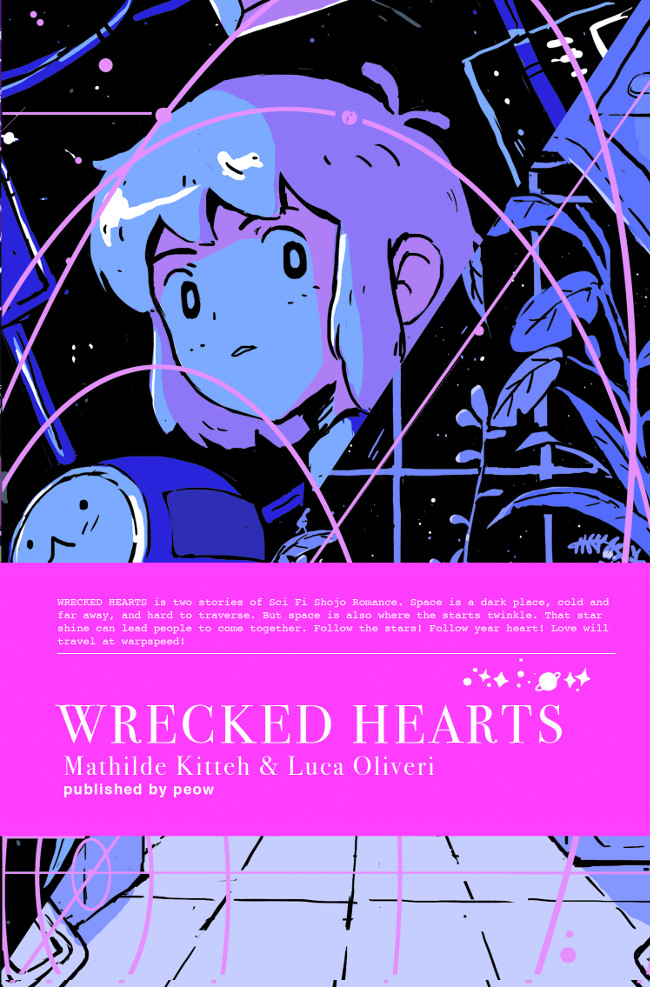 Wrecked Hearts by Mathilde Kitteh and Luca Oliveri. I came across Wrecked Hearts almost entirely by accident but I’m so glad that I did because I loved it. The volume was published by a small press in Sweden and features science fiction stories in English from two creators based in France which are heavily influenced by shoujo manga. Wrecked Hearts opens with the shorter of the two comics, Oliveri’s “The Real Thing,” about a shape-shifting alien living her life as a human girl while her father studies the human race. She develops a crush on a boy in her class and so poses as another boy during a school trip in order to try to get to know him better. The longer comic, “Dark Energy” by Kitteh, is about a celestial goddess who takes human form to experience love only to encounter heartbreak after heartbreak, ultimately deciding to travel through space alone until an android journalist comes to visit her ship. The two comics in Wrecked Hearts are not directly related by characters or plot, but the tone of the stories and some of the themes explored are similar—loneliness, love, romance, gender, sexuality, and identity are all important to the tales being told. Wrecked Hearts is also a beautifully produced book, and both Kitteh and Oliveri’s illustration styles are lovely.