• Skip to primary navigation
  • Skip to main content
  • Skip to primary sidebar
  • Home
  • About Us
    • Privacy Policy
    • Comment Policy
    • Disclosures & Disclaimers
  • Resources
    • Links, Essays & Articles
    • Fandomology!
    • CLAMP Directory
    • BlogRoll
  • Features & Columns
    • 3 Things Thursday
    • Adventures in the Key of Shoujo
    • Bit & Blips (game reviews)
    • BL BOOKRACK
    • Bookshelf Briefs
    • Bringing the Drama
    • Comic Conversion
    • Fanservice Friday
    • Going Digital
    • It Came From the Sinosphere
    • License This!
    • Magazine no Mori
    • My Week in Manga
    • OFF THE SHELF
    • Not By Manga Alone
    • PICK OF THE WEEK
    • Subtitles & Sensibility
    • Weekly Shonen Jump Recaps
  • Manga Moveable Feast
    • MMF Full Archive
    • Yun Kouga
    • CLAMP
    • Shojo Beat
    • Osamu Tezuka
    • Sailor Moon
    • Fruits Basket
    • Takehiko Inoue
    • Wild Adapter
    • One Piece
    • After School Nightmare
    • Karakuri Odette
    • Paradise Kiss
    • The Color Trilogy
    • To Terra…
    • Sexy Voice & Robo
  • Browse by Author
    • Sean Gaffney
    • Anna Neatrour
    • Michelle Smith
    • Katherine Dacey
    • MJ
    • Brigid Alverson
    • Travis Anderson
    • Phillip Anthony
    • Derek Bown
    • Jaci Dahlvang
    • Angela Eastman
    • Erica Friedman
    • Sara K.
    • Megan Purdy
    • Emily Snodgrass
    • Nancy Thistlethwaite
    • Eva Volin
    • David Welsh
  • MB Blogs
    • A Case Suitable For Treatment
    • Experiments in Manga
    • MangaBlog
    • The Manga Critic
    • Manga Report
    • Soliloquy in Blue
    • Manga Curmudgeon (archive)

Manga Bookshelf

Discussion, Resources, Roundtables, & Reviews

Archives for July 2011

Fruits Basket MMF: Sunday wrap-up

July 31, 2011 by David Welsh

We have a couple more pieces before we officially close up this installment of the Manga Moveable Feast!

At Otaku Ohana, Jason Yadao takes a retrospective look at his relationship with Fruits Basket:

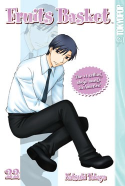
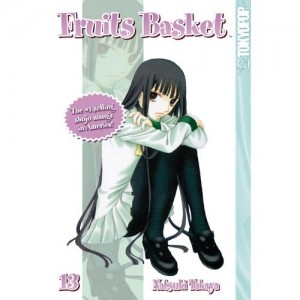
Readers loved Fruits Basket. So much so, in fact, that the hyperbole on the books’ covers gradually built over the series’ run.  Need to be reminded that Fruits Basket was “The #1 selling shojo manga in America!”? There was a blurb for that, starting from volume 5 …

And at All About Manga, Daniela Orihuela-Gruber admits that she came to Fruits Basket later than some of her peers, but she fell hard:

In short, I really could have used Fruits Basket and its complex drama about a number of well-meaning souls tormented by a restrictive and isolated society, then freed by great friendship and love. I would have loved to learn that I didn’t need to be trapped into being “friends” anyone in that school in order to have the life I wanted.

You can see a listing of all of the Feast posts here. Thanks so much to everyone who weighed in with such insightful posts. You made the week a treat!

Next up in Manga Moveable Feasts is an in-depth look at the gifted and awesome Fumi Yoshinaga, to be hosted by Kristin (Comic Attack!) Bomba an Linda (Animemiz) Yao. Kate (The Manga Critic) Dacey has the full roster of upcoming events.

 

Filed Under: DAILY CHATTER, Link Blogging

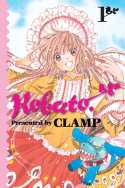
Kobato., Vols. 1-3

July 31, 2011 by Michelle Smith

By CLAMP | Published by Yen Press

The plot of Kobato. sounds like a typical shoujo magical girl story. A dim-witted and clumsy heroine, who also happens to be guileless and compassionate, is tasked with filling a magic bottle with wounded hearts so that her dearest wish can be granted. But Kobato. isn’t shoujo.

If anything, it’s seinen, as it ran for seven chapters in Sunday GX before going on hiatus and reemerging in Newtype magazine. I’m guessing that the target audience, presumed to be young men with an appreciation for moe, is the reason why Kobato commences flailing, chibified panic mode on page two and falls down approximately fifteen times per chapter. (I may be exaggerating there, but honestly not by much.) The latter gag is run into the ground so relentlessly that I refuse to consider that anyone finds it funny, so CLAMP must be trying to inspire feelings of “Aww, she’s so cute and/or hopeless.”

The first volume of Kobato. is not very good. Kobato’s incompetency grates as does the constant browbeating she receives from Ioryogi, some sort of supernatural being currently dwelling in the form of a stuffed dog, who is testing her ability to “act according to the common-sense rules of this place.” If she passes, she earns the magic bottle. These tests—mainly centered around holidays—include taking out the trash, making nabe, and spending New Year’s day playing traditional games with an elderly woman.

Things improve somewhat in the second volume. Kobato’s got her bottle now and is ready to heal some wounded hearts. After moving into the same apartment building seen in Chobits, she starts work as a helper at Yomogi Kindergarten. The head of the school, Sayako-sensei, seems to have a heart in need of some healing, as does her hard-working part-time employee, Fujimoto. With Ioryogi’s assistance, Kobato tries to discover how best to help them, and gradually learns that Sayako is working to pay off a debt her father was tricked into incurring, that Sayako’s soon-to-be-ex husband is threatening harm to the school unless she pays up, and that Fujimoto is working himself to the point of exhaustion to earn money to contribute. They seem suspicious of Kobato at first, but her genuine sincerity eventually wins over even grumpy Fujimoto.

This is definitely an improvement over the first volume, but the kindergarten-in-peril storyline still seems to be occupying a great deal of space in what looks to be only a six-volume series. (Kobato. just recently came to an end.) There is a lot of room left in Kobato’s bottle, so I wonder how she will end up filling it after spending so much time working on these two hearts in particular.

Now that I’ve finished my litany of complaints, there are some intriguing questions about Kobato. that leave me inclined to stick with the series until the end. Where is Kobato from, exactly? What is her wish? How did she and Ioryogi meet? What is Ioryogi? (We’ve learned already that if he helps Kobato grant her wish, he may be able to get his original body back.) And, most peculiarly of all, why is it that Kobato is not allowed to take off her hat?

Kindergarten peril I can do without, but I really do want to know what’s up with the hat thing.

Review copies provided by the publisher.

Filed Under: REVIEWS Tagged With: clamp, yen press

Fruits Basket MMF: Saturday links

July 30, 2011 by David Welsh

Tons of great reading today! And it’s not even over! (That’s my way of saying I’ll do one more round-up tomorrow.)

First of all, Laura (Heart of Manga) Mucciarone takes a particularly apt approach to character examination:

Along with the character analyses I’ve seen other bloggers post, I thought it would be interesting to take a look at how the characters align with their equivalent zodiac personalities. I did some research to find information on Chinese astrology and over-arching personality traits that are supposedly observable in anyone born within a particular year of the zodiac. I thought I’d post them here and let you see if you agree with them matching Takaya’s characters.

Adam (Completely Futile) Stephanides has some questions about Tohru’s idealized mother, Kyoko:

There’s one discordant element from the start, though: Tohru’s constant self-denigration. Even as she’s unselfishly helping everyone, she feels guilty for not being unselfish enough. My favorite example is the time when, after visiting Rin (who doesn’t even like her) in the hospital, she condemns herself for having forgotten for a moment about her goal of lifting the curse. If Kyoko was so wonderful, why was Tohru so bent on punishing herself?

Sometimes, it takes a village to address a book. That’s the approach the citizens of Manga Village took with their roundtable:

Connie: Too many!  Way too many!  I hate hate hate series with a huge cast of characters like this, especially characters that are introduced to fulfill a role (in this case, because there needs to be 14 Sohma family members) and then don’t figure into the story at all later.  Ritsuka is the best example in this series, but that was the worst case scenario.  Takaya does do a good job of juggling all the other characters, but the side effect is that the main story seems to drag on forever.

MJ and Michelle Smith take another bite at the apple with their latest Let’s Get Visual discussion:

MICHELLE: So, we’ve been talking about Fruits Basket all week, but I’m certainly not yet weary of the topic. How about you, MJ?

MJ: I suspect I could discuss Fruits Basket for weeks on end!

I could certainly read their discussions of the series for weeks on end. So it’s nice that MJlooks back on Michelle’s examination of Takaya’s Twinkle Stars.

Again, thanks to everyone who’s linked to or tweeted about this iteration of the Manga Moveable Feast! If you’ve got a link you’d like to share, email me at DavidPWelsh at Yahoo dot Com or post a link in the comments.


Filed Under: DAILY CHATTER, Link Blogging

Let’s Get Visual: Fruits Basket

July 30, 2011 by Michelle Smith

MICHELLE: So, we’ve been talking about Fruits Basket all week, but I’m certainly not yet weary of the topic. How about you, MJ?

MJ: I suspect I could discuss Fruits Basket for weeks on end!

MICHELLE: Me too. We’ve already discussed the general awesomeness of the story and characters this week, but one thing we haven’t talked much about yet is the art. Takaya’s style evolves a good bit over the course of the series, and while I used to think I preferred her earlier style, I’ve lately realized that that is not the case at all. Do you have a preference yourself?

MJ: Hm, well, I definitely appreciate the prettiness of the series’ early volumes, and I do think there is some detail lost later on, but one thing the series never lacks is expressiveness, and that goes for the artwork as much as anything else.

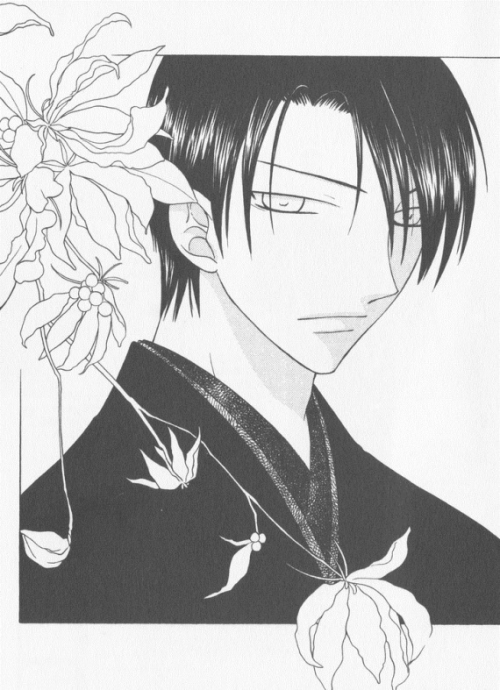
MICHELLE: I think the expressiveness actually improves later on, at least insofar as Tohru is concerned, since she loses those really, really, really big eyes of hers. I will forever mourn the changes to my beloved Hatori, though, who goes from looking like this to looking like this.

It’s not that he’s become unattractive; he’s just lost a certain bishounen quality that I had certainly appreciated.

MJ: I do think Takaya does a wonderful job of aging the characters subtly over the course of the story, and I’m not necessarily just referring to their physical ages. I think she matures them overall, letting their outsides reflect their insides.

MICHELLE: That is definitely true, especially with Kyo, Yuki, and Momiji. Probably Momiji most stunningly of all.

MJ: Yes, there is quite a bit made of Momiji’s growing up, isn’t there? And though it’s more difficult to see that transformation as “subtle,” it’s certainly striking and oddly poignant.

MICHELLE: Takaya really does well with “striking” and “poignant,” doesn’t she? Which leads us to our specific picks for this month’s column!

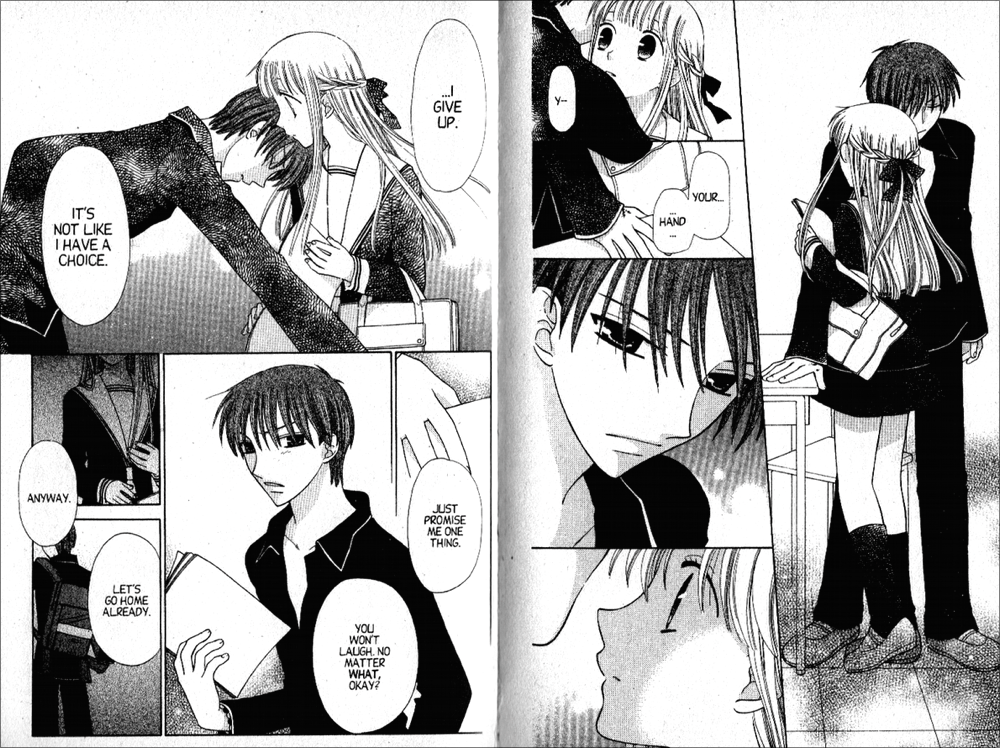
Many of the most powerful and affecting moments in Fruits Basket occur between just two characters. To exemplify this trend, MJand I have both chosen scenes starring only Kyo and Tohru.

MJ, why don’t we start with you?

Volume 15, Chapter 87, Pages 129-134 (TOKYOPOP)

MJ: Okay, well, I’ve chosen a scene from late in volume fifteen. After losing his temper in a confrontation with Yuki, Kyo returns to his classroom to find Tohru waiting for him, alone. In terms of script alone, the scene is not especially remarkable. There are some dramatic moments in Kyo’s inner monologue, but they’re both being careful not to *say* anything out of the ordinary. What makes the scene really work, though, is their body language.

At this point in the series, both Kyo and Tohru are just barely beginning to realize how they feel about each other, and Takaya plays this beautifully. The way Tohru lights up the moment she realizes Kyo is in the room, Kyo’s impulse to lean against her, their excited nervousness about being close, and especially Tohru’s last page alone—you can actually feel the tension between them in every panel. It’s so well done.

I especially like the last panel, with a flushed Tohru hurrying out of the frame. Somehow, leaving us with the empty space behind her keeps us lingering in the moment, much as she would herself, if she hadn’t been called away. There’s a sense there that the moment still looms large for her, too, even as she’s hastily left it behind, emphasized by the flowers still present in the frame. Like her absence in the frame is saying, “Really intense and possibly scary feelings happened here… run away, run away!” Does that make any sense?

MICHELLE: It absolutely makes sense! I’m always interested in how mangaka use open space, and I think you’re quite right that in that final panel it’s being used to keep us in place while Tohru dashes off. On the first page, the oddly tall panel of Tohru alone in the classroom employs empty space to emphasize how she really is the only one there.

This example reminds me of your pick for our “Duds” column, Baseball Heaven, and how the artist in that case utterly failed to establish convincing body language between two characters who were meant to be attracted to each other. Perhaps Ellie Mamahara needs to read more Fruits Basket!

MJ: Oh, good call, Michelle! Yes, that’s the perfect choice for contrast here. Everything that’s missing in that scene from Baseball Heaven is demonstrated spectacularly here, and as a result, this actually plays as a love scene much more convincingly, despite not actually being one. Even the use of small frames to emphasize the hand or face—something that just felt distracting and fragmented in Mamahara’s scene—adds to the tension here. It’s wonderfully done.

So what about you, Michelle? What scene did you choose?

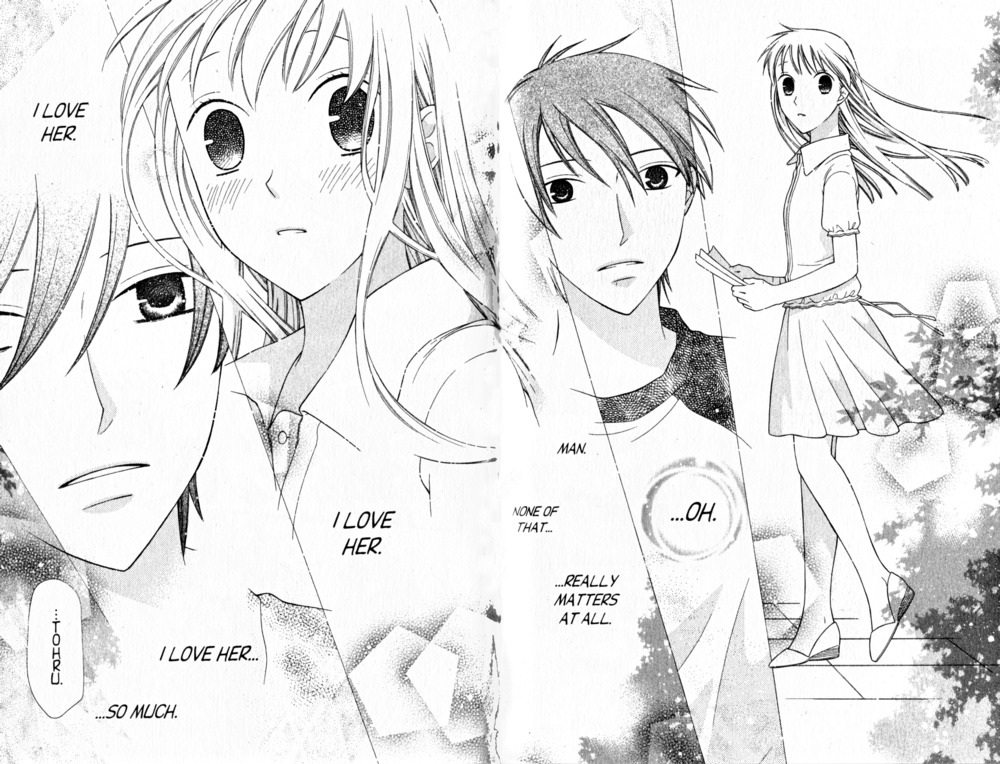
Volume 22, Chapter 128, Pages 96-99 (TOKYOPOP)

MICHELLE: The scene I’ve chosen is from volume 22, quite near the end of the series. Tohru has been hospitalized and her friends have barred Kyo from seeing her while she recovers, since she gets stressed at the mention of his name.

As Kyo makes his nervous way to the hospital, the size and shape of the panels reflect his mental state. They’re cramped, dark, and dominated by his inner monologue. “Do I really still like her? What do I like about her?” We catch incomplete glimpses of the things Kyo passes on his journey, because he is so wrapped up in his thoughts that he too is hardly noticing them. Finally he arrives at the hospital, and the tension as he catches Uotani’s eye is palpable.

And then… Tohru appears and the world falls away. Suddenly, everything is so clear. The doubts are wiped away as if they have never been, because the minute he sees her, it is so very simple. “I love her.” Even as Kyo’s focus narrows to include only Tohru, the pages still have a wide-open and airy feeling that suggests gentleness and infinite possibility. This is the first time Kyo has really allowed himself to acknowledge these feelings, and it’s so beautifully done that it gives me goosebumps.

MJ: Oh, absolutely, I have the same reaction here! Everything you’ve said about the size and tone of the panels is exactly spot-on. Also, watching Kyo’s face the few times we see it is striking, panel-to-panel. His first expression, as he’s approaching the hospital, is one of extreme trepidation, and it feels to me that he’s sort of hiding behind his bangs. He doesn’t want to be seen by anyone, especially someone like Uotani, whose gaze he reacts so intensely to. He’s terrified of his own feelings and of screwing things up, and he knows that he’s historically bad at dealing with emotional situations. He’s simply terrified on all fronts.

Then, when he sees Tohru, all of that just drops away, leaving him with an expression of pure longing and vulnerability we’ve really not seen on him before. Just as the air opens up, so does Kyo, completely unguarded for one long moment. It’s really stunning. I think both of these scenes we’ve chosen would play just the same with all the text removed—they’re so much driven by the emotion in the artwork.

MICHELLE: Longing, vulnerability and sheer wonder, I think. :)

And yes, I think we have a knack for picking scenes where text is not really necessary. Even here, body language is certainly telling a lot of the story for us, even in small ways like Kyo’s tensed, half-flexed arm and clenched fist as he finally reaches his destination. You can almost see him willing himself to get through this without messing up.

MJ: There’s just so much emotional nuance here, in every panel. When I’m reading scenes like this in context, these are details I don’t consciously notice as I let the emotions just sweep me along, but when we actually take the time to break it down like this, I can’t help but be amazed by how much thought has gone into each line on the page.

MICHELLE: Me too. It sounds like we’ve convinced ourselves that, yet again, Fruits Basket is awesome.

MJ: Indeed we have!

MICHELLE: Thank you, MJ, for joining me once again! And to those reading this column. Do you have a favorite artistic moment in Fruits Basket? Tell us about it in the comments!

Filed Under: FEATURES, Let's Get Visual Tagged With: natsuki takaya, Tokyopop

Saturday Spotlight 7/30/11

July 30, 2011 by MJ Leave a Comment

Welcome again to Saturday Spotlight, a new weekend feature dedicated to exploring the depths of the Manga Bookshelf archives.

This week’s choice is a fairly recent addition to our archives, but also especially relevant today. In the spirit of our currently-running Manga Moveable Feast, featuring Natsuki Takaya’s shoujo epic Fruits Basket it seems appropriate to shine this week’s Saturday Spotlight on Michelle’s recent review of another Takaya series, Twinkle Stars. Though Twinkle Stars has yet to be licensed in the US, it is available in English from Chuang Yi Publishing in Singapore, distributed by Madman Entertainment (Australia).

From Michelle’s review, “I thought I might be disappointed by this series. There’s no shortage of complaining Takaya fans online, after all, and it’s not like her other series Tsubasa: Those With Wings or Phantom Dream really knocked my socks off, though I did come to like the latter by the end. After having read these two volumes, however, I am left to conclude that the chief complaint of unhappy fans is that Twinkle Stars is nothing like Fruits Basket.”

Read the rest of Michelle’s review here!

Filed Under: Saturday Spotlight Tagged With: fruits basket, twinkle stars

Fruits Basket MMF: Friday links

July 29, 2011 by David Welsh

Lori (Manga Xanadu) Henderson looks at the first four volumes of Fruits Basket. Her verdict?

Fruits Basket is slow to build up, but once you get past them whole “OMG! They turn into animals!” and the “Which zodiac animal will Tohru meet this time?” parts of the story, it really start to have something to say.  The themes of being alone and finding a place to fit in and call home are ones that strike a chord with teens, which is probably one of the reasons it sold so well. This is another series that the MMF has convinced me I want to read, but since it’s OOP, that going to be kind of hard. Wouldn’t it be nice if another company could rescue it and make it available in Omnibuses (3 not 2 volumes) or better yet, digitally?

Oh, man, whoever scores the digital distribution rights to Fruits Basket won’t even need to print money.

Zoe (Manga Kaleidoscope) Alexander takes a good long look at one of her favorite series of all time:

I’m not even going to try to come across as unbiased during this review, because I’m not. I’m totally, completely 100% biased, and I make no apologies for that, because Fruits Basket is just that awesome.

Much as I enjoy a spectrum of opinion on a given work, I fully endorse this sentiment.

Again, thanks to everyone who’s linked to or tweeted about this iteration of the Manga Moveable Feast! If you’ve got a link you’d like to share, email me at DavidPWelsh at Yahoo dot Com or post a link in the comments.


Filed Under: DAILY CHATTER, Link Blogging

Fruits Basket MMF: Takaya et cetera

July 29, 2011 by David Welsh

While I like throwing a license request into the mix with every Manga Moveable Feast, it does occasionally feel like preaching to the choir. I mean, nobody needs me to remind them that, hey, it might be a good idea to publish more of Natsuki Takaya’s work because, hey, that crazy kid really seems to be on to something.

Since Fruits Basket, Takaya completed an 11-volume series called Hoshi wa Utau, which ran in Hakusensha’s Hana to Yume. It’s about a lonely orphan who finds solace in stargazing. Her life is complicated by the new boy in town. That doesn’t sound especially complicated, but brief descriptions of Takaya’s works rarely do them justice, so I think it’s safe to assume that she makes time to break readers’ hearts over and over again in the course of the story.

Takaya’s current series is also in Hana to Yume, and it’s called Liselotte to Majo no Mori. It’s about a girl who moves to a forest full of witches. She apparently does this on purpose. You can look at some sample pages here.

So that’s what’s lurking out there. I have to admit that I continue to wonder why Hakusensha doesn’t stake its own claim to the English-language market rather than relying on other licensors. I think we’re pretty much down to Viz in terms of Hakusensha publishing partners, what with CMX and Tokyopop gone.  Given how many popular-in-English series the publisher has generated over the years, you’d think they’d be interested in taking the commercial wheel.


Filed Under: LICENSE REQUESTS

Wild Adapter moves to Ichijinsha

July 29, 2011 by MJ 20 Comments

Thanks to a tip from a generous commenter, we’ve just heard the news that Kazuya Minekura’s Wild Adapter, subject of our recent Manga Moveable Feast has been given new life, thanks to a rights transfer from Tokuma Shoten to Ichijinsha.

News on this development is available in Japanese here in Minekura’s blog, and summed up by generous fans in English. According to these fans, Ichijinsha will begin re-releasing the series’ tankobon with new covers and limited edition drama CDs beginning in October, with the series eventually resuming serialization in Comic Zero Sum (home of Minekura’s Saiyuki Reload). Ichijinsha’s “teaser site” announcing the upcoming releases can be found here.

Though this series’ lengthy hiatus has generally been chalked up to Minekura’s health problems over the past few years, fans have long speculated on whether the delay might also be due to the series being (as our commenter put it) “not BL enough” for its publisher, and some of what we see here seems to support that theory.

While there is no date yet set for the series’ return to serialization, this move does provide hope for American fans as well, as the promise of new content may increase the chances of the series being re-licensed for English release.

Filed Under: NEWS, UNSHELVED Tagged With: wild adapter

Fruits Basket MMF: Thursday links

July 28, 2011 by David Welsh

MJ and Michelle Smith devote this week’s Off the Shelf column to Fruits Basket, much to my delight:

MJ: I think it is pretty early on that the wacky transformations disappear, and by the time we’re getting around to discovering things like Kyo’s true form, if they’d still been happening I think they would have seriously damaged the story. Though some of the later, softer transformations are favorite moments for me. Pretty much every time Momiji hugs Tohru, it’s the sweetest thing in the world (even when it’s very sad), and Tohru’s reaction to Hatori’s transformation will always be hilarious and charming.

MICHELLE: Momiji’s hugs are indeed both adorable and heartbreaking. He just wants to hug her so bad, he doesn’t even care what will happen as a result. I think, though, that I probably prefer older Momiji, whose method of choice for breaking hearts is his sad smile.

CRYING BUNNY! CRYING BUNNY! Must… maintain… composure…

Michelle and MJalso use 3 Things Thursday to contemplate their favorite Fruits Basket characters. I support all of their choices, but I’m increasingly suspicious that MJand I were possibly separated at birth.

Going solo, Michelle reviews the final three volumes of the series at Soliloquy in Blue.

Sean Gaffney gives Fruits Basket fan extraordinaire Ysabet MacFarlane the keys to A Case Suitable for Treatment so she can ponder the relationship between Rin and Hiro:

As a reader, what I look for in a series is great characters, and Fruits Basket has them in spades. I’m generally happy to talk about any of them, including the few I dislike, but when I’m starting a conversation it almost always starts or ends with Rin, and usually has a lot to do with her relationship with one of the other characters.

Over at Manga Therapy, Tony Yao looks at Rin from another angle:

The fact that Rin was able to go through so much physical & emotional abuse from her parents (who faked their happiness around her when she was a child) & Akito and still comes out with a lot of determination says a lot about her.

Again, thanks to everyone who’s linked to or tweeted about this iteration of the Manga Moveable Feast! If you’ve got a link you’d like to share, email me at DavidPWelsh at Yahoo dot Com or post a link in the comments.


Filed Under: DAILY CHATTER, Link Blogging

Manga the week of 8/3

July 28, 2011 by Sean Gaffney

Sorry for the list being a day late, Midtown didn’t update their Viz info right away and I wanted to ensure that I had the right titles there. (And no, still no Kodansha at Midtown.)

It’s a first week of the month, always the biggest. What have we got? Well, we’ve got the 2nd Card Captor Sakura omnibus from Dark Horse, finally staggering in after the usual eight or nine publishing delays. If it’s anything like Volume 1 was, it will be worth the wait – the series is fantastic, and DH’s reprint was flawless and worth a buy.

Presspop has an interesting release: the 1934 robot manga Tank Tankuro, a pioneering entry in almost everything. It’s an expensive hardcover with a slipcase, but with that sort of pedigree I imagine you want to pimp it a bit.

Vertical is cruising along in their release of Black Jack, with Volume 15 getting released next week. It originally ran in Weekly Shonen Champion, back when the magazine was not a haven for the lowest that manga has to offer. Of course, Black Jack is not afraid to get into some deep waters itself…

As always, the bulk of the week of Viz. We have a huge PILE of stuff. Most important to me is the 23rd volume of Gintama, which is the last currently scheduled in the States. It’s a low seller, and unlike other Viz low sellers, it’s shown no signs of ending in Japan anytime soon. So Viz is calling this the ‘Final Volume!’. Which it isn’t. Perhaps JManga might try continuing it there? Heh… In any case, Gintama, you were fantastically underrated, and I shall miss you.

There is, of course, a lot of new Jump manga that isn’t ending. Yu-Gi-Oh GX. Tegami Bachi. Slam Dunk. Nura: Rise of the Yokai Clan. Bakuman. And Bleach, getting another 3-in-1 omnibus. Speaking of those, Fullmetal Alchemist gets another one as well, despite being the redheaded stepchild of this pack, being a Shonen Gangan title.

The shoujo end of the spectrum holds even more gems. New Ai Ore!, for Mayu Shinjo fans and apparently no one else. Haruka Beyond the Stream of Time 13, for readers who have difficulty getting to sleep at night. New Kaze Hikaru, for whose who wondered if Viz was trying to quietly bury it behind the forge. And new Otomen, where I’ll bet you two to one we’ll have no idea what Ryo is thinking.

In non-sarcastic manga out this week, we have new volumes of Kamisama Kiss, Natsume’s Book of Friends (which should be catching up with Japan soon at this rate…), Sakura Hime, the Story of Saiunkoku, and the penultimate volume of Seiho Boys’ High School.

And, in non-manga news, Archie Comics releases its big 400-page Best Of Archie Comics digest. I raise an eyebrow, as I’ve seen Archie’s idea of best-ofs before, but will let you know how it is.

Busy week! What are you getting?

Filed Under: FEATURES

Fruits Basket MMF: Harry and Tom and Tohru and Akito

July 28, 2011 by David Welsh

While it’s never a bad time to consider Natsuki Takaya’s Fruits Basket (Tokyopop), the fact that this feast has fallen on the calendar shortly after the opening of the final movie in the Harry Potter series offers some other possibilities for thought. J.K. Rowling’s novels are at least partly about breaking traditional and abusive cycles, as is Fruits Basket. Rowling builds that around a rivalry between a naïve outsider (Harry) and the person who represents the worst extremes of a flawed system (Tom Riddle). Takaya does the same, positioning Tohru against Akito.

Tohru goes fairly quickly from knowing nothing about the curse to recognizing its profound destructiveness. This gives her something of an advantage over Harry, who takes roughly forever to consider the larger implications of his grudge with Voldermort. It could be argued that Tohru displays an improbable degree of altruism, and that argument isn’t automatically wrong, but most of Tohru’s qualities appear to an improbable degree – her maternal concern, her optimism, her faith in the essential goodness of others, and her belief that things and people can change for the better.

With a few exceptions, I found Tom Riddle to be a very boring antagonist. His behaviors were certainly frightening, but I very rarely recognized anything in his point of view. In this sense, Akito has the advantage as a “villain.” The leader of the Sohma family is certainly unpredictable, powerful, and frightening, but there’s a very evident level of emotional damage. Akito isn’t the progenitor of the cycle of abuse so much as just another partial victim of it.

This highlights another interesting contrast between the two properties. Harry may briefly feel stabs of sympathy for the young Tom Riddle when he learns of his circumstances, but that never translates to an attempt to save the adult Voldermort from himself or to stop him through reformation. As Rowling constructs things, that’s a ludicrous notion. It isn’t in Takaya’s narrative, and it’s entirely credible that, in spite of Akito’s cruelties, Tohru can see Akito as a victim in need of rescue.

There are other points of comparison. Like Harry, Tohru has some untrustworthy mentors. Shigure is a weird fusion of Severus Snape and Sirius Black. He manipulates Tohru for his own ends, but he cares for her as an individual, not unlike Dumbledore does with Harry. Those ends will benefit all, but Shigure has no way of knowing how Tohru will end up when his aims are met. Tohru’s allies sometimes find her as frustratingly naïve as Harry’s companions do him. And both Harry and Tohru are fixated on absent parents.

I couldn’t possibly pick a favorite of the two sagas. Fruits Basket has a more nuanced villain, but Harry Potter conducts a volume of world-building that’s almost impossible to match. Takaya really nails a lot of complex emotional truths, perhaps at the expense of chapter-by-chapter momentum. Rowling excels at building things to a crescendo, but she’ll blunt emotional nuance along the way. Basically, I’m just glad I live in a world where I can enjoy both of them, over and over.


Filed Under: DAILY CHATTER

Fruits Basket, Vols. 21-23

July 28, 2011 by Michelle Smith

As I recounted in this week’s Off the Shelf column, I have been a fan of Fruits Basket for nearly a decade now. I followed the end of the series in Japanese, and because I knew how it ended, I was able to postpone reading the final English volumes and delay the sad moment when the series really would be over. This week’s Manga Moveable Feast, however, prompted me to finally take the plunge.

Volume 21 is extremely tense, with Kyo continuing the story of how he redirected his feelings of guilt regarding the death of Tohru’s mother into a hatred of Yuki (just like his father redirected his own guilt in the death of his wife onto Kyo). Meanwhile, an ominous, knife-wielding Akito creeps up on their location. After Kyo seems to reject her feelings, Tohru runs off and crosses paths with Akito. A vitally important scene occurs between them in which Akito, weakened by lies and uncritical kindness perpetuated by various Sohma family members, is finally receptive to the kind of acceptance and sympathy Tohru offers. I’m a little disappointed that Tohru immediately falls off a cliff at this point, because that’s rather meloramatic, but I adore how urgently Akito attempts to summon help.

All of the Sohmas are worried, but none more so than Yuki (in cold fury mode) and Kyo (deeply grieving), who eventually have it out and end up finally confessing that they each aspired to be like the other. I love how this plays out, and I love that Yuki continues to nudge Kyo when necessary to ensure that Tohru ends up happy. Are they super pals by the end of the series? Not exactly, but they’ve definitely made their peace and come to an understanding. I’d say they’re closer than mere friends, actually, because they’ve gone through so much together, treasure the same person so much, and have finally realized that, despite appearances and insults, the person they are is valued by the other.

While Tohru recovers in the hospital, Kyo realizes that she’s given him something worth fighting his “fate” for. A visit to his father leads to paternal hysterics, but Kyo’s resolve is unshaken: he is going to live “outside,” no matter what. Meanwhile, Akito has made plans to demolish the isolation room. In the aforementioned Off the Shelf column, I wondered whether Akito’s actions might partly be due to some unconscious influence by the God who originally created the bond, as we later learn that he laments that something forged in love has now become a source of pain. He’s grateful to those who “shouldered that exhausted promise” for so long, and willingly lets them go. So, did he convince Akito in some way? Did Akito convince him? The latter would be more in line with the themes of the series, actually.

Uotani and Hanajima keep Kyo away from the hospital while Tohru is recuperating, since the mere mention of her name prompts her to start crying (she still believes he is disillusioned by her confession of love), but he’s finally tipped off regarding her release date and goes to see her. It’s an amazing scene: as Kyo heads there, he’s full of doubts and uncertainty regarding his own feelings, but the moment he sees her, everything is clear as day. “I love her.” I can’t help getting a bit choked up even discussing it, because it seems like I’m watching cherished friends finally find each other. They talk and work things out, and it is as lovely as can be. “I really do love you,” quoth Tohru, when Kyo warns he’ll probably cause her pain because the curse is still between them. “And that feeling is invincible.” They embrace and are profoundly shocked when Kyo does not transform. His curse is broken.

A wonderful chain-reaction montage ensues as the members of the Zodiac are freed in turn, with Yuki the last of all. “You’re the last,” says God. “Thank you. For keeping the very distant promise.” This happens just in time for Yuki, who had been on the verge of telling Machi about the curse, to embrace her in tears.

Loose ends are wrapped up in the final volume, more loose ends than I actually realized needed wrapping up, making for a very thorough and satisfying conclusion. It’s a little convenient that nearly everyone ends up romantically paired off by the end, with the exceptions of Momiji and Kagura, who are still not over their respective unrequited loves. Other things, however, aren’t wrapped up so neatly, with Rin unable to forgive Akito just yet, long-time family servants unable to adjust to the dissolution of the curse, and many painful feelings still remaining.

But, as a certain image reminded me, Takaya-sensei maintains the idea that “there is no such thing as a memory that’s okay to forget” to the end. The formerly cursed Sohma don’t need to forget what happened to them in the past in order to be happy in the future. Tohru believes this fully, collecting each of the beads from Kyo’s broken bracelet and displaying them as precious items alongside family portraits even until the day she and Kyo are lovey-dovey grandparents.

I cannot express enough how wonderful this series is. I feel so fortunate that I was able to witness the growth and transformation of such a memorable cast of characters, many of whom I dearly love.

Filed Under: REVIEWS Tagged With: natsuki takaya, Tokyopop

3 Things Thursday: Fruits Basket Favorites

July 28, 2011 by MJ 44 Comments

It’s Manga Moveable Feast time once again, which so often inspires me to think about 3 things. This week, I have with me a special guest for 3 Things Thursday, Soliloquy in Blue‘s Michelle Smith, who, like me, is a big fan of this month’s MMF topic, Natsuki Takaya’s shoujo epic Fruits Basket.

We’ve already talked at length about the series as a whole, but one thing we’d like to linger on just a little bit longer is some discussion of our very favorite characters in the series. Fruits Basket is a treasure trove of complex, deeply moving characters, each of which could easily inspire hours of discussion. We don’t have hours, but we do have some favorites, and this seemed like the ideal time to share them. We’ve each picked three, so let’s start with Michelle’s! (Click images to enlarge.)

Michelle’s 3 Favorite Fruits Basket Characters

1. Yuki Sohma – My love for Yuki springs largely from a sense of pride in how much he blossoms over the course of the series. As he recounts the story of his childhood to Manabe, Yuki says, “There was something I wanted… loving parents… a home that no one would ever want to leave. A happy home. A warm place… with everyone smiling at me.” But Yuki was denied this. His parents valued him not for himself, but as a tool to gain favor within the Sohma family. Family members revered and reviled him just because of his status as the rat, something he had no control over. Even when he left the main house to live with Shigure and attend high school, the other students saw him not for himself, but as a princely figure.

Only Tohru saw and accepted the real Yuki. And once he found that with her, once he had that warm and happy home, he was finally able to move beyond the past and begin figuring out what kind of person he wanted to be in the future. One of my favorite Yuki moments occurs directly on the heels of his conversation with Manabe, where Yuki articulates his desire to give support to someone in the future, not just receive it.

2. Ayame Sohma – As a teenager, Ayame was self-absorbed and didn’t realize, until Hatori pointed it out to him, that the things he said and did could actually hurt other people. One of those he hurt was Yuki, who had reached out to him as someone he might be able to tell about his unhappy life as Akito’s companion. Ayame failed him then, but now regrets that deeply and tries his best to form a relationship with the little brother whom he once ignored. Sure, he’s kooky and outlandish, but he’s also absolutely sincere in his love for Yuki, and little by little wins his confidence.

My favorite Ayame moment occurs in volume thirteen, when he interrupts the parent-teacher conference Yuki and his mother are attending, deflects all of their mother’s hostility onto himself, and helps Yuki find the courage to tell her that he will be the one deciding his own fate. I also love that Ayame immediately texts Hatori to let him know Yuki said he is reliable.

3. Hatori Sohma – Hatori, the quietly suffering woobie. How I love him. There are no shortage of sad characters with painful backgrounds in Fruits Basket, but the first such story we learn about in detail involves Hatori and Kana, a special, optimistic woman who loved Hatori and accepted him, curse and all. What she couldn’t accept was the guilt after Akito reacted violently to their relationship and severely wounded Hatori, putting him in the dreadful position of eventually wiping all of her memories of their time together in order to ease her suffering. Because this revelation occurs so early in the series, everything Hatori does from that point on is tinged with sadness as we know what he’s gone through. He’s also the only one who can reign in Ayame’s enthusiasm or dare to talk with Shigure about his schemes.

So, while I wouldn’t exactly call this my favorite Hatori memory, it’s certainly an indelible one.

MJ’s 3 Favorite Fruits Basket Characters

1. & 2. Arisa Uotani & Saki Hanajima – Like David, I’m a sucker for great female friendships, and no friends could be greater than Fruits Basket‘s Uotani and Hanajima. Though they are each fantastic characters in their own right, nothing beats them as a team, looking after (and being looked after by) their dearest treasure in the world, Tohru Honda. They’re happiest as a trio, of course, but fiercest as a deadly duo that doesn’t take crap from anyone. Not that Takaya limits them to a life of badassery, mind you. They’re also just as kind, broken, and unexpectedly vulnerable as anyone else in the series, and that’s saying quite a bit. I would happily read an entire series chronicling the lives of Uotani and Hanajima, their adventures, loves, and triumphs as young adults and beyond. They’re just that awesome.

Still, I admit I love them best when they’re kicking ass. Don’t you?

3. Momiji Sohma – And should one require more evidence that David and I share a brain, my third favorite character in the series—and my very favorite Sohma—is little rabbit Momiji. We meet Momiji as a hoppity, cheerful boy, but it isn’t long before we learn that he’s one tough kid. Having watched his own mother beg to have her memories of him erased, he lives as a stranger from her, keeping a brotherly eye on his little sister from afar, whom he hopes he might one day be allowed to spend time with. He’s also the first person to put himself between Akito and Tohru—a favor Tohru returns in kind.

Though Momiji is at his best when he’s happy (and awesomely brave when he’s being rebellious), one of my very favorite Momiji moments is this scene from volume eleven. After standing up to Akito, against the grain of their supernatural bond, and watching Tohru, in turn, stand up for him, he finds himself suddenly overcome by being just a kid, unable to hold back his tears. It’s a rare glimpse at the most vulnerable side of Momiji, and I dare you not to tear up when reading it in context.


Readers, which three characters from Fruits Basket do you love best? Let us know in comments!

Filed Under: 3 Things Thursday Tagged With: fruits basket, Manga Moveable Feast, MMF

MMF Guest Post: Fruits Basket – Hiro and Rin

July 28, 2011 by Sean Gaffney

Sean here, readers. Another MMF brings us another guest post! Ysabet MacFarlane is not only a good friend but also a huge Fruits Basket fan, and I knew she would not want to be left out of this month’s discussion. She was even able to adapt the two Fruits Basket fanbooks for Tokyopop! Here she is, discussing the relationship between two of the more prickly members of the Zodiac.

Hi, Sean’s readers! Despite my good intentions in previous months, this is my first-ever MMF post. Sean has had several years to notice that Fruits Basket is quite possibly my favorite thing in the world to discuss, and he kindly invited me to come hang out in his space and chat about it.

Disclaimer: Let’s play it safe and assume that this post contains for spoilers for all 23 volumes of the manga.

As a reader, what I look for in a series is great characters, and Fruits Basket has them in spades. I’m generally happy to talk about any of them, including the few I dislike, but when I’m starting a conversation it almost always starts or ends with Rin, and usually has a lot to do with her relationship with one of the other characters.

Sean already blogged about Hiro this week, but I’m here today to talk specifically about Hiro’s relationship with Rin. Like a lot of people, I discovered Fruits Basket through the anime, and when I switched to the manga I found that my feelings about a few characters changed. The main (although not the only) reason for that the manga offers a lot more development for most of them, often even in the chapters that made it into the anime adaptation. Sometimes it still took me a while to adjust, but Hiro found a shortcut: I fell for Rin pretty much on sight; Hiro was intensely worried about her; and poof!, he entered my good graces. And from my new softened-up position, it was much easier to see the many ways in which he’s a great kid who’s well on the way to growing into a truly awesome adult.

Even though Hiro and Rin’s personalities are very (very!) different, they’ve got some surface similarities: they’re both prickly as all hell, they’re each driven up the wall by some of the same things, and they’re both in the habit of calculated verbal attacks–albeit for entirely different reasons. Hiro’s smart-mouthed tendencies have to do with being young and smart and excruciatingly aware of his own limitations, while Rin’s have more to do with being constantly on both the offensive and defensive and having no energy or inclination to be pleasant about it. (Consider this: she’s a terrible liar, and she spends her first ten volumes living and breathing a lie. That alone would wear on a girl.)

What Takaya shows us with these two is almost an incomplete relationship. Time after time, we see Hiro worrying about Rin and actively checking up on her, and she in turn usually ignores him or tries to drive him off, as she does with pretty much everybody. But there are plenty of things we’re not shown. We don’t have any idea how close they might have been, if they were at all, before Hiro saw Akito attack Rin. (The closest thing we have to a clue is that we see Hiro’s mom wishing Rin were around so she could meet Hinata, which at least suggests that Hiro’s not the only member of his family who’s fond of her.) We also don’t know how seeing Rin attacked might have affected Hiro differently if he weren’t already tormented by knowing that Akito hurt Kisa because of him, and if he weren’t keeping that knowledge secret from Kisa.

Hiro is fundamentally a good kid, as I said, so I’m not at all suggesting that he wouldn’t have cared (or been traumatized) by seeing what happened to Rin, no matter what his circumstances were. But as it is, he already felt powerless and as if he wasn’t there for Kisa when she needed him, and dammit, he’s going to be there for Rin, even if that means she bites his head off just about every time he comes near her.

I think “be there” is really the critical thing here: Hiro knows he can’t actually help her, but only he can fill this particular role for her. Tohru is more than willing to befriend and support her, but Rin never actually confides in her about a lot of things (a trend that continues through the entire series, even after they’re obviously real friends), and Shigure knows what happened to her but can’t exactly be said to be on her side.

And then there’s Hiro, who doesn’t just know what he saw; he knows why she got hurt, and he knows what she’s trying to do–break the curse–and what she’s doing to herself in the process, which is literally sacrificing her life to try to save Haru while pretending she couldn’t care less about him. How much of this Hiro knows because of what Akito told him isn’t clear–he says in volume 18 that Akito and Rin both swore him to secrecy about Rin’s “accident”–but the only way he can know some of it is that somewhere along the line, Rin told him. He probably still doesn’t know everything (her red-herring conversation with Shigure in volumes 9 and 14 comes to mind as a likely omission even if she confided in him again later, but that incident would be a whole ‘nother post), but somewhere off-screen, she trusted him with the truth about what she’s trying to do and then trusted him to keep it secret. Given Rin’s rampant trust issues, that speaks highly of how she feels about him.

What this adds up to, IMO, is an unbalanced but important relationship. Hiro is a child and fully aware of how that limits him–as Tohru says, living with that awareness takes real courage–and he’s Rin’s witness. With the exception of his slip-up in volume 15, when he unthinkingly starts to criticize Haru for how his behavior may have made Rin feel (and oh, that’s such a great scene–poor Hiro! But his internal monologue is so revealing), he keeps her secrets as long as he can.

When Hiro finally does break and tell Haru the truth in volume 18, it seems to be due to a combination of factors. Haru opens the door by referring back to Hiro’s brief outburst in volume 15, and Hiro, who’s been guilt-ridden about Kisa (and he seems to be on the verge of talking to her about it before they bump into Haru and it all comes out), who’s seeing everything in a new light after the birth of his little sister, and who’s so very aware of his own inability to do anything to help Rin, betrays her trust and defies Akito because he believes Haru can help her.

I think it’s also very telling of Rin’s character and Hiro’s understanding of her that what he says isn’t “help her”. It’s “tell her she can stop now”.

“Tell her she can stop now.”

Because Hiro may not know where she is or how bad things have gotten, but he’s been watching her long enough to know that what she needs is to be stopped before she completely destroys herself. Of course, at this point she has stopped, but only because Akito has blackmailed her with a “choice” that leaves her entirely powerless, and the effects of that particular abuse and of losing her momentum stay with her for the rest of the series.

We never see Rin and Hiro together again after this point, so how much Hiro ever finds out about what actually happened to her remains a mystery. We don’t know for sure that Rin tells anyone about it herself; she’s not even in the room when Haru discusses the situation with Yuki and Kazuma, and Shigure knew about it before (probably long before) he comes to talk to her in chapter 107.

I don’t want to wrap this up by extrapolating, but as the series closes Rin is moving in the direction of very, very slowly being less guarded, and Hiro seems to be placing more value on his relationships all the time, with the weight of secrecy lifted and a baby sister in his life. If there’s one thing Fruits Basket is clear about at the end, it’s that everyone is moving forward at their own pace, and that there’s more holding this group of characters together than the supernatural bond that’s been broken.

Filed Under: UNSHELVED

Off the Shelf: Fruits Basket

July 27, 2011 by MJ and Michelle Smith 16 Comments


MJ: It’s time once again for the Manga Moveable Feast, this month featuring Natsuki Takaya’s Fruits Basket, which just happens to be a favorite series for both of us! Though one of the Feast’s greatest draws for me is the opportunity to try things I otherwise might not, I have to admit that sometimes it’s nice to simply have an excuse to wallow in things I already love. I suspect you feel the same, Michelle, yes?

MICHELLE: Oh, definitely. Particularly when it’s something like Fruits Basket, where there’s just so much going on. It really provides ample opportunity for wallowing, and even for sounding scholarly while one does it!

MJ: Well, I don’t know what my chances are of sounding scholarly, but I’m sure I’ll be able to natter on and on. Where shall we start?

MICHELLE: How about with some background regarding our own introductions to the series? Mine’s a bit of a long story, so you can go first if you like!

MJ: Well, as you know I got into manga much later than most, so by the time I’d even learned what it was, Fruits Basket was already a phenomenon in the US. My online friends who read manga raved about it. There was even a girl in my office, who, when she found out I was into manga, rushed to tell me about her own love for Fruits Basket. Like most long-time nerds, I was instinctively suspicious of anything popular with the masses, and I was still battling my own issues with “girly” things at the time (yes, I rant because I understand), so I assumed Fruits Basket was not for me.

Then, in October of 2008, I went to the New York Anime Festival for the first time. I’m incredibly shy in person—a condition that seems to have worsened over the past ten years or so—and though I’d met a few manga bloggers previously online, I was much too terrified to approach anyone. Thankfully, a couple of them introduced themselves to me, one being the lovely Ysabet Reinhardt MacFarlane, who as you probably know is a major fan of Fruits Basket. So on the final day of the convention, overtaken by some kind of gratitude-induce madness, I found a copy of the first volume of the series and bought it.

When I got home, I hardly knew what to do. How could I have purchased something like that? What insanity had possessed me? In mortification and despair, I sat down to read it, and shockingly discovered that it was good. I had one major issue with it (we’ll get to that later), but really, I was so intrigued by the story’s odd set of characters, that I simply couldn’t wait to read more. Fortunately, my dear friend Deanna (who also introduced me to Wild Adapter, if you recall) felt my distress and sent me her entire collection of the series in the mail. I think I consumed the whole thing in the course of a day or two—what was published in English, anyway. Then I joined other US fans in the agonizing wait for the series’ last few volumes.

MICHELLE: I think I knew most of that, but not Ysabet’s involvement!

I was introduced to shoujo manga and anime in late 2001 and attended my first convention, Shoujocon, in July of 2002. The big hit in the anime-viewing rooms that year was Gravitation, and I too fell under the sway of its charms. So much so that when I got home, I sought out a fansub videotape of its OVA, which had not been shown at the convention.

The Gravitation OVA is only two episodes long and, completely unbeknownst to me, the kindly fansubber had decided to fill the extra space on the tape with the first two episodes of Fruits Basket. I had seen merchandise for the show at Shoujocon, but knew nothing about it, so it came as a wonderful surprise when I immediately fell in love. My timing was good, because the first DVD of the Fruits Basket anime came out in October 2002. I vividly remember watching it with my friend in her apartment, replaying the most amusing Shigure bits. (He’s a lot less complicated in the anime.) Around the same time, I bought a bunch of the manga in Japanese and, with the help of text translations, started making my way through it.

The fourth and final volume of the anime was released on DVD in May of 2003, and during that year I also read volumes two through ten of the manga in Japanese. Finally, in February 2004, the first TOKYOPOP edition came out in English. Throughout 2004 and 2005 I read the English editions while continuing to keep up with the Japanese, but eventually, when we were only four or five volumes behind, I stopped importing and just started following new developments via summaries posted on a mailing list. I didn’t actually read the final volumes until this week, since knowing how it ended allowed me to postpone the moment when it would really be over.

So, to sum up this incredibly lengthy saga… I’ve been a Fruits Basket fan for almost a decade!

MJ: So, I think most manga fans are probably familiar with at least the general premise of Fruits Basket, but I think it’s worth establishing just in case. Recently orphaned (and exceedingly cheerful) high school sophomore Tohru Honda, through a series of wacky circumstances, comes to live with three pretty young men, one of whom is the typical “prince” at her school. As it turns out, the three are part of a family possessed by spirits of the Chinese zodiac, which causes affected family members to transform into animals when physically stressed or when hugged by a member of the opposite sex.

On the surface, this sounds like the most simplistic romantic comedy—at best a series of madcap scenes featuring lots of running around, accidental hugging, and cute animal transformations, at worst yet another tale of an intellectually vacant shoujo heroine who is inexplicably pursued by a series of dreamy bishounen. And though it might be possible to maintain these expectations a volume or two in, it soon becomes clear that both Fruits Basket and its characters are something else entirely.

MICHELLE: I think the first inklings that we are in for something far darker start in volume two, when Tohru visits the main house to talk to Hatori. He cautions her to leave Shigure’s house and not involve herself with the Sohma family any further. “I’m sure Shigure didn’t make clear the gravity of our condition,” he says. “The Sohma family continues to be possessed by vengeful spirits. It’s not the fun and games you might think. It’s bizarre… sinister… cursed. Before you regret getting involved with the Sohma… get out.”

That’s a pretty chilling development for what had seemed to be a simple romantic comedy! It only gets darker from here—though elements of humor definitely remain—as Tohru learns more about the curse and how it has affected those afflicted. By the end, we see that even Akito, long set up as the villain of the series, is not immune to damage resulting from frantically trying to maintain a tight grip on the family members sharing the so-called “bond.”

MJ: The hints are there even earlier on, I think. In the first volume, when Tohru witnesses Kyo’s transformation for the first time, she’s told that the head of the family may order to have her memory erased, as he did years ago with some children who accidentally discovered Yuki’s secret. It’s discussed almost casually, but that’s actually what makes it feel so sinister. Though we still know so little, we’re suddenly aware that we’re not in some kind of whimsical fantasy where it’s natural that people might transform into animals. What’s going on with the Sohmas is serious enough, and has been going on long enough, that they’d think very little of erasing children’s memories to protect it. Personally, I found that a bit chilling, though it isn’t given great weight until later on.

MICHELLE: I sometimes forget, especially as the series progresses, that Hatori actually has the ability to erase memories. And yet that ability plays such a huge factor in his own personal tragedy—recounted in volume two—as well as Yuki’s childhood anguish. As the series goes on, he’s usually called forward to tend to physical injuries caused by Akito’s paranoid rage, but not to protect the family secret in that way.

Speaking of protecting the family secret, we eventually learn that Tohru was allowed to remain at Shigure’s house because Akito was desperate to prove that the bond between “God” and the cursed members of the Zodiac was real and strong, and not something that could be put into jeopardy by the presence of one girl. It’s an interesting perspective that shows all of Akito’s cryptic pronouncements about the tight family bond in a new light—no, this doesn’t make Akito any less unstable or dangerous, but now we know it wasn’t so much calculated menace as sheer terror of being left behind.

MJ: I think you’re right, and I feel like the series gets pretty much to the heart of things in terms of Akito’s motivations being out of fear just as much as anyone else’s. I think what makes the curse so insidious is the fact that it’s been passed down for generations, so nobody involved now is really making the rules. Akito’s ruling by and out of desperate fear because that’s what “God” is taught to do. The bond has been perpetuated so long and twisted so hard, generation after generation, it can’t possibly be okay for anyone. The zodiac animals get the bulk of our sympathy because Akito is the one who is in the position to inflict the most pain, but Akito’s running on a particular brand of terror and pain that belongs only to the one who must be “God.”

Don’t get me wrong, I don’t have tons of sympathy for Akito. Regardless of what we’re handed, we still all make our own choices. But I think in Akito’s position, many of us would be too weak to be any better, and I’m not willing to claim with certainty that it could never have been me.

MICHELLE: That’s a great description of why the curse situation is so awful for everyone. Perhaps those most responsible for the misery of our characters are those who continue to place them on a pedestal because of their supposedly exalted status. We know the zodiac can’t help but feel drawn to Akito—there’s that memorable scene where Shigure and the others cluster around a pregnant Ren—but I wonder if they have the same effect on the rest of the family. Maybe the servants and extended family couldn’t help but revere them, but how much healthier it would’ve been for everyone involved if they were simply treated as ordinary people.

MJ: Ah, but there’s the thing, right? They can’t really be treated like ordinary people because they live in a world where ordinary people don’t transform into animals. This isn’t in the story at all, but when I’m thinking about how this all started, generations and generations ago, I’m imagining that the original Sohma members of the zodiac might have had to cultivate fear and awe in the other Sohmas in order to save themselves from persecution, even within the family.

Obviously in the universe of Fruits Basket, we’re meant to believe that the curse is a real thing and accept that as a supernatural force, but when you think about it, mankind has always dealt with the unknown by creating myth around it–usually myth based on fear and awe. So if we look at the Sohma’s curse in that light, it seems likely that those originally carrying the curse (and the people who loved them) might have done the same thing to protect themselves. Just a glimpse into Momiji’s life or Kyo’s gives us an idea of the way some members of the family react even with that protection in place.

MICHELLE: I see your point. I suppose I tend to personally downplay that aspect of the curse just because it seems that everything else that comes along with it is so much worse, but on a most fundamental level, it’s the transformation that truly cripples their ability to form relationships with outsiders and sometimes even their own families. (As a side note, I’d be interested to know where in the story (as in which volume) the characters stop transforming as a result of wacky hijinks. I’m thinking it’s pretty early on, actually.)

Momiji and Kyo are both rejected by their families because they are cursed, and that’s not something they’re ever going to be able to forget. Momiji at least seems to harbor no ill will towards his family, soldiering on to find his own happiness somewhere apart from them, but that doesn’t make it any less terrible. I’m grateful that Takaya gave us Hiro’s loving family as at least one example where one of the zodiac has been raised in an environment of warmth and love.

MJ: I think it is pretty early on that the wacky transformations disappear, and by the time we’re getting around to discovering things like Kyo’s true form, if they’d still been happening I think they would have seriously damaged the story. Though some of the later, softer transformations are favorite moments for me. Pretty much every time Momiji hugs Tohru, it’s the sweetest thing in the world (even when it’s very sad), and Tohru’s reaction to Hatori’s transformation will always be hilarious and charming.

MICHELLE: Momiji’s hugs are indeed both adorable and heartbreaking. He just wants to hug her so bad, he doesn’t even care what will happen as a result. I think, though, that I probably prefer older Momiji, whose method of choice for breaking hearts is his sad smile.

(I begin to think we could write a whole column about Momiji.)

MJ: I know I could!

(click images to enlarge)

So, I mentioned early on that there was one major issue I had with Fruits Basket when I first began reading the series, and that issue does persist throughout. While it’s always easy to talk about what we love in a column like this, it can be harder to bring up the things that we don’t. Do you have any caveats you would attach to this series?

MICHELLE: When you’ve loved something for as long as I have loved Fruits Basket, I think one starts to just accept all the less-awesome parts. So, no, there aren’t major issues or caveats I would attach to the series, though I have a feeling you’re going to point something out that’ll make me go, “Oh, yeah. That.”

There are definitely some minor things about the story that I think could’ve been handled better, though. As much as I am happy that Yuki found someone in Machi, for example, I can’t deny that she isn’t very developed as a character and reads much like (in David Welsh’s words) a “consolation prize.”

MJ: I was surprised at that, actually, when David first said it, because I’m incredibly fond of Machi, but when I thought about it, I realized that what really endeared me to her so emphatically was the fact that she bought Yuki a bag of fertilizer. It’s such a small thing, but with that one action, I completely fell for her as a character. In retrospect, I realize that may not actually constitute effective character development, but for some reason it spoke volumes to me when I first read the series.

MICHELLE: It at least shows that she knows how much Yuki’s hobby is important to him, and that he’s on her mind enough that when she happened to spot it in a store window, she thought of him.

MJ: I just thought, y’know, who would do that? Who buys someone a bag of fertilizer as a present? Then I realized the answer was, “Someone right for Yuki.”

MICHELLE: So, what is this major issue?

MJ: Ah, yes, my Issue. I had one major issue when I read the first volume of the manga, and that was Tohru’s utterly sincere declaration that marriage is every girl’s greatest dream. At the time, I hoped very much that one of the points Takaya intended to make with the story was to prove Tohru wrong on this, but alas, the entire series, and particularly the last few volumes, is dedicated to making sure this dream comes true for as many of her characters as possible.

Now, obviously this isn’t the most urgent statement the series is making, and I do think Takaya has a lot to say about human connection, the importance of acceptance, and a whole lot of other really worthwhile topics along those lines. But on this particular issue, she and I strongly disagree. In fact, I think the one other real issue I have with Fruits Basket is inextricably tied to this one. I’m bothered by the way Takaya so carefully heteronormatizes (can that be a word?) everyone at the last minute, as though any issues regarding gender and/or sexuality are just part of the dysfunction of the curse and can be cast off as easily as soiled robes the moment it is broken. It’s obvious, though, that this is done specifically to make sure that everyone can be paired off tidily to conform to the series’ matrimonial ideals.

As thoughtfully as Takaya explores so many aspects of identity and human relationships, and as much as I love this series, this is one area in which I really feel she fails me as a reader.

MICHELLE: I completely forgot that Tohru had made any such declaration. So while I obviously couldn’t help but notice “Gee, everyone is pairing off here at the end,” I didn’t tie it into reinforcement of matrimonial ideas so much as a shoujo-style idea of what a happy ending entails. Marmalade Boy does something similar, for example.

However, I admit that I did have a moment’s pause when Tohru agrees to go away with Kyo after graduation, saying, “I want to always be by your side,” which is essentially the same sort of thing I recently complained about in my review of Backstage Prince. The difference being, of course, that Tohru has expressed a desire to find a job and will likely (hopefully) do something with her life other than sit around and be a wife.

So, while I certainly can’t disagree that everyone ending up perfectly straight after exhibiting not-exactly-heterosexual behavior is kind of disappointing, I’d stop short of ascribing it all to “yay marriage.” Maybe it’s just “yay shoujo romance.”

MJ: Tohru’s declaration in the first volume struck me so hard, it was almost the only thing specific I had to say about the volume at the time, so it’s really impossible for me not to follow that thread to the end, but I can understand your interpretation. I would say, though, that reading the last volume, I did not get the impression that Tohru was intent on pursuing a job, and since the only information we’re given about her future is that she’s a very contented grandmother, I don’t think this was a priority for Takaya in terms of her storyline.

Tohru’s earlier talk about getting a job is focused entirely on her lack of other means with which to support herself, something which her friends are hoping she won’t have to do, as they eye up Yuki and Kyo as potential marriage prospects for her. So I would be surprised if that was really part of her future in the author’s eyes.

Moving on, though, let’s get back to the more pleasant pastime of discussing what we love! Michelle, do you have a favorite theme in Fruits Basket?

MICHELLE: I haven’t actually read that first volume since 2004, which was before I started reviewing, so my initial reaction to that line (which probably involved scoffing) is lost to the mists of time.

As for themes… Sometimes I feel like a broken record, but I do so love stories where someone finds where they belong. Essentially, that’s the entire theme of Fruits Basket, since the game from which the series derives its name involves children being selected based on the fruit name they’ve been assigned. In the beginning, this theme manifests as Tohru finding her place with the Sohma family, but later on, it starts to change, as the main characters start to embrace the freedom to choose their own paths for themselves. When they all finally start looking toward the future—planning their lives with genuine enthusiasm—it’s so simply triumphant for all of them that I find it really affecting.

MJ: That is one of the series’ nicest themes, though I think as someone who is still searching for this on some level (and maybe always will be), I suppose my personal reaction to it is somewhat angsty. I think my favorite theme is related, though, so overall we’re on the same page!

I am particularly fond of Takaya’s emphasis on self-acceptance and self-awareness in the series. Nearly every character in Fruits Basket is fixated on his or her own flaws (or perceived flaws), often to the point of finding someone else to blame for them. Kyo and Yuki of course are the poster boys for this, each blaming the other for being everything he thinks he should be or wants to be. And since the zodiac “bond” is primarily maintained through repeated application of shame, this is an issue that touches everyone. Even Tohru is not immune, as she obsesses over whether she’s being unfaithful to her mother’s memory.

I have a lot of reasons for connecting with this particular theme, but most of all, I think it’s one that Takaya handles particularly well, resorting to trite platitudes as little as possible.

And speaking of trite platitudes (or the lack thereof) I’d also like to mention how beautifully I think Takaya writes Tohru. It would be so easy for a character like that to fall into the worst kind of Pollyanna stereotype, and Takaya never lets this happen. She writes Tohru as a real character, and as a result, her healing influence on the Sohma family feels really genuine.

I once said in a review, “Few of us can claim to see the world through eyes as open, joyful, and compassionate as Tohru Honda’s, but the great appeal of Fruits Basket is in that it manages to make us believe we can, at least for an hour or so.” That’s really how I feel about Tohru, the way Takaya has written her.

MICHELLE: It definitely takes skill to write a character like Tohru and make her not only likeable, but realistic. Too often, characters are mad for a heroine who possesses no redeeming qualities to engender that devotion, but that’s absolutely not true here. We see, time and time again, exactly how much these characters need someone like Tohru in their lives, and even if they are resistent to her particular brand of optimism (like Rin, for example) they still value that a person like her is able to exist and are slowly healed by her proximity.

And yet, Tohru has demons of her own. It occurs to me that she has taught the Sohmas how to see beyond their pain and carry on with life, but it’s this very thing that she herself keeps doing when it would be better to stop and be selfish for a moment! So, they teach her something in return. By the end of the series, she’s prepared to accept that Kyo doesn’t love her, and has built herself up to smile when she next sees him again, but she’s finally confronted with something too meaningful to her to just give up on like that.

MJ: I think one of my favorite scenes near the end is that very moment you describe, when Tohru is released from the hospital and runs away from Kyo, because she realizes she can’t follow through with her resolve to smile when she sees him. Though I think perhaps I love even more her earlier declaration that if her mother did, indeed, tell Kyo she wouldn’t forgive him, she’d have to go against her. It’s the first time in the whole series that she really makes a choice for herself that isn’t motivated by the desire to please her mother, and that makes me very happy.

Of course, it’s just a bonus that we know this decision would have pleased her mother more than anything else in the world. But it’s meaningful that Tohru does not know that, and makes the decision anyway.

MICHELLE: I plan to talk about that very scene in further detail in this Saturday’s Let’s Get Visual column!

But yes, the decision to go against her mother is definitely a big moment, but I also appreciate her conviction later that Kyoko couldn’t have really meant that she wouldn’t forgive Kyo for letting her die. She believes it so, so strongly, so absolutely that I hope it convinces Kyo that she is right (as we indeed later see is the case).

Speaking of things that viewers are allowed to know but the characters don’t, I really appreciate that Takaya gives us a chapter (131) almost entirely devoted to the origins of the curse. It was supposed to be something created with bonds of love, but over time, people changed and the feeling of love was replaced by pain. The God who originally created it regrets all of that, but is also grateful to those who shouldered that exhausted promise for so long.

This nicely illustrates the fact that it’s impossible to make someone love you, and if you have to make them stay with you rather than allowing them personal choice, how is that worth anything at all? I wonder whether Akito’s change of heart was in any way fueled by a vague consciousness of the original God’s feelings.

MJ: That’s an interesting question, Michelle. I think I’d have to reread a few volumes again to see if I could come up with an answer.

And going back to Tohru’s best moments, I realized as I was thinking about this, that the moment I realized I really loved Tohru was when she physically pushes Akito away from Yuki in the school hallway, when she can see that Yuki’s in pain. Tohru’s a great character, and extremely likable from the start, but I think that’s when I became aware that I genuinely loved her. It’s a completely spontaneous reaction—hardly more than a reflex—that, on the surface, seems completely opposed to her natural gentleness, but that’s what makes it so great. It’s really the first time in the story we see the strength of her will demonstrated in this way, and it is awesome.

(click on images to enlarge)

Tohru’s action here reminds me somewhat of Orihime Inoue’s power to heal people by (essentially) mentally rejecting their injuries. She’s utterly rejecting Akito’s presence in Yuki’s world at that moment, because she just can’t accept that Yuki should feel that pain.

MICHELLE: Thinking about that scene gives me goosebumps, actually. Tohru really is possessed of extraordinary selfless determination, especially in her efforts to find a way to break the curse and free those whom she has come to love. No wonder Yuki sees her like a mother!

MJ: Speaking of that, I can’t help but be influenced by some of the entries we’ve seen for the MMF so far, especially David’s, and it’s been really interesting reading comments to his posts. One of the topics that’s come up a couple of times is the original love triangle between Tohru, Yuki, and Kyo. Obviously there’s a shift in the middle of the series, when Yuki becomes aware that it’s Kyo who Tohru is actually attracted to in a boyfriend kind of way, and of course right around that time, he’s got Akito telling him that he’s using Tohru as a mother figure.

There’s a lot of stuff there, and it’s fascinating to watch Yuki process everything and get to where he does by the end, but I was absolutely stunned to see someone say in comments to one of David’s posts that she never thought at any point in the series that Yuki was romantically interested in Tohru. Because wow, I certainly did. In fact, at the time, I considered his scene with Tohru at the end of volume ten to be a freakin’ confession! Whatever conclusions Yuki comes to later in the manga, it was clear (to me at least) that he believed himself to be in love with Tohru earlier on, and certainly that he was attracted to her—something he discusses at length later with Manabe. What’s your take on this?

MICHELLE: It’s rather difficult for me to remember exactly what I thought of the love triangle in early days, but I think I did believe that Yuki had romantic feelings for Tohru. Even so, and as much as I grew to love Yuki very much, I was always rooting for Kyo and Tohru to get together. Maybe even then I sensed that there was something different about Yuki’s feelings for her.

Regarding the new spin Yuki’s conversation with Manabe puts on some of the more romantic-seeming moments (in essence, that he was actively trying to summon romantic feelings)… I have to wonder how much of this was planned from the start, or if it’s some kind of retcon. The same holds true with Kyo’s initial meeting of Tohru. Did Takaya plan from the start that Kyo was experiencing everything that took place while already knowing full well who Tohru was? Did she plan that Yuki was just faking it? It’ll be strange/interesting to go back and reread the series from the beginning and see whether there’s any evidence one way or the other.

MJ: Actually, I’ve reread most of the series over the past week, and I’d say that it reads to me as genuinely planned, in both cases. Kyo has some really uncomfortable moments early on with Tohru that are very revealing on a second read. I have no doubt that was planned from the start, rereading it now.

And while it’s perhaps not quite as obvious early on that Yuki might be confused about his feelings for Tohru, reading it all right alongside his conversation with Manabe, it feels true. I think what really sells that for me is Yuki’s deliberate use of his “prince” manners when he’s making the moves on Tohru. Like, he knows how he’s supposed to act to make a girl’s heart flutter, so he puts that into motion. But we all know that’s actually not his personality at all. In those moments, he’s playing a part, just like he does at school during the first half of the series. If it’s retcon, it’s really good retcon, because you can’t tell at all.

It helps that I think he’s genuinely confused in those moments. I mean, it’s not as if he doesn’t love Tohru or doesn’t find her attractive. He does, and that’s what makes it so hard for him to sort out what it all means. And I would even go so far as to say that, regardless of the fact that he was looking for a mother in her, he probably was a little in love with her as well. These kinds of feelings are not so cut-and-dried. After all, it’s not as if she’s actually his mother.

Now, off-canon here, keeping in mind that I’m not really a believer in the idea that there’s just one perfect person for everyone, personally, I think there’s every chance that Yuki could have ended up with Tohru, had Kyo not been in the picture. It might not have been the same kind of relationship in some ways, and maybe there would be more of a contented, domestic vibe than a super-passionate one, but had Kyo not been there, it seems likely to me that Tohru and Yuki might have fallen in love in their own way (like they maybe already did, though it was eclipsed by Tohru’s feelings for Kyo) and ended up being very happy together. That’s not the story Takaya was telling, obviously, but I think it could have been, given the characters she created.

MICHELLE: I am so relieved to hear that. So many other aspects of the series have been exquisitely planned, I suppose I should have had faith. And that’s an excellent point in regards to Yuki’s adoption of princely manners and how that equates to playing a part. Maybe that was what I was picking up on when I just couldn’t really believe that they ought to end up together.

If Kyo hadn’t been there and if Yuki had been able to be his real self around Tohru, then yes, I suppose I think it’s possible they could’ve ended up together. But then she might’ve just as easily wound up with Momiji! (See how it always comes back around to Momiji?)

MJ: As well it should! Regardless of the fact that I was pretty invested in Tohru and Kyo’s romantic relationship by the end, I could have been deliriously happy had the plot suddenly shifted to Tohru/Momiji! I really do adore Momiji. I’d like to read a sequel to the series that continues on with his story.

MICHELLE: Me, too. But only if it’s, like, a string of just really awesome things that happen to him.

Speaking of follow-ups to Fruits Basket, I am honestly baffled that Takaya’s Twinkle Stars (complete in Japan in eleven volumes) has not been licensed here. I’ve read the first two volumes in English and the third in French and, okay, it’s not Fruits Basket in terms of epic scope, but it’s still plenty interesting, with a heroine who tries to be cheerful despite the massive amounts of darkness she’s already experienced in her life.

MJ: I’d certainly read it, if it’s even half as compelling as Fruits Basket.

MICHELLE: Well, hopefully we will all get the opportunity to read it in a no-importation-required kind of way in the near future. Takaya’s also recently begun Liselotte to Majo no Mori, which I don’t know much about (only a couple of chapters have been published so far) but man, does it ever look gorgeous. Behold:

MJ: Gorgeous, indeed!

Any final thoughts about Fruits Basket?

MICHELLE: Don’t be fooled by first impressions. Fruits Basket is amazing, and pretty much required reading as far as I’m concerned.

MJ: Well said, Michelle! I wholeheartedly agree.

Filed Under: OFF THE SHELF Tagged With: fruits basket, Manga Moveable Feast, MMF

  • Page 1
  • Page 2
  • Page 3
  • Interim pages omitted …
  • Page 7
  • Go to Next Page »
 | Log in
Copyright © 2010 Manga Bookshelf | Powered by WordPress & the Genesis Framework