Rasetsu is a popcorn movie in manga form, a tasty mix of suspense, humor, and sexual tension with a sprinkling of supernatural elements. Though billed as a sequel to Yurara, Chika Shiomi’s five-volume series about a trio of high school students who see dead people, Rasetsu works equally well on its own terms, providing just enough background to bring newcomers up to speed without testing the patience of folks already familiar with the series’ protagonist, Yako Hoshino.
The new series catches up with Yako about eight years after the events in Yurara. Now a graduate of a prestigious university, Yako works in a library that has an unusual problem: one of its books is haunted by the spirit of its original owner, and is siphoning demonic energy from the other titles in the library’s collection. Though Yako possesses some ghost-busting powers of his own, he can’t quite exorcise the demon, so his boss dispatches him to the Hiichiro Amakwa Agency to enlist professional help. There, Yako finds a comely, if eccentric, crew of mediums: Kuryu, the kotodama specialist and resident clothes horse; Amakwa, the agency’s owner and psychic-in-chief; and Rasetsu, a smart-mouthed eighteen-year-old who bears a striking resemblance to Yako’s old flame Yurara. Through a plot contrivance that’s both amusing and ridiculous, Yako loses his gig at the library and joins the Amakawa Agency.
Enlivening the series’ demon-of-the-week plotting is the budding relationship between Yako and Rasetsu. Rasetsu, we learn, was attacked by a malicious spirit when she was fifteen. That spirit left a rose-shaped mark on her chest and vowed to return on her twentieth birthday to make her “his,” a reclamation with deadly consequences for Rasetsu. There’s an out, however: Rasetsu need only find true love before she turns twenty, a solution that’s heretofore proven elusive thanks to her abrasive personality and uncouth eating habits. It’s too early to tell if Yako will save Rasetsu from her fate, though it certainly wouldn’t be unexpected, given the strong undercurrent of sexual attraction that informs their bickering.
Of all Shiomi’s licensed works, Rasetsu boasts the best art and most accomplished storytelling. That’s hardly a surprise, given the story’s vintage; Rasetsu began serialization in Bessatsu Hana to Yume in 2006, whereas Shiomi’s other licensed titles — Canon, Night of the Beasts, Queen of Ragtonia — represent an earlier stage in her development. Though I’m partial to her High Baroque style, characterized by big shoulder pads, big hair, and unnecessarily elaborate outfits, Rasetsu has a cleaner, more contemporary feel than Canon or Night of the Beasts. The character designs are more refined, and the costumes, though stylish, no longer dominate the composition.
Shiomi’s narrative command is similarly improved. Gone are the creaky, expository passages found in Canon and Night of the Beasts, in which characters explain key plot points in excruciating detail. Instead, Shiomi shows rather than tells, using body language and wordless panels to fill us in on Rasetsu’s backstory.
Though Rasetsu covers some well-worn ground, Shiomi’s polished art and expert pacing make this series perfect summer reading, blending the unabashed romanticism of The Ghost Whisperer with the supernatural silliness of Ghostbusters to good effect. Highy recommended.
Review copy provided by VIZ Media, LLC.
RASETSU, VOL. 1 • BY CHIKA SHIOMI • VIZ MEDIA • 192 pp. • RATING: OLDER TEEN (16+)
 Common to all of Chika Shiomi’s supernatural thrillers are her butt-kicking heroines. Whether taming demons or hunting vampires, these unapologetically tough cookies always bag a fetching fellow, personality flaws and conflicting allegiances be damned.
 While Yurara’s premise isn’t particularly novel, I found it a nice bit of wish fulfillment: who wouldn’t want the power to transform into a more competent, attractive version of themselves when the occasion warranted? Shiomi has the good sense to exploit her set-up for laughs as well as chills, milking her awkward love triangle for all its comic potential and populating her story with some goofy ghosts. In volume three, for example, Shiomi introduces us to the spirit of Yurara’s grandfather. Thrilled to be among the living again, he dudes himself out as a seventies hipster — about the decade he would have been in his masculine prime — and swaggers through the streets of Tokyo, oblivious to the fact that only Mei, Yako, and Yurara can actually see his youthful new appearance.
 is a rude, raunchy comedy that’s both a satire of death metal culture and a loving portrait of the folks who labor in its trenches.
 To a casual observer, Asuka Masamune epitomizes masculinity. Not only is he the captain of the kendo team and a star student, he’s also tall, handsome, and quick to defend weaker students from bullies — the kind of stoic, principled guy that boys and girls admire. That macho exterior belies Asuka’s true nature as a sensitive young man with girly hobbies such as making elaborate bento boxes, sewing stuffed animals (the cuter, the better), and reading Love Chick, a shojo manga serialized in his favorite magazine, Hana to Mame (literally, “Flowers and Beans,” a pun on Hana to Yume, or “Flowers and Dreams”).
 This volume presents three episodic tales, two of which focus on Asuka’s challenge to be true to himself despite the expectations of others. In the first of these stories, he acquires an apprentice who wants to use him as a reference on how to be cool and masculine, requiring Asuka to suppress his girly tendencies, and in the other, his mother attempts to set him up in an arranged marriage and manipulates him by warning that her health will suffer if he should thwart her or betray any sort of preference for feminine things. This last story is insanely kooky, but it gives Ryo the opportunity to ride in on a white horse and rescue the about-to-be-wed Asuka, so I can’t fault it too much.
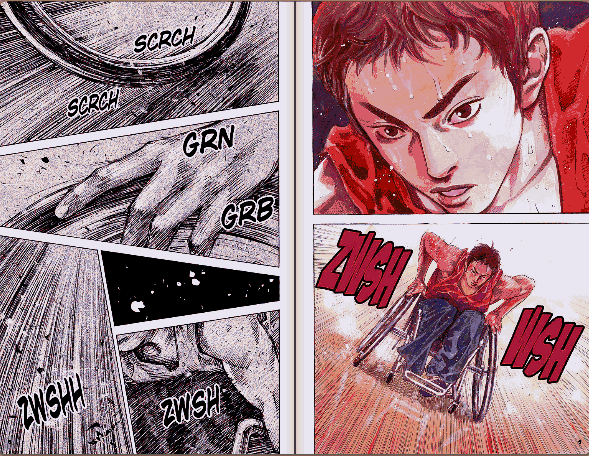
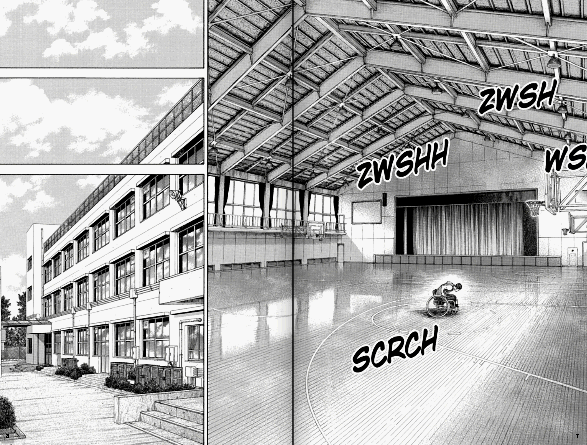
  Slam Dunk may have been the series that put Takehiko Inoue on the map and introduced legions of Japanese kids to basketball, but for me, a long-time hoops fan who grew up watching Larry Bird lead the Celtics to numerous NBA champtionships, Slam Dunk was a disappointment, a shonen sports comedy whose goofy hero desperately needed a summer at Robert Parrish Basketball Camp for schooling in the basics. Real, on the other hand, offered this armchair point guard something new: a window into the fiercely competitive world of wheelchair basketball. Watching Inoue’s characters run a man-to-man defense and shoot three-pointers from their chairs gave me a fresh appreciation for just how much strength, stamina, and smarts it takes to play the game, with or without the use of ones’ legs.