• Skip to primary navigation
  • Skip to main content
  • Skip to primary sidebar
  • Home
  • About Us
    • Privacy Policy
    • Comment Policy
    • Disclosures & Disclaimers
  • Resources
    • Links, Essays & Articles
    • Fandomology!
    • CLAMP Directory
    • BlogRoll
  • Features & Columns
    • 3 Things Thursday
    • Adventures in the Key of Shoujo
    • Bit & Blips (game reviews)
    • BL BOOKRACK
    • Bookshelf Briefs
    • Bringing the Drama
    • Comic Conversion
    • Fanservice Friday
    • Going Digital
    • It Came From the Sinosphere
    • License This!
    • Magazine no Mori
    • My Week in Manga
    • OFF THE SHELF
    • Not By Manga Alone
    • PICK OF THE WEEK
    • Subtitles & Sensibility
    • Weekly Shonen Jump Recaps
  • Manga Moveable Feast
    • MMF Full Archive
    • Yun Kouga
    • CLAMP
    • Shojo Beat
    • Osamu Tezuka
    • Sailor Moon
    • Fruits Basket
    • Takehiko Inoue
    • Wild Adapter
    • One Piece
    • After School Nightmare
    • Karakuri Odette
    • Paradise Kiss
    • The Color Trilogy
    • To Terra…
    • Sexy Voice & Robo
  • Browse by Author
    • Sean Gaffney
    • Anna Neatrour
    • Michelle Smith
    • Katherine Dacey
    • MJ
    • Brigid Alverson
    • Travis Anderson
    • Phillip Anthony
    • Derek Bown
    • Jaci Dahlvang
    • Angela Eastman
    • Erica Friedman
    • Sara K.
    • Megan Purdy
    • Emily Snodgrass
    • Nancy Thistlethwaite
    • Eva Volin
    • David Welsh
  • MB Blogs
    • A Case Suitable For Treatment
    • Experiments in Manga
    • MangaBlog
    • The Manga Critic
    • Manga Report
    • Soliloquy in Blue
    • Manga Curmudgeon (archive)

Manga Bookshelf

Discussion, Resources, Roundtables, & Reviews

Usamaru Furuya

No Longer Human, Vol. 1

November 24, 2011 by Katherine Dacey 4 Comments

First published in 1948, Osamu Dazai’s No Longer Human became one of the most widely read books in post-war Japan. The story, modeled on Dazai’s own life, chronicles a dissolute young man’s profound estrangement from his family and peers. The protagonist’s life follows a trajectory similar to Dazai’s: convinced that his life is an empty charade, Yozo drops out of school; joins the Communist Party; enters into a suicide pact with a virtual stranger; and woos lonely women, using them for shelter, emotional comfort, and financial support after his father, a prominent politician, disowns him.

The novel is divided into three sections, or “notebooks,” each corresponding to a period in the protagonist’s life. In the first, Yozo describes his childhood: his uneasy relationship with his father, his clownish behavior at school, and his abuse at the hands of a female servant. In the second and third sections, Yozo documents his troubled adulthood, as he abandons school for a life of drinking and illicit relationships, bouncing from one woman to the next with little regard for the harm he causes them — or himself. Framing Yozo’s story is a second narrative delivered by an unnamed author who has found three photographs of Yozo: as a child of ten, “a small boy surrounded by a great many women”; as a college student, handsome but “strangely unpleasant”; and as man in his later twenties, his hair “streaked with gray,” and his face “devoid of expression.”*

Given the novel’s enduring popularity, it’s no surprise that several manga artists have adapted Dazai’s text as a graphic novel. Their approaches have ranged from reverential — the East Press edition (2007) hews closely to the original novel — to provocative — Yasunori Ninose’s version (2010) uses tentacle-porn imagery to represent the character’s extreme emotional distress. Usamaru Furuya’s 2009 adaptation falls somewhere in between, taking liberties with the setting and structure of Dazai’s work, while preserving the original tone and events of the novel.

As these myriad approaches suggest, one of the biggest challenges of translating No Longer Human into a pictorial form is its interiority: though eventful, Yozo’s story is as much about his state of mind as his behavior. Early in the novel, for example, Yozo describes his inability to understand how other people feel and think. “I have not the remotest clue what the nature or extent of my neighbor’s woes can be,” he tells the reader. “It is almost impossible for me to converse with other people.” In a desperate attempt to camouflage his bewilderment, Yozo constructs a jovial mask, winning approval from his family members and classmates with impish behavior and remarks. “I kept my melancholy and my agitation hidden, careful lest any trace should be left exposed,” he explains. “I feigned an innocent optimism; I gradually perfected myself in the role of the farcical eccentric.”

Furuya makes a game effort to find visual analogues for Yozo’s interior states. Whenever Yozo feels emotionally disoriented, for example, Furuya obscures the other characters’ expressions, rendering their faces as blurs. Furuya extends this symbolic approach to Yozo’s social paralysis as well. “I was congenitally unable to refuse anything offered to me by another person, no matter how little it might suit my tastes,” Yozo confesses. “In other words, I hadn’t the strength even to choose between two alternatives.” In these passages, Furuya draws Yozo as a marionette, violently manipulated by an unseen puppeteer; as a drowning victim, disappearing under the water’s surface; and as a man engulfed in flames, so consumed by his fear of disappointing others that he surrenders his own agency.

Though Furuya follows the basic outline of Dazai’s novel, he makes two significant changes to the text. First, he moves the story from pre-war Japan to the present day, replacing the unnamed narrator with a character named Usamaru Furuya, a manga artist who discovers Yozo’s pictures on the internet. Second, Furuya streamlines the script, all but eliminating the first notebook; instead, he depicts Yozo’s childhood through a few brief, suggestive flashbacks.

The first decision makes good sense. By moving the setting from Taisho-era Japan to the present, Furuya sheds the novel’s period trappings in favor of a milieu that readers can intuitively appreciate — a world of blogs, cell-phones, high-rise apartment buildings, and other technologies that promote social isolation.

Less successful is Furuya’s decision to focus on Yozo’s adult life to the exclusion of his childhood. In the original novel, ten-year-old Yozo crosses paths with another outsider, a young boy who immediately detects the effort and strain behind Yozo’s clowning.  Fearful that Takeichi will expose his deceit to the other students, Yozo dons “the gentle beguiling smile of the false Christian,” befriending the odd, unlikeable Takeichi in an effort to buy his silence. The episode is among the most potent and revealing in the book, an early example of Yozo’s ability to manipulate others, and a rare example of him acknowledging his own agency — something he never does in the manga.

Furuya also trims another brief but important scene from the early pages of No Longer Human, in which Yozo implies that he was molested by his wealthy family’s servants. “Already by that time I had been taught a lamentable thing by the maids and menservants; I was being corrupted,” Yozo declares. “I now think that that to perpetrate such a thing on a small child is the ugliest, vilest, cruelest crime a human being can commit.” Yozo’s indifference to others’ suffering, inability to experience romantic love, and passive-aggressive behavior, suggest a pathology rooted in this formative experience. Perhaps Furuya found this passage too neatly Freudian for his purposes, but in choosing to omit it, he makes Yozo seem like just another cad who beds and discards women, rather than a wounded soul incapable of sexual intimacy.

Yet for all its shortcomings — the omissions, the obvious symbolism — Furuya’s adaptation still captures the raw power of Dazai’s original novel. In its best passages, Furuya makes us feel as dazed and lonely as Yozo himself; we appreciate how helpless he feels, though we can see how seductive — and dangerous — he can be. Furuya also manages to document the full extent of Yozo’s debauchery without eroticizing it; we are keenly aware of the emotional distance between Yozo and his sexual conquests, making these scenes feel joyless and awkward, rather than titillating in their explicitness.

In short, Furuya has found a way to transform Dazai’s sharp critique of pre-war Japanese society into a more universal text, one that raises the question, What does it mean to be human right now?

* All quotations taken from Donald Keene’s translation (New York: Penguin Books, 1958).

Review copy provided by Vertical, Inc.

NO LONGER HUMAN, VOL. 1 • NOVEL BY OSAMU DAZAI, ADAPTATION BY USAMARU FURUYA • VERTICAL, INC. • RATING: OLDER TEEN (16+)

Filed Under: Manga Critic Tagged With: Osamu Dazai, Seinen, Usamaru Furuya, vertical

No Longer Human, Vol. 1

November 24, 2011 by Katherine Dacey

First published in 1948, Osamu Dazai’s No Longer Human became one of the most widely read books in post-war Japan. The story, modeled on Dazai’s own life, chronicles a dissolute young man’s profound estrangement from his family and peers. The protagonist’s life follows a trajectory similar to Dazai’s: convinced that his life is an empty charade, Yozo drops out of school; joins the Communist Party; enters into a suicide pact with a virtual stranger; and woos lonely women, using them for shelter, emotional comfort, and financial support after his father, a prominent politician, disowns him.

The novel is divided into three sections, or “notebooks,” each corresponding to a period in the protagonist’s life. In the first, Yozo describes his childhood: his uneasy relationship with his father, his clownish behavior at school, and his abuse at the hands of a female servant. In the second and third sections, Yozo documents his troubled adulthood, as he abandons school for a life of drinking and illicit relationships, bouncing from one woman to the next with little regard for the harm he causes them — or himself. Framing Yozo’s story is a second narrative delivered by an unnamed author who has found three photographs of Yozo: as a child of ten, “a small boy surrounded by a great many women”; as a college student, handsome but “strangely unpleasant”; and as man in his later twenties, his hair “streaked with gray,” and his face “devoid of expression.”*

Given the novel’s enduring popularity, it’s no surprise that several manga artists have adapted Dazai’s text as a graphic novel. Their approaches have ranged from reverential — the East Press edition (2007) hews closely to the original novel — to provocative — Yasunori Ninose’s version (2010) uses tentacle-porn imagery to represent the character’s extreme emotional distress. Usamaru Furuya’s 2009 adaptation falls somewhere in between, taking liberties with the setting and structure of Dazai’s work, while preserving the original tone and events of the novel.

As these myriad approaches suggest, one of the biggest challenges of translating No Longer Human into a pictorial form is its interiority: though eventful, Yozo’s story is as much about his state of mind as his behavior. Early in the novel, for example, Yozo describes his inability to understand how other people feel and think. “I have not the remotest clue what the nature or extent of my neighbor’s woes can be,” he tells the reader. “It is almost impossible for me to converse with other people.” In a desperate attempt to camouflage his bewilderment, Yozo constructs a jovial mask, winning approval from his family members and classmates with impish behavior and remarks. “I kept my melancholy and my agitation hidden, careful lest any trace should be left exposed,” he explains. “I feigned an innocent optimism; I gradually perfected myself in the role of the farcical eccentric.”

Furuya makes a game effort to find visual analogues for Yozo’s interior states. Whenever Yozo feels emotionally disoriented, for example, Furuya obscures the other characters’ expressions, rendering their faces as blurs. Furuya extends this symbolic approach to Yozo’s social paralysis as well. “I was congenitally unable to refuse anything offered to me by another person, no matter how little it might suit my tastes,” Yozo confesses. “In other words, I hadn’t the strength even to choose between two alternatives.” In these passages, Furuya draws Yozo as a marionette, violently manipulated by an unseen puppeteer; as a drowning victim, disappearing under the water’s surface; and as a man engulfed in flames, so consumed by his fear of disappointing others that he surrenders his own agency.

Though Furuya follows the basic outline of Dazai’s novel, he makes two significant changes to the text. First, he moves the story from pre-war Japan to the present day, replacing the unnamed narrator with a character named Usamaru Furuya, a manga artist who discovers Yozo’s pictures on the internet. Second, Furuya streamlines the script, all but eliminating the first notebook; instead, he depicts Yozo’s childhood through a few brief, suggestive flashbacks.

The first decision makes good sense. By moving the setting from Taisho-era Japan to the present, Furuya sheds the novel’s period trappings in favor of a milieu that readers can intuitively appreciate — a world of blogs, cell-phones, high-rise apartment buildings, and other technologies that promote social isolation.

Less successful is Furuya’s decision to focus on Yozo’s adult life to the exclusion of his childhood. In the original novel, ten-year-old Yozo crosses paths with another outsider, a young boy who immediately detects the effort and strain behind Yozo’s clowning.  Fearful that Takeichi will expose his deceit to the other students, Yozo dons “the gentle beguiling smile of the false Christian,” befriending the odd, unlikeable Takeichi in an effort to buy his silence. The episode is among the most potent and revealing in the book, an early example of Yozo’s ability to manipulate others, and a rare example of him acknowledging his own agency — something he never does in the manga.

Furuya also trims another brief but important scene from the early pages of No Longer Human, in which Yozo implies that he was molested by his wealthy family’s servants. “Already by that time I had been taught a lamentable thing by the maids and menservants; I was being corrupted,” Yozo declares. “I now think that that to perpetrate such a thing on a small child is the ugliest, vilest, cruelest crime a human being can commit.” Yozo’s indifference to others’ suffering, inability to experience romantic love, and passive-aggressive behavior, suggest a pathology rooted in this formative experience. Perhaps Furuya found this passage too neatly Freudian for his purposes, but in choosing to omit it, he makes Yozo seem like just another cad who beds and discards women, rather than a wounded soul incapable of sexual intimacy.

Yet for all its shortcomings — the omissions, the obvious symbolism — Furuya’s adaptation still captures the raw power of Dazai’s original novel. In its best passages, Furuya makes us feel as dazed and lonely as Yozo himself; we appreciate how helpless he feels, though we can see how seductive — and dangerous — he can be. Furuya also manages to document the full extent of Yozo’s debauchery without eroticizing it; we are keenly aware of the emotional distance between Yozo and his sexual conquests, making these scenes feel joyless and awkward, rather than titillating in their explicitness.

In short, Furuya has found a way to transform Dazai’s sharp critique of pre-war Japanese society into a more universal text, one that raises the question, What does it mean to be human right now?

* All quotations taken from Donald Keene’s translation (New York: Penguin Books, 1958).

Review copy provided by Vertical, Inc.

NO LONGER HUMAN, VOL. 1 • NOVEL BY OSAMU DAZAI, ADAPTATION BY USAMARU FURUYA • VERTICAL, INC. • RATING: OLDER TEEN (16+)

Filed Under: Manga, Manga Critic, REVIEWS Tagged With: no longer human, Osamu Dazai, Usamaru Furuya, Vertical Comics

Short Cuts and Genkaku Picasso

November 18, 2010 by Katherine Dacey

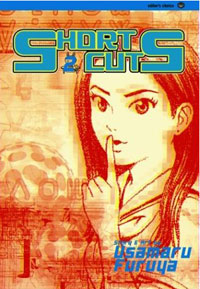
Short Cuts has the unique distinction of being one of the first manga I ever loathed. In fairness to Usamaru Furuya, I read it early in my relationship with manga, when the only titles I knew were Lone Wolf and Cub, Tokyo Babylon, InuYasha, Mermaid Saga, and X/1999. I found Short Cuts bewildering, frankly, as I knew very little about ko-gals — one of Furuya’s favorite subjects — and even less about the other cultural trends and manga tropes that Furuya gleefully mocked. Then, too, Furuya’s fascination with teenage girls, panties, casual prostitution, and incest grew tiresome: how many times can you play the am-I-shocking-you card before the shtick gets old? With the release of Genkaku Picasso, however, I thought it was a good time to revisit Short Cuts and see if I’d unfairly dismissed a great artist or correctly judged him as an unrepentant perv.

What I found was a decidedly mixed bag, a smorgasbord of jokes about girl cliques, lecherous salarymen, Valentine’s Day gift-giving, travel guides for foreigners, and, yes, sex. Some of the best strips tackle obvious targets in unexpected ways. Mr. Pick-on-Me, a recurring character, is one such example: he’s a robot whose sole job is to endure harassment from school kids, providing them a more attractive target for bullying than each other. He proves so effective, however, that the school administrators begin bullying him, too, necessitating the purchase of more robots. Another recurring character, Mitsu Cutie, is an assassin who assembles lethal weapons from bento boxes and Hello Kitty paraphernalia. Though Furuya is hardly the first person to wring laughs from a sweet-faced character’s degenerate behavior, the gag is surprisingly funny, not least for the way in which it carefully filters spy thriller conventions through the lens of shojo manga; it’s as if Takao Saito and Arina Tanemura teamed up to produce a story about a twelve-year-old hit girl.

Furuya is also a first-class mimic, capable of channeling just about any other artist’s style in service of a good joke. In one gag, for example, he twists a TV-addled teen’s face into a perfect imitation of Hitoshi Iwaaki’s parasite aliens, while in another, he shows a woman with ridiculously long eyelashes performing her daily grooming routine, revealing her true identity only in the final panel: she’s Maetel, the heroine of Leiji Matsumoto’s Galaxy Express 999. Even Tezuka take his lumps: in Furuya’s version of Astro Boy, the iconic robot looks like the rotund, bespectacled Dr. Ochanomizu, while his maker resembles Astro, though in Furuya’s telling, the mad scientist likes baggy knee socks, a hallmark of ko-gal fashion.

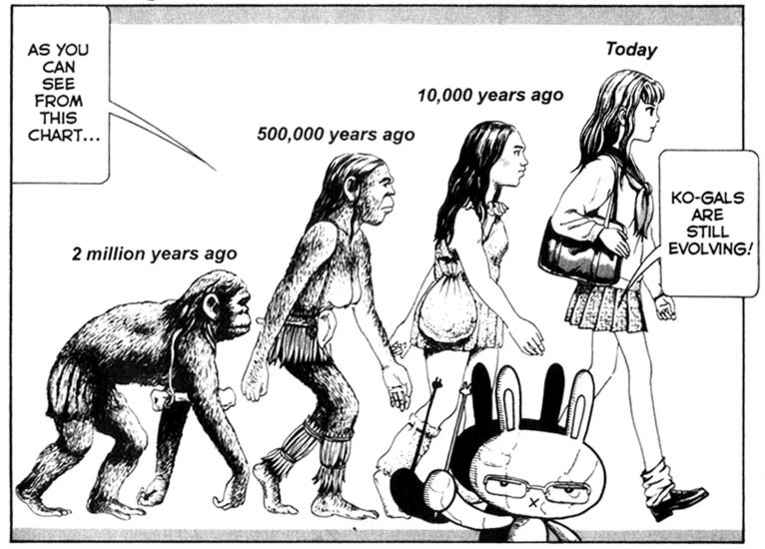
The Astro Boy strip is one of many poking fun at ko-gals, Japan’s own answer to the Valley Girl. Like their Orange County counterparts, kogals are an easy target: their speech and attire are distinctive and easily parodied, as are their devotion to shopping, brand names, and hanging out in the Shibuya district. That’s not to say that Furuya’s jokes are bad; to the contrary, there are some genuinely inspired panels. In one strip, for example, we see a shrine featuring monumental sculptures of ko-gals attended by elderly male priests in short skirts and baggy socks, while in another, a balding, middle-aged man apprentices himself to become a ko-gal, applying himself with the steely resolve of a samurai or geisha-in-training.

A lot of the ko-gal humor is rather mean-spirited, however, portraying girls as hopelessly dim, materialistic, and uninterested in sex unless it comes with a financial reward. Though the male characters are ridiculed for their willingness to pay teenage girls for sexual favors, Furuya allows the reader to have his cake and eat it, too, laughing with recognition at his weakness for panty flashes while being treated to… panty flashes. From very cute girls. Furuya even pokes fun at himself, punishing one of his female characters for her dawning awareness of his “Lolita complex.” (He first attempts to white her out, then resorts to drawing her as a monster.) In the final panel of the “cut,” he’s asserted control over the character again, blackmailing her into silence. The whole sequence is done with a nudge and a wink, as if to make us complicit in Furuya’s predilection for teenage girls; it’s a classic non-apology, the equivalent of saying, “No offense, but sixteen-year-olds are hawt, dude!”

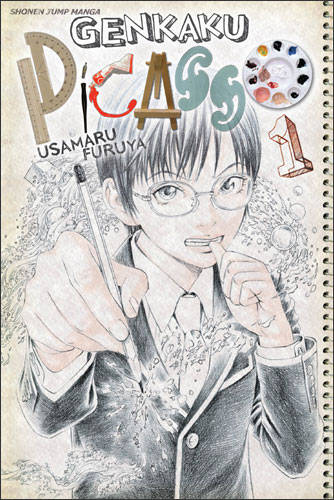
In many ways, Genkaku Picasso seems like one of the two-page “cuts” dragged out to epic lengths. The story focuses on Hikari Hamura, a weird, asexual twit who becomes so involved with his sketch book that he finds a beautiful girl’s attention a nuisance. While sitting on the bank of a river with his classmate Chiaki, a bizarre disaster kills them both. She’s reincarnated as a pocket-sized angel; he’s reborn with a new supernatural gift, the ability to draw other people’s dreams. The central joke of the series is that Hikari is a terrible dream interpreter, reading even darker intent into other students’ nightmares than is implied by the imagery.

The need to show where Hikari’s interpretations go astray proves Genkaku Picasso‘s biggest weakness. Consider “Manba and Kotone,” the third story of volume one, in which one of Hikari’s classmates is plagued by images of a teenage girl being tortured and tied up. As Ng Suat Tong points out in his review of Genkaku, the punchline is squicky: these images aren’t a dark fantasy, but pictures from a magazine shoot in which the girl volunteered to pose for her father, a professional photographer. Handled in two panels, the joke would hit like a nasty rim shot, but as the driving force behind the chapter’s storyline, it becomes… well, seriously creepy, pushing the material into the decidedly unfunny territory of incest and parent-child power dynamics.

I actually liked Genkaku Picasso more than Tong did, partly because I think Furuya is having a ball subverting shonen cliches; it’s the kind of series in which doing your best means staving off body rot, not winning a tournament, and a quiet, philosophical moment between two teens is interrupted by a fiery helicopter crash. I also liked some of the dream sequences, which showcase Furuya’s incredible versatility as an artist. However pedestrian the script may be in explaining the images’ meaning — and yes, there are some borderline Oprah moments in every story — the dreams are nonetheless arresting in their strange specificity.

After reading Short Cuts and Genkaku Picasso, I’m convinced of Usamaru Furuya’s ability draw just about anything, and to tell a truly dirty joke. I’m not yet persuaded that he can work in a longer form, but perhaps if he’s adapting someone else’s story — say, Osamu Daizi’s No Longer Human — he might find the right structure for containing and directing his furious artistic energy.

Review copy of Gengaku Picasso provided by VIZ Media, LLC.

SHORT CUTS, VOLS. 1-2 • BY USAMARU FURUYA • VIZ • NO RATING (MATERIAL BEST SUITED FOR MATURE READERS)

GENKAKU PICASSO, VOL. 1 • BY USAMARU FURUYA • VIZ • 192 pp. • RATING: OLDER TEEN (16+)

Filed Under: Manga Critic Tagged With: Shonen, Shonen Jump, Usamaru Furuya, VIZ

Short Cuts and Genkaku Picasso

November 18, 2010 by Katherine Dacey

Short Cuts has the unique distinction of being one of the first manga I ever loathed. In fairness to Usamaru Furuya, I read it early in my relationship with manga, when the only titles I knew were Lone Wolf and Cub, Tokyo Babylon, InuYasha, Mermaid Saga, and X/1999. I found Short Cuts bewildering, frankly, as I knew very little about ko-gals — one of Furuya’s favorite subjects — and even less about the other cultural trends and manga tropes that Furuya gleefully mocked. Then, too, Furuya’s fascination with teenage girls, panties, casual prostitution, and incest grew tiresome: how many times can you play the am-I-shocking-you card before the shtick gets old? With the release of Genkaku Picasso, however, I thought it was a good time to revisit Short Cuts and see if I’d unfairly dismissed a great artist or correctly judged him as an unrepentant perv.

What I found was a decidedly mixed bag, a smorgasbord of jokes about girl cliques, lecherous salarymen, Valentine’s Day gift-giving, travel guides for foreigners, and, yes, sex. Some of the best strips tackle obvious targets in unexpected ways. Mr. Pick-on-Me, a recurring character, is one such example: he’s a robot whose sole job is to endure harassment from school kids, providing them a more attractive target for bullying than each other. He proves so effective, however, that the school administrators begin bullying him, too, necessitating the purchase of more robots. Another recurring character, Mitsu Cutie, is an assassin who assembles lethal weapons from bento boxes and Hello Kitty paraphernalia. Though Furuya is hardly the first person to wring laughs from a sweet-faced character’s degenerate behavior, the gag is surprisingly funny, not least for the way in which it carefully filters spy thriller conventions through the lens of shojo manga; it’s as if Takao Saito and Arina Tanemura teamed up to produce a story about a twelve-year-old hit girl.

Furuya is also a first-class mimic, capable of channeling just about any other artist’s style in service of a good joke. In one gag, for example, he twists a TV-addled teen’s face into a perfect imitation of Hitoshi Iwaaki’s parasite aliens, while in another, he shows a woman with ridiculously long eyelashes performing her daily grooming routine, revealing her true identity only in the final panel: she’s Maetel, the heroine of Leiji Matsumoto’s Galaxy Express 999. Even Tezuka take his lumps: in Furuya’s version of Astro Boy, the iconic robot looks like the rotund, bespectacled Dr. Ochanomizu, while his maker resembles Astro, though in Furuya’s telling, the mad scientist likes baggy knee socks, a hallmark of ko-gal fashion.

The Astro Boy strip is one of many poking fun at ko-gals, Japan’s own answer to the Valley Girl. Like their Orange County counterparts, kogals are an easy target: their speech and attire are distinctive and easily parodied, as are their devotion to shopping, brand names, and hanging out in the Shibuya district. That’s not to say that Furuya’s jokes are bad; to the contrary, there are some genuinely inspired panels. In one strip, for example, we see a shrine featuring monumental sculptures of ko-gals attended by elderly male priests in short skirts and baggy socks, while in another, a balding, middle-aged man apprentices himself to become a ko-gal, applying himself with the steely resolve of a samurai or geisha-in-training.

A lot of the ko-gal humor is rather mean-spirited, however, portraying girls as hopelessly dim, materialistic, and uninterested in sex unless it comes with a financial reward. Though the male characters are ridiculed for their willingness to pay teenage girls for sexual favors, Furuya allows the reader to have his cake and eat it, too, laughing with recognition at his weakness for panty flashes while being treated to… panty flashes. From very cute girls. Furuya even pokes fun at himself, punishing one of his female characters for her dawning awareness of his “Lolita complex.” (He first attempts to white her out, then resorts to drawing her as a monster.) In the final panel of the “cut,” he’s asserted control over the character again, blackmailing her into silence. The whole sequence is done with a nudge and a wink, as if to make us complicit in Furuya’s predilection for teenage girls; it’s a classic non-apology, the equivalent of saying, “No offense, but sixteen-year-olds are hawt, dude!”

In many ways, Genkaku Picasso seems like one of the two-page “cuts” dragged out to epic lengths. The story focuses on Hikari Hamura, a weird, asexual twit who becomes so involved with his sketch book that he finds a beautiful girl’s attention a nuisance. While sitting on the bank of a river with his classmate Chiaki, a bizarre disaster kills them both. She’s reincarnated as a pocket-sized angel; he’s reborn with a new supernatural gift, the ability to draw other people’s dreams. The central joke of the series is that Hikari is a terrible dream interpreter, reading even darker intent into other students’ nightmares than is implied by the imagery.

The need to show where Hikari’s interpretations go astray proves Genkaku Picasso‘s biggest weakness. Consider “Manba and Kotone,” the third story of volume one, in which one of Hikari’s classmates is plagued by images of a teenage girl being tortured and tied up. As Ng Suat Tong points out in his review of Genkaku, the punchline is squicky: these images aren’t a dark fantasy, but pictures from a magazine shoot in which the girl volunteered to pose for her father, a professional photographer. Handled in two panels, the joke would hit like a nasty rim shot, but as the driving force behind the chapter’s storyline, it becomes… well, seriously creepy, pushing the material into the decidedly unfunny territory of incest and parent-child power dynamics.

I actually liked Genkaku Picasso more than Tong did, partly because I think Furuya is having a ball subverting shonen cliches; it’s the kind of series in which doing your best means staving off body rot, not winning a tournament, and a quiet, philosophical moment between two teens is interrupted by a fiery helicopter crash. I also liked some of the dream sequences, which showcase Furuya’s incredible versatility as an artist. However pedestrian the script may be in explaining the images’ meaning — and yes, there are some borderline Oprah moments in every story — the dreams are nonetheless arresting in their strange specificity.

After reading Short Cuts and Genkaku Picasso, I’m convinced of Usamaru Furuya’s ability draw just about anything, and to tell a truly dirty joke. I’m not yet persuaded that he can work in a longer form, but perhaps if he’s adapting someone else’s story — say, Osamu Daizi’s No Longer Human — he might find the right structure for containing and directing his furious artistic energy.

Review copy of Gengaku Picasso provided by VIZ Media, LLC.

SHORT CUTS, VOLS. 1-2 • BY USAMARU FURUYA • VIZ • NO RATING (MATERIAL BEST SUITED FOR MATURE READERS)

GENKAKU PICASSO, VOL. 1 • BY USAMARU FURUYA • VIZ • 192 pp. • RATING: OLDER TEEN (16+)

Filed Under: Manga, Manga Critic, REVIEWS Tagged With: Shonen, Shonen Jump, Usamaru Furuya, VIZ

  • « Go to Previous Page
  • Page 1
  • Page 2
 | Log in
Copyright © 2010 Manga Bookshelf | Powered by WordPress & the Genesis Framework