• Skip to primary navigation
  • Skip to main content
  • Skip to primary sidebar
  • Home
  • About Us
    • Privacy Policy
    • Comment Policy
    • Disclosures & Disclaimers
  • Resources
    • Links, Essays & Articles
    • Fandomology!
    • CLAMP Directory
    • BlogRoll
  • Features & Columns
    • 3 Things Thursday
    • Adventures in the Key of Shoujo
    • Bit & Blips (game reviews)
    • BL BOOKRACK
    • Bookshelf Briefs
    • Bringing the Drama
    • Comic Conversion
    • Fanservice Friday
    • Going Digital
    • It Came From the Sinosphere
    • License This!
    • Magazine no Mori
    • My Week in Manga
    • OFF THE SHELF
    • Not By Manga Alone
    • PICK OF THE WEEK
    • Subtitles & Sensibility
    • Weekly Shonen Jump Recaps
  • Manga Moveable Feast
    • MMF Full Archive
    • Yun Kouga
    • CLAMP
    • Shojo Beat
    • Osamu Tezuka
    • Sailor Moon
    • Fruits Basket
    • Takehiko Inoue
    • Wild Adapter
    • One Piece
    • After School Nightmare
    • Karakuri Odette
    • Paradise Kiss
    • The Color Trilogy
    • To Terra…
    • Sexy Voice & Robo
  • Browse by Author
    • Sean Gaffney
    • Anna Neatrour
    • Michelle Smith
    • Katherine Dacey
    • MJ
    • Brigid Alverson
    • Travis Anderson
    • Phillip Anthony
    • Derek Bown
    • Jaci Dahlvang
    • Angela Eastman
    • Erica Friedman
    • Sara K.
    • Megan Purdy
    • Emily Snodgrass
    • Nancy Thistlethwaite
    • Eva Volin
    • David Welsh
  • MB Blogs
    • A Case Suitable For Treatment
    • Experiments in Manga
    • MangaBlog
    • The Manga Critic
    • Manga Report
    • Soliloquy in Blue
    • Manga Curmudgeon (archive)

Manga Bookshelf

Discussion, Resources, Roundtables, & Reviews

Reviews

Dawn of the Arcana, Vol. 8

January 31, 2013 by Anna N

Dawn of the Arcana continues to be an entertaining fantasy series in a subtle and well-executed way. This volume has our adventurers in the desert kingdom of Lithuanel. Nakaba is caught up with a struggle between the princes Akhil and Azhal. They encounter a new type of ajin in the form of a group of terroristically inclined snake-people. Caesar has to prepare to return to his own country, and he attempts to push Nakaba away in an attempt to protect her from getting hurt. Nakaba has grown into a much more confident woman, and she’s not afraid to invoke her power when she needs to in order to help her friends.

One of the things I’m always wanting from this series is more Loki. Nakaba’s devoted dog-like ajin protector has always seemed to have hidden depths and motivations and Nakaba’s power shows her a series of visions that demonstrate just how far Loki is willing to go to to protect her. Nakaba gains a new appreciation for how much information he shielded her from when she was younger and more innocent. Eight volumes in, and I’m still appreciating the clarity of Toma’s art. The paneling had really developed well to showcase both action sequences and the inner feelings of the characters. Seeing a younger Nakaba in flashbacks makes the reader appreciate the bond between her and Loki, and appreciate how far she’s come since she became Caesar’s princess.

Filed Under: REVIEWS Tagged With: dawn of the arcana, shojo beat

Harlequin Manga: Angus’s Lost Lady and The Seduction Bid

January 30, 2013 by Anna N

Although I’ve read a bit of manga on the Kindle app for my iPad, I haven’t actually read any manga on my newest toy – a Kindle Paperwhite. When I discovered that there were actually several Harlequin manga for sale for .99 cents on amazon, I wasted no time in purchasing them. I was particularly interested in these two titles, because I’d previously read another title adapted by Kazuko Fujita, Sale or Return Bride. I tend to assume that the art for these Harlequin adaptations is going to be fairly rushed, but either Fujita’s art is among the best that I’ve seen in a Harlequin manga. Her character designs are attractive, and she manages to convey a great deal of nuance in their facial expressions, with the end result that she ends up elevating the stories in these volumes. Backgrounds are sparse, and if you read Fujita’s manga one after the other you will notice that she only draws one basic hero, but she does draw him very well.

Buying Harlequin manga on the Kindle is a bit confusing because there are multiple editions for each title, but I’m linking to the editions that I bought and read here.

Angus’s Lost Lady by Kazuko Fujita and Marie Ferraella

Angus’s Lost Lady is the story of a PI and single father named Angus who is surprised to see a woman with with a lost shoe and amnesia on his doorstep. The only clue to her identity is the fact that she’s clutching his business card, but she hasn’t met him before. She has a head injury as a result from being grazed by a bullet. Since this is a romance manga Angus promptly moves the lost woman into his apartment, introducing her to his daughter Vikki and trying to jog her memory by giving her a phonebook to read. The woman decides to adopt the name Rebecca. Rebecca and Angus investigate her accident and missing memories, and along the way struggle with their attraction for each other. The old “woman in danger with amnesia” is not a novel plot device, but Fujita does a good job portraying the chemistry between Angus and Rebecca, and Rebecca isn’t as simpering and weak as many Harlequin amnesia ladies usually are.

The Seduction Bid by Kazuko Fujita and Amanda Browning

Perhaps it is due to my own anger management issues, but I generally enjoy it when women in romance manga yell a lot. In this case, the heroine of The Seduction Bid barges into an office and starts to chew out an incredibly handsome man who she thinks is an unscrupulous reporter for a local tabloid. Carrie is determined to defend one of her friends from scandal. While she is momentarily distracted by the stormy grey eyes of the man she is yelling at, she ends up storming out of the office ranting about “garbage journalism”. The man with the mysterious grey eyes decides that he wants to be yelled at forever and vows to marry her. Later, as Carrie is hanging out at the house belonging to the parents of her late husband she is introduced to the object of her rant and he turns out to be Lance, cousin of the gutter journalist. Lance then proceeds to relentlessly pursue the reluctant Carrie, and his charm gradually begins to wear down her well developed defense mechanisms.

The attractive art makes these volumes a pleasure to read, and the stories are basically what you’d expect from Harlequin. Reading these on the Kindle was fine – the size of the manga to fit the Kindle screen is about what you’d see in a Japanese tankobon, and since the backgrounds of the manga weren’t particularly detailed, the smaller reading size for the manga didn’t make much of a difference. At only a dollar a pop, buying these is a no-brainer for anyone who enjoys Harlequin manga.

Filed Under: REVIEWS Tagged With: harlequin manga

Love Hina Omnibus, Vol. 4

January 30, 2013 by Sean Gaffney

By Ken Akamatsu. Released in Japan by Kodansha, serialized in the magazine Weekly Shonen Magazine. Released in North America by Kodansha Comics.

I admit I put this volume on the back burner for a while. If ever there was a series that reminded me how much one can change and grow in 10-12 years, it’s Love Hina, which has lost a lot of the luster it originally had. This is an omnibus of three parts, appropriately since it covers three volumes. The first is the best, as Mutsumi helps to draw Naru closer to Keitaro and he heads off to America for a sabbatical. The second volume is all about introducing Kanako, Keitaro’s adopted sister and reader identification figure. Lastly, Keitaro returns and everything goes south for Naru, as the final volume is a chase of epic proportions to try to get Naru to admit her feelings or die. Die being what she’d prefer, really.

lovehina4

I tend to defend Naru a lot, mostly as the people who hate her tend to use sexist, horrible imagery in that hate, like many of the worst bashers in any fandom. Their hate is summed up by “she needs to be more nice to me… I mean him” and multiple uses of the word ‘bitch’. That said, Naru is certainly at her most frustrating here, dragging out the ‘do I really love him’ question to appalling lengths. Naru’s terrified of the future and things going wrong, and I completely identify with that. But add in Akamatsu’s comedic exaggeration and you want to cry at how much she can run away from her own problems. The end of this volume has her literally running away until there is no land mass left, to the northernmost tip of Japan.

Things are not helped at all by Kanako. I’ve mellowed a bit on Kanako over the years, and can see the appeal of a character who is designed to come in and call everyone out on the crap they’ve been giving Keitaro the last few years. Her naivete and hero-worship of her brother comes through quite well, and I liked the bond she forms with Naru (no surprise there, given Naru and Keitaro’s similarities). And given this was written in the late 90s rather than the early 10s, the incest subtext is meant to be creepy and wrong, for once. Kanako also gives us my favorite joke of the volume, where she dresses Mutsumi up as Keitaro to test everyone’s love… complete with ‘attachments’, so to speak. (“My brother’s would be at least that big.”)

I was reading this volume on public transport, which could be awkward at times. After a while, all the fanservice in Love Hina tends to mesh together so much you don’t notice it anymore, which is surprising given it’s everywhere. Characters are nude or near-nude through all three volumes of this, reminding me once more that Magazine skews much older than Jump or Sunday. And that’s not even counting the goth-loli Kanako, or everyone dressed as maids, or the Halloween costumes, or all the other service that’s here. Akamatsu works hard to please his audience, but you feel a little guilty about it all.

Honestly, any chance to read more Mutsumi is always welcome for me, but Love Hina is a classic example of what should have been a nine-volume manga dragged out to 14. Luckily, that means the next omnibus (only two volumes) is the last, and should wrap everything up for Naru and Seta. Oops, I mean Keitaro. Yeah, best save that little issue for Vol. 5’s review…

Filed Under: REVIEWS

Happy Mania, Vols. 1-5

January 27, 2013 by Anna N

This is a post for the Moyoco Anno Manga Moveable Feast.

Some series I take to right away, and other manga series end up being second chance reads. Happy Mania is one of those series that is better the second time around for me. I read the first couple volumes several years ago and didn’t really get into it because I found the main character incredibly annoying. Since then I’ve read several other manga by Moyoco Anno and have long suspected that I needed to give Happy Mania a second shot. I’ve pieced together the out of print series from paperbackswap.com and some good bargain manga outlets. I was hoping to read the entire series for the Manga Moveable Feast, but I wasn’t able to start reading it until much later than I planned. I was able to read a decent chunk of it though!

The heroine as a ditsy, hopeless woman who decides to “live for love” is quite the stereotype in shoujo and josei manga. Her life gets romanticized and she ends up getting saved by her ideal man. Anno’s approach is to show just how horrible a life someone like this would actually lead. Shigeta is a young woman who works in a bookstore. Her career’s nonexistent, but she’s fixated on the idea of meeting a man who will save her from the drudgery of her daily life. Unfortunately Shigeta’s main method of dealing with men is to fixate on someone totally unsuitable, sleep with him extremely quickly, and then wonder why he’s suddenly not interested in her. While she chases bad boys, her hapless co-worker Takahashi is pining for her. He is usually drawn with tears streaming down his face, sighing Shigeta’s name.

Shigeta goes through jobs and men in quick succession, hooking up with a womanizing younger DJ, the son of a cult leader who rapidly turns psychotic, a stoic ceramics artist, and a married man. Whenever Shigeta’s in crisis, Takahashi is there for her, and even though he goes overseas to study their relationship gradually progresses into a semi-dysfunctional engagement. If Shigeta exhibited absolutely no personal growth through these volumes the series would be a bit tedious, but she does gradually realize that her goals and behavior are not making her happy. This isn’t really enough to prevent her from seeking her self worth in the knowledge that a man might be interested in her, but she isn’t entirely without self awareness. When she pauses to think about a couple of the men pursuing her, she thinks “What’s wrong with these guys? If they like me that much…there must be something wrong with them!”
Shigeta is always pursuing the next unattainable man. Being stuck in a behavioral pattern like Shigeta’s seems refreshingly realistic for a manga heroine, and Anno certainly doesn’t shy away from the more sordid aspects of her life. Happy Mania isn’t romanticized at all.

Anno’s art is distinct and fluid. She has a unique ability to draw characters that are simultaneously attractive and slightly grotesque. Shigeta looks like a limpid-eyed, slightly crazed goblin half of the time. Takahashi shifts from being slight and nerdy to being more attractive as Shigeta’s view of him changes. There always seems to be a metatextual element to Anno’s manga. Happy Mania might be a manga about a love-starved twentysomething woman, but it is also a cynical commentary about manga about love-starved twentysomething women at the same time.

I’m glad that I gave this series a second chance. Shigeta’s antics didn’t really sit very well with me the first time I tried this series, but in the intervening years I’ve read a bunch more manga, and right now I find a manga about a woman finding unhappiness through her pursuit of men much more interesting than a more typical manga that is going to head towards a happy ending after a series of wacky misunderstandings.

Filed Under: REVIEWS Tagged With: happy mania, Manga Moveable Feast

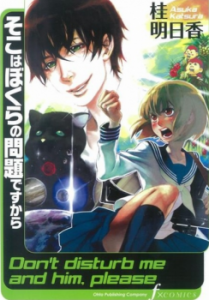
Don’t Disturb Me and Him, Please

January 26, 2013 by Sean Gaffney

By Asuka Katsura. Released in Japan as “Soko Wa Bokura No Mondai Desu Kara” by Ohta Shuppan, serialized in the magazine Manga Erotics F. Released in North America by JManga.

I… am not sure where even to begin. What the heck was this? Not since Sasameke have I been left with such a feeling of vague confusion and disgust. This one didn’t have quite the kick in the balls ending that Sasameke did, but it certainly matches it for weird gag humor out of nowhere and appalling over-the-top grotesqueries being presented as comedic. Which, to be fair, works at first, but as the manga goes on and tries to also have a real plot, the flaws inherent in the entire work become more apparent.

disturb

Given that the manga actually tries to have a plot, I suppose I should sum it up. Yaeko is a high school girl who reacts cutely whenever she’s tormented (or, more accurately, reacts in a highly amusing way), and thus has always been prey for perverts who want to dress her up, strip her, seduce her, or just rape her. Including her family. And her best friend, who in fact rapes her at knifepoint in the first chapter. While escaping said best friend by running nude through the streets at night, she’s helped by Rokuro, a gorgeous man carrying a teddy bear… who happens to match the description of a guy who’s been propositioning little kids around the neighborhood. After a series of misunderstandings, she injures his right hand, only to discover he has a high-stress job that absolutely needs doing. And so she moves in with him to be his right hand while it heals.

The reader, honestly, is meant to identify with the perverts here, as Yaeko’s reactions to everything are the best part of the manga. They are so over the top it goes beyond comedy into farce, and she frequently will be dressed as, say, a soldier or a Greek Statue for one panel only. She’s obsessed with proving that Rokuro is a lolicon, to the extent that she tries to frame him by going to a park and telling kids to pose for photos (realizing, a bit late, that this makes her a pervert – she’s even wearing the standard manga pervert outfit). Her complete lack of common sense is what drives the humor, along with her need to scream almost every line.

Sadly, Rokuro is not nearly as interesting – or indeed interesting at all. In the final chapter, we get an attempt at a backstory that explains his retiring personality and his tendency to chat up little kids, but for most of the story he’s a non-entity who exists to make Yaeko panicked and insane. He has a faux-girlfriend who (naturally) has a shotacon complex, who mostly seems to inhabit the manga so that the two of them have a third character to bounce stress off of. (Yaeko’s best friend, for obvious reasons, doesn’t fit this description. Which is a shame, as she was easily the most appalling (and therefore funny) part of this whole manga.)

I suspect this worked better serialized, but even them I think I’d be exhausted by the end of 20 pages or so. The author is better known for Blood+ and La Portrait de Petite Cosette, neither of which I believe are anything whatsoever like this. It has little to no internal logic, tries to tack on a heartwarming ending that is then ruined by both its heroine and hero, and is amazingly offensive at times (and by at times, I mean most of the volume). I will admit that I laughed at first at many of the situations, but by the time the final chapter rolled around, I was exhausted. (There were also several typos and misspellings, more than usual for a JManga release.)

I can’t possibly recommend this, as it’s bad, but if you’re in the mood to stare at your screen with your mouth open, you may want to try Chapter 1. If nothing else, it’s very different from anything else JManga has put out, and indeed any other Manga Erotics F titles I’ve seen.

Filed Under: REVIEWS Tagged With: don't disturb me and him please

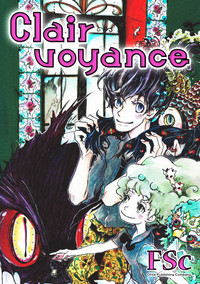
Clair Voyance, Vol. 1

January 24, 2013 by Anna N

clair

Clair Voyance Vol 1 by FSc
Available from jmanga.com

This is one of those unique non-commercial titles that makes me feel glad that jmanga.com exists in the current manga market. I decided to take a look at this title solely because of the cover image. I thought the art looked whimsical and quirky, and the inside of the volume matched with my initial impression of the cover. Clair Voyance doesn’t have much of a detailed plot, as it mostly deals with a relentless, classic science fiction novel quoting girl named Pi who fixates on a mysterious classmate named RueRune who goes around wearing a sarong and styles his hair in a bun anchored by random botanical specimens. Pi stalks RueRune, and sees him wander about, talking to the air, buying food, and getting violently ill. Eventually she realizes that his odd behavior is due to the fact that he’s talking to invisible creatures.

Where this title stands out from other monster of the week manga is the art and slice of life approach to the material. This title is published by Ohta Publishing Company, which I believe is the publisher of the magazine Manga Erotics F, home of beloved to manga bloggers authors like Natsume Ono, Usamaru Furuya, and Inio Asano. Fsc’s art reminds me a bit of a Natsume Ono, if Natsume Ono was inclined to draw spirits that look like odd hybrids between botanical illustrations and Where the Wild Things Are. Each chapter is basically a short episode where Pi indulges in her curiosity over RueRune by following him around and pestering him, and while RueRune is able to relate much easier to the creatures that surround him, Pi represents the potential for his first true human friend.

There were a few typos here and there in the translation for this book. Fans of Natsume Ono would likely appreciate the gentle atmosphere of Clair Voyance, and if you enjoy monster of the week manga but would like to try a title with a laid-back, unconventional sensibility, this is the manga for you.

Electronic access provided by the publisher.

Filed Under: REVIEWS Tagged With: clair voyance, jmanga.com

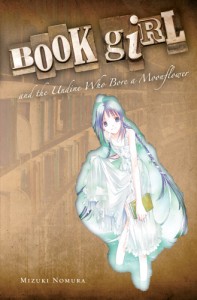
Book Girl and the Undine Who Bore a Moonflower

January 24, 2013 by Sean Gaffney

By Mizuki Nomura. Released in Japan by Enterbrain. Released in North America by Yen Press.

One of the main themes of the Book Girl series has been elements of the past seemingly overlaying with elements of the present, and our heroes and other protagonists finding themselves trapped in a seeming reimagining of past crimes. Konoha, our hero, is especially notorious for seeing his relationship with Miu mirrored and kaleidoscoped in virtually everything he interacts with, but it also plays out with Takada, Akutagawa, and the other members of the cast. Including a girl from the 2nd novel named Hotaru Amemiya, whose presence is felt in this 6th book of the Book Girl series.

BookGirlv6Final

This novel takes place chronologically between books 2 and 3 (Famished Spirit and Captive Fool), during Tohko and Konoha’s summer break. That said, it reads better having come after the others, and has significant foreshadowing for the last two books, so it’s well-placed here. It also delves into the story of Maki Himekura, which isn’t too surprising, given she’s the one remaining main cast member who didn’t get a book of their own. I had worried that Famished Spirit would be all we saw of her, but that was Amemiya’s book, and its consequences play out a bit here, as we see Maki unchained, to a degree. Or rather, that’s what she wants to be.

Each Book Girl novel focuses on a specific work, and this one is no exception. I admit I’ve never read Kyoya Izumi’s play Demon Pond (I’m not even certain if it’s available in English), but its plot it helpfully laid out by Tohko along the way, so there’s no real need to. This book is also heavily imbued with demons and the supernatural, just like Famished Spirit, and even though most all of the ghostly elements are eventually explained as being all too human, the book has an atmosphere of tension, sort of like the old haunted castle romances of the turn of the 20th century.

This book takes place at the Himekura summer estate, so Takeda, Akutagawa and Kotobuki are absent. We do get to see Ryuto, however, Tohko’s cousin, and it becomes clear that Maki isn’t the only one deeply affected by the events in Famished Spirit. He and Maki clash immediately, with physical as well as verbal abuse. Not a surprise given how they’re both extroverted, flamboyant characters. As for Maki herself, she’s trapped in a situation that fans of Japanese manga with rich girls will know all too well – her life is already laid out for her and she can’t escape the thumb of her all-controlling grandfather. This helps explain (though not excuse) some of the rather unpleasant things she does in this book.

As for Konoha and Tohko, things are seemingly the same as ever. We get a classic Konoha panic attack here (though he’s just been kidnapped and is lost in a forest during a downpour, so I’ll grant him this one), and Tohko once again has a long speech at the end where she lays everything out for the cast, something that always seems a bit affected in these books, but fits the character perfectly. However, we also get a few hints of the final two books. Ryuto gives Konoha some prompts that, when eaten, given Tohko an altogether different attitude, and the final few pages of the book show Tohko in a highly melancholic state over the fact that soon she won’t be able to be with Konoha anymore. (The answer being ‘she’s graduating’, but given who Tohko is and the way this scene is written, it makes it *sound* as if she may have some wasting disease or something. I doubt the series is that downbeat, however.)

All five previous books of this series have bold type showing the inner monologue of the volume’s protagonist or antagonist, be that Takeda, Akutagawa, or whoever. Interestingly, the epilogue to this book’s bold type not only gives us a hint of Maki’s eventual fate (not sure how I feel about it, but that’s just the shipper in me talking), but reveals who the actual author of these pieces may be. If you’ve been reading along, it’s not much of a surprise, but the fact that we’re seeing it shows that we’re definitely getting all the cards laid out now. All that’s left is the final Book Girl story, which is so epic it will take two books to cover.

Filed Under: REVIEWS Tagged With: book girl

Kekkaishi, Vols. 10-15

January 23, 2013 by Anna N

I absolutely adored the first few volumes of Kekkaishi. It is rare for me to find a shonen series that I like that features art that is both clear and visually arresting combined with plenty of character development, adventure, and the occasional bit of humor. But even though I liked what I’d read when I started reading the series back in 2010, the length of the series at 35 volumes made me a bit hesitant to commit to collecting it. I’ve had volumes 20-25 stockpiled for future reading for some time now, but the Viz digital sale during the holidays and my rapidly diminishing bookshelf space prompted me to pick up 10-19 for my iPad.

These volumes feature Yoshimori in the middle phases of his shonen hero journey. He’s a little bit more self-assured and more confident and slightly less goofy around girl next door and fellow Kekkaishi Tokine. There are glimmerings of great power that make the suggestion that he’s “the chosen one” seem plausible, but he hasn’t yet fully grown into his abilities. Tanabe does a good job fitting in more episodic adventures into the larger mystery that Yoshimori is pursuing as he tries to find out the truth behind the mystical Karasumori site he is sworn to protect.

Volumes 10 and 11 deal with a powerful attack and the aftermath when powerful opponents visit the Karasumori site. Gen, Yoshimori’s new ally who is uneasy in his skin due to his half akashi nature, but he tries to help out Yoshimori as best he can. A fox princess and her retainers are visiting the site so she can gain power, which gives Tanabe the chance to create some lovely scenes where a pavilion is transported via gianty dragonfly ships, piloted by a spider-like woman, and accompanied by ninjas who drop out of the black clouds filling the sky.

Yoshimori’s brother is away on Night Troops business, casually flying through the air on a translucent Kekkai cube, talking strategy to Gen on his cell phone. Yoshimori, Tokine, and Gen band together to defend their site, with more strategy and skill than their opponents expect. Gen finds more acceptance than he anticipates from Yoshimori when he reveals his true powers, but he’s surprised by a sneak attack. The Fox Princess, expecting to find rejuvenating power, starts getting sick instead from the site. One of the reasons why I enjoy Kekkaishi so much is that it is able to portray a variety of emotional states in just a few pages, without ever feeling rushed. Yoshimori grieves the loss of his friend, then decides that he’s determined to exact revenge and become stronger. There’s a funny sequence where he tries to join forces with Tokine’s grandmother, and since she’s trying her best to dodge him, he brings a secret weapon – not a new mystical power but a skateboard. Tanabe’s akashi designs are always interesting – one of the foes the Night troops fight when they attack Kokuboro is a giant blobby monster baby.

Yoshimori’s unique powers cause him to be kidnapped and taken hostage by the Kokuboro, something that he doesn’t seem to mind all that much because he wants to destroy the akashi who took out Gen. Volumes 12 and 13 center on the battle with Kokuboro, as Yoshimori travels through his enemy’s castle in search of Kaguro. Yoshimori runs into Sen and an old friend of his grandfather’s along the way. Kaguro likes to toy with his opponents and play mind games with them. While he taunts Yoshimori, the young hero manifests a new power of destruction – a zekkai. The Night Troops come to the rescue just as the world of Kokuboro begins to crumble, and Masamori has to help deal with the aftermath of the odd power his younger brother suddenly manifested. In Kekkaishi each battle prompts moments of emotional revelation, and a big one occurs when Tokine confronts Yoshimori about his actions when he finally returns home. There are then a few stolen moments of normalcy, as Tokine goes back to her usual lectures while the friends walk to school, and Yoshimori escapes into the kitchen once again for his dessert experiments.

In volumes 14 a new ally named Takeshi appears, on the hunt for an evil spirit named Jaren who destroyed his master. Takeshi’s enthusiasm and explosive personality almost make him a parody of a shonen hero, but things quickly turn serious when the new friends confront Jaren, whose proclivities towards psychological manipulation make battle difficult. Things can’t be all doom and gloom and angsty battles, so when Yoshimori is visited by a crow goblin seeking help because his master has grown overly flirtatious, Yoshimori finds himself drawn into an odd adventure. Things take a turn for the surreal when odd black boxes start popping up that serve as portals to the home of a very disturbed man. A young, timid member of the night troops is trapped, but she ends up being remarkably resourceful with her very specific powers.

Revisiting this series reminded me of just how enjoyable shonen manga can be when it is really well done. The pacing in Kekkaishi is excellent, as Tanabe swings back and forth between epic battles and shorter episodic encounters. The fights in Kekkaishi are rarely just for the sake of fighting, as each confrontation generally leads Yoshimori into a little bit more knowledge about either the nature of the site he is protecting or how best to manage his own powers. There are plenty of manga that sacrifice clarity for looking cool – producing action scenes that are difficult to follow or overly detailed panels that end up distracting from the story. Kekkaishi’s art is easy to follow, but many of the character designs and scenes remain in my mind after I’ve finished reading a volume. I’m a little annoyed at myself for waiting so long to continue reading this series, but I’m glad that have so many volumes waiting on my to read stack now.

Filed Under: REVIEWS Tagged With: kekkaishi, Shonen, viz media

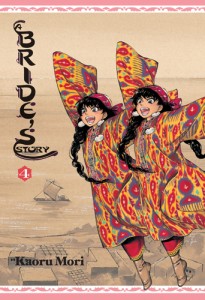
A Bride’s Story, Vol. 4

January 22, 2013 by Sean Gaffney

By Kaoru Mori. Released in Japan as “Otoyomegatari” by Enterbrain, serialization ongoing in the magazine fellows!. Released in North America by Yen Press.

I reviewed the two previous volumes of this series as Bookshelf Briefs, but continued to have the same issues I had with Volume 1. The quality was excellent, but I had trouble connecting with many of the characters due to Kaoru Mori’s standard operating procedure of placid people with vaguely repressed emotion. This was not helped by the release of her Something And Anything collection, which showed she could write loudmouths and comedy as well as the rest of them. And so, seeing this new volume was coming out and had a slightly more upbeat cover on it, I wondered if it would get me more involved emotionally.

Mori_A-Brides-Story-v4

Oh yes. Hyperactive tribe of loudmouths for the win! Actually, we do start off in Amir’s area, with ominous foreshadowing about her family’s clan, as well as a cute little story where the tribe’s resident tsundere, Pariya, finally meets a guy who may not be terrified of her. But the bulk of the story continues to follow Dr. Smith as he heads towards the West slowly (and thankfully does not run into the well-written but depressing angst that Vol. 3 gave us). Here he meets the twins of the title, who are rambunctious hellcats who can’t sit still and who are so much of a pair that a suitor for them would almost have to involve a pair of brothers so they aren’t separated. The bulk of this volume is dedicated to their trying to catch themselves a man, and their family’s eventual success at this task.

As I noted, this entire tribe seems a lot more lively than Amir’s. It’s not just the twins – their parents may be more mature, but they’re just as over-the-top. Indeed, the mother’s reaction to her children being unable to sit still for even two seconds is comedy gold. And for all that it looks as if the twins are trying totally stupid things to get themselves noticed and married off, when their mother and aunt talk about how they both got married, the stories are based off of coincidence and luck. This does not help to provide a good influence. And of course the couples contrast nicely, as each girl is matched up with a quieter, more cynical young man (childhood friends, of course) and the two couples learn how to take their own path and be slightly different. It’s only slight, too – I liked how it’s shown the two twins really are nearly alike, even in personality, and only differ in subtle ways that have to be picked up on.

Not all is sweetness and light, thought. I already noted the ominous first chapter with Amir’s tribe, but there’s a constant reminder here at how many folks die young – particularly women in childbirth. Pariya’s suitor notes her attitude, and his father says that the girls with ‘too much energy’ are the best. Likewise, the twins’ mother gives them one last request – stay healthy, above everything else. This is very much a series from another time, and it gives a poignancy to all these matchmakings.

Vol. 5 only came out in Japan recently, I think, so it may be a while before it hits here. In the meantime, we have a wedding to attend. Let’s hope this one is filled with more unambiguous joy than the others we’ve had so far. Though I have a feeling that, even as this series focuses on ‘different’ brides every arc, that we’ll soon be wandering back to Amir’s village.

Filed Under: REVIEWS

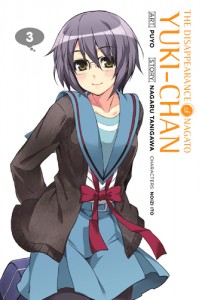
The Disappearance of Nagato Yuki-chan, Vol. 3

January 17, 2013 by Sean Gaffney

By Nagaru Tanigawa and Puyo. Released in Japan as “Nagato Yuki-chan no Shoushitsu” by Kadokawa Shoten, serialization ongoing in the magazine Young Ace. Released in North America by Yen Press.

A Quick Guide to writing manga AUs for the otaku fan, by Sean Gaffney.

I’m assisted today by Puyo, author of the Disappearance of Nagato Yuki-chan, a spinoff of the Disappearance movie filtered through the sensibilities of Puyo’s Haruhi-chan gag manga. With that in mind, let’s examine a volume of this series closely, keeping an eye out for handy tips.

yuki-chan3

The first thing to learn is that you have to know your audience. In this case, the audience are fans of the Haruhi franchise who read Kadokawa Shoten’s Young Ace magazine. They’re a built-in fanbase, and know the source material inside and out. This has its uses. You don’t have to delve so hard into character introductions, as everyone reading it knows who you’re writing about. And it means that your character interaction can be subtler. Take a look at page 27, which features Mikuru. Her dialogue, “I’m not very assertive, though, so I appreciate it when people can push me into doing things” is a redemptive reading for the original series’ Haruhi. This Mikuru is free to admit that she’s not simply being bullied and assaulted by a girl she can’t say no to, but is grateful for the assertiveness training.

In fact, this is another of the main bonuses to franchises like these, especially ones based on a light novel with a first-person narrator. Due to the viewpoint, the reader’s observations and biases are linked with the main character, as you rarely see scenes outside his purview. Even a straight manga adaptation, such as Haruhi’s, is forced by its source material into this narrow path. But in Nagato Yuki, the viewpoint is third person, which means we have the opportunity to see people in perspectives other than Kyon’s. This is particularly helpful in regards to Haruhi and Ryoko (or, as I like to call them, OTP), Both these characters change when they’re around each other. Ryoko, normally forced to be the perfect oneesama around Kyon and Yuki, lets out her childish immaturity near Haruhi. Likewise, the genki Haruhi is forced into the straight man role around Ryoko, and shows a genuine concern for her. Both characters benefit immensely from this.

The key in writing these sorts of AUs is to deviate from canon an acceptable amount, but not too much. In this case, the material is benefited by the movie itself, which gave us the shy, emotional Nagato used for this adaptation. Certain other AU adaptations, which I won’t name but rhyme with Bevamgelion, have taken their characters and made them 100% different from the original in almost every way, leading the reader to wonder why they simply didn’t create a new character? (The answer, as I’m sure you all know by now, is MONEY. Use your franchise well and use it wisely.) Nagato Yuki here is considerably different from the canon, to be sure, but the movie helped build a bridge, and there are enough signs of the original (Yuki’s explanations being incomprehensible, her reaching out for the stars) that it works.

Even Kyon, who has been poorly developed so far, gets a bit to do here, as his conversation with Ryoko shows that he seems more aware of Yuki’s affection than his canon counterpart, and is simply taking things slow. (As for Koizumi, well, he gets nothing. The others even acknowledge in the story how useless he is. We’ll be discussing this next month when we talk about the Kyon and Koizumi collection.)

In terms of things NOT to do – get back here, Puyo, and take your medicine – the artist’s art still needs work. His shading is too simplistic, especially in regards to hair. This means when you have Haruhi, Tsuruya, and Ryoko all standing near each other, they can be difficult to distinguish. I shouldn’t have to identify a person only by their hairband or eyebrows. There’s also quite a bit of fanservice here, but the artist wisely put it all in one eight-page chapter, along with the interstitials. And really, compared to some other Kadokawa titles I’ve seen, this is pretty tame. The readers of this book are the “D’aaaaawww, look at them being adorable!” crowd, they don’t need lots of nipples.

I apologize to the class for the cliffhanger ending, but Puyo assures us there’s a good reason for it, and reassures us that Yuki is not in fact killed by a car. That would make the rest of the series quite short. In the meantime, your homework is to compare and contrast this franchise to Evangelion – whoops, sorry, Bevamgelion – and Alice in the Country of Hearts, paying particular attention to which audience subset each separate spinoff title aims for. We’ll see you back here in May, and we’ll have a lot more to talk about with Yuki then. Dismissed!

Filed Under: REVIEWS Tagged With: disappearance of nagato yuki-chan

Jiu Jiu, Vol. 3

January 15, 2013 by Anna N

Jiu Jiu Volume 3 by Touya Tobina

Sean wrote in the latest Bookshelf Briefs column that Jiu Jiu is a title that he feels he should be liking more than he is, and that’s exactly how I was feeling after putting down the third volume. Jiu Jiu has many elements in place that I look for in a manga. Tobina’s art style is quirky and detailed, and I generally like supernatural/fantasy shoujo titles. The third volume features some more background information about the Hunter clans that Takamichi is ultimately going to be in charge of, along with the sudden appearance of her ex-fiance, and plenty of emotionally anguished violence.

The central refrain of Jiu Jiu that gets repeated again and again is “We’ll always be together,” as with each volume Takamichi and her familiars Snow and Night reaffirm their commitment to the odd little family unit that they’ve built for themselves. Unfortunately for me, there isn’t enough story to hang on to for me to really be all that engaged in what happens to the characters. Takamichi and her Jiu Jiu’s fight against change and growing older is not engaging me as much as other manga. I’m much more interested to find out in Demon Love Spell Volume 2, and that’s after reading only one volume. If three volumes of Jiu Jiu aren’t making me feel interested in what’s coming up next, I’m not sure if the next one will make me more invested in the story. This is a bit of a shame, because with a slightly more engaging plot or more nuanced characters I think I would enjoy this title much more. The art and hints of a darker sensibility at work do make Jiu Jiu stand out from other shojo titles, but I’m not sure if that’s enough for me.

Review copy provided by the publisher.

Filed Under: REVIEWS

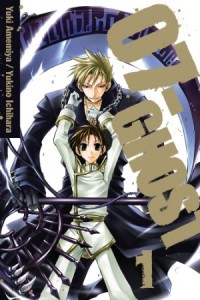
07-Ghost, Vol. 1

January 14, 2013 by Sean Gaffney

By Yuki Amemiya and Yukino Ichihara. Released in Japan by Ichijinsha, serialization ongoing in the magazine Comic Zero-Sum. Released in North America by Viz.

One of the side-effects of reviewing manga and trying to hit most of the new Vol. 1s is that I get exposed to series that I wouldn’t otherwise pay much attention to. And this one definitely falls squarely into that wheelhouse. Epic fantasy isn’t really my thing, and this is overwrought epic fantasy of the finest order. That said, it’s quite good at what it does, especially since it’s apparently the debut work of both creators (who are female – I’m used to male manga creators collaborating, so this is nice to see).

07ghost1

Teito Klein is your average fantasy bishonen, and indeed there’s more than a touch of the CLAMP influence here. He’s seen as cold by his military academy classmates, who don’t know how much he really feels. He has, however, managed to open up to one kid there, who has become just like family to him. That kid’s name is Doomed. Wait, sorry, no. It’s Mikage. They spend about 40 pages bonding and showing off that they’re skilled fighters, then Teito accidentally hears something he shouldn’t, and suddenly this military school becomes a lot more sinister and evil. Clearly the only thing to do is to run away and end up at a church filled with hot bishops, who are taking out evil wherever they may find it.

Given the authors’ past works (which consist of about 59 million Naruto yaoi doujinshi), I was rather surprised that this didn’t have quite as many BL overtones as I expected. Oh sure, Teito and Mikage have that close bond of friendship, but it actually feels like that. And Frau’s attentiveness towards Teito is somewhat undercut by his constant flirting with everyone and his porn collection. In general, this is about as gay as K-On is lesbian, which is to say that the main cast lacks any real females, so you ship what you can.

There’s a lot of religious symbolism here, with eyes given the names of archangels and discussion of heaven and hell (complete with reincarnation – as always, never let it be said that Japan settles on one religion when it can have them all). I liked the legend talking about the three dreams, which is both suitably epic and nicely sweet. I do note that I feel things went a bit too fast in this first volume. I’d have liked to see more at the military academy before Teito was captured, and we also get precious little of our main antagonist (who seems pretty ambiguous), Ayanami, who appears to have stepped out of the pages of Weiss Kreuz.

There’s a lot of goofy humor here, which helps to relive the tension caused by the apocalyptic events going on with Teito. Clearly he is a messiah figure here, and I imagine things are only going to get worse for him before they get better, which is somewhat sad given that this volume ends with his possessed best friend trying to kill him. Still, if you like CLAMP’s more fantastic titles, such as RG Veda, This should be a good read, and is a nice change of pace from Viz. (I always like seeing series in their plain old ‘Viz Media’ imprint, as opposed to Jump/Beat/Signature.)

Filed Under: REVIEWS

Girl Friends The Complete Collection, Vol. 2

January 12, 2013 by Sean Gaffney

By Milk Morinaga. Released in Japan by Futabasha, serialized in the magazine Comic High!. Released in North America by Seven Seas.

When we last left our heroines, Mari had decided that her love was never going to be requited, and had decided to move on – sort of – and tell Akko that she’d gotten a boyfriend and had gone all the way. This leads us to the first half of this omnibus, which is Akko trying to figure out why this makes her jealous, and dealing with her own newly discovered feelings for her friend. The focus shifting to Akko is very welcome, as though she’s the outgoing one of the pair she is not necessarily more worldly or mature. We see flashbacks to her childhood that show her being very much a solitary person, and even when she made friends (via discussion of fashion and makeup) they didn’t seem to be lasting friendships. This is when she latched onto Mari.

girlfriends2

It’s interesting how Mari and Akko both have misunderstandings about the nature of their relationship, but in ways that are true to their characters. Mari is basically negative, with a “no girl could possibly like me in that way” sort of attitude. While Akko’s problem is that, after kissing Mari impulsively at karaoke, she assumes that all is now well and they *are* together, not realizing that actually discussion of such feelings is needed. This is not helped by Mari’s naivete – one of the best lines in the book is Akko’s exasperated “You don’t usually slip a friend the *tongue*, got it?” That said, this makes it all the more satisfying when they do finally connect and get together as a couple.

Of course, what does that entail? Since they’re both girls, going out together, texting each other late at night… they’ve done that before as just friends. So what’s different? Sexual attraction, of course, and unlike many a mainstream yuri (or faux-yuri) manga the author does spend a fair amount of time dwelling on this. Given both girls lied to each other about their sexual experience, each worries that they’ll screw things up somehow. (This leads to Akko looking at German Porn sites to see how girls do it, which made me laugh out loud). Eventually the two do take things to the next level, in a scene that sort of rides the edge of the OT rating that Seven Seas gave the book.

There is talk of the future, but it’s mostly the same sort of talk you’d find in books with a het romance – Akko’s going to a different school than Mari, leading to stress, but you know their love will see it through, etc. There’s a brief discussion of telling their friends and family about their relationship, but that’s not something that happens in the manga itself, nor do we see any of the fallout that might arise from being a lesbian couple in Japan. This is a seinen yuri fantasy for men that ran in Comic High!, after all. Reality is not welcome in its hallowed halls.

With all that said, I don’t think the manga suffers all that much from avoiding the harsher aspects of Mari and Akko’s relationship. This is meant to be adorable moe romantic fluff, and it succeeds admirably. The emphasis is more on romance here in this 2nd omnibus, but I was pleased to see that friendship is still given a huge spotlight – Sugi gets to be the ‘mature adviser’ type of friend, Tama-min the eccentric cutie, and we even get more development from Kuno and Taguchi, the other two girls in the main circle of friends. I was pleased to see that there was no effort made to pair up the other girls with each other… even though this isn’t overly realistic, having what’s called a “cast Full Of Gay” might have strained my credulity a bit.

It goes without saying that this is a great series that fans of yuri (and moe) will adore. That said, I do have one more very important complaint. If Akko is cosplaying Lum, then Mari should be Ataru… but she just doesn’t have the personality for it. Tama-min seems to have her cosplaying as Ryuunosuke, which she’s also unlikely to pull off, but I can see it if I squint. But if she’s doing Ryu, Akko needs to be Nagisa… which leads to even more problems. Tama-min needs to think these things through! Geez!

(Also, two of those omakes make me think that Milk Morinaga has watched too many 80s American sex comedies… Getting Lucky specifically.)

Filed Under: REVIEWS Tagged With: girl friends

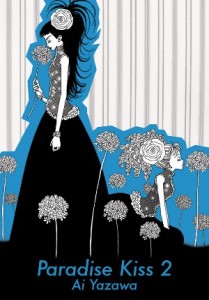
Paradise Kiss, Vol. 2

January 10, 2013 by Sean Gaffney

By Ai Yazawa. Released in Japan by Shodensha, serialized in the magazine Zipper. Released in North America by Vertical, Inc.

The second volume of Paradise Kiss continues Yukari’s journey into the glamorous world of modeling, even though it’s also about finding that you can’t simply drop everything and start a new career with nothing to fall back on. It’s also about her growing feelings for George, and realizing that a relationship with him is likely going to be far more difficult than becoming a top model. And of course it’s also a josei manga by Ai Yazawa, even within its pages. George is put out that the plot changed in between chapters, he’s chided for reading the manga and seeing Yukari’s inner monologues, and Yukari even gets in on the act, noting that she’s the heroine and can control who the hero is by who she falls for. It does seem a bit odd having her break the fourth wall along with the others. Yukari is the one that’s supposed to be the grounded girl among these flighty artists.

parakiss2

But Yukari’s image of herself is changing. Miwako helps her land a modeling gig that her sister is designing for (more Neighborhood Story cameos, as fans once again whine that this never got licensed), and she pulls it off quite well. She then uses that contact to get in touch with an agency that wants to promote her. Yukari’s upbringing has basically stomped her self-image into the ground, so there’s a constant feeling from her of waiting for the other shoe to drop. But no, she is really good at this. The words of praise and encouragement from everyone but George help as well, and set up the emotional climax of this volume, where she reconciles with her mother and agrees to return to school (but still model). It’s great stuff.

The problem, of course, is that she’s also fallen for George, hard. And while he clearly has a desire to see her succeed, mature, and become strong, he also does not given her any sort of support or encouragement – at least not explicitly. Yukari has a tendency to overthink everything, so pairing her with a man who’s almost impossible to read is frustrating enough. But you get the feeling that, unlike the rest of the cast, if Yukari were to fail or not measure up to George’s ideals, he would simply move on. He doesn’t emotionally connect, unlike the rest of the cast. We do get more scenes here of Arashi and Miwako’s relationship troubles, and the fact that he’s still jealous and fearful of Hiro. They are both easy to relate to. George is not.

(Poor Arashi is also the only straight man in a cast filled with outlandish characters, and you can see that it exhausts him. This is why he needs to make up with Hiro – he’d finally have someone to take the pressure off.)

George is an incredibly popular character. He’s handsome, dashing, trying to be a good lover (physically, at least – and he’s not the best at that either, as is lampshaded in a conversation between him and Isabella). But he has no interest in the give of a give-and-take relationship, and thus is the sort of guy you like to read about but would hate to deal with in real life. The one time in the volume that he really seems to open up to Yukari is when he’s talking about the clothing that he’s designed. Which is great for a manga that runs in a fashion magazine, but, like Yukari, I keep waiting for the other shoe to drop. In the meantime, though, no one can deny that this is a glorious soap opera, well-told.

Filed Under: REVIEWS Tagged With: paradise kiss

Weekly Shonen Jump Alpha Recap: January 7, 2013

January 9, 2013 by Derek Bown 3 Comments

cover-wsjaThere’s no real cure for a lazy writer than a topical issue that is updated every week. Thus, here we are, with a brand new column dedicated to celebrating the spearhead of digital and simultaneous manga publishing in the West: Weekly Shonen Jump Alpha.

The basic idea of this column is to provide my opinion of the most recent issue of WSJA, and to provide a forum for fans to share their own opinions on the latest Jump chapters. For those who hate reading but love listening to people talk about manga, fear not, just check out my podcast, new episodes posted the weekend after each issue comes out. You can find it at: Burning Lizard Studios

Without further ado, let’s see how the chapters this week fared. And yes, ye have been warned, there will be possible spoilers in these columns. I’ll try to keep it to a minimum, but when talking about a story you kind of need to talk about the story. So I can’t make any promises.

One Piece Ch. 693
The thing about One Piece is that depending on who you’re talking to it’s the most satisfying manga to read on a weekly basis, or it’s complete gobbledegook. Well, if you’ve paid attention to what I’ve written in the past then you know I love One Piece more than any other shounen manga. And this week was as good as ever. Some would say that Oda’s artwork is cramped, and I can’t quite deny that, seeing as how I had that same reaction the first time I ever saw the manga. But the advantage of this is that we get a chunky bit of story every week. And with how large the cast of One Piece is, that’s an absolute requirement.

The majority of this chapter was setting up the finale of this arc. Caesar Clown looks like he’s about to get away scott free, if Baby Five manages to get past Franky. With the island possibly exploding it looks like we’re in for a close escape.

onepiece

Naruto Ch. 614
Speaking of series with giant casts, Naruto is one of those series that could either use a little more content with each chapter, or at the very least spend a little more time focusing on the side characters. And even when it does focus on side characters, it’s never the ones that actually need the focus.

Case in point: A certain character is mortally wounded this chapter, and apparently dies. I’m not one to downplay tragedy, even when it’s fiction, but this really would have meant more if the certain character had actually done something in the past three hundred chapters.

It’s not like it’s impossible for an underused character’s death to be tragic; after all, Asuma’s death back in the early days of the time skip was actually well written and tragic. This is because right before killing Asuma, Kishimoto took the time to show us why him dying was tragic. His relationship with Kurenai was confirmed, and we get the revelation that they were about to have a child together. Coupled with the impact this has on his students it’s a pretty tragic moment. Granted I wasn’t entirely convinced because I personally would have preferred to see more of him before he was offed, but at the very least Kishimoto took the effort to make his death meaningful.

With the death in this chapter I have to admit that there’s still a chance that it will become more meaningful in later chapters. It just doesn’t help that I haven’t read anything substantial about this character in the past four years or more. The flashbacks to his scenes with Naruto early on in the manga don’t help much either. Rather they feel more like Kishimoto is waving them in our face, saying, “Remember how meaningful he was back when I bothered to do anything with characters other than Naruto and Sasuke? Feel bad!!!”

Nisekoi Ch. 56
It takes some serious writing chops to take a character like Marika Tachibana and actually make her interesting. We’ve seen her likes before. She’s the one everyone hates in the harem show—the arrogant one, the clingy one, the Shampoo, the Ayeka. The characters hate her, and the readers hate her. And yet, that really isn’t the case with Marika. Sure, her outer character is blatantly one-note, but those moments with her are actually entertaining, and there are just enough hints that there is more to her character—that she’s playing a part to keep us interested.

It also helps that Komi Naoshi is a genius at comedic facial expressions. I rarely get through a chapter of Nisekoi without finding an expression I love. This week the prize goes to Ruri, for her look of utter disgust at being ranked right under Shu.

nis

Toriko Ch. 216
I love Toriko far more than I should, considering I haven’t even read all of it. I’ve read the first nine volumes, and everything that’s been published in WSJA. This one is a victim of Viz’s inability to provide the chapters leading up to the most recent in a way that is actually economically feasible. Thus I find myself stuck in a position where I can either read the most recent volumes and wait for those to catch up with the chapters first published in WSJA, or I can find alternative ways to catch up. At the moment I’m holding strong with just reading the volumes, so here’s hoping we catch up soon.

I love cooking, and I love shounen fighters, so this is a match made in heaven. Especially with the most recent arc being a cooking festival. This is where I’ve truly fallen in love with the series. All the colorful characters, the way something as simple as food and cooking can fascinate an entire world. All of it together is just wonderful, and the introduction of Brunch these past chapters has been a great addition. This chapter itself is a bit on the weaker side, since it skims over most of the competition to introduce the final matches. Personally I would have loved to see more of the preliminaries, but considering how many chefs were involved I’m thinking this was probably for the best.

Cross Manage Ch. 15
I don’t particularly care for sports manga, nor am I making the mistake of getting too attached to brand new Jump series. Experience has taught me that new series have to be phenomenally lucky to actually survive to the point where they really become entertaining.

A lot of Cross Manage has been focusing more on the development of the main characters than the actual sport of lacrosse. This isn’t necessarily a bad thing, considering that lacrosse is presented more as a setting rather than the driving force of the story. But I really would like to spend some more time with the extended cast. I like series like this, where superficially it’s about a sport, but really it’s about the large cast of characters. So I find myself at a loss for what to do with a series that promises shounen manga, but then gives me a shoujo manga.

Not to say a shounen with shoujo tendencies is a bad thing, I actually find it hilarious that Cross Manage is potentially fooling people into believing it’s a shounen manga, when it so clearly isn’t.

At the very least we’ll get to see some more lacrosse, with perhaps some more focus on the ancillary characters during this tournament arc. I’d love to see this manga continue, but considering the fates of Barrage and Takama-ga-hara, I’m not too optimistic about Cross Manage‘s chances.

Bleach Ch. 521
Is it just me, or would Kubo be happier if he replaced his entire cast with big breasted women? Or just women in general. It seems to me that there is nothing he loves more than expanding a story that should take a fourth of the time it takes, and that’s drawing attractive women. Now, as a straight male I have absolutely no problem with this whatsoever. However, as a fan of manga, and fiction in general, I would appreciate if a bit more care went into the story. I’ve mentioned One Piece as an example of a manga that has a lot of material every week; well Bleach is the exact opposite. Kubo’s biggest problem, and there are some doubts that this is entirely his fault, is that he just doesn’t have enough material per chapter. A chapter of One Piece may take me a quarter of an hour to read. I can get through a chapter of Bleach in about five to eight minutes. There just isn’t enough to sink your teeth into on a weekly basis.

bleach

To be fair to this chapter, I’ve always liked Kubo’s sense of comedy. It’s not necessarily what he does best, but in my opinion he does it pretty well. The overall comedic sense of this chapter might throw some people off, but I for one at least enjoyed it. I look forward to next week’s chapter where we get to find out about the origin of Zanpakuto.

Yu-Gi-Oh! Zexal Ch. 25
Just this first column alone has taught me something important about being a manga reviewer. Sometimes you have to read something you don’t want to read. Sometimes you have to read a chapter based on an anime, based on a card game, based on a manga that by all accounts was pretty decent but has since turned into a monster of a franchise.

I’ve only ever watched the first Yu-Gi-Oh! series. And not even all of that. I’ve never read the manga. Nor have I ever read the manga (besides a few chapters) of the spin-off series. The problem with a manga like this is that it’s a tie-in media for the anime, and in my personal experience that tends to be a code phrase for, “Not very good at all.” There’s an element of laziness that creeps through in the adaptation from a different media to the graphic novel media.

But, let us not allow my bias to cloud my vision of this chapter of Yu-Gi-Oh! Zexal. What do I really think of the chapter? To be honest I don’t have a clue. Like Toriko, this series has the disadvantage of having several chapters published before it made its way into WSJA. But unlike Toriko I refuse to spend money to catch up on this series.

Superficially this is the most Yu-Gi-Oh! of all the series. The hair alone would put any glam rock band to shame. At least with the original series all the crazy hair looked fairly anime standard. With this one it looks like all the characters are Yugi poser wannabes. How many different shades of color can one head of hair have!?

This series even goes so far as to introduce technology that would be a lot more effective at resolving the conflict than a bunch of cards. Someone kidnaps your little brother? Forget the cards, you’ve got a jetpack! Fly up there and save the kid!

I will admit that a lot of my complaints stem from never really getting into this franchise. So at the very least I can say that were I invested in the series I might be more positive about this. But since I am not, I have gone from the original series to this, which is a bit of a jarring transition to say the least. As an outsider I can say that what I’m looking at is pretty ludicrous, but as an outsider I readily accept the fact that I just might be missing something.


That wraps up this week’s recap, join me next week as we continue our journey towards legally reading Jump chapters at the same time as Japan. If you want to know my opinion on last week’s chapters, check out my podcast, Manga^3 for the latest in manga news and commentary: http://www.mediafire.com/?09m5dfpi5lx92tf

Filed Under: REVIEWS, WSJA Recaps

  • « Go to Previous Page
  • Page 1
  • Interim pages omitted …
  • Page 274
  • Page 275
  • Page 276
  • Page 277
  • Page 278
  • Interim pages omitted …
  • Page 346
  • Go to Next Page »
 | Log in
Copyright © 2010 Manga Bookshelf | Powered by WordPress & the Genesis Framework