• Skip to primary navigation
  • Skip to main content
  • Skip to primary sidebar
  • Home
  • About Us
    • Privacy Policy
    • Comment Policy
    • Disclosures & Disclaimers
  • Resources
    • Links, Essays & Articles
    • Fandomology!
    • CLAMP Directory
    • BlogRoll
  • Features & Columns
    • 3 Things Thursday
    • Adventures in the Key of Shoujo
    • Bit & Blips (game reviews)
    • BL BOOKRACK
    • Bookshelf Briefs
    • Bringing the Drama
    • Comic Conversion
    • Fanservice Friday
    • Going Digital
    • It Came From the Sinosphere
    • License This!
    • Magazine no Mori
    • My Week in Manga
    • OFF THE SHELF
    • Not By Manga Alone
    • PICK OF THE WEEK
    • Subtitles & Sensibility
    • Weekly Shonen Jump Recaps
  • Manga Moveable Feast
    • MMF Full Archive
    • Yun Kouga
    • CLAMP
    • Shojo Beat
    • Osamu Tezuka
    • Sailor Moon
    • Fruits Basket
    • Takehiko Inoue
    • Wild Adapter
    • One Piece
    • After School Nightmare
    • Karakuri Odette
    • Paradise Kiss
    • The Color Trilogy
    • To Terra…
    • Sexy Voice & Robo
  • Browse by Author
    • Sean Gaffney
    • Anna Neatrour
    • Michelle Smith
    • Katherine Dacey
    • MJ
    • Brigid Alverson
    • Travis Anderson
    • Phillip Anthony
    • Derek Bown
    • Jaci Dahlvang
    • Angela Eastman
    • Erica Friedman
    • Sara K.
    • Megan Purdy
    • Emily Snodgrass
    • Nancy Thistlethwaite
    • Eva Volin
    • David Welsh
  • MB Blogs
    • A Case Suitable For Treatment
    • Experiments in Manga
    • MangaBlog
    • The Manga Critic
    • Manga Report
    • Soliloquy in Blue
    • Manga Curmudgeon (archive)

Manga Bookshelf

Discussion, Resources, Roundtables, & Reviews

Reviews

Tokyo Babylon Omnibus, Vol. 1

March 28, 2013 by Sean Gaffney

By CLAMP. Released in Japan by Shinshokan, serialized in the magazine Wings. Released in North America by Dark Horse Comics.

This is one of the big CLAMP series, the ones that first come to mind when you mention the creative team. It was their first really big hit (sorry, RG Veda), and when you read this first volume you can easily pick out why. Some manga are about the storyline and characters, some deal with building a world. But Tokyo Babylon is about building a mood, and it combines terrific artwork and a naive, somewhat somber hero to show us the world careening towards an inevitable apocalypse, one we’d see play out in the semi-sequel to this work, X.

tokyobabylon1

I’ve made a habit of pointing out CLAMP’s shortcomings in their post-2000 works, so it’s important to note how much they get right here. The artwork alone is worth buying the volume for, with a cute/handsome cast, striking settings, and strong, confident action scenes. Each story is self-contained so far, and has a plot that we’ve seen in many series before – a young spiritualists deals with restless ghosts and helps them find eternal rest – but it doesn’t feel tired, thanks in no small part to keeping the cast small and nuanced. Subaru’s noble idealism shines off the page, and makes an excellent contrast with his sister Hokuto’s eccentric extrovert. and then there’s Seishiro…

Let’s face it, Seishiro’s got something going on. I’m not spoiling anything, it’s just signposted – Hokuto even notes how he keeps changing the subject. At the start of the book he seems to be the most shallow – a nice, always smiling guy who tries to give Subaru gentle, older-man to younger-man advice while making cute jokes about seducing him. But by the time we get to the end of this volume, it’s clear that there’s something dark and unpleasant underneath that, and that Subaru’s idealism is going to run into it with a giant crunch. Honestly, in a way I can sort of see it. Subaru’s shininess is *so* over the top that it’s hard not to look at him every day and want to try to break it just a little bit…

I’ve jokes before about the magazine that Tokyo Babylon ran in, Wings, which is a shoujo/josei/fantasy/BL-lite hybrid that essentially became its own genre. Dark Horse advertises the series as one of the first BL manga to come out over here, but the BL in it is quite mild. Hokuto and Seishiro constantly joke about his love for Subaru, but Subaru’s lack of response beyond the occasional blush means that things don’t really go very far. Honestly, Hokuto is the big reason that this title isn’t completely bleak and grim – she’s a spark of life that brightens every scene she appears in. This will become far more important in the second volume, believe you me.

Dark Horse has done a really nice omnibus here, based on the re-released version from Japan (in case you’re wondering where Hokuto’s side-story got off to – it’ll be in the next one). A little oversize, nice thick paper, it’s a quality release. I’m not certain how changed the translation is from the Tokyopop edition, but it’s likely worth exchanging your old copies for this one anyway. And for those who haven’t tried this series, you really should – it’s CLAMP at their mightiest.

Filed Under: REVIEWS

Welcome to the Erotic Bookstore, Vol. 1

March 26, 2013 by Sean Gaffney

By Pon Watanabe. Released in Japan as “Momoiro Shoten e Youkoso” by Media Factory. Released in North America digitally by Yen Press.

This was definitely one of the most intriguing announcements of SDCC, and I wondered what sort of title it would be like? How mature were we walking here? Was it plot-oriented, or just a slice-of-life gag comedy? Well, having now seen it, slice-of-life is definitely the road it travels down. If it weren’t for the sex talk, this would be almost a typical workplace gag manga. It’s just that here, the workplace sells pornography and sex toys as well as the regular used books, and the clientele it gets can be a little special.

Watanabe_WelcomeToTheEroticBookstoreV1_TP

There’s only one scene that I would call so questionable that I’d grab it away from the under-18s (where the bookstore staff goes to the shooting of a porn movie… the most explicit parts of which are drawn using cute cat mascots instead), but make no mistake about it, this book is about a sex shop, and every single chapter is filled with sex talk. Masturbatory aids, adult videos, exhibitionists, voyeurs, you name it, they’re all in here. The author, by the way, is also the narrator/star, but mostly serves to stand aside and make snarky comments – she doesn’t get involved in any of the activities.

Judging by Watanabe’s other two titles, she seems to specialize in slice-of-life gag works like this. It’s broken up into short 8-page chapters, which examine the lives of the owner and staff, the varied customers, and also gets quite philosophical at times. The general rule of thumb in this book seems to be that sexuality is good and nothing to hide provided that it’s not hurting other people. This seems to be an especially good moral to have in times like these, where propriety is seen as everything.

The title is also quite funny, in a mild “causes a smile” way usually, but sometimes the more risque humor made me jaw drop a bit. It’s mostly about the shop, its merchandise, and the customers, but the real world intrudes quite a bit – you see Watanabe having to bust middle school students pretending to be over 18, dealing with yakuza and undercover police (she wasn’t arrested, but had to give a statement – no uncensored porn, please!), and going on karaoke nights with her co-workers. She’s also a female, and quite tall, so there’s talk about how sex shop customers react at having to pay for things through her. And yes, her manga skills do come up once or twice, as she tries drawing things for the shop. We also see her naivite occasionally, such as when she tries to lure more females into the store, only to find that this depletes the much larger male customer base (as they feel even more uncomfortable).

Overall, it’s a cute little title. That said, I wouldn’t get it unless you like slice-of-life mild humor stories, sexual content or no. The style is very “superdeformed” and abstract, so there’s no real nudity or sexual situations. It simply is what it is, a cute title about a woman who manages a used bookstore that has a back room filled with sex stuff.

Filed Under: REVIEWS

Neon Genesis Evangelion Omnibus, Vols. 4-6

March 21, 2013 by Sean Gaffney

By Yoshiyuki Sadamoto and GAINAX. Released in Japan by Kadokawa Shoten, serialized in the magazine Shonen Ace. Released in North America by Viz Media.

These volumes of Evangelion were coming out just as the TV series was finishing, so by now readers had a general idea where things were going to go. And so that allows Sadamoto to start to mix things up and change what we expect to see. There’s no radical alterations here, but some introductions are different, and one character’s fate is changed – for the worse.

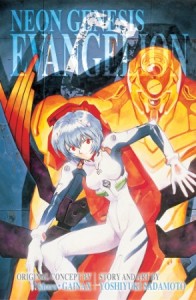
evangelion2

Rei features on the cover, but really has very little to do in these three volumes. That said, her one major scene is quite good. Shinji is still angsting about his father, and how he hates him but knows he’d like that to change. Rei points out that being silent isn’t changing anything, and he should talk to his father. So he does! And he gets shut down cold, as it becomes clear that Gendo is never going to bond with Shinji in any parental way, or stop using him as a tool. (Ironically, telling Shinji to stop trying to get closer to him might be the nicest thing Gendo does for him.) Rei also realizes that for all that Gendo is supposedly closer to her, it’s merely a facade, and I think that bothers her, in her own Rei sort of way.

Of course, the majority of this omnibus is focused on the arrival of Asuka. As noted above, she gets a different and far cooler introduction to the story, taking out an Angel by herself and then beating up a group of street punks to save Shinji’s butt. That said, she’s as harsh and abrasive as ever – except around Kaji, of course. (Kaji shutting Asuka down towards the end of this volume is handled quite well – he clearly knows what is going on and has been ignoring the hell out of it, but Asuka stripping in front of him lets him know he can’t do that anymore. Actually, Kaji in general is handled really well in the manga.) Shinji’s scenes with Asuka are usually the funniest parts of the books, and they also get some sweet bonding moments, showing them starting to open up to each other a little bit.

Then there’s the last third of this omnibus. I wonder if Sadamoto had heard people talking about how the manga was a lighter, more optimistic take on the anime and said “Oh yeah? Well take this!” All of Vol. 6 is devoted to Toji being selected as the 4th pilot, and all that stems from that. And it’s horrible, in the best possible way. In particular, Hikari’s tsundere antics (genuine tsundere, as opposed to Asuka’s “I am at heart emotionally broken” tsundere) are simply impossible to read as anything but tragic, and the last scene of the volume is a perfect “OK, gonna go sob in the corner now” capper. I hated reading it, but it was handled in a fantastic way.

So with that cliffhanger, we’ve been shown that the happy fun times of Evangelion are over. How Shinji reacts to his role in all this – as well as what his father did – will no doubt take up part of the next book. In the meantime, if you never read this series, this oversize omnibus with color pages and detailed notes explaining the confusing backstory is a perfect introduction.

Filed Under: REVIEWS

Library Wars: Love and War, Vol. 9

March 19, 2013 by Anna N

Library Wars: Love and War, Vol 9 by Kiiro Yumi

This manga is one of my go-to comfort reads. As a librarian, I am always happy to read about Library Wars‘s slight goofy premise of librarians becoming a paramilitary force to fight censorship, and while the development of the inevitable romance between overly tall rookie recruit Iku Kasahara and her intense, slightly short, and ever capable instructor Dojo might not be filled with much suspense, there are plenty of adorable and amusing moments along the way.

Iku now knows that Dojo is her fabled “Prince”, the long lost officer from her past who inspired her to join the Library Force. Dojo doesn’t yet know that she knows, but it is growing more and more difficult for the would-be couple to hide their feelings for each other. This volume is fairly episodic, but the stories do serve to push Iku and Dojo closer together. Iku takes part in a sting operation to catch a pervert that is preying on disabled women in the library, and Dojo isn’t very happy that she was placed in harm’s way even though she does manage to finish off the mission capably. Most of the volume centers around the skill test that Iku, Tezuka, and Shibazaki must pass to move up a level. Tezuka and Shibazaki don’t need to worry about passing the written part of the test, but Dojo volunteers to subject Iku to some merciless tutoring to make sure that she’ll be able to advance in her chosen profession. The skills test is where Iku will shine, because it involves leading a storytime for little kids. Tezuka has a bit of a child phobia, and he isn’t sure how to handle it. Iku seems incredibly casual about the situation but as she wanders around going on extra walks, she’s actually designing an incredibly successful active learning activity that ensures she’s going to pass the skill test with high marks. There are some great moments of awkwardness as Dojo apologizes to Iku for not having more faith in her, and she tries to give him a present in thanks for his help on the test.

In many ways, Library Wars is a standard sort of shoujo title, but Yumi’s art easily shifts between showing details of blushes and cartoonish negative emotions as the characters experience the agony of unexpressed love. The paramilitary library plotlines are amusing if one doesn’t think too hard about them, and Iku and Dojo are such a cute couple that I’d happily read many more volumes of the manga.

I didn’t realize that a live action movie adaptation was going to be released in Japan next month! Check out the trailer, what do you think?

Filed Under: REVIEWS Tagged With: library wars, shojo beat, viz media

Battle Angel Alita: Last Order, Omnibus 1

March 19, 2013 by Sean Gaffney

By Yukito Kishiro. Released originally in Japan as “Gunnm: Last Order” by Shueisha, serialized in the magazine Ultra Jump; currently owned by Kodansha and serialized in the magazine Evening. Released in North America by Kodansha Comics.

In the beginning, there was Gunnm, which ran in Shueisha’s Business Jump from 1990-1995, and told the story of Gally, a cyborg creation who was revived and had lots of awesome Rollerball-type adventures, killed bad guys, and battled the evil Desty Nova. Then in 1995 the series was wrapped up fast as the author was ill. Like “get your affairs in order” ill. Luckily, he got better, and 5 years later revived the series for new magazine Ultra Jump, retconning most of the last volume and restarting with Gally’s adventures in the sky. Viz Media licensed both series, renamed Gally to Alita, and released the first series as Battle Angela Alita and the second with the Last Order tag.

Then a few years ago, Shueisha was going to re-release the original Alita manga, but decided to remove the word “crazy” from the manga as it might upset the mentally ill. Kishiro was quite upset, and after a long, protracted battle, pulled his manga and moved to Kodansha, where it is currently running in Evening. Over here, the manga likewise leaped from Viz to Kodansha, who have started to put it out from where Viz left off (Vol. 16), but are also going back and re-releasing Last Order as large omnibuses, based off Kodansha’s bunko releases. The fate of the original series remains up in the air, but I suspect a re-release is unlikely.

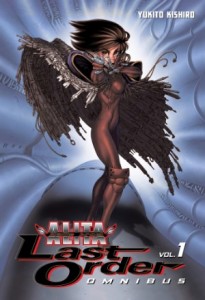
lastorder1

Which is a shame, as I think the omnibus would read much better if people could refresh their memories of the original. Kodansha Comics puts a 2-page “what has gone before” at the start, but despite trying to make Last Order as newbie-friendly as possible, every time Alita starts wondering about Figure Four, or obsessing over Lou, the reader is left thinking that they missed the first 20 minutes of this movie. Admittedly, if they did re-release the original people might be reminded that some characters who originally got happy endings now are suffering much more gruesome fates. Speaking of Lou.

With all that said, this is a really entertaining read once you get past starting in the middle. Alita’s a cute, sullen heroine who the author makes sure not to take seriously at times. Desty Nova reappears as a crazy awesome mad scientist, still amoral but no longer bwa-ha-ha evil, and now apparently mentoring her. We meet a few of her cyborg duplicates, like Sechs, who is obsessed with “defeating the original”, and Elf and Swolf, who I think are just there to be cute and snarky. And there are new characters, all of whom are dealing with a world that really, really seems to hate everyone. It’s a good thing that there’s elements of humor sprinkled throughout, as otherwise this would be the most depressing thing ever written.

There are also a lot of action sequences, which are equally excellent. James Cameron wants to turn this into a movie, and it’s not hard to see why. Not only does the artist draw a lot of fights, but you can actually tell how the characters are moving in those fights – a rarity with manga writers. Alita is amazing, of course, but still manages to get her ass kicked several times – which, given she’s a cyborg, usually involves her getting ripped in half. Indeed, she spends a good chunk of this book as only a top half. In amongst this action, there’s a whole lot of worldbuilding (I admit I skipped the textual diagrams, and don’t think I missed much), and hammering home the basic theme of the entire series, which is “what does it mean to be human” and “what makes humans different from others?” Having dreams, having goals, believing in yourself – there’s shiny shonen manga ideals buried under all this dystopia.

The omnibus is huge – 670 pages – and padded out even more by two early short stories Kishiro wrote about a year before starting Gunnm. The first is the better of the two, about a man trying to build his own plane meeting an Angel-like creature who has wings but hasn’t really had the gumption to use them. The other story, about a giant tank the size of a mountain that destroys towns and tends to mind control those who try to stop it, is less good. That said, both do continue the basic themes here – strive to survive, maintain your humanity, even if you’re a cyborg, an Angel, or a demon, and don’t let others dictate your goals.

There’s a lot going on in this volume. I didn’t even mention the Martian Queen (who appears to be Orihime Inoue’s descendant), or the obviously evil Venusian guy offering everyone roast babies just to be a dick; or my desire to see this cross over with A Certain Magical Index. But the basics of the series are laid out here, and there are a number of directions the series could go. Lots of politics, lots of action. Unless the author somehow gets distracted by writing 100+ chapters of a fighting tournament or something, I think he can’t possibly lose here.

Filed Under: REVIEWS

Knights of Sidonia, Vol. 1

March 17, 2013 by Anna N

Knights of Sidonia, Vol 1 by Tsutomu Nihei

I was excited to see that Vertical was releasing Nihei’s Knights of Sidonia, because I greatly enjoyed Biomega. As I was reading this manga, I realized that there really is a dearth of giant mecha manga being published in English. One viewing of the Evangelion anime was enough for me, so I haven’t been following the various manga spinoffs. Most shonen seems to be more of the monster of the week/fantasy variety now, and it wasn’t until I was reading Knights of Sidonia that I realized how much I missed GIANT ROBOTS FIGHTING IN SPACE!

Nihei’s manga centers on Nagate Tanikaze, a human on the seed spaceship Sidonia which is carrying humanity away from the destruction of the solar system by aliens called Guana. Nagate lives in an underground area, sharing his cramped apartment with his grandfather’s corpse and spending his time training in an alien combat simulation fighter. The human race has been split to an extent, with most opting for a procedure that allows them to photosynthesize. Nagate still needs regular human food and he is captured by others on the spaceship when he ventures out for rice. Nagate begins to assimilate into current human society, and he gets signed up to pilot a Garde – the mecha who fight the Guana that attack the Sidonia. Nagate is socially awkward but seems to have an odd ability to tolerate pain and heals up very quickly. Being a regular human might give him a bit of an edge over his modified compatriots?

As Nagate trains to fight he meets Izana, a human who can be both genders. He also meets a variety of photosynthesizing clones. Nagate’s isolation causes him to be several years behind with recent developments, but he throws himself into piloting the Tsugumori, the Guarde unit he is assigned to. There isn’t anything else going on with his life. The space battles are where a horror element comes in as the semi-sentient Guana can shift their shapes, even taking on the outward appearance of a human that they’ve killed. They’re blobby and somewhat fetus-like, if a fetus was a giant shifting alien.

One of the things I like about Nihei’s work is that he tells a compelling story without over-explaining everything. I’m getting to the point where having an origin spelled out in the first couple chapters of a manga starts making my eyes glaze over, but Knights of Sidonia manages to be intriguing without being frustrating. I’m interested to find out more about the human society on the Sidonia, the reasons for Nagate’s previous exile, and to learn more about his progress as a Guarde pilot. Knights of Sidonia doesn’t yet have some of the great desolate scenes of beauty that I enjoyed so much in Biomega, but one of the things I enjoy about Nihei’s art is his ability to convey scale and space in his backgrounds. When Nagate falls through a hole into an enormous rice storage bin, it is easy to get a sense of just how massive the Sidonia is.

Most importantly for fans of Biomega, there is a talking bear in Knights of Sidonia. She doesn’t have a machine gun yet, but she does have an artificial arm. Seriously, a talking bear in outer space with an artificial arm is reason enough to buy this manga, and all the great mecha/alien battle scenes and Nagate’s journey are really just a bonus.

Filed Under: REVIEWS Tagged With: knights of sidonia, talking bears, vertical

Trigun: Multiple Bullets

March 16, 2013 by Sean Gaffney

By Various Artists, series created by Yasuhiro Nightow. Released in Japan by Shonen Gahosha direct to tankobon. Released in North America by Dark Horse.

I am generally a manga person, though I have a lot of anime that I love. But if you were to ask me which I preferred, the manga or the anime, 90% of the time I would pick the former. Trigun is one of those exceptions, however. I saw the anime first, and was entertained and riveted by its over the top action and comedy slowly wending its way towards inevitable tragedy. It, like many other Shonen Gahosha series (including Hellsing and Excel Saga) was licensed for an anime very early on in its run, so had an ending that had many of the same beats the author wanted but was distinctly different. Unfortunately, Nightow’s action scenes tend to leave me hopelessly confused, as I simply can’t follow what he’s drawing half the time. His storytelling is also very oblique (typical to a Western). As such, I never really got into Trigun Maximum.

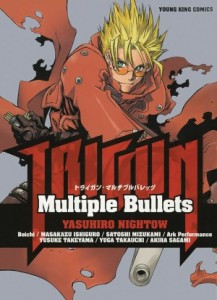
trigunmultiple

But I picked up this anthology anyway, as I was curious to see what other writers would do with Nightow’s vision. Of course, what most people might pick this up for is Nightow himself – it contains the 80-page story he wrote up to go with the release of the Trigun movie. The story, Badlands Rumble, is pretty much an encapsulation of the manga. Meryl and Milly are there but don’t do anything, Vash is really silly and then not so much, Wolfwood gets irritated but clearly is siding with Vash, and there are innocents and villains who are out of Bob’s Big Book of Western Cliches. If you liked Trigun, you’ll get a kick out of it.

Of the remaining stories, there were two that didn’t really work for me. Boichi’s story about a woman giving birth to an atomic bomb – sort of – and plays on Vash’s pledge to avoid killing. It is, however, filled with Boichi’s fanservice (he writes Sun-Ken Rock), something Trigun is usually blissfully free of. And the 4-koma with Meryl and Milly is really, really slight and not all that funny.

But there’s also some excellent storytelling here. The folks who worked on this anthology love to play around in Nightow’s world, rather than just writing character-based stories about Vash. Satoshi Mizukami, who does my pet favorite The Lucifer and Biscuit Hammer, has a story about whether the various warring races (humans, plants, worms) can really come together, but it’s actually cuter than I make it sound. Yusuke Takeyama’s is dark and depressing, with another typical Western cliche: the bit of hope that is then brutally cut down. That said, it’s tense, gripping stuff. And Sagami Akira’s Vash/Meryl story about the impossibility that is Vash’s hair is really shippy in exactly the same way that the Trigun manga never is. (The anime was a bit better at it.)

And easily the gold standard in this collection is the storybook tale that retells Trigun as a fairy tale, written by Ark Performance (better known for their Gundam stuff). The art is fantastic, the style is gorgeous, and the reveal of who’s telling the story is the perfect sweet (and bittersweet) capper. The entire volume is worth getting just for this 16-page story.

I generally prefer character-driven works to world-building stories, and Trigun definitely falls into the latter category. That said, many writers love walking around in someone else’s world, and Nightow’s is probably one of the best to wade into. This anthology had more hits than misses, and is a good epilogue to the Trigun series.

Filed Under: REVIEWS Tagged With: trigun

Barrage, Vol. 1

March 13, 2013 by Sean Gaffney

By Kouhei Horikoshi. Released in Japan as “Sensei no Barrage” by Shueisha, serialized in the magazine Weekly Shonen Jump. Released in North America by Viz Media.

It can be somewhat difficult when you advertise the popularity of your own series. Weekly Shonen Jump has made it a point to discuss the “popularity poll” table of contents they do every week, with the strong series in the front and the ones with fewer votes in the back. As well as their culling of the latter at a moment’s notice. That said, just because a series is unpopular doesn’t mean that it’s bad. When Shonen Jump Alpha started up, they grabbed a few new series to show off the web magazine, and North American readers quickly found that new series in Jump die far more often than they live. Barrage being the first casualty.

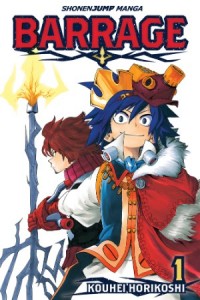
barrage1

Barrage makes it a point to say it takes place somewhere out in space, on an alien world. And indeed we do see a few aliens here and there, mostly of the villainous lizard type. But for the most part this world is “fantasy-ish”, about as alien as Naruto or One Piece’s non-Japanese worlds are. Astro is this spunky teenager who takes odd jobs to take care of the heartwarming band of orphans he’s gathered… and seems to lose said jobs just as fast due to his loud mouth and sense of justice. Then he runs into a boy who looks his exact duplicate, says he’ll have to impersonate the prince for a while… and then promptly gets shot, leaving Astro to fend for himself. Luckily, this is Jump, so a strong sense of justice is pretty much all you need. Well, that and an evolving alien sword.

There’s an over-earnestness that grates on me a bit when reading this. The scrappy band of orphans in particular look straight out of the Our Gang playbook, and their farewell scenes with Astro as he goes off to fight enemies are meant to be overly sappy in a humorous way, but instead becomes mawkish. The art is OK but not great, and at one point there’s a roving band of female outlaws (sort of) who are mostly indistinguishable from each other. And the plot and feel of this book does not particularly feel original (if Astro doesn’t turn out to have been the real prince after all by the time this wraps up, I’ll eat my copy of Volume 2).

That said, there’s stuff to like here. Astro is a good hero, being straightforward and sticking to principles without coming off as stupid or moralistic. Tiamat, the grumpy knight who is forced to mentor Astro on his journey, is the perfect antidote to Astro, and gradually won over by the boy’s immense charm. It’s also nice to see a competent, benevolent king for a change. Still, at the end of the day, if this were a 30+-volume epic like Bleach or Gintama, this would be where I’d say “it starts off poorly, but gets better after the first few volumes.” Sadly, Vol. 2 of Barrage was the last, and I suspect that the ending will feel like a “you’re cancelled, wrap it up” ending. I hope I’m wrong.

Filed Under: REVIEWS Tagged With: barrage

Paradise Kiss, Vol. 3

March 11, 2013 by Sean Gaffney

By Ai Yazawa. Released in Japan by Shodensha, serialized in the magazine Zipper. Released in North America by Vertical, Inc.

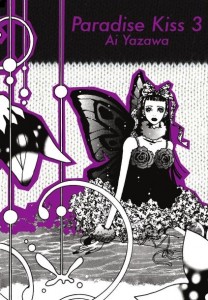
The cover of this final volume of Paradise Kiss features Yukari, looking gorgeous in that vaguely ridiculous way that haute couture always does, with butterfly wings on her back and roses on her breasts, staring off towards the camera looking like she’s about to cry. It could almost be one of her model shoots, except that none of them really want that kind of emotion – they want happy, relaxed, “wow, I want to be like her so I will buy this product” Yukari – or, when she’s modeling with George, “Wow, I want George so I will be like her.” Yukari is best in modeling when she’s self-assured and casual, which is the exact opposite of her teenage years and her relationship with George.

parakiss3

There was a point about halfway through this volume when I’d really had it up to here with Yukari, as her self-loathing, jealousy, and highly wrought emotional state all come together at once with the arrival of Kaori, George’s old classmate and friend. Not only is she the one girl who seems to have resisted his advances – but she’s become successful, seems to have her act together, and also manages to be the one to advance the plot (and George’s career) when George himself is unable or unwilling to. And yet she’s not with George – and neither is Yukari, as after this scene I think George has realized that being with her as a couple is bad for both of them individually.

Yukari has realized this too, of course, but wants desperately to cling to what she has anyway. We’ve all been there – it’s our first love, so we’re determined to make it work even when there’s all sorts of evidence that it won’t. It’s hard to let go. In addition, it’s all too easy to let fear and self-hatred put things in a holding pattern as well. This is Arashi’s issue, who can’t understand why Miwako doesn’t hate him, especially as she knows she still loves Hiro. Of course, it’s because she loves Arashi, and is trying hard to make things work. They, unlike George and Yukari, have a relationship where they’re better people together than they are separately. Arashi’s still bad with words, but his inviting Hiro to the shrine visitation speaks volumes.

Of course, just because the two leads aren’t a good couple in the long run didn’t mean there wasn’t a lot of love and affection there. George’s final gesture to Yukari is typically grandiose, but also shows how much she really meant to him, even if he didn’t always communicate it properly. It could be argued that the epilogue is a bit overly happy – Yukari is successful as a model and actress, George is designing Broadway shows, Arashi and Miwako have a kid – but that’s pretty much exactly what we want from the series. This was about a group of overambitious, overemotional overachievers. They crashed and burned in their teenage years, both in love and in the ParaKiss brand, but it only gave them more strength. Yukari gets told at one point, worrying about embarrassing herself on a catwalk, “Well, yeah, you’re gonna do that, all models do at first.” By not giving up, and keeping that drive for success and happiness, Yukari and her friends earn the right to their shiny happy ending. Even if, like Yukari, you’ll tear up a bit as well.

Filed Under: REVIEWS Tagged With: paradise kiss

One Piece, Vol. 66

March 10, 2013 by Sean Gaffney

By Eiichiro Oda. Released in Japan by Shueisha, serialization ongoing in the magazine Weekly Shonen Jump. Released in North America by Viz.

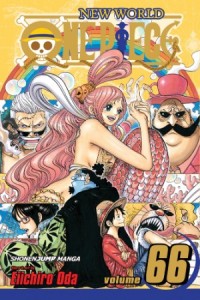
The cover to this volume of One Piece is very telling, given that this volume ends one arc and begins another. In the foreground, we have Luffy, Jimbei and Shirahoshi, but new events are creeping in in the background, with Big Mom’s pirates one the right and Smoker and Tashigi on the left. Things are in a state of flux, and we aren’t quite sure where the manga is headed next. (That is, if we’re reading the manga only by volumes, Most North American readers can now read Shonen Jump weekly on Viz’s site, where Punk Hazard has just finished. Viz seems content to have the volumes be about a year behind the weekly chapters.)

onepiece66

Hody Jones having been defeated at the end of the last volume (and his comeuppance is highly amusing, and makes for a good capper to the “drugs are bad” plotline he and his mates had), all that’s left is to stop the ark crashing into the island and sinking it. Which is done, with the help of some ancient and powerful sea monsters who are mostly there to be mysterious. Then there’s the standard “we’ve won, let’s have a party” finale, which always gives us a nice two-page spread.

Most of what’s interesting about this volume, though, is the backstory we don’t really see. Robin has discovered the true nature of Shirahoshi, and it’s quite surprising. (And makes me wonder about Alabasta, which told of the location of another one of those ancient weapons – man, if it turns out to be Vivi, I’ll be highly amused.) Jimbei tells us that Akainu and Aokiji fought to see who would be leader of the Marines. It’s not a big surprise that Akainu wins, but Aokiji then resigning might lead to more surprises down the road. Oda sometimes compresses manga stories for time, and I suspect this is a battle he wanted to show but just never got a chance to. And of course this means the Marines are still after them, with Smoker and Tashigi, both now promoted, hot on their trail.

Speaking of Tashigi, the Marines seem to be treating her as they did Hina, which is to say half-awesome Captain and half sexpot. Hina, like Nami and Robin, didn’t really give a rat’s ass what they said. But Tashigi is obviously bothered by the sexism, and calls it out. Of course, I doubt very much this will stop it. Oda’s less sexist than some other Jump authors, but it creeps in here and there (look at how he draws most of the women now vs. 10 years ago), and I think Tashigi drawing attention to it just makes it more obvious. But hey, I’m glad to see her back regardless.

The Straw-Hat crew, meanwhile, leave Fishman Island to travel to, naturally, the most dangerous place Luffy can find (this is after going through a deathtrap waterspout with the help of some whales who aren’t Laboon, but could be his parents). There’s some lovely art here, and I like that, while the spout itself terrifies the designated crew members who get scared (Nami, Usopp, and Chopper), the terrifying visage of the New World just makes everyone happy. Well, happy till they reach Punk Hazard, with its ravaged landscape, fire-breathing dragons, and bottom halves of samurai. Oh, and half the crew already captured. Never let it be said that Oda paces things slowly.

If you love One Piece, you’ll love this. If not, this is absolutely not the perfect place to start – go back and read the early volumes.

Filed Under: REVIEWS

Strobe Edge, Vol. 3

March 6, 2013 by Anna N

Strobe Edge is the manga equivalent of comfort food and I find myself liking it more and more with each volume. The third volume explores the emerging love triangle between Ninako, reformed womanizer Ando, and unavailable but perfect Ren. Ninako is struggling a bit with wanting to be friends with Ren after being rejected previously, and things become even more emotionally traumatic when it seems like Ren is deliberately acting cold to her. Ren actually being a good guy, he is attempting to protect Ninako from the attentions of the Rejected by Ren Girl Squad, who have targeted Ninako with their bullying ways. This gets cleared up relatively quickly, but more complications are on the way as Ando’s feelings towards Ninako grow and deepen. The two guys in love with a slightly oblivious girl is a well-word shoujo plot device, but Ninako is oblivious and friendly that it is difficult to get annoyed with her. Sakisaka does a good job portraying the subtle ways that Ren and Ninako continue to be drawn towards each other. They have a random conversation about sweets and Ren reveals that he doesn’t think that his girlfriend even knows that fact about himself because he pretends to dislike them around her because she’s always watching her figure. Ren’s general protectiveness towards Ninako is unusual given is general indifference towards other girls. Ren’s actions like helping Ninako out at a school festival and providing extra math tutoring seem to go a bit beyond the limits of normal guy niceness.

Ando has plenty of feelings for Ninako but seems to be holding back both due to his awareness of her feelings for Ren and his realization that she probably couldn’t handle it. He hints around about his feelings and even confronts Ninako about her feelings for Ren, saying “You can’t love someone forever…without getting something back from them.” Ando’s brash personality is a big contrast to Ren’s more quiet thoughtfulness, but it is clear that he does actually care about Ninako and isn’t trifling with the idea of having a relationship with her.

I feel like Sakisaka’s art has grown a bit after three volumes. While the first volume focused a bit too much on Ninako’s blushing naivete, there are more comedic moments in this volume, mostly at Ando’s expense as he gets crushed in a subway car while Ren protects Ninako. When Ninako, Ren, and Ando all start a part-time job in a cafe, Ren and Ando are portrayed as the ultimate desirable waiters, smoothly taking care of everything, while Ninako’s enthusiasm almost makes up for her clumsiness. It is easy to see how well Strobe Edge fits into the Shojo Beat line and with so many series ending or about to end, I’m glad to have a newer series to follow.

Filed Under: REVIEWS Tagged With: shojo beat, Strobe Edge, viz media

Skip Beat, Vol. 30

March 4, 2013 by Anna N

Skip Beat Volume 30 by Yoshiki Nakamura

I continue to be an absolute fangirl over the current Skip Beat storyline about the Heel siblings. It says a lot that 30 volumes into this series I’m still so excited each time I pick up a new volume. Even with some of my other beloved shoujo series like Boys Over Flowers, I think I was starting to get impatient for things to wrap up around volume 30 but as far as I’m concerned I would be perfectly happy for Skip Beat to continue on indefinitely.

Nakamura is very clever about how she’s structured Skip Beat, because while there are plenty of shoujo series out there that use show business as a superficial setting, she really uses the idea of acting and the challenge of portraying other characters to highlight the inner psychological turmoil of her characters. I begin to get a better sense of why Kyoko and Ren are portraying the abnormally close punked-out Heel siblings. Ren playing a actor playing a role of a violent criminal gives him a certain amount of distance from the role in his new movie, a role that is dangerously close to the person he used to be as Kuon. This volume shows Ren’s legendary control slipping a bit as even with the protective layer of Cain Heel, the self he thought was buried starts to resurface.

Kyoko as Ren’s sibling functions as an important anchor for him, but she’s beginning to get a bit disconcerted by her physical proximity to Ren, and while she is attempting to carry out her real life role as best she can, she isn’t able to stay entirely in character. One of the things I’ve always appreciated about Skip Beat is how visually dynamic it is. There’s an extended action sequence at the start of this volume, but there’s plenty of visual interest as Kyoko and Ren both just process their thoughts about their situation. Ren cycles through different aspects of himself as we see the violent and non-reflective Kuon from the past, the grim Cain Heel role, and then glimpses of present-day Ren slip through the cracks in his performance as he interacts with Kyoko. It is nice to be able to count on Skip Beat for a reliable dose of shoujo manga goodness.

Filed Under: REVIEWS

Barrage, Vols. 1- 2

March 3, 2013 by Anna N

Barrage Vols 1 and 2 by Kouhei Horikoshi

Barrage is a bit of a rarity, a two volume complete shonen series. I tend to read less shonen than shoujo just because of my interests as a reader, but I also have a certain hesitation to commit to a long-running shonen series when there are so many shoujo series that I’m following. I think I enjoyed Barrage more just because at two volumes the story didn’t start to get spun out to the point where the manga overstayed its welcome.

Barrage is very loosely based on The Prince and the Pauper. Astro is a plucky slum kid in a futuristic world called Industria where the humans have completely been overrun by aliens, who function as a version of the mafia on the poor stressed planet. Astro has adopted other orphan kids and tries to hold down a job despite his difficult boss just so he can feed his adopted family. One day an arrogant prince named Barrage gets his attention called to Astro and proposes a switch in identities because the boys look so similar. A stray laser blast promptly sends the prince to his death, and a group of handlers take Astro to the palace. Astro agrees to serve as the prince, and he’s given help in the form of the Knight Tiamat, who is aces at fighting and incredibly frightened of women. Astro also demonstrates an uncanny ability to weild the weapon of the royal house, a bracelet called the Orgue which can transform into a powerful energy weapon based on the wielder’s intentions. The first volume mostly serves as set-up, as Astro takes his place in the palace despite his misgivings, and he learns that he has to travel from town to town to fight off the invading aliens. Astro’s motivation stems mainly from his desire to protect families in any form, and the stress that the aliens place on normal people trying to live their lives is almost unbearable to him. Tiamat is filled with exasperation at having to train a newly minted Prince imposter, but he also has some hope for the new state of affairs as Astro takes his responsibilities much more seriously than the previous prince.

The second volume settles in to more of an in-depth storyline as Astro and Tiamat head to a new town and meet Tiko, a young girl determined to avenge the death of her parents at the hands of the alien invaders. The art for Barrage is generally detailed and interesting, with plenty of variation in the aliens’ character designs. Barrage takes down a mountainous rock-like alien and one that looks a bit like a tadpole. Astro’s past is filled in a bit as he gears up to fight an alien who he previously knew in his life as an orphan. While by the end of the second volume I felt like there could have been at least one more volume of story, things were wrapped up nicely and I enjoyed being able to read a complete, short, shonen series. While there might not be anything super innovative about Barrage, it was fun to read and I thought that using the Prince and the Pauper as a set up made the basic story a bit more interesting that I would otherwise expect.

Filed Under: REVIEWS Tagged With: barrage, Shonen Jump, viz media

Neon Genesis Evangelion: Comic Tribute

March 3, 2013 by Sean Gaffney

By Various Artists, based on the franchise created by khara and GAINAX. Released in Japan by Kadokawa Shoten direct to tankobon. Released in North America by Dark Horse.

We’ve been seeing more and more of these doujinshi anthologies over here in North America. Quite common in Japan, both official product and fan-produced, doujinshi in this case doesn’t mean porn featuring the characters (at least not yet; Kadokawa just announced another Eva spinoff and I think they’re running out of other ways to make it work), but getting other artists around the office to draw parody comics making fun of said franchise, with the tacit approval of the creators. Given that Anno is quite happy making fun of his own work, an anthology like this was probably inevitable. But the question is, is it readable?

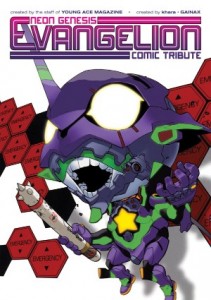
evangelioncomic

Well, yes, but only if you’re a hardcore Evangelion fan. As you’d expect, this volume makes absolutely no attempt to interest casual readers, and relies on everyone knowing not only the series itself but also the fandom and cliches regarding said series. The very first story involves the pilots dealing with their public approval rating dropping because they’re whiny and morose, there’s mocking of the fake “episode 26”, Shinji Ikari Raising Project, and even the live-action Eva that was in production at one point. Everyone is equally skewered, though admittedly Shinji gets the majority of the abuse here. And fear not, Eva fans who like to admire the girls, there’s lots of fanservice here, from normal “Ooooh, pretty girl” art from the Macross character designer all the way to leeringly horrible “Look, boobs!” parody as Misato and Ritsuko try to get Shinji to study by dressing in increasingly skimpy outfits.

That said, I feel pretty safe in saying this isn’t for everyone. It’s almost entirely comedy, with only the author of Loveless, Yun Kouga, providing a serious character study towards the end. Much of the humor relies on knowing the other titles the artist is famous for, which is fine if it’s say, the Sgt. Frog artist (who did the cover, of course) but verges towards incomprehensibility when you see artists such as Keiichi Tanaka and Tony Takazaki clearly making use of their own stylistic humor… which is lost on me. Given this is edited by Carl Horn, some liner notes might have been appreciated. Then again, given there’s a Sambo joke towards the end, maybe they were better off without them.

All that said, I did laugh quite a bit while reading this, even if it was sometimes “what the hell, this is so stupid!” laughter. Easily the best bits in here are the ones by Yushi Kawata and Yukito, “Neon Genesis Revolutionary Legend Evangelion”. They get three short chapters all to themselves, so I suspect the editors liked them as well, and have just the right amount of humor, snark, and insanity. Yoko Sanri’s Eva-san (the author of B Gata H Kei) is also fun, an amusing 4-koma Eva that feels like a relaxing breeze amidst all the loud Osaka comedy in this that tries a bit too hard.

I think Evangelion fans will like this, but even for them it may be a bit of a risk, as it’s simply so diffuse. The sort of book you’d describe as madcap. But recommended to Eva fans anyway, provided you don’t mind a lot of making fun of the cast. Oh yes, and Rikdo Koshi does a color page at the start, in case people wondered if my Excel Saga radar hadn’t gone off.

Filed Under: REVIEWS Tagged With: evangelion

The Wallflower, Vol. 30

February 28, 2013 by Sean Gaffney

By Tomoko Hayakawa. Released in Japan as “Yamato Nadeshiko Shichihenge” by Kodansha, serialization ongoing in the magazine Bessatsu Friend (“Betsufure”). Released in North America by Kodansha Comics.

Recently, Vol. 30 came out of two separate successful shoujo series. Yet while the reaction of most online fans to Skip Beat! 30 is “Yay! I’m so happy that it’s still running!”, the reaction the The Wallflower 30 tends to be more “EEEENNNNDD!!! EEEEEEEEEEEENNNNNNDDDDD!” Partly this is due to The Wallflower’s writer having little to no idea on how to resolve her romance without destroying her comedy, as I’ve noted before. But another reason is that The Wallflower is so episodic. If you jump from Vol. 6 of Skip Beat! to Vol. 25, you’re going to be somewhat lost. This is much less of a problem with this series, where even in this volume, where three of the stories interweave a small amount, each can be read on its own if you just happen to pick up that month’s Betsufure after a 4-year-hiatus.

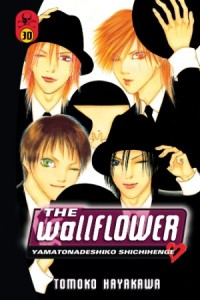
wallflower30

There is also, every chapter, the illusion that progress is being made and characters are growing. I’m not sure how much of it is deliberate, actually. But every chapter in this volume has that one moment where a character (either Sunako, Kyohei, or both) has that moment of realization where they understand what someone else is thinking and what needs to be done. Their empathy with Sunako’s aunt when she’s once again taken advantage of; Sunako noting that “I’ll just pretend we’re not friends” is a horrible strategy when trying to avoid having your friend get bullied; Kyohei realizing that there is a difference between ‘watching Sunako get embarrassed’ and real emotional and physical pain; and Sunako finding that regarding Kyohei as a ‘bright, shiny object’ as she always does is only what everyone else in the world has done to him forever, and he HATES it. You sense that everyone is gradually growing up… yet you aren’t surprised when they backslide next month.

Because everyone still serves the comedy. Which is how Ranmaru can be the most awesome fiance ever in one chapter and then (literally five minutes later in story terms) announce he’s going to go out and pick up more women. (By the way, props to Takenaga for calling him out on it – Noi wasn’t even there to impress!) Meanwhile, Tamao gets a bit more development here, but I’m not sure it’s to her benefit. She’s always been the nice, perfect princess who loves Ranmaru no matter what and doesn’t get angry, but now we see her life at school involves another, less perfect princess bullying her every day, and she simply takes it with a niceness that borders on surreal. Thank God Sunako shows up (looking gorgeous, by the way, one of the best ‘Sunako pinup’ shots in ages). Oh well, it could be worse – she could be Yuki, who the author has totally forgotten about.

This series continues to have all the weaknesses that it’s well-known for, and is not getting rid of any of them soon. (My favorite being the author’s complete inability to draw backgrounds half the time – the story could take place in a white void for all we know.) But it also continues to have all of the same strengths, and Kyohei and Sunako are both perfect for each other, even if they don’t see it. Best of all, the series is still funny, as everyone in this manga, except maybe Yuki and Tamao, are completely insane. Which is why we get shots of the leads dressed as PIRATES! in the first chapter here. Looking forward to the next 30 volumes!

Filed Under: REVIEWS Tagged With: wallflower

  • « Go to Previous Page
  • Page 1
  • Interim pages omitted …
  • Page 272
  • Page 273
  • Page 274
  • Page 275
  • Page 276
  • Interim pages omitted …
  • Page 346
  • Go to Next Page »
 | Log in
Copyright © 2010 Manga Bookshelf | Powered by WordPress & the Genesis Framework