• Skip to primary navigation
  • Skip to main content
  • Skip to primary sidebar
  • Home
  • About Us
    • Privacy Policy
    • Comment Policy
    • Disclosures & Disclaimers
  • Resources
    • Links, Essays & Articles
    • Fandomology!
    • CLAMP Directory
    • BlogRoll
  • Features & Columns
    • 3 Things Thursday
    • Adventures in the Key of Shoujo
    • Bit & Blips (game reviews)
    • BL BOOKRACK
    • Bookshelf Briefs
    • Bringing the Drama
    • Comic Conversion
    • Fanservice Friday
    • Going Digital
    • It Came From the Sinosphere
    • License This!
    • Magazine no Mori
    • My Week in Manga
    • OFF THE SHELF
    • Not By Manga Alone
    • PICK OF THE WEEK
    • Subtitles & Sensibility
    • Weekly Shonen Jump Recaps
  • Manga Moveable Feast
    • MMF Full Archive
    • Yun Kouga
    • CLAMP
    • Shojo Beat
    • Osamu Tezuka
    • Sailor Moon
    • Fruits Basket
    • Takehiko Inoue
    • Wild Adapter
    • One Piece
    • After School Nightmare
    • Karakuri Odette
    • Paradise Kiss
    • The Color Trilogy
    • To Terra…
    • Sexy Voice & Robo
  • Browse by Author
    • Sean Gaffney
    • Anna Neatrour
    • Michelle Smith
    • Katherine Dacey
    • MJ
    • Brigid Alverson
    • Travis Anderson
    • Phillip Anthony
    • Derek Bown
    • Jaci Dahlvang
    • Angela Eastman
    • Erica Friedman
    • Sara K.
    • Megan Purdy
    • Emily Snodgrass
    • Nancy Thistlethwaite
    • Eva Volin
    • David Welsh
  • MB Blogs
    • A Case Suitable For Treatment
    • Experiments in Manga
    • MangaBlog
    • The Manga Critic
    • Manga Report
    • Soliloquy in Blue
    • Manga Curmudgeon (archive)

Manga Bookshelf

Discussion, Resources, Roundtables, & Reviews

Reviews

Kaze Hikaru, Vol. 21

July 8, 2013 by Anna N


Kaze Hikaru Volume 21 by Taeko Watanabe

Kaze Hikaru is one of those titles that makes me feel happier just because it exists. The new volumes come out very slowly now, so when one appears it is always a good excuse to celebrate! This volume was particularly rewarding for any long-time reader of the series, as Sei and Soji begin to acknowledge their feelings about each other although they remain very much constrained by Sei’s disguise as a male Shinsengumi recruit and the customs of the times.

In the aftermath of Sei’s mission, it is announced that she’s going to be reassigned to Saito’s troop. Soji decides to create more distance between him and his young protegee by telling her that he requested the transfer and abruptly ordering her to leave him alone, saying “I got sick of your chasing me around like a girl.” Sei assumes that Soji thinks her feelings are burdensome and decides to run away. She leaves, fortunately during her rest period so she won’t be executed for desertion. Soji is relaxing, assuming that he’s fixed everything but he’s alarmed when Saito informs him that he’s in love with Sei.

Sei travels to a nunnery where she’s taken refuge before, learning about village healing from the head nun Suigetsuni. Sei has decided to sever the ties to her old life and join a nunnery, because it is the only way to sever her ties with her previous life. Soji becomes more and more worried as he realizes that no one knows where Sei is, and with his position in the Shinsengumi he can do nothing but sit, wait, and be forced to execute her for desertion if she doesn’t come back. The parallel stories shifting back and forth between the couple were particularly effective in this volume, as Soji’s growing concern forces him to confront his own feelings about Sei, and Sei grapples with her thoughts about healing and death as she learns more about Suigetsuni’s life story.

Watanabe is a master at spinning out a story, as 21 volumes into Kaze Hikaru, I’m in no hurry to see it wrapped up. Even though so much of this manga revolves around the characters being unable to express their emotions to each other, it is easy to see just how much Sei and Soji have changed each other through their unconventional friendship. As always, the author notes manage to distill an incredible amount of research into a few pages focusing on an element from the historical setting of the manga. This volume focuses on clothing and her reasons for depicting the Shinsengumi a certain way. If you aren’t reading this manga yet, give it a try! This is such a thoughtful, well-executed historical series that really stands out as having much more substance than most shoujo manga.
Filed Under: REVIEWS Tagged With: kaze hikaru, shojo beat, viz media

7 Billion Needles, Vol. 1

July 7, 2013 by Anna N

7 Billion Needles, Vol. 1 by Nobuaki Tadano

I was happy when I saw that Vertical was releasing some of their titles for the Kindle, but I already had print copies of the main series I was following like Twin Spica. I remember hearing interesting things about 7 Billion Needles, so I decided to give the first volume a try. Hikaru is a typical teenager, spending most of her time shutting out the world by keeping her headphones on. She’s a teenager with something other than angst churning inside her though. On a school trip she had an encounter with an extraterrestrial object that vaporized her body, leading to an alien intelligence named Ciel who reconstructed her body and establishes a symbiotic relationship with her.

Tadano does a good job establishing a slightly unsettling slice of life tone for this manga. Hikaru goes through her life someone aimlessly, and gradually more and more strange events begin to occur around her. Ciel makes contact and tells his host that he’s hunting an even worse threat – an entity called Maelstrom that might also be inhabiting a human. The title 7 Billion Needles refers to the needle in a haystack like task of hunting down an evil alien intelligence hiding somewhere in the human population. The manga is based on the Hal Clement novel Needle, and Tadano does manage to strike a good balance between the thought experiment vibe of classic science fiction and manga action as Hikaru and Ciel strike an uneasy truce and start hunting together.

The reading experience on my Kindle Paperwhite was just fine. I was intrigued by the first volume, and this is the type of digital series I can easily see myself stocking up on when I’m about to go on a trip and can’t haul around a bunch of physical copies of manga with me.

Filed Under: REVIEWS Tagged With: 7 billion needles, vertical

Mobile Suit Gundam: The Origin, Vol. 2

July 5, 2013 by Sean Gaffney

By Yoshikazu Yasuhiko; Original Story by Yoshiyuki Tomino and Hajime Yatate; Mechanical Design by Kunio Okawara. Released in Japan by Kadokawa Shoten, serialized in the magazine Gundam Ace. Released in North America by Vertical, Inc.

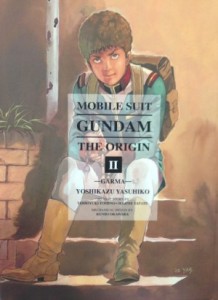
When we last left our heroes, they’d finally gotten back to Earth. Of course, this proves to be only the beginning of their troubles… they’re in enemy territory, and are being told by their allies in South America “get here first, then we’ll tell you what to do next.” Their ace pilot is having a bit of a PTSD attack, and wants no part of all of this. The refugees they picked up are resorting to taking hostages just to be allowed to leave. And our man in charge, Bright Noah, just can’t seem to get any respect. But then, this is what happens when your enemies call your ship the “Trojan Horse”… you have all the luck that Troy did.

gundam2

To get the obvious out of the way first, most of what you enjoyed about the first book is present and correct here in the second. The battles are done very well, with lots of attention to detail and realism (given that these are robot wars), but don’t take up so much of the book that you get bored with all the combat. The overall tone is serious, but there are some very amusing dashes of humor, including Lieutenant Reed’s ulcer, Fraw Bow’s jealousy (and a flash of the same thing from Amuro), and every exasperated face Noah makes. But overall, the message continues to be what Gundam does best: war is a horrible thing that destroys entire cities, and one should never revel in it.

I think my favorite party of the volume was watching every single interaction between Char and Garma. After all the earnestness that our heroes fall into, it’s great seeing two people who clearly despise each other attempting to one-up each other in how politely smug they can be. Char’s needling of Garma, and manipulation as the story goes on, really shows of his people skills, albeit not in a good way. He spends much of this volume simply watching things develop (well, that and taking long showers so that he can properly show off his fantastic naked body to the reader). This makes his arrogant sneering at Garma right at the end all the more startling, and reminds you once again that he may be the bad guy you love to hate, but he’s still the bad guy.

As for Amuro, he gets the bulk of the second half of this volume, as he reunites with his mother. I’ll be honest, I totally expected him to return and find his mother dead – all the signs were pointing that way – but then, this series has pointed one way and gone another before, so I shouldn’t be surprised. What we got was even better, though – his mother has no context for what’s happened to Amuro at all, and all she can see is that her little boy has become a killer. This is far more visceral than most stories of this time, given Amuro has to lethally fight his way out of the encampment his mother is living in. It’s the emotional heart of the story.

And then there is the titular Garma. The Gundam story makes sure that we don’t simply see the Zeon enemy as “space Nazis”, and Garma’s desire to be worthy of his name, as well as his romance with an Earth girl, is part of this. I was never quite sure till the end how invested he was in Icelina, but it seems to be more genuine than I thought, and I wonder if she’ll return at some point down the line. But in the end, this is a story about war and the prices that one pays during it, and the final images we see are a father brutally gunned down in front of his daughter, and a father stunned to hear of the death of his son.

I admit I would perhaps have slightly fewer mech battles if I were plotting this, but oh well. Gundam is still a riveting and fascinating series, and fully justifies why it has endured all these years. And the presentation, again, is fantastic – a real coffee table book. It’s hard to wait three more months to see what happens next.

Filed Under: REVIEWS

Utsubora: The Story Of A Novelist

July 2, 2013 by Sean Gaffney

By Asumiko Nakamura. Released in Japan as two separate volumes by Ohta Shuppan, serialized in the magazine Manga Erotics F. Released in North America by Vertical.

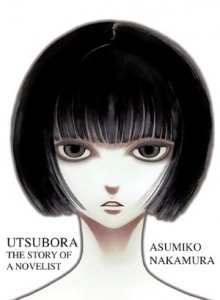
I didn’t know a whole lot about this series going into it, except that it had striking cover art, and the premise seemed to promise a whodunnit sort of thing. As it turns out, the death at the start of the book is more of a catalyst than a mystery. Instead, it’s the story of several really broken people, and watching them all move through life, desperately trying to find the purpose they lack. And trust me, that’s a lot more riveting than trying to figure out how someone really died.

utsubora

The plot of the manga involves a well-known writer who has apparently begun a new series in a monthly magazine called ‘Utsubora’ – an archaic Japanese word that can mean ‘hollow space’. The fictional story and the manga both are inhabited by people who define that word, be it the writer himself, the mysterious girl who seemed to be his muse, his exasperated editor, or the niece who is seemingly the most normal girl here. One of the things I really liked about the manga is the way that Nakamura makes you shift sympathies as you read and understand more – I really empathized with Tsuji, the young editor, at the start, and then less and less as the story went on and we saw how far he’d go regarding his crush. Likewise, Mizorogi started off as a stoic creep, but gradually I felt deep pity and empathy for him.

Despite what the title may imply, not every series that runs in Manga Erotics F has to have sex in it. This one does, though, and we see quite a few scenes of lovemaking. The interesting thing is that they’re all presented very differently depending on who is present. Mizorogi’s psychological issues mean that sex with him is very different from sex with someone like Tsuji, a fact that is pointed out immediately by the girl who’s been with both of them. (It also ties in to his issues with being able to write, and using “Fujino” for that.) And a later scene showing Tsuji and a desperate female author who’s in lust with him seems far dirtier than the other scenes, less loving and more passionate and quick.

I haven’t talked much about the two girls on the front and back covers, even thought they are very much the focus of this work. Indeed, for a while I wasn’t quite sure what was going on with them at all. The mystery set up at the beginning was less about the death and more about what happened before, and how much we, as a reader, could trust what’s presented to us. In the end, though, I’m left with an almost aching sadness as I look back on what happened with Aki Fujino, Sakura Miki and Fujiko Akiyama, and it’s her character that conveys the meaning of the title the most. At the start, and at the end, she stands stoic before us, but in between those times the raw emotion is almost too much to bear.

Utsubora is a book, I think, that has to be felt almost as much as it has to be read. Its examination of a writer’s life, and the people that surround that life, is tangible and heartbreaking. There’s a lot of stuff I wasn’t even able to cover here, simply as I didn’t want to spoil too much about this book, which is highly unusual for me. Seek this out, it’s one of the best titles I’ve read this year.

Filed Under: REVIEWS

Cross Game, Vols 7 and 8

June 30, 2013 by Anna N

Cross Game is one of those series that was so great, I’m a bit angry at myself for taking so long to finish it. The seventh omnibus volume was a bit of a surprise, because something that I expected to happen didn’t, and it didn’t happen in a way that was really interesting with the story that Adachi was building. All along I thought that there’d be a major confrontation between Ko’s team and the antagonistic coach at Kurokoma. But Kurokoma doesn’t even bother to scout their first-round competition because they’ve never heard of the team. Daimon’s arrogance is on full display as he talks to Junpei who is on his way to scout Seishu’s first-round opponent. Daimon says of his competition that he doesn’t even know what they are called, they’re “some no-name school…a team I have no intention of remembering…” The no-name team ends up being Seishu’s next opponent, as Kurokoma is defeated in the first round. Daimon’s comeuppance didn’t come at the hands of Seishu, it came from his own internal failings. In most other shonen manga there’s be a more simplistic confrontation between the two teams during the tournament, but thankfully Adachi doesn’t write his manga in an expected way.

Junpei has proposed to the oldest Tsukishima daughter Ichiyo, and she’s answered that she’ll marry him if Seishu gets to Koshien, adding an extra element of romantic tension to every baseball game. Ko’s finally reached a point where he can’t rely on Aoba for advice. His athletic abilities keep growing and as he tries to adjust his form after throwing the ball faster than he has before, Aoba can’t help him because she’s never thrown a ball that fast. Akane is hospitalized, and the idea of losing her combined with her similarity to Wakaba, makes the summer seem a bit eerie. Ko seems largely unflappable through the whole situation and Aoba comments to Yuhei that he seems cold. Yuhei comments that Ko knows “some things you just gotta do. Other things, you can only have faith…”

One of the things I love is the way simple scenes end up saying so much about the relationships between the characters. Aoba and Ko are riding an empty train together and she makes a point of sitting as far away from him as possible. Ko comments that the distance between them never changes and when she sharply asks if he said anything, he just replies “Nope.”

As the series comes to a close, I was reminded all over again how for a manga the focuses so intensely on baseball, it isn’t really about baseball at all in terms of the motivations and actions of the characters. Ko’s calm and constant training is touched off by the idea that Aoba’s will only like a boy who can pitch a 100 mph fastball. As All of Ko’s training begins to pay off with some inspired pitching as his team becomes a contender for Koshien, his pitches start clocking at higher and higher speeds. As Aoba watches Ko she thinks that he used to be like her, overly emotional and with a quick temper, but now “he’s just like Wakaba.”

During the final game there’s parallel baseball action and emotional revelation happening, as the reader sees the depth of Aoba’s hatred for Ko, and how that hatred is a proxy for dealing with Wakaba’s death, and how stoic and emotionally mature Ko is to just let himself be the object of Aoba’s scorn. During a pivotal moment Ko has to bat, and he hands the umpire a token, putting himself firmly back in the mental space of all of the times he’s practiced his batting at the Tsukishima’s batting cage. Adachi introduces these moments in such an off-hand naturalistic way that the symbolism involved never seems forced or overly precious. As the series concluded I realized that more than just showing the dramatic struggles of a high-school baseball team, Cross Game is really a classic romance manga, with some closing moments that would put most shoujo manga to shame just in terms of the emotional depth portrayed. Ko and Aoba are one of my favorite manga couples, and Cross Game really is a work to be treasured.

Filed Under: REVIEWS

Lone Wolf & Cub Omnibus, Vol. 1

June 30, 2013 by Sean Gaffney

By Kazuo Koike and Goseki Kojima. Released in Japan by Futabasha, serialized in the magazine Manga Action. Released in North America by Dark Horse.

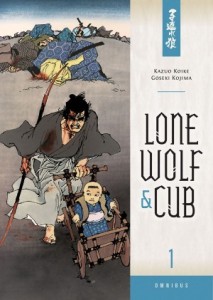
I had never read Lone Wolf and Cub when I started to get into manga back in the day. My tastes ran more towards Ranma and Sailor Moon at that time, and it was also in a weird format, with smaller trim than what I was expecting. Then as it went on I simply never got a chance to go back to it. Now Dark horse is releasing the series in large omnibuses, sized like the other books on your shelves (although still flipped), with the first three volumes in this giant 700+-page monster. Is it worth picking this up?

lonewolf1

Well, if you already have it, I wouldn’t get it again, as there’s no new translation or anything. If you don’t have it, though, this is a surprisingly gripping tale of assassination and vengeance. I say surprising as, at least for these three volumes, it’s also very episodic, bouncing back and forth between various parts of feudal Japan. It appears to all take place in the same year, given that Daigoro (the ‘Cub’ of the title) stays about 3 years old throughout, but there’s little continuity between each story, and we really don’t even know much of why Ogami is an assassination for hire beyond “he was set up and his wife was killed”. This is an early 70s seinen action manga, so there’s not a lot of heavy continuity here.

That said, this also adds to the purity of the story. Our hero roots out corruption (he even makes sure to get the FULL story from his clients, including everything they’ve done wrong, just in case) and metes out his own brand of justice. Naturally, given that the protagonists are a killer assassin and his three-year-old son, the villains tends to go either two ways: horrible and cowardly villains who die like the dogs they are, or noble-yet-conflicted samurai who duel to the death with dignity. And they all know who Lone Wolf is, not to mention his Cub. Doesn’t really stop him from getting what he wants, even if he has to take out 8 female ninja assassins, or fight on a rickety bridge, or even inside an inescapable prison.

This is, of course, written by Kazuo Koike, later known for works like Crying Freeman. It will not surprise anyone, therefore, that Ogami is also an excellent lover, though we don’t see that quite as often as I expected here. Partly as the focus of the series is sword battles, but also because the women here tend to be dead or evil – I was rather surprised when one chapter showed a thief/prostitute actually surviving to the next chapter. At least I think that’s her in the next chapter – the artist is not that great at differentiating between his characters. Luckily, Ogami’s eyebrows are large enough so he can be spotted anywhere.

This is a giant tome of a book – it may actually read easier in its original non-omnibus format – and we have a ways to go, as the series runs to the mid-20s or so, and this is only Vol. 1-3. Nonetheless, it’s highly influential, and you can see why – as a mood, the book is stellar. Recommended for those who like manly manga, swordfights, or samurai.

Filed Under: REVIEWS

Wandering Son, Vol. 4

June 27, 2013 by Sean Gaffney

By Shimura Takako. Released in Japan by Enterbrain, serialization ongoing in the magazine Comic Beam. Released in North America by Fantagraphics.

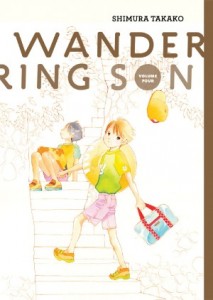
In my last review, I noted that all the characters were just starting to reach that age where love would come into the picture, and wondered what would happen when it arrived. Well, that moment is here, and the answer is simple: a trainwreck of feelings and emotions. There’s actually not as much regarding Nitori and Takatsuki’s gender identity disorder here, but there doesn’t need to be. Takako-san has set up all the characters’ wants and needs in the first three volumes, and now can send them careening everywhere confident that we’ll follow along.

wanderingson4

This is not to say that everyone is embracing these new-found feelings. Nitori and Anna’s feelings for each other, for example, almost read like they’re out of Bob’s Big Book Of Manga Cliches. Anna is clearly attracted to Nitori, but is still a bit weirded out by Notori’s gender issues, so this tends to come out as abuse. Honestly, I wasn’t expecting Anna to be as utterly tsundere as she is here, given this is a very realistic, subtle work. And Nitori is also attracted to Anna, but she’s sending all the wrong signals, so he just ends up frustrated. And then there’s Takatsuki to consider…

Sometimes friends fall out, particularly in the elementary school/middle school years. The tragedy of what happens with Saori is that she can see it – hell, she excoriates herself for it, quoting from Anne of Green Gables again – but still can’t help what her heart feels, and this causes her to lash out at Takatsuki. Meanwhile, Takatsuki’s relationship with Nitori is all over the school – there’s a rumor they were seen kissing, and it won’t quite die down. It’s getting to the point where Nitori and Takatsuki are starting to dream of each other… erotic dreams. Takako-san’s subtleties excel here, as you clearly know that we’re seeing wet dreams without there being anything racy or suggestive.

In the end, almost everyone ends up unhappy or unfulfilled here, which is not a surprise given the age of the protagonists. Saori seems to have shut down (the unwanted attention she’s getting from a male friend at church isn’t helping), and the others are simply trying to keep it together. The other friend in their little group, Sasa, barely appears, but it’s noted a couple of times they want to try to stay on an even keel for her – she seems to be the heart of the group. There is, however, one romance that does work out, and fittingly, it’s for a slightly older couple. Maho is finally able to get over her own shyness and panic, and she and Seya become a couple. (His own feelings for Nitori-as-a-girl are still an issue, of course.)

So another solid volume that really makes me love these characters even more. My favorite part of the entire book was probably a chapter where Nitori, frustrated by his sister, Anna, and everything going on at school, decides to run away. Not being able to afford to go anywhere, though, as the day progresses Nitori just ends up at a zoo. In the end, the day passes and on Nitori’s return, no one realizes he’s even been gone. Nitori’s imagination and emotions are further along than his maturity level, and it’s causing him great pain. Will middle school help to guide him? Can’t wait to find out.

Filed Under: REVIEWS

GA: Geijutsuka Art Design Class, Vol. 5

June 25, 2013 by Sean Gaffney

By Satoko Kiyuduki. Released in Japan by Houbunsha, serialization ongoing in the magazine Manga Time Kirara Carat. Released in North America by Yen Press.

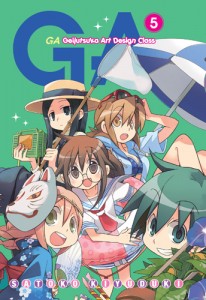
As I have mentioned before, there are an awful lot of 4-koma series coming out featuring a bunch of eccentric, yet cute and lovable girls around high school age. Indeed, most of them are also being put out by Yen. And yet I’ve always enjoyed reading GA the most, particularly as it rewards detail-observant readers. There’s a lot going on here, not least of which is how much this series has taught me about art. And about how to draw a panda properly.

Kiyuduki_GA_V5

Actually, much of this volume takes place over the summer break, meaning we get the opportunity to observe the girls outside of the school environment. (Though this does mean we get less of the ‘B’ cast, i,e, Awara and company.) We even get to see a couple more family members, particularly Namiko’s sister, who turns out to be the sort of aggressively good at everything big sister that would drive Namiko insane (which is indeed what happens). We also get a brief view (back only) of Noda’s gorgeous big sister of legend. The siblings in GA tend to show off a lot of that ‘we can’t stand each other, but love each other deep down’ dynamic you like to see in comics like these.

The ‘art’ parts of the volume focus on the four seasons, and how you get your piece to show off what spring means, or summer, etc. This includes several examples of works that do precisely thins, both Western and Japanese, so you can go to Google and look up paintings like ‘Autumn in the Village’ by Marc Chagall or ‘Beach Baskets in Holland’ by Wassily Kandinsky. The art actually helps you to understand the girls better, as you see how they might see the world, and what kind of canvas they want to create with it.

The girls, by the way, are exceedingly cute here, as you would expect. A trip to a summer festival is enlivened by a fox spirit briefly taking the place of one of the girls (Kisaragi being Kisaragi, she goes to the fox shrine the day after to thank them for having fun with the rest of the girls). A trip means postcards, which the girls hand-draw, and discussion of how to balance picture and words (it also shows Namiko and Noda talking about getting married one day – sorry, yuri fans!). Perhaps the most poignant chapter shows Noda unknowingly showing up for school the first day of summer break, and having lunch while pretending her friends are there around her. Noda surrounded by people is the best Noda, I think we all agree.

As ever, if you’re looking for a deep manga with a lot to say about the human condition, this isn’t the one for you. It’s a 4-koma about cute high school kids, and no amount of praise from me is going to change that. If you do enjoy this genre, however, GA is fantastic, balancing humor, cuteness, and an appreciation of art, even if you aren’t artistic. It doesn’t come out very often (it’s caught up with Japan), but is always recommended.

Filed Under: REVIEWS

Higurashi: When They Cry, Vol. 22

June 23, 2013 by Sean Gaffney

Story by Ryukishi07; Art by Karin Suzuragi. Released in Japan as “Higurashi no Naku Koro ni: Matsuribayashi-hen” by Square Enix, serialized in the magazine Gangan Joker. Released in North America by Yen Press.

And so, finally, welcome to the Good End, as well as the longest of the arcs – it’s 8 volumes, or 4 omnibuses. We’ve come a long way to get to this point, seeing most of the main characters at their worst, and then later seeing them at their best. Well, mostly. The adults in Higurashi haven’t really gotten a good backstory yet. Particularly the villain of the piece. We knows that she’s insane and sociopathic – witness her face at the end of the Massacre Arc, as well as the plot she’s cooked up – but “she’s evil like that” is not a motivation, and Ryukishi07 has gone to great pains in previous arcs to show us how important someone’s past and the way their life unfolded can be to the actions they may take in the future. So, what’s Miyo Takano’s past?

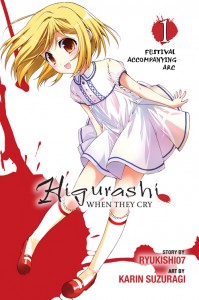
Ryukishi07_Higurashi_22_CVR

Well, it starts with a little girl named Miyoko Tanashi. That’s her on the cover, isn’t she a cutie? She lives with a loving mother and father, and her hobbies are collecting flags of the world from a local restaurant chain. She is living a great childhood. Then… there’s a train accident. Miyoko went out to play with her friends instead of going shopping with her parents. From that, comes one of the most horrific childhoods we’ve seen in all of Higurashi, even managing to top Satoko and Rena’s. Miyoko’s father, before he dies, tries to get Miyoko to contact a researcher friend of his, but to no avail – Miyoko is sent to the local orphanage instead.

Orphanages in fiction are usually never a good deal, but this one goes above and beyond. (I have no idea if this is what orphanages in Japan were like in the early 60s – I hope it’s heavily exaggerated for dramatic effect.) It’s a prison camp for children, with daily beatings and abuse. Then comes the most striking scene of the volume, where Miyoko and her three other friends make an escape attempt from the orphanage – led by Eriko, who has heard there’s another orphanage a few miles away that’s loving and happy. What follows is… bad. They don’t escape – indeed, the whole “other orphanage” doesn’t seem to even exist. They are taken back. Eriko is tortured and killed by having her unconscious body tied down and covered in chicken feed, so she is basically pecked to death. I mention this as a spoiler because it’s so grotesque and graphic – everyone who reads the manga remembers this. The other two girls are rolled into a mat (which is then beaten with sticks) or put into a metal shower cage (and then beaten with sticks till they go deaf).

As for Miyoko, before capture she was able to accomplish a few things. First, she found a phone and managed to call her father’s friend. More importantly to the story, though, she screams at God to kill her, and a lightning bolt then comes down… directly behind her, missing her body. She takes this as a sign. It doesn’t go into effect right away – I won’t spoil her punishment, except that it’s the ugliest of the four, and the only reason she isn’t killed is that her father’s friend, Hifumi Takano, shows up to adopt her. (Note there is no suggestion the orphanage is ever shut down or stopped – only Miyoko is saved. I am reminded of the fact that everyone accepts Mion will be a yakuza head when she grows up. Morality in Higurashi can be starkly realistic when it wants to be.)

So, ten points to Hifumi for rescuing Miyoko, who changes her name to Miyo Takano. However, just putting her in a loving home and having her help with his research into brain parasites is not going to do the trick. Miyo clearly has post-traumatic stress disorder – we see her reliving the events of the orphanage more than once – and really should be getting therapy that she never gets. As a result, the PTSD will never really leave her, and drives her actions and descent into madness. Especially when the government mock and ridicule his research into parasites, and this drives him into deep despair. And so Miyo makes it her life’s dream to prove her father’s research is correct and that he was right all along. His research… into Hinamizawa Syndrome.

That leads us to the second half of the omnibus, where an adult Miyo is putting all her pieces into place. She’s not going to be stopped by some nasty old government officials – indeed, at one point, she believes that bullets won’t kill her (flashing back to the lightning bolt missing her as a sign). She delves further into his research, and also makes connections, showing that she’s an up-and-coming woman whose drive is not merely frivolous. (We briefly see her fighting a bit of “but gosh, why is a girl interested in parasites?” male doctors.) And finally, she gets what she wants – a research facility in Hinamizawa, with a helpful doctor in Kyousuke Irie, and a liaison in Jiro Tomitake. she notes Tomitake looks like an easy sucker, something that does not bode well for their relationship.

Irie is more complicated, though, and our sympathy shifts to him in this second half as Takano starts to slip deeper into madness. Turns out Irie, due to his parent”s crumbling marriage after his father had a head injury, has made it his life’s work to study brain injuries. Unfortunately, he was doing this around the time lobotomies were discredited, and therefore his career was somewhat ruined. Here in Hinamizawa, he’s trying to start over – being a nice helpful doctor, encouraging a young and stress-out Satoshi to take an interest in baseball – while also researching Hinamizaqwa Syndrome and trying to stop it. He’s a good guy, mostly.

Then they bring in a live specimen. The murderer of the dam construction manager, who is at Level 5 and trying to claw out his throat. And Takano blackmails Irie into dissecting his brain – while he’s alive. This really doesn’t bode well for Satoko Hojo, as she’s also showing signs of Hinamizawa Syndrome, and her parents fell off of a bridge just now in a very suspicious manner. Miyo isn’t too bothered – more live dissections! – but with Irie draw the line and cutting open a little girl?

As you can see, there’s a lot of backstory here, but it’s presented with a lot of dramatic effect – indeed, one might argue too much at times. This is really over the top grotesque in places, and the images of Eriko, and later the live dissections, are some of the more nightmare inducing of the entire series. That said, I think we can now see how Miyo Takano got to be the way she is, even if we can’t sympathize with her. Irie’s role in the series expanding is also a good thing, taking him away from “comedy lolicon doctor” and into a man trying to hold onto his ethics while still doing surgery FOR SCIENCE.

Karin Suzuragi did the Keiichi and Rena arcs, and her art is back as well for the final arc. It’s not my favorite of the artists, but it’s pretty good – although she’s not good at showing younger versions of our leads. Satoko in 1980 looks exactly the same as Satoko in 1983, and given that’s going between age 8 and age 12 or so, I’m not sure I buy that. Overall, though, for an omnibus whose job is to pour out backstory and explanations, this remains an amazingly gripping read, though of course I only recommend it for fans who’ve read the other books.

Filed Under: REVIEWS

Blood Lad, Vol. 3

June 20, 2013 by Sean Gaffney

By Yuuki Kodama. Released in Japan by Kadokawa Shoten, serialization ongoing in the magazine Young Ace. Released in North America by Yen Press.

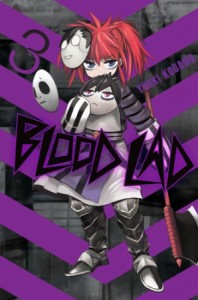
I’d mentioned in my previous review that Blood Lad had become a very solid shonen series (that runs in a seinen magazine, yes). I’ll go further with Vol. 3: this is really excellent. The previous volume showed us the main characters being quite clever, something which continues here. But this volume also shows us the writer being very clever. Kodama has crafted a plot that makes me want to dig deeper, with no elements so far dominating the others. The internal power struggle for the demon world, the Frankenstein monster corpse-robbing from last time, and Staz’s quest to restore Fuyumi to life all get about the right weight, with few pointless side journeys. Best of all, we have Fuyumi’s backstory, which I’ll delve into further.

bloodlad3

I knew coming in that Fuyumi’s family was going to somehow be connected to the demon world, given all the hints we’d had in the previous book. And indeed, that turns out to be exactly the case. But there’s no secret adultery or trips to the demon world here. Instead, there’s a very clever (and fairly creepy) use of doppelganger legends to show how Fuyumi is related to Bell and her brother while still remaining completely human. What’s more, it actually plays out what happens after with Bell and Fuyumi’s fathers, and shows us that the demon world is not the only one to have scary guys. This is easily my favorite part of the book.

Of course, Fuyumi’s reaction to this is pretty much the same as it’s been since the start of the series: dull surprise. This is actually lampshaded in the series, as she notes after discovering her mother’s real identity that she’s been too overwhelmed by events to process anything since she came into the demon world, and seems to have been fairly mellow even before her death. Still, it can be frustrating, especially given how often she’s meant to be fanservice for the reader, how passive she is. Her stepfather gives Staz two very important conditions to satisfy before he’ll let Fuyumi put herself in danger by journeying with him, and both of them amount to the same thing: give Fuyumi agency to decide things herself.

Which is good, because while Staz is not your typical shonen ‘rush into fights’ dolt, he has not really given much thought to what Fuyumi wants, something else pointed out to him. He has to stop treating Fuyumi like an object (and then, perhaps, the manga itself will stop doing the same thing). Staz is already suffering from the fact that, as a vampire, he’s almost trained since birth to see himself as an evil person. So his desperate attempts to restore Fuyumi, without asking her what she really wants to do, are indicative of this. He thinks that this is something that makes him evil, and that, by listening to Fuyumi and doing what she really wants, he can become a hero for her. (This also brings up the question of whether they love each other – everyone except the two of them seem to think this is the case.)

Staz is, of course, already a hero, and I hope that this change of lifestyle for him does not involve more charging ahead and less cunning in fights. (The fanservice this volume went to Bell, by the way, and the fight between her and Staz is a great example of how to combine Staz’s intelligence and cunning and his complete lack of awareness when it comes to women’s feelings.) How all this plays out, though, is something I really am desperate to find out. Though I may have to wait a while: we’re caught up with Japan, at least as caught up as Western publishers like to get. In the meantime, read this series.

Filed Under: REVIEWS

Weekly Astro Boy Magazine Vol. 1

June 19, 2013 by Anna N

Weekly Astro Boy Magazine Vol. 1

I was intrigued when Emanga.com announced that they would be releasing an Astro Boy magazine. I’m feeling a bit nostalgic for manga magazines at this point, with the demise of print anthologies. I’ve read some Tezuka, but I’m definitely not familiar with all of his works. The magazine format for Tezuka works very well, because his art and storytelling style varies so much with the titles presented in the magazine, it is interesting to compare and contrast the differences between his different titles in this format.

I haven’t read much Astro Boy before, but the storyline for inclusion in the first issue of this manga magazine is a strong one, as it is “The Greatest Robot on Earth,” where the robot Pluto created to battle all the other great robots that exist, until he is hailed as the supreme robot. This storyline is what Naoki Urasawa used for his manga series Pluto. Astro Boy tangles with Pluto for a little bit, but his creator calls him off. Astro Boy responds to the existence of the new robot by requesting an upgrade of his own power. Astro Boy really displays the virtue of simplicity. The robot designs are so distinct, and the action in Astro Boy is so clear and easy to follow, it makes me think that some of the detail and opaque action in modern manga has really missed the mark.

Phoenix is the next title featured in this magazine, and this is a real treat because I believe some of the print volumes released by Viz are now out of print. The story comes from the fourth volume of Phoenix, called Karma. It is easy to see why Phoenix is often called Tezuka’s masterwork. This chapter featured the story of a boy who was injured just after being born, becoming a monster due to the harsh treatment from his fellow villagers. He encounters a sculptor in the woods and damages one of his arms. The sculptor finds refuge in a temple and begins to reach a different stage of consciousness as he attempts to take up art again. Reading Phoenix itself is a bit of a philosophical experience, as the characters encounter each other in this fable-like story, with stylized depictions of nature inter cut with both action and personal reflection.

The rest of the book is rounded out by shorter chapters for Dororo and Black Jack. It was a bit difficult for me to get a handle on Dororo just due to the small page count. Black Jack, I automatically read with feelings of affection, because the two-fisted surgeon is one of my favorite Tezuka characters. Overall, I really enjoyed the opportunity to read different Tezuka works back to back. It is a bit different than diving into a full volume of manga, but it really gives the reader an appreciation for the variations in art and theme that is expressed in Tezuka’s manga. This is definitely worth checking out if you don’t have an extensive Astro Boy collection and especially if you want an accessible way of reading Phoenix.

Electronic access provided by the publisher

Filed Under: REVIEWS Tagged With: digital manga publishing, emanga, Osamu Tezuka

Kisses, Sighs, and Cherry Blossom Pink

June 18, 2013 by Sean Gaffney

By Milk Morinaga. Released in Japan by Futabasha, serialized in the magazine Comic High! (earlier stories serialized by Ichijinsha in the magazine Comic Yuri Hine). Released in North America by Seven Seas.

When I was growing up, the generally accepted “yes, you can now be nostalgic about this” period was about 20 years. Happy Days being the primary example, but the same thing applied as the 1980s wore on. Then, sometime around the early 90s, nostalgia started to speed up. Suddenly we can’t get enough of revisiting things that only happened 5-10 years ago. And this makes sense, given how fast culture has been moving lately thanks to the Information Superhighway and such. (See what I told you about nostalgia?) What this means in practice is that we can be startled that things we read only a few years back suddenly seem like products of a bygone age, and Kisses, Sighs and Cherry Blossom Pink is an excellent example.

kissessighs_vol1_full

When these stories first came out in 2003 or so, it was fantastic. They were in a magazine devoted exclusively to ‘yuri’ stories, and many of them sailed along based solely on that premise. Girls! In love with other girls! And even kissing and stuff! This particular story was actually a group of one-shots that ended up centering around the same school, which is attended by Nana and her friends (Hitomi’s school gets far less attention, possibly as it seems to be far less yuri-friendly). It’s not just Nana – there’s ghosts in love, and unrequited love, and a Takarazuka ‘prince’ who’s actually a bit of a weirdo. It’s a whole yuri subculture. And, in 2003, this was fantastic.

Why does it seem to old and cliched now? It’s partly because Morinaga Milk essentially rewrote and improved Nana and Hitomi’s story in Girl Friends a few years later for Futabasha (after first wrapping it up, as we see in the second volume of this collection.) But it seems to me to be primarily that this sort of story is now old hat. There’s so much more yuri out there, and not all of it has to be “Girl meets girl, girl likes girl, they like each other, the end.” Actually, at the time this collection went FURTHER than a lot of the stories in Yuri Hime. Nana and Hitomi are sexually active, and we see that – again, something that was a real wow in 2003.

But nostalgic doesn’t necessarily mean bad, it simply means “wow, I can’t believe this is only 10 years old”. These stories are cute and sweet, and even the story that doesn’t end with two girls getting together still manages to be adorable. There’s not a lot of “couples buying refrigerators” here – indeed, the manga ends literally right before Nana and Hitomi will have to do that – because in 2003, this was enough. Girls being gay and in love (well, as gay as they’re allowed to be – the word ‘lesbian’ isn’t used much here) at their local schools, and some of them even (gasp!) staying together after they leave school.

I really enjoyed this series, as it brought back a lot of happy memories, and the stories set up a lot of other series that I’ve also enjoyed that followed its example. Nana and Hitomi are sweet, everyone is happy (though the final Nanan and Hitomi story does have a deus ex machina so blatant you could drive a moving truck through it), and the series is quaint. Quaint and twee, you’re in 2003. Nostalgia is the new nostalgia. Recommended.

Filed Under: REVIEWS

One Piece, Vol. 67

June 16, 2013 by Sean Gaffney

By Eiichiro Oda. Released in Japan by Shueisha, serialization ongoing in the magazine Weekly Shonen Jump. Released in North America by Viz.

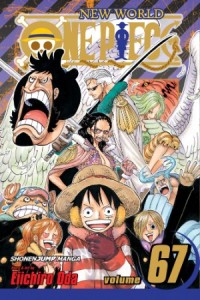
If you had not been following along with One Piece and were trying to come into this volume totally unspoiled, well, sorry. The cover totally spoils one of the funniest gags Oda’s come up with in some time, unashamedly. There’s a whole lot going on in Punk Hazard, and I’ll get to some of it later. But mostly what people remember from this volume is the bodyswapping. The reasoning behind it is somewhat flimsy – Law doesn’t want the Strawhats getting away, so does this to create chaos, I believe – but the consequences are pure gold, even if it means putting up with Sanji trying to feel himself up half the time. Even Smoker and Tashigi get in on the act, with a bodyswap that makes your head hurt even more. (Tashigi is still, I note, dealing with “we’ll obey our captain because she’s really hot!” from the crew, and is totally unable to do anything against Law. But then again, neither is Smoker.)

onepiece67

Oh yes, Law! One of the most popular of the Supernovas, we knew he’d show up again, but not quite so soon. He doesn’t seem to be entirely behind what’s going on here, but he’s involved in some way, and it’s interesting seeing him scheme and plan when compared with Luffy’s “well, whatever” style of piracy. As for who is behind things, well, it would appear to be ex-government scientist Caesar Clown, who is basically the Joker from Batman, only as a mad scientist. He is creepy as hell, and it’s pretty obvious that he’s the guy Luffy will have to fight a few volumes down the road. His plot involves kidnapping and experimenting on young children, which is pretty damn dark, but then I remember the other backstories that this series has given us.

I would be remiss in this review if I did not stop to talk about my favorite character. Robin gets a lot to do here, including, to my surprise and pleasure, a huge number of jokes. No, she’s not making goofy faces, but we do see her imagining Usopp and Zoro as Duck Ferry Rides, and joining with the others in stealing the villains’ clothes for warmth, and absolutely shutting Franky down when he tries to make his usual poses and faces in Chopper’s cute body. (Robin has always had a soft spot for Chopper. Also, I sense this may be Oda trying to sink the Franky/Robin ship a bit – she’s clearly REALLY IRRITATED here.) And of course she’s making her usual references to all her comrades possibly being dead on pools of blood. If it’s Robin humor you want, this is the volume for you.

And I haven’t even mentioned the goofy samurai who’s just a head, or Nami’s maternal instincts oddly popping up (I’ll buy it, but only just – I have to wonder if she’s thinking of her own childhood pre-Bellemere), or Brownbeard, of all people, making a comeback, or the really creepy chamber of corpses, or the bird woman and what role she’s playing. As ever, there’s just so much going on here. By the time you finish this volume of One Piece, you could have read 5 Bleaches! Absolutely recommended.

Filed Under: REVIEWS

Knights of Sidonia, Vol. 2

June 13, 2013 by Anna N

Knights of Sidonia, Volume 2 by Tsutomu Nihei

As I was reading the second volume of Knights of Sidonia, it occurred to me that Nihei ably manages a narrative balancing act of giving the reader just a little bit more information in each volume, but not so much that everything feels completely filled in. My curiosity about the history of Sidonia was fulfilled with a bit of backstory about why the massive ship seems to be moving through space alone, isolated except for occasional attacks by the Guana. I’m still intrigued to learn more about Nagate Tanikaze and why he happens to be so good (in a somewhat bumbling way) at piloting the Tsugumori. He also seems to be continually singled out by those in command.

I enjoy the general sense of scale expressed with the illustrations of interior of the giant spaceship – it does really seem massive. The human cost that occurs when it has to maneuver itself suddenly makes it clear that even safely inside a spaceship death can come at any instant. Reading this manga, I get the sense that Nihei plans out all the details of his worlds very meticulously. One negative thing is that generally the characters in this manga suffer a bit from samefaceitius, making it sometimes difficult to sort out who is who absent any extreme differences in hairstyle. However, this is a minor quibble next to the general awesomeness of seeing the Guarde units fly through space in their ringed locked arm formation.

This is not a happy manga about giant space robots fighting aliens. The evolutionary capabilities of the Guana give some scenes a horror comic vibe, and bad things certainly happen to good people. But there’s enough humor in the strained interpersonal interactions of the people aboard the Sidonia that when finishing up a volume of this manga, I’m not feeling oppressed by tragedy but very interested to see what happens next.

Also, for those of you reading this manga solely for talking bear appearances, there is some talking bear in this volume!

Filed Under: REVIEWS Tagged With: knights of sidonia, vertical

Atomcat

June 13, 2013 by Sean Gaffney

By Osamu Tezuka. Released in Japan by Sekai Bunkasha, serialized in the magazine Nico Nico Comic. Released in North America by Digital Manga Publishing.

I have been noticing, around the internet, a lot less enthusiasm for this particular title as opposed to other Tezuka titles. Usually the comment will start by saying “Well, any Tezuka is good Tezuka, BUT…” and then moving on to note its fluffiness and lack of deep, tragic history. This is a marked contrast to the other type of Tezuka fan, which is the “we must have every single Tezuka work ever created translated into English as soon as possible!” sort. I have sympathy for both camps. Tezuka wrote a TON of stuff, and not all of it is going to be on the scale of Apollo’s Song or Buddha. At the same time, I do want to see his lighter comics that are just moments of everyday life or dumb humor. And that’s why I’m quite pleased to see Atomcat, which is both.

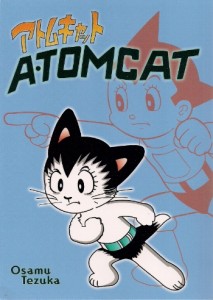
Atomcat

The story of a young boy and his Astro Boy-themed superhero cat, this manga actually intersperses moments from the actual Astro Boy manga (redrawn by Tezuka) as contrast and compare. Usually Tsugio reads about another aspect of Atom’s fairly crappy life, and sympathizes, then has to deal with his own issues, such as an eccentric father, overbearing mother, and the ever-present school bullies. He tries to take home a stray cat as a pet, but the cat is an absolute disaster, destroying everything in the house in a great comedy sequence. Taking it away so he can abandon it, he and the cat and struck by a car… driven by Princess Diana. Only not really, she and Prince Charles are actually ALIENS. The boy is fine, but the cat is dead, so they fix him using the boy’s memories… with are filled with Astro Boy. So now the cat is intelligent and has superpowers. This doesn’t help quite as much as you think, although he’s a few levels above Doraemon.

This is a very 1980s manga – leaving aside Charles and Di the space aliens, we also have the school bully being named Gaddafi. It’s also very much for kids – Unico was too, but it had an undercurrent of melancholy at its core that Atomcat simply doesn’t possess. This is broad comedy with lots of funny faces. Our hero’s father is an absentminded freak, and his wife is the typical cartoon wife – all she needs is a rolling pin to beat her husband with. Atomcat and Tsugio fight mummies and gangsters, search for island treasure, and plunge through the sewers of Japan.

There’s no real character arc here – Tsugio starts the series as a bit of a wimp, and ends that way as well, and the series does not so much end as stop. But it’s fun! The dialogue is snappy, the Astro Boy inserts work well with the themes of the stories, and there’s lots and lots of comedic slapstick, which Tezuka was very good at indeed. I read this title and thought of Mitsuru Adachi’s Cross Game, or Rumiko Takahashi’s Ranma 1/2. Everyone says they’re influenced by Tezuka, but we tend to look for it in series like Ayako. In reality, these manga artists were more likely to grow up reading stories like these – and these are the stories that influenced a future generation. Fluff, but IMPORTANT fluff.

Filed Under: REVIEWS

  • « Go to Previous Page
  • Page 1
  • Interim pages omitted …
  • Page 268
  • Page 269
  • Page 270
  • Page 271
  • Page 272
  • Interim pages omitted …
  • Page 346
  • Go to Next Page »
 | Log in
Copyright © 2010 Manga Bookshelf | Powered by WordPress & the Genesis Framework