• Skip to primary navigation
  • Skip to main content
  • Skip to primary sidebar
  • Home
  • About Us
    • Privacy Policy
    • Comment Policy
    • Disclosures & Disclaimers
  • Resources
    • Links, Essays & Articles
    • Fandomology!
    • CLAMP Directory
    • BlogRoll
  • Features & Columns
    • 3 Things Thursday
    • Adventures in the Key of Shoujo
    • Bit & Blips (game reviews)
    • BL BOOKRACK
    • Bookshelf Briefs
    • Bringing the Drama
    • Comic Conversion
    • Fanservice Friday
    • Going Digital
    • It Came From the Sinosphere
    • License This!
    • Magazine no Mori
    • My Week in Manga
    • OFF THE SHELF
    • Not By Manga Alone
    • PICK OF THE WEEK
    • Subtitles & Sensibility
    • Weekly Shonen Jump Recaps
  • Manga Moveable Feast
    • MMF Full Archive
    • Yun Kouga
    • CLAMP
    • Shojo Beat
    • Osamu Tezuka
    • Sailor Moon
    • Fruits Basket
    • Takehiko Inoue
    • Wild Adapter
    • One Piece
    • After School Nightmare
    • Karakuri Odette
    • Paradise Kiss
    • The Color Trilogy
    • To Terra…
    • Sexy Voice & Robo
  • Browse by Author
    • Sean Gaffney
    • Anna Neatrour
    • Michelle Smith
    • Katherine Dacey
    • MJ
    • Brigid Alverson
    • Travis Anderson
    • Phillip Anthony
    • Derek Bown
    • Jaci Dahlvang
    • Angela Eastman
    • Erica Friedman
    • Sara K.
    • Megan Purdy
    • Emily Snodgrass
    • Nancy Thistlethwaite
    • Eva Volin
    • David Welsh
  • MB Blogs
    • A Case Suitable For Treatment
    • Experiments in Manga
    • MangaBlog
    • The Manga Critic
    • Manga Report
    • Soliloquy in Blue
    • Manga Curmudgeon (archive)

Manga Bookshelf

Discussion, Resources, Roundtables, & Reviews

Reviews

Young Lady Albert Is Courting Disaster, Vol. 5

April 1, 2024 by Sean Gaffney

By Saki and Haduki Futaba. Released in Japan as “Albert-ke no Reijō wa Botsuraku o Goshomō Desu” by Kadokawa Beans Bunko. Released in North America by J-Novel Heart. Translated by Ray Krycki.

I am pleased to say that the antagonist of this new volume is not a new heroine or villainess fro yet another spinoff of the original game this world is based around. No, we’re going back to first principles here. Remember how this series began in the first place? With Mary Albert trying to cause her own doom because she knew that her family becoming too powerful would lead to bad things within the kingdom? Well, um, she failed, if you recall. And thus, well, her family, as well as Patrick’s, have gotten so insanely powerful, at least in the minds of some of the lesser nobles, that the worry is that soon there be be no need for those lesser nobles. And since attacking Mary Albert has, well, worked very badly for the last four books, it’s time to try to do the next best thing: go after Alicia, who even Mary says lacks any behavior at all that makes her a royal.

I appreciate that this series knows how to have the broadest possible caricatures of characters and yet also use them seriously for plot purposes. One of the best things about Alicia has been that she’s basically a bullheaded puppy who only cares about Mary (and Patrick, if she’s forced to admit it), but now it’s come back to bite her, and seeing her cowed and doing her best to learn manners (even if she’s quickly distracted) is something new. Likewise, Mary’s desires to exile herself and start her own fried migratory bird stand are all very well and good, but there’s a reason that her brothers have been absent from the last four books. We finally meet them… and they’re exactly what you’d expect from a couple of opposite personality twins who are also siscons. If I told you just that sentence, you could write all their dialogue. Marty may not want to be, but this book makes clear she NEEDS to be the next family head.

And she manages to win the day without ever really changing at all. Sure, she does end up giving in and throwing her hat into the succession ring, mostly to save Alicia, but the rousing speech that she gives at the climax amounts to one giant tsundere hair flip, thrown at the (increasingly pathetic) oppositional lords. And there’s even room for the sensible straight men of the series as well. OK, Adi is not always sensible, but he does the detective work here, which involves Mary’s old drill hair, believe it or not. And Patrick and Gainas help to remind everyone WHY Mary is so powerful and influential – every family and house that tries to go up against her becomes an ally, and they all (remotely) rally to her here.

So yes, no worries, Alicia is the princess, and she’s allowed to tackle hug Mary again. And Mary might be the next head of the family, but she’s still far more interested in croquettes and etiquette. Still a very fun series.

Filed Under: REVIEWS, young lady albert is courting disaster!

Re: ZERO ~Starting Life in Another World~, Vol. 24

March 31, 2024 by Sean Gaffney

By Tappei Nagatsuki and Shinichirou Otsuka. Released in Japan as “Re: Zero Kara Hajimeru Isekai Seikatsu” by MF Bunko J. Released in North America by Yen On. Translated by Dale DeLucia.

I had assumed, since the end of the last volume was one of those “I have been a dumbass for a while but now I have turned the corner and am fighting back” endings, that there might be a bit less Return by Death in this book. Hardly. All that means is that the deaths are not “Subaru dies by being an idiot” but are instead “Subaru dies as he tries to figure out how to escape a damn near impossible situation”. Which means going through everything bit by bit and breaking it down into manageable chunks. but it does mean that this book is pretty exhausting, and features a lot of the cast getting their asses handed to them, as well as a lot of supposed allies turning out to be secret antagonists – though honestly, the latter should not be too surprising to a reader who is paying attention. This book is all the detective work, and the payoff will presumably be next time.

Subaru, now determined to fight back, goes back to square one and confesses to all that he’s lost his memories. He’s already worked out how he died the first time, by being pushed off the staircase, and solves that fairly quickly. The next step is to try to find Reid Astrea’s book in the Library, so that they can read his memories in hopes of finding a weakness – what killed him, for a start. Unfortunately, that ends up going badly, as when Subaru goes into Reid’s book he instead finds… another Gluttony. This one is named Louis (pronounced the French way), and she almost manages to break Subaru entirely before he’s saved by the least likely savior out there… and also the most likely, let’s face it. Unfortunately, they now have multiple Gluttonies running around, Reid running amuck, and that pesky killer scorpion. What’s up with that, anyway?

There are many amazing fight scenes in this, which the author has started to specialize in. This arc in particular continues to be a gift for Emilia fans, and that’s despite the fact that she (in one loop) gets her identity eaten by Gluttony. A fight that ends with her sneaking up behind Lye (Gluttony #2) and hitting him with a giant ice hammer while yelling “Sneak Up And WHAM” is possibly in my top five moments in the entire series. There’s also Subaru doing what he does best, which is rallying the troops and getting them to do what they do best… though sometimes even that isn’t enough. It all comes to a head in the final scene of the book, when he confronts Shaula and gets her to admit what she’s been hiding and why. It’s a very sympathetic reason – tearjerking, even – but honestly, I suspect that she’s absolutely correct and knows it. And that’s why she’s breaking down.

The next book is the final book in this arc, and I suspect it will need to be a much longer volume in order to fix everything up. Till then, this was a solid volume, and had a minimal amount of Subaru being a dumbass, which is always my measuring stick for how enjoyable it is.

Filed Under: re: zero, REVIEWS

Sasaki and Peeps: An Unidentified Flying Object from Outer Space Arrives and Earth Is Under Attack! ~The Extraterrestrial Lifeform That Came to Announce Mankind’s End Appears to Be Dangerously Sensitive~

March 30, 2024 by Sean Gaffney

By Buncololi and Kantoku. Released in Japan as “Sasaki to Pi-chan” by Media Factory. Released in North America by Yen On. Translated by Alice Prowse.

One of the tropes of this series, which is not exactly welcome but I’ve been able to deal with it, is that Sasaki is a main character, in his late 20s/early 30s, who accumulates either underage girls or girls who look like underage girls, some of whom are either in love or dangerously obsessed with him. This is brought home once more in this volume, when he shows up at Hoshizaki’s apartment and her younger sister notes that he now has ANOTHER underage girl with him, and, very sensibly, feels she cannot trust him around her sister. As such, I appreciate Sasaki’s narration spelling out that, even if he’s not explicitly asexual, that he is at least totally uninterested in sex with anyone right now. This is not going to reassure the younger sister, nor is it stopping Elsa from being engaged to him (which happens here), but it at least assures the READER. The author is here to jam pack this story with as many genres as possible, but harem is not near the top.

Picking up where the last book left off, there’s a UFO that the entire world are dealing with, and Sasaki, Hoshizaki and Futarishizuka are assigned to do something about it. As it turns out, a lot of groups have made their way to the alien, and are being quizzed – and then rejected. Unfortunately, thanks to Hoshizaki trying to define the word “lonely”, the alien realizes that she’s suddenly overcome with that feeling, and decides to try to destroy the Earth because she can’t handle it. Fortunately, this does not happen, mostly as the alien (who is basically “robot girl” for the sake of the tropes, and is called Type Twelve) gloms on to both Hoshizaki and Kurosu, the neighbor girl, who are trying to help her make friends and find happiness when she has no concept of such things. Boy, sure hope one of them doesn’t get kidnapped by bad guys, that would ruin everything…

Since my last review, we’ve had the anime of Sasaki and Peeps, and it was… OK, I guess. It’s getting a second series, though that’s mostly out of necessity given the nature of the plot. One complaint I saw was that the neighbor girl was pointless, and, well, yeah, none of her stuff becomes relevant till Book 3, so of course she is. Because Sasaki and Peeps is a genre mashup, in general the more genres it mashes the better. And this volume has almost everything, with the fantasy isekai aspect being the only one getting short shrift here. Alien robot girl searching for emotions and super powerful is not the most original of ideas, but originality is the opposite of what this series needs. Everyone gets to do cool things. Futarishizuka gets to be an adorable asshole. Hoshizaki is tsundere. Neighbor Girl (look, he doesn’t call her Kurosu so why should I?) is still terrible at social interaction. Sasaki is a bit of a narrative blank (Futarishizuka calls him “flaccid”, which, ouch), but I can deal with it. We want to see what crazy thing will happen next. That’s that point of the series.

Next time we might see the “island cut off from communication” trope, which should be fun. Till then, enjoy all the cute girls and be reassured Sasaki has no interest in any of them.

Filed Under: REVIEWS, sasaki and peeps

A Misanthrope Teaches a Class for Demi-Humans, Vol. 2

March 29, 2024 by Sean Gaffney

By Kurusu Natsume and Sai Izumi. Released in Japan as “Jingai Kyōshitsu no Ningen-girai Kyōshi: Hitoma-sensei, Watashi-tachi no Kibo o Mitsukete Kuremasu ka……?” by Media Factory. Released in North America by Yen On. Translated by Linda Liu.

This is the sort of series where you can call the second volume “more of the same” and have it be a good thing. We’re here for very specific things. We want to see new students trying their best to become human, and we also want to see Hitoma, despite everything, be a really great teacher who is slowly regaining his faith in humanity. We’ve still got the three students from before, and now we add three, which gives us a lovely opportunity to dig into why these girls want to become human. Sometimes it’s pretty easy, like Minazuki and her desire to be a dancer (she’s still graduated, by the way, and doesn’t show up in this second book). Sometimes it’s harder, like Usami, whose goals have gotten so large that they’re almost impossible to achieve. And sometimes they’re… well, done to please someone else. And that forms the crux of the most interesting part of this book.

As noted, there are three new students in the classroom this year. Karin Ryuzaki is a dragon girl who has fallen in love with her teacher at first sight, and is determined to confess – despite the obvious issues with a student teacher romance. Machi Nezu is a mouse girl with an obsession with food and also an obsession with her little sister, who is in the lower grade of the school. And Neneko Kurosawa is a cat girl who seems to sleep most of the time and be relatively uninterested in class when she’s forced awake. When asked why she wants to be human, she replies at first that it’s a secret, then later that it’s someone else’s desire. But Neneko has a bigger secret, one that will severely impact her time at this school: she doesn’t actually want to become human at all.

The other girls do also get attention paid to them. We now know Haneda’s secret, of course, so she has a larger role than usual. Usami is trying harder than ever, but at least is allowed a bit of closure from her previous life. And Ohgami is… well, I hesitate to say that she’s the weak link. Her story is touching and feels earned. But I get the sense she graduated mostly as the author had run out of things to do with her. We don’t even see the “split” that is supposed to allow both aspects of her to pursue separate human lives, it’s all implied. Bit of a bummer. By contrast, Neneko’s story is the most interesting, being a companion of a witch who is at risk of becoming a yokai rather than a human. But she’d rather deal with that than deal with being separated from the one she cares for, and I like that she’s able to get that across and that they’re searching for a solution.

The book ends with a cliffhanger that makes me wonder if it will end in the next volume, as it certainly promises to wrap up Hitoma’s past trauma. But the 3rd book in the series only came out a few days ago in Japan, so it will be a while. Till then, this is good fun and heartwarming.

Filed Under: a misanthrope teaches a class for demi-humans, REVIEWS

Alya Sometimes Hides Her Feelings in Russian, Vol. 4.5

March 28, 2024 by Sean Gaffney

By Sunsunsun and Momoco. Released in Japan as “Tokidoki Bosotto Russia-go de Dereru Tonari no Alya-san” by Kadokawa Sneaker Bunko. Released in North America by Yen On. Translated by Matthew Rutsohn.

I joked on Twitter that after Agents of the Four Seasons (which was terrific) and The Deer King (which was sublime), anything read after it would always suffer in comparison, so I’d have to “sacrifice” a series and it might as well be Alya. Honestly, though, I think I’d have been ‘meh’ about this volume even if it hadn’t come after books that are much better than it is. First of all, and most obviously, my least favorite part of the series to date was the horrible hypnosis subplot in the third book, and so it’s not surprising that I greeted a short story that’s basically a sequel to that with numb horror. More to the point, though, the last volume was relatively disconnected to begin with, showing the cast on summer break, so I’m not sure why we needed another volume that shows the summer break stories we missed the previous time. Can’t we just get on with the plot?

The stories: 1) Sayaka and Yuki bond over their love of otaku stuff, but that also means they’re rivals; 2) A day in the life of Nonoa, whose facade hides a whole lot, and her underlings she has picked up from the bottom; 3) Alya and Ayano both suffer trying to cure their fear of spicy ramen; 4) Masachika and Yuki’s father gets home from overseas, and realizes that his son and daughter are a bit weird; 5) The cast try to clear up the “seven mysteries of the school”, which involves wandering around the school late at night; 6) Part 2 of this, involving Alya and Masachika getting “locked” in a gym storeroom; 7) Part 3 of the story, where we deal with Maria and Alya’s fear of ghosts, and discover that ghosts can be punched; 8) The story of how Touya and Chisaki met; 9) more hypnosis; 10) Maria and Alya go shopping for swimsuits; 11) the cast has a “guess who cooked what meal” competition; 12) the girls, late at night at the summer event, talk about love; and 13) Masachika and Alya, on the subway, discuss the kiss that happened in Book 4.

As with most of these collections, some stories are better than others. I enjoyed the “guess who cooked what” chapter more than I expected, mostly as it did not fall into the trap of anime cliches. Sayaka and Yuki being giant nerds was also amusing, though honestly we get that from Yuki all the time. Masachika and Yuki’s own father worrying they’re a bit too incestuous helps to show why the two of them have gotten away with hiding their sibling relationship for so long – people don’t want to pick the creepy option. And the final chapter was sweet and quiet, and probably should have been in the fourth book to begin with. Aside from the one I mentioned above, none of these were bad, but they weren’t essential – even the author admits they’ll never be brought up in the main series. It is a quintessential .5 volume.

Fortunately, Vol. 5 is next. Let’s hope for plot.

Filed Under: alya sometimes hides her feelings in russian, REVIEWS

The Deer King, Vol. 2

March 27, 2024 by Sean Gaffney

By Nahoko Uehashi and Masaaki Yamamoto. Released in Japan as “Shika no Ō” by Kadokawa Bunko. Released in North America by Yen On. Translated by Cathy Hirano.

There’s a lot that happens in this book, and much of it is in the back half. But I’ll be honest, for me the book’s main purpose was achieved right before then. We spent the entirety of the first book going back and forth between two narrative strands, one with Van and his struggles, the other with the doctor, Hohsalle, and his attempts to fight the ongoing plague. There was a great deal of tension because we really wanted the two of them to meet, but they never did. The same could be said of this volume as well, though the narrative here is a lot more weighted on the Van side by the end. So when they finally meet, it’s the payoff we’ve been waiting for, and it’s easily my favorite part of the book. Which is odd, because this book is filled with action scenes, tragedy, political wrangling, and good old fashioned terrorism. But yeah, my favorite part is Hohsalle breaking down exactly how antibodies and vaccines work.

We pick up where we left off. Yuna has been kidnapped, and Van is trying to go after her, helped along the way by Sae, the woman who fell off that cliff and distressed Makokan so much. While trying to find her, he ends up meeting Ohfan, chief of the Ahfal Oma, who has big big plans for Van. Mostly as Ohfan’s father, Kemoi, is the Dog King, and can lead the infected dogs to do his bidding. Van, of course, is also able to do this. Now they finally have a way to destroy the invaders once and for all. There is just one slight problem: Van doesn’t want to do this at all, so they’re going to have to somehow trick, blackmail, and use underhanded ruses to get what they want. Meanwhile, Hohsalle continues to struggle to try to get a vaccine for the illness going around, but he might actually be helped by the missing Yuna, who turns out to be able to see the lichen that provide what he needs.

This book has too large a cast. Even the helpful cast list provided at the start is long and unwieldy. It doesn’t help that, because this is an immersive fantasy novel, all the names of fathers and sons look very similar except for a couple of letters. That makes it hard at times to follow along with the actual plot. That’s OK, though, as I’m not sure I was reading this book for the plot. This is a book you read for mood, and in that it excels. That said, there were as few plot-related things I was following. Van and Sae, both middle-aged and grieving, end up having a sort of slow-burn kinda romance that is sweet to see. I also wanted to see if this book was going to be a downer at the end, and the answer is, kinda but not really. Can has everyone he really needs.

If you like mature, serious fantasy, this is a winner. Just… have a good memory for names.

Filed Under: deer king, REVIEWS

Agents of the Four Seasons, Vol. 2

March 26, 2024 by Sean Gaffney

By Kana Akatsuki and Suoh. Released in Japan as “Shunka Shūtō Daikōsha” by Dengeki Bunko. Released in North America by Yen On. Translated by Sergio Avila.

This is very much the sort of series where I needed a “She does not get eaten by the sharks at this time” moment. In the book The Princess Bride (which is why it’s sharks, shut up movie fans), The father says this so as to make William Goldman less anxious about exactly how deadly this book is going to get. It’s OK, this says. This may be deadly, but it’s not THAT deadly. I needed a moment like that in this book. I did not get it. This is a book where I spent nearly the entire length of the book wondering if it was going to kill off some of the cast. Now, to be fair, I already said that the point of this arc is that the agents, who have been used and abused for their entire lives, are taking back control and saving things their way. It would undercut it quite a bit if they fail. But they don’t ALL have to succeed. Hence the worry.

The agent of Autumn has been kidnapped, and Hinagiku knows who’s done it. It’s the same organization that captured and tortured her, the terrorist group New Year, which theoretically wants the Agents to be more proactive and save the world a bit more with their cool new powers, but in reality it’s a far more personal sort of reason. Hinagiku knows exactly what the head of New Year is like, and really wants to stop Nadeshiko from sharing the same fate that the old Hinagiku did (I am trying to respect Hinagiku’s belief that the old Hinagiku died during captivity, since it’s still a big part of who she is right now). Towards that end, she rallies the forces to the headquarters of the Four Seasons. Unfortunately, there are traitors everywhere. New Year turns out to have infiltrated a lot more than everyone thought, and they have one goal: get Hinagiku back, and kill everyone else.

This is a long book, and has a lot going on. I’m actually going to skip talking about Summer’s agent here, as the next book looks like it’s going to focus on that, and I don’t want to spoil too much of what happens here. We do hear what happened to Hinagiku in the time she was in captivity, and it’s both sordidly bland (she was forced to make pot with her powers to help the terrorist organization make money) and also part of a cycle of abuse (the head of New Year had several traumatic experiences as a child and also lost her baby, so is determined to get a “replacement” daughter). The triumphant part of the book is seeing how she, Sakura, Rosei, and Itecho are all; still dealing with trauma but manage to gut past it and score a triumphant victory. The book honestly reads like one of those action movies that’s almost all climax. And that’s fine.

It’s not perfect – I was annoyed at the identity of some of the traitors, as I liked them (that’s the point, Sean), but it’s still hugely enjoyable, and I look forward to the next book, which apparently moves away from Hinagiku and Sakura for a bit. It’s fine. Let them rest.

Filed Under: agents of the four seasons, REVIEWS

The Magical Revolution of the Reincarnated Princess and the Genius Young Lady, Vol. 6

March 24, 2024 by Sean Gaffney

By Piero Karasu and Yuri Kisaragi. Released in Japan as “Tensei Oujo to Tensai Reijou no Mahou Kakumei” by Fujimi Fantasia Bunko. Released in North America by Yen On. Translated by Haydn Trowell.

(So yeah, spoilers for this volume right up top, warning in advance.)

I’m always a big sucker for the “what if everything in your life was perfect?” story. One of my favorite Urusei Yatsura episodes showed Lum going through alternate universes trying to find the correct one, and discovering a universe where everything is the same only Ataru loves her unconditionally. And she has to give it up, because that’s not the right one. That’s not the Ataru SHE loves. And here we see Anis being offered everything she’s always wanted. She still has her lover and her friends. She’s still making cool magical inventions. But she’s beloved by everyone, and she can use magic. And everyone – EVERYONE – knows she was reincarnated from Japan. It’s presented as the best thing ever. Look, you don’t need to struggle anymore. You don’t have to fight anymore. Here is everything you always wanted. And to the reader, and Anis, it’s horrible, as it eliminates everything she fought FOR.

Lainie has a favor to ask. She wants to find out more about her mother. So she, Anis, and Tilty (???) along with the usual male guards go off to an orphanage and an adventurer’s guild to try to track down the history of Tiris, who was also an adventurer but also, unbeknownst to most everyone, a vampire. While doing this they find that the nearby forest is cleaned out of monsters and normal animals both, and the reason is that there’s an even more powerful presence there, and they’re experimenting with horrible things. Meanwhile, back with Allie and Acryl, they too are having a similar encounter, and it becomes clear what it is: vampires. They’re here, they’re getting revenge on the country, and they… seem to be of one mind.

As I said last time, the series is trying to figure out what to do next, and in order to to that, Anis has to get over all of her hangups and take control of her future. She’s been worried about Euphie’s lifespan being so much longer than her own, and, not to spoil even more, but that mostly gets solved here. Anis may dislike a world in which no one suffers and therefore no one has to strive for anything, but that does not mean that she doesn’t want to live as long as possible while still doing that. Ilia is having similar worries, but hers are not resolved here, and will likely be a bubbling subplot. It’s hard when your core group is genius battle princess, genius royal mage, prodigy vampire, and… maid. Unfortunately, the story still struggles for focus at times, especially at the start. Tilty comes along with the group, I think, mostly as the author wanted us to remember she exists. And, given this is a very Anis-heavy book, Euphie does not get quite as many “let’s be really powerful and cool” moments.

And so now Anis is determined to transform the world, and has the extra power to do it. Where are we heading next? Hopefully the series now has a firm plan for the future.

Filed Under: magical revolution of reincarnated princess and genius young lady, REVIEWS

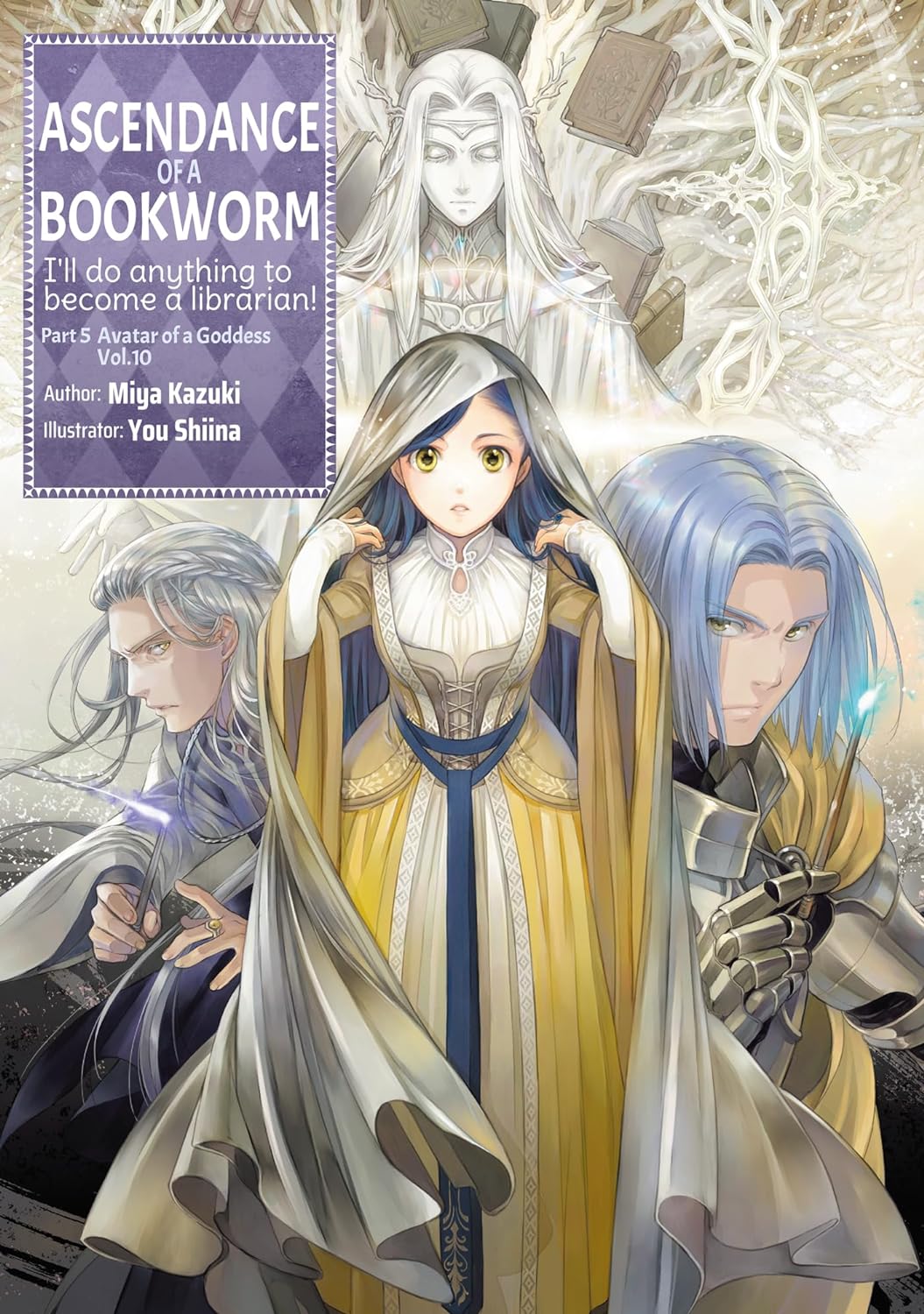
Ascendance of a Bookworm: I’ll Do Anything to Become a Librarian!, Part 5: Avatar of a Goddess, Vol. 9

March 23, 2024 by Sean Gaffney

By Miya Kazuki and You Shiina. Released in Japan as “Honzuki no Gekokujou: Shisho ni Naru Tame ni wa Shudan wo Erandeiraremasen” by TO Books. Released in North America by J-Novel Club. Translated by quof.

Thankfully, after the start of this volume, things are allowed to calm down a bit, as we have the aftermath of what’s benn happening for the last two book. Unfortunately, that means that the start of this volume absolutely does not calm down at all. I hate that it happens to her, but one of the best plotlines I’ve seen so far in this series is Rozemyne being in the thick of the battlefield, and what it does to her psyche afterward. PTSD does not really seem to be a thing here, and indeed we are on Rozemyne’s side. Why the hell is everyone so used to war and slaughter? People turning into feystones when they die has been around for some time, but it’s still “this is a fantasy world with magic, not real”. It’s not till Sylvester does the equivalent of pulling Georgine’s corpse out of his robes and slamming it on the table in front of her that she really snaps.

As I noted above, the start of this book is the fight against Grausam, who actually turns out to be in several places at once… which leads to the conclusion that Georgine is as well. Moreover, the battle ends up having to involve ONLY Rozemyne and Matthias for plot reasons, and she not only sees many soldiers have limbs cut off, get poisoned and turn into multiple feystones hitting against her pandabus, but she has to turn the pandabus into a kaiju in order to finally take (the real) Grausam down. At the same time, they are told that Sylvester has managed to defend the foundation and kill Georgine, and they can all return to Ehrenfest (after paying off Dunkenfelger with some booze). Unfortunately, thanks to the battle, Rozemyne can’t even look at a feystone. What’s worse, she has to figure out what to do now – and how Ferdinand is going to be involved in whatever she does.

If there is a lighter side to this rather heavy book, it’s seeing Rozemyne continue to explain how what she feels for Ferdinand is not, in fact, love. Again, this is Rozemyne and her life in Japan, where she’d never had a boyfriend or lover, trying to apply romance-novel rules to love. Love is desire, love is sex, etc. She doesn’t have those feelings for Ferdinand. But every OTHER part of love is literally exactly what she describes her ideal life with Ferdinand to be, and it’s no wonder that Hannelore and the others stare at her as if she’s out of her mind. To their society, where almost everyone marries for political reasons and having a marriage based on love and sex is seen as really weird (see: Sylvester and Florencia), what this is is just Rozemyne saying “Sure, I love him, but it’s not love because I say so.” It’s amusing, but in a sort of dark way.

As with the previous book, the last quarter of it is devoted to filling in the war from the POV of people who are not Rozemyne. We see Charlotte’s attempts to administrate everything, and are reminded that, with Rozemyne leaving and Wilfried… being Wilfried, she’s the next Aub, at least for now. Judithe has to deal with the fact that she’s defending the temple, and not in a more important role. (Judithe is also the utter innocent of the book, assuming everyone is going out to look at flowers and not, y’know, “pick” them.) Gunther gets to PUNCH THE EVIL AWAY thanks to the power of the love his family has for him and his shonen dad power. Florencia gets to have a nice chat with Veronica and finally move on and forget about her. And Sylvester gets to narrowly escape being poisoned to death but, to the very end, still not understand the boiling rage and hatred that is making Georgine do this. It’s very well done.

So much going on here that I haven’t even touched on. I’m sure the 10th book in this arc will be fine and filled with tea and snacks.

Filed Under: ascendance of a bookworm, REVIEWS

The Banished Former Hero Lives as He Pleases, Vol. 1

March 21, 2024 by Sean Gaffney

By Shin Kouduki and Chocoan. Released in Japan as “Dekisokonai to Yobareta Moto Eiyū wa, Jikka Kara Tsuihōsareta node Suki Katte ni Ikiru Koto ni Shita” by TO Books. Released in North America by J-Novel Club. Translated by bedi and Joshua Douglass-Molloy.

I’ve always been something of a nerd for “publishers”. What I mean is, I always try to figure out what books or manga are coming out where, and what they might have in common. Sometimes this is easy (Weekly Shonen Jump, Gagaga Bunko). Sometimes it can be trickier (whatever Wings is). And TO Books is sort of the anti-GC Books for me, in that I’ve always had a lot of good luck when trying books from this publisher. Bookworm and Tearmoon being the obvious winners. And so, when I saw this newly licensed title with, let’s face it, a very familiar premise, I thought “eh, I’ll take a flyer on the first book”. And I have good news, I was rewarded. Oh, this is not really all that original. And it has its character types, most notably the “too cool for school” hero. But it doesn’t feel like it’s being written for teenage boys. 20-something boys, perhaps.

The book opens with the banishment in the title, as Allen is thrown out of his family and told to leave the city by his father, Evil, and his younger brother, Evil, Jr. (They have names, but trust me, that’s how you’ll remember them.) In a world where so much depends on raising your level, Allen hasn’t raised his one bit, and thus a former prodigy is now regarded by most nobility as a disgrace. But Allen has a secret: he’s actually a reincarnation from a different fantasy world, where he spent his days saving the world for little glory, only earning the terror of the populace. He asked to be reborn in another world where he can live a peaceful life – which he did not get, until now. Oh yes, and he also has all his skills from the other world. So, um, he’s actually super duper ooper powerful.

Yeah, yeah, I know. Sean’s been drinking the Kool-Aid again. Trust me, Allen is not why I enjoyed this book. Though he’s fine, I guess. As generic heroes go, he’s on the more serious side of generic, and he doesn’t have any annoying traits. Kinda boring. But it’s the women in the series that interested me. Allen’s former fiancee, Princess Riese, her bodyguard, Beatrice, the world’s Champion, Akira, and the elf blacksmith, Noel. They are not introduced by telling us their breast sizes. There are not gratuitous scenes of them in a bath, or stripping. There is, in fact, no fanservice at all. Sure, Riese clearly is in love with Allen, but it’s handled very sedately, and the other characters do not all seem to have fallen for him as well (though this may change). It is, once again, a series that clears a bar that should be easy to clear but which most other isekai fail at. Oh yes, and no slavery yet, either.

Now, this is getting an anime soon, which may add in all the stuff I just said was absent. And, I mean, he’s still a ludicrously OP guy with minimal personality. But I liked the women. I want to see more of them, and have them help Allen more (I would like then to get their own subplots, but I’m not THAT delusional.) And the “elf is a blacksmith” thing was genuinely amusing and great. I’ll read more.

Filed Under: banished former hero lives as he pleases, REVIEWS

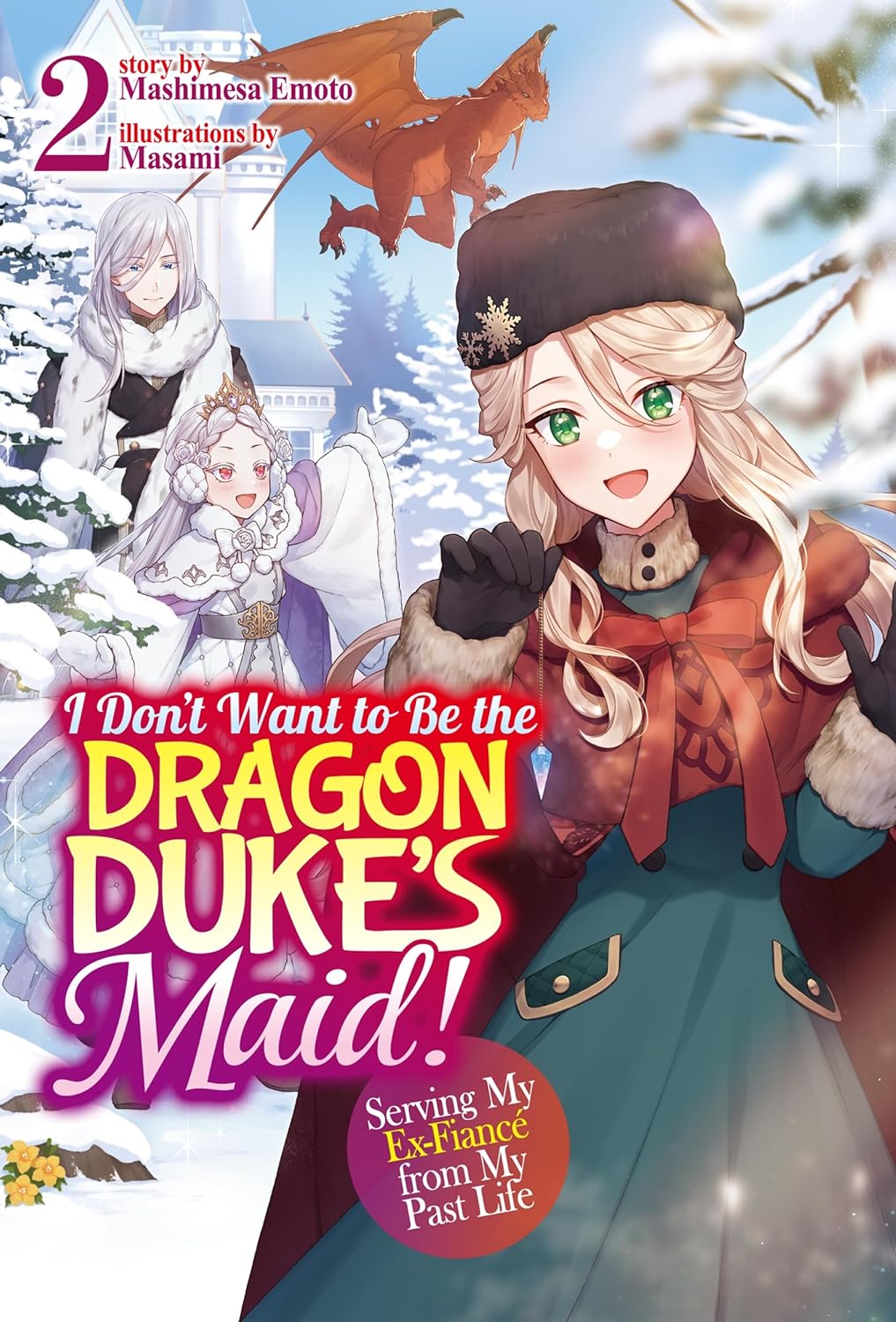
I Don’t Want To Be the Dragon Duke’s Maid! Serving My Ex-Fiancé From My Past Life, Vol. 1

March 19, 2024 by Sean Gaffney

By Mashimesa Emoto and Masami. Released in Japan as “Ryū Taikō no Senzoku Jijo wa Goenryō Shitai! Tensei Saki no Okyūji Aite wa Zense no Moto Konyakusha Deshita” by Arian Rose. Released in North America by J-Novel Heart. Translated by Amanogawa Tenri.

I think most readers of Japanese light novels by now are used to the title of the book being a summary. This is why I was quite surprised that we were getting to the halfway point of this new series and I had still not seen our heroine being forced to be the dragon duke’s maid. In this particular case, this is a good thing. This world has a lot of stuff in it that needs to be explained, and we also need to get into the head of our protagonist and get used to how she thinks of herself and how she treats others. Oh yes, and there’s also the “I was killed and reincarnated with my past memories” aspect to the whole thing, which is also influencing her. But, at last, she finally ends up serving the dragon duke… sort of. We never actually see her do maid work. She’s far too busy trying to help save the nation.

The dragon duke who rules the nation of Eclair is making his first appearance for one hundred years, and going to see him is the family of our heroine, Mille-Feuille. Unfortunately, the moment she claps eyes on him she passes out, as the memories of her previous life return. She was Charlotte, a human woman in love with the dragon duke, and she ended up dying, though Mille-Feuille can’t remember anything about it except the dragon duke’s face of fury. That said, she has enough in her life to get on with. In this world, men turn into dragons once a month, and can only be calmed by a female family member giving them mana – which causes great pain and suffering to the women who have to do it, ranging from mild facial blemishes to near-comas. Mille-Feuille, who seems to have more magic talent than most, happens across a way to help women recover their mana more easily after this, and she is now secretly passing out cures. Unfortunately, people are noticing…

The main reason to get this book is the heroine, who is very much of the “I am practical and somewhat snarky and completely willfully ignorant of how absurdly powerful I really am” school of heroines. There is a test that women take to determine how much mana capacity they have, but for one reason or another, Mille-Feuille has managed to skip every one of those measuring ceremonies. As such, she is uniquely suited to handle the dragon transformations of the duke himself, who is super powerful and therefore super hard to control. The romance between the two of them is cute and very romance novel-ish, and that comes complete with the mystery villain who keeps trying to wreck things as well as the younger sister of the duke who is a jealous brat till she grows out of it. But again, the heroine is the best.

This feels finished in one volume, but there’s apparently a second one. It won’t win points for originality, except for the dragon mana transfer, but I quite enjoyed it.

Filed Under: i don't want to be the dragon duke's maid!, REVIEWS

Earl and Fairy: A Cursed Diamond Imbued with Love

March 18, 2024 by Sean Gaffney

By Mizue Tani and Asako Takaboshi. Released in Japan as “Hakushaku to Yōsei” by Shueisha Cobalt Bunko. Released in North America by J-Novel Heart. Translated by Alexandra Owen-Burns.

Once again, as I read this series I am reminded just how far shoujo has come in the last twenty years, and how different it is. Everything going on between Edgar and Lydia in this series is intensely familiar to anyone who read the popular titles of the day back then… and yet it already feels like it’s from a hundred years ago, with Lydia’s inability to think anything but the worst of Edgar and his own inability to show Lydia what his love actually means feeling more frustrating than romantic. There’s also the “Lydia is kidnapped every volume, and threatened every volume, or both” problem. There’s consent issues. That said, once more, if you read this as a supernatural thriller and try to ignore the romance, there’s gold to be found here. Every volume brings a new creature that I have to google and find fascinating, and this one is no exception. We’re also getting a lot more contextualization about Edgar’s goals… and what he will and won’t do to get them.

Lydia is, unfortunately, at a society tea party, where she is forced to deal with a lot of hot gossip, most of it about Edgar, who now is rumored to have an entire harem of women. Of course, Lydia almost immediately believes this – if there’s one thing we know about Victorian England, it’s that rumors are true unless proven false. And, of course, Edgar *does* appear to be going to what is very carefully not described in this book as an opium den, but, well, is an opium den. He seems to be visiting a mysterious woman who lurks in a corner of the room… and he’s not the only one, as a marquess is also very interested in the same woman. What does this have to do with a paired diamond, black and white, which is mysteriously connected to Edgar’s family? And will Edgar and Lydia ever truly understand each other?

Edgar’s enemy in this, of course, is “The Prince”, and is trying to prove a closer heritage to being the future King of England than the current residents on the throne. Victoria is never mentioned here, nor is “Bertie”, the Prince of Wales at the time of this series (which seems to be set in a vague “somewhere between 1837-1901” time), but the general attitude of the bad guys is basically that they are, perhaps, not quite as British as one would like in a monarch. Perhaps a bit too Saxon. That said, I doubt we’re really going for any critique of the English monarchy here, but instead the series is using the time period as an obvious place where a large number of people would still believe in the fairies that are Lydia’s bread and butter, and who litter this series,. on both sides. Again, it’s all about the thriller.

The 6th book in the series is not scheduled yet, so there may be a bit of a break next. Perhaps it will allow Lydia to realize that not everything she hears about Edgar is true, and for Edgar to realize that confessing his love doesn’t amount to much if he has no future to offer her.

Filed Under: earl and fairy, REVIEWS

I’m in Love with the Villainess: She’s So Cheeky for a Commoner, Vol. 2

March 17, 2024 by Sean Gaffney

y Inori and Hanagata. Released in Japan as “Heimin no Kuse ni Namaikina!” by GL Bunko. Released in North America by Seven Seas. Translated by Kevin Ishizaka..

This is a very good second volume in this spinoff series, which sets out to show us Claire’s changing views in more depth and also flesh out some of the minor characters. It succeeds, but there’s also a feeling here that this is the middle volume of a trilogy. A lot of things we know will pay off in the third book are bubbling under here, but the lack of a real climax to the book does make it a bit unsatisfying. That said, overall I’m quite happy. This book reminds us that the goal for the visual novel Rae finds herself in is revolution, and that it’s still lurking. The anime, by necessity of only getting through Manaria, was barely able to touch on this, and Claire’s ignorance and tsundere stubbornness made it a wee bit unsatisfying. That changes here. Claire is learning how the commoners live, and how the commoners die. And she’s also learning how nobles live and what they do to keep that lifestyle. And she hates it.

Claire is having a bit of trouble warming up to her commoner classmate, who confesses her love but who Claire can’t take seriously. Perhaps things will change with the arrival of Manaria from the Sousse Kingdom, who Claire “greatly admires” and had a massive crush on as a child when she was is despair over the death of her mother and also thought Manaria was a boy. The result of Manaria’s visit will change her relationship with Rae forever. We then see Claire and Rae travel to Rae’s hometown, where Claire eats commoner food, has a pathetic attempt at learning to swim, and fights off undead pirate ghosts. Finally, back at school, they deal with Yu’s real gender, and how the Church is tied up in all of this. Claire’s social consciousness is growing by the day, and she knows that things cannot stay the way they are.

Claire’s POV is still the best reason to get this, but I must admit my favorite part of the book is the development of “Those Two Girls”, aka Loretta and Pepi. Both of them get a tremendous amount of character building in this book. Loretta is being potentially married off to someone involved in human trafficking, and also is forced to deal with the fact that commanding an army in real life, as opposed to supervised by her family, means she is sending some people out there to die. Pepi, meanwhile, also discovers that her family is up to their neck in bad things, and things are too dangerous for her to confide in either Claire or Loretta. It doesn’t help that Pepi has realized that her feelings for Loretta are romantic in nature. The only one who remains in a holding pattern in this volume is Catherine, who continues to stay in her dorm room, doling out advice to Claire and ominously foreshadowing her own fate. Clearly this will pay off in the final book, but it does not here.

It does, however, really make me want to read the final volume in this series. It was 14 months here between Vol. 1 and 2, hopefully it won’t be as long between 2 and 3.

Filed Under: i'm in love with the villainess, REVIEWS

The Evil Queen’s Beautiful Principles, Vol. 1

March 16, 2024 by Sean Gaffney

By Reia and Haduki Futaba. Released in Japan as “Akutoku Joo no Kokoroe” by Kadokawa Books. Released in North America by Airship. Translated by Gigi Li. Adapted by Abigail Clark.

Even if it didn’t also have the same artist as well, I think that readers of this new series will quickly realize that the author is the same as Accomplishments of the Duke’s Daughter. In fact, the author straight up admits that the idea for this series came about when she thought “what if Iris’ world had magic?”. The book tries not to go along the same lines, and indeed Luxeria’s story is a lot darker and more tragic than Iris’ (well, at least Iris rewriting her own story). But after the time skip, you gradually see that this is another woman who likes to surround herself with super competent servants and colleagues who she has also, in adventures we hear about but do not see, “recruited” from various circumstances. And there’s also a lot of “how do we create a better, more equal kingdom” worldbuilding here, as everyone knows that things need to change but actually making those changes is difficult and takes a while. That said… yeah, this is darker than Duke’s Daughter.

We open with our protagonist, Luxeria, stabbing her groom with a sword on their wedding day in front of the rest of the wedding party. We then track back a bit to see how we got to that point. Young Luxeria is commanded by her family to go live in a tower by herself. She’s delighted by this, as her overpowered magic allows her to see into people’s hearts (and also mind control them a bit), and she dislikes how it makes others uncomfortable. She’s supplied with a maid, the one girl out there who seems to be immune to Luxeria’s powers, and the two settle in and become good friends. Unfortunately, this kingdom is a monarchy but also has five strong marquess houses that have a lot of power. This means that they make an attempt on her life, put the maid into a coma, and kill her parents, the king and queen. Kinda sucks. Oh yes, and she’s a Japanese reincarnation, because of course she is.

I was expecting this to be a typical villainess book where the evil is just a bunch of misunderstandings, but no, Luxeria is out for revenge on those who killed her family and is determined to exact it. Of course, she does not want to exact her revenge while also destroying the country, which is where all that worldbuilding I mentioned above comes in. Actually, I think a flaw in this volume is that I want things to go a bit more slowly. We meet several of her underlings here, but the story of how she got them to work for her instead of against her (her main spy was trying to kill her, in fact) is not told here, but instead we just get a “ha ha yeah those were the days”. The relationship between her and her tragic groom is… also not handled well, mostly as he’s barely in the book. The relationship between her and her maid Alicia is the best thing about the book, and I hope the trust the two have in each other is not broken in the second half.

This was apparently not as long as Duke’s Daughter, so will wrap up in the next volume. I’d recommend it for fans of the earlier series, or for those who want a complete set of villainess books featuring characters called Alicia, of which there are many.

Filed Under: evil queen's beautiful principles, REVIEWS

The Otome Heroine’s Fight for Survival, Vol. 1

March 15, 2024 by Sean Gaffney

By Harunori Biyori and Hitaki Yuu. Released in Japan as “Otome Game no Heroine de Saikyō Survival” by TO Books. Released in North America by J-Novel Club. Translated by Camilla L.

This is another one where I had a different idea of what it was going to be like before I read it. When I typed up the premise in Manga the Week of, I said it was an Otome Game Reincarnation Meets Survival Game. Which… is not inaccurate per se, but I think fans of both genres are going to find this a little less than what they were hoping for. For otome heroine fans, while there are multiple reincarations and a villainess to go with our heroine, it only becomes relevant at one point in the story. As for the survival game, that comes right at the start and then is mostly setup for future volumes. As for what this actually is, well, it’s an attempt to tell a “dark” otome heroine story, featuring a heroine who learns how to kill in order to survive. That said… it’s a stat head book. If you’re the sort who can’t get enough of people raising their STR stat +1, you’ll be in clover.

Alicia, an orphan who is trying to live like a plucky young girl despite the orphanage being a Pit Of Evil, is accosted one day by a madwoman. She says this is actually an otome game, and Alicia, the heroine, is destined to be the secret daughter of nobility and end up at a school with multiple men vying for her. The other woman tries to use a magic crystal to transplant her soul into Alicia’s… which only partly succeeds, then Alicia, being a desperate 7-year-old, kills her. Now that Alicia has the woman’s knowledge of this world… and, it’s hinted, a healthy dose of nihilism… she returns to the orphanage, where she was about to be sold to some pedophile, kills the old woman running it, and flees. As she walks through the forest and cities of this world, she gradually works out how magic really works in this world, self-trains, gets help from a few allies, and gradually grows incredibly overpowered. Despite this, she never loses her new personality.

As you can likely guess, someone’s been watching a lot of the “dark magical girl” shows and thinking “hey, I can do that”. And, to be fair, they can do it pretty well. The usual complaining about stats aside (and believe me, it’s very annoying), Alicia, later Alia, is an interesting protagonist, whose influx of memories from the woman who attacked her helps to ward off accusations of her being nothing like any other 7-year-old out there. The same applies to Elena, the future Villainess of this world, who is also, separately, trying her best to avoid her fate in the game. Frankly, the meeting between Alicia and Elena is the highlight of the book, and the final scene may not be yuri (they’re both too young, leaving aside their mental age), but it’s fraught with doomed Birdie Wing-style dramatics, as one pledges to do one (and only one) thing to help the other no matter what, and the other promises to kill one (and only one) person for the other no matter what. It was damn cool.

That said… again, hope you like stats. I’m definitely reading the 2nd book, though, which may have a new cast, given our heroine fakes her own death at the end of this one.

Filed Under: otome heroine's fight for survival, REVIEWS

  • « Go to Previous Page
  • Page 1
  • Interim pages omitted …
  • Page 37
  • Page 38
  • Page 39
  • Page 40
  • Page 41
  • Interim pages omitted …
  • Page 342
  • Go to Next Page »
 | Log in
Copyright © 2010 Manga Bookshelf | Powered by WordPress & the Genesis Framework