• Skip to primary navigation
  • Skip to main content
  • Skip to primary sidebar
  • Home
  • About Us
    • Privacy Policy
    • Comment Policy
    • Disclosures & Disclaimers
  • Resources
    • Links, Essays & Articles
    • Fandomology!
    • CLAMP Directory
    • BlogRoll
  • Features & Columns
    • 3 Things Thursday
    • Adventures in the Key of Shoujo
    • Bit & Blips (game reviews)
    • BL BOOKRACK
    • Bookshelf Briefs
    • Bringing the Drama
    • Comic Conversion
    • Fanservice Friday
    • Going Digital
    • It Came From the Sinosphere
    • License This!
    • Magazine no Mori
    • My Week in Manga
    • OFF THE SHELF
    • Not By Manga Alone
    • PICK OF THE WEEK
    • Subtitles & Sensibility
    • Weekly Shonen Jump Recaps
  • Manga Moveable Feast
    • MMF Full Archive
    • Yun Kouga
    • CLAMP
    • Shojo Beat
    • Osamu Tezuka
    • Sailor Moon
    • Fruits Basket
    • Takehiko Inoue
    • Wild Adapter
    • One Piece
    • After School Nightmare
    • Karakuri Odette
    • Paradise Kiss
    • The Color Trilogy
    • To Terra…
    • Sexy Voice & Robo
  • Browse by Author
    • Sean Gaffney
    • Anna Neatrour
    • Michelle Smith
    • Katherine Dacey
    • MJ
    • Brigid Alverson
    • Travis Anderson
    • Phillip Anthony
    • Derek Bown
    • Jaci Dahlvang
    • Angela Eastman
    • Erica Friedman
    • Sara K.
    • Megan Purdy
    • Emily Snodgrass
    • Nancy Thistlethwaite
    • Eva Volin
    • David Welsh
  • MB Blogs
    • A Case Suitable For Treatment
    • Experiments in Manga
    • MangaBlog
    • The Manga Critic
    • Manga Report
    • Soliloquy in Blue
    • Manga Curmudgeon (archive)

Manga Bookshelf

Discussion, Resources, Roundtables, & Reviews

Reviews

Buck Naked in Another World, Vol. 1

May 3, 2020 by Sean Gaffney

By Madoka Kotani and Mochiusa. Released in Japan as “Shinyaku Isekai ni Tensei Shitara Zenra ni Sareta” by Mag Garden Novels. Released in North America by Seven Seas. Translated by Garrison Denim. Adapted by Matthew Grune.

When Seven Seas first tweeted about this license, I may have made a comment or two about it. Something about the title, the concept, and the cover art just set me off. It looked to be the culmination of every single bad light novel trend out there. Unfortunately, people responded to my blithe snarky comments with “ha ha, can’t wait to read your review!”. I realized only too late that this meant I actually had to review the thing. Oh well. How bad could it be? Things weren’t helped by the fact that, when it arrived on my phone, I found it was far longer than a book called “Buck Naked in Another World” had any right to be. This is a chunky volume. But, I finished it. And here I am, reviewing it. And I will tell you right up front: do not read this bad book. Tempting as it is to end the review there, let’s move on to a summary of the plot.

…no, wait, first I want to talk about that cover. I have to hand it to the artist: I don’t think I’ve ever seen a light novel hero I want to punch in the face on sight more than this guy. Look at that smug cocky grin. And we have the adoring mild-mannered girl on his left, and a big-breasted, eyepatch-wearing warrior on his right. More to the point, as you can tell, he’s not QUITE naked. Shuta (who everyone calls Shooter in this world) is a 30-something guy who floats from menial job to menial job, till one day he winds up in another world, naked. He’s at first arrested and put to even more menial jobs… naked except for a small loincloth, which you see on the cover. Gradually he wins over the population of the village he ended up in, gaining a wife and defeating monstrous wyverns. Then he goes to the big city, where due to his lack of identification he ends up tricked into slavery, and slaves are… you guessed it… naked.

Before I get into the naked thing, let’s talk about everything else wrong with this book. It almost reads like a checklist of things I dislike in light novels. It’s clearly based on a webnovel, and thus very long and not at all edited down. (In fact, judging by the ‘Shinyaku’ in the title, this isn’t even the first attempt at publishing it!) Slavery is here, because it’s a fantasy light novel, and it’s still irritating. There’s a scene where a woman pees herself in fear and Shooter will not shut up about it, something that remains very popular in these sorts of light novels as well for reasons I’d rather not think about. Shooter gains the affection of at least 6 different women over the course of the story, one of whom he marries, and does not do much except kill monsters and be nice to them to earn this affection. Moreover… OK, let’s get to the naked bit.

First of all, it is not clear until a side story at the very end why no one just gives this guy a pair of goddamn pants. I had gone into the book assuming it was some curse or such, but no. The village thinks that because he arrived naked, and does not immediately shriek for clothes, that this is just his thing. His wife (clearly embarrassed by his nudity, something Shooter interprets as fear) makes him g-string underwear, but says pants are above her station. When he’s enslaved, slaves are said to be naked, but again, he’s really the only slave we meet for more than two lines of text, so it’s still just him. Look, I get that you need to make your book stand out among all the other fantasy isekais. But… OK, let’s take Reborn As a Vending Machine. Ridiculous isekai premise, right? Harem of girls, right? Overpowered guy, right? However, if you took out ‘he’s a vending machine’, nothing in the story would work. But if you gave this guy clothes… nothing in this story would change at all, except we’d be spared a few wiener jokes from the narrator. There’s no goddamn reason for him to be naked except for clicks on your webnovel. At least rise above that low bar!

The translator and adapter do their best here… for good and ill, Shooter’s narration sounds like the sort of guy you’d imagine from the cover. In other words, you want to strangle him. Sadly, his smugness doesn’t help the mind-numbing worldbuilding that we get sprinkled throughout this, which is the main reason this is so long but is not worth it. And oh yes, for those who are buying the book featuring that a book with a title and girls like this has to have sex? Nope. Not at all. This book if irritating, dull, occasionally offensive, and far too long. Do not read it.

Filed Under: buck naked in another world, REVIEWS

Rascal Does Not Dream of Bunny Girl Senpai

May 1, 2020 by Sean Gaffney

By Hajime Kamoshida and Keji Mizoguchi. Released in Japan as “Seishun Buta Yarou wa Bunny Girl Senpai no Yume wo Minai” by Dengeki Bunko. Released in North America by Yen On. Translated by Andrew Cunningham.

(This review is based on a review copy provided by the publisher.)

A lot of times these days, licensed light novels tend to fall into two different categories: “we’re licensing this because the Japanese publisher knows there’s an anime in the works”, and “the anime has come and gone but this did not immediately vanish into obscurity the moment the anime ended so let’s take a flyer on it”. Rascal Does Not Dream of Bunny Girl Senpai seems to be the latter – it started Japanese publication in 2014, which makes it quite old by licensing standards. I haven’t seen the anime (yes, try to contain your surprise) but I’d certainly heard of it, with it seeming to occupy that odd position of both “high school romcom” and “vaguely supernatural things happen” that we see in Haruhi Suzumiya and others. That said, I did notice (and tweeted about) a major different I spotted: unlike all those novels with snarky first-person narrators whose inner thoughts we are buried in, Aobuta (its Japanese nickname) is third person. It makes a difference, believe it or not.

Our hero apparently already had a boatload’s worth of light novel events happen to him before the series began: Sakuta has a past, which has left him with huge gashes across his chest, a little sister who’s a shut-in, and a reputation at school that means he has precisely two friends. One day at the library he is startled to find Mai, an upperclassman of his and a famous actress… well, actress on hiatus… dressed as a bunny girl and walking around. No one pays any notice to her – but Sakuta can see her, much to her shock and dismay. As they gradually get closer he discovers that more and more people simply don’t notice that Mai exists, and it’s becoming something of a problem. Since he has experience of this thanks to his sister’s history of being bullied (which also involved mysterious supernatural consequences), he chooses to help her out. It helps that she’s really hot. It doesn’t help that he will say absolutely anything that comes out of his brain with no filter.

As I said, this is in third person, so while we can hear about Sakuta’s thoughts and decisions, we don’t get his specific thought process. This means that things that others, such as Kyon or Hachiman, might think to themselves for the benefit of the reader but not bother to say aloud he says aloud. This might actually make him more attractive to Mai, who is used to people not knowing how to talk to her and thus not talking to her at all. The relationship between the two is the best part of the book. I also like how he expects her, when they first meet, to behave like Senjogahara – the book is aware of its influences. Mai is a bit less sharp than that, but still falls into that basic type. In the second half of the book, as things turn more serious and Mai’s “no one can see me” condition turns potentially fatal, the two have a warmly growing bond that I want to see more of.

The book is part of a series, which not only makes for an annoying cliffhanger (expect a Groundhog Day loop next time) but also sometimes means things clearly meant for future novels are introduced here, no matter how awkwardly they may fit in. If Tomoe is the subject of the next book (as the title suggests), she’s going to have to be more interesting than she was here to win me over. (That said, she clearly wins out over the girlfriend of our hero’s best friend, who seems to be designed to be a Hate Sink so that the fandom can go after her and leave the rest of the cast alone.) In the end, I found Rascal Does Not Dream 1 (the titles will be changing with each book) to be an excellent stand-alone romance that seems to be a harem-ey ongoing series. As such, we’ll see what happens in the second book.

Filed Under: rascal does not dream, REVIEWS

Silver Spoon, Vol. 14

April 30, 2020 by Sean Gaffney

By Hiromu Arakawa. Released in Japan as “Gin no Saji” by Shogakukan, serialized in the magazine Weekly Shonen Sunday. Released in North America by Yen Press. Translated by Amanda Haley.

This isn’t the last volume of Silver Spoon – that’s the next one, and I’ll get into why that’s controversial when I review it – but let’s be honest, for most readers of this series who were not in it for just the extensive farming talk, this volume is the payoff. This is not to say there isn’t still extensive farming talk – in fact, there’s more of it than ever. Arakawa is determined to drill into readers’ heads what making a living as a farmer in 21st century Japan is like, and by now the readers are close to understanding it, though probably not enough to actually start a farm. As our heroes get closer to graduation, we see expanding businesses, more pizza sales (though they don’t break even – always talk to Tamako first), and how to see your career prospects threatened by an extremely sketchy company looking for indentured servants in all but name. That said, the big plot here is Mikage and her exams.

The cover might seem ominous, with Hachiken and Mikage once again separated from actual romantic contact. And the exams are not easy – indeed, Mikage’s exam partner, Aikawa, ends up not passing – with Mikage getting a particularly vicious interviewer who suggests that her love of animals is because she hates dealing with people. Of course, as we’ve seen in the past, he’s not far off, but the days of deflecting and stepford smiles are over for Mikage, who gives a nice, heartfelt answer that amounts to both “I fell in love with this guy” and also “I was inspired to better myself because of everything he did”. As for Hachiken, frankly, he’s so worried he ends up in bed with gastritis. However, not to spoil too much, but things work out. In both ways – the 121st chapter is, as I said above, the payoff, and after a LOT of events conspiring against them (even equestrian helmets!), Hachiken and Mikage are a couple.

Now, Silver Spoon was never just about whether these two would get together, so there’s more to come here. For one, the other students find out – which naturally leads to the two of them being separated for all romantic holidays from now until graduation, because the boys are lovable assholes. There’s even another couple getting together – to contrast with Hachiken and Mikage’s tortured courtship, Sakae and Maruyama’s pairing is as blase as they come, and the two of them still think like farmers, as they have to discuss how the family businesses would merge in the event of their getting married. (Sakae also has some great lines as the biggest Mikage/Hachiken shipper in the cast.) Mikage’s parents also find out, which goes exactly the way you would expect. Basically, as with previous volumes of this series, every super heartwarming moment is undercut by extreme silliness.

So we head towards graduation, and seeing what everyone does next. Will there be enough pages to fully flesh everything out? Aheh. We’ll talk about that next time. Till then, enjoy what everyone was waiting for.

Filed Under: REVIEWS, silver spoon

The Extraordinary, the Ordinary, and SOAP!, Vol. 1

April 29, 2020 by Sean Gaffney

By Nao Wakasa and ICA. Released in Japan as “Hibon, Heibon, Shabon!” by ArianRose. Released in North America by J-Novel Club. Translated by C. Steussy.

I have talked before, and no doubt will again, about the fact that one of my favorite types of light novel is the kind that has, as its plot and character archetypes, not one original bone in its body, yet somehow still manages to win you over with the sheer power of good writing. I enjoy it so much because a) let’s face it, the old and familiar is like that hoodie that you always wear around the house – it’s your comfort food, but b) it shows the author has the skill to make you want to read more. This especially applies to the latest in a long line of shoujo light novels from J-Novel Club’s Heart imprint. I love that we’re finally getting so many light novels for women rather than men, but let’s face it, introducing a dozen or so of them in the space of about five months has been a bit wearing. So we start with a story about a common girl with a dull magic power who can SAVE THE WORLD!

The title in Japanese – Hibon, Heibon, Shabon! – is snappy and rhymes and is, unfortunately, nearly impossible to translate so that it does the same thing in English. Shabon is soap, and that’s what our heroine Lucia can do – her powers make soap bubbles that can clean even the most stubborn stains. After the death of her mother leaves her with a pile of debt, she moves to the king’s castle to find work as a laundrywomen and enjoys a fun, ordinary life – including having lunches with Sir Celes, a cute and handsome knight. Sadly, he’s away when the castle is attacked by horrible monsters one day, but Lucia, desperate and terrified, casts her soap magic on one… to find it suddenly calm and placid. Turns out her magic is a lot more than removing stains from clothing, it can also apparently remove the horrible mental and emotional stains from people. So she’s sent off to join the Sacred Maiden, who has been transported from another world to… wait, what?

Yes, the best part of the series, easily, is that this is in fact an isekai, but the girl who is transported from Japan is only a supporting character. Maria is supposedly the deus ex machina that will save them all, but things aren’t going very well. And actually, I tell a lie, because the best part of the series is the subtlety in its writing. As an example, Maria is shown to be selfish and horrible whenever we hear about her, but after Lucia a) hits her with Soap a few times to clean her clothes, and b) talks to her like a normal person rather than a savior of the world, Maria gets better. (Somewhat.) Is it Lucia’s magic or is it Lucia’s talking her down? It’s left open. The scene at the castle when the monsters are attacking is also expertly handled – there’s a real sense of terror from both Lucia and the residents of the castle, and it adds to the sense of depth in the books. As for the relationship between Lucia and Sir Celes, it’s cutely handled so far, and I liked that we added a bunch of other hot young/middle aged guys to the cast and Lucia is interested in precisely none of them – in fact, she thinks “is this what it’s like to have a dad?” with one big bruiser.

Good writing, a clever take on isekai, only a little fanservice (Lucia is somewhat busty, which is mentioned once or twice), and a winning heroine. Best of all, it’s only three volumes long, so there’s not a huge investment. And you’ll absolutely have to get the next book, as this one ends on a nasty cliffhanger. Very pleased with this series.

Filed Under: extraordinary ordinary and soap!, REVIEWS

My Next Life As a Villainess! All Routes Lead to Doom!, Vol. 5

April 27, 2020 by Sean Gaffney

By Satoru Yamaguchi and Nami Hidaka. Released in Japan as “Otome Game no Hametsu Flag Shika Nai Akuyaku Reijou ni Tensei Shite Shimatta…” by Ichijinsha Bunko Iris. Released in North America by J-Novel Club. Translated by Marco Godano.

It’s been a while since we last saw the light novel version of this series. Since last July, the anime has started to air and seems to be quite popular despite the fact that casuals will now ask novel fans why they spell Katarina with a K; the manga has started its second story arc, adapting the third novel; and a second manga has started with a spinoff idea of “what if Katarina fell and hit her head… when she was already bullying Maria at the Academy?”. Looking at my last review, I had wondered if the series would finally allow everyone to graduate next time. Well, the answer is no; this is a short story collection, taking place all over the Bakarina timeline, and therefore we don’t see her entering the Ministry of Magic or anything here. Instead we get a wide variety of tales, some good, some dull, and a few manga interspersed (the artist of the light novel illustrations is also the artist for the main manga series).

To start with the duller stories, Keith is a nice guy but tends to lead to tedious story beats, and that holds true here. Alan is slightly more interesting but “have a picnic and climb a tree” is still very slight. Raphael’s story seems to be there to remind us that that section of the cast exists, and the manga sections are fun but also very slight. The end of the book has a lot of tiny little stories from various minor members of the cast, showing how Katarina has impacted their lives. That said, there are also some very strong stories here. Katarina runs into a self-proclaimed rival who reminds me a bit of Nanami from the Utena series, and fares about as well; Nicol starts an arranged marriage process because he feels it’s his duty, only to run into a bunch of women who strangely don’t find “I’m doing this because I have to” enticing; Katarina and her girl friends/girlfriends all talk about romance; and Katarina’s snake making may upset her fiancee, but is a potential moneymaker.

The series is still ongoing in Japan, and I imagine is continuing its balancing act with Katarina being too dense to realize that everyone in her orbit is in love with her. That said, I do wonder if it’s showing signs that it might actually resolve with her making a choice, mostly as there are minor signs of “pairing the spares”, so to speak. Nicol’s final fiancee interviewee actually seems to go together very well with him, despite neither one wanting to get married to each other. Mary, usually one of the most hardcore Katarina fanatics, shows a brief moment of doubt after Alan rescues her from a creeper. That sort of thing. That said, that balances with the other thing this book hammers home, which is that Katarina is the best at it, but is certainly not alone in misreading the obvious intentions of everyone else. Even her own mother gets into the act, seeing only the annoying perpetual 8-year-old part of Katarina and missing the fact that she’s managed to become the most influential person in the entire kingdom.

So worth picking up, but lacks some of the impact of the other volumes. It’s also quite short. Will the next book finally have Katarina in the working world? And will she ever show any romantic feelings towards anyone at all? I look forward to finding out. Till then, there’s still the anime to watch.

Filed Under: my next life as a villainess, REVIEWS

Bloom Into You: Regarding Saeki Sayaka, Vol. 2

April 26, 2020 by Sean Gaffney

By Hitomi Iruma and Nakatani Nio. Released in Japan as “Yagate Kimi ni Naru: Saeki Sayaka ni Tsuite” by Dengeki Bunko. Released in North America by Seven Seas. Translated by Jan Cash and Vincent Castaneda. Adapted by Jenny McKeon.

A couple of quick notes before we get to the meet of this second of three novels concerning Sayaka before, during and after Bloom Into You. First of all, the book assumes you are familiar with events in the 7th manga volume, which just came out over here, and also assumes you know how the manga is going to end, at least vaguely. Secondly, this is written by the author of Adachi and Shimamura, and that’s a big surprise to me, as the two books could not have felt more different. Adachi and Shimamura deliberately meandered and stayed in one emotional beat for most of its first volume, despite the multiple narrators. Whereas this book, entirely narrated by Sayaka, absolutely knows where its endpoint is, and barrels along getting there, even as most of it involves an extended flashback showing Touko and Sayaka’s first year. If nothing else, this shows you that just because a book is a tie-in does not mean it’s just dashed off.

The book begins around the time of the manga, with Sayaka first meeting Yuu and noticing her relationship with Touko. The two have nice, frank discussions in ways that neither one of them could ever have with Touko (I’ll be honest I can’t remember which of these scenes, or maybe all, are from the manga as it’s been a while since those volumes), and then takes us up to Sayaka’s confession from the 7th manga volume. We then have an extended flashback, the bulk of he book, showing us Touko and Sayaka growing slowly closer over the course of the year, despite the walls both of them naturally keep up, and also showing Sayaka becoming aware of Touko’s circumstances… and not really doing much with that information. It’s a great look at why Yuu, rather than Sayaka, is the winner here. We then end with Sayaka in college, in what amounts to a trailer for the 3rd volume, meeting who I assume is her future partner.

Again, the best reason to read these novels is Sayaka’s POV. I may have criticized the author for her narratives in her own work, but handling someone else’s character she’s fantastic, and supported well here by the translators and adapters. Sayaka sounds exactly like we’d expect, both in dialogue and in her head, and I loved the constant use of Touko’s full name in her thoughts until they get to be friends – and note this is after Sayaka says that she’s in love with her! Sayaka’s experiences in the first book help her here, but that doesn’t mean that she doesn’t run into her problems, and her own decisions regarding the “safe” relationship with her best friend lead to it never getting past that. And there’s also Sayaka’s own natural reserve, which gets a little better here but is still there… while watching Touko crawl around her bedroom trying to chase one of Sayaka’s cats (thank god that got an illustration), Touko notes for the first time Sayaka’s face looks “relaxed”.

So yes, Sayaka matures here but is still very much a high school student when it comes to her emotional strength. I greatly look forward to the third book, which shows us Sayaka in college, and hopefully seeing how she builds on her love. I also look forward to rereading this one day after doing a reread of the manga, to better pick up the nuances at the start of it. All Bloom Into You fans, and yuri fans, should love this.

Filed Under: bloom into you, REVIEWS

Altina the Sword Princess, Vol. 3

April 24, 2020 by Sean Gaffney

By Yukiya Murasaki and himesuz. Released in Japan as “Haken no Kouki Altina” by Famitsu Bunko. Released in North America digitally by J-Novel Club. Translated by Roy Nukia.

Having given us a military story for the first two volume, Altina now dives headfirst into the politics of medieval succession, as she and Regis return to her Empire’s home for a formal get together. Of course, there’s a lot more to it than that. She was set up to fail as the commander of her remote base, and succeeded; she was set up to fail by taking an untakeable fortress, and succeeded; now she’s back home so that her brothers can make use of her once and for all in their own power struggles. Of course, each has their own problem. The first prince was poisoned recently, and since recovering has looked rather weak… among other things. The second prince is in the strongest position, and has his own version of Regis, but still feels the need to reach out to Altina. And there’s a third group of nobles also jockeying for position, and their leader seems to really, really like Regis. Fortunately, this is the one area where he’s an idiot.

It has to be said, Altina is a much better military commander than she is a princess, and she likely realizes this; she’s too straightforward and honest to manipulate. Which at times is a problem, such as when Latrielle, the second prince, offers to have her join him and her hot-headed response is exactly what the situation doesn’t need. Fortunately, she is smart enough to realize Regis needs to be there, and he comes up with a very elegant solution to a difficult problem though admittedly it also involves immediately fleeing as quickly as possible to avoid being killed. He is helped out by Auguste, the first prince, who has a rather poorly kept secret that nevertheless has persisted. Speaking of secrets, Eric continues to be a good, if excitable bodyguard to the princess, but gosh, it’s so odd how he doesn’t want to change in front of Regis and keeps blushing all the time about it. And asks him about daughters who are trying to keep their family traditions no matter what. Wonder what that could be?

These are short books, and the writing is snappy, so the prose flies by. Unlike some other series by this author, there’s also minimal fanservice, so it’s safe to recommend to other folks. I will admit that we do lean very hard on Regis being so self-loathing and modest that he is unable to see why any woman would possibly be interested in him, despite Altina, Clarisse, Elenore, and Eric (oh what a giveaway) all making overtures of some kind or another. This doesn’t just apply to his non-romance either; he regards his tactics as fake because they come from books he’s read, and therefore has a low opinion of his own brilliance. It’s frustrating, but makes sense for his character, and I hope he slowly grows out of it. (Also, we get some details on the books he enjoys reading, and wow, this world has some bizarro fantasy novels.)

There’s setup for a war that looks like it will happen next volume. In the meantime, if you like political intrigue, fiery redheads, and something you can polish off in an hour or two, this is your book.

Filed Under: altina the sword princess, REVIEWS

My Dress-Up Darling, Vol. 1

April 23, 2020 by Sean Gaffney

y Shinichi Fukuda. Released in Japan by Square Enix, serialization ongoing in the magazine Young Gangan. Released in North America by Square Enix Manga. Translated by Taylor Engel.

Despite the tendency of modern-day folks to say that it’s OK to be introverted and that not everyone needs to be brought out of their shell, there’s no denying that the number of works dedicated to that continue to proliferate. In manga, who the introvert is depends very much on who the series is meant for: in shoujo works, it’s a shy young girl who runs into a brash and outgoing young man, and in shonen or seinen works, it’s the opposite. Since this runs in Young Gangan, you can guess what we have here. That said, as I have always said, just because a story is familiar does not make it bad. Both leads are quite likeable and the whole thing put a smile on my face – despite the M rating (mostly due to frank discussion of a game), so far it’s pretty wholesome, and its premise of “don’t be ashamed of your hobbies even if they are seen as girly” is a good one. Plus that cover is fab.

Our hero is Gojo, a young man who has a deep and abiding love of Hina dolls – those little dolls with the fancy head and hairpeieces – but alas, a childhood friend said that this was a girly hobby and she hates him now, and this led him to lose all confidence and become a shy loner who is constantly doubting himself. Into his life one day comes Kitagawa, a popular “gal’ in his class who has no trouble both saying what’s on her mind and also admitting to hobbies that might be seen as uncool. When she finds Gojo working on a sewing machine one day, and realizes he can make clothes, she asks him to help her cosplay, something she’s been trying but failing to do as she can’t sew at all. There is, perhaps, one catch – she wants to cosplay a character from an ero-game – again, something she’s not shy in saying.

As I said, this title is rated M. Though there are fanservicey shots of Kitagawa in her underwear – indeed, it’s on the first color page – the relationship between her and Gojo is pretty PG so far – she tries to tease him a few times, but is also starting to like him in a way that makes her shy off of that. The M rating comes from the game she loves, “Saint♥Slippery Academy for Girls–The Young Ladies of the Humiliation Club: Debauched Miracle Life 2”. It’s a title that you know a company like MangaGamer would snap up in real life, and, like a lot of these sorts of games, balances out the sex scenes with emotional moments of “love” – dubious though it may sound. Kitagawa talks about this a LOT, and as Gojo plays it and they discuss it, sometimes there are misunderstandings.

That said, the main reason to get this title is the main couple – they’re really cute, bond immediately, and I want to see them open up to each other more. (I do also wonder if the series will earn its rating more in future volumes.) I definitely recommend it for those who like comedic romance with a touch of spice – well, OK, given the game Kitagawa is a fan of, a touch of sleaze.

Filed Under: my dress-up darling, REVIEWS

Ascendance of a Bookworm: I’ll Do Anything to Become a Librarian!, Part 2: Apprentice Shrine Maiden, Vol. 3

April 22, 2020 by Sean Gaffney

By Miya Kazuki and You Shiina. Released in Japan as “Honzuki no Gekokujou: Shisho ni Naru Tame ni wa Shudan wo Erandeiraremasen” by TO Books. Released in North America digitally by J-Novel Club. Translated by quof.

A very telling quote comes about a quarter of a way into this volume of Bookworm, with the High Priest and Benno meeting to talk about Myne. “We must think of a plan at once. Benno, what means are there to control this thing?” The “thing” is Myne, and it seems very rude, but to the regular citizens of this world, it’s absolutely true, especially in this volume, as Myne is about to invent movable type and the printing press. In previous volumes we’d seen Myne come up with ridiculous ideas, but they were ideas – even the paper – which could still reasonably fit into a very class-based world and not create too much of a fuss. This is a very different story – nothing will ever be the same again. If you add that to the ridiculous amount of mana she has, it means that Myne is not so much a young girl as a nuclear weapon. Sadly, this means she may lose her family.

This is the third of a four-volume arc. The first arc was “Daughter of a Soldier”, and this one is “Apprentice Shrine Maiden”. Glancing at the subtitle of the next arc shows that Myne will be moving up in the world once again. It’s a horrible decision for her, as she loves her family, and they love her. Notably, the High Priest is not compromising one bit at this point – there’s no “oh, but you can still see your old family” here, mostly as if Myne is a noble, she’ll be nowhere near her old life. The book also hammers home why this is important. We see suspicious guild leaders trying to kidnap her, suspicious nobles trying to kidnap her, and the cliffhanger shows another evil noble on the way – one who likes small children, which is very disturbing given that this world shows off how young girls can “move up in the world” mostly by becoming concubines. Myne can’t simply walk around town coming up with cool new ideas anymore.

The book is well-written as always, and very long, also as always. The main new character we meet is Sylvester, another noble who, as Myne describes him, is an adult with the mind of a 6-year-old boy. There’s clearly more to him than that, but she’s also not wrong, and I admit that I found him to be more obnoxious than anything else. Fortunately, the noble who’s supposed to adopt her looks a lot more reasonable. Myne also gets a permanent bodyguard, one of the two knights who were “protecting” her in the past book. He’s a bit of a schmuck, to be honest, though he’s nice at heart. And, as noted above, Myne has her movable type thanks to a craftsman who loves working with small, detailed pieces. Now Myne is sponsoring him, something he’s rapidly coming to regret, as it’s hard to deal with Hurricane Myne. Oh yes, and new baby! Myne gets to be a big sister… if only briefly.

Supposedly Myne has until she’s ten years old until she’s to be adopted. That said, the cliffhanger implies not only bad things for Delia (who I worry about even though she’s a spy), and I suspect that that timeline may be moved up. Till then, this remains one of the most addicting light novels around. Watch the anime as well!

Filed Under: ascendance of a bookworm, REVIEWS

Yona of the Dawn, Vol. 23

April 20, 2020 by Sean Gaffney

By Mizuho Kusanagi. Released in Japan as “Akatsuki no Yona” by Hakusensha, serialization ongoing in the magazine Hana to Yume. Released in North America by Viz Media. Translated by JN Productions, Adapted by Ysabet Reinhardt MacFarlane.

After escaping from the burning building, complete with another round of “Jesus Christ, Zeno, MUST YOU?” self-sacrifice, our heroes are ready to deal with the plot. Unfortunately, the plot is forcing them to do something that’s been a long time coming. For most of the beginning and middle of this series, the goal has been to hide Yona’s identity and have her and the others function as a rogue band of do-gooders while also learning more about the country where her father was (a pretty crappy) king. But sometimes things can’t be solved by anonymous bandits, and here Yona is forced to not only reveal who she actually is, but goes off to negotiate with Su-Won as herself, something that I’m sure will go well and not be a disaster at all. Unfortunately, we have to wait till Vol. 24 for the fallout. Again, though, Yona’s “beacon of hope shining in the darkness” personality trumps all subterfuge. Well, that and the fact that 3/4 of the cast are hostages.

We also meet Princess Kouren, Tao’s older sister, in the best possible way – Yona shoots down a bird that lands directly on her face. I expect we will get more from her in the next volume, but it’s worth noting that Tao here is allowed to have the longer view of trying to save more lives of her kingdom’s people (and it’s shown here that they’re really trying to conscript EVERYONE into the army here) because she has not been traumatized by the violence of the kingdom’s enemies. If you see all of your friends brutally murdered in front of your eyes, it is absolutely valid that you are not going to want to simply barter a peace treaty with those who did it. That said, I worry that she may end up needing to be killed by the plot in order to posthumously learn to let go. Let’s hope not.

Elsewhere, as I mentioned, most of Yona’s group are either seriously injured, captured, or both, allowing us to get a good dose of their captor, who has a truly disturbing slasher smile. I hope something bad happens to him, he is not a nice man. As for Yona, she’s pushing herself so hard she almost collapses, which is a shame, as it means she misses Hak murmuring some very important words to her. (There’s also a side story showing how few real friends she had as a child – two is the correct answer – and again you marvel how how much she’s been forced to change, and how she’s blossomed as a result. and just in case you worried there was no humor in this volume, there’s a hilarious side story where Gija, Sinha, and Yona all eat a mystery candy and turn violent. Yona, of course, being the reason this is so funny.

The best volumes make you want to read the next one right away, and that’s definitely the case here. Read it now.

Filed Under: REVIEWS, yona of the dawn

Samurai 8: The Tale of Hachimaru Vol 1

April 19, 2020 by Anna N

Samurai 8: The Tale of Hachimaru Vol 1 by Masashi Kishimoto and Akira Okubo

Samurai 8 is a retro futuristic manga that mashes up The Last Starfighter with Samurai tropes, with very detailed art and maybe a little bit too much exposition in the first volume. The art is incredibly detailed, and I’m hoping a more coherent story emerges in the second volume since the exposition will be out of the way.

The volume opens with a futuristic battle between questing samurai, and some of the story elements resemble a video game… because it is. Hachimaru is a sickly child who is kept alive due to the inventions of his father, but takes refuge in gaming. He isn’t able to go outside at all, but this situation is quickly resolved when a Samurai in the shape of daruma appears and asks Hachimaru if he has heroism within him. Daruma announces that he’s seeded the video game throughout the galaxy in order to find young people with potential. In just a few panels, Hachimaru’s father is fending off a band of ronin, Hachimaru undergoes a bodily transformation and becomes a samurai, and Daruma takes him on as a new pupil.

Samurai 8 Volume 1

The art is incredibly detailed and many of the futuristic landscapes are stunning. There are so many floating armor plates hovering around the characters, it made the action scenes a bit difficult to follow for me, just because I wasn’t sure where my eyes should go. There’s a lot of potential with this series, but I think both the story and art needed a bit more room to breathe. My kids read this manga and liked it, but thought it was “too fast.” I’m hoping that things settle down a little bit in the next volume, because there is plenty of potential here.

Filed Under: Manga Reviews, REVIEWS Tagged With: Samurai 8

The Economics of Prophecy: Dealing with Guild Politics in Another World

April 19, 2020 by Sean Gaffney

By Norafukurou and Rei Shichiwa. Released in Japan by Legend Novels (Kodansha). Released in North America by J-Novel Club. Translated by Hikoki.

I have to admit, if you asked me what the next volume of The Economics of Prophecy, a work whose core audience is made up of older men already in the Japanese workforce, would be about, “school festival arc” is not what would have sprung to mind. And yet our heroes are at a school for sons and daughters of guild nobility, and therefore it stands to reason that a festival would be just as cutthroat as anything else. Naturally, it’s once again the strong vs. the slightly less strong, with Ricardo (who presents himself as the weakest but is anything but) trying to walk a fine line so that he can get what he wants in the end. The fine line is the most interesting part of this book, as it becomes clear to the reader that denseness about women might not be Ricardo’s only fault; he doesn’t really seem to realize how deep into the political world he has to get till it’s spelled out for hi8m at the end.

As you might expect, the school festival is an excuse for the kids to show off their future inheritance, with the best rooms taken by the stronger family simply by dint of rewriting the rules. Ricardo and Mei do not have a booth (they are, after all, a mere copper family) but they do need to help Alfina the Prophecy Princess, who has been exiled to a courtyard because she has her own politics to deal with. Also, one of the lesser families’ heirs is Mei’s friend (though you get the sense that Mei is less and less thrilled with this as the weeks go on), and, most importantly, he happens to be in the wrong place at the wrong time and gets drawn in. That said, he has a plan. A plan that involves modernizing this kingdom’s concept of dining to take in the outdoor cafe and the single-plate lunch.

I noted the first volume was a bit dry, and that’s also a fault with the second volume: the start in particular is a massive economics lecture that will make you yearn for the plot to begin. Once it does, however, the book picks up considerably: the interfamily politics and Ricardo’s navigating through it all with ease is immensely fun (he’s just as OP as any other isekai hero, just in terms of economic theory and political savvy). He continues to be unaware that both Alfina and Mei are in love with him, and in fact explicitly notes that Alfina, due to his live lived in Japan added to his years here, is more of a niece to him. He’s also, however, of the impression that he can magically manipulate events behind the scenes to perfection, explain exactly how he did so, and then quietly go back to his honey company and keep plugging away. That is just not going to happen, as the families explain to him at the end. It’s amusing.

There’s setup for a third book towards the end, a book that, as of this review, has not come out in Japan. So it may be a while before we see more of this. Still, if you want less dungeon crawling and magical swords and more explanations of sunk cost fallacies, this is the series for you.

Filed Under: economics of prophecy, REVIEWS

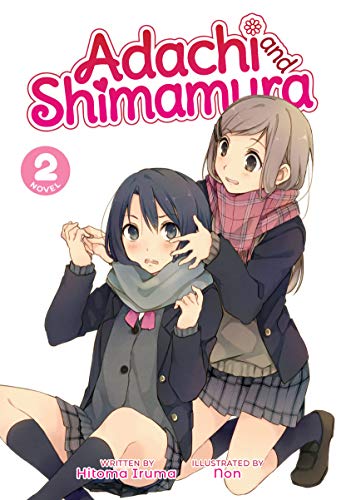
Adachi and Shimamura, Vol. 1

April 18, 2020 by Sean Gaffney

By Hitoma Iruma and Non. Released in Japan by Dengeki Bunko. Released in North America by Seven Seas. Translated by Molly Lee.

It is, to be honest, rare that a light novel catches me completely by surprise. For one thing, I tend to spoil myself as to what the content of a series is going to be. I thought I knew about this one. I knew it was an extremely popular yuri light novel series. I also knew it was supposed to be a bit boring. Both are true. The story begins with Adachi and Shimamura already knowing each other (though we get a later flashback to how they meet). They’re both delinquents who tend to cut class. Adachi, the black-haired girl, is seemingly stoic and unapproachable. Shimamura, who has dyed light brown hair, is more open and has more friends than the aloof Adachi, but also seems to have a disconnect when it comes to emotions. Seeing them flapping around in their interior monologue trying to connect is what’s meant to be the point of the book. That said, it doesn’t quite keep the reader’s attention. Then the girl in the spacesuit shows up…

So yes, this is my own fault. I knew that the author of this series has written a large number of other series for both Dengeki Bunko and other publishers (including the Bloom Into You light novel spinoffs). I had also heard of the much older series Ground Control to Psychoelectric Girl (Denpa Onna to Seishun Otoko), but didn’t realize that it was also by this author. And that series has, as one of its supporting cast… a girl who dresses in a spacesuit and has seemingly supernatural powers. In the context of that other series, which stars another girl who says she is an alien, Yashiro as a mysterious maybe alien with supernatural abilities works fine. But when she shows up here and starts hanging out in what is, let’s face it, the cast of K-On! without the band, it’s quite jarring. Especially when she takes over the scenes she’s in… and proves to be more interesting than the two leads.

Let’s get back to the title characters. Three fifths of the book is narrated by Shimamura, and is the poorer for it. I’m not sure what the author is really trying to convey with her headspace. She seems to be pretending to be a normal, outgoing high school girl to hide her own inner lack of empathy and interest, but she’s too good at it externally and too bad at it internally, so it doesn’t quite come off. She’s the reason the book is seen as dull. When the narrative shifts to Adachi, things pick up a great deal, as she has the actual character conflict – she’s in love with Shimamura, something she starts the book off denying (in the classic “not in a gay way or anything!” sense) but accepts, at least to herself, by the end of the book. I think she’d have confessed to Shimamura on their “date” if Yashiro hadn’t ruined her chances. Hopefully future books will give Shimamura the chance to develop beyond “how do I connect to other humans” as well.

So I am very fifty-fifty about this book. The most interesting character in it is from another series. The narrator for most of the book struggles to connect with not only everyone around her but also the reader. On the other hand, Adachi’s inner monologue of panicked love epiphany was genuinely involving. I’ll be reading another volume, but so far it’s more Adachi than Shimamura for me.

Filed Under: adachi and shimamura, REVIEWS

The Hitchhiker’s Guide to the Isekai

April 16, 2020 by Sean Gaffney

By SAKKA KEIHAN and Shinobu Shinotsuki. Released in Japan by the authors at Comiket 96. Released in North America by J-Novel Club. Translated by Emily Balistrieri, Noboru Akimoto, Roy Nukia, Andrew Cunningham, Andrew Hodgson, and Mike Langwiser.

First of all, I really like the fact that this was licensed. I appreciate publishers taking a flyer on titles like this, especially when it’s something that was not published professionally in Japan, but rather was the author’s own fan work they sold at one of the Comikets. It’s also an amusing idea, the sort of thing you can imagine a writer’s group brainstorming about – deconstructing and parodying the isekai genre by putting themselves into the genre, and showing the pitfalls that most isekais manage to avoid by not thinking about them too closely. These stories think about things far too closely, and that’s part of the humor. It’s also a doujinshi, so it’s not too long (and don’t expect illustrations beyond the cover art – these are writers, not artists). That said, I feel it could stand to be a bit shorter. The danger of anthologies is that you find stories you like and stories you don’t, and this did not have a great batting average overall.

The cover art alone should tell you how seriously to take it. We start with Carlo Zen (the author of The Saga of Tanya the Evil) writing isekai as a travel guide for tourists. Tappei Nagatsuki (the author of Re: ZERO) then steps in with what amounts to a broadsided attack/homage of his friend Natsume Akatsuki’s work KonoSuba, as well as other “goddess grants you powers” works. Natsuya Semikawa (the author of Otherworldly Izakaya Nobu) has the isekai as a day trip to escape the burdens of deadlines. Natsu Hyuuga (the author of The Apothecary Diaries) writes the straightest isekai of the bunch, where they are not only transported to another world but are a “piglet” (the word “orc” is studiously avoided) and having trouble surviving; Katsuie Shibata trades on the fact that he took his penname from a Sengoku military commander and does the “accidentally summoned instead of someone else” story, and Hoko Tsuda is transported via delicious ramen into a “everyone mistakes everyone’s intentions all the time” world.

I’ll start with the good: Nagatsuki’s section is reason enough alone to buy this book, as it’s hilarious, especially if you’ve read KonoSuba. Getting hit by a truck, magical power lotteries, and Aqua herself (well, a 2nd rate expy of her) combine to make this tremendous fun. Carlo Zen’s section suffers from his dry, textbook prose (something Tanya readers will find familiar) but is an amusing “what about inoculations/money/customs declarations/etc.” guide. After that, though, things start to sink a bit, though I will admit I found the idea of Shibata’s (penname authors summoned as Sengoku commanders for a real fight) to be a very good one, but the execution was also a tad boring. Semikawa’s story was simply tedious, Hyuuga’s was far too normal (it read like a standard isekai), and Tsuda’s, I suspect, depends on knowing the work that he is riffing on, which I do not.

So again, your mileage may vary, and I like the concept and would like to see more author anthologies like this. But this particular anthology had more misses than hits for me.

Filed Under: hitchhiker's guide to the isekai, REVIEWS

Prince Freya, Vol. 1

April 15, 2020 by Sean Gaffney

By Keiko Ishihara. Released in Japan as “Itsuwari no Freya” by Hakusensha, serialization ongoing in the magazine LaLa DX. Released in North America by Viz Media. Translated by Emi Louie-Nishikawa.

One of the habits that I’ve noticed a lot of creators have, particularly in series that have afterwords, is that they can sometimes apologize for the flawed behavior of the main character. Rarely is this an actual apology, it’s more to let the reader know that yes, the author did in fact plan for this character to be weak/annoying/overpowerful/perverse, and that it is a function of the plot, so don’t worry too much about it. We get that here as well, as the author tells us she is aware that Freya is a bit of a crybaby, but to hang in there because the story is about her character growth. What makes this amusing is that the author also starts the book with a startling image of Freya leaping off a giant cliff. Again, this is a fakeout (she looks tragic and doomed, but it turns out was gathering herbs that grow in dangerous places) but it does set up up to see her as bold and fearless… THEN shows us what she is is coddled.

Freya is a teenage girl in “fantasy medieval Europe”, whose mother is sick and whose adopted brothers are part of the Prince’s elite guards. We get a chapter or so showing us her life, where she tends to be sweet but also shy. Fortunately both brothers are awesome, so she need not worry (her mother is also awesome, we are told, despite now being ill). That said, there is a problem. Their kingdom is under threat, and the prince is actually dying. A prince who, it turns out, is a dead ringer for Freya. The brothers have been sent to get her so that she can imperso9nate the prince, but neither of them want this outcome. Unfortunately for them, Freya overhears them and decides to follow them to the castle. She may regret this: by the end of the volume the country is still in great danger both from without and within, and her resolve to impersonate the prince is derailed by personal tragedy and her own skittish personality.

It feels a bit strange, particularly from this publisher/magazine, to have a first volume that is almost all setup. I’m so used to one-shots that slowly turn into series, or stories that appear to be complete but then we get more of when they get popular. Prince Freya, though, is designed to run for a few volumes, and it shows. Freya is an interesting heroine, who is instinctively very brave and bold, but when she thinks about things she locks up and falls to pieces. It’s not helped that she suffers a horrible trauma halfway through the book (I’ll just say that one of her adopted brothers is incredibly cool, nice, loves her, etc. and let you take a wild guess) and that those in the book who aren’t her family are a lot less patient with her hysterics given that the country is in danger. Fortunately, the end of the book sees her acting instinctively, jumping off a building (she really does jumping from great heights)… and ending up accidentally kidnapped. Whoops.

It’s just a start, but there’s a lot here to make readers want to read more. We’ll see how Freya does as prince next time around.

Filed Under: prince freya, REVIEWS

  • « Go to Previous Page
  • Page 1
  • Interim pages omitted …
  • Page 119
  • Page 120
  • Page 121
  • Page 122
  • Page 123
  • Interim pages omitted …
  • Page 342
  • Go to Next Page »
 | Log in
Copyright © 2010 Manga Bookshelf | Powered by WordPress & the Genesis Framework