• Skip to primary navigation
  • Skip to main content
  • Skip to primary sidebar
  • Home
  • About Us
    • Privacy Policy
    • Comment Policy
    • Disclosures & Disclaimers
  • Resources
    • Links, Essays & Articles
    • Fandomology!
    • CLAMP Directory
    • BlogRoll
  • Features & Columns
    • 3 Things Thursday
    • Adventures in the Key of Shoujo
    • Bit & Blips (game reviews)
    • BL BOOKRACK
    • Bookshelf Briefs
    • Bringing the Drama
    • Comic Conversion
    • Fanservice Friday
    • Going Digital
    • It Came From the Sinosphere
    • License This!
    • Magazine no Mori
    • My Week in Manga
    • OFF THE SHELF
    • Not By Manga Alone
    • PICK OF THE WEEK
    • Subtitles & Sensibility
    • Weekly Shonen Jump Recaps
  • Manga Moveable Feast
    • MMF Full Archive
    • Yun Kouga
    • CLAMP
    • Shojo Beat
    • Osamu Tezuka
    • Sailor Moon
    • Fruits Basket
    • Takehiko Inoue
    • Wild Adapter
    • One Piece
    • After School Nightmare
    • Karakuri Odette
    • Paradise Kiss
    • The Color Trilogy
    • To Terra…
    • Sexy Voice & Robo
  • Browse by Author
    • Sean Gaffney
    • Anna Neatrour
    • Michelle Smith
    • Katherine Dacey
    • MJ
    • Brigid Alverson
    • Travis Anderson
    • Phillip Anthony
    • Derek Bown
    • Jaci Dahlvang
    • Angela Eastman
    • Erica Friedman
    • Sara K.
    • Megan Purdy
    • Emily Snodgrass
    • Nancy Thistlethwaite
    • Eva Volin
    • David Welsh
  • MB Blogs
    • A Case Suitable For Treatment
    • Experiments in Manga
    • MangaBlog
    • The Manga Critic
    • Manga Report
    • Soliloquy in Blue
    • Manga Curmudgeon (archive)

Manga Bookshelf

Discussion, Resources, Roundtables, & Reviews

Features

The Condor Trilogy in Manhua: Return of the Condor Heroes

April 13, 2012 by Sara K. 14 Comments

The cover of Volume 15 of Return of the Condor Heroes, featuring Guo Xiang and Yang Guo.

Let’s leave Hong Kong for a post to visit Singapore. A peek at this manhua was already presented in an earlier post: The Condor Trilogy in Manhua: Fighting.

Singapore’s most commercially successful manhua artist by far is Wee Tian Beng. He was the first Sigaporean manhua artist to achieve success in the Hong Kong and Taiwan markets. Wee Tian Beng is best known for The Celestial Zone and its sequels, but before Wee Tian Beng made The Celestial Zone, he adapted Shēn Diāo Xiá Lǚ, using ‘Return of the Condor Heroes’ as the official English title. In 1997 this adaptation won the “Asian Manga Prestigious Award” at the Asian Manga Summit held in Seoul, South Korea.

Art

Hong Qigong teaches Yang Guo some of the Dog Staff technique.

Compared to Hong Kong manhua, Wee Tian Beng’s drawings look simple and cartoonish. I admit that at first that turned me off. However, as I read more and more, it dawned on me that the artwork is quite rich. Sure, the artwork does not have the intricate line-work characteristic of Hong Kong wuxia manhua … but there is such variety in the way Wee Tian Beng draws the story.

Hong Qigong and Ouyang Feng watch Yang Guo training.

For example, there are many sequences showing a series of graceful motions by the characters. Indeed, I think Return of the Condor Heroes has the most graceful movement of all of the Condor Trilogy manhua – Hong Kong manhua tends to have characters move in a more BLAM! manner.

A drawing of Yang Guo in which his right side is done in negative shading.

There are many panels which play with light and shadow, particularly shadow.

Xiaolongnu weeps over a sleeping Yang Guo.

It's because of moments like this that I think that Shēn Diāo Xiá Lǚ is the most shojo-like novel in the Condor Trilogy. When he wakes up, even though his face is still wet from her tears, there is already no trace of her current wheareabouts.

And of all of the Condor Trilogy manhua, Return of the Condor Heroes is the most cinematic. Often there will be a series of panels, or even pages, without dialogue or fancy composition—just simple still shots.

We see a beautiful songbird as Yang Guo rides through the countryside.

Speaking of cinema, Return of the Condor Heroes is the manhua which puts the most emphasis on natural scenery. Like westerns in the United States, wuxia movies and TV shows sometimes put a lot of emphasis on beautiful scenery. Something about human nature must make people enjoy watching fighters beat the living daylights out of each other in gorgeous settings. Heck, I first became interested in wuxia because it features people beating the living daylights out of each other while wearing beautiful clothes—I only came to appreciate other aspects (the story, for example) later.

NOTE: While all other manhua adaptations of the Condor Trilogy are read from right-to-left, Return of the Condor Heroes is read from left-to-right.

A close-up drawing of some water birds.

The water birds in flight.

As the water birds fly in the background, Yang Guo wanders the countryside, longing for Xiaolongnu.

All of the Condor Trilogy manhua show some of the naturally beautiful settings. Even The Heaven Sword and Dragon Sabre occasionally has a nice page or two showing the lovely scenery. But Wee Tian Beng’s Return of the Condor Heroes not only has many panels of lofty mountains, verdant forests, and scenic rivers, it also shows quite a bit of the wildlife too. While Tony Wong’s The Eagle Shooting Heroes is the adaptation to look to if you want luxurious palaces, Wee Tian Beng’s Return of the Condor Heroes is definitely the scenic route.

Wee Tian Beng’s drawings also renders the characters in a more subtle manner than Tony Wong and Ma Wing-shing. For example, I really like the way that Wee Tian Beng draws Guo Xiang.

A picture of Guo Xiang with a variety of beasts behind her.

His drawings capture how she is curious, clever, mischievous, and naïve at the same time—in other words, how she is just like many other teenage girls.

While at first I did not care for the way he draws Xiaolongnü, his depiction of her grew on me.

Xiaolongnu is conflicted as she fights Gongsun Zhi.

Wee Tian Beng conveys how cold Xiaolongnü is while offering glimpses of the feelings she has deep down. That’s hard to pull off, and something that I do not think Tony Wong really succeeded at. While I haven’t seen any of the TV/film adaptations of the Condor Trilogy, I think that Xiaolongnü would be the most challenging role for an actor to play in the entire trilogy.

So, in spite of a bad first impression, the art definitely won me over.

Yang Guo catches a knife with his mouth.

Did Yang Guo just yank away that knife with his mouth? THAT IS SO COOL!

Adaptation

Wee Tian Beng botched the depiction of Yang Guo’s childhood. He shows Yang Guo as a mischievous young boy—fair enough, Yang Guo is a mischievous boy. Yang Guo’s childish exploits are shown in a humorous light—fair enough, some of them are humorous. Wee Tian Beng also shows some of the bullying … but … but the bullying is also shown in a humorous light, which is definitely not how it reads in the original novel. Wee Tian Beng also fails to show the true extent of the bullying. And no where in the manhua is it shown, or even said, that Yang Guo was wandering around China, homeless, without any relatives or friends, surviving by any means necessary … when he was just eleven years old. Plotwise, is that detail important? No, not really. Is that detail important for Yang Guo’s character development. Oh hell yes it is.

The reader needs to feel Yang Guo’s pain to have the fullest experience of the story. As Todd Brown succinctly put it in his review of the 1983 TV series, Yang Guo “has been repeatedly abandoned and abused by the adults in his life, leaving him both desperate for approval and deeply distrustful.” While I do not enjoy reading about Yang Guo being bullied, abused, and neglected, it is a necessary foundation for everything that is done with Yang Guo’s character later. I love reading about teenage Yang Guo kicking everybody’s ass because I know how much he suffered as a boy. Without that suffering …. I care a lot less about Yang Guo.

Furthermore, Wee Tian Beng also messed up the scene which made me fall in love with Shēn Diāo Xiá Lǚ. Specifically, the first fight with Li Mochou in the Tomb of Living Death. I cannot get into details without spoilers, so let’s just say that I love the scene because it feels like it was ripped straight from a fairy tale, spiked with the kind of melodrama found in classic shoujo manga. First of all, Wee Tian Beng completely takes out the buildup to the fight. That is not horrible, but it does make things seem rather sudden. But—and this is what really bothers me—he also took the most dramatic, fairy-talish moment out. That just killed the scene for me.

So, between the way Yang Guo’s childhood was (not) shown and what it did to one of my favourite scenes, I was set to hate this adaptation.

Then, about a third of the way through, this manhua started being a lot more faithful to the novel. It started to include many of the things which The Legendary Couple left out, including some of the subtle little details. Of course, the subtler details matches the subtler art. And I found myself sucked back into the story again. I relived the experience of the novel, but I think even if I had not read the novel, this manhua would have still sucked me in.

For example, I think that this adaptation did another one of my favourite scenes—the trip Guo Jing and Yang Guo make to the Mongol camp—better than The Legendary Couple. Generally, I felt that The Legendary Couple gave the relationship between Guo Jing and Yang Guo short shrift, but because it glosses over it rather than actively butchers it, it did not bother me as much as what Wee Tian Beng’s Return of the Condor Heroes did to the first fight in the Tomb of Living Death. Yet … this is one of those scenes where Yang Guo’s childhood suffering is very relevant. I love this scene because, in the novel, the suspense and the intensity made my heart leap into my throat. However, cutting back on Yang Guo’s childhood cuts the suspense and intensity of this scene, so while I appreciate Wee Tian Beng giving this scene a fuller treatment that Tony Wong, I cannot say “well done.”

Overall, this manhua is quite good at capturing the quiet melancholy of the story, as well has having the richest versions of the characters of any of the manhua reviewed thus far. And the melancholy is quite beautiful.

But.

While the story certainly has plenty of subtlety and quiet melancholy, some parts have all of the subtlely of a sword pierced through the chest (wrong novel, I know). While The Legendary Couple was not subtle, it could pierce. I don’t think Wee Tian Beng’s Return of the Condor Heroes ever manages to be sufficiently sharp during those moments. Three examples:

Example 1: There is a scene where a father threatens to cut off his daughter’s arm. In The Legendary Couple, there is a full-page panel dedicated to this moment, highlighting the father’s intent and the daughter’s terror. In Wee Tian Being’s Return of the Condor Heroes, this moment is not shown as being particularly special. I actually like the way he draws the father’s calm resolve, however the daughter does not seem to be really terrified.

Example 2: (WARNING: if discussion of sexual assault triggers you, skip to Example 3) There is a rape scene. Here is what I was thinking when I read the rape scene in Wee Tian Beng’s Return of the Condor Heroes:

“She looks so lovely and vulnerable … that’s a nice use of shadow … what a beautiful night, with the stars and the trees.”

This is what I was thinking when I read the rape scene in The Legendary Couple:

“No, not this scene again. Maybe I should skip it … [shudder] the clothes have come off … no! Stop! No! No! No! No! No! No! No! No! DO NOT DO IT!!!!!!!!!!”

I will let you draw your own conclusions about which manhua evoked a more appropriate response to the rape scene.

Example 3: At one point in the story, a character’s hair turns white in the course of a single night.

In The Legendary Couple, it looks like this.

Yang Guo is weeping, on top of a cliff, with his cape swirling, and his hair all white.

This is the same moment in Wee Tian Beng’s Return of the Condor Heroes.

Yang Guo looks down from the mountain, and then sees his reflection in the water - his hair has gone white.

Some people might prefer Wee Tian Beng’s quieter interpretation, but I think that if somebody has experienced something so horrible that his hair turns white in one night, exclamation points are called for. Generally, I feel that The Legendary Couple was much better at punching out the exclamation points.

Availability

Wee Tian Beng’s Return of the Condor Heroes is the only manhua adaptation of the Condor Trilogy which has been completely published in English. The publisher claims to still have the English-language edition for sale, but I have not personally confirmed this.

To the best of my knowledge, all Chinese language editions, both simplified and traditional characters, are out of print, but I can testify that it is still fairly easy to get the Taiwanese (traditional characters) edition, at least in Taiwan.

Conclusion

Ultimately, I think this manhua has more to offer than The Legendary Couple. I must find time to read The Celestial Zone some day. Yet I find The Legendary Couple flashing in my mind far more often than Wee Tian Beng’s Return of the Condor Heroes. While it is less admirable, The Legendary Couple made a deeper impression on me.

Because of the problems with the first part of this manhua, I do not recommend making this one’s first contact with Shēn Diāo Xiá Lǚ.

What I highly recommend for lovers of Asian comics is reading the seven ComicsOne volumes of The Legendary Couple first, and then proceed to read this. That is a nearly ideal manhua experience—ComicsOne edition cuts off right around the point Wee Tian Beng’s Return of the Condor Heroes starts being better than The Legendary Couple, and readers can experience both interpretations of the story.

Of course, if you can, you really should read the novel. While both of the manhua adaptations are fine, neither can match the experience of the original.

Discussion Question:

Which do you think you would prefer, The Legendary Couple or Return of the Condor Heroes?


Sara K. loves dancing. She has taken ballet, swing, modern, jazz, Afro-Haitian, and noh dance classes. However, the dance of her dreams is tap dance. Of course, she thinks Swan is fantastic, and she also appreciates the way the characters in Wee Tian Beng’s Return of the Condor Heroes look like they are dancing.

Filed Under: FEATURES Tagged With: condor trilogy

Manga the Week of 4/18

April 11, 2012 by Sean Gaffney

Man, April has been a very busy month for manga. Let’s see what’s hitting stores this week. It’s a lot.

Dark Horse, a company that’s cut back on manga in recent years, has three whole new books out! There’s Vol. 22 of popular violence ‘n service title Gantz. Vol. 41 of Oh My Goddess!, which is not known for its violence or fanservice. Well, not the kind of service Gantz offers, anyway. And after 7 years, we see Vol. 2 of The Monkey King, another adaptation of the famous story by Vampire Hunter D artist Katsuya Terada that ran in Shueisha’s Ultra Jump.

From Kodansha, we get Vol. 5 of their two newest Shonen Magazine titles. Thriller Bloody Monday (which reminds me of 24), and mystery Cage of Eden (which reminds me of Lost, only with far more shots of breasts drawn in loving close-up).

Seven Seas gives us two volumes that many folks got today from Diamond – for once, it’s Midtown being a week late. Blood Alone Vol. 6 has vampires in it. And Toradora Vol. 4 has tsunderes in it. It’s arguable which creature might be more scary to the average person…

Udon offers us Vol. 1 of a manga I know absolutely nothing about, Captain Commando. It seems to be some sort of superhero thing. And is apparently not from Japan, but original to this publisher? I guess? Looks interesting, at any rate.

Viz’s third week is usually its most interesting. We see Vol. 6 of my favorite Ikki title Dorohedoro; Vol. 6 of the Tenjo Tenge omnibus; and Vol. 2 of the X reprint, which should look gorgeous if nothing else. And apocalyptic.

Lastly, Yen has a giant pile of releases. New Betrayal Knows My Name. New Black Butler. New Black God. And that’s just the B’s! There’s also the 2nd Durarara!! manga, which should finally give us some Shizuo; a 6th volume of Zombie massacre title High School of the Dead; and the final volume of Higurashi’s latest arc, the Atonement Arc. After this we take a 5-month break before the next arc begins, so enjoy Higurashi now for the summer months!

So what are you getting out of that large pile of manga?

Filed Under: FEATURES

The Condor Trilogy in Manhua: The Heaven Sword and the Dragon Sabre

April 10, 2012 by Sara K. 7 Comments

A cover illustration showing a number of the Heaven Sword and Dragon Sabre characters inside the Dragon Sabre.

This is part four in a series of posts about the Condor Trilogy in Manhua. The previous posts are Introduction, Fighting, Tony Wong’s The Eagle-Shooting Heroes, and The Legendary Couple.

This manhua is by Ma Wing-shing, who is Hong Kong’s next most significant wuxia manhua artist after Tony Wong.

Whereas the other novels in the trilogy have been adapted multiple times into manhua, this is the only manhua adaptation of Yǐ Tiān Tú Lóng Jì. Poor Zhang Wuji, nobody loves him. Well, maybe my friend loves him. She kept on asking me what I thought about him as I read the novel (“Isn’t he wonderful?” “Ummm, he’s still twelve years old” “Just wait until he becomes a man!”)

Speaking of Zhang Wuji and female attention, let’s check out his wedding.

Example Scene:

Zhang Wuji and Zhou Zhiruo are staring at each other while they are wearing traditional Chinese wedding clothes.
The young couple is getting married. And they love each other. They really do. This must be a happy scene where nothing goes wrong…

Zhao Min, a Mongol Princess, crashes the wedding.
… aside from a Mongolian princess barging in.

Zhao Min tells Zhang Wuji to call off the wedding.
The Mongolian princess asks the groom to jilt the bride. The groom says that if he did that, he would be a jerk.

Zhao Min changes Zhang Wuji's mind with whatever is in her hand (not shown to the reader).
The Mongolian princess seems to have something in her hand. Whatever it is, it makes the Chinese groom change his tune.

Zhou Zhiruo sees that Zhang Wuji might actually call off the wedding, and looks worried.
Hey, Chinese people bride, it’s time to PROTECT YOUR COUNTRY MAN FROM THE MONGOL INVASION PRINCESSS!

Zhao Zhiruo starts to attack Zhao Min.
Go Chinese people bride, go!

Zhou Zhiruo attacks Zhao Min in a major way.
*sigh* Bride, you’re not going to score any points if you beat up a helpless princess who … poisoned and kidnapped a bunch of the world’s most powerful martial artists … is the best schemer in the story … can get Zhang Wuji to crack a joke (before the Mongol princess showed up, I was under the impression that Zhang Wuji didn’t have a sense a humor) … okay, bride, if you take down the princess, you score ALL the points.

Zhang Wuji defends Zhao Min.
Given a choice between a Mongol princess who is trying to ruin his wedding and previously tried to kill him and his companions, and a woman that he loves and wants to marry, the groom is of course siding with the Mongol princess.

Zhang Wuji and Zhou Zhiruo get into a kung fu fight.
You know, I think most weddings would be improved if the bride and groom decided to break out into a kung-fu match in the midst of the ceremony. Too bad that this couple seems to be fighting for real.

Zhou Zhiruo smashes her phoenix-bridal crown.
Apparently the wedding is now messed up beyond all repair.

Zhang Wuji runs after Zhao Min as she flees the wedding.
Game over. Mongol empire princess: 1; Chinese people bride: 0.

Adaptation

The manhua is paced very differently from the novel. Even though this manhua is 25 volumes long (Taiwan edition), the first 75% of the novel gets covered in the first 5 volumes, though some of the early scenes in the novel appear later in the manhua as flashbacks. Considering that the first half of the novel is about as brisk as rush hour traffic, this is not exactly a bad thing. Even so, the sheer speed did make me a little dizzy. The last three chapters of the novel, however, are covered in about 6 volumes, which allows much more room for nuance. While I will not say that the last three chapters are the best three chapters, the last fourth of the novel is certainly the best part, so I cannot exactly argue with this either.

However, while the pacing of the manhua is completely different from the novel, the plot is pretty much the same. Like every other adaptation of the Condor Trilogy, some details are left out. Yes, some of the moments which are missing are my personal favorites, but that’s always going to happen and I can always re-read the novels if I so wish.

Yǐ Tiān Tú Lóng Jì has less humor than the other parts of the trilogy, but whatever humor the story has, this manhua manages to kill it. For example, the socks scene is utterly serious—and I don’t mean that it is done deadpan style. It simply is not funny in the manhua. The only humor in this manhua is unintentional—such as the wedding scene described above (to be fair, I thought the wedding scene was quite funny in the original novel too, and I do not think that was Jin Yong’s intent).

The manhua is based on the second edition of the novel and has the second-edition ending (different editions have different endings). I also happened to read the second edition of the novel. My first reaction to the ending of the novel was “what the [expletive]!” and then I chose to be amused. Ma Wing-shing has a very different take on the second-edition ending—he presents it as being creepy and scary. (Which just goes to show how open-ended the second edition ending is.) Whereas I took the most light-hearted interpretation possible, Ma Wing-shing took the darkest interpretation possible. The line between comedy and tragedy can be quite fine.

Generally, out of all of the Condor Trilogy manhua, this was the hardest one for me to get involved in the story. There were points when I got involved, but it felt like I was recalling how a given scene made me feel in the original novel rather than re-experiencing the scene anew. I think this is mainly an art issue, because aside from the pacing, timing, and some simplifications, the dialogue and the plot of the manhua are not that different from the novel.

Artwork

An illustration showing the backstory of the Persian Ming cult and its female leader, using purple dragons as visual flourishes.

Ma has a more gritty-realistic style than Tony Wong. Though he can use an abundance of flourishes when he wishes, they do not have the eye-candy feel of Tony Wong’s visual flourishes. While the characters in Tony Wong’s manhua often seem to have a light spring to their steps, Ma’s characters move in a more grounded manner. Overall, where Tony Wong’s art expresses exuberance, Ma’s art expresses restraint—a restraint which sometimes bursts into an explosion of glory. And to be honest, I have trouble imagining a Tong Wong adaptation of Yǐ Tiān Tú Lóng Jì. While Tony Wong expresses excitement—whether of joy or angst—quite well, he is not so adept at expressing solemn, heavy feelings. Thus, I feel that the right artists were chosen for the right adaptations.

An illustration of a scene which, in spite of being a fight/soap opera scene, is full of talking heads.

Because the manhua tries to cover the first three-fourths of the novel so quickly, the art is in rapid plot-exposition mode—which means there are a lot of talking heads. In the hands of an artist who is great at drawing talking heads, that would be sweet. Ma Wing-shing is not that kind of artist. Not only do the characters constantly seem to be wearing the same stoic expression, but they often look just like each other. I think that depicting the characters as constantly having a stoic expression is an interesting way to interpret Yǐ Tiān Tú Lóng Jì—but when you’re mostly seeing talking heads, it looks really monotonous.

Zhang Wuji is thinking about a certain Mongol Princess.

This moment is supposed to be full of feeling, but because the faces look just the same as they do in pretty much every other moment, I find it hard to feel the feeling.

However, while Ma is not good at expressing character through face or body, he can express the character’s inner life through composition, color, and motion.

The Ming Cult thinks about the death of one of their leaders.

For example, you can tell by the blues, the rain, the way the figure’s back is turned as his body fades into the storm, that this a sad, solemn moment.

A nice set of pictures of Zhang Sanfeng.

But to express things through composition and color, one needs a high-page-to-plot ratio. Such a ratio does not exist in the first half in the manhua. There were flashes of Ma’s visual genius, even in the first half, but they were quickly buried in a sea of talking heads.

Zhang Wuji sees an injured Yin Liting.

But when the page-to-plot ratio goes up? Ma demonstrates why he is one of Hong Kong’s most celebrated manhua artists. The last 8 or so volumes are GORGEOUS. When I say they are gorgeous, I mean they are full of pages like this (click to see them in larger size):

The Yellow Dress Maiden fights Zhou Zhiruo.

And this:

Xie Xun fights Cheng Kun in grand style.

And this:

Zhou Zhiruo thinks she is being pursued by the ghost of Yin Li.

I am tempted to say that if Ma had expanded this story over more pages, the entire manhua could have been visually amazing. But I suspect Ma needed to be inspired to show his true capabilities, and that the first part of the story did not inspire him.

Please forgive my poor digital camera – it does not do the artwork justice.

More Thoughts on the Adaptation

This is my least favourite of the manhua adaptations of the Condor Trilogy.

The last fourth of the original novel kept my jaw fixed in a state of drop until it was over. When the manhua adaptation made my jaw drop, it was always because the art was stunning, not because the story swept me up again.

Perhaps the art and the story failed to connect because there was no focus. I would have been happy to read a manhua adaptation of Yǐ Tiān Tú Lóng Jì which threw the story to hell and focused on fantastic fight scenes—and I think Ma could have delivered such a version. I might also enjoy a manhua adaptation which focuses on the romance—as one can probably tell by my commentary on the wedding scene, I would have a lot of fun with that version.

The manhua adaptation I would really like to see is one which delved into the commentary on society and politics. Hong Kong wuxia manhua uses plenty of visual metaphors and flourishes to flesh out the battles. Why not use those visual metaphors and flourishes to flesh out the socio-political allegory? Yǐ Tiān Tú Lóng Jì would be the perfect story for this treatment. The title literally means “Relying on Heaven to Kill the Dragon Tale” and is usually interpreted to mean that when the emperor (dragon) is bad, the people who support justice (heaven) will remove him. And there are two blades—the Heaven Sword and the Dragon Sabre—which carry this metaphor throughout the story. Why not build on that? I think sequential art is the perfect medium for examining this side of the story. Alas, this manhua does not try to go there and mostly takes the story at face value.

And I think that might be the thing. This adaptation sticks too close to the surface. It is reasonably faithful to the letter of the story—more so than the Tony Wong adaptations. But it does not try to dig into any aspect of the story—not the battles, not the romance, not the camaraderie, not the social commentary, not the tragedy, and so forth. I already know the story, so I am not terribly interested in a shallow overview.

Availability in English

11 volumes of this manhua were published in English by ComicOne. They are out of print, and seem a little harder/more expensive to get than The Legendary Couple, but are apparently not too difficult to acquire. I do not know how the ComicOne volumes correspond to the Taiwan edition. Having only read the Taiwan edition, I also cannot comment on the translation.

To continue the story in English, Chu Yuan’s The Heaven Sword and Dragon Sabre Part 1 & 2 (1978), The New Heaven Sword and Dragon Sabre (1986), and The Heaven Sword and Dragon Sabre (2009) are all available on DVD with English subtitles.

Conclusion

I think the only people who should read the ComicOne edition are people who really want to experience the story of Yǐ Tiān Tú Lóng Jì in a printed medium and cannot read the novel. It is actually not a terrible adaptation, and can give one a sense of the story, even though it cannot replace the experience of reading the novel.

Everyone else—Yǐ Tiān Tú Lóng Jì fans, Ma Wing-shing fans, and so forth, should go straight to one of the Chinese-language editions, regardless of one’s Chinese reading ability or lack thereof. If one wishes to invest money in this manhua, there is no reason to deny oneself the splendor of the late volumes.

Speaking of gorgeous art, the question is:

Whose art style do you prefer, Tony Wong’s or Ma Wing-shing’s?


Sara K. has tried martial arts herself. She has taken kickboxing and Tai Chi (Chen style) classes, and has gone up to green belt in Tae Kwon Do. She is slow and her arms are weak. She is flexible, has a good sense of balance, and has powerful legs. If she found herself in hand-to-hand combat, she would use her arms mostly for defense and use her legs mostly for offense. Her bones have an unusual structure, which means that certain arm twists which work on most people do not work on her (and would offer her an excellent opportunity to send her opponent a surprise elbow jab), however her unusual bone structure also makes her more prone to injuries in general. If she were to study a new martial art, she would choose archery.

Filed Under: FEATURES Tagged With: condor trilogy

Comic Conversion: The Wonderful Wizard of Oz

April 7, 2012 by Angela Eastman 10 Comments

The Wonderful Wizard of Oz| Novel: L. Frank Baum / W. W. Norton Norton & Company | Graphic Novel: Eric Shanower and Skottie Young / Marvel Comics

When Dorothy’s dog, Toto, hides under a bed during a twister, she follows in an attempt to save him. As a result, both are trapped in the house as it’s carried away by the storm. Dorothy wakes up to find herself in a new land, and discovers that she has just killed a Wicked Witch. She’s a hero to the Munchkins, but Dorothy only wants to go home—and the only person who can help her do that is the Wizard of Oz. As she travels to see the wizard she meets a talking scarecrow, a man made of tin, and a lion who’s afraid of everything, but when they reach the end of the road will they all be able to get what they wish for?

L. Frank Baum published the first Oz book in 1900, and it became a success almost immediately. He went on to write 13 more novels in the series, and even produced a stage adaptation of the original book. And we all know that Oz has inspired movies, including one written and directed by Baum and, even more famously, the MGM movie starring Judy Garland.

It’s safe to say that The Wonderful Wizard of Oz is universally recognized as a classic novel and a staple of American culture, but Baum’s great aspiration was simply to create an enjoyable story for children: “The Wonderful Wizard of Oz … aspires to being a modernized fairy tale, in which the wonderment and joy are retained and the heart-aches and nightmares are left out.” And that’s just what Baum created. With simple—but still lovely—language, Baum has carried generations of children through his rich, fantastical world full of characters that are entertaining as well as deep and real.

Baum’s story is pretty straightforward, but Dorothy and her friends experience a number of adventures both before and after they meet the Wizard (certainly many more than in the MGM film). Shanower and Young manage to find a way to fit all the adventures from Baum’s novel into the comic—but that’s not necessarily a good thing. Dorothy’s three friends are given more room to expand as characters in the side adventures, but in context of the comic, these feel like wasted time. Bits like the Lion jumping a gorge feel unnecessary, taking up little enough time to seem unimportant, but enough page space to disrupt the flow.

The comic also fails to escape the problem of using too much of the book’s original narration. Much of it is helpful for establishing the setting, but sometimes the narrative is contradictory to the illustrations, such as when Dorothy and the Scarecrow are described as walking through a “dismal country” while the art shows a bright, friendly-looking forest. Luckily the comic doesn’t rely as heavily on the narration as other, less well-crafted adaptations, such as when we first see Dorothy’s home in Kansas. Baum aptly describes the monotony of the scenery in the original novel: “Dorothy … could see nothing but the great gray prairie on every side … The sun had baked the plowed land into a gray mass … Even the grass was not green, for the sun had burned the tops of the long blades until they were the same gray color …” As imagistic as that prose is, Shanower wisely chooses not to put any of the description in his novel. Instead, Young and colorist Jean-Francois Beaulieu give us a sweeping view of the gray plains with Dorothy in her pink dress as the only spot of color.

The art works in favor of the characters as well. Adding his own touches, like a mustache on the Tin Woodman, Young inserts his own vision into the designs rather than simply copying Denslow’s original art or redrawing the actors from the movie. The personality Baum gave his characters shines through, like his roly-poly lion and his viciously cruel Wicked Witch. Young’s illustrations also increase the intensity in some scenes, such as one in which the Scarecrow and Tin Woodman fend off the Wicked Witch’s beasts. Wolves are given bright red eyes, and we see the sketchy shadows of their heads flying as the Woodman chops them apart. A silhouette of the Scarecrow snatches descending crows and crushes their necks.

It seems almost impossible to escape the over-narration problem with comic adaptations, at least those of classic novels, but Shanower manages to reduce it enough so that you’re not constantly wincing at artwork clogged with text. Shanower may have also kept a few too many of the off-shooting scenes, but he does offer those with no Oz experience outside the MGM movie a glimpse of the true depths of Baum’s characters. Young’s art is what really makes this adaptation worthwhile. His illustrations enhance the whimsical fairy tale feel of the original book, giving the comic its own life and a leg to stand on amongst the many adaptations Baum’s work inspired. Baum’s book is a classic that all fans of children’s literature should read at some point (I’m ashamed to say I didn’t read it until adulthood), but Shanower and Young’s adaptation is still a fine means for jumping into the world of Oz.

Have any graphic novel adaptations you think do a good job? Or a comic you want me to check out for you? Leave suggestions for future columns in the comments!

Filed Under: Comic Conversion Tagged With: Eric Shanower, L. Frank Baum, Marvel Comics, Skottie Young, The Wonderful Wizard of Oz

The Condor Trilogy in Manhua: The Legendary Couple

April 6, 2012 by Sara K. 9 Comments

To see an example scene, please refer to the second post in this series, The Condor Trilogy in Manhua: Fighting.

The Legendary Couple is Tony Wong’s version of the second novel, Shēn Diāo Xiá Lǚ. Even though it’s the second novel, Tony Wong adapted this novel before he adapted the first novel.

Art

Yang Guo, passed out, is about to be attacked by a giant snake.

The style of The Legendary Couple, unsurprisingly, has a lot in common with Tony Wong’s Eagle-Shooting Heroes, but is less spectacular than the latter. The fights in The Legendary Couple are simpler and shorter—yet they are more confusing. There is less contrast to help readers quickly distinguish the various elements. That’s a pity, because I generally find the fights in Shēn Diāo Xiá Lǚ to be more engaging than the fights in Shè Diāo Yīngxióng Zhuàn.

Yang Guo and Xiaolongnu fight the master of the Passionless Valley - with swirling swords used by all parties

Sure, there are lots of swirls—but they are not as pretty as the ones in Tony Wong’s The Eagle-Shooting Heroes. There are also visual metaphors, but they are not as abundant or exciting as the visual metaphors in The Eagle-Shooting Heroes. There are diagonals and slanted views, but not nearly as much as in The Eagle-Shooting Heroes. There are also some sweeping vistas … but they are not as plentiful as in The Eagle-Shooting Heroes.

Xiaolongnu weeps with a sunset in the background

Almost everything in this manhua seems to happen at sunset or in the early evening. That’s rather appropriate. More than the other two parts of the trilogy, the second part is about things falling apart. Song China is collapsing under the weight of Mongol invasion. The main characters’ personal lives are constantly tottering on the brink of collapse, more so than in the other parts of the trilogy. The sunset and evening colors do help pull out the angst and melancholy.

Xiaolongnu, Wan Botong, and the Jade Bees (the Jade bees are attacking Wan Botong, and while Xiaolongnu offers to help him, he actually likes being stinged by them)

Something that really comes through in this adaptation is how well Tony Wong can express characters through art. Comparing this with The Eagle-Shooting Heroes, I don’t think the characters are actually drawn better in The Legendary Couple … but because the other elements of the art draw less attention, there is much more focus on the characters. Their movements are lively, but most importantly, the drawings clearly expose the characters’ feelings.

As soon as Huang Rong has finished giving birth, Xiaolongnü prompty kidnaps her newborn daughter. If that's not melodrama, I do not know what is.

What Tony Wong really does better in The Legendary Couple than in The Eagle-Shooting Heroes is hitting the high notes of the drama through art.

Ouyang Feng remembers his son, Ouyang Ke

I particularly like the collages Tony Wong draws when characters are remembering earlier events.

Yang Guo and Xiaolongnu see each other in color, and everything else in rendered in black and white.

And there are various visual gems throughout the manhua—for example, this use of color vs. black and white to show how these two characters only see each other and are unaware of their surroundings.

The Tibetans have captured Guo Fu.  Her mother and sweethearts are watching the Tibetans.  Yang Guo and Xiaolongnu watch everybody.

And this is one of my favourite pages in the entire manhua because it really lets the reader put the scene together—but first, this page needs some labels.

Same as the previous image, just with the characters labelled.

This page so perfectly captures the tension of this moment. The captive’s mother and sweethearts want to rescue her … but they also do not want her to get hurt, which is why they are staring at the Tibetans instead of attacking them. The Tibetans know that they are being stared at, but are confident that they have the upper hand. Everybody is too preoccupied to notice the people in the top-left corner of the page … but the wildcard characters are watching everything, unsure of what they want. Suffice to say, when the tension reaches a breaking point and the weapons come out, it’s the wildcard characters who decide the outcome.

While I prefer the art of Tony Wong’s The Eagle-Shooting Heroes for its sheer majestic sweep, I have to admit that the art in The Legendary Couple does a better job of supporting the story itself.

Adaptation

Whereas I was not able to quite lose myself to the story again in Tony Wong’s Eagle-Shooting Heroes, I did get involved in the story of Legendary Couple. It’s still a streamlined version, with some parts of the story changed and many bits removed. Some of the changes bother me (I cannot describe them without spoiling), but most of my quibbles are minor. Overall The Legendary Couple is a more complete version of second novel than Tony Wong’s The Eagle-Shooting Heroes is of the first novel. And I think that makes the difference.

It’s still not nearly as rich an experience as reading the original novel. The details left out in The Legendary Couple often come at the cost of the pathos and the depth of the characters. This adaptation is generally quite good at conveying the melodrama itself, but it is often not so good at conveying the other aspects of the story. The soft moments do not feel so soft, the quiet sad moments do not seem so quiet and sad, and in the joyful moments the joy feels a little muted. To be fair, the silly moments—at least the silly moments which were not cut out—are still quite silly in this adaptation. I think it is not the lack of drama which makes this adaptation feel a little thin—it’s the lack of the things which nuance the drama. Nonetheless, Shēn Diāo Xiá Lǚ is such a passionate novel that even a watered-down version of it can still hold its own against, say, 70s shoujo manga.

Availability in English

ComicsOne published 7 volumes of The Legendary Couple in English. They are now out of print, but apparently not hard to acquire. I do not know how the ComicsOne edition corresponds to the Hong Kong or Taiwan editions, so I am not sure how far into the manhua it goes. Based on the covers, the ComicsOne edition seems to cut off somewhere in the Hong Qigong/Ouyang Feng arc. There is another manhua adapted from Shēn Diāo Xiá Lǚ which has been fully published in English—not to mention that the 1983 live-action drama, the 2006 live-action drama, and the anime are all available with English subtitles—so it is certainly possible to continue the story in English after the ComicsOne edition cuts off.

Conclusion

If you want a good comic to read, I would definitely recommend The Legendary Couple over Tony Wong’s The Eagle-Shooting Heroes. This manhua can definitely stand on its own, whereas I am not sure Tony Wong’s The Eagle-Shooting Heroes would work for anybody who was not already familiar with the story.

Yet, I personally prefer Tony Wong’s The Eagle-Shooting Heroes. While The Legendary Couple is much better at capturing the spirit of the original and certainly has its moments, I feel that I did not get much from The Legendary Couple which I could not get from Shēn Diāo Xiá Lǚ—and the novel Shēn Diāo Xiá Lǚ has much more to offer. Tony Wong’s The Eagle-Shooting Heroes, in spite of its flaws, stretched my imagination. The Legendary Couple, for the most part, did not.

Discussion Question:

Which would you rather read, Tony Wong’s The Eagle-Shooting Heroes or The Legendary Couple?


Sara K. has been travelling for the past few days (these blog posts are canned), so she has not been terribly responsive. She is now back in Taoyuan county, and should finally be replying to whatever comments people left. Currently, she is reading Demi-Gods and Semi-Devils (the novel, not the manhua, which also happened to be drawn by Tony Wong).

Filed Under: FEATURES Tagged With: condor trilogy

Manga the Week of 4/11

April 4, 2012 by Sean Gaffney

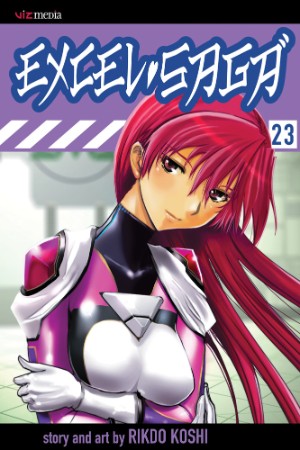
THERE IS ONLY ONE MANGA OUT THIS WEEK. BUY EXCEL SAGA 23. THAT IS ALL.

…OK, there are a *few* other manga besides Excel Saga. Hrmph.

Dark Horse has the sequel to Magic Knight Rayearth, with our heroines returning to a Cephiro much changes. Expect ship wars between Ascot and Clef fans, lots of cute fluffy romance between Fuu and Ferio, and one of the few workable threesomes in all of manga with Hikaru. Guaranteed to be good CLAMP-y fun! In the genuine way, not the postmodern ironic CLAMP fun way

DMP seems to finally be releasing the 8th volume of Itazura na Kiss, with … did Vol. 7 ever come out via Diamond? They skipped it, didn’t they? God. Anyway, enjoy your favorite shoujo couple be prickly and worried at each other. There’s also another mini-manga of Moon and Blood. And for yaoi fans, Vol. 2 of Countdown 7 Days and Vol. 2 of Replica.

Kodansha has the 7th volume of shoujo thriller Arisa, and the 14th – and possibly final – volume of Sayonara, Zetsubou-sensei. Please don’t Gintama this series on me, Kodansha. I will nag you hard.

NBM is releasing a single volume manga called Rohan at the Louvre, which I know nothing about but which I hear has some amazing art.

Udon is releasing the first volume of Sengoku Basara Samurai Legends, which sounds like it’s related to the series of video games based around feudal Japan.

Aside from EXCEL SAGA 23, Viz is releasing a bunch of other stuff. We get the penultimate volume of Cross Game, which I understand may have some baseball in it. A new Case Closed, a new Itsuwaribito, a new Kekkaishi. The final volume of Maoh: Juvenile remix (this last volume remixed by Junior Vasquez) (hey, if you’re going to tell a joke, tell it all). Vol. 8 of Nura, which did not ship last week for some weird reason. And Vol. 20 of 20th Century Boys, which no doubt will confuse some bookstores.

So, yeah, some other stuff. But mostly EXCEL SAGA 23.

Filed Under: FEATURES

50 Shades of Morally Unambiguous, Part 4 (The Final Post I Swear!)

April 4, 2012 by Aja Romano 3 Comments

Hello, MB! This is the last post in a series of posts rebutting last week’s Dear Author series on fanfiction. (That is, I think it’s the next-to-last. Either way, I just really like saying ‘penultimate.’) It’s also the 4th and final of a sub-set of posts responding to one DA post in particular: “Fanfiction: A Tale of Fandom and Morality.”

(I know, right? you thought it was never going to end and I was never going to move on from rebutting that post. WHAT KIND OF COLUMN IS THIS, you wondered. That makes two of us, guys, that makes two of us. WELL. THIS IS THE LAST ONE, I PROMISE.)

Before I dive in here, let me just issue, once again, the disclaimer that everything I write here is based on my own experiences and encounters with many different elements and aspects of many different kinds of fandoms. I have what I believe is a pretty broad perspective on fandom in general, but none of my thoughts on fandom should be taken as declarations of universal truth. If anyone wants my full and complete fandom bibliography I’ll happily provide it, but you really don’t want it because it’s long and boring and also includes this really awkward year where I was in the Kevin Spacey fandom. Trust me, let’s just not go there.


J/K, Boy-o, it’s cool.


In the previous three posts, I talked about the ways in which trying to police how influence works itself out in fiction is nearly impossible, and ultimately bad for the works on either side of the equation. I also talked about how it’d be a bit hypocritical for us to do that in the case of 50 Shades of Grey, our current controversial work of fanfic-turned-pro, given that one of the things publishers want writers to do is to appeal to the audience who shelled out for Twilight. In my last post I also discussed the potential for remix culture to change the way we think about creativity and the origins and ownership of creative ideas.

Now. There are a couple of potential negative aspects to this admittedly warm-fuzzy and optimistic scenario of industry free love. One of them Has mentions in her original post, and others I’ve had conversations with fans about throughout the past couple of weeks. They seem to boil down to the following arguments:

  • pro-fic can threaten fandom by damaging the implicit “no profiting off fanwork” code between fans and creators, thereby causing authors to be, as Has puts it, “more proactive in protecting their books from fanfiction.”
  • pro-fic can damage the quality and kind of fannish output, because instead of writing in order to critique specific canons, writers will come to fandom purely to exploit it and gain fanbases for their original works. We have already seen a bit of this in the Twilight fandom, according to Twilight fans themselves.
  • pro-fic can alter the nature of fandom by jeopardizing the free-exchange and alternative profit structure that fandom has going for itself.

I think these are all really good points, and there’s precedent for each of them. However, the construction of each argument removes autonomy from fans–millions of fans–who have been operating within their own spaces long enough to know exactly what they’re doing and why they’re doing it. Take, for instance, the case of Fanlib, which was an infamous site begun in 2007 which attempted to exploit fan creativity in order to make money for corporate creations. The backlash from my corner of fandom against the whole idea of Fanlib was so strong that it partially fuelled a movement within fandom to create multiple platforms, blogging communities, archives, and even the non-profit organization for fan advocacy that would become the Organization for Transformative Works. All because many of us realized that if we didn’t create our own spaces that people outside of fandom would be all-too happy to exploit it. Former Fanlib user aurimyonys has a great post about realizing what was problematic about the site she loved:

In the end, what is niggling at me here is the idea of corporate invasion into fan fiction – making the things we write fit their molds rather than ours (there was indeed a brochure from the Fanlib company referring to the fan scripts and contests they ran, separate from the Fanlib website, that said fans’ creations were made “to fit in the lines, as in a coloring book”). That basically destroys fan culture. Fan culture allows fans to play with worlds in unique ways. If what we are permitted to do suddenly is assigned a strict formula, that kills fandom. Really and truly.

And that, my friends, scares the hell out of me.

Fandom has a proven track record of withstanding attempts by outsiders or TPTB to take it over, shut it down, or dictate to it. But is professionally written fanfic a kind of corporate invasion? I don’t think so, and the main reason I don’t is because the overlap between pros and fans, as I’ve previously discussed, has always been there. Policing the interplay between them is literally impossible whether the policing is coming from fandom or from copyright holders. The other main reason is that just like with every other creative field, one or two breakout successes don’t suddenly create an entire overwhelming trend of for-profit fics. The reason 50 Shades is getting this much attention is because its success is so unprecedented; there have been plenty of other bestsellers based on fanworks, absolutely, but always tacitly so. Fanfiction that was openly converted into original work which then became a bestseller? This has never happened before. To me, the far more amazing and phenomenal fact about all of this is that members of Twilight fandom actually built and created their own publishing houses in order to truly bypass the gatekeepers of publishing; but that aspect of 50 Shades’ success isn’t really being talked about in the media to any degree. And even when you look at the dozens of dozens of Twilight fics that have been converted into original works, they’re absolutely nothing against the millions of Twilight fanfics that are happily co-existing for free alongside them. Literally, millions. I haven’t actually counted the number of Twilight fanfics over on FF.net, but it’s probably at least 3 million or so. Probably much more. One bestselling fanfic-turned-original work, balanced against all of the others that are still being produced within the culture of free exchange that the majority of fandom is happy to uphold? That’s just simply not a threat to fandom, any more than it is to Stephenie Meyer.

This is also the part where I point out that nearly half a million people on Tumblr alone know what “OTP” stands for. Fan culture is evolving and changing all the time, but it’s converging with mainstream culture in ways that actually strengthen it, not weaken it. Tumblr fascinates me because the whole site is so synonymous with fandom at this point that you really can’t extricate fans who identify themselves as being part of “fandom” from all of the other fans who simply reblog, like, and participate in fandom jargon and culture without realizing that’s what they’re doing. And when you consider that all of this fandom activity is directly supporting the creators, it becomes clear that outsiders don’t need to exploit fandom, because fandom is already a juggernaut of profit-making for any creator with sense. If it wanted to, fandom could prove a formidable enemy to copyright, but it clearly doesn’t want. Its own internal resistance to the idea of for-profit converted fic makes that abundantly clear. (I am telling you, thank goodness Sherlock Holmes is public domain, because if he wanted to, Benedict Cumberbatch could probably summon his own mini-army of fans to overtake copyright and leave it squirming on the floor begging for mercy. )


(Twice.)


What’s more, fandom’s respect for its canons actively works to protect creators from those who actually would infringe upon their copyright. Anyone remember Kaavya Viswanathan? When fans of Megan McCafferty got their hands on copies of the book, they instantly twigged that there was plagiarism afoot, and they helped document passage similarities while the story was still breaking. The irony here, of course, is that Viswanathan herself was a huge fan of McCafferty; and not to apologize for her plagiarism, but if we take her statements–that she unconsciously internalized McCafferty’s novels and reused her language accidentally– as being true, then I can’t help but feel that if she’d been a part of a fandom where there was a community around McCafferty’s language and story concepts, then she would have been more self-aware when writing her own works, less likely to plagiarize whole chunks of language and scenes from McCafferty, because that impulse would have been channelled into the creative transformation that fanwork affords.

There’s one final thing that I’ve not yet touched on in each of these posts, and that is the basic question: is for-profit fanfiction ethically wrong?

I say no, and here’s why. I have written numerous articles and blogged many times about how the publishing industry does all of the following things to books because they think it will make them more marketable:

  • whitewashes book covers
  • tries to erase queer and genderqueer characters from narratives, and often succeeds
  • queerwashes book covers to make butch, trans, or androgynous characters appear more binary gendered
  • thinwashes narratives and book covers
  • puts most of its financial and marketing support behind primarily white narratives
  • perpetuates the idea that minorities and women will read stories about white men, but white men won’t read stories about minorities and women, which turns into an awful catch-22 of a self-fulfilling prophecy that has nothing to back up a compelling contrary prevailing belief, because none of those other stories get told.
  • contributes, generally, to the danger of a single story

I believe that all of these extremely common occurrences within the publishing industry are immoral. I also believe that reclaiming heteronormative narratives, making them our own, and diversifying them, offering up alternatives to them, is far more ethical than supporting a hoary traditionalist system that wants to erase me, my friends, and other cultures besides my own. Which is why I believe that taking narratives out of the hands of the gatekeepers of traditional publishing–agents, editors, publicists, book-buyers–and putting them directly into the hands of people who want to read them can only ever be a good thing.

It doesn’t matter that most people wouldn’t find a book of BDSM erotica like 50 Shades of Grey particularly progressive or groundbreaking. To me, its function as a response to a literary phenomenon, its creation entirely within a fandom community, and its being placed directly into the hands of people who wanted to read it are all hugely progressive events. I believe every 50 Shades that a fandom produces actually paves the way for us to have more voices telling more stories, doing more things with narrative and modern technology, and telling more stories to more and more people. I believe that all of these things work to diversify our existing pools of literature, whether we’re writing the next Wide Sargasso Sea or the sixth millionth iteration of a SasuNaru fic where one of them gets turned into a bunny.


Source: Pixiv.Net


Plenty of people within fandom disagree with me, incidentally: there are many people who feel that trying to prove that all fanfic is transformative or empowering is a snooty and constricting activity, and I think that’s a valuable viewpoint too. To me, fanfic that is just produced for purposes of escapist entertainment is still transformative, because it’s still free work that’s being published for love and joy, and that still is a kind of response to established traditional means of producing literature. What gets me really excited is the idea that the millions of fanworks that exist can be all of these things at once: dialogic, monologic, pure porn, escapist, profound, literary, shallow, something in-between, or none of the above. And it’s still, all of it, working to increase the number of perspectives that get heard, the number of voices that get to speak. Fanfic that gets converted and published is still helping to do all of these things.

And what could be more “moral” than that?

Filed Under: FANBATTE Tagged With: dear author, fandom, fanfiction

The Condor Trilogy in Manhua: Tony Wong’s The Eagle Shooting Heroes

April 3, 2012 by Sara K. 7 Comments

Cover illustration of Tony Wong's The Eagle Shooting Heroes, Volume 13

This is part three in a seven part series about the Condor Trilogy and its manhua adaptations.

Example Scene (be sure to click on the pictures for a bigger size!)

The theme of this round of the contest Huang Yaoshi is hosting between Ouyang Ke and Guo Jing is music, and – oh, who cares? I didn’t pick this scene because of the plot. I picked this scene because it’s pretty.

Huang Yaoshi plays the flute

I really like the presence of swirling things in this manhua. The music coming from Huang Yaoshi’s flute is no exception.

Guo Jing listens to the music

This manhua is occasionally punctuated with a page which is meant to pop. The “pop” pages usually are done in pastel, and consist of a single panel. However, even though the left page is the “pop” page, my favorite panel here Guo Jing on the right, as he stops worrying about the fact that he knows squat about music and just listens. It helps that there is yellow fog/music/something swirling around him in that panel.

The action continues in the Guo Jing vs. Ouyang Ke competition

One of the things that helps keep the action clear is the alternation of panels showing close-ups of the characters faces and panels showing the action.

The musical competition gets flooded by a metaphorical sea.

Yes! I love the copious use of visual metaphors to represent the action! Here, the sea represents the music. And notice how the orange sound waves contrast with the blue sea waves. The blue-orange color theme continues for the rest of the scene.

Guo Jing actually gets the music, to the surprise of everybody

Look at the bottom-left panel. Not only has the sea metaphor been expanded to include a whale, fish, and dragons, but the way Huang Rong’s face pops in close up and at an angle makes this panel perfect. Her face connects the turbulence of the sea and Guo Jing’s tranquility.

Cool ocean metaphors, included merpeople, continue.

Notice how in the top-right panel, the sharp-pointed, orange, concave diamond Guo Jing is inside contrasts with the blue sea swirling around it. Guo Jing’s extended arms reinforce the pointy nature of the diamond, while the mer-people’s curved tails reinforce the wavy nature of the sea. It’s the multiple layers of visual contrast which makes that panel so dynamic—of course, it’s also pretty.

Huang Yaoshi really wants Guo Jing to lose, but Guo Jing is winning

There are many things I can say of the page where Huang Yaoshi is dancing and playing the flute around the seated Guo Jing, but I’ll stick to the colors. Notice that Guo Jing is blue, which is the opposite color of the orange swirls around him—maximum contrast. Huang Yaoshi, of course, is green, which does not constrast quite so much with either blue or orange, so, colorwise, he forms a soft border. And to reinforce the theme of the blue/orange contrast, in the background there is a blue/orange yin-yang.

Guo Jing wins the second round

By now, you should appreciate how wonderful the swirls, color contrasts, and visual metaphors are. And yes, Guo Jing wins this round.

About Tony Wong and his adaptation of Shè Diāo Yīngxióng Zhuàn

Tony Wong is called “the godfather of Hong Kong comics.” He has been publishing manhua since the age of 13, and has since become an institution of Hong Kong culture. More Jin Yong novels have been adapted by him than any other manhua artist.

This manhua, first published in 2007, is a relatively recent Tony Wong work, and he definitely had an army of assistants help him make this. That doesn’t matter. What matters is how good is it to read.

The Art:

Once in the while, I have the pleasure of reading a comic where the art is so good that, after finishing a volume, I am compelled to immediately go back through the pages so that my eyes can rest some more upon the pictures. This manhua is one of those pleasures.

This picture how detailed the art in Twesh is

I am impressed by the way that the art manages to be detailed and complex without looking too busy. I am not completely sure how Tony Wong pulls it off, but I do have some ideas. First of all, this comic is in color. Tony Wong uses colors to increase the contrast between different things, which increases the level of detail each panel can sustain without losing the reader. Look at this page (and click on the picture to see it in full size!).

This image shows young Mei Chao-feng and Huang Yaoshi on Peach Blossom Island

In this page, the main color theme is green against red-orange, two colors with a high contrast. This helps my eyes figure out quickly where one object begins and another one ends. While I didn’t notice it while casually reading the comic, looking through the pages again, I see than most scenes have 2-3 key colors which form a theme, which not only helps distinguish things inside a given scene, but also helps set that scene apart from the scenes with different color themes.

Guo Jing fights Mei Chaofeng

Especially impressive are the fight scenes, which in spite of being long and complicated, are lively, varied, and easy to follow. Looking at the extras sections, it becomes apparent that a lot of planning had to go into the battle scenes to get this result – there are illustrations of all Guo Jing performing all 18 of the “Eighteen Dragon Subduing Palms,” as well as Huang Rong performing all of “Dog Staff Technique” moves. Taking the time to distinguish every individual move helps a lot to keep the fights interesting and readable.

In addtion, the high level of detail supports many wonderful flourishes in the linework. Swirls and circles are in abundance, like frosting on the cake.

I also love the constant use of visual metaphor. There are little visual metaphors throughout the comic, like pretty little flower petals casually left in the wake of a pacing young lover saying “He loves me… he loves me not…” For example, this:

Hong Qigong hurls some buckets of water at Ouyang Feng, turning the water into dragons.

I love that Hong Qigong can turn buckets of water into dragons!

Of course, the big, bold visual metaphors come out when it’s time to fight! It helps the reader keep track of what’s going on, and even better, it’s exciting.

The artwork alternates between regular coloring and pastel work. At first, this jolted me a little, but I got used to it quickly. The pastels generally come out to emphasize the expression of a certain character or to highlight a key moment in a battle. Usually there is only one pastel panel every few pages or so, or a full single or double page spread done in pastel. When the pastels are used differently, it feels even more special.

Yang Kang and Mu Nianci get romantic with each other

Seeing so many panels in pastel together really drives home that this is as special scene. And pastels are also warm, soft, and fluffy, like the characters’ feelings for each other.

Yang Kang wants sex.  Mu Nianci does not.  They are both kung fu fighters, and act accordingly.

Wait a minute, the pastels are stopping. Uh oh…

Mu Nianci points a sword at her throat and says that she will kill herself if Yang Kang tries to touch her.

Yep, something is definitely wrong – in the story, I mean. There is nothing aesthetically wrong with the way Mu Nianci has poised a sword at her own throat.

While Tony Wong is not a master of showing subtle feelings or complex personalities through drawings, the characters all feel quite lively with a little spring in their step, keeping the energy level high.

And overall, the art evokes a greater-than-life grandeur. The frequent use of slanted angles makes the artwork more exciting, the costumes are often lovingly rendered, and palaces, islands, cliffs, and all sorts of grand sights make the world seem bigger than life.

The Adaptation

This is the whirlwind edition of Shè Diāo Yīngxióng Zhuàn. The story has been greatly streamlined. Many details, and even some story arcs, have been removed, pretty much leaving just the essence of the plot intact. This allows the story to move—and move it does. Sometimes things happened so quickly that I felt like I got whiplash. However, the fast pace keeps the energy high, and makes the comic all the more sweeping.

There is also a strong emphasis on the battles. Many battles run 20+ pages. This allows Tony Wong room to fully flesh out the battles with sophisticated yet easy to understand moves. The battles are a lot of fun to read.

However, because the story has been so stripped down and the battles are given so much room, the characters and the pathos are greatly dimished. While the characters do not ring false, with so many details removed, they feel much less rich than in the original novel. And while the characters are given many pages to punch each other, the scenes which are meant to punch the readers in the heart often only run 4-10 pages. This is not really enough pages to let the impact sink in, especially when the reader is quickly swept to the next event. I do not think this adaptation of Shè Diāo Yīngxióng Zhuàn will make anybody weep.

One exception is the backstory of Yi Deng, Yin Gu, and Wan Botong. This manhua actually goes into their history in greater detail than the original novel, and gives sufficient room for the reader to feel the tragedy. That said, this manhua still did not make my eyes wet with this story arc, whereas the original novel did.

In short, this adaptation fails to bring out the melancholy, tragedy, and passion of the original story … and succeeds at bringing out the fun and excitement with flying colors.

Guo Jing, Huang Rong, and Hong Qinggong are running out of a giant snakes mouth - with lots of snakes chasing them.

Whee! Doesn't that look fun?

Availability

This manhua, to the best of my knowledge, is totally unavailable in English, or any language other than Chinese. That is not a big deal. If one already knows the story of Shè Diāo Yīngxióng Zhuàn, understanding the dialogue is unnecessary.

Conclusion

I knew these characters really well before I read this manhua. Therefore, even though many of the details that fleshed them out are missing, I still know those details, and filled them in as I read this manhua.

I only recommend this manhua for fans of Shè Diāo Yīngxióng Zhuàn. Much of the story has been gutted—I think it would be very hard to get involved in characters’ struggles if this was a reader’s first contact with the story.

For me, this manhua truly was a pleasure to read. It made Jianghu look more lovely, spectacular, and wonderful than it ever looked inside my own head. It was like watching a friend coming to the ball looking like the most fabulous person in the world. Thank you, Tony Wong, for expanding my imagination.

Which brings me to the discussion question:

Which adaptations have you seen or read which, while clearly inferior to the original work, expanded your imagination or showed new sides of the story?


Sara K. has previously written for Manga Bookshelf: Why You Should Read Evyione Part 1 & Part 2, Mary Stayed Out All Night, and The Geeky Heart of Taipei. Her personal blog is The Notes Which Do Not Fit, though there is not much about comics or East Asian pop culture over there. She is a vegan, atheist, Linux user, ace, loudmouth, and the person in the back of the classroom who is always clicking her pen.

Filed Under: FEATURES Tagged With: condor trilogy

The Condor Trilogy in Manhua: Fighting

March 30, 2012 by Sara K. 11 Comments

two Xiaolongus with her swords

The Condor Trilogy is considered a martial arts epic because there is a heck of a lot of martial arts. Without understanding how martial arts work in wuxia, much of the story will fly over one’s head. I had to figure it out the hard way—reading a lot. I am writing this post so that others will not have to figure it out the hard way.

I am going to use one of my favorite fights—the big battle a the Quanzhen monastery as depicted in both Wee Tian Beng’s Return of the Condor Heroes and Tony Wong’s The Legendary Couple—as my example.

Prelude

So, at the Quanzhen monastery, a delegation of Mongols/Tibetans are talking with the Daoist monks, asking them to accept the authority of the Mongol Empire. The Quanzhen monks want to remain loyal to Song China … but they also want to survive, and the Mongols have a “if you’re not with us, you’re against us” attitude.

Then a certain woman enters the monastery.

Xiaolongu enters the monastery.

suddenly all of the attention is on her. The Quanzhen monks suspect she has not come with good intentions.

Everybody looks at Xiaolongu

The Quanzhen sect specializes in the art of the sword, and all of the monks are at least above-average fighters. And this woman is alone. Yet she is the one who is totally calm, while the Quanzhen monks panic.

Now that I have your attention, let’s review some nuts and bolts:

Teacher-Student Relationships

Almost all martial arts fighters have a shifu, which literally means “teacher-father.” Even female masters are referred to as shifu—a shimu is one’s shifu’s wife (I admit, I do not know what one would call one’s shifu’s husband). Shifu are responsible for the martial arts education of their apprentices (Mandarin: tuer). However, the relationship is much more than that. Accepting somebody as a shifu/apprentice is as serious a matter as adoption, and the bond between shifu and apprentice is considering as strong as parent and child. Also important are the relationships between shijiemei (teacher-sisters) and shixiongdi (teacher-brothers). A shijie/shige/shimei/shidi is somebody who has the same shifu as you, and these relationships also carry the same weight as the relationship between blood siblings. And these are the foundations for a whole set of relationships. For example, a shishu would be one’s shifu’s shimei/shidi, and a shibo would be one’s shifu’s shijie/shige, and a shizufu would the shifu of one’s shifu. Much drama is squeezed from all of these relationships.

There are certain social rules for dealing with these relationships. For example, apprentices are supposed to obey their shifu as long as their shifu is not telling them to do something unethical. Apprentices also need their shifu’s permission to make many major decisions, such as marriage. It is okay for shijiemei and shixiondi to marry each other—with the shifu’s permission of course. It is NOT OKAY for shifu to have romantic/sexual relationships with their apprentices. Of course, Ouyang Ke has sex with his apprentices anyway, but he’s a villain, and villains do things which are not okay. Learning martial arts from somebody who is not one’s shifu is alright, though a relationship with an outside teacher/student does not carry as much weight as the relationship with one’s own shifu/apprentice(s). Having more than one set of shifu is not okay, though there is a villain who has multiple sets of shifu anyway.

If you notice an elephant in this room, and feel compelled to discuss it, please use spoiler warnings.

Sometimes, these shifu/apprentice relationships form the foundation of a larger group. Since martial arts and religion are intertwined, many martial arts groups are Daoist or Buddhist sects, in which the monks/nuns are all “descended” from a single shifu or group of shifu. For example, the Quanzhen sect, featured in this battle, was founded by Wang Chongyang, who was considered the greatest martial artist of his time. There are also groups “descended” from a single shifu or group of shifu that are secular. And of course, these groups have complicated relationships with each other.

Back to the Battle

Now Xiaolongnü gets down to business – which, apparently, is to kill all of the Quanzhen monks.

Xiaolongnu kills Quanzhen monks

And considering that she is fighting one against many, she’s doing a pretty well. How does she do it?

Lots of Swordfighting

She knows the “Sword Technique of the Jade Maiden,” which was developed specifically to counter the Quanzhen fighting style. That alone would mean that any individual Quanzhen monk fighting her would be in trouble, but it’s not enough to put an entire group of Quanzhen monks in trouble.

More swordfighting

She knows the Quanzhen fighting style too—and it so happens that when one person is using the Jade Maiden technique, and another person is using the Quanzhen technique, and the two are in harmony with each other, they can provide each other perfect protection—in other words, they are invincible.

More swordfighting

But wait a minute—Xiaolongnü is all alone! How can she be simultaneously using the Jade Maiden and Quanzhen techniques? First of all, notice that she has two swords. And just before this battle, she learned the technique of “Two Fists Fighting Each Other”—in other words, each of her arms can act as independent agents. One arm represents herself and uses the Jade Maiden technique, and another arm represents somebody else and uses the Quanzhen technique. Oh snaps.

More swordfighting

And that is one the things I love about this battle. It takes a three techniques which had been gradually introduced during the course of the story—Quanzhen, Jade Maiden, and Two Fists Fighting Each Other—and combines them. And with these three combined techniques, Xiaolongnü has reached a new level of badass. As soon as I realized these three techniques could be combined this way, I really wanted to see the full extent of what Xiaolongnü could do with this, and this is the battle where she shows it.

Which brings us to the next topic.

Fighting Techniques

Of course there are many weapons—bows and arrows, swords, clubs, fists, feet, as well as more unusual weapons such as jujube seeds. For example, Xiaolongnü can attack people with the sashes of her sleeves (and I claim—with my tongue bulging out of my cheek—that this is the main reason why Shēn Diāo Xiá Lǚ is so popular). But there is a lot more to these techniques than the choice of weapon.

Fighting techniques often come with a set of words, or mnemonics, to help people execute them properly. One can of course know the words without knowing the moves, which is useless in a fight. What is more interesting is that sometimes, if one knows the moves but does not know the words, the technique might still be useless in a fight.

In order to become a great martial arts fighter, one must have a powerful neigong. “Neigong” means something like “inner force.” Without a powerful neigong, it is not possible to execute the really powerful fighting techniques. Thus, a hero-in-training’s first order of business is building up one’s neigong. A common way to build one’s neigong is to sleep in uncomfortable places—for example, on top of a rock on a snowy mountain. Neigong can sometimes be used directly in a fight—for example, shoving one’s neigong into somebody else can hurt them—but neigong is more often transferred between people for healing purposes. Since building neigong is a life-long endeavor, older fighters tend to have more powerful neigong, which is one reason why older martial artists are considered more dangerous than younger martial artists. However, Xiaolongnü has built up an unusually powerful neigong for somebody her age. Oh snaps.

In addition to neigong, there is qinggong—speed and lightness. It basically grants martial artists the ability to defy gravity. Since actors are really bad at qinggong, they need wires to fake it. But manhua characters have excellent qinggong, so no wirework is required. And the most powerful qinggong in the martial arts world happens to be the qinggong practiced by Xiaolongnü’s sect. Oh snaps.

Xiaolongu practically flies around with her swords

Look, no wires!

Though acupuncture points are not being used in this battle, they are significant throughout the Condor Trilogy. Acupuncture points can be used in various ways in both fighting and healing, but the most common usage is to hit people’s acupuncture points in order to partially or completely immobilize them. Sometimes acupuncture points will re-open on their own after a while without intervention. Sometimes another character will re-open the acupuncture points of the afflicted. There are a few—very few characters—who can re-open their own acupuncture points without having to wait for the effects to wear off. Xiaolongnü is not one of those characters—if she were, the plot would have gone in a different direction, and this battle would not be happening.

There are two main ways techniques are transmitted, though sometimes they can be transferred by more unusual means. The most obvious way is from teacher to student, whether they are shifu/apprentice or not. The other way is by studying scriptures which describe various fighting/healing techniques—and much of the plot of the Condor Trilogy consists of searching and fighting over these scriptures. Of course, it is not enough to have the scripture. Training takes time, and somebody without a basic martial arts education would not be able to make use of the scripture at all. One of these scriptures, the Jade Maiden Heart Sutra, describes the Jade Maiden Sword Technique that Xiaolongnü is using. Of course, out of all the scriptures, the most coveted is the Nine Yin Manual, which describes the most powerful martial arts techniques in the world. Anyone who has mastered the techniques of the Nine Yin Manual can pretty much beat anybody who has not. The Quanzhen monks do not know any of the techniques of the Nine Yin Manual, but Xiaolongnü has a copy, and she’s had over a year to practice the techniques. Oh snaps.

Again, the Battle

There is an image in this battle so wonderful it was used as the illustration for this chapter in the original novel.

Xiaolongnu makes the swords fly like magpies

The illustration from the novel

This is yet another technique introduced earlier in the story—the “Palm of Infinity Web.” Previously, it had only been shown as a training technique—a character has to use the Palm of Infinity Web to keep a flock of magpies in place in order to improve his qinggong. Before this battle, I hadn’t realized that it could be used in a fight. But here it is—except, instead of flock magpies, it’s a flock of swords. That. Is. Cool.

Wee Tian Beng's drawing of a flock of swords like magpies

That’s a basic rundown of the mechanics of the battle, and while watching a woman mow down a bunch of men using cool sword work is fun in its own right, what makes this battle (and all of the memorable battles) really moving is what is going on with the characters. While I used pictures from Wee Tian Beng’s manhua for the this part of this post, for the next part I’m going to use pictures from Tony Wong’s manhua.

The Character Side

So, why is Xiaolongnü trying to kill all of the Quanzhen monks? She says that she is there for revenge. But the problem with this explanation is that she has had opportunities before to get revenge for all of the bad things the Quanzhen sect has done, and she never took advantage of any of them. She has even said that revenge is pointless because it cannot undo the bad things which have been done. So why is now different?

Tony Wong's illustration of the swordfighting

Different readers may interpret this differently, but I think Xiaolongnü is fighting the Quanzhen sect because she does not know what to do. The past few months of her life have been rather awful—more awful than anything she has experienced before. And Xiaolongnü currently does not have a social network—no friends or family—and there are reasons why she will not contact any of the remaining members of her sect. That is one of the things which makes this battle so exciting. Not only is Xiaolongnü more potent than ever before, she is also psychologically less stable than ever before.

So she falls back on what she knows—martial arts—and practicing martial arts, to a large extent, means fighting people. Given that the Quanzhen sect is partially responsible for the awfulness in her life, they are the obvious target of her aggression. And as a reader, I find it satisfying to see the Quanzhen sect finally getting some payback for the uncool things they have done.

She really is targeting the Quanzhen sect rather than looking for any suitable opponent, because she tells the Mongols/Tibetans that she is not interested in fighting them. Unfortunately, the Tibetans are interested in fighting her.

Xiaolongu fights the Tibetans

Fortunately, Xiaolongnü is currently invincible.

The Quanzhen Elders burst onto the scene

And in the course of the battle, they manage to disturb the Quanzhen elders. They had secluded themselves so they could learn how to counter Xiaolongnü; they knew she was really dangerous and figured it was only a matter of time before she attacked. Little did they know that she would attack so soon. They also see the Mongols/Tibetans, who are also bad news. Then they notice that Xiaolongnü and the Tibetans are fighting each other, which is not such bad news.

Xiaolongnu gets distracted when she thinks about Yang Guo

Then Xiaolongnü thinks about a certain somebody and gets distracted. She had resolved never to see this special person ever again, but in the midst of battle, she suddenly realizes that she wants to see this person again, at least once, before she dies. Ironically, while her life is not at risk as she perfectly executes the Jade Maiden / Quanzhen sword techniques, thinking about how much she wants to live makes her stop, putting her life in danger. This, to me, is more evidence that she is fighting because she lost herself, not because she wants to punish the Quanzhen monks. If she were hellbent on revenge, I do not think she would be distracted so easily.

As Xiaolongnu thinks about Yang Guo, a Tibetan strikes her

A Tibetan takes advantage of this opportunity to strike her.

A Quanzhen monk offers his life to protect Xiaolongnu from the Tibetan

Then one of the Quanzhen monks sacrifices himself to protect Xiaolongnü. Why? Hasn’t she been trying to kill them? Let’s just say that he is obsessed with Xiaolongnü and is personally responsible for some of the awfulness in her life.

Xioalongnu pulls the sword out of the Quanzhen monk

He asks her if she can forgive him. She answers “You ruined my life, how can I forgive you?” And she pulls out her sword. Ouch.

A Quanzhen elder aims for a Tibetan … but the Tibetan pulls himself out of the way, and puts Xiaolongnü in the way. OUCH OUCH OUCH!

Xiaolongnu collapses from her injury

So, one of the world’s more powerful martial artists has just pulverized, albeit unintentionally, Xiaolongnü’s guts. I’ll stop here, because even somebody as powerful as Xiaolongnü cannot continue to fight in this condition.

The consequences of Xiaolongnü getting trashed like this are major. In the original novel, what happens after this battle is one of most heartbreaking scenes in the entire trilogy (alas, neither of the manhua adaptations get that scene right).

The Manhua

Often the manhua artists draw fantastic elements—such as dragons—in the midst of battles. Rest assured, there are no actual dragons in the Condor Trilogy. Those are all visual metaphors. The visual metaphors help keep track of which techniques are being used, since the same technique will probably have the same visual metaphor associated with it when it is performed. They should not be taken literally. Reading a bit of the manhua should be enough to get a hang of what is metaphor and what is literally happening. The fantastic elements are beautiful and make the artwork that much more wonderful.

Guo Jing fights Ouyang Feng

When Guo Jing uses the 'Eighteen Dragon Subduing Palms' against Ouyang Feng's 'Toad Technique', we see a dragon and a toad. How cute!

I think the battles are one aspect of the story which I prefer experiencing through manhua over prose. Sure, I thought the battle at the Quanzhen monastery was superb when I read it in the novel, but having to keep track of the techniques and visually map it out in my head is work. Following the fights is much easier in the manhua where it is all laid out for the reader, with all of the techniques conveniently labeled. And the manhua artists make the battles look far more fantastic than what I see in my head as I read the novels. That is why they are professional visual artists, and I am not.

Hopefully, this can make readers’ first contact with wuxia manhua more enjoyable—and if you have any questions, please feel free to ask. Speaking of questions, I have some discussion questions for you:

How is the battle system in the Condor Trilogy / wuxia like the battle systems used in manga, particularly, but not exclusively, shonen manga? How is it different?


Sara K. has previously written for Manga Bookshelf: Why You Should Read Evyione Part 1 & Part 2, Mary Stayed Out All Night, and The Geeky Heart of Taipei. Her personal blog is The Notes Which Do Not Fit, though there is not much about comics or East Asian pop culture over there. She has been studying Chinese since the fall of 2009, and is dangerously close to becoming a wuxia fan.

Filed Under: FEATURES Tagged With: condor trilogy

50 Shades of Morally Unambiguous, Part 3: The Sparkle-Fairy Edition

March 28, 2012 by Aja Romano 6 Comments

Hello, MB! This is the 4th (or 5th, but who’s counting) post in a series of posts rebutting last week’s Dear Author series on fanfiction. And it’s the third of a set of posts responding to one post in particular: “Fanfiction: A Tale of Fandom and Morality.” TODAY IS THE VERY SPECIAL FAIRY EDITION OF THIS POST.

In the previous two posts, I talked about the ways in which trying to police how influence works itself out in fiction is nearly impossible, and ultimately bad for the works on either side of the equation. I also talked about how it’d be a bit hypocritical for us to do that in the case of 50 Shades of Grey, our current controversial work of fanfic-turned-pro, given that one of the things publishers want writers to do is to appeal to the audience who shelled out for Twilight.

In the original post, author Has asserts, “Taking an entire fanfiction story and turning that into a published book is:”

  • ethically wrong
  • a cynical ploy to market books… an easy way to cash in because there’s already a built-in fanbase that is able to market the book via word of mouth
  • [an indication] that the author does not believe what they wrote is strong enough to stand on its own merits but decided to publish it so they could profit by exploiting their fanbase
  • disappointing
  • might start off an ever-crazier circle of fanfiction based on fanfiction.
  • very detrimental to fandom and fanfiction

I’ve already pointed out, in the previous posts, how the “marketing ploy” argument is hypocritical to criticize a fan author for doing exactly what publishers want them to do in terms of appealing directly to a rich consumer base. As for the second bullet point: the whole weight of history is behind the act of spinning old works and characters into new versions and iterations. The idea that the fan author’s writing can’t stand alone/isn’t good enough to be publishable is one fanfiction authors have been saddled with for decades. I’ve already rebutted this argument very thoroughly, so I’ll just add: this argument, that fans surely couldn’t write an original plot, not only debases fanfiction, but it seems to target members of female fandom spaces. It also completely sidesteps the whole point that in most cases, the fanfiction that gets converted into original fiction winds up far removed from the source material. And in many cases already was to begin with.

Okay, now for bullet #4 (I’m skipping around, okay): might start off an ever-crazier circle of fanfiction based on fanfiction.

Hahaha. Okay, well, for one thing, people have been writing fanfiction based on fanfiction for fucking years. How is that bad? I’ve had several works of fanfiction written for my own works of fanfiction, and like every other member of fandom I know, I’ve never been anything but extremely flattered. Just like getting fanart or a podfic of your story, fanfic based on one of your own stories is seriously one of the best things ever that can be gifted to you in fandom. There are even remix challenges that invite authors to write fanfic of fanfic, all over fandom. This is not a serious criticism of the “danger” of published fanfiction, and no one who understands how remix culture works would ever offer it up as one, because the whole point of being in a remix culture is that we’re all gleaning, transforming, and passing on what’s come before.

Which brings me to fairies.


Eat, Pray, Love author Elizabeth Gilbert has an amazing 2009 TED talk entitled “A New Way to Think About Creativity,” where she talks about trying to find new ways to “manage the inherent emotional risks associated with creativity.” ((transcript) I would never encourage you to read EPL but I would urge all of you to watch her talk because I think it’s completely brilliant, and her ideas, while they are offered in the context of taming genius, also are extremely relevant to the way we frame the argument about fanwork. Gilbert asks if we can “go back to some more ancient understanding of the relationship between humans and the creative mystery:”

[In Ancient Greece], people believed that creativity was this divine attendant spirit… a “genius” was this sort of magical divine entity who was believed to literally live in the walls of an artist’s studio—kind of like Dobby, the house elf. So, brilliant, there it is, that distance—that psychological construct to protect you from the results of your work. ….

And for me, the best contemporary example that I have of how to do that is the musician Tom Waits, who I got to interview several years ago on a magazine assignment. And we were talking about this, and you know, Tom, for most of his life he was pretty much the embodiment of the tormented contemporary modern artist, trying to control and manage and dominate these sorts of uncontrollable creative impulses that were totally internalized.

But then he got older, he got calmer, and one day he was driving down the freeway in Los Angeles he told me, and this is when it all changed for him. And he’s speeding along, and all of a sudden he hears this little fragment of melody, that comes into his head as inspiration often comes, elusive and tantalizing, and he wants it, you know, it’s gorgeous, and he longs for it, but he has no way to get it. He doesn’t have a piece of paper, he doesn’t have a pencil, he doesn’t have a tape recorder.

So he starts to feel all of that old anxiety start to rise in him like, ‘I’m going to lose this thing, and then I’m going to be haunted by this song forever. I’m not good enough, and I can’t do it.’ And instead of panicking, he just stopped. He just stopped that whole mental process and he did something completely novel. He just looked up at the sky, and he said, ‘Excuse me, can you not see that I’m driving? Do I look like I can write down a song right now? If you really want to exist, come back at a more opportune moment when I can take care of you. Otherwise, go bother somebody else today. Go bother Leonard Cohen.’

And his whole work process changed after that. Not the work, the work was still oftentimes as dark as ever. But the process, and the heavy anxiety around it was released when he took the genie, the genius out of him where it was causing nothing but trouble, and released it kind of back where it came from, and realized that this didn’t have to be this internalized, tormented thing. It could be this peculiar, wondrous, bizarre collaboration kind of conversation between Tom and the strange, external thing that was not quite Tom. ….

This is hard. This is one of the most painful reconciliations to make in a creative life. But maybe it doesn’t have to be quite so full of anguish if you never happened to believe, in the first place, that the most extraordinary aspects of your being came from you. But maybe if you just believed that they were on loan to you from some unimaginable source for some exquisite portion of your life to be passed along when you’re finished, with somebody else. And, you know, if we think about it this way it starts to change everything.”

I like this idea a lot. I like it because it makes ideas a community process of receiving, sharing, and passing on. I like this idea for its potential to revise the way we think about storytelling and narrative theory. I like it because it’s anti-capitalist! I like it because it reconfigures creativity with communal narratives at the center of a kind of group process in which we all give and receive ideas as they come to us. And I like it because it implies an equal balance of agency between us as creators and the fairy-like muses that gift us with stories and ideas.

What if we viewed creators as being strands along a larger, interconnected web of ideas? What if we could agree that original works and the works they inspire could co-exist alongside of one another—since we know they already do—and that maybe that’s okay? And what kinds of new business models could we derive from thinking about creativity this way? What if I write a book that I am willing to openly claim is based on an idea that I drew from your book, and instead of you sueing me, we work out a deal where “Inspired by (Your Book)” goes on my cover? What if, after a certain number of copies sold, both of our books are reprinted and we share the wealth?

What if taking inspiration from someone else’s works didn’t have to get conflated with “plagiarism” (which is when you explicitly copy something and don’t credit) but could instead be seen as a form of literary sampling? Dear Author actually has a post from 2010 arguing for compulsory licensing for ALL fanfiction (um, how about no); but what if a conversation about licensing and royalties could be had without thinking of these things as a way to proscribe the boundaries of fanfiction? What if they could be seen, instead, as potential ways to make it easier for attributed transformative work to be sold openly and linked back to its source inspiration, for the mutual benefit of all parties?

Tomorrow, we’ll talk about the down-side of this new world of Free Love And Published Fanfic! But for now:


(source)

Damn straight!

Filed Under: FANBATTE Tagged With: dear author, fandom, fanfiction

Manga the Week of 4/4

March 28, 2012 by Sean Gaffney

It’s a first week of the month at Midtown, and we’ve got the usual Viz suspects, some Kodansha runoff from last month courtesy Diamond, some new Vertical titles (also a week late, also courtesy Diamond), and… two very odd releases.

Bandai may be dead, but it apparently had quite a backlog of titles to keep releasing. Thus we get Vol. 5 of both of their Code Geass doujinshi anthologies – Queen for the male readers, and Knight for the female ones. I’m going to take a wild guess that these are the final volumes we’ll see from Bandai here.

Kodansha has another volume of the Negima re-release, which updates the translation with its current version provided by the Nibley twins. This volume has Vols. 10-12 of the original, covering a great deal of the tournament battle, which, unlike many shonen tournament battle arcs, was really where Akamatsu came into his own. There’s some great stuff here.

I didn’t get a chance to use GTO as my featured image when Vol. 1 came out, so it goes here. The second volume of 14 Days in Shonan is almost nonstop action, and really packs a kick. As does its hero. There’s also the 3rd omnibus volume of Drops of God, containing the original Vol. 5 and 6. It looks as if we may finally get to see the First Apostle. As well as lots more wine.

Then there’s the huge pile o’ Viz. A Devil and Her Love Song got the image last time instead of GTO, but Vol. 2 excites me just as much as Vol. 1 did. There’s also a new Dawn of the Arcana, Kamisama Kiss, Sakura Hime, and Skip Beat!, giving you lots of shoujo goodness. If shonen is more your thing, well, this is Jump week. New Bakuman, new Bleach (still not at all caught up with the online releases), new Blue Exorcist (man, this and Kamisama Kiss come out FAST), A new Rosario + Vampire Season 2, a nicely retro new Slam Dunk Vol. 21, and the 9th Toriko. Lastly, they also have the first volume of that Voltron Forge graphic novel to excite sentai fans.

As an aside, this is my 100th post tagged ‘Manga The Week Of’. I hope it’s proven of interest to you, as it’s mostly just an excuse for me to geek out, and also keep track of what’s been coming out when. What whets your appetite to read over the Easter weekend?

Filed Under: FEATURES

The Condor Trilogy in Manhua: Introduction

March 27, 2012 by Sara K. 16 Comments

Xiaolongnu and Yang Guo embracing at the bottom of the gorge

This fanart was made by Dy Martino.

The three novels in Shè Diāo Sānbùqǔ, or as it is known in English, The Condor Trilogy, are the most popular Chinese-language novels of the 20th century. Due to their popularity, the novels have been adapted into TV shows, movies, video games, and of course, comic books (manhua). Because everybody has read the novels or at least seen one of the TV adaptations, the trilogy needs no introduction and I can jump straight to talking about the manhua.

Maybe not.

Even though asking somebody in the Chinese-speaking world “Have you heard of The Condor Trilogy?” would be like asking somebody in the English-speaking world “Have you heard of Harry Potter?,” The Condor Trilogy is strangely obscure outside of Asia. When I discuss the manhua, I want to discuss the manhua, so before we get there, an introduction to the trilogy is in order.

Background

The books in the Condor Trilogy are wuxia novels – wuxia being a Chinese genre which lies in the gray area between historical, action, and fantasy fiction. The term “wuxi a” comes from “wǔ” (which means “martial” as in related to the military or martial arts) and “xiá.” “Xiá” is often translated into English as “chivalry,” but I think that translation is wrong, because xiákè are very different from knights or samurai. Knights and samurai generally belong to the gentry and try to uphold their society’s social hierarchy, whereas xiákè generally belong to the peasant class and are often opposed their society’s corrupt ways. A xiákè has a lot more in common with Robin Hood than Sir Lancelot. Nonetheless, the xiákè are trained fighters and do have a code of conduct referred to as the way of the ‘xiá’.

The Condor Trilogy was written by Louis Cha under the pen name Jin Yong in the 1950s and early 1960s. Jin Yong is considered the top wuxia writer of the 20th century, possibly of all time. The novels were originally published as newspaper serials in Hong Kong, and later collected as books. They had been banned in Taiwan and possibly China too (I know some of Jin Yong’s other novels were banned in China). The bans did not work, because pirated copies were widely distributed. Nowadays, the Condor Trilogy is available unabridged everywhere in the Chinese-speaking world.

The General Story

The plot of the trilogy spans over a century—from the late Song dynasty to the very beginning of the Ming Dynasty. In between the Song and the Ming eras, China was ruled by the Mongol empire, and Mongols play a major role in all three of the novels. However, the Mongol invasion is usually in the background, not foreground. The heroes sometimes choose to collaborate with the Mongols, and the Song and Ming are not exactly depicted in a flattering light. While the Mongols are considered particularly bad because they destroy towns, massacre people, and are not Chinese, there is a general sense that all governments are corrupt and dominated by the power-hungry, and that the common people suffer no matter who is in charge. The trilogy is much more concerned with the lives and relationships of individual characters against the backdrop of such historic events.

Some people say that the trilogy is a martial arts soap opera. They are correct, mainly because there are many scenes like this:

Character #1: (Oh no! Six groups have joined forces to kill off the faction that my maternal grandfather and maternal uncle belong to! I must save them!) “I won’t let you all hurt a single person in this faction”
Crowd: “Who the hell are you?”
Character #1: (If I reveal my true identity, they will force me to betray my godfather) “I am [fake name]. Each of you, send a champion. If I can beat every one of your champions in a duel, then don’t kill anybody from this faction.”
Crowd: “Fine”
[Long elaborate fight scene]
Crowd: “How come this nobody is such a great martial arts fighter?!”
[Long elaborate fight scene finishes. Character #1 won, but is in a bloody heap and, without medical attention, will die soon]
Character #2: “I must kill that person over there!”
Character #1: “I won’t let you hurt a single person from that faction!”
Character #2: “But he kidnapped and raped my fiancée!”
Character #1: “Before you can hurt a single one of them, you must kill me first.”
Character #2: “Even though it is not honorable to kill people who are already bloody heaps, I must get vengeance for her!”
Character #1: “Then kill me, dear uncle.”
Character #2: “You said that just the same way my brother’s son used to call me uncle. My poor nephew, he died years ago… could it be… you are…”
Character #1: “Yes, it’s me!”

In the process of simplifying and de-spoilering this scene, I also significantly downplayed it. The actual scene is vastly more melodramatic.

However, the story of the Condor Trilogy feels as much like a fairy tale as a soap opera to me. There is the constant use of the number three. For example, after a princess saves the life of the hero’s comrade, the hero must fulfill whatever three things she requests as long as they are not against the way of the xiá, do not threaten his faction, and do not threaten his own position (actually, the mere presence of princesses makes the trilogy feel more fairy-tale like). And there are the almost-magical elements, such as a boy getting sword lessons from a giant eagle, or someone seeing what looks like a fairy approaching him on a lake, or a character being pursued by someone who looks so much like the girl she murdered that it cannot be anyone else. The supernatural is never directly invoked, but much of what happens seems almost supernatural.

Furthermore. the novels are also filled with a human-bites-dog, or rather, human-bites-snake logic.

Guo Jing bites a snake.

A snake gets a human-bite.

Example 1: In order to climb an un-climbable mountain, the characters pull out a flock of sheep, chop off the sheep’s legs, and use them to create a ladder (when the blood in the legs freeze, they stick to the side of the mountain so hard that people can step on them).

Example 2: There is a boy who follows a girl and keeps on provoking and harassing a girl so that she will yell at him. Why? To him, being yelled at by a woman is the sweetest sound in the world—in fact, he considers the times he has been scolded and punished by a certain woman to be the best moments of his life.

Example 3: There is a scene where a girl is talking about how a boy bit her and she never forgot him. Said boy and a different girl are eavesdropping. The second girl then bites the boy. Then the second girl asks the boy if she bit him as deeply as he had bitten the first girl. The boy asks her why does she want to know. The second girl answers that she never wants him to forget her, so she wants to make sure that the bite is just as deep.

These off-the-wall moments make me love the trilogy that much more. It’s engaging to not be sure what bizarre thing will happen next and to constantly blurt out (in my mind) “What the hell was THAT?!” Most of all, the off-the-wall-ness makes the relationships feel that much more real. Some of the things that the characters do together are so just odd. In my mind I often treat them more like real people than fictional characters, offering them advice while reading the story, giving them a high-five when they are being awesome, and yelling at them when they frustrate me.

Unfortunately, all of the manhua adaptations tone down the off-the-wall-ness – I suppose nobody wants to draw martial artists urinating on live, venomous snakes.

Since each novel feels distinct, here’s a basic overview of each novel.

First Novel: Shè Diāo Yīngxióng Zhuàn

English Titles: The Eagle-Shooting Heroes, Legend of the Condor Heroes

More so than the other books in the trilogy, this is an adventure. A Chinese boy who grew up in Mongolia travels south to take care of unfinished business, and in the process he makes friends, makes enemies, falls in love, and of course, learns many martial arts techniques. There is plenty of swashbuckling fun for everyone—getting shipwrecked on an uninhabited island, hiding in a secret room, riding giant eagles, meeting the great martial arts masters one by one, running around a palace, and so forth.

However, in the last fourth of the story, fun and games are over. All of the relationships built up in the first three-fourths of the story are ripped apart. Tragedy strikes again and again. And our humble hero is forced to ask some tough questions.

This was the first novel I ever read in Chinese, and for that reason alone it will always have a special place in my heart. I grew very fond of the characters. Some—such as Huang Rong and Yang Kang—I liked right away (okay, maybe I do not “like” Yang Kang, but I really like reading about him), whereas it took more time for other characters, such as Guo Jing, to grow on me. To me, the plot is of secondary importance. Whenever I experience this story again, it is like spending time with old friends.

Second Novel: Shēn Diāo Xiá Lǚ

English Titles: The Giant Eagle and Its Companion, Return of the Condor Heroes, Divine Eagle, Gallant Knight, Condor Hero

When you heard or read the story of “Sleeping Beauty,” did you ever think “This story needs a Mongol invasion, a bunch of characters from Shè Diāo Yīngxióng Zhuàn, and tons of violence and kung fu?” No, me neither. But having read Shēn Diāo Xiá Lǚ, I think the story of “Sleeping Beauty” is much improved with these additions.

At heart, Shēn Diāo Xiá Lǚ is still a “Sleeping Beauty” story. However, rather than eliminating all of the spindles in the lands, in order to protect her from having her heart broken, the guardian of “sleeping beauty” instead trained her to kill all emotions to the extent that she is indifferent to the prospect of her own death. So successful is “sleeping beauty” in withdrawing from life that her body does not age—she looks indefinitely like a 16-year old even though she is significantly older. Yet because “sleeping beauty” is not literally sleeping, she has agency and makes choices—that makes her a much interesting character. The story of Shēn Diāo Xiá Lǚ really belongs to ‘prince charming’—he has a history, he has a personality, and it is not love at first sight—he has to spend time falling in love with ‘sleeping beauty’ only to lose her. “Sleeping beauty” and “prince charming” represent two approaches to the hardships of life: to escape, sacrificing joy to avoid pain; and to expose oneself to the cruelties of the world in pursuit of fleeing moments of happiness.

I would say, of all the novels, this one has the worst plot. But that is unfair, because the plot is not supposed to be good. This novel is all about exhilarating, intense moments. The plot is there to make those moments happen, no matter how much it has to contort itself. Between the amazing fight scenes, beautiful imagery, complex relationships, and of course, the passion, this is my favorite novel in the trilogy.

Third Novel: Yǐ Tiān Tú Lóng Jì

English Titles: The Heaven Sword and the Dragon Sabre, The Tale of Relying on Heaven to Kill the Dragon

While Chinese society is falling apart in the first two novels, the society has already collapsed in this story. The Mongols have been ruling China for almost a century. Violence is widespread, even between commoners. The Dragon Sabre and Heaven Sword were created so that the Chinese would eventually be able to drive out the Mongols for good. Ironically, the struggle for the Dragon Sabre, which supposedly contains the secret to dominating the martial arts world, polarizes the martial arts world and inspires the various sects to continue the internecine fighting which prevents them from uniting against the Mongols.

The main character, Zhang Wuji, is constantly defending people who I consider to be scum. I think the characters are scum because of the horrible things they did. One reason there is so much fighting is that, when Character A finds out that Character B did something terrible to Character C, Character A figures that it is okay to to horrible things to Character B. Then Character D finds out about this, and figures it is now okay to do terrible things to Character A. Zhang Wuji, on the other hand, insists on seeing people at the best, not their worst … and that’s how he manages to make things slightly better. When I finally realized this, I was quite humbled to realize I had the same attitude as the characters who were escalating the violence. In addition to being a great martial artist, Zhang Wuji is also a great doctor, and I think this represents that his true role is not to fight the Mongols, but to heal his scarred society.

This is my least favorite novel in the trilogy, mainly because the story does not really get going until halfway through the book, and it has a relatively high percentage of characters I do not like. Of course, even the first part of the novel has its gems—Chapter 10 made me cry. And, while I did not enjoy this novel as much as the other two, it has been no less thought-provoking.

Availability of the Novels

If you can only read European languages, you are out of luck. The only novel which has ever been published in a European language is the first novel, Shè Diāo Yīngxióng Zhuàn, as La Légende du Héros Chasseur d’Aigles. There are fan translations into English, floating around the internet, but they are 1) in violation of copyright law and 2) incomplete. Three other Jin Yong novels, on the other hand, have been published in English: The Book and the Sword, The Fox Volant of Snow Mountain, and The Deer and the Cauldron.

Availability is much better in Asian languages. The entire trilogy has been published in Japanese, Korean, Indonesian, Vietnamese, Burmese, and Malay. And of course, if you can read Chinese, you’ve already read the novels, right?

More TV adaptations have been made of the Condor Trilogy than I can keep track of, and some of them are available on DVD with English subtitles. While I have not watched any of them yet, many people say that the 1980s TVB adaptation is the best, and it also happens to be the only TV adaptation which is entirely available with English subtitles on DVD. For people who cannot read the novels, this is how I suggest experiencing the complete trilogy.

And, surprisingly, some of the manhua adaptations—specifically The Legendary Couple by Tony Wong, Return of the Condor Heroes by Wee Tian Beng, and The Heaven Sword and Dragon Sabre by Ma Wing-shing—have been published in English.

What’s next?

Many people who have never tried wuxia before find the fights confusing. Thus, in the next post, I am going to break down how they work.

Then, I am going to review every manhua adaptation of the Condor Trilogy. There is a manga adaptation—Shachou Eiyuuden Eaglet—which I have not read and will not review.

For each post, I will pose a discussion question. And the question for this post is:

If you do not know the story of The Condor Trilogy, based on this post, which manga/manhwa do you think is most resembles? If you know the story of The Condor Trilogy, which manga/manhwa do you think are not most like it?

I have my own answer, which I will post in the comments section after a few other people have weighed in.


Sara K. has previously written for Manga Bookshelf: Why You Should Read Evyione Part 1 & Part 2, Mary Stayed Out All Night, and The Geeky Heart of Taipei. Her personal blog is The Notes Which Do Not Fit, though there is not much about comics or East Asian pop culture over there. She grew up in Jiujinshan – meaning the city in Jiazhou – and currently lives in Peach Garden County, Ilha Formosa.

Filed Under: FEATURES Tagged With: condor trilogy, manhua

Subtitles & Sensibility: Let the Bullets Fly & K-20

March 26, 2012 by Jaci Dahlvang 5 Comments

Let the Bullets Fly is currently the highest-grossing Chinese-language film ever. Essentially a western, it opens with a classic bandit attack on a train. Said train is carrying a new mayor (You Ge) to Goose Town, but since his motives were none-too-pure to start with, he and his wife (Carina Lau) cut a deal with the bandit chief (Wen Jiang, also the director & screenwriter), and off they go to profit.

Profiting turns out to be not that simple, because there’s already a gang in charge and they’re in no hurry to give up their power, let alone their money. Thus we begin with a game of many wits and surprisingly few bullets, double crossing and triple crossing, and hardly a lady in sight beyond the sadly underused Lau, now posing as the wife of the bandit chief.

I was excited to see it because I have been known to enjoy ridiculous, over-the-top action movies, and because, like everyone, I am a fan of Yun-Fat Chow. Unfortunately, the film is over-long, often confusing, and not nearly as funny as it thought it was.

For example, in theory I like the idea of subverting expectations by casting Yun-Fat Chow as the villain gang leader, but in practice, it would have been nice if he had been given something more to do than laugh uproariously at his own cleverness and mug a bit as his own double.

Tonally, it doesn’t work. Obviously a film can be both violent and funny, but it is a delicate balance. A drawn-out scene where a character was manipulated into slicing open his own stomach and a (mercifully offscreen) gang rape were probably intended as further indications of just how bad our bad guy was, but they were also played for laughs, taking me right out of the film.

Let the Bullets Fly does offer lush cinematography and great images (particularly the horse-drawn train, even if the attack effect itself was lacking), and it references everything from Red Cliff to Butch Cassidy & the Sundance Kid with the broadest of winks, but in the end it isn’t universal enough to work.

Since seeing the film I’ve read in a few places that the humor in particular requires a deeper knowledge of Chinese culture than I have personally, and that it has political undertones (or even overtones) which were largely lost on me. Nonetheless, a better film would have worked on multiple levels.

::

In contrast, K-20: The Fiend with 20 Faces was wicked fun both times I saw it: first at a packed film festival screening and later at home. It’s also an over-the-top, vaguely historical action film. The set-up with K-20 is that WWII never happened, the aristocracy still controls the vast majority of the wealth in Japan, and there is no class mobility.

Against this backdrop swoops K-20, a failed Robin Hood who steals from the rich and keeps it all for himself. He sets up Heikichi Endo (the always-charming Takeshi Kaneshiro), a circus acrobat & illusionist, to take the fall for him.

Since K-20‘s genre of choice is the superhero movie, this injustice sets up Endo to become the hero. With the help of a band of thieves and a band of orphans, he launches into the obligatory training montage. It’s parkour and disguise training rather than the traditional swordsmanship or the like, which is a lot of fun, and Endo’s goal is simple: to clear his name so he can return to the circus.

Along the way he encounters the baron-slash-detective (Tôru Nakamura) who is hunting K-20, as well as the detective’s fiancée (Takako Matsu). She’s a delight, a duchess who considers self-defense “just part of being a lady”.

The film is a little long, but the plot keeps moving at a decent pace, hitting all the points of the classic origin story and a villain off to steal some massive technological weapon. Character-wise I am a big fan of Yoko, the fiancée, who is clever and resourceful, rescuing others far more often than she is rescued.

Visually the movie is pure eye-candy, from the wild steampunk world of the upper class to the dense maze of Thieves’ Alley. And sure, we’ve seen it all before, but it’s still a great ride through all of the best bits stolen from the golden age of comics, with an acrobat and a duchess fighting crime.

All in all K-20 is an absurd movie, but it knows that full well that it’s absurd, and it doesn’t take that as an excuse to sacrifice character development. We care about these people even as we’re suspending our disbelief from here to Japan, and as the end credits rolled (both times!) I wished I knew when I could queue for a sequel.


Review copy of K-20: The Fiend with 20 Faces provided by New People Entertainment.

Filed Under: Subtitles & Sensibility Tagged With: k-20: the fiend with 20 faces, let the bullets fly

Going Digital: March 2012

March 25, 2012 by MJ and Sean Gaffney 6 Comments

Welcome to the latest Going Digital, Manga Bookshelf’s monthly feature focusing on manga available for digital viewing or download. Each month, the Manga Bookshelf bloggers review a selection of comics we’ve read on our computers, phones, or tablet devices, to give readers a taste of what’s out there, old and new, and how well it works in digital form.

This month, MJchecks in on the iPad manga scene, while Sean takes a look a a recent JManga release for your web browser. Device, OS, and browser information is included with each review as appropriate, to let you know exactly how we accessed what we read.


iOS

Manga on the iPad: 18 month check-in

It’s been a year and a half since New York Comic Con 2010, where Yen Press announced the launch of their new iPad app. Viz followed soon after, and quickly rose to the head of the class thanks to their quickly growing catalogue and significantly lower pricing. Fast forward to NYCC 2011, where Kodansha USA finally joined the game, followed by Digital Manga Publishing a few months later.

For me, the success (or failure) of any manga app can be boiled down to three basic components: functionality, selection, and price. So now, 18 months after manga first began trickling onto the iPad, how are publishers faring on these three key issues?

Functionality

All four of the major manga apps began with strong functionality right out of the gate. Their (very similar) layouts are all fairly intuitive, with easy access to each publisher’s catalogue as well as the user’s own library of purchased manga. Each app offers high-quality images, and the ability to read in single or double page-view, as well as the ability to zoom in on (and out from) any single panel with ease. Of these apps, only Kodansha Comics’ displayed any functionality issues at launch time, with its progressive images that stall readability from page to page. Unfortunately, this issue appears to remain unresolved at the time of this writing, making Kodansha Comics’ app the least visually attractive of the manga apps to-date.

It’s worth noting here, too, that while both Viz and DMP both have browser-based stores as well, so far only Viz’s app allows for cross-platform purchases, while eManga customers must buy again to read their purchased volumes on the iPad.

Selection

Viz far outshines its mainstream competitors in this category, with over fifty titles available to-date (and more being added all the time), including super-popular titles like Naruto and One Piece, as well as more eclectic fare like House of Five Leaves and Saturn Apartments. Though I’m still hoping to see some of Viz’s out-of-print shoujo licenses show up here one day (e.g. Please Save My Earth, Banana Fish, Basara) there’s no denying that Viz is blowing everyone else away when it comes to selection on this platform. Recent additions like Hikaru no Go suggest that Viz indeed views its various digital platforms as a means for introducing long-running, completed series to new readers, and I certainly hope to see that continue.

DMP started out with a very strong catalogue, particularly for fans of its Juné and Digital Manga Guild imprints, but new additions have stalled since their recent issues with Apple censors, and it’s difficult to know at this point what the future of their app might be. BL fans can still pick up over fifty different titles (several with multiple volumes) at the time of this writing, ranging from newer releases like An Even More Beautiful Lie, Seven Days, and Blue Sheep Reverie, to older titles like Maiden Rose and Il Gatto Sul G. Though many more DMP/DMG titles are currently available to iPad readers by way of Amazon’s Kindle app (which has had its rocky moments, too), issues like image quality and reading direction make this option less than ideal.

While Yen Press’ catalogue is relatively small (25 titles as of this writing), it does have the advantage of being the only real source for Korean manhwa among these publishers to-date. Manga Bookshelf favorites like Time and Again and 13th Boy are both being released by Yen Press on this platform, and I certainly hope this will be a continuing trend. Though Yen’s manhwa licensing seems to have come to a halt over the past year or so, it would be a real treat to see series like Forest of Gray City or Very! Very! Sweet make a reappearance on the iPad so that they can be discovered by new readers. OEL series are another highlight of Yen’s app, including critical successes like Nightschool and Soulless: The Manga. Yen’s manga selection is less impressive, with titles Yotsuba&! and The Melancholy of Haruhi Suzumiya standing as its heaviest hitters.

Bringing up the rear in this category again is Kodansha Comics, whose catalogue has still not expanded beyond the four series it launched with (Arisa, Fairy Tail, Sayonara, Zetsubou-Sensei, and Until the Full Moon) even after six months.

Price

Here, again, Viz leads the pack, with prices starting at $4.99 a volume for Shonen Jump and Shojo Beat series, $5.99 for IKKI and Signature series, and between $6.99-$8.99 for oversized or omnibus releases. Though I still think that $5 a volume is too high to encourage real bulk purchases, it remains the best price out there for manga on the iPad. Kodansha Comics’ volumes sell for $4.99 apiece as well, though it’s worth mentioning that they ran a $2.99 special for Fairy Tail when the app first launched—a price I absolutely would pay for bulk purchases of a series I had interest in reading.

Both Yen Press and DMP lag in this category, with single volumes going for $6.99-$8.99 apiece—sometimes significantly more than print prices online—and $12.99 for larger volumes. Though BL readers, in particular, are accustomed to paying more for their habit, thrifty shoppers who are willing to put up with the downsides of the Kindle app can pretty much always get the same books for less by going that route—and have their purchase available on their other compatible devices as well, including their computers. I will admit that though I was fairly depressed not to be able to purchase Keiko Kinoshita’s You & Tonight through DMP’s far superior iPad app, it’s awfully nice to have it available on both my iPad and my laptop via Amazon’s Kindle app.

Bottom Line

Viz is the clear winner on the iPad overall, performing well in all three categories of functionality, selection, and price. DMP’s app is promising, and should they manage to resolve their issues with Apple and find a way to better serve cross-platform customers, they could become a digital powerhouse for BL fans, despite a significantly less attractive price point. Yen Press’s app lags in both selection and price, though it does hold a particular allure for manhwa fans. (Will we ever see NETCOMICS in the iPad app game?) And though Kodansha Comics does well when it comes to pricing, its dinky selection and less-than-optimum readability diminish its worth significantly.

What do you suppose this year’s New York Comic Con will bring? – MJ


Web Browser

Anesthesiologist Hana Vol. 2 | By Nakao Hakua and Kappei Matsumoto | Futabasha, Manga Action | JManga.com | Windows XP, Firefox 11.0
Volume Two of this medical series continues to pummel our heroine with exhausting daily living. I’d say crises, but she’s an anesthesiologist, so to a certain degree this is what she does. She has professors teaching a class putting her on the spot to embarrass her, the hospital changing to more of a trauma unit center (meaning longer hours), and most of all a new doctor in the unit, Hiura, who is a complete and utter jerk to her He’s constantly yelling at her and forcing her to step up her game, and is rude to her other colleagues… especially Dr. Kobayakawa, the troubled young doctor Hana hit it off with last volume. Of course, those familiar with this type of manga will know immediately that he is the sort of person that doesn’t suffer fools gladly. He dislikes Kobayakawa for his fear and wasted potential, and is so hard on Hana because of her increasing skills and pluck – he teaches by rudeness, basically.

He also, in yelling at Hana, basically notes that her breasts are big, something this manga never really allows us to forget. There’s no gratuitous shower scene here, but instead we get a new trauma doctor, Kenshi, who simply walks up, marvels at her breasts, and starts to fondle them. My jaw dropped briefly, and I am once again reminded of the huge sexual harassment gulf between here and Japan, in that Hana didn’t slug him. Yes, this is supposed to take place in the mid-90s rather than the time it was written, but sheesh. This doctor later gets a nice moment where he tries to teach Hana a basic truth – patients die, and that doctors simply have to accept this and try to save the next one just as hard – but he can’t read her as well as Hiura, so it doesn’t really take. In any case, if his schtick of groping Hana becomes his running gag, I can’t say I’ll be too fond of him.

There’s a lot of medical stuff going on here, and like the first volume if the reader doesn’t want to wade through some jargon they may be in trouble..That said, it’s not too difficult, and the basic premise remains the same – a doctor’s life is very hard, and every day is a struggle to wonder if it’s worth it. Especially given that these are anesthesiologists, so they don’t have the ‘these are my life-saving hands!’ aspect that, say, heart surgeons would. Hana, like the heroine of Nao Go Straight, can be too empathic at times – something contrasted with the new trauma doctors introduced towards the end. The best chapters were the two-parters, one dealing with the patient who loses his life, as I’d mentioned, and the other with how anesthesiologists have immense trouble with morbidly obese people. Hiura wants to harness Hana’s passion, and avoid having her become like Kobayakawa. Can he do it? To be continued! -Sean Gaffney


Disclosure: MJ is currently under contract with Digital Manga Publishing’s Digital Manga Guild, as necessitated for her ongoing report Inside the DMG. Any compensation earned by MJin her role as an editor with the DMG will be donated to the Comic Book Legal Defense Fund.

Filed Under: FEATURES, Going Digital Tagged With: DMP, iPad, JManga, Kodansha Comics, VIZ, yen press

50 Shades of Morally Unambiguous, Part 2

March 24, 2012 by Aja Romano 15 Comments

Copyright, Transformative Fiction, and Value

Continuing the series of responses to the Dear Author series on fanfiction; this is Part 2 of a 3-part response to “Fanfiction and Morality.” (Part 1 is here!)

To recap, the author of this post, Has, argues that “Taking an entire fanfiction story and turning that into a published book is:”

  • ethically wrong [in part because the fan code of conduct is never to profit off fanfic]
  • a cynical ploy to market books… an easy way to cash in because there’s already a built-in fanbase that is able to market the book via word of mouth
  • [an indication] that the author does not believe what they wrote is strong enough to stand on its own merits but decided to publish it so they could profit by exploiting their fanbase
  • disappointing
  • might start off an ever-crazier circle of fanfiction based on fanfiction.
  • very detrimental to fandom and fanfiction


The CoC (my oh-so-hilarious abbreviation for ‘fan code of conduct’) is a lie meant to keep fandom protected from copyright holders, but the reality is that it’s the copyright holders who aren’t protected—not because of any malice on the part of fans, but because of the fact that modern copyright law upholds the value of transforming existing works.

Copyright will always deter straightforward derivative rip-offs of your work, but it doesn’t guarantee your work can’t be really transformed and that money won’t be made off that transformation. The copyright holder can be legally subject to having their work taken and revamped and published in (at least?) 4 ways:

  • The copyright holder can have their work revamped and published as parody under the Fair Use clause—which allows, of course, for the commercial sale of parody, even when works aren’t parodies but are in fact serious, like the famous case of Alice Randall’s bestselling African-American critique The Wind Done Gone.
  • The copyright holder can have their work inspire a new universe with new settings, contexts, and characters, the way Twilight inspired 50 Shades.
  • The copyright holder can have their copyright expire and enter the public domain—at least 50 years after their death for countries following the Berne Convention.
  • The copyright holder can drop off the face of the earth and be unreachable when the remixer comes calling. This is called the orphan works clause, and it allows for your copyright to be overruled if no information about the work can be traced back to you as the creator after a good faith effort has been made to find you.

Obviously the law doesn’t think transformative fair use threatens the copyright holder. And historically the copyright holders themselves haven’t seen it that way either. I just happen to be re-reading Jerome K Jerome’s classic satirical memoir Three Men In a Boat (To Say Nothing of the Dog), which was originally published in 1889, sold a bajillion copies, and has never gone out of print since. For the 1909 edition (which is printed in my copy, which incidentally was published by Barnes & Noble), Jerome writes:

The world has been very kind to this book. Mr. Arrowsmith speaks only of its sales in Great Britain. In Chicago, I was assured by an enterprising pirate now retired, that the sales throughout the United States had exceeded a million; and although, in consequence of its having been published before the Copyright Convention, this has brought me no material advantage, the fame and popularity it has won for me among the American public is an asset not to be despised.

I find it wondrous and wonderful that one hundred years ago the concept of copyright could so amiably co-exist alongside the idea that monetary value was not the only kind of value that mattered in the dissemination of an author’s works and reputation throughout the world. And it still can and does.

In contemporary Japanese culture, copyrighted manga is sold in stores right next to fan-produced doujinshi of that manga. Wiki notes that doujinshi artists “rarely secure the permission of the original creator,” and that the largest doujinshi con has over a million freaking people in attendance. Nothing about the practice of fanwork is secret or hidden, and neither are fans prevented, either legally or socially, from making money off what they do. As MB’s own Brigid Alverson writes:

Current copyright laws allow publishers to tolerate a certain amount of remixing of copyrighted characters. …on balance, many observers think that the doujinshi phenomenon is good for the manga market, because it builds interest for the series and characters and provides a training ground for new creators—perhaps the best known being Rumiko Takahashi, creator of InuYasha and Ranma 1/2, who got her start creating doujinshi under the guidance of Lone Wolf and Cub artist Kazuo Koike.

Let’s make this even clearer: in Japan, E.L. James could write and sell Twilight doujinshi and no one would prosecute her for it because the culture, production, and sale of doujinshi adds value to Stephenie Meyer’s original product. In Japan, she wouldn’t even have to change the names to a) profit off her work AND b) increase the value of SMeyer’s work.

I’m not making this point to argue that SMeyer shouldn’t get to prosecute people who infringe upon her copyright. I’m arguing that what’s happening here is not really infringement, because even when it is for profit, it still increases the value of the original product.

My friend Silvia Kundera has a quote on my ‘fanfic is okay‘ post that I think is relevant here:

I am actually the proud owner of an authorized & published One Tree Hill Brooke/Lucas, implied Peyton/Nathan novel that I bought at fucking Borders. And it’s ‘real’ fanfic, man. It’s a pairing-centric fix-it that does a shippy re-write on Season 2. for the author’s preferred couples. It’s exactly what I’d expect to bookmark on delicious when I’m in the mood for het. The only difference between this and a 50k Sheldon/Penny fanfic is that:
— one of these is on my bookshelf & someone got paid for it;
— one is on my computer & someone did it for love.

Has’s argument that publishing fanfic as origfic is “a cynical ploy to market books” fails to take into account the value-added worth of a book that can be tied back to a previous source. The One Tree Hill franchise obviously thought that paying an author to write a shippy fix-it fic would add value and meaning to its overall product. How, in theory, is this any different from EL James publishing 50 Shades and then linking it back to Twilight?

For that matter, in what kind of warped thought process does a for-profit novel with no obvious connection to a franchise get branded as less legitimate than a for-profit novel written directly for a franchise? One is a series tie-in, one is a bestselling novel that you would never connect to the Twilight series if you didn’t already know through word of mouth and the media that it began as Twilight fic. The book 50 Shades of Grey has literally nothing to do with the book Twilight.

I said I wasn’t going to tackle Dear Author’s examination of 50 Shades itself, because it’s a maddening, dishonest red herring of a post, but—okay. Look. Dear Author focuses a lot of time on attempting to decode how transformative the new, names-changed version of James’ fanfic is compared to the original version. They devote an entire post to the task of comparison which starts by doing a literal find/replace count on the character names. This is an EPIC example of missing the point. The side by side comparison never once considered how similar the work of fanfiction itself was to Twilight, and how far removed the characters may have been from Meyer’s to begin with. Because honestly, most people picking up 50 Shades of Grey would never be reminded of Twilight—prolly because Twilight is about TEENAGE VAMPIRES AND NOT BDSM PORN, JUST A THOUGHT.

And I’ll add: the DA side by side comparison is also an epic example of rudeness, since they obviously acquired their copy of the fanfic after the author had removed it from the web. In other words, they dug up her deleted fanfic just because they could. There is absolutely no reason for a side-by-side comparison of MotU and 50 Shades except to attempt to humiliate and shame the writer, and to imply that all she did was change some names around, AND to imply that changing some names is all ANYONE does when they convert their fic to original fic. That is. just. SO INSULTING. It’s so insulting that I’m not going to devote a whole separate post to responding to it because I think it’s completely duplicitous.

Because you know what words they didn’t do a find/replace on? VAMPIRE. WEREWOLF. SPARKLE. FORKS. Possibly because none of those central elements of Twilight are anywhere to be found in 50 Shades. Oh my god I just. okay. moving on.

Is the argument here honestly that the success of E.L. James’ novel is somehow a shameful thing because it dares to piggyback on Twilight’s success?

Um. Then what the hell has the publishing industry been doing since 2005?

Because correct me if I’m wrong, but I thought we’d spent the last 7 years seeing hundreds upon thousands of Paranormal YAs flooding bookstores. I thought I’d spent years seeing bookstore displays using “If you liked Twilight, you’ll love this!” as a promo to sell books. I thought I’d seen dozens of books being reprinted specifically to have iconic red and black covers. I thought I’d seen Wuthering Heights, Pride and Prejudice and Romeo and Juliet all being explicitly appropriated and repackaged for teenagers as books Bella and Edward love. Did I just make all these things up?


Er. No?

It is intellectually dishonest to handwring about undue influence because a few dozen of Twilight fandom authors are owning up to doing, explicitly, what the publishing industry has been blatantly encouraging the entire industry to do for years. Why on earth shouldn’t E.L. James market her book’s appeal to Twilight fans, given that that’s exactly what publishers want a book to have?

And the thing is you usually never know what the sources of influence are as long as they aren’t disclosed and aren’t completely overt or apparent in the work itself. What if Left Hand of Darkness really is a Star Trek fanfic? What if Inception really is unauthorized Paprika fanfic? After all, Nolan calls it one of his “principle influences.” What if “Firefly” really is unauthorized fanfic of “Cowboy Bebop? After all, Joss said it had anime influences. I’m pretty sure no rights or attribution was ever given in these cases. Does that mean the influence wasn’t felt? Nolan even said he based the character of Ariadne on the main character of Paprika. But it’s okay, because clearly they’re just general tropes, right? Much like the character trope of a young spunky heroine falling in love with a seductive, dominating hero….

In all of the cases I mentioned above, there is a documented influence because the creator was familiar with the previous work and its genre conventions. Are these things fanfiction? A better question is how aren’t they fanfiction? And what’s more, how don’t they add value to the original work? I like these specific examples because I watched Cowboy Bebop after I heard Firefly was based on it. I watched Paprika and the film Dark City because I heard Inception was based on them both. I finally decided to take the plunge and watch Original Trek after I read Left Hand of Darkness. Even when influence isn’t openly claimed and owned up to, value still reflects upon the original inspiration.

And whether or not Twilight fans and critics want to admit it, there’s nothing harmful about 50 Shades’ success. Stephenie Meyer’s fans aren’t going to stop being fans of her books just because 50 Shades exists. But fans of 50 Shades might decide to go back and read Twilight, if there’s anyone out there who hasn’t yet. These two different novels can co-exist, just like they already do in Japan. These works amplify each other, to the credit of all.

Later: Part 3—the “morality” of all this, and new ways to think about creative autonomy!

Filed Under: FANBATTE Tagged With: dear author, fandom, fanfiction

  • « Go to Previous Page
  • Page 1
  • Interim pages omitted …
  • Page 85
  • Page 86
  • Page 87
  • Page 88
  • Page 89
  • Interim pages omitted …
  • Page 114
  • Go to Next Page »
 | Log in
Copyright © 2010 Manga Bookshelf | Powered by WordPress & the Genesis Framework