By Naoko Takeuchi. Released in Japan as “Bishoujo Senshi Sailor Moon” by Kodansha, serialized in the magazine Nakayoshi. Released in North America by Kodansha Comics.
Having defeated Death Phantom and the Black Moon Clan, and briefly saying hi to their 20th century selves, Usagi and friends have returned to the present, ready to prepare for their final year of middle school, with all the test-taking that involves for typical Japanese students. But this is Sailor Moon. More importantly, it’s the Sailor Moon manga, where filler is hard to find. There’s barely any time to breathe before a new enemy has made its presence known. But… who *is* the new enemy, anyway?

It has to be said, the senshi are getting better at finding and stopping threats. There is no flailing around the way we sometimes saw in previous volumes. The trouble is that while they can find beings of power, they aren’t quite sure if they’re bad guys or not. Sometimes it gets obvious right away. Possessed schoolgirl has huge lumpy monster leap off her back? That’s a bad guy. (Well, the lump anyway, try not to kill the girl.) But there’s also a couple at the newly formed Private School For The Awesome, Mugen Academy. He’s a cocky smart-aleck who seems taken with Usagi, but also gives off a different kind of aura. She’s a cool and self-possessed gorgeous teen who seems to like Mamoru. And together… well, they have their own agenda.
Of course, I am talking about Haruka and Michiru, who (along with Hotaru) make their debut here. It’s interesting in hindsight to see how much time Takeuchi-san devoted to making the main cast doubt the two new cast members, mostly as, of course, from our perspective, we know they’re good guys, if ones with ambiguous ethics. They’re helped out by a deliberate stylistic art choice. Haruka, when she’s being her normal Academy student self, is not only drawn in the male uniform but is drawn as a male. The judo practice in particular shows this. Whereas when she’s Sailor Uranus, there are far more curves. As I said, though, this is mostly stylistic (Naoko admitted as much in an interview), and Haruka does not appear to be a sex-changer like Ranma or anything. The anime didn’t even bother to deal with this at all, and just made Haruka obviously female for all but her very first episode.
There’s a lot of gender identity stuff here. When Makoto gets hurled to the ground in the judo match, the other senshi yell at Haruka, but she replies that gender shouldn’t matter if you have something you want to protect. Likewise, later on Usagi asks Haruka (who she suspects of being Sailor Uranus) point blank if she’s a woman or a man, and Haruka asks “Does it matter?”. Being a woman and the strength that it provides are a core theme of the series, of course, but Haruka’s dual identity adds a dual thrill to the whole thing. As for the agenda of Sailors Uranus and Neptune, it seems to be partly ‘this is our fight, not yours’ and partly ‘we are better at this and know better’. Though thankfully not quite as obnoxious about it as they would be in the anime.
And there’s also Hotaru, one of my favorite characters, who at this point seems to be shaping up to be a tool of the big bad more than anything else. As opposed to the other senshi (including Uranus and Neptune), Hotaru’s true identity actually *does* remain a surprise in the manga proper, though this is slightly spoiled by the start of the volume having a giant color picture of all ten senshi. Hotaru here mostly gets ill and bonds with Chibi-Usa (who is quite cute here, and also very much like her mother). There is an interesting scene where she is clearly unhappy with Kaolinite, her father’s new assistant, accusing her of breaking up their family. Unfortunately, I think she is going to be disappointed on that front. Despite her initial standoffishness, though (much like the other Outers), there is a core of empathy to Hotaru that makes us sympathize with her.
I do still have a few issues with the manga proper. The anime, particularly this arc, spoiled me for real villains. Yes, the Witches 5 are present and accounted for, but they’re one-offs who do their schtick and get killed off. We don’t even get Eudial driving her car! Likewise, I’m afraid that the main villain behind the scenes, Pharaoh 90, is another nebulous black miasma of evil. Not to be confused with the previous two nebulous black miasmas of evil. (I think Takeuchi eventually realized what she was doing and ‘fixed’ this, if I recall the Stars plotline correctly.)
Still, overall a fantastic volume of Sailor Moon. And hey, who’s that we see at the cliffhanger? Gosh, she looks very familiar…




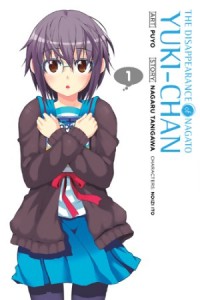
 SEAN: It’s rare for me to recommend a manga purely on the basis of OH MY GOD IT’S SO ADORABLE, if only because there are so many other moe titles that ply on that trait that I dislike. Puyo’s alternate universe take on the 4th Haruhi Suzumiya novel, however, The Disappearance of Nagato-Yuki-chan is an exception. The artwork may not be perfect, especially at the start, but otherwise this is basically Haruhi reimagined as a cute romantic comedy starring Kyon and Yuki. (Don’t worry, Haruhi won’t stay away for long). Funny in a cute way, angsty in a cute way, and romantic in a very cute way, this is for everyone who thought that Haruhi’s story would be great if only everyone was simply nice to each other. And wait till you see Ryoko Asakura. (Of course, non-Haruhi fans likely won’t get the same value, but…)
 KATE:
 MICHELLE: There are other worthy entries on this list, but I only have eyes for 13th Boy. As was my rationale with Ouran High School Host Club a few weeks ago, it’s impossible for me not to pick the final volume of a beloved series when it’s my last opportunity to do so. 13th Boy is easily one of the strongest, most interesting and surprising manhwa series to be released in America; if you’re at all curious about comics from Korea, you owe it to yourself to check it out.






 KATE: I only have eyes for one book this week: the long-awaited third volume of
 MICHELLE: I, too, am happy to see volume three of Summit of the Gods appear at long last, but I’ll throw a bit of love toward
 BRIGID: Summit of the Gods sounds pretty tasty, but it’s 95 degrees and I’m in the last stages of San Diego prep frenzy, so I need something light and amusing. I thought the first volume of
 MJ: Aside from Summit of the Gods, this week is pretty light for me, so as I’m weighing in last, I’ll to head over to NETCOMICS and recommend their
 Case Closed, Vol. 43 | By Gosho Aoyama | VIZ Media – In the latest volume of Case Closed, Conan and the gang solve three mysteries: one involving a lost cell phone, another involving a toy company president, and yet another featuring a bomb-wielding maniac. The stories are a little hit-or-miss, relying heavily on surprise twists that few readers will be able to anticipate from the available clues. Of the three, “One Demon Among 53,000” is the best, a crisply executed beat-the-clock thriller in which Conan must find a terrorist who’s threatening to blow up Koshien Stadium during the national baseball championships. Smart pacing and effective jump cuts convey the urgency of the situation, making it all the more frustrating that volume 43 ends without resolving this promising storyline. Guess I’m on the hook for 44! – Katherine Dacey
 Dawn of the Arcana, Vol. 4 | By Rei Toma | Published by VIZ Media – While this volume doesn’t play up my favorite aspect of Dawn of the Arcana—Nakaba’s inner struggle between her loyalty to her protector, Loki, and her burgeoning feelings for her new husband, Caesar—as much as I would like, it’s still quite an important volume. Nakaba’s influence on Caesar continues to be profound, and when he learns that his father is planning an attack on a village of Loki’s people, he sets out to foil the plan. Meanwhile, Nakaba begins to explore her powers of foresight and starts to think she may be able to use it to help people, only she can’t tell Caesar because the king would execute her if he were to catch wind of her ability. She’s shaping up to be a strong and capable heroine, and I look forward to seeing where the story goes from here! – Michelle Smith
 The Drops of God, Vol. 4 | By Tadashi Agi and Shu Okimoto | Vertical, Inc. – The moment that Shizuku won the battle for the first Apostle, I was ready for the second battle to be Issei’s. He has to be a formidable foe, after all. To that end, he gets the bulk of the character development here, going to the Tibetan desert in order to find the perfect inspiration and also to acquire another love interest (in a sequence which is both heartwarming and laughable in its cliche). Shizuku, meanwhile, seems the odd one out this time – in a volume that is filled with lovers reconnecting and familial bonds, he can’t even understand why Miyabi seems so grumpy when he notes they’re just colleagues. No surprise, then, that he ends the volume with need of some serious soul-searching. Hopefully he’s found it by the next omnibus, which jumps ahead about a dozen or so volumes. –Sean Gaffney
 Kamisama Kiss, Vol. 8 | By Julietta Suzuki | VIZ Media – The kami conference wraps up quickly here, and I liked that they did show Kayako again just to have a bit of closure. The bulk of the volume, however, deals with Kurama and his tengu family, as Nanami and Tomoe get involved in a tortuous succession battle. There are sprinklings of the main romance here and there, but for the most part this volume works like many of the previous ones – a new character meets Nanami and takes an instant dislike to her, only to eventually fall for her on account of her gumption, stick-to-it-ive-ness, and general main character syndrome. I don’t expect Jiro to be any different, especially as he’s already noting the differences between men and women. Provided you haven’t grown weary of everything revolving around how swell Nanami is (she needs more obvious flaws), this series still entertains. –Sean Gaffney
 La Corda D’Oro, Vol. 16 | By Yuki Kure | VIZ Media – This dating-sim-cum-manga would be a true guilty pleasure if Kahoko, the heroine, wasn’t such a dithering idiot. Alas, her doormat behavior and lack of focus make her an unlikely candidate for classical music greatness, as she spends more time mooning over cute guys than she does practicing her etudes. In volume sixteen, for example, she nearly flops in competition because she’s become utterly preoccupied with aloof but handsome violinist Len. Len’s big revelation — and the fallout from it — could have been handled in five or ten pages, but Yuki Kure milks it for nearly three chapters, treating us to repeated scenes of Kahoko blushing, stammering, and playing sour notes as she frets about Len. Worse still, these scenes feel like they’ve been pilfered from earlier chapters; even the characters seem bored with their lines, sleep-walking through an all-too-familiar tournament scenario. Wake me up when the backstage backstabbing resumes! – Katherine Dacey
 Natsume’s Book of Friends, Vol. 12 | By Yuki Midorikawa | VIZ Media – For the most part, this manga is content to be a series of short one-shots and two-parters dealing with the yokai world, and the new yokai Natsume has to deal with. We have seen him slowly starting to open up, however, and the three-parter here shows how it’s affecting both him and Tanuma. This is the classic ‘if I’m not close to them, they won’t be in danger’ hero dilemma for Natsume, but we not only see Tanuma’s side – wanting to help but feeling completely inadequate about it – but also Nitori’s, who it is implied made his choice earlier in life and is trying to ensure Natsume does not duplicate it. There’s a lot more action here as well, as if the increase in emotions lends itself to a faster, more frantic pace. Loneliness has plagued Natsume’s life as it did his grandmothers. Can he stop the cycle? Addicting. –Sean Gaffney
 Oresama Teacher, Vol. 9 | By Izumi Tsubaki | VIZ Media – It’s great to see Tsubaki’s abilities improve with each volume. In particular, the focus issue she’s always had is almost entirely absent here, mostly due to the fact that there’s only one real plot here – the attempt to crush Okegawa. It’s his story more than Mafuyu’s here, which is why he takes her out right before the final battle – and also why he is seemingly finally allowed to see through her disguise. Okegawa is fantastic here, as we see that being a bancho is not just about thugging it up, but almost a military calling – planning the battle, caring for your subordinates. And loving a good fight as well, of course. Lest you think that this is a serious volume, however, fear not – the author can’t go three pages without sticking in something hilarious, with this particular volume ending in what amounts to a giant pie fight. I still like this series better than most. Listen to me, though, as I’m the correct one. –Sean Gaffney
 Ouran High School Host Club, Vol. 18 | By Bisco Hatori | Published by VIZ Media – I read the first volume of Ouran back in June 2006, so getting to this final volume has been a six-year journey. Staying true to itself to the end, the conclusion is simultaneously so silly it’s positively ridiculous and so sunny that it’s pretty endearing. I’d say this is a satisfying ending for the most part, though the special side story, about Kyoya’s ambition and his thoroughly Slytherin family, was really kind of dull. I wanted more Tamaki and Haruhi cuteness! Throughout the volume, Hatori includes illustrations and sidebars about the futures of various characters, and some of those are adorable, and we also get one final cameo by Mori’s chicken! I can’t adequately express how much I love that durn chicken. Not without flaws, but still recommended. – Michelle Smith
 Toriko, Vols. 10-11 | By Mitsutoshi Shimabukuro | VIZ Media – The latest installments of Toriko illustrate what’s bad — and good — about this goofy series. Whenever the story’s focus shifts from food to fighting — as it does in volume ten — Toriko becomes a dreary slog, filled with ugly characters engaged in sadistically violent combat. Making these battle scenes even more tedious is the dialogue, as bad guys pause to outline their plans, or explain the source of their power, thus providing Toriko an opportunity to gain the upper hand. When the story focuses on food and friendship, however, it’s a cheerful, if occasionally stomach-churning, parody of Iron Chef, as Toriko and his sidekick Komatsu scour the globe in search of rare ingredients. For my taste, there’s too much combat and not enough cuisine in Toriko; even the reappearance of master chef Setsuno, one of the series’ most memorable characters, wasn’t enough to erase the memory of volume ten’s endless wrangling. – Katherine Dacey
