• Skip to primary navigation
  • Skip to main content
  • Skip to primary sidebar
  • Home
  • About Us
    • Privacy Policy
    • Comment Policy
    • Disclosures & Disclaimers
  • Resources
    • Links, Essays & Articles
    • Fandomology!
    • CLAMP Directory
    • BlogRoll
  • Features & Columns
    • 3 Things Thursday
    • Adventures in the Key of Shoujo
    • Bit & Blips (game reviews)
    • BL BOOKRACK
    • Bookshelf Briefs
    • Bringing the Drama
    • Comic Conversion
    • Fanservice Friday
    • Going Digital
    • It Came From the Sinosphere
    • License This!
    • Magazine no Mori
    • My Week in Manga
    • OFF THE SHELF
    • Not By Manga Alone
    • PICK OF THE WEEK
    • Subtitles & Sensibility
    • Weekly Shonen Jump Recaps
  • Manga Moveable Feast
    • MMF Full Archive
    • Yun Kouga
    • CLAMP
    • Shojo Beat
    • Osamu Tezuka
    • Sailor Moon
    • Fruits Basket
    • Takehiko Inoue
    • Wild Adapter
    • One Piece
    • After School Nightmare
    • Karakuri Odette
    • Paradise Kiss
    • The Color Trilogy
    • To Terra…
    • Sexy Voice & Robo
  • Browse by Author
    • Sean Gaffney
    • Anna Neatrour
    • Michelle Smith
    • Katherine Dacey
    • MJ
    • Brigid Alverson
    • Travis Anderson
    • Phillip Anthony
    • Derek Bown
    • Jaci Dahlvang
    • Angela Eastman
    • Erica Friedman
    • Sara K.
    • Megan Purdy
    • Emily Snodgrass
    • Nancy Thistlethwaite
    • Eva Volin
    • David Welsh
  • MB Blogs
    • A Case Suitable For Treatment
    • Experiments in Manga
    • MangaBlog
    • The Manga Critic
    • Manga Report
    • Soliloquy in Blue
    • Manga Curmudgeon (archive)

Manga Bookshelf

Discussion, Resources, Roundtables, & Reviews

Sean Gaffney

Alice in the Country of Clover: Bloody Twins

June 14, 2012 by Sean Gaffney

By Quin Rose and Mamenosuke Fujimaru, based on the game by Quin Rose. Released in Japan as “Clover no Kuni no Alice – Bloody Twins” by Ichijinsha, serialized in the magazine Comic Zero-Sum. Released in North America by Seven Seas.

I never did finish Alice in the Country of Hearts, for obvious reasons. Hopefully that will be remedied later this month by Yen Press. That said, it sold pretty well, so I was not surprised that various spinoffs were licensed. There’s certainly twenty million or so of them coming out in Japan right now. This first volume is complete in one, and focuses on the two cute twins, Tweedledee and Tweedledum. The manga (based on the game once more) posits that Alice did not choose a boyfriend in the “Hearts” game, so instead of a love via “passion” it goes for a love via “friendship.”

Unfortunately, there are a few problems with this approach. First of all, the Dee & Dum story takes up barely half the book, so it’s padded out with a few other short stories based on ‘what if Alice chose xxxxx?’ plotlines. Some of these could be interesting (the Vivaldi plotline in particular), but they’re too short to go anywhere. And since most Western readers will have only read the manga rather than played the game, some seem completely out of left field. Gowland? Really? He was barely in the original manga! The purpose of this is straight up ‘give a nice bone to fans of the game who won’t get to see their path animated’.

As for the main plotline, I was never really a big fan of the twins to begin with, but the main reason to read Alice and enjoy it, at least for me, was that this was a twisted, disturbing variation on an otome game. The reason Alice hadn’t chosen a boyfriend is that they all seemed to be psychotic. You can tell that they’re attempting the same thing here (the twins certainly butcher a lot of people), but whether it’s the different artist or something else the fact is it all comes off as too cute and light-hearted. And Alice falters as well, as requiring her to be in love reduces her to the usual shoujo cliches “he cannot love me the way I love him”, “how can I possibly choose between them”, etc. You know it’s bad when the ancillary character bio describes Ace as ‘more unstable’ in Clover World, but he actually seems genteel by comparison.

This ran in a magazine with a slightly older demographic than the original Hearts manga, and the situations are slightly more adult in nature, though mostly in the way of implication. Throughout the Dee & Dum story, everyone is joking about Alice loving both twins being “tough on a girl’s body”, and the Blood Dupre story has similar implications. It’s not actually too bad, but worth noting given that I think the original manga when released by Tokyopop may have had a younger audience.

There are a large number of sequels/side-stories still to go, but this wasn’t exactly a great place to start. At least it’s only one volume. Hopefully better things will come with Cheshire Cat Waltz, a 3-volume sequel featuring Boris.

Filed Under: REVIEWS

Manga the Week of 6/20

June 13, 2012 by Sean Gaffney

Eep. You may look at what’s coming out next week and think it’s a first week of the month. There is a giant PILE of stuff from several publishers. Let’s break it down.

Dark Horse has the 23rd volume of Gantz. It’s been mentioned that Dark Horse’s manga licenses (Berserk, Gunsmith Cats, Gantz) tend to cater more for the Western Comics sort of fan, and I can sort of see their point. These may not hit any bookstore bestseller lists, but rest assured they do well with Diamond folks.

Kodansha has a few titles that are already out via bookstores but are trickling into Diamond, because Diamond knows the Kodansha buyer is willing to wait those extra weeks. (sarcasm mode off) There’s Volume 19 of Fairy Tail, continuing the long protracted battle against… um… those guys, you know. The latest villains. Also, Jellal. We also have the 3rd volume of the Ghost In The Shell: Stand Alone Complex manga, which apparently has an ongoing plot here regarding a serial killer. I think Bloody Monday 6 and Gon 6 are also out, though they vanished from Midtown’s list between 1pm and now. Midtown does this to me sometimes. I think they vanished Mickey Mouse to spite me last week as well.

Viz has their usual slate of non-Jump releases. (Though my shop still has yet to get Toriko and Kamisama Kiss from 2 weeks ago, Bless you, Diamond. Bliamond.) New Arata the Legend and Kekkaishi from Shonen Sunday. New Bokurano and House Of Five Leaves from the diminished but still plugging away Ikki line. New Jormungand from Sunday GX, which is sort of the Shogakukan equivalent to Ultra Jump. And a new Tenjo Tenge omnibus from Ultra Jump, which, well, is sort of a Shueisha version of Sunday GX.

And then there’s Yen’s huge June lineup. No Higurashi, which is taking the summer off (ironically, given it takes place in a June that never ends). But we have tons of other stuff to whet your appetites. As you see, Olympos is coming out. (OK, it’s not on Midtown’s list either, but my store is getting it in.) This is a done-in-one fantasy manga from Ichijinsha’s sorta josei magazine Comic Zero-Sum, and as you can imagine deals with gods and mythology. Two volumes in Japanese, it’s out as an omnibus here. Speaking of omnibuses, remember Alice in the Country of Hearts and its 5 of 6 completed volumes? Well, Yen has rescued it, and is redoing the whole shebang in 3 big omnibuses, including the as-yet-unseen ending volume. I enjoyed this dark and twisted otome game world, and look forward to seeing how it wraps up… or, being a harem game, *if* it wraps up.

Other titles from Yen include the 6th Kobato manga from CLAMP, which I believe is the final one, and which will no doubt be adorable as all get out. Also in the adorable category is Sunshine Sketch 6. I have a soft spot for this 4-koma series, which has gotten some flak for its lack of plot and its even-more-superdeformed-than-usual designs. I do wonder if it will get more readers in this post-Madoka Magica world? In the OEL category, there’s the 2nd volume of James Patterson’s Witch & Wizard, by Nightschool artist Svetlana Chmakova. And lastly, though it’s not Yen, the 7th Haruhi Suzumiya novel is out from their corporate parents. This one is a full complete novel rather than a short story collection, and has enough time-travel to shake a TPDD at. Go get it.

Filed Under: FEATURES

Pick of the Week: Of Mice and Men

June 11, 2012 by Katherine Dacey, MJ, Michelle Smith and Sean Gaffney 1 Comment

KATE: I’d be the first to admit that Honey Darling is silly. The plot hinges on the kind of illogical behavior and improbable coincidences that a first-semester film student would know better than to include in his script. (The nadir is a scene in which one character runs into the street asking strangers where the nearest animal clinic is. Hasn’t he heard of directory assistance? Or Google, for that matter?) If you can look past the contrivances, however, what you’ll discover is a sweet story with a good heart and a good sense of humor, in which two impossibly handsome guys fall in love with each other. Fans of smutty manga may be disappointed, as all the heavy breathing takes place in the final chapter, but readers who like a more straightforward romance will find Honey Darling agreeable.

MJ: I must say, I’m with Kate this week. I’ll admit there haven’t been a lot of titles for me to love in SuBLime’s lineup so far, which is to say that they’ve simply been Not to My Taste. I have been won over by a couple of books, however, and they’ve been the ones I least expected to enjoy—first Oku-San’s Daily Fantasies and now Honey Darling. It is silly, just as Kate says, and there’s nothing truly remarkable in its fairly conventional BL premise, but it’s a lovely example of sweet, sincere romance that doesn’t take itself too seriously. Simply put, Honey Darling is a pleasure to read.

MICHELLE: I’m also aboard the BL bandwagon, but I’m once again recommending Kazuma Kadoka’s Kizuna, which is seeing the release of its sixth and I think final volume. Kizuna was actually released in English before, by long-defunct CPM, but that publisher never got around to publishing the last volume. Though DMP repackaged the first ten, already-released volumes in two-in-one omnibus editions, they’ve left this final one as a standalone, meaning that all the folks who didn’t rebuy the series can just snap this one up! Pretty considerate, actually! Anyway, this BL story (with plenty of yakuza) has been a pleasure to read and I look forward to seeing how it all ends.

SEAN: Honestly, there’s nothing this week that screams Pick of the Week for me. So I will move away from manga and go with the 3rd collection of Floyd Gottfredson’s comic strips, Walt Disney’s Mickey Mouse Vol. 3: High Noon at Inferno Gulch. These volumes have been a revelation, showing a generation who had only seen the dull, squeaky clean corporate Mickey exactly why he was the darling of the 1930s. Pure rollicking high-adventure, they’re also filled with background material and essays by cartoon scholars such as editor David Gerstein. A must for any cartoon fan collection.


Readers, what looks good to you this week?

Filed Under: PICK OF THE WEEK

Bookshelf Briefs 6/10/12

June 11, 2012 by MJ, Sean Gaffney, Katherine Dacey and Michelle Smith Leave a Comment

This week, MJ, Sean, Kate, and Michelle look at recent releases from VIZ Media and JManga.


Bakuman, Vol. 11 | By Tsugumi Ohba & Takeshi Obata | VIZ Media – I’ve always considered Bakuman to be a manga made up of pretty much equal parts “awesome” and “maddening,” and if that’s a decent description of the series as a whole, it’s especially applicable to volume eleven. In the category of “maddening,” we have the usual tiresome offenses against feminism—specifically the further domestication of Kaya, Takagi’s spunky but unambitious young wife, and the over-the-top vilification of Aiko Akina, the talented young writer who was first introduced as a girl too smart to be attractive to men. In the “awesome” column, on the other hand, is basically everything else, especially ongoing rivalry between our heroes and Eiji Nizuma and the artistry it elicits from both sides. By the end of the volume, even Akina is finally beginning to be portrayed as a worthwhile rival instead of the jealous harpy she’s been painted as all along. Overall, I’d probably call it a win. YMMV. – MJ

A Devil And Her Love Song, Vol. 3 | By Miyoshi Tomori | VIZ Media – It’s becoming pretty clear that we’re in for the long haul as regards Maria being bullied, and this volume seems to continue the pattern of her winning over the class one by one. That said, ‘winning over’ is not the same thing as it was with Tomoyo or our two male love interests. Maria has genuine problems interacting with others, and even if you admire her ability to tell folks the truth straight up, you have to acknowledge it. The maskless Maria in this volume goes up against another girl who is putting up a facade, and is just as intolerant of it. I enjoyed the author’s depiction of the crush Hana has on Yusuke – it’s all about the awkward and childish, with very little ‘we were meant to be from the start. Plus, of course, it helps keep the romantic triangle involving Maria alive. – Sean Gaffney

Fluffy, Fluffy Cinnamoroll, Vol. 4 | Story & Art by Yumi Tsukirino, Original Concept by Chisato Seki | VIZ Media – I feel like a grinch for not succumbing to the charms of this Sanrio series, but Fluffy, Fluffy Cinnamoroll has all the warmth of a Transformers comic: it’s a slick, synthetic story in which the real aim is selling products, not creating memorable characters or representing real emotions. The second half of volume four is particularly egregious, as it focuses on the “girl” puppies’ efforts to become pop idols and date celebrities. There’s no doubt that tween girls fantasize about being famous, but the the stories are so neatly resolved that only the least discerning ten-year-old will find them convincing. About the best I can say for volume four is that the first batch of stories — in which the entire gang gets into the crepe-making business — are moderately amusing, as Cinnamoroll’s forest-dwelling neighbors ask for unusual fillings; the raccoons and chickens are a good foil for the prissy, sweets-eating pups. The rest of volume four suffers from their absence. – Katherine Dacey

Gokudou Meshi, Vol. 2 | Shigeru Tsuchiyama | JManga – I was really looking forward to the second volume of Gokudou Meshi and it didn’t disappoint, but that’s because I knew what to expect: tales of simple fare told by a nearly indistinguishable cast of inmates sitting around their cell in a Japanese prison. The food featured in this volume includes instant ramen, katsudon, spaghetti, and even canned pineapple juice. We also see the storytelling tradition spread from the original room 204 to room 307, at which point it becomes apparent that there’s absolutely nothing to be gained in trying to keep track of the characters, because they are utterly unimportant. Gokudou Meshi has stripped away the things that are not essential (plot, characters…) and instead focuses solely on the food. It’s a formula that works for me, though, and one that’s not unaffecting—now I need to find a place in town with good katsudon! – Michelle Smith

Nura: Rise of the Yokai Clan, Vol. 9 | By Hiroshi Hiibashi | VIZ Media – If you like shonen battles and you like yokai, there’s plenty to enjoy here. Rikuo trains in order to be able to face his newest enemies in Kyoto, and for those playing along ‘fear’ is apparently Nura’s version of ‘bankai’ or ‘haki’ or whatever you call a power-up in Jump. There’s new characters introduced, most of whom mistake Rikuo as a weakling before they learn better, and the villain marches through Kyoto curbstomping everyone and being arrogant. That said, I do sort of miss the initial plot of Nura trying to balance his human and yokai sides, which has gotten a bit lost amidst the battles. Now that his classmates are in danger (again) in Kyoto, perhaps we can get a bit more of a return to form. I’m not hopeful, though – the artist seems to love the yokai world far more than they do the human one.. – Sean Gaffney

The Story of Saiunkoku, Vol. 7 | Art by Kairi Yura, Story by Sai Yukino | VIZ Media – I’ve always really liked The Story of Saiunkoku, but this volume made me love it. While Shurei continues to persevere at court in the face of tremendous hardship (winning some admiration in the process), there is a lot of other really interesting stuff going on, including Koyu’s doubts about whether his guardian truly cares for him, Seiran’s promise to watch over Shurei until she can stand on her own, and the arrival of Shurei’s uncle with plans to recall her to the Hong clan’s “main house” someday. As if that weren’t enough, there’s an accusation of favoritism regarding Shurei’s test results, an arrest, a confinement, and a liberal sprinkling of Ryuki being awesome. Really, this volume has it all. I can’t imagine anyone waffling on the quality of this series, but if you did have doubts, volume seven will put them to rest! – Michelle Smith

Filed Under: Bookshelf Briefs

Ouran High School Host Club, Vol. 18

June 11, 2012 by Sean Gaffney

By Bisco Hatori. Released in Japan as “Ouran Koukou Host Club” by Hakusensha, serialized in the magazine LaLa. Released in North America by Viz.

At long last, one of Viz’s most beloved shoujo series is coming to an end. We’ve had all the drama, we’ve had the love confession, so all that’s left is wrapping things up. Luckily, for the most part that means a return to the comedy that was one of the main reasons that fans loved this series. From Tamaki’s over-the-top reactions, to Haruhi’s deadpan remarks, to Kyoya’s smiling nastiness, there’s something for everyone here. And it’s all topped with a layer of sweetness that will give you cavities – but in a good way.

I should probably mention right now, though, that some BL fans of the series may end up being annoyed. Ouran has a huge BL fandom, as many reverse harem series tend to, and the artist enjoyed playing up to it – though always in a silly way. However, now that it’s the end of the series, she does little panels devoted to what happens to the cast when they grow up. A note to authors of books or manga with romantic entanglements – fans HATE this. Telling folks who love to write fanfiction that all of their romantic avenues are blocked by canon just grates. So when Ouran fans started off Vol. 18 by having Hunny married off to Reiko, I suspect the reaction was less “awww, so cute!” and more “Noooooo, he’s Mori’s!”. Be prepared for this throughout the book.

As for the book itself, I had wondered what Tamaki’s reaction to Haruhi’s confession would be like. It’s pretty much exactly as I predicted – which is what makes it fun, of course. Tamaki’s tendency to overdo everything, his naivete at basic day-to-day living and yet his mastery of reading other people are all on display here, and I think after 18 volumes we no longer worry about how he’ll function as an actual responsible adult. The same goes for Haruhi – the change in her over the course of the series has been astounding, and here we see her actually being openly affectionate with Tamaki.

The series proper ends about 2/3 through the volume, so we get two ‘side stories’ taking place after the series. The second is just 6 pages of our main couple being adorable, but the first is full-length, and focuses on Kyoya and his family issues. The author notes in comments that she wanted to leave Kyoya’s story open-ended as it would be very difficult to realistically wrap it up that fast – it will take years. So instead we have Kyoya being clever, but still not quite clever enough to think ahead of his father, which is his main goal. He also clashes with a woman from another family who’s being engaged to one of his brothers. Seeing their sharp, nasty barbs towards each other – all delivered, of course, with bright and happy smiles – made me happy. And of course the rest of the Host Club is there as well, making this probably the funniest chapter of the volume.

As with all harem series that deliver an actual ending, this is going to upset a few people. But I suspect the majority will be delighted. Ouran has been an over-the-top romantic comedy which, even if it got a bit melodramatic towards the end, never stopped delivering entertainment. It’s been worth the wait to have it fully come out here. v(I do wonder if Viz will license Hatori’s new work, The Bullshit Delusional Opera, when it comes out in Japan. It may need a title change.) Congratulations to Haruhi, Tamaki and the cast!

Filed Under: REVIEWS

Until Death Do Us Part, Vol. 1

June 8, 2012 by Sean Gaffney

By Hiroshi Takashige and DOUBLE-S. Released in Japan as “Shi ga Futari wo Wakatsu made” in 2 separate volumes by Square Enix, serialization ongoing in the magazine Young Gangan. Released in North America by Yen Press.

It feels rather refreshing, after reading this first omnibus, to know that I will not have to be thinking of ways to praise the author’s fresh, original ideas. There’s nothing like that here. Not that this is a bad manga – it’s quite good – but it is an action-packed thriller with spectacle and excitement, not a densely plotted opaque mystery. Well, unless it surprises me later. That said, as I indicated, it’s startling how well this works anyway. This manga is a compulsive page-turner, with likeable, cool characters and lots of good action scenes that are (for once) relatively easy to follow.

The premise reads like the author stared surfing TV Tropes and writing stuff down. Our hero, Mamoru, a blind swordsman who is testing new technology that lets him a) see folks as wire frame-type contours, and b) cut them with a monofilament sword, is interrupted one day by a girl, Haruka, who can predict the future under the right conditions and has a lot of bad guys hoping to catch and dissect her to figure out why. He reluctantly helps her, and along the way they meet the organization he belongs to, a special task force composed of victims of terrorism who are not getting revenge. Together they will bring down an insane global conspiracy!

Again, if I read that synopsis of fanfiction.net, I’d be moving on without a second thought. But the creators make it work, mostly by not really giving anyone time to think about anything. This is an action manga, and things rarely stop for more than 5-10 pages without another firefight or sword battle breaking out. The lead is cool, handsome, morally ambiguous, and has a tortured past – winning qualities, every one. (I am unsurprised that this manga has a large female following.) His colleague Ryotaro is refreshingly normal, aside from his amazing tech savvy, and seems to handle the dual role of Mr. Exposition and Straight Man fairly well.

As for Haruka, well, so far she is the typical waif. I have the most misgivings about her, mostly due to the way this role has been handled in the past. I hope that she gets stronger and starts taking her own initiative (although props to her for escaping and seeking out Mamoru at the start). There’s also the whole “one day I’ll marry him” thing, which gets wrapped up in the actual title of the manga. Given she seems to be about 12, let’s hope that it continues to stay hypothetical. The artist doesn’t seem to draw in a very ‘moe’ style, which is a plus. On the other hand, he avoids panty shots and then points out in the afterword how he avoided panty shots, which is a minus. Sort of a ‘Don’t show, don’t tell’.

So despite being a collection of action cliches, this is a lot of fun. There’s a fair amount of violence, as you’d expect from a manga about terrorists who fight other terrorists, but it’s not overwhelming. It also has a good head on its shoulders, and even an occasional sense of humor. I think the word I’m looking for is solid. Yen has found good, solid entertainment here. Check it out.

Filed Under: REVIEWS

Manga the Week of 6/13

June 6, 2012 by Sean Gaffney

Despite my irritation at Diamond for not shipping half of Viz’s releases this week (at least I got Ouran 18…), I am here to tell you about next week.

Dark Horse has the 11th volume of the Evangelion spinoff Shinji Ikari Raising Project. At the rate it’s going it should pass its original source soon in length. I’m sure it will have far more heartwarming romantic comedy moments as well – the original Evangelion manga really doesn’t have time for that these days.

Digital Manga Publishing debuts a new BL office romance, Same Difference. It looks like it might be lighthearted, always nice to see. There’s also the 4th volume of Bad Teacher’s Equation, and the 6th volume of the fancy Deluxe version of Kizuna.

Seven Seas has the first of a new spinoff series from Alice in the Country of Hearts, as this time she ends up in the Country of Clover. The cast seems to be similar, though, and I’m sure it will share the reverse harem datesim genre that its parent series had. There’s also the 12th volume of Dance in the Vampire Bund, which sadly does not seem to feature a cameo from Christie High Tension. :)

There’s also two new titles from Viz’s BL line Sublime. Honey Darling and Three Wolves Mountain come out with covers that make me immediately wary, but perhaps the cute boys are slightly less cat-eared inside the volume. In any case, it’s great to see Viz dipping its toes into the BL genre.

Anything that interests you this week? Or, like me, are you still waiting for half your Viz order?

Filed Under: FEATURES

Nonnonba

June 6, 2012 by Sean Gaffney

By Shigeru Mizuki. Released in Japan as “Nonnonba to Ore” by Chikuma Shobo. Released in North America by Drawn & Quarterly.

It feels somewhat odd that after reading Nonnonba, a semi-autobiographic epic by the creator of Gegege no Kitaro, the man who is known worldwide for his amazing yokai tales and characterizations, that I found the yokai in it the least engaging part. Oh, don’t get me wrong, there are some spectacular spooks here. My favorite was probably Azuki-Haraki, who looks as if he had been drawn by guest artist Robert Crumb. But though there are yokai and supernatural elements throughout, the reason this is such a famous title – it’s gotten many accolades ever since its first publication in 1977 – has been its human characters, in particular Shigeru himself.

There are several main plotlines that flit through Shigeru’s life as he grows older in this volume. His flighty father’s continued schemes to chase his dream – and unemployment that inevitably follows. The young child gangs that roam the streets, which seem to be undecided as to how serious they are – especially after their new leader has Shigeru ostracized. His grandmother – the titular Nonnonba – moves back in with them after the death of her husband and is very much what you’d expect, dispensing good advice, acting as a nanny/doctor, and occasionally dealing out exposition on yokai.

One of the main things I noticed, though, was the series of girls approximately Shigeru’s age who arrive, seeming to be potential love interests, and then move on. At first this is sudden – “Oh, she died of the measles a week ago”, and you accept it as part of what being a child in 1930s Japan was like. Then we meet a sickly girl who enjoys Shigeru’s drawings, and given she has ‘doomed’ written all over her (if this were a Western comic she’d be dying of consumption), one can briefly raise an eyebrow. Then, in the last third of the book, we meet Miu, a young girl who is part of a ‘family’ moving into a haunted house – and can also sense nature and the supernatural in an almost psychic way. I was fairly sure she would die as well – the color pages at the start made me think they were all going to the land of the dead – but her fate is far more realistic, fitting in with the darker tone of the 2nd half of the book.

Still, the book itself is not depressing. Life is something that has to be accepted, in all its facets. Mizuki is an expert at capturing his childhood in a way unfettered by preciousness or overanalysis. There’s also a bit of eerie prescience here – Shigeru reforming the teen gangs to ‘pacifism’ is all very well and good, but I kept being reminded that this group of kids would be going off to war in a scant few years. This is probably why Shigeru the child has an emphasis on pacifism – and why the ostracized gang eventually joins him over the dictatorial leadership of the stronger Kappa (Kappa being a nickname, he’s not a yokai).

I wasn’t as blown away by this as I thought I would be – Gegege no Kitaro remains the title I want to see here the most – but it was a nice, solid autobiography, mixing reality and fantasy in such a way that each complements the other. There’s a lot of extremely flawed human beings here, including Shigeru, but the overall mood is one of nostalgia and remembrance.

Filed Under: REVIEWS

Pick of the Week: Ouran, Devil, GTO

June 4, 2012 by Michelle Smith, Sean Gaffney, MJ and Katherine Dacey 3 Comments

MICHELLE: Ordinarily next week would be one of those impossible-to-choose weeks for me, featuring as it does series like Bakuman, Slam Dunk, Kimi ni Todoke, and Dawn of the Arcana, all of which are terrific. However, they’re all also still being released in English, which means I have plenty of time to recommend them in future. The same cannot be said for Ouran High School Host Club, which reaches its eighteenth and final volume at long last. I’ve followed this series for six years, throughout various ups and downs—I loved some of it, I liked some of it, and I grew frustrated by some of it—but I am really looking forward to its conclusion. I hope it’s as satisfying as it has the potential to be!

SEAN: What Michelle said. Ouran 18 for me as well. (Hey, sometimes even I have little to say.)

KATE: I’ve never been an Ouran gal, so my pick goes to another Shojo Beat title: volume three of A Devil and Her Love Song. I thought the first two volumes showed promise, but felt that the author sometimes didn’t quite know what to do with her prickly, truth-telling heroine. In the third volume, however, the story really clicks: the characters are fully realized, and the storyline begins moving more briskly. Though there are some melodramatic flourishes, A Devil and Her Love Song remains squarely focused on real teenage concerns: fitting in, staying true to one’s beliefs, and rejecting phoniness in all guises. Surely Holden Caulfield would approve.

MJ: While there are quite a few favorites of mine on the list this week, I’ll give my vote to volume three of GTO: 14 Days in Shonan. From my write-up at Off the Shelf: “What I found pretty spectacular about 14 Days in Shonan, is that it features a main character who spends a lot of time telling other people just how much of a badass he is, while actually being a badass … I enjoyed these volumes so much more than I expected, I find myself wishing I had some kind of award to give out for it, or something. It’s been a while since my expectations were so neatly trounced.” I realize that simply repeating myself is a lazy way to make my pick, but really, that gets to the crux of it. I (very unexpectedly) loved the first two volumes of this manga, and I can’t wait to read more!


Readers, what looks good to you this week?

Filed Under: PICK OF THE WEEK

Bookshelf Briefs 6/4/12

June 4, 2012 by Michelle Smith, Sean Gaffney and Katherine Dacey 1 Comment

This week, Michelle, Kate, and Sean look at recent releases from Viz Media, Yen Press, and Sweatdrop Studios.


Ai Ore!, Vol. 5 | By Mayu Shinjo | Viz Media – Ai Ore! in its fifth volume is pretty different than its first. Almost entirely gone is Akira’s manipulative/disturbing behavior (though he’s still fixated on making Mizuki “his”), which is definitely a good thing, and the series has settled into a fairly generic romantic comedy groove. Unfortunately, it seems like Mayu Shinjo may already be out of ideas, since we’re treated to yet another “Mizuki thinks Akira has secretly been gay all this time” bout of melodrama. I continued to be disappointed that Mizuki, who occasionally looks ravishingly boyish, is not a cooler and stronger character, but it’s pretty much a lost cause at this point. Still, even though I stop short of calling Ai Ore! good, it is compulsively readable, and I see myself finishing out the series, though I’m not looking forward to the beachy hijinks advertised for the next volume. – Michelle Smith

Bamboo Blade, Vol. 13 | By Masahiro Totsuka and Aguri Igarashi | Yen Press – There’s some big surprises here, though many of them were signposted earlier. TV Savant Erina is not who she appears to be, and it’s her backstory and growth that is the focus of this volume. The reason that it’s her, by the way, is that Tama loses – genuinely and honestly. This is exactly what her coach has wanted all along, and now we get to see what she will gain from it. Tama has always sort of done kendo as it’s expected of her. Now she sees true kendo passion – both from Erina and from Ura Sakaki, whose delusions of sentai are finally thrashed out of her in one of the most awesome sports battles I’ve seen in a long time. So we’ve one volume to go, and I’ve no doubt that volume will have Tamaki finally seeking the real reason she fights kendo matches. Highly recommended. –Sean Gaffney

Oresama Teacher, Vol. 8 | By Izumi Tsubaki | Viz Media – I sense that Tsubaki-san was told be her editors at Hana to Yume around this point in the manga that the series was a success, and in no danger of ending soon, so it was time to break out the new characters and plot complications. There’s a sense of gearing up for the next big battle here. Unfortunately, as always, Tsubaki’s plotting always seems flaky and scattered. So we get a chapter giving a bit of depth to the main villain, then some background for Takaomi, then a whole passel of new minor villains (some even female – gasp!) are introduced, and then Mafuyu’s two suitors find out about her relationship with Takaomi. There’s some fun stuff here – I was, as always, laughing a lot throughout – but Tsubaki needs a stronger editor than the ones Hakusensha provides. –Sean Gaffney

Soul Eater, Vol. 9 | By Atsushi Ohkubo | Yen Press – Soul Eater is another title, like Oresama Teacher, that is finishing one plot and getting ready to gear up for another. It, however, handles this much better, with plot threads from Vol. 6 onwards just now starting to pay off. The focus here is on our three meisters, rather than their weapons, and I was impressed with how the manga handled Black*Star, everyone’s favorite insufferable talented jerk. We get a lesson seemingly set up for teaching him humility and learning to hold back for the sake of the others – then it turns out this is a fakeout, and that it’s Maka who has to learn not to hold her fellow student back. Finally, our team goes off on its next big battle, where they’re acting as backup for an increasingly unstable Doctor Stein – and they promptly disobey his orders and charge in to the rescue. Kids, sheesh. Good shonen fun. –Sean Gaffney

The Story of Saiunkoku, Vol. 7 | By Kaira Yura and Sai Yukino | Viz Media – The ongoing hazing and abuse of Shurei and Eigetsu sort of percolates along through this entire volume, driving many plots but not quite coming to a head – no doubt that will happen in the next volume. Instead, we get to see that ‘slow and steady wins the race’ seems to be the moral lesson for the entire cast – the villains always seem to overplay their hands by overdoing things and making fast, impetuous choices. Our heroes, meanwhile, are the picture of calm and serenity, even when they’re being arrested for favoritism or held captive so as not to testify at a trial. Of course, one can be *too* serene and unreadable – there’s a great story here about Koyu’s frustration with his lord, and being unable to tell the difference between not caring and not wanting to hold back. It’s all about the small, quiet moments here. –Sean Gaffney

Sun Fish Moon Fish | By Morag Lewis | Sweatdrop Studios – Set in the fictional kingdom of The Thousand Island Archipelago, Sun Fish Moon Fish tells the story of Anciarin, a court mage who’s falsely accused of murdering Archipelago’s royal family. The premise is certainly ripe with potential, but the execution is wanting; Morag Lewis’ character designs have a faintly unnatural quality to them, with enormous, wide-set eyes and perpetually surprised expressions. The dialogue, too, tacks between medieval formality and modern-day casualness, with one character demanding, “What’s your beef?” and another making reference to “teams,” as if he were a S.W.A.T. captain. If the art and dialogue are sometimes amateurish, Lewis shows considerable promise as a writer; Sun Fish Moon Fish is briskly paced and skillfully plotted, giving equal time to Anciarin and Iashar, the soldier tasked with bringing the mage to justice. An ambitious, though uneven, work. – Katherine Dacey

Filed Under: Bookshelf Briefs

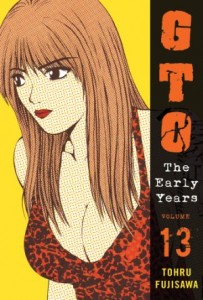
GTO: 14 Days in Shonan, Vol. 3

June 4, 2012 by Sean Gaffney

By Toru Fujisawa. Released in Japan by Kodansha, serialized in the magazine Weekly Shonen Magazine. Released in North America by Vertical.

After an action-packed 2nd volume of GTO, it’s time to take a breather and get back to some lighter stuff before we gear up for the next broken teen who Onizuka has to save. And hey, didn’t Shiratori-san say that there was someone else who worked at the White Swan? Who was even prettier than her? Could this possibly be the overture to… some romance?

Well, no. This is Eikichi Onizuka, so whenever romance rears its ugly head, he turns into the immature idiot that he is. (Yes, he’s also a heartwarming badass, but hey, facets.) First he tries his hand at seducing Shiratori-san via some red wine, which is a little creepy but it becomes clear that he’s not really going to follow through on it unless she’s awake and willing… okay, no, it’s creepy no matter what. Then when she falls asleep, he falls back on peeping on the other caretaker in the house, who we haven’t met before… or so we think. Much to his surprise and ours, the other caretaker turns out to be his old not-girlfriend Shinomi Fujisaki, who is, as you might imagine, displeased at Onizuka ogling her nude.

It’s great seeing Shinomi back in the storyline, as she makes a good love-interest contrast to Azusa Fuyutsuki from the GTO series proper. Whereas Azusa tends to be ‘he’s sort of a weirdo, but I can see the good heart inside of him’, Shinomi is very much in the ‘I’ve always seen the good heart, but WHY IS HE SUCH A FREAK’ school of lovers. As you might expect, Onizuka walking back into her life after disappearing years ago confuses the hell out of her, and she responds via violence in the best tsundere way. (Onizuka, who is very similar to her, responds by changing the subject and being over the top goofy, which we’ve already seen tends to be his way of avoiding serious issues.) I don’t expect much to be resolved here – this takes place during GTO proper, which didn’t resolve any romances – but it’s sweet to see them reunite.

As for the rest of the manga, we’ve resolved the parental problems that Miki had, and now that we know that she was merely the easiest ‘villain’ to take down, we know it’s only going to get worse. So we get a flashback to another resident of the White Swan, Ikuko, and her abusive mother, who was so bad social services had to step in. This is probably one of the best written parts of the entire volume, as it really gets into the ambiguous feelings kids have when their loved ones abuse them – and the stoic acceptance that it’s their fault for not being “good enough”. I’m not sure we’ll see more of Ikuko’s life later on, but I do hope that she manages to come to terms with her upbringing.

Then there’s Seiya, who would appear to be the next ‘project’ for Onizuka to fix. And once again, we see how Onizuka works – forcing the kids to ‘go too far’ in order to show them that deep down they really don’t want to take the final steps towards darkness. All of these manga – GTO, Shonan Jun’ai Gumi, and this spinoff – stem from the same genre of Japanese manga, which are about teenagers and family, and how much they feel abandoned and helpless. If Onizuka can help these kids reconnect emotionally, on any level, he’s going to do it. And it would appear that the fourth volume will be another action-filled one.

Filed Under: REVIEWS

Manga the Week of 6/6

May 30, 2012 by Sean Gaffney

That’s a whole lotta Viz, that is.

Mind you, there is a Vertical title as well. In fact, it came out everywhere but Diamond this week. Vol. 3 of 14 Days in Shonan puts the series at 1/3 complete, but Onizuka’s work has barely begun! He has kids to inspire and adults to castigate! And old… friends?… to reunite with! Who knows, he may even get lucky! (OK, no, that will never happen.)

The big release from Viz, meanwhile, is the final volume of Ouran High School Host Club. And for those who are curious, unlike most harem manga, this one resolves its pairing. Fans have loved the story of Haruhi, Tamaki and the others – enough to bring the anime over here as well – and now we finally have closure. Thanks to Bisco Hatori for so much great romantic comedy.

There are other releases as well. More shoujo! Black Bird 14, which will no doubt continue to sell like hotcakes. Dawn of the Arcana 4, which I am horribly behind on. Devil and Her Love Song 3, which I am greatly looking forward to, as I love snark. Earl & The Fairy 2, which hopefully will improve a bit on its first volume. Kamisama Kiss 9 and Kimi ni Todoke 14, for you romantics out there. And Sakura Hime, for the Tanemura addicts.

This does not mean there is not a giant pile of shonen as well. Bakuman 11, now in its 2nd half! Not one, but two Bleach volumes, which I believe have some great stuff for IchiHime fans! A new Nura and Toriko, which don’t get to speed up as much as Bleach, but have less to catch up on. Slam Dunk 22, in case your daily basketball quotient needed filling. And Yu-Gi-Oh Zexal, the nth sequel to the popular franchise.

That’s a whole lot. An exhausting amount, in fact. Anything for you?

Filed Under: FEATURES

A Certain Scientific Railgun, Vol. 4

May 30, 2012 by Sean Gaffney

By Kazuma Kamachi and Motoi Fuyukawa. Released in Japan as “Toaru Kagaku no Railgun” by ASCII Media Works, serialization ongoing in the magazine Dengeki Daioh. Released in North America by Seven Seas.

This volume, as the back cover tells you, marks the start of the ‘Sisters’ story arc for Railgun. Which, if you’re only following the manga, means very little to you. But this is not a manga for those who merely read the manga (though it can be read on its own fairly easily, as I have shown). Franchise manga tend to lack the surprising plot twists that original titles may have, simply as they rely on an already existing base. So if you’re buying this 4th volume of the Railgun manga, it’s already expected that you’ll have bought the Index light novels, and the Index manga and anime, and indeed Railgun’s own anime, which is namechecked here. Higurashi does this too – I’ve been coyly pretending not to know who the villain is in my reviews, but of course I do – as did all the readers of the manga when it came out. Expectations are set differently.

That said, this volume has a lot to offer. It’s rather upfront about the way that it manipulates its cast – particularly its heroine, Misaki. We start right off with her being shown a boy with muscular dystrophy, and asked to donate some of her DNA to help fight such things. Which would be fine, if she had parents who were also giving consent, or if the scientist askin g didn’t have an evil leer on his face after she agrees. No, we know we’re going to be getting into evil clones right off the bat. (Well, the cover might have clued us in as well.)

Of course, the evil is debatable – the clone on the cover actually looks rather sad and vulnerable (and mysteriously missing genitalia, in the best time-honored tradition). And indeed, when we first meet Misaka 9982, she is immediately filled with likeable traits. She’s snarky, and intelligent, and deadpan, and talks in the third person (something I wasn’t sure Seven Seas would carry over – it sounds more awkward in English, but does help to set the clones apart from the original). This is contrasted with Misaka herself, who spends the entire volume frustrated and not sure how she should feel. She’s heard the rumors before, but being faced with the actual reality is a bit much.

As we see Misaka meet her clone, and have amusing arguments with her clone, and come to see her clone as a little sister sort of figure – complete with giving her a frog badge she got from a crane machine – we know, instinctively that we’re heading for tragedy, and that this clone is going to die. Of course, the number ‘9982’ after her name might also clue us in – these clones are being created as experimental subjects, and their purpose is to die for the greater good. I suspect Misaka is not going to see it that way, however, and the volume ends with her losing it and attacking the mysterious boy who is responsible.

All of this is handled quite well. The manga flies by, and we get just enough characterization from Misaka 9982 to feel horrible about what happens. And certainly we immediately loathe Accelerator, the young man who seems to be our heroine’s new villain. Ah well, I’m sure he will simply be a minor villain… you see? There I go again, pretending that this isn’t a franchise. :) Definitely recommended.

Filed Under: REVIEWS

Pick of the Week: Genshiken, Wallflower, & more

May 29, 2012 by MJ, Sean Gaffney, Katherine Dacey and Michelle Smith 3 Comments

MJ: There’s not much to choose from at Midtown Comics this week, but making my pick is astonishingly easy, perhaps only because I came so late into the world of manga. The truth is, I’ve always wanted to read Genshiken, and this new omnibus release from Kodansha Comics has finally made it easy for me to actually conceive of doing so. I look forward to finally picking this series up!

SEAN: It’s a very slim week this week, so instead of highlighting something revolutionary or cutting-edge, I will go for one of my comfort manga again. The Wallflower will not win any points for originality—or indeed for resolving its plot—but it’s always so much fun, and I always enjoy seeing what wacky situations the cast will find themselves in this time. Everyone needs a manga that you just turn your brain off and read, and this is a good one. Plus Sunako kicks ass when she wants to.

KATE: Looking over the final shipping list of the month is like opening a half-empty refrigerator: there’s bound to be something worth trying, but it takes a little imagination to find it. This week, however, the manga offerings are just too meager, so I’m going to recommend the first Wonder Woman trade instead. For me, the big draw is the artwork: Cliff Chiang depicts WW not as a voluptuous pin-up, but as a tall, lean warrior who just happens to look a lot better in a strapless unitard than the rest of us mortals. I don’t have any difficulty imagining this WW kicking ass and taking names.

MICHELLE: It’s not on the Midtown list, but according to Amazon, volume three of GTO: 14 Days in Shonan is due out this Tuesday. I wasn’t sure what to expect from this tale of a former delinquent with a talent for getting through to troubled teens, but it turns out it’s a lot of fun. I enjoyed volume two more than the first, as a matter of fact, which certainly bodes well for this next installment!


Readers, what looks good to you this week?

Filed Under: PICK OF THE WEEK

Manga the Week of 5/30

May 23, 2012 by Sean Gaffney

It’s a 5th week of the month, you know that means there’s virtually nothing. In fact, all three of these are available now… unless you order from Diamond.

Kodansha gives us the first Genshiken omnibus, collecting three volumes of this otaku-loving series. I always tended to read it for Saki, but there’s something for everyone here. Unlike Negima, this does not feature any new translation, possibly as the old version was perfectly fine. We also get Vol. 34 of Negima, which I’ve already reviewed, possibly as it’s hitting Diamond a full month late. And we have Vol. 28 of The Wallflower, which I always enjoy, mostly as I expect laughs and nothing else. This volume apparently featured the obligatory Edo Period AU!

Aaaaaand that’s it. Thoughts?

Filed Under: FEATURES

  • « Go to Previous Page
  • Page 1
  • Interim pages omitted …
  • Page 355
  • Page 356
  • Page 357
  • Page 358
  • Page 359
  • Interim pages omitted …
  • Page 378
  • Go to Next Page »
 | Log in
Copyright © 2010 Manga Bookshelf | Powered by WordPress & the Genesis Framework