• Skip to primary navigation
  • Skip to main content
  • Skip to primary sidebar
  • Home
  • About Us
    • Privacy Policy
    • Comment Policy
    • Disclosures & Disclaimers
  • Resources
    • Links, Essays & Articles
    • Fandomology!
    • CLAMP Directory
    • BlogRoll
  • Features & Columns
    • 3 Things Thursday
    • Adventures in the Key of Shoujo
    • Bit & Blips (game reviews)
    • BL BOOKRACK
    • Bookshelf Briefs
    • Bringing the Drama
    • Comic Conversion
    • Fanservice Friday
    • Going Digital
    • It Came From the Sinosphere
    • License This!
    • Magazine no Mori
    • My Week in Manga
    • OFF THE SHELF
    • Not By Manga Alone
    • PICK OF THE WEEK
    • Subtitles & Sensibility
    • Weekly Shonen Jump Recaps
  • Manga Moveable Feast
    • MMF Full Archive
    • Yun Kouga
    • CLAMP
    • Shojo Beat
    • Osamu Tezuka
    • Sailor Moon
    • Fruits Basket
    • Takehiko Inoue
    • Wild Adapter
    • One Piece
    • After School Nightmare
    • Karakuri Odette
    • Paradise Kiss
    • The Color Trilogy
    • To Terra…
    • Sexy Voice & Robo
  • Browse by Author
    • Sean Gaffney
    • Anna Neatrour
    • Michelle Smith
    • Katherine Dacey
    • MJ
    • Brigid Alverson
    • Travis Anderson
    • Phillip Anthony
    • Derek Bown
    • Jaci Dahlvang
    • Angela Eastman
    • Erica Friedman
    • Sara K.
    • Megan Purdy
    • Emily Snodgrass
    • Nancy Thistlethwaite
    • Eva Volin
    • David Welsh
  • MB Blogs
    • A Case Suitable For Treatment
    • Experiments in Manga
    • MangaBlog
    • The Manga Critic
    • Manga Report
    • Soliloquy in Blue
    • Manga Curmudgeon (archive)

Manga Bookshelf

Discussion, Resources, Roundtables, & Reviews

Sean Gaffney

Alice in the Country of Hearts: The Clockmaker’s Story

August 21, 2013 by Sean Gaffney

By Quin Rose and Mamenosuke Fujimaru, based on the game by Quin Rose. Released in Japan as “Anniversary no Kuni no Alice – Tokeiya” by Ichijinsha. Released in North America by Seven Seas.

You would think that I would have run out of things to say about these volumes. Sometimes I have, when they’re particularly pointless – see last month’s batch of Bookshelf Briefs for my opinion of the Ace spinoff – but there always seem to be a few nuggets of interest to keep me going. It also helps that this volume focuses on one of my favorite of Alice’s romantic choices, Julius Monrey, the clockmaker. (In case you’re wondering about the ‘Anniversary’ thing in the Japanese title, it’s what they called the updated PS3 version of Alice in the Country of Hearts.)

clockmaker

The basic premise won’t be a surprise to anyone who’s read the previous spinoffs of this endless otome game series. Alice is trying to get away from an oppressive Peter White at Heart Castle, so she asks Julius if she can stay at the clocktower for a while. He agrees, and they gradually begin to open up to each other. As their relationship deepens, however, Alice has to not only deal with her own feelings, and the fact that her beloved is not the type to take the initiative, but also realize that Julius is hated by a large number of folks throughout Wonderland. Can she come to terms with what his job really entails? And what of her ever-present need to return to her sister?

Julius is a rarity in the set of Wonderland males that Alice runs into. He’s passive, introverted, and taciturn. He will happily stay in his tower for weeks, just working on clocks and sleeping when he remembers to. After several stories with Blood, or Ace, or the twins, or Eliot, or Boris, he feels like a breath of fresh air. He also causes Alice to need to be more proactive, rather than simply have the love interest be aggressive consistently until she gives in. There’s lots of adorable scenes here.

Also, he’s a mortician. Who can resurrect the dead. Only not really. Wonderland’s weird world, where everyone has clocks instead of hearts, and people can be ‘resurrected’ but aren’t quite the same people they were before, makes almost everyone uncomfortable, and that gets taken out on Julius. He’s clearly not doing this for fun, but it’s his role, and he regards it as necessary. But in a way, hanging out with him is keeping Alice in a constant shadow of death – something that I imagine makes Peter quite nervous, given what they’re all trying to make Alice not remember.

This one-shot also has an unusual ending in that, when Alice confesses her love, she chooses to remain in Wonderland and stop trying to return to her own world. Which she’s done before, but in this case the vial filled with people’s feelings that she carries around throughout the game is seen in the final shot to be shattered at her feet. It’s a striking image, showing that there’s no going back. I will admit I’m not entirely happy with the basic premise of the series being ‘if she remembers her traumatic past that makes it a bad end’, which seems to romanticize denial more than I’d like. Still, it does make for a good capper on what has been a fairly enjoyable, if slight, story.

There are also two Crimson Empire stories at the end. Luckily, they are shorter in length than they were in the Ace book. I say luckily as they were incredibly boring and tedious. Alas, you’re better off with Alice than Sheila.
Filed Under: REVIEWS

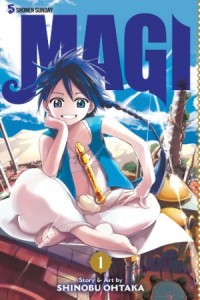
Magi, Vol. 1

August 20, 2013 by Sean Gaffney

By Shinobu Ohtaka. Released in Japan by Shogakukan, serialization ongoing in the magazine Shonen Sunday. Released in North America by Viz.

I like Shonen Sunday series a lot, and I wish they sold better over here, as I’ve noted before. Therefore, when a really good Sunday series debuts, I get a bit excited. Of course, like most really good shonen series, you read the first volume and realize ther4e’s going to be several volumes of setup before we get to the really good stuff. This one is clearly in for the long haul. That said, the worldbuilding is fun, particularly if you are a fan (as I am) of the Arabian Nights stories, which are used as the basis for this series.

magi1

The boy on the cover is Aladdin, one of the two main heroes we meet in this volume (we also meet a third major character, but spoilers). Aladdin is very much cut from Luffy stock (the author notes she grew up in high school reading Jump, which sounds like it was right about when One Piece hit it big, so this isn’t surprising), being naive, upbeat, and generally happy-go-lucky. Unlike Luffy, he also seems to have a thing for busty women, though he’s young enough that no one really minds all that much. He carries a flute with a genie inside, which is generally weak/strong depending on how much food he’s eaten, and gives him most of his cool powers.

The other main lead is Alibaba, who is also another common shonen hero. He’s been slightly trampled down by life, and is trying to make it through this world by being a cynical money-grubber. Sadly, he has a good heart and can’t stand injustice, so that doesn’t work out very well for him. It’s not helping that he runs into Aladdin, who frequently serves as his conscience when Alibaba is trying to drown out its loud voice. Alibaba does NOT have a genie who can grant his every wish, so has to get by on street smarts and some basic fighting skills. He makes an excellent contrast with Aladdin.

After the two of them team up, we hit what seems to be the other main feature of this world, at least in this early part of the series: dungeon crawling. Yes, gamers will feel sympathetic here. There’s a twisty maze of passages (all alike) that have to be marked as ‘bad’ by previous dead explorers. There’s hideous creatures, and deadly traps. And there’s also, allegedly, buttloads of treasure. Treasure that everyone seems to have been waiting for a kid like Aladdin and his genie to show up so they can use him to acquire it. As such, we meet, right near the end, the lord of the territory Jamil and his faithful slave (so faithful she returns to him even after getting freed by Aladdin) Morgiana. It’s not entirely clear if this will be our first bad guy or if his ways will be changed by our heroes’ goodness and niceness. I suppose we must wait till Vol. 2 to find out.

Again, there’s not much that’s original here. But it’s fun! Likeable characters, a lot of fascinating Arabian tropes, some cool fights, and a quest that can go anywhere. Magi is a big hit in Japan, with an anime under its belt already, so I’m very pleased that Viz is taking a chance on it. If you like One Piece or Toriko, give Magi a try.

Filed Under: REVIEWS

Bookshelf Briefs 8/19/13

August 19, 2013 by MJ and Sean Gaffney Leave a Comment

This week, MJand Sean check out recent releases from Yen Press, Viz Media, Kodansha Comics, and Vertical, Inc.


bunnydrop9Bunny Drop, Vol. 9 | By Yumi Unita | Yen Press – So, it’s finally here. Yes, it. You know what I’m talking about, fan of Bunny Drop. In fact, it’s difficult to imagine that any manga fan online has avoided hearing all about the controversial romance between Bunny Drop‘s teenaged Rin and her forty-something guardian, Daikichi, which began brewing out of the blue in the series’ last volume, at least on Rin’s side. Rin’s feelings are revealed fully in this final volume, and though things progress just as reported (feared?), Unita still manages to surprise me. Her ending is both as awkward and as oddly right as I might have wished—emotionally complicated and utterly unsexy (which, for once, is a really good thing). Though it’s still hard for me to buy in to Rin’s sudden feelings, Daikichi’s reaction rings perfectly true, and that makes all the difference, at least for this reader. Still recommended. Honestly. – MJ

devil10A Devil And Her Love Song, Vol. 10 | By Miyoshi Tomori | Viz Media – Well, we’ve been wanting Shin and Maria to finally have a nice long kiss, right? Be careful what you wish for. The scene in the music room with Maria’s breakdown was as raw and shattering as this manga has ever gotten, and I was surprised that it was then topped by Maria in her own apartment, contemplating something unthinkable. Never in this entire series have I been more grateful that Ayu exists. There’s still a lot to work through here, though, and it’s not going to go away due to a sweet hug on the rooftop. I suspect Kurosu just isn’t going to let this go, and it’s hinted that he knows even more about Maria’s past. Altogether, this is one of the best volumes yet of this series, typing together Maria’s past, her friendship with Anna, and her romance with Shin into one big screwed-up package. – Sean Gaffney

kamisama13Kamisama Kiss, Vol. 13 | By Julietta Suzuki | Viz Media – I will confess to being surprised by not one, but two plot twists in this volume. First of all, things were slowly being set up to show that sometimes duty is more important than true love, particularly when it involves a human. Of course, I was then taken aback when true love won out after all, though I appreciated Nishiki’s character growth. More to the point, I was very surprised and happy that Tomoe didn’t immediately cotton on to Nanami’s being ‘fake’. So many fantasy stories have the true love easily able to spot that the one in front of them isn’t the right one, it was great to see that no, Tomoe didn’t get it right away, particularly given it was Nanami’s own body. Another fun volume here, with hints at something darker coming soon, involving Tomoe’s past. – Sean Gaffney

kimi17Kimi ni Todoke, Vol. 17 | By Karuho Shiina | Viz Media – A.K.A. “The Payoff Volume”. Everyone knows that long-running romance series run on ‘will they or won’t they’, but there’s only so long you can hold onto that without frustrating the audience away. And so here we get big payoffs to two of our three couples. (Chizu and Ryu are sweet, but sort of take a back seat here aside from one big present moment.) It’s thematically appropriate, given Japanese customs, that this all happens at Christmas, as Yano finally gives in and opens up to Kento, and Kazehaya finally breaks free from his own chains and admits how much he physically desires Sawako. We also get some nice scenes from Pin, who always gives great advice even if he’s being a complete goofball. Overall, this is a pitch-perfect volume that everyone who follows the series will love. – Sean Gaffney

sidonia4Knights of Sidonia, Vol. 4 | By Tsutomu Nihei | Vertical, Inc. – I find it amusing, given this is a sci-fi action horror thriller sort of story, that I keep focusing on the awkward and goofy romantic comedy love triangle that also is happening within its pages. But it’s just so much fun, and really helps to make the series not just one big depressing angstfest. (Also, the book of Secrets about Sidonia should totally have had Toilet Hinako somewhere.) That said, there’s also a lot of dark tension here as well, as we continue to realize just how much the leaders of the ship seems to have it in for Tanizake. There’s also some rather terrifying body horror towards the end, that startled me quite a bit. The plot is still a bit overly complex for me to take in at times (it may benefit from reading in large chunks), but this is still space opera at its most compelling. – Sean Gaffney

librarywars10Library Wars: Love & War, Vol. 10 | By Kiiro Yumi and Hiro Arakawa | Viz Media – Sometimes it seems that Iku just can’t catch a break. As if it isn’t bad enough coping with her newfound love for Dojo, she also has some buried jealousy of Shibazaki tormenting her (oh, if she only knew how likely it was that the feeling was mutual), more bullying from a new group of girls, and her parents finally becoming aware that she’s a soldier and not merely a simple librarian after all. Of course, all these stress points end up becoming ways to give us compelling, heartwarming and satisfying drama. (We also see more of the still newborn Tezuka/Shibazaki romance, which I love to bits but which will likely be far harder to pull off than simple-minded Iku’s love.) It’s easy to forget this is a spinoff franchise, based on a light novel and with an anime as well It doesn’t read like a cash-in at all. – Sean Gaffney

wallflower31The Wallflower, Vol. 31 | By Tomoko Hayakawa | Kodansha Comics – Yes, in practice this volume ends the same way that the previous 30 have, with minimal forward movement between our heroes. However, I do think there are some very important signposts here towards an endgame, particularly in the 2-parter involving Sunako’s friend Yuki, who we first met in Vol. 6 (so long ago they have to footnote it.) Yuki is dealing with a painful first love, and at first it looks like things may go badly. But when her love is returned, we see her suddenly morph into… a beautiful, normal proportioned shoujo person. It’s always been only Sunako who pulls off the SD vs. normal switch with any regularity, so this is yet another sign that it’s not literal, but a figurative transformation that depends on the self-image of the person. All this, plus a Yuki chapter! (No, the other Yuki.) Recommended to those who still read it. – Sean Gaffney

Filed Under: Bookshelf Briefs

Pick of the Week: Helter Skelter

August 19, 2013 by Sean Gaffney, Michelle Smith, Anna N and MJ Leave a Comment

helterskelterSEAN: Yeah, it’s Vertical again. Sorry, but josei from Vertical has proven to be something to be cherished in the past, and I’m not expecting that to change with the release of Helter Skelter: Fashion Unfriendly. I expect this to be a somewhat different take on modeling from what we saw in Paradise Kiss. Good times.

MICHELLE: There are a couple of things out next week that I’ll definitely be reading—Bunny Drop 9 and Pandora Hearts 17—but I’ll not miss the chance to rally behind a done-in-one josei release. Count me in for Helter Skelter, too!

ANNA: I’m going to have to pick Helter Skelter too, because new josei from Vertical makes me happy.

MJ: I have to agree with everyone else here. I’ve been interested in this title since Vertical first announced it, and it’s absolutely my must-buy for the week. There’s nothing else that comes close.

What looks good to you this week?

Filed Under: PICK OF THE WEEK

Bunny Drop, Vol. 9

August 19, 2013 by Sean Gaffney

By Yumi Unita. Released in Japan as “Usagi Drop” by Shodensha, serialized in the magazine Feel Young. Released in North America by Yen Press.

You may finally discuss Bunny Drop in the comments. But be polite.

And so here we are. I’d mentioned when reviewing the previous volume of Bunny Drop that there was a certain discomfort with where it was going, even if there wasn’t really anything objectionable besides the basic concept. That feeling continues and is magnified in this volume, which could almost be described as “Yeah, it went there.” It does its best to try to show the thought patterns of the people this decision impacts – though Rin, as always, is harder to read and understand than the others. But in the end, was this trip really necessary? Let’s find out.

bunnydrop9

For most of the volume, the basic conflict is not so much “Rin is in love with Daikichi” – that was dealt with by Vol. 8, mostly. The conflict is that Rin seems to be perfectly content to never deal with this and live in her happy family cocoon forever, denying her own feelings so that things can be the same. And big props to Kouki for pointing out how selfish this is. Honestly, Kouki’s development has probably been written better than Rin’s as this series has gone along – he’s still very much in love with her, and knows that love can’t happen, but is determined to be sure that Rin is happy. What she’s doing now isn’t getting her that way. So, because he’s that sort of person, he simply tells Daikichi everything.

Yumi Unita’s art has always been best when showing feelings of awkward discomfort, and really excels here in the middle part of the book, as Daikichi has to deal with Rin’s feelings, and Rin has to deal with Daikichi knowing about it, and – inevitably – the destruction of their cozy parent-child relationship. I liked that she ended up going to her mother – whose character development has also been good but is mostly off-screen. The mother, of course, is there to provide the “”out” the story needs – Rin isn’t really Soichiro’s daughter, she’s an adopted daughter. Meaning she and Daikichi aren’t related by blood. Which is fine, except, y’know, he’s still raised her as a parent since she was six. Sigh.

Daikichi says to Rin he’s going to wait two years, possibly thinking that Rin might get over this. But of course she does not. Through most of the post-timeskip series we’ve had trouble reading Rin, but right at the end it’s Daikichi who becomes difficult, as his acceptance of Rin’s love and agreement to marry her seems to come less from romantic feelings and more “well, a father can’t say no to his daughter”. Which provides all sorts of deeply wrong reactions. Particularly when Rin brings up children right at the end.

There is a certain odd dilemma with this series. When it began, everyone was enchanted by its warm and loving take on parenting and adopted families, and recommending it to libraries and such. Then the spoiler hit, and suddenly the entire fandom took a darker turn. The anime solved this problem by simply ignoring the timeskip altogether. The difficulty is that if readers had known the manga was going to go down this direction, I don’t think any of them would have bought the series. Most people still reading have a sense of “Well, better see this through to the end, since I’ve invested so much time in it.” Which is not what one really wants from a heartwarming manga series. Bunny Drop could be very well-written, and thoughtful, and have nice art, and I’ve analyzed it more than most other series. But I don’t think I’ve ever felt quite as uncomfortable with an ending as I am with this one.

Of course, there’s Vol. 10 in April of next year. But I hear that’s mostly side-stories from when Rin was a kid. We shall see. (What, drop the series? Nah.)

Filed Under: REVIEWS

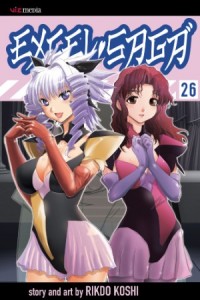
Excel Saga, Vol. 26

August 18, 2013 by Sean Gaffney

By Rikdo Koshi. Released in Japan by Shonen Gahosha, serialized in the magazine Young King OURS. Released in North America by Viz.

In between all the body swaps, and personality wipes, and past lives, and pure hostile mind takeovers, it’s become increasingly apparent that one of the core themes of Excel Saga (the manga) has been identity. What is it that makes us who we are? Is it the bag of meat we currently inhabit? Is it that we think, therefore we are? What if we have amnesia? What if we’re put into a robot body? What if we are a reincarnation of someone else with similar memories? Lately it seems that our cast, especially Excel, need to have this question answered. And while I’m not sure this volume gives us anything definitive, it is one of the best at showing just how complicated this can actually be.

excel26

Let’s start with Excel, who is now back in her regular old human body after a couple volumes as a Ropponmatsu. Of course, ‘regular old human body’ has never quite applied to Excel, given she is capable of lifting several hundred pounds if she doesn’t think too hard about it, can open doors to ancient civilizations, and clearly has a past which Doctor Kabapu is trying hard to deny. (Kabapu and Shiouji’s greek chorus is one of the more frustrating things going on in this volume, mainly as Kabapu clearly has the answers but doesn’t want to say them out loud, and Shiouji doesn’t care enough.) Unfortunately, Excel, newly invigorated and with Hyatt and Elgala by her side, runs into Il Palazzo, and the shock causes her to have a mental breakdown for the last half of the volume.

Because of course that isn’t really Il Palazzo. Oh, it’s his body, all right. This is actually a major reason why Excel breaks down, as she can’t get over how Il Palazzo-ish he really is… until he speaks. And we finally get to see the truth about Shiouji’s father, Tenmangu. I’ve gotta say, we’ve been expecting him to be possessing Miwa’s body since about Vol. 13, which is… sort of true, only not. No, he’s now in control of Il Palazzo, and Miwa is a Ropponmatsu – one far more powerful than anything Shiouji could ever invent. Of course, this may not really matter all that much, as we’ve never really delved too deeply into who Il Palazzo really is. Excel figures out something is wrong purely due to the ideals she holds so dear – Il Palazzo talks about this “wonderful world”, and she knows her real love believes that this world is truly corrupt. (Given Excel Saga’s plotline, I really have to lean more towards Il Palazzo than Tenmangu here.)

Even if you can understand who someone really is, there’s always the chance of them disappointing you. Both Umi and Hyatt seem to hold Teriha/Excel on an impossible pedestal, one that she’s never really going to live up to. Elgala is more realistic about her expectations of Excel, but gets too lost in her own la-la land to be of any help. Misaki still has trouble rationalizing her love for Iwata, given what a giant doofus he is 90% of the time. Sumiyoshi always found Ropponmatsu 2 to be a loli pain, but is rather surprised by how angry her destruction makes him. And Watanabe disappoints EVERYONE, as his love for Hyatt has clearly not lessened (or ind3eed deepened) one iota.

The next volume of Excel Saga is the final one, and I’m fairly certain that we won’t be getting everything answered. But we should at least clear up a few things, and hope that at least some of these people can live happily ever after. Or at least get a good night’s sleep. God knows they need it.

(Also, Excel’s face when she realizes that’s not Il Palazzo is beautiful yet achingly sad at the same time. This series can still hit the heartstrings when it wants to.)

Filed Under: REVIEWS

Happy Marriage?!, Vol. 1

August 17, 2013 by Sean Gaffney

By Maki Enjoji. Released in Japan as “Hapi Mari” by Shogakukan, serialized in the magazine Petit Comic. Released in North America by Viz.

Viz has started to slowly dip its toe into the waters of josei, first a few years back with Butterflies, Flowers, and now with two new series, of which this is the first. They’re all being put under the Shojo Beat imprint, because a) it’s a brand people look for, which a Signature title isn’t necessarily; and b) honestly, most of these titles hit the same beats as their shoujo titles, it’s just that the protagonists are adults and there is sexual content. It wouldn’t be hard to see something like Happy Marriage?! reimagined to high school and Sho-Comi, with Hokuto as the hot new transfer student or something.

hapimari1

The basic premise isn’t too hard. Chiwa is an office lady whose father is a bit of a naive idiot, so their family is in heavy debt. She’s trying to deal with it by taking extra jobs, but that’s not going so well. Then the company chairman has the brilliant idea of marrying her to the company president, a smooth yet vaguely jerk-like guy naked Hokuto. Neither of them are really enthused about the idea, particularly Chiwa, who is a twitchy virgin who has no idea how to handle anything like this. Will they gradually grow to love each other as husband and wife and find true love and sexual satisfaction?

It’s hard not to compare this title with Butterflies, Flowers, Viz’s first foray into the world of Petit Comic. Both have the same types of hero and heroine, both involve company power issues (he has far more power than she does), and both heroines tend to freak out when bad or confusing things happen to them. Happy Marriage?!, though, is a far more natural and mellow title than Butterflies, Flowers ever was. There’s no real exaggeration for comedic effect here. No superdeformed heroines, no over-the-top sexist behavior as of yet, and zero Gundam references. Hokuto seems a bit standoffish, and like many shoujo/josei heroes likes to smirk smugly on occasion, but compared to other types I’ve seen he’s not too bad. Likewise we see Chiyo standing up for herself on occasion, though her lack of life experience and self-confidence is no doubt going to be one of the issues this manga deals with through its 10-volume run.

Of course, the problem with not having the appalling lows of Butterflies, Flowers is it doesn’t have the amazing highs either. The comedy and gratuitous appallingness of the latter title was what kept audiences reading, as they wanted to see what outrageousness would happen next. There’s not as much outrageousness in Happy Marriage?!, so what you’re left with is just a bit duller. It feels like one of many other shoujo titles, just grown up. Which is something you could say for a lot of josei, really. Chiwa in particular hasn’t really done much to separate herself from other blushing blonde heroines. Hokuto at least is more reserved than this type usually is, and I liked that we see he doesn’t really understand his new wife any more than she understands him, he’s just better at hiding it.

This is a good start to a romantic series, and I look forward to seeing if it avoids other ‘smutty shoujo’ traps once our heroes get hot and heavy (which they don’t here). I’ll check out another volume. But it’s not making my jaw drop the way its predecessor at Viz did.

Filed Under: REVIEWS

Manga the Week of 8/21

August 15, 2013 by Sean Gaffney, MJ, Michelle Smith and Anna N 4 Comments

SEAN: Third week of the month, which is traditionally Yen Press time, and that’s true this month as well. But before we get to Yen, we have a few choice tidbits.

Kodansha has the 11th volume of Cage of Eden. Now that it’s getting serious enough to kill off some of its main cast, will things continue to take a turn for the deadly? And what will this mean for the female cast’s ability to strip naked and bathe in rivers? (Likely not much.)

helterskelter

Vertical continues to dip its toes into the josei market, this time with Kyoko Okazaki’s Helter Skelter: Fashion Unfriendly, a done-in-one manga volume from the pages of Shodensha’s Feel Young. The premise reminds me of the movie Death Becomes Her, though I suspect this won’t be as funny as that was. It’s still a highly awaited release.

MJ: I’m absolutely looking forward to this, and have been since the announcement last year at NYCC. I’ll be picking it up for sure.

MICHELLE: Me, too!

ANNA: I am looking forward to this as well! I think Vertical putting out more josei is a great thing, and I’ll absolutely be picking this up.

SEAN: Viz has its annual release of Ikigami: The Ultimate Limit, but it’s almost over, as I think the series ends with 10. I’m not sure if it’s still doing the ‘let’s see how people deal with impending death’ thing or if it’s moving into a big climax. Honestly, it was a bit too depressing for me.

MJ: I haven’t read this in a long time, and had actually thought it was already over. Oops?

MICHELLE: I have a bunch of volume of this but I haven’t read beyond volume two ‘cos it was too depressing for me, too.

SEAN: And now about that Yen. There’s Vol. 3 of BTOOOM!. Indeed. There is that.

MJ: Um. No.

MICHELLE: Big fat no.

SEAN: We have reached Vol. 9 of Bunny Drop, which ends the main storyline, though there is one more volume of side-stories coming out next year. This is the biggie, and now at last everyone can discuss THAT spoiler. Though not till next week, please. (It’s also still quite well-written, but I fear any discussion of it tends to be dwarfed by THAT.)

MJ: I’m diving in… with a little fear, I’ll admit, but I wouldn’t miss this for the world.

MICHELLE: I definitely feel that I have to read it for myself before formulating an opinion, but there is definitely some trepidation.

ANNA: I honestly stopped reading this because of THAT spoiler, I think I stopped at volume 3 or so.

SEAN: For those who liked the Doubt omnibus, we have Vol. 1 of Judge. I didn’t, so will be passing. But hey, more students trapped in a survival game who die one by one. We can never get enough of that. Apparently.

MJ: Heh.

pandora17

SEAN: Pandora Hearts 17 will no doubt excite MJas much as 15 and 16 did. Or perhaps even more. One day I’ll read it. (Likely whenever Squeenix titles are available digitally again.)

MJ: Definitely more! After volume 16, I’m pretty much dying for what comes next. DYING, I say.

MICHELLE: Big fat yes!

ANNA: Everyone is such a fan of this, one of these days I’m going to have to check this series out.

SEAN: Puella Magi Kazumi Magica is apparently the fluffier of the two spinoffs, but that’s really not saying much. Any series with Kyubey in it is guaranteed to get very dark, very fast. Vol. 2 is here.

Spice and Wolf’s 9th novel drops. Wolves. Economics. Econowolves.

Lastly, Umineko: When They Cry wraps up its 2nd Arc, Turn of the Golden Witch. In case you needed reminding, this manga contains some scary scenes that may not be suitable for children. PARTICULARLY the tea party. (shudder)

MICHELLE: I gave up on this a while ago. Has that kid stopped going “Uuuuu! Uuuuu!!” yet?

SEAN: Pretty much no, though we do eventually find out why she does that.

What manga are you reading with your tea and cake?

Filed Under: FEATURES, manga the week of

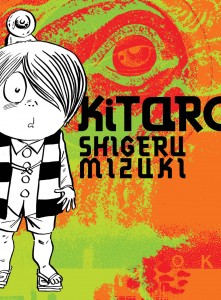
Kitaro

August 14, 2013 by Sean Gaffney

By Shigeru Mizuki. Released in Japan as “Gegege no Kitaro” by Kodansha, serialized in the magazine Weekly Shonen Magazine. Released in North America by Drawn & Quarterly.

This is another of those titles manga fans have been waiting for years to see, and now Drawn & Quarterly are finally releasing what I hope is the first of multiple volumes devoted to it. Shigeru Mizuki’s most famous and influential series, about the adventures of a young yokai and his various supernatural friends, who spends much of his time investigating creepy happenings and trying to stop them. Almost all yokai manga on the market owe a debt to Kitaro, even if, on the surface, this manga is not really all that much like Kamisama Kiss or Natsume’s Book of Friends.

kitaro

It starts off fairly slowly, with a few short one-shots involving Kitaro being mysterious, and a large amount of human involvement. There are some very nice scares, though, such as the story about the drunken salarymen who insult yokai at a bar and then get taught a lesson on the train ride home. These stories have Kitaro mostly on his own, which is fine for a while, but he’s pretty much a stoic straight man, so the series needs some spicing up after it gets going. Enter Nezumi Otoko (Rat Man), a yokai who is always out for himself above any other. His appearance adds a lunatic joy to the proceedings, as you’re never quite sure if he’s been possessed by evil, is changing sides merely to save his own skin, or is genuinely being a complete ass. Usually it’s all three.

As the collection goes on, the stories get longer and more complex. One tale has Kitaro and several of the stronger yokai (including future series regulars Konnaki Jiji, Sunakabe Baba, and Ittamomen) headed to an island that has been taken over by Western monsters such as Dracula and Frankenstein. At first I was expecting this to be a fairly lighthearted romp, but things got surprisingly dark and serious for our heroes. Even more impressive is the largest story in the book, which shows Kitaro joining an expedition to track down an immortal yokai monster, but being hindered (and later completely betrayed) by an egotistical young scientist who wants the credit and glory of single-handedly discovering it. What eventually happens is a giant kaiju battle, a la Godzilla. This gives us some of the best art of the series, and also has Nezumi Otoko bitchslapping the villain over and over again, something I will never get tired of reading.

Contrary to today’s hipper, sexier Shonen Magazine, the stories that ran in the 1960s version are totally child-friendly, and I think that still applies today. Younger kids may get freaked out a bit by some of the scarier things, particularly Kitaro and his father, who is an eyeball that lives in Kitaro’s own empty socket, and pops out grotesquely from time to time. For the most part, however, these are great, fast-paced ghost stories with action and laughs that any child can enjoy.

And it goes without saying that adult manga fans should enjoy this as well. It’s fairly episodic – there really aren’t any ongoing plot threads beyond ‘Kitaro discovers new yokai threat’ – but that’s mostly irrelevant. You’re here to see a good story well told, some really creepy yokai, and the work of a master craftsman in what has proven to be his greatest work. Highly recommended.

Filed Under: REVIEWS

Pick of the Week: Variety

August 12, 2013 by Michelle Smith, Anna N, Sean Gaffney and MJ 1 Comment

potw-8-12MICHELLE: This week, I’m awarding my pick to the second volume of Shoko Hidaka’s Blue Morning. As I wrote back in June, “Complex, dark, and a bit twisted, Blue Morning is the best BL I’ve read so far this year.” With praise like that, you can bet I’ll be back for volume two!

ANNA: There’s a ton of manga coming out this week, but I think that what looks most interesting is the latest Tezuka release, Triton of the Sea. I think it is great that we’re getting so many manga translated from this prolific author.

SEAN: This week hurts my soul, with a promising manga debut I’ve wanted to see for ages in Magi, and one of my favorite experimental series in Dorohedoro also coming out. But I have to stay true to my core principles, otherwise I’m just no good as a man. Thus I have to pick Excel Saga this week. It’s arrived at the climax of the entire story, and is actually getting around to giving us answers. Well, some answers. I absolutely cannot wait.

MJ: Well, okay, my first choice this week is probably Blue Morning, as I loved the first volume quite a lot. But since Michelle has already spotlighted it so nicely, I’ll give my vote to the sixth and final omnibus volume of CLAMP’s X. These large-trim omnibus editions have turned me around on this series to a rather stunning extent, mainly on the strength of its gorgeous, shoujo-rific artwork. Viz’s omnibus collection is a must-have for any fan of CLAMP, or frankly any fan of early 90s shoujo. It’s a mess, in many ways, but it’s a beautiful, beautiful mess.

What looks good to you this week?

Filed Under: PICK OF THE WEEK

Otakon License Roundup

August 11, 2013 by Sean Gaffney

Another week, another con, and another passel of new manga titles coming your way. I’m also throwing in Seven Seas’ new titles, as they generally don’t do con panels, but simply announce their titles on social media.

So starting with them, we have a new yuri title from Morinaga Milk, author of Girl Friends and the Kisses, Sighs and Cherry Blossom Pink anthology. The premise sounds at first like it may have a bit of a Sukeban Deka series, but it looks quite light-hearted in tone, as a newly undercover police officer at a high school (a new recruit filled with justice) finds that her school already HAS an undercover police officer there, who insists this is her turf. It looks like a great cute title for those who loved Morinaga’s other cute titles.

A few weeks earlier, they also announced another four Alice in the Country Of titles, as it’s a series that has sold quite well for them, and there are still many titles available out there. (In fact, I suspect one of the main reasons for their license of the Crimson Empire series is that half the Alice volumes have CE side-stories in the back.) We get one volume for familiar harem protagonists Eliot March (the March Hare), Julius Monrey (whose first focus manga, The Clockmaker’s Story, is out this month), and Ace (whose series will hopefully focus a little more on the psychosis that makes him interesting.) We also get a volume devoted to Nightmare, the somewhat puckish ruler of dreams who sort of fills the caterpillar role in these books. This is honestly a whole lot of Alice, but I’ve found little gems interspersed among the more obvious cash-ins, so they’re worth checking out.)

whatdidyou

As is standard lately, the big announcement of the day came from our friends at Vertical, who have licensed the Fumi Yoshinaga manga Kinou Nani Tabeta?, aka What Did You Eat Yesterday?. This seinen slice-of-life manga runs in Kodansha’s Morning magazine, and tells the story of a longtime gay couple (one dour and the straight man, one carefree and outgoing). What makes it compelling is that the story is told around the edges, as each chapter is mostly about the two men eating and cooking food, and recipe tips are interspersed throughout. Yoshinaga is mostly known over here for two things: BL and food. This 7+ volume series combines the two of them, and has been a much coveted license for quite some time. It’s also a rare seinen license from Kodansha, which makes me very happy. I can’t wait to read this one.

Lastly, Viz mentioned that they will be re-releasing the Monster manga in omnibus format next year. This Naoki Urasawa title is quite dark indeed, involving a doctor who saves the life of a young child only to find he grows up to become an insane madman. It ran in Big Comic Original, one of the few licenses from that seinen Shogakukan magazine. It was intensely popular online with manga and comics bloggers, but didn’t really catch on as much in terms of sales – perhaps this new omnibus, which will be in a larger trim and 2-volumes-in-1, can give it the audience it deserves – I think fans of Death Note who have grown to want more mature stories would really get a kick out of it, as well as Urasawa fans who discovered him via Pluto or 20th Century Boys. Hey, if it sells really well, maybe we can finally see Yawara: A Fashionable Judo Girl! Or even Happy!, one of the most depressing sports manga ever written.

What appeals to you most here? My guess is the foodie title.

Filed Under: NEWS, UNSHELVED

Book Girl and the Scribe Who Faced God, Part 1

August 9, 2013 by Sean Gaffney

By Mizuki Nomura. Released in Japan by Enterbrain. Released in North America by Yen Press.

It is not uncommon in the world of fiction – and indeed in the world of manga – for the main character to be the most difficult, the most problematic, and sometimes the least satisfying. This is particularly true when the goal of your book or series of books is to have that character achieve catharsis, to rise above mental and emotional blocks and become a better person who can move past the past that may be causing them suffering. There’s a fine line here, particularly in a series. Their faults and trauma drive the plot, but at the same time the goal is to heal them. This can lead to an unfortunate tendency to ‘forget’ past lessons learned in time for the new book to roll around, so the character always starts two steps backward from where he was before.

bookgirl7

As you can guess, I’m talking about Konoha Inoue, the first-persona narrator and hero of these books. The last events in this series chronologically, Book Girl And The Wayfarer’s Lamentation, showed Konoha finally confronting directly the girl most associated with his past trauma – Asakura Miu – and dealing with exactly what led to that point, both his actions and those of Miu. At the end, both have moved to a point where they can start to repair their psyches. So you can imagine my frustration where, at several times during this new volumes, Konoha is still consumed by the same demons that haunted him before, particularly in regards to his writing.

It’s especially frustrating because we even see Miu, who is brought in in a short scene to attempt to smack some sense into Konoha, and we can see for ourselves that the same thing has not happened to her. Miu is changing, has grown and started to mature, even though we see that it’s hard for her, and she may still be regretting a few things. We thought this is what Konoha was doing as well. He was moving in the right direction, had started to opemn up to others, and had (we thought) made peace with Tohko, his mentor/friend, moving on to college. Of course, the main problem with this is that the series didn’t end with Book 5, and there’s one more backstory we haven’t really focused on, and that’s Tohko’s.

Konoha and Tohko have what amounts to a very codependent relationship in this book, far more than what we appeared to see in the prior books in the series. There had been small hints in the past, but nothing that quite led us to expect what was going on with Tohko and Ryuto here. It thus feels overwrought and emotionally draining, and worse, it feels like those emotions haven’t really been earned yet. This is in contrast with the scenes with Miu, and also Nanase, where you can buy into the tension and dissonance that flows between their characters and Konoha. Tohko seems to have made a leap here I wasn’t prepared for.

Speaking of Nanase, she really needs to move to another series ASAP. K-On!, or Sunshine Sketch, or something cute and fluffy that is absolutely not filled with broken people who think nothing of throwing each other to the wolves. While Ryuto’s frustration with Konoha is absolutely understandable – we feel the same way, honestly – his handling of Konoha is brutal and horrible, and made me lose all sympathy for him, mostly as he’s risking Konoha having a complete mental breakdown. Given the cliffhanger shows that he’s determined to ‘break’ Nanase, I can only look forward to that part of Vol. 8 with dread. I never had any illusions that Konoha and Nanase were going to remain a couple – his affection for her has never quite seemed like genuine romantic love – but this isn’t how I want to see them break up.

Lastly, there’s the question of what Book Girl as a series thinks of writing and authors in general. Ryuto’s mother points out that Konoha shouldn’t be an author, and Konoha through this book seems to regard writing as suffering. Except, of course, that he’s been writing short stories for Tohko the entire time. He just doesn’t think of that as coming from the same place. What he fears more than writing is notoriety – someone reading his work, holding it up to others, and judging it. Tohko notably never does that – his snacks are pretty much immediately eaten by her, and never see anyone else’s eyes. But given how screwed up Kohona is at this point, and the fact that Tohko’s mask may have been in place more than any of the other masked characters in this series, can we really resolve this in just one volume?

Well, no, that’s why there’s a Part 1 up there. This came out in Japan in 2 parts, and unlike the Haruhi 2-parter coming out in November, Yen has chosen to release it separately as two volumes. This means we have to wait till January to find out how this will all end. And despite all my complaints, I still want very much to see the resolution. After all, any series that can make me go on at this length about its faults is one that’s worthy enough to read. Even if Konoha does make me grind my teeth. A lot.

Filed Under: REVIEWS

Manga the Week of 8/14

August 8, 2013 by Sean Gaffney, Anna N, Michelle Smith and MJ 3 Comments

SEAN: First of all, I’m giving up on moving Yen to when I get it. Diamond is shipping it next week to me, but that would mean 25 books this week, and only 3 to discuss next week. That’s just imbalanced. I’ll go back to using Amazon’s street date, and just revel in things on my own earlier.

triton1

We start off with another Tezuka manga, as Vol. 1 of Triton of the Sea hits stores via Digital Manga Publishing. Another late 60s/early 70s Tezuka title, this was serialized one page at a time in Kodansha’s daily newspaper Sankei Shimbun. The story involves humans and mermaids, and is not as peppy and cheerful as Unico and Atomcat were.

ANNA: This looks interesting!

SEAN: DMP are slowly returning to print, which means more BL titles as well. The Tyrant Falls in Love has hit 8 volumes, and judging by the description it’s done that by basically being a giant soap opera. Expect emotions.

MICHELLE: I’ve never read any of this series, but I’m very happy to see DMP returning to print editions.

ANNA: I’m also glad to see that DMP is returning to print.

MJ: I hated the first volume of this series and then loved the second. I’ve been warned off later volumes of the series by fans who know my tastes, but I’m still glad to see it returning to print.

SEAN: Meanwhile, Wild Honey is a one-and-done volume that involves… sigh… werewolves. Really hot werewolves, no doubt.

Kodansha has the 2nd Battle Angel Alita: Last Order omnibus. I think this volume will feature the title’s descent into the Tournament Arc from Hell, which it takes several years to emerge from. That said, the fights are quite well drawn.

And the second volume of No. 6 drops, where no doubt our hero continues to find out how this world really operates and has more not-quite-ship tease with his newfound companion.

MICHELLE: I’m going to give this series one more volume at least, but I’m feeling a little meh so far.

SEAN: SubLime has the 2nd volume of Blue Morning, for those who want butlers and masters and really well-done cover art.

MICHELLE: Yay!

MJ: I kinda can’t wait for this.

SEAN: For those who don’t want well-done cover art, there’s Embracing Love, debuting here in a 2-in-1 omnibus. See how the leads stare at you. They are serious about being gay. VERY serious.

MICHELLE: *snerk* I believe this is considered a BL classic, so I’m interested to read it.

MJ: Agreed.

SEAN: Viz has some amazing titles coming out this week, making my Pick of the Week either a chore or something I will have to cheat on. Dorohedoro hits double digits, which I am honestly delighted by. Still my favorite SigIkki title, and it looks like it may be hitting a point of no return soon in regards to Caiman.

excel26

EXCEL SAGA 26! The second to last volume! Do you realize that we are almost at a point where you will not be buying new volumes of Excel Saga? This makes me so sad! And yet, new volume! Everyone must buy it! It has Homestuck, Warehouse 13, and Welcome to Night Vale cameos in it! Really! Trust me! Would I lie to you?

MJ: Someday, Sean, I’m going to try to read this series, and it will be entirely because of your undying enthusiasm.

SEAN: InuYasha’s VIZBIG edition hits Vol. 16, containing… (calculates) 3 more volumes! Honestly, I can’t remember. I think it’s somewhere in the 40s. Takahashi fantasy at its most popular. I really must catch up one day.

MICHELLE: I still haven’t finished InuYasha. I think I have the last ten volumes hanging around here unread.

ANNA: I am frightened by the length of this series, but it is totally something I would check out of the library one day.

SEAN: Itsuwaribito 9 brings us to a village ruled by women who have no use for men. Oh dear. In a shonen manga? Please don’t have the village learn a valuable lesson about how awesome the male lead is…

magi1

I’ve been waiting for this debut for a while now. Magi is one of Shonen Sunday’s more successful current titles, and I hope the title breaks out here in North America in a big way. Retelling the Arabian Nights the shonen fantasy way, with verve and sass. And yes, starts slow. All Sunday titles start slow.

MICHELLE: I was pleasantly surprised by volume one, so if it gets even better from here, that’s definitely promising.

ANNA: Hmm, this sounds like a good shonen series for me to try out.

MJ: I’ve definitely got this in my queue!

SEAN: Neon Genesis Evangelion 3-in-1 gives us Vol. 4, containing Vols. 10-12 of the original title, and everything begins to go completely to hell here. Not that it had all that far to wander, honestly.

If you can’t get enough of the main Tiger & Bunny series, how about a doujinshi anthology? No, not like that, you pervs. This is 100% clean, though no doubt FILLED with ship tease. Vol. 1 of the anthology debuts from Viz.

MJ: I gotta say… meh. Unfortunately.

SEAN: Lastly, the X 3-in-1 hits Vol. 6. If I’m not mistaken, this is where the volumes will have to end, at least until CLAMP returns to the title to wrap it up. Which ain’t happening anytime soon. In the meantime, enjoy where it leaves off.

MICHELLE: I have no idea if it’s still available, but the anime did offer an ending of sorts. Or at least a reasonably satisfying stopping point.

ANNA: This is really one of my favorite CLAMP series despite the lack of ending.

MJ: I’m actually really looking forward to this, even though I’ve already read the not!ending. These lovely editions really have given me a new appreciation for the series.

SEAN: Besides EXCEL SAGA!, what else interests you here?

Filed Under: FEATURES, manga the week of

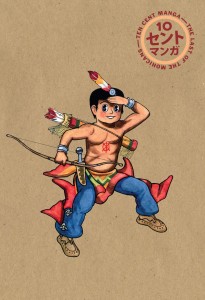
Last of the Mohicans

August 7, 2013 by Sean Gaffney

By Shigeru Suguira. Released in Japan initially by Shueisha; this updated edition was released by Shobunsha. Released in North America by PictureBox.

Wow. I had heard that this author was a bit surreal, so I went into this thinking I was prepared, but I was not remotely prepared. I’m not entirely sure that this manga can be read, per se. It’s an experience, almost like going to an interactive art show or something. Each page led to a new expression on my face: awe, bewilderment, sometimes staring blankly while saying “Really?” There is a story to tell, and it flows pretty well, but I’ll be honest, there’s nothing here regarding plot and characterization to talk about. Not that this is a bad thing. I found reading this to be very sensory, and absolutely would recommend it to other hardcore manga fans.

Mohicans

Technically, this is an adaptation of James Fenimore Cooper’s Leatherstocking Tale, and the basic framework does sort of follow the plot. This doesn’t take place in a realistic world, however. This is the world of Wild West movies, where the East Coast can have huge mesa and rocky cliffs. It’s also very much the world of 50s comic books and strips. Photorealistic serious-minded Indians stand together with some of the goofiest faces you’ve seen this side of Doraemon. And it’s in your face the whole time – there’s no way you can try to work around it. Because this is also very comedic, despite its presence. There’s lots of fourth-wall breaking, and silly gags, and dumb Indians doing dumb things. It’s fun, but loose – one feels that if you take one wrong step along the way, you’ll end up in a place no reader has gone before.

According to the very welcome essays at the end of this book by translator Ryan Holmberg, this is how Sugiura’s style worked in general, particularly in the 60s and 70s. This edition dates from 1973-74, and is an update of the original 1953 edition. Reading the essays made me realize what my mind had been struggling with the entire time I read the manga – it felt like a collage. Pastiche isn’t quite right, because it doesn’t explain the way that the work gives a sense that anything can be pasted in from anywhere as you go. And so the two military daughters who need to be rescued are straight out of a romance comic-book and the villain of the piece is drawn completely straight, yet one of the guards is Oliver Hardy, and Wimpy from Popeye is the chef. The band Negativland once called this kind of approach culture jamming, and that’s what we see here – American and Japanese influence all thrown into one glorious canvas.

This is not the sort of manga I would recommend to any casual manga reader, nor do I think it would be a good present for kids, even if it was meant for young children in Japan. The content pretty much deals with the old, slightly racist way that Hollywood and comic books dealt with Indians, though honestly it’s much better than other contemporary works could be. But for those who really love something different in their manga, or for scholars, this is a real treat. It’s just about the right length – I’m not sure I could have taken more than the 114 pages it turned out to be, mostly as reading it can be a bit exhausting. For those who like a challenge, or art lovers, or even folks who enjoy slapstick comedy, give Last of the Mohicans a try. It’s like a yaminabe – you never quite know what ingredient will come out next.

Filed Under: REVIEWS

Bookshelf Briefs 8/5/13

August 5, 2013 by Anna N, Sean Gaffney and Michelle Smith 4 Comments

This week, Anna, Sean, and Michelle look at recent releases from Viz Media and Kodansha Comics.

dawn10Dawn of the Arcana, Vol. 10 | By Rei Toma | Viz Media – This fantasy manga featuring a misfit red-headed princess struggling with her gift to see into the past and future has developed into an engrossing story with a focus on expansive worldbuilding and political machinations. The tenth volume heads into a new direction as Nakaba and Caesar are remarried to other people, while still determined to somehow build the better world they envisioned together. Nakaba has come a long way since her more tentative appearance in the first volume, so I’m looking forward to seeing what she does as she seeks her own political power with only Loki by her side. – Anna N.

devil10A Devil and Her Love Song, Vol. 10 | By Miyoshi Tomori | Viz Media – It isn’t often that a shoujo manga volume leaves me with conflicting feelings a few days after reading it, but I’ve come to expect the unexpected from this manga. While Shin has been warned off from physical intimacy with Maria due to her psychological issues, he does force the issue with traumatizing results. Maria has unsettling flashbacks as her repressed memories are triggered, and Shin continues for a bit despite her clear distress. In a way this scene almost feels like Tomori’s commentary on the way similar set-ups are romanticized in manga, but in A Devil and Her Love Song it is genuinely unsettling. I predict fallout from this volume will continue for awhile. This is one manga that is always a bit unpredictable, which is why I enjoy reading it. – Anna N

fairytail28Fairy Tail, Vol. 28 | By Hiro Mashima | Kodansha Comics – Several people may have been surprised, even a bit annoyed, at Cana ignoring her friends’ plight in order to reach the goal of the S-class battle that is clearly cancelled. Now we find out why – it’s tied in to finding her father, whose identity is someone we all know. Cana’s past is rather sad and lonely, and reminds me a bit of Wendy. Meanwhile, the villains strike back in the quest to secure victory on the island, and at one point are so strong they even take out Gildarts (who, it has been said, rarely appears as he’s such a game-breaker). Luckily, Erza wins the day by, well, her psychic connection with Jellal – sorry, folks who hate him. As for Grey, he quickly sees through Ultear’s false crocodile tears. But is that going to do him any good? Still a fun shonen battle manga. – Sean Gaffney

kaze21Kaze Hikaru, Vol. 21 | By Taeko Watanabe | Viz Media – Volume 21 focuses on the fallout from Sei’s stint as an undercover spy—as a result of Okita’s feelings for her jeopardizing the mission, Sei is transferred to another company. She’s never been one for just following orders and so demands an explanation, and when Okita claims he requested the transfer because he’s sick of her, she contemplates giving up on bushi life and becoming a nun until an actual nun helps her gain perspective. I enjoyed this volume, but I was troubled by the number of times various characters equate being a girl with impetuous thinking. Too, Sei blames the female part of herself for wanting love, but isn’t it equally the girl part of her that wants to be a bushi and avenge her father and brother? This is something that Basara got right, and which I thought Kaze Hikaru did too. I must say I’m a little disappointed, though my love for the series remains intact. – Michelle Smith

magi1Magi, Vol. 1 | By Shinobu Ohtaka | Viz Media – I knew absolutely nothing about Magi going in to this debut volume, but it turned out to be pretty fun! The first chapter introduces Aladdin, a young boy with a penchant for good food, pretty ladies, and super-deformity. He’s on the search for a metal vessel for his friend, Ugo the djinn, who currently resides in the flute Aladdin wears around his neck and who can be summoned in times of need. When Alibaba, a destitute young man looking to strike it rich by “clearing” one of the mysterious and deadly treasure-laden dungeons that have sprung up around the world, witnesses Ugo in action, he decides that Aladdin must be his servant friend and accompany him in this perilous endeavour. Magi‘s tone is light and the RPG influence strong, resulting in something that’s familiar and yet sort of refreshing. I’ll definitely be checking out volume two. – Michelle Smith

Filed Under: Bookshelf Briefs

  • « Go to Previous Page
  • Page 1
  • Interim pages omitted …
  • Page 334
  • Page 335
  • Page 336
  • Page 337
  • Page 338
  • Interim pages omitted …
  • Page 382
  • Go to Next Page »
 | Log in
Copyright © 2010 Manga Bookshelf | Powered by WordPress & the Genesis Framework