• Skip to primary navigation
  • Skip to main content
  • Skip to primary sidebar
  • Home
  • About Us
    • Privacy Policy
    • Comment Policy
    • Disclosures & Disclaimers
  • Resources
    • Links, Essays & Articles
    • Fandomology!
    • CLAMP Directory
    • BlogRoll
  • Features & Columns
    • 3 Things Thursday
    • Adventures in the Key of Shoujo
    • Bit & Blips (game reviews)
    • BL BOOKRACK
    • Bookshelf Briefs
    • Bringing the Drama
    • Comic Conversion
    • Fanservice Friday
    • Going Digital
    • It Came From the Sinosphere
    • License This!
    • Magazine no Mori
    • My Week in Manga
    • OFF THE SHELF
    • Not By Manga Alone
    • PICK OF THE WEEK
    • Subtitles & Sensibility
    • Weekly Shonen Jump Recaps
  • Manga Moveable Feast
    • MMF Full Archive
    • Yun Kouga
    • CLAMP
    • Shojo Beat
    • Osamu Tezuka
    • Sailor Moon
    • Fruits Basket
    • Takehiko Inoue
    • Wild Adapter
    • One Piece
    • After School Nightmare
    • Karakuri Odette
    • Paradise Kiss
    • The Color Trilogy
    • To Terra…
    • Sexy Voice & Robo
  • Browse by Author
    • Sean Gaffney
    • Anna Neatrour
    • Michelle Smith
    • Katherine Dacey
    • MJ
    • Brigid Alverson
    • Travis Anderson
    • Phillip Anthony
    • Derek Bown
    • Jaci Dahlvang
    • Angela Eastman
    • Erica Friedman
    • Sara K.
    • Megan Purdy
    • Emily Snodgrass
    • Nancy Thistlethwaite
    • Eva Volin
    • David Welsh
  • MB Blogs
    • A Case Suitable For Treatment
    • Experiments in Manga
    • MangaBlog
    • The Manga Critic
    • Manga Report
    • Soliloquy in Blue
    • Manga Curmudgeon (archive)

Manga Bookshelf

Discussion, Resources, Roundtables, & Reviews

Sean Gaffney

The Asterisk War: Festival Symphony

September 5, 2018 by Sean Gaffney

By Yuu Miyazaki and okiura. Released in Japan by Media Factory. Released in North America by Yen On. Translated by Haydn Trowell.

The author admits in the afterword that this was supposed to end with the start of the next school battle, but that things got out of hand. As such, we have another volume that is theoretically marking time and having fun before the next round of fights. In reality, of course, what we get here is more insight into the six other schools, with attention paid to almost all of them. We finally find out what Claudia’s wish is, and why the entire world seems to want to stop her. And Ayato gets another girl falling in love with him, and like the others, she’s intensely likeable. The drawbacks of the series remain the same – every plot twist is quite predictable, and the characters sometimes seem to be types rather than real people. But as a book that puts the “light” in light novel, it’s fun.

The majority of the book, as the title might suggest, is taken up with the Culture Festival that all six schools are giving. Ayato has agreed to take Sylvia on a date around the schools, something which the other girls in his orbit are all very well aware of. I liked the differing approaches to dealing with their jealousy – Julis hides from the entire festival and works on training, Saya does a bunch of events where she can just destroy everything, etc. Ayato, meanwhile, being terminally clueless about romance, has no idea why any of this is going on, which can sometimes be a problem, as he and Sylvia put on disguises but he keeps breaking their cover. The date itself also serves as an excuse to talk a bit more about the different schools and the types of students they attract, and we also meet some new recurring cast members, both comedic (the idol group that’s trying to top Sylvia) and serious (Jie Long’s new powerhouses, though Hufeng’s “long suffering” attitude is sometimes funny).

We’re gearing up for the next tournament, the Gryps, which depends on teamwork. As such, Claudia discusses her weapon and what the drawbacks to it are, and also shares why she wants to win: she wants to talk to a supposed criminal that’s been imprisoned. Ayato and Sylvia, meanwhile, may not be at the same school, but their desires also hinge on the book’s later plotline, with Ayato being offered a way to wake his sister up that involves a “deal with the devil” sort of bargain, and Sylvia finding out that her old teacher is not who she once was. Sylvia seems to have a large amount of “I don’t want to burden others with my own problems” to her, which I’m sure will get her in danger sooner rather than later.

The Asterisk War is never going to be among the best light novels out there, but it’s always readable and fun, and I’d argue it’s perhaps the most “typical” example of the genre.

Filed Under: asterisk war, REVIEWS

Otorimonogatari: Decoy Tale

September 4, 2018 by Sean Gaffney

By NISIOISIN and VOFAN. Released in Japan by Kodansha. Released in North America by Vertical, Inc. Translated by Ko Ransom.

This was one I was always going to be very interested in. Long-time readers of this blog will know that “Sean loves to defend hated characters” is a thing I do, especially when the characters are young women and the haters are mostly men. And while I’d argue that the most recent Monogatari anime has meant that Nadeko Sengoku isn’t hated anymore, I think there’s still a lot of ambivalence about how to react to her in the fandom. Now, having read the book that features her, I can see why that’s the case; Nisioisin is trying to lead you that way himself. There are a LOT of elements in this book designed to set the reader up to viciously turn on Nadeko. Rumor has it that the story idea came to Nisioisin after Kana Hanazawa, the voice actress who played her in the first Bakemonogatari series, said she’d like to play a Nadeko who’s turned evil. And that’s what we get here, even though I can’t help but see it as a stressed introvert at the end of her rope finally snapping.

Even Nadeko’s narrative voice is leading the reader to think “OMG, FAKE CUTE!”. She thinks of herself in third person, and speaks that way as well, which is common for children in Japan, as well as “girls who are trying to be cute”. She also has a tendency to quote and misspell certain words, which I’m not sure about – is it something to do with katakana? I’d like translation notes on that, but again, I think it’s meant to be seen as an affectation. Most notably, though, when she uses the personal pronoun ‘I’ it’s in lower case, showing off the fact that Nadeko debases herself to a large degree. That said, for all the narrative tricks, Nadeko is basically going through the ever-popular “middle school syndrome” to a large degree, and most of her personality problems that aren’t “is a terminally shy girl” are based around that. It’s telling that she gets called out big time by Tsukihi, who one can argue is the extroverted version of Nadeko, but also owns that and doesn’t try to deny it.

There are a lot of great set pieces in this book. Tsukihi’s teardown of Nadeko, which is not so much about Nadeko’s fake cuteness – Tsukihi even praises that – so much as Nadeko’s desire to not try to move forward or have a goal. (There’s some light subtext here, not helped by Nadeko wondering if she actually fell in love with Tsukihi rather than Araragi.) And then there’s Nadeko finally losing it when her asshole teacher asks if she’s managed to fix their classes’ problem, as she starts screaming, swearing, and kicking in doors in one epic tantrum that is, frankly, awesome. Unfortunately, things go south after that. For all that the “villain” of this piece points out that he’s imaginary and this is all Nadeko’s delusion, we can finally start to see a sort of arc villain: Ogi Oshino seems to actively be pushing against Araragi, and it’s concerning, especially as this book ends unresolved – Nadeko is now a Missing Person, and the god that took her place is holed up at the shrine fantasizing about blockbuster action-filled finales that, I hate to break it to her, are not going to take place.

Next time, after Hanamonogatari leapt forward nine months, and Otorimonogatari about 2-3, we finally go back to August to resolve a few plot points there. In the meantime, enjoy Nadeko Medusa, but try not to think of evil scorned Nadeko as her “real” personality any more than cutesy Nadeko was. If we see a “real” Nadeko in this story, I think it comes from a repeated line of dialogue: “It’s just… tiring.”

Filed Under: monogatari series, REVIEWS

Pick of the Week: Beat Surrender

September 3, 2018 by Sean Gaffney, Michelle Smith, Katherine Dacey, MJ, Anna N and Ash Brown Leave a Comment

MICHELLE: For me, Skip Beat! will always win any week in which it appears. I do love it so.

SEAN: I have to agree, Skip Beat! is what has me most excited for this week.

KATE: This is a Shonen Jump week for me: I’ll be picking up volume two of Demon Slayer — the monster manga with heart! — and volume one of Dr. STONE, which has been garnering good reviews around the web.

MJ: I was a big fan of the too-short trilogy, QQ Sweeper, which hit a lot of my supernatural investigator-type buttons. I haven’t kept up with its sequel (reboot?), Queen’s Quality, but I think that is my mission this week!

ANNA: Any week that features a new volume of Skip Beat is a week to celebrate!

ASH: So many great releases this week! Skip Beat is always welcome, but I have some catch up reading I need to do before I can get to it, so my pick this week goes to Demon Slayer, which is still so early on in the series that I haven’t had a chance to fall behind yet. Although I am curious about Dr. STONE, too…

Filed Under: PICK OF THE WEEK

Silver Spoon, Vol. 4

September 3, 2018 by Sean Gaffney

By Hiromu Arakawa. Released in Japan as “Gin no Saji” by Shogakukan, serialization ongoing in the magazine Weekly Shonen Sunday. Released in North America by Yen Press. Translated by Amanda Haley.

Through the beginning of Silver Spoon, we’ve seen Hachiken interact with the other agricultural college students, and gradually learn wheat they do and how tough a job it is. He has a reputation, as is stated in this book, for being “stupidly honest”, but doesn’t quite have the life skills that are needed yet to wear that well – he just comes across as stressed most of the time. Still, he is slowly making an impact, and we see that the graduating third years know that he can use those skills if given the chance when they choose him to be vice-president. What’s more, his own ideas are starting to influence the others – we get the resolution of the “pig meat” arc here, and it shows off the way that he forces others to think of new ways to try things and new options to explore, as well as proving Hachiken is never going to become stoic about the slaughter of animals.

Of course, while Hachiken is the main character, there are others to think of. And not everyone wears their heart on their sleeve the way he does. We already know that Mikage is coping with needed to take over her family’s farm even when she’d rather be working with horses, and now it looks as if Komaba is having issues as well. Since they’re both farm kids who grew up together, it’s natural they’d confide in each other. Since they’re both very good at pretending everything is fine in front of other people, it’s natural they’re both unwilling to confide in Hachiken. Still, they both need social skills development, as the blunt “it’s nothing to do with you” they give him over and over pretty much eats into his heart. Unlike Hachiken, who is still a bit lovestruck, I don’t think that this means Mikage and Komaba are dating, I think it just means they’re not good at showing weakness. Which is why, in the end, Mikage ISN’T picked to vice-president of the club.

There are a lot of things going on in this series, and it seems planned out in advance quite well. The chapters do a good job alternating between character drama that advances the plot, learning about farming and agriculture, and goofy fun comedy. The goofy comedy this time around involves all the guys escaping so they can go to “Area 51” to see the amazing spectacle that only comes there at night. Yes, that’s right, it’s… not UFOs. It is, of course, something that would excite everyone except Hachiken (and Tamako, for an extra added punchline). At this point, Silver Spoon seems like a series brimming with its author’s self-confidence. Next time around it looks as if we’re getting the Ag School equivalent of a Culture Festival. Let’s hope Hachiken remembers to have fun. (Who am I kidding, he’ll be a wreck.) Every volume of this is a joy.

Filed Under: REVIEWS, silver spoon

Konosuba: God’s Blessing on This Wonderful World!: Princess of the Six Flowers

September 2, 2018 by Sean Gaffney

By Natsume Akatsuki and Kurone Mishima. Released in Japan as “Kono Subarashii Sekai ni Shukufuku o!: Chūnibyō demo Majo ga Shitai!” by Kadokawa Sneaker Bunko. Released in North America by Yen On. Translated by Kevin Steinbach.

The subtitle of this volume should be very familiar to Yen On fans, as it’s a take on the light novel series Rokka: Braves of the Six Flowers. Whereas in the Rokka series you spend each novel wondering who’s going to be accused of being a traitor, in KonoSuba you spend each novel wondering who’s going to be the designated straight man. Here it’s Darkness, who is forced to act the noble lady far more than she’d like, given that most of the book takes place in a royal castle or in the homes of noble lords. That said, Megumin is mostly under control here as well, with a few notable exceptions. Heck, even AQUA, of all people, shows off her skills during a big battle and is revered by the city for keeping casualties to a minimum. Yes, the entire cast are fantastic… with the exception of Kazuma, who as usual needs to descend to his lowest point before he can rise again.

The cover girl is Iris, the young princess of the realm, who Kazuma desperately wants to see as a little sister so he can add to his list of fetishes (no, really, that’s basically what he says, though at least he has no romantic interest in the 12-year-old princess). She is, for the most part, content to go along with this, as her real big brother is away fighting the demon lord and Kazuma treats her like a normal little girl rather than a royal princess. Unfortunately for Kazuma, he rapidly runs out of cool stories to tell her, and the stories he does tell, as we’ve seen, involve him being clever but the others doing the heavy lifting. And then there really IS a demon lord attack, and Kazuma proves why whenever he’s headstrong and impetuous, he is the absolute worst. Given the rest of the squad saved the day, he’s basically ripped a new one by the princess’ bodyguard in a vicious yet 100% accurate takedown.

She has a point. Aqua, Megumin and Darkness, in a group of four, are all eccentric, impossible to handle weirdos. The same group, however, in a pack of 200 adventurers, are able to function far better. But of course, for better or worse, Kazuma *is* part of their group, and they wouldn’t have it any other way. And he does get to show off his actual talent, finally, in the last quarter of the book, where he helps Chris the thief (remember her?) try to steal a dangerous artifact that has made its way to the princess. When he’s in trouble and actually thinks, Kazuma is very impressive. He’s the opposite of a hero like Luffy. There’s also the standard KonoSuba humor here, which most of the audience is expecting, but it’s a sign of good writing that I’m ignoring it in favor of discussing Kazuma’s character and how he can be incredibly frustrating at times.

A cliffhanger makes me think that the next volume will be Darkness-oriented, and I hope she gets to be silly again. Till then, KonoSuba fans will like this even as they yell at Kazuma for being… well, Kazuma.

Filed Under: konosuba, REVIEWS

I’ve Been Killing Slimes for 300 Years and Maxed Out My Level, Vol. 2

August 31, 2018 by Sean Gaffney

By Kisetsu Morita and Benio. Released in Japan as “Slime Taoshite 300 Nen, Shiranai Uchi ni Level MAX ni Nattemashita” by Softbank Creative. Released in North America by Yen On. Translated by Taylor Engel

The afterword for this second volume has the author telling us that GA Bunko’s editors told them that the first volume was the biggest seller in the history of the publishing label. Which, given this is the same publisher as Is It Wrong to try To Pick Up Girls in a Dungeon?, is quite impressive. But I can see it. Unlike DanMachi, the average reader does not have to deal with any of those pesky male heroes, and the girls are all cute/sexy/maternal (delete where applicable). [EDIT: It turns out that DanMachi is on a different imprint at the same company, so the two may not be comparable after all.] The series is still trying, for the most part, to keep a “my pace” sort of drama, with plotlines taking the form of things like “we’re opening a maid cafe” and “we have to design a dress for a ghost”. And, of course, the heroine is still an amazingly powerful person but absolutely does not seek to show it off or take advantage of it unless absolutely necessary. Which it is one or two times here. This is such a peaceful series.

The cast remains the same as the first book, with one or two additions. Halkara, the busty elf who was the weakest part of the first book, is better here – there’s still a lot of focus on her bust, but doubling down on the clumsiness and bad luck makes her a more entertaining comedic figure. It can also lead to drama, as with the longest story of the volume, where Azusa and company go to the Demon Lord territory to accept an award (for achieving peace in Vol. 1 by stopping the dragon war) and Halkara accidentally headbutts the demon lord to the brink of death, something punishable by execution. Fortunately, Azusa is clever, and even more fortunately, Azusa is a Level 99 powerhouse, showing off her amazing fighting skills and taking out all the demons trying to arrest them. It all ends up good anyway, as the demon lord (who is also female, to go with the rest of the main cast) proves to be more of a troll – in the internet sense – than actually evil.

New cast members include the ghost I mentioned before, who (like everyone that falls into Azusa’s orbit) proves to be friendly and eager to please, and can even help with the cooking. And there’s also Flatorte, the blue dragon who was the antagonist of the first book. She’s now back and tricked by the demon lord into being Azusa’s slave, though Azusa nips that in the bud immediately, to her credit. If nothing else, she will offer a different kind of personality – the main flaw of the book is arguably that everyone is far too nice and sweet. Now, that is the POINT of the book, which is why I said ‘arguably’, but it can all feel very pat. There’s one story where Halkura gets herself in trouble (again) and our heroes have to take out a corrupt governor. They do this in the space of about 5 pages, in what must be the fastest takedown of this sort of character ever. It’s almost embarrassing.

If you like exciting adventures, run, don’t walk away from this series. If, on the other hand, you want the light novel equivalent of a nice hot cup of tea, this is a great buy.

Filed Under: i've been killing slimes for 300 years, REVIEWS

Manga the Week of 9/5/18

August 30, 2018 by Sean Gaffney, Michelle Smith, Anna N, Ash Brown and MJ Leave a Comment

SEAN: Back to School! You’ve bought all your school supplies, but save money for manga too!

Ghost Ship starts us off with a 4th volume of Yokai Girls.

J-Novel Club has one debut this week. Gear Drive stars a young woman in a world where magic is commonplace. However, she doesn’t have a specialty… yet. Could her specialty be gears? Bet it’s gears.

There’s also a 3rd volume of The Master of Ragnarok and Blesser of Einherjar (watch the anime!) and a 5th volume of Outbreak Company (anime aired some time ago).

Kodansha has a whole pile of digital stuff, including Peach Girl Next, the sequel to the just re-released Peach Girl. It’s about… what happens next.

MICHELLE: Heh.

ANNA: I barely remember Peach Girl, and don’t think I am going to reread the digital version, but I am sort of curious about what happens next!

SEAN: There’s also Beware the Kamiki Brothers! 5, Can You Just Die My Darling? 4, Cosplay Animal 7, I’m Standing on a Million Lives 2, My Boy in Blue 2, The Prince’s Romance Gambit 2, and Those Summer Days 4. Getting so far behind.

MICHELLE: Desperately far behind.

SEAN: In print, there’s only one: Persona Q: Shadow of the Labyrinth Side: P4 Volume 3. If you can translate the code of all those letters and numbers, you can get the manga’s secret message.

ASH: It’s a fun addition to the Persona franchise.

SEAN: Seven Seas has a digital debut with the 6th Boogiepop novel, Boogiepop at Dawn.

ASH: Released in print a decade ago, and to be released in print again in an omnibus in the near future, I rather liked the volume.

SEAN: Vertical gives is an 8th Mobile Suit Gundam Wing.

And there’s Viz! A lot of Viz, as always. The debut is Shonen Jump this time, with Dr. STONE, a manga that’s been a big hit in Japan. It’s got the writer from Eyeshield 21 and the artist from Sun-Ken Rock, and it’s a post-apocalypse adventure.

MICHELLE: Oh, interesting! I’ve been meaning to finish reading Eyeshield 21.

ANNA: That does sound interesting!

ASH: The creative team involved certainly caught my attention if nothing else. I generally enjoy a good post-apocalypse adventure, too, though.

MJ: I’m interested!

SEAN: Also Jump or Jump-esque: Astra: Lost in Space 4, Boruto 4, Demon Slayer 2, Haikyu!! 27, Kaguya-sama: Love Is War 4, One Piece’s 25th 3-in-1, Seraph of the End 15, and Twin Star Exorcists 13.

MICHELLE: Haikyu!!

ANNA: My kids are so devoted to this series they wanted to get their own volleyball to start practicing in real life.

ASH: Haikyu!! and Demon Slayer are both high on my list.

SEAN: On the shoujo end, no new debuts, but we get Anonymous Noise 10, Queen’s Quality 5, Skip Beat! 41, and The Young Master’s Revenge 3. Skip Beat! Is always wonderful whenever it comes out.

MICHELLE: Skip Beat! I’ve really been dying to see how Kyoko’s latest audition turns out. I need to get caught up on Queen’s Quality, too.

ANNA: No surprise, I’m excited about all these series!

ASH: I quite enjoy a fair number of them myself.

MJ: I’m also planning to get caught up on Queen’s Quality!

SEAN: What manga are you secretly reading under your desk during class?

Filed Under: FEATURES, manga the week of

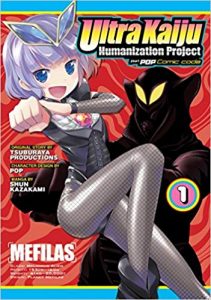
Ultra Kaiju Humanization Project, feat. POP Comic Code, Vol. 1

August 30, 2018 by Sean Gaffney

By Tsuburaya Productions, POP, and Shun Kazakami. Released in Japan as “Ultra Kaijuu Gijinka Keikaku – Feat. Pop Comic Code” by Akita Shoten, serialization ongoing in the magazine Young Champion. Released in North America by Seven Seas. Translated by Thomas Zimmerman. Adapted by Janet Houck.

Yes, I know. I don’t know why I do this to myself either. I’m sure many people who are used to me saying that I haven’t seen the anime/game this is based on will be completely unsurprised to know that when it comes to Ultraman in particular and tokusatsu in particular, my experience with it is zero. So naturally, I am the perfect audience for a series that reimagines the classic villainous monsters from the series as high school girls in a fairly standard light comedy high school series. It’s not even the first time this premise has been done! One of the Dengeki magazines also has a series where the kaiju are humanized. So, with all that in mind, I can’t tell you whether a hardcore fan of the Ultraman series will get a great deal out of this. I can tell you that as a fan of all-girl high school light comedies, it was okay.

The other gimmick here is that the planning and character design are by POP, the creator of the insanely popular Moetan franchise which helps teach English to Japanese folks. This probably explains why their name is added to the title in the style of a rap single. The premise is that when the various kaiju are destroyed on Earth by the good guys, they die and wake up as a cute high school girl in your average everyday school. Here most of the girls concentrate on drinking tea, having fun, eating manju, etc. The newest arrival, Mefilas, is seemingly made of sterner stuff, and occasionally tries to get the others to be interested in obtaining the Earth’s heart, etc. For the most part, though, there’s antics involving a kaiju who’s afraid of water (she was drowned in the Ultraman battle), a kaiju with tea rooms seemingly everywhere, and Mefilas’ growing yuri crush on her friend Eleking, which is pretty much completely one-sided.

The manga does a decent job of trying to bring in individual quirks that match up with the original kaiju episode, and the character profiles helpfully give us a picture of what they looked like before. There’s also a vague semblance of a plot, as Melifas and her fellow fired-up partner Alien Temperor investigate a new, mysterious kaiju girl who seems to be a villain, though it’s not quite clear why yet. As for the comedy, well, it’s silly stuff. If you’ve read any of the many series that run in Manga Time Kirara _____, then you’ve seen what’s going on here. We get trying to start a club, eating too many sweets and needing a dentist, etc. So if you’re a tokusatsu fan, I’d only pick this one up if you like cute girls being cute. If, on the other hand, you’re a fan of cute girls being cute but have no idea what tokusatsu is, you’d probably still find this entertaining.

Filed Under: REVIEWS, ultra kaiju humanization project

Sword Art Online, Vol. 14: Alicization Uniting

August 29, 2018 by Sean Gaffney

By Reki Kawahara and abec. Released in Japan by ASCII Mediaworks. Released in North America by Yen On. Translated by Stephen Paul.

(Of necessity, this review is going to have to spoil events in this book. If you want to be surprised, read the book first.)

It has to be said, given the length and breadth of the Alicization series, and the complete absence of most of the rest of the original cast, that Kirito and Eugeo’s relationship feels like the strongest and most valid in the series. Yes, this includes Asuna, who is almost entirely absent from this book save for the cliffhanger ending. But Kirito and Eugeo are meant to be two sides of the same coin, each yearning for what the other has, with Kirito’s cynicism being set off by Eugeo’s innocent idealism. Even the fate of Alice Synthesis Thirty, who nearly sacrifices herself a couple of times for Kirito in this book, has her own Eugeo counterpart in Alice Zuberg’s state of being and eventual fate. Kirito and Eugeo is the main reason to watch the upcoming anime to see what they do with it. And it’s also what makes this volume the most heartbreaking of the books to date.

For all that Kawahara wrote a story about a death game where people die in real life, he’s been pretty good about not actually killing most of the main cast. When there is a death, it tends to have major impact on the characters going forward – see Sachi and Yuuki, for example. This volume, though, is absolutely filled with horrible deaths, both seen and unseen. The actual plot is pretty simple – it’s the end of the fight to the top of the tower. Eugeo throws off his mind control fairly quickly all things considered, but that’s not really helping any of them defeat Administrator, who is simply too damn overpowered. And so one by one characters come out of the woodwork to buy time so that the hero can figure out what to do. And no, that hero’s not Kirito this time, who spe4nds much of the book dealing with the fact that he’s getting his ass handed to him. It’s up to Eugeo to make the ultimate sacrifice, destroying Administrator for the sake of the world, even if it costs him his life.

Actually, while Administrator is the weak part of the book, being the usual ‘I have no nuance I am just eeeeeeevil’ Kawahara villain, she is impressively tough, in that she even survives Eugeo’s final attack, only to get taken out by her minion’s overpowering creepy love for her. Still, she is a piece of work. The ceiling of her tower will go up there with the depiction of the Senate in the previous book as one of the most disturbing things in SAO. As for the state of the world now that Administrator is gone, we’ll have to see. It may have to deal with life without Kirito for a bit, as things have apparently been going on in the real world in his absence, and his “fluclight” is seemingly damaged right at the very end. Will this mean an entire volume with no Kirito narration?

Kawahara says in the afterword he debated letting Eugeo survive in the LN version, but decided not to. Much as I love Eugeo, I think it was probably the right choice. In the meantime, this is a very strong volume of SAO, and I can’t wait to see where we go from here – we still have four books to go after this, let’s remember.

Filed Under: REVIEWS, sword art online

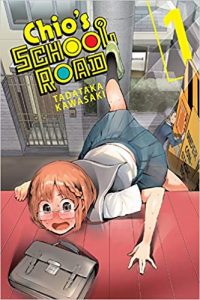
Chio’s School Road, Vol. 1

August 28, 2018 by Sean Gaffney

By Tadataka Kawasaki. Released in Japan as “Chio-chan no Tsuugakuro” by Media Factory, serialization ongoing in the magazine Comic Flapper. Released in North America by Yen Press. Translated by Alexander Keller-Nelson.

Sometimes you can think yourself to death. We’ve all had that happen to us. You worry about how you’re going to achi9eve something, or how you’re going to talk to that person, or even how you’re going to get to school on time in the morning, your brain goes into overdrive, and you come up with some silly options that no one would actually do unless they were in some sort of comedy manga. Fortunately, Chio is in a manga, and so is able to do the silly things for our entertainment. A typical glasses-wearing, semi-introverted gaming girl, her late night habits lead her to be late almost every day, and things are not helped by random construction, or running into the popular girl and having to interact with her, or even just trying to find a bathroom. That’s the plot, really – we don’t really see Chio much at school, though she does have an equally socially inept friend. It’s just “what happens to Chio next?”.

I get the sense that the author came up with the idea for the first chapter and the publisher wondered what it would be like as a series, because “what if someone really did try to go roof hopping” really is a great one-shot premise, and it even gets highlighted in the cover art. It’s not as easy as it sounds, to no one’s surprise, especially when you’re trying to ensure no one notices you. The rest of the book is not quite as high concept – the chapters with Chio having to deal with interacting with other students, or talking with her equally unpopular friend about boys, are not quite as good as the rest of the book, and the reader gets the sense that this probably works better as a monthly serial in a magazine than it does collected into book form. (I’m also not sure the kissing in the back alley scene works well, as I suspect it will lead yuri readers to expect more tease that likely is not going to happen.)

The best chapters highlight the desperation of Chio’s needs and her motormouth inner monologue, where things just escalate to ridiculous levels. Getting past the gang member with his motorcycle in the path leads, inevitably, to Chio having to pretend to be a feared, deadly schoolgirl assassin, with appropriate glaring, and it’s quite well done, especially the anticlimactic payoff. Likewise, something as simple as Chio trying to find a bathroom spirals out of control and also highlights one of Chio’s other flaws, which is her selective obliviousness when it comes to digging herself into holes. I think whether you enjoy this book depends on how much you can tolerate Chio – she can be somewhat exhausting, and you get the feeling she’s her own worst enemy most of the time. Still, that’s the fun. As long as you don’t sympathize with her too much, Chio’s School Road should be a very entertaining series.

Filed Under: chio's school road, REVIEWS

Bookshelf Briefs 8/27/18

August 27, 2018 by Ash Brown, Sean Gaffney and Michelle Smith 1 Comment

Bloom Into You, Vol. 5 | By Nakatani Nio | Seven Seas – Yuu works with Kanou to get the ending of the student council play rewritten so that the character Touko’s playing won’t disregard the her of the present to pretend to be the her of the past. When Touko sees the new script, especially the requirement that she now say a line about how her choices have been wrong, she’s rather put out and expects Sayaka to support her, but instead, Sayaka is with Yuu on this one. Finally, though, Yuu seems to be getting through to her with an impassioned speech about, “You’ve been you all this time!” I do think Touko probably needs to be in therapy, but it seems like her love for Yuu, something her sister never had, might be showing her the path to her real self, and that’s kind of neat. I’ll keep reading! – Michelle Smith

Giant Killing, Vol. 13 | By Masaya Tsunamoto and Tsujitomo | Kodansha Comics (digital only) – There are twenty minutes left in ETU’s game against Tokyo Victory and their early one-point lead is in jeopardy as Victory’s previously injured ace, Mochida, takes the field. It’s probably too early in the series for ETU to achieve an outright victory over the league champions, but they at least hold them to a draw, with Tsubaki playing with a lot more confidence than in their prior matchup. It’s awesome to see how much he’s grown. Next, over midseason break, some of the players have been drafted for an exhibition game between the league’s Japanese all-stars and its foreign players, with ETU management hoping an MVP recognition might appease their sponsors, particularly the son of a wealty donor who is not as enamored of the club as his father is. Basically: this is grown-up sports manga and it’s great. – Michelle Smith

Hakumei & Mikochi: Tiny Little Life in the Woods, Vol. 1 | By Takuto Kashiki | Yen Press – It’s the manga’s subtitle that reveals the conceit that separates Hakumei & Mikochi from any number of other slice-of-life series currently being released. The two titular characters, like everyone else in the manga, are tiny. Like, using-beetles-as-a-mode-of-transportation small. Overall the tone of the manga is calming and optimistic although it’s not without its moments of danger and drama as the story follows Hakumei and Mikochi through their day-to-day lives. Mikochi is the more quiet and reserved of the two while Hakumei is more energetic and outgoing. The two young women live with, support, and look out for each other. The artwork of the series is detailed, with particular attention given to creating a well-realized setting and portraying the beauty of nature. At this point there’s no evidence whatsoever of humans encroaching upon the surprisingly gentle world of Hakumei & Mikochi, and I suspect that will be the case for the entire series. – Ash Brown

Lovesick Ellie, Vol. 6 | By Fujimomo | Kodansha Comics (digital only) – The drama in this volume mostly hinges on communication fails and I’m sorry to say that it’s getting old. Some of it is pretty good, like when Sara’s feelings get hurt when she realizes that Ellie never told her when she and Akira officially started going out. But it’s frustrating when Ellie irrationally decides that Akira does not actually care about receiving the Valentine’s Day chocolates she made for him. It’s just so stupid because it’s obvious that it means a lot to him! The cuteness of the resulting smoochy times just can’t make up for such a dumb moment. To top it all off, the friendless boy with whom Ellie sympathizes, despite Akira’s jealousy, is now poised to be a rival for her affections. Whee, a love triangle. My favorite. I hope I can continue to enjoy this series going forward, but I’m not so sure. – Michelle Smith

Scum’s Wish, Vol. 8 | By Mengo Yokoyari | Yen Press – The final volume of Scum’s Wish ends as it began, with the horrible pangs of unrequited teenage love. Neither Hanabi nor Mugi gets what they want, and while it would be really easy for them to take comfort in each other, they can’t bring themselves to do it. They just don’t have those feelings. It’s well-portrayed. Slightly less so is Akane, who seems to end up with Narumi because of his acceptance and love of who she is, including the awful bits—it’s fine if she cheats on him, he says with a smile. This leads her to the revelation that she really does want to marry him, but it feels, like most of Scum’s Wish, a bit more sordid than I’d like. There’s a sequel, but I suspect this may be it for the title over here. It was good, but painful. – Sean Gaffney

Stupid Love Comedy | By Syusyusyu Sakurai | Yen Press – For a manga with “love comedy” in the title, Stupid Love Comedy has surprisingly little romance in it. Suzu Sakura is a manga creator described as a natural genius but who requires quite a bit of oversight from her editors in order to keep her on schedule. Stupid Love Comedy opens with her being assigned a new editor, Osamu Hasegawa, who is less inclined to put up with her antics and excuses. Feelings of love aren’t completely absent from the story, and in some ways the series is set up like a reverse harem (every guy Sakura works with is incredibly attractive), but for the most part the true love of the various characters is the creation of manga. The stories and characters of Stupid Love Comedy are based on real-life people and experiences, the series providing a humorous, entertaining, and at times outrageous behind-the-scenes look at the manga industry. – Ash Brown

Tales of Wedding Rings, Vol. 3 | By Maybe | Yen Press – Last time I said the series was avoiding the obvious harem fantasy tropes, and while I enjoyed this volume as well, I can’t say that here. From catgirls to “my future husband must defeat me in combat,” it’s all present and correct. What’s more, Wife #1 Hime is starting to feel a bit jealous, and also somewhat inadequate compared to the powerhouses Satou is picking up. Still, she’s first among equals, and I think that fans of harem romances will… well, OK, fans of harem romances will be upset there was no nookie here either—Souma explicitly wants to wait till he’s back home in Japan. Next time we’ll get a new princess, no doubt, but I think the series works best when it’s focused on Satou and Hime. – Sean Gaffney

Toppu GP, Vol. 3 | By Kosuke Fujishima | Kodansha Comics – Everyone loves Myne, the Belldandy of this series, though she doesn’t really seem to have her eye on anyone. Which is good, as the romance would get in the way of the bike-racing and bike-training. The majority of this is basically watching awesome motocross racing and giving advice to newbies on how to get better, which includes things like “don’t ride when you are frustrated or you’ll injure yourself.” Toppu is a lot more young and teenage than the Keiichi ever was—actually, to be honest, he resembles the Keiichi at the start of Oh My Goddess!, before he became sexless by design. This comes out once in a blue moon, but it’s still a good title for Fujishima or biking fans. – Sean Gaffney

Yowamushi Pedal, Vol. 9 | By Wataru Watanabe | Yen Press – Day Two is over, and it will come as no surprise to anyone to learn that Midousuji’s way of biking is not going to come out on top. He gets a tragic backstory that makes things more understandable, but at the end of the day I still sort of hate him. Fortunately, this volume is far more balanced between the three teams, giving everyone a chance to show off, be really shonen, and demonstrate to the reader how cool, powerful, and exhausting this all is. The book reads as fast as the race, as you find yourself pulled along by the lineart. So with two days down and one to go, I expect some downtime in the next book. However, I still can’t wait to read it. Addicting. – Sean Gaffney

Filed Under: Bookshelf Briefs

Pick of the Week: Again!! Again (Again?)

August 27, 2018 by Sean Gaffney, Katherine Dacey, Michelle Smith, Anna N, Ash Brown and MJ Leave a Comment

SEAN: I know my pick this week should be Cutey Honey: The Classic Collection, despite the fact that I know it will depress me in the end. I’m also interested, as always, in Nisioisin’s works, so Otorimonogatari is also a possible choice, despite ALSO ending on a down note. But I will be good. Please support Cutey Honey so we can get more series like it (by which I mean Shameless School).

KATE: I’m going to be super-predictable and shill for Again!! again. It’s easily one of the best new series of 2018, with humor, heart, and a wicked edge that prevents the story from feeling too pat. I’ll also be picking up Cutie Honey, as I want to support Seven Seas’ efforts to bring more classic manga to the US.

MICHELLE: I’m definitely keen to read more Again!! but The Night Beyond the Tricornered Window comes out so infrequently, to so little fanfare, and is so stellar that I just have to laud it when given the chance.

ANNA: Out of everything coming out this week, no question I’m most excited about Again!!

ASH: And once again… Again!! (And also Cutie Honey)

MJ: I’m going to back up Michelle this week, and encourage everyone to catch up on The Night Beyond the Tricornered Window! It’s so easy for me to forget digital titles when new volumes are released, and this one is worth remembering.

Filed Under: PICK OF THE WEEK

Defeating the Demon Lord’s a Cinch (If You’ve Got a Ringer), Vol. 1

August 27, 2018 by Sean Gaffney

By Tsukikage and bob. Released in Japan as “Darenidemo Dekiru Kage kara Tasukeru Maou Toubatsu” by Famitsu Bunko. Released in North America by Yen On. Translated by Alex Kerwin.

I write a column for Manga Bookshelf called Manga the Week of, where I point out the manga and light novels coming out next week, and briefly try to hype the debuts. Sometimes, though, this can lead to me being embarrassingly wrong about a title, because the cover art and blurb were vague, or even actively misleading. It’s especially true when there really isn’t much known about the new series. So, let me say up front: I was expecting Demon Lord Ringer (as I will call it for brevity’s sake) To be far more comedic in tone, something like Konosuba only with more of a straight man as the lead. Now, to be fair, Ares is definitely a straight man. But the book is not going for funny, instead being a crash course in how much we can take of its intensely serious, brimming with suppressed rage narrator until we beg for the demon lord to win after all. Make no mistake about it: the Ringer is a bit of a jerk.

As you can see by the cover image, as well as the blurb, this is not merely a case of me being too thick (which has also happened before): the premise is actively trying to mislead you. It is accurate, as far as it goes. A hero has been summoned to defeat the demon lord, but the hero’s level is far too low, and as for companions, we have a third princess as a mage who can only use fire magic (the entire book takes place in a forest, so she can’t do anything), a swordswoman who has recently changed her sword style away from her family specialty (so is learning a whole different skill set on the fly), and Ares, who is a priest who clearly is far more powerful than the Level 3 he suggests he is. (Yes, the usual fantasy RPG tropes apply here, as the characters discuss buffs and leveling as if they are real life fantasy terms.) The hero’s party, however, wants to get rid of Ares. And you can’t blame then, really.

There’s a reveal at the end of the book I was very impressed by, one that makes the entire party’s behavior around Ares make a lot more sense. It’s such a good reveal I won’t get into it. It actually made me want to read the second book, which I was on the edge about, to be honest. The book’s prose is good, and Ares is certainly a memorable character. But god, you want to throttle him. He’s given an assistant, Amelia, who seems to have some lingering affection for him (he doesn’t recall their ever meeting in person, which irritates her), and she keeps desperately trying to get him to slow down and not do absolutely everything on his own. And she fails. I was honestly wondering if the big reveal was going to be that he’s the villain after all, but it would seem that’s not the case. But so far, my interest in what happens next has won out over “my god, do I really need to listen to this guy’s simmering fury for another three+ volumes?”.

Filed Under: defeating the demon lord's a cinch, REVIEWS

A Certain Magical Index, Vol. 16

August 25, 2018 by Sean Gaffney

By Kazumi Kamachi and Kiyotaka Haimura. Released in Japan as “To Aru Majutsu no Index” by ASCII Mediaworks. Released in North America by Yen On. Translated by Andrew Prowse.

Given the events of the last volume, and the fact that the cover art looks for all the world like a fun romantic comedy, I imagine the average reader went into this book thinking it would be a nice, relaxing volume. And it is… for about the first quarter of the book. Then Acqua of the Back arrives, and everything pretty much goes to hell. But hey, at least this book has Touma and Index in it, right? Well, not so much. Index is once again relegated to comic relief (she even lampshades how useful she WOULD have been after everything has already happened), and Touma is removed from most of the fighting by, yet again, half-fatal injuries. No, this book is about the Amakusa Church, their guilt-driven Saint Kaori Kanzaki, and their #1 Touma fan Itsuwa, who can cook, clean, is pretty with a nice chest, wields a spear magnificently, and loves Touma. In fact, in a series filled with heroines with major faults, her main fault may be not having one.

Introduced in this book: Fiamma of the Right, the “Knight Leader”, and the Third English Princess, whose name I will hold off on till I see how Yen romanizes it. This takes place about three days after Touma and Index get back from France. Touma is starting to worry about his attendance credits, and well he should – he’s barely been in class this semester. We have basically passed all the Index spinoff titles in terms of chronology. There are, of course, several ongoing plot threads from previous books. Itsuwa is dispatched to be Touma’s bodyguard after the events of tBook 14 (and so that the Amakusa Church can try to get them together as a couple, something doomed to failure). Acqua’s threat to Touma a couple books ago is carried out here, and he very nearly succeeds. And Mikoto has found out about Touma’s amnesia, and it’s bothering her, mostly as she’s not sure when it happened.

This book, as with a lot of shonen titles, is about seeing people who are so much better, faster, and stronger than you, and then getting up and fighting anyway because it’s right. Acqua doesn’t care what Touma’s motivations or desires are – his hand is a weapon, and therefore he treats Touma the same way. (Honestly, given the last two members of God’s Right Seat, he’s the least villainous, but that’s only by degree.) Itsuwa and the rest of the Amakusa fight because they know Touma is a good person, right hand or no. And Kaori leaps in to fight because Acqua is about to kill the rest of the Amakusa, and she may be keeping her distance from them but she still wants to protect them. In fact, arguably it’s Kaori who learns the biggest lesson here – no, not Tsuchimikado’s stupid ero maid thing, which made my teeth grind. But you can’t protect the ones you love from the shadows and by pushing them away. It only hurts them more. Seeing Kaori and the Amakusa team up was absolutely the highlight of this book, and I like that for once Touma did not get in the final blow (or even break any illusions), though he certainly made it possible.

It appears we’re going to be focusing on England next time (and watch out for Fiamma describing how to bring the island nation down to its knees in a way that sounds suspiciously similar to a no-deal Brexit). Also, I worry my discussion of the lack of a role for Index and her desire to help more may change for the worse soon – it sounds like Fiamma’s big plan is basically to capture her. In any case, though Kamachi remains as bad as ever at wacky harem antics, this is still an excellent volume of Index.

Filed Under: a certain magical index, REVIEWS

That Blue Sky Feeling, Vol. 1

August 24, 2018 by Sean Gaffney

By Okura and Coma Hashii. Released in Japan as “Sorairo Flutter” by Square Enix, serialization ongoing in the magazine Gangan Joker. Released in North America by Viz Media. Translated by Jocelyne Allen.

When I first saw the cover for this manga on preordering it, my thought was “Boy, that guy sure is excited”. And that’s a pretty good description of the first volume. Noshiro, the guy punching the air on the cover, is just a big bundle of energetic, outgoing “HI THERE”, and you can’t help but be carried along in his wake. Even when he’s being introspective, angry, or doubting himself, it’s filled with big, energetic emotions and movements. This is, of course, to contrast him with the series’ other lead, Sanada, who is introverted, quiet, doesn’t smile much – at least at first – and is the very definition of standoffish. Most of the book is devoted to Noshiro’s arrival in Sanada’s life, and his reaction and actions on hearing the rumor going around the school, which is that Sanada is actually gay. A rumor that Sanada later confirms to Noshiro.

Most of the rest of the volume focuses on Noshiro’s developing reaction to this news, although honestly the book is as much about Sanada as an introvert as it is about Sanada as a young gay man. Sanada’s childhood friend Yamamoto has always come to eat with him (and might have a crush on him), but seems delighted that he’s finally making another friend, and tries to support Noshiro’s attempts to batter his way into Sanada’s life. But Sanada’s introversion and his sexuality aren’t easily separated either, and even being introverted isn’t always black and white. We see Sanada meet some old friends from junior high, and he’s smiling and laughing with them in a way he doesn’t seem to with Noshiro. This leads both Noshiro and Yamamoto to wonder if Sanada is “faking it” in front of them – something which Sanada rebuts, saying that both aspects of him are “real”.

We also meet Hidemitsu in this story, an older man who Sanada describes as “sort of an ex-boyfriend”. The fact that Sanada is still a high school boy is briefly brought up and then shunted aside, but I will hold off on objections till I see how close they actually were. For the moment Hidemitsu functions as an advisor and mentor to both Sanada and Noshiro, having a mature wisdom that both of them lack at this point. It also is fairly obvious that Hidemitsu and Noshiro look a whole lot alike, and that a lot of Sanada’s standoffishness may simply be attraction. Noshiro’s sexuality hasn’t come up much – he finds it difficult to name a specific girl he’s attracted to in a “guy conversation”, and has no romantic experience – but I suspect we may delve further into that in future volumes.

Honestly, the best thing about this ongoing coming-of-age story is simply how well-written it is. The characters are likeable, they have good depth, and you care about them. It feels very real. I absolutely recommend it.

Filed Under: REVIEWS, that blue sky feeling

  • « Go to Previous Page
  • Page 1
  • Interim pages omitted …
  • Page 218
  • Page 219
  • Page 220
  • Page 221
  • Page 222
  • Interim pages omitted …
  • Page 382
  • Go to Next Page »
 | Log in
Copyright © 2010 Manga Bookshelf | Powered by WordPress & the Genesis Framework