My News and Reviews
Last week Experiments in Manga reached its fifth anniversary, so I wrote a somewhat lengthy post about what I’ve been up to online and offline over the last year. Thank you again to everyone who has shown support and encouragement for Experiments in Manga over the years. Apparently, people actually want to see another five years, so I guess I better get to work on that. With that in mind, have two more in-depth reviews! Last week I took a look at Rikao Yanagita’s surprisingly entertaining The Science of Attack on Titan, one of the two non-manga books that Kodansha Comics has released so far. (The other one was related to Attack on Titan, as well.) I also reviewed Baku Yumemakura and Jiro Taniguchi’s The Summit of the Gods, Volume 5, which is the final volume in one of my favorite series. The writing and artwork in The Summit of the Gods is superb; I’m so glad that the entire manga is now available in English.
A few other things caught my eye online last week. Mangabrog has translated an article from 2013 that provides a tour through Inio Asano’s workspace. More information has been revealed about Kodansha’s digital efforts and the publisher is aiming high: digital editions of two thousand volumes translated into English by the end of 2017. Occasionally manga makes its way to NPR (which I believe is how I actually first learned about and became interested in Death Note). Most recently, one of NPR’s contributors featured a few great romantic manga: Kaoru Mori’s Emma, Ichigo Takano’s Orange, and Ai Yazawa’s Nana. I haven’t had a chance to read Orange yet, but considering the quality of Emma and Nana, I’m now looking forward to Seven Sea’s upcoming print release of the series even more. The game of manga tag continues to make it rounds, this time Narrative Investigations’ Helen tackles the questions.
Quick Takes
 Castle Mango, Volume 2 written by Narise Konohara and illustrated by Muku Ogura. While I liked the first volume of Castle Mango, I really enjoyed the second and final volume of the series. Castle Mango is an unusual boys’ love manga; most of it doesn’t have anything to do with romance. The close relationship between Yorozu and Togame begins with a terribly manipulative lie, but it eventually develops into something real for both of them. In the first volume, the two men frequently seemed to have an almost father-son sort of vibe, but by the end of the series I was slightly more convinced by their intimacy as boyfriends. It does take a little while to get there though; they spend a large portion of the second volume apart. Togame is trying to give Yorozu space, feeling that it’s in the younger man’s best interest, but he doesn’t really go about it in the best way. Unfortunately, this is happening at the same time that Yorozu is struggling to take care of his little brother and his family’s business (a love hotel) when his mother is hospitalized. Yorozu is in the process of shedding the last of his immaturity and makes some terrible decisions in the process. In many ways, Castle Mango is more about Yorozu’s growth as a person than anything else.
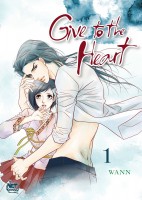 Give to the Heart, Volumes 1-4 by Wann. After a long period of silence, about a year ago Netcomics quietly began publishing books in print again. Give to the Heart was the first manhwa to be released after the publisher’s hiatus. I was interested in reading the series because I wanted to support Netcomics, but also because it was created by Wann. (I had previously read and thoroughly enjoyed Wann’s collection of short manhwa 9 Faces of Love.) At first Give to the Heart seemed like it was going to largely be fantasy fiction, but as the series progresses, more and more science fictional elements are introduced. The ongoing story is about Sooyi, a young woman who became the wife of Ganok, the demon king who controls all water, but who is now attempting to escape him. Not only that, she is trying to find a way to kill him as well, or at least cause him as much pain as possible even if that means sacrificing her own life in the process. Though it is implied that Sooyi and Ganok were at one point content and happy as a pair, their current relationship obviously has its problems. Actually, considering the extreme imbalance of power between them—Ganok being a cruel god and Sooyi being a human with a strong will—that’s been true from the very beginning.
 My Little Monster, Volume 9 by Robico. So, Haru and Shizuku are now officially a couple, although not much has actually changed in their relationship. But now that that has been settled, the other romantically interested parties are more or less able to move on with their lives. As a result, the plot of My Little Monster is now able to move along as well. This particular volume includes summer vacations and festivals, which is fairly standard for a high school romance, but Haru’s family drama is starting to come to the forefront of the story again. Underneath the humor of My Little Monster there seems to have been something ominous lurking waiting to be revealed. Haru’s brother Yuzan isn’t as terrifying as he once was, but there is definitely something going on between him and Haru and with Haru’s reluctance to interact with the rest of his family. Haru is trying to keep Shizuku from finding out the details, though eventually he’s really going to need to come clean with her and explain his situation. But, while Shizuku is still in the dark, at least readers get to learn a bit more. I continue to enjoy My Little Monster, especially the series’ quirky characters, and I’m happy to see the manga continue to gain some forward momentum.


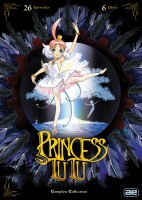 Princess Tutu directed by Junichi Sato. I picked up Princess Tutu more on a whim than anything else when I saw it on super sale. Although I vaguely remembered hearing good things about the anime, I honestly didn’t know much about the series. I’m very glad that I own it because Princess Tutu is marvelous. I do find it somewhat difficult to describe in a way that does the justice, though. The story follows a girl called Duck who really is a duck. She’s under an enchantment that allows her to not only take human form but to also become the magical Princess Tutu. Through the power of her dance she restores the shattered heart of a prince who had sacrificed himself to save others. That all might sound a little strange, and parts of the anime are admittedly weird, but the series is also very good. Stories are just as real as reality in Princess Tutu, and just as potent if not more so. Bits and pieces of classic ballets, operas, and plays can be found throughout the series all mixed together to form a unique work. I absolutely loved the anime’s use of orchestral works not just as background music but as meaningful additions to the story, emphasizing the significance of the characters and of their actions and, for those who are familiar with the pieces, even revealing some of the plot.