• Skip to primary navigation
  • Skip to main content
  • Skip to primary sidebar
  • Home
  • About Us
    • Privacy Policy
    • Comment Policy
    • Disclosures & Disclaimers
  • Resources
    • Links, Essays & Articles
    • Fandomology!
    • CLAMP Directory
    • BlogRoll
  • Features & Columns
    • 3 Things Thursday
    • Adventures in the Key of Shoujo
    • Bit & Blips (game reviews)
    • BL BOOKRACK
    • Bookshelf Briefs
    • Bringing the Drama
    • Comic Conversion
    • Fanservice Friday
    • Going Digital
    • It Came From the Sinosphere
    • License This!
    • Magazine no Mori
    • My Week in Manga
    • OFF THE SHELF
    • Not By Manga Alone
    • PICK OF THE WEEK
    • Subtitles & Sensibility
    • Weekly Shonen Jump Recaps
  • Manga Moveable Feast
    • MMF Full Archive
    • Yun Kouga
    • CLAMP
    • Shojo Beat
    • Osamu Tezuka
    • Sailor Moon
    • Fruits Basket
    • Takehiko Inoue
    • Wild Adapter
    • One Piece
    • After School Nightmare
    • Karakuri Odette
    • Paradise Kiss
    • The Color Trilogy
    • To Terra…
    • Sexy Voice & Robo
  • Browse by Author
    • Sean Gaffney
    • Anna Neatrour
    • Michelle Smith
    • Katherine Dacey
    • MJ
    • Brigid Alverson
    • Travis Anderson
    • Phillip Anthony
    • Derek Bown
    • Jaci Dahlvang
    • Angela Eastman
    • Erica Friedman
    • Sara K.
    • Megan Purdy
    • Emily Snodgrass
    • Nancy Thistlethwaite
    • Eva Volin
    • David Welsh
  • MB Blogs
    • A Case Suitable For Treatment
    • Experiments in Manga
    • MangaBlog
    • The Manga Critic
    • Manga Report
    • Soliloquy in Blue
    • Manga Curmudgeon (archive)

Manga Bookshelf

Discussion, Resources, Roundtables, & Reviews

who killed the hero

Who Killed the Hero?, Vol. 3

July 18, 2026 by Sean Gaffney

By Daken and toi8. Released in Japan as “Dare ga Yuusha wo Koroshita ka” by Kadokawa Sneaker Bunko. Released in North America by Yen On. Translated by Kim Morrissy.

This was well-written, and I enjoyed it, but I have to say that diminishing returns are starting to set in. I am wondering how many times we can go to the well of what it means to be a hero, and how many times we’re going to get a clever identity twist. The bulk of this book is written knowing that the reader will be trying to “work out” what is happening, so there are lots of false clues and real clues scattered throughout. More importantly, though, we’re back with the cast of the first book, and we get to see what they were like as they started out on their journey. Unsurprisingly, the answer is “not great”. They’re abrasive, strong, and somewhat rotten personalities, with the exception of Ares, and he feels like he’s unable to corral them because they’re all so much better than he is. The real plot of this book may be fixing that mindset, which he does thanks to a real swell guy.
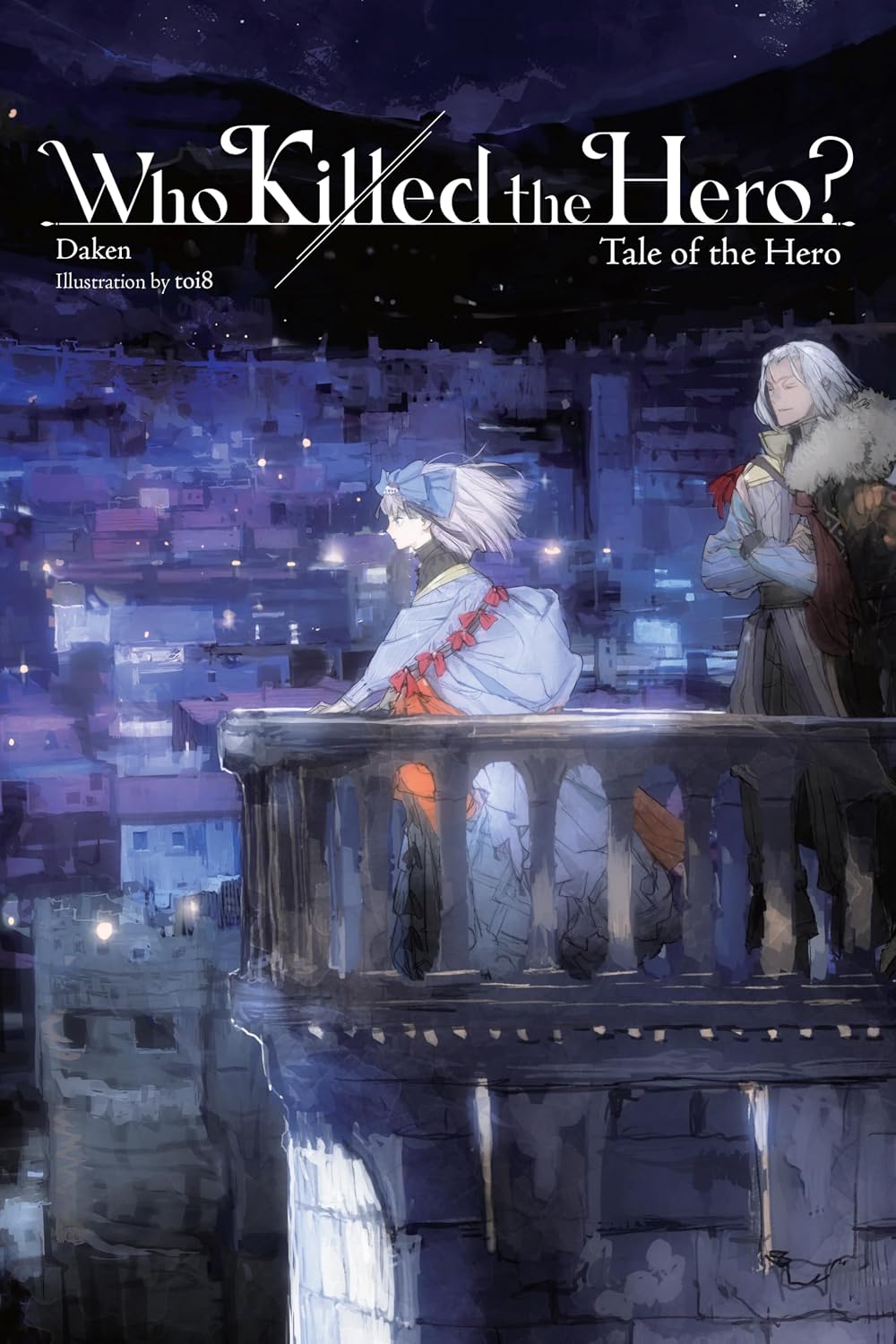
In a prologue, we see a princess open a coffin whose contents surprise her. We then cut to Zack, who is walking the city during a memorial festival when he is accosted by the same princess, who asks a very pointed question: Did he kill her brother? We then flash back to Ares and his team setting off to kill the demon lord, passing through Ludonia, where they can get some experience killing monsters and working as a team. Which they need, as they’re horrible at working as a team, mostly as Leon, Maria and Solon dislike each other intensely. Almost wiped out by an ambush, they’re rescued by Carlos, the prince of Ludonia – and the country’s hero, who defends it from demons, and who has an entourage that worships the ground he wanks on. Compared to Carlos, Ares is just this guy, you know? Still, unsurprisingly with this series, there’s more going on than what’s on the surface.

Ares remains the best part of this book. He and the author clearly define hero the same way, but there are others who see “hero” the same way you would define “savior” or “messiah”, and that’s a problem, especially when you have two heroes in the same castle. We also hear about shapeshifters, who can supposedly disguise themselves perfectly as a friend or ally, but who may or may not exist. It should not surprise anyone to learn that we are led to believe a certain thing about the traitorous shapeshifter, then have it go another way, and then have it go a mysterious third way. I felt Carlos’ story was very strong, although not as strong as Ares’. If there’s a weakness in the book it’s Erena, Carlos’ sister and the princess I mentioned earlier. She doesn’t get much to do for plot reasons, and the ending, which is meant to be more ambiguous and less triumphant than the first two books, also reads a bit like the author had hit a word limit.

There’s apparently a fourth book in the series just out in Japan, so apparently we can go to the well at least once more. I did enjoy reading this, but I would like the author to move on to other series, perhaps. Don’t overegg the pudding.

Filed Under: REVIEWS, who killed the hero

Who Killed the Hero?, Vol. 2

November 29, 2025 by Sean Gaffney

By Daken and toi8. Released in Japan as “Dare ga Yuusha wo Koroshita ka” by Kadokawa Sneaker Bunko. Released in North America by Yen On. Translated by Kim Morrissy.

(I won’t be spoiling too much about this book, but by necessity this does spoil a big reveal for the FIRST book, so beware that.)

It’s always tricky when you write a perfectly self-contained novel that gets so popular you have to write a sequel to it, and it’s even trickier when you are an author who is known to a certain degree for clever plot twists. By now anyone who picks up the second volume of this book will be sitting back and saying “well, go on, impress me”. When I heard about the plot for this book, I wondered if it was a prequel to the previous book, showing one of the many failed parties that the Prophet tried to gather together who failed to defeat the demon lord. And that’s kinda sorta true. But for the most part this book wants to explore what the idea of a hero and heroism is, and whether it’s something that some people have and some people don’t or if it all depends on circumstances. Because the hero’s party we see here have a reputation that is, shall we say, less than ideal.

The bulk of this book takes place right before the events of the first in the series. The Prophet is searching for someone who can be a hero, unite the Sword Saint, the Holy Maiden, and the Great Sage (who, you may recall from Book One, have shall we say DIFFICULT personalities), defeat the demon lord and save humanity. This is hard, and she’s tried to do this a large number of times, including the noble knight Carmine, whose corpse we see as this book starts. But we also see another party, which also looks DIFFICULT. They’re led by a man named Leonard, who is, not to put too fine a point on it, an asshole. He only believes in the power of money, he demands ten times the requested fee to be paid before he does a job, and if a cute li’l orphan tries to join the retreat at the last minute? Well, cute li’l orphan will cost extra, of course. He’s the OPPOSITE of a hero… or is he?

Since we have read the first book, and therefore know its plot twists, we’re allowed to take a much closer look here at the character of the Prophet, aka the Queen. We see her morbid fascination with Leonard’s party, which is literally the opposite of the actual Hero’s party from the first book (Leonard is a weirdo, and he has three relatively normal companions). As it turns out, though, they’re much more closely linked than she expects. Seeing her desperation and despair as the search goes on, especially since the nature of the time loops mean there’s no one who she can talk to about it, is touching and makes me go along with the somewhat unrealistic final page. As for Leonard himself, we guessed it was an act from the start, but he’s also the best character in the book, having both a lot of cynical common sense but also an idealistic goal that he knows will probably end in his death. Even assholes can still be heroes.

There’s a third volume to this, and I’ve no idea how it will be intermingling with the first two. But the author has my respect enough that I’ll definitely check it out.

Filed Under: REVIEWS, who killed the hero

Who Killed the Hero?, Vol. 1

July 4, 2025 by Sean Gaffney

By Daken and toi8. Released in Japan as “Dare ga Yuusha wo Koroshita ka” by Kadokawa Sneaker Bunko. Released in North America by Yen On. Translated by Kim Morrissy.

It’s always hard to try to review a book whose very nature requires that the reader is surprised as it goes along. It’s even harder to do this when the book is excellent, as your review essentially amounts to “You’ve got to read this, it’s great!” “Why?” “I can’t tell you, spoilers!”. But here we are, and this book is great, so let’s settle down and try to do this. At its heart this book takes a long look at the fantasy standard “hero’s party goes to defeat the demon lord” cliche. There’s a prophecy, there’s the hero/swordsman/mage/healer party composition, there’s a promised reward of a royal daughter, and, inevitably, there’s a death. Because the book is called “Who Killed the Hero?”, I can at least talk about that. The death, in turn, leads the book and its cast to ask about the nature of the hero, why they have to defeat the demon lord when others cannot, and how a story can be turned on its ear by a simple investigation.

Four years earlier, the hero, Ares, led an elite team to defeat the demon lord. There was noble swordsman Leon, beautiful priestess Maria, and intelligent yet cynical mage Solon. They succeed… and yet, when they return, Ares did not come back with them, and they said that he perished on the return visit. Now someone is going around, getting the word on the street, talking to the other members of the hero’s party, as well as the prophet who made the prophecy about the hero in the first place, to try to figure out what happened. Because no one’s quite sure. Some say Ares was killed by a rogue demon. Some say the other members of the party killed him as there was a love triangle going on. And even the person who is going all around the capital trying to figure things out has their own agenda. What happened?

This is, by necessity, not a book with a large cast, and I enjoyed all the characters tremendously. My favorite was undoubtedly Maria, theoretically a girl devoted to God but in reality someone who will have a boy go and get her the “best” bread every day because it amuses her… only to be stunned when he actually manages to learn the things she was theoretically teaching him. I also was fond of the young princess, who listens to the hero say that he’ll defeat the demon lord, but he’s not coming back, and refuses to accept that. There are a lot of cynical people in this book, and it’s dealing, through almost its entirety, with a death. Despite that, I was amazed at how life-affirming and happy it is, and that once you get all the answers in the end even the one person whose life you assumed would end here ends up being forced into happiness.

There’s two more volumes of this, which seem to have a similar premise but a different cast. Similar to Brunhild the Dragonslayer, I think. In any case, despite not being able to give much away, this is a very rewarding book. Seek it out.

Filed Under: REVIEWS, who killed the hero

 | Log in
Copyright © 2010 Manga Bookshelf | Powered by WordPress & the Genesis Framework