• Skip to primary navigation
  • Skip to main content
  • Skip to primary sidebar
  • Home
  • About Us
    • Privacy Policy
    • Comment Policy
    • Disclosures & Disclaimers
  • Resources
    • Links, Essays & Articles
    • Fandomology!
    • CLAMP Directory
    • BlogRoll
  • Features & Columns
    • 3 Things Thursday
    • Adventures in the Key of Shoujo
    • Bit & Blips (game reviews)
    • BL BOOKRACK
    • Bookshelf Briefs
    • Bringing the Drama
    • Comic Conversion
    • Fanservice Friday
    • Going Digital
    • It Came From the Sinosphere
    • License This!
    • Magazine no Mori
    • My Week in Manga
    • OFF THE SHELF
    • Not By Manga Alone
    • PICK OF THE WEEK
    • Subtitles & Sensibility
    • Weekly Shonen Jump Recaps
  • Manga Moveable Feast
    • MMF Full Archive
    • Yun Kouga
    • CLAMP
    • Shojo Beat
    • Osamu Tezuka
    • Sailor Moon
    • Fruits Basket
    • Takehiko Inoue
    • Wild Adapter
    • One Piece
    • After School Nightmare
    • Karakuri Odette
    • Paradise Kiss
    • The Color Trilogy
    • To Terra…
    • Sexy Voice & Robo
  • Browse by Author
    • Sean Gaffney
    • Anna Neatrour
    • Michelle Smith
    • Katherine Dacey
    • MJ
    • Brigid Alverson
    • Travis Anderson
    • Phillip Anthony
    • Derek Bown
    • Jaci Dahlvang
    • Angela Eastman
    • Erica Friedman
    • Sara K.
    • Megan Purdy
    • Emily Snodgrass
    • Nancy Thistlethwaite
    • Eva Volin
    • David Welsh
  • MB Blogs
    • A Case Suitable For Treatment
    • Experiments in Manga
    • MangaBlog
    • The Manga Critic
    • Manga Report
    • Soliloquy in Blue
    • Manga Curmudgeon (archive)

Manga Bookshelf

Discussion, Resources, Roundtables, & Reviews

sword art online

Sword Art Online, Vol. 15: Alicization Invading

December 23, 2018 by Sean Gaffney

By Reki Kawahara and abec. Released in Japan by ASCII Mediaworks. Released in North America by Yen On. Translated by Stephen Paul.

I was expecting that this volume would be a bit of a letdown after the highs of the previous work. Sadly, it’s even worse than I had anticipated: I actively don’t like this volume. Well, parts of this volume. We can divide the books events in half. Half of it involves Alice, having run away from the Integrity Knights at the end of the last book, living in the woods with Kirito, who is unresponsive and seemingly braindead. She’s struggling to find a purpose to fight, and various circumstances seem to give her that. This is not great writing, but it’s at least decent, and helps to set up the next couple of books. Alas, we then have the other half of the book. Even a Monkey Can Draw Manga discusses Shonen Power Creep, but there’s another aspect that Kawahara really suffers from, Shonen Villain Creep. Each villain has to be worse and more monstrous than the last one, doing even more evil things. So, ladies and gentlemen, meet Gabriel Miller.

Gabriel is introduced to us as a young corporate executive type, and we then flash back to his childhood, where he lived a comfortable life, met a nice sweet young girl to be his childhood friend, and then… well, Gabriel is a sociopath, like so many other of Kawahara’s villains, so you can probably guess. He’s part of a terrorist squad invading the ocean turtle, where Asuna and Kirito’s body are currently, in order to get the results of their experiments – Alice. He seems to regard humans and bugs exactly the same way, and is a thoroughly unpleasant individual. (He is assisted by another evil guy named Vassago, and I suspect that we may be familiar with him from previous volumes, though I will hold off till it’s confirmed.) Gabriel and Vassago are locked away from the Underworld, but they can still become “characters” in it. Which they proceed to do, as Gabriel is now the Demon Lord invading the human world.

The main problem with this book, and it’s teeth-grinding, is that half of it is from Gabriel’s POV. Given I already hate the way Kawahara writes villains, having to experience their thoughts for so long is unbearable. There’s also a couple of horribly violent deaths in the book, both women of course, there to make the reader feel sad and also make me wonder if the author had recently watched Se7en. (Speaking of which, Kawahara is rewriting his webnovel and editing it, and he changed events in Book 11 so that Ronie and Tiese are not, in fact, raped – however, dialogue towards the end of this book shows that he isn’t very good at cleaning up the mentions of it after the fact.) This may come as a surprise to the casual SAO fan, but I really miss Kirito’s POV here. Alice’s uncertainty and Gabriel’s loathsome villainy just make this book very hard to read. Oh yes, and Gabriel has also been in Gun Gale Online, and wants to do nasty things to Sinon as well. So that’s just great.

This was originally written when Kawahara was a much younger man, and it shows – it reads like the sort of thing an emo guy would write in order to be grim and gritty. The author, I think, realizes this – after the anime adaptation of Vol. 11, he publicly apologized for the rape scene, and said he wouldn’t write that sort of thing anymore. Unfortunately, it does mean we still have to plow through this book, which is filled with setup for cooler events to come, as well as appalling sadism. I won’t say to skip it, but you won’t enjoy it.

Filed Under: REVIEWS, sword art online

Sword Art Online: Progressive, Vol. 5

November 21, 2018 by Sean Gaffney

By Reki Kawahara and abec. Released in Japan by ASCII Mediaworks. Released in North America by Yen On. Translated by Stephen Paul.

There are several reasons that I think that Reki Kawahara is happier writing the Progressive novels, but the primary one is that he really just loves writing Kirito and Asuna falling deeply in love with each other – something we get quite a bit of here. He admits in the afterword that he’s not entirely sure how this is going to mesh with canon – in the original series, Kirito and Asuna act like they’re casual acquaintances when we first see them. But as I’ve said before, I think he knows he doesn’t have to worry about that till about Floor 10, and they’re only on the sixth. What’s more, this is Progressive’s first two-parter – which is likely why it’s shorter than usual. If you dislike Kirito (it’s all his POV again) or don’t care for Kirito and Asuna as a couple, the entire Progressive series is skippable for you. For the rest of us, it’s pretty fun and adorable – well, mostly adorable. Those player killers keep coming back, and they’re after our heroes.

I had to remind myself what was going on in the plot, as it’s been two full years since the last volume (fortunately, we will have less of a wait for the next one). The new floor consists mainly of puzzles to be solved, such as sudoku or the sliding pieces puzzles. Kirito and Asuna try to breeze through the main quest in the town, helped along by Kirito’s beta knowledge, but a spanner is thrown into the works when they’re captured while under a paralysis spell (as part of the quest they’re doing) by Morte and his partner, who are ready for some killing. Kirito and Asuna are really starting to fear for their lives here – especially Kirito, who’s been attacked multiple times. Things aren’t being helped by the ongoing war between the two lead factions, and Kirito attempting to deftly not support either side. Fortunately, the two of them do also have their bond with Kizmel and the elves, and can (mostly) safely relax in her presence – even if that means sharing a hot spring. And a bed.

It does have to be said, this volume of Progressive also contains an awful lot of game mechanics. I’ve never been overly fond of these sort of things in light novels, and I’m not fond of it here. But power through the endless pages of Kirito describing how his sword movements work or which stat boost he should get next, because the meat of the book is Kirito and Asuna’s relationship. They’re simply cute, and honestly I think the only think holding them back right now is the strange sense of self-hatred Kirito gets about himself as a romantic lead (yes, I am aware how ironic this is given the SAO franchise as a whole) and Asuna’s embarrassment, though by the end of the book she not only “bundles” with him in a queen sized bed (in the Scottish sense of the word) but they’re connecting pinkies as they sleep so that they’re always aware of each other’s presence. Sword Art Online Progressive is, at heart, a love story.

It’s also only half done – there’s no cliffhanger, and the author admits this is basically “I wrote too long a book, so they cut it in half”. I’m definitely ready for the next half, and more shipping tease. Oh yes, and more Argo! She was barely in this one.

Filed Under: REVIEWS, sword art online

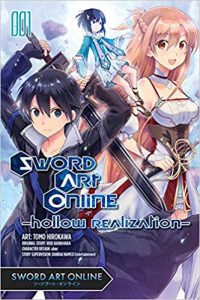
Sword Art Online: Hollow Realization, Vol. 1

November 8, 2018 by Sean Gaffney

By Tomo Hirokawa, based on the series created by Reki Kawahara. Released in Japan by ASCII Mediaworks, serialization ongoing in the magazine Dengeki Maoh. Released in North America by Yen Press. Translated by Stephen Paul.

Fair warning, this review contains spoilers for the video game Sword Art Online: Hollow Realization. And while the average reader may be staring at their screen now and saying “DUR!”, believe me, they came as a surprise to me. I have not played any of the SAO games, but assumed that this adaptation would not really have a lot of barriers to me picking it up and just reading it. And that’s… somewhat true? The main issue being when all the other girls in Kirito’s life start showing up. There’s our usual main harem, but then I ran into a girl who I was pretty sure died tragically in one of the prior books, and Yui’s little sister, and a sysadmin helping the group, and… I had to run crying to the Sword Art Online wiki. Not a pretty sight. So yes, for readers of the manga who have NOT played the game (and its prequels)? You will be confused.

The premise is that Kirito and company are beta testing a new version of SAO based off the original game… but without the ‘trapped and dying’ parts. They immediately run into a few NPCs, including one who appears to be more of a blank slate than you’d expect, particularly as the NPCs here are more lifelike and real than had been seen in SAO previously (let’s leave Kizmel to the side for the moment). Asuna names the NPC Premiere, and we begin to watch her slowly develop wants and needs, such as the desire to protect herself. And she certainly needs to protect herself too, as players are going around killing NPCs for their stuff… and the NPCs don’t return afterwards. Can our heroes help Premiere achieve sentience while also stopping the ‘it’s just a game’ PCs and a creepy swordsman named Genesis?

The concept of NPCs being more than what they seem is something SAO (and indeed many other ‘trapped in a game world’ series) has come back to many times, especially since Kawahara began the “Progressive” series. In fact, one of the very first SAO doujinshi the author wrote, back when it was still a webnovel, featured Kirito and Asuna arguing over whether it was OK to sacrifice NPCs in order to clear a level. Clearly the story is meant to have us rooting for Premiere and her fellow non-players, and I’m fine with that – she’s cute and likeable without being overly cloying. As for the rest of the cast, they all show up, but mostly it’s the Kirito and Asuna show, which is fine by me – there’s lots of “they’re so in love with each other” interaction that makes Lisbeth and company a bit ill. (Quiet, Liz, the artist was very kind to you.) And as I indicated there’s a few extra girls who also show up here, and if Mother’s Rosario left you wishing that it could have gone differently… you might want to check this out, though you’ll be whistling for explanations – “buy Lost Song” is apparently the answer.

Overall, this is a fun tie-in manga that I suspect will appeal more to those familiar with the game, though (as I’ve shown) you can read it without any game knowledge and just be slightly confused.

Filed Under: REVIEWS, sword art online

Sword Art Online Alternative: Gun Gale Online: Second Squad Jam: Start

October 6, 2018 by Sean Gaffney

By Keiichi Sigsawa and Kouhaku Kuroboshi, based on the series created by Reki Kawahara. Released in Japan by ASCII Mediaworks. Released in North America by Yen On. Translated by Stephen Paul.

If you read the first volume of this series and thought “I’m here to read deep characterization and cool gun battles, and I’m all out of deep characterization”, then I’ve got some good news for you. Now, there is some attempt at character, which I’ll get into later on, but for the most part you are not here to see what makes Pitohui tick or reading about Llenn’s desire to save her. You are here to read about guns, and fights, and gunfights. And in this regard, the Second Squad Jam offers just what the first did, and does a very good job of it. There may be a few too many long descriptions of makes and models for my taste, but the concept and strategy of what’s going on here is top notch. You can tell this is the main thing Sigsawa wants to write – in fact, he wrote so much of it that this is a two-parter, with the second half due out early next year.

On the cover we see Llenn with a new partner, Fukaziroh, who is Karen’s real-life best friend Miyu. Miyu is not meant, so far, to have much depth. She is in this book to be FUN, and she succeeds admirably. She’s bubbly, extroverted, acts before thinking, and is also hellaciously strong in game, so is a good contrast to Llenn’s speed and agility. Llenn’s former partner, M, can’t pair up with her as he is pairing up with Pitohui, and this Squad Jam is – stop me if you’re surprised in a SAO title – a matter of life or death for the both of them. Why that is has a lot to do with Pitohui’s twisted personality, and also a lot to do with the original Sword Art Online, which Pitohui was not involved with – in fact, that’s the problem. This is handled pretty well, though if I hear yet another thing tying into Laughing Coffin again I may scream. M has a plan to fix things, though we don’t hear the specifics, for the sake of suspense.

These are not the only returning characters, of course. The squad of huge muscular women who turned out to be cute Japanese schoolgirls is back, and anxious to have a rematch with Llenn. That may have to wait, though, as Llenn is on a direct course to confront Pitohui, who we finally see in action, and it is both amazing and terrifying. She’s sort of broken, but the fact that this really IS just a game means that her cruelty and callousness comes off merely as cool rather than as any form of sociopathy. We also see the paramilitary unit, as well as the machine gun idiots. Now that we’ve gotten the plot out of the way, I expect the back half of this two-parter to be incredibly cool fights from beginning to end. As this is the first volume, there’s a lot of necessary setup that gets in the way.

Still, this is frothy fun. It’s never going to win awards for depth or emotion, but if you need a light novel equivalent of Pixy Stix, then by all means this SAO spinoff is absolutely the title for you.

Filed Under: REVIEWS, sword art online

Sword Art Online, Vol. 14: Alicization Uniting

August 29, 2018 by Sean Gaffney

By Reki Kawahara and abec. Released in Japan by ASCII Mediaworks. Released in North America by Yen On. Translated by Stephen Paul.

(Of necessity, this review is going to have to spoil events in this book. If you want to be surprised, read the book first.)

It has to be said, given the length and breadth of the Alicization series, and the complete absence of most of the rest of the original cast, that Kirito and Eugeo’s relationship feels like the strongest and most valid in the series. Yes, this includes Asuna, who is almost entirely absent from this book save for the cliffhanger ending. But Kirito and Eugeo are meant to be two sides of the same coin, each yearning for what the other has, with Kirito’s cynicism being set off by Eugeo’s innocent idealism. Even the fate of Alice Synthesis Thirty, who nearly sacrifices herself a couple of times for Kirito in this book, has her own Eugeo counterpart in Alice Zuberg’s state of being and eventual fate. Kirito and Eugeo is the main reason to watch the upcoming anime to see what they do with it. And it’s also what makes this volume the most heartbreaking of the books to date.

For all that Kawahara wrote a story about a death game where people die in real life, he’s been pretty good about not actually killing most of the main cast. When there is a death, it tends to have major impact on the characters going forward – see Sachi and Yuuki, for example. This volume, though, is absolutely filled with horrible deaths, both seen and unseen. The actual plot is pretty simple – it’s the end of the fight to the top of the tower. Eugeo throws off his mind control fairly quickly all things considered, but that’s not really helping any of them defeat Administrator, who is simply too damn overpowered. And so one by one characters come out of the woodwork to buy time so that the hero can figure out what to do. And no, that hero’s not Kirito this time, who spe4nds much of the book dealing with the fact that he’s getting his ass handed to him. It’s up to Eugeo to make the ultimate sacrifice, destroying Administrator for the sake of the world, even if it costs him his life.

Actually, while Administrator is the weak part of the book, being the usual ‘I have no nuance I am just eeeeeeevil’ Kawahara villain, she is impressively tough, in that she even survives Eugeo’s final attack, only to get taken out by her minion’s overpowering creepy love for her. Still, she is a piece of work. The ceiling of her tower will go up there with the depiction of the Senate in the previous book as one of the most disturbing things in SAO. As for the state of the world now that Administrator is gone, we’ll have to see. It may have to deal with life without Kirito for a bit, as things have apparently been going on in the real world in his absence, and his “fluclight” is seemingly damaged right at the very end. Will this mean an entire volume with no Kirito narration?

Kawahara says in the afterword he debated letting Eugeo survive in the LN version, but decided not to. Much as I love Eugeo, I think it was probably the right choice. In the meantime, this is a very strong volume of SAO, and I can’t wait to see where we go from here – we still have four books to go after this, let’s remember.

Filed Under: REVIEWS, sword art online

Sword Art Online Alternative: Gun Gale Online: Squad Jam

July 2, 2018 by Sean Gaffney

By Keiichi Sigsawa and Kouhaku Kuroboshi, based on the series created by Reki Kawahara. Released in Japan by ASCII Mediaworks. Released in North America by Yen On. Translated by Stephen Paul.

And so it’s finally here, the Sword Art Online novels for the fan who hates Sword Art Online. Or at least that’s how this is sometimes described. Sword Art Online is a very popular franchise, but it’s also the series that’s cool to hate, particularly its lead character. And so there’s a certain desire to play around in the universe but without all the baggage of Kirito and friends. Enter Alternative, where the author (best known here as the creator of Kino’s Journey, though he also is a specialist at playing in author author’s worlds) explicitly says that none of the main cast will ever be in these books. Nor is he really interested in the death game or its sequel. No, instead we have what is essentially Gunsmith Cats: the RPG, only Rally has been replaced by Goldie. The author loves guns, so do the characters, and you’d better be prepared to hear about guns.

For those who haven’t read the manga (which I reviewed last year) or seen the anime (which just ended this week), SAO Alternative stars Karen, a very tall girl who has few friends because she’s introverted and tall. Her friends tries to get her to do MMORPGs like ALO, but Karen’s character creation always gives her a really tall character – exactly what she doesn’t want. In desperation she tries to sci-fi apocalypse shooter Gun Gale Online, and finds, at last, she’s tiny! And cute! After playing around a bit, she runs into Pitohui, who is cool, gives good advice, and also seems to have a screw loose or two, though we don’t really get into that as much as I expected this book. She recommends that LLENN (as Karen names herself) participate in a new event called the Squad Jam, which is basically the BoB tournament but for teams. Sadly, Pitohui can’t make it, but she does provide LLENN with a partner, the hulking giant M, who also is there to give advice and backup. With a team of only two, can they possibly win this?

If you’re here for gun battles, then this is absolutely the book for you. The Squad Jam itself takes up two-thirds of the book, and is exciting, dramatic and fun. LLENN proves to be a natural at the game, and her headspace is also fun to follow. The purpose of the characters in this book seems to be “make them different from the real players” to contrast with the SAO crew. Karen has a short, tiny character, the stoic, invulnerable M proves to be, well, rather less stoic and invulnerable, and the team that LLENN ends up going against in the finals are a group of big burly Russian women who, it will not surprise the reader to know, are not big, burly and Russian in real life. It’s an escape. That said, while I enjoyed this book it’s not as ambitious as SAO – I’d say it’s better written but lacks the highs and lows of the original series. It feels like Sigsawa has no greater motivation than “I want to play in this sandbox”. It’s a fun sandbox, though, and if you hate SAO this may be for you.

Also, the Agatha Christie fan in me is annoyed that the team name is not “LLENN or M?”.

Filed Under: REVIEWS, sword art online

Sword Art Online, Vol. 13: Alicization Dividing

May 2, 2018 by Sean Gaffney

By Reki Kawahara and abec. Released in Japan by ASCII Mediaworks. Released in North America by Yen On. Translated by Stephen Paul.

As you might gather from the title, Kirito and Eugeo are divided throughout the book, as the cliffhanger from last time leaves Kirito and Alice hanging off the edge of the tower, and Eugeo needs to go on by himself to duel the last of the Integrity Knights there to stop them. This once again allows the author to alternate between third-person Eugeo POV and first-person Kirito POV. I’m not entirely certain if the hate-on fans have for Kirito is as omnipresent in Japan as it is here in the West, but I get the sense that Kawahara is playing with the reader a bit here. Eugeo is the straightforward, pure, noble type hero and Kirito is the snarky little cheater. Possible the funniest moment in the book is when Kirito wears Eugeo’s sword, and he and Alcie talk for a bit about how difficult using two swords actually is. Kirito doesn’t bring up his past as he feels embarrassed by it. Even Kirito is sick of Kirito. That said, Eugeo does not end up in a good place either.

As I said before, Kirito and Alice end up hanging off the tower by their swords, and have to find a way to climb up about twenty floors. This allows them to snark at each other, bond during fights, and of course for Kirito to tell Alice what’s really going on with the Integrity Knights. I will note that this scene should look fantastic when animated, though I suspect my fear of heights will mean I would never be able to watch it. I was most interested in how Kirito and the author are both telling the reader to think of Alice Zuberg, the little girl and childhood friend, as a separate person from Alice Synthesis Thirty, the Integrity Knight. Kirito knows that saving the former means killing the latter, and is feeling increasingly bad about that. More to the point, Eugeo is clearly there for Alice Zuberg… but Alice the Integrity Knight is obviously being set up as another of Kirito’s love interests.

Speaking of Eugeo, his fight against Bercouli was pretty awesome, and I was amused by the idea of a time-traveling sword slash. Eugeo gets the better of him in sort of a double suicide attack, but unfortunately is then found and brought to the administrator, whereupon he runs up against the necessity of the plot. Kirito and Eugeo are both great protagonists, but there can be only one Kirito in Sword Art Online. And come on, you know that the two friends were going to have to battle at some point. So yes, much as we’d like Eugeo to be strong and throw off the obvious brainwashing, he falls, and the cliffhanger shows that he is now an Integrity Knight with his memory removed. (Speaking of which, Alice, Eugeo and Kirito all have flashes of Kirito being present in their childhood – something Kirito clearly doesn’t recall now. I do wonder what’s going on there.)

So we’re all set up for friend vs. friend next time around. Will they finally be able to take down the Administrator? Well, possibly not, as we’re only now at the halfway point of the Alicization arc. One last thing: Kirito and Alice discovering the true nature of the Senators may in fact be the darkest, most horrifying scene Kawahara has ever written. Well done. I shuddered.

Filed Under: REVIEWS, sword art online

Sword Art Online, Vol. 12: Alicization Rising

January 4, 2018 by Sean Gaffney

By Reki Kawahara and abec. Released in Japan by ASCII Mediaworks. Released in North America by Yen On. Translated by Stephen Paul.

Last time I mentioned that the regulars not named Kirito barely appeared in the book, and this time they don’t appear at all – even Asuna isn’t in it, as we spend our entire time in Underworld watching Kirito and Eugeo slowly make their way upward in order to stop our chief villain of this arc. It can be a bit frustrating, especially as Kawahara excels at introducing new characters who could conceivably be quite an interesting addition to the ensemble and then leaving them by the side of the road. Eugeo, at least, continues to play the second protagonist role admirably, and once again the narration of the book is divided, with first-person Kirito for the first half and third-person Eugeo for the second. The book, in fact, somewhat mirrors the last one – just as that ended with a pile of exposition after a series of cool fights, so this one begins with the exposition before we get to the fighting. Kirito even gives us a “for those of you just starting this series” intro.

My favorite part of the book was probably the two girls on the cover, Fizel and Linel. They’re introduced at a point where the ordinary reader would be very suspicious, which is why the cover fakeout is so clever – given that they flank Kirito, clearly they’re meant to be new allies that he picks up along the way. A heh. Perhaps not. That said, once their subplot is done they are tossed out of the way like everyone else, and I do wonder if we’ll ever see what becomes of them, particularly if Kirito wins the day, something that is still not entirely certain. The best fight scene in the book goes to an Integrity Knight named Fanatio, which has to be intentional as she certainly seems fanatical. She has a complex about being a feminine knight, both because she was treated as weak by other men before and also because Alice has just arrived and is pulling off being feminine and hella strong perfectly. Kirito, who points out that he’s had the crap kicked out of him by women in fights before, is all too happy to duel her and teach ehr the error of her ways. It’s not terrible, but I’m not sure it comes off the way he wants it to – there’s still a tinge of sexism here.

Of course, we knew that before we reached the top of the tower and the final villain we’d have to fight Alice again. And, as if proving Fanatio to be even more wrong, she proceeds to absolutely kick Kirito and Eugeo’s asses, at least until the obligatory cliffhanger. Given everything that we learn about the Integrity Knights in the early infodump, I am curious as to whether Kirito and Eugeo will be able to snap her out of it – I suspect that may take up a good deal of the next book. In the meantime, Sword Art Online continues to be exactly the sort of series you think it is. The highs still high, the frustrations still omnipresent. I’d still argue it’s well worth a read, unless you hate Kirito.

Also, I found it hilarious that Kirito points out he has now failed to graduate THREE times – from middle school (trapped in SAO), high school (being trapped here), and sword academy (for breaking the taboo index). It’s OK, Kirito, there’s always McRonald’s.

Filed Under: REVIEWS, sword art online

Sword Art Online Alternative: Gun Gale Online, Vol. 1

November 15, 2017 by Sean Gaffney

By Keiichi Sigsawa, Kouhaku Kuroboshi, and Tadadi Tamori, based on the series created by Reki Kawahara. Released in Japan by ASCII Mediaworks, serialized in the magazine Dengeki Maoh. Released in North America by Yen Press. Translated by Stephen Paul.

The Sword Art Onlione franchise has done a lot of worldbuilding over the course of the series, detailing no less than four different games/VR environments. Some are more popular than others, but I think Gun Gale Online struck a cord with a lot of gamers, as usually these sorts of novels concentrate on sword-based fantasy RPGs – as indeed Sword Art Online did for its first four volumes. So the idea of combining that sort of immersion with a game filled with all sorts of guns, rifles, and lightsaber–sorry, beam swords was incredibly appealing. As for the publisher, I imagine having a spinoff series that did not have to be overseen by Kawahara as much as the others was a plus – the number of regular SAO cast in this first volume is zero. So if you want to read about Gun Gale Online but hate Kirito, have I got a series for you.

This manga is, like a lot of Sword Art Online, based off of a novel. Unfortunately, the novel has not been licensed here as of yet. It’s by Keiichi Sigsawa, who some may know as the creator of Kino’s Journey. Our heroine is Karen, an incredibly tall girl who went to a women’s college to try to change her self-conscious self, but found when she got there that most of the other students already knew each other, and she’s still huge, so she’s mostly a social outcast again. She decides to try to forget about it by playing a VRMMO… but every one she tries gives her another tall avatar. As a last resort, she tries Gun Gale Online, and finds that – finally – she’s short and cute. Now she and her pink gun (OK, Bambi) can have as much tiny fun as they want! (I am reminded of Log Horizon, where Akatsuki originally played as a huge male assassin because “games allow you to be something you’re not”.

We see Llenn (her screen name) gradually getting used to the game with the help of another player, Pitohui, who is the very definition of “obviously evil”, not that this seems to register with Llenn. As she gets a gun and starts to go after other players, she begins to have a lot of fun – botjh because her small form is very good at this sort of thing and also because, well, it’s a game, and in a game, killing others can be fun. That said, this is SAO, so we know those sorts of feelings are always dangerous, especially when helped along by Pitohui, who seems to be trying to make Llenn into a tiny little killing machine. (There is a very disturbing scene in reality midway through the book, showing a young woman (I really hope it’s a young woman, she looks far too young) on top of a guy, sexing him up while also threatening him regarding the upcoming GGO match. It’s heavily suggested this is Pitohui in real life, and does not bode well for our heroine. It also feels oddly out of place.)

The rest of the book is gun battle fun, as Llenn gets a partner who seems taciturn and scary at first but eventually shows he’s a nice enough guy. Are they good enough to win a tournament even though there’s only two of them? Even if their opponents look to literally be JSDF? What is Pitohui scheming? And can we really get through an SAO spinoff without Kirito showing up at all? Find out in the next thrilling volume!

Filed Under: REVIEWS, sword art online

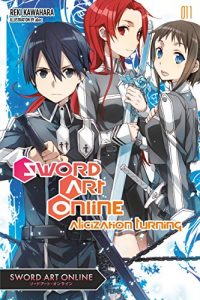
Sword Art Online, Vol. 11: Alicization Turning

August 31, 2017 by Sean Gaffney

By Reki Kawahara and abec. Released in Japan by ASCII Mediaworks. Released in North America by Yen On. Translated by Stephen Paul.

I don’t think I’ve ever come across a book that more perfectly summarizes the best and the worst of Sword Art Online in one handy gulp. The high points of this book are excellent, and the low points are incredibly frustrating. Put together, though, we have a series that continues to intrigue even as the main cast that isn’t Kirito continues to be entirely absent – Asuna gets a few pages in the middle, but for the most part we are entirely in Kirito’s fantasy world here. Fortunately, the first half of the book or so gives another break from Kirito’s first person, as we get a long stretch narrated by Eugeo, who is nice and earnest and a good contrast to Kirito. I was expecting that we would see more training at the knight academy, probably ending up in the giant fighting tournament that had been lampshaded earlier. But then things went entirely off the rails.

Let’s get the bad out of the way first. We have yet ANOTHER instance where female characters are captured and threatened with rape, so that we may see how irredeemably evil the villains are (Kawahara’s villains remain his giant weak point – he can’t write nuance) and also justify Kirito’s violence towards them. This is even more annoying because we’d barely gotten to know Tiese and Ronie, so the threat doesn’t have as much of a reader impact as it did with Asuna and Shino, assuming the reader impact cannot just be narrowed down to “rolls eyes, sighs”. And then due to the plot moving on, we don’t see the girls after this, which just makes it more blatant it was done for pure “damsels in distress” reasons. I understand in the original webnovel this was taken from, the girls actually were raped – thank heavens for small favors that this was changed. SO BORED WITH RAPE THREATS, KAWAHARA.

Of course, disposing of the two villains does mean that the plot makes a right turn, as now Kirito and Eugeo are captured by the Synthesis Knights and brought to the Central Cathedral… which was their goal, to be fair, but probably not as prisoners to be judged. Things pick up a great deal here, as we find that Alice (remember Alice?) is one of the knights, but doesn’t seem to remember Eugeo at all. Kirito takes up the narration again here, and it works out well, showing off his smarts in knowing when to push hard on “this is a game world with game rules” – breaking the chains was particularly good. What’s more, after a long and highly interesting fight scene that shows us the knights may in fact be brainwashed, we are given a long, long infodump by a new character that actually feels realistic and welcome, telling us a lot more about the Underworld, how it got its start, and the evil woman now at the head of it all.

In the end, this is book 3 of a 10-book arc, so there’s a limit to how far it can take things. But once you get past Kawahara deciding that nothing adds to drama quite like rape threats, it’s enjoyable and fun, with excellent fight scenes. Just… get a new gimmick. I beg you.

Filed Under: REVIEWS, sword art online

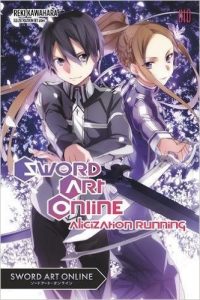
Sword Art Online, Vol. 10: Alicization Running

April 26, 2017 by Sean Gaffney

By Reki Kawahara and abec. Released in Japan by ASCII Mediaworks. Released in North America by Yen On. Translated by Stephen Paul.

If the 7th Sword Art Online novels felt rushed because we weren’t used to the pace of a single volume story, then this book has the opposite issue. Alicization Running is filled with cool scenes, exposition, and character development, but it is the very definition of “Part 2 of 10” – it doesn’t stand on its own as a novel, really. For those who expected we’d see Kirito and Eugeo reuniting with Alice in this book, she’s barely even mentioned except as a goal, because to get to her they have to become Knights, which means winning a tournament, which means going through sword training school, which means winning ANOTHER tournament. Kawahara is stretching this out, for good or ill. Fortunately, it’s partly good – this is still readable, and by now I hope the average Sword Art Online reader takes Kirito’s success with a sword for granted and does not grind their teeth at it.

The other good news is that the first third or so of this book is devoted to Asuna in the real world, who is trying to figure out what happened to Kirito, who is not, as we may have expected, in a hospital but has instead completely vanished. We do eventually find out where he is, with a lot of seeming villains who are really helping out heroes and the like. We also get more of one of my least favorite things in Sword Art Online – praising Akihiko Kayaba, the villain of the first arc who condemned thousands to death, but is really just a misunderstood man with a dream, something that even Asuna says she can respect, which just makes me shake my head. Unfortunately, the rest of Asuna’s section is taken up with huge swaths of technobabble as Kikuoka explains what they’re trying to do here, why they’re trying to do it, and why Kirito is here. Some of those explanations are a bit disturbing – the author even has to remind us in the afterword that he does not necessarily agree with his characters (I’m guessing he’s meaning the use of DELICIOUS TASTY BABY SOULS).

Meanwhile, Kirito’s having an adventure, and while he does think of Asuna and the others, and misses them, his focus is on getting to the central capitol. This involves a lot of showing off, because this is Kirito after all, as well as forging him an amazing weapon that can be the equal of the sword Eugeo possesses (which is a black blade almost identical to his Aincrad one). He also gets to face off in a battle with the #1 swordsman at the school… who sadly is not the young woman on the cover. She’s the second strongest swordsman, and the plot is set up to build to a final battle against her that never happens. I’d like to say it’s not just because she’s a woman, but let’s be honest, it probably is. As always, Kirito is at his most interesting when he’s upset or something goes wrong, such as when his classmates’ petty bullying and destruction leads him to the literal power of prayer to fix things (fortunately, this is a gaming world, so it succeeds).

I wish we had more of Eugeo, who’s a nice sweet kid but not much else – he got far more development last time. As for the regulars who aren’t Kirito or Asuna, well, Leafa and Sinon get to have a confab with Asuna at the start of the book, but Lisbeth and Silica are reduced to begging on the back cover. Yui actually fares better than they do – her discussion of AIs, and how in the end she isn’t the amazingly self-aware fairy daughter she appears to be, is well-written and also chilling. This is a necessary volume of Sword Art Online if you want to read more of Alicization, but by itself it’s a bit frustrating. Recommended for fans of the series, but I’m hoping for a bit of a Turning point next time…

Also, Kirito spends most of the book being protected by invisible sentient head lice, who I can’t help but picture as Jiminy Cricket. I just want to throw that out there.

Filed Under: REVIEWS, sword art online

  • « Go to Previous Page
  • Page 1
  • Page 2
  • Page 3
 | Log in
Copyright © 2010 Manga Bookshelf | Powered by WordPress & the Genesis Framework