• Skip to primary navigation
  • Skip to main content
  • Skip to primary sidebar
  • Home
  • About Us
    • Privacy Policy
    • Comment Policy
    • Disclosures & Disclaimers
  • Resources
    • Links, Essays & Articles
    • Fandomology!
    • CLAMP Directory
    • BlogRoll
  • Features & Columns
    • 3 Things Thursday
    • Adventures in the Key of Shoujo
    • Bit & Blips (game reviews)
    • BL BOOKRACK
    • Bookshelf Briefs
    • Bringing the Drama
    • Comic Conversion
    • Fanservice Friday
    • Going Digital
    • It Came From the Sinosphere
    • License This!
    • Magazine no Mori
    • My Week in Manga
    • OFF THE SHELF
    • Not By Manga Alone
    • PICK OF THE WEEK
    • Subtitles & Sensibility
    • Weekly Shonen Jump Recaps
  • Manga Moveable Feast
    • MMF Full Archive
    • Yun Kouga
    • CLAMP
    • Shojo Beat
    • Osamu Tezuka
    • Sailor Moon
    • Fruits Basket
    • Takehiko Inoue
    • Wild Adapter
    • One Piece
    • After School Nightmare
    • Karakuri Odette
    • Paradise Kiss
    • The Color Trilogy
    • To Terra…
    • Sexy Voice & Robo
  • Browse by Author
    • Sean Gaffney
    • Anna Neatrour
    • Michelle Smith
    • Katherine Dacey
    • MJ
    • Brigid Alverson
    • Travis Anderson
    • Phillip Anthony
    • Derek Bown
    • Jaci Dahlvang
    • Angela Eastman
    • Erica Friedman
    • Sara K.
    • Megan Purdy
    • Emily Snodgrass
    • Nancy Thistlethwaite
    • Eva Volin
    • David Welsh
  • MB Blogs
    • A Case Suitable For Treatment
    • Experiments in Manga
    • MangaBlog
    • The Manga Critic
    • Manga Report
    • Soliloquy in Blue
    • Manga Curmudgeon (archive)

Manga Bookshelf

Discussion, Resources, Roundtables, & Reviews

Reviews

Even a Replica Can Fall in Love, Vol. 4

February 12, 2026 by Sean Gaffney

By Harunadon and raemz. Released in Japan as “Replica Datte, Koi o Suru” by Dengeki Bunko. Released in North America by Yen On. Translated by Andrew Cunningham.

There are spoilers for this book, at long last, as it becomes impossible to try not to give everything away like I’ve tried in my previous obfuscating reviews.)

Last time I mentioned that we could all guess what Nao’s decision is, and I was absolutely correct, but that’s not what makes this book so interesting. What first surprised me is how long it takes Nao to avoid having to answer the question, first telling Sunao that she’ll answer her before the end of the year, and then essentially trying to cram in as much life as possible into those days, even as she continues to worry about how Sunao is doing. There’s a great scene in the book where Sunao gets a bloody nose during a sports event, and everyone completely panics, even as she grumpily insists that she’s fine. It helps to underline the idea that Sunao is fragile, especially when Nao is out and about, and that Nao’s decision is entirely about her, rather than about Aki or her own love. And then she takes Aki and Ricchan on one last big blowout date, on Christmas day, to an amusement park. SHE may not make her decision till 3/4 through the book, but WE know it from page 1.

Now that it’s apparent that when the original and the replica are both “out and about”, the replica generally can’t be seen, Nao is trailing along with Sunao more often. This allows her to see the aforementioned game where Sunao is injured, as well as look at all the photos from the class trip, which she is burning into her brain. She’s also talking with Satou about things, because one thing that might make Nao hesitate in her decision is she has no idea what will happen to Sunao, or how she’ll be affected, after it occurs. There’s just no way to know, especially if you’re Nao. And of course there is Aki, who knows what her decision is, and respects her own autonomy, but spends most of this book brutally sad and depressed, and you can see why. In the end, Nao chooses to… well, what DOES happen?

The other big surprise for me was the last quarter or so of the book. Where Nao winds up in Replica Heaven, basically, and meets up with Ryou, who explains that after they have “finished their work”, replicas come here to essentially live an afterlife. They’re in a school, and though they can’t leave it (there are dorms), and time doesn’t really pass, they can learn, and read books, and even date other replicas. And they all seem pretty content with this… except Nao. It was very hard for me while reading this section not to think about the Talking Heads song “Heaven”, which its chorus “Heaven is a place where nothing ever happens”. Nao can’t get over how the entire thing is essentially in muted greyscale, but as it turns out that’s not the Replica afterlife, it’s HER. She gets remonstrated for not only making the wrong decision but making it badly, trying to do the most dramatic thing ever in order to burn herself into everyone’s brain. And more importantly, she needs to go back.

This is, for all intents and purposes, the end. But we’re not done, as we’re finally going to get what I’ve wanted from the start: Sunao’s side. She was just as big a part of the finale of this book as much as Nao, and her “I no longer hate myself” made me well up a bit. This is really good, folks.


Filed Under: even a replica can fall in love, REVIEWS

Re: ZERO ~Starting Life in Another World~ Short Story Collection, Vol. 4

February 11, 2026 by Sean Gaffney

By Tappei Nagatsuki and Makoto Fugetsu. Released in Japan as “Re: Zero Kara Hajimeru Isekai Seikatsu: Tanpenshuu” by MF Bunko J. Released in North America by Yen On. Translated by Sarah Moon.

This fourth volume of short stories definitely expands the palette, as Subaru, Emilia and Rem/Ram don’t appear at all. They’re mentioned a few times, but for the most part the purpose of these stories is to flesh out and develop other members of the cast. This is good news, though the fact that Yen Press has been putting out the Short Story volumes well after they came out in Japan means that sometimes the stories don’t quite have the hit the author wanted, I suspect. For one thing, I’m starting to get a bit sick of Priscilla, mostly as we’re in the middle of Arc 7, which features her, we’ve had a few EX volumes with her, and the last short story volumes have had her. The author clearly LOVES writing her and Al, so I don’t expect this to change anytime soon. On the other hand, the first half of the book is very welcome, as Felt is easily the least developed supporting character in Re: Zero to date. No, not like that.

There are four short stories here: 1) Felt has announced herself as a Royal candidate, but is still grumpy about the whole thing, and she’s angry at Reinhard all the time. She is trying to get some allies, however, even if they happen to be the Three Stooges (published before Book 6); 2) Their group heads back to Reinhard’s domain, away from the political turmoil of the royal capital, but have to deal with an abandoned baby (published between Book 12 and 13); 3) Priscilla and Al have to deal with a few nearby villages seemingly being infested by undead, in a story that is literally called Price, Prejudice & Zombies (published with Book 18); 4) Otto is waylaid as he tries to leave a town and forced to mount a rescue mission for a missing girl, but ends up getting captured himself (published with Book 13).

The Felt stories are the highlight of the book. She’s loud, coarse, and angry throughout both of them, but also proves to be a sharp cookie and is surprisingly astute when it comes to Reinhard, who tends to wear his heart on his sleeve a bit too much because he hasn’t experienced the failures of life that Felt has. The whole point of the Royal Selection is that all the candidates could be very good rulers but that the folks in charge would hate them, and you can see that here. The Priscilla story is a sort of horror mystery, and mostly serves to show off a character that it then seemingly kills off, and once again show off the bond between Priscilla and Al. The Otto story is the slightest, but also shows off that he has a good heart, frequently to his detriment.

Next time, we’ll focus on Crusch and Anastasia. That said, I think next up we have a new EX book, which returns to the story of Wilhelm and Theresia. Till then, gosh, Re: Zero continuity is complex, but this was good.

Filed Under: re: zero, REVIEWS

New Game Plus After Defeating the Last Boss: All These Beautiful, Problematic Girls in the First Town Have Gotten Really Attached to Me… , Vol. 1

February 10, 2026 by Sean Gaffney

By Touwa Akatsuki and Falmaro. Released in Japan as “Last Boss Toubatsu Go ni Hajimeru Nishuume Boukensha Life: Hajimari no Machi de Wakeari Bishoujotachi ga Mechakucha Natsuite Kimasu” by Fujimi Fantasia Bunko. Released in North America by Yen On. Translated by Kamishiro Taishi.

Just the title should tell you that we’re in old, familiar territory. First of all, this is from the author of ridiculous OP harem battle light novel The World’s Strongest Rearguard, whose anime is out soon. More importantly, there are levels and classes and stats, though thankfully a lot fewer stat screens than Rearguard ever had. New Game Plus is what some games have where, after finishing the game, you get to start over at Level 1 but you get to keep all your old gear and skills. In return, there’s stronger everything. That’s essentially what happens to our main character here. He also gains a bevy of new party members, who dominate the cover art. (He’s in the upper left corner. You’ll have to squint.) They’re fanservicey as hell, and all fall in love with him immediately. But don’t worry. Just like Rearguard, nothing will actually happen. This is about comfy rather than horny.

A young boy, Crow, is a thief. Who has no mana, unlike almost everyone else in the world. Naturally, he’s abandoned and lives in the slums. Fortunately, he can make friends and allies, even though he longs to be a magic user. Years later, he is Level 100, and he and his three level 100 party members (all gorgeous women) face off against a demonic dragon. They win, but Crow dies taking a curse meant to kill their swordfighter. He wakes up (sigh) talking to a goddess, who says he can be resurrected, and change his class. He immediately wants to be a Sage, the most powerful magic class. Now called Might, he’s back in the starter town he grew up in, and also looks 15 again rather than in his late 20s. But… he’s a sage! He can use magic! It’s just he’s Level 1 again. But… as he finds out, he’s still as strong as he was before.

If you’re looking for serious and deep, flee. If you’re looking for a long-running, consistently released series, flee as well – this had two volumes and then stopped, the author seems to be like that. If you’re looking for goofy fun with really likeable girls, some gratuitous fanservice, and an immediate found family, this is for you. If you’ve read Rearguard, no, he doesn’t have magical orgasm powers when his party sleeps like Akihito does. That said, I’m going to append a “yet” to that, because we also see him drawing out the girls’ secret hidden powers by kissing their hands. He can see locks on people’s chest that break when they fall in love with him, and he is breaking locks left and right, because he’s nice, powerful, polite, and doesn’t leer. Much. As for the girls, there is blue-haired swordfighter with a rather poorly hidden secret, her friend who claims to be a paladin but see previous secret, and an awkward mage with a large hat, small bust, and love of making her own homebrew potions rather than following the recipe. They’re all great, and funny. Might? You know what Might is like, you’ve read these. He’s a potato-kun. But a nice one. Kazuma wishes he were this guy, but Kazuma is more entertaining.

Again, this series has one kind of audience: those who like fantasy books with cute girls who like a nondescript hero. It’s a must for Rearguard fans, though, despite not having Best Lizard.

Filed Under: new game plus after defeating the last boss, REVIEWS

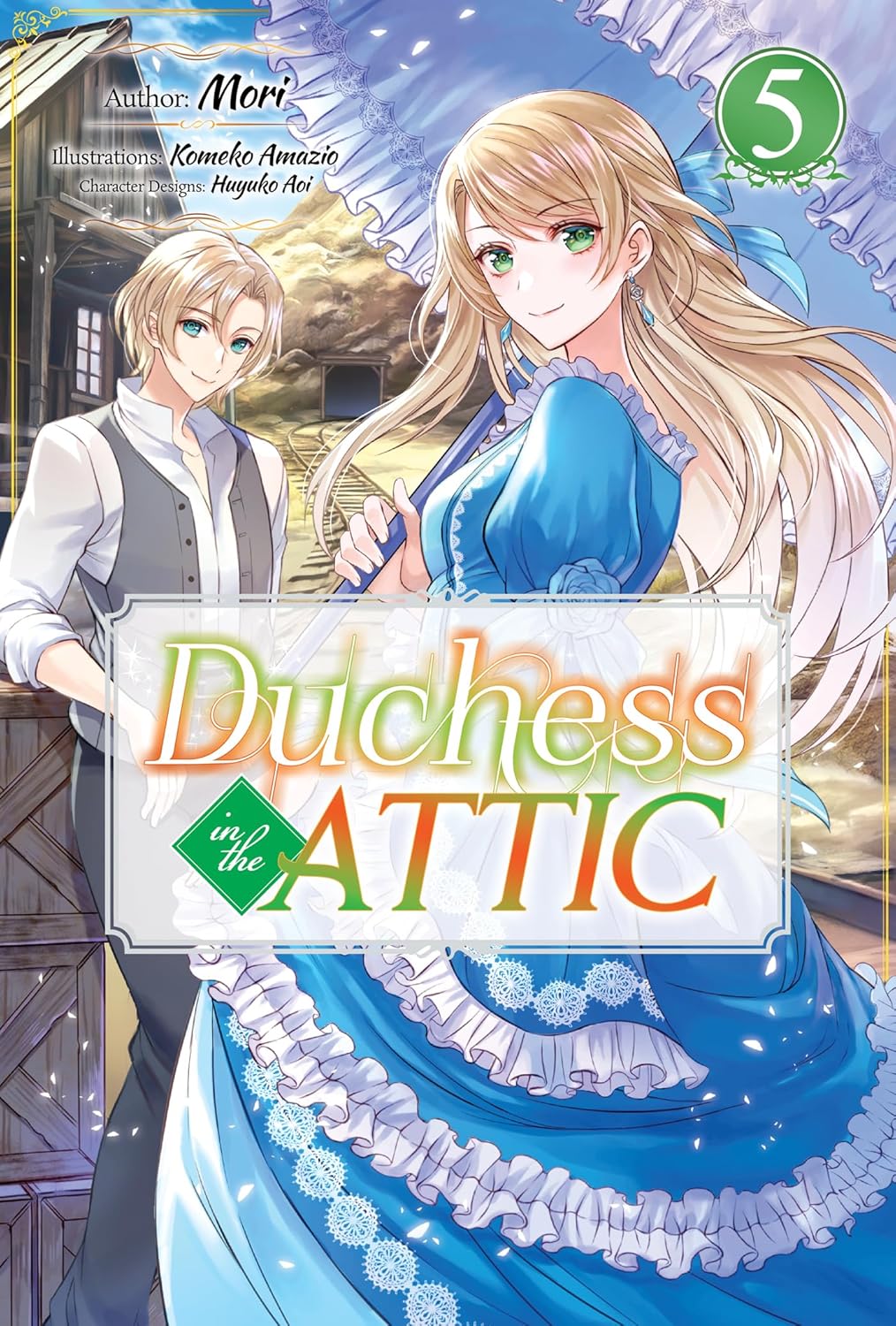
Duchess in the Attic, Vol. 5

February 10, 2026 by Sean Gaffney

By Mori and Huyuko Aoi. Released in Japan as “Yane Urabeya no Kōshaku Fujin” by Kadokawa Books. Released in North America by J-Novel Heart. Translated by piyo.

So you’re a writer and you have a problem. You’ve introduced a naive idealist who has no idea how the real world works, and who tends to be easily led. Over the course of the book, your lead character manages to educate them on how things should be done and how they’re the ones to do them. Which is great, now the character knows better and is ready to contribute to society. And yet, your book can’t really happen when everyone is being relatively savvy. It’s time to introduce relative of naive idealist, who’s twice as bad and twice as stubborn. If your book is for guys, be sure to make the second character a woman, preferably blonde. If it’s for girls, then be sure to make him handsome but dumb. So dumb. We want to be able to see the wind whistling through his head. And if you really want to go all the way, just make him a trainspotter. Sure, American readers might not get the type. But Brits sure will.

Opal is back in Lumeon, there to celebrate Ellie becoming the new grand duke. Unfortunately, while Opal now knows that Ellie has grown up and is ready to become a fine ruler, this has not filtered out to anyone else in the country. As such, Opal and her brother Julian (Claude, alas, stays home this book to take care of the kid) do their best to show how Ellie has changed and make the path to her… whatever coronation is for dukes… easier. Julian is also there to be a sexy noble hitting on Ellie and romancing her, because they still don’t know who was behind her kidnapping in the last book. The prime suspects are her uncle, who doesn’t really have a motive, and her cousin, who is… well, see paragraph above. As such, the bulk of this book is a mystery rather than a thriller as Opal and Julian try to work out the why and how of all the cunning plans the enemy has.

Yes, we again open in an attic to make the title work, but once again, it’s just as a nostalgic show – Opal does have her life threatened twice in this book, but both times it’s in the open, so attics are not in play. I did call this book a mystery, but the mystery is not really that hard – hrm, could it be the guy who’s always looking shifty and evil? – so the real reason to enjoy this is to see Ellie continue to gain experience and confidence, her cousin Michael be dumb as a stump (his obsession is trains, but as Opal soon shows, he’s not an expert on them either), and Julian be a charming asshole most of the time, usually on purpose to incite others to show themselves. As with Book 1 and Book 3, you could theoretically end the series here, but technically Ellie isn’t in power yet, so I’m sure Opal will be back soon.

This continues to fit the definition of “solid”.

Filed Under: duchess in the attic, REVIEWS

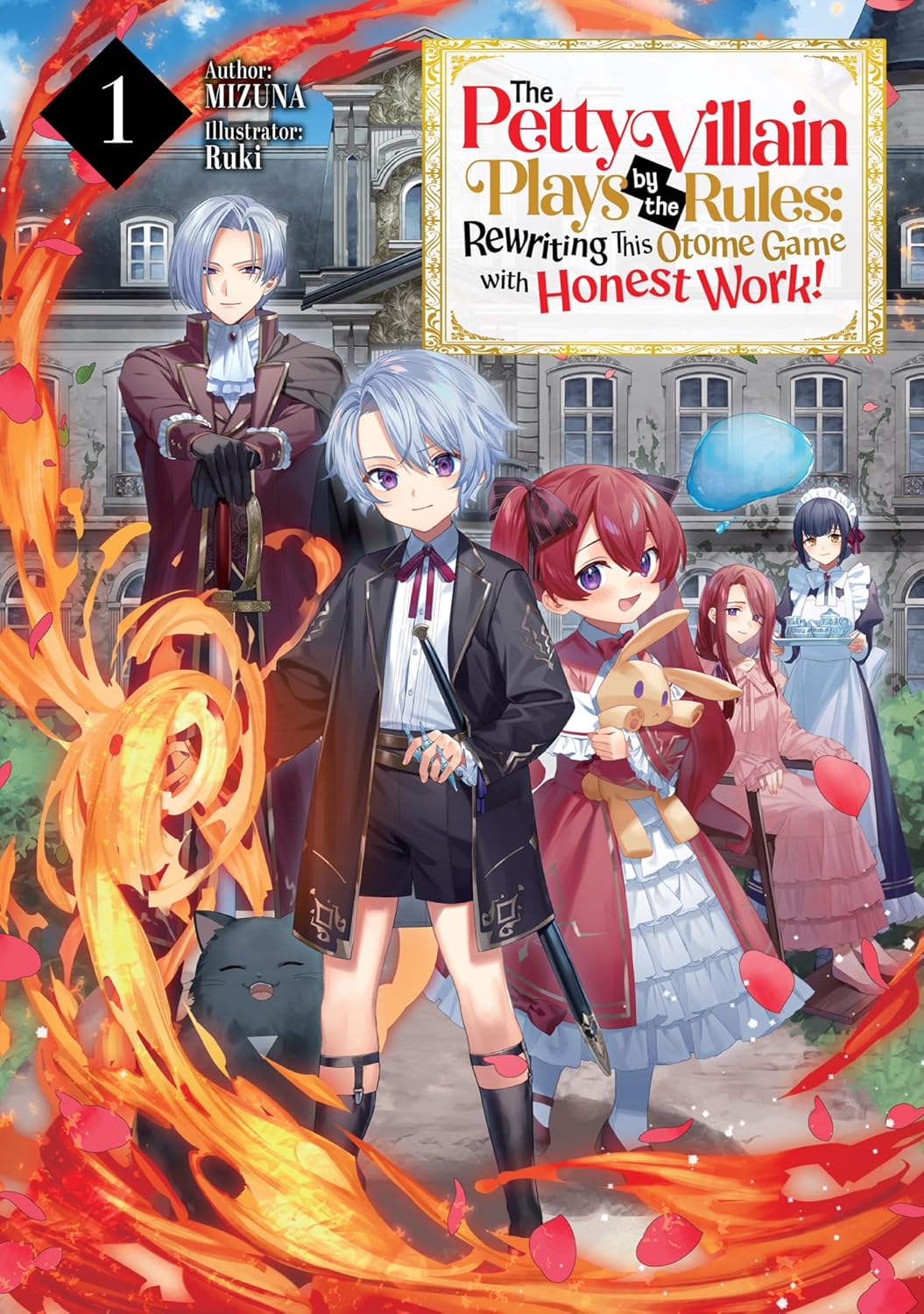
The Petty Villain Plays by the Rules: Rewriting This Otome Game with Honest Work!, Vol. 1

February 8, 2026 by Sean Gaffney

By MIZUNA and Ruki. Released in Japan as “Yarikonda Otome Game no Akuyaku desu ga, Danzai wa Iya nano de Mattou ni Ikimasu” by TO Books. Released in North America by J-Novel Club. Translated by sachi salehi.

I kept waiting for this one to go wrong, and it never really managed to. Oh, it flirted with going wrong a few times, but for the most part this book was content to stay in its lane and do what it came here to do, which is be another one of those “reincarnated as a kid and I revolutionize the entire country with my inventing basic modern conveniences” genre, of which there are quite a few. Our main character learns magic. He invents hand lotion and conditioner. He invents radio calisthenics. And while he doesn’t immediately manage to cure a dread disease plaguing his family, he does manage to find a palliative cure, which sometimes is all we can do. There are elves. There are dark elves. There are beastgirls. There are petty noble jerks. There’s a empress who has all the real power. Hell, our hero even gets married at six years old, which comes as a surprise even to him. It’s got everything.

J. Random Salaryman discusses the otome game he just finished with his co-worker, heads home, and has a heart attack and dies. He wakes up in the body of a 6-year-old who is also recovering from collapsing in the garden, and startles everyone around him by being polite and sensible. Then he realizes that he’s in the young body of Reid Valdia, who… was barely in the game at all, at least until you cleared it all and got the chance to free play, whereupon you realize he had amazing things he could do if only he raised his base stats… which he didn’t. Turns out the reason he didn’t is his mother is dying, and he’s been too busy appalling everyone around him and throwing a massive tantrum. Now that he has new memories, he can make up with his sister, treat the maids and knights well, and also try to find a way to cure his mom. Among other things.

So, because it always gets asked, yes, there’s slavery in this world, but not in our main character’s empire. I’m sure we’ll be dealing with it eventually, but at least he clears the low bar by saying “let’s NOT use a slave” here. There’s also Reid forming a cute little crush on the hot elf that he hired to sell his products, though I could do without the comedy “everyone gets mad at me” part of that, as well as the hot elf’s reaction to the whole thing, which is “I’m reacting like a lovestruck teenager because I forgot he’s six.” To be fair, he doesn’t ACT six. One of the better scenes here has his father essentially straight up ask “what the hell happened, why are you different?” and Reid telling him the truth. I also liked the “like father like son” comparison, as we see Reid rescue a lost cute girl who later turns out to be someone important, and in a side story at the end we see his father rescuing a young woman from ruffians.

Oh yes, and the Empress is awesome. This is not going to set any “wow, this plot is original!” records, but it does what people want, and it does it pretty well. I’ll read more.

Filed Under: petty villain plays by the rules, REVIEWS

Tearmoon Empire, Vol. 16

February 8, 2026 by Sean Gaffney

By Nozomu Mochitsuki and Gilse. Released in Japan as “Tearmoon Teikoku Monogatari” by TO Books. Released in North America by J-Novel Club. Translated by Madeleine Willette.

It’s been a long time since the last volume of Tearmoon Empire, so it feels good that this volume was a lot of “here’s what you remember best about the series”. Lots of snarky narrator, lots of Mia thinking of a selfish reason to do something only for everyone around her to take it as the noblest reason ever (even when she literally says “I do things for myself”). Some lovey dovey stuff with her and Abel. And of course the ongoing plot, which is… erm, let me check my notes… or right, Princess Orania, who seems to only care about fishing, and Mia’s attempts to befriend the hell out of her. Which naturally end up interacting with her kingdom, a civil war, preventing another terrible future, and those pesky Chaos Serpents. Though honestly, to the Chaos Serpents, Mia is proving to be even more pesky, and they’re rather annoyed that she keeps showing up right before they enact their evil plans. It’s almost as if she has a book that can see the future.

Tearmoon Empire plays in the larger ocean of both villainess books and time travel to fix the future books, so it’s not a surprise that Orania’s tragic backstory may ring a bell to fans of those books. When you’re in a political marriage but only one of you is actually in love, life can be difficult, and naturally that can mean projecting all your hopes and dreams onto your child. Fortunately, sometimes your husband takes pity on you and gets you another husband who loves you! And you can have children out of love and live happily now! Hrm? Your first daughter? Meh. Whatever. As you can imagine, this has pretty much broken Orania, whose father is of the opinion that she can do whatever, he doesn’t care. Well, until the cliffhanger ending of the book, which promises there’s more behind that… hopefully for the better.

As for Mia herself, she mostly has a pretty good book. Honestly, it’s Rafina who suffers this volume – first because she’s the only girly girl in the entire cast, and thus the only one horrified at the idea of handling the live bait involved in the fishing contest. But also because Mia a) tells her that there’s an active slavery ring going on, something that infuriates Rafina, but b) dealing with it means Mia will be absent from the Holy Eve Festival. Let’s face it, Mia has too many friends, all of whom want to monopolize her time. I’d suggest she find technology to clone herself, but I can only imagine what a disaster that would be. We’re sixteen books in, and it’s getting harder and harder to wrangle everyone together to do a thing. And sometimes she can be completely caught off guard, like with the ending of this volume. Yes, after a couple books that don’t end in the middle of an arc, we’re back to normal here.

Fortunately, we won’t have long till we find out how Mia gets out of thi… hrm? Short Story volume, you say? Ah well.

Filed Under: REVIEWS, tearmoon empire

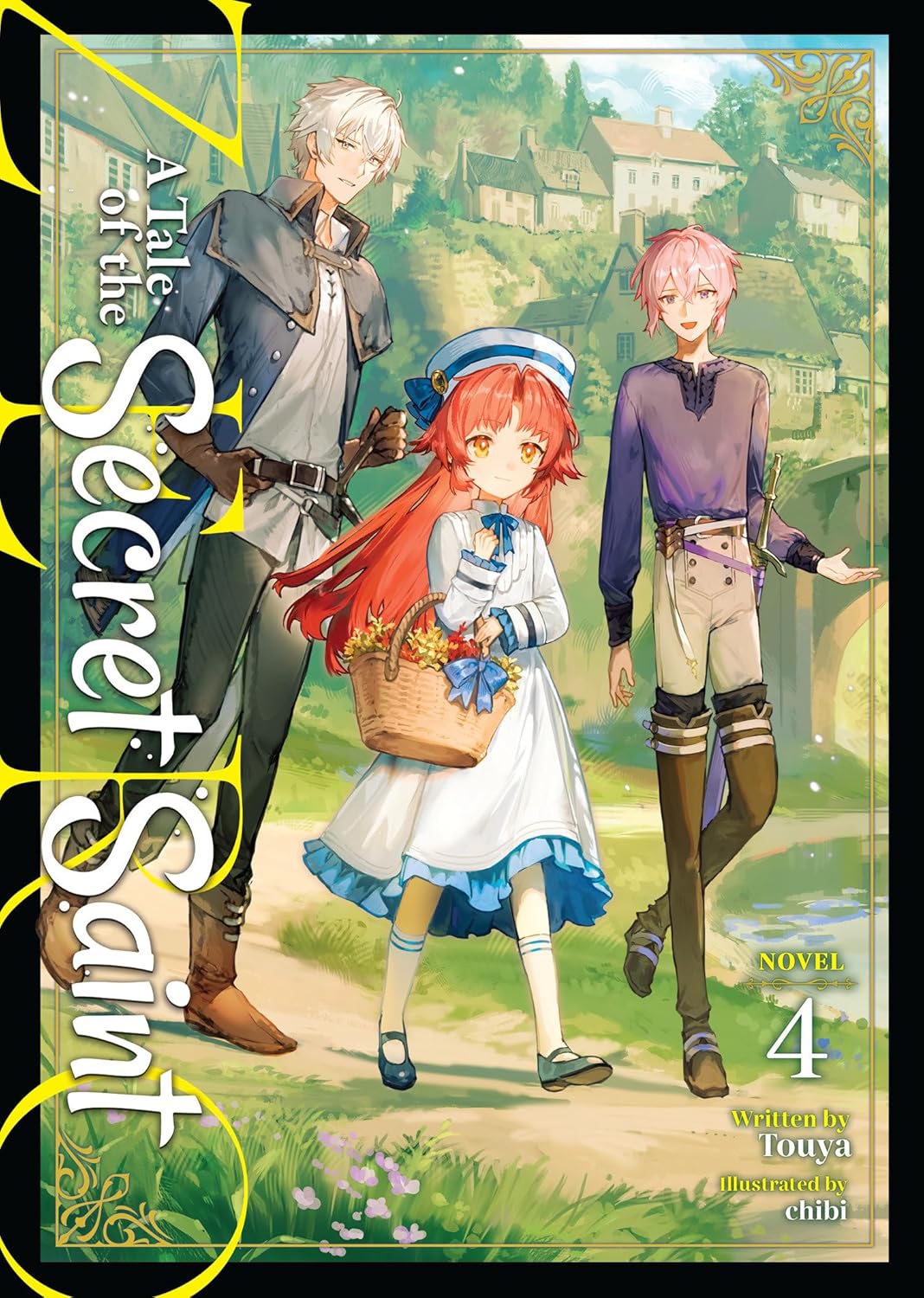
A Tale of the Secret Saint ZERO, Vol. 4

February 7, 2026 by Sean Gaffney

By Touya and chibi. Released in Japan as “Tensei Sita Daiseijyo ha, Seijyo Dearuko Towohitakakusu ZERO” by Earth Star Novels. Released in North America by Airship. Translated by Sarah Burch. Adapted by Melanie Kardas.

I sometimes feel that I’m the only one who tries to keep bringing back the dark beginnings to these series that suddenly turn out sweet and fluffy. Kuma Bear is not going to be reminding us of the darker side of its world much anymore. Likewise, A Tale of the Secret Saint is probably going to continue to gloss over the events that occurred after Serafina’s capture and before her murder. But it does sometimes make this prequel, featuring the adorable six-year-old Serafina and the knights and royalty who love her, a bit darker than it necessarily wants to be. A chunk of this book is dedicated to trying to get Serafina to live the life of a normal child… or at least a royal child. But that’s not who she is. She’s the one who will grow up to the the Greatest Saint, and is barreling towards that future full speed. And we, the reader, know where that future ends. (Yes, reincarnation, but let put that aside for now.)

We pick up where we left off, with Serafina’s terrible brothers in danger. As it turns out, this is a plot by the King to try and make them be a bit less lazy and take things more seriously. That said, there are an awful lot of monsters here, and with Serafina watching it all there’s no way she won’t leap in and help. Then it’s time for the other outstanding plot point from last time, the Galle Gold Leaf, which has been impossible to find for the last twenty years, but once Serafina is involved all the issues proceed to fall over like a stack of dominoes, and we even get all the past conflict with the village (and conflict within the knights) resolved. And then we have the third plot point from the last book – Serafina got a key from Oligor to Luntia’s secret room. Which turns out to be astonishing to absolutely everyone, but also promises this series may get darker in the future, tying back into its origins.

The other dissonance in this series is that between Serafina and every other saint. Fia, in the main series, is astonished at how little power the saints have, and that certainly seems to be true, the saints in her past incarnation seem to be more powerful. But even they pale in comparison to a girl who is beloved by the spirits, who is the descendant of spirit lords, and whose power is off the charts when she tries to do anything. In the main series that’s mostly used for comedy, because of course she’s the SECRET Saint, but even here where everyone knows who she is… mostly… it’s ridiculous. And I should also acknowledge the elephant in the room, which is that most of this prequel involves knowing that a grown man and a six-year-old girl are made for each other and destined. It’s not helped here by two other underage girls in the village grabbing one of the knights and saying he’s their chosen one. As always, reading light novels requires tripping over the whole “it’s not sexual it’s just moe” annoyances, and we don’t even get the usual “she’s really 900 years old” excuse here.

That said, this remains a sweet and fun prequel, free of “fanservice”, and does not appear to be in any hurry to get to Serafina’s teenage years, so I think things should remain that way.

Filed Under: a tale of the secret saint, REVIEWS

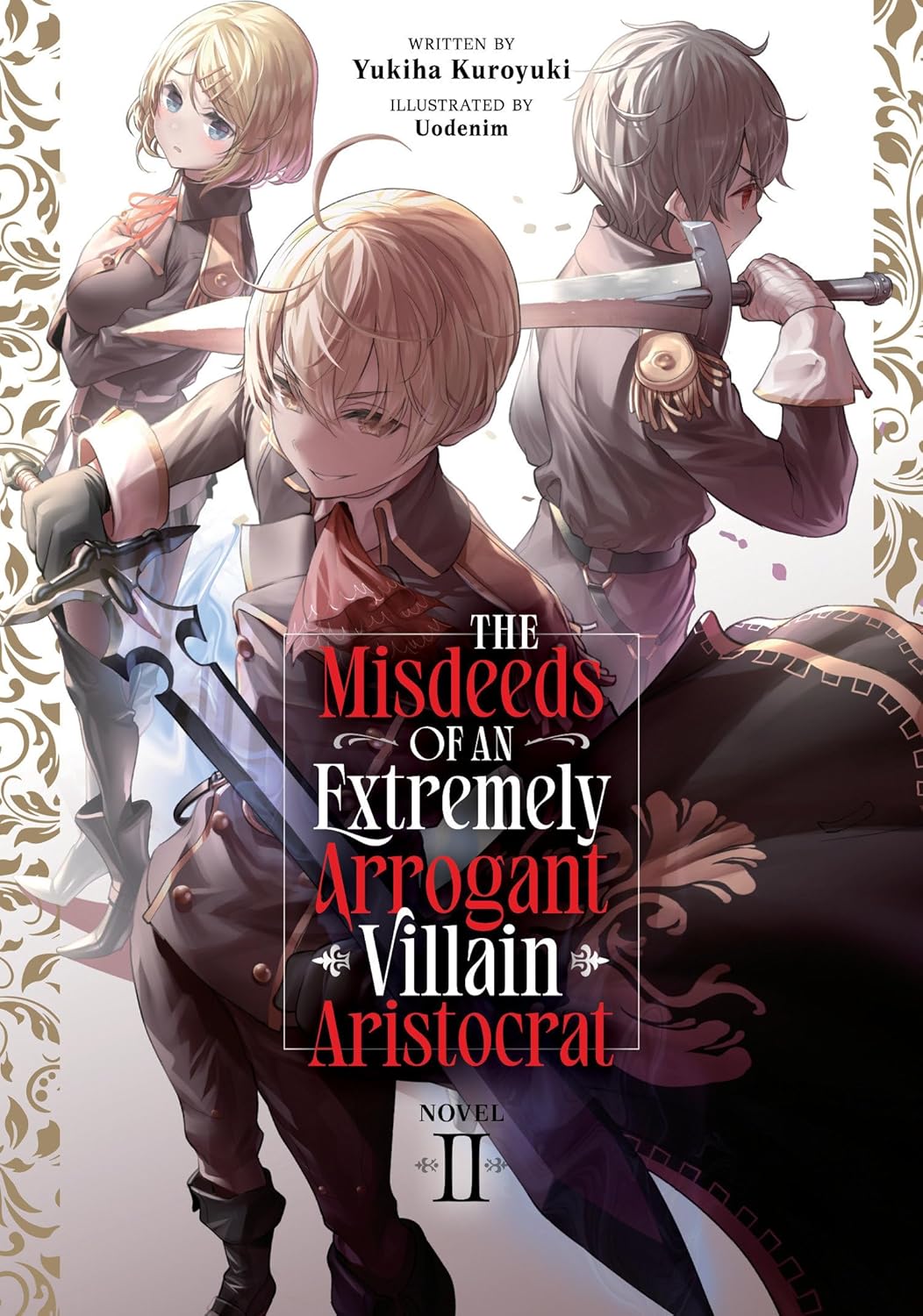
The Misdeeds of an Extremely Arrogant Villain Aristocrat, Vol. 2

February 5, 2026 by Sean Gaffney

By Yukiha Kuroyuki and Uodenim. Released in Japan as “Kiwamete Gouman Taru Akuyaku Kizoku no Shogyou” by Kadokawa Sneaker Bunko. Released in North America by Airship. Translated by Ben Trethewey. Adapted by Kylee Yasin.

I was checking the Sneaker Bunko site to see if this was ongoing (there is as third volume, but it came out a year and a half ago, so those who like to say “axed” will no doubt be happy) and glanced at the machine-translated summary of the third book, which described our extremely arrogant villain aristocrat as “depressed as a worm”. Now, that could be the usual translation bullshit, but it is true that Luke spends a great deal of this book frustrated, angry, or depressed. He’s certainly changed the book’s plot enough that he doesn’t need to worry about it happening, but bits of it that happened to Abel are now happening to him, and the allies that were supposed to flock around Abel are now flocking around him. And he really does not want anything to do with it. He wants to use his OP magic and his OP sword, he does not want all these “friends” and “lovers”. So troublesome.

After the events of the last book, Luke now has a lover, who he is now admitting is his fiancee, at least unconsciously. He also has a pawn, though he wishes he didn’t as he discovers that Mia is very emotionally volatile when it comes to being abandoned. (By the end of the book she too will be his fiancee, and Luke admits he doesn’t oppose it, mostly as he has a vision of her murdering him otherwise.) He also gets a second pawn by annihilating them in battle, and this one is the second prince, who in the book turned out to be a bit of a despot, but here is another loyal minion. Oh yes, and to top it all off assassins come to the campus and try to kidnap him while he sleeps. All of this is incredibly irritating. But worst of all… Abel, the hero, won’t stop saying that they’re friends!

I mentioned online that I called this “top-tier trash”, and I stick by that. It is a grotesque male power fantasy, where our hero and the reader stand-in gets all the women and beds them too, has the coolest magic, and swings the coolest sword. That said, I find it highly readable, as it doesn’t take itself at all seriously. Luke’s aggravation with his perfect life can be hilarious at times. He’s helped out by all the women he meets (except Lily, Abel’s childhood friend, who I fully expect will be the NTR final boss) running into his “fuck you” style of speaking and immediately going weak at the knees. We get his own childhood friend here, who’s aan arrogant noble whose family and his no longer get along. She’s rude to him… then gets in her carriage to drive off and fantasizes about how cool he was being rude right back at her. Hell, even the scary dragon he fights at the end ends up surrendering to him. It’s easy to be a top when your world is full of bottoms.

This will never win awards for plot, and you’d better have a high tolerance for the usual male fantasy bullshit. But it’s still a lot of fun.

Filed Under: misdeeds of an extremely arrogant villain aristocrat, REVIEWS

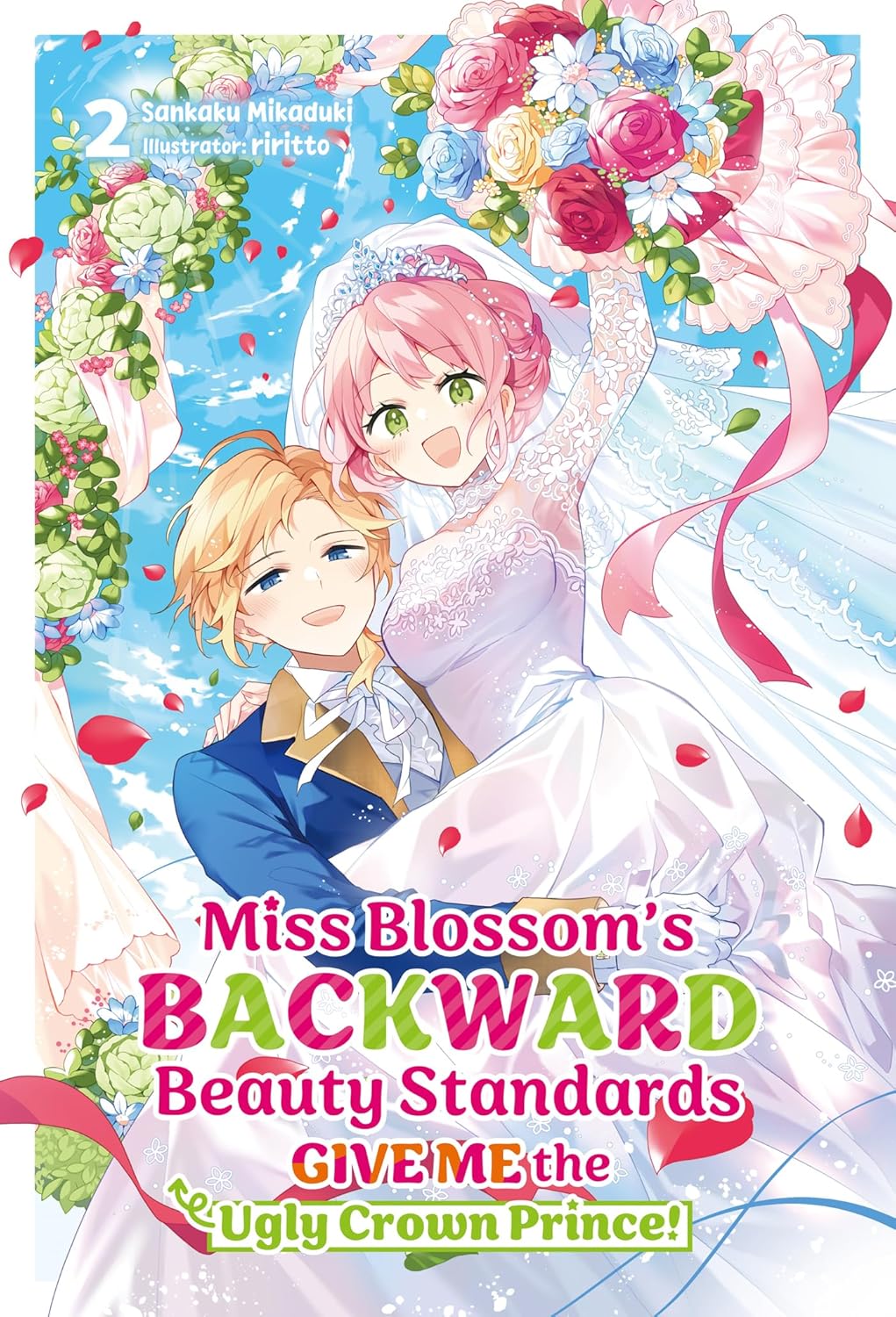
Miss Blossom’s Backward Beauty Standards: Give Me the Ugly Crown Prince!, Vol. 2

February 5, 2026 by Sean Gaffney

By Sankaku Mikaduki and riritto. Released in Japan as “Bishuu Abekobe Isekai de Busaiku Outaishi to Kekkonshitai!” by DRE Novels. Released in North America by J-Novel Heart. Translated by Olivia Plowman.

Sometimes all it takes is one hook. I was reading the second volume of this series, and it was… good. I wasn’t bored or anything, but I joked online that DRE Novels had told the author “you know how we give everyone three books? You get two.” This is indeed the final volume, as the cover no doubt gives away, but it’s also the second volume of a series that started with nobles as children, so we are obliged to do nobles at the academy. And while it’s using villainess tropes and time loop tropes, the only one with memories from Japan is Cocolette, our heroine. So when Pia Abbott arrived, like Cocolette I was puzzled, then vaguely irritated. What was up with her? WAS she one of those “I’m in an otome game!” sort of girls? And then we got a scene from her POV giving her backstory and motivation and, like Cocolette with her pretty boys, I started to stan. Pia, NOW you have my attention.

As noted above, the main cast are going to school, with all that this entails. Cocolette, though she’s smart enough, is not joining the advanced course with the others, but the Ladies’ Course, so that she can make connections with other nobles and gain education in how to be a queen for when she inevitably marries Raph. Unfortunately, others don’t buy that it’s inevitable. The current queen wants Coco to be a concubine, and for Lunamaria to be Raph’s wife… though she doesn’t seem to actually like Lunamaria at all. Prince Ork is still pining for Coco, so she’s still technically a potential fiancee to both princes. And there’s a foreign prince at the academy, this one with a face like a goblin. Naturally everyone loves his ethereal beauty except Coco. And yes, there’s Pia, who seems to be behaving just like the heroine in an otome game… though it’s not really working, much to her frustration. Can Coco navigate all this and get her happy ending?

As I said, the moment it was revealed that Pia was not an idiotic evil heroine with no sense, but a cynical yandere spy who by 2/3 of the way through the book just wants to get away from everyone at the school, I wanted to stand up and cheer. I love a good bitter bitch, which is exactly what she turns back into after she’s arrested. I also liked how her mysterious charm power really is a mystery, because for once this kingdom mostly is without magic, much to their chagrin. It also made it acceptable that in the end she essentially gets off scot-free, as they need her as a lab rat to study, and Coco knows that her obsessive love means she won’t just run away. The rest of the book is more normal, mostly driven by Cocolette’s desire to be surrounded by bishonen contrasting with everyone thinking she’s the greatest thing since sliced bread for hanging around them all. It’s funny, but not as funny as the author thinks.

Fortunately, they all live happily ever after, except maybe for the goblin prince. Decent enough.

Filed Under: miss blossom's backward beauty standards, REVIEWS

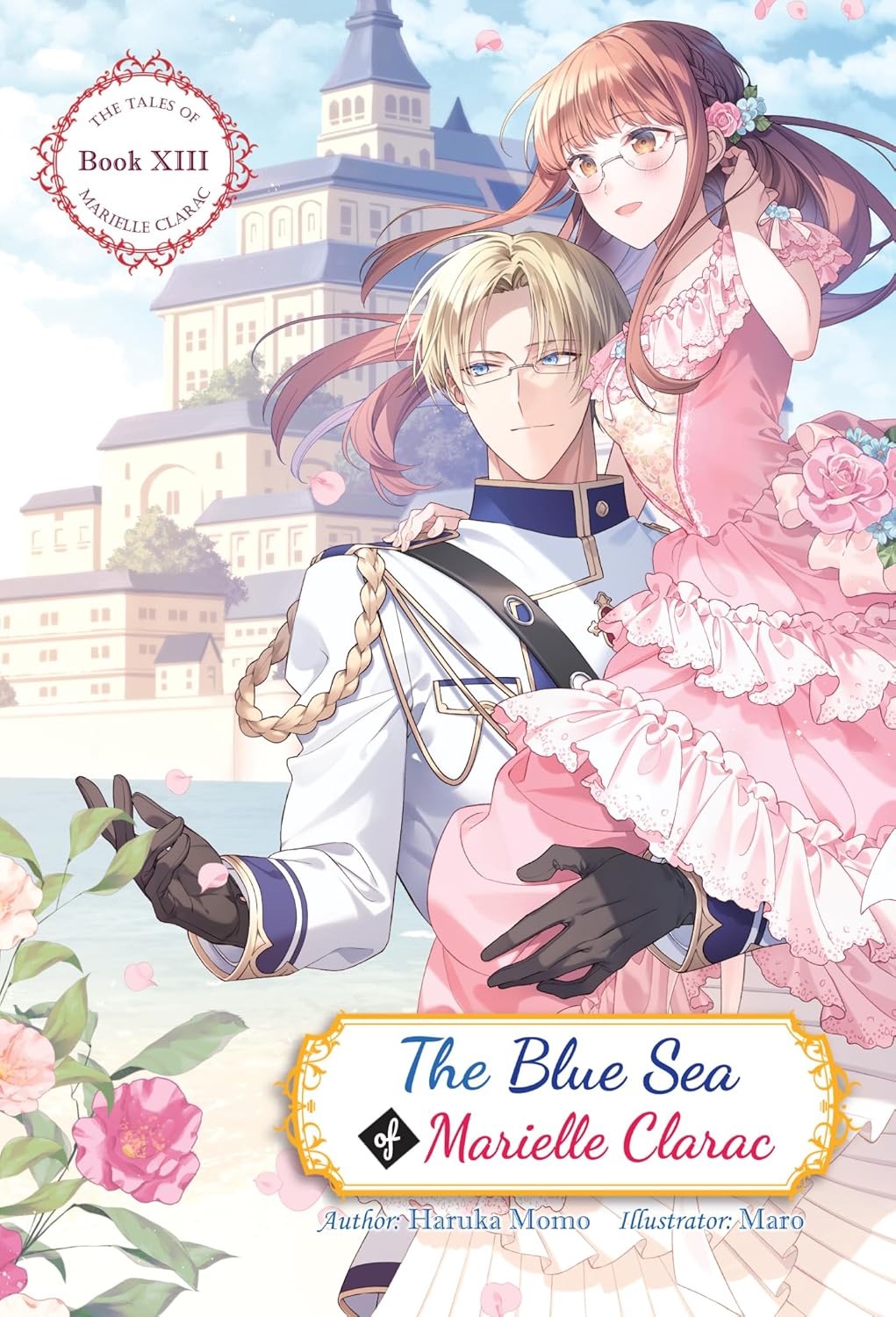
The Blue Sea of Marielle Clarac

February 3, 2026 by Sean Gaffney

By Haruka Momo and Maro. Released in Japan as “Marielle Clarac no Sokai” by Ichijinsha Bunko Iris NEO. Released in North America by J-Novel Club. Translated by Jasmin Thairintr.

I’ve been mentoining for a while now that I thought this author was in a bit of a rut. They have a successful series and want to continue it, but they also clearly do not want to go down the baby route at all, they’ve pretty much been doing a series of weddings and engagements with a coating of political intrigue. And that certainly seems to be the case at the start of this one, as we nudge ever closer to (but still have not quite arrived at) the wedding of the Crown Prince. That said, I think the lightbulb has finally gone off, as the coating of political intrigue we’ve had for a while has become the point, and the author flat out says in the afterword that we are headed for War. That would certainly give the cast something to do that doesn’t involve Marielle popping out a kid. Assuming that she’s able to survive till it happens, as I joked that this volume could also be titled The Execution of Marielle Clarac.

As Marielle desperately tries to write before her deadlines pass, she gets a disturbing letter from her husband that says to ignore any rumors she might hear… and this is followed by an invitation from the prince to a royal ball they’re holding that evening for the Crown Princess of Vissel. A wary Marielle shows up, only to find that the princess is throwing herself at Simeon to an almost ridiculous degree. That said… something definitely seems off about it. Marielle’s people-reading skills come in handy, and she soon gets an apology from the princess… who does not actually explain why she’s cuddling up to Simeon, only apologizes for it. (The answer, as it turns out, involves possibly the most misogynistic ass we’ve met in this series to date.) Unfortunately, Marielle soon finds other things to worry about: someone keeps trying to kill her.

Given that the last book had everyone in the cast assume that wherever Marielle goes, trouble follows, I had wondered if a clever villain might try killing her off in order to stop her amateur sleuthing. That’s not what’s happening here, though it might be better for her if it was. As it is, she’s simply someone who is very beloved by most of the important people in her kingdom, and killing her off would be a very easy way to start a nasty war. Which other countries clearly want. There is a bit of hemming and hawing here about the fact that their kingdom has colonies, and that sometimes those colonies rebel and have to be put down. (We have in fact seen this sort of thing before in this series.) Marielle knows it’s bad, as does the prince, but magic wands are in short supply. The climax of this book, meanwhile, is very action packed, and shows Marielle having a crossover with one of Tearmoon Empire’s iconic characters, and not in a good way. Fortunately, she is saved, but it’s probably the closest she’s come to death in this series.

All this and we finally get the resolution of a minor plotline that’s been around since the first book… and one which impacts Marielle’s family in a big way. The next book just came out last month in Japan, though, so get ready for another wait.

Filed Under: marielle clarac, REVIEWS

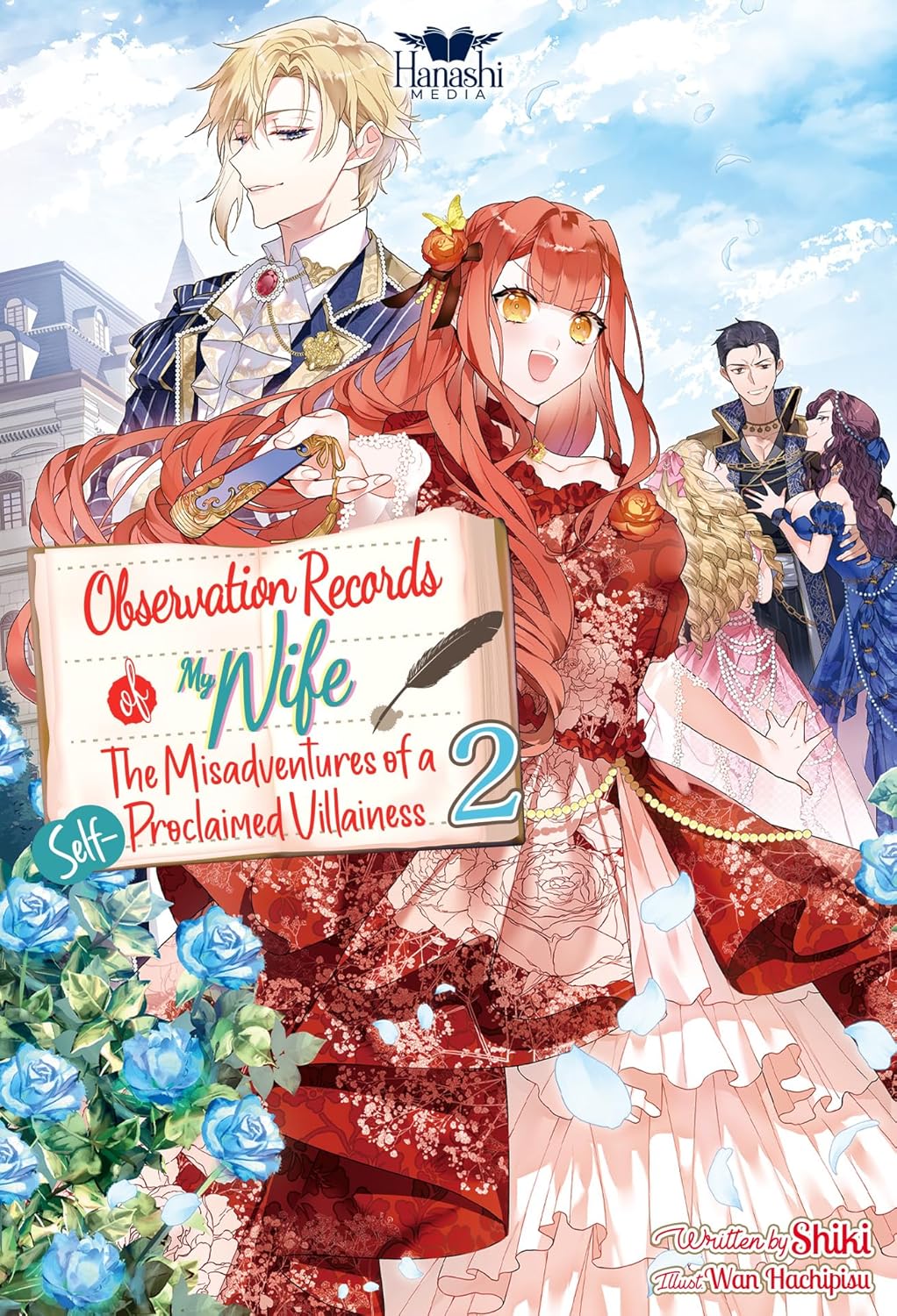
Observation Records of My Wife: The Misadventures of a Self-Proclaimed Villainess, Vol. 2

February 3, 2026 by Sean Gaffney

By Shiki and Wan Hachipisu. Released in Japan as “Jishō Akuyaku Reijō na Tsuma no Kansatsu Kiroku” by Regina Books. Released in North America by Hanashi Media. Translated by Ethan Holms.

Villainess stories generally tend to either be narrated entirely from the perspective of the villainess herself, or they do that thing where we get her POV for a while, then we get the POV of all her love interests going over the same ground from their perspective (see Bakarina as an example). This series, on the other hand, is entirely from the POV of Prince Cecil, which works very well, not only as he’s easily the most interesting character in the series, essentially an evil villain who has never had the “this is when I became a villain” moment, but because he does not have the memories of otome games and shoujo novels and all the other things that Bertia has that makes her act… well, “more” eccentric would be an accurate phrase. But this also means that, because he’s merely dealing with a particularly stupid foreign prince, he doesn’t realize why he’s so stupid till the final scenes of the book.

Cecil and Bertia are still in Seahealby, having spent the last book trying to heal the awkward, poor relationships between the crown prince and his fiancee and the second prince and his fiancee. Unfortunately, that leaves the first prince, and he proves to be a real piece of work. Things are not helped by Bertia, drunk off the sake that she gifted the crown prince and his wife at their wedding, accidentally giving some to a snake spirit who turns out to be the country’s god. Now the god is obsessed with Bertia, and so is the first prince, who seems to assume that Cecil and Bertia are merely tolerating each other, so essentially says to him “let me marry your wife and take her off your hands”. Cecil then destroys the entire country and kills everyone in it… well, no, but he does get very angry indeed.

I’ve said it before and I’ll say it again: Cecil is essentially a sociopath with minimal empathy whose sole chain linking him to being a good person is his wife, whom he adores. Every time that he gets angry because something is happening to Bertia, everyone around him recoils in horror, as his face is that of someone about to commit murders. He’s even warned not to go to Bertia right away as he’ll terrify her. That said, their relationship is mutual – thanks to the first prince’s manipulations, Bertia has a meltdown when she believes Cecil might abandon her, and he has to reassure her. There’s also a nifty twist at the end, not just because of why the first prince is the way that he is, but the fact that the shoujo novel Bertia was thinking of happens two years LATER than their current year. Once again, Bertia makes everything better by accident.

The next volume should be out after the anime premieres, and we’ll see if the anime helps or hurts it. I’m enjoying it a great deal, at any rate.

Filed Under: observation records of my fiancee, REVIEWS

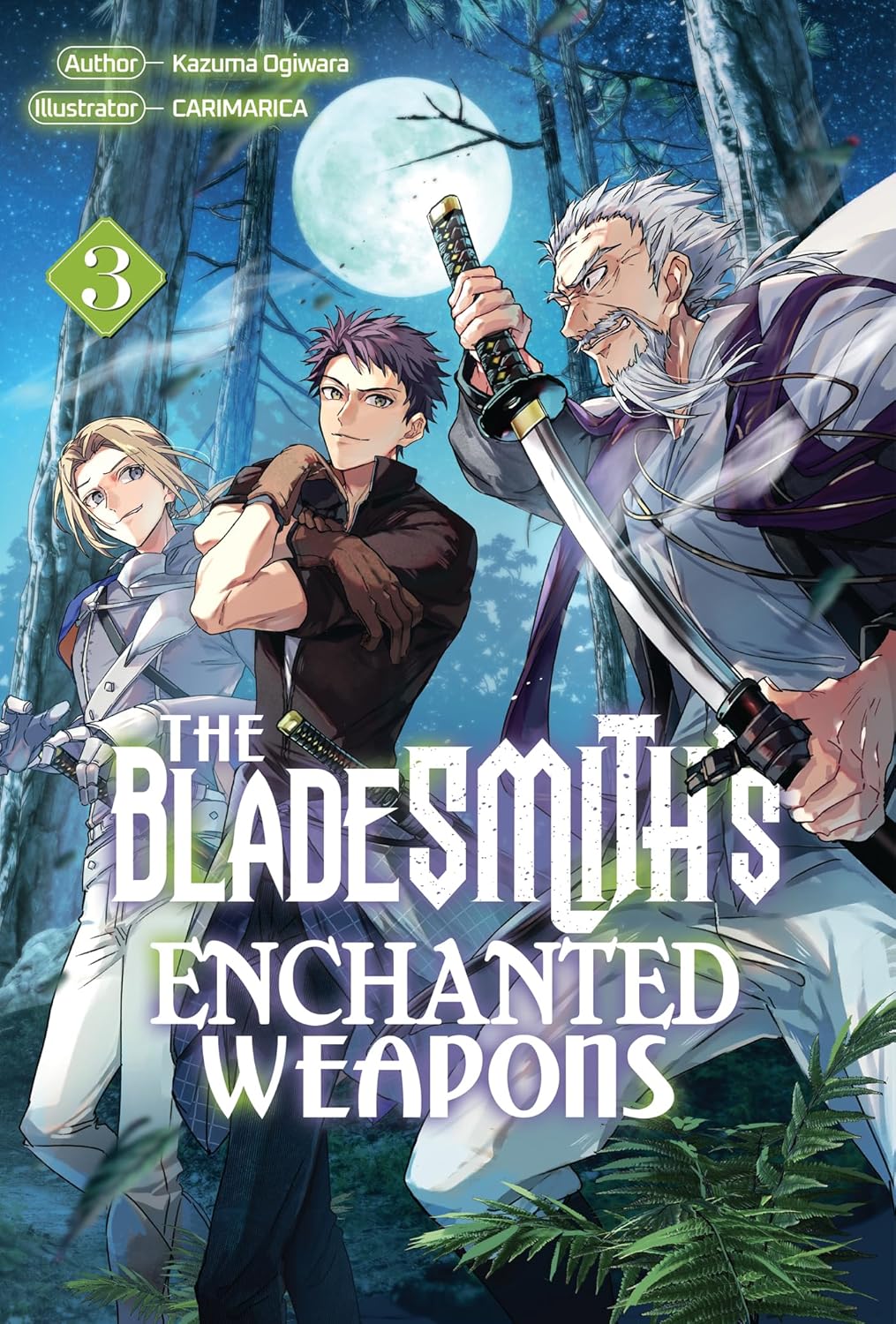
The Bladesmith’s Enchanted Weapons, Vol. 3

February 1, 2026 by Sean Gaffney

By Kazuma Ogiwara and CARIMARICA. Released in Japan as “Isekai Toushou no Maken Seisaku Gurashi” by Kadokawa Books. Released in North America by J-Novel Club. Translated by Ryan Burris.

We’re very used to seeing light novel titles where “the title is the plot” by now. They’ve become a joke now, usually involving a long title, a colon, and an even longer subtitle. The Bladesmith’s Enchanted Weapons does not have such a long title, but it falls under this category as well, as by now every volume’s plot has been set into motion by Lutz crafting a weapon, Gerhard enchanting it, and chaos accidentally springing from giving it to someone. The Japanese title translates a bit longer, but that also brings up something odd: it distinctly called Lutz an “isekai blacksmith”, but so far there’s nothing whatsoever indicating that’s true. Indeed, the third volume hammers home even more that Lutz’s father lived in this world and died in it. What seems to be the “isekai” part is simply that they’re making katanas, rather than the usual fantasy broadswords. The smithing technique is from another world… and it’s causing just as much of a mess as any potato-kun making mayonnaise does.

Last time I said I hope things would be a little better in the next book for Princess Listill, and I guessed I jinxed myself, as she really doesn’t have a good book. She’s on her way to visit Claudia, who she now regards as a big sister, when she’s kidnapped by bandits, who kill her guard knights and drive off the servants going with her. Given that she wouldn’t have been kidnapped if she weren’t going to visit Shander in the first place, the count sends an elite team to rescue her… and Lutz goes along as well, of course. She is rescued, and even manages to not get raped, because the bandits are ex-soldiers who were treated like murderers after the war ended, and are just trying to air their grievances before the king. Sadly, while their grievances are aired, the rumor mill is what it is, so everyone assumed the worst happened to the Princess, who is now “used goods”. And then things get worse.

In case you were wondering, rest assured Claudia is in this book a lot, and she and Lutz have a very active love life. She’s also good at strategy… though not as good as she thinks she is. I appreciated that the end of this volume showed that while Claudia is very clever, she still lacks experience and can be, as she disparagingly says, only good for her big, stupid butt. (Which is mentioned more than once – this author knows their audience). It’s not only her fault, though – Lutzx has got to start making katanas that turn everyone who gets them a bit crazy, because it’s starting to actually influence the politics of the region. And I didn’t even mention the secondary plot, a horror story where the dungeon in their domain has been seeing a lot of missing adventurers and a lot of mysterious jewels… or things that look like jewels.

This continues to be a series that you mostly read if you like watching guys acting cool. There’s a lot of that here. I quite like it.

Filed Under: bladesmith's enchanted weapons, REVIEWS

I’ll Become a Villainess Who Goes Down in History: It Seems Turning into a High-Born Baddie Makes the Prince All the More Lovestruck, Vol. 3

January 31, 2026 by Sean Gaffney

By Izumi Okido and Jyun Hayase. Released in Japan as “Rekishi ni Nokoru Akujo ni Naru zo: Akuyaku Reijō ni Naru hodo Ōji no Dekiai wa Kasoku suru yō desu!” by B’s-LOG Bunko. Released in North America by Yen On. Translated by Sarah Moon.

She’s not in this volume much, but I will admit I have started to wonder what this series is going to do with Liz. For the most part, these sorts of “the good villainess is balanced by a bad heroine” style books tend to overbalance the heroine into being genuinely evil, or incredibly incompetent, etc. It’s easy to see what’s going to happen to them. Liz is not quite like those in that she’s charming people into loving her, but not deliberately, and it’s basically causing folks to affirm her own misplaced idealism. Unfortunately for her, the rest of the cast really hate her, and I’m fairly sure that exile is probably going to be her best outcome here, and genuinely snapping may still be on the menu. Sometimes you’re just the wrong archetype in a book that’s about someone else. Speaking of what someone else, let’s check in on Alicia.

Alicia wants to investigate Laval, but she can’t simply take a field trip into another country, especially when their own country is chock full of magic users and Laval doesn’t have any of them. So she’s going to have to figure something out. Fortunately for her, Duke suddenly loses all his memories of her, and everyone around says that she’s the one who did it – something which she leans into almost on impulse, because she literally cannot resist trying to be a drama queen. Hey, presto, she’s exiled to Laval so quickly that you’d almost think that it was a deliberately ploy on the part of Duke. She arrives disguising herself as a boy and quickly ends up part of the knights who work for the second prince, who is trying to find an achievement that will let him take the throne. An achievement that may need… magic.

It is sometimes interesting seeing the narrative through the eyes of Alicia, who is living it as if she’s the protagonist of a light novel and to whom dramatic events constantly happen, and the rest of the cast, who are actually part of reality and are forced to deal with the darker bits that Alicia touches upon but rarely stays long. The reunion of the king and his brother is agonizingly awkward, especially when you consider that a lot of the cause of their strife is, well, still around. Alicia may be delighted to be exiled, but for Gill it’s a nightmare, and to make matters worse he’s at Duke’s side through most of the book, so he can’t even pine properly for the girl he loves because the much better love interest is next to him. As for Alicia herself, we’re rapidly finding out that she may want to be a villainess, and has been told to play a villainess, but she has a much more important hidden role. Which, well, Liz is not gonna like.

This isn’t top tier villainess, but it’s solid, and fans of the genre should be quite pleased.

Filed Under: i'll become a villainess who goes down in history, REVIEWS

Rascal Does Not Dream of a Dear Friend

January 29, 2026 by Sean Gaffney

By Hajime Kamoshida and Keji Mizoguchi. Released in Japan as “Seishun Buta Yarou wa Dear Friend no Yume wo Minai” by Dengeki Bunko. Released in North America by Yen On. Translated by Andrew Cunningham.

And so the Rascal books come to an end (leaving aside any short story or side story collections) with a volume just as short as the previous one. The main conflict from the last few books gets solved fairly quickly and easily, so much so that we realize that it was a fakeout, and we’re right, as the real conflict is with Sakuta himself. Well, that and maybe the publishers. I’ve talked before about how the series has always felt a little artificially extended after the 9th book, and that Sakuta in college but still dealing with all the Adolescent Syndrome stuff felt tacked on. Turns out Sakuta agrees with me – no, not the Sakuta we’re familiar with, but his alternate-world “perfect” Sakuta, who has come by to let him know that there are many and infinite alternate realities around them, and they all think Sakuta sucks, because he’s managing to break all of them.

When we last saw Sakuta, everything was terrible as Mai announced to the world that she was Touko. Now he has to make things right, which involves getting deep into the heart of Miori’s relationship with Touko and why her repressed feelings are actually making things worse. This is resolved, and thanks to Mai doing a quick “this was all an April Fool” bit, no one believes that she’s Touko anymore (including Mai herself). Unfortunately for Sakuta, all the OTHER reality-altered dreams are still present and correct – there are two Kaedes, Yuuma is dating Rio, etc. As it turns out, Miori is more than just the last in a string of women Sakuta has to help, she’s a dimensional nexus point of sorts. While everyone else has alternate versions of themselves (which we’ve seen with the alt-Sakuta), there is only one Miori. That said, most of this has little to do with Sakuta’s actual problem – how does he fix everything?

Despite the fact that this seems like the 15th book in a row where Sakuta takes a lot of public transportation lovingly described until a solution occurs,. there are things I really enjoyed here. Touko’s final song being a palindrome made it very life affirming, and I wish Miori luck in finding a Touko who isn’t dead. I also liked Sakuta’s discussion with the alt-Kaede, and her own simple solution to his “problem”. His problem is phrased as “grow up”, and the solution is pretty neat, and ties into something we’ve known about Sakuta from the very start – I appreciate how this fixes everything. The biggest issue with the book, and possibly why the last two were so short (well, that and artist illness) is that it’s padded out. Sakuta goes round in circles a lot here, and at one point takes us on a tour of iconic Rascal Does Not Dream locations. Like his alternate self, I wanted Sakuta to get with it and solve everything, not mope around.

The book ends with an epilogue set two years later, with stuff I really liked as well as a few things I’m eeeeh on (why do people love student/teacher relationships? Who are not students?). Sakuta and Mai are still exactly the same as before only with all their issues resolved – sorry, no engagement, marriage, or honeymoon scenes. Basically, everyone has grown up. Rascal went on too long, just like its hero, but I liked it a lot.

Filed Under: rascal does not dream, REVIEWS

The Magical Revolution of the Reincarnated Princess and the Genius Young Lady, Vol. 8.5

January 27, 2026 by Sean Gaffney

By Piero Karasu and Yuri Kisaragi. Released in Japan as “Tensei Oujo to Tensai Reijou no Mahou Kakumei” by Fujimi Fantasia Bunko. Released in North America by Yen On. Translated by Haydn Trowell.

Ah, the good old .5 volume. This one even helps us out by telling us where most of the original short stories were seen – they were in Fujimi Shobo’s Dragon Magazine, which frequently has short story extras for its popular series. This is good news, as it means they’re all chunky short stories written for an attentive audience, rather than, say, the “these are all 2-3 page stories written for bookstore giveaways” short story volumes. In fact, I’d say this is just as strong as the regular volumes, and some of the stories I’d call essential. They mostly, with the exception of the first, examine life after Euphie takes the throne, and deal with the fallout of what comes from that. As we saw in the last volume, it’s still ongoing and nasty, and is destroying a number of families and lives. That said, we know where our sympathies lie, because the families whose lives are getting destroyed are trying to marry Euphie off to a man and still hate Anis.

The stories: 1) Near the start of their relationship, Anis shows Euphie how she collects spellstones, and they have a nice bath and are attracted to each other; 2) Anis tries to repair her relationship with her mother, which is difficult as they’re both very awkward and blame themselves for everything that happened between them; 3) Ilia’s family has gotten rid of her abusive parents, and are trying to get her to come back to them and marry her cousin, but Lainie isn’t going to let that happen; 4) in an original story for the book, Anis tries to ruffle Euphie’s coolness by being her maid for the day; 5) We get Tilty’s backstory as she tries to avoid reconciling with her father; 6) Halphys is getting married but a surprise succession change may mess things up for her at the last minute; 7) In another original story for the book, Euphie asks Anis if she can sometimes wear nice dresses and actually socialize.

The relationship between Anis and Euphie has always tried to toe the line between “codependent, but in a good way” and “codependent, but in a terrible way”. There’s a scene in Halphys’ story where a noble admits he’s abdicating simply as Euphie terrifies him, and given what happened in Book 8, I absolutely get it. Anis may get upset that Euphie always seems to be the dominant one in their love, but that’s more down to Anis’s embarrassment, whereas with Euphie being overly affectionate is how she holds on to what’s left of her humanity. The best story, I thought, was Tilty’s, where we meet her father and realize that they’re the classic case of two people trying to be considerate of each other who only end up hurting each other instead. It’s a must read if you like her character.

Hopefully we’ll get the 9th book a bit faster than we got this one. Another great volume in a series I really love.

Filed Under: magical revolution of reincarnated princess and genius young lady, REVIEWS

  • « Go to Previous Page
  • Page 1
  • Page 2
  • Page 3
  • Page 4
  • Page 5
  • Page 6
  • Interim pages omitted …
  • Page 346
  • Go to Next Page »
 | Log in
Copyright © 2010 Manga Bookshelf | Powered by WordPress & the Genesis Framework