• Skip to primary navigation
  • Skip to main content
  • Skip to primary sidebar
  • Home
  • About Us
    • Privacy Policy
    • Comment Policy
    • Disclosures & Disclaimers
  • Resources
    • Links, Essays & Articles
    • Fandomology!
    • CLAMP Directory
    • BlogRoll
  • Features & Columns
    • 3 Things Thursday
    • Adventures in the Key of Shoujo
    • Bit & Blips (game reviews)
    • BL BOOKRACK
    • Bookshelf Briefs
    • Bringing the Drama
    • Comic Conversion
    • Fanservice Friday
    • Going Digital
    • It Came From the Sinosphere
    • License This!
    • Magazine no Mori
    • My Week in Manga
    • OFF THE SHELF
    • Not By Manga Alone
    • PICK OF THE WEEK
    • Subtitles & Sensibility
    • Weekly Shonen Jump Recaps
  • Manga Moveable Feast
    • MMF Full Archive
    • Yun Kouga
    • CLAMP
    • Shojo Beat
    • Osamu Tezuka
    • Sailor Moon
    • Fruits Basket
    • Takehiko Inoue
    • Wild Adapter
    • One Piece
    • After School Nightmare
    • Karakuri Odette
    • Paradise Kiss
    • The Color Trilogy
    • To Terra…
    • Sexy Voice & Robo
  • Browse by Author
    • Sean Gaffney
    • Anna Neatrour
    • Michelle Smith
    • Katherine Dacey
    • MJ
    • Brigid Alverson
    • Travis Anderson
    • Phillip Anthony
    • Derek Bown
    • Jaci Dahlvang
    • Angela Eastman
    • Erica Friedman
    • Sara K.
    • Megan Purdy
    • Emily Snodgrass
    • Nancy Thistlethwaite
    • Eva Volin
    • David Welsh
  • MB Blogs
    • A Case Suitable For Treatment
    • Experiments in Manga
    • MangaBlog
    • The Manga Critic
    • Manga Report
    • Soliloquy in Blue
    • Manga Curmudgeon (archive)

Manga Bookshelf

Discussion, Resources, Roundtables, & Reviews

Reviews

Long Story Short, I’m Living in the Mountains, Vol. 1

May 13, 2025 by Sean Gaffney

By Asagi and Shino. Released in Japan as “Zenryaku, Yama Kurashi wo Hajimemashita” by Kadokawa Books. Released in North America by J-Novel Club. Translated by N. Marquetti.

As I’ve said before, I tend not to read the blurbs for books before I start them. As a result, I started this book assuming that it took place in some fantasy world a la every other isekai, with giant chickens being one of the commonplace things you see around there. Then our protagonist starts talking about getting TV and internet, and I reasoned, oh, hey, I was wrong, it’s just a normal Japan novel, only a bit weird. As the author states in the afterword, this turns out to not be correct either. This seems to be a strange mostly-Japan world, but with unseen gods, who seem to be selling mythological animals to anyone who happens to buy a mountain and be dealing with severe psychological issues. Does it work? Yes, mostly, though I think how much you enjoy this will depend on how much you like straight up “slow life”. This is not a slow life fake out, at least not yet. We’re here for the man and his birds.

Sano Shokei has just been dumped by his fiancee. It was a big enough thing, we find out later, that he got a sizeable payoff from her family as an apology. As a result of wanting to get the hell away from anyone who knows who he is and might pity him, he proceeds to buy two mountains and move to one of them. He also buys three checks that he gets at a spring festival, who weirdly have lizard tails. Also weirdly, they grow very big very fast, and they seem to like eating snakes. And bugs. And boars. Are they really chickens? What’s more, there are other mountains on either side of his, both of which are owned by someone fleeing a bad relationship and both of whom have animals that seemed to be normal but may actually be mythological monsters. But does it really matter in the end? They’re good birds.

The author straight up says in the afterword this is not going to have romance in it, which is a very good thing, I think, especially after meeting Sano and the other owners of the various mountains. At one point Sano wonders if he’s suffering from depression, and after seeing him through this entire book, putting down his appearance and personality and breaking down in tears when he gets drunk and thinks about his ex, I’d have to say yes. Aikawa, meanwhile, had a stalker after him for so long he has a violent fear of women (which makes it ironic that he has a lamia as one of his pets). And Katsuragi is prone to panic attacks and had an abusive boyfriend, though her behavior when she sees the very attractive Aikawa… as well as her behavior when she sees Aikawa’s friendship with Sano… suggests she may be the comic relief of this series. Well, when it isn’t the birds.

This is 8 volumes and counting in Japan, and a glance at future covers suggest it’s not really going to change from what it is. If you want to read a man tending his mountain with his giant chickens, this is right up your alley. If you’re not fond of the giant chicken genre, this won’t change your mind.

Filed Under: long story short i'm living in the mountains, REVIEWS

The Legendary Witch Is Reborn As an Oppressed Princess, Vol. 4

May 12, 2025 by Sean Gaffney

By Touko Amekawa and Kuroyuki. Released in Japan as “Shiitagerareta Tsuihou Oujo wa, Tenseishita Densetsu no Majo deshita: Mukae ni Koraretemo Komarumasu. Juuboku to no Ohirune wo Jamashinaide Kudasai” by Overlap Novels f. Released in North America by J-Novel Heart. Translated by Jeremy Browning.

This series has pretty much shown itself to be “mystery of the day”, with the main plot usually only cropping up near the end. We see Claudia and Noah go to a country that is having a problem, they investigate the problem, they solve the problem more or less, and they return to home base. That’s also what happens here, with some nice little twists to keep the reader guessing. And, unlike a lot of other light novels where the twists are obvious and meant to be so, these are actually hard to guess till almost the reveal. That said, we can’t quite get away from the main plot, and the fact that it’s been seven years since the start of the series, and Claudia is seven years older, and yet she still can’t use magic for extended periods without having to nap for days. Stronger steps are needed.

This book is essentially “Claudia and Noah do Arabian Nights”, though thankfully the problematic aspects that could arise from that are kept to a minimum. After being knighted by Claudia on his 16th birthday, there is an attack on the castle’s barrier by a raging griffin, who is taken down when it tries to attack Claudia… and promptly turns to solid gold. This prompts the two of them to head to the kingdom of Sharavia, a desert oasis which also has a legendary Golden Falcon that is apparently the savior of their kingdom… and might also turn things to gold. Unfortunately, on arriving there, they find the king has gone undercover to look for the treasure, which has been stolen… and he needs Noah to take his place as King. As for Claudia, she’s headed to the harem…

I did say “kept to a minimum”, not eliminated. There is a harem here, though, because this is still a romantic story for women to a degree, the king only has one true love that he visits – whether that’s the current king or Noah, of course. There’s also a grand vizier type, though the series cleverly tries to dance around how trustworthy he’s actually meant to be. He’s very good at chipping away at Noah’s stoic “I am merely my lady’s servant, there is nothing between us” exterior, pointing out (as so many light novel readers are quick to point out to supposedly asexual protagonists who say they’re not in love LOOKING AT YOU ROZEMYNE) that everything he describes about how he feels about Claudia is love. As for her, she’s far more explicit in saying she loves him, but that’s possibly as she’s still under the impression that eventually she will die and she wants him to live on without her. And honestly, given the cliffhanger ending of this book, that day may come sooner rather than later.

Now that we’re caught up on 7th Time Loop, the author’s other series, I’m pleased we still have a bit to go with this one. That is assuming the author does not kill of Claudia and just have 200 blank pages next time. Unlikely.

Filed Under: legendary witch is reborn as an oppressed princess, REVIEWS

Abducted Princess Running Rampant: Wielding Forbidden Magic in the Demon King’s Castle

May 11, 2025 by Sean Gaffney

By Hiroshi Nagamatsu and Tsubame Nozomi. Released in Japan as “Maou ni Sarawareta Kiyoshi Oujo desu ga, Maoujou Gurashi ga Hima datta no de Kinki Mahou de Abaremasu” by Fujimi Fantasia Bunko. Released in North America by J-Novel Club. Translated by Shaun Cook.

As I was about two-thirds of the way through this book, I wondered what it was about it that felt weird to me. I kind of hated the pacing, and thought that the author was getting distracted by having its heroine wander around rather than trying to advance the plot. Then, as I came to the very end, I realized the truth: this is only one volume. It’s pretty rare that we get a single volume series from JN-C, and of course it’s possible that they know something we don’t and it has a secret anime coming soon or a second volume in the works soon. But I kind of doubt it. There’s nothing in here that makes me want to read the further adventures of. As a one-volume series, this was OK. That abducted princess runs rampant, and then we all go out for tea.

Princess Mil Arphilia has valuable appraisal magic, and so she’s almost never let out of the castle by her overprotective father except under ludicrously heavy guard. Her dream is to be an adventurer, just like all the one’s she appraised over the years. But alas, her level’s not that great, as there’s a limit to what you can do fighting humans. Then one night, she’s abducted by the demon lord, who wants her… to do the exact same thing, only for his demon soldiers. At first, she’s delighted to see all these new species of demons she’d only read about previously, but gradually she starts to realize that she’s doing the exact same thing she did before, only with no other princess duties, AND she’s still trapped in a castle. Fortunately, surrounded by monsters, she can now level up seriously.

The best part of the book, in my opinion, is the second quarter, where Mil wanders around the castle and makes herself ludicrously strong and powerful because no one’s been told to watch over her closely. She also runs on “will this be really cool or not?”, so has no problems learning the darkest magic that can easily murder whole cities and think nothing more than “this will be handy when trying to get rid of today’s garbage”. After she inevitably escapes, thanks in part to a highly amusing demon whose mindset is “I am overly literal but only when it amuses me”, the rest of the book is less compelling, as she gradually visits various places and picks up new party members, including the shy sheltered mage, the gruff but lovable beast woman, and the demon lord’s daughter, who immediately gives off “I am a tsundere who is going to fall in love with the princess” vibes, so fast in fact that the other two comment on it.

Alas, one volume, so no yuri here. I don’t regret reading this, but if it does ever get more to it, I feel no real drive to get more of it.

Filed Under: abducted princess running rampant, REVIEWS

Love Between Fairy & Devil: Cang Lan Jue, Vol. 1

May 10, 2025 by Sean Gaffney

By Jiu Lu Fei Xiang. Released in China on the JJWXC website. Released in North America by Seven Seas. Translated by Yu. Adapted by Ivy Fox.

This one really took me by surprise. Partly as it’s a Chinese fantasy novel that isn’t danmei, a rarity for Seven Seas. But I had sort of expected the genre to be fantasy romance. Which it is, don’t get me wrong. That said, I would call the actual genre of this book “buddy film”. The author is a screenwriter, and it shows, as this really feels like it’s written to be adapted to the screen. (Indeed it was, and I suspect those who watched the Live-Action Drama may be surprised when they start the book.) The titular Fairy and Devil just can’t seem to shake each other throughout this entire volume, are constantly sniping at each other, and gradually develop a bond of trust. The fantasy is also pretty danm cool. As for the romance, well, the premise seems to invite the use of what some term the “manic pixie dream girl”, but I think this girl is a bit too much of a mess. Manic Pixie Nightmare Girl? Honestly, she’s Usagi Tsukino.

After a brief prologue, we open *after* the main plot development has already happened. (The live-action drama, which I watched part of after reading this, gives a lot more background to the main heroine.) Xiao Lanhua is currently sitting in a cell, in the body of the demon king, Dongfang Qingcang. Meanwhile, the demon king is in *her* body, and planning to escape. This, needless to say, upsets her just a bit, to the point where she slaps the demon king with the full force of her currently occupied body… killing her original body. After escape, the two of them are now BOTH in his body, Steve Martin/Lily Tomlin style, and have to each learn to operate one side. Needless to say, this leads to shenanigans which occupy the first half of the book. The plot arrives in the second half.

Not that there’s much of that. The plot appears to be Dongfang Qingcang slowly getting slightly less evil under the influence of Xiao Lanhua, and Xiao Lanhua learning more about how the world world outside of the very sheltered life that she has led. There are cool scenes with lots of fantasy explosions, and Xiao Lanhua does get some “wait, do I care about him or not” romantic tension. But honestly, the best reason to read this is that Xiao Lanhua is hilarious. She’s constantly snarking at Dongfang Qingcang, but she’s pretty pathetic when she tries to do anything without his help. She starts by murdering her own body by accident, then ends up in his own body, then a slowly rotting corpse, and by the time we’re near the climax of the book she’s reduced to an angrily screaming torso. It’s absolutely amazing, I cackled.

I’m not sure how many volumes this will end up – two or three sounds about right – but I’ll definitely read the next one, which I hope, even as things get more serious and we inevitably find out Xiao Lanhua’s secret origin, that we have time for more truly goofy slapstick.

Filed Under: love between fairy & devil, REVIEWS

My First Love’s Kiss, Vol. 3

May 9, 2025 by Sean Gaffney

By Hitoma Iruma and Fly. Released in Japan as “Watashi no Hatsukoi Aite ga Kiss Shiteta” by Dengeki Bunko. Released in North America by Yen On. Translated by Kiki Piatkowska.

(This discusses the final “twist” in this third and final volume of the series, but not till near the end.)

OK, I’ve calmed down a little bit from a couple hours ago, when I finished this book and was ready to not only tear into it, but also Adachi and Shimamura, and hell, toss Bloom Into You there as well, which the author wrote a spinoff to. But I am now thinking of that meme with the “dead dove do not eat” bag, and I will admit, after my experience with the first volume, and the fact that the second volume managed to somehow up the ante, I really should not have been that surprised at … MOST of what I read here. Most of what I read here is just an author who has decided to write a thought experiment rather than about characters, and also possibly saying “see? I could have turned Adachi and Shimamura into THESE two! Aren’t you glad I didn’t?”. (Oh yes, and there’s another stupid cameo from another of the author’s series I don’t know.) So we’re left with one thing so stupid I’m still angry.

We pick up where we left off, and honestly the rest of the book plays out so predictably – mostly – that I feel reluctant to even sum it up. After hearing that Shiho is her sister, Umi seems to fall EVEN HARDER for her, and decides to move out of the bedroom she shares with Takasora and into an apartment with Shiho. This is, mind you, after Shiho runs off while leaving her bag at Takasora’s house, which requires going to her rich estate to confront her. Takasora tries to stop this happening by grumping about it very hard, but by now Umi is not only aware that Takasora is in love with her but has started to actively reject that. Things are not helped by Umi confessing to Takasora: she plans to kill herself after graduation.

As I said above, I could have guessed most of this by the end of the second book. It is not exactly a surprise that Umi does not really care about any incestuous aspect of her relationship with Shiho. In fact, the fact that Shiho is also a family member – and one who actually explicitly loves her – sends Umi over the moon, really. I’m also not very surprised that the entire Umi suicide plot is left completely up in the air at the end, because, just as Adachi and Shimamura is really Shimamura with a bit of Adachi, these books have been about Takasora, not about Umi, so her own fate is irrelevant once Takasora gives up on her. I can even, very, very grumpily, accept the ending twist where, years later, Takasora has become another Shiho, preying on young students and breaking up their friendships with other girls. It’s thematically gross and terrible, but I can see how the author went “Oh, wow, what a great twist!” while cackling to themselves. No, the absolute DUMBEST thing in this book is Takasora slipping and hitting her head on a rock, and that head injury being signposted as to what made her “turn evil”. There was no need for that! You already signposted your shitty twist! There was no need to make it due to brain damage after talking to Yashiro and wiping out in the river! WHYYYYYYY?

There’s another Adachi and Shimamura due out later this year, and I’m wavering on whether I want to read it, especially since the author wrote the 99.9 volume giving the series a very definitive ending. But whatever it turns out to be, I hope to god they don’t feel a need to shoehorn in anything from this terrible series. There are much better toxic yuri couples out there.

Filed Under: my first love's kiss, REVIEWS

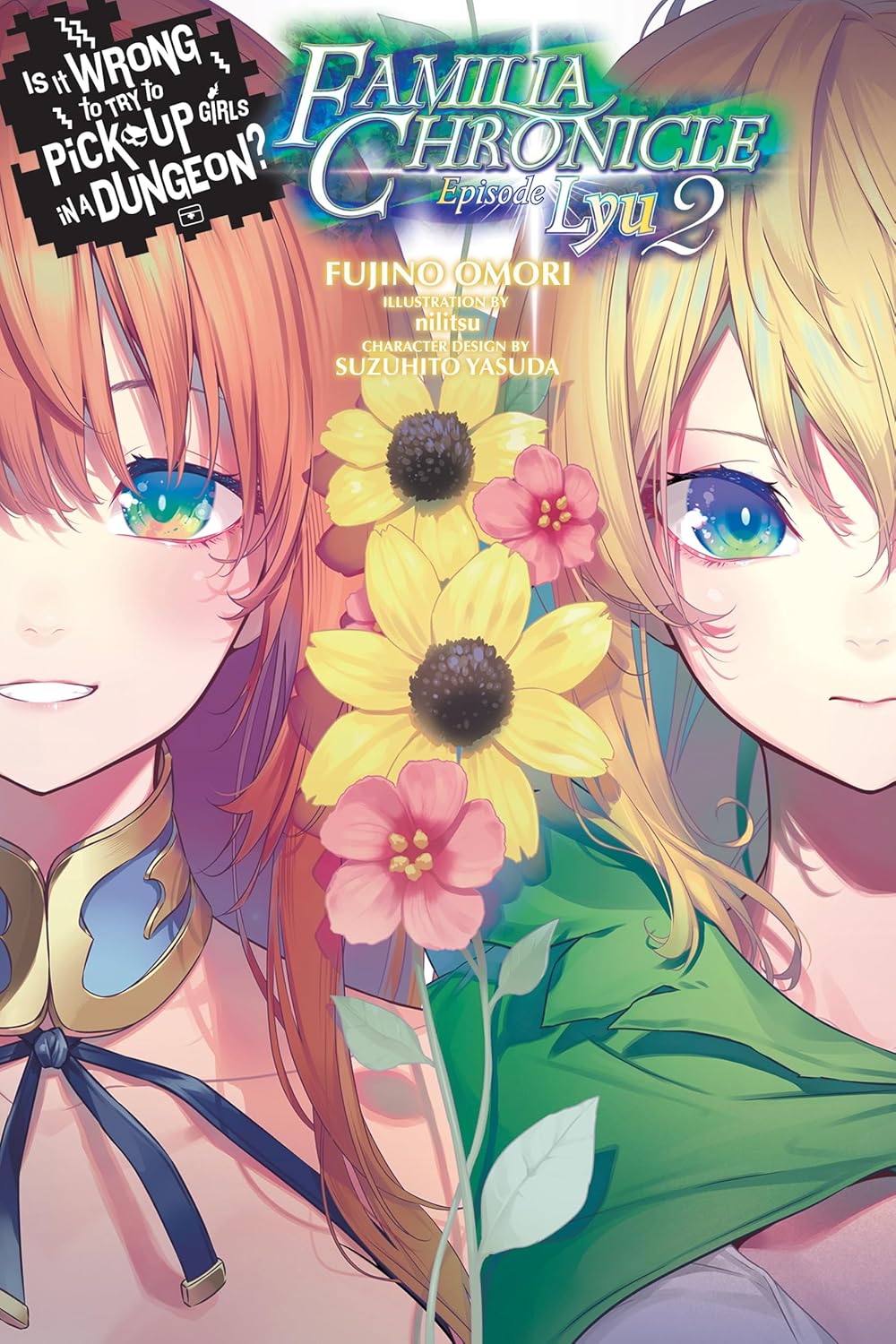
Is It Wrong to Try to Pick Up Girls in a Dungeon?: Familia Chronicle: Episode Lyu, Vol. 2

May 8, 2025 by Sean Gaffney

By Fujino Omori and NIRITSU. Released in Japan as “Dungeon ni Deai o Motomeru no wa Machigatte Iru Darou ka?: Familia Chronicle: Episode Lyu” by Softbank Creative. Released in North America by Yen On. Translated by Dale DeLucia.

So technically this is the second volume, the first having come out seven years ago. It was the one with Lyu and Syr in the casino, if you forgot. And it’s also the bit that the author cut out of the 18th volume, because that would have made it 700 pages. But in reality, this feels like Astrea Record, Vol. 4. We even get extra scenes with Adi, to remind us that she’s still tragically dead but oh so very, very shiny And of course the rest of the Astra Familia that Lyu was with five years ago? Also still dead. Fortunately, Astrea is not dead, and it turns that she has new Familia in a remote smithing town. And so it’s time for Lyu to run very fast, so that she can break down, get forgiven, level up and get stronger, and then run back to help Bel. Of course, it turns out to not be as simple as that.

Lyu groveling for forgiveness, which comes relatively easily, takes about the first 10 pages of this book. the rest is harder. When Astrea levels her up, she levels to 5, and anyone who read Book 18 of the main series knows that there’s something fishy going on here. Then Lyu tries to train with her new level, and discovers there’s a big difference and she needs to practice. Fortunately, she has three adorable Level 1 juniors to beat up… erm, play tag with, as well as a forest spirit who is really looking for an excuse to go all out… possibly a mistake given this is Lyu. Unfortunately for Lyu, the current captain of Astrea Familia, a Level 2 smith named Cecille, hates her guts. Despite, or perhaps because of, the fact that Astrea has entrusted her with something very important in regards to Lyu.

This is a book about Lyu, so it’s not a surprise that the plot is as straightforward as hell. Lyu is not quite completely healed, and also needs to go from Level 4 to Level 6 in about 5 days, something which no one has EVER done before, so strategy is called for. Fortunately, most of the strategy is “keep hitting things till you get it right”. As for Cecille, she’s not hard to figure out either, mostly as she’s very similar to Lyu, something Lyu knows as she very awkwardly tries to take on a mentor role. It turns out that trying to create the perfect weapon for someone you’ve only heard stories about that drive you crazy with envy can be very hard! It’s only when Lyu opens up and shhares her own tragedy that Cecille manager to find her own inspiration. That said, “straightforward” does not mean bad. This series has never really been known for narrative curveballs anyway.

Good stuff, and if you want to know what happens next, go read 18 again. I think next for us is the Sword Oratoria SS volume.

Filed Under: is it wrong to try to pick up girls in a dungeon?, REVIEWS

The Villainess Is Dead! Long Live the Empress! Redoing the Story After a Poisonous End, Vol. 1

May 7, 2025 by Sean Gaffney

By Iota Aiue and Tsukasa Kuga. Released in Japan as “Shokeisareta Akujo wa, Taikoku de Kouhi no Za wo Tsukamu” by DRE Novels. Released in North America by J-Novel Heart. Translated by Mac B. Gill.

I would not be reviewing 80 billion of these villainess books if I was not a big fan of the genre. As such, I can usually forgive it if it’s a bit on the nose. There are a lot fewer surprises in this first book than is perhaps required, although you might call the end of the book a surprise, as I sense that making this a series rather than a standalone book was a last-minute decision borne out by the rushed non-ending. It does, however, have a terrific romantic couple as our leads. The villainess is honorable, noble, tricky, stubborn, etc. in equal measure. The prince (technically that is a spoiler, but come on, it’s revealed almost immediately and is not a surprise even then) is handsome, self-assured without being smug, and they realistically realize the truth about each other very fast. Also, there’s a handsome woman knight, who is such a great character I will ignore our heroine buying her as a slave (it’s fixed almost immediately).

We open with Westalia, our heroine, being executed after being framed for an attempted murder by her supposed best friend. (I did say this was a typical villainess book.) But it’s OK. She’s taken an antidote, and rises from the dead when her grave is being robbed. Fleeing across borders, she ends up in the Archadies Empire, where the Empress is chosen by a country-wide search. Though, given the literacy rate is pretty low, the finalists do tend to be rich nobles. Westalia came here on purpose. After spending her life trying to learn to be a good queen only to be betrayed, she’ll be damned if she’s going to thrown away trying to help people and do good. So she’s going to become Empress by hook or by crook. Fortunately, the only real competition she has seems very familiar, as if every villainess needs an idiot heroine…

I talked about being a fan of villainess stories, which means I’ve met my share of bratty younger sisters, evil heroines, etc. We get two varieties for the price of one here. Both are presented as “mostly sort of evil”, which is to say they’re evil until the point where the author allows them a bit of depth. Lily has always hated Westalia, and was too busy pretending to be her best friend to realize that her dilemma of being married off to a creepy middle-aged man might have been something solvable with Westalia’s help. (She’s merely disgraced, so we may see her again.) Meanwhile, Elizabeth is using her money and connections to buy the contest, so is very upset when that still isn’t enough. She seems to at least have a bit of self-awareness. She’s definitely coming back, because they rewrote the cliffhanger to assure it.

If you are a villainess fan, this is really good. If you can take or leave it, you probably won’t like it. I’ll definitely read more, though I suspect it might have been better as a one-shot.

Filed Under: REVIEWS, villainess is dead long live the empress

Lady Bumpkin and Her Lord Villain, Vol. 3

May 6, 2025 by Sean Gaffney

By Ageha Sakura and Kurodeko. Released in Japan as “Imokusa Reijou desu ga Akuyaku Reisoku wo Tasuketara Kiniiraremashita” by Overlap Novels f. Released in North America by J-Novel Heart. Translated by Vasileios Mousikidis.

In the first volume, we saw how Agnes was physically, mentally and emotionally abused by her family, and it was pretty terrible (the abuse, that is, not the book). In the second volume, we hear how actually a number of young noble ladies have this problem, and many of them are cracking under the strain and falling for handsome guys with vague mind control powers. And now, in the third volume, we’re told that it’s pretty rare to find a teenage noble girl in Desnim who is NOT abused by their family in some way. Heck, even when we get the classic setup in this volume – abused, Cinderella-esque older sister, arrogant and spoiled younger sister – it rapidly becomes clear that the younger sister is not actually LOVED by her family or anything, and that if they lose their scapegoat they’re perfectly happy to offer up scapegoat number two. Oh, yes, and other noble girls are raped by priests until they’re driven mad. Meanwhile, Agnes and her husband flirt shamelessly and plan an official wedding ceremony.

It’s been a year since Agnes arrived in Sutrena, and she’s is happily married to Lord Nazel (who is very happy to perform his husbandly duties all the time now that Agnes is mostly over her shyness). Nazel wants to have the big wedding ceremony they never had when they were married, and cajoles Agnes into it. This will require a priest sent from the capital, who is rather downtrodden and overworked, so quite happy to end up in a domain where people appreciate him. They also need a silver ring from a different domain, and meet the pleasant lord, his wife, and their two children. One of whom looks like she’s about to fall over dead from overwork at any moment, and the other of whom looks like she was born to hold her hand in front of her mouth and Ohohohohohoho. So yeah, family abuse. Sadly, things then get worse. For both daughters.

We’ve seen “good older sister, spoiled brat younger sister” endless times now in light novels, to the point where I was ready to roll my eyes. It’s a credit to the writing, though, that I rapidly realized that Furla was not going to end up with a fate worse than death, nor was she going to be arrested with her parents (whose crime is treating their child like crap, really). No, this is about getting an incredibly selfish young woman who, deep DEEP down, realizes that she’s nothing special to understand that all her safety and security is now gone and that she can’t simply simper at someone and get her own way. Technically things don’t end well for her – she’s another of Agnes’ endless parade of former nobles who are now maids, and the guy she’s fallen for is in love with this series’ equivalent of Superwoman. But frankly, compared with where she could have ended up… Furla does OK. She’s even learning laundry.

I will once again be annoyed at the author for yet another “I don’t swing that way” joke, which is tedious. Other than that, the fact that this series pinballs between dark abusive tragedy happening right off screen and Agnes and Nazel being flirty and happy and adorable is both the series’ greatest strength and its greatest weakness. Also, still don’t know why there’s a chibi-Agnes on each cover.

Filed Under: lady bumpkin and her lord villain, REVIEWS

Fluffy-Eared Realm Restoration: Taking It Slow with My Cool Big Brother, Vol. 1

May 5, 2025 by Sean Gaffney

By Iota Aiue and Tsukasa Kuga. Released in Japan as “Tensei Mofumofu Reijou no Mattari Ryouchi Kaikakuki: Cool na Onii-sama to Amaama Slow Life wo Tanoshindeimasu” by DRE Novels. Released in North America by J-Novel Heart. Translated by Raenoire.

This is one of those series that I was on the fence about till I saw that I had read the author before. They’ve done a very series over here, mostly for Cross Infinite World, and I’d enjoyed their previous series, Third Loop. Though honestly, I may have enjoyed this new one more if I had not read Third Loop, as it’s clearly trying to hit the same sort of themes and cuteness as that one. The author seems to dabble in popular genres, and clearly this one is dabbling in both the “I go back in time to fix things” stories as well as “fluffy things are wonderful and cute girls are cute” stories, which has gotten popular lately. This book does have a few interesting things that held by attention, but unfortunately it is also very by the book, with almost no actual surprises. It’s a “would you like that fastball right down the plate?” book.

We open with Lune Renard, the crown princess, about to get guillotined by a revolutionary mob, along with her adopted brother and father, who don’t seem to like her any more than the mob. She’s tried to help her family and their holdings, but has only made things worse, and now she’s being executed. She prays to the fox god who supposedly rules this domain… and he answers, sending her back in time to just before she was found in the temple as an orphan by her family. Can she make things right this time, and ensure she is NOT married off to a royal? Sure she can. After all, she now can not only speak to spirits, but she also has adorable fox ears and a tail. She never had the power of cute in her past life!

I did like a couple of things about this book. We’ve sometimes seen prisoners abused by the kingdom in previous books, but we’ve never really gotten a low-security prison for political criminals like we get here, complete with the “funny” eccentric doctor. (YMMV.) And I appreciated that it acknowledged the difference in status and how they’re treated with the commoner “hard labor” criminals. Also, while the crown prince showing up was as bratty and awful as you’d expect, he was actually more layered than I expected. He becomes a different type of awful once he realizes that Lune is valuable and can talk to spirits, but he still sees her as an object rather than a person, and thinks she should be grateful to be his concubine. (They’re both eight, by the way.) That said, when presented with evidence that he cannot really weasel his way out of, he manages to actually not be evil, even if this means, um, throwing allies under the bus. That said, most of this book is Lune being adorable, talking to her snarky god, and fixing things relatively easily as these sorts of books go.

And, as I noted, I’d read this once before, when it was called Third Loop. If you like fluff or defeating roundworm through the power of yoga, this is okay.

Filed Under: fluffy-eared realm restoration, REVIEWS

Adachi and Shimamura, Vol. 99.9

May 2, 2025 by Sean Gaffney

By Hitoma Iruma and raemz. Released in Japan by Dengeki Bunko. Released in North America by Seven Seas. Translated by Molly Lee. Adapted by Emlyn Dornemann.

So, the rumor is that the author of this series started panicking and worrying that they would die before it was finished, and so they came up with several volumes that would feel like a final volume. That said, there is not a more final final volume than this one. and yes, I know that we still have Volume 12 and a second Short Story collection to go, but thematically, this ties absolutely everything into a nice neat bow. Unlike the SS volume, which featured 3-4 page microstories as well as one long one, this has 4 longer stories and a wraparound plot which were written for the Blu-Ray release of the anime. Generally speaking, Blu-Ray ‘extras’ tend to be a bit more involved than your typical throwaway bookstore giveaways, and it shows. This not only manages to have a lot of typical Adachi and Shimamura style shenanigans, it gets quite sad and tear-jerking at times. Be prepared to be with Adachi and Shimamura to the very end of their lives.

A brief content warning: this volume contains more Yashiro than any other volume to date, and with good reason. The wraparound story has A young woman in the very far future, on an post-apocalyptic world, being slowly led by Yashiro to her destined soulmate. Along with that, we see 1) Shimamura visiting Hino at her mansion; 2) Adachi inviting Shimamura to a hot spring, supposedly so they can finally have their first time together; 3) A Shimamura in her late eighties, with all of her family, all her friends, and her lover now dead, finding solace in playing an RPG her sister once played with, you guessed it, Yashiro; 4) The resolution of the future world, with Yashiro, her mission now done, heading out to find other Adachis and Shimamuras and reunite them; and 5) Shimamura dying, and going where she knows she needs to go.

As you may have gathered, this volume gets a lot darker than I was really guessing. The far future story is more heartwarming than anything else, and the Hino story was fairly pointless except for us to see her as an adult (sorry Nagafuji fans, she’s not in it). The hot spring story, and this is hardly a spoiler, does not end with sex. But it’s the story of Shimamura in her dotage that hit the hardest. The chapter with her looking back on everyone who left her behind is quite touching, especially as she’s haunted by her lover, who shows up to be a Greek chorus. Then there’s the last chapter, which is both a tearjerker and also a bit eerie, as Yashiro shows up to lead Shimamura to the afterlife… which has her grandparents, and her beloved dog, but that’s not where she needs to be. You know where she needs to be? Remember Adachi’s idea of heaven from the previous SS book? Yup. Shimamura is now in Adachi’s heaven, with no one else but them. Never let it be said this series is not defined by the lovable headcases that are its leads.

Possibly this worked well for me because I am overly sentimental, but I found it one of the best in this series. I’m not sure I want the 12th volume, but we’ll see if it can be more than “slice of life”, which this volume was.

Filed Under: adachi and shimamura, REVIEWS

Dinners with My Darling: How the Former Monster King Ate Her Way to Happiness, Vol. 2

May 1, 2025 by Sean Gaffney

By Mugi Mameta and Nagisa Hanazome. Released in Japan as “Aisanai to Iwaremashite mo – Moto Maou no Hakushaku Reijou wa Kimajime Gunjin ni Ezuke wo Sarete Shiawase ni naru” by M Novels f. Released in North America by Cross Infinite World. Translated by JC.

There are times throughout this second book (and indeed the first one as well) when you can kind of feel everything about to go off the rails. Abigail is a lot, and not only does the cast have trouble trying to control her, so does the author. Perhaps we did not need quite so many scenes of her yelling ‘coitus’, especially as the writing has not quite mastered the difference between “Abigail sounds like someone who has grown up isolated and also is more monster than human a lot of the time’ and ‘Abigail sounds and acts like a 6-year-old”. Where the book does succeed, though, is the divide between genres. The rest of the cast are in a tense political thriller, and also investigating a corrupt domain that abused our main character horribly. Oh, and killer monsters are everywhere. Abigail, however, is in a cooking manga.

The first half of this book is all smiles, as Gerald and Abigail travel to the sea for fish and souvenirs, try to decide if a whole sheep or a whole cow is a better gift for someone, and finally have their first time, which is offscreen but which Abigail seems to like a whole lot, given how much she uses it as a go-to “calm my husband down” thing later. In the second half, though, they’re both forced to go visit the royal family, and deal with the fourth prince, who is in charge of the old lands that Abigail grew up in. Unfortunately, the officials sent there to take care of things have all disappeared/been murdered, so he really needs Abigail (and Gerald) to head over there to help him figure out why. What they find there is that Abigail’s blase description of her abusive life proves to be more horrifying than what they thought.

As with so many other series that are basically “everything was terrible till the start of the first book, everything is wonderful from that point on”, the best parts tend to be the jagged edges that stick out on occasion. Everyone seems to be trying to kill Abigail, be it hired bandits (who she spots running alongside their carriage) or the citizens of her former land (who try to poison her), and things get to the point where an angry dragon decides to kill every human in the area because they’re just that terrible. The best part of the book, as it’s the most horrifying, is when Abigail decides the solution is to let the dragon kill her and be reborn as a human again and get married 15 years down the road. It has to be explained to her why everyone hates this. Then again, Gerald is no better, as he doesn’t seem to understand why Abigail is upset he ran off to fight and left her behind, to the point where she had to climb to the op of a high tree to fix everything.

This is not in the top tier of Cinderella style genre books, but it’s solid. I’ll read another.

Filed Under: dinners with my darling, REVIEWS

The Invisible Wallflower Marries an Upstart Aristocrat After Getting Dumped for Her Sister!, Vol. 3

April 30, 2025 by Sean Gaffney

By Makino Maebaru and Murasaki Shido. Released in Japan as “Kon’yaku Haki Sareta “Kūki” na Watashi, Nariagari no Dan’na-sama ni Totsugimashita” by Mag Garden Novels. Released in North America by Cross Infinite World. Translated by piyo.

The first two volumes of this series were pretty rough, and while I knew this third one would be the finale, I also wondered if we’d have to get through a lot of pain and drama to get to the inevitable wedding photo cover art. As it turns out, not only did the book start with the wedding, but this came a lot closer to the “victory lap” I’ve talked about before than I was expecting. Oh, sure, there’s a murder attempt, a blackmail attempt, and a relatively serious resolution to the matter of Lucas’ parentage. That said, the fact that the parentage was resolved in any way other than “dead deadbeat dad” surprised me. What this mostly was was Lucas and Iris in love, and having to prove over and over they’re in love because everyone is trying to get them to back out of their relationship. Fortunately, they’ve already consummated… oh, right, they’re both innocent virginal dorks. Well, heck.

Lucas and Iris have moved up their wedding, mostly as the third prince has been sending potential fiancee towards Lucas,. trying to get him to call things off. Lucas, of course, refuses. Meanwhile, he and Iris are busy searching for his father, and decide to start by going back to the convent where his mother gave birth to him. This reveals a secret that is not exactly a shock to Lucas, Iris, or the reader – his mother was a noble, and was cast out of her family for being in love with a commoner. What’s more, this is also known to the noble family itself – who are down on their luck right now, and could really use a fresh new pawn to blackmail into doing whatever they say. As for Iris, well, that’s what murder is for. OK, it’s not ENTIRELY a victory lap here.

The outcome of the dangerous evil nobles is not exactly a surprise – in fact, it’s so little of a surprise that we never actually find out how Iris manages to get out of being murdered, she just shows up to rescue Lucas and save the day. That said, as I noted above, I was surprised that we actually had some resolution with Lucas’ long-lost father, who turns out to be hard done by but who also married too young, and the way that Lucas reacts to all of this information coming at once feels very true to life. I will note that this book definitively ends with the third volume, but it may have been a last minute decision – Things are set up so there could be more,. but then we get a quick epilogue explaining they had many children and lived happily ever after. It does have a really killer ending sentence, though, which ties up the theme of Iris’ character nicely.

These two have spent three books trying to stay married, let’s leave them to it. A fun read.

Filed Under: invisible wallflower marries an upstart aristocrat, REVIEWS

Bottom-Tier Character Tomozaki, Vol. 11

April 29, 2025 by Sean Gaffney

By Yuki Yaku and Fly. Released in Japan as “Jaku Chara Tomozaki-kun” by Gagaga Bunko. Released in North America by Yen On. Translated by Jennifer Ward.

Last time I said that this volume is the final one, which is not true anymore. That said, last time I reviewed this series it was June 2023. Yuki Yaku has been busy with the anime, as well as writing Jellyfish Can’t Swim in the Night. But, he assures us, the 12th volume is done and will be out a few months later. Um, well, this came out in Japan in January 2024. And there’s no sign of it. But honestly, that’s fine, as this book was a jaw dropper, and I was emotionally worn out by the end of it. We’re at the finale even though this is not the final volume, and you can tell because the cast has narrowed considerably. It feels thematically relevant that everyone who ends up in the sciences classroom for third year doesn’t appear for the rest of the volume. We can’t solve this with numbers. In fact, that may be part of the problem. We need to solve it with words… which Tomozaki is good at, but “good” isn’t enough anymore.

We pick up where we left off, with Aoi seeing the family video that was made for her. Let’s just say her reaction is… viscerally bad. After we return to school, and the main cast starts their third year, Aoi is absent from school, and does not appear to be returning. It doesn’t help that she’s not in either arts OR sciences, but the “advanced” classroom, meaning she’s isolated. And so Tomozaki is forced to do things that are, well, sketchy. Namely, lurk around her house, and eventually start talking with her younger sister Haruka, who, after verifying Tomozaki is not a kidnapper or creeper, opens up to him – a bit – about her family. Eventually these meetings do drag Aoi out of the house, and she too opens up to Tomozaki. Unfortunately, learning the full story of the death of her other sister does not fix everything magically.

There’s a lot of really big scenes in this book – the author excels at writing compelling set pieces to advance the story. Fuka, who is the secondary heroine of this whole series, shows off why she’s the only one besides Tomozaki who’s been able to rattle her, and Fuka’s response when Haruka explains her family is stunning – and also drives home the fact that she truly thinks like a writer. The lightest part of the book is at the live Atafami competition, with Mimimi’s novice commentary, but even that has Tomozaki realize that while he wants to be a gamer he doesn’t really have a compelling enough dream that will make him attract others. Lastly… we really had not seen much of Aoi’s mother at all, but we get a much better portrait of her here. And oh, I wish we hadn’t. There are some things you should not say to grieving children.

We came very close to ending on a MASSIVELY depressing cliffhanger, but fortunately, Fuka exists, and as always is there to pull Tomozaki up and push him forward. Though if they’re going to save Aoi, they’ll need the entire cast, not just this scaled-back version. As for when we’ll see the finale? Or if it really will be the final book? Stay tuned.

Filed Under: bottom-tier character tomozaki, REVIEWS

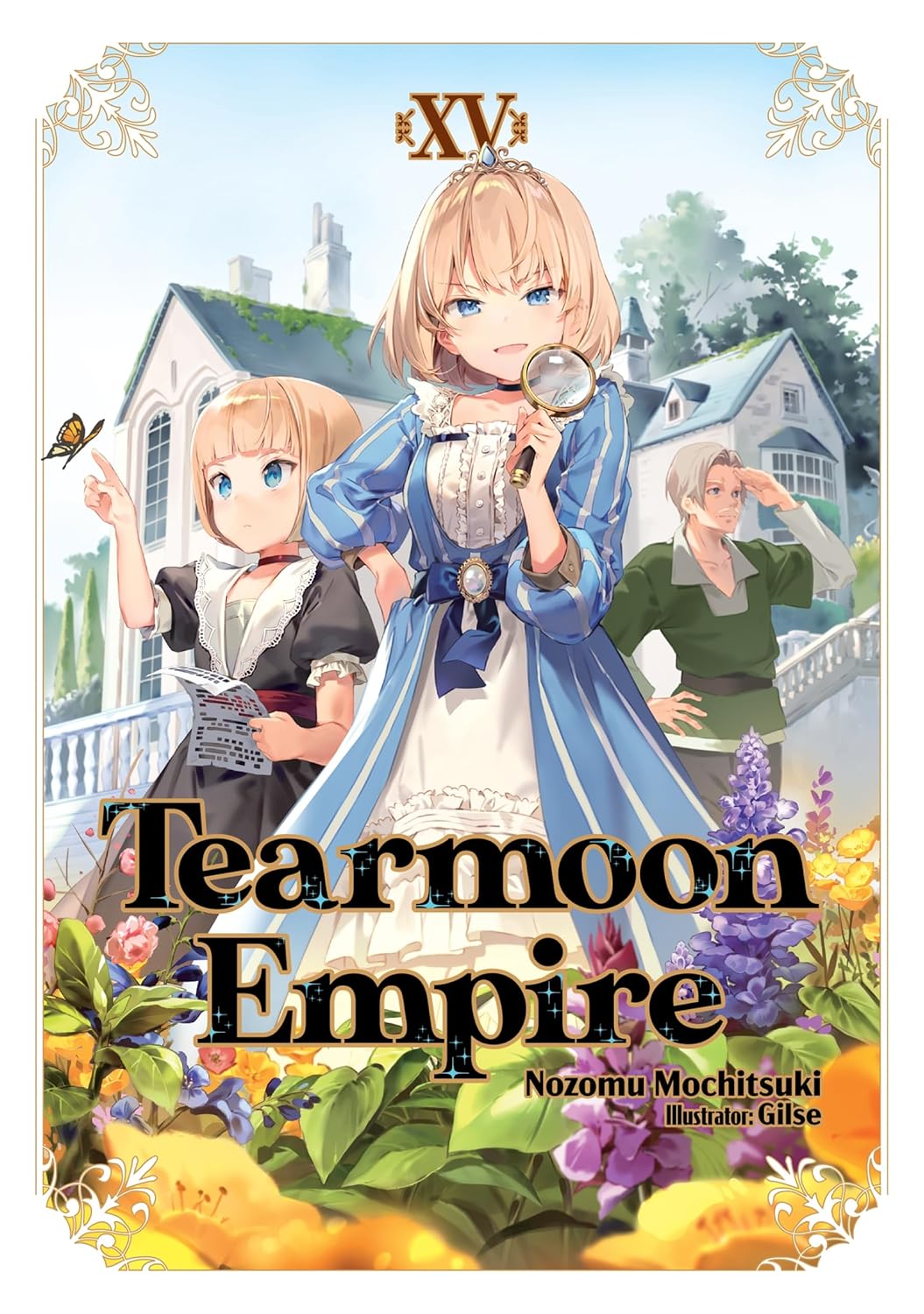
Tearmoon Empire, Vol. 15

April 28, 2025 by Sean Gaffney

By Nozomu Mochitsuki and Gilse. Released in Japan as “Tearmoon Teikoku Monogatari” by TO Books. Released in North America by J-Novel Club. Translated by Madeleine Willette.

Generally speaking, unless God is literally involved in the plot, the “how and why” of these time loop stories is rarely examined. We know why – so they can redo their life and get it right this time. And for a lot of Tearmoon Empire, that’s been the case. Even with vanishing diaries and conflicting timelines, the premise has been “Mia fixes things so she’s not executed”. But with Bel and Patty, things aren’t quite so clear cut. We can guess that Patty might have been sent back to screw up Mia’s timeline fixes, but if so that’s going pretty badly. As for Bel… is it really just to help her mature and keep Citrina happy? Or is there some deeper purpose to her presence? Is there a guiding hand in this that is not Saint Mia and her sarcastic narrator? Unfortunately, this is Bel’s problem to solve, as Mia has a whole host of new things to deal with. Which, mostly, she handles very well.

This is a “set up the next arc” volume, so there’s a bit less drama and a lot more talking. What drama there is comes from Patty, who is on the verge of a nervous breakdown, and Mia realizes that she may have left it a bit too long before she needs to tell her the truth. We also get more details about Patty’s brother, who was supposedly very ill, and also supposedly assassinated by Citrina’s family… though we discover most of those “assassinations” were “ship them overseas on a boat” instead. Once Mia returns to home base, she must deal with her clingiest friends being out of sorts about not spending time with her, and also has to win over a new princess in order to further her own plans. Unfortunately, this princess is following daddy’s orders, and while she’s savvy she’s not really that clever… except when it comes to fish.

After last volume reminded us that Sapphias exists, this volume does the same for Esmeralda, who has mostly been absent from the story since the shipwreck arc. She’s very aware of that, in fact, and has been hearing about Mia having all of these adventures – some of them dangerous, but that doesn’t matter – without her. As for Esmeralda herself… look, with Mia, we have her genuine character growth constantly undercut by the narrator, so we have to pick it out in between the snark. The narrator, however, mostly shuts up when Mia or her immediate offspring aren’t involved, though, and it allows us to see that Esmeralda has changed as much as Mia.This also means that she not only spots regrets in others – such as one of Mia’s ex-maids who is now at the Mia academy – but also in herself, as she finally gives Arshia a richly deserved apology… which, to Arshia’s credit, she doesn’t accept. More needs to be done before the bridges can be repaired. It’s also a good example of the timeline changing as we read. as the start of her arc in this book has Esmeralda an obscure, mostly forgotten figure who worked behind the scenes, while at the end she’s a famous diplomat.

I was annoyed that the fat jokes seem to have returned here, but other than that this was an excellent volume, showing Mia actually thinking things through and making clever decisions, though it’s her empathy, as always, that wins the day.

Filed Under: REVIEWS, tearmoon empire

Homunculus Tears: Alchemy for the Brokenhearted

April 26, 2025 by Sean Gaffney

By Inori and Aonoshimo. Released simultaneously in Japanese, English, Spanish and German by the author. Translated by Kevin Ishizaka.

(I try not to spoil too much about this book, but I do spoil the final resolution of it. Reader beware.)

This is a spring/summer that will have two works by I’m in Love with the Villainess author Inori coming out. The second, The Girl Who Wants to Be a Hero and the Girl Who Ought to Be a Hero, came out the traditional way in Japan via Dengeki Bunko, and is coming out the traditional way here via Yen Press. But this is a self-published work, releasing digitally on the same day in four languages, and translated by the same translator as ILTV. As such, thoughts like “experiment” and “risk” come to mind. Which may be true, but in the end, I think the most important thing is that it’s a good book with a lot to say about why we exist and what to do when someone feels they no longer want to. It’s also got a good couple at the center of it, who can be boiled down to “the grumpy one and the sunshine one”, but also contain greater depths. Best of all, I love the narrator, whose deal is my favorite part of the book.

In a dystopian world where humans are at war with the demons (and the men appear to have all been killed off – this is a yuri genre, after all), Maha is a grim but excellent soldier, who uses alchemy to wipe out the demons, though the cost of the alchemy she does is that she deliberately destroys past ties to herself, such as her memory of those who died, or of the taste of good food, in order to give equivalent exchange to power her spells. One day, her researcher mother (who has spent most of her life ignoring her daughter) reveals they have created a homunculus, who hopefully will be able to fight against the demons so that humans no longer has to. Maha has many feelings about this, most of them angry, but unfortunately, the homunculus herself, Ruri, is adorable, innocent, and really likes Maha a lot. And Maha’s grumpy, closed-off heart gradually starts to open up again.

There were a couple of minor things that made me a bit annoyed during the book – I’m not fond of the “loli that’s really x00 years old” archetype, and the relationship between Maha and Ruri starts off with “we’re like older and younger sister!”, which I’ll be honest had me saying “oh no, not again” after ILTV. But for the most part, this was a very rewarding read. The narrator is not Maha, as you’d expect, but instead… well, I don’t want to spoil too much, but someone who is both a guide for Maha and also a filthy shipper who really wants Maha to fall in love with another woman. The narrator is also deeply tied to the past of this book, which reminded me a lot of the 5th ILTV book, and I’m wondering if the author first thought of this concept while writing that. I also appreciated the fact that it managed to not only argue for the value of living, but did so without (I’ve got to spoil this) a tragic sacrifice, while I was expecting from about Page 20, and had steeled myself for. Instead everyone goes for a swim. I smiled.

The author says there may be more self-published works in this vein. Honestly, I’d like to see a different story done the same way, as I feel this wraps up very neatly in a volume and doesn’t need a sequel. Fans of the author should enjoy this a great deal.

Filed Under: homunculus tears, REVIEWS

  • « Go to Previous Page
  • Page 1
  • Interim pages omitted …
  • Page 17
  • Page 18
  • Page 19
  • Page 20
  • Page 21
  • Interim pages omitted …
  • Page 346
  • Go to Next Page »
 | Log in
Copyright © 2010 Manga Bookshelf | Powered by WordPress & the Genesis Framework