• Skip to primary navigation
  • Skip to main content
  • Skip to primary sidebar
  • Home
  • About Us
    • Privacy Policy
    • Comment Policy
    • Disclosures & Disclaimers
  • Resources
    • Links, Essays & Articles
    • Fandomology!
    • CLAMP Directory
    • BlogRoll
  • Features & Columns
    • 3 Things Thursday
    • Adventures in the Key of Shoujo
    • Bit & Blips (game reviews)
    • BL BOOKRACK
    • Bookshelf Briefs
    • Bringing the Drama
    • Comic Conversion
    • Fanservice Friday
    • Going Digital
    • It Came From the Sinosphere
    • License This!
    • Magazine no Mori
    • My Week in Manga
    • OFF THE SHELF
    • Not By Manga Alone
    • PICK OF THE WEEK
    • Subtitles & Sensibility
    • Weekly Shonen Jump Recaps
  • Manga Moveable Feast
    • MMF Full Archive
    • Yun Kouga
    • CLAMP
    • Shojo Beat
    • Osamu Tezuka
    • Sailor Moon
    • Fruits Basket
    • Takehiko Inoue
    • Wild Adapter
    • One Piece
    • After School Nightmare
    • Karakuri Odette
    • Paradise Kiss
    • The Color Trilogy
    • To Terra…
    • Sexy Voice & Robo
  • Browse by Author
    • Sean Gaffney
    • Anna Neatrour
    • Michelle Smith
    • Katherine Dacey
    • MJ
    • Brigid Alverson
    • Travis Anderson
    • Phillip Anthony
    • Derek Bown
    • Jaci Dahlvang
    • Angela Eastman
    • Erica Friedman
    • Sara K.
    • Megan Purdy
    • Emily Snodgrass
    • Nancy Thistlethwaite
    • Eva Volin
    • David Welsh
  • MB Blogs
    • A Case Suitable For Treatment
    • Experiments in Manga
    • MangaBlog
    • The Manga Critic
    • Manga Report
    • Soliloquy in Blue
    • Manga Curmudgeon (archive)

Manga Bookshelf

Discussion, Resources, Roundtables, & Reviews

Reviews

Yona of the Dawn, Vol. 21

December 7, 2019 by Sean Gaffney

By Mizuho Kusanagi. Released in Japan as “Akatsuki no Yona” by Hakusensha, serialization ongoing in the magazine Hana to Yume. Released in North America by Viz Media. Translated by JN Productions, Adapted by Ysabet Reinhardt MacFarlane.

It can sometimes be hard to remember that Hak, in the context of this series, is a normal human. He does not have any Dragon Warrior powers, but gets by by simply being very, very, VERY strong. This becomes very clear about two-thirds of the way through this volume, where the tension that has been slowly building about how long can Su-Won and Hak get away with not meeting face to face finally breaks – there’s just no avoiding it in the melee battle to save Riri that is going on. Indeed, it’s the unspoken communication between the two that saved Riri’s life, and I really long for some sort of alternate universe where the two of them fight crime. But unfortunately, they are enemies. Ju-Do certainly doesn’t forget that, and he alone is ready to take down Hak for the benefit of the Kingdom. But there’s more complexities going on here than can be dealt with by a murder. Hak and company saved so many lives. They do have to ignore each other right now.

The first half of the book is quite serious and action packed, though I’m not entirely sure Zeno saving Yona by literally dropping himself like a bomb on the enemy can be called 100% serious. Su-Won is once again doing far more than a King should be doing, which to be fair Riri is very grateful for. He’s still not really recognized by his subjects or indeed neighboring kingdoms, which leads to scenes like the one we get here, where a thousand soldiers are taken down by him and his four generals… and yes, the Happy Hungry Bunch, an alliance that makes both uncomfortable. The second half is lighter in tone, starting with Hak, whose nerves are frazzled by having to ignore Su-Won here because of circumstance, becoming a cuddlebug and hugging Jaeha and Zeno, both of whom react appropriately for such an occurrence.

This then leads to a wonderful chapter where, having moved back to the forest to camp out, Hak and Yona try to have a heart to heart. There’s an earnest core here, as Yona has felt fairly “princess in need of rescuing” this arc, which makes her unhappy, and Hak is dealing with her being in danger PLUS Su-Won, so is, as I said, a bit frazzled. But Hak is hugging others, and Yona wants to be hugged… except (she thinks to herslf) she hasn’t had a good bath in a while, so she must stink. Hak has not, in fact, noticed this, and later says she’s been filthier before (not the right thing to say), which leads to an amazing battle between the two of them, Yona avoiding his touch and Hak trying to capture her. It all ends well, though, with hugs being had, and Hak being reassured. That said, though, Yona still is apparently unaware of her own feelings towards Hak. How long will that last?

To no one’s surprise, this is an exceptional volume of Yona, and brings this arc to a close. What happens next? Intrigue? Action? Shenanigans? All of the above? Please read this series.

Filed Under: REVIEWS, yona of the dawn

You Call That Service?, Vol. 1

December 6, 2019 by Sean Gaffney

By Kisetsu Morita and Hiroki Ozaki. Released in Japan as “Omae no Gohoushi wa Sono Teido ka?” by GA Bunko. Released in North America by Yen On. Translated by Jasmine Bernhardt.

This book lets you know right away that it’s a comedy, and, with the exception of one or two bits near the end, does not really let up on that throughout the volume. The characters do comedic things, the setup is written to be highly amusing, there’s a lot of boke/tsukkomi humor, and you get the standard harem novel staples, lots of girls after the hero, misunderstandings, etc. There is even a psycho lesbian and a yandere stalker girl, which Japan seems to find far more hilarious than I ever have. Actually, that seems to be the issue I have with this entire book. It really really sets itself up to be a laff riot, but it’s not particularly funny. There were times I smiled at an obvious gag, and there were points where you could clearly tell I was supposed to laugh, but the laughs just were not coming across. Which is a problem when your series is a comedy.

Our hero is Ryouta, whose grandfather made a misplaced wish that has cursed him to be attractive to all girls around him, which is a pain when the girls are mentally unstable or his immediate family. He’s walking in the mountains one day to get away from it all and happens on a city… and a young girl, who quickly bites him on the neck. She’s a vamp–erm, part of the Sacred Blood Empire, which this entire city is now made of, and wants Ryouta to be her minion. Sadly, he’s less obedient than she’d like. As they live together and go to school, he meets more Sacred Blood denizens, all of whom have their eyes on him, and learns about the Emperor, all the while yearning for the one girl in his life he actually felt love for, his elementary school crush. In the end, all these plotlines converge and Ryouta has to decide who he wants to be loyal to.

This was written in 2011, which is several generations old in light novel years, and it shows. The lead girl, Shana… erm, Taiga… no wait, Louise… Nagi? Ah, I got it, Shiren, cries out to be played by Rie Kugimiya, and Ryouta is the sort of bland, nice-but-snarky harem lead that you get in this sort of thing. The first 2/3 of this book is mostly them interacting, and while it’s comedy that I don’t find funny, it’s not all that bad. Shiren is clearly desperately lonely, and Ryouta realizes this fairly quickly. That said, there was one part where I did actively scream “fuck this”. As I said above, I’m not fond of “psycho lesbian” as a character trait to begin with, and this one went from zero to murderous in about ten seconds… then, after being forced to lick our hero’s blood in order to avoid dying, suddenly is into him as well. It’s one of the plotlines you’d assumed writers had given up on because it always gets bad press these days… but here it is.

The author is VERY prolific, having also written I’ve Been Kiling Slimes for 300 Years (which IS funny, though not always as funny as it wants to be) and the upcoming A Mysterious Job Called Oda Nobunaga. Both of those are likely better than this, which I recommend only to those anime fans who want to watch anything with a small, angry blonde with twintails.

Filed Under: REVIEWS, you call that service?

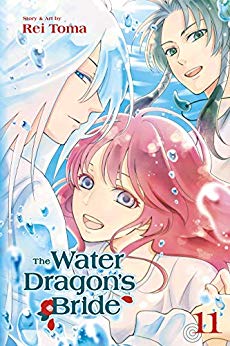
The Water Dragon’s Bride, Vol. 11

December 4, 2019 by Anna N

The Water Dragon’s Bride Volume 11 by Rei Toma

I was genuinely not sure what to expect in the final volume of The Water Dragon’s Bride. While I naturally tend to assume that a happy ending is a given in a shoujo series, this series has explored the nature of humanity through the slowly changing personality of a god. It has also been unflinching about portraying all the petty and dark aspects of human nature, especially the machinations of humans who attempt to take advantage of the divine.

Water Dragon Bride 11

In the end, the final volume of this series has an elegantly constructed ending that allows for multiple moments of closure, another opportunity to ponder the nature of immortality, and some flashbacks that add additional resonance and meaning to the previous volumes. The Water Dragon God’s power is now fading after investing power into Asahi. Before he becomes too weak and disappears, he announces that he will send her back to her world. Asahi decides that she wants to spend time enjoying regular activities like picking berries and going fishing. Asahi, Subaru, and the Water Dragon God enjoy some brief lyrical moments just doing basic human activities. Toma’s skills in paneling and illustration are shown off to great advantage throughout this final volume, as brief wordless scenes convey a depth of emotion that make dialog and description unnecessary.

As the Water Dragon God prepares his farewell, Subaru gets a chance to be heroic yet again, looking out for Asahi and her future in a way that she might not immediately appreciate. Themes of longing and loss are explored as The Water Dragon God moves into a new plane of existence and Asahi integrates back into the life that she’s left behind twice. Overall, this was a tremendously affecting series, with a mystical and elegiac quality that sets it apart from other fantasy shoujo that I’ve read. I hope more of Toma’s manga makes it over here.

Filed Under: Manga Reviews, REVIEWS Tagged With: shojo beat, shoujo, the water dragon's bride

Sword Art Online Alternative: Gun Gale Online: 3rd Squad Jam: Betrayer’s Choice (Part 2)

December 4, 2019 by Sean Gaffney

By Keiichi Sigsawa and Kouhaku Kuroboshi, based on the series created by Reki Kawahara. Released in Japan by Dengeki Bunko. Released in North America by Yen On. Translated by Stephen Paul.

As with most of these volumes, I find that this volume of SAO Alternative starts slow and gradually gets going till a 2nd half that verges on fantastic. The first part of the book briefly checks in with all the other teams, showing us what they were doing while Llenn and company were having their adventures by the train depot in the first part. They all gradually get the same notice: one of them is a traitor, please report to the traitor area for debriefing. The reactions range from vague dissatisfaction to rage to deep sadness, and then there’s Pitohui, who is OVER THE MOON. The story then moves to a massive ocean liner that is grounded on the island… except the island is sinking under the ocean, so gradually it becomes a real boat. Can everyone get to the boat before they drown? Can they defeat this new team made up of “betrayers”? And will the betrayers really work together anyway?

There are some nice moments with characters other than the two leads, I will briefly admit. The soldier that Pitohui fought in the 2nd Squad Jam gets a name and some righteous fury, not that it does him much good. SHINC are still the best huge Russian women who are really cute middle schoolers out there, and I really loved it when Llenn and Eva teamed up – if they can’t have their long-awaited battle (and it’s become clear by now the narrative will ALWAYS stop them in some way), this is almost as good. Fukaziroh is also a lot of fun, with quips at the ready, though she also functions as a good sounding board for Pitohui to actually (gasp!) open up. And the final battle between Fukaziroh and Eva is almost as good as Llenn and Pitohui’s. But not quite. Because, once again, we’re here to read about these two girls and their twisted relationship.

A warning for those who love reading SAO spinoffs but hate Kirito: he’s not in this book, but a flashback shows Pitohui, as a beta tester for SAO, fighting a swordsman who is very clearly him. I’m very glad that Pitohui missed getting trapped in SAO despite what it ended up doing to her already somewhat broken self, as I suspect she would have ended up in Laughing Coffin. (So does she.) But it’s seeing Pito’s vulnerability that’s the best part of this book – admitting to Fukaziroh that she’s terrified of Llenn, her real-life bodies own limits impacting her performance towards the end, and her own latent attraction to Llenn, who is not only cute and lethal (especially when in a rage-filled haze as she is towards the end here) but also in real life tall, athletic, and pretty. Sadly, Llenn still seems to have no interest.

I left out the book’s big spoiler, as it’s a very well done twist. And the ship’s AI was wonderful. Other than that… well, people read Alternative for the gun battles, and there are certainly a lot of those here. I read Alternative for the characters, though, and it was great to see some development with them as well. Will we get a 4th Squad Jam next/ Or something else?

Filed Under: REVIEWS, sword art online

Re: ZERO ~Starting Life in Another World~, Vol. 11

December 2, 2019 by Sean Gaffney

By Tappei Nagatsuki and Shinichirou Otsuka. Released in Japan by MF Bunko J. Released in North America by Yen On. Translated by Jeremiah Borque.

I was sort of expecting this volume of Re: ZERO to be a lot of dying and repeating, and that’s what it is, but we have the added factor, which is good for the reader but bad for Subaru, that things are not repeating in the same way. Due to the nature of Subaru’s Return by Death, every time he dies and comes back the people he needs to convince distrust him more and more as a possible Witch Cultist. Also concerning (and thankfully pointed out by the text) is that Subaru is getting perhaps a little too used to his Return by Death, to the point that his normal emotions are getting a bit flattened. Now, admittedly, the end of the book shows this is not necessarily the case, but if Subaru is going to be a pragmatist I would like him to be one who shouts and waves his hands and is sarcastic to people he dislikes. Grimdark Subaru is not a thing I want.

Having been ignominiously killed by a familiar face at the end of last book, Subaru wakes up in the Tomb, having just completed the first task. He now informs the reader that the one who killed him was Elsa. Remember Elsa? From Book 1? She’s back, and as he finds out when he returns to the mansion again, this time with Ram, she’s there for slaughter and not much else. Even when he can escape her he’s eaten by some sort of beast creature. And things aren’t much better back at the Sanctuary. As I said earlier, Garf is disliking him more and more due to the “witch smell” he gives off the more he returns by death, Roswaal is being very cagey and suspicious (Subaru asks him point blank at one time “are you the enemy?”), and Emilia is sadly still not passing her trial – in fact, she’s barely in this book, much to the annoyance of fans who would like to see her at least try to pull even with Rem.

A lot of this series relies on really good scenes that stick with you long after you’ve finished reading, and here the best of those is at the end of another Bad End in the mansion where Elsa is killing everyone. Subaru is already near death’s door from wounds and missing limbs when he happens upon the door to Beatrice’s library. Unfortunately, he was trying to rescue Rem at the time, so she’s toast. And Beatrice heals him, making it harder for him to go back and die. The ensuing temper tantrum that comes from him is understandable but also awful, and Beatrice’s hurt reaction, and then her enraged response, not only makes the reader feel horrible but also provides very important plot details. I suspect it may be Beatrice who gets development before Emilia here. Also nice to see Petra here again. Let’s give her a hand, people. (Sorry.)

So this was very much still a setup book, being Book 2 of 6 in this arc. There’s a lot of witches I didn’t really get into, including one familiar one who shows up right at the cliffhanger ending. Fans of the series will find a lot to sink their teeth into, though. Just… Subaru, are you OK?

Filed Under: re: zero, REVIEWS

How Heavy Are the Dumbbells You Lift?, Vol. 1

December 1, 2019 by Sean Gaffney

By Yabako Sandrovich. Released in Japan as “Dumbbell Nan Kilo Moteru?” by Shogakukan, serialization ongoing in the magazine Ura Sunday. Released in North America by Seven Seas. Translated by Wesley O’Donnell. Adapted by Sam Mitchell.

I must admit, I’ve seen titles devoted to giving the reader a bunch of fanservice. I’ve also seen titles that are “instruction” manga, where they’re teaching a lesson to the reader, usually via an unknowing protagonist. But, aside from maybe Futari Ecchi, I can’t think of a title that’s managed to balance them fairly equally as much as How Heavy Are the Dumbbells You Lift?, a series that really wants to go into great detail about how to properly work out and gain muscles, but also really wants to show you that it has a bunch of cute, large-breasted young women who frequently bend over, take showers, get very sweaty indeed, etc. It should be terrible, but somehow you get the feeling that, if asked to choose one, the author would jettison the service in favor of the lessons. (They wrote a long series about muscular men, Kengan Ashura, that supports this – though to be fair, if you like heavily muscled men, they are in this title.)

Hibiki is a high school girl who loves to eat, to the point where she’s getting a bit too chubby for her uniforms and swimsuits. She tries running… and gives up. Exercise at home… failure. Clearly she needs something more regimented. So she goes to a local gym. There she is surprised to meet the student council president, who is also there for gym membership. Hibiki, who feels a bit uncomfortable (she’s a “gal” sort, Akemi is the “pure” type), and notices the gym is filled with muscular men being beefy, is about to bail, but then she sees the instructor, Machio, who is a total bishie!… at least till he takes off his jacket, then he becomes a poster boy for beefcake. But Hibiki is smitten anyway, and, with Akemi and Machio helping her, she gradually begins to gain muscle mass (though she’s not losing weight yet) and learn the ins and outs of keeping in shape.

To a large degree this is a comedy. Hibiki is good at reacting to extremely silly situations (she also lampshades the fanservice frequently, even though she’s the most frequent body used) and noticing things like Akemi’s muscle fetish being disturbingly sexual, as well as the fact that Machio’s upper body seems to be a TARDIS. But the advice on weight training really is quite good, and I actually learned a thing or two. Plus, while there is an awful lot of fanservice, it doesn’t ever descend into mean-spiritness, and as I said earlier, the author wants to draw the girls working out just as much as looking hot. We also do see their muscle mass – Hibiki’s friend Ayaka looks at first to be the “normal” one in the group, then it turns out she’s part of a boxing family. (Speaking of which, Hibiki’s own undiscovered strength shows she might want to lean in that direction as well.)

It’s definitely for the male reader, make no mistake, but compared to what I was expecting, I found the first volume of this dumbbell manga to be rather interesting. I’m definitely going to be reading more.

Filed Under: how heavy are the dumbbells you lift?, REVIEWS

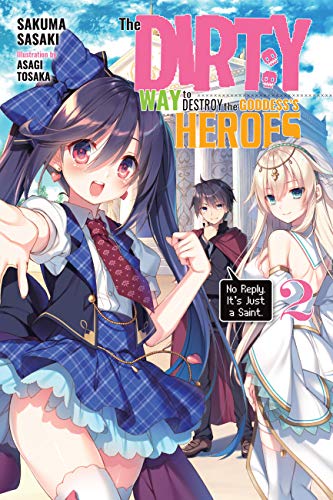
The Dirty Way to Destroy the Goddess’s Heroes: No Reply. It’s Just a Saint.

November 30, 2019 by Sean Gaffney

By Sakuma Sasaki and Asagi Tosaka. Released in Japan by Famitsu Bunko. Released in North America by Yen On. Translated by Jordan Taylor.

Sometimes I get a bit ahead of myself. I was really enjoying this second volume of Dirty Way to Destroy the Goddess’ Heroes, and tweeted as such. The second “hero” they had to face off with was very different from Arian, Shinichi’s plans were clever enough, the banter between him and Celes was fun. It was a really fun book, despite the occasional lecherous joke that made me wince. And then came the last quarter or so, where the lecherous jokes that made me wince became the resolution of the entire plot, and the bottom dropped out of the whole thing, leaving it once again something I can only recommend to those who don’t mind the usual light novel perversions, with an added slice of homophobia. It’s really irritating, as the characters are engaging, the plot lends itself well to a 6-book series (as this is), and some of the humor is great. Just… stop with the pedophilia and “gays are predators” jokes. I beg you.

The religious oligarchy trying to take down the demon lord (for their own personal gain, of course) now sends “the Saint” after him. Sanctina has been raised in a box since she was a baby, the daughter of talented magic users who were bribed to have a child and leave it with the Church. There were four others like her, but one by one none of them were quite as “devoted” (read: unwilling to question) as she was, so they vanished or were sent away. Now she’s in a neighboring kingdom taking people’s life force to power a magical container big enough to destroy the demon lord once and for all. Shinichi and company quickly figure out that, because her personality is somewhat blank due to her upbringing, normal means aren’t going to cut it. And so they decide to make Rino, the demon lord’s daughter, into… a pop idol?

As I said, most of this is fun. It mocks idol culture, and Sanctina does make a genuinely disturbing villain. Then we get the climax. First of all, Shinichi hired an incubus to disguise themselves as Sanctina and go around anally raping muggers (and later, after the denouement, Sanctina’s other “Holy Knights”). No. Do not do this. I don’t care how evil the muggers and knights are, and they’re pretty bad, don’t. Do. This. Secondly, Sanctina’s jealousy and hatred of Rino, who is not only a popular idol who can also heal the sick but shows a genuine love and compassion for everyone around her that Sanctina lacks, finally causes her to break. Which is fine. And be sexually attracted to Rino. Who is underage. We’d had a few pedophilia jokes scattered though the book that grated, but this is the climax, and given Sanctina returns with the protagonists, is likely not going away. Shinichi even observes “Great, she’s a lesbian”. Again, just… fuck this.

So yeah, I retract my prior tweet. Dirty Way to Destroy the Goddess’ Heroes has a lot of potential, but in the way can’t quite escape its tendency to wallow in nasty stereotypes for both humor and plot resolution. As such, recommended only to those who are used to that sort of thing and don’t care.

Filed Under: dirty way to destroy the goddess's heroes, REVIEWS

Is It Wrong To Try To Pick Up Girls In A Dungeon? On The Side: Sword Oratoria, Vol. 10

November 29, 2019 by Sean Gaffney

By Fujino Omori and Kiyotaka Haimura. Released in Japan as “Dungeon ni Deai o Motomeru no wa Machigatte Iru Darou ka? Gaiden – Sword Oratoria” by Softbank Creative. Released in North America by Yen On. Translated by Dale DeLucia.

The long delay in the 14th book in the main series reaching North America has meant that the side series has been able to catch up quite a bit, and this book benefits from covering two books in the main series, the 10th and 11th, from the perspective of Loki Familia. Last time was very Aiz-heavy, and so she ends up not quite as featured in this book, though that does not mean that she’s not completely devastated by the end of it. And no, that doesn’t mean it’s Lefiya-heavy either, though she does get to barrel through the entire book fueled on pure rage at Bell, and also gets some of the more badass fight scenes. No, it’s Finn who’s the biggest protagonist in this book, as you might guess from the cover, which shows him, Aiz and Bell in a three-way standoff sort of situation. Bell inspires Aiz, much as he is unaware of this… and also, by the end of this book, Finn.

The majority of this book revolves around the Xenos getting out of Daedalus Street and back to the dungeon, only from the perspective of Loki Familia, who are here to kill them… well, that’s a secondary goal, but the primary goal is to use them to draw out the Evils and get another key (or two… or three…) to Knossos. Things are not helped by Hestia Familia, who are driving Finn and company to distraction (we see Lilly’s deception in this book from the Loki Familia side, where it just looks like picking on Raul, and it’s a lot less triumphant). Oh yes, and Hermes family is in there as well. And then there are the random adventurers who are simply really pissed at Bell, and the poor and orphaned who live here, who are also a little pissed at Bell, though they’re less certain about that.

Finn has no doubt that Bell is NOT being a selfish adventurer, but when he figures out his actual motive it’s tremendously difficult to accept. The story of Loki Familia has featured, time and again, folks who lost their families and loved ones to monsters. Aiz, Finn, Bete…it’s no wonder that Finn’s response, on hearing that these are intelligent monsters with emotions and morals of their own, is “I don’t care”. But seeing him gradually piece together what’s been happening, and fighting against his own instincts (which tell him not to kill these particular monsters), along with one of Riveria’s elves being saved by a Xenos taking the bullet, essentially, shows that he can’t simply stick by his rock-solid principles. He has to move forward just as fast, if not faster than Bell Cranel, and if that means changing how he thinks about monsters, then he will.

Of course, that doesn’t mean he’s not above using them, and he now has another group that can help them take on Knossos. The next two books seem to be tied together, and may be more Lefiya-centric. Which, given that Aiz ends this volume somewhat shattered, is probably a good thing. If you haven’t been reading this as it’s a spinoff, or because you hated the anime, please change your mind and get it immediately.

Filed Under: is it wrong to try to pick up girls in a dungeon?, REVIEWS

Didn’t I Say to Make My Abilities Average in the Next Life?!, Vol. 8

November 27, 2019 by Sean Gaffney

By FUNA and Itsuki Akata. Released in Japan as “Watashi, Nouryoku wa Heikinchi de tte Itta yo ne!” by Earth Star Novels. Released in North America by Seven Seas. Translated by Diana Taylor. Adapted by Maggie Cooper.

It has to be said, our four heroines are getting just a wee bit famous, especially when they return to the area near where they went to hunter’s school. Sometimes this is good, as it means that we don’t have to have quite as many reaction shots of everyone boggling at their OP selves. And sometimes this is bad – for them, at least, as the funniest scene in the entire book as them running up against a guild master who saw their final exam battle way back in the early volumes. And bought the figures. With poses that… seemed cool at the time. Though it may not look like it, our heroines are slowly growing up, and part of that process is looking back on the dumb things you did in your youth and cringing. And nothing hammers this home quite like a figure of you in a dorky pose you thought was really cool being venerated by a creepy middle-aged man.

The book is divided into four large sections. The first has Mile and company returning to her homeland to save the kingdom. The interesting thing here is that, because of Adele’s sheltered upbringing both before and after her mother’s death, no one remembers her very well. So when Mile shows up, she’s actually assumed to be her late mother, literally returning from heaven to help them. (The best part of this is finding out that Mabel, Adele’s mother, was basically the spitting image of her daughter, and was also highly eccentric. Even without the reincarnated memories, Mile would still likely have been Mile.) The invasion is handled relatively easily, and starts up a nice running gag of Pauline and company charging everyone for food and drink that they desperately need. The second section has them returning to base… and immediately setting out again, before they can be married off or otherwise ensnared.

The third section has Mile and company, along with two other hunting parties, helping a group of soldiers battling an infestation of monsters that are sent by the neighboring enemy kingdom. This is probably the weakest section, and drives home the point that our heroes needs stronger enemies or they risk being bored… and having the reader be bored as well. The final section leads to a cliffhanger, and has the Crimson Vow go to a village of dwarves, who are unable to craft their materials anymore as the mountainside is infested with orcs and ogres. Abnormally strong orcs and ogres. This works very well as Mile is genuinely startled by this, and actually encourages everyone to fight their hardest. It promises a strong beginning next time. It also shows off something relatively rare: Mile plans ahead for the village by buying a lot of high-quality alcohol to sell to the dwarves, and… then sells it, despite the lampshading about it being the perfect plan. I was waiting for it to go wrong.

The anime adaptation of the series has now begun, and I hear adds a lot more fanservice. This volume does, like the previous ones, talk about everyone’s breasts more than anyone cares, but other than that (and Mile’s ludicrous Goddess costume) is content to let the characters and humor drive the book. A lot of fun.

Filed Under: Didn't I Say to Make My Abilities Average in the Next Life?!, REVIEWS

Urusei Yatsura, Omnibus 4

November 26, 2019 by Sean Gaffney

By Rumiko Takahashi. Released in Japan in two separate volumes by Shogakukan, serialized in the magazine Shonen Sunday. Released in North America by Viz Media. Translated by Camellia Nieh.

I’ll be honest, I wasn’t looking forward to this volume quite so much. Don’t get me wrong, I love UY with all my heart. But I knew we were going to get a heaping helping of Ten here, and Jariten has always grated on me. That said, as I re-read these manga chapters, he didn’t come off quite as badly as I’d expected. The thing is, Ten was SUPER popular when he first appeared in Japan – if not with the readers, then definitely with the animators of the soon-to-come anime series, which took the liberty of inserting Ten into the third episode and having him shoehorned into most episodes after that. But “bratty little kid” has always been a harder sell in the West, particularly if they’re not the ‘sarcastic adult’ kind of brat – look at the four or five failed attempts to sell Crayon Shin-chan here. So it was always hard for me to not just grit my teeth. But here, in the manga chapters written specifically for him, he’s a lot of fun.

Ten, like Mendo before him, is meant to set up a basic truth of the series. Many of the male characters are set up to be contrasts to Ataru, only for it to turn out in the end that they’re exactly the same as Ataru. Ten is a “cute little baby” to most of the women around him, which he uses shamelessly, as he notes he’s not into young girls his own age. (What age that is is left up in the air – he certainly seems very angry when someone calls his tiger skin a diaper.) But of course, Ataru never gets anywhere with any girl not named Lum, and the same applies to Ten – sure, he can snuggle in some bosoms, but he’s essentially just as much of a sad sack as everyone else in the book. He’s also naive enough to be taken in by Ataru’s really, really obvious schemes – see the chapter where he and Sakura go on a “date” that is meant to have her beat him like Ataru but doesn’t work as Ten is a x-year-old boy.

Elsewhere, Ran settles in as a main cast member, though when the focus isn’t on her, her characterization can vary – during the poetry competition, she seems like a different person! There’s a 3-chapter arc set during the Heian period… sort of, note they’re all watching TV and have electricity… which is basically there to show that the cast’s crazy adventures are timeless. Probably my favorite chapter is one where Ataru has made an “anti-teenage gang” movie for the school. It’s absolutely terrible, and Mendo tries to have it destroyed, but instead, thanks to Lum’s alien projector, the delinquents in the movie come to life and terrorize the school… then fend off an invasion by delinquents from another school. From seeing the main cast dressed up as stereotypical delinquents, to movie-Ataru’s ‘LOVE AND PEACE!’, to movie-Lum and Shinobu literally being able to fire huge missiles from under their skirts, it’s pure Takahashi hilarity.

With Ten’s arrival, we’re almost at UY’s middle period here. Takahashi has settled in and is doing what she does best – writing zaniness. Anyone who loves seeing what comedy manga was like at its peak should be reading this.

Filed Under: REVIEWS, urusei yatsura

Do You Love Your Mom and Her Two-Hit Multi-Target Attacks?, Vol. 4

November 25, 2019 by Sean Gaffney

By Dachima Inaka and Iida Pochi. Released in Japan as “Tsujo Kogeki ga Zentai Kogeki de Ni-kai Kogeki no Okasan wa Suki desu ka?” by Fujimi Fantasia Bunko. Released in North America by Yen On. Translated by Andrew Cunningham.

There is a certain weariness to this volume of Do You Love Your Mom?. The author implies at the afterword that they had not expected this series to run quite as long as this, and taking that one gag and making it go over and over is hard. It shows in this volume’s villain, who manages to make the villain of Book 3 look competent. She has one trick, and when it doesn’t work she essentially whines and moans. There’s also a pile of mothers who are lured into the plot because, well, they’re not all that good at being mothers. It’s meant to set up the final moral, which is that it doesn’t matter if you’re bad at cooking and sewing as long as you have feelings for your children, but I do wonder: are there any dads in this world at all? Why can’t they do the housework? It likely won’t come up, as the premise is moms and children, but I am curious.

Our heroes wind up in Casino Town, and the goal is immediately to get rich so they can buy items and not have Mamako steal all the glory and level ups. Naturally, this goes badly. Masato and his mom end up going on a day-long date where Mamako dotes on him to a hideous degree (the entire “let me wash your back” scene can just go away), while the other three try to cheat at the casino and are immediately captured and converted into bunny girls. Yes, even Porta. Now Mamako and her son must invade the casino to win back the others, and also find out about a sinister plot that involves the mothers of this town disappearing, and their children imprisoned. Fortunately, Mamako has had an entire day of spoiling her son, so her mom powers are higher than they’ve ever been…

I am, as always, most pleased by the appearance of Shiraaase, a one-gag character whose gag never gets old to me. (Oddly, her gag seems stunted in this book, possibly as the villain talks in looooong, draaaaawn-out vowels and thus Shiraaase holds back to avoid confusing the two of them.) She even manages to achieve things before getting thrown back in her coffin. Speaking of which, the most satisfying scene of all may be one where Masato has to get through an army of skeletons to get at the big bad. He’s alone, and the fact that he actually has to rely on his own strength and weapon makes him so happy that he simply mows them down like they’re weeds. Now, this is undercut by the Big Boss essentially letting up on him because of a mom thing, but hey! He briefly did a thing!

The series is 9 volumes and counting in Japan, so any danger of the main plot wrapping up is nil. And the fanservice aspect of the series is, to be blunt, really irritating. If you really like Shiraaase or enjoy the main conceit, it’s still worth reading, but if you’re looking for a series to drop as it’s not good enough anymore, this one works fine.

Filed Under: do you love your mom?, REVIEWS

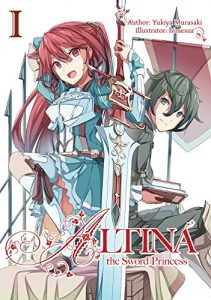
Altina the Sword Princess, Vol. 1

November 24, 2019 by Sean Gaffney

By Yukiya Murasaki and himesuz. Released in Japan as “Haken no Kouki Altina” by Famitsu Bunko. Released in North America digitally by J-Novel Club. Translated by Roy Nukia.

We live at a time when most light novels are trying to get readers attention by a gimmick. It might simply be an excessively long title. It might be a premise so ridiculous that people buy it out of curiosity. It might be piling on the fanservice or ramping up the angst and violence. As such, it’s refreshing to see a series that has a normal title, a normal plot and normal characters. I’m not criticizing here: this really does feel refreshing, coming across as a simple medieval fantasy, lacking even magic (so far) and relying on its two leads to make the reader stick around. (It helps that this series began in 2012 in Japan – its title might be more elaborate were it to come out nowadays.) An overly reckless princess, a needlessly self-hating strategist, and a fort in the middle of absolutely nowhere. No bells, no whistles, and I quite liked it. It does have a very snarky maid, I will admit. But that’s all.

Regis is an administrative officer who’s been demoted… well, OK, reassigned… to the northernmost provinces after a tragic battle that saw his mentor get killed. He is quick to take all the blame on himself, and in fact has a case of self-hatred that seems ridiculous and one suspects stems from some childhood issue. Once near the area, he finds, to his horror, that books up north are rare and expensive – he’s also a book nut. Fortunately, he runs into a girl headed to the fort who can take him there on her coach. Given she asks him to call her Altina, the reader is not in the dark about her identity, but Regis is, at last till they run into a blizzard and are attacked by wolves. So he’s met the princess and settled in… but can he get anything accomplished? Especially as no one at the fort takes Altina seriously?

This is by the author of How NOT to Summon a Demon Lord, which worried me briefly, but it seems the author is quite good at writing to his intended audience. There’s a brief scene of Regis walking in on Altina changing, but that’s about all, and the fact that she’s fourteen, and thus too young to think of romantically, is constantly in his head. Which is good, as I think they both need to mature a bit. Regis desperately needs to have some good things happen to him to get rid of the “everything I do sucks” mentality, and Altina is going to get herself killed one day by her impetuous behavior. Her final battle with the fort commander, which has “if I win, you listen to what I say” as the prize, is very nearly a savage beatdown for her, and she’s saved mostly by her ludicrous sword (which, to be fair, is wielded by her ludicrous strength).

There’s clearly a lot of backstory here, some of which is given in this volume, involving the empire and its current power struggles among the sons and daughters. Altina’s goal of “don’t get married off to become a trophy wife” is a good one, and I look forward to seeing more of the family in future volumes. There’s nothing in this book that really knocks it out of the park or anything. But it’s a very solid read with likeable flawed people, and the flaws don’t irritate. Definitely getting more of this.

Filed Under: altina the sword princess, REVIEWS

My Youth Romantic Comedy Is Wrong As I Expected, Vol. 8

November 23, 2019 by Sean Gaffney

By Wataru Watari and Ponkan 8. Released in Japan as “Yahari Ore no Seishun Rabukome wa Machigatte Iru” by Gagaga Bunko. Released in North America by Yen On. Translated by Jennifer Ward.

I have to hand it to the author, they are very very good at making me, as a reader, feel thrilling highs and desperate lows. Unfortunately, due to the nature of this series as a whole, each book always seems to end on a low, and so I often end up being depressed after a new volume of it. That said, I do still want to learn what happens next, even if I suspect it will once again be a journey where I grind my teeth and yell at everyone to actually have a decent talk with each other. But the nature of our three protagonists is such that that’s not going to happen – if they did, the series would have ended back at Vol. 3. Instead, buckle up for another adventure with Hachiman, whose cynical and roundabout narrative voice make me want him to meet Zaregoto’s Ii-chan someday. On the bright side, when he suggests his one solution to any problem, people are finally there to tell him to take his idea and shove it.

The soccer club manager we met in the short story volume has been nominated for Student Council President. She doesn’t want to do it, but also doesn’t want to deal with fallout of her dropping out or sabotaging herself. So she asks the club to help out. Hachiman suggests writing a bad speech so that everyone blames the speechwriter (him). This goes over like a lead balloon. Instead, first Yukino and then Yui decide to run against her, which will solve the problem, but also mean they likely would not be in the club any more. This also leaves Hachiman with nothing to do. After the middle of the book, which I will get to in a bit, he bands together with the rest of the main cast and comes up with a third option: convince Iroha that she really WOULD be a good Student Council President, thus removing the original request. Sadly, he does this without thinking of Yukino or Yui, particularly Yukino, and the result is the worst victory ever.

That said, the best reason to get the book are two scenes in the middle of it. The first has Hachiman and Hayama on the double date from hell, as his old classmate from middle school, Orimoto (the one he confessed to) and her friend want to get in with Hayama and he begs Hachiman to come along as he clearly doesn’t want to deal with this. After spending most of said date listening to Orimoto mocking and belittling Hachiman, Hayama snaps and tears them apart, pointing out the close relationships Hachiman has gained in high school. Tellingly, Hachiman is more upset by this than anything else. The second scene, my favorite, has Hachiman, at his lowest ebb, returning home and coming across Komachi, who he’d had a fight with at the start of the book. They make up quickly, and the ensuing conversation that follows is possibly the warmest, most heartwarming scene he’s had in the whole series to date, as he asks Komachi for her help and she talks about how worried she really is for him.

So the middle will make your heart grow three sizes, and the ending will make your face turn pale. But that’s typical of this series, which might better be called My Youth Romantic Soap Opera Is Wrong As I Expected. Like most soap operas, it makes you want to read the next book.

Filed Under: my youth romantic comedy is wrong as i expected, REVIEWS

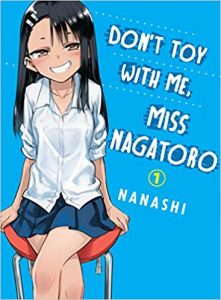
Don’t Toy with Me, Miss Nagatoro, Vol. 1

November 22, 2019 by Sean Gaffney

By Nanashi. Released in Japan by Kodansha, serialization ongoing in the magazine Magazine Pocket. Released in North America by Vertical Comics. Translated by Kristi Fernandez.

One of the bonuses that come with buying a volume of the manga that you’ve already read in a magazine or online is the interstitial art that goes in between each chapter. Many manga, particularly comedies, tend to have these, usually little ‘tags’ that follow the chapter, meant to add something to the reader’s perspective or give them another good laugh. Sometimes it can be fairly pointless, but sometimes it’s actively welcome. Don’t Toy with Me, Miss Nagatoro is definitely a case of the latter. The interstitial art for the first few chapters shows a blushing Nagatoro, rushing away from the scene, wondering if she got her point across or took things too far. It makes it very clear that her previous actions were based on “girl who teases the guy she likes”. This is important, because, while it has righted itself by the end of the volume, the initial chapters of this series skew waaaaay too far towards the “bullying” end of the spectrum rather than “toying with”.

The protagonist is unnamed, as far as I can tell, and is generally called ‘senpai’ by the other lead, Nagotoro. He’s a bit of a schlub, and has a hobby of drawing manga. One day his underclassman, Nagatoro, discovers this and proceeds to grab his manga, read it aloud, and mock it mercilessly. As the volume goes on, she proceeds to take every opportunity possible to viciously attack him, and he is, understandably, feeling a little aggravated by this. Eventually, though, he discovers that she seems to only be like this with him, showing quite a different face to other guys that she’s around. What’s more, by the end of the book the reader, if not the senpai, realizes that she’s doing this because she’s got a crush on him. Of course, her methods may still involve bullying, but, well, that’s how she communicates, right?

There’s been a mini-genre in Japan of this sort of series, ranging from cute and innocent (Teasing Master Takagi-san) to unthinking and broad (Uzaki-chan Wants to Hang Out). Nagatoro takes a third tack. Nagatoro’s teasing verges on cruel, particularly at the start of the book, and if it had stayed that way I might have decided to drop it. It can be hard to get through. The tone softens as it goes along, if only a bit, though, and we start to see more of Nagatoro’s softer, more vulnerable side – and also see her get a bit flustered, particularly when she’s doing things like accidentally talking to her senpai via video chat. It’s important we come to like Nagatoro because unfortunately the senapi, as befits his lack of name, has far less character. He’s a bullied kid who cries a lot, and is quite good at art. If Izuku from My Hero Academia had given up on being a hero and gone to art school, he might be this guy.

So a bit of a mixed bag, but I like where the direction is going. We’ll see if it can keep it up.

Filed Under: don't toy with me miss nagatoro, REVIEWS

Bottom-Tier Character Tomozaki, Vol. 2

November 21, 2019 by Sean Gaffney

By Yuki Yaku and Fly. Released in Japan as “Jaku Chara Tomozaki-kun” by Shogakukan. Released in North America by Yen On. Translated by Winifred Bird.

Having started to successfully negotiate life the way that he does games, Tomozaki now runs up against more treacherous waters. Inviting a group out for a lunch accidentally turns into a shopping trip (MUCH harder for someone like him), and he has to ask his library friend out to see a movie, something that would be adorably cute but unfortunately gets derailed by the main plot. The main plot being Mimimi, the overenthusiastic and hyper classmate of his, running for Student Council President… against Hinami. As we discover that Mimimi has a long history of coming in second to Hinami, and see just how far above everyone else Hinami really is, Tomozaki decides that he wants to help Mimimi take her down by winning the election. But is he really good enough to do that now? And isn’t this just ignoring the larger issues that Mimimi has? More to the point, is being the best at everything really something you can criticize? All this, and it’s only the second volume.

We’d seen a hint of Mimimi’s hidden depths in the first volume, but the second one goes into far more detail. (My suspicion is that each girl on the cover art will be the focus of the book in question, so expect library girl to take center stage next time.) It can be hard to constantly find yourself hitting an insurmountable wall, and even harder when it’s a person. There’s a core of self-loathing to Mimimi’s behavior here, as she can’t see a way past what she’s doing without feeling angry with herself. The “what’s the second highest mountain in Japan?” question was a good way to demonstrate it to Tomozaki – with everyone watching Hinami at number one, who’s going to look at the next best? But, as we hear towards the end, Hinami has felt that anger and frustration as well – in fact, it’s what led to this entire situation. As Tomozaki says towards the end of the book, nobody did anything wrong here.

There’s also a lot of good stuff here about student council elections in Japanese schools, and how you have to balance what kids want vs. what teachers will let you talk about. The reader is absolutely meant to root for Mimimi and Tomozaki here. That said, the reader also suspects the result will be as inevitable as Hinami says it is. (I’m still not sure how the author wants us to feel about Hinami – getting a very “Medaka Kurokami” vibe about her.) And then there’s Tomozaki, who does make some good steps forward here (I really liked his buying the hair wax), but needs to stop framing everything as “this is what normies do” and putting himself outside that box. Also struck by a naïveté I was not expecting from him – even I knew what Mimimi did to Tama, but he’s baffled by it the entire book.

So, to sum up: I enjoyed the plot, I liked the characters, the writing felt smooth and readable (very good translation here), and it doesn’t feel quite as much like a self-help guide compared to the first. Overall, it was excellent. Cannot wait for the next book.

Filed Under: bottom-tier character tomozaki, REVIEWS

  • « Go to Previous Page
  • Page 1
  • Interim pages omitted …
  • Page 132
  • Page 133
  • Page 134
  • Page 135
  • Page 136
  • Interim pages omitted …
  • Page 346
  • Go to Next Page »
 | Log in
Copyright © 2010 Manga Bookshelf | Powered by WordPress & the Genesis Framework