• Skip to primary navigation
  • Skip to main content
  • Skip to primary sidebar
  • Home
  • About Us
    • Privacy Policy
    • Comment Policy
    • Disclosures & Disclaimers
  • Resources
    • Links, Essays & Articles
    • Fandomology!
    • CLAMP Directory
    • BlogRoll
  • Features & Columns
    • 3 Things Thursday
    • Adventures in the Key of Shoujo
    • Bit & Blips (game reviews)
    • BL BOOKRACK
    • Bookshelf Briefs
    • Bringing the Drama
    • Comic Conversion
    • Fanservice Friday
    • Going Digital
    • It Came From the Sinosphere
    • License This!
    • Magazine no Mori
    • My Week in Manga
    • OFF THE SHELF
    • Not By Manga Alone
    • PICK OF THE WEEK
    • Subtitles & Sensibility
    • Weekly Shonen Jump Recaps
  • Manga Moveable Feast
    • MMF Full Archive
    • Yun Kouga
    • CLAMP
    • Shojo Beat
    • Osamu Tezuka
    • Sailor Moon
    • Fruits Basket
    • Takehiko Inoue
    • Wild Adapter
    • One Piece
    • After School Nightmare
    • Karakuri Odette
    • Paradise Kiss
    • The Color Trilogy
    • To Terra…
    • Sexy Voice & Robo
  • Browse by Author
    • Sean Gaffney
    • Anna Neatrour
    • Michelle Smith
    • Katherine Dacey
    • MJ
    • Brigid Alverson
    • Travis Anderson
    • Phillip Anthony
    • Derek Bown
    • Jaci Dahlvang
    • Angela Eastman
    • Erica Friedman
    • Sara K.
    • Megan Purdy
    • Emily Snodgrass
    • Nancy Thistlethwaite
    • Eva Volin
    • David Welsh
  • MB Blogs
    • A Case Suitable For Treatment
    • Experiments in Manga
    • MangaBlog
    • The Manga Critic
    • Manga Report
    • Soliloquy in Blue
    • Manga Curmudgeon (archive)

Manga Bookshelf

Discussion, Resources, Roundtables, & Reviews

raven of the inner palace

Raven of the Inner Palace, Vol. 7

September 28, 2024 by Sean Gaffney

By Kouko Shirakawa and Ayuko. Released in Japan as “Kōkyū no Karasu” by Shueisha Orange Bunko. Released in North America by Airship. Translated by Amelia Mason. Adapted by T. Burke.

Probably the most startling thing about this final volume of Raven of the Inner Palace is how little Jusetsu is in it, and when she appears, it’s not really her actions that save the day, just her actual presence. She’s spent her life being a vessel for a higher power, and being involved in a God vs. God battle is something that she has to get dragged into or else bad things will happen. But it’s not what she herself wants. Honestly, I think she’s still flailing around trying to figure out what she wants until this final volume, and it’s not saving the day and unleashing her inner raven. Nor is it headed back to the palace to deal with the unstated romantic feelings she and Koshun have dealt with since Book 1 – that ship has run aground already. That said, we do get to see the resolution of a ship, sort of – the trouble is that it’s Jusetsu/merchant marine life. Which, refreshingly, is not what anyone was expecting.
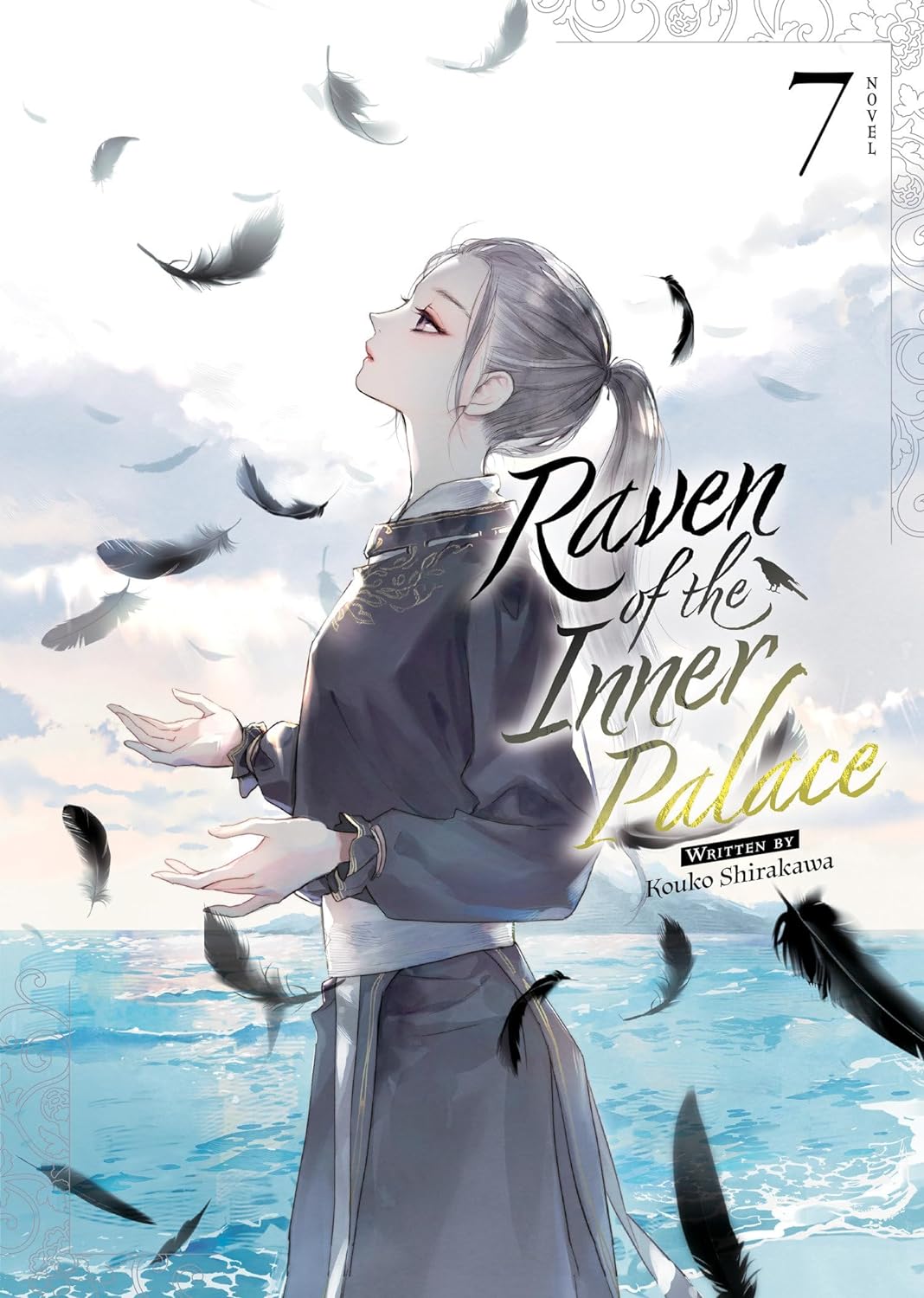
This book is essentially divided into two plotlines, one on and going to the island, and the other up in the mountains. They’re actually mostly completely separate. We already know about Jusetsu, who needs to somehow get past an underwater volcano exploding to get to the island so that she can reunite the two halves of the raven. She’s got to do this despite the turtle god resorting to threats, more threats, and possession in order to win the day. The other half of the book is still drenched in Saname family drama, which we already got a heaping helping of in the last book. Ko has been sent by his father to use the mountain tries to incite a rebellion, which won’t succeed, but will mean that they’ll have to kill Jusetsu in order to calm everyone down. If you think this makes no sense, well, it doesn’t make much sense to Ko either, but it’s hard to go against Daddy.

I’ll be honest, this book was not quite the big finale I was hoping for. As noted, Jusetsu is just present rather than active for the battle, which makes sense but is dramatically unsatisfying. Likewise, there’s no rebellion, because in the end the stability of the country is more important than an old man trying one last time to exercise his power. And yes, Koshun has almost been the co-protagonist of the series, and so seeing him so uninvolved in the finale – he doesn’t leave the palace – makes sense but is dramatically unsatisfying, the second time I’ve typed that. I did like Jusetsu’s career choice – she can’t stay in the palace, after all, especially not with an Empress and two kids from other wives – and so traveling the world and seeing other cultures makes sense. And I’m delighted she takes her entourage with her – I love Jiujiu.

So yes, something of a mixed bag finale, but overall this was a good series, and a worthy addition to “intrigue in the inner court of the emperor” genre.
Filed Under: raven of the inner palace, REVIEWS

Raven of the Inner Palace, Vol. 6

July 4, 2024 by Sean Gaffney

By Kouko Shirakawa and Ayuko. Released in Japan as “Kōkyū no Karasu” by Shueisha Orange Bunko. Released in North America by Airship. Translated by Amelia Mason.

Yeah, sorry, the days of solving ghost crimes are officially history, unless you mean the overall plot, which is more like God vs. God. Though we do get to see everyone trying to solve the mystery of Jusetsu’s ghost, sort of, and Shiki still has the arm of his dead sister, who actually ends up saving the day. But really, this is the first part of a two-part finale, and as such it’s taking all the political drama and intrigue and fantasy deity stuff from the past five books and setting off all the guns at once. Honestly, it’s hard to put down, as it barrels along till it gets to the final chapter, which slows way down but has more of a devastating impact because of that. In general, if you really enjoyed previous volumes of this series, you will enjoy this volume, and the wait for the final volume will likely prove quite difficult.

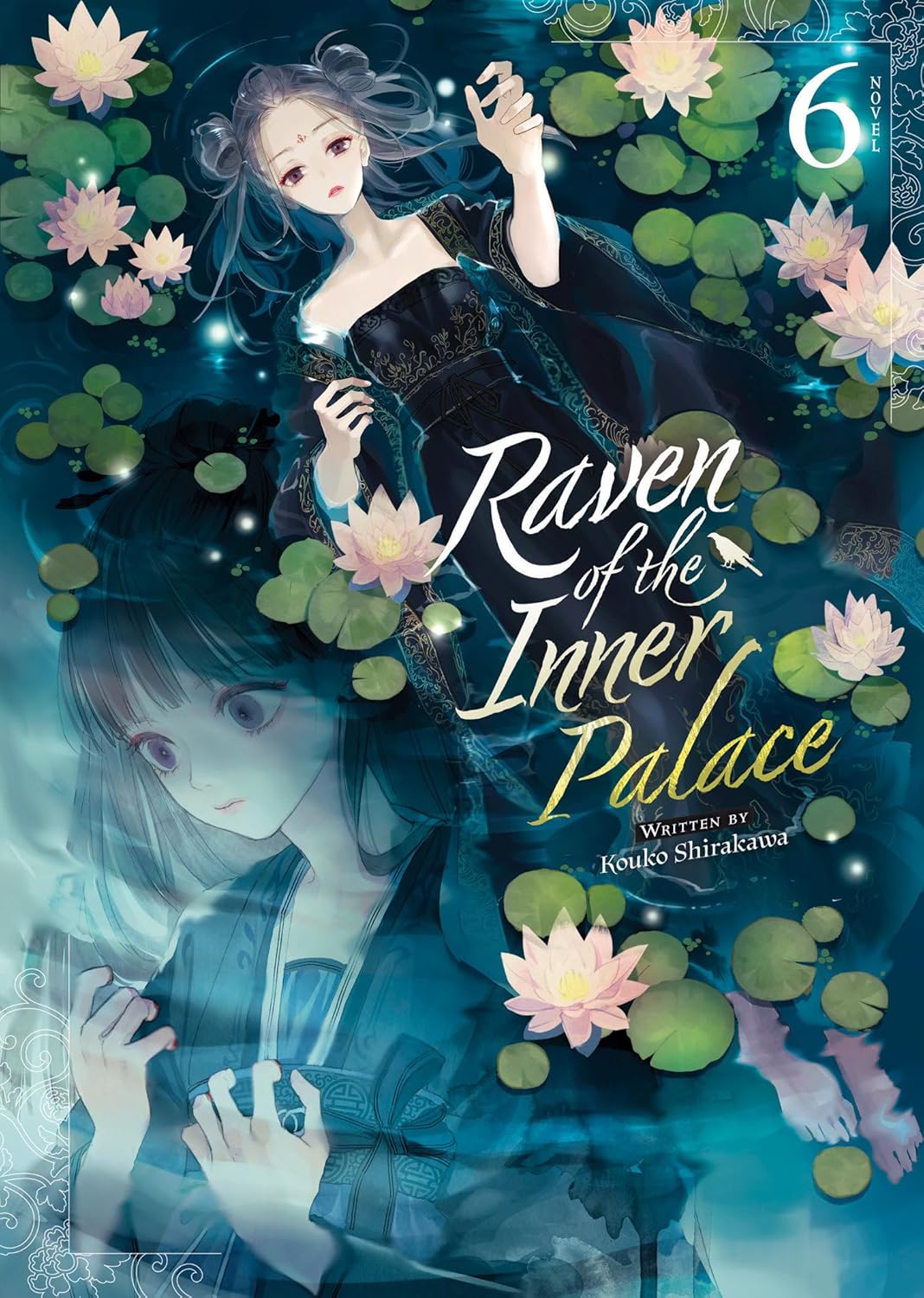
There is, frankly, too much for Koshun to deal with right now. After the events of the last volume, everyone knows that there’s a member of the Ran family, who were supposed to be completely wiped out, in the Inner Palace. Jusetsu is no longer in her body, which is now possessed by the Raven, who is only partly helpful after having been betrayed for so long. And there are any number of political allies and enemies looking to take advantage of this. Fortunately, he’s able to calm things down a bit with a few well-placed cabinet meetings, as well as one of our main characters finally having to bite the bullet and admit that he’s a lot closer to Jusetsu than anyone thought. Meanwhile, Jusetsu herself is in limbo, depicted here as a river (the cover shows this), but has to deal with Kosho, the one who started all this, who has been trapped there forever by the gods and really wants someone else to join her in despair.

The last half of the book continues to deal with the main plot, but away from the two leads. We get Senri and Shiki acting as a sort of Holmes and Watson as they try to work out how much of the volcano story is actual history in order to try to get the other half of the Raven’s body back. This is particularly difficult for Shiki as he runs into the man he wants revenge on, the very revenge that his sister is trying to stop him getting. This was very good. The last chapter returns us to the family drama of the Saname family, which, and for once I mean this in a GOOD way, reads a lot like a Sam Shepard play. In fact, it reads like Buried Child. Shin suffers very well, as every around him tries to convince him to get the hell away from there, only in the most awkward and counter-intuitive way. This is excellent, and possibly the highlight of the book, provided you don’t mind awfulness.

Everyone’s arrived at the volcano site by the end of this book, and it’s going off again for the cliffhanger. Can’t wait to see how this wraps up.

Filed Under: raven of the inner palace, REVIEWS

Raven of the Inner Palace, Vol. 5

January 18, 2024 by Sean Gaffney

By Kouko Shirakawa and Ayuko. Released in Japan as “Kōkyū no Karasu” by Shueisha Orange Bunko. Released in North America by Airship. Translated by Amelia Mason.

This series, while telling the story of Jusetsu and her attempts to broaden her world, find out more about the Raven Consort in general, and escape, began as an anthology series to a large degree, which each chapter featuring a ghost story of the week for her to solve. That still happens at the start of the fifth book, with a court lady whose makeup box is upsetting people in the living quarters by being haunted by a ghost. But as this book goes on we realize that we’re past the halfway point of the series, and we can’t really focus that much on Jusetsu solving ghost crimes anymore. Or rather, the ghost crimes she’s solving are ones that affect her specifically. Because we’re getting to the bottom of what the Raven Consort position really is, and what happens to those who have been Raven Consorts, and let me tell you, it might be scarier than most of the stories we’ve read in this series to date.

Jusetsu is not the only one trying to figure out how to break the barrier stopping her from leaving and free the raven, the Emperor is as well. This is despite the fact that he (consciously) and Jusetsu (unconsciously) are in love with each other, and leaving the palace will mean never being able to return. The Emperor, towards that end, has now buckled down to the position of siring an heir – two of the consorts are now pregnant. He’s even inviting back old retainers who had previously been exiled for being on the wrong side of past conflicts, mostly as he finds it a lot more preferable to have any seeds of rebellion close to him rather than far away where he can’t do much. Meanwhile, Jusetsu gets the shamans needed to help her destroy the barrier, and even knows where she should probably go, thanks to several old folk tales about an underwater volcano. Unfortunately, that pesky God is still around…

Jusetsu was told, at the start of this series, that she had to be alone, not take retainers or bodyguards, and hold herself aloof. This from the previous Raven Consort. She has not remotely done that, and for the most part the consequences have been pretty good – close friendships, respect, people who like spending time with her. Unfortunately, we’re now seeing the pendulum swing the other way. Solving the problem of the makeup box, for example, even though it saved a life, just makes people think that she was the cause of the accident. And I suspect the cliffhanger at the climax of this volume is going to make leaving the palace more of a “fleeing for her life” sort of deal. That said, anything’s better than suffering the fate of all the Raven Consorts before her, whose souls are frozen in a sort of massive grudge to prevent exactly what Jusetsu has been doing. It’s a bit scary.

There are, I believe, two more volumes in the series, and I suspect we’re not going to have too many “let’s solve a mystery” chapters anymore. Where we will go remains intriguing.

Filed Under: raven of the inner palace, REVIEWS

Raven of the Inner Palace, Vol. 4

October 8, 2023 by Sean Gaffney

By Kouko Shirakawa and Ayuko. Released in Japan as “Kōkyū no Karasu” by Shueisha Orange Bunko. Released in North America by Airship. Translated by Amelia Mason.

Usually when you see character development, it’s meant to be heartwarming, or affirming, and generally a good thing. And there is that here. Seeing Jusetsu gradually open up to being around others, helping people, and growing more comfortable in her own skin is absolutely a good thing, and the Emperor knows it. That said, the fact that she is the Raven Consort makes this a bit of a double-edged sword. The classic joke “I’m not like other girls” is eerily true here, and that’s why there’s a sense of this series moving faster and faster down a hill towards a crash that Jusetsu is not going to be able to stop. It does not help that certain factions in the court are trying to apply the accelerator rather than the brakes, and suddenly instead of being fond of Jusetsu, or looking up to Jusetsu, they are WORSHIPING Jusetsu. And that’s definitely a bad thing, give that’s she’s already a part of a god, and the other god who is the enemy may be getting back to full strength.

The main plot shows the Crane Consort’s father, Choyo, arrive at the palace, supposedly in order to apologize to the Emperor for what happened in the last book, and grace him with some of their most valuable silkworm cocoons. In reality, Choyo is there to blackmail/threaten the Emperor with the knowledge that he knows who Jusetsu is and that she should stay isolated in her own quarters. Meanwhile, the man responsible for the events of the third book, Hakurai, may have lost an eye but is not remotely down and out, and he’s here to try to kill Jusetsu *and* destroy her reputation – and nearly succeeds at the second. And, of course, these events are interspersed with the meat and potatoes of this series; a ghost is in the palace, let’s figure out why.

Generally speaking the main reason to read any of these “inner palace of the Emperor” series, be it Apothecary Diaries, Though I Am an Inept Villainess, or this one, is for the court politics, and that’s no exception here. Jusetsu is trying her best, helping people and making sure to right wrongs and save those who can be saved (and send to the afterlife those who can’t). But by the end of the book she’s basically been asked to stay shut up until further notice, and while I doubt that will last long, it feels like a loss for her. This is not to say that Choyo wins, however. Banka easily gets the most interesting plotline and the best moment in the book, as she’s seemingly ineffectual, useless, and getting sicker and sicker over the course of the book. I say seemingly because she confronts her father angrily near the end, reveals a secret she’s been holding back that upends a lot of what will be coming, and basically says “I’m not your toy anymore”. It’s great. I can’t wait to see how she nobly dies in a future volume.

Good intrigue, great characters, worrying that it will end with half the cast dead, but hey. Romance is sort of vaguely there but very much in the background. To sum up: read this, it’s good.

Filed Under: raven of the inner palace, REVIEWS

Raven of the Inner Palace, Vol. 3

August 7, 2023 by Sean Gaffney

By Kouko Shirakawa and Ayuko. Released in Japan as “Kōkyū no Karasu” by Shueisha Orange Bunko. Released in North America by Airship. Translated by Amelia Mason.

This volume delves deeper into why everyone insists that the Raven Consort always be alone. Throughout the book we see Jusetsu just generally being nice to people and helping them with their personal trauma. She’s a good egg. And she’s also gaining another bodyguard here, even though he may be a spy (or a double agent… it’s that kind of book). She might even get in more ladies-in-waiting, though I think Jiujiu might have something to say about that. She’s growing closer to the emperor, though I don’t think she really realizes what those feelings are yet. (It doesn’t help that she has to have jealousy explained to her, and doesn’t get it.) That said, the end of the book is worrying. Having good friends is fine, especially as the emperor is going to work on saving Jusetsu. But the way some people are reacting to her actions is beginning to look a bit like worship. And, as we see in this book, new gods are not always a good thing.

As with the previous books in this series, there are four chapters, each of which has a self-contained “mystery” but each also adds to the larger narrative. A lady-in-waiting is being haunted by a ghost, but the ghost is just standing there and not doing anything. An ancient ghost wanders the inner palace lamenting… but if the ghost is so ancient, why has it only started appearing this last week? A scholar new to the palace has a ghostly arm pulling on his sleeve, trying to stop him from… something. And, as is traditional with this series, the book ends with one of the consorts near death, this time because of a cursed item that was actually meant to kill Jusetsu. Throughout all this, Jusetsu takes care of the problem while struggling to come to terms with her need for people around her.

The best part of the book is its emphasis on the fact that people have more than one side to them, and that just because you had a bad time because of something that someone else did does not mean they meant you to have a bad time. The lady-in-waiting;s ghost was upset with her for fleeing while they were left to die… but they also told her to flee out of love. This also allows Jusetsu to come to terms with her mother’s own sacrificial actions, which were meant to save her even as they also made her suffer. As for the horror part of the book, there’s less of it this time around. It was a bit eerie how one of the supporting characters was revealed to not really exist and just smiled and said “Yup, bye”. And the resolution of the third chapter was basically “well, now I know why I have a ghost, but I can’t stop what I’m here for, so welp”, which is realistic but unsatisfying.

The book overall remains an excellent read for fans of “emperor’s palace” books and dark mysteries.

Filed Under: raven of the inner palace, REVIEWS

Raven of the Inner Palace, Vol. 2

April 16, 2023 by Sean Gaffney

By Kouko Shirakawa and Ayuko. Released in Japan as “Kōkyū no Karasu” by Shueisha Orange Bunko. Released in North America by Airship. Translated by Amelia Mason.

I mentioned last time that this was a mystery series, and that’s still true here. The book is set up so that we have the chapter itself, which is a self-contained “a ghost is causing problems” thing for Jusetsu to deal with, but each chapter also adds to the overall narrative of Jusetsu and the Emperor getting closer to each other despite the entire world seeming to throw “do not do this” signs at them. But this second volume also amps up another part of this series, which is the horror. There is some deeply creepy shit going on here, and honestly the chapter that began with a court maid being found dead with her throat ripped out was on the milder end of the spectrum. These ghosts have issues, and just because Jusetsu is here to try to get them to the afterlife doesn’t mean she’s always going to succeed. Especially since it seems she has a distaff counterpart, the owl to her raven. And he’s trying to kill her.

The first story here has Jusetsu meet a young eunuch who is tormented by a ghost that only he can see, one that keeps apologizing in the direction of the concubine of that quarters. Who is the ghost and what does it have to do with gorgeous blue feathers? In the second story (and the most horrific of the lot), an old woman begs Jusetsu to try to put to rest the spirit of a young concubine who drowned herself, but the main issue is that some people, even when grieving, have to make it all about them. The third story has a mask with holes in the eyes which, when put on, shows a ghost who seems to be very interested in a specific kind of lute playing. And the final story has Jusetsu get involved with a concubine who has been somewhat off the rails since her brother died, and who will accept any help in order to get her brother back.

It’s very odd seeing the inner narrative push back against what we, as a reader, want. Jusetsu is a kind and lonely young girl who is starting to really come out of her shell now that she’s surrounded by people. She’s got a cute servant girl, a nice bodyguard, an older woman to give (wordless, her tongue was cut out) advice, and of course the Emperor dropping by all the time, seemingly infatuated with her. This is definitely good in an emotional way. But man, the backstory and the actions of others within the narrative have it being painted as this massive disaster, and honestly you can’t help but since every time she shows empathy to someone new and yet another person reminds her “the raven consort but always be alone”. And then there’s the end of the boo, which gives her her very own nemesis, who is going to murder her for her own good. Well, for the raven’s own good. Jusetsu is just unfortunate baggage.

As you can imagine, these are very good books. If you like your fantasy dark and don’t mind some creepy ghosts, definitely get this.

Filed Under: raven of the inner palace, REVIEWS

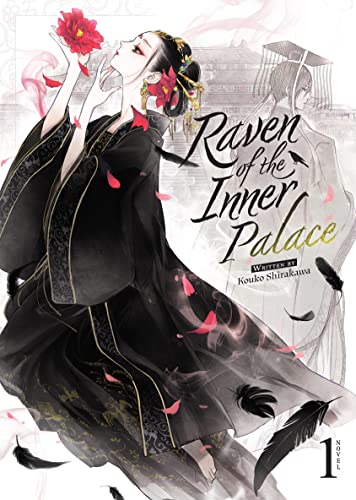
Raven of the Inner Palace, Vol. 1

January 16, 2023 by Sean Gaffney

By Kouko Shirakawa and Ayuko. Released in Japan as “Kōkyū no Karasu” by Shueisha Orange Bunko. Released in North America by Airship. Translated by Amelia Mason.

Sometimes people just want variations on a theme. Looks at why isekai is so popular, despite the fact that everyone you talk to seemingly hates it. Heck, look at Villainess novels, where I feel like Holt from Brooklyn Nine-Nine. “I’ve read this story before.” “AND YOU’LL READ IT AGAIN!” And now we have the mini-genre of “intrigue in the inner court palace of the Emperor and his harem”, where I’ve already got The Apothecary Diaries (mystery series with a side of toxic romance), Culinary Chronicles of the Court Flower (foodie shoujo with doomed romance very much not as the side), and Though I Am An Inept Villainess (bodyswap AND villainess AND romance AND intrigue). And now we have Raven of the Inner Palace, which has mystery, and also romance, but most importantly it has ghosts. So many ghosts, they’re honestly choking the Inner Palace. Fortunately, we have a young woman who can help them move on. Somewhat less fortunately, she’s stuck there for the rest of her life, because she is Special ™.

Jusetsu is the Raven Consort, who, unlike the other Consorts in the Inner Palace, does not spend the nights “having conversations” with the Emperor. Instead, she helps others in the court to find lost items, or to remove a curse with her mystical powers. Now the Emperor, who is relatively new to power after overthrowing the Dowager Queen (who is ludicrously evil in an almost laughable way, despite the fact that we never see her) is here to see Jusetsu to see if she can identify who is the owner of a jade earring dropped on the ground. From here, and despite Jusetsu being standoffish and prickly and the Emperor seemingly being stoic, the two grow closer, and each learns the backstory of the other.

As with a lot of mystery series, I don’t want to give the game away by talking about the plot too much. I do like Jusetsu, who different enough from the other “court intrigue” heroines to be her own person. She turns out to be socially awkward as hell, partly from her tragic past, but mostly, it’s inferred, from the training she got to be the next Raven Consot, which consisted of emphasizing that she should have a minimum of human contacts. That goes out the window in the first book. Not only is the Emperor clearly starting to fall for her (she doesn’t notice) and she gains a court lady and a second servant. This is clearly a good thing for her character development, but I suspect a lot of folks are not going to like her straying out of her lane in the future. It does help that she’s very good at the supernatural part, which is the other half of this book. The ghosts are more sad than terrifying, but I’m sure we’ll have even more of them in future.

This also got an anime in the fall (which, be warned, used the Chinese names rather than the Japanese ones as this translation does). It succeeds for the same reason the other three series I mentioned do. Not because of the genre, or because of the mysteries. It’s because they’re REALLY well written. I wasn’t planning to read more. It’s now definitely one I’ll read more of.

Filed Under: raven of the inner palace, REVIEWS

 | Log in
Copyright © 2010 Manga Bookshelf | Powered by WordPress & the Genesis Framework