• Skip to primary navigation
  • Skip to main content
  • Skip to primary sidebar
  • Home
  • About Us
    • Privacy Policy
    • Comment Policy
    • Disclosures & Disclaimers
  • Resources
    • Links, Essays & Articles
    • Fandomology!
    • CLAMP Directory
    • BlogRoll
  • Features & Columns
    • 3 Things Thursday
    • Adventures in the Key of Shoujo
    • Bit & Blips (game reviews)
    • BL BOOKRACK
    • Bookshelf Briefs
    • Bringing the Drama
    • Comic Conversion
    • Fanservice Friday
    • Going Digital
    • It Came From the Sinosphere
    • License This!
    • Magazine no Mori
    • My Week in Manga
    • OFF THE SHELF
    • Not By Manga Alone
    • PICK OF THE WEEK
    • Subtitles & Sensibility
    • Weekly Shonen Jump Recaps
  • Manga Moveable Feast
    • MMF Full Archive
    • Yun Kouga
    • CLAMP
    • Shojo Beat
    • Osamu Tezuka
    • Sailor Moon
    • Fruits Basket
    • Takehiko Inoue
    • Wild Adapter
    • One Piece
    • After School Nightmare
    • Karakuri Odette
    • Paradise Kiss
    • The Color Trilogy
    • To Terra…
    • Sexy Voice & Robo
  • Browse by Author
    • Sean Gaffney
    • Anna Neatrour
    • Michelle Smith
    • Katherine Dacey
    • MJ
    • Brigid Alverson
    • Travis Anderson
    • Phillip Anthony
    • Derek Bown
    • Jaci Dahlvang
    • Angela Eastman
    • Erica Friedman
    • Sara K.
    • Megan Purdy
    • Emily Snodgrass
    • Nancy Thistlethwaite
    • Eva Volin
    • David Welsh
  • MB Blogs
    • A Case Suitable For Treatment
    • Experiments in Manga
    • MangaBlog
    • The Manga Critic
    • Manga Report
    • Soliloquy in Blue
    • Manga Curmudgeon (archive)

Manga Bookshelf

Discussion, Resources, Roundtables, & Reviews

Reviews

My Next Life As a Villainess! All Routes Lead to Doom!, Vol. 2

February 11, 2019 by Sean Gaffney

By Satoru Yamaguchi and Nami Hidaka. Released in Japan by Ichijinsha. Released in North America by J-Novel Club. Translated by Shirley Yeung.

When I was reviewing the 2nd and final volume of It’s My Fault That My Husband Has the Head of a Beast, I noted that it was a very open ending for a series that wrapped up there, not resolving much of anything. The 2nd volume of Bakarina has the opposite problem – unsuspecting readers who finish this book will definitely think it’s the final volume, which isn’t true. While none of the cast have been able to get their feelings through to the dense Katarina yet, the book takes us through to the end of the “Fortune Lover” game that her prior incarnation had been playing, and she successfully navigates it without getting a horrible Bad End. We even meet Maria Campbell, the actual heroine of the game, and she’s sweet and kind and also falls head over heels for Katarina, because of course she does. Problems are solved, tragic backstories ferreted out, and they all lived happily ever after and ate lots of snacks.

I will issue a word of warning: while there are still tons of hilarious parts to this volume, the second half of the book turns serious, and one of the backstories features sacrificial murder of a loved one. It’s not played for laughs at all, nor should it be. Katarina starts her school life, meets Maria and defuses any problems there by her love of sweet, and all seems to be well… except that the same things happen that occur in the game – Katarina is accused of being a terrible bully to Maria. Fortunately, in this world it’s not true, so this is rapidly defused, but it’s clear that someone is out to get Katarina. Someone with Dark Magic, which can control a person’s mind and also means they’ve killed to get it. The culprit is not exactly a mystery, frankly, but it’s handled quite well, especially as Katarina doesn’t have any foreknowledge of the events – her past self never got to the “hidden route” before she died.

Speaking of past lives, we find here that another of the main characters turns out to be a reincarnation, though she isn’t consciously aware of it. This allows Katarina, at a time of great peril, to get advice from her former friend who HAD played the game, and allows her to try to save the villain – because remember I said tragic backstory? Plus this is Katarina, and much as she may be silly and dense a lot of the time, she’s a kind and loving heroine, to an extreme. This means that she’s allowed to talk the villain down by simply saying that she’ll listen to him and she understands his pain. Bakarina is having fun with its heroine’s personality, but it’s not really subverting or deconstructing anything except perhaps the fact that literally everyone falls in love with her. She is 100% shiny and pure.

So with everyone living happily ever after, where does the series go from here? Well, they’re all still at school (though Nicol graduated, and time definitely seems to be moving faster than these sorts of books usually do), and this world may be based on a game but clearly isn’t actually a game, so I’m sure that something will come up. And maybe Katarina will realize the others’ feelings for her!… yeah, OK, no.

Filed Under: my next life as a villainess, REVIEWS

Young Master’s Revenge, Vol. 4

February 10, 2019 by Anna N

Young Master’s Revenge Volume 4 by Meca Tanaka

Young Master’s Revenge has been a such a fun short series! I just finished reading the last and final volume this week and I found that it had much more of an emotional payoff than I was expecting from a manga with its main plot centering on turtle-inflicted butt scars. There’s never any doubt that Leo and Tenma are going to end up together, but seeing how they finally both grappled with their feelings made the ending of this series rewarding.

young master's revenge 4

Tenma and Leo are living separately, and she’s actually able to take care of herself finally now that she’s endured life as Leo’s maid. She’s moved on from being oblivious about romance to trying to figure out how to deal with her newly realized crush on Leo, which results in a bunch of protestations and slightly emotional outbursts. Leo’s secret scars are almost exposed, and Hana goes to whatever lengths she can in order to protect him. The confusing feelings of teen romance are amped up even further when Tenma reluctantly agrees to go on a date with “Rose King” Barazono, while Leo and Togo pretend to go on their own date in order to act as silent observers. Tenma finds herself unable to control her crying when she sees Leo and Tojo together, and Leo confesses his true feelings but doesn’t let Tenma say anything in return.

Tenma decides to take on the emotional labor of fixing everything herself and while she previously was more self-contained due to her upbringing and unfamiliarity with basic teen socialization, she stands up for herself and her feelings in quite a spectacular fashion. She demonstrates quite a few over the top angry faces along the way. Seeing Tenma and Leo finally get together without the specter of revenge that’s been hovering over the series brings everything to an extremely satisfying conclusion. Young Master’s Revenge might seem a little superficial and silly, but at four volumes it doesn’t feel like the plot was stretched out just for the sake of extra drama. It is a great series to use as a mini-vacation if you’ve been bogged down by reading too many angst-ridden manga.

I was able to talk about Young Master’s Revenge on the Shojo & Tell Manga Podcast recently, I’ll update this post when the episode is available!

Filed Under: Manga Reviews, REVIEWS Tagged With: shojo beat, shoujo, viz media, young master's revenge

The Promised Neverland, Vol. 8

February 10, 2019 by Sean Gaffney

By Kaiu Shirai and Posuka Demizu. Released in Japan as “Yakusoku no Neverland” by Shueisha, serialization ongoing in the magazine Weekly Shonen Jump. Released in North America by Viz Media. Translated by Satsuki Yamashita.

The cast of characters, and the first few volumes in general, try to give equal emphasis to Emma, Norman and Ray as the three protagonists, keeping a healthy balance. But… I think the readers tend to think of Emma as the ‘lead’, and she’s certainly featured more when Jump does a ‘one character from all our series’ picture. Emma fans will be quite happy with this volume, which definitely revolves around her. The first third or so finds her and Ray trying to desperately escape demons that can regenerate, trying to intuit how to kill them. They’re not helped by their guide (still nameless, which begins to get annoying towards the end of the volume), who doesn’t want to kill them but is trying to convince himself that he can easily let them die. He’s no match, however, for Emma’s shining beacon of hope, who talks him down by guessing exactly what happened to him and pointing out that his now dead) friends would never have wanted this. It’s really sweet.

Unfortunately, Emma is then kidnapped and brought to a hunting ground for demons, with kids as the prey. Emma tries her best here as well, and is remarkably clever, deadly, and optimistic. Sometimes, though, optimism can’t save you, and a couple of people that Emma promises the world to end up dead. For all that it’s a series about kids being raised to be eaten for their delicious brains, there hasn’t been much actual death so far except right at the start. (I continue to maintain that Norman is alive because we didn’t see him die.) It gives these deaths added impact, and Emma briefly falls into despair. Luckily, we get to meet a lot of new kids who are basically doing for the hunting ground what she’s done with Grace Field… helped by an adult who seems very familiar. This part of the book is probably the most heartwarming, and Emma, seeing that even in despair there’s still hope, is back to her old self.

There’s lots of little touches in this volume I liked. The author gives a lot of attention to the guide’s past friends, even if they’re all long dead, so that we can imagine what things must have been like for them, and they seem like a great group of kids. I am also very pleased at the series of faces that Ray makes as Emma tries to convince the guide to help them by being her shiniest – this is why Ray is Emma’s best friend, but he still can’t help going “what the hey” every time he sees her in action. (He should know, he’s seen it used on him.) And, in case you’d forgotten the horror part of Promised Neverland, the shot of Theo revealing that Jake and Monica were killed by the hunters then cuts to the demons having a delicious meal – and we can likely guess who it is. The author can still make you shiver.

This is a strong time from Shonen Jump series in general, and The Promised Neverland is one of the strongest. It should never be far from the top of your reading pile when it comes out. Also, Emma is amazing.

Filed Under: promised neverland, REVIEWS

Takane & Hana, Vol. 6

February 9, 2019 by Anna N

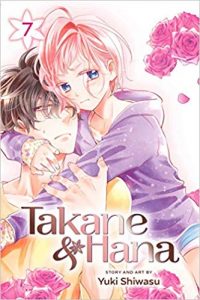
Takane & Hana Volume 6 by Yuki Shiwasu

I should have read this volume earlier this winter, because it had a great Christmas story in it! But Takane & Hana can always be counted on for some breezy shoujo antics as it explores the potentially problematic relationship between a high school student and an heir to industry who become friends after Hana subs in for her sister at an arranged marriage meeting with Takane.

The volume opens with Takane standing Hana up for a date due to his workload, so she goes out with friends instead. It turns out that he was actually planning on surprising her with a Christmas date. Takane is incapable of doing anything less than a grand gesture, so he appears before Hana in a custom designed cashmere Santa Suit. Hana realizes that he planned the whole thing after she made a random comment about how normal people celebrate Christmas, and she’s touched by the gesture.

The major storyline in this volume centers on Takane suffering a reversal of fortunes when his grandfather takes away his access to all his bank accounts, his high-powered job, and his apartment, telling him that he has to prove himself by working his way up to the top. Takane’s occasional glimpses through Hana of how common people live do not prepare him at all for being cut off from his credit card. As he slowly starts to adjust to the horror of cheap suits, convenience store lunches, and public transportation, he cuts off contact with Hana, not sure what to do if he can’t appear before her with elaborately expensive presents. Hana is mystified and confused because while he certainly is in the habit of being busy with work, he’s never cut off contact with her for such a long time before. As always, Shiwasu is a master of exaggerated facial expressions, and seeing Takane react to his changed circumstances is both sad and hilarious.

One of the things that has me rooting for this relationship between a forthright high schooler and an emotionally stunted captain of industry is Hana’s habit of confronting Takane and pointing out when he’s being an idiot. Takane rejects her offers of help, but she’s not going to back down. A rich person learning who they are after a reversal of fortune is a very common plot trope, but seeing how these particular characters take on this challenge makes it interesting in Takane & Hana.

Filed Under: Manga Reviews, REVIEWS Tagged With: shojo beat, shoujo, takane & hana, viz media

Classroom of the Elite, Vol. 1

February 9, 2019 by Sean Gaffney

By Syougo Kinugasa and Tomoseshunsaku. Released in Japan by Media Factory. Released in North America by Seven Seas. Translated by Timothy MacKenzie. Adapted by Jessica Cluess.

By the end of the first volume of this new light novel series, I finally had an idea where the author was going with the series. It’s something of a thought experiment, examining a school that functions similar to the Assassination Classroom school. The school has a hierarchy, and once you find yourself in the ‘D’ class, comprised of the seeming failures, its impossible to climb back up and you are belittled and ridiculed by the rest. Naturally, our heroes are in this class. That said, it takes about half the volume to get to the point where the author does anything more than drop ominous hints. Before that, unfortunately, what we get is a painfully normal light novel with the ‘average’ hero who doesn’t stand out, the grumpy beauty who doesn’t like talking to anyone, her contrast in the perky upbeat girl who wants to be friends with everyone, and, sadly, the perverted best friends who only want to talk about sex. You have to crawl through this to get to the point.

Of course, all is not as it seems. Horikita, the grumpy, sullen heroine of this volume, is the closest thing to being exactly what she seems, fortunately – the only hidden side she has is a desperate need to please her brother. Our hero, Ayanokouji, meanwhile, takes pains to not stand out – indeed, by the end of the book it’s becoming clear that he’s going to ridiculous lengths. His scores are average, but they’re the sort of average that requires brilliance to achieve. He’s very muscular, but denies being in any sports clubs. And he seems somewhat desperate to be at the school – I smell a tragic past. Sadly, he’s also almost as stoic and unfriendly as Horikita, which means both the narrator hero and the heroine of this first volume are downers. There’s some brightness with Kushida, the typical perky upbeat girl you see in every shonen school series… only, of course, she has a secret dark side as well. I’m pretty sure they all do.

That said, I’m not entirely averse to the ideas here, provided that they also include later character development. There are hints it may happen. The premise is that the world is fundamentally unequal but we should strive to be as equal as possible anyway, something that the school is seemingly opposed to – though this could all end up being a secret test of character. By the end of the book, Horikita is marginally more social, even if she’s unaware that her very unsociability is why she’s in the class in the first place. So I’ll definitely get the second volume. That said, everyone in this is depressing to read. Even the teacher seems sadistic for no other reason than that she enjoys it. If the series slowly works to make these kids better people and to grow up, I may enjoy it a great deal. If it remains an intellectual thought experiment, though, I’m out.

I understand that the anime, which I haven’t seen, took a number of liberties with the novels, so fans of one should definitely pick up the other. I’d also pick this up if you like Dark!Grey Harry Potter/Naruto fanfics or arguing about rationality on Reddit. As for light novel fans, your mileage may vary.

Filed Under: classroom of the elite, REVIEWS

Yona of the Dawn, Vol. 16

February 8, 2019 by Sean Gaffney

By Mizuho Kusanagi. Released in Japan as “Akatsuki no Yona” by Hakusensha, serialization ongoing in the magazine Hana to Yume. Released in North America by Viz Media. Translated by JN Productions, Adapted by Ysabet Reinhardt MacFarlane.

The actual resolution of the plot in this arc is treated as an afterthought, with Hyo, the villainous drug merchant, getting blithely killed off so that we may reach the real confrontation of the book. Because, having spent several chapters deliberately having Hak not meet Riri’s new bodyguard, when the moment arrives it takes pride of place above anything else that might be going on. It is truly an amazing setpiece, and shows off how good Kusanagi is at her craft. The rage that pours from Hak, his desire to kill Su-Won dripping off of him, is stunning to see. And you know that, at this point in time, it would be the absolute worst thing in the world for Hak to do that. Thank goodness for Jaeha, and later on Yona herself, for pointing out what’s important here: Yona is fine, she doesn’t need Hak to get revenge for her. Not like this. It’s only one chapter in this volume, but what a chapter.

I also definitely want to talk about the continued growth of Riri. Having stolen her father’s political seal as a means of showing that she has his power, she puts it to good use, getting the soldiers and merchants to unite to defend against Hyo’s fleet. What’s more, when events wrap up, she’s ready to take her punishment for what she did, even if that means being killed. That said, Riri’s political activism seems to have finally sunk in , as her father not only “punishes” her by exiling her to Sensui, where she can continue to do what she was planning to anyway. What’s more, he himself is now no longer content to be passive – which means that the tribes are now united in taking a more active role in the kingdom… even if that means war. All this from a young woman who was inspired by Yona (and is arguably in love with Yona, because their final scenes together really read like Riri wants to say something but chooses to hold back).

Riri is not the only woman in this volume who is awesome. Yona and Tetra are recovering from serious injuries, and are visibly exhausted, but are not letting that stop them from doing what needs to be done. Indeed, Tetra and Ayura have figured out Yona’s secret (such as it is), but are content to let her get on with what she needs to do. Heck, even the Sensui divers, who at first look to be introduced as a joke to show off “Jaeha is a player”, are swimming out towards enemy ships with bombs strapped to their heads. One of the best reasons to read Yona of the Dawn is that the cast is trying to effect change, and we see everyone who wants it step up and make that happen. It’s made explicit here with Riri’s father, but previous volumes also show that everyone Yona comes into contact to takes up her idealism… even if they’re cynics. It’s nothing to do with romance, though her own party does have guys who like her. It’s her sheer presence and drive.

I will end this review as I have many previous Yona reviews. This is possibly the best shoujo manga currently coming out in English. Everyone should be reading it.

Filed Under: REVIEWS, yona of the dawn

Toradora!, Vol. 4

February 7, 2019 by Sean Gaffney

By Yuyuko Takemiya and Yasu. Released in Japan by Dengeki Bunko. Released in North America by Seven Seas. Translated by Jan Cash & Vincent Castaneda. Adapted by Will Holcomb.

This fourth volume of Toradora! does a very good job of playing to the series’ strengths. The core of it is getting the five main characters to become closer and bond as friends, and it achieves that. That said, there is also the romantic comedy/drama part of it, and that’s even better. It was always going to be hard for a series where the winning pairing is literally in the name to try to have “who will they end up with?”, but this volume comes closer than any so far. Ryuuji is still crippled by his awkwardness around Minori, but when he tries to can actually have a really meaningful conversation with her where she opens up (obliquely) about her own insecurities. As for Ami, not only does Ryuuji force her to open up a bit more (a very little bit more) about her own insecurities, but she also flat out states she thinks Minori and him would be a bad match, and that he should hook up with her. As for Taiga? Well, there’s the puppy dream.

The puppy dream is great. Starting off as ridiculous, with both Taiga and Ryuuji completely disgusted by it, the reader is immediately thinking “they’re sharing dreams now!”. By the end of the book, Ryuuji is seeing how the dream could also be taken as really sweet and familial. That said, for the most part the Taiga/Ryuuji antics take a backseat here… or at least the boil settles down to a mild simmer, as there are no shortage of scenes showing them being each other’s perfect halves. Taiga fares far less well in the romance department here, partly as she’s still cripplingly shy and partly as Kitamura is even more Kitamura than usual, complete with accidental flashing. I do sort of wonder how clued in he is to everything going on around him – like Minori, he thinks that Ryuugi and Taiga are meant to be a couple, if not already, but it’s not clear that he’s realized Taiga’s feelings.

That said, this is Minori’s book in the end, as she shows off a fragile vulnerability here, and there’s the first signs that she may feel something for Ryuuji as well. Unfortunately, both are the sort to back off at the last minute – as Ami bluntly points out, they can’t get close to each other. But we also have lots of Minori acting goofy, and of course the giant “let’s try to scare Minori” horror movie plotline, which gives us the opportunity for some great laughs. Toradora! holds up over a lot of other comedy romances in that the comedy does not feel forced or cliched, a la “whoops I just fell into your boobs”. The humor is natural, realistic, and both situational and character-driven. But it’s the drama that readers may take away from this volume. Will things change when they go back to school? Will Ami press her suit/ Will Minori do anything? Will Taiga yell at Ryuuji? At least one of those things is guaranteed to happen!

Filed Under: REVIEWS, toradora!

Arifureta Zero, Vol. 2

February 5, 2019 by Sean Gaffney

By Ryo Shirakome and Takaya-ki. Released in Japan as “Arifureta Shokugyou de Sekai Saikyou Rei” by Overlap. Released in North America digitally by J-Novel Club. Translated by Ningen.

In my review of the first book in this prequel series, I said that it was Miledi’s book and Miledi’s series. Here I’ll go further: I think that Miledi is meant to compare directly with Hajime. Yes, in terms of personality, she reads more like a horrible fusion of Shea and Tio, but as we see a lot in this book, even more than the last one, she is wedded to her ideals and prepared to do anything in her power to preserve them, even if that means taking on the Church, a bunch of pirates, or even a giant seas monster with her ungodly gravity powers. (Ungodly would suit her fine, I think). As for Oscar, he has Hajime’s snark down pat, but after this book we really know who he’s meant to be. He’s Shinpachi from the Gintama series. No, really, the author even straight up ripped off the glasses joke. Oh yes, and we get a new Liberator as well. That’s her on the cover.

The author suggests that the seemingly sweet big sister type who’s really a sadistic tease is a surprise for this book, something which… isn’t true, but whatever. Meiru is a lot of fun, though, and is not only a big sister to her captured real sibling, but also to a huge pirate family that she heads up. Yes, it’s Arifureta does One Piece. Miledi and company are arriving at the city the pirates work out of to find the next Liberator, and after a host of misunderstandings that eventually get resolved, find she… doesn’t want to join them. Well, that’s fine, we went through this in the first book. Till then, there’s sea monsters that get attracted to Miledi’s magic, and casino capers, etc. Of course, eventually the Church is ordered to destroy these pirates once and for all, which leads to the last half of the book, which is one giant melee battle that is highly entertaining provided you love 120-130 pages of fights.

Honestly, I’m surprised there isn’t a much higher body count in this prequel. We already know it’s going to end badly, and it always seems like there’s going to be some dead innocents, but so far the author has done a pretty good job of having them saved at the last minute. (There are a couple of Oscar’s orphan kids who are in a coma from the last book, but Meiru may be able to save them too). In fact, despite the grim Church and the ever-present threat of death, this is a fun book – I would say of all the Arifureta books, this one balances the wacky humor and the thrilling serious plot the best. Miledi is annoying as hell, but not to the reader, just to the characters – an important development! Even the art is really good, showing off both the silly and dramatic (the picture of Miledi giving the finger to the villain may be my favorite).

This is a long book, like most of the Arifureta series, but for fans, it’s a must read. Even casual readers who are turned off by Hajime being Hajime in the main series may want to give the prequel a shot.

Filed Under: arifureta, REVIEWS

For the Kid I Saw in My Dreams, Vol. 1

February 4, 2019 by Sean Gaffney

By Kei Sanbe. Released in Japan as “Yume de Mita Ano Ko no Tame ni” by Kadokawa Shoten, serialization ongoing in the magazine Young Ace. Released in North America by Yen Press. Translated by Sheldon Drzka.

This author has previously written the mystery thriller Erased, a series which I could see was very well done and I could also see was probably not for me. This feels like the same sort of thing – even without a hardcover-style release to make it fancier, this manga just seems “important” as you read it. The art is compelling, the characters are, if not likeable, at least someone you want to follow. Senri is our “hero”, a young man who in his childhood had his parents brutally murdered. He also had an older twin, who hid him from this (in fact, the father was abusive, and the twin was hiding him from the abuse – the murder was incidental). Senri always had a connection with his twin, in a “psychic powers” sort of way, but shortly after this he gets a vision of his brother being killed, and that’s it for psychic connections. So how does he grow up? Consumed with vengeance, of course.

There’s a common trope in manga where you see the hero, supposedly a bad guy, who beats up other, scummier villains to show off that he’s really good deep down. The manga fakes us out by making it seem that grown up Senri is the same… but no, he’s actually in league with the bullies, and is extorting money. I mean, he needs SOMETHING else to do beyond trying to track down his parents’ and brother’s killer. (They may not, in fact, be the same killer, but I’m guessing.) He runs on suppressed rage, and is fascinating to read but also somewhat exhausting. He also seems to have little regard for human life, unsurprisingly, and there are a couple points in the book where he’s driven to almost murder in his efforts to find out what happened back then. He also gets beat up a lot. He’s a very grim protagonists, in all senses of the word.

Fortunately, we also have Enan, the saving grace in this book. She’s Senri’s childhood friend, as they were in the same orphanage after his parents were murdered. She’s from a tragic home as well, as her dad was a murderer and her mother killed herself because of the harassment – which she gets as well, because we all know that children are their parents. Senri does not believe this, and says so, possibly the one nice thing he does in the entire book. As a result, Enan is his best (and it seems only) friend, and yeah, probably likes him romantically, though that doesn’t really come up. She’s there to prevent him from turning evil, and has a ways to go, frankly. I liked her a lot. Usually these sorts of characters are fresh-faced innocent types, but Enan is a jaded “gal” sort, though she’s good with kids in her daycare job. I hope nothing horrible happens to her.

As I said, this may not be the sort of title I want to keep reading. But it’s good, and I am interested in seeing what happens next, assuming Senri doesn’t die from the skull fracture he seems to get at the end of the volume and the rest of the series is just light music played over blank pages. Fans of dark thrillers will absolutely want to check it out.

Filed Under: for the kid i saw in my dreams, REVIEWS

Log Horizon: Krusty, Tycoon Lord

February 3, 2019 by Sean Gaffney

By Mamare Touno and Kazuhiro Hara. Released in Japan by Enterbrain. Released in North America by Yen On. Translated by Taylor Engel.

It’s been a long time since the last volume of Log Horizon – almost a year. It may be even longer till the next volume as well, as there’s no sign of it in Japan. That said, this is a big volume for fans of the series, as it’s the first volume that has not actually been animated. As such, it will prove to be entirely new material. Appropriately, it focuses to a large degree on Kanami’s party, who were the subject of the 9th book (which was adapted the least by the anime), and have now reached the equivalent of Mongolia. But as you may have guessed by the title, the other major participant in this volume is Krusty, who is having memory issues but is not letting that stop him from living the easy life, as he’s essentially in the game equivalent of heaven being waited on by cute animal person servants. The book’s main thrust has a scheming villainess try to pit the two parties against each other.

The book mostly succeeds, but it is worth noting, once again, that there is a truly ridiculous amount of gaming chatter and discussion in these volumes, and that it can quickly get tedious, especially when you’re in the middle of a large battle. Classes, levels, aggro… I don’t really care. But someone cares, and that someone is Elias, who we get to know a lot more about in this book. From the last book, we know that he labors under a curse that means he never gets the last hit in – he can’t be the one to kill the monsters. Of course, since Log Horizon was a game, and he was one of the bigger NPCs, it makes sense. The players make the big kill. But here we see how this weighs heavily on him, and also how his party seems to have been broken, and possibly killed, simply by hinting at their very nature – Elias, throughout the book, seems to be shying away from thinking that he’s just an NPC in a game.

So it’s pretty easy to get him to go all out against Krusty, who’s perfectly happy to have people think he’s a villain if it gets him a good fight. We get a lot of Krusty’s own background from Earth here too, and it fits with his personality to a T. Krusty really can’t stop Elias, especially given he’s dealing with his own curse. Kanami is there to be Haruhi Suzumiya and not much else. I like her, but she’s completely at peace with everything about herself, so is terrible at this sort of thing. And Coppelia is still pretty much monotone. That leaves Leonardo, still a frog and not a turtle, to deliver the big verbal cooldown speech to Elias. I won’t spoil it, as it’s easily the best part of the book, and made me smile quite a bit. When Log Horizon isn’t pouring verbiage into its worldbuilding, it can be pretty heartwarming.

We’re almost entirely in ‘the China server’ this volume, with only one chapter back in Akiba to show us that Raynesia’s noble friends are all getting engaged, which I suspect means that an arranged marriage is in her future. Her noble friends also think she’s in a relationship with Krusty, which she’s not. In the next volume, whenever that may be, I suspect we’ll be headed back to Shiroe and company. Till then, enjoy this look at what it means to be “cursed”, and how to resolve it.

Filed Under: log horizon, REVIEWS

Outbreak Company, Vol. 7

February 1, 2019 by Sean Gaffney

By Ichiro Sakaki and Yuugen. Released in Japan by Kodansha. Released in North America by J-Novel Club. Translated by Kevin Steinbach.

For the most part, I tend to wait at least a day before writing a review of something. Reflection can be a good thing, and so sometimes my opinions on Twitter – which are as I read – don’t match up with what’s here. And, let’s face it, this volume had an uphill battle to win my affection in the first place. I enjoy Outbreak Company a great deal, but not for the fanservice. Thus when you have a volume that, in one way or another, doubles down on such things, you’re going to be losing me. That said, it is not without interest. If you can ignore the fact that the entire first story seems to revolve around Minori’s tits, it’s actually a lot of fun, and there is some actual suspense in there briefly – that turns out to be undercut. It’s Outbreak Company’s excuse to do a beach episode with swimsuits, something it admits within the text, and as such is fine. The other two stories were a bit more problematic with me.

The second story should have easily been my favorite, as it’s an emotional character-driven piece. It’s also from the POV of Myusel, which makes for a great change. We’ve known since the first book that she’s half-elf, but the subject of her parents has never come up. Now, all of a sudden, due to changes in the family, her mother has arrived (she’s the elf) and wants Myusel to leave the mansion and come live with her. Myusel, we know, really does not want to do this at all, but runs up against everyone seemingly thinking it’s a done deal and accepting that it has to happen. And if Minori and Shinichi are already arranging for her replacement, how can she say no? I was struck by how obtuse everyone was being in this part. Frankly, as a reader, Myusel’s depression could not be more obvious if she’d tried, and the fact that the characters all assume she’s fine with it really bothered me. Do they really know her all that well? This was well-written but the characterization just felt… off.

The third story was apparently written with the help of one of the author’s female assistants, who is a fujoshi. He clearly said to her “I want a story where Minori is going through BL withdrawal, make it as exaggerated as possible.” And boy howdy, that’s what happened. Again, the issue I have is with the characterization. I’m fine with Minori being like this. Though the constant chants of “homo, homo” are perhaps a bit… insensitive, shall we say, they certainly fit with a certain type of fujoshi. I was more annoyed with this essentially turning into a fujoshi zombie movie, with Minori infecting everyone else in the story (even Myusel, though she holds out at first, for reasons that everyone but Shinichi understand) so that the entire cast are suddenly mindless BL maniacs. Yes, that’s the exaggeration, but it didn’t sit well with me. That said, if you enjoy over the top comedy, this may be your favorite segment. It’s certainly that. And OK, the “Vitamin BL” gag was very funny.

This was certainly a volume of short stories. There were some interesting parts, but I am hoping that next time around we get back to the main plot.

Filed Under: outbreak company, REVIEWS

Kakuriyo: Bed and Breakfast for Spirits, Vol. 1

January 30, 2019 by Anna N

Kakuriyo: Bed and Breakfast for Spirits, Volume 1 by Waco Ioka, Midori Yuma, and Laruha

Ordinary girl suddenly discovering a world filled of spirits or yokai and having her life altered forever is a common trope in shoujo manga, it is subgenre that can be relied upon for some interesting storytelling. However, is there room for more translated yokai titles after such great series such as Kamisama Kiss and Demon Prince of Momomochi House?

Kakuriyo:Bed and Breakfast for Spirits is a light novel franchise with an anime adaptation as well, so that accounts for the multiple credits on the managa, which sometimes makes me a bit nervous. Aoi Tsubaki had a charming but shiftless grandfather who recently passed away. She goes about her daily interrupted by her visions of strange ayakashi, and she feeds homemade snacks to the more harmless ones. As she passes a shrine she sees an ayakashi who looks like a young man wearing a demon mask and she hands him her bento box after he complains that he’s hungry. When she passes by the spot later on that day to retrieve her bento, she finds it decorated with a fancy hair ornament and new wrapping cloth. A gate opens up and the ayakashi grabs her wrist, saying “Welcome to Kakuriyo, my darling bride.”

bed and breakfast for spirits

Kijin is an ogre and the master of Tenjin-ya, an inn for ayakashi. When Aoi refuses to become his fiancee, she offers to work at Tenjin-ya to pay off her grandfather’s debt, except none of the ayakashi in charge of the various functions of the inn are willing to hire a human. Aoi then meets Ginji, a nine-tailed fox with a series of different forms and he becomes her unofficial guide to the spirit world. As Aoi begins to become more aquainted with her strange new world, one constant that she takes with her is her joy in preparing food for people. I found the slice of life and food elements in this story entertaining. Where this title falls a little flat compared to similar series is the art. It works just fine, but without that something extra present that readers can find in the whimsy of Kamisama Kiss or the lush detail of The Demon Prince of Momochi House. I always hope that the opportunity to portray a spirit world will cause an artist to go wild with creativity and innovative character designs, but I wasn’t finding that in this series. I’m hoping though that the fact that the manga is an adaptation of a light novel series will mean that the plot will compensate for the art being less creative than I’d like for the subject matter. I did enjoy the setting in this first volume and I’m curious to see how the story unfolds.

Filed Under: Manga Reviews, REVIEWS Tagged With: kakuriyo bed and breakfast for spirits

In Another World with My Smartphone, Vol. 12

January 30, 2019 by Sean Gaffney

By Patora Fuyuhara and Eiji Usatsuka. Released in Japan as “Isekai wa Smartphone to Tomo ni” by Hobby Japan. Released in North America digitally by J-Novel Club. Translated by Andrew Hodgson.

It’s actually been a while since I’ve had a volume of Smartphone that didn’t irritate me in some way. Touya does not take the time to wipe out and entire country full of evil cliches here, which helps a lot. Instead, we get what are essentially a bunch of short stories, as always – Smartphone has an ongoing plot, but it sort of judders along, and gets abandoned whenever the author feels like it. Here Touya investigates the hidden island discussed in prior volumes and makes contact with them; deals with a return of the creepy soul eating monster, which he now knows is being controlled by the rogue God (the one bit of ongoing plot here); travels to another dimension to help a group of phantom thieves; and tries to resolve a political romance. In between there’s time for a forest that’s being taken over by bad guys (and fanservice), and a puppet show. A very leisurely Smartphone, in other words.

The art is… mostly good, except for that cover, which has creeped me out ever since I first saw it in the original Japanese. Yae and Leen’s expressions are just deeply wrong. In any case, the fiancee horde actually gets a fair bit to do here, with each of Touya’s missions except the third one involving him traveling with one or more of the girls. The third, the one in the alternate world, honestly reads sort of like a backdoor pilot for a different series, and given most of the thieves are cute young girls, it’s likely for the best that the fiancees didn’t come along. They’re still not married, having a couple years of waiting to go, though after a fertility device works as planned (Sue’s getting a little sibling), Touya does take the time to ponder having children with his wives, and the wisdom of perhaps staggering them out a bit so he doesn’t have 8 kids at once. And, let’s face it, Linze’s puppet making ability, and the show that follows, runs on pure adorable. I won’t even complain about the forest of monsters that involves licking the heroine’s butts, though I will roll my eyes a bit.

As for Touya, the author has found a nice balance between him doing ludicrous things and his getting called out on doing ludicrous things. Given Touya’s lack of emotional range (he’s the sort to say “that makes me mad” in the same vaguely cheery voice he uses for everything), everyone around him has to pick up the slack a bit. This is shown off best in the final story, where he is forced by circumstances to fight a 10-year-old girl who is very strong in both fighting and magic and has grown rather proud and arrogant as a result. He’s asked to teach her humility… and he does, literally saying “it’s time to dunk on a 10-year-old”. Leaving aside how weary I am of terrified girls wetting themselves in Japanese series, the fight is hilarious, as is the reaction of everyone else, which is basically “I know we told you do to this, but eeeeeehhhh.” Poor Touya, once again history’s greatest monster.

If you’ve been avoiding Smartphone because it’s been leaning a bit too hard on the genocide sort of thing recently, this is an excellent volume ot pick up. It’s relaxed, fun, and features Touya being ludicrous.

Filed Under: in another world with my smartphone, REVIEWS

Apparently It’s My Fault That My Husband Has the Head of a Beast, Vol. 2

January 28, 2019 by Sean Gaffney

By Eri Shiduki and Kasumi Nagi. Released in Japan by Ichijinsha. Released in North America by J-Novel Club. Translated by David Evelyn.

The second volume of this romance sees our heroine and her beast-headed husband traveling to a seaside religious community, hoping to find a way to cure both her condition and his. Unfortunately, there seems to be something very wrong in the Holy Land. There’s maids and princesses trying to take Rosemarie down, and she herself is seemingly possessed to leave the room late at night to try to return to the gods. That said, Rosemarie is made of sterner stuff in this book compared to the last one. Can she overcome mind control with the sheer power of being kind to people? Can she manage to tear herself away from her beloved bucket? And can she actually manage to have a direct conversation with Claudio where they both admit that they’re in love with each other? All the ingredients are here for a classic romantic potboiler. We may even discover what happened to her and Claudio as children!

The mystery is not really a good reason to read this (for a moment I thought we were going to meet a non-evil clergyman, but he was an undercover sorcerer, so…), but the romance holds up well, provided you’re OK with these two socially awkward kids doubting themselves and saying absolutely the wrong thing all the time. The reader will no doubt be sympathizing more with Heidi, Rosemarie’s maid who is somewhat desperate for her lady to realize that she is loved. That said, we do make some definite strides here. Rosemarie realizes that she’s actually jealous when Claudio is dealing with other women who have their eye on him, and that fixing his mana issue and leaving to go back home would devastate her. As for Claudio, he can still be a jerk when he’s trying to be kind (which leads to the funniest part of the novel, as his sorcerer friend literally kicks him in the ass for screwing up a romantic moment), but he too finds it in himself, albeit accidentally, to admit that he loves her.

The biggest problem with this book occurs at the end, when you finish it and realize that a lot of things are still up in the air. Rosemarie and Claudio’s problems have still not been solved, and they’ve still not consummated their marriage. They have admitted they love each other to their faces, but I was hoping for a bit more. Sadly, the second volume appears to be the final one, so this is all the closure that we’re going to get. I want to see more of these characters. I want Alto and Heidi to hook up (there’s zero evidence for this, but I want it to happen anyway). And there was almost no gardening! Am I going to be forced to turn to Bakarina for all my gardening heroine needs? Oh well. Despite a “you’re cancelled” feeling, only for light novels rather than manga, this has bee a fun and romantic little series. I recommend it for those tired of isekai.

Filed Under: apparently it's my fault that my husband has the head of a beast, REVIEWS

10 Dance, Vol. 1

January 27, 2019 by Sean Gaffney

By Inouesatoh. Released in Japan by Kodansha, serialization ongoing in the magazine Young Magazine the 3rd. Released in North America by Kodansha Comics. Translated by Karhys.

You can learn a lot from looking at a cover. This was one of those titles that I picked up solely because the cover looked so great, so it’s worth looking at. Clearly, based on the title and the two guys on the cover, it’s a ballroom dancing manga. Clearly, by the fact that there *are* two guys on the cover, it’s BL. The ’10 Dance’ part of the title is helpfully laid out for you in the text below their arms, showing us the ten dances in question – five Standard, five Latin. But most of all, the facial expressions and the posing of the two guys tells you immediately that this is going to be a contentious relationship, that they will probably dislike each other before they like each other, and that they’re both seriously attractive. It is, in fact, most everything that you could ask for in a BL title from a company that is just starting to dip its toe into that arena.

Both leads are named Shinya, and their last names are pretty close as well – Sugiki is the black-haired Standard Dancing champion, and Suzuki is the Latin Dance expert. Each wants to learn each other’s specialty so that they can compete in the 10 Dance, an endurance competition which, as the title implies, has contestants do all ten dances, five from each type. Both of them have female partners, who briefly get attempts at characterization before being quietly moved to one side, but we’re not reading this for them (though I loved the bit right at the start where Aki complains about female Latin dancers being pigeonholed as sluts or bitches). As a result, Sugiki and Suzuki take turns playing the ‘woman’ as they try to learn from each other, which mostly involves sniping at each other because each of them is wretched at the other’s specialty. Suzuki lacks the composure for Standard Dancing, trying to skip over the basics. And Sugiki is stiff and formal, which in Latin dancing is the kiss of death. Will they ever see eye to eye?

They also make a pretty hot couple, though neither of them is admitting it right now, or even admitting that they might not be as straight as they expected. We see Suzuki having various short-term affairs (including one who proceeds to rob him after sex), none of which are satisfying. The two women who are their partners are both in relationships of their own, despite media coverage (the media really like it when ballroom dance couples are also real life couples, which is not the case here). Suzuki sometimes makes suggestive comments, but you get the sense that that’s because that’s the sort of guy he is. That said… there’s no denying these two have a deep sexual tension right away, and they can’t stay away from each other. There’s a pilot chapter near the end that shows it even more – one woman is stunned when Suzuki hits on her, as she was pretty sure they were a gay couple. It’s a classic case of everyone can see it.

And, of course, there’s the main reason to get this – the art is great. The artist may not be as knowledgeable about the subject as, say, Welcome to the Ballroom’s artist (and given Ballroom’s erratic release schedule, fans of that may simply want to move to this title instead), but the drawings convey both a passion for dancing as well as the underlying sexual passions. Even if BL is not your thing, you may still want to read this – I enjoyed it quite a bit.

Filed Under: 10 dance, REVIEWS

  • « Go to Previous Page
  • Page 1
  • Interim pages omitted …
  • Page 149
  • Page 150
  • Page 151
  • Page 152
  • Page 153
  • Interim pages omitted …
  • Page 342
  • Go to Next Page »
 | Log in
Copyright © 2010 Manga Bookshelf | Powered by WordPress & the Genesis Framework