• Skip to primary navigation
  • Skip to main content
  • Skip to primary sidebar
  • Home
  • About Us
    • Privacy Policy
    • Comment Policy
    • Disclosures & Disclaimers
  • Resources
    • Links, Essays & Articles
    • Fandomology!
    • CLAMP Directory
    • BlogRoll
  • Features & Columns
    • 3 Things Thursday
    • Adventures in the Key of Shoujo
    • Bit & Blips (game reviews)
    • BL BOOKRACK
    • Bookshelf Briefs
    • Bringing the Drama
    • Comic Conversion
    • Fanservice Friday
    • Going Digital
    • It Came From the Sinosphere
    • License This!
    • Magazine no Mori
    • My Week in Manga
    • OFF THE SHELF
    • Not By Manga Alone
    • PICK OF THE WEEK
    • Subtitles & Sensibility
    • Weekly Shonen Jump Recaps
  • Manga Moveable Feast
    • MMF Full Archive
    • Yun Kouga
    • CLAMP
    • Shojo Beat
    • Osamu Tezuka
    • Sailor Moon
    • Fruits Basket
    • Takehiko Inoue
    • Wild Adapter
    • One Piece
    • After School Nightmare
    • Karakuri Odette
    • Paradise Kiss
    • The Color Trilogy
    • To Terra…
    • Sexy Voice & Robo
  • Browse by Author
    • Sean Gaffney
    • Anna Neatrour
    • Michelle Smith
    • Katherine Dacey
    • MJ
    • Brigid Alverson
    • Travis Anderson
    • Phillip Anthony
    • Derek Bown
    • Jaci Dahlvang
    • Angela Eastman
    • Erica Friedman
    • Sara K.
    • Megan Purdy
    • Emily Snodgrass
    • Nancy Thistlethwaite
    • Eva Volin
    • David Welsh
  • MB Blogs
    • A Case Suitable For Treatment
    • Experiments in Manga
    • MangaBlog
    • The Manga Critic
    • Manga Report
    • Soliloquy in Blue
    • Manga Curmudgeon (archive)

Manga Bookshelf

Discussion, Resources, Roundtables, & Reviews

Reviews

Invaders of the Rokujouma!?, Vol. 29

January 24, 2020 by Sean Gaffney

By Takehaya and Poco. Released in Japan as “Rokujouma no Shinryakusha!?” by HJ Bunko. Released in North America digitally by J-Novel Club. Translated by Warnis.

I’ve been saying for a while now that the “harem total” in this series is not going to get larger or smaller, and in this volume I am proved wrong. That said, if you’re going to add someone to a pile of girls who are as much a found family as romantic rivals, go big or go home. God joins the party here, in the presence of the being who greeted Koutarou in Volume 1. For a while it was thought to be Harumi/Alaia in some way, but now we know that that wasn’t thinking quite grandiose enough. Before we get to that point, though, we continue the theme of the previous books, as one by one the cast vanish from Koutarou’s life, essentially his worst fear, and he has to deal with it. He doesn’t deal with it very well. Fortunately, the dwindling group of women in his life are able to figure out what is going on long enough for him to go back to the place it all began… and also set up some intriguing alternate universes.

The cover art… and the plot… and every single thing about the book, really… might make you assume this is the last book in the series. It’s certainly the final part of the “main” plot that the author originally came up with – this is where he envisioned it ending, no matter how many books it turned out to be. But the cast are becoming third-years (except for the graduated Harumi), and we’re going to be seeing what happens next starting with Vol. 30. As for this book, there’s not much to it aside from emotional beats. They’re very good emotional beats, don’t get me wrong, but I do wish Koutarou had sort of figured out that when he is standing next to a girl and reminiscing about all the good times they’ve had since book 1, she’s going to be the next to go. There is a bit of a “memory reset” at the end, but it’s entirely voluntary, and you understand why they did it.

The interesting thing, to me, was the concept of the alternate universes brought up by Nalfalaren. The one we’ve been reading is the only one in like 5 billion or so where Koutarou revives her with all nine girls who are “part of her” at his side. In other words, this is the only harem end universe. We see one of the alternate universes towards the end of this book, as Koutarou has to deal with a world where none of the cast ever showed up in Room 106 and he ended up dating Shiori Kashiwagi, who readers may recall as having a crush on him a few books back, and is entirely a normal girl. It’s good to know someone is there to help Koutarou get over the tragedies in his life regardless, but it’s still nice to see the ending I think readers wanted, which is ambiguous but also feels right.

Next time we’re getting a continuation, but we’re also going to start to see some of those “alternate universes” where Koutarou was able to settle on one of the girls. Either way, you don’t have to worry about the cast vanishing from your lives anytime soon.

Filed Under: invaders of the rokujouma!?, REVIEWS

Kitaro: The Trial of Kitaro

January 23, 2020 by Sean Gaffney

By Shigeru Mizuki. Released in Japan as “Gegege no Kitaro” by Kodansha and Shogakukan, serialized in various magazines. Released in North America by Drawn & Quarterly. Translated by Zack Davisson.

This is the final volume of D&Q’s Kitaro collections, and, while Kitaro has never really been serialized in a plot or characterization way, it picks an apt final story to end on. The largest story in the book is the titular Trial, where Kitaro is brought up against the Yokai Supreme Court and charged with helping humans at the cost of yokai. Which, admittedly, there’s a grain of truth to. A number of Kitaro’s adventures have featured him helping hapless humans who are being used and/or outright tortured by yokai – indeed, we’ll see some later in this collection. That said, no surprises for guessing who’s really gotten Kitaro into this mess. After much foofaraw, the trial ends with Kitaro agreeing that he will not only help innocent humans beset by yokai, but also the reverse – such as not helping the shady TV producers who are manipulated by Nezumi Otoko into the documentary stat starts this all off.

As this is the final Kitaro review I’m writing up (presumably), I’d like to expound once again on Nezumi Otoko, the Donald Duck to Kitaro’s Mickey Mouse. The trial story features perhaps Nezumi Otoko at his most iconic – setting up the entire situation in the first place for cash, teaming up with an even worse yokai, framing Kitaro and testifying against him, and then quickly rolling over when things turn against him. Of all the many and varied yokai we’ve seen over the course of the series, Nezumi Otoko’s actions are perhaps the most jaw-dropping – even the evil yokai are more consistent in what they do day to day. But of course Kitaro gives the reason why Nezumi Otoko is who he is – he’s half human, and it’s the humanity in him that makes him crafty and a bit of a complete snake. That said, for Kitaro to continually hang out with him after everything shows he has the patience of a saint… or that Nezumi Otoko has the love of the author.

The rest of the stories in the volume are more typical, featuring the classic Kitaro way of doing things… get devoured and killed by the enemy, then come back and do something about it. The most interesting story other than the trial episode has to deal with a cursed toilet in the middle of the woods (yes, really) and Kitaro also losing all his hair… which, as is pointed out by Nezumi Otoko, is one of the sources of his strength. Honestly, without it he’s almost unrecognizable. I also liked the story of the merman who blackmails/tortures Kitaro into getting him fish, and actually ends up living in a mansion as a human. This leads to the dark punchline where Kitaro agrees to turn him INTO a human, and then the merman finding out that life as a human is not all that greater after all. Also, watch out for the cute maid working in the merman’s mansion who walks off with Kitaro in the end – Mizuki rarely drew cute girls in this series.

The seven volumes of Kitaro released over here, as well as the compilation that came first, do so much to show off the strengths of Shigeru Mizumi as an artist and storyteller. They’re a must for any library. Ge! Ge! Ge-ge-ge-no-geeeeee…

Filed Under: kitaro, REVIEWS

In Another World with My Smartphone, Vol. 18

January 21, 2020 by Sean Gaffney

By Patora Fuyuhara and Eiji Usatsuka. Released in Japan as “Isekai wa Smartphone to Tomo ni” by HJ Novels. Released in North America by J-Novel Club. Translated by Andrew Hodgson.

Any Smartphone book that manages to put Touya in actual danger is automatically more interesting than most. This one actually does it twice. Not that anything actually happens to him… remember what you’re reading. But the Mutant Phrase descend with an anti-God weapon that is so poisonous that it takes Touya out for three days, and later on an inadvisable attempt at waking an ancient weapon results in time literally being rewritten to make sure it didn’t happen… something Touya is aware of but no one else is. Unfortunately, neither of these crises serve to move Touya beyond his typical bland facade… generally the only thing that can do that these days is mentioning love, as per most awkward overpowered male leads in isekai. Sadly, the weddings are still a fair ways away, but at least we’re seeing a number of other plots starting to come together. Could the end be in sight? (Probably not.)

At the start of the book, the regular Touya world and the Reverse World finally merge together, and much of the rest of the volume is spent dealing with the political fallout from that. It does not help that the bad guys choose this moment to launch their ‘anti-Touya’ poison attack, which destroys one of the kingdoms we’d seen previously. (Not Touya’s own hand this time, so that’s good.) We actually get a few Phrase battles this time around, including Ende getting his revenge against the evil twins who mopped the floor with him last time. And we finally get an idea of what happened back in ancient times when the Phrase first invaded, and hopefully a way to avoid it happening again. In between there’s the usual wacky slice-of-life stuff… a young idiot prince comes by to show how strong he is and gets his ass kicked; Hilde’s sister fights a dragon; Sakura sings Freddie Mercury songs. The usual.

I admit, much as I grouse about the series when it’s doing things wrong like having Touya be history’s greatest monster, when it doesn’t happen there’s very little TO talk about in a review of Smartphone. Touya is bland. His fiancees, though they have more emotional range, are equally bland. There’s the royalty of the neighboring kingdoms… they’re pretty bland as well. This is sort of like a “slow life” series without the slow life part. The author says that we’re going to be fighting the Evil God next time, which is good, because when there are fights at least something is happening on the page. The wedding might also help, but that’s still a few books away. That leaves us with Touya wandering around doing Touya things, which is… boring. Dull. Nearly getting killed was the best thing to happen to him all book.

The series is still worth reading for the tiny little things that make it bearable – Sue’s Hammer Throw was great – but I suspect most readers, like me, are waiting for Touya to get married and simply paddling along ill that happens. 2 out of 5 Smartphones this time around.

Filed Under: in another world with my smartphone, REVIEWS

Daytime Shooting Star, Vol. 4

January 20, 2020 by Anna N

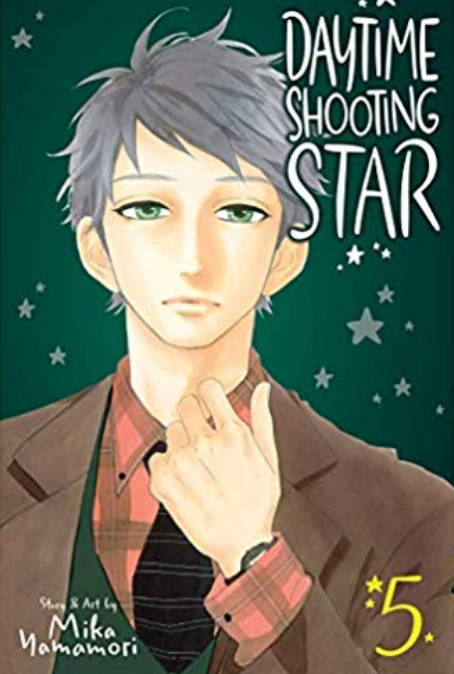
Daytime Shooting Star Volume 4 by Mika Yamamori

This volume of Daytime Shooting Star is focused on summer vacation. I really like the way the matte cover sets off the powdery pink blossoms used in the cover illustration for this volume. I’m so curious as to how this student-teacher romance manga will conclude, I’m guessing a giant time skip picking up with the high school characters post-college graduation. The volume opens as Suzume uses her intense knowledge of fish and extra cash to help out a strange but somewhat familiar man in the grocery store who has difficulty both shopping for seafood and remembering his wallet. When she drops by his house to get repaid for his groceries, she realizes that he’s Mamura’s father! Suzume gets a glimpse of Mamura’s very loud little brother, and she and Mamura are able to talk to each other again like friends.

Tsubomi ends up blowing out of town leaving a tornado of emotional devastation in her wake, as she seems to think it is appropriate to leave a note for her ex-boyfriend Shishio with the teenage girl who has a crush on him. Susume can’t resist the impulse to deliver it, and when she meets Shishio again, they decide to go on a group outing with her classmates to the aquarium, since Tsubomi enclosed an aquarium gift certificate. Of course, the day of the outing no-one else shows up, so the student and teacher are on a full-on solo date where Suzume gets to indulge in all the fish trivia questions she has ever dreamed of. Shishio continues to be fairly inappropriate but not doing anything physical beyond resting his head on Suzume’s shoulder. Even though he rejected Suzume’s love confession, it is clear that he’s still looking out for Suzume at school and in general acting protective and awkward at various moments. Suzume sees all this happening and becomes confused yet again. Fortunately there’s the school festival coming up that will provide a welcome distraction from all these romantic foibles, or amp everything up even more?

I continue to enjoy Yamamori’s stylish character designs. Suzume’s moments of introspection and insight as she’s attempting to get a handle on the world around her keeps Daytime Shooting Star interesting. It is easy to see how she’ll eventually grow up to be a formidable adult.

Filed Under: Manga Reviews, REVIEWS Tagged With: daytime shooting star, shojo beat, shoujo, viz media

Outbreak Company, Vol. 12

January 20, 2020 by Sean Gaffney

By Ichiro Sakaki and Yuugen. Released in Japan by Kodansha. Released in North America by J-Novel Club. Translated by Kevin Steinbach.

I feel that I’ve said a lot when reviewing Outbreak Company that the book starts off badly and gets better as it goes along till a good climax, and that holds true here as well. That said, the annoying parts of the book are very annoying. I haven’t used the word ‘queerbaiting’ when reviewing this series, mostly as it’s highly unlikely the author is doing it deliberately to bring in BL fans. (Then again, given that afterword, I may be wrong.) But for the most part the book is content to view Garius the way that Minori does – as a product of BL fantasy that she can ship with either Shinichi or newcomer Rubert – without ever explicitly having Garius say that he’s gay or state he is gay. It may sound like it’s so implied that they don’t have to, but that’s the point – the BL subtext is slathered on with Minori-vision, making it hard to take seriously. There’s no gay characters here, just a bunch of heavy breathing.

I may be more annoyed than usual as Garius and his supposed homosexuality are front and center in the plot this time. The prince of a neighboring country that is on good terms with Eldant has arrived to propose marriage to Petralka. He apparently knew Garius when they were younger, and it is heavily hinted they were lovers in college – again, with just enough plausible deniability that, should the author want, he can satisfy fans that might be put off by that – and the implication is he’s doing this to get close to Garius. The other half of the plot, which works MUCH better, is that Rubert’s country are very much prejudiced against non-humans, and an alliance between the two countries is bad news for most of the cast. Plus there’s the fact that Petralka loves someone else. Can Shinichi get over his obliviousness and self-hatred long enough to solve this new problem? And will Minori ever shut up?

Shinichi’s low self-worth – still stemming, he says, from getting rejected by the girl he likes for being a creepy otaku – has hovered over the entire series. You’d think, after saving the world multiple times and having at least three different women, and possibly more, in love with him that he might be gaining more self-confidence, but the lack of communication about his real feelings – which is the same reason that he can’t recognize the girls are in love with him – has kept him from seeing that he’s changed. This is frustrating to the reader, and also to Hikari and Matoba, who see him as a standard harem lead and want to kick him in the balls. Fortunately, his opening up to Petralka about his past may have helped to trigger something – she and Myusel are far more open about the love triangle they’re in (sorry, Elvia, you were never going to win this one) and the cliffhanger ending is that Shinichi finally figures this out.

Will this affect the plot going forward? Well, we’ve still got 6 more volumes and an ‘after story’ volume to go, so I suspect not all that much. Till then, please enjoy a new Outbreak Company, irritating and teeth-grinding as it still is.

Filed Under: outbreak company, REVIEWS

Invaders of the Rokujouma!?, Vol. 28

January 20, 2020 by Sean Gaffney

By Takehaya and Poco. Released in Japan as “Rokujouma no Shinryakusha!?” by HJ Bunko. Released in North America digitally by J-Novel Club. Translated by Warnis.

The author admits that this was supposed to be the last book but it got too big, so it’s split into a two-parter with a cliffhanger ending. It also gives some extra attention to Clan and Maki, two of the last to join in the Koutarou sweepstakes, and therefore the ones with the least development with him. That said, Clan going with Koutarou to the past gave her a leg up on the others, and Maki got a book of her own as well. The plot machinations involved mean we get a “greatest hits” compilation with those two, which is sweet and reminds you of why you like them, and also writes them out… at least for now. Because the girls are disappearing, starting with those two, and no doubt that feeds into the final book of the “main” series. Fortunately for the reader, they seem to know what’s going on, even if Koutarou doesn’t. It’s probably connected to the ancient ruins he fell into in the first book.

The main thrust of the book is not the disappearances, though, but Forthothe going public. After spending so much time trying to cover up the existence of alien worlds, and parallel magical worlds, and underground dwellers, they’re all coming out at once, and Earth is trying to deal with the fallout. And I do mean all of Earth – the fact that all this cool stuff is centered on Japan means that other countries are upset, and are not going to simply smile and nod. As a result, we have spies following our heroes around trying to prove their connections to everyone. Mostly this happens because, well, Theia used Forthothe’s own past as part of her drama club show, so it has everything written down. Koutarou, Maki and Clan’s job is to make the spies think the girls – particularly Kiriha and Yurika – are normal. They do a good job.

Though the book has not explicitly made this a “everybody wins” sort of series, that’s clearly the way that it’s heading, and the books have set this up very well, emphasizing the close bond everyone has with each other. That said, I do also appreciate that everyone is not magically OK with everything – when, in the classroom, Koutarou and Maki have a telepathic conversation, we see the other girls jealous of their closeness. One of the running themes of the series is that each of the girls desires what the other one has – Harumi wants to be roughhoused with, Clan wants to be cared for, everyone wants the closeness that Koutarou and Yurika or Theia have… they’re not a hive mind. Or at least not yet… if the disappearances and the “globes” that we see at the very end are anything to go by, Koutarou may have to handle this final crisis by himself.

The 29th volume (31st in the series – remember the .5s!) has the original “main” cast on the cover, as befits an ending volume. Of course, it’s not ending. But this is a good setup for a sort of finale. Fans of the series should enjoy it. Also, it’s quite short.

Filed Under: invaders of the rokujouma!?, REVIEWS

Kobold King, Vol. 1

January 19, 2020 by Sean Gaffney

By Syousa. and sime. Released in Japan by Legend Novels (Kodansha). Released in North America by J-Novel Club. Translated by Fatuma Muhamed.

I find myself saying “this is a book of two halves” quite often, but it fits with this one as well, so I’m going to stick with it. Our hero is Gaius, a huge ex-soldier who has left his position in the kingdom for reasons that are hinted at but never quite fully explained, and gone back to his home village… which was destroyed long before. He’s come to put his relative’s ashes to rest. Then he comes across a monster trying to kill what sounds like a child in the woods, but turns out to be a Kobold, which is to say a cute puppy that walks on two legs and talks. She takes him to her village, which is recovering from an attack by humans, and he starts off as a prisoner. But gradually he endears himself to everyone there, and life is wonderful… at least until humanity reinserts itself into his life. From there, the book takes a much darker and more tragic turn.

Frankly, Gaius fits in much better with the kobolds than he does with other humans, and not just because he’s one-quarter troll. He’s a huge bear of a man, really sweet and nice but also tends to act without thinking and does not do well with politics or tactics… you can sense why he left the kingdom, in the middle of a tactical war, without really being given the gist. He’s also one of those “I smile but it looks scary” types. The best part of the book is the first third or so, which is just him and the kobolds, as he ingratiates himself and proves indispensable to them. The middle sags a little by adding a few “this is more like anime” sort of characters – his ex-adjutant is a half-elf who’s in love with him, something which everyone can see except him. There’s also his adopted daughter Darke, whose backstory is not revealed till the end, which means mostly she irritates, as she wants to be Gaius’ first lover. And there is a teenage dwarf, Emon (his name is a pun on Doraemon), who wants to be a strong and brave warrior.

After a middle third of these three joining the cast, the humans (who had already driven the kobolds from their first village and killed a great number of them) return to finish the job. I knew there would be another battle, but I wasn’t expecting it to get so dark – Gaius’ attempt at negotiation is an utter failure, and characters we’ve come to care about die or are permanently disabled. That said, it serves to emphasize the aims of the book, which is “war is hell” and “humans are bastards”. There’s a battle for a throne between two royal family members, and though we never see either royal, both sides look pretty bad to me. The kobolds are dismissed as “monsters” and therefore creatures to be exterminated. We meet a band of evil adventurers (an excellent part of the book that shows off the dark side of adventuring after reading all those isekais) and see how each one is individually the worst.

So in the end this is a good book in getting Gaius to stand up and fight again, rather than simply retreating, but it’s a downer, frankly. Fortunately, it does not seem like the sort of series that’s going to run and run, so things should resolve soon. Worth a read.

Filed Under: kobold king, REVIEWS

Is It Wrong to Try to Pick Up Girls in a Dungeon?, Vol. 14

January 18, 2020 by Sean Gaffney

By Fujino Omori and Suzuhito Yasuda. Released in Japan as “Dungeon ni Deai o Motomeru no wa Machigatte Iru Darou ka?” by GA Bunko. Released in North America by Yen On. Translated by Winifred Bird.

This was long. Hideously long. Even by the standards of DanMachi, which has had some very long books, it’s long. It’s longer than Book 8, the previous record holder. It’s longer than almost all the Tanya the Evil books. Arguably, it uses its length wisely, which may come as a surprise given how much of it is just straight up monster fights. But it doesn’t just have fight after fight with no purpose. Each of the fights is meant to develop the character of one of the regulars, mostly Bell and Lyu, who do the heavy lifting in the book, but also Welf, Cassandra, and the rest of the other party who are desperately trying to find them. It earns its length. That said, I do think it could have bee a BIT shorter. I love the way the author writes fights, but by the end of the book I felt like Bell and Lyu do, i.e. mostly dead.

The book is divided into two halves, or rather one third and two thirds. The first third features the rest of the cast down in the dungeon on the 26th floor trying to survive without Bell, and finding strength beyond simply supporting him in his own dream. Welf in particular comes off well here, making an even more magic sword than his others, but Cassandra has perhaps the best emotional arc of the section, even if I’d have liked a bit more payoff where everyone actually admits she was right. Which, yes, goes against her character name. The second part of the book features Bell and Lyu down on the 37th floor, where Bell has to battle Killer Sheep Skeletons, The Juggernaut that he thought they’d killed off earlier back for revenge, a battle arena filled with infinitely spawning monsters, and perhaps most dangerous of all, Lyu’s suicidal tendencies.

Lyu’s backstory is finally given in full here, and it’s pretty much what I expected. It’s broken her to such an extend that, experiencing almost the same events as well as Bell seemingly trying to throw his own life away to save her (which happens… I lost count, but a LOT in this book) is making her want to give up, and the only reason she keeps trying is she wants to save Bell and see him safely off before she allows herself to be destroyed. It’s heartbreaking, and those who wanted Lyu to be a bit more emotional will be happy but also sad. (That said, I could have done without the comedy epilogue with her losing her top… but I guess after the emotional wringer you needed SOME comedy.) As for Bell, he’s had other books that have helped to show off his development more, and this is more Lyu’s. Here he’s just the almost indestructible rabbit that will save everyone in the world. Of course, this also means that Lyu has fallen in love with him. Honestly, given the sheer amount of focus she’s gotten in this series, she may be second only to Aiz in the “what if it’s not Hestia?” love interest sweepstakes.

Thankfully, the next book in the series looks to be much shorter than this, and also less emotionally devastating. Unfortunately, it’s not scheduled yet for North American release, so it may be a bit. Till then, this is one of the best books in the series, assuming you survive the read.

Filed Under: is it wrong to try to pick up girls in a dungeon?, REVIEWS

Saint Young Men, Vol. 1

January 15, 2020 by Katherine Dacey

Saint Young Men sounds like the set-up for a George Carlin routine: Jesus and Buddha spend a “gap year” on Earth, sharing an apartment in present-day Tokyo while wrestling with the temptations and banalities of modern life. The manga’s prevailing tone, however, is more silly than satirical, focusing not on big theological or philosophical questions, but mundane ones: how to stretch a monthly budget, where to find the best souvenirs, how to fend off drunken commuters.

Most of the humor stems from Hikaru Nakamura’s portrayal of Jesus and Buddha as opposites, with Jesus as a cheerful spendthrift with a fondness for t-shirts and tschotkes, and Buddha as a frugal “big brother” who agonizes over every purchase. The two have a kind of Ernie-and-Bert dynamic in which Buddha frequently chastises Jesus for his impulsive behavior, whether Jesus has purchased a “shinsengumi set” or wants to wear a pair of Mickey Mouse ears in public. Though their bickering provides most of the series’ comic fodder, there are also jokes about walking on water and turning water into wine, as well as a few sly pokes at Osamu Tezuka’s Buddha.

Anyone hoping to be outraged by Saint Young Men will be sorely disappointed, since its most blasphemous idea is that even Jesus and Buddha can’t resist the temptations of social media and shopping for melon bread. Anyone hoping for more insight into the human condition will likewise be disappointed, as Nakamura settles for easy laughs in lieu of real insight or religious critique—a missed opportunity, I think, since her premise offers plenty of latitude to reflect on Buddhist and Christian teachings, or the perils of modern-day materialism. A few good sight gags land well, but the manga’s eagerness to please blunts the edge of its best ideas. Your mileage may vary.

SAINT YOUNG MEN, VOL. 1 • STORY AND ART BY HIKARU NAKAMURA • TRANSLATION BY ALTHEA AND ATHENA NIBLEY • KODANSHA COMICS • 152 pp.


Filed Under: Manga, Manga Critic, REVIEWS Tagged With: Comedy, Hikaru Nakamura, Kodansha Comics, Saint Young Men

Sword Art Online, Vol. 18: Alicization Lasting

January 15, 2020 by Sean Gaffney

By Reki Kawahara and abec. Released in Japan by Dengeki Bunko. Released in North America by Yen On. Translated by Stephen Paul.

This is not, of course, the final volume of Sword Art Online. There’s a 2-part Underworld arc after this one, and Kawahara just started a new arc with surprise twists that’s still ongoing in Japan. But this has the feel of an ending, and you certainly get the sense that had they wanted to, the series could happily have ended here. It’s a good ending, despite all the issues I’ve had with Alicization in the past, A very strong beginning, then a middle that gets a bit tedious and annoying, before a stronger finish. A word of warning to those who love Sword Art Online but hate Kirito: he’s back, and is absolutely ridiculous in this book. He flies, like Superman. It’s even lampshaded. (I was actually startled when the book shifted back to his first-person narration, as I’d forgotten that was the standard.) Do the others get anything to do? Um, no, Kirito’s back. Didn’t you hear? But they do cheer him on really well.

To be fair, Asuna does some things as well. In fact, this leads to what may be my favorite part of the book. The book itself is not shy about showing that, haremettes aside (with Alice a strong #2 at this point – sorry, Sinon) there is only one ultimate pairing, and it’s Kirito and Asuna. That said, when the chips are down and they need some inner strength and resolve, they do not turn to each other. It’s no surprise that Kirito hears Eugeo’s voice telling him to get up and save everyone – their bond is the most important part of this arc, Alice or no, and Underworld is the sort of world where the spirit of a dead person taking form to spur on the living would be par for the course. That said, Yuuki was never in the Underworld, but she’s here as well, reassuring Asuna and giving readers one last chance to see Mother’s Rosario in action. I like how the relationships between Kirito and Eugeo, and between Asuna and Yuuki, are shown to be so impactful and important on their lives going forward.

For those who want to see Kirito being a bit merciless, there’s his dealing with both PoH (who gets an abbreviated backstory here showing his childhood) and Gabriel Miller – both of whom he essentially murders, though Gabriel’s actual ending back in “the real world” is a bit more fantastical than I’d like in a non-game setting, and also reminded me of the end of the movie Ghost. Unfortunately, Kayaba is also still around, despite dying 16 books ago, and Kawahara continues to try to show him as a true hero saving everyone while occasionally dropping the odd “he also killed over 4000 people and there’s no forgiving that” paragraph which really does not convince anyone. To be honest, after Underworld resolves, the rest of the battle on the Ocean Turtle reads as a letdown, and I was relieved when we got to the epilogue.

We get a good look at Kirito’s self-destructive tendencies in his relationships with other people here, and how Asuna and the others have helped cure that mostly. He’s now actively thinking of a future, for both himself and the Underworld, at a Japanese college. (Given what Lisbeth said about them being at a special school and getting counseling that assumes they’re all going to snap at any moment, I assume the government will lean on organizations hard to employ/educate them in the future, as otherwise I can’t see anyone hiring a SAO survivor.) He has Asuna at his side, of course. And also Alice, who is now in the real world via a robot body, which is eyebrow-raising but does lead to the best joke in the book, which I won’t spoil but involves a big box. (It’s also hinted on the back cover.)

And so Alicization is over, and thank Goodness. Kirito is back and taking the spotlight from everyone else, so haters will be thrilled they can get very angry again. That said, there was a very obvious story not told in this book – what happened to Kirito and Asuna in the two hundred years they were trapped in Underworld? We might find out in the 19th book, which stars… Ronie?

Filed Under: REVIEWS, sword art online

The Promised Neverland, Vol. 13

January 14, 2020 by Sean Gaffney

By Kaiu Shirai and Posuka Demizu. Released in Japan as “Yakusoku no Neverland” by Shueisha, serialization ongoing in the magazine Weekly Shonen Jump. Released in North America by Viz Media. Translated by Satsuki Yamashita.

Well, last time I said that Lucas and Yugo probably were not long for this world, but would go out in a blaze of glory, and I turned out to be 100% right there. This is the fate of ‘mentor’ characters in a lot of series, not just manga, and it makes sense in a story way – their work here is done, they’ve saved Emma and the others, and now they can get the classic ‘yes, they’re really dead this time’ moment (unlike, say, Norman, who didn’t get this and isn’t dead) when they see all their dead friends in the afterlife welcoming them. It really is a cool death, though, and will likely look fantastic animated. Sadly, they did have the main bad guy get away so that he can threaten our heroes once more, and also let them know that they need a new safe space – as Emma cheerfully says at the end of the volume, nowhere is safe for them right now – that’s why they’re doing this.

This is not to say that Emma does not suffer quite a bit in this book. Yugo’s death in particular – which plays out as his coming to visit and give her new advice, then point out that he’s just a dream she’s having – is heartbreaking, and it hits all the kids, including the Goldy Pond ones, really hard. So hard that they’re about to go off half-cocked and try to find Lucas and Yugo. Fortunately, the villain of this arc is so wretchedly horrible that he manages to drive the point home that they have to move on. That said, Andrew’s fate is nasty, as befits someone who is hell bent on murdering about 60 kids. It does feel a bit of a copout that he’s taken out by a demon, though – you get the sense the author is trying to keep Emma’s hands clean. This is even lampshaded by Andrew, who says Emma won’t be able to shoot him dead.

We’re getting more of a sense that the kids here are not the only force fighting back. We’ve heard about William Minerva, even though it seems doubtful he’s still alive. We also see another group of humans trying to save farms… or at least give those within them mercy killings. Given the attitude and personality of some of these people we meet, I suspect that Emma and Ray’s pile of idealistic children may be running into a pragmatic brick wall soon. We also see “William Minerva” from the back, and he looks vaguely familiar… in a way I think the reader is supposed to be able to guess. That said, before they meet Mr. Minerva, they need to save the dying Chris, so there may be another action sequence to go.

This is the sort of manga that cries out to be animated as well, so we’re fortunate that more is coming. Till then, enjoy another solid volume, which promises many changes still to come.

Filed Under: promised neverland, REVIEWS

An Incurable Case of Love, Vol. 2

January 13, 2020 by Anna N

An Incurable Case of Love, Volume 2 by Maki Enjoji

As with most romance manga I was totally expecting an additional antagonist to show up to further complicate the non-relationship between Dr. Tendo and nurse Nanase. Dr Kusagi is unfailingly smiling, with a focus on his outward demeanor that seems suspicious. Kusagi quickly keys in to the budding relationship between Nanase and Tendo and attempts to subvert it by plying Nanase with alcohol, even though after an earlier outburst and piggybacking episode with Dr Tendo, she is determined to cut down on her consumption.

Tendo immediately starts acting irrationally territorial, and if you enjoy grouchy and withholding heroes, this manga has plenty of scenes of Tendo attempting to object to things and then realizing that he has little standing to interfere in Nanase’s life. This doesn’t stop him though!

While the story is developing with a very familiar formula, Enjoji is executing it extremely well, with little touches that make the series unique. I continue to be amused by the workplace culture at the hospital, and the gang of nurses who continue on with their nicknames of “Valiant One” for Nanase and “Dark Lord” for Tendo. Their support of this unconventional mentoring relationship developing into a friendship is mainly because no one wants to be the target of the Dark Lord’s criticism, but it all still manages to seem like a relatively supportive and friendly workplace! The hospital setting also feels a bit fresh to me after reading plenty of manga series set in offices. Enjoji doesn’t have a ton of variation in her character designs, but she does draw with great expression as Nanase struggles to deal with her romantic life and move ahead with her goals as a new nurse.

Nanase and Tendo keep getting thrown together for various reasons, and the volume closes with a take on a serious situation that can befall any woman who might be easily targeted in a helping or service profession. The main workplace romance combined with side stories dealing with more serious topics seems like a promising way for this series to develop. I’m also enjoying Nanase’s personality, she’s young but still sometimes blunt about expressing what she wants, and I’m curious about how her character will develop as she becomes more comfortable with her new profession. We might only get one josei disguised as shoujo series being released at a time from Shojo Beat, but An Incurable Case of Love fits in well with the rest of the line, and I’m enjoying it while I wait for even more josei releases.

Filed Under: Manga Reviews, REVIEWS Tagged With: An Incurable Case of Love, Josei, shojo beat, viz media

Chainsaw Man

January 13, 2020 by Katherine Dacey

There comes a moment in every manga reader’s journey when they’re no longer dazzled by the sheer variety of genres, styles, or outrageous storylines that an issue of Weekly Shonen Jump or Big Comic Spirits offers—the moment when a manga about killer goldfish or a warrior with lethal nose hair sounds more exhausting than awesome. I reached that milestone around the time I read The Qwaser of Stigmata, a manga so lewdly preposterous I felt uncomfortable even summarizing the plot in my review. So when I heard about Chainsaw Man, a series whose premise is pretty much summed up in the title, I was pretty sure I wasn’t interested in reading it. Then I saw this image:

My first thought was whoa. And then: cool. And so began my Chainsaw Man read-a-thon, an attempt to understand the appeal of this blood-and-testosterone-soaked battle manga.

The character atop the shark is Denji, who begins the story as an ordinary young man struggling to pay off his father’s gambling debts. His only friend is the sweet-faced Pochita, a dog demon with a chainsaw blade where his snout should be. After local mobsters brutally attack Denji, Pochita transfers his demonic powers to Denji, thus enabling Denji to transform from scrawny teen to chainsaw-wielding menace with the pull of a cord. His remarkable abilities attract the interest of Makima, a professional Devil Hunter who recognizes Denji’s potential value as a weapon. Through a mixture of flirtation, cajoling, and threats, Makima recruits Denji for the Public Safety Council, dispatching him to kill monsters.

Going into Chainsaw Man, I was fully prepared for carnage and mayhem and three-eyed sharks. What I didn’t expect were moments of genuine pathos. The interactions between Denji and Pochita, however, are sniffle-inducing, underscoring the poignancy of Pochita’s decision to sacrifice himself for Denji. Later chapters set up an interesting parallel between Denji’s relationship with Pochita and his relationship with Makima, who refers to him as her “dog.” When Denji chafes against the conditions Makima has imposed on their partnership, it spurs a moment of self-reflection about his own treatment of Pochita, making him realize just how much he took Pochita’s companionship for granted.

Of course, no one is reading Chainsaw Man for these kind of emotional beats; they’re hoping for outrageous displays of gore and violence, and on that front, Tatsuki Fujimoto does his utmost to push the boundaries of good taste. Every time Denji reverts to his demonic form, chainsaw blades burst through his chest and head with great clouds of arterial spray, a preview of the even bloodier manner in which he kills his enemies. Though some of the demons are uninspired—how’s a giant bat grab you?—Fujimoto’s most memorable creations are clearly designed to elicit an appreciative “ewww”; the first monster Denji kills, for example, is an enormous tomato devil who looks like something that’s been moldering in the crisper drawer for weeks.

Between the action scenes, Fujimoto peppers the script with crude jokes to remind us that Denji is a teenage boy whose primary motivation for fighting demons is to impress Makima and earn enough money to eat junk food. In that respect, Denji is a more honest shonen hero than the typical Jump lead; he thinks and acts like a real teenage boy, right down to his self-absorption and total objectification of women. (There’s even a chapter called “A Way to Touch Some Boobs.” Yes, really.) I can’t say I ever warmed to Denji as a lead character, but I finished my read-a-thon with a grudging respect for Fujimoto’s excessive, ridiculous creation, which entertained and repelled me in equal measure. Your mileage will vary.

Chapters 1-53 of Chainsaw Man are available at the VIZ website. 

CHAINSAW MAN • STORY AND ART BY TATSUKI FUJIMOTO • VIZ MEDIA


Filed Under: Manga, Manga Critic, REVIEWS Tagged With: Action/Adventure, Chainsaw Man, Horror/Supernatural, Shonen Jump

The Economics of Prophecy: Avoiding Disaster in Another World

January 13, 2020 by Sean Gaffney

By Norafukurou and Rei Shichiwa. Released in Japan by Legend Novels (Kodansha). Released in North America by J-Novel Club. Translated by Hikoki.

So you want to read an isekai, but instead of being a horny Japanese teenager, you’re a late 30s-early 40s Japanese officer worker. You’re married, have a couple of kids. You really are not looking for a fantasy involving game systems, harem building, and fanservice. You don’t even need illustrations. You’re looking for something a bit more highbrow. Fortunately, Legend Novels, a fairly new Kodansha imprint, has you covered. The Economics of Prophecy is not kidding about its economics, and so will replace discussion of gaming stats with correlation coefficients. There is more than one girl interested in the hero, but they are more understated and political about it. As for the hero, well, yes, he’s a bit bland, but he’s bland in an ADULT way. All that said, this is still a young Japanese man transported to another world with monsters and magic, who goes to an elite private school along with his unlucky childhood friend and the gorgeous, naive princess. Not ALL the tropes are gone.

The actual “reincarnated and growing up in a new world” part of Ricardo’s life is glossed over in about two paragraphs – we jump right into him as a young businessman, trying to attend school and get his family honey-making business off the ground. Unfortunately, rival companies are bigger and richer than he is. All he has is his knowledge from Japan of economic theory and his secretary/childhood friend Mia. The fourth princess of the realm, Alfina, even does a taste test between the companies. Unfortunately, as Ricardo finds, once you start meeting this princess you can’t stop meeting her. And she’s actually an oracle with a different prediction than the usual “everything’s fine again this year” – there will be a disaster. What kind? She doesn’t know. Exactly where? She’s not quite sure. Can Ricardo help her figure out what and where is going to happen? And will it even matter given the complacency of this kingdom?

The plot and the main leads are the strongest part of this book. There is a lot of economic stuff, but it never quite gets to the point where you want to flip ahead. Ricardo is one of those “I am scheming and clever but also secretly really nice to people” sorts, a bit like the Genius Prince in Yen’s recent series – he works best when he’s being pressured. Alfina manages to be a very naive, innocent royal without becoming annoying, and she’s really sweet. On the flip side, Mia is vastly underused – we clearly see she has a thing for Ricardo, but given that she (like he) is also emotionally minimal this mostly comes out as disapproval when he’s around other women. I would have liked more of their childhood backstory. Alfina also has an aide that ends up getting relatively humiliated, but I’m not entirely sure that the crime merited the punishment – it wasn’t clear enough that Claudia had abandoned Alfina, so it seemed sort of mean instead.

This is still definitely strong enough that I’d recommend it, and I’ll be reading the second volume. It’s respectable, an isekai you could happily introduce to your parents.

Filed Under: economics of prophecy, REVIEWS

The Irregular at Magic High School: Ancient City Insurrection Arc, Part I

January 12, 2020 by Sean Gaffney

By Tsutomu Sato and Kana Ishida. Released in Japan as “Mahouka Koukou no Rettousei” by Dengeki Bunko. Released in North America by Yen On. Translated by Andrew Prowse.

Just because a large majority of the cast go “eurgh” whenever Miyuki is snuggling up to her brother does not mean that the writer is not leaning on the incest subtext as hard as he possibly can. Indeed, one can’t happen without the other. And since a lot of this book is Minami suffering through watching the siblings be “embarrassing”, or noticeably avoiding saying anything in order not to upset the powerful teenager with a hair-trigger killer ice move, there is an awful lot of my least favorite plot element in this series in this book. I made a promise to myself that I would hold out till the 16th book – this is, after all, one of Dengeki Bunko’s ‘flagship’ series, alongside titles such as Sword Art Online and A Certain Magical Index… which also have issues. We’ll see why I chose Book 16 in the summer. Till then, fortunately, there is more to this book than just snuggling against Tatsuya, though it suffers from being part one of two.

The Thesis Competition is coming around again, though this year Tatsuya is not involved – at least not directly. He’s going to be doing security, given what happened at the last event. Unfortunately, he’s also still dealing with fallout from the last couple of books – in particular, Gongjin Zhou’s whereabouts, which likely will impact a lot of things going forward. The ancient magicians are taking interest in him and his friends as well. Fortunately, trying to locate the base of these magicians allows him to travel to Nara and make a new friend. Possibly unfortunately, Minoru is, of course, probably going to be a major enemy down the road, particularly if they’re dealing with the parasites that have been cropping up for a while. Fortunately, he’s on their side for now, and is a nice, polite, pretty and very powerful young man. Possibly unfortunately, Minami falls for him – hard.

When you snip out discussion of magic and incest, what little is left in this series is action, and the action is very good. We even get the death of a character we’d seen before, which surprised me, and their death also impacts Mayumi, who is unable to get much information out of her “I am evil and sneering” dad. (Their relationship makes em think of Tokiomi and Rin.) Mayumi also gets to be in possible the funniest scene of the book, where she’s having lunch and discussing things with Mari and tries to deny that she’s in love with Tatsuya, a denial that is rather pathetic – she’s trying to say they’re like a big sister and little brother, but this is NOT the series to say that in. And it is nice – although, as Tatsuya and Miyuki acknowledge, rather odd – for Maya to actually ask Tatsuya to do a thing, rather than order him.

As I noted, this is Book 1 or 2, so I expect the second half will have a lot more action and payoff. Till then, this remains a good series provided you strip out the incest and magic talk – which, alas, leaves about 50 pages per book.

Filed Under: irregular at magic high school, REVIEWS

  • « Go to Previous Page
  • Page 1
  • Interim pages omitted …
  • Page 125
  • Page 126
  • Page 127
  • Page 128
  • Page 129
  • Interim pages omitted …
  • Page 342
  • Go to Next Page »
 | Log in
Copyright © 2010 Manga Bookshelf | Powered by WordPress & the Genesis Framework