• Skip to primary navigation
  • Skip to main content
  • Skip to primary sidebar
  • Home
  • About Us
    • Privacy Policy
    • Comment Policy
    • Disclosures & Disclaimers
  • Resources
    • Links, Essays & Articles
    • Fandomology!
    • CLAMP Directory
    • BlogRoll
  • Features & Columns
    • 3 Things Thursday
    • Adventures in the Key of Shoujo
    • Bit & Blips (game reviews)
    • BL BOOKRACK
    • Bookshelf Briefs
    • Bringing the Drama
    • Comic Conversion
    • Fanservice Friday
    • Going Digital
    • It Came From the Sinosphere
    • License This!
    • Magazine no Mori
    • My Week in Manga
    • OFF THE SHELF
    • Not By Manga Alone
    • PICK OF THE WEEK
    • Subtitles & Sensibility
    • Weekly Shonen Jump Recaps
  • Manga Moveable Feast
    • MMF Full Archive
    • Yun Kouga
    • CLAMP
    • Shojo Beat
    • Osamu Tezuka
    • Sailor Moon
    • Fruits Basket
    • Takehiko Inoue
    • Wild Adapter
    • One Piece
    • After School Nightmare
    • Karakuri Odette
    • Paradise Kiss
    • The Color Trilogy
    • To Terra…
    • Sexy Voice & Robo
  • Browse by Author
    • Sean Gaffney
    • Anna Neatrour
    • Michelle Smith
    • Katherine Dacey
    • MJ
    • Brigid Alverson
    • Travis Anderson
    • Phillip Anthony
    • Derek Bown
    • Jaci Dahlvang
    • Angela Eastman
    • Erica Friedman
    • Sara K.
    • Megan Purdy
    • Emily Snodgrass
    • Nancy Thistlethwaite
    • Eva Volin
    • David Welsh
  • MB Blogs
    • A Case Suitable For Treatment
    • Experiments in Manga
    • MangaBlog
    • The Manga Critic
    • Manga Report
    • Soliloquy in Blue
    • Manga Curmudgeon (archive)

Manga Bookshelf

Discussion, Resources, Roundtables, & Reviews

Archives for November 2010

Saturday Morning Cartoon: Paradise Kiss Ending

November 6, 2010 by Anna N

Today’s Saturday morning cartoon is the ending credits for the Paradise Kiss anime, because more anime shows need to show their characters shaking their heinys:

I do love these whimsical credits and the shift in character design for the closing. Using a Franz Ferdinand song isn’t so bad either.

Filed Under: UNSHELVED

Fanservice Friday: A Girl’s (G)Fantasy

November 5, 2010 by MJ 60 Comments


Many female manga fans regularly read shonen manga. This is simply a fact. Women are infinitely adaptable and generally omnivorous readers. We like romance, intrigue, action, drama, satire, comedy, tragedy, and sometimes, porn. Most of us spent our school days reading books written by men, the classroom philosophy being that girls would read books written for boys, but boys would rarely read books for girls.

Popular entertainment thrived on this principle also, ensuring that most film and television with any real money behind it would be geared to male viewers. We’d come along too, the executives figured. And sure enough, we did. In fact, in 2009, women dominated the movie-going market, though only a couple of big hits were deliberately made with us in mind.

Though the Japanese manga industry offers girls a veritable treasure chest by comparison, girls still spend a lot of time in the shonen section of the store, enough so that publishers deliberately court a female audience, even for manga created for boys.

Watching the industry from the English-language side, we’re not always privy to Japan’s subtler trends. Titles are generally chosen here with American tastes and habits in mind, and Japanese demographic categories frequently become meaningless. Casual fans rarely know or care how their favorite titles are marketed in Japan, let alone what magazines they ran in.

But for those of us who read a lot of manga, and who are likely to identify books with their publishers, certain things eventually become apparent. This entry concerns a trend that’s become particularly fascinating to me as a female reader who enjoys quite a bit of shonen manga.

All of the cover art displayed above belongs to manga series that run in the same magazine. That magazine is Square Enix’s Monthly GFantasy. Its demographic? Shonen.

So why are these shonen titles plastered with fanservice… for girls?

Some of the licensed titles that have run in GFantasy include Switch, Gestalt (both published by Viz Media), Black Butler, Pandora Hearts, Zombie Loan, and Nabari no Ou (all from Yen Press). Something all these titles share in common (besides a gallery of drool-worthy bishonen covers) is that they’re all written and drawn by female mangaka. Though women drawing shonen is hardly revolutionary, a collection of so many in a single magazine seems notable indeed. And with the kind of artwork that’s being displayed to market this manga, it seems likely that Square Enix has gathered them for a reason: to draw in a female audience.

Though each of the titles I’ve mentioned contain fanservice for girls, some of it is so subtle, you’d never know from a quick glance. Gestalt, for instance, contains as much (or more) fanservice for male readers, with its female lead, Ouri, prancing around in outfits that reveal a bouncing bosom any shonen manga would be proud to display. All the women in Gestalt are voluptuous, while most of its men are somewhat nerdy, especially glasses-wearing Father Olivier who begins as sort of the hero of the piece.

Yun Kouga’s trick is in text more than in pictures, where she reveals in the first volume that curvy Ouri is actually a man, lending new, exciting undertones to a scene like this.

Gestalt is an older manga than the others on this list, running from 1992 to 2001, which may account in part for its more traditional boobs and butts. Kouga’s artwork, too, though attractive, lacks the excessively pretty bishonen that dominate many of the magazine’s current series.

Still, the story’s gender-bending heroine provides titillation for both its male and female readers, while bringing to mind Deb Aoki’s recent question on Twitter, where she asked if Shonen Jump manga might be the gateway drug to yaoi.

Of course, some of GFantasy‘s titles are more subtle than others.


Yana Tobaso’s Black Butler, in particular, makes use of heavy BL subtext (as well as actual parody text as illustrated above) to please its female readers, particularly playing up the relationship with butler Sebastian and underaged Ciel, tapping into not just BL fans but shota fans in particular.

While that particular type of fanservice is not at all my cup of tea, elements of shotacon can be found even in my favorite GFantasy series, Jun Mochizuki’s Pandora Hearts, a serious fantasy tale that uses inter-dimensional time incongruities to create a gap of quite a few years between hero Oz and his devoted valet, Gilbert. Though the fanservice to this end is far more subtle than in Black Butler, the situation allows for lots of lingering glances and tense undercurrents.

Mochizuki’s real talent for fanservice, however, shines through in her character designs and costuming. She fills the pages of Pandora Hearts with long, tousled bangs and oversized shirt and coat sleeves, infantilizing even her creepiest characters in a spectacularly cozy way. Though this effect is used indiscriminately, both on male and female characters, the males’ top hats, long coats, and careless tendrils enhance the look significantly.

Sometimes, of course, her artwork is just very, very pretty.

In the face of all this girl-centric fanservice, the question burning in my mind has been, “Is shonen really the demographic for this magazine?” GFantasy runs other series, of course, that don’t fit the picture I’ve been painting, but even so, series like Black Butler or even Nabari no Ou seem especially crafted to please a female demographic. Yet a quick (and even not-so-quick) web search reveals no conversation on the topic whatsoever.

Unsatisfied, I turned to Twitter to seek out those more knowledgeable than I, and received some interesting responses from some folks who regularly buy and research magazines in Japan.

Sean Gaffney, in particular, had some interesting things to say. “… as the years have gone buy, and ‘comics for boys’ and ‘comics for girls’ have come more and more to mean ‘comics for people who have money to spend’, the genres have been busted down as the magazines cater to what people want to buy … And if that means pretty boys, hey, then pretty boys it is. Square Enix does not have a dedicated shoujo magazine, the way their competitors do … As a result, when they have a female friendly title, it has to go into one of those books.”

“But you’re right, no other title seems to lie about its genre more than GFantasy.”

And Tanbishugi pointed out these interesting facts: “Saiyuki and Loveless were originally serialized in GFantasy and later moved to Comic Zero-Sum which is a female-oriented magazine. Tactics also briefly ran in GF before it moved to another publisher.”

Also, regarding the BL background of some of the series’ authors, “Yana Toboso got her start writing Prince of Tennis doujinshi and Gackt RPS, and original BL under the pen name Yanao Rock. Naked Ape have also been fairly active in the doujinshi scene.”

And who do American publishers see as their primary market for these books? My request for insight from Yen Press received no response, but photos from last month’s Yaoi-Con suggest that women are good bet, at least for some titles.

So readers, male and female, do you read GFantasy titles? Manga Bookshelf wants to know!


******

Images copyright Yun Kouga, Peach-Pit, Naked Ape, Yana Tobaso, Jun Mochizuki, Square Enix, Viz Media, & Yen Press

Many thanks to David Welsh who proposed the title for this feature! Check back for more Fanservice Friday on the first Friday of every month!

Filed Under: Fanservice Friday

PR: IMPERIAL INTRIGUE AWAITS READERS IN THE STORY OF SAIUNKOKU, NEW FROM VIZ MEDIA

November 5, 2010 by Anna N

Viz has released a press release announcing Story of Saiunkoku, a title I’ve already reviewed here. There’s been a lack of new historical fantasy shoujo series coming out recently, and this manga was one of my most anticipated new series. I’m looking forward to reading the second volume. Read on for details:

IMPERIAL INTRIGUE AWAITS READERS IN THE STORY OF SAIUNKOKU, NEW FROM VIZ MEDIA

Beautifully Illustrated Shojo Beat Series Depicts A Young Girl’s Rise In the Imperial Court To Become A Royal Confidant And Advisor

San Francisco, CA, November 4, 2010 – VIZ Media, LLC (VIZ Media), one of the entertainment industry’s most innovative and comprehensive publishing, animation and licensing companies, delivers shojo-styled drama with the release of THE STORY OF SAIUNKOKU, written by Sai Yukino with artwork by Kairi Yura, available now in stores. The new manga (graphic novel) series will be published under the company’s Shojo Beat imprint, is rated ‘T’ for Teens, and will carry an MSRP of $9.99 U.S. / $12.99 CAN.

Shurei Hong, destitute but of noble birth, has always dreamed of working as a civil servant in the imperial court of Saiunkoku, but women are barred from holding office. The emperor Ryuki, however, refuses to take command, leaving everything to his advisors. Shurei is asked to become a consort to the emperor to persuade the ne’er-do-well ruler to govern.

“THE STORY OF SAIUNKOKU will draw readers in with its beautiful artwork and smart, courageous heroine who dedicates herself to serving her country, rising in the ranks to become the emperor’s trusted advisor,” says Nancy Thistlethwaite, Editor. “This historical fantasy also inspired the popular anime series produced by Madhouse Studios. THE STORY OF SAIUNKOKU is an exciting new addition to the Shojo Beat imprint, especially for those readers who love romance and political intrigue!”

Kairi Yura is the illustrator of both the manga and the light novels for THE STORY OF SAIUNKOKU. She is also the creator of the Angelique series. Sai Yukino is author of the popular series of young adult novels, THE STORY OF SAIUNKOKU, and its manga counterpart. She also received an honorable mention and the Readers’ Award for Kadokawa’s Beans Novel Taisho Awards.

For more information on THE STORY OF SAIUNKOKU manga and to read free previews online please visit www.ShojoBeat.com.

Filed Under: UNSHELVED

Manga on Deck for early November

November 4, 2010 by Anna N

I enjoy it when other people feature the new manga they’ve gotten on their sites, so I thought I’d do that here too.

This is what I’ve bought or swapped for recently. I tend to preorder my manga from DCBS and I only do monthly shipping so sometimes I’m waiting a little bit for newer volumes.

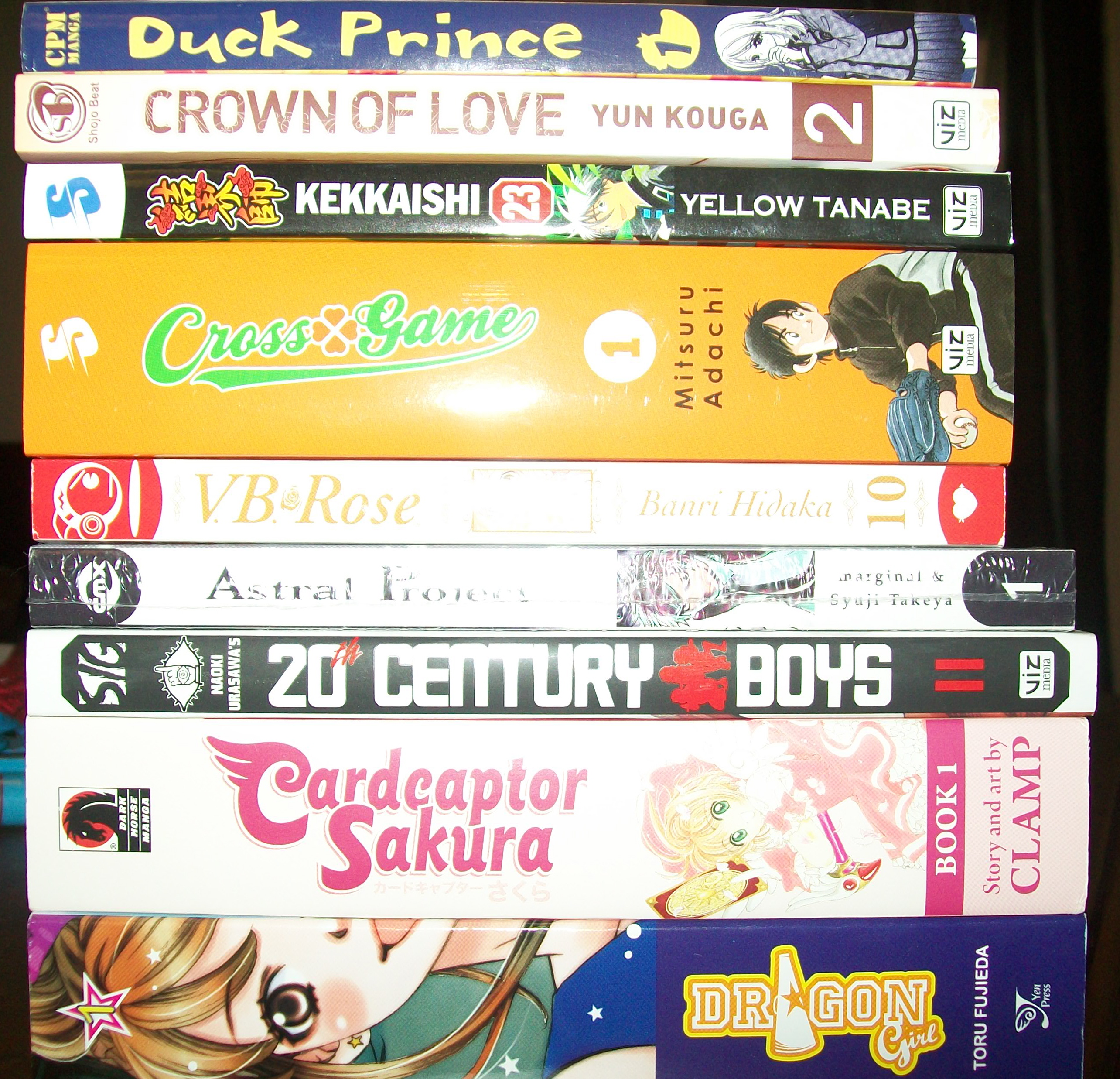
I bought:

Cross Game Omnibus 1
Cardcaptor Sakura Omnibus 1
Dragon Girl Omnibus 1
20th Century Boys #11
VB Rose #10
Astral Project #1 (Decided to throw this in randomly during my last DCBS order)
Kekkaishi #23

I swapped for:

Duck Prince #1
Crown of Love #2

While I’m excited to read all of this, I’m probably most looking forward to the Dragon Girl Omnibus. I enjoyed Toru Fujieda’s Oyayubihime Infinity series a bunch, so I was excited to see that an additional series from her was licensed. What new manga are you looking forward to reading?

Filed Under: UNSHELVED

3 Things Thursday: Going Digital

November 4, 2010 by MJ 8 Comments

Everyone’s excited about digital manga these days, with more companies jumping on board all the time. TOKYOPOP teamed up with comiXology in September (and with eManga just a short while later). Last month’s New York Comic Con elicited announcements from both Dark Horse and Yen Press, with Viz Media‘s new iPad app emerging just this week. And I’m sure I’m not the only manhwa fan anxiously following iSeeToon.

These announcements are unquestionably exciting, of course, and even those of us who far prefer our beloved ink on bound paper can’t reasonably deny the importance of this shift. Thing is, there’s been digital manga available for quite some, much of which has received little attention up to this point.

With that in mind, I’m dedicating this week’s 3 Things to digital manga (and manhwa)’s early players.

3 digital comics you may have been missing:

1. Small-Minded Schoolgirls | Toma | NETCOMICS – This digital-only offering comes from Korean artist Toma, better known for X-Diary, the basis for a feature film currently in production. The series follows the lives of two women, Miru, a successful novelist, and Somi, a would-be writer who makes her living securing talent for a literary magazine. The women become acquainted through Somi’s magazine, and as the manhwa progresses, we see their lives contrasted as they each struggle with issues of career, love, and family, thwarted, more often than not, by their own self-made obstacles. Toma’s simple, expressive artwork is a highlight of the series, and serves as nice counter to complaints of manhwa artists emulating Japanese style.

Check out Michelle Smith’s review of the series’ first two volumes for more.

2. Kiss Blue | Keiko Kinoshita | Juné – For BL fans, I recommend Kiss Blue, a quiet story of friends-turned-lovers that explores this common yaoi trope in a particularly thoughtful way. The manga provides an intimate look at the feelings of its characters, without relying on melodrama to move the story forward. This isn’t a flashy title by any means, but it’s one of those that has stuck with me since my very first digital read. Though also available in print, of course, it’s hard to beat the bargain at eManga, which offers a rental price of 200 points (about $2) with the option to “keep” for just double that. That’s less than a third of the book’s retail price. And with a second volume finally slated for release next month, this is a great time to check out the first online.

Read this review from Leroy Douresseaux for more.

3. 10, 20, and 30 | Morim Kang | NETCOMICS – Also from Korea, this seven-volume series revolves around three generations of women, teenaged Rok, her twenty-something cousin Belle, and her widowed mother, Krumb. The story follows each of them through school, career, and romantic trials, devoting significant time to both their individual hopes and pursuits as well as their dynamic as a family. Though the first two volumes were made available in print, even these may be hard to find (both volumes, for instance, are currently out of stock at Amazon), and despite a lack of permanence, NETCOMICS’ online rental price–a total of $7 to read the series in its entirety–is more than a bargain.

Look to Kate Dacey’s review of the series’ first volume for more.

Though it was tempting to consider some of Viz’s SigIKKI titles for this list (House of Five Leaves, in particular, springs immediately to mind), the removal of early chapters as new volumes are released in print makes them imperfect as digital options. You, readers, however, may choose whatever you like. :)

So, how about it, readers? What are some of your favorite early digital adopters?

Filed Under: 3 Things Thursday Tagged With: 10 20 and 30, kiss blue, small-minded schoolgirls

Off the Shelf: Sports, Ghosts, Books, & Boys

November 3, 2010 by MJ and Michelle Smith 7 Comments

Welcome to another edition of Off the Shelf with MJ & Michelle! I’m joined, as always, by Soliloquy in Blue‘s Michelle Smith.

This week, we check out new volumes of currently-running series from Yen Press and Viz Media, as well as a sweet, new one-shot from Digital Manga Publishing.


MJ: Hi, Michelle! So… I am totally out of semi-clever lines with which to begin this exchange. Um. Got books?

MICHELLE: Have I ever! I came close to answering “Far too many,” but then wondered if that could ever really be true.

MJ: I think emphatically not. :)

MJ: They really are! Also, I have to say that your description of the book has completely charmed me. I hadn’t had much interest in checking out this title, but now I feel I must read it!

MICHELLE: More like there are far too many I want to read right this minute!

One book that I did manage to read this week is Cool/Uncool, a recent release under DMP’s DokiDoki imprint. Cool/Uncool follows a pair of life-long friends turned lovers as they progress from high school to college and deal with various insecurities in their relationship. In the title story, Yukihisa can’t figure out why his friend Takashi keeps avoiding him. Savvy BL readers will think “It’s because he loves you, silly!” and that does tie into it, but the actual reason is completely random and rather endearing.

Each successive story visits the boys after the passage of months or more and reveals the status of their relationship at that point in time. Much of the plot is derived from one fellow feeling like he’s the only one feeling a certain way, whether it be the desire to stay together forever or jealousy of a female classmate. In the end, the message is “be straightforward with your concerns,” which is not exactly the most riveting conclusion ever, but it fits well with such a cute and cozy story.

I liked the art in this one, as well. There are quite a few comedic interludes that look positively adorable, but the artist has quite a way with eyes. Here, check out this example! (see attachment)

Aren’t they pretty?

MJ: They really are! Also, I have to say that your description of the book has completely charmed me. I hadn’t had much interest in checking out this title, but now I feel I must read it! …

Read More

Filed Under: OFF THE SHELF Tagged With: cool/uncool, kingyo used books, real, time and again

Apology to readers

November 3, 2010 by MJ 1 Comment

This is a heartfelt apology to readers who rely on RSS or e-mail subscription to follow new posts on Manga Bookshelf.

It’s come to my attention that personal posts from another of my blogs are being displayed and distributed to Manga Bookshelf readers via Feedburner, thanks to my use of a (generally awesome) WordPress plugin, Sitewide Tags. I haven’t yet figured out how to keep this from happening without losing the vital functionality that plugin provides. But in the meantime, I want to apologize for any posts you’ve been delivered that may not be what you signed up for.

Thank you for your patience as I tackle this problem.

Sincerely,
MJ

Filed Under: UNSHELVED

Jyu-Oh-Sei Volumes 2 and 3

November 2, 2010 by Anna N

Jyu-Oh-Sei Volumes 2 and 3 by Natsumi Itsuki

I enjoyed the first couple volumes of Itsuki’s Demon Sacred so much, it reminded me that I’ve been meaning to read the rest of Jyu-Oh-Sei, her pulpy science fiction series that Tokyopop released in omnibus format. I read the first volume some time ago, but it was easy for me to pick up the threads of the story again when revisiting the jungle planet of Kimaera.

Jyu-Oh-Sei Volume 2

Young Thor has unexpectedly survived being marooned on the inhospitable planet, and he becomes more and more important within the tribal structure of the planet’s inhabitants with every fight he wins. The third in command of the Ochre ring (conveniently named Third) is convinced that Thor should rise in the ranks to become the ruler of the planet, the Beast King. Third sets up a manipulated challenge that leaves Thor injured but he survives and is now the Ochre Ring’s Top. The story fast forwards a few years, and Thor and his girl second Tiz are all grown up and super-hot. Thor’s held on to his position of authority but everyone is shaken up when the leader of the Blanc Ring goes on a fighting rampage. It turns out that the Blanc Ring Top is an old acquaintance of Thor’s – Zagi who guided Thor when he was first dropped off on the planet.

Thor is caught between Zagi and Third. Zagi’s brutality in battle is extreme, but he tells Thor that becoming Beast King is for suckers. All the previous Beast Kings are frozen in a space station, ruling over nothing. Third urges Thor to take control by becoming Beast King in order to make the planet better. Romantic complications are introduced when Thor falls in love with Zagi’s second, a striking woman named Karim. This does not go over well with Tiz, who is still determined to bear Thor’s children even though he tends to view her as a sister. The second volumes sets up both emotional angst and the growing suspicion that the society on Kimaera might be engineered and controlled in a way that the natives don’t suspect. Many people are invested in Thor’s ability to lead, but why is he being singled out so much?

Jyu-Oh-Sei Volume 3

The first volume of Jyu-Oh-Sei felt like it was laying the foundation for Itsuki’s unique world. The planet itself was its own character, with the unique vegetation threatening human existence wherever Thor went. The second volume built more on the societal and emotional aspects of Kimaera, with Thor finally being portrayed as a grown-up instead of a lost boy. The concluding volume shifted into action movie territory, with surprising revelations about Thor’s own nature and a race against time to save the planet of the Beast King. I won’t go into the details too much to avoid spoiling the story, but after finishing this volume I had a renewed appreciation for Itsuki’s world building. Thor finds out the truth behind his adopted planet and confronts the people who had his parents murdered long ago. He then has to lead a small group of people in an attempt to save the planet from a desperate act. The structure of the final act of the story is circular, as the strange vegetation on the planet yet again plays a prominent role in the story.

I can see how this manga might not appeal to readers who don’t appreciate a healthy amount of exposition in their science fiction books. I liked seeing how Itsuki layered her story elements and carefully plotted out the details of her unique world. While I thoroughly enjoyed Jyu-Oh-Sei, it does lack the wackiness that causes me to look forward to the next volumes of Demon Sacred with so much affection. Jyu-Oh-Sei goes on a very short list of thoughtful science fiction manga that I wouldn’t hesitate to anyone looking for manga that features stories about the future of humanity. It has much more depth than the typical sci-fi manga, and I’d rank it up with Planetes as a favorite of the genre.

Filed Under: UNSHELVED

Pick of the Week: The Story of Saiunkoku

November 2, 2010 by MJ 6 Comments

Looking at this week’s manga arrivals at Midtown Comics, it’s a week filled with new volumes of great series, including Hikaru no Go, Crown of Love, Kimi ni Todoke… the list goes on. It’s even bigger if you consider what’s expected at Comicopia, where they have previous Pick Twin Spica on the docket.

Still, this week’s choice was a fairly easy one to make, as it’s the first volume of a new shojo series that charmed me significantly from the start. This week’s Pick is The Story of Saiunkoku, based on the light novels by Sai Yukino, adapted by Kairi Yura, published in English by Viz Media.

Here are some excerpts from my review of the first volume:

“The story revolves around a young woman named Shurei Hong, whose family, despite their noble bloodline, has fallen destitute. Shurei lives with her father (and their sole remaining retainer) and spends most of her time trying to earn money for the family, so when the opportunity to make 500 gold comes around, there’s no way she can say no, even if it means becoming consort to the country’s famously ineffective emperor. The emperor is a slacker with no interest in government and even less in women–two points that Shurei is tasked with remedying with by way of her civil responsibility and feminine wiles.

Despite the fact that I’d heard positive buzz about this series… based on that premise, I admit I was more than skeptical. The manga’s opening chapter didn’t do much to sway me, either, with its gag sensibility and creepy romantic overtones, all of which seemed contrary to the gravity of Shurei’s actual circumstances.

Fortunately, it quickly became clear that my first impressions were just wrong. While the series’ premise, as stated, is absolutely correct, its execution is thoughtful and unexpectedly nuanced.”

As I mentioned in a recent 3 Things Thursday, with just one volume, The Story of Saiunkoku has become one of my favorite currently running shojo series. Buy this book!

Filed Under: PICK OF THE WEEK Tagged With: the story of saiunkoku

Viz iPad app – quick reactions

November 2, 2010 by Anna N

So I assume that the big news that Viz Media was hinting about on twitter is the release of the Viz iPad App. The app lets you download some of Viz’s popular Shonen Jump titles like Bleach, Dragonball, One Piece, and Naruto. The first volume of Death Note is free for a limited time, and free sample chapters are also available.

It looks a lot like a skinned Comixology app to me, so similar that I was surprised Comixology wasn’t mentioned in the Publisher’s Weekly article. But maybe Viz just created a very similar app. I quickly downloaded Death Note. The reading experience is exactly what you’d expect if you’ve already been reading comics on the iPad. You can turn pages by swiping your finger in the direction you want to go, and it is easy to zoom in on the art.

What I’m curious about is the selection of titles that will ultimately be available. I’m probably not the main type of consumer Viz is going for, but I’d love to see some of the series in Viz’s back catalog be made available electronically. I’d totally buy some of Viz’s older shoujo series like Please Save My Earth or Kare First Love if they were made available electronically. I have so much manga in the house, having electronic copies would be one way to catch up on some of the series that I’ve missed reading before and I wouldn’t have to worry about my continually overburdened bookshelves. Also, I would likely sample some of the shonen series that I’ve dropped if some of the more recent volumes were available. $4.99 per volume seems like a decent price point. I’ll be checking out this app to see what happens when more titles are available.

Filed Under: UNSHELVED

Bakuman Volumes 1 and 2

November 1, 2010 by Anna N

Bakuman Volumes 1 and 2 by Tsugumi Ohba and Takeshi Obata

This is another series I’d steered clear of initially, because even though I enjoyed Death Note despite the narrative shortcomings towards the end of the series, I wasn’t sure how interesting I’d find manga about manga to be. I also read some reviews that charged the series with sexism, so I was avoid the series for that reason as well. I found the first two volumes of Bakuman entertaining, and the sexism in the series seems like an accurate reflection of the attitudes of its protagonists – aspiring manga creators and schoolboys Moritaka Mashiro and Akito Takagi.

Bakuman Volume 1

Mashiro is crushing on the coolest girl in his class, Azuki. He practices his drawing skills by sketching her portrait in his school notebook. When he leaves his notebook at school he rushes back to make sure no one will find out the secret of his drawing habit and his crush. He’s confronted by Akito Takagi, a boy who sits in the back of the classroom and prides himself on his observational powers. Takagi proposes a partnership: he’ll write stories and Mashiro will provide the drawings. They will become mangaka together. Mashiro loves drawing, but is reluctant to become a mangaka because his uncle used to be a professional who failed to build on the success of his initially popular gag series. He died broke and alone.

Takagi ends up forcing Masahiro to draw manga by dragging him to Azuki’s house and confessing their ambitions. Masahiro is so embarrassed, he randomly breaks out with a proposal of marriage, and she accepts on the condition that they marry after they’ve fulfilled their dreams. This ends up being somewhat convenient in a narrative sense, because Azuki ends up being a character that Masahiro can just use as a muse. She isn’t given much of a personality compared to her male counterparts.

I can see why people are criticizing Bakuman for being sexist, but the elements that someone would use to make that critique didn’t really bother me because they seemed to fit with the point of view of young Japanese teenage boys. Takagi makes a long speech about how clever Azuki is because she dedicates herself to being the perfect girl. Her grades aren’t too good. She has a socially acceptable goal of becoming a voice actress. She doesn’t act too stuck up, and she’s mediocre enough not to stand out so she doesn’t inspire jealousy in the other girls. Takagi attributes her behavior to careful calculation. This type of speech seems just like the type of thing a 14 year old boy with ambitions of becoming a writer would say.

Bakuman Volume 2

Seeing how Mashiro and Takagi evolve their ambitions and refine their approach to making manga was fascinating. I always knew manga polls in magazines were significant, but seeing the way the boys discuss the type of story they need to produce in order to get the poll numbers they need made me realize how much the creation of a successful series can be a numbers game. Mashiro and Takagi have a more cerebral, offbeat approach to the stories they create, while their prodigious rival Nizuma seems to be creating the straight-up action series that fans of Naurto would adore.

There were plot elements in Bakuman that seemed to make things just a little too easy. Takagi’s family has held on to his uncle’s studio and gives him access when he announces that he’s going to follow his dream. It turns out that Azuki’s mother was actually the long-lost love of Takagi’s uncle too. Azuki and Takagi agree to wait for each other while pursuing their respective dreams, freeing her up to be an objectified object of affection with the eventual couple only cheering each other on mostly through text messages. The genius fifteen year old manga creator Nizuma and the way he inspires the heros of the story to work harder seems more than a little reminiscent of the relationships between L, Mello, and Near in Death Note.

While all the details about manga creation were interesting, there was a slightly didactic or textbook-like quality to all the exposition. While I enjoyed reading Bakuman, I don’t think it would be the type of series I’d read over and over again. I put these volumes down with a renewed appreciation for Obata’s art. He makes playing Go look dynamic and filled with action, and similarly he makes the process of creating manga look gripping. I put these volumes down with an appreciation for the creative process and the business behind manga. It was interesting to see how Mashiro and Takagi started to revise their work after being taken under the wing of an editor. Seeing how difficult it is to even get a story published in the first place makes me appreciate manga creators even more. Bakuman isn’t a perfect work by any means, but I did feel like I got a lot out of reading it. I’d recommend this title for anyone who is curious about the process of manga creation.

Review copy of volume 2 provided by the publisher.

Filed Under: UNSHELVED

Digital Manga Guild: Revolution or Folly?

November 1, 2010 by MJ 28 Comments

Digital Manga Publishing has formally announced its new fan/publisher hybrid program, the Digital Manga Guild. According to a newsletter sent out this weekend, DMP expects to be able to offer “thousands more” manga through the new program, which will rely on fan translators, editors, and letterers to revolutionize its production of digital manga in English.

At the Guild’s new website, fans can apply to sign on as translators, editors/adapters, or letterers by providing online samples of their previous work. There is no up-front payment, but DMP promises compensation when actual sales are made. Though the arrangement may sound sketchy, this section of the company’s informational material is somewhat heartening for prospective participants:

However, no party — Digital Manga, Inc., the Japanese publishers, or you (the localizers) — will get paid until a sales transaction is made. That means, we are all in this together!

Though it’s too early to speculate on the program’s success, the BL fanbase, in particular, seems like the ideal community in which to try out something of this kind. BL fans tend to be consistent manga buyers, always looking for the latest in their genre, while also maintaining a dedicated scanlation community that focuses largely on unlicensed material. By offering potential income and a stamp of legitimacy (along with reasonably-priced digital manga) can DMP succeed in bringing scanlators and readers fully into the fold?

Many are sure to have an opinion on the subject, including professional translators and editors who currently struggle to make a living in their field. And, as Brigid Alverson points out in her Robot 6 write-up, scanlators are already questioning DMP’s motivations. Is this a pioneering moment or an industry trainwreck waiting to happen?

What do you think, readers?

Update 2/1/2011: Check it out.

Filed Under: NEWS Tagged With: digital manga guild, digital manga publishing, yaoi/boys' love

Manhwa Monday: November Preview

November 1, 2010 by MJ 2 Comments

Welcome to another Manhwa Monday! As we’re thrust, brutally, into November on this chilly Monday morning, it seems like the appropriate time to step back from frantic news-seeking and take a moment to ponder the month ahead in manhwa.

Yen Press goes it alone this month, at least in the print market, with final volumes of three manhwa series, Legend, Moon Boy, and the aptly-named Very! Very! Sweet. Other Yen Press releases this month include new volumes of Raiders, Japanese-produced Black God, and Manhwa Bookshelf favorite Time and Again.

With so many of Yen’s manhwa series wrapping up this month, our real question of course is, “Will there be new licenses to replace them?” We remain cautiously hopeful.

In the digital realm, NETCOMICS’ update schedule remains empty at the moment, but we do have high hopes. Though they don’t seem to have followed through with their promise of a Dokebi Bride revival last week, perhaps we’ll see something shortly? Meanwhile, webtoon publisher iSeeToon reports that their Magician iOS app is still on track.

For a bit of levity, here’s a link to some humorous speculation on the part of the National Catholic Reporter, in which managing editor Dennis Coday asks (regarding the upcoming Priest movie, among others), “Is the Catholic church a sure-fire money-maker for comic book movies?”

Critics continue to weigh in on the first volume of Japanese-produced, Korean-created March Story (Viz Media), with reviews this past week from Bill Sherman, Julie Opipari, and Kate Dacey. And at Manga Village, Lori Henderson discusses volumes two and three of Time and Again (Yen Press). I include the series in my list of favorite ghost-hunting comics over at Manga Bookshelf as well.

That’s all for this week!

Is there something I’ve missed? Leave your manhwa-related links in comments!

Filed Under: Manhwa Bookshelf, Manhwa Monday

  • « Go to Previous Page
  • Page 1
  • Page 2
  • Page 3
  • Page 4
 | Log in
Copyright © 2010 Manga Bookshelf | Powered by WordPress & the Genesis Framework