• Skip to primary navigation
  • Skip to main content
  • Skip to primary sidebar
  • Home
  • About Us
    • Privacy Policy
    • Comment Policy
    • Disclosures & Disclaimers
  • Resources
    • Links, Essays & Articles
    • Fandomology!
    • CLAMP Directory
    • BlogRoll
  • Features & Columns
    • 3 Things Thursday
    • Adventures in the Key of Shoujo
    • Bit & Blips (game reviews)
    • BL BOOKRACK
    • Bookshelf Briefs
    • Bringing the Drama
    • Comic Conversion
    • Fanservice Friday
    • Going Digital
    • It Came From the Sinosphere
    • License This!
    • Magazine no Mori
    • My Week in Manga
    • OFF THE SHELF
    • Not By Manga Alone
    • PICK OF THE WEEK
    • Subtitles & Sensibility
    • Weekly Shonen Jump Recaps
  • Manga Moveable Feast
    • MMF Full Archive
    • Yun Kouga
    • CLAMP
    • Shojo Beat
    • Osamu Tezuka
    • Sailor Moon
    • Fruits Basket
    • Takehiko Inoue
    • Wild Adapter
    • One Piece
    • After School Nightmare
    • Karakuri Odette
    • Paradise Kiss
    • The Color Trilogy
    • To Terra…
    • Sexy Voice & Robo
  • Browse by Author
    • Sean Gaffney
    • Anna Neatrour
    • Michelle Smith
    • Katherine Dacey
    • MJ
    • Brigid Alverson
    • Travis Anderson
    • Phillip Anthony
    • Derek Bown
    • Jaci Dahlvang
    • Angela Eastman
    • Erica Friedman
    • Sara K.
    • Megan Purdy
    • Emily Snodgrass
    • Nancy Thistlethwaite
    • Eva Volin
    • David Welsh
  • MB Blogs
    • A Case Suitable For Treatment
    • Experiments in Manga
    • MangaBlog
    • The Manga Critic
    • Manga Report
    • Soliloquy in Blue
    • Manga Curmudgeon (archive)

Manga Bookshelf

Discussion, Resources, Roundtables, & Reviews

Unshelved

Bakuman Volumes 1 and 2

November 1, 2010 by Anna N

Bakuman Volumes 1 and 2 by Tsugumi Ohba and Takeshi Obata

This is another series I’d steered clear of initially, because even though I enjoyed Death Note despite the narrative shortcomings towards the end of the series, I wasn’t sure how interesting I’d find manga about manga to be. I also read some reviews that charged the series with sexism, so I was avoid the series for that reason as well. I found the first two volumes of Bakuman entertaining, and the sexism in the series seems like an accurate reflection of the attitudes of its protagonists – aspiring manga creators and schoolboys Moritaka Mashiro and Akito Takagi.

Bakuman Volume 1

Mashiro is crushing on the coolest girl in his class, Azuki. He practices his drawing skills by sketching her portrait in his school notebook. When he leaves his notebook at school he rushes back to make sure no one will find out the secret of his drawing habit and his crush. He’s confronted by Akito Takagi, a boy who sits in the back of the classroom and prides himself on his observational powers. Takagi proposes a partnership: he’ll write stories and Mashiro will provide the drawings. They will become mangaka together. Mashiro loves drawing, but is reluctant to become a mangaka because his uncle used to be a professional who failed to build on the success of his initially popular gag series. He died broke and alone.

Takagi ends up forcing Masahiro to draw manga by dragging him to Azuki’s house and confessing their ambitions. Masahiro is so embarrassed, he randomly breaks out with a proposal of marriage, and she accepts on the condition that they marry after they’ve fulfilled their dreams. This ends up being somewhat convenient in a narrative sense, because Azuki ends up being a character that Masahiro can just use as a muse. She isn’t given much of a personality compared to her male counterparts.

I can see why people are criticizing Bakuman for being sexist, but the elements that someone would use to make that critique didn’t really bother me because they seemed to fit with the point of view of young Japanese teenage boys. Takagi makes a long speech about how clever Azuki is because she dedicates herself to being the perfect girl. Her grades aren’t too good. She has a socially acceptable goal of becoming a voice actress. She doesn’t act too stuck up, and she’s mediocre enough not to stand out so she doesn’t inspire jealousy in the other girls. Takagi attributes her behavior to careful calculation. This type of speech seems just like the type of thing a 14 year old boy with ambitions of becoming a writer would say.

Bakuman Volume 2

Seeing how Mashiro and Takagi evolve their ambitions and refine their approach to making manga was fascinating. I always knew manga polls in magazines were significant, but seeing the way the boys discuss the type of story they need to produce in order to get the poll numbers they need made me realize how much the creation of a successful series can be a numbers game. Mashiro and Takagi have a more cerebral, offbeat approach to the stories they create, while their prodigious rival Nizuma seems to be creating the straight-up action series that fans of Naurto would adore.

There were plot elements in Bakuman that seemed to make things just a little too easy. Takagi’s family has held on to his uncle’s studio and gives him access when he announces that he’s going to follow his dream. It turns out that Azuki’s mother was actually the long-lost love of Takagi’s uncle too. Azuki and Takagi agree to wait for each other while pursuing their respective dreams, freeing her up to be an objectified object of affection with the eventual couple only cheering each other on mostly through text messages. The genius fifteen year old manga creator Nizuma and the way he inspires the heros of the story to work harder seems more than a little reminiscent of the relationships between L, Mello, and Near in Death Note.

While all the details about manga creation were interesting, there was a slightly didactic or textbook-like quality to all the exposition. While I enjoyed reading Bakuman, I don’t think it would be the type of series I’d read over and over again. I put these volumes down with a renewed appreciation for Obata’s art. He makes playing Go look dynamic and filled with action, and similarly he makes the process of creating manga look gripping. I put these volumes down with an appreciation for the creative process and the business behind manga. It was interesting to see how Mashiro and Takagi started to revise their work after being taken under the wing of an editor. Seeing how difficult it is to even get a story published in the first place makes me appreciate manga creators even more. Bakuman isn’t a perfect work by any means, but I did feel like I got a lot out of reading it. I’d recommend this title for anyone who is curious about the process of manga creation.

Review copy of volume 2 provided by the publisher.

Filed Under: UNSHELVED

Digital Manga Guild: Revolution or Folly?

November 1, 2010 by MJ 28 Comments

Digital Manga Publishing has formally announced its new fan/publisher hybrid program, the Digital Manga Guild. According to a newsletter sent out this weekend, DMP expects to be able to offer “thousands more” manga through the new program, which will rely on fan translators, editors, and letterers to revolutionize its production of digital manga in English.

At the Guild’s new website, fans can apply to sign on as translators, editors/adapters, or letterers by providing online samples of their previous work. There is no up-front payment, but DMP promises compensation when actual sales are made. Though the arrangement may sound sketchy, this section of the company’s informational material is somewhat heartening for prospective participants:

However, no party — Digital Manga, Inc., the Japanese publishers, or you (the localizers) — will get paid until a sales transaction is made. That means, we are all in this together!

Though it’s too early to speculate on the program’s success, the BL fanbase, in particular, seems like the ideal community in which to try out something of this kind. BL fans tend to be consistent manga buyers, always looking for the latest in their genre, while also maintaining a dedicated scanlation community that focuses largely on unlicensed material. By offering potential income and a stamp of legitimacy (along with reasonably-priced digital manga) can DMP succeed in bringing scanlators and readers fully into the fold?

Many are sure to have an opinion on the subject, including professional translators and editors who currently struggle to make a living in their field. And, as Brigid Alverson points out in her Robot 6 write-up, scanlators are already questioning DMP’s motivations. Is this a pioneering moment or an industry trainwreck waiting to happen?

What do you think, readers?

Update 2/1/2011: Check it out.

Filed Under: NEWS Tagged With: digital manga guild, digital manga publishing, yaoi/boys' love

Shoujo Mega-Pack giveaway

October 31, 2010 by Anna N

I thought I’d celebrate moving into my new digs over here at Manga Report and do a manga giveaway. I’m going to give away to one reader:

INVU #5
A Tale of an Unknown Country #1
Nana #21
Butterflies, Flowers #4
Kobato #1

To enter, just leave a comment on this post with the name of your favorite manga heroine. I’ll select a winner at random on Nov 11. You must be 18 to enter.

Filed Under: UNSHELVED

Saturday Morning Cartoon: Princess Jellyfish

October 30, 2010 by Anna N

Today’s Saturday morning cartoon is the opening sequence of Princess Jellyfish, a new anime that Funimation just started streaming. The characters are shown reenacting scenes from classic movies like Star Wars, Mary Poppins, James Bond, and The Graduate.

Ordinarily I don’t automatically tend to go for stories about female otaku, but Princess Jellyfish is very cute. Tsukumi from the first moment her mother took her to visit an aquarium. She moves to Tokyo to become an illustrator and moves into a shared apartment house owned by a shut-in manga creator who only communicates through papers shoved through her door. “The Sisterhood” that lives in the house are all made up of female otaku. One loves trains, one loves Kimono, there’s a woman obsessed with martial arts and the Chinese classic Romance of the Three Kingdoms. When a beautiful woman helps Tsukumi take home a jellyfish that is being mistreated by an ignorant aquarium owner, Tsukumi discovers that her unwanted new friend is actually a cross dresser.

Here’s the Hulu Channel for the show. Two episodes have been posted so far.

Filed Under: UNSHELVED

Wicked Lovely: Desert Tales

October 28, 2010 by Anna N

Wicked Lovely: Desert Tales Volume 1 by Melissa Marr and Xian Nu Studio

There have been quite a few manga style adaptions of young adult books. I find the idea of reading original side stories set in an author’s universe more interesting than reading a manga adaptation of what I’ve already read. I’ve read the first three books in Melissa Marr’s Wicked Lovely series and mostly enjoyed them, although the third book teetered on the edge of being a little too emo for my taste. I wrote about Wicked Lovely and Ink Exchange over on the Bureau Chiefs site. Wicked Lovely: Desert Tales features characters from the main books, but the focus is on a new character named Rika.

The Wicked Lovely series is an urban paranormal fantasy series. Keenan, the Summer King of the fairies has been on the hunt for his Summer Queen for centuries. He chooses his queen candidates from mortal girls. There’s a test they have to pass – if they grasp the staff of the Winter Queen and survive the ice, they’re his destined mate. If not, they’re iced over and turn into the Winter Queen, the Summer King’s most hated enemy. Rika is a mortal girl turned fairie by her experience being forced to serve as Winter Queen. She’s taken refuge in the desert, far away from Keenan. Her main distraction is watching a mortal boy – an artist and rock climber named Jayce.

Rika is careful to observe the usual fairy rules about contact with mortals and keeps herself carefully invisible. But the wild desert fey threaten Jayce and she intervenes in order to keep him from being injured. Jayce is mystified at the sudden appearance of a beautiful girl, and they have an awkward first date which consists of them wandering around a nearby town while Rika tries to fight off invisible assailants. Her one local ally is a faerie named Sionnach who seems to be pushing Rika towards the mortal for reasons of his own.

Melissa Marr excels at writing about romance in the initial attraction stage. Jayce and Rika meet, she bandages him up, and as they start talking to each other they share their interests in art and the desert landscape. The character designs fit with the slightly punked out sensibility of the Wicked Lovely books. Rika has pale eyelashes and a choppy bob, providing a contrast to Jayce’s dark skin and dreadlocks. The mischievous desert fey that harass the budding couple are drawn with lines of sand scattered across their skin. I found the story a little more interesting than the art, and there were a couple places in the book where I wished for better transitions between panels or across pages.

I think that fans of the Wicked Lovely series will enjoy this book. I’m not entirely sure how accessible it would be to someone who isn’t already familiar with Melissa Marr’s world. I found reading this manga to be a bit of a relief after Ink Exchange. The love triangle in the main series with Seth, Aislinn, and Keenan has just gotten a little bleak and depressing so I enjoyed being able to visit the Wicked Lovely world with some fresh characters who aren’t bogged down with the continuity in the main series. There are two additional volumes in the Wicked Lovely: Desert Tales manga series, the concluding volume comes out in February.

Filed Under: UNSHELVED

Say Hello to Black Jack

October 27, 2010 by Anna N

Japanese publishers tend to shy away of digital distribution, so I’m finding the case of Shuto Sato‘s Say Hello to Black Jack really interesting. I was interested to see the notice at Anime News Network that he’s seeking English translators for his online comics site. Sato disclosed financial numbers for what he was making as a mangaka before switching to online distribution. I’ll be curious to read an authorized English translation of Say Hello to Black Jack when it becomes available.

Here’s some links for more information about Sato and Say Hello to Black Jack:

Manga Reality: The Case of Say Hello to Blackjack
Japanese Live Action Drama site
Mangaonweb (Sato’s digital comics site)

Filed Under: UNSHELVED

Kekkaishi Volumes 8 and 9

October 26, 2010 by Anna N

One of this week’s spooky manga picks is the always excellent shonen monster hunting series Kekkaishi. It is daunting sometimes to try to catch up on a long running series like Kekkaishi, but Tanabe’s excellent pacing and character development make it possible to keep following the story even if you have skipped a few volumes. I’ve read the first five volumes of the series previously.

Kekkaishi Volume 8 by Yellow Tanabe

Things are growing more complicated for monster hunters Yoshimori and girl next door Tokine. Performing their duties as protectors of the mystical energy site located by their school used to be fairly straightforward, but now they’re dealing with an organized effort from a group of ayakashi (monsters) who even have the ability to take on human form. They’ve been sent an ally named Gen from the Shadow Organization, where Yoshimori’s brother has now risen to a position of power. Gen has been taken out of the fight and Yoshimori and Tokine have to fend off a large group of monsters by themselves. Yoshomori’s latent power briefly manifests when Tokine is frightened, and the leader of the monster pack inexplicably calls off the attack, perhaps content in finding out something about Yoshimori’s power levels that young kekkaishi doesn’t even know himself. The remainder of the volume shows some of Gen’s backstory as he struggles with the idea of continuing his assignment to help Yoshimori and Tokine. Gen is half ayakashi, and has the potential to turn entirely into a monster if he isn’t careful with restraining his power. Yoshimori’s older brother Masamori placed him with a special class within the shadow organization called the Night Troops, which is made up of other children similar to Gen. Masamori also seems to be playing politics within the Shadow Organization, so it is easy to see why Yoshimori might be suspicious of him.

It seemed to me like there was a tiny bit of character progression in the way Yoshimori was drawn. I thought he looked a little bit more angular in the face, perhaps showing him as becoming more mature as a person and in the use of his power since the series started. Tanabe’s monster designs are always a highlight of the book, with Yoshimori’s foes looking like demonic versions of a squid, Cousin It, a mutated bat, and an odd insect.

Kekkaishi Volume 9 by Yellow Tanabe

The ninth volume is devoted to some fun training sessions for Yoshimori, Gen, and Tokine when Gen’s monster trainer Atora shows up suddenly to put them through their paces. She challenges them to capture her, and they’re forced to work together as a team. Tokine and Yoshimori already have a rapport, but Gen just tends to rush off into battle and doesn’t coordinate his actions with others. Due to some traumatic events when his power manifested Gen tends to hold himself apart from others. Atora was a fun character, who was always drawn with a sunny grin on her face. She announces her presence by blasting the door in and seems absolutely delighted at the opportunity to stage a mock battle. More importantly, she wants to check up on her pupil to see if he’s finally making friends. She’s accompanied by a giant bear named Raizo who is extremely cute even as he starts emitting dangerous electricity.

While the new three person team of kekkaishi begins to work together, the organized group of akakashi start acting up in mysterious ways. One of them drinks up the mystic swamp where the spirit Lord Uru lives, and Yoshimori is concerned about the fate of the nature god. This volume contained some of Tanabe’s great arresting images. Yoshimori’s grandfather thinks one of his old friends might be in danger of an attack, and a representative of the Shadow Organization breaths a giant smoky scorpion into existence in order to provide transportation. Gen and Yoshimori bond over lunch as they float on a cube of energy far above their high school.

I think it says a lot about Tanabe’s skills as an author that a manga that juggles complex plots and a variety of characters is still easy to follow even if there are gaps in the volumes that you’ve read. One of these days I’ll be totally caught up! In a world filled with formulaic shonen, Kekkaishi really is something special.

Filed Under: UNSHELVED

Dengeki Daisy Volumes 1 and 2

October 25, 2010 by Anna N

Dengeki Daisy Volumes 1 and 2 Kyousuke Motomi

Just what I need, yet another shoujo series to follow! I didn’t run out and preorder the first volume of Dengeki Daisy when I saw it solicited. I tend to enjoy most Shojo Beat series, but I thought the idea of a girl getting over her brother’s death due to her guardian angel “Daisy” who is reachable only by cell phone was maybe not the greatest premise for a story. Then I saw all the positive reviews for the series from other manga bloggers and I started to think I was missing out. When Viz sent me a copy of the second volume, I decided to give in and try the series, and I was very pleasantly surprised.

Volume 1

Dengeki Daisy starts out with a rather worn out premise, but the execution of all the details made the story seem fresh. Teru’s older brother has died, but before he passed on he gave her a cell phone and said that the phone will connect her to a person named Daisy who will always be there to support her. As the volume opens poor but sassy Teru is treating the phone like a false diary, telling Daisy that she’s doing fine when she’s being bullied by the sadistic student council at her school. Teru isn’t a helpless heroine. After she gets splashed with a bucket of water she turns a hose on the perpetrators. She’s aided further as some balls thrown by a mysterious rescuer connect with the heads of her tormentors. Teru tries to throw the balls back in the direction where she thinks they came from, but they end up breaking a window at the school. Enter the creepy yet astoundingly young and handsome school custodian Kurosaki. Since Teru is too poor to pay to fix the window, he announces that she’ll become his servant and puts her to work performing custodial tasks while he communes with his laptop. They quickly fall into the habit of bickering, as Kurosaki gruffly orders Teru around and she bids him farewell by saying “I hope your hair falls out by tomorrow!” Kurosaki always seems to be around when Teru needs help. When Teru needs help hacking into a computer in order to aid a classmate, she texts Daisy and the situation is quickly resolved. She asks Kurosaki if he’s Daisy and he denies it.

That scene was where I thought there was an indication that Dengeki Daisy might be a little more interesting than the average shoujo manga. I think in a more conventional title, it would take at least a volume or two for Teru to register the suspicion that Kurosaki is Daisy. Bad boys who are secretly good are shoujo staples but Kurosaki is a superior example of the type. I found myself captivated by his expressions of unholy glee as he dealt with the people who were picking on Teru. He was gruff and surly with Teru, and only had a gentle expression on his face when she couldn’t see him. Thankfully the evil student council plot is left quickly behind and the odd couple end up having to unravel something more interesting – industrial espionage. Teru’s older brother was a genius engineer, and unscrupulous people suspect that since Teru’s only inheritance from him was a cell phone it might be more valuable than it appears. While Kurosaki isn’t revealing his identity as Daisy to Teru, he used to work with her brother and took the custodian job to watch over her. He’s filled with guilt about the death of his friend.

Motomi’s art easily shifts between different modes that expresses what the characters are going through. When Teru and a couple of her friends express solidarity, they strike a fighting pose straight out of comedic shonen manga and vow “Even if we are poor and are clothes are shabby! Even if we are ugly and girls don’t like us! Our hearts bloom like flowers, beautiful and strong! And we’re proud of it!!!” Kurosaki looks like a capable action hero when he leaps to defend his girl and when they share a quiet moment in the school’s garden the backdrop of flowers and significant glances creates an emotionally charged mood broken only by Kurosaki telling Teru that she’s stupid for thinking he’s Daisy.

Volume 2

Teru and Kurosaki become temporary roommates after somebody breaks into her apartment. He puts her to work doing various domestic tasks like cooking, organizing CDs, and providing him with shoulder massages. One of the things I like is the emotional give-and-take between the couple. Kurosaki attempts to tease her after she announces that to her Daisy is the best thing in the world by asking her what would happen if Daisy turns out to be a total jerk like him. She says “That goes without saying, I’ll love everything about you,” then wacks him in the head. Kurosaki is momentarily dumbfounded and as Teru walks away she thinks “Even if you aren’t Daisy, I’ve already fallen for you.”

The supporting cast is rounded out by the addition of the new school counselor Riko. She is also someone who used to work with Kurosaki and Teru’s brother. Riko’s also interested in looking after Teru and when Teru seeks her advice she tells Teru that Kurosaki is a terrible, selfish person. Teru thinks that it is true that Kurosaki might be terrible because she has no idea what he’s thinking, so she vows to become “a terrible woman whose thoughts are unreadable” so she can play with his emotions. Teru and Daisy’s texts to each other provide an interesting counterpoint to the relationship between Teru and Kurosaki. He has more knowledge of her inner feelings, and Teru will sometimes confess something to Daisy and put on an entirely different facade for Kurosaki. Teru’s troubles continue as she continues to be the target of people who are after her brother’s research. The emotional strain of protecting Teru and holding back his feelings for her begins to weigh more heavily on Kurosaki, and the reader sees a flashback to a scene between him and Teru’s brother that seems a little creepy.

One thing that I thought was curious about this manga was the author bios in the back of the books. I’d thought that Kyousuke Motomi was one of the few men working as a shoujo manga artist, but the author bios indicated the author was female. On the other hand, the self-portrait of the author looked like it had a very stylized mustache, and there’s an a author comment about facial hair growth. So I’m not sure what to think, but I’d honestly be curious to read more shoujo written by men just as I enjoy shonen manga written by women.

Even though some of the plot points in Dengeki Daisy manga aren’t very unique, by the end of these two volumes I was totally invested in wanting to see what happens to Teru and Kurosaki. The industrial sabotage subplot and the events surrounding the death of Teru’s brother creates an ongoing mystery that works as a counterweight to the budding romance. Also, I find the idea of a romance between a high school girl and a seemingly benign yet emotionally traumatized hacker who is posing as a school custodian just creepy enough to be entertaining while not quite entering into the “No, this is yucky” territory of a manga like Black Bird. Teru seems to be extremely resilient and is able to cope with Kurosaki by coming up with quick put-downs whenever he seems mean. Dengeki Daisy manages to blend different emotional aspects to come up with a compelling story. I enjoyed reading this series because there’s suspense, romance, action, and just enough comedy to keep things from being too heavy.

Review copy of volume 2 provided by the publisher

Filed Under: UNSHELVED

Let’s Get Visual: Speechless

October 23, 2010 by MJ 2 Comments

Once again, it’s time for Let’s Get Visual, a monthly art-focused exercise with Michelle Smith, hosted at her blog, Soliloquy in Blue.

This month, we respond to a request for discussion of nonverbal storytelling. My choice for the exercise is a scene from the fourth volume of Fumi Yoshinaga’s Antique Bakery. Though the scene does contain some minimal dialogue, I provided scans from the Japanese book in order to illustrate how profoundly the artwork does the talking.

Though we discuss only the scene as presented, and never reveal what is said between the two characters, thinking about this series made me want to start handing it out to gay teens as my version of an “It Gets Better” video. The way that Ono moves on from this moment to discover a new life, while Tachibana hangs on to his guilt for years after… it’s so close to the stories of many of my own friends who left high school to move on to things much, much greater, while their tormentors stayed behind, still mired in the world of our high school social scene.

As always, please remember that we’re asking for your help. We want to improve our ability to analyze visual storytelling and we’re anxious for feedback from those who know more than we. Though we’d prefer you be gentle, we’ll take what we can get!

So head on over to the latest Let’s Get Visual and let us know how we’re doing!

Filed Under: DAILY CHATTER, NEWS Tagged With: antique bakery, fumi yoshinaga, let's get visual

Saturday Morning Cartoon: FLCL Ending

October 23, 2010 by Anna N

I decided to steal an idea from Bully and start a regular Saturday morning cartoon feature. To kick things off, let’s go back a few years and appreciate the gloriousness that is found in the ending credits to FFLCL. I saw this anime some time ago, so it is just a jumbled mess in my head of robots, vespas, aliens, and an inexplicable giant iron. One of the most memorable things about this show was the sound track, provided by The Pillows. I don’t think you can listen to “Ride On Shooting Star” and not feel a little bit happier by the end of the song.

Filed Under: UNSHELVED

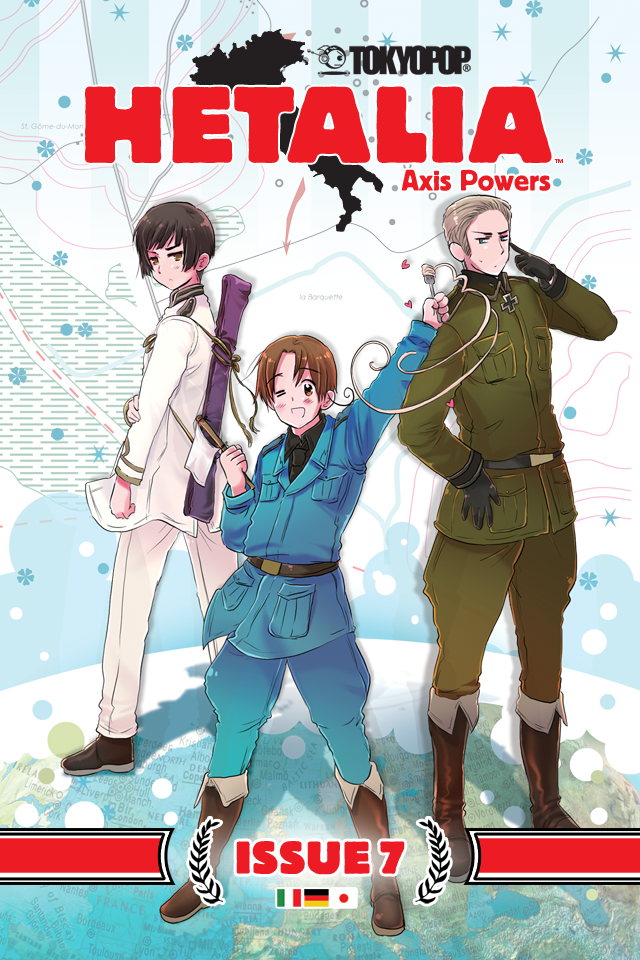
PR: Free Preview of Hetalia Volume 2 on Comixology on Oct 24

October 21, 2010 by Anna N

Since I have drunk the iPad kool-aid, I am enjoying reading online comics on it using Comixology. So I was psyched to see that Tokyopop is offering a sample chapter of the next Hetalia chapter on Comixology on Oct 24th. Here’s the link provided for the download.

I wonder if Italy will be waving his surrender flag again. Oh, that wacky Italy!

Filed Under: UNSHELVED

Rescue Manga poll results

October 20, 2010 by Anna N

I threw together a poll about manga on hiatus over on Manga Views and thought the results were interesting. I didn’t include every stalled manga series that I knew of because I was trying to represent a few different publishers. So it was interesting to see from the small section of the mangasphere that voted that the love for Even a Monkey Can Draw Manga remains so strong. I also had no idea how fervently people missed Nodame Cantible. I read the first few volumes of that series but lost steam a little bit. There were some good additions in the comments with votes for some horror and seinen manga, which tend to not be on my radar very much.

I miss many of the series listed on the poll, but I voted for Crown over Swan, just because Crown is so goofy, and I’m determined to just buy the rest of Swan in Japanese sometimes and at least enjoy the pretty pictures even if I can’t really tell what’s going on. Swan is one of those series that is so visual in its storytelling I think I’d enjoy reading it even in the absence of a translation.

Filed Under: UNSHELVED

Two from emanga: The Cinderella Inheritance and The Cinderella Solution

October 19, 2010 by Anna N

Harelequin manga might be a little bit on the disposable side – I don’t know if I’ve read any that I know I’d want to reread but I’m just getting over a cold and there is really no better manga to read while you have a stuffy head. So here are quick takes on two Harlequin manga that have the word Cinderella in their titles. One manga was good, and one was not so good.


The Cinderella Inheritance by Carolyn Zane and Mon Ito

Cynthia has worked as the personal secretary to the patriarch of a rich family, Alfred Wingate. She’s engaged to his womanizing grandson Graham, but decides that she has to call the engagement off because Graham is a pathological cheater. Things get complicated when Alfred dies and leaves his mansion to Cynthia, along with the qualification that she can’t give the mansion back to the WIngate family. If she doesn’t take it, it has to go to charity. Graham’s long lost brother Rick shows up for the reading of the will, and promptly decides that Cynthia is a scheming woman who got close to his family in order to grab her share of the Wingate fortune.

The quality of these Harlequin manga can be erratic. Sometimes they are good in a brain candy type of way, but other times they really seem rushed. Some of the transitions between scenes in The Cinderella Inheritance seemed a little jerky and the plot elements were introduced randomly, without a real connection to the character’s emotions or backgrounds. I’m never entirely sure if these execution problems are due to issues with the adaptation or the source material because let’s face it, we’re talking about harlequin romance novels here. Of course, Rick and Cynthia fall in love with each other while she’s jugging the expectations of the Wingates that she marry Graham so the mansion will stay in the family. Of course she’s just a good girl who is working her way for college, and while Rick is initially suspicious he finds himself falling in love with her despite his better judgment. I didn’t find Ito’s character designs very appealing, and the art was static. The characters just seemed like paper dolls put through the paces to satisfy a fairly predictable plot.

This title is skipable, but I enjoyed the other Harlequin Manga with Cinderella in the title much much more.

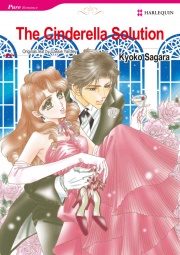
The Cinderella Solution by Kyoko Sagara and Cathy Yardly

Charlotte and Gabe are best friends. She’s a bit of a tomboy and she goes along with Gabe to all of his typical guy-like activities like poker and football games. He even takes her out to a bachelor party right before she’s supposed to be the maid of honor at his sister’s wedding. They constantly compete with each other by making stupid bets. Charlotte has a bit of a psychological complex where she thinks of herself as unfeminine, which is absolutely ridiculous because Sagara draws her as a classic shoujo heroine with shining eyes and glossy hair. I guess the thing that signals that she isn’t very girly is the fact that she always has her hair pulled back in a ponytail.

I’ve decided that I enjoy these Harlequin manga the most when the art is extra super-girly and this manga didn’t disappoint in that category. Take a look at the cover where our cute couple is surrounded by both roses and weird blobby sparkly things. The character designs are cute, with bee-stung lips and perfect hair. The only odd thing is that Sagara tends to draw her men with extra long eyebrows, which sometimes gave Gabe a vaguely insectoid appearance. But, unlike the flat personalities in the previous manga, The Cinderella Solution really takes the time to establish the bickering relationship between Gabe and Charlotte. She’s in agony performing her bridesmaid duties at the wedding and Gabe is the master of casually cruel comments like “Do you think Charlotte is the wife type? She’ll be just fine single for the rest of her life.” Goaded beyond her limits, Charlotte bets Gabe $1000 that she’ll find someone to propose marriage to her in a month. She embarks on a makeover campaign, and soon finds a potential suitor when an eligible bachelor moves next door. Gabe is surprised by his growing feelings of jealousy as he sees other men notice his best friend. Charlotte uses the bet as a way of gaining more self confidence, and Gabe is soon confronted with the decision that he might have to give up platonic friendship for romance or lose her forever.

The Cinderella Solution was an enjoyable read simply because the characters were more fully developed, so I was interested in seeing the conclusion of their story. I tend to like romances more when some funny moments are incorporated, so I appreciated Charlotte inadvertently introducing herself to her neighbor while wearing a mud pack on her face and Gabe’s unique approach to formal wear when he goes to spy on Charlotte and her wanna-be boyfriend at a party. This was definitely a better than average Harlequin manga title.


Access to electronic copies provided by the publisher

Filed Under: UNSHELVED

March Story debuts 10/19

October 18, 2010 by MJ 1 Comment

As someone who pays quite a lot of attention to Korean manhwa artists, it’s a bit embarrassing for me to admit that one of the things that tends to pass by my radar completely is Korean artists with work being serialized in Japan. One such artist (or two, actually) has a work debuting here in English this week and I’m terribly late to the party.

The work I’m referring to, of course, is March Story, story by Hyung Min Kim and artwork by Kyung Il Yang, debuting tomorrow on Viz Media’s Signature imprint.

Here’s a rundown of the story as described in a recent press release from Viz:

Among the quiet villages and towns of 18th century Europe, demons known as the Ill hide within the most beautiful works of art and are sparked to life by the torment of their creators. Attracted by their jewel-like allure, unwary viewers can find themselves possessed by the Ill and will be driven to horrific acts of violence. Only the hunters of the Ciste Vihad can dispel the Ill. March is one such hunter, tracking the Ill from town to town to find the antiques that contain the demons before they can possess anyone. If the worst has come to pass, March’s full powers are unleashed to battle the fiendish Ill.

This volume is rated “Mature” and will sell for $12.99 here in the US. For more information, visit Viz’s news room.

Filed Under: NEWS Tagged With: march story

The Dreaming Complete Collection

October 17, 2010 by Anna N

The Dreaming Complete Collection by Queenie Chan

I’d read the first volume of The Dreaming before and enjoyed it, but I hadn’t read the last two volumes of the series. I thought looking at the new omnibus edition would be a good pick during October. This was one of Tokyopop’s more successful titles out of their big OEL push several years ago, and the collected edition features several color pages, bonus stories, and an author interview.

Identical twins Amber and Jeanie arrive at a boarding school called Greenwitch Private College placed far in the Australian bushlands. Their Aunt Jessie is headmistress at the school, but after getting the twins settled she takes off on an extended trip, leaving them alone to get adjusted. They soon find that the school isn’t what it seems. The vice principal Mrs Skeener has a pathological aversion to twins. There’s a mysterious locked room down one corridor that’s been ineffectively disguised by wallpaper. Paintings in the school seem to tell the story of something horrible happening to girls in the Victorian era. Jeanie is the more outgoing twin, and she sets herself the task of unraveling the mystery behind the strangeness at the school. Amber is more sensitive to her surroundings and has horrible dreams, taking refuge in sleeping pills and the hope that she won’t remember the details of her dreams when she’s awake.

As befitting a manga called The Dreaming, Jeanie gradually gets a full picture of the school by piecing details of different stories together. She shares frightening dreams with her sister, where they are lost in the bush wearing victorian dress, trapped under trees that rain blood. Other students share details that allow her to gradually get a full picture of the school’s history. Girls have gone missing before in the past, and when the ringleader of an ill-fated seance in the present day goes missing it looks like the disappearances are starting to happen again. The only criticism I have of the book is that it sometimes seems a little referential. There’s the crazy older spinster character in the person of Mrs Skeener. Characters frequently refer to “odd rumors” and if you’ve ever seen a scene of girls trying a seance in a horror movie, you know that when Jeanie and Amber’s classmates stage one it isn’t going to turn out well. Still, if you’ve enjoyed gothic novels and episodes of the Twilight Zone in the past, there’s a certain amount of pleasant nostalgia invoked in the reader by The Dreaming.

Queenie Chan creates a suitably gothic atmosphere for her book. The wide shots of the school surrounded by dense bushland look incredibly claustrophobic. There’s plenty of detail included in the school’s interior and the Victorian costumes of the phantoms that come to haunt the current students. Setting the story in Australia provides an interesting source of local ghost legends to draw from as well. I especially appreciated the feeling of the epilogue, which evoked the spirit of Daphne du Marier’s opening line in Rebecca “Last night I dreamt I went to Manderley again,” as Jessie revisits her own history with the school.

I liked all the bonus content included with this omnibus. There’s an extra story included at the end that shows how Greenwitch Private College will endure even after the twins’ history with the place has ended. Omake episodes called “The Haunted Linen Cupboard” are included at the end of each volume, giving Chan the opportunity to make fun of some of the horror conventions that she uses in The Dreaming. Overall, this series provided old-fashioned horror fun with plenty of spooky dreams, evil old women, Australian spirits, and the occasional axe.

For more about Queenie Chan, visit her website.

Review copy provided by the publisher.

Filed Under: UNSHELVED

  • « Go to Previous Page
  • Page 1
  • Interim pages omitted …
  • Page 49
  • Page 50
  • Page 51
  • Page 52
  • Page 53
  • Interim pages omitted …
  • Page 62
  • Go to Next Page »
 | Log in
Copyright © 2010 Manga Bookshelf | Powered by WordPress & the Genesis Framework